activism
Another Pro-Choice Meme – Does it Succeed?
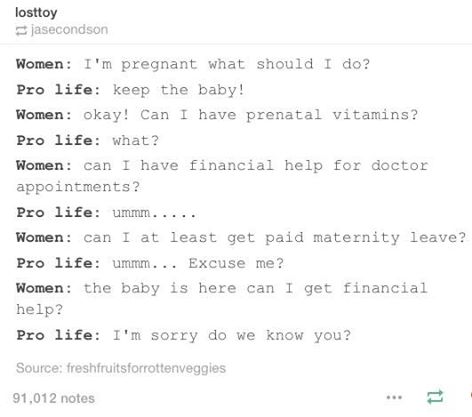
Recently, I saw a few people on Facebook posting this image. It’s a bit hard to see on here so here’s a transcript (skip this if you already read it and go to the “Analyzing the Meme” section [I typed it as it is without correcting punctuation):
Women: I’m pregnant what should I do?
Pro life: keep the baby!
Women: okay! Can I have prenatal vitamins?
Pro life: what?
Women: can I have financial help for doctor appointments?
Pro life: ummm…..
Women: can I at least get paid maternity leave?
Pro life: ummm… Excuse me?
Women: the baby is here can I get financial help?
Pro life: I’m sorry do we know you?
Analyzing the Meme
The meme is clearly aimed at the notion that pro-life advocates are inconsistent. They claim to be “pro-life” but when it comes down to the details of life, they jump ship.
I am not speaking for all who are pro-life (that would be impossible), but I do think it is extremely important to be consistently pro-life. That is, an argument like this can show that a position like pro-life is inconsistent, and that does discredit the pro-life position. We need to be consistently pro-life if we are to consider ourselves pro-life at all. But–and this is a really big “but”–the meme completely misses the point.
Missing the Point
It should be clear, however, that the argument presented in this meme is a bit off target. The point is that the real question at issue is whether the unborn is a person.
Think about the meme this way:
Women: I have a toddler what should I do?
Pro life: keep the toddler!
Women: okay! Can I have health care?
Pro life: what?
Women: can I have financial help for doctor appointments?
Pro life: ummm…..
Women: can I at least get paid leave if he/she is sick?
Pro life: ummm… Excuse me?
Women: the toddler is here can I get financial help?
Pro life: I’m sorry do we know you?
What conclusion could be drawn from this? That women (or men) have the right to kill the toddler if they don’t receive those things? I should hope the answer is obvious: no, that does not follow at all. Whether one thinks the answers to the questions the women ask in this scenario should be affirmative or not, suppose it was no to all of them: does that mean we’d go ahead and green light the parents killing the toddler?*
Thus, the argument begs the question. No one should take seriously the notion that if someone can’t pay for supporting a human being they should kill him or her. The only way the argument makes any sense is if one has already assumed that the unborn is not a human being/person. And that is an issue that should be discussed more thoroughly. I have written numerous articles in defense of the pro-life position, so I won’t repeat my arguments here.
Conclusion
One of the comments on Facebook a user posted from the group that put up this image was “How true..
They are not pro life…they are pro birth…then wash their hands afterwards..”
I think this comment demonstrates how much of an emotional impact a meme like this can have. We as pro-life individuals need to be consistently pro-life, lest people reject our reasoning because they see us as “hypocrites.”
However, the ultimate point–the one at the heart of the debate–is whether the unborn is a person. And a meme like this does nothing to discredit the pro-life position whatsoever. It does not follow that if I can’t pay to support my son, I should be allowed to kill him. Neither does it follow that the interlocutor of the meme has demonstrated the pro-life position is mistaken.
Links
Be sure to check out the page for this site on Facebook and Twitter for discussion of posts, links to other pages of interest, random talk about theology/philosophy/apologetics/movies and more!
Pro-life– I have written a number of posts advocating the pro-life position. Particularly relevant to the present discussion are “From conception, a human” and “The issue at the heart of the abortion debate.”
*This is an example of the “trot out the toddler” defense of the pro-life position. It was coined by (I believe) Scott Klusendorf.
I am not sure who was the original user that put the image up, so I can’t cite it appropriately. I make no claim to owning the image and use it under fair use.
SDG.
——
The preceding post is the property of J.W. Wartick (apart from quotations, which are the property of their respective owners, and works of art as credited; images are often freely available to the public and J.W. Wartick makes no claims of owning rights to the images unless he makes that explicit) and should not be reproduced in part or in whole without the expressed consent of the author. All content on this site is the property of J.W. Wartick and is made available for individual and personal usage. If you cite from these documents, whether for personal or professional purposes, please give appropriate citation with both the name of the author (J.W. Wartick) and a link to the original URL. If you’d like to repost a post, you may do so, provided you show less than half of the original post on your own site and link to the original post for the rest. You must also appropriately cite the post as noted above. This blog is protected by Creative Commons licensing. By viewing any part of this site, you are agreeing to this usage policy.
Book Review: “The Poverty of Nations” by Wayne Grudem and Barry Asmus

The Poverty of Nations: A Sustainable Solution
It is worth noting up front that I have a BS in Social Studies and had numerous classes on economics and international economics at a college level. This doesn’t make me an expert, but I think it allows me to take a decently accurate look at economic theories.*
Economics
The first half of the book focuses on issues of economics on a national level. Specifically, they endorse the free market as a way to bring prosperity to all nations. Their argument is based upon historical observations about how nations have gotten out of poverty and become prosperous.
Thus, the authors argue that fair trade and open borders (with low or no tariffs and the like) will drive the market to balance itself out and also increase the overall prosperity of people from various nations. Moreover, it will provide a means by which lesser-developed countries can utilize their comparative advantages to produce things that other countries are willing to pay a higher price such that they do not need to produce them. Demand drives the market, and the freer a market, the more demand is able to do so. The reason it is beneficial to allow demand to drive the market is because it allows for people to genuinely respond to others wants and constantly produce newer, better goods in more efficient ways, thus increasing the wealth across the board.
I should note that, by necessity, this is merely the briefest overview of this section of the book. Those who read The Poverty of Nations are essentially getting a fully realized introduction to international economics. In fact, the economic portion of the book is quite strong in many ways (though some issues with the complexity are noted below).
Biblical/Moral Issues
Like the economics portion, this half of the book has much to commend it. Though basic, much of the instruction is vital and important to realize as necessary for economic success. For example, government curtailing of bribery is important for an economic system to become more successful. Another, more complex example would be the notion that tariffs decrease the productivity of international trade and artificially increase prices.
The problem with much of the focus on the moral background to the “Free Market” is that Grudem and Asmus seem to assume or assert more often than they provide evidence. It’s easy for someone like me from a relatively free market system who favors open markets to nod along to how a free market encourages integrity because of the repeated transactions between the same persons and the like, but then a statement like this is made:
When people are held responsible by the voluntary personal interactions of the free market, they are typically more responsible. (Kindle Loc. 3784)**
Statements like this are frequently made, but after reading along and perhaps agreeing largely, one is forced to wonder about things like: “Where is the empirical evidence to show that this is actually the case?”; “To whom or to what are people more responsible to?”; “How are we capable of making judgments like this across incredibly complex systems like the economic practice of states, regions, nations, and the world?” The particular statement made above offers no empirical support for its claim, nor do the authors explore the complexities of simply stating that “people… are typically more responsible” in a free market. This statement, and others like it, leave me scratching my head and asking for the evidence. Certainly it is possibly true or perhaps it is true, but why think it without anything more than an assertion?
Another difficulty with this section is that throughout, the specific examples given are taken to be the biblical approach to economics. Now, I think one could fairly say that the Bible condemns bribery, but what of more complex issues like whether it actually endorses a free market? One constant refrain in the book is the use of Genesis 1:28 (“fill the earth and subdue it”) to support various things, from use of natural resources (which are rather shockingly claimed to be essentially unlimited: “[I]t is highly unlikely that any resources will be used up in the foreseeable future… we keep discovering huge new reserves of resources and inventing more creative ways to access them” (6606-6617)–but of course where are the huge new reserves of forests? fresh water? etc.?) to drive people to invent and make new things (3405), to making products from the earth specifically (1169), to move beyond subsistence farming (4207), and more.
One is forced to wonder whether the verse actually means all these things or if, perhaps, the Bible is simply under-determined when it comes to economic policy. I do genuinely wonder whether the Bible is to be treated as an economics textbook, which it often seems to be in this book. Quotes like these are scattered throughout, often in seemingly random fashion in the economics portion. The question is whether this really may be seen as a systematic treatment of the Bible on economy, or whether it may perhaps instead be mining the text to try to support claims about economy which are not really found therein. Not that these are unbiblical points; merely that they perhaps are not the focus or intention of the texts.
Complexities
The book seems to oversimplify on some aspects. It is common practice to use examples which allow an economist to shift just one aspect in order to demonstrate a theory.* That said, at times the examples used in The Poverty of Nations are often a bit too simplistic to believe. For example, at one point a thought experiment asks whether simply taking money from a group of wealthy elites would solve the existing issue of poverty. Although it seemed clear that simply attempting to redistribute wealth didn’t solve the problem, the proposed solution–the book’s solution–was to produce more goods. But it seems to me that if a number of elites were controlling the wealth in a country, just producing more goods would continue to line the pockets of those elite rather than specifically helping the poor.
Examples like this abound throughout the book, as simple solutions are offered to extremely complex issues. Economics is a wonderfully complex topic, but as the authors themselves note at the beginning, it is one which is hard to study due to the human factor in it. Despite the professed efforts to avoid such simplification (Kindle location 2115, for example), the book often does seem to suggest a one-size-fits-all approach to solving economic problems.
That said, at other times the authors do a great job of speaking directly to the complexities of the issue. For example, their discussion of colonialism was marvelous and ably pointed out both the potential benefits and cons of those endeavors on our present world situation. It was a great way to survey a complex issue without trying to identify any one factor. Portions of the book like this make the places where it is simplistic stand out even more, however.
A final issue is that of audience: Asmus and Grudem claim the book is primarily written for leaders of impoverished nations, which–apart from coming off as a bit imperialistic–doesn’t actually seem to be the likely readership. The authors note others as possible audience, but I wonder whether we may end up with several people walking around with this as their only interaction with economic theory and assuming they are able to fix the world’s problems through this oft-simplified economics instruction.
Conclusion
The Poverty of Nations: A Sustainable Solution is at times brilliant, but at others frustrating. It is well-worth a read for Christians interested in economics and attempting to strike at the core of poverty through effective legislation and whole-nation solutions. It does provide a very useful introduction to international economics, and gives some very good ways forward for those wishing to engage on this topic. However, readers should go in with some caution: the simplification at times means that readers should not take this as the final word on this topic, nor should they assume by reading the book they are suddenly equipped to run national-level economic programs.
Links
Be sure to check out the page for this site on Facebook and Twitter for discussion of posts, links to other pages of interest, random talk about theology/philosophy/apologetics/movies and more!
Sunday Quote!- A biblical answer to economic woes?– I discuss a quote from a section of The Poverty of Nations and whether it is true that the Bible may contain specific economic practice.
Source
Wayne Grudem and Barry Asmus, The Poverty of Nations: A Sustainable Solution
*I was a Social Studies major in college and so took a number of economics classes. I am making no claim to be an expert, but rather educated laity in this area.
**All references are to kindle locations.
Disclaimer: I received a review copy of the book through Crossway. I was not obligated by the publisher to give any specific type of feedback whatsoever.
SDG.
——
The preceding post is the property of J.W. Wartick (apart from quotations, which are the property of their respective owners, and works of art as credited; images are often freely available to the public and J.W. Wartick makes no claims of owning rights to the images unless he makes that explicit) and should not be reproduced in part or in whole without the expressed consent of the author. All content on this site is the property of J.W. Wartick and is made available for individual and personal usage. If you cite from these documents, whether for personal or professional purposes, please give appropriate citation with both the name of the author (J.W. Wartick) and a link to the original URL. If you’d like to repost a post, you may do so, provided you show less than half of the original post on your own site and link to the original post for the rest. You must also appropriately cite the post as noted above. This blog is protected by Creative Commons licensing. By viewing any part of this site, you are agreeing to this usage policy.
Book Review: Abortion and Unborn Human Life by Patrick Lee
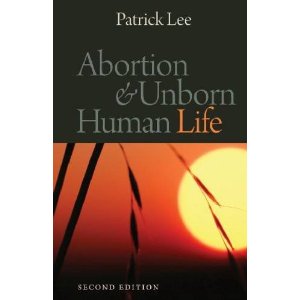 There are few ethical topics more controversial than abortion.Finding books on the topic is not very difficult, one needs only to search “abortion” on Amazon to find more than 10,000 results in the books category. Patrick Lee’s Abortion & Unborn Human Life (hereafter AUHL) stands out as one of the better pro-life books I have read, despite one major flaw.
AUHL starts with a syllogism:
1) Intentionally killing an innocent person always is morally wrong
2) Abortion is the intentional killing of an innocent person
3) Therefore, abortion is always morally wrong.
The rest of the book (164 pages of content) serves to defend this syllogism.
Chapter one argues against the idea that unborn human beings become persons after birth. Lee’s arguments are very good until he starts to argue by going against substance dualism to make his case. I think that this is a major flaw of Patrick Lee’s book. Substance dualism serves as a powerful argument against abortion. Not only that, but to argue against substance dualism primarily for the sake of an ethical position doesn’t make a lot of sense. Lee does introduces several philosophical arguments against dualism, but they fail to make a sufficient case against the position. This makes the rest of his case seem weaker than it is, had it been bolstered by substance dualism rather than arguing against it. It is really unfortunate, because readers may walk away thinking that the case against humans becoming persons after birth is weaker than it is.
In chapter two, Lee argues against the idea that human beings become persons during gestation. This chapter is particularly strong, and Lee introduces many arguments I hadn’t thought about before. Particularly important to this argument is what it means to have “moral standing.” Often, pro-life advocates forget that we sometimes don’t share the same basic presuppositions as the pro-choice advocates. Lee helps to bring the focus back to the basics (I have focused on this elsewhere myself, see here).
Lee argues in chapter 3 that individual human beings come to be at the moment of fertilization. This is another very strong chapter in which Lee offers scientific and philosophical reasons to accept this position.
Chapters 4 and 5 address the particularly chilling (and more recent) arguments that abortion can be justified as non-intentional killing of human beings (4) or that preventing certain consequences permit the killing of human beings (5).
Overall, AUHL is a fantastic read. Lee produces a compelling and powerful case that abortion is morally wrong, no matter what. Despite the rather large flaw of arguing against substance dualism, the book is a must-read for those interested in a philosophical defense of the pro-life position.
Abortion and Unborn Human Life
——
The preceding post is the property of J.W. Wartick (apart from citations, which are the property of their respective owners) and should not be reproduced in part or in whole without the expressed consent of the author. All content on this site is the property of J.W. Wartick and is made available for individual and personal usage. If you cite from these documents, whether for personal or professional purposes, please give appropriate citation and provide a link to the original URL. By viewing any part of this site, you are agreeing to this usage policy.
Abortion: The Struggle Between Objectivity and Subjectivity
 I’ve noticed in the past that as I debate the moral issue of abortion, it seems as though people tend to ignore reason in lieu of emotional appeals. Upon further examination of the issue, I am even more convinced that this is the case. But what is at the bottom of this appeal? Why is it that something which must have an objective answer is treated like subjective, lukewarm hogwash? The reason, I believe, is because the issue of abortion is involved in the overarching debate of subjective (relative) versus objective ethical theories.
What reasons do I have for making this claim? First, we must examine the most prominent pro-choice arguments. Pro-choice arguments generally fall into two broad categories:
1) Devaluing the fetus
2) Pointing towards the value of personal choice/control over one’s own body
Now, 1) fails miserably on a number of logical and scientific levels. See my other posts on the topic for discussions of these reasons (notably, this post and this one). But if 1) is rejected, then 2) may be the only way for pro-choice advocates to argue for their position. Unfortunately, 2) boils down to a kind of subjectivism about morality which ends up being self-defeating.
I am reminded of the echoing catch-phrase popular with politicians, “I am pro-choice, but against abortion.” What does this mean? Often, those who say such things generally mean that whatever someone else wants to do is fine with them. We shouldn’t try to limit the choices others make. We don’t have any reason to regulate what choices someone else can make or can’t make. And sure, I think abortion is wrong, but what right do I have to force my morality on others?
Initially, such arguments seem to make intuitive sense. The problem is that while the argument is trying to avoid forcing any “ought” statements, it has one huge “ought” planted right in the middle of its train of thought. That is, that “We ought not limit the choices of others.” But why should this be the case? There are certainly a huge number of cases in which I would limit the choices of others. Rape, for example, would be one instance where I would say this choice is not to be allowed. Perhaps the argument could be modified, then, and say that as long as one’s choice doesn’t harm anyone else, we ought not limit it. But then this pushes the burden of proof back onto argument 1), which is becoming ever more difficult for the pro-choice advocate to uphold.
Not only that, but having an “ought” statement like any of those above goes exactly contrary to what such statements are asserting. What if I choose to disagree with the statement that we “ought not limit the choices of others”? Should my choice to disagree be limited?
Furthermore, what reasons are their to argue that one should have absolute and total control over one’s own body? For if we do think that this is the case, we should then cease efforts in trying to limit substance abuse, cutting, anorexia, suicide, bulimia, and the like! These are all cases in which someone is simply making choices about his/her own body! If I want to cut myself, that should be my choice! If I want to starve myself, that should be my choice!
No, the bottom line is that the pro-choice camp wants to advocate total relativism. On this view, that which is ethically right for one person is okay for that person. There are innumerable difficulties with such a view (I’ve only touched on these above).
Thus, it seems to me that the pro-choice advocate has insurmountable difficulties with his or her position. First, this view cannot accurately measure when one’s “personhood” begins objectively. Second, it desires to claim an objective “ought” statement which ultimately defeats itself. Third, it runs contrary to scientific advances in measuring the stages of life of the human. Fourth, it stands on shift philosophical soil, for it is unable to accurately define “personhood” in any sufficient manner.
Thus, I conclude, as I’ve done so many times before, that to be pro-abortion is to hold a view that is positively irrational.
——
The preceding post is the property of J.W. Wartick (apart from citations, which are the property of their respective owners) and should not be reproduced in part or in whole without the expressed consent of the author.

 J.W. Wartick - Reconstructing Faith