apologetics
Forgotten Arguments for Christianity: Undesigned Coincidences- The argument stated
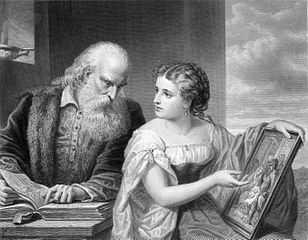 The argument from undesigned coincidences is one of the forgotten arguments for Christianity. It has seen a very recent resurgence through the work of some Christian apologists, such as the philosopher Timothy McGrew. The core of the argument is an investigation of the Bible. When one examines the Scriptures, one finds a number of historical, factual claims which either overlap and confirm others made independently or fill in gaps that authors familiar with current events at the time of the writings would have assumed their readers knew about. These coincidences are therefore undesigned–they are unintentional–but they show that the authors who wrote the books which contain them were telling historical truths.
The Argument Outlined
The argument from undesigned coincinces is not an argument which can be contemplated and accepted or dismissed within minutes or even a few hours of study. The argument must be analyzed by investigating individual instances of the undesigned coincidences for oneself and feeling the weight of the evidence begin to burden the mind.
The argument is an inductive argument. Basically, it argues for the conclusion that the Bible is historically accurate. However, it can be used to argue more specifically towards the conclusion that the miraculous accounts in the Bible did in fact happen.
John James Blunt, an early (1794-1855) proponent of the argument from undesigned coincidences, uses the argument as a challenge:
In our argument we defy people to sit down together, or transmit their writings one to another, and produce the like [undesigned coincidences]. Truths known independently to each of them, must at the bottom of documents having such discrepancies and such agreements as these in question. (J.J. Blunt, kindle location 89, cited below)
It would be hard to make the argument more succinct than this. The argument is built from an ever-growing number of independently observed statements throughout the Bible which coincidentally prove, confirm, or fill in historical gaps of other passages. Therefore, it can feature a huge number of steps, each one an additional piece of evidence. Because of this, it is most easily stated as a challenge. Once you have considered the massive weight of the evidence from untold numbers of undesigned coincidences, can you really maintain your skepticism of the historicity of the Bible?
The argument is used not just to establish the credibility of the Gospels but can be used for a number of other claims about the historicity of Christianity: “The argument deduced from coincidence without design has further claims, because… it establishes the authors of several books of Scripture as independent witnesses to the facts they relate; and this, whether they consulted each other’s writings or not; for the coincidences, if good for anything, are such as could not result from combination, mutual understanding, or arrangement” (Blunt, Kindle Location 78).
Undesigned Coincidences- What are they?
Tim McGrew explains the notion of an undesigned coincidence:
How can we say, no, really there are marks of authenticity [in the Bible]… We should look not for parallel passages in the same words but for what are called undesigned coincidences… Sometimes two works written by different authors incidentally touch on the same point in a manner that cannot be written off as copying or having a copy made from some third source… The two records interlock like the pieces of a jigsaw puzzle. [McGrew, cited below]
Undesigned coincidences overlap and interlock with each other. It is perhaps easiest to explain the concept through an example [I owe this example to Jonathan McLatchie in his post “Undesigned Coincidences: The Ring of Truth”:
Luke 23:1-4:
Then their whole assembly rose up and brought Him before Pilate. They began to accuse Him, saying, “We found this man subverting our nation, opposing payment of taxes to Caesar, and saying that He Himself is the Messiah, a King.”
So Pilate asked Him, “Are You the King of the Jews?”
He answered him, “You have said it.”
Pilate then told the chief priests and the crowds, “I find no grounds for charging this man.”
Wait, what? Isn’t it Pilate’s job to make sure the Jews do not revolt against Caesar? This guy just basically said he was king!
But then compare that to John 18:33-38:
Then Pilate went back into the headquarters, summoned Jesus, and said to Him, “Are You the King of the Jews?”
Jesus answered, “Are you asking this on your own, or have others told you about Me?”
“I’m not a Jew, am I?” Pilate replied. “Your own nation and the chief priests handed You over to me. What have You done?”
“My kingdom is not of this world,” said Jesus. “If My kingdom were of this world, My servants would fight, so that I wouldn’t be handed over to the Jews. As it is, My kingdom does not have its origin here.”
“You are a king then?” Pilate asked.
“You say that I’m a king,” Jesus replied. “I was born for this, and I have come into the world for this: to testify to the truth. Everyone who is of the truth listens to My voice.”
“What is truth?” said Pilate.
After he had said this, he went out to the Jews again and told them, “I find no grounds for charging Him.
John’s telling of the story therefore fills in the gap in Luke’s story. In Luke, there is no reason Pilate would not find grounds for charging Jesus. Only by reading the story in John does one discover that Pilate wanted to let Jesus go because Jesus had explained that his Kingdom was not an earthly kingdom.
If one looks again at these texts in context, one will find that in John, there is no explanation for why Pilate would think Jesus claimed to be a king anyway–it is just out of left field. But turning back to Luke, there is a scene in which the Jews accuse Jesus of claiming to be a king to Pilate. So there is, in these passages, a back-and-forth confirmation. You have to read them both to get the whole picture, and these kinds of details are not the types of things people could plan for.
This is just one example, but they can be multiplied almost beyond comprehension. The way they work is, as McGrew said, like interlocking pieces of a puzzle.
What about Miracles?
The argument can even be used to make a stronger claim. Again, see Blunt, “[I]n several instances the probable truth of a miracle is involved in the coincidences… [W]hen we see the writers of Scriptures clearly telling the truth in those cases where we have the means of checking their accounts… it is reasonable to believe that they are telling the truth in those cases where we have not the means of checking them…” (Kindle Location 89).
Thus, the argument from undesigned coincidences is not a religiously neutral argument. It can also be used to support the truths of miracles. The way this argument works is very subtle. It is not reducible to only the claim that because the Scriptures seem reliable on historical matters due to the undesigned coincidences, we should trust them on the miraculous. Rather, the fact is that the “probable truth of the miracle is involved in the coincidences” (Blunt, 89). “[W]here the natural and supernatural are in close combination, the truth of the former must at least be thought to add to the credibility of the latter” (ibid, 531). The miraculous is sometimes so intertwined with the historical that the confirmation of the historical cannot help but be evidence for the miraculous. Thus, the argument from undesigned coincidences provides a direct argument for the truth of the miraculous.
Conclusion: There’s more where that came from
I have written this post with the intended purpose only to show what the argument from undesigned coincidences looks like. We have seen that it is an inductive argument that is based upon a vast number of examples of varying weight. Furthermore, unlike many historical arguments for Christianity, the argument from undesigned coincidences offers a direct argument for the truth of miracles. I have not addressed possible objections to these arguments. Instead, I leave those for a later post. The next post in this series will outline a few principles of undesigned coincidences.
In closing, it is perhaps best to close with the words of another pre-1900 proponent of the argument:
[S]ince we decide many important worldly matters upon the mere preponderance of evidence and arguments, why should we not adopt the same principles here? It is not necessary in order to recommend the Gospel story for our adoption to insist that it be proved to a mathematical demonstration, and beyond the cavils of every doubter, or of every unreasonable skeptic. Why not adopt that conclusion which has the higher degree of probability rather than the opposite? [Bennett, Kindle Location 59, cited below]
Links
If you want to learn more about forgotten arguments for Christianity, check out my post “On the Shoulders of Giants: Rediscovering the lost defenses of Christianity.”
Tim McGrew has offered a number of other talks on the topic. Please check them out for more discussion of this argument. McGrew on Evidence4Faith. Another lecture by McGrew on undesigned coincidences. Check out McGrew’s interview with Apologetics 315.
Another great post on “undesigned coincidences” can be found at the Christian Apologetics Alliance blog: “The Ring of Truth.”
Cross Examined has a number of coincidences to examine in their post on undesigned coincidences.
Sources
The image is public domain. {{PD-1923}}
John James Blunt, Undesigned Coincidences in the Writings of both the Old and New Testament, New York, 1847.
Edmund Bennett, The Four Gospels from a Lawyer’s Standpoint, New York, 1893.
Timothy McGrew, “Undesigned Coincidences”- this talk can be accessed free of charge here.
William Paley, Evidences of Christianity, New York, 1794; 1865.
SDG.
——
The preceding post is the property of J.W. Wartick (apart from citations, which are the property of their respective owners, and works of art as credited) and should not be reproduced in part or in whole without the expressed consent of the author. All content on this site is the property of J.W. Wartick and is made available for individual and personal usage. If you cite from these documents, whether for personal or professional purposes, please give appropriate citation with both the name of the author (J.W. Wartick) and a link to the original URL. If you’d like to repost a post, you may do so, provided you show less than half of the original post on your own site and link to the original post for the rest. You must also appropriately cite the post as noted above. This blog is protected by Creative Commons licensing. By viewing any part of this site, you are agreeing to this usage policy.
Really Recommended Posts: 11/09/2012
 I have featured literary apologetics, apologetics to Muslims and Jehovah’s Witnesses, geocreationism, and more. Check out the posts. Let me know what you liked. Come back for more.
Elves, Orcs, and Freaks: The Shared Authorial Vision of JRR Tolkien and Flannery O’Connor– Garret Johnson has written a very interesting look into the works of Tolkien and O’Connor. He notes that they viewed fiction as reality from a different outlook. It’s a fascinating post, and there is a second part, which can be viewed here.
An Encounter with a Jehovah’s Witness– It is easy for Christians to slam their doors on those who come door-to-door. What if, instead, we engaged them? This post is a model for engagement and provides some ways forward to engage with Jehovah’s Witnesses.
The Day After: My Thoughts on the Presidential Election– Michael Licona, author of The Resurrection of Jesus: A New Historiographical Approach
Human Footprints in Dinosaur Footprints– Over at GeoCreationism (a highly recommended site), Mike addresses the notion that human and dinosaur footprints have been found together or side by side. Some argue that this supports young earth creationism. Mike explores the paleontological evidence.
Meet the Multiverse– Edgar Andrews, author of what I think is the best introduction to Christian apologetics with a scientific emphasis, Who Made God?
Did Jesus Claim to be Divine? (Answering Islam)– I found this look at answering Muslim objections to the deity of Christ refreshing. It offers an essentially presuppositional approach, which I have found to be very useful when engaging with Muslims. Check it out.
Really Recommended Posts 9/21/12
 There are so many fantastic posts out there it has been hard for me to keep up. I actually have another RRP scheduled with all the backlogged posts I’ve run into. Let me know which posts you’ve enjoyed. I feature here a diverse spread of posts. The necessity of apologetics, atheism, the Gospel of Barnabas (!?), young earth creationism, and resisting sin are all featured. Check ’em!
Sarah Geis provides pointers for constructive debate and disagreement– A creative look at how to debate constructively by showing how not to do so.
Why Apologetics Should Be A Requirement For Every Pastor– Fellow Christians, I hope this post convicts you like it convicted me. We need to be doing apologetics. We owe it to our youths, we owe it to the adults in our congregations, and we owe it to ourselves.
Born Atheists?– Yes, you have heard it somewhere. We’re all born atheists. Really? What is that even supposed to mean? I found this post really excellent and it got me thinking. Check it out.
What is the Gospel of Barnabas?– Some Muslims have been claiming that the so-called Gospel of Barnabas falsifies the Christian doctrine of the Son of God. It is not, however, a serious threat. Check out this post to get some great historical information on this attempt to refute Christianity.
Atheism, Agnosticism, and the New Atheists– It never gets old. What does “atheist” mean? Don’t atheists just believe in one fewer god than believers? I’ve written about this topic myself. Check out this great post on the subject.
A Young Earth Chronometer?– One of my favorite websites has recently taken an intense three-part look at the claim that the amount of salt in the ocean is evidence for a young earth. I highly, heartily recommend the site itself to all my readers, Naturalis Historia.
How to Start a Preemptive Strike on a Sinful Inclination– Another one of my favorite and highly recommended sites, No Apologies Allowed, posted this thought-provoking comic about resisting sin.
The Presumption of Pluralism: How religious pluralism devalues all religious persons
Everyone has their own truth.
What’s true for you is true for you, what’s true for me is true for me.
All religious backgrounds have a piece of the puzzle.
All roads lead to the same goal.

Pluralism is rampant in our society. People want to affirm everyone’s belief. Tolerance is the buzzword. Few want to talk about the differences in worldviews. It’s easier to affirm everyone’s beliefs as having a place in the interchange of ideas.
Pluralism is the position that all religions are true. This can be qualified in a number of ways. Often, the views are not well-thought out and amount to little more than saying that all ways get to heaven. However, there are thoughtful pluralists with highly developed structures for affirming their professed pluralism. For example, John Hick, a well known proponent of pluralism, writes:
[T]he Transcendent in ‘its’ inner nature is beyond human description or comprehension… it is ineffable or, as I would rather say, transcategorical, beyond the scope of our human concepts. It is to this ultimate transcategorical reality that the religions are oriented and to which they are human responses. (Hick, 163, cited below)
Thus, for Hick and most other pluralists, all religions are oriented towards some kind of Ultimate or Transcendent, from which they derive all of their beliefs. Thus, these pluralists can affirm the notion that all religions are “true” in a qualified sense.
The problem with pluralistic claims is that in their gusto to affirm all religions as true, what they’ve actually done is said that all religions are false. Again, Hick realizes a problem inherent in qualifying religions–and specifically Christianity–such that they can all be true. The problem is that some claim to have stated actual truths about transcendent reality. In other words, when a theologian claims that God is Triune, they are making a claim about objective reality. But Hick’s proposed solution is to simply place such theological claims into the reports of experiences about the “Real”: “according to our hypothesis, the different traditions are not reporting experiences of the Real in itself, but of its different manifestations within human consciousness” (171, cited below). Unfortunately for pluralists, what this has done is create what I find to be the real problem for pluralists.
The problem is that the pluralist is the only one whose claims about the Real/Transcendent are true.
The presumption of pluralism is that it assumes the invalidity of all religious claims. Only the pluralist can see that all religious claims to exclusivity are false. The exclusive claims of individual religions are dismissed offhand. After all, if all ways are true, then none can be exclusive.
Again, look at the reasoning from Hick: the claims of theologians are not actually claims about the Real itself. Rather, the claims of the theologian apply only to the Real-as-experienced in human consciousness. In other words, those making truth claims about individual religions are only expressing claims about their own subjective experience of an objective reality: the Real.
Thus, the pluralist undermines the truth claims of all religions, while simultaneously trying to affirm them. Only the pluralist is able to look beyond the truth claims of religion and see that when the Muslim claims that Allah is the only God, he is mistakenly reporting his experience as opposed to a claim about reality. Only the pluralist can see that the Christian who claims that Jesus is the only savior, she is only reporting her conscious experience of the Real. The Buddhist who says there is no God is similarly mistaken: perhaps there is? Who knows? Only the pluralist can see that all of these contradictory claims about religious reality are in fact merely the reports of conscious experience of a supra-reality: one which stands above all religions and is the true religion.
The bottom line is that the pluralist has become the exclusivist. Only the pluralist knows the true way. Thus, their system must collapse in on itself. It either relegates all religious claims to become mere reports of human consciousness and thus affirms itself as the only true religion, or it must affirm blatantly contradictory claims like “God exists” and “There is no God” or “Shiva is a god, Vishnu is a god, etc.” and “There is no God but Allah.” The pluralist has presumed much.
If all ways are true, then none are. Pluralism has failed.
Links
Can we evaluate worldviews?– I discuss how to evaluate rival worldviews and outline some criteria by which to do it.
A Vision for Christian Apologetics to World Religions– I outline a vision for Christians interacting with believers of other faiths. Integral to this approach is understanding others’ beliefs.
Source
John Hick, The New Frontier of Science and Religion (New York: Palgrave Macmillan, 2010).
SDG.
——
The preceding post is the property of J.W. Wartick (apart from citations, which are the property of their respective owners, and works of art as credited) and should not be reproduced in part or in whole without the expressed consent of the author. All content on this site is the property of J.W. Wartick and is made available for individual and personal usage. If you cite from these documents, whether for personal or professional purposes, please give appropriate citation with both the name of the author (J.W. Wartick) and a link to the original URL. If you’d like to repost a post, you may do so, provided you show less than half of the original post on your own site and link to the original post for the rest. You must also appropriately cite the post as noted above. This blog is protected by Creative Commons licensing. By viewing any part of this site, you are agreeing to this usage policy.
Book Review: “From God to Us” by Norman Geisler and William Nix
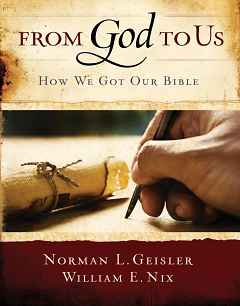 From God To Us
Inspiration
FGU outlines the nature of inspiration. It is important to note that “it is only the product that is inspired, not the persons” (17). Another misconception is that inerrancy/inspiration applies to copies. The sense in which it does must be limited: “Only the autographic [original] texts themselves (or perfect copies of them) are inerrant… Every other copy is inspired only insofar as it is an accurate reproduction of the original” (18).
The authors then turn to a defense of inspiration through the Biblical teaching of inspiration. By outlining the way the text is treated as inspired in both the Old and New Testaments, the authors make a case for the general inerrancy of the autographic texts. Finally, the authors provide an argument for the Bible as the word of God (68ff). The argument is 12 steps and they provide a basic defense of each premise.
Canonization
One of the most frequent objections brought up offhand to those who hold to a high view of the inspiration of the Bible is that of the canon. Some say that the canon was just arbitrarily chosen by a church council somewhere, and that there is no way to determine how books got into the Bible.
FGU provides a more historically accurate look at the canon. The authors first outline a number of factors that are faulty for determining canonicity. For example, age alone cannot determine canonicty because some books of the Bible drew from contemporary sources.
In direct opposition to the notion that a council alone could determine the canon, FGU underscores the notion that: “the role of the Christian church… is not to determine which books are in the canon but to discover which books God determined should be in the canon, namely, those that He had inspired” (91). The authors then explore a number of factors which play into discovering the canon.
Historically, FGU explores the extent and formation of the Old Testament and New Testament canons. The arguments are concise and direct readers to further areas of exploration, while providing enough information to refute most basic arguments.
Transmission
The Bible had to be transmitted: namely, God’s word had to be communicated to human persons. How was this done? Largely in the form of written languages. FGU explores the importance of written language as a means of communication and provides a brief background in the development thereof (164ff).
Of great importance to the reader is the extensive material on the manuscripts of the Bible. The details of the manuscript tradition are outlined and even several forms of extrabiblical manuscript evidence is brought into the picture. Such evidence is an important part of a believers’ background of Bible knowledge. FGU also does a fantastic job outlining the foundations of textual criticism and the valuable role it can play in determining the accurate reading of the text (221ff).
One of the most enlightening parts of FGU outlines the nature of finding “errors” in the transmission of Scripture. Often, one will hear the claim that there are 100s of thousands of errors in the Bible. Bart Ehrman has, in particular, focused upon this in order to cause some unrest in the notion of the accuracy of the Bible (243). But these are actually variants in manuscripts which are sometimes counted numerous times:
If a single word were misspelled in 3,000 different manuscripts, they are counted as 3,000 variants… Ironically, the way Ehrman counts ‘errors’ (variants), there were 1.6 million errors in the first printing of his book. For there were 16 errors, and the book printed an alleged 100,000 copies… Ehrman himself admits the biblical variants do not affect the central message of the Bible. (243)
The authors then turn to an analysis of variant readings and how they occur, from misspellings and unintentional changes to corrections to try to bring texts into concord (246ff).
Translation
FGU provides an intense look at a number of ways the Bible has been translated and the way that translations happen. The traditions of translation are outlined and traced through history (280ff) and the importance of individual translations are analyzed.
Another extremely valuable part of the book is the analysis of how translations come about as far as the emphasis placed upon form-driven versions, meaning-driven versions, and paraphrases. Readers interested in modern Bible translations will find a wealth of resources for analyzing the varied translations. There are nearly 70 pages of information on these translations, so readers will have a number of points to discuss with those asking questions about translations.
Analysis
FGU is a huge resource for those interested in not just defending but learning about the Bible and how it has arrived in its current state in our pews. The book covers a number of issues and it will have appeal to both lay readers and interested professionals. Christian apologists will find a treasure trove of information about the background of the Bible which is often glossed or ignored in a number of apologetics resources.
The authors come from a decidedly conservative background, but this does not prevent them from a generally fair analysis of a number of topics. For example, though they seem critical of the so-called “gender accurate” language of TNIV, the analysis of the translation is objective and simply outlines how the translation comes to its current form (350-353).
Conclusion
Norman Geisler and William Nix have provided a solid resource with From God to Us. It will appeal to those who want to get a lengthy introduction to a number of relevant apologetical issues related to the Bible. Furthermore, it provides a significant amount of background on various translations of the Bible. What is most surprising about the book is how it manages to provide so much information without becoming too dense or thin. It covers so many issues that the danger would seem to be either to err on the side of being too long or too brief on each issue. The authors admirably do not stray to either side, and in doing so, have provided an invaluable resource for both the interested lay reader and professional.
SDG.
——
The preceding post is the property of J.W. Wartick (apart from citations, which are the property of their respective owners, and works of art as credited) and should not be reproduced in part or in whole without the expressed consent of the author. All content on this site is the property of J.W. Wartick and is made available for individual and personal usage. If you cite from these documents, whether for personal or professional purposes, please give appropriate citation with both the name of the author (J.W. Wartick) and a link to the original URL. If you’d like to repost a post, you may do so, provided you show less than half of the original post on your own site and link to the original post for the rest. You must also appropriately cite the post as noted above. This blog is protected by Creative Commons licensing. By viewing any part of this site, you are agreeing to this usage policy.
Book Review: “The Myth of Religious Violence” by William Cavanaugh
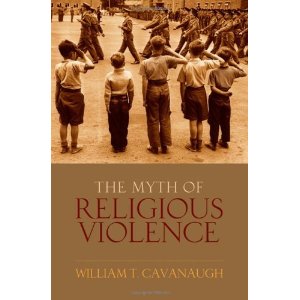 William T. Cavanaugh’s The Myth of Religious Violence
Violence in the name of…
Cavanaugh first turns to the analysis of violence. He argues that rather than just declaring “religion” violent, people should engage in an empirical study. In analyzing various “ideologies, practices, and institutions” like “Islam, Marxism, capitalism, Christianity, nationalism, Confucianism, secularism, Hinduism…” “A careful examination of the varieties of each [worldview] and the empirical conditions under which each does in fact support violence is helpful and necessary. What is not helpful is to divide the above list into religious and secular phenomena and then claim that the former are more prone to violence… such a division is arbitrary and unsustainable on either theoretical or empirical grounds” (16).
Next, Cavanaugh analyzes three ways that religion is supposed to be tied intrinsically to violence. These are that “religion causes violence because it is (1) absolutist, (2) divisive, and (3) insufficiently rational” (17-18). MRV follows several important thinkers who argue from each camp. Cavanaugh concludes that:
[T]here is no doubt that, under certain circumstances, particular construals of Islam or Christianity contribute to violence… Where the above arguments [about the intrinsic ties of religion to violence]–and others like them–fail is in trying to separate a category called religion with a peculiar tendency toward violence from a putatively secular reality that is less prone to violence. There is no reason to suppose that so-called secular ideologies such as nationalism, patriotism, capitalism, Marxism, and liberalism are any less prone to be absolutist, divisive, and irrational than belief in, for example, the biblical God (54-55).
The Myth of Religion
In a very real sense, MRV could just as easily be titled The Myth of Religion. Cavanaugh argues extensively for the conclusion that “Within the west, religion was invented as a transhistorical and transcultural impulse embedded in the human heart, essentially distinct from the public business of government and economic life” (120).
The attempt to define “religion” has “nothing close to agreement among scholars…” (57). In fact, “[t]here is a significant and growing body of scholars… who have been exploring the ways that the very category religion has been constructed in different times and different places… Religion is a constructed category, not a neutral descriptor of a reality that is simply out there in the world” (58). Following Jonathan Z. Smith, Cavanaugh states, “religion is not simply found, but invented. The term religion has been used in different times and places by different people according to different interests” (58).
Cavanaugh argues towards these conclusion through multiple lines of evidence. First, the concept of religion itself is different across different times and places. The Western notion of religion is not mirrored in other cultures (61). Yet even in the west, the concept of what denoted “religion” evolved. The concept was used simply to mean “worship” in the past (63). Through the medieval period, religion basically just meant “rites” or “piety”: religion was “not a universal genus of which Christianity is a particular species” (64-65).
Thus, religion was “invented in the West.” Now it has come to mean a “universal genus of which the various religions are species” (69). Part of this development was due to a need in the Reformation to demarcate differences between the varying schools of thought (72ff). When moderns use the concept religion in a universal fashion, such as Edward, Lord Herbert of Cherbury (1583-1648) did, the problem “is that it is unfalsifiable. In constructing an a priori religion in the minds of all people, Herbert [and those like him] has made his theory impervious to empirical evidence. All evidence is seen and interpreted through the lens of his religious view a priori” (77). “There was a time when religion, as modern people use the term, was not, and then it was invented” (81).
MRV then outlines two ways to define religion, either through a substantavist–one which focuses on the content of religion–or functionalist–which focuses on how a practice functions–approach. The problem with a substantivist definition is that “even if one were able to come up with a coherent, transhistorical, and transcultural definition of religion which would include things like Christianity and Confucianism and Buddhism and exclude things like Marxism and nationalism and capitalism, it would not tell us anything worthwhile about the cuases of violence. Indeed, to exclude [the latter three] a priori from an investigation of violence in the service of ideology in fact distorts the results of any such study” (105). Functionalist definitions fare slightly better because they define religion in such a way that “‘if it looks like a religion and acts like a religion, then it is a religion'” (109). This approach is capable of including things like the American Civil Religion.
Thus, Cavanaugh states that “there is no transhistorical or transcultural concept of religion. Religion has a history, and what counts as religion and what does not in any given context depends on different configurations of power and authority… the attempt to say that there is a transhistorical and transcultural concept of religion that is separable from secular phenomena is itself part of a particular configuration of power, that of the modern, liberal nation-state as it developed in the West (59).
What does this mean for violence and religion? Cavanaugh proposes a test:
The crucial test, however, is what people do with their bodies. It is clear that, among those who identify themselves as Christians in the United States, there are very few who would be willing to kill in the name of the Christian God, whereas the willingness, under certain circumstances, to kill and die for the nation in war is generally taken for granted (122).
The Creation Myth of the Wars of Religion
The story goes that, after the Protestant Reformation divided Christendom along religious lines, Catholics and Protestants began killing each other for holding to different doctrines. The wars of religion… demonstrated to the West the inherent danger of public religion. The solution to the problem lay in the rise of the modern state, in which religious loyalties were marginalized and the state secured a monopoly on the means of violence…
This story is more than just a prominent example of the myth of religious violence. It has a foundational importance for the secular West, because it explains the origin of its way of life and its system of governance. It is a creation myth for modernity (123).
Following the lines of thinking of Voltaire, John Locke, and others, Cavanaugh argues that the myth of religious violence is perpetuated in order to marginalize that which is considered religious and give rise to the nation-state. According to this myth, “All theological religions are to be tolerated, provided they do not interfere with the obligations of citizens to the state…” (129). The myth is that religion is divisive and that they “fight over doctrines or ‘religious creeds'” so that “the state steps in to make peace” (130).
Cavanaugh shows that this myth is indeed false. The “wars of religion” had any number of motivating factors. The use of this story is not so much to tell a truth as it is a means by which to legitimize the nation-state. He argues towards these conclusions by showing that many “wars of religion” were in fact wars of economy, wars of power structures, and the like. He notes four primary factors for this myth to work: that combatants were motivated by religious difference, that the primary cause of war was religion, that religious causes are analytically separable from political, economic, and social causes at the time of the wars, and that the rise of the modern state was not a cause of the wars (141-142). He then analyzes each of these in turn based upon the historical record and shows that these all fail to account for the actual history of the “wars of religion.” In fact, the opposite is true in each case (142-177).
“We must conclude that the myth of the wars of religion is finally incredible, which is to say, false” (177).
The Uses of the Myth
Perhaps the most challenging and paradigm-shifting portion of the book is that which focuses upon the uses of the myth of religious violence. Cavanaugh argues that the myth is so perpetuated because of its usefulness.
First, he analyzes the use of the myth in building the “wall of separation” between church and state. He examines a number of supreme courses and how the myth of religious violence was used to favor the constructed notion of “secular” over that of “religious” (183ff).
The myth of religious violence is used to create a religious “other” which can then be exploited, coerced, and denigrated. “[R]eligion–or more precisely, religion in public–is what the liberal nation-state saves us from” (192). History is revised in order to show how religion is that which causes violence, while the secular nation-state is that toward which we should turn for salvation.
Oddly, it is permitted, encouraged, and sometimes even required to give devotion to the nation state, while this is not religious. “We are all Americans, and devotional exercises [the pledge of allegiance, venerating of the flag, etc.] meant to instill love of our country are unitive, not divisive. Such exercises, however, are not religion. Patriotism, in this world view, is defined over against public religion. To allow that patriotism might be a type of religion and might carry its own dangers of violence would threaten the very basis of our social order” (192).
On a functionalist definition of religion, however, nationalism counts as religion. “American religion” has “saints (the founding fathers)… shrines (Independence Hall)… relics (the Liberty Bell)… holy scriptures (the Declaration of Independence, the Constitution)… martyrs (Lincoln)… inquisition (school boards that enforce patriotism)…” and various religious festivals (Flag Day, the Fourth of July) (117). Nationalism is prevalent in many countries. Religion is privatized, secular nationalism is standardized and enforced. Not only that, but “Only the nation-state may kill” (118).
Again, Cavanaugh’s point ties into his earlier discussion: the ties to violence must be an empirical study based upon ideologies, not one based upon constructed categories of religious and secular. These categories are faulty in-and-of themselves. Furthermore, they undermine the possibility of the empirical study of violence. Nationalism and secularism–ideologies in other words–can be every bit as violent as some ideologies called “religion.”
The myth is also used to hide possible “secular” causes for war. Al Qaeda is specifically religious, and the West is all too happy to use this to ignore the fact that its own mistakes in installing regimes in the Middle East has caused the rise of absolutist, controlling states (202ff).
Worst of all, the myth of religious violence has been used to carry out violence against the religious other. Those who perpetuate this myth often use it in order to legitimize violence against the religious person, who, after all, is irrational and incapable of reason due to their religious beliefs. Sam Harris is a prime example of this notion. He argues that “There are other ideologies with which to expunge the last vapors of reasonableness from a society’s discourse, but Islam is undoubtedly one of the best we’ve got” (HarrisThe End of Faith, 136, quoted in Cavanaugh, 214). Furthermore, “Some propositions are so dangerous that it may even be ethical to kill people for believing them… Certain beliefs place their adherents beyond the reach of peaceful means of persuasion while inspiring them to commit acts of extraordinary violence against others” (Ibid, 52-53, quoted in MRV 213). Notice how this works: the religious other is that which is unreasonable and violent; in order to stop their violence, it may be ethical to kill them for their beliefs. Harris is not the only one who perpetuates this ideology. Cavanaugh cites a number of other thinkers who have utilized the myth of religious violence in this fashion.
Killing for religion is bad, killing for the state is often good (219). As Cavanaugh states, “The myth of religious violence thus becomes a justification for the use of violence. We will have peace once we have bombed the Muslims into being reasonable” (215). This analysis of violence again plays off the myth of religious violence: “Violence labeled religious is always irrational, particularly virulent, and reprehensible. Violence labeled secular, on the other hand, no matter how regrettable, is often necessary and sometimes even praiseworthy for the job it does defending us from religious violence” (216).
Violence feeds on the need for enemies, the need to separate us from them. Such binary ways of dividing the world make the world understandable for us, but they also make the world unlivable for many. Doing away with the myth of religious violence is one way of resisting such binaries, and, perhaps, turning some enemies into friends (230).
Conclusion
It is rare that one comes across a book that forces them to rethink just about everything they have thought about a specific issue. William Cavanaugh’s The Myth of Religious Violence is one of those books which will challenge readers on every level of the discussion. It has an extremely broad scope, but argues convincingly and with a depth that seems almost indefeasible.
The myth of religious suffers a number of serious defects. It assumes an unwarranted division between the constructed categories of “religious” and “secular,” it oversimplifies the justification for violence, it is a clear example of a creation myth used for the founding of the nation state, and most alarmingly it is used to justify violence against the religious other.
The myth of religious violence may live on on the popular level, but Cavanaugh has dealt its death blow. Whether it takes 50 years or never happens, the myth has been destroyed.
The review has been lengthy, but that is due to the importance of this topic. I will be expanding on and elaborating Cavanaugh’s ideas over the course of the next 1-2 months. Check back here, where I will post links to future posts, or be sure to follow the blog to catch the posts over the coming weeks.
Finally, I want to say that this book was a gift from an anonymous donor from this site and I must say Thank you, you have been a huge blessing! It was so delightful to receive a book out of the blue, and to have it be so fantastic was another reward.
Source
William T. Cavanaugh, The Myth of Religious Violence
SDG.
——
The preceding post is the property of J.W. Wartick (apart from citations, which are the property of their respective owners, and works of art as credited) and should not be reproduced in part or in whole without the expressed consent of the author. All content on this site is the property of J.W. Wartick and is made available for individual and personal usage. If you cite from these documents, whether for personal or professional purposes, please give appropriate citation with both the name of the author (J.W. Wartick) and a link to the original URL. If you’d like to repost a post, you may do so, provided you show less than half of the original post on your own site and link to the original post for the rest. You must also appropriately cite the post as noted above. This blog is protected by Creative Commons licensing. By viewing any part of this site, you are agreeing to this usage policy.
Really Recommended Posts 9/1/12
I am constantly delighted by the great quality of posts by my brothers and sisters in Christ. This week, I have provided a choice selection. The topics range from politics (the doctrine of peace through strength) to young earth creationism to presuppositional apologetics and Islam and beyond. I even linked to three of my favorite songs, to give a slightly different feel this go-round.
As always, please let me know what you liked!
———
The Natural Historian writes about Isaac Newton’s thoughts on the Mosaic account of creation. Check out this excellent quote:
Attempts to bring explanations for the physical origins of the geographic features of the earth into conformity with a six day creation and a universal flood has never yielded a unified view of how to interpret the data… [T]he application of that traditional view [young earth creationism] to an understanding of the physical creation and the origin of the earth has never accomplished a satisfying nor widely accepted result.
Refuting Islam: Philosophical Analysis– Mike Robinson uses presuppositional apologetics to evaluate Islam and argues that Islam is founded upon a logical fallacy.
Of Jesus, the Woman Caught in Adultery, Public Morality, The Law…– A fantastic and lengthy post on Christianity in the public square, legislating morality, and some specific moral issues. Recommended if you enjoy political discussion and the interaction of faith with politics.
What is the Doctrine of Peace Through Strength?– Wintery Knight weighs in on a national defense policy of peace through strength. This isn’t directly related to Christian apologetics, but I found it interesting, and Wintery Knight is a master of discussing Christianity in the public square. Check out the rest of his site. A choice quote from the article on peace through strength:
The way to stop most wars is to make dictators believe that you have the means and the will to stop their aggression.
The Ring Makes All the Difference: A Word to the Wise on Cohabitation– Does marriage make a difference? Should we do trial runs of living together first? What does sociology say about these issues? Check out this informative article.
Some of My Favorite Music– Here are some links to songs by three of my favorite artists. Yes, they range wildly in genre. I like some Christian rap- like Lecrae; I like Christian Metal like Demon Hunter (my favorite band) and I love some Christian Blues too, check out the Glenn Kaiser Band.
Stephen Law, his evil god, and radical skepticism
 My contention is that Stephen Law’s epistemological approach to his “evil god challenge” to Christianity entails radical skepticism. Because his challenge entails radical skepticism, Law has forced his cohorts to choose between the seeming irrationality of that position or a denial of the power of the “evil God challenge.”
Entailment of Skepticism
Stephen Law’s “evil God challenge” presents the following:
Suppose the universe has a creator. Suppose also that this being is omnipotent and omniscient. But suppose he is not maximally good. Rather, imagine that he is maximally evil. His depravity is without limit. His cruelty knows no bounds. There is no other god or gods – just this supremely wicked being. Call this the evil-god hypothesis. (Law, “The Evil God Challenge,” 4, cited below)
Now, the point of this challenge is:
the challenge of explaining why the good-god hypothesis should be considered significantly
more reasonable than the evil-god hypothesis.
Law argues in his paper that any theodicy used for the “good god” can be equally used for the “evil god.” Therefore, the theist has yet to show why one should favor the good god over the evil god, and so cannot rationally hold to belief in the good god over the evil god.
Law’s primary support for this supposition is his symmetry thesis:
I shall call the suggestion that, in terms of reasonableness, there is indeed such a rough symmetry between the good-god and evil-god hypotheses, the symmetry thesis.
Nowhere does Law explain what “rough symmetry” means or how balanced the evidence really is between the good god and evil god. Rather, he just uses the phrase “rough symmetry” and argues as though this is enough to discredit the good god hypothesis.
Now notice that the very heart of Law’s argument is something similar to this:
1) If one has no reason to believe that hypothesis a is “significantly more reasonable” than hypothesis b, one cannot rationally hold a over b
It is exactly at this point that Law’s entire epistemology must collapse into radical skepticism. Why? Simply because I can construct parallel but contradictory accounts for nearly any object of knowledge that is not a necessary truth. Just because Law is able to [unsuccessfully, in my opinion] construct a “parallel” system of explanation to that of the ‘good god’ hypothesis does not mean that his parallel is on the same level or even a challenge to that hypothesis.
To see why constructing parallel explanation of reality does not somehow undermine reality, consider two scenarios I constructed to outline this exact point.
The 5 minutes ago challenge
Scenario 1: Our universe was created 5 minutes ago with all our memories and experiences implanted into us.
Those who are familiar with epistemology and philosophy of mind will recognize this as a very pervasive scenario throughout the literature. But how does one go about solving a problem like this? Consider a defense of what seems to be everyday experience.
a) it does not seem to me as though the universe was created 5 minutes ago. I have vivid memories of ten years ago and can interact with others about some of those memories.
The problem with a), of course, is that it exactly lines up with the notion that the universe was created 5 minutes ago with our memories and experiences implanted inside our heads.
Unless I’m very much mistaken, I think I could construct a similarly parallel account for any possible defense of experience of more than 5 minutes ago.
Therefore, I conclude with Law that because the “5 minutes ago” hypothesis is has “rough symmetry” with the hypothesis that our universe is 16 billion years old and the like, it is unreasonable to embrace either proposition. After all, the 5 minutes ago thesis seems extremely improbable, and it is roughly symmetric to the ‘everyday experience’ hypothesis. Law’s symmetry principle applies and undermines all of our experience.
 The Cartesian Demon Hypothesis
Scenario 2: A Cartesian Demon (again, those familiar with philosophical literature will likely recognize this one) has us all under some kind of magic Matrix-like spell where we live our whole lives in our minds even though in reality our bodies are being tortured. The demon delights in our blissful ignorance of the horrible state of our souls and so he continues to implant memories as our lives continue on.
Again, I can’t think of any defense of everyday experience I can’t parallel. Therefore, we should not believe that our everyday experience is correct, according to Law.
I could continue with examples. The problem of other minds is another that immediately jumps out: how do we know there are actually minds in those walking people we see around us. They could just as easily be [philosophical, not pop-fiction] zombies walking around mechanically acting as though they have minds inside them. Again, parallels=>skepticism about whether other minds exist.
Ultimately, Law’s “symmetry thesis” leads us into radical skepticism and even solipsism. That seems to me enough to reject it.
Challenge to Christianity?
So how exactly does Law’s evil god challenge present any difficulties for Christianity? Honestly, I’m not sure. Unless one is convinced of the solipsistic scenarios outlined above, one should not be convinced of Law’s evil god challenge. His symmetry thesis is the only way he can press this challenge, and that same thesis undermines all knowledge of experience and induction. It doesn’t seem like much of a challenge to me.
Law’s Odd Conclusion and My Conclusion all at once
Law’s conclusion states that:
The problem facing defenders of classical monotheism is this: until they can provide good grounds for supposing the symmetry thesis is false,
they lack good grounds for supposing that the good-god hypothesis is any more reasonable than the evil-god hypothesis – the latter hypothesis being something that surely even they will admit is very unreasonable indeed.
Now, one again must see exactly where this is leading. Suppose, as a theist, I find the evidence for the existence of a god to be very convincing. Suppose further that I find the theodicies Law parodies to be sound. Suppose that I think that Law’s evil god hypothesis meets these theodicies equally. Now, according to Law, I am in the state of “symmetry”; I have no reason to prefer the good god over the evil. Law maintains that this means not just that I can’t rationally hold to either, but rather that because the evil god hypothesis is “very unreasonable indeed” I should also reject the good god.
But of course the theist we are supposing to exist believes that the good good hypothesis is extraordinarily reasonable. And because Law’s thesis works, according to them, following Law, they have no reason to believe the evil god is any less probable than the good god. Thus, according to this theist, the evil god hypothesis is not improbable but rather extraordinarily probable.
What Law has done is pretty simple. He’s argued that the good and evil gods must be on the same level of rationality. Because he (apparently) and others reject the evil god out-of-hand, he argues that they are on equal footing and so one should reject the good god. But again, what if the theist agrees that these hypotheses must be on equal footing and that it’s not that both are improbable but rather that both are extraordinarily probable?
All Law has said in response to such a person is that the evil god is “very unreasonable indeed” but why? Law has just spent over 20 pages arguing that the evil god is actually reasonable. Suddenly, the evil god is worthy of rejecting a priori? How does that work out? Law hasn’t done anything to dissuade the convinced believer. The only way his argument works is if one thinks that the good god hypothesis is barely rational. If one follows his conclusion and thinks god’s existence is very likely, then they must follow it all the way through: the evil god’s existence is very likely too. Law just imports this unreasonableness from his own a priori denial of the existence of God.
So what, at this point, does the believer do? Well, it seems we’re back to my first point. One can either believe the symmetry thesis and thus devolve into radical skepticism, or one can reject it and thus throw Law’s argument out the window where it belongs.
Finally, it’s worth noting that there are other reasons to reject the “evil god challenge.” First, it doesn’t take into account the whole range of theistic argument. For example, the ontological argument is based upon the notion of God as maximally great. Law would have to argue that an evil being could be maximally great. Good luck.
Links
William Lane Craig and Stephen Law debated some time back. I wrote a review summarizing and analyzing the arguments.
Glenn Andrew Peoples presents Law with a formidable challenge on the Unbelievable? Podcast.
Edward Feser weighs in on the evil God challenge.
Glenn Andrew Peoples’ podcast on the evil God challenge is phenomenal.
Max Andrews weighs in, arguing that even though Law’s argument is much like the Cartesian demon, we should take it seriously.
Luke Nix at Faithful Thinker comments on the same argument from a different angle.
Source:
[Cited as directed here:] STEPHEN LAW The evil god challenge. Religious Studies, Available on CJO doi:10.1017/S0034412509990369
SDG.
——
The preceding post is the property of J.W. Wartick (apart from citations, which are the property of their respective owners, and works of art as credited) and should not be reproduced in part or in whole without the expressed consent of the author. All content on this site is the property of J.W. Wartick and is made available for individual and personal usage. If you cite from these documents, whether for personal or professional purposes, please give appropriate citation with both the name of the author (J.W. Wartick) and a link to the original URL. If you’d like to repost a post, you may do so, provided you show less than half of the original post on your own site and link to the original post for the rest. You must also appropriately cite the post as noted above. This blog is protected by Creative Commons licensing. By viewing any part of this site, you are agreeing to this usage policy.
The Consolation of Counterfactuals: The Molinism of Boethius
Whence comes this powerful understanding
That all things sees and all discerns?
…This is a cause more powerful
More forceful and effectual
Than that which passively awaits… (Boethius, The Consolation of Philosophy, Book V, section IV)

Molinism is holds that God has counterfactual knowledge of every situation. What this boils down to is that God knows conditional statements for every possible situation, such that God knows statements like “If J.W. has free time, then he will read.”
One prominent challenge to molinism is the notion that such counterfactuals about future choices cannot exist or that God simply couldn’t know them. I was startled as I read Boethius’ (480-525 AD) work, The Consolation of Philosophy, to see that he had anticipated this objection and provided the outline of an answer to it about 1500 years ago.
Boethius wrote the work as a dialog between himself and Philosophy, a woman who represented, well, philosophy. The last book focuses upon God’s foreknowledge and human freedom.
Writing as philosophy, Boethius states
All those things which happen without happening of necessity are, before they happen, future events about to happen, but not about to happen of necessity… But this, you will say, is the very point in question–whether there can be any foreknowledge of things whose occurrence is not inevitable. (Book V, section IV)
Again, it was amazing to see that Boethius had anticipated an objection to molinism–a system of theological thought which hadn’t been conceived fully yet (and wouldn’t be for about 1100 years!)–and provided an answer. The objection was seen above: many modern philosophers and theologians contend that God could not know that which is not necessitated to happen.
Yet Boethius answers the problem in a unique way:
The cause of this mistake [believing that God couldn’t know things that will not happen by necessity] is that people think that the totality of their knowledge depends on the nature and capacity to be known of the objects of knowledge. But this is all wrong. Everything that is known is comprehended not according to its own nature, but according to the ability to know of those who do the knowing. (Book V, section IV)
Before developing this argument, it is important to note that it rests squarely within Boethius’ later reflection upon the eternity of God–a being who has “the complete, simultaneous, and perfect possession of everlasting life” (Book V, section VI). Because Boethius holds that God is eternal in this sense–timeless–he can reasonably hold that God’s capacity to know is not limited by temporal constrictions.
Thus, we get back to the nature of his response to the counterfactual objection to molinism. Boethius, holding that God is eternal and therefore not limited by time, grounds the knowledge of counterfactuals not in their own inherent ability to be known or not known, but rather in the ability of the knower to know them.
It is worth emphasizing how radical and powerful this response is to the modern argument against molinism. If God is indeed timeless in the sense Boethius presses, then God would have access to the entirety of time as far as knowledge and action are concerned. Thus, by grounding knowledge not in the objects of knowledge themselves but in the capacity of the knower, Boethius grounded counterfactual knowledge.
Objection
Now, modern opponents of molinism would take this in stride and argue either against the contention that God is timeless or against the contention that knowledge is based in the capacity of the knower rather than the known. Exploring either of these objections is beyond the scope of this post, but it is worth noting that Boethius’ rebuttal to the problem of counterfactual knowledge works if both of his contentions are true. The question is, of course, whether they are.
A Final Objection and Response
Another way to attack Boethius’ defense of God’s knowledge of counterfactuals is to argue that even if it is the case that God is eternal and that His knowledge is grounded in the knower rather than the known, then it still would only mean that God knows what will happen, not what would happen if something were to happen. In other words, one could hold that Boethius’ answer doesn’t actually apply to counterfactual knowledge.
It seems possible, however, to modify Boethius’ defense to counter this argument as well. One could note that because God is eternal, any event that would happen, God would know about it. In other words, if x were z instead, then God’s knowledge would simply be z instead of x. This response turns the counterfactual into a counterfactual about God’s knowledge rather than about freedom. The response offered turns the question from whether God could know that “If x, then y” about John Smith into a question of “If z instead of x, then God knows z.”
Conclusion
It seems clear to me that there is much to develop yet in the objections and responses offered above. The last critique offered and my response certainly opens a number of areas of inquiry. However, for now it seems clear that Boethius has offered a unique way to look at the problem of counterfactual knowledge. Whether his perspective is correct remains a matter for further inquiry.
Boethius offered a unique and stirring defense of molinism over a thousand years before it was fully articulated by Luis de Molina. It is worth looking into his answer, even if it fails, simply for the foresight it provided. But Boethius’ work is known as an astounding discussion of divine eternity as well, among other things. Thus, I encourage readers to look into his short work, The Consolation of Philosophy. Who knows, you may even find the consolation of counterfactuals therein.
Edition Used: For this post I used the Penguin Classics edition of The Consolation of Philosophy (New York: Penguin, 1999).
SDG.
——
The preceding post is the property of J.W. Wartick (apart from citations, which are the property of their respective owners) and should not be reproduced in part or in whole without the expressed consent of the author. All content on this site is the property of J.W. Wartick and is made available for individual and personal usage. If you cite from these documents, whether for personal or professional purposes, please give appropriate citation with both the name of the author (J.W. Wartick) and a link to the original URL. If you’d like to repost a post, you may do so, provided you show less than half of the original post on your own site and link to the original post for the rest. You must also appropriately cite the post as noted above. This blog is protected by Creative Commons licensing. By viewing any part of this site, you are agreeing to this usage policy.
Really Recommended Posts 8/3/12
Wow, there are some really excellent posts out there. I am constantly blessed by reading or viewing great material from others. This week, the topics covered are all over the board: abortion, Leviticus, 50 Shades of Grey, apologetics methodology, and more! Check out these really recommended posts.
Grey Areas: How explicit literature went mainstream– You’ve heard of 50 Shades of Grey. What’s all the fuss about? And what kind of junk are we putting on the bookshelves?
The Mistake of Leviticus– Leviticus is one of those books in the Bible many balk at reading. Check out the insight provided here by Credo House. I really, really recommend this post.
Some Standard Definitions From the Doublespeak Dictionary– Bigot, Christian, and Intolerant tie together so well! Check out this great apologetic cartoon.
The Bibliographical Test Updated– Clay Jones, a professor over at Biola University, offers an update to the number of ancient manuscripts available for the various “bibliographic tests” for the accuracy of the New Testament. A brief, readable, and important post.
Is Abortion Really Wrong?– A great introduction to the debate over abortion.
Why I don’t reply to everyone (and neither should you)– It’s easy to get caught up in online debates or try to respond to everyone who comments on a blog or forum. Glenn Andrew Peoples offers an excellent post on why he doesn’t respond to everyone. He also gives some good guidelines for deciding whether you’re going to respond to someone.
The Atheist War Against Logic and Philosophy– I’m not sure this video is fairly named, because it seems like it is more the extreme views on philosophy of a number of people dismissed by the vast majority of others. Good watch if you want to pull your hair out at people rejecting logic while using it.
Apologetic Taxonomy: Methodological Approaches– Readers of my blog know I’ve been exploring a few other apologetic approaches. Here’s an excellent post which outlines the various methodological approaches to apologetics in a brief, readable format.

 J.W. Wartick - Reconstructing Faith
