apologetics
Apologetics Guided Reading: Historical Apologetics Read-Along

Image from a camping trip I took. The beauty of creation points to the existence of God.
I am going to lead a read-through of a historical apologetics work, Manual of Christian Evidences by George Park Fisher. Why choose this book? There are a few reasons. First, it is public domain and therefore available for free through various online formats (including getting it on your Kindle or other e-reading formats). Second, it provides a good framework for understanding the historical development of apologetics from its time (late 19th century) until now. Third, it introduces a few arguments that most people familiar with modern apologetics will find novel, thus showing the importance of exploring historical apologetics. Finally, fourth, I’ve already been doing a read-along of the book in the Facebook group, “Dead Apologists Society,” and I can both tie this discussion back to that group and also use what I’ve been writing up there for this.
I’m interested to get some feedback on this read along because I want it to be useful both for myself and for you, my readers. I have a few questions for you, then, readers. First, are you interested in this? Second, what kind of format would be most helpful for you? I already have a few posts in the works with some questions on the content and application. Third, how often would work for reading along? The chapters are quite short and readable, and I was thinking either weekly or monthly would be the goal. I’m leaning towards monthly so I can space them out more easily.
The book can be acquired here. We’ll be using the 1892 edition, which is available in various e-formats here.
I hope you’ll join me in this read-along!
Read Along Links
Chapter 1– What is the purpose of the Manual? This chapter gives us a preview of what kind of arguments Fisher will use going forward. I provide some questions and discussion for chapter 1 here.
Chapter 2– Fisher defines and defends the possibility of miracles. Come talk about some related issues regarding free will, the definition of miracles, and more.
Chapter 3– Fisher introduces the “argument from felt need” for Christianity (also known as the “argument from desire”). Learn about this argument and its defense.
Chapter 4– A great difference between Christianity in Fisher’s time and in our time is revealed. How does it impact his defense of Christianity? How must ours change?
Chapter 5– Jesus’s character is unique, argues Fisher, such that we can see the person himself as unique.
Chapter 6– Jesus’s behaviors, argues Fisher, show that they are not invented.
Chapter 7– Paul’s letters offer more insight into the life of Christ.
Chapter 8– A brief argument for the authenticity of the Gospels is offered.
Chapter 9– Are the writers of the apostles themselves trustworthy? If we can trust them to tell the truth and their words are accurately reported, then we have reason to believe Christianity.
Links
Dead Apologists Society– A page for Christians interested in the works of historical apologetics. There is also a Facebook group for it.
Book Review: “A New Kind of Apologist” edited by Sean McDowell
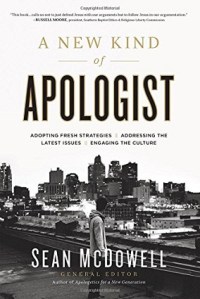
A New Kind of Apologist edited by Sean McDowell is a collection of essays addressing many of the challenges facing apologetics and apologists now. The chapters offer insights in such diverse topics as apologetics and economics, Islam, and sexuality. The chapters range from 2-14 pages and so are necessarily brief.
Several of the chapters are particularly insightful. For example, “Why We Should Love Questions More Than Answers” by Matthew Anderson notes that we need to be careful listeners when we take questions. It does no good to be able to answer questions if we are answering the wrong ones. The chapter “Telling the Truth about Sex in a Broken Culture” by John Stonestreet speaks to how the changing cultural climate regarding exposure to, consumption of, and even understanding of sexuality has changed such that we need to have a holistic biblical vision of human sexuality is another example of the broad perspectives this book offers on apologetics.
The topics in the book aren’t limited to some kind of ivory tower arguments (though I believe such arguments and books are very valuable); here, topics have direct application to life while maintaining an apologetic perspective. It’s a practical book, though it is necessarily brief on each topic that is covered. It provides more of a grab bag of ideas than well-developed approaches to the topics. Readers will be exposed to many different ideas, each with some insight on where to pursue further reading on the topic. The sheer breadth of issues touched upon make the book guaranteed to have something of interest for anyone even remotely concerned with apologetics. Method, Christian living, other religions, and a host of topics in between are covered. It’s an exciting book, as each chapter presents a new avenue for readers to explore.
An admirable aspect of the book is that it features several women’s voices. Too often, collections of apologetic essays do not have even one woman in the work. Here, there are several, including an excellent chapter by Holly Ordway on the use of imagination in apologetics and another chapter by Mary Jo Sharp that calls on women to be involved in aoplogetics.
Section breaks often feature interviews with prominent apologists, but the most intriguing of them are the interviews with atheists–including some who were once apologists. This provides a look at areas that some readers may never engage with–genuine interaction with atheists and an attempt to understand why the “other” believes as they do.
One area of critique is that some chapters persist in using “man” and “men” as descriptors for “human” and “humanity.” Although it is commonly argued that people just know that the latter is what is meant, precision of language as well as the real possibility of confusion suggests use of gender-neutral language ought to be preferred.
A New Kind of Apologist is an important, helpful book. It is just the kind of work that someone interested in apologetics should pick up as quickly as possible. It opens the reader up to several new topics, as well as new authors and ideas. It comes recommended.
The Good
+Engages a ton of topics
+Insightful interviews
+Features women’s voices
The Bad
-Very brief on the topics it touches
-Lack of gender-neutral language in some chapters
Disclaimer: I received a copy of the book for review from the publisher. I was not required to provide any kind of feedback whatsoever.
Source
A New Kind of Apologist edited by Sean McDowell (Eugene, OR: Harvest House, 2016).
Links
Be sure to check out the page for this site on Facebook and Twitter for discussion of posts, links to other pages of interest, random talk about theology/philosophy/apologetics/movies and more!
Book Reviews– There are plenty more book reviews to read! Read like crazy! (Scroll down for more, and click at bottom for even more!)
Eclectic Theist– Check out my other blog for my writings on science fiction, history, fantasy movies, and more!
SDG.
——
The preceding post is the property of J.W. Wartick (apart from quotations, which are the property of their respective owners, and works of art as credited; images are often freely available to the public and J.W. Wartick makes no claims of owning rights to the images unless he makes that explicit) and should not be reproduced in part or in whole without the expressed consent of the author. All content on this site is the property of J.W. Wartick and is made available for individual and personal usage. If you cite from these documents, whether for personal or professional purposes, please give appropriate citation with both the name of the author (J.W. Wartick) and a link to the original URL. If you’d like to repost a post, you may do so, provided you show less than half of the original post on your own site and link to the original post for the rest. You must also appropriately cite the post as noted above. This blog is protected by Creative Commons licensing. By viewing any part of this site, you are agreeing to this usage policy.
Book Review: “How to Be an Atheist” by Mitch Stokes
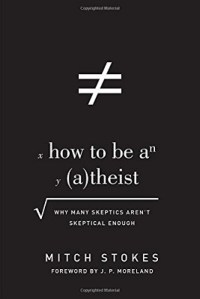 I’ll admit it: going into Mitch Stokes’ How to Be an Atheist: Why Many Skeptics Aren’t Skeptical Enough, I was skeptical [har, har]. Any book that claims to discuss “how to be x” where “x” is some worldview to which the author does not describe has an uphill battle. After finishing, I have to say that my fears were premature. In this astonishing book, Stokes does well what few even attempt: relational, witty engagement with those with whom one disagrees. The book is a calling for self-described skeptics to examine their own skepticism and see whether they are being skeptical enough. Throughout the book, key tenets of “belief” that most people share are challenged by means of classical and modern skeptical argument. Few aspects of life are left unexamined. Whether it is the belief in other minds, morality, or the origin of the universe, Stokes encourages consistent skepticism on all counts.
The book is organized around three parts: Sense and Reason, Science, and Morality. Stokes avoids the potential pitfalls of getting bogged down in complex attempts to defend an alternative view and focuses instead upon skeptical inquiry. He takes a microscope to these topics and asks, effectively, “How should we treat this topic if we were really going to be skeptics?” It’s a refreshing perspective, and one that makes the book highly readable. It reads like an inquiry in the best, technical sense of the term.
‘How do the topics of this inquiry fare?’ you might wonder. Under skeptical scrutiny, very little is left for us. This is not an extended apologetic for the Christian faith. No, this book is specifically aimed at seeing where skepticism takes us if we are actually consistent about it. Free will, objective morality, sense perception, and even realism about scientific inquiry are each cast into doubt. None of this is done in a condescending way or through trickery. Instead, Stokes continually utilizes the works of atheists as sources for his points. True skepticism leaves very little to be affirmed in the world, and what is left behind looks rather pale in comparison to what we experience.
How to Be an Atheist is one of those rare apologetics books that could, I think, reasonably be handed to a skeptical, atheistic friend as a book they might be willing to read–and engage with. Stokes’ humorous style is never offputting. Instead, he encourages a consistent, skeptical look at the world. He shows just how bleak such a vision of the world ought to be. Moreover, he does so by using the words and works of atheists themselves. The New Atheists (Sam Harris, Christopher Hitchens, Richard Dawkins, and Daniel Dennett) are featured throughout, but Stokes doesn’t limit the scope of the work to them. He delves deeper, citing some of the great skeptical minds of all time–people like J.L. Mackie and David Hume. The continued engagement with the best and brightest atheists demonstrates a willingness to engage with the “other side” on the part of Stokes that is admirable and fascinating.
If there is anything to critique in this excellent work, it would be that Stokes, having demonstrated the bleak view of the world through skeptical eyes, doesn’t do enough to dig readers back out of the “hole” of doubt that has been descended into. There are a few moments where this happens, but the book is almost entirely a work of skeptical inquiry–showing what it would look like if people consistently applied their skepticism. It is an endeavor to show the absurdity of life without God.
How to Be an Atheist: Why Many Skeptics Aren’t Skeptical Enough is an enjoyable read that provides both a mental workout and a bit of fun. It will serve as a valued reference and resource for me for some time to come, I’m sure. I recommend it very highly.
The Good
+Humorous examples
+Encourages consistency
+Engages top skeptical minds
+Valuable resource all-around
The Bad
-Little direction about where to go next
Disclaimer: I received a copy of this book for review from the publisher. I was not required to provide any specific kind of feedback whatsoever.
Source
Mitch Stokes, How to Be an Atheist: Why Many Skeptics Aren’t Skeptical Enough (Wheaton, IL: Crossway, 2016).
Links
Be sure to check out the page for this site on Facebook and Twitter for discussion of posts, links to other pages of interest, random talk about theology/philosophy/apologetics/movies and more!
Book Reviews– There are plenty more book reviews to read! Read like crazy! (Scroll down for more, and click at bottom for even more!)
Eclectic Theist– Check out my other blog for my writings on science fiction, history, fantasy movies, and more!
SDG.
——
The preceding post is the property of J.W. Wartick (apart from quotations, which are the property of their respective owners, and works of art as credited; images are often freely available to the public and J.W. Wartick makes no claims of owning rights to the images unless he makes that explicit) and should not be reproduced in part or in whole without the expressed consent of the author. All content on this site is the property of J.W. Wartick and is made available for individual and personal usage. If you cite from these documents, whether for personal or professional purposes, please give appropriate citation with both the name of the author (J.W. Wartick) and a link to the original URL. If you’d like to repost a post, you may do so, provided you show less than half of the original post on your own site and link to the original post for the rest. You must also appropriately cite the post as noted above. This blog is protected by Creative Commons licensing. By viewing any part of this site, you are agreeing to this usage policy.
Book Review: “Keeping Your Kids on God’s Side” by Natasha Crain
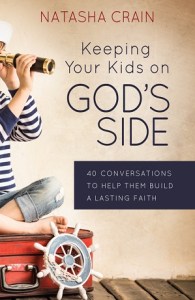 As a Christian parent, one of the things most important to me is bringing my son up in faith in Christ. As a man with an MA in Christian Apologetics, I know that my child will face many challenges going forward, and that the Christian faith has the answers. The problem, it seems, is figuring out how to unite these two–apologetics and child-rearing–in a way that can be understood by children, without being domineering or scary. Natasha Crain’s book, Keeping Your Kids on God’s Side, is an answer to prayers about this important topic.
The book features 40 “conversations” that can be had with children centered around topics from why we believe the Bible and textual criticism to the existence of God to questions about science and Christianity. Each of these chapters provides an introduction to the topic at hand. Crain utilizes stories of her own children quite well to demonstrate how these conversations might play out–or how they might get started.
The most helpful aspect of the book is that it provides a kind of all-in-one reference for common questions and apologetic topics that can be used to start children on the right path towards defending their faith and the calling of 1 Peter 3:15-16. Each of the 40 conversations is one that is worth having, and is often accompanied with quotes from prominent atheist thinkers to show the objections often raised to the faith.
Crain also does a good job of presenting multiple sides of controversial topics without specifying a side. For example, in the chapter on hell, she presents historical Christian positions (a literal view, a figurative view with eternal punishment, and the conditionalist view). The one place there is a bit of a slip on this regard is when it comes to the creation and evolution debate. She adequately presents both young and old earth creationism, but only gives a view like theistic evolution a passing mention, despite having seemingly increasing support among evangelicals.
A downside to the variety of topics that Crain presents is that she is only ever able to scratch the surface on each. The type of book it is basically makes this a necessity, and Crain does provide resources for further reading. Parents should note that they will need to utilize these resources for continuing conversations.
Keeping your Kids on God’s Side is a phenomenal work. It is the kind of book that parents will come back to time and time again. Not only that, but it has broad enough appeal that it serves as an excellent general apologetic work. It will energize parents to start these conversations with their children and give them the tools to keep them going. I highly recommend this work.
The Good
+Broad-minded approach that doesn’t tell readers what to think on controversial topics
+Clear tone and presentation
+Astounding number of topics introduced with valuable information
+Offers several key points to help discuss topics with children
The Bad
-Very brief on several points
-Doesn’t address full breadth of views on creation/evolution
Disclaimer: I received the book for review from the author. I was not obligated to provide any specific kind of feedback whatsoever.
Source
Natasha Crain, Keeping Your Kids on God’s Side (Eugene, OR: Bethany House Publishers, 2016).
Links
Be sure to check out the page for this site on Facebook and Twitter for discussion of posts, links to other pages of interest, random talk about theology/philosophy/apologetics/movies and more!
Book Reviews– There are plenty more book reviews to read! Read like crazy! (Scroll down for more, and click at bottom for even more!)
Eclectic Theist– Check out my other blog for my writings on science fiction, history, fantasy movies, and more!
SDG.
——
The preceding post is the property of J.W. Wartick (apart from quotations, which are the property of their respective owners, and works of art as credited; images are often freely available to the public and J.W. Wartick makes no claims of owning rights to the images unless he makes that explicit) and should not be reproduced in part or in whole without the expressed consent of the author. All content on this site is the property of J.W. Wartick and is made available for individual and personal usage. If you cite from these documents, whether for personal or professional purposes, please give appropriate citation with both the name of the author (J.W. Wartick) and a link to the original URL. If you’d like to repost a post, you may do so, provided you show less than half of the original post on your own site and link to the original post for the rest. You must also appropriately cite the post as noted above. This blog is protected by Creative Commons licensing. By viewing any part of this site, you are agreeing to this usage policy.
Book Review: “Pitfalls: A Quick Guide to Identifying Logical Fallacies for Families” by J.D. Camorlinga
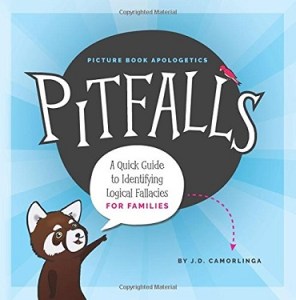
Pitfalls: A Quick Guide to Identifying Logical Fallacies for Families provides a way to teach logic in a concise, easy to understand format. The book is part of the “Picture Book Apologetics” series and approaches the fallacies from the stance of teaching children to engage in conversations about their faith, though it is clearly broadly applicable.
The fallacies covered in this book are informal fallacies, though at the end the authors note the difference between formal and informal fallacy. Both the back cover and the table of contents explain what a logical fallacy is. Fallacies covered include ad hominem, appeal to force, equivocation, and many more. There are 24 covered in all, along with the distinction made between informal and formal. Each features an illustration with a dialogue between various delightful critters demonstrating the fallacy. Many of the explanations close with a humorous application of the fallacy. Each explanation is about 50-80 words long (I counted a few of them).
The explanations are clear and concise, to the point where they would frankly serve the introductory philosophy course as well as the six-year-old. They’re impressively well done and with plenty of humor on the side for older children and adults. It is rare I find myself really enjoying a children’s book, but this is one that easily fits in that category.
I put the book through the rigorous test of seeing how long the illustrations could please my son. He isn’t quite a year and a half old yet, and his attention span reflects that. Nevertheless, he touched many of the cutely drawn animals and even made (highly accurate) animal noises for a few. Given that both I and my son enjoyed the illustrations, I think its safe to say they’re well done.
I would be a poor reviewer if I didn’t note the tongue-in-cheek humor behind some of these illustrations. For example, the fallacy of “Begging the Question” is clearly a depiction of Joseph Smith with the gold plates for the Book of Mormon, and the “Genetic Fallacy”‘s illustration is a pair of Jehovah’s Witness gerbils (or hamsters? I can never keep them straight). These do not mock these groups, but instead expose their ideas in the briefest conversation bubble and show some of the fallacious reasoning behind them. It’s done smartly.
It’s difficult to judge exactly how easily understood these fallacies are made by the book with myself and my son as subjects, but having discussed this kind of thing with parents who have older children, I believe this book would be highly beneficial for introducing some heady concepts at fairly young ages. Of course, do that at your own risk as you will be training little lawyers. Each explanation is quite brief, to the point where a few times I wish there had been just a little more clarification. It’s hard to fault that, however, given the intended audience of the book.
Pitfalls: A Quick Guide to Identifying Logical Fallacies for Families is just as advertised, but with no small amount of wit. It is both informative and delightful, well-illustrated and humorous. I highly recommend it.
The Good
+Clever examples
+Cute illustrations
+Grab-bag of information
+Useful for review
The Bad
-Could be a bit more expansive on a few topics
Disclaimer: I was provided with a copy of the book by the publisher. I was not required to give any specific kind of feedback whatsoever.
Source
J.D. Carmolinga Pitfalls: A Quick Guide to Identifying Logical Fallacies for Families (Whittier, CA: Picture Book Apologetics, 2015).
Links
Be sure to check out the page for this site on Facebook and Twitter for discussion of posts, links to other pages of interest, random talk about theology/philosophy/apologetics/movies and more!
Book Reviews– There are plenty more book reviews to read! Read like crazy! (Scroll down for more, and click at bottom for even more!)
Eclectic Theist– Check out my other blog for my writings on science fiction, history, fantasy movies, and more!
SDG.
——
The preceding post is the property of J.W. Wartick (apart from quotations, which are the property of their respective owners, and works of art as credited; images are often freely available to the public and J.W. Wartick makes no claims of owning rights to the images unless he makes that explicit) and should not be reproduced in part or in whole without the expressed consent of the author. All content on this site is the property of J.W. Wartick and is made available for individual and personal usage. If you cite from these documents, whether for personal or professional purposes, please give appropriate citation with both the name of the author (J.W. Wartick) and a link to the original URL. If you’d like to repost a post, you may do so, provided you show less than half of the original post on your own site and link to the original post for the rest. You must also appropriately cite the post as noted above. This blog is protected by Creative Commons licensing. By viewing any part of this site, you are agreeing to this usage policy.
Really Recommended Posts 1/22/16- Neuroscience and boy/girl brains, consent, and more!
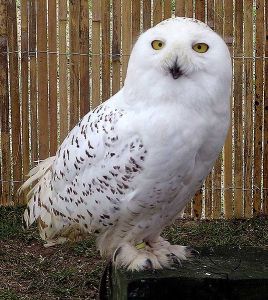 I’ve been nose-deep in the latest Dean Koontz novel, but I still managed to pull together these posts for you, dear readers. We have neuroscience and the notion of a boy/girl brain, works of dead apologists, Consent and Planned Parenthood, oral tradition in the Bible, and Wittgenstein and Scholastic Metaphysics. Let me know what you think, and be sure to let the authors know as well.
Girl Brain? Boy Brain?: A Neuroscientist Examines the Evidence– We often hear about how boy and girl brains are hardwired to behave in different ways. What should we think about this claim? What does it mean?
Planned Parenthood’s Absurd Position on HIV Disclosure– “Consent” in sex entails informed consent, something that Planned Parenthood concedes. Why, then, do they turn around and argue you don’t need to give information to get consent?
Goodill on Scholastic Metaphysics and Wittgenstein– A philosophy-heavy post from Edward Feser on a challenge raised against Scholastic Metaphysics based on Wittgenstein’s philosophy. I enjoyed this read quite a bit.
Book Review: Understanding the Oral Tradition by Eric Eve– A substantive book review that will get you thinking about oral history and the transmission of the Bible.
Works of Dead Apologists– If you aren’t reading the works of dead apologists, you ought to be. Here’s a good place to get started.
Really Recommended Posts 1/15/16- Graphic Novel Apologetics, Stay at home dads, and more!
Brr! It’s cold in Iowa… but not as cold as it was in Minnesota! I still walk around without a coat on in 30 degrees (F) due to my time spent in the frozen north. Anyway, the cold has given me time to read, and I present this latest round of really recommended posts to you, dear readers. There are posts about stay-at-home dads and egalitarianism, Batman and Christianity, Answers in Genesis’s position on “kinds,” the flying spaghetti monster and Santa, and censoring pro-life voices! Wow, I’m excited. Let me know what you think, and be sure to let the authors know you enjoyed their stuff, too!
Egalitarianism is for Men, Too– As a stay-at-home dad currently, I wrote this post for Christians for Biblical Equality to show some of the challenges faced in my life as well as how an egalitarian theology can benefit men. This one is from the heart, folks.
Review and Christian Reflections of My Favorite Works on Batman– Here’s a literary apologetics post on different Batman graphic novels. I decided to pick up one of these to start my own reading of Batman, since I’ve always enjoyed Batman. It is important to apply the Christian worldview to every aspect of our lives–including the fiction we read–and this is a good post showing how to do that.
Are Ruminants Derived from a Common Ancestor? Ruminating on the Meaning of Noahic “Kinds”– The Young Earth Creationist group, Answers in Genesis, is known for squeezing animals onto the Ark by reducing the number of species required, appealing to the notion of “kinds” in order to allow for common ancestors. Here is an analysis of just how difficult this assertion is to maintain.
God, Santa, and the Flying Spaghetti Monster– Often, atheists claim that God is on the same level, evidentially, as things like Santa Claus and the Flying Spaghetti Monster. Here is an analysis of that claim.
Six Ways I’ve seen Pro-Choice People Censor Pro-Lifers– Here are six common ways that pro-choice people have interfered with people who are trying to choose to listen to pro-lifers on college campuses and elsewhere.
Book Review: “Expository Apologetics” by Voddie Baucham, Jr.
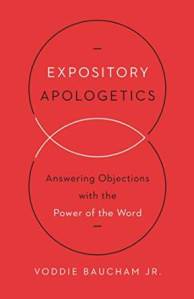 Expository Apologetics by Voddie Baucham, Jr. puts forward an apologetics methodology that is largely presuppositional in its approach. The core of Baucham’s approach is the use of biblical texts in engaging with those who do not believe.
A central aspect of Baucham’s methodology is the notion that the problem of unbelieve is not a lack of information but rather sin. He bases this claim on an interpretation of Romans 1 that is very much in line with that of other presuppositional apologists (see my post on the topic here). Because of this, Baucham alleges, apologetic approaches which approach others with information (such as an argument for the existence of God) rather than the Gospel (i.e. direct exposition of the Bible) fail.
Baucham also appeals to Scripture throughout the book, noting that the use of God’s word ought to be central to our lives as Christians and therefore central to our witness. He argues rightly that every single Christian ought to be engaged in apologetics; it is not something merely for experts.
Chapter 5, which emphasized learning apologetics through the use of historical creeds, confessions, and catechisms, was an excellent piece of advice for apologists. This was a breath of fresh air as too often Christians ignore the historical definitions of faith which are full of the richness of Christian thinkers throughout time. Baucham notes that anyone who attempts to dismiss a creedal tradition by saying “No creed but the Bible” has already made their own creed to which they adhere.
The book has many applicable insights into doing apologetics. This is worth taking note of, because often introductory apologetics books claim to present a method, but then never show that method in action. This makes it difficult to actually understand how to do apologetics or what is even meant by all the discussion about method. Baucham, however, continually uses examples that have direct practical application. Chapter 9 “Preaching and Teaching Like an Expository Apologist” is full of practical insights for apologists trained and untrained. Chapter 8 applied various ways to answer objections to a number of different situations. I appreciated how much practical advice is found throughout the book. It should be noted that a primary target for these practical engagements is same-sex marriage. It would have been nice to have the focus be on atheism rather than on specific moral issues, but the practical advice given can be applied to other situations as well.
A serious question might be raised about the audience of the book. Baucham claims that it is for “everyone” but then goes on to outline the audiences he intends. “The first audience is the heathen” (Kindle location 293). Surely, the use of this term will prejudice those who do not believe towards the book immediately. Heathen has come to be understood as very pejorative, and it is difficult to see why it was chosen. Moreover, he adopts the biblical use of the term “fool” not just in its technical sense, but also throughout the book to refer to those who do not believe. One wonders whetherthose who are described as heathen fools would be willing to read the book.
Another difficulty with the book is Baucham’s suggestion that children are basically little unbelievers. This stands in contrast to the notion of having faith like a child (which suggests that children have faith). Elsewhere, Baucham discusses the question one of his children asked him and how it demonstrated this child had not come to faith in Christ yet. But of course children ask questions about all kinds of things, and this does not entail they don’t believe in them. Indeed, Baucham’s continual assertion that unbelief is a problem of sin rather than information suggests that he is going against his own advice here. He treats his own children’s information problem as though this proves they are atheistic. This kind of theology is deeply troubling, and it cuts against the grain of Jesus’ own words about little children coming to him and having faith such as those little children.
The critique of other apologetic methods is also off base. For example, Baucham is highly critical of any method which does not use Scripture throughout the whole process. He cites a number of verses that speak of the power of God’s word, as well as other presuppositional thinkers like Sye Ten Bruggencate to forcefully admonish those apologists who use other forms of apologetics. However, such a critique is fundamentally flawed, for despite presuppositionalists’ commitment to realizing the epistemic effects of sin, they maintain this critique despite the fact that atheists often immediately shut down conversation–whether by refusing to continue, mocking, or the like–when the Christian cites Scripture. Baucham allows for this in some fashion by coming sidelong with Scriptural principles rather than direct citations, but if that is his position, then his whole critique is misguided to begin with! After all, a Scriptural principle is surely that God exists. Ergo, an apologist seeking to prove that God exists without explicitly citing Scripture is permitted to do so on Baucham’s own view, despite his critique of that very same apologist.
For some reason, Baucham also clings to using male pronouns for everything throughout the book, referring to humanity as “man,” and talking about all believers as “men.” Interestingly, the only female pronoun I noticed being used generically in the whole book was for an atheist “interlocutor.” When portions of the book refer to not needing to be seen as wise by “men” and or needing to be thought of well by “men,” one wonders whether Baucham simply dismisses women’s opinions entirely.
Expository Apologetics is an ultimately uneven ride introducing presuppositional apologetics to a broad audience. There is much applicable knowledge here, to be sure. However, it is alongside some poor arguments against other apologetic methods, questionable use of terminology, and some disturbing theological conclusions. It’s worth the read for the applicable knowledge, but there are many pitfalls to be found.
The Good
+Emphasizes the notion that every Christian should be an apologist
+Creeds seen as major point to drive apologetics
+Good amount of practical application to apologetics
The Bad
-Poor use of terminology
-Suggests children are to be treated as unbelievers
-Consistently uses male pronouns and “man” instead of gender inclusive language
-Dismisses other forms of apologetics
Disclaimer: I was provided with a copy of this book for review by the publisher. I was not required to write any specific kind of feedback whatsoever.
Source
Voddie Baucham, Jr. Expository Apologetics (Wheaton, IL: Crossway, 2015).
Links
The Unbeliever Knows God: Presuppositional Apologetics and Atheism– I write about the notion that all people have knowledge of God whether that is acknowledged or not. This has great implications for apologetics of all methods.
Be sure to check out the page for this site on Facebook and Twitter for discussion of posts, links to other pages of interest, random talk about theology/philosophy/apologetics/movies and more!
Book Reviews– There are plenty more book reviews to read! Read like crazy! (Scroll down for more, and click at bottom for even more!)
Eclectic Theist– My other interests site is full of science fiction, fantasy, food, sports, and more random thoughts. Come on by and check it out!
SDG.
——
The preceding post is the property of J.W. Wartick (apart from quotations, which are the property of their respective owners, and works of art as credited; images are often freely available to the public and J.W. Wartick makes no claims of owning rights to the images unless he makes that explicit) and should not be reproduced in part or in whole without the expressed consent of the author. All content on this site is the property of J.W. Wartick and is made available for individual and personal usage. If you cite from these documents, whether for personal or professional purposes, please give appropriate citation with both the name of the author (J.W. Wartick) and a link to the original URL. If you’d like to repost a post, you may do so, provided you show less than half of the original post on your own site and link to the original post for the rest. You must also appropriately cite the post as noted above. This blog is protected by Creative Commons licensing. By viewing any part of this site, you are agreeing to this usage policy.
Really Recommended Posts 12/11/15- Jesus’ Wife?, Polemical Apologetics, and more!
 Another week brings you another round of reads from around the web, courtesy yours truly. This week we have a report in on the “Gospel” of Jesus’ Wife, a look at “Guy Secrets revealed” (a common trap for our thoughts–making gender binaries), polemics in apologetics, our attitudes over Christmas/Advent, and a response to some arguments against the conclusions of the recent book, The Great Christ Comet.
Whatever Happened to Jesus’ Wife?– Well? Notice that the media uproar over the alleged “Gospel” of Jesus’ wife has effectively disappeared? There’s a good reason for that.
Response to an Amazon Review of “The Great Christ Comet”– Colin Nicholl, author of The Great Christ Comet, responds to a highly critical Amazon review of the book. The review argues that supernatural explanation best fits the Star of Bethlehem, while Nicholl holds it was a comet that was providentially ordered. See my review of the book here.
Guy Secrets Revealed?– Here’s an analysis of a book that claims to reveal “guy secrets.” The post provides much needed correction for the whole movement that seeks to identify the alleged inherent differences in preferences, mentality, and the like between men and women.
Polemics in Apologetics– The use of polemics in Christian apologetics is a necessary endeavor, but it requires some caution. Here is a great post putting forward how to balance the use of polemics in defending the faith.
A Note from Auntie Screwtape– If you’re not familiar with C.S. Lewis’s Screwtape Letters, I suggest you get acquainted with it ASAP. The concept is a set of letters written from a demon to another regarding temptation. Here is a post in that style about temptations this Christmas season.
Really Recommended Posts 12/4/15- Star Wars theology, women in the early church, and more!
We have already made it to December! Can you believe it? I can’t. That doesn’t mean I won’t keep delivering the goods, however! This week we have posts on women in the early church, dinosaurs and young earth creationism, an evil god?, the theology of Star Wars, and the Planned Parenthood shooting. As always, let me know what you think–and be sure to let the authors know as well. Also, because it’s already snowed a couple times, we’re switching back to the snowy owl to bring our post, Hogwarts style.
A Theology of Star Wars– Star Wars Episode VII comes out soon. I bet that’s news to you! I may or may not have my tickets to an early showing. The world will never know. Anyway, here’s a free e-book (sign up to newsletter required) on Star Wars and Christian theology. I haven’t gotten through the whole thing yet, but I’ve enjoyed what I’ve read so far.
Four Myths about Women in the Early Church– The topic of women in the early church is quite interesting. I’ve only read one book on the topic, but I’d like to explore further. This post highlights some myths about women in the early church that are largely taken as givens. In the debate over women in the church and home, it is important to get our facts straight.
Is an Evil God as likely as an All-Good God?– Edward Feser analyzes Stephen Law’s (in)famous “evil God challenge,” in which Law alleges that the evidence for the existence of God cannot bring us to a good God, so an evil God is just as likely. I have analyzed Law’s argument myself, and I believe I demonstrate that the assumptions behind his argument would yield radical skepticism if held consistently.
Why Pro-Life Advocates are not responsible for the Planned Parenthood Shooting– Some have alleged that the recent, horrific attack on a Planned Parenthood building can be blamed on the pro-life movement. Here is an analysis of that ad hominem attack vs. pro-life advocates that gets at the heart of the issue.
Where did all the Dinosaurs go? Ken Ham’s Climate and Human Induced Dinosaur extinction hypothesis– Young earth creationists must deal with the evidence we have about dinosaurs and their lives. Here is an analysis of Ken Ham’s hypothesis regarding what happened to all the dinosaurs after they purportedly survived a global flood alongside humans.

 J.W. Wartick - Reconstructing Faith