apologetics
Book Review: “God’s Crime Scene” by J. Warner Wallace
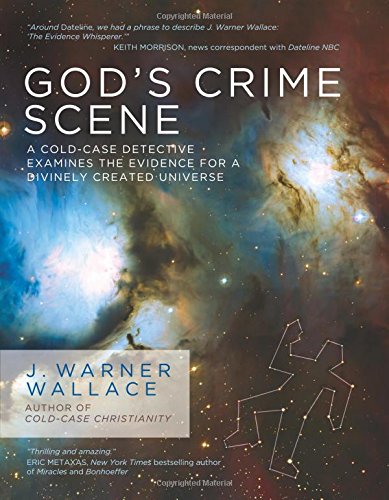 J. Warner Wallace is the a homicide detective and the author of Cold Case Christianity, one of my favorite introductory apologetics books (see my review). He recently came out with his second apologetics book, God’s Crime Scene. The former work focuses on the evidence for the resurrection and the reliability of the New Testament. In God’s Crime Scene, Wallace makes a convincing case presenting evidence for the existence of God.
The first question I think readers will ask is: “What separates this introductory apologetics book from the pack?”
That’s a valid question. There really are a rather large number of intro-to-apologetics books on the market now (thank goodness!). God’s Crime Scene is different from the rest in that it makes real-world examples central to the case that is made therein. That is, Wallace uses examples of crime scenes that he has experienced throughout the book (sans much of the gory details) to set the stage for each exploration of a different argument for the existence of God.
The way this works is simple: each chapter begins with a story that reads much like a mystery novel. Then, Wallace asks a question like “How might we figure out the evidence inside the room with the victim?” After he presents an answer to that question, he shows how similar evidence inside our own “room” (the universe) points to a being outside the room (aka a transcendent being) as the explanation. This makes the book eminently readable while also being almost immediately applicable.
The arguments that Wallace surveys are the cosmological argument, the fine-tuning argument. an argument from the origin of life, a biological design argument, the argument from consciousness, the argument from free will, and the moral argument. Then, he examines the problem of evil before summing up the case. Each chapter presents a look at the evidence, non-theistic explanations (with critiques), and an argument for why a theistic explanation is superior. The chapters then end with what this evidence tells us about God.
Wallace does a great job summing up many of the arguments involved in some of the standard theistic proofs. Each is analyzed briefly, but with a sometimes astonishing amount of information packed into a tight space. Thus, careful reading is required, and the benefit from a careful read is immense.
There are many illustrations and sidebars found throughout the book. These illustrations are always helpful rather than distracting, and highlight key parts of the arguments that Wallace makes. The sidebars are often discussions of how to weigh evidence according to the U.S. Criminal Justice system or Expert Witnesses that are either for or against the presented argument (this latter point is worth highlighting: Wallace does not only appeal to those with whom he agrees–he fairly presents the opposition’s viewpoint and even references their works directly).
There are a few criticisms I would offer. The first is that it seems like some conclusions are reached rather hurriedly, which is addressed in part through the excellent appendices that add more detail to the cases. Even there, however, one gets a sense that the sheer volume of material to cover is at times a stretch, with some objections only given two or so sentences as rebuttals. The other, admittedly nitpicky issue is that it does seem a little bit weird to have the analogue of the criminal being God. That is, the analogy being used is that just like we can detect a criminal through investigation of a murder scene, so to could we detect God through investigation of the universe. It just seems a little weird. It works; but it’s worth mentioning.
God’s Crime Scene is a valuable resource for those interested in apologetics. The way it is written makes it exciting rather than a chore, and the huge amount of information and argumentation contained therein is well worth the price of entry. I highly recommend it.
The Good
+Great use of criminal investigations to highlight points
+Clear exposition of arguments
+Good illustrations that add to what is written
+Real-world situations increase possibility of retaining information
+Includes experts who are not only theists but also anti-theists
The Bad
-Conclusions at times feel rushed
-A bit weird to have analogue of criminal as God
Disclaimer: I received a review copy of this book from the publisher. They did not require any specific kind of feedback whatsoever.
Links
Be sure to check out the page for this site on Facebook and Twitter for discussion of posts, links to other pages of interest, random talk about theology/philosophy/apologetics/movies and more!
Book Reviews– There are plenty more book reviews to read! Read like crazy! (Scroll down for more, and click at bottom for even more!)
Source
J. Warner Wallace, God’s Crime Scene (Colorado Springs, CO: David C. Cook, 2015).
SDG.
——
The preceding post is the property of J.W. Wartick (apart from quotations, which are the property of their respective owners, and works of art as credited; images are often freely available to the public and J.W. Wartick makes no claims of owning rights to the images unless he makes that explicit) and should not be reproduced in part or in whole without the expressed consent of the author. All content on this site is the property of J.W. Wartick and is made available for individual and personal usage. If you cite from these documents, whether for personal or professional purposes, please give appropriate citation with both the name of the author (J.W. Wartick) and a link to the original URL. If you’d like to repost a post, you may do so, provided you show less than half of the original post on your own site and link to the original post for the rest. You must also appropriately cite the post as noted above. This blog is protected by Creative Commons licensing. By viewing any part of this site, you are agreeing to this usage policy.
Really Recommended Posts 7/31/15- Planned Parenthood, the next Earth, the Quran, and more!
 I’m pleased to present to you, dear readers, another round of “Really Recommended Posts.” This round includes posts on science, the Quran, Planned Parenthood, and a four-legged snake.
Response to Planned Parenthood President Cecile Richards’ Washington Post Opinion Piece– A point-by-point rebuttal of Planned Parenthood’s response to the recent revelations regarding the possibility of their selling of body parts. Richards’ response leaves something to be desired.
Earth 2.0? Not Quite. – The recent revealing of an “earth-like” planet has sent some into spirals of hyperbole and extrapolation. What might we say about this “Earth 2.0”? Check out this post to find out more.
Why the Discovery of the Oldest Quran Fragments is No Big Deal– Recently, fragments of the Quran thought to be the oldest ever have been discovered. Does this demonstrate the truth of Islam? I think this is a good post on the apologetic significance of this find, though I do think that the increased ability to do textual criticism of the Quran is a pretty important aspect of the find.
How Atheists Try to Incorporate the Big Bang into their Worldview– Although not exhaustive, this post on some of the ways that some prominent atheist have tried to explain (or explain away) the Big Bang and its significance for the origin of the cosmos is worth reading and taking note of.
A Four-Legged Snake! Has the Edenic Serpent Been Found?– Does the discovery of a four-legged snake demonstrate the truth of young earth creationism?
Really Recomended Posts 7/24/15- Pantheism, Parenting, Headship, and more!
Another week means another go-round of the web with some great reads for you, dear readers! This week we have a broad array of posts featuring pantheism, apologetics for kids, “male headship,” distractions and dedication to scholarship, and creationism. Let me know what you thought of the links and be sure to let the authors know as well!
Aristotle’s four causes versus pantheism– Can pantheism account for the world we actually observe? Here, prominent Scholastic Philosopher Edward Feser makes an argument that pantheism fails to account for the different kinds of causation we observe in the world.
How to Get Your Kids to Ask More Questions About Their Faith– Natasha Crain offers some thoughts on how to get kids invested in their faith through asking questions. I hope to one day implement some of these ideas into my own home, when my child is maybe a little older 🙂 (he’s 10 months old right now).
Headship Madness: The Headship Litmus Test– How does the notion that male headship is necessary and the biblical view lead to it being a kind of litmus test for theology generally and church practice explicitly? Here’s a post exploring how this view often does lead to headship becoming the test for sound theology.
Terry Mortenson concedes: “Stone Age” tools are a problem for Young Earth Creationism– Here’s an analysis of recent comments from an Answers in Genesis scholar on one argument that has been used against young earth creationism. This is a pretty major problem for trying to fit the timeline of YEC into the evidence we have.
Strive to be the Spiritual Bruce Lee (Comic)- We need to work to avoid the distractions that often get in the way of our spiritual practices and work towards building the kingdom instead of blowing time on such things. That said, we also need to balance some time for doing activities we enjoy and relaxing. Here’s a comic that speaks to the need to beat distractions.
Really Recommended Posts 7/17/15- Inside Out, women and sacraments, apologetics, and more!
I’m excited to present this week of “Really Recommended Posts” to you, dear readers, because it is a truly extraordinary lineup. I’ve worked ’round the clock (or at least for an hour) to read and bring to you some excellent posts from all over. Our diverse reads today include the latest Pixar movie, “Inside Out,” the necessity of not sharing (or apologizing for) fake news, women in sacramental churches, an exciting new book, and the criminal justice system. As always, let me know what you think! Be sure to let the authors know you appreciated their posts as well.
Inside Out– One of my favorite web sites, Empires and Mangers, takes a look at Pixar’s latest smash hit, “Inside Out.” Anthony Weber looks at the worldview issues raised in the movie, as well as how it might be used to start discussions about some good topics with children. Check out this great reflection.
An Embarassing Week for Christians Sharing Fake News– Here is some advice that we all need to take to heart. Ed Stetzer goes beyond just calling on Christians to check their sources to a real urgency to repenting and admitting wrong when we do share falsities. This is a phenomenal read that deserves to go viral.
Women Leadership in Sacramental Churches– The debate over women’s “role” in the church looks different in those church bodies which are sacramental in nature. I am Lutheran and have experienced the kind of reasoning outlined in this post to try to restrict women’s places in the church firsthand. This is a good read that will not only broaden perspectives about sacramental churches but also make headway in the debate over women in the church.
New Book by James Warner Wallace: “God’s Crime Scene: A Cold Case Detective Examines the Evidence for a Divinely Created Universe– Here is some background on an exciting upcoming release from the author of “Cold Case Christianity,” J. Warner Wallace. It looks like it will be examining arguments like the fine-tuning argument for the existence of God. I wrote a glowing review of Wallace’s previous book, and I look forward to reading this one as well.
Obama frees drug offenders whose terms ‘didn’t fit crimes’– I think that the criminal justice system has turned into a major issue of injustice that we need to address. I think the President’s calling attention to this is a great thing, regardless of what political stance I and others take. There is gross injustice in inequality of sentencing for drug-related crimes, and there is data to back up that much sentencing is racially-biased. We as Christians must speak up for those treated unjustly, and this is an issue worth talking about. What are your thoughts? I’d love to read them here.
Rhetoric as Apologetic- Can we learn from ancient apologetics?
 In the ancient world, rhetoric was a major field of study. Briefly, classical rhetoric is the practice of discourse as a means to motivate, inform, persuade. It is hard to pin down to an exact degree what rhetoric is, but here we will use the term as broadly defined above.
Ancient Rhetoric in Apologetics
Mark Edwards, in “The Flowering of Latin Apologetic: Lactantius and Arnobius,” (cited below) examines the way these ancient apologists used rhetoric in their defense of the Christian faith. This involved demonstrating that Christians were educated over and against the notion that Christians were all slaves and fools. It also involved showing that Christians were the paragons of (Roman) society rather than people who overthrew society. They presented Christianity as an alternative way of thinking–a whole system which was to overthrow the Pagan thought of the time.
These different aspects of rhetoric in apologetics were specifically aimed at the audience of the time of Lactantius and Arnobius. Perhaps we can learn from their example.
Rhetoric in Apologetics Today
There are a number of ways we may apply rhetoric to apologetics today. One may argue that the use of memes is one (lowbrow) way of utilizing rhetoric in apologetics–making brief points in a provocative manner that brings forth further thought. How might we best use memes in apologetics? Are they even appropriate? These are questions that I will not delve into, but I think they are worth trying to work out for those involved in apologetics or interested in doing the same.
Another aspect of rhetoric which may be integrated into today’s apologetic is the continued deflection of charges from non-Christians against the faith. Specifically, some allege that Christians are stupid. Like Lactantius and Arnobius, we may feel free to flourish the names of Christian scholars through time and into today. Christians cannot truly be classified as necessarily stupid or foolish when they continually work in the highest levels of academia.
Rhetoric in apologetics seems as though it may necessarily be focused on the “low hanging fruit” like the examples given above. I’m not convinced this is the case, nor am I convinced that this is a valid objection to its use. Regarding the latter point, surely if charges are made against Christians necessarily being foolish or lacking education, a valid response is to demonstrate how this is false. The use of memes is frequently effective, though we must be wary of their tendency to oversimplify.
Regarding the former point–that rhetoric is not necessarily focused on “low hanging fruit,” I would note that in many ways, a convincing case depends on how it is presented. Moreover, as Christians we are called to present our case in a way that will put us above reproach in character. If we’re able to eloquently present a case, then perhaps more will consider the case itself. I’m not suggesting we try to obfuscate, but we should try to work to present our case in a winsome manner that utilizes the best scholarship, the most current language, and integrates the fewest possible errors (and this includes typos and spelling errors–something of which I am guilty, I’m sure).
Moreover, Lactantius and Arnobius were both clearly concerned with the imminent attacks on Christianity. They weren’t seeking to anticipate and shoot down future problems so much as they were dealing with the current attacks on their faith. Perhaps we can take this as a call to focus on the issues which face Christianity today ourselves. Like them, we need to confront the most popular of our naysayers and utilize the best scholarship in order to refute criticisms of Christianity.
Links
Be sure to check out the page for this site on Facebook and Twitter for discussion of posts, links to other pages of interest, random talk about theology/philosophy/apologetics/movies and more!
Sunday Quote– If you want to read more Sunday Quotes and join the discussion, check them out! (Scroll down for more)
On the Shoulders of Giants: Rediscovering the lost defenses of Christianity– I have written on how we may discover the enormous resources historical apologists have left behind for us. Take and read!
Source
Mark Edwards, “The Flowering of Latin Apologetic: Lactantius and Arnobius” in Mark Edwards, Martin Goodman, and Simon Price, eds., Apologetics in the Roman Empire
SDG.
——
The preceding post is the property of J.W. Wartick (apart from quotations, which are the property of their respective owners, and works of art as credited; images are often freely available to the public and J.W. Wartick makes no claims of owning rights to the images unless he makes that explicit) and should not be reproduced in part or in whole without the expressed consent of the author. All content on this site is the property of J.W. Wartick and is made available for individual and personal usage. If you cite from these documents, whether for personal or professional purposes, please give appropriate citation with both the name of the author (J.W. Wartick) and a link to the original URL. If you’d like to repost a post, you may do so, provided you show less than half of the original post on your own site and link to the original post for the rest. You must also appropriately cite the post as noted above. This blog is protected by Creative Commons licensing. By viewing any part of this site, you are agreeing to this usage policy.
Book Review: “Fool’s Talk” by Os Guinness
 Os Guinness’ Fool’s Talk is an argument for the need to change the forms of Christian persuasion used in apologetics specifically but also more generally in evangelism.
Guinness critiques the way that many go about their witnessing in categories that really only make sense within contexts that are foreign to a biblical understanding and worldview. He also shines the light on how often we allow our modern concepts to distort our witness–often for the worse. There are also a number of incisive arguments against the ways that people use excuses or sinfulness to avoid the truth in witness.
There are also many helpful comments on how we need to change our communication to confront the assumptions of our cultures and resonate even with those who are predisposed to disagree with us or not want to listen to the message of Christ. These include the need to confront sin, but do so in a winsome manner; to surprise listeners with a story told in a different way, and more.
The book is also supremely quotable, with many excellent one-line examples that people might use to illustrate points about communication, culture, and other important topics.
My main complaint with the book is that Guinness uses few practical examples to go with his critique or discerning of the styles of witnessing and engagement. The main examples used are biblical examples–surely a good way to find some effective communication!–but often these feel highly occasional rather than applicable to everyday situations. Guinness does an admirable job explaining these examples and highlighting how they were effective means of communication, but it would have been nice to have several practical applications in order to see exactly how Guinness thinks we are to change in these areas.
In several sections does offer some examples of how we might better communicate, but often it seems he is more concerned with informing the readers about how communication needs to change rather than following that with exactly how change might look.
Another complaint is that one of the hooks used by Guinness to start a chapter was to talk about a misogynist who successfully redirected the ire towards his position into making people think about what they were saying. It was an example that caught my attention, but using such a negative example to try to make a positive point was jarring.
Fool’s Talk provides many insights into how apologetically- and evangelically-minded people can explore new avenues for witnessing. However, it does not provide many practical examples for how people might go about exploring these avenues. It’s a good starting point, but readers will need to go farther.
The Good
+Clever wording often puts new perspective on old issues
+Some helpful hints at directions apologetics may pursue effectively
+Insightful commentary on ways engagement needs to change to be successful
The Bad
-Doesn’t offer many practical applications
Disclaimer: I was provided with a review copy of the book from the publisher. I was not asked to give any specific kind of feedback whatsoever.
Links
Be sure to check out the page for this site on Facebook and Twitter for discussion of posts, links to other pages of interest, random talk about theology/philosophy/apologetics/movies and more!
Book Reviews– There are plenty more book reviews to read! Read like crazy! (Scroll down for more, and click at bottom for even more!)
Source
Os Guinness, Fool’s Talk (Downers Grove, IL: InterVarsity, 2015).
SDG.
——
The preceding post is the property of J.W. Wartick (apart from quotations, which are the property of their respective owners, and works of art as credited; images are often freely available to the public and J.W. Wartick makes no claims of owning rights to the images unless he makes that explicit) and should not be reproduced in part or in whole without the expressed consent of the author. All content on this site is the property of J.W. Wartick and is made available for individual and personal usage. If you cite from these documents, whether for personal or professional purposes, please give appropriate citation with both the name of the author (J.W. Wartick) and a link to the original URL. If you’d like to repost a post, you may do so, provided you show less than half of the original post on your own site and link to the original post for the rest. You must also appropriately cite the post as noted above. This blog is protected by Creative Commons licensing. By viewing any part of this site, you are agreeing to this usage policy.
Really Recommended Posts 6/19/15- Creationism, memes, masculinity, and more!
Another week, another round of excellent reading from around the web for you, dear readers. We have analysis of creationist scholarship, a look at an exciting new book, historical apologetics, pro-life method, and analysis of a meme that attacks Christianity. As always let me know what you think, and let the authors know you enjoyed their posts as well!
The Dangers of Poor Scholarship: A Creationist’s Take on Feathered Dinosaurs– How do Young Earth Creationists often interact with science stories? Is there method consistent? Here, there is an analysis of creationist methodology when it comes not only to feathered dinosaurs but also to how the evaluate faulty arguments and lack consistency.
Malestrom: Swept up in the Currents of a Changing World (Review)– Color me delighted to see a book like this coming out. Our perceptions of what it means to be masculine are deeply embedded in our cultural norms. I have often engaged with complementarians who inform me of exactly what they think men ought to do or what men are “at their core.” But this they do without even acknowledging that even today there are cultures with differing understandings of what is masculine. How might we separate the good from the bad when it comes to talking about masculinity? This book seems to offer a way forward.
William Warburton’s 18th Century Defense of Christianity– It’s amazing how many historical defenses of Christianity are effectively lost in our time. The study of historical apologists is a continually fruitful one that yields great rewards for those who pursue it. Here, Doug Geivett highlights how even arguments that seem tied to their own time periods may provide us with new insights into controversies of our day.
John Reasnor Fails to Show that Incrementalism is Unbiblical– Clinton Wilcox engages in a debate over method when it comes to pro-life reasoning. Some have been arguing that we must do pro-life activism in such a way that only those laws or methods that ban all abortion may be supported. Is this reasonable? Wilcox analyzes the argument. I have provided a lengthy overview of and review of a debate on the same topic.
Will Your Murderer Be In Heaven?– Nick Peters offers an analysis of a meme floating around recently that attacks the goodness of Christianity because one’s own murderer might be in heaven. How does this attack hold up under scrutiny?
Robert Sawyer’s “The Neanderthal Parallax” – Faith, Scientism, and Humanity
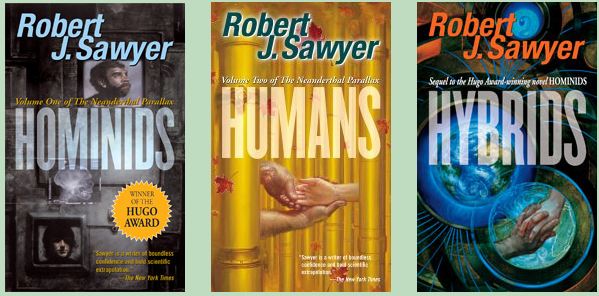 I recently finished reading Robert Sawyer’s trilogy “The Neanderthal Parallax.” I found the plot intriguing, but the worldview issues the books brought up had great difficulties in how they were conveyed and the kind of hidden premises smuggled in. Every story has a worldview, and the worldview of these books was surprisingly hostile and disingenuous particularly to Christians. I have enjoyed Robert Sawyer’s work in the past, but feel forced to interact with these books in a fairly critical fashion. There will be SPOILERS in what follows. I’ll not summarize the plot, but interested readers can see summaries on Wikipedia. I have written a review of the books here.
Faith
Perhaps the most unfortunate aspect of the books is that Sawyer seemingly did not put anything close to the amount of research and care into his portrayal of faith as he did his portrayal of biology, cosmology, and the like. On the latter topics, great detail is put into explaining aspects of various sciences and even invented science that Sawyer employs to support the plot. But people of faith are put up as frequently hypocritical but also lacking in erudition and thoughtfulness.
The central faith figure is Mary Vaughan, a specialist in ancient genetics. She consistently is put forth as the faithful counterweight to the faithlessness of the Neanderthals. However, she is a Roman Catholic who reveals objects to parts of her church’s official doctrines. She rejects the doctrine of original sin, for example. Having her put forward as the example of a religious person makes this even more difficult to swallow. I’m not suggesting that there are no people who have great cognitive dissonance in their beliefs–obviously many people do. The problem is that Sawyer uses Mary as the central image of Christianity throughout the novels, but she is woefully inept at even holding to the faith she claims for herself.
At one point in Humans, Ponter is talking to Mary at the Vietnam Memorial about life after death(188-207). He simply asserts that if you can’t see something it doesn’t exist. But of course this is as absurd as he claims “Gliskins'” (homo sapiens sapiens as opposed to the Neanderthals) belief in things like God is. I cannot see my own thoughts, yet they exist. Neither can I observe other people’s mental life, yet I am not irrational in believing that the people around me are also having thoughts.
In Hominids, Ponter speaks to Mary about the Gliskins’ viewing of a Mass taking place and again basically asserts that Christian belief in deity is absurd on its face. Mary struggles to articulate even the slightest defense of the Incarnation and other central Christian doctrines. Again, plenty of believers would struggle in this fashion, but Sawyer uses Mary as a kind of foil for all of Christianity. She’s got the best defenses Christians have to offer, and she can’t do anything but stutter when challenges to her faith are raised.
At several points, Big Bang Cosmology is challenged as something the Gliskins cling to because of their necessity of belief in a finite universe to support deity. Yet not only was Big Bang Cosmology initially rejected by the scientific community for this and other reasons (and only later accepted due to the mounting evidence for it), but even were the universe infinite, it would hardly follow that it is uncreated, as Ponter asserted without challenge. Sawyer seems to be unaware of–or at least makes his characters ignorant of–the entirety of Scholastic thought on the topic of continuous creation. Thomas Aquinas admitted this as a possibility. Thus, for Christians it is hardly an either/or of either eternal universe or finite universe. Either fits in with various strands of historic Christian theology. But again, Sawyer seems to have been either ignorant of this or willfully ignoring it to portray belief in deity in a more negative and indefensible light.
All of this wouldn’t be as unfortunate if Sawyer didn’t put discussions like this forward as if they were the best defenses Christians could come up with for their positions. Had they been simply believers who were also uninformed or insincere, it would not be as great an error. But Sawyer paints these interactions as though the defenses are the best Christians can come up with. As we have just surveyed very briefly, this is mistaken. I enjoyed the stories Sawyer put forward here, but his portrayal of people of faith is deeply flawed.
Religious Experience
Sawyer uses the books to explore the notion of a God part of the brain which, when triggered, can set off religious experiences. In Humans, it is discovered that Gliskins have a part in their brain which is able to have “religious experiences” triggered through electromagnetic interaction, while Neanderthals do not have a corresponding part of their brains.
A central scene in the entire series is near the end of Hybrids in Times Square, New York City. The Earth’s magnetic field is resetting and it triggers religious experiences, UFO sightings, and the like among the crowd gathered as this part of the Gliskin (homo sapien, remember) brain is triggered. People are crying out to their deities, fending off invading aliens, and the like all over Times Square. From this, Mary Vaughan’s faith is finally shattered:
The Pope had some ‘splainin’ to do.
All religious leaders did…
“It’s all a crock, isn’t it?” [Mary] said [to Ponter].
…”Look, I’ve changed my mind. About our child… Our daughter should not have the God organ…” (389)
Thus, we find that in Sawyer’s universe, the notion that we can induce religious experiences in the brain (and other types of experience like UFOs) means that these experiences are baseless in reality. Mary decides that her child should not have the capacity to have religious experience because it is all “a crock.” The Pope and others have some “‘splainin’ to do.” Presumably they are expected to take this as some kind of major challenge to their respective faiths.
The main problem with this is that we can conceivably trigger all sorts of things in the brain. It does not seem too outlandish to suppose that if we triggered a certain part of the brain, we might bring up a memory. If we extrapolate more, Sawyer’s vision of electromagnetically triggered religious experiences could be on par with memories as well, which could (in this scenario) be triggered in the same way. Should we start to distrust our perceptions or memories if we are able to trigger them with various impulses? Certainly not. This way lies (true) madness: distrust in our own memories and senses.
So what is left? What does the notion that religious experiences might be triggered by various brain activity demonstrate? Just that: religious experience may be triggered through manipulation. Full stop. This doesn’t in any way undercut evidence for theism or other beliefs from religious experience any more than our capacity to trigger scents, sounds, or memories would undercut our rational basis for believing this things to be real (or about real events).
Social Ills?
Sawyer uses the trilogy to attack all kinds of perceived and real social ills, from our treatment of the environment to gun control laws, and the like. But the question is how can he realistically put forward any kind of inter-cultural critique when the whole view he puts forward in the books is ultimately subjective. Mary Vaughan suffers a grotesque act of violence in a rape scene, but this is only used as an instrument in the plot (see my discussion here). Any moral critique Sawyer offers through his characters falls hollow because his only basis for it is some vague concept of pragmatism and self-preservation. Thus, it seems there is no ultimate basis for his criticisms of various ethical wrongs, and his use of several of these as mere instruments to advance the plot betrays this inability to provide an objective basis for right and wrong.
Conclusion
I’ve already written much on the difficulties with worldview in these novels. There are many more I could discuss. Again, I want to emphasize that it is very true that many Christians and believers would struggle to articulate their faith, be unable to defend various aspects of it, and not agree with at least some teachings of their church body. The problem is that Sawyer portrays this as the best Christianity can come up with. I was deeply disappointed to see that the overall thrust of the books was ultimately a kind of attack on my own faith, without any reasonable portrayal or interaction with stronger versions of it. Would that Sawyer had put the time into his depiction and study of faith as he had with the science behind this science fiction. For further reading, check out my reviews of the trilogy.
Links
Be sure to check out the page for this site on Facebook and Twitter for discussion of posts, links to other pages of interest, random talk about theology/philosophy/apologetics/movies and more!
Book Reviews: “The Neanderthal Parallax” – Hominids, Humans, and Hybrids by Robert Sawyer– I wrote a review of the trilogy on my other interests site. This review brings up some of the other worldview issues in the books, in addition to a brief summary of the plot outline and look at the science fiction elements.
Aliens that believe in God: The theological speculations in Robert Sawyer’s “Calculating God”– I write about a different Robert Sawyer book that I did enjoy quite a bit, Calculating God. I even wrote a second post discussing abortion, fundamentalism, and other issues the book raised.
Source
Robert Sawyer, Hominids (New York: Tor, 2002).
—, Humans (New York: Tor, 2003).
—, Hybrids (New York: Tor, 2003).
SDG.
——
The preceding post is the property of J.W. Wartick (apart from quotations, which are the property of their respective owners, and works of art as credited; images are often freely available to the public and J.W. Wartick makes no claims of owning rights to the images unless he makes that explicit) and should not be reproduced in part or in whole without the expressed consent of the author. All content on this site is the property of J.W. Wartick and is made available for individual and personal usage. If you cite from these documents, whether for personal or professional purposes, please give appropriate citation with both the name of the author (J.W. Wartick) and a link to the original URL. If you’d like to repost a post, you may do so, provided you show less than half of the original post on your own site and link to the original post for the rest. You must also appropriately cite the post as noted above. This blog is protected by Creative Commons licensing. By viewing any part of this site, you are agreeing to this usage policy.
RRP 6/5/15
Another week, another round of Really Recommended Posts! Here we have posts on “celebrity books,” a pro-life debate, young earth creationism, what it means to be a man, and Zen Buddhism. Check ’em out, let me know what you think, and let the authors know as well!
When We Evaluate Zen Buddhism by Its Own Standards– What happens when you evaluate a religion like Zen Buddhism by its own standards of truth and the like? Check out this post to find out.
A Response to John Piper: What does it mean to be a man?– Frequently, Christians who have specific views of what gender “roles” are supposed to be package their cultural notions of what these roles ought to be in as well. Thus, it is claimed that men like cars, but women like shoes. Often, these claims are made straight-faced as if they apply to all women and men in all times and places. I have seen this time and again. Here is a response to John Piper on this very topic.
Celebrity Books– People don’t always read books unless they are “celebrity” authors. Do you often just buy books because of the author on the front? I know I do. To be fair–this often works out well. Here’s a post looking at some of the downside of this.
Is It Wrong to Pass Incremental Pro-Life Laws?– Here is a snippet of a debate on pro-life method with the question of whether we should pass incremental legislation. I summarized this debate here and analyzed the debate here.
My Response to a Young-Earth Critique of “Navigating Genesis”– Hugh Ross responds to a critique of his recent book on Genesis. The specific challenge raised is the location of Eden.
Really Recommended Posts 5/29/15- Jesus or Muhammad, Kierkegaard, and more!
Hello folks, it’s another week and that means another round of Really Recommended Posts! Here we have a pretty solid lineup which includes a discussion of whether Muhammad or Jesus was prophesied in the Bible, an accidental flight to North Korea as a sermon illustration, Kierkegaard, the Resurrection, and setting an example for your kids.
A Prophet like Moses: Jesus or Muhammad?– It has often been alleged by Muslim apologists that Deuteronomy 18:18 references a prophecy of Muhammad. How strong is this claim? What about Jesus?
Apologetic Sermon Illustration: Why doctrinal details matter and the case of Kenyan accidental flight to North Korea– Based on a real news story in which a Kenyan made a nightmarish mistake: he flew to Pyongyang, North Korea instead of Pyeongchang, South Korea. In his own words: “…who could tell the difference?” This post is worth reading for the news story alone, but the use of it as an apologetics illustration as well was a great idea. The author used it to discuss religious or doctrinal pluralism.
The Great Dane: Remembering Kierkegaard– A brief snippet on Kierkegaard’s impact and life.
If Jesus did not really rise from the dead (Comic)- Here’s a great illustration of why it is important to realize what relevance the sincere belief of the disciples had regarding evidence for the resurrection.
Why Setting a Good Example for your Kids is Overrated– We need to avoid making our instruction of our children law-oriented and on behavior rather than on the truth of Christianity and the grace of God. Here’s a discussion of how we might do that.

 J.W. Wartick - Reconstructing Faith