atheism
Cosmos: Episode I Recap and Review
The Cosmos is all there is or was or ever will be. – Carl Sagan
I will be watching the “Cosmos” TV series and providing recaps and responses as we go. I’ll evaluate the ideas presented for accuracy and give critical responses where I see necessary. Future “Recaps” will likely be shorter, with more length dedicated to the response.*
Episode I: Recap
The episode started off with the above quote from Sagan. Then, we took a trip in a spaceship with the “imagination” to see what the Earth looked like millions of years ago, followed by a picture of what it might look like in the future (apparently like the Borg invasion in “Star Trek: First Contact,” so watch out!).
Then, we got a pretty sweet CG-heavy tour of the solar system via fake spaceship that looks like Eve from Wall-E. I mean it, it was awesome! I was reminded of the majesty of a Ben Bova novel (if you haven’t read him, I would recommend it, but be aware of some rather simplistic discussion of religion). Finally, we zoomed in on Voyager I which had sound travelling from it in vacuum. I’m pretty sure that can’t happen, but I could easily be mistaken about that, so I’d be happy to be corrected.
An unimanginably awesome picture of the Milky Way through infrared really put us in perspective: there are seemingly infinite stars to be seen merely in our galaxy, which is one of an untold panoply of galaxies. As we zoomed out through the gigantic extremes of the universe (the Supercluster), we find that that supercluster is but one among untold billions of galaxies and the observable universe.
But what is meant by “observable universe”? The universe is actually so huge that we can’t actually observe the entire thing because there is more beyond what we can see. But “many… suspect” that our universe is but one in an extremely huge number of actual individual universes (here shown as little bubbles spreading out continually over the screen).
Let’s also not forget the church is a big destroyer and persecutor of science. Galileo proves that science and religion are forever enemies, right? Galileo’s story is preceded by Giordano Bruno, who is portrayed as a kind of anime graphic novel hero maverick because he went along with Copernicus. I’ll just narrate along. He “dared to read the books banned by the church… and that was his undoing.” No really, that’s what they said about him. Interestingly, they also say that Bruno reasoned that because God was infinite, creation couldn’t be anything less. But the evil church threw him out into the cold and he had to sleep on the ground and freeze at night! Then, he had a vision of science dreamland wherein he broke the universe with his finger and lifted the veil of knowledge that the idiots surrounding him had put in place. He floated around the universe and was the first person to figure out that there was vacuum and also the first person to fly in space and land on the moon and sun. (Again, I’m not making this up: this is what he does in the animated sequence in the dream.)
If Bruno was right, according to “Cosmos,” then not only is church authority overthrown, but the Bible can be brought into question *cue religious people gasping in shock.* Bruno was condemned by the church and burned at the stake but magically had powers to float throughout the universe so that’s pretty cool: throw off the chains of church oppression and what you’ll get is genius and the ability to fly in space.
The episode then walked through the history of the universe by paralleling a single year. The Big Bang: we are all made of “star stuff” which was produced through various processes during and after the Big Bang. Earth formed through a number of collisions with various asteroids and the like. The origin of life “evolved” through biochemical evolution. These “pioneering microbes” invented sex, so that’s pretty cool. December 30th (in the cosmic year) brought about the desolation of the dinosaurs with an asteroid. Humans only evolved “the last hour of the last day of the cosmic year.”
 Evaluation
I love space. I love astronomy–my wife can attest to this as I randomly bought an astronomy textbook to read when I was in college. Yeah… I’m a nerd. I don’t claim to have science training or be a scientist, but there is something I can spot: unfounded metaphysical statements. That’s something I honestly expect to see quite a bit of when it comes to this TV series. It actually began with one from Carl Sagan: “The cosmos is all there is or was or ever will be.” Is that a scientific fact about the cosmos? Could you demonstrate that one for me? No. In short, the show begins with an ungrounded metaphysical statement.
Another issue I have is the personification and reification of science. “Science” does x; “Science” gives us y. I’m not at all convinced that “science” is a clearly dilineated entity such that we may speak of it as though it were a reified, ontologically extant entity. What does it mean to say that “science” does something? Don’t we mean that scientists are really the ones who do this? And are not scientists just as much people as anyone else?
The episode’s portrayal of history was very unbalanced. They depicted Giordano Bruno as a kind of hero against the church full of blundering idiots. When he was finally excommunicated, the quotes they put into the church’s mouth were interesting because they portrayed some of the actual issues happening, such as a strict adherence to Aristotelian science. At the time academia really was fully behind Aristotle, and it helped that the church had bought into his cosmology as well. However, for every minimal effort they made at showing some of the historical background, there was some significant effort made to show that the stupid church and its evil Inquisition had a “sole purpose to… torment anyone” who disagreed with the views of the Church. Bruno thought God was infinite so the universe could be infinite as well. Interesting thoughts, but these are juxtaposed against a depiction of everyone else as a bunch of religious idiots who couldn’t transcend space like Bruno could.
Moreover, what banned books that Bruno read are they referencing? Copernicus’ works weren’t put on the list of banned books until 1616 (thanks to Tim McGrew for this information). Just for reference, Bruno died in 1600. I’m curious as to what this depiction was supposed to suggest. I think they mentioned someone else earlier but the ties to Copernicus were evident throughout this section, and given that it was really the rejection of Aristotelianism which was condemning, there was some historical accuracy to be desired here.
Tim McGrew also points out a number of other historical errors, such as the notion that Bruno was burned at the stake for his astronomical views; the notion that everyone at the time thought the Earth was the center of the universe; the notion that being the “center” of the universe meant Earth had a privileged place; and several more major difficulties. I highly recommend surveying them.
The depiction of the multiverse with little-to-no qualification was alarming, for there is much debate over whether there even is such a multiverse, and if there is, to what extent it may be called a multiverse. The portrayal within this episode was essentially a fictitious account being passed off without qualification as something a lot of people believe. The wording used was that “many… suspect” there is such a universe. Well yes, that may be true, but to what extent can we test for these other universes? What models predict them and why? I am uninterested in how many people hold to a belief; I am interested in whether that belief is true.
The survey of the history of the universe was interesting, but there were some major glosses. As an apologist, let me admit my bias here: I would have loved to see some discussion of the fine-tuning involved for life. But that aside, I have to say that the brief snippet used to explore the origin of life: “biochemical evolution” was astonishingly insufficient. I’m sure we’ll get into that in the next episode, but the origin of life is one of the great unsolved mysteries within science and to just hand wave and say “biochemical evolution” is, well, notable to say the least.
Overall, I have to say I was unimpressed by this episode. The historical difficulties were great, but the metaphysical claims throughout passed off as scientific fact were more disturbing.
Links
Be sure to check out the page for this site on Facebook and Twitter for discussion of posts, links to other pages of interest, random talk about theology/philosophy/apologetics/movies and more!
Cosmos, Giordano Bruno, and Getting it Right– A brief but incisive critique of a number of major historical errors made throughout the first episode.
Cosmos with Neil deGrasse Tyson: Same Old Product, Bright New Packaging- In this post, Casey Luskin takes on the notion that science and religion are at war alongside some other errors in the episode.
Is there any science in the new “Cosmos” series, or is it all naturalistic religion?– Wintery Knight takes on the episode for making a bunch of claims without evidence.
Notes
*I may miss an episode or two if I have to work.
The image with the text “Cosmos: A Spacetime Odyssey” is from Fox and belongs to them. It came from promotional material and I use it under fair use and make no claims to ownership.
SDG.
——
The preceding post is the property of J.W. Wartick (apart from quotations, which are the property of their respective owners, and works of art as credited; images are often freely available to the public and J.W. Wartick makes no claims of owning rights to the images unless he makes that explicit) and should not be reproduced in part or in whole without the expressed consent of the author. All content on this site is the property of J.W. Wartick and is made available for individual and personal usage. If you cite from these documents, whether for personal or professional purposes, please give appropriate citation with both the name of the author (J.W. Wartick) and a link to the original URL. If you’d like to repost a post, you may do so, provided you show less than half of the original post on your own site and link to the original post for the rest. You must also appropriately cite the post as noted above. This blog is protected by Creative Commons licensing. By viewing any part of this site, you are agreeing to this usage policy.
Really Recommended Posts 3/7/14- Pastafarianism, Russia/Ukraine, Creationism, and more!
 Testing The Creationist’s Hyper-Evolution Orchard: Canines, Felines, and Elephants– Young Earth Creationists appeal to the Flood to explain the rock strata and fossil record. Yet in order to fit the animals onto the Ark, they are forced to posit a kind of hyper-evolution wherein only two of each “kind” were brought aboard and later diversified into the life we see now. Here is an in-depth analysis and critical response to this argument.
Off their noodles: The tedium of Pastafarianism– An insightful, thoughtful discussion of the New Atheist trend for comparing deity to the “Flying Spaghetti Monster.” Here, there is extensive analysis of the alleged analogy and its “adherents.”
Russia Launches Armed invasion of Crimea region of Ukraine– Some interesting analysis of the foreign policy issues at play here. The development of this has implications for people of faith, and we should be praying for those in the region, whatever our political affiliations or thoughts. The acting President of the Ukraine recently spoke of seeing God’s hand in the events in the region. As Christians, we should be seeking for God’s aid and intercession on behalf of the innocent; we should be praying for peace and the freedom of the oppressed.
Dear Sam Harris, It doesn’t matter if others made claims similar to the New Testament authors– It is not enough to say there are parallels to the Gospel claims and thus dismiss them historically. I made a lengthy argument against the notion that parallels can dismiss historical claims as well: Method or Madness?
Maybe Young Christians Leave Us Because They Were Never With Us in the First Place– J. Warner Wallace offers this powerful call to youth education in the faith.
Really Recommended Posts 2/28/14
Kids Say the Darnedest Heresies– How should we react when kids don’t understand essentials of Christian doctrine? Jason Wisdom offers some interesting advice for how to deal with the situation… and it’s not just to laugh it off! I’d be curious to see what parents think of this post!
A Critical Review of Myron Penner’s “The End of Apologetics”– “The End of Apologetics” recently received some acclaim from Christianity Today, which I find a bit shocking, to be honest. Rather than declaring the “end” of Apologetics, we should be encouraging its bolstering and spread. I very highly recommend this post for some looks into the issues Penner’s book raised.
Kevin Lewis: Sharing the Gospel with Atheists (VIDEO)- One of my professors from Biola University, Kevin Lewis, here shares his thoughts on how to share the Gospel with atheists. Kevin Lewis is a witty, awesome lecturer, and I think you’ll enjoy this as much as I did!
Option (COMIC)- A fun way to look at the rather famous “trilemma” from C.S. Lewis. Here, it is presented in comic form.
A Smart Movie that Questions Evolution (Yes It’s Possible!)– There’s a movie coming called “I Origins” which explores intelligent design and the New Atheism through… yes! a storyline! Check out this look into the flick. It’s apparently out already but I can’t seem to track it down anywhere. Have you seen it? What are your thoughts?
Book Review: “A Visual Defense” by Robert Velarde
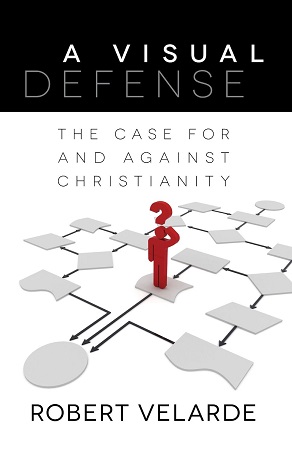 Robert Velarde’s A Visual Defense: The Case for and Against Christianity
Positives
The clear and extremely important benefit of the work is that it really does provide a way for people to envision how a number of arguments related to the truth of Christianity would look mapped out. The way that Velarde brings this out is by making a flow chart with the argument mapped out alongside objections and rebuttals.
The flow charts themselves are extremely helpful, because they really do allow one to sit with the book and use a finger to trace how the argument would work in practice. Although I was familiar with the arguments given, I felt as though I learned some things simply by seeing the arguments lined up in such a way as to follow them pictorially.
The format of the book is also very helpful. Each chapter begins with a flow chart that addresses a specific topic via an argument(s). The different parts of the flow chart have different shapes depending on whether they are the conclusion, assumption, premise, or rebuttal. These flow charts have every bubble numbered. The chapter following the flow chart simply lays out the numbers in order and explains in greater detail the conclusion, the premises, the objections, and the rebuttals. Thus, the format is highly readable and helps to draw out the flow chart more readily. I found myself flipping back to the flow chart very frequently as I read through the book.
Negatives
This book cannot really be used in isolation. One either needs another stack of books to get to the heart of many of the topics introduced or to come to the book with a working knowledge of a wide range of apologetics topics. The numbered outline of each part of the flow chart often gives only a small paragraph in defense of rather major apologetics topics. For example, the defense of the argument from religious experience comprises a page and a half and three bubbles on the flow chart (46-47). The argument itself is an area of major interest for me and, having read ten books and multiple articles on the topic, I realize it is a really massive issue. But due to the format of the book, this diminishes its value somewhat, as it seems like it would best be used as part of an apologetics class or an introduction to the issues related to the defense of the Christian faith. However, in order to do so, one would need a hefty general apologetics book(or a couple more specialized ones) to use alongside it.
I’m sure this was a conscious decision on the part of Velarde and others–the book is surely intended to be used in this fashion–but that doesn’t make the price of entry for newcomer any less.
The “visual” aspect of the visual defense could also be better integrated in the body of the work. The flow charts are extremely helpful, but it perhaps could have been even better to have a few more of them scattered about to use as defenses of various premises or other issues. I’m not a visual learner, so I admit it is hard for me to brainstorm on this, but I also think that the book could have perhaps integrated more pictures to show how the argument moves from one point to the next.
Conclusion
Robert Velarde is to be commended for taking a unique approach to introducing apologetics. The importance of providing a way for visual learners to understand these arguments in a pictorial fashion should not be understated. That said, the book essentially requires others to be read alongside it. I would imagine this book would be most useful for professors or small groups wanting to introduce the topics as opposed to a book to pick up and hand to a friend interested in apologetics. It would be a great tool to utilize in an apologetics class to introduce each major argument and then proceed into lengthier defenses of each.
Links
Be sure to check out the page for this site on Facebook and Twitter for discussion of posts, links to other pages of interest, random talk about theology/philosophy/apologetics/movies and more!
Source
Robert Velarde, A Visual Defense: The Case for and Against Christianity
I was provided with a review copy of the book from Kregel. I was in no way asked or required to offer any specific type of review. My thanks to the publisher for the review copy.
SDG.
——
The preceding post is the property of J.W. Wartick (apart from quotations, which are the property of their respective owners, and works of art as credited; images are often freely available to the public and J.W. Wartick makes no claims of owning rights to the images unless he makes that explicit) and should not be reproduced in part or in whole without the expressed consent of the author. All content on this site is the property of J.W. Wartick and is made available for individual and personal usage. If you cite from these documents, whether for personal or professional purposes, please give appropriate citation with both the name of the author (J.W. Wartick) and a link to the original URL. If you’d like to repost a post, you may do so, provided you show less than half of the original post on your own site and link to the original post for the rest. You must also appropriately cite the post as noted above. This blog is protected by Creative Commons licensing. By viewing any part of this site, you are agreeing to this usage policy.
Sunday Quote! – Is Atheism Wishful Thinking?
 Every Sunday, I will share a quote from something I’ve been reading. The hope is for you, dear reader, to share your thoughts on the quote and related issues and perhaps pick up some reading material along the way!
Atheism as Wish Fulfillment
I’ve been reading through Edward Feser’s The Last Superstition: A Refutation of the New Atheism. Feser is a Thomistic philosopher (one who follows in the tradition of Thomas Aquinas) and so he approaches these questions from a slightly different perspective than that of other theists who have responded to the challenge of the New Atheism. I’ve only just begun the book, but I found this quote juicy:
It is true that a fear of death, a craving for cosmic justice, and a desire to see our lives as meaningful can lead us to want to believe that we have immortal souls specially created by a God who will reward or punish us for our deeds in this life. But it is no less true that a desire to be free of traditional moral standards, and a fear of certain (real or imagined) political and social consequences of the truth of religious belief, can also lead us to want to believe that we are just clever animals with no purpose to our lives other than the purposes we choose to give them, and that there is no cosmic judge who will punish us for disobeying an objective moral law. Atheism, like religion, can often rest more on a will to believe than on dispassionate rational arguments. – Edward Feser, The Last Superstition, 10
Feser’s point is that atheists are just as capable of allowing their desires to cloud judgment when it comes to matters of philosophical judgments as are theists. Everyone has desires; the question is what the evidence is to support those desires. What do you think of this quote? How would you respond to those who assert that religious people are merely seeking wish fulfillment?
Links
Be sure to check out the page for this site on Facebook and Twitter for discussion of posts, links to other pages of interest, random talk about theology/philosophy/apologetics/movies and more!
Guest Post: “The Presumption of Popular Atheism” by David Glass– In this post, David Glass, himself an able response-man to the New Atheism, highlights one primary argument atheists make regarding theism: that theists have all the burden of proof on their side.
SDG.
Ken Ham vs. Bill Nye- An analysis of a lose-lose debate
 Today, Ken Ham, a young earth creationist, debated against Bill Nye an agnostic famous for “The Science Guy” program, on the topic: “Is creation a viable model of origins in today’s scientific era?” The debate was watched by over 500,000 people and generated a huge amount of interest. Here, I’ll review the debate section by section. Then, I’ll offer some thoughts on the content as well as a concluding summary. If you watched the debate, you may want to just skip down to the Analysis section. The debate may be watched here for a limited time (skip to 13 minutes in to start debate).
Ken Ham Opening
Ham began by noting that many prominent scientists argue that scientists should not debate creationists. He wondered aloud whether that might be because creationism is indeed a viable model and some don’t want that to be shown. He then showed a video of a creationist who was a specialist in science and an inventor, noting that creationism is not mutually exclusive from science.
The three primary points Ham focused on were 1) the definitions of terms; 2) interpretation of the evidence; and 3) the age of the universe is not observational science. Regarding the first, Ham noted that science means knowledge and so evolutionists cannot claim to be doing science. Regarding the second, he argued that both creationists and evolutionists observe the same evidence; they simply interpret that evidence differently. Regarding the third, Ham observed that “We weren’t there” at the beginning of the Earth and so we can’t know through observational science what happened.
Bill Nye Opening
Nye noted that the primary contention of the topic was to see whether the creation model lined up with the evidence. Thus, we must compare Ken Ham’s creation model to the “mainstream” model of science (his word). There are, he contended, major difficulties with Ham’s model, including the fossils found in layers in the Grand Canyon. He noted that there is “not a single place” where fossils of one type cross over with fossils of a different type or era. Yet, on a creation model, one would expect vast amounts of mixing. Thus, the creation model fails to account for the observational evidence.
Nye also noted that there are “billions of people ” who are religious and do not hold to creation science.
Ham Presentation
Ham again emphasized the importance of defining terms. He then presented a few more videos of creationists who are active scientists in various fields. One, a Stuart Burgess [I think I typed that correctly] claimed that he knew many colleagues who expressed interest in creationism but were afraid for their careers.
Non-Christians, Ham alleged, are borrowing from the Christian worldview in order to do science. The reason for this is because their own worldview cannot account for the laws of logic, the uniformity of nature, or the laws of nature. He asked Nye to explain how to account for these aspects of reality without God.
The past cannot be observed directly, he said, and concluded that we can’t be certain that the present is like the past. Thus, we must only deal with the observed facts that we can see now. On this point, the disagreements are over the interpretation of the evidence. That is, there is a set of evidence that both people like Nye and Ham approach. According to Ham, it is their worldviews which color their interpretation of the evidence such that they use the same evidence and get entirely contradictory conclusions.
The diversity of species which is observed is only, Ham argued, difference in “kind.” Thus, it cannot be used as evidence for evolution. The word “evolution” has been “hijacked” and used as evidence for unobservable phenomena extrapolated from that which is observed. The various species demonstrate a “creation orchard” as opposed to an “evolutionary tree.” One may observe different creatures, like dogs, each stemming from an a common origin, but none of these are traceable back to common descent, rather they exhibit discontinuity in the fossil record.
There is a major difference, Ham alleged, between “observational sciences” which looks at the things we can see in repeatable events now and “historical sciences” which extrapolates from the evidence gathered what happened in the past. We can never truly have “knowledge” regarding the historical sciences.
Nye Presentation
Nye began his presentation by noting that the debate took place in Kentucky and “here… we’re standing on layer upon layer upon layer of limestone.” The limestone is made of fossils of creatures which lived entire lives (twenty or more years in many cases) and then died, piled up on top of each other, and formed the limestone underneath much of the state. The amount of time needed for this is much longer than just a few thousand years.
Nye also turned to evidence from ice cores, which would require 170 winter/summer cycles per year for at least a thousand years to generate the current amount of ice built up. In California, there are trees which are extremely ancient, and some trees are even older, possibly as old as 9000 or more years old. Apart from the difficulty of the age of these trees, one must also wonder how they survived a catastrophic flood.
When looking at a place like the Grand Canyon, one never finds lower layer animals mixed with higher level animals. One should expect to find these given a flood. Nye challenged Ham to present just one evidence of the mixing of fossils of different eras together; he said it would be a major blow to the majority sciences.
If the flood explains animal life and its survival, one should observe the migration of animals across the earth in the fossil record; thus a Kangaroo should be found not just in Australia but along the way from wherever the Ark rested. However, these finds are not observed. Finally, the Big Bang has multiple lines of evidence which confirm it as the origin of the universe.
Ham Rebuttal
Ham argued that we can’t observe the age of the Earth. No science can measure it through observational evidence; rather it falls under historical sciences. One should add the genealogies in the Genesis account in order to find the age of the Earth. Whenever a scientist talks about the past, “we’ve got a problem” because they are not speaking from observation: they were not there.
Various radiometric dating methods turn up radically divergent ages for artifacts from the same time period and layer of rocks. The only infallible interpreter of the evidence is God, who provided a record in the Bible.
Nye Rebuttal
Rocks are able to slide in such a way as to interpose different dated objects next to each other.
Nye noted that Ham kept saying we “can’t observe the past,” but that is exactly what is done in astronomy: no observation of stars is not observing the past. Indeed, it takes a certain amount of time for the light to get to Earth from these various stars. The notion that lions and the like ate vegetables is, he argued, preposterous. Perhaps, he asserted, the difficulty is with Ham’s interpretation of the biblical text.
Nye then compared the transmission of the text of the Bible to the telephone game.
Ham Counter-Rebuttal
Ham again pressed that natural laws only work within a biblical worldview. There only needed to be about 1000 kinds represented aboard the ark in order to represent all the current species. Bears have sharp teeth yet eat vegetables.
Nye Counter-Rebuttal
Nye asserted that Ham’s view fails to address fundamental questions like the layers of ice. The notion that there were even fewer “kinds” (about 1000) means that the problem for Ham is even greater: the species would have had to evolve at extremely rapid rates, sometimes even several species a day, in order to account for all the differences of species today.
Q+A
I’ll not cover every single question, instead, I wanted to make note of two major things that came up in the Q+A session.
First, Nye’s answer to any question which challenged him on things like where the matter for the Big Bang came from was to assert that it’s a great mystery and we should find out one day. Second, Ham’s response to any question which (even hypothetically) asked him to consider the possibility that he would be wrong was to assert that such a situation was impossible. In other words, he presupposed he was correct and held to the impossibility that he could be wrong.
Analysis
Ken Ham
Ken Ham’s position was based upon his presuppositional apologetic. He continued to press that it is one’s worldview which colors the interpretation of evidence. The facts, he argued, remained the same for either side. It was what they brought to the facts that led to the radically different interpretations.
There is something to be said for this; it is surely true that we do have assumptions we bring to the table when interpreting the evidence. However, apart from the problem that Ham’s presuppositional approach with creationism is unjustified, Ham failed to deal with facts which really do shoot major holes in his theory. For example, it simply is true that, as Nye noted, when we observe the stars or distant galaxies, we are observing the past. Ham was just wrong on this regard. Moreover, other observational evidence (though not directly showing the past) does demonstrate that the Earth cannot be so young as Ham supposes. Furthermore, his hard and fast distinction between historical sciences and observational sciences is more of a rhetorical device than anything.
Ham’s position, I would argue, fails to account for the evidence which Nye raised (along with a number of other difficulties). Moreover, he continued to paint a picture of the Bible which rejects any but his own interpretation. In other words, he presented a false dichotomy: either young earth creationism or compromise with naturalism. However, I did appreciate Ham’s focus on the Gospel message. It was refreshing to have him present a call to belief in Jesus Christ as Lord and savior in front of such a massive audience.
Bill Nye
Nye did an okay job of trying to show that there may be more to the debate than simply creationism-or-bust for Christianity. Indeed, he actually went so far as to say there is “no conflict” between science and faith. Instead, he argued that Ham’s position is the one which generates such a conflict. His rebuttals provided some major reasons to think that Ham’s creationism could not account for the evidence. In particular, the difficulties presented by the proliferation of species after the flood and the fossil record were solid evidences.
However, Nye’s presentations had a couple difficulties. First, he failed to account for polystrate fossils: the very thing he challenged Ham to present. There really are such things as fossils which are found out of sequence (thanks to ElijiahT and SkepticismFirst on Twitter for this). That’s not to say they prove young earth creationism. Far from it. So Nye seems to have been mistaken on this point. Second, he presented the Big Bang theory as though Fred Hoyle somehow came up with the hypothesis, yet Hoyle is well known for denying the Big Bang. Third, the notion that the interpretation, translation, and transmission of the Bible through time is anything like the telephone game is a tiresome and simply mistaken metaphor.
Both
Both men were extremely respectful and I appreciated their candor. Each had several good points; each had some major flaws in their positions. The dialogue as a whole was interesting and helpful.
Conclusion
Readers by now should realize that I have to confess my title is a bit misleading. I was impressed by the tone of both speakers, though I thought they each made major gaffes alongside some decent points. The bottom line is that I find it unfortunate that we were exposed to a false dichotomy: either creationism or naturalism. There is more to the story. As far as “who won” the debate, I would argue that because of this false dichotomy, neither truly won. However, it seemed to me Ham had a more cohesive 30 presentation. That is, his presentation stayed more focused. Nye’s presentation jumped around quite a bit and had less directness to it. So far as “debate tactics” are concerned, one might chalk that up to a win for Ham. However, Nye successfully dismantled Ham’s presentation in the rebuttal periods. Thus, one was left with the impression that Ham’s view was indeed based upon his presupposition of its truth, while Nye was more open to the evidence. Again, I think both are wrong in many areas, but I hope that Nye’s tearing down of Ham’s position will not demonstrate to some that Christianity is false. As Nye noted, it may instead be Ham’s interpretation which is wrong.
There was much more to cover here than I could get to, so please do leave a comment to continue the discussion.
Links
Be sure to check out the page for this site on Facebook and Twitter for discussion of posts, links to other pages of interest, random talk about theology/philosophy/apologetics/movies and more!
Naturalis Historia– This site is maintained by a biologist who presents a number of serious difficulties for young earth creationism.
Gregg Davidson vs. Andrew Snelling on the Age of the Earth– I attended a debate between an old earth and young earth creationist (the latter from Answers in Genesis like Ken Ham). Check out my overview of the debate as well as my analysis.
Debate Review: Fazale Rana vs. Michael Ruse on “The Origin of Life: Evolution vs. Design”– Theist Fazale Rana debated atheist Michael Ruse on the origin of life. I found this a highly informative and respectful debate.
Reasons to Believe– a science-faith think tank from an old-earth perspective.
Other Reviews of the Debate
Ken Ham vs. Bill Nye post-debate analysis– The GeoChristian has a brief overview of the debate with a focus on what each got right or wrong.
Ken Ham vs. Bill Nye: The Aftermath– Luke Nix over at Faithful Thinkers has another thoughtful review. His post focuses much more on the topic of the debate as opposed to a broad overview. Highly recommended.
Ken Ham vs. Bill Nye: The Debate of the Decade?- Interested in what led up to this debate? Check out my previous post on the topic in which I urged Christians to write on this debate and also traced, briefly, the controversy leading up to this debate.
The image used in this post is was retrieved at Christianity Today and I believe it’s origin is with Answers in Genesis. I use it under fair use to critique the views. I make no claims to owning the rights to the image, and I believe the image, as well as “The Creation Museum” are copyright of Answers in Genesis.
SDG.
——
The preceding post is the property of J.W. Wartick (apart from quotations, which are the property of their respective owners, and works of art as credited; images are often freely available to the public and J.W. Wartick makes no claims of owning rights to the images unless he makes that explicit) and should not be reproduced in part or in whole without the expressed consent of the author. All content on this site is the property of J.W. Wartick and is made available for individual and personal usage. If you cite from these documents, whether for personal or professional purposes, please give appropriate citation with both the name of the author (J.W. Wartick) and a link to the original URL. If you’d like to repost a post, you may do so, provided you show less than half of the original post on your own site and link to the original post for the rest. You must also appropriately cite the post as noted above. This blog is protected by Creative Commons licensing. By viewing any part of this site, you are agreeing to this usage policy.
Really Recommended Posts 1/31/14- “Frozen,” French and American Atheists, world religions, and more!
 Another week, another round of great reading served up for you, dear readers. I’m writing this in the midst of getting 4-6 inches of snow (it’s already at 3, and not showing signs of slowing…), so I can’t help but feel a little bit like throwing in a Christmas movie today and sipping some cocoa. Oh well! It also made me think of the movie “Frozen.” The topics this week are Disney’s “Frozen,” the conversion story of a French atheist, “Street Epistemology,” the sign of Jonah and world religions, something we can learn from atheists in the “Bible Belt,” and evangelicalism and liturgy.
Disney’s “Frozen” might be the most Christian movie lately– I found this article on the movie “Frozen” to be quite insightful and interesting. I highly recommend the movie as well as this article.
How God turns a French atheist into a Christian theologian– I found this conversion story simply fascinating for how God works in people’s lives. The insights from this theologian are profound, and they speak volumes for the importance of a reasoned faith.
A Look at the New “Street Epistemology” Movement– Eric Chabot analyzes the “Street Epistemology” movement forged by Peter Boghossian for creating atheists. Chabot’s approach is fairly unique in that he explores the movement through means of certitude and doubt–a primary weapon for Boghossian.
Bible Belt Bubble Burst? Wisdom from an atheist friend– The importance of a reasoned faith is shared eloquently here through reflection on a conversation with an atheist friend in the “Bible Belt” of the United States. Highly relevant.
The Sign of Jonah– Winfried Corduan is a major scholar of world religions. In this blog post, he offers up a video of how world religions are impacting the United States alongside a commentary on the “Sign of Jonah” which Jesus says will be given to his contemporaries.
Evangelical conservatives vs. Liturgical conservatives– Is it true that one can be either evangelical or liturgical? Is there such a thing as a perfect blend and harmony of evangelical conservatism and liturgy? Look no further than Lutheranism. Check out this post with some interesting insights.
“Peter Boghossian, Atheist Tactician”- A brief look at the e-book by Tom Gilson
 I recently downloaded Tom Gilson’s evaluation of Peter Boghossian’s epistemology for my Kindle. The work is witty but also to the point. Gilson launched a full-on attack against Boghossian’s mission to create atheists. The best parts of the book–and let me be clear, I think the entire work is essential reading–were his critique of Boghossian’s view of faith and his appeal to Christians regarding the importance of the topic.
Gilson makes it clear how important it is to provide a reasoned answer to Boghossian’s view. However, he goes much further than that; he notes that Boghossian’s mission is specifically to destroy the faith of Christians. For any Christian, this should be a disturbing thing to hear. Unlike many other atheists, Boghossian seems to have a plan: he’s going to actively work to proselytize Christians for atheism. He may be called an atheist missionary. Gilson called Christians to see this as a serious threat for Christianity. It’s not that Christianity doesn’t have the resources to answer Boghossian’s arguments; instead, it is that we have not equipped ourselves to do so. The average Christian-in-the-pew is basically incapable of refuting Boghossian-esque reasoning, and so will, possibly, have their faith seriously challenged by arguments which are basically vacuous.
Part of Boghossian’s mission, Gilson notes, is to redefine the meaning of faith. For Boghossian, faith should always be understood as “pretending to know what one does not know” (kindle location 118). Gilson notes that not only would such a redefinition be catastrophic for people of faith [of “pretending to know…”], but it is also a completely invented definition with no basis in reality. That is, Boghossian sems to be pretending to know what he doesn’t know. On his own definition, he is very faithful.
Why think that Boghossian’s definition is wrong? Gilson offers a number of points. Among them is the fact that the redefinition of the term cannot account for its usage among the faithful. Gilson shows how the redefined “faith” would lead to an absurd meaning for any number of texts in the Bible. Not only that, but he also cites a number of Christian thinkers to demonstrate that the usage of “faith” is much more grounded in evidence and true belief than it is grounded in a “pretend” world. By the time Gilson has finished dismantling Boghossian’s usage, it becomes clear that the latter is truly living in his own fantasy. The problem is that if Christians do not equip themselves to combat it, the dream may become reality.
There are a number of other excellent portions of this quick read, such as Gilson’s direct interaction with a number of Boghossian’s interviews and writings. He also approaches Boghossian’s work from several angles, providing a solid ground for the refutation of the atheistic work.
In short, I implore you to pick up and read this work by Gilson. He has done an excellent job of showing how Boghossian’s work may prove to be a challenge to Christianity. But the greater service he has done is provided a tool to equip believers to combat this challenge. Read it, spread it. Keep the faith.
Links
You may get Gilson’s e-book for free at this link [I am unsure of how long this offer will last]. You may also support the ministry of Ratio Christi by purchasing the e-book.
Be sure to check out the page for this site on Facebook and Twitter for discussion of posts, links to other pages of interest, random talk about theology/philosophy/apologetics/movies and more!
Source
Tom Gilson, Peter Boghossian, Atheist Tactician (2014).
SDG.
——
The preceding post is the property of J.W. Wartick (apart from quotations, which are the property of their respective owners, and works of art as credited; images are often freely available to the public and J.W. Wartick makes no claims of owning rights to the images unless he makes that explicit) and should not be reproduced in part or in whole without the expressed consent of the author. All content on this site is the property of J.W. Wartick and is made available for individual and personal usage. If you cite from these documents, whether for personal or professional purposes, please give appropriate citation with both the name of the author (J.W. Wartick) and a link to the original URL. If you’d like to repost a post, you may do so, provided you show less than half of the original post on your own site and link to the original post for the rest. You must also appropriately cite the post as noted above. This blog is protected by Creative Commons licensing. By viewing any part of this site, you are agreeing to this usage policy.
The Bible Is Not One Book
 I was doing some research recently for a lengthy (book length!) project I am working on and was searching Amazon for some books on Bible prophecy. I came upon a work by John Walvoord called Every Prophecy of the Bible

I was perplexed by his (a male, judging by the picture) objection to confirming the Bible as true through prophecy. He wrote, “The book basically runs off a list of biblical prophecies that have supposedly been fulfilled. Amazingly pretty much all the evidence for these so called fulfilled prophecies comes from the same book making the prophecies in the first place ie the bible.” He then proceeded to ridicule Christians who do believe this as holding to an “infantile” belief.
The Objection
Unfortunately, this is not the first time I have seen an objection like this. Put simply, the objection is that the Bible can’t confirm itself, because that would be a circular argument. In other words, one can’t use material from one part of the Bible to confirm other parts of the Bible because then one is arguing for the truth of the Bible from the Bible.
The Problem
Most people should immediately see what the problem is. Although the Bible as we have it today is a single “book” in the sense that its contents share the same binding, it is really a collection of independent works written across over a thousand years by various authors in different parts of the world. In other words, the Bible is not “one book,” at least in the sense that one needs to maintain for this objection. Thus, if there is a prophecy found in one book which we know to be earlier than a book which is later that records its fulfillment, then there seems to be at least some evidence, prima facie, for the truth of the prophecy. (Of course this would be contingent upon the historical accuracy of the books, etc., etc. but the simple fact of an alleged prophecy’s existing before its fulfillment is an interesting facet to consider.)
A friend, Anthony Weber, made an analogy: think of the Bible as a library of books. Would it not be silly to think you couldn’t pull one book of the shelf and say that it confirmed another book? Suppose each book was about history, and one made a mere mention of a topic, while another featured a more detailed description. Would we not be surprised if someone came along and objected, saying “Well, they’re in the same library, so we can’t trust them!”
Inerrancy?
Christians need to realize that this has implications for doctrine as well. For example, those who maintain inerrancy–and I strongly believe that consistent Christians should do so (see my arguments to this end and defense of the doctrine here)–may be concerned that viewing the Bible in this fashion comes in danger of breaking it up piecemeal and pitting each segment against the others. But this is not what follows at all. Instead, it is simply an acknowledgment that the Bible is a collection of works in different genres written at different times in different places which, when put together, form a coherent whole.
Concluding call for intellectual honesty
In light of what I have explored, I want to first issue a call to the atheists out there: I know that you (atheists) do not all hold to objections like this and would find someone else using this objection a bit alarming. I call you to challenge your fellow atheists to a more honest interaction with positions of faith. If you want to criticize someone else’s position, fine. But do it without completely misrepresenting them. Call out your fellow atheists when they try to put forth this kind of drivel as a serious objection to Christianity. I try to call out fellow Christians when they do the same with other views.
To my fellow Christians: be aware that objections like these are not the backbone of atheism. Frankly, I think people like “gavin” are just grasping at anything to maintain unbelief and ridicule others they choose to look down on as “infantile.” Let’s engage with people who make these objections, but if they persist, dismiss the objection as the ridiculous notion it is. Finally, if you catch yourself treating the Bible like one book without any distinction in genre, time, place, etc., stop yourself. It is important to note the Bible is united in message, but God used different people as they were “carried along by the Holy Spirit.” It wasn’t delivered all by divine dictation.
Links
Be sure to check out the page for this site on Facebook and Twitter for discussion of posts, links to other pages of interest, random talk about theology/philosophy/apologetics/movies and more!
SDG.
——
The preceding post is the property of J.W. Wartick (apart from quotations, which are the property of their respective owners, and works of art as credited; images are often freely available to the public and J.W. Wartick makes no claims of owning rights to the images unless he makes that explicit) and should not be reproduced in part or in whole without the expressed consent of the author. All content on this site is the property of J.W. Wartick and is made available for individual and personal usage. If you cite from these documents, whether for personal or professional purposes, please give appropriate citation with both the name of the author (J.W. Wartick) and a link to the original URL. If you’d like to repost a post, you may do so, provided you show less than half of the original post on your own site and link to the original post for the rest. You must also appropriately cite the post as noted above. This blog is protected by Creative Commons licensing. By viewing any part of this site, you are agreeing to this usage policy.
Really Recommended Posts 1/10/14- Divergent, marriage, Boghossian, and more!
Dear readers: As a thank you for stopping by, check out my latest “Really Recommended Posts.” Here, we’ll look at the Young Adult book Divergent (coming to theaters soon!), marriage, Augustine, abortion, Boghossian’s atheist propaganda, and some great free Bible inserts for apologetics. Check ’em out. As always, feel free to drop your own Really Recommended Posts by leaving a comment with your recommendation (and why). Also, feel free to leave a comment on your thoughts on any of these posts.
Free E-Book Download: Peter Boghossian, Atheist Tactician– Let me tell you right now, you should immediately download and start reading this free e-book. It is a response to Peter Boghossian’s A Manual For Creating Atheists. Boghossian is intentionally trying to destroy Christianity and proselytize for atheism. I have not finished the book yet, but what I have read has been excellent. It comes with my recommendation.
Divergent– Anthony Weber over at Empires and Mangers, one of my favorite sites (and one you should follow!), reviewed the YA Book Divergent. He examined it from a worldview perspective. The book is being made into a major motion picture and has been hailed by some as the “next Hunger Games.” That means we’re going to run into it everywhere. What questions can we bring to the table? There are SPOILERS in this linked post.
Modern Marriage Concerns– How might egalitarianism play out in marriage? Here, a brief post explores the nature and possible concerns regarding marriage in an egalitarian system.
A Free Bible Insert to Say Thanks for a Great 2013– Check out this link to get some great printable Bible inserts related to apologetics to tuck into the pages for quick access. I highly recommend checking them out.
Augustine’s Confessions: Some Lessons for apologetics– Augustine’s work, Confessions, is an autobiographical account of parts of his life. In it, he provides some insights into what is needed for an apologetic approach even in our church today.
‘He killed my baby !’: The day I lost my daughter to the Culture of Death– A powerful story about awakening to the wrongness of abortion.

 J.W. Wartick - Reconstructing Faith