atheist
Materialists: Where is hope? Look to the stars!
 “[T]he Universe may harbor civilizations more intelligent than our own. Perhaps one day, through interstellar communication, some advanced civilization will help us resolve such age-old problems as war, famine, disease, overpopulation, misuse of natural resources, and human aging.”- John Oró, “Historical Understanding of Life’s Beginnings” (40, cited below).
Such is the hope of materialism. I’ve argued elsewhere that if all we are is matter, then there is no meaning. The pervasive response was that “we make our own meaning.” Leaving questions over the tenability of such a view aside, I have turned to a different, and interesting phenomenon: Where is there room for hope, within materialism?
It didn’t take long to dig up some quotes. One of the classes I’m taking this semester is on the Origins of Life. A few books we were assigned for this class were from a materialist perspective. The quote above is from one of those books. It resonated deeply with me. Consider this: If all we are is matter, having arrived here by unguided, biochemical processes, living on a dying planet in a dying universe–where is our hope? One cannot turn to transcendence with such a worldview, but one can attempt to emulate it.
Such is the case found in materialistic literature. Such is the grand materialist hope:
We can look hopefully for our saviors from the stars. There must be more intelligent life out there, and they will usher in a new era, a near utopia wherein disease, death, war, and hunger are all eliminated. Our alien saviors will rush to our aide once they’ve found us on this dying rock, and we will worship them as we used to worship the mythic gods of old.
But it is not just hope for the future which must guide us. Our realization that we are but one among many (and many who are probably smarter than us) must lead us to a new set of ethics. Oró writes of new ethical principles we must embrace: “Humility: The life of all cells descends from simple molecules… Hope: Someday we may communicate with more advanced civilizations… Universality: We come from stardust and to stardust we shall return… Peace: We should change our culture of war into a culture of peace” (Oró, 40-41 cited below). Humility, hope, peace, universality–these are all things Christians embrace also, but the materialist has redefined them. Our hope is not int the transcendent but in the here-and-now. Our hope, again, reaches for the stars.
But is this really a hope? We know the universe is dying. We know that, even were we to escape death, eventually the cosmic heat death of the universe would occur, and our ultimate doom is sealed. Should we hope that our alien saviors are also inter-dimensional travelers? Should we hope that they transcend space and time? I leave these questions open.
But the most interesting phenomenon in all of this is that the materialist has abandoned their presupposition. Rather than hoping for what is they hope for what we know not. They look to the stars, grasping at things unseen. Iris Fry, a professor at both Tel Aviv University and Technion-Israel Institute of Technology in Haifa and author of The Emergence of Life on Earth writes honestly and lucidly of the philosophical commitments of the materialist in this sphere:
[T]he realization that many non-empirical factors are involved in determining scientific positions and in the adoption of scientific theories leads to the notion of theoretical and philosophical decision, or commitment. Research into the origin of life and the search for extraterrestrial life are a clear case in point, because here the weight of the philosophical commitment is much greater than in more conventional scientific fields. As long as no empirical evidence of life beyond Earth has been found, and as long as no scientific theory has succeeded in providing a fully convincing account of the emergence of life on Earth, the adoption of an evolutionary point of view toward the question of life’s origin and the rejection of the idea of purposeful design involve a very strong philosophical commitment. -Iris Fry (283, Cited Below)
Ultimately, I think she is quite right. There is a philosophical commitment being espoused here, not a scientific commitment. Too often, materialists forget that, but kudos to Fry for honestly admitting it while also espousing the very commitment.
Where is our hope?
The materialist answers: The stars.
Is this really rational?
Sources:
John Oró “Historical Understanding of Life’s Beginnings” in Life’s Origin ed. J. William Schopf (Berkeley, CA: University of California, 2002).
Iris Fry The Emergence of Life on Earth (New Brunswick, NJ: Rutgers, 2000.
SDG.
——
The preceding post is the property of J.W. Wartick (apart from citations, which are the property of their respective owners) and should not be reproduced in part or in whole without the expressed consent of the author. All content on this site is the property of J.W. Wartick and is made available for individual and personal usage. If you cite from these documents, whether for personal or professional purposes, please give appropriate citation with both the name of the author (J.W. Wartick) and a link to the original URL. This blog is protected by Creative Commons licensing. By viewing any part of this site, you are agreeing to this usage policy.
Reading Mackie “Miracle of Theism”: Chapter 1
 I’ve been reading through The Miracle of Theism by J.L. Mackie. The book is known as one of the more powerful philosophical explications of atheism. You can read my thoughts on the introduction here (along with links to the rest of the series as they appear).
Chapter one thoughts:
Mackie begins with a brief outline of Hume’s argument, which he first outlines in five points, and refines it further thereafter. The five points from Hume, according to Mackie (p. 14-16) are: 1) “Hume says there are no really well-attested miracles…”; 2) “the human mind has a positive tendency to believe what is strange and marvelous”; 3) “reports of miracles ‘are observed chiefly to abound among ignorant and barborous nations’. Where they are believed by civilized peoples, these ‘will be found to have received them from ignorant and barbarous ancestors’, so that the stories will have acquired the authority of received opinions before the nations in question have developed powers of criticism and traditions of rational inquiry…”; 4) “different religions are in conflict: their claims therefore undermine and destroy one another…”; 5) “Hume says, the very fact that a miracle story is used to introduce a new religion or to support an existing one is an additional reason for skepticism. Many people have an intense desire to believe in some religious object…”
I see very little to commend among these five points. In fact, I find them all rather horribly mistaken. In regards to 1, this is simply begging the question. This “argument” is less a premise than it is an axiomatic denial of miraculous claims. It’s a broad, sweeping claim with no reason to accept it. There is nothing to support the second claim. I actually see it as a bit of “folk psychology of religion,” as it were. Isn’t it funny that the person, like Hume, who makes this point is believing a rather marvelous claim: that they are epistemically in a position to judge everyone else? It’s quite patronizing to make a point like 2, and given that the only evidence Mackie is willing to offer to support the claim is a vague hand wave towards people who believe in flying saucers, I don’t see any positive evidence to accept 2.
Regarding 3, we have a wonderful example of the genetic fallacy. Not only that, but I think we have a decent amount of evidence to show that this claim is simply false. While there are certainly persons who uncritically accept reports of miracles, there is a startling tradition within Christianity specifically which tells us to test such things for truth (cf. the comment to test the truth of spirits by the received Spirit in 1 John 4:1). And, of course, we could grant the third point and still find little reason to undermine the truth of miracles. Just because we have “received opinions” doesn’t mean these opinions are false. Mackie/Hume again just assume falsity, and apply folk psychology. It’s not a very objective method.
Point 4 is interesting because Mackie grants that “[4] has less force now than it had when Hume was writing.” But this is due, according to Mackie, not to the radical overvaluing of religious conflict, but because, according to him, various religions have made efforts to conform and take in aspects of each other—allowing for a broader spectrum and less internal conflict with claims of miracles from other religions. Fair enough, but I think there’s an even better reason to think the argument has little force: it doesn’t follow that because claims conflict, they are all false. Or, as I often like to put it, “Diversity of opinions does not entail the falsehood of them all.” I still struggle to see what the problem is supposed to be about miracle reports. It’s clearly false to say that they would cancel each other out, as Hume so ineloquently assumes. Suppose we apply this to another example: a murder investigation. One expert witness comes forward and says that the DNA evidence is positive. Another expert says it is negative. According to Hume’s standards, they’re both wrong, because they have conflicting opinons! But one of them has to be correct. I see no reason to accept 4 whatsoever because it literally tells us nothing useful.
Against 5, there must be some argument to show that 5 should be true, apart from more folk psychology. What evidence does Hume have to show us what he is saying is correct? I haven’t seen any offered.
Interestingly, Mackie actually grants a number of things which give credibility to the Resurrection. For example, he grants that independent witnesses increase the value of testimony (25). But, perhaps with the argument from the historicity of the resurrection in mind, he quickly modifies this account in an ad hoc way to provide himself a way out: “Not only in remote and barbarous times, but also in recent ones, we are usually justified in suspecting that what looks like distinct reports of a remarkable occurrence arise from different strands of a single tradition between which there has already been communication” (26). But of course Mackie gives no reason to accept this premise, and that is what it is: a premise. Mackie is positing that given a “remarkable occurrence” which is testified by different sources, we are justified in believing that they aren’t really independent, but are strands of a single tradition. Why should we believe him? What justifies us (epistemically) to do this? It is a rather monumental claim made by Mackie here, because he’s literally telling us that we are justified in question-begging any independent testimonies of miraculous reports out of existence.
Finally, Mackie closes the chapter with another remark similar to those he’s grown accustomed to throughout the chapter: “…it is all too easy to explain [a miracle/violation of a natural law] immediately by the automatic communication of beliefs between persons and the familiar psychological processes of wish fulfillment, and ultimately by what Hume himself was later to call ‘the natural history of religion’” (29). Well this sounds quite impressive, but Mackie has given us no reason to think that these explanations serve as the best explanation or presented us with evidence for the supposition that a natural explanation is always preferable to a supernatural one.
I can’t say I’m very impressed with Mackie’s critique of miracles. Hume’s argument fails to take into account anything but folk psychology, and Mackie’s additions really just amount to “Beg the question against the believer, and you’ve explained miracles.”
SDG.
——
The preceding post is the property of J.W. Wartick (apart from citations, which are the property of their respective owners) and should not be reproduced in part or in whole without the expressed consent of the author. All content on this site is the property of J.W. Wartick and is made available for individual and personal usage. If you cite from these documents, whether for personal or professional purposes, please give appropriate citation with both the name of the author (J.W. Wartick) and a link to the original URL. This blog is protected by Creative Commons licensing. By viewing any part of this site, you are agreeing to this usage policy.
Book Review: “Divine Motivation Theory” by Linda Zagzebski
 Linda Zagzebski is rightfully becoming a well-known figure in philosophy of religion. Her book, Divine Motivation Theory
The thrust of Zagzebski’s work is focused around two ideas: 1) exemplarism; 2) motivation. Together, these formulate the foundation for the rest of her discussion. The book is divided into three parts. The first explores “Motivation Theory” from a perspective which could be held even by those who are not theists. The second part explores “Motivation Theory” from within a theistic perspective. The third part deals with ethical pluralism.
One of the most important concepts in DMT is that of an exemplar. An exemplar is exactly what one would expect: a figure who demonstrates a “good life” by living it. Zagzebski writes of exemplars: “The particular judgments to which a moral theory must conform include judgments about the identity of paradigmatically good persons [exemplars]” (41). The thrust of Motivation Theory is a refocusing of metaethics. Rather than examining what is good and then evaluating judgments in light of that (as in Platonism, including theistic Platonism in many ways), and rather than focusing upon virtue (as in virtue theory), motivation theory focuses upon persons who are good. These persons formulate the basis for judging what is good, based upon motivation and emotion (40-50). A good action, motivation, or emotion, argues Zagzebski, is one which an exemplar would perform, have, or entertain.
Initially I admit I was a bit put off by this because it seemed quite arbitrary. Could we not define as exemplars people who are vicious and evil. Could not an exemplarist focus on ethics lead to Stalin, Hitler, and Pol Pot as exemplars?
Zagzebski counters this within DMT by focusing in part 2 upon the “divine.” Rather than arbitrarily choosing whomever one wishes as the exemplar, Zagzebski endorses God as the primary exemplar. This provides an alternative to Christian Platonism and Divine Command Theory by arguing instead that “God is essential to morality, not because it comes from either his intellect or his will, but because it comes from his motives. God’s motive dispositions, like ours, are components of his virtues, and all moral value derives from God’s motives” (185). The upshot of this is that God, being a perfect being (granting traditional theism), would have perfect motivations. Whatever God does, must be perfectly motivated.
The theistic focus on motivation within DMT provides several advantages. One among them is the fact that it solves many of the “problems” related to perfect goodness. For example, regarding what makes something God does good, DMT offers the solution that “God is good in the same way that the standard meter stick is one meter long. God is the standard of goodness” (185). Regarding the problem of evil, Zagzebski points out that her theory successfully solves the issue if it is metaphysically possible (313). The reason is that DMT’s focus upon motivation can be used analogically with human parents. “If we can understand,” she writes, “how the motivation of love of a human parent for her child might not involve any considerations of good and evil and yet still be a good motive, we must conclude that promoting good and preventing (or eliminating or not permitting) evil is not necessarily part of the motivational structure of a good being… even a perfect being might love in such [a] way that he would be willing to permit any amount of evil, not for the sake of some good, but out of love for persons” (317). These are oversimplifications of what Zagzebski writes on these problems, but I encourage the interested reader to read her work for a fuller explication.
There are so many things to discuss about DMT that remain, but I feel a full explanation would drag this review on unnecessarily. I would like to note a couple other very interesting arguments Zagzebski makes. She argues that there can be truth values with emotions (75ff). She points out that motivation is extremely important in moral judgments–if someone is doing something just to be hailed as a hero, they are much less praiseworthy than if they are doing it merely out of goodness (see 100ff). Elsewhere, Zagzebski and discusses several principles for dealing with pluralism (369ff). There are important points like these throughout the book. DMT challenges readers to rethink aspects of metaethical theory which they have unreflectively ignored. Yet in doing so, Zagzebski articulates a metaethic for theists which seems to have just as much (or more) plausibility as the alternatives.
Divine Motivation Theory deserves a reading by anyone interested in theistic metaethics. Linda Zagzebski offers a theory that has advantages over both Christian Platonism and Divine Command Theory. I highly recommend this work to any philosopher of religion. I cannot emphasize how much I think readers should get their hands on this work.
Source (and link to Amazon):
Linda Zagzebski Divine Motivation Theory
SDG.
——
The preceding post is the property of J.W. Wartick (apart from citations, which are the property of their respective owners) and should not be reproduced in part or in whole without the expressed consent of the author. All content on this site is the property of J.W. Wartick and is made available for individual and personal usage. If you cite from these documents, whether for personal or professional purposes, please give appropriate citation with both the name of the author (J.W. Wartick) and a link to the original URL. This blog is protected by Creative Commons licensing. By viewing any part of this site, you are agreeing to this usage policy.
Reading “Miracle of Theism” by J.L. Mackie: Introduction
This post will serve as a base for links to the rest of the chapters as I read them:
One reader of my blog recently challenged me to take on the heady atheists. Rather than focusing on the kind of basic fallacies found in various atheistic objections to belief, he suggested I should devote some of my philosophical energy to rebutting the claims of atheists who should actually be taken seriously. I took the advice to heart, acquired copies of J.L. Mackie’s Miracle of Theism and Graham Oppy’s Arguing About Gods. I’ve started reading Mackie’s book. I will be posting thoughts as I continue to read through it, and tie it into an extended critique of his arguments. For today, I’ll discuss only the introduction.
I found a few areas of agreement. Mackie noted that a cumulative case would not point to certainty, but could overcome objections to individual arguments. I agree with him here. I tend to favor a “cumulative case” type of argument, though I think that some theistic arguments could easily stand on their own to prove general aspects of theism (like a first cause).
I find a bit of difficulty with Mackie’s rather dismissive attitude towards faith (p. 4-6). As tends to be the case when faith is discussed by non-theists, he just brought up arguments which he believes shows that reason must be the basis for belief, and then moved on. But I’m not totally convinced that faith can be tossed aside as it is so often. First, I think of Plantinga’s proper function account and I think that while it is ultimately based on reason, it allows for one to be justified in belief through faith. Second, I’m not persuaded that faith cannot work as a kind of reason or discovery of reality. Faith, as it were, seems to account for many of our beliefs (other minds, for example?). So I think while I tend to be an evidentialist when it comes to these things, I am skeptical of a simple dismissal of faith. If anyone could help me with these points, I’d appreciate it.
Mackie discussed the possibility of naturalistic explanations of religion. I’m continually perplexed by the pervasiveness of this idea.Why should the origin of a belief undermine its truth? This would only work if the origin would serve to discredit the belief itself (as in Plantinga’s Evolutionary Argument Against Naturalism).
And I’ve been similarly unconvinced when it comes to others who argue that an account of how religious came to be would undermine the belief. I know Plantinga gives the idea more credit than I: in Warranted Christian Belief, I think, I recall him arguing extensively against naturalistic accounts. But I don’t see them as much of a threat, and I admit I groaned a bit when Mackie started going in that direction. It always seems like the kind of “hidden weapon” atheists have: “We have an evolutionary account of religion!” Of course whether that is true or not, I don’t see it as very persuasive.
SDG.
——
The preceding post is the property of J.W. Wartick (apart from citations, which are the property of their respective owners) and should not be reproduced in part or in whole without the expressed consent of the author. All content on this site is the property of J.W. Wartick and is made available for individual and personal usage. If you cite from these documents, whether for personal or professional purposes, please give appropriate citation with both the name of the author (J.W. Wartick) and a link to the original URL. This blog is protected by Creative Commons licensing. By viewing any part of this site, you are agreeing to this usage policy.
Refutation of Zeitgeist the Movie/farce.
One popular atheistic movie is “Zeitgeist,” a movie which purports (basically) to show that Christianity is made up , among other things.
As Peter Van Inwagen once said, it’s better to be right than original (irony? he wrote this in An Essay on Free Will), so I suggest anyone interested in refuting this farce of a “documentary” should go listen to Glenn Peoples’ podcast on the topic, found: HERE. Also, check out this great article which breaks Zeitgeist down point-by-point: HERE.
Those interested enough to check it out, I recommend watching the documentary, then listening to the podcast. Peoples really does an excellent job taking it down.
Letter to a free thinker.
Dear Free Thinker,
What does it mean to think freely?
Does it mean I must be an atheist?
You tell me there is no evidence for the existence of God.
You say that there is more evidence for unicorns than the object of my worship.
You tell me that I’m an atheist too.
Why do you say “we’re all atheists” when I believe in God?
You tell me “That’s just your interpretation”; “You’re wrong”; “I’m right.”
I reject science, according to you. I don’t know how to open my eyes. I’m blind, foolish, and stubborn.
You say that I’m delusional, and that my belief is a disease.
I have a final question:
Am I allowed to think freely…
Or is it just you?
Sincerely,
J.W. Wartick
——
The preceding post is the property of J.W. Wartick (apart from citations, which are the property of their respective owners) and should not be reproduced in part or in whole without the expressed consent of the author. All content on this site is the property of J.W. Wartick and is made available for individual and personal usage. If you cite from these documents, whether for personal or professional purposes, please give appropriate citation with both the name of the author (J.W. Wartick) and a link to the original URL. This blog is protected by Creative Commons licensing. By viewing any part of this site, you are agreeing to this usage policy.
Atheists and Unicorns: Emotional Appeal

 You may have heard it before. “I’m an a-unicornist, just like I’m an atheist.” “I don’t believe in unicorns, nor do I believe in God.” “There’s as much evidence for unicorns as for God.”
What are these statements supposed to show?
Whether intended or not, these kinds of statements are simply emotional appeals. The atheist is attempting to psychologically discredit Christianity without ever engaging any kind of logical reasoning.
Think about it, when you hear these phrases, what rational process goes on? There is no rational link between unicorns and theism. There is no reason to correlate the two.
Theists could just as easily use psychological appeals, but there is no need to do so. Such pejorative language doesn’t serve to foster discussion. It’s preaching to the choir. It is useful only for increasing dogmatism. So why do atheists use it so frequently?
Again, the key is to note that those who use this phrase are not doing so in the interest of academic honesty or discussion, but in the interest of psychologically weighting the discussion in their favor before it even begins. Rather than looking at the evidence, they dismiss it.
But what about another common use of the unicorn within atheism? Namely “I can’t prove there is no God, just like I can’t prove there are no unicorns.”
While this initially seems plausible, it only remains plausible if one assumes positivism. We can actually prove there is no God. If the Christian’s account of God was found to be incoherent, then God would not exist. It would, in fact, be impossible for God to exist were his nature contradictory.
So even in this use of the phrase we find that the atheist is committed to a dogmatic assumption of positivism. By assuming that God can only be disproven by empirical evidence, they uncritically advance a philosophical enterprise which has largely been abandoned within modern philosophy.
A word of advice: focus on the arguments at hand, not pejorative language.
SDG.
——
The preceding post is the property of J.W. Wartick (apart from citations, which are the property of their respective owners) and should not be reproduced in part or in whole without the expressed consent of the author. All content on this site is the property of J.W. Wartick and is made available for individual and personal usage. If you cite from these documents, whether for personal or professional purposes, please give appropriate citation with both the name of the author (J.W. Wartick) and a link to the original URL. This blog is protected by Creative Commons licensing. By viewing any part of this site, you are agreeing to this usage policy.
Immortal, Invisible: Do Christians believe something crazy?

 I was singing a hymn in church today, one of my favorites: “Immortal, Invisible”; also known as “Immortal, Invisible God Only Wise”
Looking through the lyrics I could see objections to Christianity arise:
“Immortal, invisible, God only wise… Unresting, unhasting, and silent as light… ‘Tis only the splendour of light that hides thee.”
I could see the objection that would be raised almost instantly: Why do Christians believe in something they cannot see? Are Christians crazy?
Simple answer: No, we all believe in invisible things, whether we know it or not.
Long answer: Think of all the things we cannot see that we believe in, and judge for yourself.
1) We believe in the reality of others’ thoughts. This cannot be observed. Although we can observe, in some sense, the brain functioning, we cannot literally see others’ thoughts.
2) Other minds. This one is very similar to the previous one; we believe other people have minds (not to beg the question against materialist–this could be reworded to say we believe other people have brains which trigger phenomena).
3) The ‘real world.’ It is impossible to prove that we are not brains-in-vats. We cannot prove that everything we know is not being projected into our minds by some outside source. Yet we are justified in believing in a world outside of ourselves.
4) Causation. We cannot “see” causation; we can only see its effects. While some philosophers (Hume, for example) deny causation; we are justified in believing that events can cause each other.
5) Gravity. I can’t “see” gravity, I can only infer that it’s there based upon its effects and/or measurements from instruments which don’t show me pictures of gravity.
6) Dinosaurs lived. We have not observed living, breathing dinosaurs. Yet we feel are within our epistemic rights believing that, at one time, dinosaurs walked on the earth. But think about it: we’ve never seen a dinosaur–we’ve only seen its bones. What allows us to think that those bones were once covered with flesh and walking around?
To deny the above examples (which could be multiplied continually) rightly seem ludicrous, yet they are based on similar reasoning as those who object to God’s existence simply because we cannot see God. Think about it: the inference is “I cannot see God, therefore, God does not exist.” Yet the same types of argument would dispute belief for any of the above examples.
These things are known only by their effects. But the Christian believes God is known by His effects as well. God responds to prayer; He keeps the universe in existence; He causes miracles; He caused the universe. Not only that, but we have philosophical arguments which justify belief in God. The case for the existence of God does not rest on whether we can “see” Him or not.
Those who ridicule Christians for their belief in a God who cannot be seen but by His effects may want to reevaluate their arguments; as with most fallacious arguments, they either prove too much (all things we can’t see don’t exist) or nothing at all (the argument is false).
SDG.
——
The preceding post is the property of J.W. Wartick (apart from citations, which are the property of their respective owners) and should not be reproduced in part or in whole without the expressed consent of the author. All content on this site is the property of J.W. Wartick and is made available for individual and personal usage. If you cite from these documents, whether for personal or professional purposes, please give appropriate citation with both the name of the author (J.W. Wartick) and a link to the original URL. This blog is protected by Creative Commons licensing. By viewing any part of this site, you are agreeing to this usage policy.
Do I reject secular government?
Recently, Austine Cline, of the about.com breed of atheists, has offered this critique of my position on Christian voting/acts in government. My own post on the topic can be found here. I would like to clear up a few things about the position I hold. These clarifications will be found in numbered italics throughout the post below.
1) I accept the authority and respect the secular government.
Cline started his caricature of my position immediately with his title. The title of his entry is “J.W. Wartick: Christians Should Reject Secular Government.”
Let me make this clear. That is a position I deny, and in fact oppose. The Apostle Paul wrote in Romans 13:5-7 that “it is necessary to submit to the authorities, not only because of possible punishment but also as a matter of conscience. This is also why you pay taxes, for the authorities are God’s servants, who give their full time to governing. Give to everyone what you owe them: If you owe taxes, pay taxes; if revenue, then revenue; if respect, then respect; if honor, then honor.” Being a Christian who views the Bible as a source of authority, I agree wholeheartedly.
2) My previous post on the government was intended as a wake-up call to Christians who are lax when voting on moral issues.
One who reads my previous post on this topic should be able to discern that I was not advocating a theocracy, but rather a theo-centric approach to voting. I was arguing that Christians should vote their beliefs, not what they think is most “neutral.” Cline took that and ran with it, and, whether intentionally or not, used his post to try to portray me as some kind of fanatic advocating the overthrow of government in favor of a theocracy. Again, such a position may exist somewhere, but it is not the position I hold.
3) The authority of government comes from God.
Again, Paul makes this clear in Romans 13:1 “Let everyone be subject to the governing authorities, for there is no authority except that which God has established. The authorities that exist have been established by God.”
Obviously, this won’t be convincing to the atheist. But this is intended to rebut a critique from Cline, who wrote, “[Wartick’s argument] presumes that the government has any authority to prevent ‘unrepentant sin’ and ‘unbelief’ in the first place.”
Clearly, if the government gets its authority from God, then it would have the authority to do this. Cline is an atheist, so he rejects such a structure of authority. However, being a Christian, I don’t see any reason to reject it. Yet the focus of Cline’s critique was based upon this premise (in fact, he restates it later “On what basis does Wartick think he has the right to enlist the government to help him prevent other Christians from doing things which he thinks is sinful but they don’t?” and then again in regards to other religions).
My answer to these questions is simple: the government gets its authority from God, so it does have the authority to do these things. Cline presented no argument to the contrary, nor did he offer a positive argument for secular government, other than a brief note that Christians established it to begin with so they would stop killing each other (according to Cline). So Cline’s counter-argument merely begs the question by assuming a secular authority structure. If there were no God or if the authority of the government were not from God, then he would have a valid critique. But criticizing my argument in this manner does not serve to do anything but beg the question against the Christian theist, particularly because my original post was written to fellow Christians (hence the closing line, “Christians, why are you politically atheists?”).
4) Cline misrepresented my argument.
As I’ve already hinted at, Cline cherry-picked portions of my post, and then made a title which seems to aim more towards sensationalism than any kind of respectful debate. I never argued Christians should reject secular government; I did argue that Christians should not be atheists themselves when it comes to politics. This kind of fear-mongering about Christians in politics doesn’t serve anyone but those who are already fanatics themselves–to the other extreme.
SDG.
The Kalam Cosmological Argument
 One of the most frequently cited and debated arguments for the existence of God is the Kalam Cosmological Argument. I have not written on the argument before because there is simply so much good material on it out there that I don’t think I can add anything new. I have, however, run into numerous people with questions on the argument recently, and felt the need to finally get around to a post on the Kalam. Those interested in the argument are highly encouraged to read the links included at the end.
The argument
The argument itself is quite simple:
1) Everything that began to exist has a cause
2) The universe began to exist
3) Therefore, the universe has a cause
The argument is deductively valid, so the question is whether the premises are true. If true, the conclusion is certain.
Defense of Premise 1
Why should we think that whatever began to exist has a cause? First, it seems a denial of this principle would undermine science. Science is an investigation of causation. If the anti-theist wishes to deny this premise, she is committed to a fallacy similar to that which she calls the “goddidit” fallacy: dismissing explanation for an event. (Interestingly, saying “God did it” is not a dismissal of explanation: it is, itself, an explanation. It’s saying the explanation which best fits the evidence is theism.)
Suppose premise 1 were false. In that case, things could and would be coming into existence for no reason whatsoever out of nothing. We would observe a remarkably different universe than that which we do, in fact, observe. A tiger would miraculously materialize in my room and eat me.
Now, it must be noted that some appeal to quantum physics in order to say this premise is false. They hold that certain quantum events bring things into existence without reason. Such an interpretation seems misguided at best, however, for a few reasons. First, the event would seem to have an explanation, namely, that it is a quantum phenomena of type x. Second, even were one to deny that this is a form of explanation or causation, the fact remains that these quantum events don’t originate from nothing. They originate from the laws and systems present within our universe. Third, these quantum events, on an examination of quantum theory, are not uncaused; they are merely spheres of probability. Finally, an exclusion of causal chains seems to undermine quantum theory itself or at least make it difficult to correctly interpret (on this, see William Wharton’s paper “Causation with Quantum Mechanics”). Like Wharton, I think the main reason causation is sometimes excluded from interpretations of QM is because of an avoidance of “metaphysical first causes.” Obviously, if this is the motivation for avoiding causation, it is not spurred by a commitment to science, but a commitment to avoiding the metaphysical implications of science.
Finally, consider what Wintery Knight points out about QM and the Kalam:
First, quantum mechanics is not going to save the atheist here. In QM, virtual particles come into being in a vacuum. The vacuum is sparked by a scientist. The particles exist for a period of time inversely proportional to their mass. But in the case of the big bang, there is no vacuum – there’s nothing. There is no scientist – there’s nothing. And the universe is far too massive to last 14 billion years as a virtual particle. (Wintery Knight, “How to defend the kalam cosmological argument just like William Lane Craig” April 8th, 2009).
The quantum events observed are caused: by the scientist. Therefore, they don’t undermine premise 1.
To sum up, the reasons for thinking the first premise true are clear: 1) to deny it undercuts science; 2) we don’t observe a universe with uncaused events; 3) the only reason found to deny the premise is an a priori commitment to anti-theism.
Defense of Premise 2
Did the universe begin? There are many arguments to support the premise that the universe did, in fact, begin, but I’m going to focus on only two: the impossibility of an infinite past and the empirical evidence of a finite past.
Impossibility of an infinite past
If the past is infinite, then we will have had to cross an infinite number of moments of time in order to come to the present moment. However, for any finite number of moments in time, x, there will always be a moment such that x+1 does not equal infinity. There is no way to start at any arbitrary moment in the supposedly infinite past and then add enough successive moments to arrive at the present moment. As such, it would be impossible to experience the present moment. However, we are experiencing the present moment, therefore, the past is finite.
Empirical evidence for a finite past
Despite misgivings from some Christians about the Big Bang theory, it has proven to be eminently valuable for arguments like the Kalam. I would go so far as to say the Big Bang serves as powerful evidence for a creator.
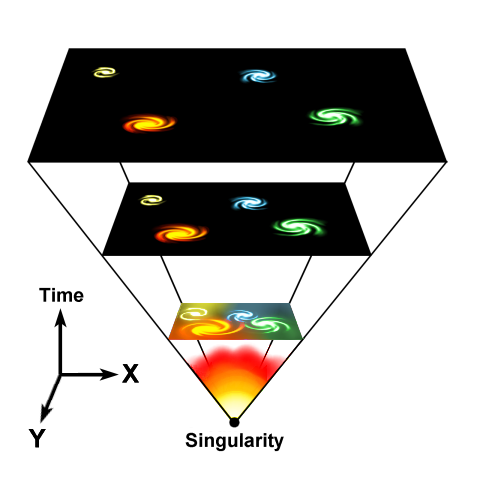
The reasoning behind this is that when we measure cosmic background radiation we can measure the expansion of the universe. Extrapolating backwards leads us to the conclusion that at some point in the finite past, the universe began to exist.
Therefore, it is reasonable to conclude that both premise 1 and 2 are true. However, because the argument is deductively valid, it follows that the universe has a cause.
Conclusions
Okay, so the universe has a cause. That doesn’t prove God exists! Well no, it doesn’t, but it does show that whatever caused the universe has many of the attributes classical theism has attributed to God, and therefore lends credence to the claim God exists. For whatever caused the universe must have extraordinary power (omnipotence); it must have made a choice to create the universe out of nothing (personal causation/agency); it must have been outside of time (the universe came into existence along with space and time); it must have been outside of space; and it must exist necessarily. As such, the Kalam doesn’t prove Christianity true instantly; it just proves theism is more plausible than atheism. Not only that, but it does show that whatever caused the universe is remarkably similar to the God Christians claim exists.
Appendix: Who made God?
Perhaps the most common objection to the argument outlined above is “Okay, well who made God?” This common retort can be answered after a minute of reflection. Classical theism holds that God exists necessarily, which means that God is eternal and beginningless. The first premise asserts that “whatever begins to exist…” therefore, it doesn’t apply to God. Is this a mere ad hoc fix on theism? No, because it isn’t saying God has no explanation for His existence (which reason is found in His necessary existence); it is saying that he did not begin, and is therefore uncaused. The detractor at this point would have to establish that “everything which exists is caused”–a much more difficult claim to defend than the claim that “everything which began to exist has a cause.” In fact, the anti-theistic claim seems necessarily false, for things which don’t begin are uncaused.
Links
Answers to objections towards the Kalam Cosmological Argument from Richard Dawkins and Graham Oppy
Did the multiverse create itself? Who made God?– more objections to the KCA are answered.
Sites
Wintery Knight “How to defend the kalam cosmological argument just like William Lane Craig”
Thinking Matters “The Kalam Cosmological Argument”
Wintery Knight, “The kalam cosmological argument defended in a peer-reviewed science journal”
Books
The Kalam Cosmological Argument by William Lane Craig
The Blackwell Companion to Natural Theology edited by Craig and J.P. Moreland
SDG.
——
The preceding post is the property of J.W. Wartick (apart from citations, which are the property of their respective owners) and should not be reproduced in part or in whole without the expressed consent of the author. All content on this site is the property of J.W. Wartick and is made available for individual and personal usage. If you cite from these documents, whether for personal or professional purposes, please give appropriate citation with both the name of the author (J.W. Wartick) and a link to the original URL. This blog is protected by Creative Commons licensing. By viewing any part of this site, you are agreeing to this usage policy.

 J.W. Wartick - Reconstructing Faith