bible
Really Recommended Posts 9/16/16- Jesus as false prophet?, Irenaeus, ESV, and more!
 The latest round of Really Recommended Posts is in, dear readers, and is it a good batch, or what? We have a few posts on Crossway’s announcement of the “Permanent Text” of the ESV, a post addressing the claim that Jesus was a false prophet, insight into one of the earliest Christian apologists, and controversy over a citation of a scientist in regards to creationism. As always, let me know your thoughts.
The ESV: The New Inspired Version– A tongue-in-cheek look at the announcement of the “Permanent” ESV and the kind of reasoning it seems like is behind it.
A Permanent Text of the ESV Bible? They Must Be Joking– A more straightforward critique noting several difficulties with the concept of a permanent text or a “literal word-for-word” translation.
The New Stealth Translation: ESV– A post with some more in-depth look at specific aspects of the ESV changed in this “Permanent” text.
Was Jesus Really a False Prophet?– Thorough analysis of the argument that some have made that Jesus was, in fact, a false prophet.
A Crash Course on Irenaeus– Irenaeus offered one of the earliest defenses of the Christian faith. Check out this post with a wonderful infographic to learn the basics on Irenaeus.
Patterson Misquoted: A Tale of Two “Cites”– Some young earth creationists have been using a quote from Dr. Colin Patterson, a paleontologist, to support their claims. Here is a detailed background of the quote and why it does not support young earth creationism.
Really Recommended Posts 5/6/16- creationism and the Grand Canyon, Deborah, and more!
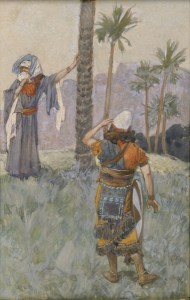
Deborah judging in Israel
It’s another week and I’m here to bring you some more great reading for your weekend. Be sure to let the authors know what you think, and let me know here as well. Topics for this week include the Grand Canyon and the biblical Flood, Deborah as leader, Jehovah’s Witnesses, and more!
Deborah and the “no available men” argument– A refutation of the notion that Deborah was only chosen to lead Israel because there were “no available men” who could or would do so. Unfortunately, this argument is fairly common among those who do not wish to affirm the Bible’s teaching on women’s equal leadership.
The Grand Canyon’s Magnificent Witness to Earth’s History– Often, young earth creationists argue that the Grand Canyon can only be explained (or at least is better explained) by the biblical Flood as a global flood. A new book is challenging that perception. Check out this post to learn more.
7 Things to Know about Jehovah’s Witnesses– It is important to understand others’ beliefs. Here is a post outlining 7 points of belief for Jehovah’s Witnesses.
Calamity (The Reckoners)– Superheroes and villains face off with those who seek vengeance against those villains who destroyed their world. Check out this look at worldview issues in Brandon Sanderson’s latest Young Adult novel, Calamity. Also check out my own reflection on the book.
Really Recommended Posts 2/19/16- Textual Criticism, Lent,and Jesus on Evil
 Another round of Really Recommended Posts for you, dear readers! This week, we have a biblical scholar from the throw out pile, voting in Lent Madness, the problem of evil and Jesus’ response, textual criticism, and women in combat. Be sure to let the authors know what you thought, and let me know your responses as well!
The Biblical Scholar from the Throw-Out Box– “If [Katharine Bushnell] had been a man, every single contemporary Bible scholar writing on gender would have had to reckon with her findings. As it was, she was a woman, and her work was ignored.” Here’s a post on
Lent Madness– Vote for different theologians throughout history in brackets to determine the winner of this year’s Lent Madness. Who will wear the golden halo this year?
Jesus’ Answer to the Problem of Evil & the Unfairness of God– What did Jesus have to say about the problem of evil? Here is a post looking into this topic in ways that might make us uncomfortable.
Debunking Silly Statements in Greg Gilbert’s Debunking Silly Statements About the Bible: An Exercise in Biblical Transmission– Some clarifications about textual criticism are found in this post that addresses some common misunderstandings that Christian scholars hold about the field.
The Bible and Combat Women- Does the Bible forbid women in combat roles? Does this go against gender roles entirely? Check out this commentary on the issue, and see also my post on the subject.
Book Review: “Partners in Christ: A Conservative Case for Egalitarianism” by John G. Stackhouse, Jr.
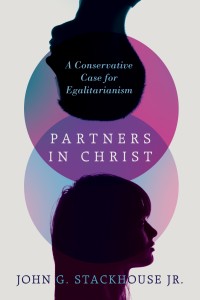 Partners in Christ: A Conservative Case for Egalitarianism is a challenging, extraordinary work. The first thought many readers might have when they see the title of this book is “A conservative case for egalitarianism? What!?” Yet that is exactly what this is. John G. Stackhouse, Jr. presents a case for egalitarianism that will challenge those on either side of the issue to rethink various aspects of their view.
The book is organized around a number of chapters, each of which is quite short. Each chapter’s title basically states what the goal of that chapter is. For example, a chapter entitled “Counterarguments from Church History” presents counterarguments to Stackhouse’s position from, well, church history. The organization is helpful, though it should not be mistaken for a license to jump around within the book. The case made herein is progressive and builds up over the course of the whole book.
Central to Stackhouse’s model is the notion that complementarians and egalitarians often talk past each other or fail to recognize the genuine concerns and possible insights from the “other side.” Thus, he challenges egalitarians to take more seriously the arguments for maintaining complementarity in gender, while he pushes complementarians to realize how often their case is based on presupposition rather than the biblical texts themselves. In other words, Stackhouse is going to make you uncomfortable, no matter what your position is. And, frankly, that’s a good thing. I’m a staunch egalitarian who used to be just as entrenched a complementarian, and it was good for me to have a book that challenged the assumptions I’m working under now. I think that effectively any reader could benefit from Stackhouse’s approach, even in disagreement.
The breadth of topics the book addresses makes it an excellent resource. Church history, theology, exegesis, modern social science, and more are each pieces of evidence that is brought forward to shed light on the issue. Particularly interesting was the chapter “Why, then, Do Women Not Lead?” which answered the question with a number of arguments from social science to theology. This kind of integrated approach is used beneficially throughout the book.
A disadvantage of the way the book is organized is that there is little space to dedicate to individual exegesis. Make no mistake, this is not the strongest egalitarian case from the Bible that can be made. It is an introduction to the full scope and depth of egalitarian arguments, yes, but it should not be mistaken for the most powerful argument possible.
Stackhouse’s ultimate conclusion is that women should be allowed the same roles in leadership in the church and home as men are allowed to fulfill. Again, this is not to say he will not challenge those who agree with this conclusion. I was taken aback by how fair and balanced this case was, and I know of no other book that presents as broad an introduction to such a complex topic as this one. I highly recommend Partners in Christ to you.
The Good
+Will challenge virtually every reader
+Excellent case, in brief, for egalitarianism
+Addresses wide variety of topics, arguments, and counter-arguments
+Balanced approach
The Bad
-Quite brief on several key points
-Concedes the notion of the “feminization of worship”
Disclaimer: I was provided with a copy of this book for review by the publisher. I was not required to write any specific kind of feedback whatsoever.
Source
John G. Stackhouse, Jr. Partners in Christ (Downers Grove, IL: InterVarsity, 2015).
Links
Be sure to check out the page for this site on Facebook and Twitter for discussion of posts, links to other pages of interest, random talk about theology/philosophy/apologetics/movies and more!
Book Reviews– There are plenty more book reviews to read! Read like crazy! (Scroll down for more, and click at bottom for even more!)
Eclectic Theist– Check out my other blog for my writings on science fiction, history, fantasy movies, and more!
SDG.
——
The preceding post is the property of J.W. Wartick (apart from quotations, which are the property of their respective owners, and works of art as credited; images are often freely available to the public and J.W. Wartick makes no claims of owning rights to the images unless he makes that explicit) and should not be reproduced in part or in whole without the expressed consent of the author. All content on this site is the property of J.W. Wartick and is made available for individual and personal usage. If you cite from these documents, whether for personal or professional purposes, please give appropriate citation with both the name of the author (J.W. Wartick) and a link to the original URL. If you’d like to repost a post, you may do so, provided you show less than half of the original post on your own site and link to the original post for the rest. You must also appropriately cite the post as noted above. This blog is protected by Creative Commons licensing. By viewing any part of this site, you are agreeing to this usage policy.
Really Recommended Posts 1/8/16- Hyperbole, Voluntarism, commentaries, and more!
 Happy New Year! Let’s kick off the year with another round of “Really Recommended Posts.” It’s cold so we’re doing an owl post edition. The topics I have for you, dear readers, include divine voluntarism (what?), hyperbole and the Canaanite conquest narratives, Leibniz’s contingency argument for God, bible commentaries, and Star Trek.
Hyperbole Interpretation is Not Helpful for Canaanite Conquest– Clay Jones argues that the recent apologetic turn towards arguing that the conquest narratives in the Bible feature hyperbole is not as fruitful an apologetic as some have thought. Although some of his argument resonates with me, I think he misses a crucial point in his counter-examples by having different categories of act. I hope to write a response to this… some day… when I have time.
Leibniz’s Contingency Argument (Video)– A relatively short video explaining the Leibnizian Cosmological Argument. I’m not as sold on how the argument is presented here, because I think the premise about the universe and God makes it tougher to defend, but I think this video does a good job of explaining the most important issues. Check out my post on the argument for more details, as well as the version I think is stronger.
Francis Turretin on Divine Voluntarism: Most Reformers Follow Aquinas– I found this an interesting read on the topic of divine voluntarism, which is an intriguing problem within some theological systems.
Christians for Biblical Equality’s Commentary List– Here’s a resource for we egalitarians out there: a commentary list put forward by Christians for Biblical Equality.
TV Trekkin for a New Generation– There’s a new Star Trek series coming! Here are some speculative details and discussion about what it might be.
Book Review: “The Great Christ Comet” by Colin Nicholl
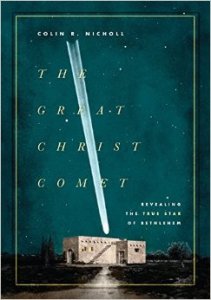 There are few biblical images which capture the imagination as much as the Star of Bethlehem. Its prominent portrayal in films featuring the Nativity, in popular renditions of a Nativity scene, and its place in many Christmas carols demonstrates its continuing popularity. Colin Nicholl’s work, The Great Christ Comet is a significant contribution to scholarship about the nature of the Star of Bethlehem. Nicholl approaches the topic from both the standpoint of theology and astronomy.
Nicholl’s analysis of the biblical data is extensive and interesting. Early in the book, he establishes that the exegetical evidence is important to anyone–including astronomers–who would like to pinpoint what the Star of Bethlehem may have been.
As I read through the theological portions of the book, I found myself opening up my running Bible commentary document to add several notes as Nicholl provide insight into the text and argued for specifics about the narrative. In addition to interpreting the passage, he also sheds light on it from extrabiblical sources, particularly in regards to the Magi and Herod. Regarding the former, he discusses the practice and likely origin of the Magi, noting they were likely astrologer/astronomers from Babylon. Regarding the latter, he shows how the Massacre of the Innocents would not be so out of place for Herod, and why he would have been so willing to go to the depths of evil action that he did. There were many more times I found Nicholl’s exegesis enlightening on various passages–including prophetic ones in Numbers and Isaiah and others in Revelation.
The interpretation offered by Nicholl related to the movement of the Christ Comet is different than any I have read. Nicholl delves into Revelation 12:1-5a in order to argue that this passage describes a literal astronomical phenomenon with the celestial movements of Virgo, a comet, and a meteor storm in view. It was in this section that my confidence in his conclusions wavered. He makes a convincing argument for showing that the comet could have moved and shined in the way he believes is described in this passage, but I am less convinced by the simple connection of Revelation to Matthew in this literal, astronomical way. The infancy narrative of Matthew and the description in Revelation are both referencing the birth of Christ, but I’m not convinced John in Revelation is attempting to give a full explanation of a cosmic event that occurred here. Regardless of my reservations, however, Nicholl does establish that this is a possible, if not probable, reading of the text while also laying out in extensive detail how a comet could have engaged in this “cosmic drama.”
I am not an expert in astronomy, so my comments on that regard are that of an interested lay person. Nicholl gave significant background into astronomy before he delved into some of the data and the competing theories regarding the Star of Bethlehem. This included extensive discussion of the nature of different kinds of comets and how they move throughout. At many points these details are accompanied by historical drawings or artistic renditions of the aspects discussed. Nicholl’s theory is outlined in intricate detail, and it includes a kind of procession of the comet throughout various astrological signs to the point that it reaches Virgo. At this point, the Magi were convinced by the movement of the comet that a significant birth was occurring and they headed west. Nicholl draws upon the words of the Magi as well as Matthew and Luke’s infancy narrative, in addition to Revelation 12 to show that his theory corresponds to literal readings of the various passages and allows a real astronomical event to lie behind the explanation of the comet. This, however, does not mean that the comet is a purely naturalistic phenomenon, as Nicholl argues that the one-of-a-kind, astounding nature of this comet and its performance–down to marking the very location of Jesus’s home in Bethlehem–point to divine intent.
One significant difficulty with the book is the overall feeling of “assured results” found throughout. A search for “certainly” shows up 66 results; 9 for “unquestionably” (each used in context of conclusions drawn). Other words like “undoubtedly” (11 results) show up throughout as well. While it is admirable to have confidence in one’s own position, at times I wondered whether the arguments presented could yield such levels of confidence. The very existence of such continuing debate over the nature of the Star of Bethlehem calls into question any interpretation which comes along and offers certainty across the board, whether it is the refutation of other theories or the interpretation of the Book of Revelation.
So much is invested in the relation of Revelation 12 to the infancy narratives that if one remains unconvinced by his exegesis there, one may not find his overall theory convincing. However, this is not necessarily the case. The argument he presented for a great comet being the origin of the Star of Bethlehem was quite convincing to me, despite my not being fully sold on the Revelation 12 theory. One does not have to accept Nicholl’s view of how the comet played across the sky to accept that the comet is the best explanation.
As far as substantive critique of Nicholl, on the astronomical part I admit I don’t have the knowledge to offer much. Both theologically and astronomically, it seems Nicholl’s proposal is airtight and stunning. Frankly, that is probably where my suspicion comes from: I tend to be a bit suspicious of anything that is such a perfect fit. The Bible is a complex work, and the debate over the Star of Bethlehem is entrenched with many differing positions. Could it really be so simple (in the sense of having this be the answer)? I would like to say yes. I want to. But I’m not sure I can be fully on board. Nicholl has convinced me that the Star was a great comet, and the movement he describes seem possible, but it is perhaps only a personal feeling of reservation that holds me back from embracing the whole picture. This does say something for the strength of Nicholl’s argument, of course, for it suggests that it is really this personal reservation that holds me back rather than significant criticisms.
Nicholl’s concluding thoughts about the Christ Comet deserve to be quoted:
What the Great Christ Comet did… was extraordinary and merits wide telling. People of all disciplines… must come to grips with its story. In an era when science is often viewed as the enemy of religion, the Christ Comet suggests that science may be the best friend of religion. In a period when the claims of Christ are commonly disregarded, the Star callse upon all to give his claims a fresh reappraisal… (Kindle Location 7343).
Whatever one thinks about certain aspects of Nicholl’s argument, the book as a whole presents a comprehensive, deep case for the Star of Bethlehem being a great comet. The Great Christ Comet is a fantastic, deep read that will expose readers to a variety of topics in a fresh way. The amazing intricacy of the movement of the comet and its correspondence to the readings Nicholl presents in the book would be, if true, a monumentally powerful testament to the power of God and the truth of the Gospels. I enjoyed it immensely, even though I may not be fully convinced of every detail.
The Good
+Extensive look at the Biblical data
+Fascinating topic
+Provides background for astronomical analysis
+Massive scope with in-depth discussion
The Bad
-Overstates case at points
-Exegesis of some passages uncertain
Disclaimer: I received a copy of this book for review purposes from the publisher. I was not required to provide any specific kind of feedback whatsoever.
Source
Colin Nicholl, The Great Christ Comet (Wheaton, IL: Crossway, 2015).
Links
Be sure to check out the page for this site on Facebook and Twitter for discussion of posts, links to other pages of interest, random talk about theology/philosophy/apologetics/movies and more!
Book Reviews– There are plenty more book reviews to read! Read like crazy! (Scroll down for more, and click at bottom for even more!)
Eclectic Theist– Check out my other interests site for posts on science fiction, fantasy, television, and more!
SDG.
——
The preceding post is the property of J.W. Wartick (apart from quotations, which are the property of their respective owners, and works of art as credited; images are often freely available to the public and J.W. Wartick makes no claims of owning rights to the images unless he makes that explicit) and should not be reproduced in part or in whole without the expressed consent of the author. All content on this site is the property of J.W. Wartick and is made available for individual and personal usage. If you cite from these documents, whether for personal or professional purposes, please give appropriate citation with both the name of the author (J.W. Wartick) and a link to the original URL. If you’d like to repost a post, you may do so, provided you show less than half of the original post on your own site and link to the original post for the rest. You must also appropriately cite the post as noted above. This blog is protected by Creative Commons licensing. By viewing any part of this site, you are agreeing to this usage policy.
Really Recommended Posts 11/27/15- Purity, Final Fantasy, and more!

Screenshot from Final Fantasy X. I do not claim rights to this image.
I’m getting this round up a little late because I was traveling. I hope you all had safe travels (if you traveled) and some time to reflect on the blessings God gives us over this holiday weekend. I’m on a bit of a time crunch so I’ll let you just get to the posts!
7 Lies Purity Culture Teaches Women– The “purity culture” movement seems to be filled with misconceptions about men and women. Here are some difficulties with what has come to be known as “purity” teaches women.
Revelations of Suffering in Final Fantasy X and Shusaku Endo’s Silence– Look, if you follow this blog you know I’m a big nerd. Is it any surprise that I love Japanese Role-Playing Games? Final Fantasy X was one of my favorites, though I found some difficulties with its worldview. Here’s a great post comparing the game to what sounds like a wonderful novel, particularly on the notion of suffering.
Christianity: The World’s Most Falsifiable Religion– Christianity stands on an historical claim. That claim is the resurrection of Jesus. Does that make Christianity unique? This post argues that the falsifiable nature of Christianity makes it worth considering.
The 10 Least Popular Books of the Bible (Infographic)– I rediscovered this one a little while back and I just love it. It helps us to think about those books we may not be reading as much–and gives us the opportunity to learn more about them.
Are Pro-Lifers Hypocrites?– A common charge against pro-life groups is that they are hypocritical, for various reasons. Here is a post answering one popular meme/comedian on the topic.
Book Review: “Rediscovering Jesus” by David B. Capes, Rodney Reeves, and E. Randolph Richards
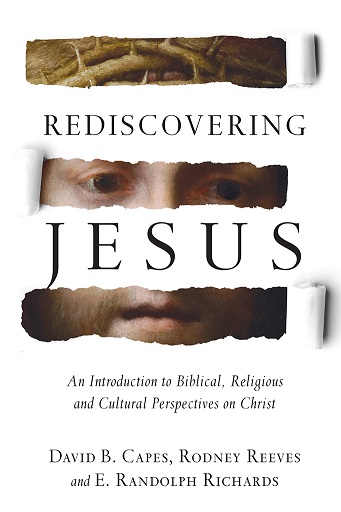 Rediscovering Jesus is part project of unearthing aspects of Jesus which are often ignored, part recovery of the biblical portrait of Jesus, and all intriguing.
The book is structured such that each chapter presents a specific portrait of Jesus. Each chapter has a brief introductory section that gives an overview of that specific Jesus, an exposition of how the specific work presents Jesus, how that Jesus is different or unique, and what we would believe about Jesus if that were the only information about Jesus we had.
The first part focuses on biblical images of Jesus, but does so by looking at individual books of the Bible (though a few writings are lumped together). Thus, rather than seeing a composite Jesus made up of all four Gospels put together–not itself a bad thing, necessarily–the chapters provide a deeper look at the individual focus of each Gospel or book. Thus, readers are confronted by a Jesus who is a man of action in Mark, a priest in Hebrews, and an apocalyptic judge in Revelation.
The second part examines pictures of Jesus outside the Bible: the ones examined are the Gnostic, Muslim, Historical, Mormon, American, and Cinematic Jesus.
The primary value of the work is how it challenges readers to rethink how they have viewed Jesus. If their Jesus has been shaped predominantly by cultural and non-biblical portraits, the book serves as a call to return to the biblical portrayal. But it does not do so at the expense of all extrabiblical imagery. The authors carefully outline how there might be truth found in various images of Jesus. If our Jesus has been shaped by biblical imagery, the authors challenge us to see how we might have glossed over specific emphases of the different authors of the New Testament.
Each chapter is filled with insights and things to explore. Readers will be continually challenged in how they may have a deficient or composite view of Jesus that does not match the Jesus of the Bible. It is a book which calls us, primarily, to learn about our Lord Jesus Christ. It does so in a way that is constantly exciting and invigorating.
I recommend Rediscovering Jesus wholeheartedly. It was a phenomenally interesting read, and one which will challenge you to rethink how you have conceived of Jesus, while calling readers back to biblical portrayals. I can’t really recommend it highly enough.
The Good
+Illuminates a number of aspects of the biblical Jesus that we often miss
+Great chapter organization
+Excellent information found throughout the book
The Bad
-Very brief on several points
Disclaimer: I received a review copy of the book from the publisher. I was not required to leave any specific kind of feedback whatsoever.
Links
Be sure to check out the page for this site on Facebook and Twitter for discussion of posts, links to other pages of interest, random talk about theology/philosophy/apologetics/movies and more!
Book Reviews– There are plenty more book reviews to read! Read like crazy! (Scroll down for more, and click at bottom for even more!)
Source
David B. Capes, Rodney Reeves, and E. Randolph Richards, Rediscovering Jesus (Downers Grove, IL: InterVarsity, 2015).
SDG.
——
The preceding post is the property of J.W. Wartick (apart from quotations, which are the property of their respective owners, and works of art as credited; images are often freely available to the public and J.W. Wartick makes no claims of owning rights to the images unless he makes that explicit) and should not be reproduced in part or in whole without the expressed consent of the author. All content on this site is the property of J.W. Wartick and is made available for individual and personal usage. If you cite from these documents, whether for personal or professional purposes, please give appropriate citation with both the name of the author (J.W. Wartick) and a link to the original URL. If you’d like to repost a post, you may do so, provided you show less than half of the original post on your own site and link to the original post for the rest. You must also appropriately cite the post as noted above. This blog is protected by Creative Commons licensing. By viewing any part of this site, you are agreeing to this usage policy.
Sunday Quote!- Perspicuity of Scripture and your Study Bible
Every Sunday, I will share a quote from something I’ve been reading. The hope is for you, dear reader, to share your thoughts on the quote and related issues and perhaps pick up some reading material along the way!
Perspicuity of Scripture and your Study Bible
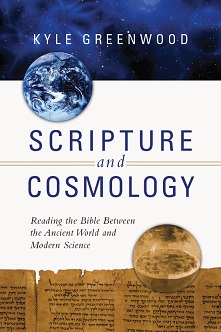
I just started reading through Kyle Greenwood’s Scripture and Cosmology, a book that looks at the ancient concepts of cosmology found in the Bible, and came across a wonderful discussion of the perspicuity of Scripture:
The doctrine of the perspicuity of Scripture states that Scripture is clear and unambiguous on matters pertinent to salvation. It does not, however, apply to all matters. This should be an obvious conclusion, based on the overwhelming number of biblical commentaries and the voluminous sales of study Bibles. (10, cited below)
You see, many who disagree about science and Christianity in particular argue that the perspicuity of Scripture somehow solves the problem. Other times, Christians with disagreements about other issues also raise this doctrine as a kind of trump card. But Greenwood’s quote puts this usage in stark relief: if the Bible were so clear about things like the age of the Earth or other hotly-debated issues, there wouldn’t easily be so much debate, would there? Now, his point shouldn’t be overstated: simply having disagreement doesn’t automatically mean something is unclear. The point, however, is that the sheer amount of time and energy Christians have put into understanding some of these other issues demonstrates the depths of insight the Bible has for us.
Scripture and Cosmology is shaping up to be an interesting read. I’ll share a review once I’ve finished it.
Links
Be sure to check out the page for this site on Facebook and Twitter for discussion of posts, links to other pages of interest, random talk about theology/philosophy/apologetics/movies and more!
Sunday Quote– If you want to read more Sunday Quotes and join the discussion, check them out! (Scroll down for more)
Source
Kyle Greenwood, Scripture and Cosmology (Downers Grove, IL: InterVarsity, 2015).
SDG.
Really Recommended Posts 10/23/15- Apologetics, Diatoms and the Flood, patriarchy, and more!
 Hello, dear readers! I have another round of posts that I hope you will enjoy perusing. The topics this week include apologetics, an objection to the pro-life position, patriarchy and biblical sex, and some tiny organisms that pose some big problems. Let me know what you think, and be sure to tell the authors you enjoyed their posts as well!
Apologetics Started in the Bible– Some Christians object to the use or import of Christian apologetics. However, apologetics got its start in and from the Bible. Here’s a post showing how.
Biblical Sex: Patriarchy’s Great Enemy– This post highlights the fact that in the Bible, male-female sexual relations really go against the paradigm of complementarian theology.
Book Review: “The Grand Weaver”– Ravi Zacharias is an excellent Christian apologist. Here’s an in-depth look at one of his books from Luke Nix. I recommend reading this one because it will give you some insights into Zacharias’ approach to apologetics. The book itself is also excellent.
Diatoms: Tiny Organisms Highlight Big Inconsistencies in Young Earth Flood Geology Models– Diatoms are tiny organisms that put up some big difficulties for young earth creationist models. Check out this post to read about some of these difficulties.
Response to objection that pro-lifers are “nowhere to be found once our children are born”– It is commonly objected that the pro-life position only cares about children in the womb. Once they’re born–who cares? I think that it is important for the pro-life position to be holistic and look at the totality of life rather than simply looking at unborn life as worth protecting. Here is a post that directly confronts this common objection.

 J.W. Wartick - Reconstructing Faith