book review
“The Count of Monte Cristo” – Faith, Vengeance, and Destiny
 I have decided to mix in some classics with my constant reading of sci-fi/fantasy, philosophy, theology, and biographies. In order to pick which classics to read, I have largely crowdsourced recommendations of which classic literature they have enjoyed, combining this with lists of major classic works. So yeah, pretty subjective, but we can deal. As I read through the classics, there will be SPOILERS, because I want to actually talk about them. Maybe it will encourage you to read them, or, if you have read them already, you can join in a deeper discussion of these great works. Feel free to recommend your favorites, as well.
The Count of Monte Cristo
Several friends had recently talked about finishing this book and how much they enjoyed it. I also recalled seeing the recent-ish movie several years ago (though, having finished the book, I threw it on hold at the library, so I’ll be watching it again!). Also, there’s a delicious sandwich that I at least assume got its name from this book, which makes it even better. But other than these fleeting glimpses, I knew pretty much nothing about Alexandre Dumas’s The Count of Monte Cristo going in. The memory of the movie had faded, and I just recalled there was some guy who wanted revenge. Yeah, there’s a lot more to the novel than that.
The Count of Monte Cristo is, on the surface level, a novel of vindication and revenge. It’s an adventure that spans more than a thousand pages. Yet it remains a page-turner that demands to be devoured in sitting after sitting. But on the deeper level, it is a fantastically Christian look at the world and God’s action therein.
The set up for the plot involves the man who would be the count getting set up by several who wish him ill for various reasons. But throughout even that section, “Providence” is constantly in view. Providence is historically one way people talked about divine activity in the world, so the reader is led to see Dumas’s viewpoint as having a divine hand in many acts. And, indeed, as our lead character begins his quest for vindication and vengeance, bringing blessings and curses upon those who helped or hindered him, we as readers cannot help but associate his actions with those of God. We want the Count to succeed in his quest for revenge; it is so well planned, and he has become a man of almost limitless poise and focus. It is not until the count has one part of his vengeance go “too far” that he starts to have second thoughts.
These second thoughts translate into an awareness that our Count’s activity is not just the hand of God acting. Though we as readers have been rooting for him throughout, it becomes clearer that the assumptions we’ve made about how the story is going are wrong. It’s as though Dumas played into our expectations, allowing us to think that, perhaps, here is the kind of “divine vending machine” that we so often wish to turn God into. Here, in at least this story, God is working in the way that we want, dispensing a kind of hard justice on wrongdoing and giving great benefit to those who deserve it. But our Count realizes that this is not, in fact, what is happening. His own actions have been, well, his own. Has he been aided by God? Yes, in the sense that his endeavors could not have all succeeded without some acts of Providence. But he has presumed too much. Like Job in the Bible, he has questioned God; nay, he has gone farther and turned himself into the hand of God, dishing out vengeance and blessing as he wished. And his actions have led to a great wrong with the death of innocents.
So Dumas asks us to take ourselves back out of the shoes of the Count, to stop assuming that we know what is supposed to happen. Instead, he has lured us into this complacency, thinking we know how things ought to be, when instead we should be approaching the acts of God with fear and trembling, carefully avoiding the notion that we can make God act in the ways we desire. Hidden in plain sight within this apparent adventure novel, we have a serious theological commentary that forces us to re-examine who God is and how God acts. How often we make God into what we want, thinking we can control God! Yet here we see how foolish that is, and how we must once again evaluate the assumptions we have made.
So apart from this deep theological discussion, is there a good book? Yes, yes, yes, a thousand times yes. The novel is so well written. I found it un-put-down-able. It’s a true page turner even at its doorstop-like heft. The story is full of beautiful description and overflowing with heart and depth.
There is far more that I could say about The Count of Monte Cristo. It’s such a phenomenal achievement. It definitely stands among my favorite works of all time, and I cannot recommend it highly enough to you, dear readers.
Links
Be sure to check out the page for this site on Facebook and Twitter for discussion of posts, links to other pages of interest, random talk about theology/philosophy/apologetics/movies and more!
Book Reviews– There are plenty more book reviews to read! Read like crazy! (Scroll down for more, and click at bottom for even more!)
SDG.
——
The preceding post is the property of J.W. Wartick (apart from quotations, which are the property of their respective owners, and works of art as credited; images are often freely available to the public and J.W. Wartick makes no claims of owning rights to the images unless he makes that explicit) and should not be reproduced in part or in whole without the expressed consent of the author. All content on this site is the property of J.W. Wartick and is made available for individual and personal usage. If you cite from these documents, whether for personal or professional purposes, please give appropriate citation with both the name of the author (J.W. Wartick) and a link to the original URL. If you’d like to repost a post, you may do so, provided you show less than half of the original post on your own site and link to the original post for the rest. You must also appropriately cite the post as noted above. This blog is protected by Creative Commons licensing. By viewing any part of this site, you are agreeing to this usage policy.
Book Review: “Evangelical Theological Method: Five Views” edited by Stanley E. Porter and Steven M. Studebaker
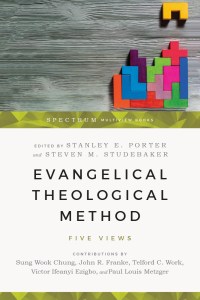 I love multiview books. I find them generally enlightening, filling in details about views I don’t hold (and sometimes didn’t even know existed) while also showing how my own view (or one like it) stacks up against others. Evangelical Theological Method: Five Views presents a multiview book on doing theology as an evangelical.* I found it to be highly informative, though I was somewhat perplexed by some aspects of the book.
The views presented here as different theological methods for evangelicals are “Bible Doctrines/Conservative Theology” presented by Sung Wook Chung, “Missional Theology” presented by John R. Franke, “Interdisciplinary Theology” presented by Telford C. Work, “Contextual Theology” presented by Victor Ifeanyi Ezigbo, and “Trinitarian Dogmatic Theology” presented by Paul Louis Metzger.
The Bible Doctrines view is essentially grounded in the notion that we use the Bible as a source to draw information from and then outline what the Bible teaches. The Bible is the data, theology is presenting and systematizing that data. Chung appeals to the historical grammatical view in support of this, arguing that while history and textual criticism may provide some correctives, the core is to ask “what does the Bible teach” and end the discussion there. The missional view does theology with a focus on the church lived/living its mission to make disciples of all nations. Thus, it is an inherently practical theology, looking to apply what the Bible teaches to the mission of Christ’s church. Interdisciplinary theology is an approach that utilizes any field of study, making theology the “queen of the sciences” while integrating insight from biology, psychology, literary studies, and more. Interestingly, Work does a case study based on homosexuality and Christianity, arguing that the question is not “Is homosexuality wrong” but rather what kind of people we ought to try to be to conform to the image of Christ. Contextual theology seeks to make the Gospel of Christ understandable and appealing to all people not by applying a one-size-fits all doctrinal mold or practice but rather by utilizing insights from cultures that exist to show the truth of Christ. The Trinitarian Dogmatic Theology chapter was the most difficult in the book, utilizing themes from Barth (along with Dietrich Bonhoeffer an Colin Gunton) to draw out a dogmatic theology for Christianity.
There is some clear overlap between a few of these views, particularly the missional/contextual view and the “Bible Doctrines”/Trinitarian views. The responses at the end of the book didn’t allow individual authors to respond back to the responses, something I did miss. It would have been nice to see, for example, I’d be curious to see how Ezigbo might respond to Chung on the challenge he offered to contextual theology and the possibility of syncretism or the authority of Scripture.
Ezigbo’s essay struck me as particularly insightful, and his responses were perhaps the best in the book. His challenge to Metzger, for example, is on point: “Clearly Metzger exhibits the characteristics of theologians whose theological reflections focus primarily on peer-driven questions… One could only wonder what Metzger’s study of Barth would like like if his aim were to discern Barth’s relevance to the contemporary christological questions that Christians with no formal theological education are asking today” (181-182). Ezigbo notes that he isn’t saying that peer-driven questions are irrelevant, “but if theologians expect their theological reflections to benefit all Christians… they should seek to develop skills and the patience required to exegete the… contexts that shape the life of Christians and their communities” (182). I found this a clear challenge for myself as well, as one who is very interested in the life and work of Dietrich Bonhoeffer. How do we ensure as people doing and discussing theology that our discussions actually have relevance? Of course, one could argue more abstractly that if Barth’s dogmatics are true, then in the broadest sense they are relevant for all people, no matter how obscure, in that truth impacts reality. But that seems cold comfort when the challenge is much more personal: why should Barth’s insights matter to me? It’s food for thought, I think.
One thing that was only addressed in passing by a few of the authors was the strangeness of seeing theological method as an either/or. As a good Lutheran, I love me some ‘both-and.’ It seems to me, as a reader, that these methods could each benefit from one another, and that trying to practice one exclusively would be detrimental. Dogmatics need context. Interdisciplinary studies need some mission. The Bible Doctrines approach could probably stand to acknowledge some of the inherent concerns there (eg. a tendency to assume that one’s own presuppositions of the text or “plain sense” reading is, in fact, correct, despite possible evidence to the contrary).
I found Evangelical Theological Method: Five Views to be a very interesting book, and one which raises many avenues for further research. Those interested in systematic theology, especially, ought to pick it up to read through it. The authors provide some challenges for each of the approaches in the book, and it is important that we do not become too simplistic in our working out of theology.
*I am a Lutheran (specifically of the Evangelical Lutheran Church in America) and although my denomination has “evangelical” in the name, Lutherans are generally different from what is considered broadly evangelical views, particularly in regard to the sacraments. Though, to be fair, Lutherans were the first to identify “evangelical” as a term to call themselves. I give this caveat to show my own outlook on the book.
Disclaimer: I was provided with a copy of the book for review by the publisher. I was not required to give any specific kind of feedback whatsoever.
Links
Be sure to check out the page for this site on Facebook and Twitter for discussion of posts, links to other pages of interest, random talk about theology/philosophy/apologetics/movies and more!
Book Reviews– There are plenty more book reviews to read! Read like crazy! (Scroll down for more, and click at bottom for even more!)
SDG.
——
The preceding post is the property of J.W. Wartick (apart from quotations, which are the property of their respective owners, and works of art as credited; images are often freely available to the public and J.W. Wartick makes no claims of owning rights to the images unless he makes that explicit) and should not be reproduced in part or in whole without the expressed consent of the author. All content on this site is the property of J.W. Wartick and is made available for individual and personal usage. If you cite from these documents, whether for personal or professional purposes, please give appropriate citation with both the name of the author (J.W. Wartick) and a link to the original URL. If you’d like to repost a post, you may do so, provided you show less than half of the original post on your own site and link to the original post for the rest. You must also appropriately cite the post as noted above. This blog is protected by Creative Commons licensing. By viewing any part of this site, you are agreeing to this usage policy.
Book Review: “The Battle for Bonhoeffer” by Stephen R. Haynes
 The Battle for Bonhoeffer by Stephen R. Haynes highlights the ways that people across theological, social, and political spectrums have played tug-of-war with Bonhoeffer’s thought, words, and legacy. As Charles Marsh puts it in his Foreword, “It is understandable… that readers with different theological and ideological perspectives would desire to claim Bonhoeffer as their own. ‘Excerpting Bonhoeffer’ has become a familiar exercise in each team’s effort to win…” (ix). Yet Bonhoeffer’s legacy is far more complex than a simple Google quote mine would allow. In my own reading of Bonhoeffer’s works, it is clear that it would be simple to find conflicting messages even within the same sermons at times. Like Martin Luther, for example, reading Bonhoeffer and interpreting him is like peeling away the layers of an onion, trying to get to the core. It takes care, precision, and thought. Unfortunately, as Haynes notes throughout this book, few people are concerned with doing so.
Though the subtitle is “Debating Discipleship in the Age of Trump,” there is far more to the book than dealing with the recent Trump phenomenon. Haynes notes how people on both the right and left have distorted or ignored aspects of Bonhoeffer’s legacy to turn in him into a supporter of their own positions. Marsh sets the table well, asking: “Have you heard progressive Christians cite the passage in Ethics calling abortion ‘nothing but murder’? Or recall Bonhoeffer’s preference for monarchy over democracy?” (xii). Haynes notes how Bonhoeffer was cited on one hand by Vietnam draft resisters, peace activists, liberation theologians, death-of-God thinkers on the left, and on the right by people who oppose abortion or same-sex marriage (and, regarding the latter, Haynes notes insights from both Charles Marsh’s Strange Glory and Diane Reynolds The Doubled Life of Dietrich Bonhoeffer [which I reviewed here] for reasons this may be quite inaccurate]). The baffling array of topics Bonhoeffer is alleged to have endorsed or condemned suggests that the quote mining being done through his legacy belies an inner complexity that is far deeper.
Haynes surveys the history of interpretation of Bonhoeffer, particularly in America, through the next several chapters. He places a special emphasis on seeing how evangelicals have viewed Dietrich Bonhoeffer. What is interesting in this latter topic is that, initially at least, Bonhoeffer was viewed positively but with some “warning flags” by American evangelicals who interacted with his works. Several appreciated his resistance to Nazi ideals, but were put off by his apparent lack of concern for things like “a high view of Scripture/inerrancy” and his being influenced by liberal German theologians. This portrait by the early evangelicals of Bonhoeffer is far more accurate than the one that has been passed into our own time, in part because it allowed for a multifaceted Bonhoeffer who was complex enough to resist being easily integrated into any one position.
Fairly early on, however, the complexities of Bonhoeffer’s thought and life began to be ignored in favor of seeing him as a figurehead for resistance to one’s own preferred ideas. Haynes demonstrates how Bonhoeffer was used to resist George W. Bush and the “war on terror,” and then ironically turned around to resist the “culture of death” under Barack Obama. The raising of the “Bonhoeffer flag” behind such opposed viewpoints should have served as a warning sign, but it unfortunately did not.
Enter Eric Metaxas. Metaxas’s biography, Bonhoeffer: Pastor, Martyr, Prophet, Spy was an extreme departure from Bonhoeffer scholarship generally. For one thing, Metaxas himself admitted to virtually ignoring or explicitly shunning the conclusions of 70 years of Bonhoeffer scholarship both at home and abroad. The cover flap for the book features a spurious quote from Bonhoeffer “Silence in the face of evil is evil itself…” that has since been passed all over the world and even “quoted” multiple times in Congress on record. To say that using an invented quote from Bonhoeffer on the cover of a biography of the man is a bad sign is an understatement. Haynes notes many, many problems with the biography, from a lack of engagement with Bonhoeffer’s actual works (and ignoring, for example, his Letters and Papers from Prison, which is one of the most important works for understanding his developed thought) to a recasting of Bonhoeffer into an American Evangelical. Yet it is Metaxas’s biography that has become the torch-bearer for the populist Bonhoeffer, making an image of the man that is incredibly distorted. For my own part, when I read Metaxas’s work, I was struck by how entirely de-Lutheranized Metaxas had made Bonhoeffer. Dietrich Bonhoeffer was a man who explicitly stated that, for example, without the Lord’s Supper there is no Christianity and who certainly supported infant baptism and regeneration, but Metaxas excised such details from his own dim look at Bonhoeffer’s theology, preferring to pull out those things which were more amenable to the typical American evangelical.
It was the populist view of Bonhoeffer which lead to notions of a “Bonhoeffer Moment” at various times before, during, and after the 2016 election cycle. Haynes spends some time noting how it was frequently said during the Obergefell v. Hodges Supreme Court case that American Christians were facing a “Bonhoeffer Moment” in which they would need to resist the government’s tyranny. Haynes notes how many evangelicals made comparisons to previous Supreme Court rulings, conveniently ignoring those unjust rulings they supported or the just ones they opposed. More decisively, Haynes notes that after Obergefell, evangelicals rallied around a woman who was part of an anti-Trinitarian sect to be their martyr for the cause. In the time since, though, very little has been done by evangelicals in their supposed “Bonhoeffer Moment.” This kind of co-option of the man’s legacy is a disservice to all involved.
Haynes doesn’t limit his analysis of the “battle for Bonhoeffer” to just the positives of Bonhoeffer’s life. Metaxas and others have argued Bonhoeffer is a “Righteous Gentile” (Metaxas even made “righteous gentile” part of his additional subtitle to his biography). But Bonhoeffer has explicitly been turned down for that technical categorization for a few reasons: 1) he wrote or supported some things that were seemingly anti-Semitic; and 2) though he did become a martyr, it wasn’t specifically due to his efforts to help the Jews during the Holocaust, which is a criterion for being deemed a “Righteous Gentile.” Bonhoeffer certainly opposed the Nazi treatment of the Jews and did help some Jews escape Germany (though at arm’s length for the most part–simply helping get proper papers from afar); but that was not his project or his main reason for opposing Nazi Germany. And that’s okay. It is important not to lionize Bonhoeffer for things he didn’t actually do, and Haynes is careful to help readers realize that.
The Battle for Bonhoeffer isn’t very long, but its length shouldn’t be taken for a lack of depth. It’s a thoughtful, critical, and sometimes convicting read. As one who is deeply indebted to Dietrich Bonhoeffer in my own theology and thought, I found ways in which I had been distorting him in this book as well. Haynes’ book provides an invaluable correction to distortions on the man’s life, times, and thought. I very highly recommend it.
Disclaimer: I was provided with a copy of the book for review by the publisher. I was not required to give any specific kind of feedback whatsoever.
Links
Be sure to check out the page for this site on Facebook and Twitter for discussion of posts, links to other pages of interest, random talk about theology/philosophy/apologetics/movies and more!
Book Reviews– There are plenty more book reviews to read! Read like crazy! (Scroll down for more, and click at bottom for even more!)
SDG.
——
The preceding post is the property of J.W. Wartick (apart from quotations, which are the property of their respective owners, and works of art as credited; images are often freely available to the public and J.W. Wartick makes no claims of owning rights to the images unless he makes that explicit) and should not be reproduced in part or in whole without the expressed consent of the author. All content on this site is the property of J.W. Wartick and is made available for individual and personal usage. If you cite from these documents, whether for personal or professional purposes, please give appropriate citation with both the name of the author (J.W. Wartick) and a link to the original URL. If you’d like to repost a post, you may do so, provided you show less than half of the original post on your own site and link to the original post for the rest. You must also appropriately cite the post as noted above. This blog is protected by Creative Commons licensing. By viewing any part of this site, you are agreeing to this usage policy.
Book Review: “Last Call for Liberty” by Os Guinness
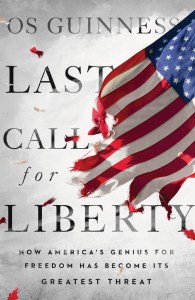 Os Guinness issues a call to question ourselves and what we mean by “freedom” and “liberty” in the United States in his book Last Call for Liberty. He argues that the United States must work to restore its faith in the “covenant” of the Constitution and help preserve liberty through its republican system.
Perhaps the most prominent theme throughout the book is that of 1776 vs. 1789. The dates refer to the American Revolution and the French Revolution. Guinness never really delves into defining this alleged conflict, though he does stick with the definition of “classical liberal” vs. “left/liberal.” The pervasiveness of this theme would lead readers to think that there would be some elucidation of the specifics of this distinction, but those readers are left wanting. Guinness simply refers to those dates throughout the book as though readers will just know and agree how horrible the French Revolution was for “liberty” (however defined) and how wonderful and perfect the American Revolution was for liberty. That is supposed to be obvious to anyone reading the book, apparently, because there is no point at which Guinness argues the point. In the introduction, for example, when he first introduces the theme, he writes:
Either the classical liberalism of the republic will prevail and 1776 will defeat 1789, or the Left/liberalism of 1789 will defeat 1776, and the republic will fail and become a republic in name only. (4)
Those are some dire words. Probably they should have some basis in argument, definition, and reality. But readers will never know if this distinction has a reality from the arguments presented in the book, because Guinness blithely assumes readers will go with his argument, despite never actually having made it.
The 1776/89 theme is pervasive throughout the book, and is continually used either as the point of an argument or as a way to hammer opposing views. For example, at one point Guinness states that “There can be no truce between 1776 and 1780. The clash of freedoms has to be settled in favor of one way or another, for they lead in entirely different directions” (179). Readers won’t really have a firm idea of what those directions are beyond 1776 is good and 1789 bad; but beyond that point is the absurdity of the actual statement made. “No truce” between the two can exist? How about the fact that, historically, the United States did, in fact have a truce with the Revolutionaries of 1789 and ultimately even an alliance? Sure, the relationship between the two countries soured to the point of a pseudo war, but it healed again shortly thereafter. Why? Because the United States was more favorably inclined towards a French country that had thrown off its monarchy than other countries that were dedicated to preserving theirs (eg. Britain). I admit I have simplified things historically, but even this analysis provides more historical background to the two years than Guinness does in close to 300 pages of text! Not only that, but Guinness had, at an earlier point, argued that history is the test for different systems to work, citing, of course, the worst possible examples of political systems that are different from a republic in his argument. But if history is the test for truth claims, his absurd claim that there can be no truce between 1776/1789 has been tested and is false.
Much of the rest of the book is filled with vague or explicit notions of American exceptionalism. The United States has the best system because it does, right? For example, only pages after Guinness condemns Athenian democracy for its limits on freedom because it only gave certain men the right to vote and Athens didn’t give in to reasoned arguments against slavery (77-78), he goes on to praise the United States for its own wonderful adherence to liberty. I don’t know whether to be amused by the irony or saddened by the apparent intentional ironing out of history’s wrinkles. After all, the 1776 liberty and freedom-loving republic Guinness wants us to all to hearken back to as the best example itself only allowed certain men the right to vote and endorsed and made laws for slavery. I cannot emphasize enough how deeply conflicted Guinness’s words are with his own thesis throughout the book. Whose liberty and freedom is Guinness really concerned with here? I can’t help but ask the question, because his ignoring of the wrongs of slavery and limited votes in the earliest days of the republic are set alongside nearly worshipful praise of the wisdom of the Founders demands that we ask whose power Guinness is concerned with.
Another major problem with the book is the style of writing Guinness has. At very few points was I able to draw out a thread of an argument. Rather, throughout the work, waxing eloquently is taken in the place of argument. It’s the kind of writing style that will pump up an audience already firmly in agreement with the thesis, but it doesn’t advance the argument or really even state it in any way. Alongside these vague statements that nevertheless provide good quote-mining is the notion that the United States somehow, in 1776, did something akin to making a proper covenant with God by being “under God” in the formation of the nation. I am still not sure I understand Guinness’s point here, but neither do accept fault for not understanding it. Like most other points in the book, this covenant/constitution/under God unity is never explained but merely assumed and orated upon.
Guinness apparently also felt the need to jump on the bandwagon of at least referencing the concept of calling younger people “snowflakes” and restating some of the mockery directed towards those who were upset by results of an election. For a man who literally wrote a book about how we must work to preserve freedom and liberty, it is deeply ironic to read condemnations of people feeling passionately about the results of efforts to do so. Sure, Guinness probably disagrees with how these others are voting, but for him to complain about the passion people felt about elections is asinine. How can Guinness seriously place this complaint having just written a book trying to put forward a passionate cry for liberty? Oh, and don’t forget to blame 1789 for people not conforming to Guiness’s standards of how people should react to elections, as well. Not content to stop with that self-condemning thought, Guinness also equivocates between the notion of political correctness and “newspeak” from the book 1984. It’s not a sick take down of the “Left” (or the Right, really) unless we bring up some of our favorite dystopic novels, right? This equivalency is stunning, because it seems to imply that Guinness actually believes that calls to, say, use accurate language for people groups is the same as literally changing truth to falsehood. Maybe he does believe that, in which case his own position seems much more dangerous to liberty than those he condemns.
Really, the entire book reads like someone who is having to face the fact that his position–that of an elder white male–is no longer valued simply by virtue of being an elder white male. Liberty is easily defined into power for his own position, and this definition is made almost explicit when he, as noted above, praises the United States’ republican system that excluded all non-white people, females, and non-land owners from voting in the glorious year of 1776. It’s hard to take seriously a man who can make such a heartless statement in praise of that system who then turns around and complains about others not liking his viewpoint.
Last Call for Liberty is the kind of alarmist and elitist work that Guinness purports to condemn in the book itself. By aligning himself so closely with the notion that the United States is under (or should be under) some kind of divine mandate and “covenant,” Guinness preaches to the choir of American exceptionalism. By sweeping the faults of our form of “liberty” under the rug, he engages in the very immunization against facts that he criticizes the “left/liberal” of doing. It is at times baffling to see such contradictory sentiments contained in the same book. Unfortunately, I believe that its primary audience will find it as faultless as they find our country.
Disclaimer: I was provided with a copy of the book for review by the publisher. I was not required to give any specific kind of feedback whatsoever.
Links
Be sure to check out the page for this site on Facebook and Twitter for discussion of posts, links to other pages of interest, random talk about theology/philosophy/apologetics/movies and more!
Book Reviews– There are plenty more book reviews to read! Read like crazy! (Scroll down for more, and click at bottom for even more!)
SDG.
——
The preceding post is the property of J.W. Wartick (apart from quotations, which are the property of their respective owners, and works of art as credited; images are often freely available to the public and J.W. Wartick makes no claims of owning rights to the images unless he makes that explicit) and should not be reproduced in part or in whole without the expressed consent of the author. All content on this site is the property of J.W. Wartick and is made available for individual and personal usage. If you cite from these documents, whether for personal or professional purposes, please give appropriate citation with both the name of the author (J.W. Wartick) and a link to the original URL. If you’d like to repost a post, you may do so, provided you show less than half of the original post on your own site and link to the original post for the rest. You must also appropriately cite the post as noted above. This blog is protected by Creative Commons licensing. By viewing any part of this site, you are agreeing to this usage policy.
Book Review: “Homeland Insecurity: A Hip Hop Missiology for the Post-Civil Rights Context” by Daniel White Hodge
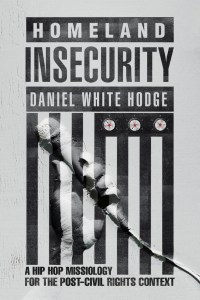 Daniel White Hodge’s Homeland Insecurity: A Hip Hop Missiology for the Post-Civil Rights Context is much more than a book about missions, though it has plenty there. It challenges readers to broaden perspectives, think critically about their own assumptions, and engage with cultures they may not have otherwise done.
The book starts off with an exploration of Christianity and “the theological turn of the twentieth century.” This theological turn was, in part, a moving away from seeing Christianity as a kind of turning everyone into white people with ways of thinking and culture. After World War II, there was a questioning of authority and the structures that were set in place to maintain authority that began to be challenged. But missiology hasn’t kept up with all the trends. As communities of black people began to be formed outside the church in the Post Soul context, these communities relied less upon the church, which then attempted outreach, turning it again, unfortunately, into a viewpoint where the dominant white culture and hierarchy became enshrined as part of the church and, therefore, of the mission preached to the community.
Throughout this first section, we see how racism in the church and the accompanying silencing of the voices of people of color led to multiple challenges in the American church. As people began to associate the church with oppression, they began to see Christ and orthodox Christianity as inherently wound up in the same systems. Opposition to doctrines that were taught by missionaries who seemed to care much more for the numbers they could draw than for the people or empowerment of the oppressed became part of the experience of many people of color. Hodge, here, shows through both anecdotes and broader analysis that this opposition to orthodoxy in some sections of the church arose from opposition to those associated with the orthodoxy. And here’s where the book begins to truly challenge its readers. After all, I personally cannot say how often I’ve heard about how much it is ideas that matter rather than the people who put the ideas forward. Objective truth, that is, is true no matter who shares it. I believe that. But when the people who share objective truth are actively oppressing you and preventing, sometimes by force, family members from doing things like voting, it becomes difficult to see where the lines should be drawn between the objective truths and the objective lies and distortions being put forward by the same individuals or groups of people.
There is a kind of blithe assumption that we–all people, that is–can just separate whatever someone believes or teaches from the person. Truth is supposed to be impersonal, and so it doesn’t matter if the one who is teaching the Gospel is a Klansman, because it still is the true Gospel. Objectively, that is true, but the message it sends is that the Gospel is associated with the Klan, whether we want it to be or no. That means the challenges faced by missiology must include not just teaching objective truths, but demonstrating that these objective truths are capable of objectively changing reality for both the one sharing the truths and for those who hear them. And that is exactly what the Gospel of Christ is about, for it ushers in salvation through the Kingdom of God. Hodge’s book continues to challenge readers throughout. Nowhere does he say that heresy is good or that it should be accepted, but he does call readers to see how heresy might become appealing when orthodoxy is associated with structures that oppress.
Hodge weaves data and anecdotes throughout the book. The segments from interviews are particularly poignant, as readers learn about young people of color who faced challenges of racism even in their small Christian groups. One example I remember is of a large black man who did his best to be cheerful, funny, and self-deprecating in order to come off as non-threatening to his church community only to have that community doubt his reports of aggression from police and white people outside that community purely based on his status as a large black man.
Then, Hodge turns to Hip Hop and an analysis of some major works in that genre to see how they’ve helped shape the thought and even theology of communities. Though often dismissed offhand as sinful due to content including cuss words, sex, violence, and drugs, hip hop is one way that people are trying to make sense of the world. But the analysis of Hip Hop isn’t an attempt to excuse its content; rather, it is a demonstration of the power of that content for communities experiencing that content and a call to develop missiology that acknowledges this context. It shows how Hip Hop has its own missiology and theology, deeply spiritual and often developed out of a Christian context and background.
Homeland Insecurity: A Hip Hop Missiology for the Post-Civil Rights Context is a challenging, fulfilling read. It’s a call to readers to go beyond the straightforward and look, truly look at the way we impact our communities. Moreover, it is a call to action. I highly recommend it.
Disclaimer: I was provided with a copy of the book for review by the publisher. I was not required to give any specific kind of feedback whatsoever.
Links
Be sure to check out the page for this site on Facebook and Twitter for discussion of posts, links to other pages of interest, random talk about theology/philosophy/apologetics/movies and more!
Book Reviews– There are plenty more book reviews to read! Read like crazy! (Scroll down for more, and click at bottom for even more!)
SDG.
——
The preceding post is the property of J.W. Wartick (apart from quotations, which are the property of their respective owners, and works of art as credited; images are often freely available to the public and J.W. Wartick makes no claims of owning rights to the images unless he makes that explicit) and should not be reproduced in part or in whole without the expressed consent of the author. All content on this site is the property of J.W. Wartick and is made available for individual and personal usage. If you cite from these documents, whether for personal or professional purposes, please give appropriate citation with both the name of the author (J.W. Wartick) and a link to the original URL. If you’d like to repost a post, you may do so, provided you show less than half of the original post on your own site and link to the original post for the rest. You must also appropriately cite the post as noted above. This blog is protected by Creative Commons licensing. By viewing any part of this site, you are agreeing to this usage policy.
Book Review: “A Light So Lovely: The Spiritual Legacy of Madeleine L’Engle” by Sarah Arthur
 A Light So Lovely is a remarkable look at an intriguing woman’s life and contributions to spirituality. At times challenging while at others biographical, Sarah Arthur weaves together tale with theology, fact with fiction in a compelling way.
Madeleine L’Engle is almost certainly best remembered for her book A Wrinkle in Time, but Sarah Arthur exposes readers to the broad range of L’Engle’s work, which seems to rival C.S. Lewis’s output in both range and output. Arthur draws on this comparison herself a number of times, though she never comes to rely upon it. L’Engle is her own person, and one with complexities that demand careful reading.
The book is organized around a number of themes within L’Engle’s thought and work. Arthur notes that one of L’Engle’s driving spiritual themes is that of the “both/and” rather than the “either/or.” As a Lutheran, this resonates with me quite a bit because Lutherans tend to see themes in life as both/and as well (e.g. that Christians are sinner/saints). The chapters reflect this “both/and” narrative with titles like “Icon and Iconoclast” and “Faith and Science.” In each chapter, the both/and that L’Engle affirms becomes clear.
L’Engle’s spirituality is tied up in both fiction and nonfictional works. At times, it challenges the bounds of what some would demand for orthodoxy. Her apparent affirmations of things like ultimate universalism and the like caused some controversy in her own time and continue to do so to this day. L’Engle explored spirituality through myth and mythmaking (using the terms in the technical sense). Arthur draws upon fiction, nonfiction, anecdotes, interviews, the Bible, and more for sources in outlining L’Engle’s thought and spirituality.
So what is L’Engle’s spirituality? It would be hard to sum it up even in paragraph form, but Arthur’s focus in the chapters already points towards a way to do so. Specifically, L’Engle’s spirituality was one which was inclusive almost to a fault, focused on uniting truths together that some would see as at odds with each other. Her spirituality was also deeply practical, with her honest looks at the struggles of working as a mother, dealing with doubt, and more. Another theme Arthur explores is the way L’Engle tied her spirituality into her fiction. It is remarkable, looking back, to see that a book like A Wrinkle in Time, with its explicitly Christian themes, managed to win a Newbery Award, for such awards typically avoid anything explicitly religious. But L’Engle’s work is so magical, so captivating, and her Christianity so matter-of-fact that it becomes its own kind of light, the “light so lovely” that it can inspire others to learn more and seek it out. This central theme of the book is also central to L’Engle’s spirituality.
A Light So Lovely is a delightful work. The highest laud I can give it is that it has led me to seek out more writings of L’Engle to seek a deeper understanding and try to help make my own light shine. Recommended.
Disclaimer: I was provided with a copy of the book for review by the publisher. I was not required to give any specific kind of feedback whatsoever.
Links
Be sure to check out the page for this site on Facebook and Twitter for discussion of posts, links to other pages of interest, random talk about theology/philosophy/apologetics/movies and more!
Book Reviews– There are plenty more book reviews to read! Read like crazy! (Scroll down for more, and click at bottom for even more!)
SDG.
——
The preceding post is the property of J.W. Wartick (apart from quotations, which are the property of their respective owners, and works of art as credited; images are often freely available to the public and J.W. Wartick makes no claims of owning rights to the images unless he makes that explicit) and should not be reproduced in part or in whole without the expressed consent of the author. All content on this site is the property of J.W. Wartick and is made available for individual and personal usage. If you cite from these documents, whether for personal or professional purposes, please give appropriate citation with both the name of the author (J.W. Wartick) and a link to the original URL. If you’d like to repost a post, you may do so, provided you show less than half of the original post on your own site and link to the original post for the rest. You must also appropriately cite the post as noted above. This blog is protected by Creative Commons licensing. By viewing any part of this site, you are agreeing to this usage policy.
Book Review: “Ecologies of Faith in a Digital Age” by Stephen D. Lowe and Mary E. Lowe
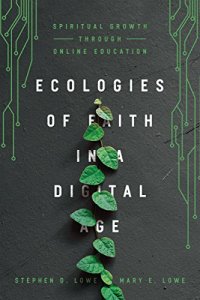 Ecologies of Faith in a Digital Age is a narrowly focused book that will be essential reading for its target audience. That target audience? People who are teaching or participating in online learning.
I’m almost tempted to leave the review at that, because genuinely, this book has a razor sharp focus that will make it invaluable for that audience but not as interesting for those who aren’t in the target group. As one who has done my share of online learning, I wish that I’d had this book ahead of time to help me foster some of the advice the authors share.
So what kind of advice is given herein? It ranges from helping make connections with others on social media to how best to design a learning environment for an online-only experience. The authors go beyond merely giving advice to helping readers strategize how to teach, learn, and foster spiritual growth in online environments. All throughout the book, many of the points are tied to scriptural examples in ways that–this is important–don’t feel like pulling texts out of context. The authors are careful to make points that will be directly relevant to their readers, and in doing so they’ve created a kind of guidebook for spiritual learning and growth online. Indeed, a whole section is dedicated to “A Biblical Theology of Ecology” before turning to how the internet has created its own share of “digital ecologies.”
Ecologies of Faith in a Digital Age will give readers exactly what they want out of it, so long as they’re part of its audience. For those involved in online learning or online groups geared towards formation, this will be an invaluable read.
Disclaimer: I was provided with a copy of the book for review by the publisher. I was not required to give any specific kind of feedback whatsoever.
Links
Be sure to check out the page for this site on Facebook and Twitter for discussion of posts, links to other pages of interest, random talk about theology/philosophy/apologetics/movies and more!
Book Reviews– There are plenty more book reviews to read! Read like crazy! (Scroll down for more, and click at bottom for even more!)
SDG.
——
The preceding post is the property of J.W. Wartick (apart from quotations, which are the property of their respective owners, and works of art as credited; images are often freely available to the public and J.W. Wartick makes no claims of owning rights to the images unless he makes that explicit) and should not be reproduced in part or in whole without the expressed consent of the author. All content on this site is the property of J.W. Wartick and is made available for individual and personal usage. If you cite from these documents, whether for personal or professional purposes, please give appropriate citation with both the name of the author (J.W. Wartick) and a link to the original URL. If you’d like to repost a post, you may do so, provided you show less than half of the original post on your own site and link to the original post for the rest. You must also appropriately cite the post as noted above. This blog is protected by Creative Commons licensing. By viewing any part of this site, you are agreeing to this usage policy.
Book Review: “Always Be Ready” by Hugh Ross with Kathy Ross
 Always Be Ready is another entry in the crowded field of introductory apologetics works. What sets it apart? I’d answer the question two ways: first, it has a number of deeply personal stories about faith and defending the faith from a noted apologist, Hugh Ross; second, it gives more insight than most books do into how to set up your own apologetics group/meeting/blog/etc.
The Ross couple give a number of anecdotes about their experience sharing the faith. As with most of the books from Reasons to Believe, there are a number of scientific discoveries sprinkled throughout the work. But the focus of the book is really on the title and the verse(s) it is taken from, 1 Peter 3:15-16 (NIV) “Always be prepared to give an answer to everyone who asks you to give the reason for the hope that you have. But do this with gentleness and respect, keeping a clear conscience, so that those who speak maliciously against your good behavior in Christ may be ashamed of their slander.”
Too often, apologists focus on the preparation and being ready, but not on the gentleness and respect aspects of it. The authors do a great job preparing readers for that side, while also opening readers to the resources to explore how to be ready for a defense when needed. The aspects of apologetic argument that are offered are in line with other Reasons to Believe publications, primarily focused upon an old earth creationist, concordist view of science, and seeing science as directly related to specific statements in the Bible. Whether one finds such a view of hermeneutics compelling or not will determine, largely, how useful such sections are.
But the book also has a surprising latter part, which deals in specifics of setting up small or large groups for apologetics discussions, along with a few tips that can apply to blogging, other online ministries, and more. I found these sections particularly useful, because they aren’t often things that apologetics works touch upon. It’s one thing to have an apologetics method and knowledge, but what if we don’t know how to sit down and compassionately, compellingly share that? The authors prepare readers for just that activity, making the last section of the book extremely valuable. Tips include thinking about your goal for the group. A large group is nice on the “numbers” front, but you won’t be able to make it as personalized as a smaller group. On the flip side, a larger group may allow some people who aren’t comfortable in small group settings to come and be somewhat anonymous. These kinds of tips that direct thinking for those who are eager to go and share their faith are essential reading.
Always Be Ready is a solid, introductory apologetics work with a focus on method and storytelling. Those are two aspects that aren’t discussed enough in much of the apologetics-related literature.
Disclaimer: I was provided with a copy of the book for review by the publisher. I was not required to give any specific kind of feedback whatsoever.
Links
Be sure to check out the page for this site on Facebook and Twitter for discussion of posts, links to other pages of interest, random talk about theology/philosophy/apologetics/movies and more!
Book Reviews– There are plenty more book reviews to read! Read like crazy! (Scroll down for more, and click at bottom for even more!)
SDG.
——
The preceding post is the property of J.W. Wartick (apart from quotations, which are the property of their respective owners, and works of art as credited; images are often freely available to the public and J.W. Wartick makes no claims of owning rights to the images unless he makes that explicit) and should not be reproduced in part or in whole without the expressed consent of the author. All content on this site is the property of J.W. Wartick and is made available for individual and personal usage. If you cite from these documents, whether for personal or professional purposes, please give appropriate citation with both the name of the author (J.W. Wartick) and a link to the original URL. If you’d like to repost a post, you may do so, provided you show less than half of the original post on your own site and link to the original post for the rest. You must also appropriately cite the post as noted above. This blog is protected by Creative Commons licensing. By viewing any part of this site, you are agreeing to this usage policy.
Book Review: “Rethinking Incarceration: Advocating for Justice that Restores” by Dominique DuBois Gilliard
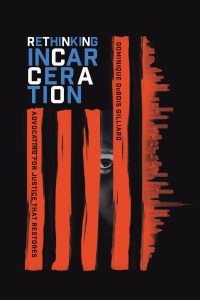 People from across the political system have called for reform of the penal system in the United States. With Rethinking Incarceration: Advocating for Justice that Restores, Dominique DuBois Gilliard delivers both a bevvy of information for those curious about the penal system alongside a call to work for higher justice.
The book is arranged around two parts: “The Roots and Evolution of Mass Incarceration” and “The Church’s Witness and Testimony.” These parts have much interplay with each other. The first part lays the groundwork for understanding how the United States has become the world’s largest prison system. He grounds this in a slew of historical details, starting with an examination of the “War on Drugs” and how it led to a massive upturn in numbers of incarcerated. Gilliard notes how Black Codes paved the way for “Neoslavery” and the use of the penal system to effectively make slaves once again. He notes these historical perspectives alongside discussion of the “pipelines” (to prison) of mental health, privatized prisons for profit, and immigration. Each of these has clear justice issues that cannot be ignored. The School-to-Prison pipeline, something I had only heard referenced but not really dug into before, seems quite clear to me after reading this book. Essentially, by allowing police presence into schools, we have criminalized delinquency at an alarming rate. Things that may have earned detention or suspension before now yield prison sentences to minors. Frankly, this seems insane. I was blown away by learning that very few states have any special training for the “resource officers” that are put into schools to watch our children is equally disturbing. There is no requirement for any kind of child psychology, de-escalating situations with minors, and the like whatsoever in most places.
After establishing this historical basis for the increase in incarceration rates, Gilliard turns to seeing what the church might do about this plight. He does not ignore historical perspective here, either. One of the most moving and interesting chapters in the book is “The Prisoners’ Pastor: Chaplaincy and Theology’s Institutional Impact.” Therein, Gilliard uses chaplains at the notorious Sing Sing prison in New York as a case study. It was thought by some that sending chaplains to the prisoners was pointless because they were “too far gone” to be impacted by such a ministry. The impact of the persistent chaplains in the face of serious opposition–including by those who ran the prison–is a wonderful tale, but not one without stumbling blocks either. It is also clear that when the chaplains become tools of the system, it can be incredibly damaging.
Another chapter examines the nature of punishment and how a Christian view of the penal system ought to be oriented towards not just punishment but also bringing people back into community. He argues this through an analysis of biblical justice and showing that restoration is a major theme. One of the major ways we can help to cut down on the system of mass incarceration is to educate rather than resort to exclusion and punishment every single time.
Rethinking Incarceration: Advocating for Justice that Restores is a fascinating, heart-rending, and immediately applicable book. Agree or disagree with Dominique DuBois Gilliard’s positions, it should be read by Christians who wish to think discerningly about our penal system. I highly recommend it.
Disclaimer: I was provided with a copy of the book for review by the publisher. I was not required to give any specific kind of feedback whatsoever.
Links
Be sure to check out the page for this site on Facebook and Twitter for discussion of posts, links to other pages of interest, random talk about theology/philosophy/apologetics/movies and more!
Book Reviews– There are plenty more book reviews to read! Read like crazy! (Scroll down for more, and click at bottom for even more!)
SDG.
——
The preceding post is the property of J.W. Wartick (apart from quotations, which are the property of their respective owners, and works of art as credited; images are often freely available to the public and J.W. Wartick makes no claims of owning rights to the images unless he makes that explicit) and should not be reproduced in part or in whole without the expressed consent of the author. All content on this site is the property of J.W. Wartick and is made available for individual and personal usage. If you cite from these documents, whether for personal or professional purposes, please give appropriate citation with both the name of the author (J.W. Wartick) and a link to the original URL. If you’d like to repost a post, you may do so, provided you show less than half of the original post on your own site and link to the original post for the rest. You must also appropriately cite the post as noted above. This blog is protected by Creative Commons licensing. By viewing any part of this site, you are agreeing to this usage policy.
Book Review: “Faith Across the Multiverse” by Andy Walsh
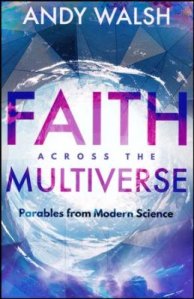 Faith Across the Multiverse is a difficult book for me to categorize. Based on the title and cover blurb, it seemed a bit like another entry in the crowded field of basic science-faith works. It’s an interesting field, but one that has many, many entry points. Yet as I continued to read the book, I discovered an appreciation for the unique style and depth of discussion that definitely separates it from the pack.
Walsh separates the book into four parts: The Language of Mathematics, The Language of Physics, The Language of Biology, and The Language of Computer Science. These titles might lead one to assume that this is (again) yet another book arguing for design or intelligent design. It is not. So it isn’t a broad introduction to faith-science issues, and it isn’t an entry level book on ID theory. What is it? It’s a kind of stream of consciousness look at several deep science-faith topics with some nerdy anecdotes and Biblical interpretation sprinkled in. That’s a mouthful, and that’s because this book is heady, much headier than one may expect. It grew on me more and more as I read it.
Each chapter has some kind of theme woven through it, typically drawn from some part of nerd culture. For example, in chapter 7 Orphan Black, a Canadian science fiction drama that I’m currently watching myself, is used to talk about nature vs. nurture, DNA coding, the church body, and denominations. It should be easy for readers to see why the book deserves a careful reading. Yes, many, many topics are raised all at once, but Walsh does an admirable job tying them all together and relating them back to Christianity in realistic ways. It’s fascinating to read about Walsh’s thoughts on mathematics and see how he applies them to the Bible and Christian doctrine. This isn’t a kind of 1-to-1 correlation as if Walsh is arguing for some kind of biblical numerology–far from it. Instead, he uses physics, math, biology, and computer science to highlight reasons to believe as we do–and sometimes to challenge those beliefs.
I noted already that the titles of the parts in the book make it sound like it’s arguing for Intelligent Design. It isn’t. Indeed, Walsh actually argues against the theory (though it doesn’t appear in the index) by noting how mathematical models can create seemingly infinite complexity without needing informational input. One example he uses is the Koch Curve, which is a phenomenally complex early look at a fractal that seems to create massive complexity through a very simple form (225ff). The Bible itself speaks to God using seemingly random things to generate information or to work for God’s ends (eg. the casting of lots) (p. 251-252). Evolution, he argues, doesn’t threaten God’s sovereignty any more than a seemingly unknowable outcome on our end (the rolling of dice) means God can’t design or control the process.
The book is truly a monument of imagination, while being grounded in real outcomes, science, and math. It’s fascinating to see Walsh tie Ms. Marvel, the X-Men, or Mark Watney, the star of The Martian into real life scenarios and biblical examples. By my count, Walsh managed to reference 65 books of the Bible in the text, while also drawing in nerd references, Francis Collins, discussions of the soul, and more. I can’t really overstate how remarkable I find the fact that there is unity in a text like this, but Walsh somehow pulls it off and delivers a rather fascinating science-faith work.
Andy Walsh’s Faith Across the Multiverse manages to distinguish itself by both the depth of its science and the fun of its references. It’s a surprising, thought-provoking work worthy of a careful read. I recommend it. Incidentally, I also found the book’s website as I wrote this review, if you’d like to explore further.
Disclaimer: I was provided with a copy of the book for review by the publisher. I was not required to give any specific kind of feedback whatsoever.
Links
Be sure to check out the page for this site on Facebook and Twitter for discussion of posts, links to other pages of interest, random talk about theology/philosophy/apologetics/movies and more!
Book Reviews– There are plenty more book reviews to read! Read like crazy! (Scroll down for more, and click at bottom for even more!)
SDG.
——
The preceding post is the property of J.W. Wartick (apart from quotations, which are the property of their respective owners, and works of art as credited; images are often freely available to the public and J.W. Wartick makes no claims of owning rights to the images unless he makes that explicit) and should not be reproduced in part or in whole without the expressed consent of the author. All content on this site is the property of J.W. Wartick and is made available for individual and personal usage. If you cite from these documents, whether for personal or professional purposes, please give appropriate citation with both the name of the author (J.W. Wartick) and a link to the original URL. If you’d like to repost a post, you may do so, provided you show less than half of the original post on your own site and link to the original post for the rest. You must also appropriately cite the post as noted above. This blog is protected by Creative Commons licensing. By viewing any part of this site, you are agreeing to this usage policy.

 J.W. Wartick - Reconstructing Faith