book review
Book Review: “Paul and Gender: Reclaiming the Apostle’s Vision for Men and Women in Christ” by Cynthia Long Westfall
[U]ntil very recently (ca. 1980s), traditional readings [of Bible passages related to women] have assumed the ontological inferiority of women through the entire history of interpretation, and it is implausible to think that an interpreter can effectively shed the foundational assumptions of the traditional view and still coherently maintain the remainder of interpretations and applications virtually intact. (4)
[T]raditional readings of the texts have been used and are being used overtly in a social construction of a theology of power and control that privileges one group over another (males over females), and those readings are controlled by the privileged group (males). (4)
Cynthia Long Westfall’s Paul and Gender: Reclaiming the Apostle’s Vision for Men and Women in Christ brings forward insights from hermeneutics, linguistics, sociology, history, and insight into the ancient world to present a consistent reading of the Pauline corpus in regards to gender. Westfall contends that the traditional reading of the text must face the challenge that it does not consistently read the Pauline corpus, but rather tends to prioritize certain readings of texts over other texts, rather than trying to unify them. A lack of consistent methodology is also a problem, as hermeneutic method changes depending upon what the text is taken to defend (3). Moreover, traditional readings of the texts are “problematic,” she argues, for several reasons: first, the traditional readings of the texts “have not resulted in making sense of Paul’s Letters” (ibid); second, these readings of the texts are making a theology of power (4); third, the ontological basis for the traditional reading has largely been acknowledged as mistaken (see the first quote, above); fourth, both the individual and the group can make significant contributions to and impact on interpretation. For these reasons, Westfall suggests a return to the texts to see what they actually mean in context, again, drawing on linguistics, contemporary cultural studies, and many more disciplines.
Westfall organizes the book topically, looking at how various topics relate to Paul and gender. These topics are culture, stereotypes, creation, the Fall, eschatology, the body, calling, authority, and an extended look at 1 Timothy 2:11-15. By organizing the book largely around these important topics in Paul’s thought, Westfall avoids the somewhat common theme of books about sexuality in Christianity of looking at one proof text after another to come down on one side or the other. Instead, Westfall presents a cohesive, rational way for looking at the whole of the Pauline corpus, yes, through looking at individual texts, but also by uniting Paul’s thought and bringing in insights from various fields.
Time and again throughout Paul and Gender, I came upon a way of looking at things I hadn’t considered before. Westfall’s use of linguistics and deep knowledge of the cultural context of the New Testament leads to arguments and conclusions that are powerful and compelling. Some of her points seem obvious on reflection, but were points I have rarely if ever seen discussed in literature related to men and women in Christ. For example, regarding 1 Timothy 2:13, she notes that in Genesis, from which Paul is drawing his point, primogeniture is constantly reversed. That theme is one I had learned and put forward myself, but I hadn’t thought about how it could be applicable to understanding Paul’s use of Adam first/Eve next in 1 Timothy. Why is it that complementarians repeatedly make a bald assumption that primogeniture is seen by Paul as an inherent hierarchy between man and woman when Paul is specifically using an example from a book where primogeniture is consistently overthrown by God? Her extensive look at 1 Corinthians 11 helps to make it even more clear how difficult it is to adequately understand some of these texts as English speakers. Through conversation with many contemporary sources, she conclusively demonstrates that the notion of the man being “head” is not a hierarchy. Moreover, her reading of what is meant by calling woman the glory of man as well as her interpretation of why women should have a kind of covering over their heads is one that answers many, many questions for me as a reader. By showing what, culturally, was going on in Corinth and the church in general, she presents readings that explain the text rather than obscure it further–or turn it into a proof text for a specific position.
The greatest strength of Westfall’s approach is that it truly does present a unified look at the Pauline corpus. Rather than having to look at texts piecemeal and form a series of doctrinal theses therefrom, Westfall’s reading of the texts related to gender present a consistent, holistic view of Paul’s teaching on gender. It is a truly remarkable book that deserves careful reading. I spent several hours on the chapter on “culture” alone, finding many deep insights both in the main text and the footnotes. As a reader, I feel as though I have a much deeper and more complete understanding of Paul on these topics than I did before I read it.
With Paul and Gender, Cynthia Long Westfall has created one of the most profoundly exegetical and deep challenges to the complementarian reading of the Pauline Corpus in existence. Her breadth of knowledge of many different fields of studies is effectively utilized to present a cohesive, persuading reading of Paul regarding gender. May all who are interested in finding what the New Testament teaches on gender read this book.
Disclaimer: I was provided with a copy of the book for review by the publisher. I was not required to give any specific kind of feedback whatsoever.
Links
Be sure to check out the page for this site on Facebook and Twitter for discussion of posts, links to other pages of interest, random talk about theology/philosophy/apologetics/movies and more!
Book Reviews– There are plenty more book reviews to read! Read like crazy! (Scroll down for more, and click at bottom for even more!)
SDG.
——
The preceding post is the property of J.W. Wartick (apart from quotations, which are the property of their respective owners, and works of art as credited; images are often freely available to the public and J.W. Wartick makes no claims of owning rights to the images unless he makes that explicit) and should not be reproduced in part or in whole without the expressed consent of the author. All content on this site is the property of J.W. Wartick and is made available for individual and personal usage. If you cite from these documents, whether for personal or professional purposes, please give appropriate citation with both the name of the author (J.W. Wartick) and a link to the original URL. If you’d like to repost a post, you may do so, provided you show less than half of the original post on your own site and link to the original post for the rest. You must also appropriately cite the post as noted above. This blog is protected by Creative Commons licensing. By viewing any part of this site, you are agreeing to this usage policy.
Book Review: “Reformation Commentary on Scripture: New Testament XIII- Hebrews, James” edited by Ronald K. Rittgers
 The Reformation Commentary on Scripture series focuses on sharing insights from Reformation theologians on the Bible. Here, we’ll take a look at the Hebrews, James volume of this extensive series.
I was particularly excited to read and review this volume of the series, because Hebrews and James were especially controversial in the Reformation period. The editor of this volume, Ronald K. Rittgers, does an excellent job of both showing that controversy over these books while also bringing forward some unified themes of the Reformers in regards to them. As a Lutheran, I found the various quotes and notes from Luther and other early Lutherans (particularly Veit Dietrich) to be of great interest. Luther infamously called James an epistle of straw, and here we have his quote in its context. It seems clear that the notions of inerrancy of modern evangelicalism cannot easily be read back onto many of these Reformers. When you have one explicitly stating that James is “worthy of censure in some places” (Veit Dietrich), it is hard to say that the Reformers unanimously would have affirmed modern notions of biblical inerrancy. Reading what these reformers actually said about specific Christian doctrines may serve as a corrective to some clearly false statements.
Of course, reading these Reformers also means we get insight into the controversies of their time, and we see, for example, John Calvin hitting back at those “who do not think [James is] entitled to authority” because he sees “no just cause for rejecting it” (quoted p. 202). Other major controversies dealt with Christology, human and divine responsibility for evil, and works righteousness. These issues are presented with multiple Reformation perspectives given, making the volume an essential resource for those wishing to look more deeply into some major modern controversies as well. Other areas are less controversial, such as the teaching of the eternally begotten Son–an orthodox position unfortunately rejected by some today.
Both the general introduction and the Editor’s introduction to this volume were informative and well worth reading on their own. They each provided much-needed background for understanding some of the controversies, as well as the names, involved in the text.
Volume XIII of the New Testament series of Reformation Commentary on Scripture is a simply excellent resources for those interested in reading and understanding Scripture. Reformation thinkers share much wisdom and insight. The conflicts that happened then, in some ways, still impact us today. By reading these voices from the past we can begin to understand our present more fully. I highly recommend this volume.
Disclaimer: I was provided with a copy of the book for review by the publisher. I was not required to give any specific kind of feedback whatsoever.
Links
Be sure to check out the page for this site on Facebook and Twitter for discussion of posts, links to other pages of interest, random talk about theology/philosophy/apologetics/movies and more!
Book Reviews– There are plenty more book reviews to read! Read like crazy! (Scroll down for more, and click at bottom for even more!)
SDG.
——
The preceding post is the property of J.W. Wartick (apart from quotations, which are the property of their respective owners, and works of art as credited; images are often freely available to the public and J.W. Wartick makes no claims of owning rights to the images unless he makes that explicit) and should not be reproduced in part or in whole without the expressed consent of the author. All content on this site is the property of J.W. Wartick and is made available for individual and personal usage. If you cite from these documents, whether for personal or professional purposes, please give appropriate citation with both the name of the author (J.W. Wartick) and a link to the original URL. If you’d like to repost a post, you may do so, provided you show less than half of the original post on your own site and link to the original post for the rest. You must also appropriately cite the post as noted above. This blog is protected by Creative Commons licensing. By viewing any part of this site, you are agreeing to this usage policy.
Book Review: “Dietrich Bonhoeffer and the Ethical Self: Christology, Ethics, and Formation” by Clark J. Elliston
 Clark J. Elliston’s Dietrich Bonhoeffer and the Ethical Self is a fascinating look at Dietrich Bonhoeffer in conversation regarding the concept of oneself in relation to the other, as well as one’s commitments to oneself. It is also an exposure to some writings and engagement with them that I suspect most readers of Bonhoeffer have yet to engage. As complex as Bonhoeffer’s philosophical writings were, Elliston manages to connect them to the reader in ways that make sense and holistically bring together Bonhoeffer’s thoughts on the self.
Before diving into this deep work, it is worth asking the question of why it is important. Most simply put, it is nearly impossible to accurately interpret Dietrich Bonhoeffer without coming to some understanding of his concept of the self and how one relates to the “other.” To do so, however, requires engagement with the deepest and most difficult of Bonhoeffer’s writings. Elliston’s book is just such an endeavor.
Clark J. Elliston engages the topic of the “ethical self” in Dietrich Bonhoeffer’s body of work through the lens of Emmanuel Levinas and Simone Weil. Who? Yeah, that’s what I thought, too. But Elliston introduces these thinkers and summarizes their thoughts to the extent that it not only makes sense for them to be the dialogue partners with Bonhoeffer but that I as a reader enjoyed the engagement. With Levinas and Weil, Elliston is able to approach Bonhoeffer’s thought from a two-pronged approach.
Levinas’s approach to the self is largely focused on the self in relation to the other. Elliston notes that this may present a “challenge for both theology and philosophy” by noting the interplay between self-other and the way responsibility forms. Bonhoeffer, however, Elliston argues, is able to meet the challenge and provide a holistic self in ethical relations to the other, allowing for theology to remain coherent as well. While Levinas believes that theology neutralizes the “other,” Bonhoeffer provides a corrective that preserves “otherness” without reducing it to the self.
Weil’s perspective is interesting becuase it is so other-oriented. The self exists “for” the other (Kindle location 2568). Weil’s thought included the concept of “decreation” which sees people as obstacles to God’s becoming. Creation is a kind of “renunciation” for God to provide other “selves” outside of himself. Decreation, though, is the act of total orientation of the self towards God. Attention is another central theme for Weil, and the attention towards the other is a way to engage with decreation and God. While Levinas and Bonhoeffer would surely be at odds regarding theology, he and Weil would be much closer. Many points of intersection exist between the two on the self. They share the notion that the self must limit its ego in order to better engage with the other.
I was particularly surprised when I saw that Elliston had utilized Adolf Eichmann as an example in the last chapter. Yes, that Eichmann. But it made sense in that Eichmann was a contemporary of Bonhoeffer’s and Elliston makes it quite clear that Eichmann is not being used positively. Instead, Eichmann is, Elliston argues, a good example of irresponsibility regarding the personal self. Eichmann demonstrated a defective view of the self and this undercut greatly his capacity to engage in proper ethics.
From all of this, it should be clear Elliston’s work is deeply philosophical. Much like reading Bonhoeffer’s Act and Being, reading Elliston here is a deep engagement on tough issues which demand much reflection.
On a side note, it would be remiss to not mention how excellent Elliston’s notes are throughout the book. Often paragraph-length themselves, these notes direct the reader to many different and intriguing topics, as well as providing insight into the details of Elliston’s theses.
Elliston’s Dietrich Bonhoeffer and the Ethical Self is a deep, thoughtful, and sometimes surprising book. It takes a careful reading to fully engage with the topics here, and it warrants re-reading several sections. I recommend the book for those who are looking to go more deeply into their study of Dietrich Bonhoeffer.
Disclaimer: I was provided with a copy of the book for review by the publisher. I was not required to give any specific kind of feedback whatsoever.
Links
Be sure to check out the page for this site on Facebook and Twitter for discussion of posts, links to other pages of interest, random talk about theology/philosophy/apologetics/movies and more!
Book Reviews– There are plenty more book reviews to read! Read like crazy! (Scroll down for more, and click at bottom for even more!)
SDG.
——
The preceding post is the property of J.W. Wartick (apart from quotations, which are the property of their respective owners, and works of art as credited; images are often freely available to the public and J.W. Wartick makes no claims of owning rights to the images unless he makes that explicit) and should not be reproduced in part or in whole without the expressed consent of the author. All content on this site is the property of J.W. Wartick and is made available for individual and personal usage. If you cite from these documents, whether for personal or professional purposes, please give appropriate citation with both the name of the author (J.W. Wartick) and a link to the original URL. If you’d like to repost a post, you may do so, provided you show less than half of the original post on your own site and link to the original post for the rest. You must also appropriately cite the post as noted above. This blog is protected by Creative Commons licensing. By viewing any part of this site, you are agreeing to this usage policy.
Book Review: “Scars Across Humanity: Understanding and Overcoming Violence Against Women” by Elaine Storkey
 Warning: Some statistics related to domestic violence and sexual violence are discussed in this post.
[T]he… acts of violence to women aged between 15 and 44 across the globe produce more death, disability and mutilation than cancer, malaria, and traffic accidents combined (2).
Every three seconds a girl under the age of 18 is married somewhere across the world-usually without her consent and sometimes to a much older man (49).
Nearly 200 million women and girls worldwide are living with the traumatic consequences of female genital mutilation (30).
It is an alarming picture of mass termination: prenatal offspring, aborted for no other reason than they happen to be female (19).
There are some nonfiction books that have made me sit back upon finishing reading them, wondering about the world we live in, because the book has given me new eyes to see. Scars Across Humanity has become one of those books. Though I was aware of, broadly, some of the statistics of violence against women, I had no idea how completely pervasive it is at all stages of life. Nor did I fully comprehend or appreciate how totally violence against women has penetrated every level of nearly every society on Earth. Though the #MeToo and #ChurchToo movements have highlighted some of these issues, Storkey gets to the meat of the issue, giving enormous amounts of statistics and serious analysis of the totality of this horrific situation.
The bulk of Scars Across Humanity focuses on statistics and specifics. First, Storkey shows that violence against women is a “global pandemic.” There is no part of the world that is untouched by this blight upon humanity. Then, several chapters go over specific instances of violence against women. Abortion is the first level of violence against women. Sex-selective abortions are almost entirely chosen to kill unborn girls. This, in turn, fuels human trafficking as women are moved into those parts of the world where a serious imbalance of adult men and women exists, largely due to sex-selective abortions. Female genital mutilation is opposed by leaders of all major faiths, yet it continues across the world and cases of it in places like England and the United States are on the rise. Early and forced marriage is another global problem. Indeed, in the United States, very few restrictions exist on girls being married off to men–indeed, 20 states have no minimum age of marriage.
The misnomer of “honor” killings continue in some parts of the world and, where it is outlawed, enforcement is incredibly lax. Women are murdered or disfigured for the sake of male notions of “honor.” Domestic violence exists in the home and a stigma surrounds it such that it is underreported. Women are at the highest risk when they attempt to leave an abuser, and as many, many instances have shown, they are often not believed when accusations of abuse are made. To help stop the wave of violence in the home, we must work to end stigmas surrounding those who have been harmed by domestic partners, work with law enforcement agencies, and change laws as needed to provide for the greatest possible protection of those towards whom violence is directed. Human trafficking and prostitution are closely tied together and even in those areas where prostitution is made into “just another job,” evidence suggests that massive increases in trafficking occur. Rape is a worldwide epidemic and Storkey shows clear instances of how “rape culture” is a real thing that women must deal with when they report this sexual violence. A huge part of ending rape is to educate men and punish them where they perpetrate these vicious acts. War almost inevitably leads to sexual violence, as can be seen in the historical record as well as into today. Rape is sometimes even used as a weapon of genocide in cultural warfare. Women, time and again, are seen as pawns in conflicts and power dynamics of men.
By the end of Storkey’s analysis, I was left wondering whether there was any room for hope. Storkey does offer a few points, sometimes highlighting how laws have changed to help fight violence against women (though often noting alongside this the serious lack of enforcement of those same laws). However, it is in the last few chapters that Storkey offers her broader vision of overcoming violence against women. Largely, this includes working both internationally and locally (with specific guidelines and stories of how this has worked) to create and enforce laws and to spread and teach the Christian theology of the equality of all humanity.
From before women are born to their all-too-often violent deaths, women across the planet are attacked in often brutal ways. Scars Across Humanity shines a light upon this darkness and issues a serious, empowering call to end this horror of violence against women. If we are truly serious about men and women being made in the image of God, we must fight this gender-based violence on a global level. Storkey’s book is highly recommended.
Links
Be sure to check out the page for this site on Facebook and Twitter for discussion of posts, links to other pages of interest, random talk about theology/philosophy/apologetics/movies and more!
Book Reviews– There are plenty more book reviews to read! Read like crazy! (Scroll down for more, and click at bottom for even more!)
SDG.
——
The preceding post is the property of J.W. Wartick (apart from quotations, which are the property of their respective owners, and works of art as credited; images are often freely available to the public and J.W. Wartick makes no claims of owning rights to the images unless he makes that explicit) and should not be reproduced in part or in whole without the expressed consent of the author. All content on this site is the property of J.W. Wartick and is made available for individual and personal usage. If you cite from these documents, whether for personal or professional purposes, please give appropriate citation with both the name of the author (J.W. Wartick) and a link to the original URL. If you’d like to repost a post, you may do so, provided you show less than half of the original post on your own site and link to the original post for the rest. You must also appropriately cite the post as noted above. This blog is protected by Creative Commons licensing. By viewing any part of this site, you are agreeing to this usage policy.
Book Review: “Come, Let Us Eat Together: Sacraments and Christian Unity” edited by George Kalantzis and Marc Cortez
 Come, Let Us Eat Together: Sacraments and Christian Unity provides something not often seen in the polemics of our day: a call for Christian unity even over those things which are of most import. Here, the issue of the sacraments is evaluated regarding what they may have to do with Christian unity. A number of from scholars in various denominations (from what I can tell, included are Roman Catholic, Baptist, Reformed, Methodist, Eastern Orthodox, and Lutheran writers, though there may have been more represented) present essays reflecting on ecumenism and the sacraments.
Topics in these various essays go across a wide range. Whether it is ecumenism presented through the arts or the notion of closed communion in some Baptist churches (something I didn’t realize existed anywhere in the Baptist tradition), any reader will find something of interest to them related to the Sacraments.
I found a few essays of particular interest. First, “A Way Forward: A Catholic-Anabaptist Ecclesiology” by D. Stephen Long caught my eye simply for the title. Few theological systems could be more at odds than that of the Roman Catholic and that of the Anabaptist. In the essay, we find a few broad steps that can be taken to see some areas of agreement between these divergent strands of theology. Second, “Visual Ecumenism: The Coy Communion of Art” by Matthew J. Milliner invites readers to see the Lutheran view of Law-Gospel distinction in other denominational perspectives as well. Multiple essays that focused more exclusively on ecumenism as a possibility were quite interesting. I already mentioned in passing Marc Cortez’s “Who Invited the Baptist?” for its introducing me to the idea that some Baptists practice closed communion. I’m still trying to figure out exactly why a Baptist would do so, but had I not read this book I’m not sure when I would have been exposed to this differing and unexpected practice in the Baptist community.
As a Lutheran in the Evangelical Lutheran Church in America, a body that practices open communion while also affirming baptismal regeneration and Christ’s “real presence” in the bread and wine of the Lord’s Supper, I found a number of points of agreement and disagreement here. That is, of course, exactly what this collection of essays (originally lectures) is all about: finding those points of division and seeking to heal–or at least address–them. It’s a fascinating work.
Disclaimer: I was provided with a copy of the book for review by the publisher. I was not required to give any specific kind of feedback whatsoever.
Links
Be sure to check out the page for this site on Facebook and Twitter for discussion of posts, links to other pages of interest, random talk about theology/philosophy/apologetics/movies and more!
Book Reviews– There are plenty more book reviews to read! Read like crazy! (Scroll down for more, and click at bottom for even more!)
SDG.
——
The preceding post is the property of J.W. Wartick (apart from quotations, which are the property of their respective owners, and works of art as credited; images are often freely available to the public and J.W. Wartick makes no claims of owning rights to the images unless he makes that explicit) and should not be reproduced in part or in whole without the expressed consent of the author. All content on this site is the property of J.W. Wartick and is made available for individual and personal usage. If you cite from these documents, whether for personal or professional purposes, please give appropriate citation with both the name of the author (J.W. Wartick) and a link to the original URL. If you’d like to repost a post, you may do so, provided you show less than half of the original post on your own site and link to the original post for the rest. You must also appropriately cite the post as noted above. This blog is protected by Creative Commons licensing. By viewing any part of this site, you are agreeing to this usage policy.
Book Review: “The Messiah Comes to Middle Earth” by Philip Ryken
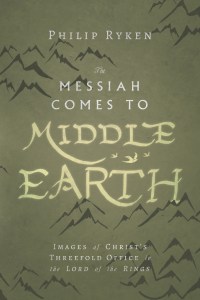 The Messiah Comes to Middle Earth by Philip Ryken is a collection of lectures given by Ryken that explore the notions of prophet, priest, and king in The Lord of the Rings trilogy.
In the first lecture, Ryken explains the notion of the threefold office of Christ found in Lord of the Rings as an amalgam of different characters therein. Then, he goes over the notion of the threefold office in the early church and Scripture. Gandalf the Grey is seen as the prophet. This doesn’t necessarily mean what we often think–foretelling the future–but rather the sharing of wisdom. Gandalf “sees the present in true perspective” (15). After going over ways Gandalf may be seen as prophet, he looks at some applications that can be made. A response is offered by Sandra Richter.
The office of priest is found, Ryken outlines, in the priesthood of all believers reflected in Sam, Frodo, and others. He ties this doctrine into the Reformation and draws out the notions of priesthood as bearing burden and sacrifice unto death. A response is offered by Jennifer Powell McNutt.
Regarding the office of king, Aragorn is the plain choice, though Ryken has already alluded to how some of these roles intertwine in other characters in the previous lectures. Prophecy is one aspect of a king fulfilled, and Ryken relates that in LOTR to that in the Bible. William Struthers offers a response here.
The Messiah Comes to Middle Earth is a practice of literary apologetic and intertwining myth with our reality. It’s brief, to the point, and applicable.
Disclaimer: I was provided with a copy of the book for review by the publisher. I was not required to give any specific kind of feedback whatsoever.
Links
Be sure to check out the page for this site on Facebook and Twitter for discussion of posts, links to other pages of interest, random talk about theology/philosophy/apologetics/movies and more!
Book Reviews– There are plenty more book reviews to read! Read like crazy! (Scroll down for more, and click at bottom for even more!)
SDG.
——
The preceding post is the property of J.W. Wartick (apart from quotations, which are the property of their respective owners, and works of art as credited; images are often freely available to the public and J.W. Wartick makes no claims of owning rights to the images unless he makes that explicit) and should not be reproduced in part or in whole without the expressed consent of the author. All content on this site is the property of J.W. Wartick and is made available for individual and personal usage. If you cite from these documents, whether for personal or professional purposes, please give appropriate citation with both the name of the author (J.W. Wartick) and a link to the original URL. If you’d like to repost a post, you may do so, provided you show less than half of the original post on your own site and link to the original post for the rest. You must also appropriately cite the post as noted above. This blog is protected by Creative Commons licensing. By viewing any part of this site, you are agreeing to this usage policy.
Book Review: “Philosophical Foundations of a Christian Worldview” 2nd Edition by J.P. Moreland and William Lane Craig
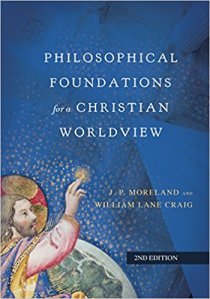 A work of the size and scope as J.P. Moreland and William Lane Craig’s massive Philosophical Foundations for a Christian Worldview is daunting, so readers will want to know if it is work going through. The short answer to that question is that yes, it is, so long as one reads the work–like any other–with a critical eye.
The book is broken up into six parts: Introduction, Epistemology, Metaphysics, Philosophy of Science, Ethics, and the Philosophy of Religion and Philosophical Theology. Each section is full of definitions and lengthy philosophical outlines arguing for the positions Craig and Moreland hold. They attempt to stick to a largely “mere” Christianity, though at times they stray from a vision that is as broad as possible. For example, regarding the debate over the soul, Moreland and Craig fall staunchly into the dualist camp, to the extent that a physicalist theory of mind from a Christian perspective isn’t even considered. Regarding the science-faith question, the authors argue lengthily against any perspective which would hold to methodological naturalism and seem to align most closely with ID theory. For a theory of time, the authors push for an A-theory of time, which later impacts their doctrine of God by making God temporal post-creation and undermines the notion of divine simplicity.
Yet even those who take issue with the positions the authors hold will continue to benefit from interacting with their views. For example, interacting with their arguments about God and time would be a great exercise whether one believes God is temporal or atemporal.
I did, however, find the choices of subjects related to philosophical theology to be particularly interesting. The first two sections make arguments related to the Trinity and the Incarnation, which are both definitional to the notion of a “Christian.” The third, however, is about the Atonement, and quickly (613) states that “an essential, and indeed central, element of any biblically adequate atonement theory is penal substitution” and then go on to say “More than that, penal substitution, if true, could not be a merely subsidiary facet of an adequate atonement theory, for it is foundational to many other aspects of the atonement, such as redemption from sin, satisfaction of divine justice, and the moral influence of Christ’s example” (613-614). I was quite surprised by this–especially the latter statement–because there are entire theories of atonement based around these aspects. Thus, for example, the Example Theory of the atonement is entirely based upon the notion that Christ is an example and would therefore give us all kinds of moral influence. Interestingly, the fourth doctrine addressed is that of Christian particularism–the notion that salvation is in Christ alone. I tend to agree that no orthodox Christian would deny this, but it is interesting to see that Craig and Moreland seem to equate belief in, say, universalism with a denial of particularism, though to my knowledge most of the 19th century Christian universalists affirmed particularlism but held to universal salvation through Christ. Craig and Moreland go on to state that views like annihilationism “are rather difficult to square with the biblical data” (632) even though, in my experience, annihilationists almost always go straight to the biblical text to support their views (see, eg. numerous passages that equate hell with death or destruction). Again, it seems odd in a book that tends to go towards “mere” Christianity to pick views that are at issue and then exclude all others.
Many readers will want to go straight to the book for arguments about the existence of God, and Moreland and Craig do not disappoint. In the two chapters on the topic, the authors summarize huge swathes of philosophical arguments for the existence of God, along with answering many objections. Like the rest of the book, this is done in summaries of longer arguments, but readers will still get much of use out of this section.
Though I’ve skimmed through many portions of the book, I’d like to focus a little bit on Christology and the discussion of what Craig elsewhere calls Neo-Apollinarianism. I was curious to see if the 2nd edition of the book would modify this position in critical ways to avoid the pitfalls of his previous position, but it seems it does not. The argument is made that “Apollinarianism achieved a genuine incarnation that… is no more implausible than the soul’s union with the body” (597). The problem was that it failed to unify body with mind in Christ. Thus, the authors propose making the divine Logos the mind of Christ, among other things (603ff). This seems to me–and many others–to punt the problem by still making it such that the Incarnated Christ does not have the totality of human nature, for the mind is from the divine nature. Simply calling it the “Logos” does not smooth over the problem of making the human nature effectively mindless without the divine. Because this Christology does not give Christ a human mind, as Gregory of Nazianzus said, “That which was not assumed was not saved” (glossing a bit). This seems an incomplete Christ.
Moreover, the discussion on the Lutheran view of Christology (a view that I as a Lutheran ascribe to) rather strangely condemns Lutherans for confusing the natures of Christ by teaching the communication of the attributes. Such a blithe dismissal seems wrongheaded, unless Moreland and Craig wish to further deny that the Incarnate Christ was incapable of divine activity. Alas, such misunderstanding of Lutheran positions are not uncommon.
With Philosophical Foundations for a Christian Worldview, Moreland and Craig have provided a truly impressive contribution to Christian philosophy of religion that will serve as a starting point for many an engagement with a huge number of topics. At some points, the authors take contentious positions, and it is unfortunate that they endorse a non-standard Christology. Thus, readers should read the work with a critical eye, treating it as a practice of interaction on a high level with a number of philosophical ideas related to Christianity.
Disclaimer: I was provided with a copy of the book for review by the publisher. I was not required to give any specific kind of feedback whatsoever.
Links
Be sure to check out the page for this site on Facebook and Twitter for discussion of posts, links to other pages of interest, random talk about theology/philosophy/apologetics/movies and more!
Book Reviews– There are plenty more book reviews to read! Read like crazy! (Scroll down for more, and click at bottom for even more!)
SDG.
——
The preceding post is the property of J.W. Wartick (apart from quotations, which are the property of their respective owners, and works of art as credited; images are often freely available to the public and J.W. Wartick makes no claims of owning rights to the images unless he makes that explicit) and should not be reproduced in part or in whole without the expressed consent of the author. All content on this site is the property of J.W. Wartick and is made available for individual and personal usage. If you cite from these documents, whether for personal or professional purposes, please give appropriate citation with both the name of the author (J.W. Wartick) and a link to the original URL. If you’d like to repost a post, you may do so, provided you show less than half of the original post on your own site and link to the original post for the rest. You must also appropriately cite the post as noted above. This blog is protected by Creative Commons licensing. By viewing any part of this site, you are agreeing to this usage policy.
Book Review: “Theistic Evolution: A Scientific, Philosophical, and Theological Critique” Summary of Response
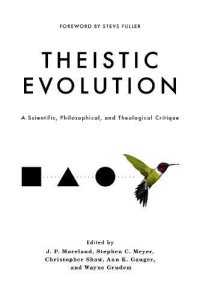 I’ve spent quite a bit of time reviewing, re-reading, and contemplating the massive book entitled Theistic Evolution: A Scientific, Philosophical, and Theological Critique edited by J.P. Moreland, Stephen C. Meyer, et al. I reviewed the book, interacting with the scientific and philosophical parts, and then looking in even more detail at some individual chapters in the theological section of the work. I wished to make a post that summarized some of my thoughts, as well as providing a one-stop shop for viewing my lengthier criticisms as well as those of others.
Review
Theistic Evolution is, without a doubt, the most comprehensive collection of arguments against the eponymous position that I know of in existence. But that is not to say there is going to be much new here for those who have read about science-faith issues. Indeed, though almost every chapter is first published here (except where otherwise noted in a few chapters), most of the arguments have been dealt with or have been ongoing for years, if not decades. Here, I can only offer the briefest interaction with the massive work (but see my longer interactions linked below).
The scientific section is largely outside my area of expertise, so I’ll limit myself to a few broad comments. Time and again, various authors move from saying that scientists cannot determine the exact order of a certain evolutionary chain to saying that there is therefore no such chain. This is deeply mistaken, though I admit I used to buy into this type of anti-evolutionary argument myself. At first it sounds compelling, until one considers that nowhere else do we allow this reasoning. For example, we would not say that no automobile accident happened just because we could not determine the exact order in which individual parts of the cars involved were crushed. Another difficulty with the scientific part of the book is that time and again, the assertions are made that theistic evolutionists do not allow there to be design as a possibility or God acting in nature; yet this is false at best and disingenuous at worst.
The philosophical critique falls largely flat. For one thing, a constant refrain is that theistic evolutionists are no different from atheists when it comes to methodological naturalism, yet this strangely ignores the “theistic” part of the term theistic evolution. Because proponents of said position are theists, they clearly allow for divine activity, and major proponents of the theory like those at Biologos constantly affirm this. Second, assertions that evolution would not allow for theism in the first place also fail both because Christians from the beginning of interaction with evolution have noted that God could simply have ordained the whole process and because those Christians who think in Aristotelian terms can still have final ends in mind with evolution, even on the level of individual species.
The theological critique musters perhaps the strongest arguments in the book, but even here there are a series of blunders that undercut much of the case. In the chapter on the Old Testament, for example, the author fails to defend or even define the meaning of the term “history” and its use to describe the early chapters of Genesis. In the chapter on the New Testament, the author strangely insists that Jude must mean Genesis is “historical” (again failing to define or even touch on what that term is supposed to mean here) while also dismissing claims that other parts of Jude would make other events historical. Then, the author turns around and says that because Jude cites the book of 1 Enoch, that means some parts of 1 Enoch are historical while others aren’t. Which are which? Well, clearly, whichever parts benefit the author are historical; those that don’t are not. Moreover, the same author does not at any point defend the notion of taking a genealogy in the way that we Westerners in the 21st century take it, despite the genealogies in the New Testament being written in an ancient time with a completely different culture. In the chapter on historical Christian theology, the word “creation” is wielded like a sword, leading to some possible confusion on categories related to Aquinas and others.
Definitions are clearly very important in the book, though vastly important terms like “history” or “historical narrative” are thrown about without ever interacting with them. This, despite the intense debate in the field of history about the changing meaning of the term and how history is written. The definition of Theistic Evolution–“God created matter and after that did not guide or intervene or act directly to cause any empirically detectable change in the natural behavior of matter until all living things had evolved by purely natural processes” (67)–given in the book fails to adequately account for the range of beliefs of theistic evolutionists and does not draw adequately from major TE groups. Nevertheless, the authors use that definition as though it can exclude or include people in the umbrella term. Not only that, but some authors rail against TEs for things the definition that the editors themselves endorse use make clear TEs don’t all believe. Prominent Christian philosopher J.P. Moreland is among those who attack TEs for denying a historical Adam and Eve, yet the definition that the editors provide does not actually exclude this belief in any way.
Overall, Theistic Evolution: A Scientific, Philosophical, and Theological Critique does not contribute much new to the intrafaith debate about evolution. For one thing, as noted above, it fails to adequately interact with the actual views of those who hold to theistic evolution, while also failing to acknowledge the breadth of thought such a position represents. Additionally, the arguments presented herein have largely been encountered in other works throughout the science-faith debate. Finally, many of the arguments presented herein are either circular or self-refuting. As noted briefly above (and in more detail in my extended analyses below), several authors simply assert that parts of the Bible are “historical” and then use that to batter theistic evolution, as if no serious exegesis has been done on the other side. Where exegesis is addressed, it is typically perfunctory and laced with dismissals of rival positions. I cannot recommend the book to those wishing to have a full and honest discussion of theistic evolution, though if it does truly represent the best of the best by way of critique of theistic evolution, I would say that those holding to that position may sleep soundly.
Disclaimer: I was provided with a copy of the book for review by the publisher. I was not required to give any specific kind of feedback whatsoever.
Extended Critique of Individual Sections and Chapters
My individual sections critiquing the book on numerous fronts can be found as follows:
Book Review: “Theistic Evolution: A Scientific, Philosophical, and Theological Critique” Part 1- Definition(s)– Definitions are a key issue throughout the book, and I take a look at a few here, including the definition the authors use for “theistic evolution” and the lack of interaction with major groups who are advocates of this position.
Book Review: “Theistic Evolution: A Scientific, Philosophical, and Theological Critique” Part 2: Science– A significant portion of the book was dedicated to scientific critique of theistic evolution, which is largely to say critique of the theory of evolution broadly speaking. Though I’m not an expert in science by any means, I interact with this portions I felt comfortable with, especially calling into question the movement from lack of 100% certainty to not having any possibility of evolution being true.
Book Review: “Theistic Evolution: A Scientific, Philosophical, and Theological Critique” Part 3: Philosophical Critique– Several philosophical issues are raised, from methodological naturalism to alleged contradiction of affirmations of Christianity that theistic evolutionists must hold. In contrast, I note that theistic evolutionists have a broader base to allow for ends in evolution, while also noting that the alleged contradictions are non-existent.
Book Review: “Theistic Evolution: A Scientific, Philosophical, and Theological Critique” Part 4: Theistic Evolution and the Old Testament– From the creation accounts to the historicity of Adam, arguments are made to the effect that the Old Testament cannot be compatible with theistic evolution. I note the circularity of several arguments the author makes, as well as questioning their use of the category “history.”
Book Review: “Theistic Evolution: A Scientific, Philosophical, and Theological Critique” Part 5: Theistic Evolution and the New Testament– Several parts of New Testament teaching, from the genealogies in the Gospels to the faith list in Hebrews are taken to show that theistic evolution is “incompatible” with the New Testament. I argue that this is mistaken, and indeed the author fails to demonstrate this incompatibility.
Book Review: “Theistic Evolution: A Scientific, Philosophical, and Theological Critique” Part 6: Theistic Evolution and Historical Christian Doctrine– Theistic evolution is often said to contradict the historic teaching of the church. Here, I analyze the extended arguments of one author who suggests this is the case, noting that at many points, modern categories are imported into the discussion of historical theology.
Other Reviews/Interactions (will update with more)
J.P. Moreland and the Book “Theistic Evolution” (Part 1: What do William Paley, Richard Dawkins, and J.P. Moreland all have in common?)– A two-part analysis of J.P. Moreland’s commentary on theistic evolution and its method. Part Two.
Links
Be sure to check out the page for this site on Facebook and Twitter for discussion of posts, links to other pages of interest, random talk about theology/philosophy/apologetics/movies and more!
Book Reviews– There are plenty more book reviews to read! Read like crazy! (Scroll down for more, and click at bottom for even more!)
SDG.
——
The preceding post is the property of J.W. Wartick (apart from quotations, which are the property of their respective owners, and works of art as credited; images are often freely available to the public and J.W. Wartick makes no claims of owning rights to the images unless he makes that explicit) and should not be reproduced in part or in whole without the expressed consent of the author. All content on this site is the property of J.W. Wartick and is made available for individual and personal usage. If you cite from these documents, whether for personal or professional purposes, please give appropriate citation with both the name of the author (J.W. Wartick) and a link to the original URL. If you’d like to repost a post, you may do so, provided you show less than half of the original post on your own site and link to the original post for the rest. You must also appropriately cite the post as noted above. This blog is protected by Creative Commons licensing. By viewing any part of this site, you are agreeing to this usage policy.
Book Review: “Living Wisely with the Church Fathers” by Christopher A. Hall
 What kind of insight can we glean from the church fathers, anyway? That’s a question I’ve heard often and asked myself before I began to delve into the answers. Hall’s series on the fathers is a lengthy answer to that question.
The first logical question is about this book as a series. Is it possible to read this without reading the other books and gain insight? Yes, absolutely. I, in fact, did not read any of the other books in the series and didn’t even know it was one until I read the introduction. I imagine readers would gain more from reading the entire series, but would also say that it is perfectly acceptable to read just this one.
This book is about living with the fathers. Specifically, it is about how we ought to live in light of Christ. Chapters focus on martyrdom, wealth and poverty, war and military service, sex and the dynamics of desire, life as male and female/marriage, life and death, entertainment, and the well-ordered heart. An incredibly broad array of topics, to say the least.
Highlights of the book include the chapters on entertainment, wealth and poverty, and war and military service. Regarding the latter, it seems clear that “for hundreds of years, the ancient church opposed service in the military” (126). However, perspectives began to change later, specifically with Constantine and Augustine. Nevertheless, a strong commitment to pacifism in the church remained a lively option even to this day. Entertainment is a tough field to navigate, and though some seem to suggest that people today face worse challenges than ever before, it is clear that in Ancient Rome, with its debauchery and gladiatorial games, had much to deal with as well. The way the early church dealt with this, argues Hall, reveals a kind of threefold response to entertainment: “first, the intimate link between Roman entertainment and Roman religious life; second, specifically what was being offered as entertainment; and third, the effect of this entertainment on God’s image bearers…” (199). It is easy to see how this can be applied to entertainment today, though Hall doesn’t spend much time highlighting how the application might be transferred. Regarding wealth and poverty, Hall notes that the wealthy and poor were both early Christians, and even then too many Christians ignored the plight of the poor (61). What we do with our wealth shows the state of our heart. If there is something negative to be said about the book it is that at times, it seems Hall may smuggle a few of his own theological perspectives into the positions of the church fathers, but these are few and far between.
Living Wisely with the Church Fathers is a broad look at the theology of the early church regarding the Christian life. Those interested in learning more about Christian living or historical theology should check it out.
Disclaimer: I was provided with a copy of the book for review by the publisher. I was not required to give any specific kind of feedback whatsoever.
Links
Be sure to check out the page for this site on Facebook and Twitter for discussion of posts, links to other pages of interest, random talk about theology/philosophy/apologetics/movies and more!
Book Reviews– There are plenty more book reviews to read! Read like crazy! (Scroll down for more, and click at bottom for even more!)
SDG.
——
The preceding post is the property of J.W. Wartick (apart from quotations, which are the property of their respective owners, and works of art as credited; images are often freely available to the public and J.W. Wartick makes no claims of owning rights to the images unless he makes that explicit) and should not be reproduced in part or in whole without the expressed consent of the author. All content on this site is the property of J.W. Wartick and is made available for individual and personal usage. If you cite from these documents, whether for personal or professional purposes, please give appropriate citation with both the name of the author (J.W. Wartick) and a link to the original URL. If you’d like to repost a post, you may do so, provided you show less than half of the original post on your own site and link to the original post for the rest. You must also appropriately cite the post as noted above. This blog is protected by Creative Commons licensing. By viewing any part of this site, you are agreeing to this usage policy.
Book Review: “The Myth of Equality” by Ken Wytsma
 It is difficult for me to state how important I believe Ken Wytsma’s book, The Myth of Equality, is. Wytsma’s work is half about showing that we–and by we I generally mean WASPs- White Anglo-Saxon Protestants–have bought into serious misinformation or myths about equality and half about showing what we can do about it.
Part I of the book, entitled “The Story of Race,” is a well-researched, broad look at racism in the United States. Wytsma shows how the notions of race became so ingrained in our worldview–despite the United States being a nation, mostly, of immigrants. Then, he demonstrates that institutions have existed throughout the history of the United States that have influence stretching into today. This section is perhaps the most important for building up his overall case, as many express doubts about these very conclusions. The notion that slavery was “back then” and has little-to-no impact on today is one that I have run into many times. Wytsma shows that this is a completely mistaken idea. From the immediate re-enslavement of black people in the south through the use of convicts’ labor, the collapse of Reconstruction, to redlining and the war on Drugs, time and again Wytsma doesn’t just outline the woes of our country, but shows how these institutions’ have influence that reaches into today. The facts, details, and data are all brought to bear, however briefly, to demonstrate his points. Not only that, but he provides ways to do more research for those interested.
Part II moves from the “what” of inequality to the “what can we do about it?” Wytsma argues that racial justice does absolutely belong in conversations in church. Biblically, justice is at the center of the truths of Christianity. Racial reconciliation is a worthy end goal for all people of faith. Citing respected theologians like C.S. Lewis and Dietrich Bonhoeffer, Wytsma shows that the call to obedience and finding justice apply to all Christians.
Part III, called “The Challenge of Privilege,” brings forward that difficult topic of privilege, that many refuse to even acknowledge as an issue. Wytsma challenges us to see how we lie to ourselves and how the way we perceive things can reinforce racism and make it so that we don’t even see it as it happens.
I cannot recommend The Myth of Equality highly enough. It should be required reading for anyone who wishes to have any kind of informed opinion in discussions of race, inequality, and Christianity. From dismantling the lies we tell ourselves about race to encouraging us to seek justice and showing some avenues to do so, the book is an invaluable asset.
Disclaimer: I was provided with a copy of the book for review by the publisher. I was not required to give any specific kind of feedback whatsoever.
Links
Be sure to check out the page for this site on Facebook and Twitter for discussion of posts, links to other pages of interest, random talk about theology/philosophy/apologetics/movies and more!
Book Reviews– There are plenty more book reviews to read! Read like crazy! (Scroll down for more, and click at bottom for even more!)
SDG.
——
The preceding post is the property of J.W. Wartick (apart from quotations, which are the property of their respective owners, and works of art as credited; images are often freely available to the public and J.W. Wartick makes no claims of owning rights to the images unless he makes that explicit) and should not be reproduced in part or in whole without the expressed consent of the author. All content on this site is the property of J.W. Wartick and is made available for individual and personal usage. If you cite from these documents, whether for personal or professional purposes, please give appropriate citation with both the name of the author (J.W. Wartick) and a link to the original URL. If you’d like to repost a post, you may do so, provided you show less than half of the original post on your own site and link to the original post for the rest. You must also appropriately cite the post as noted above. This blog is protected by Creative Commons licensing. By viewing any part of this site, you are agreeing to this usage policy.

 J.W. Wartick - Reconstructing Faith