book review
Book Review: “Signposts to God” by Peter Bussey
 Signposts to God by Peter Bussey is an introductory apologetics book written by a particle physicist. It surveys specifically the fields of physics and astronomy to argue that these fields “point the way to belief.”
The first question–and a fair one–that needs to be asked about this book is this: “Why another introductory apologetics book?” There are so many introductory books on the market at this point that it seems kind of pointless to have another one. But seeing Signposts to God as merely an introductory apologetics book would be to do it injustice. Unlike some of the better known works in this area, Bussey’s work is not merely a series of the most popular arguments for theism with an argument for the resurrection thrown in point to Christianity. Bussey’s approach features a rather robust look at modern physics and astronomy before diving into two primary arguments: the argument from cosmological design (teleological argument) and the argument from first cause (cosmological argument). Thus, Bussey’s book has a narrower focus than many introductory books, which means that it ultimately gives readers a better working knowledge of the lofty topics it contains.
Bussey’s intriguing approach of introducing readers to some basics of astronomy and physics before diving in means that readers will be better able to articulate their own beliefs while also interacting with criticisms more easily. There’s a great difficulty in apologetics-circles, I think, of people thinking that reading one book will be enough to make them an expert and able to answer every argument ever put forward against Christianity. This is definitely not the case, and Bussey’s humble approach speaks volumes to this.
Illustrative of Bussey’s approach is his brief mention of the biological design argument (often referred to as Intelligent Design or something similar). He notes that it can be intuitively clear that a natural path to some feature seems impossible, but that time and again such intuitions seem to be proven wrong. Thus, he doesn’t outright reject such forms of apologetics, but rather urges a word of caution when trying to use one specific feature of one specific creature to point to a designer. Moreover, he ties this thought back into the argument he does make from the design of the universe as a whole to show that the latter does not face the same possibly mistaken conclusions.
The man problem with the book, I think, is that there are no charts or graphics to speak of. While certainly not a requirement, they would have been helpful in explaining some of the concepts Bussey is trying to introduce. Of course, I suspect not having so many graphics was a conscious choice on the part of the author to prevent readers from being distracted or misled by such illustrations. Nonetheless, I thought it was worth mentioning.
It’s hard not to say that Signposts to God feels in some ways like just another introductory apologetics book. However, the distinctives that have been noted above help to set it apart from the pack as a fresh take on some of the questions that have been asked many times. Readers looking for a fairly scientific approach to apologetics by an expert in a relevant field ought to immediately grab it.
The Good
+Separates from a crowded field through a narrow focus
+Written by expert in relevant fields
+Provides ways forward for exploration
The Bad
-Could use some charts/graphics to help break it up
Disclaimer: I received a copy of the book from the publisher. I was not obligated to provide any specific kind of feedback whatsoever.
Links
Be sure to check out the page for this site on Facebook and Twitter for discussion of posts, links to other pages of interest, random talk about theology/philosophy/apologetics/movies and more!
Book Reviews– There are plenty more book reviews to read! Read like crazy! (Scroll down for more, and click at bottom for even more!)
Eclectic Theist– Check out my other blog for my writings on science fiction, history, fantasy movies, and more!
SDG.
——
The preceding post is the property of J.W. Wartick (apart from quotations, which are the property of their respective owners, and works of art as credited; images are often freely available to the public and J.W. Wartick makes no claims of owning rights to the images unless he makes that explicit) and should not be reproduced in part or in whole without the expressed consent of the author. All content on this site is the property of J.W. Wartick and is made available for individual and personal usage. If you cite from these documents, whether for personal or professional purposes, please give appropriate citation with both the name of the author (J.W. Wartick) and a link to the original URL. If you’d like to repost a post, you may do so, provided you show less than half of the original post on your own site and link to the original post for the rest. You must also appropriately cite the post as noted above. This blog is protected by Creative Commons licensing. By viewing any part of this site, you are agreeing to this usage policy.
Book Review: “The Message of Spiritual Warfare” by Keith Ferdinando
 The Message of Spiritual Warfare by Keith Ferdinando is an exploration of spiritual warfare throughout the Bible. The topic immediately conjures sensational images to mind of demons vying with pitchforks against a frightened mob. Searching the book’s title brings up all sorts of strange books on the topic promising to teach Christians the exact method for fighting their inner and outer demons. In other words, Ferdinando has plunged into a topic that, if he were me, he would have stayed away from. So much disinformation and sensationalism is out there that the task of sorting through it all seems monumental. Ferdinando, however, does this in seemingly the exact right way: by taking readers back to Scripture.
Ferdinando’s work is thoroughly grounded in Scripture. Rather than attempting to deal with the endless iterations of views on demon possession, spiritual warfare, cosmic warfare, and the like, Ferdinando points directly towards what the Bible tells us about this volatile topic. In doing so, he avoids the difficulty of making an overly-bloated work filled with attempts to discredit other positions while also avoiding jumping into the controversy. The book surveys a huge number of passages in no small amount of depth, and its format is such that readers could easily use it either as a reference (looking at individual passages as they come to them in their own reading) or as a work to read through time and again.
Ferdinando’s balanced approach is like a breath of fresh air, particularly as one who has read little on the topic but has still encountered some very strange and unbiblical perspectives. Ferdinando doesn’t do much to urge readers away from sensationalism, rather he expounds on Scripture to show that many prominent views of spiritual warfare are simply mistaken. In one example, he highlights the fact that demon possession in the New Testament is not confronted by violence, by trying to force the demon to speak its name, or by some other ritual; rather, demons are confronted by Jesus’ name and the use of prayer. Full stop. By showing this from the Bible itself, Ferdinando effectively puts to rest the debate. Another instance can be found on page 87 when he writes of demon possession and that it is treated in the New Testament not as a sin to be confessed but rather as something from which people are delivered. These and many other helpful points effectively serve notice to those views of demon possession and spiritual warfare which prey upon people’s fears.
I would note that Ferdinando does allow himself to get sidetracked at times by somewhat unrelated points. For example, at one point he offers a few paragraphs on the nature and extent of eternal punishment, taking as his example the fate of Satan in Revelation. Though this is an interesting topic, it wasn’t terribly related to the theses in his book. This does’t happen often, but when it does it seems to take away from the thrust of the book.
The Message of Spiritual Warfare is an even, thoughtful look at a too-often sensationalized topic. It comes recommended.
The Good
+Even-tempered tone
+Thoroughly grounded in Scripture
The Bad
-Occasionally gets sidetracked by other issues
Disclaimer: I received a copy of the book from the publisher. I was not obligated to provide any specific kind of feedback whatsoever.
Links
Be sure to check out the page for this site on Facebook and Twitter for discussion of posts, links to other pages of interest, random talk about theology/philosophy/apologetics/movies and more!
Book Reviews– There are plenty more book reviews to read! Read like crazy! (Scroll down for more, and click at bottom for even more!)
Eclectic Theist– Check out my other blog for my writings on science fiction, history, fantasy movies, and more!
SDG.
——
The preceding post is the property of J.W. Wartick (apart from quotations, which are the property of their respective owners, and works of art as credited; images are often freely available to the public and J.W. Wartick makes no claims of owning rights to the images unless he makes that explicit) and should not be reproduced in part or in whole without the expressed consent of the author. All content on this site is the property of J.W. Wartick and is made available for individual and personal usage. If you cite from these documents, whether for personal or professional purposes, please give appropriate citation with both the name of the author (J.W. Wartick) and a link to the original URL. If you’d like to repost a post, you may do so, provided you show less than half of the original post on your own site and link to the original post for the rest. You must also appropriately cite the post as noted above. This blog is protected by Creative Commons licensing. By viewing any part of this site, you are agreeing to this usage policy.
Book Review: “The Book of Isaiah and God’s Kingdom” by Andrew Abernethy
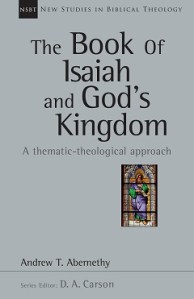 Andrew Abernethy’s The Book of Isaiah and God’s Kingdom has a kind of dual purpose: introducing readers to the overarching themes of the Book of Isaiah and to show that Kingdom in particular is central to understanding the Book of Isaiah.
Abernethy acknowledges a number of difficulties with Isaiah, including the difficulty of tying down its historical context, the problem of a “meta-history” of the book and its composition and getting to its final form, and the sheer size of it going against several attempts at a unified meaning. Nevertheless, he takes on that latter task, and on the way manages to deal with the other difficulties, at least in passing.
Abernethy traces the concept of “Kingdom” in Isaiah through five chapters that each focus on one aspect of the Kingdom: God as King now and to come; God as saving King, God as warrior/compassionate king; lead agents of the king; and the people of God’s kingdom. The first three of these provide a broad thematic overview of Isaiah, splitting it into three parts, and the latter two cover each of the three parts related to the thesis.
The book is quite dense despite having a somewhat introductory idea. That is almost certainly because Isaiah itself is so dense that in order to do it justice, Abernethy was forced to introduce a vast amount of information. What makes the book particularly useful is that Abernethy ties Isaiah not just together, but also into the canonical narrative, and this is perhaps most prominent in the God as saving King and people of God’s kingdom sections. As an example, in the section on God as saving king, there is a small (two-page) section on Isaiah 40:1-11 and 52:7-10 in canonical context which contains over a dozen references to other canonical references (this at a glance). Abernethy thus deftly balances reading Isaiah on its own terms with understanding it both in its historical and canonical context. The fact that such a sentence can be written itself speaks highly of the work.
Perhaps the biggest strike against the book is that because it does have a rather basic feeling to it, and because Isaiah is itself so dense, the work feels much longer than it actually is. It stands at 200 pages sans the appendix, but feels much longer simply because so much space is covered, with multitudes of Scriptural references on each page. This makes me question what audience the book was written towards, as beginners will likely feel it is a daunting read, while those who’ve done a good amount of reading on Isaiah already will have picked up on most of the themes contained here. That said, the book can easily serve as a great reference and tool to glance over when one wants to explore the book of Isaiah in more depth. It is about as compact an introduction–while still being useful–as one could expect.
The Book of Isaiah and God’s Kingdom isn’t trying to forge much new ground. Rather, it is a dense survey of a book of the Bible that is packed full of information. Abernethy does readers a service by helping to unpack Isaiah while sticking to broad themes rather than individual debates.
The Good
+Focus on broad themes makes it more readable
+Good reference work for themes in Isaiah
+Highlights many of the more interesting questions about the book of Isaiah
The Bad
-Incredibly dense for such a short read
-May be off-putting to some of the target audience
Book Review: “Evangelism for Non-Evangelists” by Mark R. Teasdale
 Mark Teasdale’s Evangelism for Non-Evangelists is one of those deceptively simple books. Yes, the title basically describes exactly what its contents are, and yes, it is full of information that will make even those who think they know what it means delve more deeply into the topic.
From the get-go, Teasdale undermines the biases readers may have in regards to evangelism. Not only is there no one size fits all approach to evangelism, but that very notion has done serious damage to efforts made by Christians in the past (10-11). Another challenge is lobbed at American evangelicalism, as Teasdale not only notes that evangelism cannot be reduced to contemporary evangelicalism, but also acknowledges that progressive theologians and others are capable of evangelizing and having worthwhile perspectives as well (17-19). These are the kind of often difficult insights Teasdale offers throughout the book, and for that reason alone the book is worth reading.
But the book is much more than a collection of challenges against one’s preconceptions. As the title suggests but does not fully reveal, it is a work of the heart of an evangelist who seeks to teach others to spread the Good News of Jesus Christ our Lord. This is not an easy task. Evangelism is not merely something that will succeed based on effort, but is Spirit-led. Evangelism takes serious effort on the part of the one wishing to spread the Gospel. Evangelism involves contextualizing not just the teachings of Christianity, but also making sense of why Christianity is important for whatever individual one encounters. In short, evangelism is tough, and more complex than many may realize.
Fear not, however, as Teasdale provides many practical insights to help those interested in evangelizing to learn how to become more effective evangelists, though it will take time. Although a summary of these points will sound overly basic (i.e. “get to know the individual”), Teasdale’s points are presented succinctly but in ways that I think most readers will benefit from.
Evangelism for Non-Evangelists is one of those rare books I can recommend without any reservation. It’s a fast read, but one that demands reflection and re-reading. It has challenges to readers that are on-point without ever being overbearing. It’s a fantastic work that introduces a necessary topic for Christian living.
The Good
+Many practical applications
+Goes beyond American evangelical tradition
+Full of insights into the practice of evangelism
The Bad
-None
Disclaimer: I received a copy of the book from the publisher. I was not obligated to provide any specific kind of feedback whatsoever.
Links
Be sure to check out the page for this site on Facebook and Twitter for discussion of posts, links to other pages of interest, random talk about theology/philosophy/apologetics/movies and more!
Book Reviews– There are plenty more book reviews to read! Read like crazy! (Scroll down for more, and click at bottom for even more!)
Eclectic Theist– Check out my other blog for my writings on science fiction, history, fantasy movies, and more!
SDG.
——
The preceding post is the property of J.W. Wartick (apart from quotations, which are the property of their respective owners, and works of art as credited; images are often freely available to the public and J.W. Wartick makes no claims of owning rights to the images unless he makes that explicit) and should not be reproduced in part or in whole without the expressed consent of the author. All content on this site is the property of J.W. Wartick and is made available for individual and personal usage. If you cite from these documents, whether for personal or professional purposes, please give appropriate citation with both the name of the author (J.W. Wartick) and a link to the original URL. If you’d like to repost a post, you may do so, provided you show less than half of the original post on your own site and link to the original post for the rest. You must also appropriately cite the post as noted above. This blog is protected by Creative Commons licensing. By viewing any part of this site, you are agreeing to this usage policy.
Book Review: “Insider Jesus” by William A. Dyrness
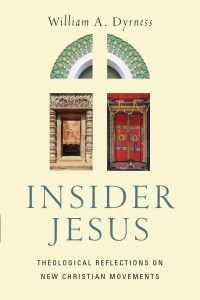 What does it mean to be a follower of Jesus in non-Western cultures? Could it mean something different than it does in places like the United States and Europe? These are some of the questions that Insider Jesus by William A. Dyrness seeks to answer.
Dyrness, in this pithy book, focuses on contextualization and the frequent misunderstanding of the same. Contextualization is often seen by some as being the distortion of Christianity to fit a culture; at the opposite extreme, it is seen as a kind of imperialistic co-opting of whatever culture is being witnessed to. Dyrness calls us to move past these extremes and come to understand that we must take a critical look at our assumptions about what other Christians should do and how they should behave. Often, these “shoulds” reflect our culture rather than a biblical understanding of Christianity.
Dyrness utilizes a number of case studies to highlight examples of “insider movements” in which Christians are not abandoning their culture while still following Jesus. These studies include Latin America and Africa with interfaith dialogues, emergent Christianity in places like India, and more. Each shows some ways in which Christianity is making headway in places that it might not have otherwise done. Each may make readers uncomfortable as we are forced to see that many of the things we take for granted culturally are not even understood in other cultures.
It is this last point that is perhaps most important to Dyrness’s thesis. Spreading the Gospel of Christ does not mean spreading our culture. As Christians, we’re called to be all things to all people, and that may, at times, make us uncomfortable. Some may here charge Dyrness with syncretism–a dreaded word in interfaith discussions–but such an accusation would be off-base. As Dyrness argues, using the thought of Kang-San Tan, a Christian from a Buddhist background, that we must
…distinguish between the danger of external identification with two religious communities and the possibility, even the necessity for those from these religious backgrounds, of maintaining an inward multireligious identity… Christianity itself necessarily exhibits an integration that reflects its historical and cultural situation… Every Christian religious expression represents some combination of indigenous values and religious practices… and the impact of the Christian Gospel… on this (124-125, emphasis his)
The point is that many of the things we think of as normal for Christian worship (standing during the Gospel reading, for instance) are clearly a use of cultural context to worship our God. Such things are not necessary for other groups, but when they are absent, it may lead us to wrongly think these other groups are mistaken.
Insider Jesus provides a much-needed critical perspective on insider movements that encourages readers to be aware of these movements and how their own faith is influenced by many similar aspects. It’s an uncomfortable read at times because it highlights areas of our own blindness about our religion. Several points Dyrness makes are controversial, but he provides enough argument and context that readers will be challenged even where they disagree.
The Good
+Provides framework for thinking through controversial questions
+Further study encouraged with sources to pursue
+Good job introducing complex topics
The Bad
-Exegetical sections brief with sometimes questionable conclusions
Disclaimer: I received a copy of the book from the publisher for review. I was not obligated to provide any specific kind of feedback whatsoever.
Links
Be sure to check out the page for this site on Facebook and Twitter for discussion of posts, links to other pages of interest, random talk about theology/philosophy/apologetics/movies and more!
Book Reviews– There are plenty more book reviews to read! Read like crazy! (Scroll down for more, and click at bottom for even more!)
Eclectic Theist– Check out my other blog for my writings on science fiction, history, fantasy movies, and more!
SDG.
——
The preceding post is the property of J.W. Wartick (apart from quotations, which are the property of their respective owners, and works of art as credited; images are often freely available to the public and J.W. Wartick makes no claims of owning rights to the images unless he makes that explicit) and should not be reproduced in part or in whole without the expressed consent of the author. All content on this site is the property of J.W. Wartick and is made available for individual and personal usage. If you cite from these documents, whether for personal or professional purposes, please give appropriate citation with both the name of the author (J.W. Wartick) and a link to the original URL. If you’d like to repost a post, you may do so, provided you show less than half of the original post on your own site and link to the original post for the rest. You must also appropriately cite the post as noted above. This blog is protected by Creative Commons licensing. By viewing any part of this site, you are agreeing to this usage policy.
Book Review: “Ministering in Honor-Shame Cultures” by Jayson Georges and Mark D. Baker
 Understanding the context to which we are ministering is one of the most important aspects of mission–and other–work. Jayson Georges and Mark D. Baker have provided, in Ministering in Honor-Shame Cultures, a way to understand cultural practices that are far from what many in the West experience. I found it to be enlightening, and a little alarming, because it showed many times where I may have given offense without even realizing it.
Georges and Baker utilized a number of stories to illustrate some of the difficulties in understanding honor-shame cultures when one’s background is not in that culture. For those, like me, with a limited grasp of the topic, honor-shame cultures ought to be defined, but that itself is difficult. Basically, these cultures have a system where the community is valued more highly than the individual, and shame, rather than guilt, is the result of violations of the strictures of society. Such a perspective means that, for example, the core problem with one’s violation of the codes of society is not that we make mistakes (as in our individualistic societies) but rather that our very being has been corrupted. Thus, rather than trying to justify or apologize for our mistake, it is more important to cover that mistake (see especially the table on page 38).
We often see honor-shame cultures as silly or backwards–possibly even morally wrong or bankrupt–because our very understanding of human interaction is built upon a different system. Why should we have to highlight someone else’s importance in order to get what we deserve? Just as easily, the other could ask why we refuse to honor them with the standing in society that they possess? These stories help highlight both the strangeness of the “other” in the honor-shame culture and the way that we may be equally seen as brusque at best to people of other cultures. The early chapters, in particular, highlight these points.
Even more importantly–and the above is certainly vital–we may be misreading the Bible due to our misunderstanding of honor-shame cultures. For example, the many rules about purity and what makes someone unclean are almost impossible to understand without some grasp of honor-shame culture. The chapters on biblical background for understanding this and other aspects of Christianity that can really only be fully understood in honor-shame contexts.
Finally, Georges and Baker provide a number of practical applications for what they highlighted in the first 100 or so pages. These applications range across spirituality, relationships, evangelism, conversion, ethics, and community. Three appendices provide (lots of) key scripture passages on honor-shame, biblical stories that address honor-shame cultures, and resources for further reading.
Throughout the book, smart use of tables and graphs helps readers visualize the differences in cultures that lead to many misunderstandings. If there is one complaint I have the book it is that I desired more exegetical considerations, which is basically to say that I’d love a follow-up work that focuses on understanding critical biblical passages. In other words, there’s little to complain about here. It is a book full of insights that are both practical and engaging.
Ministering in Honor-Shame Cultures is one of those rare books that makes you sit back and think–really think–about how you understand the “other.” For that alone, it is worth the read. Set that alongside a good helping of practical applications and biblical theology, and the book is a must-read. It comes highly recommended.
The Good
+Provides numerous examples to help think through the issues
+Use of graphics smartly done
+Highlights very important, but often misunderstood topics
+Encourages critical interaction
The Bad
-More exegesis of some key passages would be helpful
Disclaimer: I received a copy of the book from the publisher for review. I was not obligated to provide any specific kind of feedback whatsoever.
Links
Be sure to check out the page for this site on Facebook and Twitter for discussion of posts, links to other pages of interest, random talk about theology/philosophy/apologetics/movies and more!
Book Reviews– There are plenty more book reviews to read! Read like crazy! (Scroll down for more, and click at bottom for even more!)
Eclectic Theist– Check out my other blog for my writings on science fiction, history, fantasy movies, and more!
SDG.
——
The preceding post is the property of J.W. Wartick (apart from quotations, which are the property of their respective owners, and works of art as credited; images are often freely available to the public and J.W. Wartick makes no claims of owning rights to the images unless he makes that explicit) and should not be reproduced in part or in whole without the expressed consent of the author. All content on this site is the property of J.W. Wartick and is made available for individual and personal usage. If you cite from these documents, whether for personal or professional purposes, please give appropriate citation with both the name of the author (J.W. Wartick) and a link to the original URL. If you’d like to repost a post, you may do so, provided you show less than half of the original post on your own site and link to the original post for the rest. You must also appropriately cite the post as noted above. This blog is protected by Creative Commons licensing. By viewing any part of this site, you are agreeing to this usage policy.
Book Review: “Critical Theology: Introducing an Agenda for an Age of Global Crisis” by Carl A. Raschke
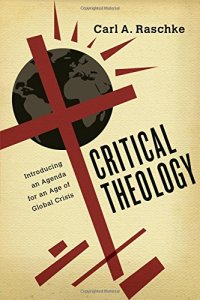 Carl Raschke’s Critical Theology: Introducing an Agenda for an Age of Global Crisis is a brief look at the integration of critical theology into global theology. Now that I’ve basically just restated the title in different terms, what does it actually mean? Raschke states it as: “The thesis… is that the new era of global crisis demands a whole new theological formulary that is unprecedented both in the content of the challenges it faces and in the conceptual resources or ‘intellectual capital’ on which it must draw” (10). Essentially, the idea is that there is a global crisis–a kind of intermingling of ideas that makes it difficult to sort out what is what–and in order to deal with that, Christian theology must utilize a new set of tools for thinking and conceptualizing ideas.
After a chapter outlining this “Age of Crisis” in greater depth (along with a very brief history of critical theory), Raschke draws upon many lines of critical theory to show how it might be used to communicate Christianity effectively on a global scale. Mostly, this plays along the lines of highlighting several important critical thinkers (Jurgen Habermas, Martin Heidegger, Immanuel Kant, and the like) and showing how their thought may be applied to broader theological trends. Of course, none of this is done naively, as some of the pitfalls of critical theory are also acknowledged. But the focus is almost entirely on what critical theory brings to the table as far as the “global crisis” is concerned. It is worth noting here that the book assumes a general working knowledge of many of these important thinkers.
One question which it seems to me Raschke did not adequately deal with is the question of whether “new” theology is a good thing. As many have said in various ways, “new theology” tends to be heresy. There’s a reason that the historic church made confessions and creeds–in order to establish boundaries for orthodoxy. Thus, some may argue there is a danger to trying to make a truly new theology, for it may just be a rehashing of old errors, as so many modern heresies are. I didn’t see any specific place where Raschke dealt with this objection at length. I suspect his answer would be that yes, new theology in a sense is a dangerous endeavor, but when genuinely new challenges arise (i.e. globalization/globalism and how to make sense of Christianity in a somewhat universal fashion), it calls for new evaluations. Yes, there is truly nothing new under the sun in some sense, because what Raschke calls for is a critical look at existing theology and sources thereof so that we do not get too attached to cultural expressions of Christianity as just being orthodoxy. On these proposed responses, I believe Raschke to be correct. But he doesn’t make this or any other specific defense at length, so far as I can tell.
Critical Theology is a needed work that will get readers to look, well, critically at ideas they may have taken for granted before. It’s a deep work, despite its brevity.
The Good
+Brings critical theory to bear in theology
+Challenges perspectives
+Encourages further study
The Bad
-At times may leave those unfamiliar with the topic befuddled
-Little defense of the notion of “new theology”
Disclaimer: I received a copy of the book from the publisher. I was not obligated to provide any specific kind of feedback whatsoever.
Links
Be sure to check out the page for this site on Facebook and Twitter for discussion of posts, links to other pages of interest, random talk about theology/philosophy/apologetics/movies and more!
Book Reviews– There are plenty more book reviews to read! Read like crazy! (Scroll down for more, and click at bottom for even more!)
Eclectic Theist– Check out my other blog for my writings on science fiction, history, fantasy movies, and more!
SDG.
——
The preceding post is the property of J.W. Wartick (apart from quotations, which are the property of their respective owners, and works of art as credited; images are often freely available to the public and J.W. Wartick makes no claims of owning rights to the images unless he makes that explicit) and should not be reproduced in part or in whole without the expressed consent of the author. All content on this site is the property of J.W. Wartick and is made available for individual and personal usage. If you cite from these documents, whether for personal or professional purposes, please give appropriate citation with both the name of the author (J.W. Wartick) and a link to the original URL. If you’d like to repost a post, you may do so, provided you show less than half of the original post on your own site and link to the original post for the rest. You must also appropriately cite the post as noted above. This blog is protected by Creative Commons licensing. By viewing any part of this site, you are agreeing to this usage policy.
Book Review: “Theology and Science Fiction” by James F. McGrath
One of my favorite pastimes is to read and write science fiction. One of my others is to read and write theology. Thus, the intersection of the two is sure to catch my interest, and James F. McGrath’s book, Theology and Science Fiction serves as an excellent way to show how intertwined the two are. McGrath’s central thrust is to show how people may think of science fiction and theology as a cultural interchange. He does this by showing several parallels with science fiction and theology, and then outlining various views of science fiction and theology (science fiction against/as theology; theology as/against science fiction; etc.).
McGrath ably utilizes key source material while avoiding the pitfall of assuming readers of the book will be familiar with the entire field of science fiction. Rather than a survey of the who’s who in science fiction, then, the book serves as a kind of primer on how to reflect theologically upon science fiction, as well as how to perhaps integrate the two in meaningful, forward-moving ways.
The book is therefore full of broad points that trace themes such as “robots as gods” or “aliens as saviors,” reminiscent of the excellent Scientific Mythologies. The key with McGrath’s book, however, is a less negative assessment of science fiction overall. Yes, he acknowledges that often science fiction can be written against theology, but also draws out key areas in which the two overlap and even where theology can be written as science fiction and vice versa. These make for great ways to reflect on one’s own reading and writing in these areas and open avenues for research.
Gnosticism, Daoism, and many other views of the world are surveyed alongside science fiction as McGrath ably shows the wideness of the field.
Overall, Theology and Science Fiction is a worthy, exciting read. It would serve equally well as a textbook for a kind of cultural-integration theology course or as reading for those interested in either science fiction or theology (and certainly both). It comes highly recommended.
The Good
+Avoids potential pitfalls of being too negative or too positive
+Surveys wide range of views and possibilities
+Provides fruitful discussion points that may lead readers to more exploration
The Bad
-A tad short
-Perhaps too few examples
Disclaimer: I received a copy of the book from the publisher. I was not obligated to provide any specific kind of feedback whatsoever.
Links
Be sure to check out the page for this site on Facebook and Twitter for discussion of posts, links to other pages of interest, random talk about theology/philosophy/apologetics/movies and more!
Book Reviews– There are plenty more book reviews to read! Read like crazy! (Scroll down for more, and click at bottom for even more!)
Eclectic Theist– Check out my other blog for my writings on science fiction, history, fantasy movies, and more!
SDG.
——
The preceding post is the property of J.W. Wartick (apart from quotations, which are the property of their respective owners, and works of art as credited; images are often freely available to the public and J.W. Wartick makes no claims of owning rights to the images unless he makes that explicit) and should not be reproduced in part or in whole without the expressed consent of the author. All content on this site is the property of J.W. Wartick and is made available for individual and personal usage. If you cite from these documents, whether for personal or professional purposes, please give appropriate citation with both the name of the author (J.W. Wartick) and a link to the original URL. If you’d like to repost a post, you may do so, provided you show less than half of the original post on your own site and link to the original post for the rest. You must also appropriately cite the post as noted above. This blog is protected by Creative Commons licensing. By viewing any part of this site, you are agreeing to this usage policy.
Book Review: “A Shared Mercy: Karl Barth on Forgiveness and the Church” by Jon Coutts
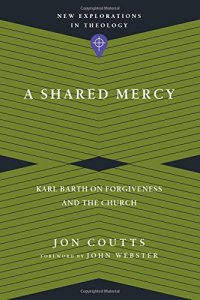 Jon Coutts’ A Shared Mercy explores the doctrine of forgiveness from the perspective of Karl Barth. Because it is the perspective of Karl Barth, it also reflects on doctrine of the church, as this was central to Barth’s thought. However, Coutts argues we must be careful not to subordinate all doctrines Barth taught under his doctrine of the church.
The book is organized into 6 chapters that largely center on two parts: Barth’s doctrine of forgiveness and what a full doctrine of forgiveness based on Barth might look like in application. Throughout the book there is a kind of unity between these topics as Coutts takes what Barth taught on forgiveness and applies it.
First, Coutts notes that because Christ taught that forgiveness is central to the lives of his followers, it follows that forgiveness is central to the church (1). Thus, exploring Barth’s Church Dogmatics, we ought to expect to find forgiveness as a central, not tertiary teaching. Coutts argues throughout the book that this is, indeed, what we find, though little has been studied in regards to Barth on forgiveness in the church in contemporary theology.
Readers may be concerned that a book so focused on a somewhat obscure topic may lack applicable insights, but Coutts does a great job not merely reporting Barth’s beliefs but also deriving thoughts therefrom that have application to the contemporary Christian. One example is the question of whether forgiveness first requires one to wait for repentance:
A legitimate practical concern… [is] the perpetuation of victimhood that seems to be implied when the imperative [to forgive] is self-giving and forgiving love. But this is founded on a misconception of the call to cruciform discipleship… Even if the abusive party is unrepentant, the result is not unforgiveness, but an acknowledgement of nonreconciliation… Forgiving the abuser is not the perpetuation of victimhood but the free offer of further reconciliation. (154-155)
This and many other passages provide direct application to the lives of believers. At several points, then, Coutts ably demonstrates the way to bring scholarship to the person in the pew, something that is too-often lacking in scholarly works.
As a Lutheran, I appreciated the highlighting of the importance of baptism and the Lord’s Supper for Christian community, though I think Barth’s teaching on these sacraments falls short of the biblical teaching. Yes, baptism is a sign of community, but Barth and Coutts each seem to err in seeing baptism as a kind of political action of the church rather than a gracious action of God. Similarly, the view of the Lord’s Supper as being primarily a work of the church rather than a gracious gift of God takes away the greatness of the gift.
Because the book is so focused on a specific aspect of Barth’s teaching, it does at times read a bit too much like a journal article–engaging with very specific opponents with little context. However, these moments are thankfully few and far between.
A Shared Mercy is an interesting, surprisingly applicable study on forgiveness in Barth’s doctrine. More importantly, it shares information that can be applied directly to the broader church. The importance of a doctrine of forgiveness ought never to be understated, as it is so central to Christian teaching. As such, this book is an important contribution to understanding what we as Christians, and the church, are called to do.
The Good
+Insights into Barth’s theology of the church, in balanced perspective
+Background for modern discussions of forgiveness
+More applicable material than me be expected
The Bad
-Sometimes reads a bit more like a journal article than a book
-Reduces both baptism and the Lord’s Supper to human act
Disclaimer: I received a copy of the book from the publisher for review. I was not obligated to provide any specific kind of feedback whatsoever.
Links
Be sure to check out the page for this site on Facebook and Twitter for discussion of posts, links to other pages of interest, random talk about theology/philosophy/apologetics/movies and more!
Book Reviews– There are plenty more book reviews to read! Read like crazy! (Scroll down for more, and click at bottom for even more!)
Eclectic Theist– Check out my other blog for my writings on science fiction, history, fantasy movies, and more!
SDG.
——
The preceding post is the property of J.W. Wartick (apart from quotations, which are the property of their respective owners, and works of art as credited; images are often freely available to the public and J.W. Wartick makes no claims of owning rights to the images unless he makes that explicit) and should not be reproduced in part or in whole without the expressed consent of the author. All content on this site is the property of J.W. Wartick and is made available for individual and personal usage. If you cite from these documents, whether for personal or professional purposes, please give appropriate citation with both the name of the author (J.W. Wartick) and a link to the original URL. If you’d like to repost a post, you may do so, provided you show less than half of the original post on your own site and link to the original post for the rest. You must also appropriately cite the post as noted above. This blog is protected by Creative Commons licensing. By viewing any part of this site, you are agreeing to this usage policy.
Book Review: “No Skin in the Game: The God of the Jehovah’s Witness” by Frank H. Armstrong
 Frank Armstrong’s No Skin in the Game is a pithy introduction to defending orthodox Christianity against Jehovah’s Witness beliefs. Central to Armstrong’s book is the notion that we must not focus merely on firing proof-texts back and forth, but rather that we ought to see the meta-narrative of Scripture and keep that in mind as we evaluate claims of how to interpret key texts.
Armstrong focuses on this meta-narrative of God as love and uses it to show that God the Son and the Father must be co-eternal. Moreover, he continues to note the continuity of Scriptures between the Testaments by showing that those things ascribed to the Father (which Jehovah’s Witnesses call Jehovah) are then ascribed to Christ (eg. creation). It is truly remarkable how many applicable examples Armstrong manages to pack into a short work.
The book provides not just a grab-bag of important verses but a guide for how to use the Bible to reason with Jehovah’s Witnesses. Several examples of verses shown with key phrases changed to reflect Jehovah’s Witness theology highlight this. The book is therefore thoroughly practical and will be useful to those hoping to engage with Jehovah’s Witness theology.
If I had one critique it is that the example of conjoined twins alongside the Trinity may cause some confusion. Armstrong argues that conjoined twins show in principle that one being may be the center of multiple persons, and as far as demonstrating that, it may not be objectionable. The problem is that such a comparison begs further comparison, and the example quickly breaks down as one considers whether conjoined twins really are one being or are two that happen to occupy the same space. Other difficulties arise upon further reflection. For what Armstrong was trying to demonstrate, it works alright, but the problem with any analogy of the Trinity is that it breaks down and may cause confusion if pressed.
No Skin in the Game is an exciting, economical introduction to witnessing to Jehovah’s Witnesses. I recommend it.
The Good
+Brief, readable style
+Puts forward many key texts
+Focuses on core ideas
The Bad
-Example of conjoined twins may cause confusion.
Disclaimer: I received a copy of the book from the publisher for review. I was not obligated to provide any specific kind of feedback whatsoever.
Links
Be sure to check out the page for this site on Facebook and Twitter for discussion of posts, links to other pages of interest, random talk about theology/philosophy/apologetics/movies and more!
Book Reviews– There are plenty more book reviews to read! Read like crazy! (Scroll down for more, and click at bottom for even more!)
Eclectic Theist– Check out my other blog for my writings on science fiction, history, fantasy movies, and more!
SDG.
——
The preceding post is the property of J.W. Wartick (apart from quotations, which are the property of their respective owners, and works of art as credited; images are often freely available to the public and J.W. Wartick makes no claims of owning rights to the images unless he makes that explicit) and should not be reproduced in part or in whole without the expressed consent of the author. All content on this site is the property of J.W. Wartick and is made available for individual and personal usage. If you cite from these documents, whether for personal or professional purposes, please give appropriate citation with both the name of the author (J.W. Wartick) and a link to the original URL. If you’d like to repost a post, you may do so, provided you show less than half of the original post on your own site and link to the original post for the rest. You must also appropriately cite the post as noted above. This blog is protected by Creative Commons licensing. By viewing any part of this site, you are agreeing to this usage policy.

 J.W. Wartick - Reconstructing Faith