book review
Book Review: “To the Ends of the Earth” by Michael Haykin and C. Jeffrey Robinson Sr.
 The question of “Why evangelize?” is one which is often leveled against Calvinism. After all, it is reasoned, if people are fore-ordained to be elect or one of the damned, then why bother to go out and evangelize them? Interestingly, this is a charge which I think may be leveled against virtually any view of foreknowledge, so the Calvinist answers given in To the Ends of the Earth: Calvin’s Missional Vision and Legacy
Contents
The book begins with a survey of the arguments made to suggest that Calvinism would not endorse evangelism or makes evangelism pointless. Clearly, the charge has come from many fronts throughout the history of the church. Then, Haykin and Robinson introduce the primary reason for others’ concerns about Calvinism’s evangelical prospects: that Calvin believed God had ordained some to be elect, and others to be damned, before the foundations of the world.
The authors defend the doctrine, taking on many of the key “all” passages which some argue make explicit the openness of salvation to all individual people. Calvin is brought to his own defense alongside a number of modern Calvinist theologians, ably presenting the Calvinist case for exegesis of these key passages, which basically is that when “all” or “world” is used, it is referring to the breaking open of salvation for all tribes and nations as opposed to merely the chosen people of Israel. The book goes beyond these basics and also outlines how other passages might be understood in this context.
Next, the authors turn to an exposition of Calvin’s theology of missions. Part of this theology was the notion that a Christian life lived was a profound witness to the Gospel. Word and deed were central to Calvin’s missions theology. This missional activity was to be for all people (Kindle location 993). Prayer was also central to Calvin’s theology, as he believed that it might be used by God to bring about change in persons (rather than change in God).
Historical Reformed missions are surveyed in the next sections. Calvin taught many going into France and certain torture and death if discovered, and even made significant efforts towards (ultimately failing) missions into Brazil. These efforts showed that through his actions, Calvin himself valued global missions.
Later Calvinist traditions and persons also demonstrated the urge to missions that the Reformer’s theology compelled. The Puritans sought to evangelize and frequently prayed for the same, though they may not have had the success of other contemporaries. Calvinist Baptists in England feverishly evangelized and planted churches, while also demonstrating concern for global evangelism (Kindle loc. 1420ff). Jonathan Edwards, contrary to some opinions, was also focused on missions by developing his own missional theology and also going on a mission to Native Americans himself.
The book closes with thoughts on “developing missional passion” through observations about Samuel Pearce, a theologian known in his time for fervent prayer and love of missions. Central to Pearce’s theology was the cross; Christ crucified was “his darling theme from first to last”; while the other primary theme of his life was a “passion for the salvation of his fellow human beings” (Kindle loc. 1978).
Evaluation
To the Ends of the Earth is a great, pithy read on a topic that should be of interest to many from a diverse array of backgrounds. It has appeal which goes beyond Calvinism in the way it demonstrates missions ought to be of central importance and also in its justification of missions even in light of the notion that there really do exist an elect people. Of course, the thrust of the book is to demonstrate that Calvinist theology does not undermine the need or motivation for missions. Those interested in that topic will find the most to benefit from the book. Regardless of one’s level of interest, however, the book generates its own avenues for exploration by introducing several little-known figures and historical events for further reading. It is short enough to enjoy in a single afternoon (as I did), yet deep enough to keep one’s mind occupied for some time afterwards.
Perhaps the greatest weakness of the book, however, is its length in that there is little ultimate exposition of the counter-arguments to those who would fault Calvinism with lack of evangelical fervor. That is, readers are often left to tie the arguments off themselves instead of having them drawn out and defended. This, however, is a minor fault in what is an otherwise excellent book, regardless of one’s position on the arguments made therein. It was well worth the read, in my humble opinion.
Links
Be sure to check out the page for this site on Facebook and Twitter for discussion of posts, links to other pages of interest, random talk about theology/philosophy/apologetics/movies and more!
Source
Michael Haykin and C. Jeffrey Robinson, Sr., To the Ends of the Earth: Calvin’s Missional Vision and Legacy
Disclaimer: I received a review copy of the book through Crossway. I was not obligated by the publisher to give any specific type of feedback whatsoever.
SDG.
——
The preceding post is the property of J.W. Wartick (apart from quotations, which are the property of their respective owners, and works of art as credited; images are often freely available to the public and J.W. Wartick makes no claims of owning rights to the images unless he makes that explicit) and should not be reproduced in part or in whole without the expressed consent of the author. All content on this site is the property of J.W. Wartick and is made available for individual and personal usage. If you cite from these documents, whether for personal or professional purposes, please give appropriate citation with both the name of the author (J.W. Wartick) and a link to the original URL. If you’d like to repost a post, you may do so, provided you show less than half of the original post on your own site and link to the original post for the rest. You must also appropriately cite the post as noted above. This blog is protected by Creative Commons licensing. By viewing any part of this site, you are agreeing to this usage policy.
Book Review: “Hollywood Worldviews” by Brian Godawa
 I often say that every movie has a worldview. The same is true for any story. Brian Godawa’s book, Hollywood Worldviews: Watching Films with Wisdom & Discernment
First, Godawa introduces the concepts of a “cultural glutton” as opposed to a “cultural anorexic.” The point is that Christians are to be in the world not of it. It is one thing to say that violence in a movie is bad; but what of the context of the violence? The Bible also has many scenes which, if filmed, could even rate NC-17. The question is: what’s the point? When looking at film, Christians should look into the way the narrative shapes what happens in the movies.
In order to look into this theme, Christians must be equipped to seek out the context of stories as well as the explicit (and implicit) things they teach. In order to equip people to watch film critically, Godawa approaches this task is divided among several chapters by topics related to film and worldview. Each chapter begins with a summary of the topic of the chapter and how one might discover this theme in film. For example, in the chapter on “Postmodernism,” he begins with a definition and explanation of the concept. Then, he utilizes a slew of examples from various movies to show how postmodernism is found in them in either positive or negative light.
The chapters all cover interesting topics, and Godawa’s use of specific examples from movies are fantastic case studies for showing how critical engagement with worldviews can play out. Even better, Godawa’s explanations and applications could easily be used to apply outside of film and in areas like literature. Frankly, some of Godawa’s evaluation of popular films–including some I’ve enjoyed greatly–have forced me to rethink how I thought of the storyline. Movies which may appear to be fairly neutral or simply entertainment alone do indeed have their own way of approaching reality. Some of the movies which were brought to new light for me included “Gladiator,” “The Truman Show,” and “Groundhog Day.” Dozens of movies are treated throughout this book, and Godawa’s analysis is always interesting and thought provoking, encouraging the critical engagement he seeks.
Another great aspect of the book are the activities Godawa proposes for each chapter to apply what one has learned. These are frequently interesting and provide ways forward to put into practice the art of discernment when it comes to watching film.
One difficulty with a book like this is there is some necessary oversimplification. For example, Godawa, in his discussion of existentialism, writes: “Existentialism accepts the Enlightenment notion of an eternally existing materialistic universe with no underlying meaning or purpose” (95). Oddly, Godawa seems to downplay Kierkegaard’s very explicit Christian faith in light of his existential views, and Kierkegaard seems to become a kind of pariah through this analysis. Kierkegaard, for Godawa, is strangely aberrant from his general picture of existentialism as necessarily godless and without purpose.
At other points, films receive short shrift are are discussed in ways which seem a bit odd. Of course, engagement with these points actually encourages the sort of critical interaction Godawa is pursuing. Some offhand comments are a bit awkward and out of place (for example the bare assertion that “men are the leaders in home and public roles” in Christianity without qualification–in contrast with the declared equality of genders in Galatians 3:28 and the apostleship of a woman in Romans 16:7), but overall these negative points are outweighed by the service Godawa has done to provide critical perspective on worldviews in film.
Hollywood Worldviews is a great book which will encourage much discussion. It would serve as a good resource for those who wish to meaningfully engage the culture. People who read it will be equipped to have thoughtful conversations on the way movies put forth worldviews. The book should come with a warning, though, some of your favorite movies may not be what they seem!
Links
Be sure to check out the page for this site on Facebook and Twitter for discussion of posts, links to other pages of interest, random talk about theology/philosophy/apologetics/movies and more!
Engaging Culture: A brief guide for movies– I outline my approach to evaluating movies from a worldview perspective.
I have a number of ways in which I have critically engaged with culture in movies, books, and other arts in my posts on current events (scroll down for more posts).
Source
Brian Godawa, Hollywood Worldviews: Watching Films with Wisdom & Discernment
SDG.
——
The preceding post is the property of J.W. Wartick (apart from quotations, which are the property of their respective owners, and works of art as credited; images are often freely available to the public and J.W. Wartick makes no claims of owning rights to the images unless he makes that explicit) and should not be reproduced in part or in whole without the expressed consent of the author. All content on this site is the property of J.W. Wartick and is made available for individual and personal usage. If you cite from these documents, whether for personal or professional purposes, please give appropriate citation with both the name of the author (J.W. Wartick) and a link to the original URL. If you’d like to repost a post, you may do so, provided you show less than half of the original post on your own site and link to the original post for the rest. You must also appropriately cite the post as noted above. This blog is protected by Creative Commons licensing. By viewing any part of this site, you are agreeing to this usage policy.
Book Review: “Imaginative Apologetics” edited by Andrew Davison
 Imaginative Apologetics: Theology, Philosophy, and the Catholic Tradition
The book is a series of essays dedicated broadly to this topic. Some of these are quite on-point. Donna Lazenby’s essay “Apologetics, Literature, and Worldview” is among these. In it, Lazenby engages with various atheists through the use of literature and suggests that non-theistic literature ultimately is left in a void, seeking a greater reality. Graham Ward’s essay “Cultural Hermeneutics and Christian Apologetics” is equally insightful, as Ward applies various critical theories to examining the broader implications for culture and understanding. Alison Milbank’s “Apologetics and the Imagination: Making Strange” shows how the imagination may be engaged in worship and the religious life. These essays alone are worth the price of entry, and there are other bright spots throughout the work which are just as engaging.
However, Imaginative Apologetics is not without some serious flaws. Perhaps the most troubling aspect of the book, in my opinion, is the sometime refrain and skepticism against “theistic proofs.” For example, John Hughes, in “Proofs and Arguments” suggests that “the rationalist project of proofs has sold out the Christian faith to deism and turned the God of Jesus Christ into an idol of human reason” (7). Strong words, but I’m not sure they are at all true. In particular, Hughes seemed to broadly label essentially any attempt at natural theology as equivalent to this rationalism. Later, Hughes does give a nod to the project of natural theology but–in a seemingly confused fashion–suggests that arguments like cosmological arguments are merely “more ancient arguments.” I wonder how he would comment on the modern retooling of the Kalam Cosmological Argument… would this be a project of “rationalism” and making deistic idols; or an evidence pointing to the truth of theism? The lack of distinctions being made left the definitions given in this essay (a lead-in for the rest of the discussion) with a decidedly amorphous view of the project of apologetics as a whole.
Later essays emulate this error at times. Craig Hovey’s “Christian Ethics as Good News” (an interesting piece itself) addresses a strange and seemingly false dichotomy of “two different understandings of what apologetics is all about… quasi-legal defences of a certain sort of self-confident Protestant who went around armed with a hundred and one proofs… [or] the early Church’s efforts to defend the faith against misunderstanding from their pagan neighbours…” (98). Hovey expressed some caution: “My unease with the proof version of apologetics stems from my suspicion that… [it may make] the point of being a Christian… to be right or rational” (99). Although he admits he wants to be right and rational too; he says there is more to Christianity than that.
I admit I know of no published Christian apologist today who thinks that “the point of being a Christian” is to be right and rational. Of course, that doesn’t at all preclude the project of proving Christianity to be true. Christianity is about Jesus Christ as crucified and risen Lord and Savior, but of course if that is itself not true, Christianity is rather pointless, isn’t it? Hovey’s comments seem to divorce Christianity from being a historical reality; and this, as I showed above, is a kind of confusion over the project of apologetics which occurs in other places in the book.
As I noted, there are moments of utter brilliance found throughout the text. Ultimately, however, it seems the book does not live up to its title. At times some authors flounder with understanding the meaning and application of apologetics, but more importantly, few essays seem to actually recommend or apply a method of apologetics which engages the imagination [with noted exceptions above, as well as tidbits throughout every essay… and I’d like to note Alister McGrath was, as usual, excellent (though perhaps also off topic with his essay on science and apologetics)]. The book, it seems, is often more about its subtitle (“Theology, Philosophy, and the Catholic Tradition”) than its title. Although at times interesting, I found it an overall disappointment. Perhaps that is due to my own high expectations going in, but there it is. A few gems make it well worth the read, but I would recommend a critical eye on the commentary on the nature of apologetics and readers should realize that only at times does it focus on the application of the imagination to apologetics.
Links
Be sure to check out the page for this site on Facebook and Twitter for discussion of posts, links to other pages of interest, random talk about theology/philosophy/apologetics/movies and more!
Book Review: “Think Christianly” by Jonathan Morrow– Interested in engaging the culture on multiple levels? I highly recommend this book by Morrow for those who want to critically encounter the surrounding culture and “think Christianly” throughout their lives.
Source
Alison Milbank, “Apologetics and the Imagination: Making Strange” in Imaginative Apologetics: Theology, Philosophy, and the Catholic Tradition
SDG.
——
The preceding post is the property of J.W. Wartick (apart from quotations, which are the property of their respective owners, and works of art as credited; images are often freely available to the public and J.W. Wartick makes no claims of owning rights to the images unless he makes that explicit) and should not be reproduced in part or in whole without the expressed consent of the author. All content on this site is the property of J.W. Wartick and is made available for individual and personal usage. If you cite from these documents, whether for personal or professional purposes, please give appropriate citation with both the name of the author (J.W. Wartick) and a link to the original URL. If you’d like to repost a post, you may do so, provided you show less than half of the original post on your own site and link to the original post for the rest. You must also appropriately cite the post as noted above. This blog is protected by Creative Commons licensing. By viewing any part of this site, you are agreeing to this usage policy.
Book Review: “Pig and the Accidental Oink! – Picture Book Apologetics”
 When I found out about “Picture Book Apologetics” I was intrigued by the notion of bringing apologetics into the realm of picture books. Pig and the Accidental Oink!
…What? Right, that’s what the book does. But J.D. Camorlinga, the author, doesn’t just throw phrases like that into the children’s book. For this review, I’ll start at the end. The end of the book has two pages dedicated to parents interested in taking the content of the book beyond its pages. One page has an activity suggestion, the other has an explanation of the content in greater detail (here is where the term “Kalam Cosmological Argument” is used–and defined!).
The activity involves chocolate chip cookies (a bonus) and uses them to explain the notion that something does not come from nothing. The note to parents is helpful and provides avenues for further exploration.
The picture book itself is engaging and fun. Two children encounter a pig, who insists that “It makes more sense to believe that everything began by accident” than that God created the universe. The children go home, dejected, but their father explains that things don’t just pop into existence out of nothing; observation in the lives of the children shows that things which begin have causes. Armed with a new strategy for discussing beginnings, the children return to Pig and convince him that he can’t just posit an accident as the most reasonable explanation when his own experience contradicts it. They then run and play together happily.
Though I’m not completely sure about the wisdom of making the skeptical stand-in a pig (a bit too polemical, perhaps?), there is much to commend in Accidental Oink! The story is fun to follow; the characters are interesting, and the art is great. The illustrations are quite good. They’re what looks like colored pencil drawings and they’re vibrant and they avoid the generic look that some children’s books have. There remains a kind of charming style throughout the book that is recognizable on its own. Moreover, it’s definitely the kind of book to start all kinds of great conversations.
Pig and the Accidental Oink!
Links
Be sure to check out the page for this site on Facebook and Twitter for discussion of posts, links to other pages of interest, random talk about theology/philosophy/apologetics/movies and more!
Youth Apologetics Network– An interesting site which seeks to provide resources for youths related to apologetics. They are affiliated with Picture Book Apologetics as well. Great resources to explore for those interested in youth ministry.
——
The preceding post is the property of J.W. Wartick (apart from quotations, which are the property of their respective owners, and works of art as credited; images are often freely available to the public and J.W. Wartick makes no claims of owning rights to the images unless he makes that explicit) and should not be reproduced in part or in whole without the expressed consent of the author. All content on this site is the property of J.W. Wartick and is made available for individual and personal usage. If you cite from these documents, whether for personal or professional purposes, please give appropriate citation with both the name of the author (J.W. Wartick) and a link to the original URL. If you’d like to repost a post, you may do so, provided you show less than half of the original post on your own site and link to the original post for the rest. You must also appropriately cite the post as noted above. This blog is protected by Creative Commons licensing. By viewing any part of this site, you are agreeing to this usage policy.
Book Review: “Faith Founded on Fact” by John Warwick Montgomery
 John Warwick Montgomery (hereafter JWM) is about as evidentialist as they come, and Faith Founded on Fact: Essays in Evidential Apologetics
Central to JWM’s apologetic methodology is the notion that one need not presuppose the truth of the Bible in order to defend it. For him, one may make the appeal to the skeptic by going to the skeptic and battling their reasoning on their own grounds. He states his thesis succinctly:
Few non-Christians will be impressed by arguments… in which the Christian stacks the deck by first defining ‘rationality’ and ‘internal consistency’ in terms of the content of his own revelational position and then judges all other positions by that self-serving criterion. (xix, cited below)
JWM surveys various attacks on the practice of evidential apologetics and argues that they fail (28ff). Although he deals with various liberal objections to apologetics, the core of his concern is for the objections raised by those who feel as though the evidentialist approach does injustice to faith. In response, he notes that any approach which removes Jesus from historical investigation–from hard evidence capable of being explored by all–reduces Him to a “historical phantasm” and does injustice to the reality of the incarnation (34-35).
The possibility of miracles and the argument of Hume engages in “circular reasoning” for Hume’s argument relies upon “unalterable experience” which is, of course his own experience and that of those who agree with him. Moreover, the definition of miracle has been slanted in such a way as to make it either irrelevant or beyond the realm of evidence by various parties (46ff). A case study of the miracle of the resurrection provides proof that miracles may be examined with an evidentialist mentality, for any who wish to deny the notion must relegate history to a place which may never be accessed through evidence (56ff).
JWM analyzes Muslim apologetics and concludes that it provides a number of lessons for Christian apologetists. Among these is the notion that merely showing the falsity of other religions is not enough for an evidential defense (93-94), the notion that “no religion is deducible from self-evident a prioris…” (97), and mere appeal to “try out” a religion is not enough to establish its credibility (98).
One of JWM’s most famous (or infamous, depending upon your view) essays is “Once Upon an A Priori,” in which he launched a broad-spectrum attack on presuppositional apologetics as a methodology. In this essay, JWM argues that when one suggests there is no neutral epistemic ground between two positions whatsoever–as presuppositional apologists do–“Neither viewpoint can prevail, since by definition all appeal to neutral evidencve is eliminated” (115). Because there are no neutral facts, there can be no appeal to facts to make one’s case; instead, all one is able to do is argue in circles against each other… “appeal to common facts is the only preservative against philosophical solipsism and religious anarchy…” (119). Instead, Christians must, like Paul, “become all things to all” people (122) in order to make the case for Christianity.
The practice of apologetics, for JWM, is intended to break down the barriers to belief. But the evidences are so strong that they obligate belief in Christian theism. However, the work of the Spirit is the work of conversion. The “evidential facts are God’s work, and the sinner’s personal acceptance of them… is entirely the product of the Holy Spirit” (150).
After an essay appealing to Christians to continue to use mass communication to spread the Word, JWM turns to “The Fuzzification of Biblical Inerrancy.” By “fuzzification,” he means (following James Boren), “the presentation of a matter in terms that permit adjustive interpretation” (217). In its application to inerrancy, it means the constant adjustment of inerrancy to make it invulnerable to attack in often ad hoc ways. What one is left with is “inerrancy devoid of meaningful content…” (223). In order to combat this, JWM suggests explicit definitions of terms such that one has a firm grasp upon what is meant by inerrancy, rather than a constant modification of the term and meaning.
There are a few areas of disagreement I would express with JWM’s theses. First, his apparent dismissal of the practice of taking the “falsity of one religion” as proof of another (93-94). He is correct in that the falsity of any given religion does not entail the truth of any other one. However, it seems to be the case that the falsity of any one religion does entail that any which have not been proven false are inherently more probable. Second, I think his reaction against presuppositionalism has led him to reject all of its tenets a bit too vehemently. For example, it seems to me that in his rejection of the notion there can be “no neutral ground” he also seems to jettison the notion that facts are interpreted no matter what the facts are. However, at times it is difficult to distinguish whether he is making a statement in a vaccuum or against a context. In relation to “facts,” he clearly holds the facts are determinative enough to demonstrate Christianity; but he also holds that people will not accept said facts other than through God’s action. Thus, perhaps the gulf between his position and that which he rejects is not so wide.
These disagreements aside, I also have enormous respect for and agreement with much of the content of Faith Founded on Fact. JWM effectively disposed of any apologetic method which inherently ignores the value of evidentialist reasoning, and he did so through not only apologetic but also theological reasons (i.e. it turns Christ into an “historical phantasm”). Moreover, his critique of presuppositional methodology–though at times off base (as noted above), does not entirely miss the mark. In particular, his critique that presuppositionalism voids any kind of objective method for determining facts is troubling for those who have presuppositional tendencies (readers should note that I myself think presuppositionalism has some merit–see my posts on the topic).
Faith Founded on Fact, put simply, is fantastic. In this review, I have only surveyed a small number of the areas I found to be of note throughout the work. JWM is witty and clever as usual, but he also raises an enormous number of points to reflect upon whether one agrees with his views or not. He offers a number of ways to approach apologetics from an evidentialist perspective, while also offering some devastating critiques of those who would allege that evidentialism fails. The book is a must read for anyone interested in apologetics.
Links
“How Much Evidence to Justify Religious Conversion?” – John Warwick Montgomery on Conversion– I summarize and analyze an incredible lecture given by John Warwick Montgomery which I had the pleasure of attending at 2012’s Evangelical Theological Society Conference. JWM argues for an evidential view of religious conversion.
Be sure to check out the page for this site on Facebook and Twitter for discussion of posts, links to other pages of interest, random talk about theology/philosophy/apologetics/movies and more!
Source
John Warwick Montgomery, Faith Founded on Fact: Essays in Evidential Apologetics
SDG.
——
The preceding post is the property of J.W. Wartick (apart from quotations, which are the property of their respective owners, and works of art as credited; images are often freely available to the public and J.W. Wartick makes no claims of owning rights to the images unless he makes that explicit) and should not be reproduced in part or in whole without the expressed consent of the author. All content on this site is the property of J.W. Wartick and is made available for individual and personal usage. If you cite from these documents, whether for personal or professional purposes, please give appropriate citation with both the name of the author (J.W. Wartick) and a link to the original URL. If you’d like to repost a post, you may do so, provided you show less than half of the original post on your own site and link to the original post for the rest. You must also appropriately cite the post as noted above. This blog is protected by Creative Commons licensing. By viewing any part of this site, you are agreeing to this usage policy.
“Divergent” by Veronica Roth – A Christian review of the book
 Veronica Roth’s Divergent
Factions/Divergence
In the world of Divergent, Factions are the way of order. The people of the city of Chicago came together after a cataclysmic event (left largely unexplained in the book) to try to restore order. The thought was that they would split people into various Factions which each held to a certain primary guiding principle to combat evil and wrongdoing. For example, the Candor Faction felt that lies were the primary way in which evil entered the world. Deception was how anger and hatred could be brought into the world again, with dire consequences. Other factions-Abnegation, Erudite, Amity, and Dauntless-follow a similar structure of thought: each is constructed around the notion that a specific weakness led to the destruction of the world.
However, Tris, the main character of the book, is Divergent- she does not fit well into any one faction. Those who are divergent are considered dangerous because they are not as fully in line with the thinking of a faction, which makes it harder for them to be conditioned behaviorally to fit into any of the differing paradigms. Thus, they are not only dangerous to the system, but also dangerous to life: they might ruin the system which has protected those inside it.
The notion that humans would divide into different groups which each see a certain facet of human nature as dangerous for the thriving of the species is intriguing. It did seem a bit of a stretch for me to believe that people would willingly divide up into such factions and focus on nothing but those aspects of the human psyche, but it helped to drive the plot and it is perhaps more believable in light of Roth’s statement (through Tris, of course) that each faction began to mock even the good aspects of the others. For example, those who were in Dauntless like Tris would often mock the perceived need for Tris to take an extra step to care for others; or they would laugh at the difficulties with telling lies some people had (“You should have been from Candor!”).
Human nature in Divergent is shown to be more complex through those who are themselves divergent. They see beyond the narrow limits of each individual faction and are therefore immune to the conditioning others succumb to.
Family
Throughout the book, Tris repeats the mantra: Faction before Family. However, the mantra does not play out in reality. Instead, Tris find herself continually longing for her family and the familiarity of her former faction. Although she also finds herself becoming loyal to her new faction, the Dauntless, Tris is ultimately saved by the reunification (however brief) of her family.
The theme is rather poignant, for it suggests there is something to the notion that the family is the proper realm of interaction. It’s not that everyone has a perfect family in the “real world,” rather, the point is that in an ideal situation, everyone would have a support structure within a family. This support structure would be a place for ultimate refuge.
Choice
The book’s cover focuses on choice: it is one choice that defines who you are forever, it says. That choice, of course, is which faction to join. But when push comes to shove, so to speak, towards the end of the book, it turns out that a whole series of choices define you, not just which faction you want to belong to. It is not one choice that defines Tris and the others; it is the choices they make in times of crises, alongside those choices they’ve made throughout their lives, which ultimately determines who they are.
The concept of choice in the book resonates alongside the notion of divergence. After all, the Divergent are those who cannot be neatly categorized into any of the factions. Their choices, it seems, have a bit more freedom, or at least freedom from conditioning. I can’t help but think of the choice made in Eden that led to the Fall. Before that fateful choice, humans had a very wide range of choices available to them; afterwards, humans became bound to sin and much more narrow in their vision. In seeking freedom, we became bound; in trying to open more opportunities, we limited them.
Conclusion
Divergent is a very interesting book written by a woman who professes her Christian faith. The book is very dark at times and there are many more themes I could explore. The interest in “choice” and “divergence” related to human nature and sin is fascinating to me. I’m interested to hear your own thoughts on the issue, so be sure to leave a comment below!
Links
Divergent– Anthony Weber over at Empires and Mangers, one of my favorite sites (and one you should follow!), reviewed the YA Book Divergent. He examined it from a worldview perspective. The book is being made into a major motion picture and has been hailed by some as the “next Hunger Games.” That means we’re going to run into it everywhere. What questions can we bring to the table? There are SPOILERS in this linked post.
Be sure to check out my other looks into popular books (scroll down for more posts).
Source
Veronica Roth, Divergent
SDG.
——
The preceding post is the property of J.W. Wartick (apart from quotations, which are the property of their respective owners, and works of art as credited; images are often freely available to the public and J.W. Wartick makes no claims of owning rights to the images unless he makes that explicit) and should not be reproduced in part or in whole without the expressed consent of the author. All content on this site is the property of J.W. Wartick and is made available for individual and personal usage. If you cite from these documents, whether for personal or professional purposes, please give appropriate citation with both the name of the author (J.W. Wartick) and a link to the original URL. If you’d like to repost a post, you may do so, provided you show less than half of the original post on your own site and link to the original post for the rest. You must also appropriately cite the post as noted above. This blog is protected by Creative Commons licensing. By viewing any part of this site, you are agreeing to this usage policy.
Book Review: “What’s Your Worldview” by James N. Anderson
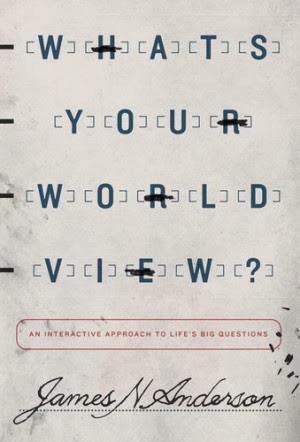 When I first learned about What’s Your Worldview?: An Interactive Approach to Life’s Big Questions
The book’s format is set up such that it outlines something (like what it means to say there is objective truth), then asks whether you believe in it. If you choose yes, you flip to one page; if no, you flip to another. Ultimately, your answers will land you in a worldview. Each worldview has a few pages of brief discussion on how it views reality and what problems might arise with that worldview.
I decided to indeed choose my own adventure and start out reading it from an atheist’s perspective. I figured that would give me a good look into the approach. I quickly realized that answering the questions in such a way got me to “dead ends.” If I said “No” to whether I believed in objective truth, I flipped to the worldview of “Relativism,” had the view explained and some major issues brought up. The end. Full stop. Or is it?
Anderson encouraged readers to go back to the previous question after any worldview evaluation if they didn’t like the conclusions drawn. Thus, continuing the example of relativism, he argued that it is self-defeating: after all, if all truth is relative, is that itself a relative truth? If so, why should I hold to it? Back to the questions! The book encourages such flipping back and forth. It encourages engagement in a way many apologetics books do not.
There is, however, one major drawback to the approach. That is, because it is a book about worldviews, and because it is only just over 100 pages long, there’s not a lot of meat to the discussion. If you’re looking for major critiques and interactions with response-rebuttal-counterpoint on various worldviews, this is not the book you’re looking for. Alongside that, there is a real danger of oversimplification. For example, in the “worldview” section on “nihilism,” it was stated that nihilism is “the view that there are no objective values” (Kindle location 1022). Properly speaking, this only refers to moral nihilism, not nihilism as a full system, which would entail a whole system of “nothings”: no meaning, no objective values, possibly even no reality one can access, etc. Due to the short length, much nuance to each worldview must be lost. Possible objections to Anderson’s brief critiques abound, and readers may be left thinking their own view was perhaps a bit too blithely dismissed.
Of course the length could just as easily be seen as an advantage. One can very easily pick it up and read it in an afternoon; one could hand it to an interested neighbor; it lends itself to use in a brief study period (youth group? adult forum?). These are all advantages. Readers just need to be aware of some disadvantages as well.
I was also very impressed by the depth of insight Anderson gave to rival theist worldviews. Once one answers that there is at least “a” deity, the book still has many more questions to peruse: do you think there is only one?; is Jesus God?; did God communicate with humans? If so, was this communication open?; etc. I found these to be fun to flip through and very informative and on-point. This isn’t an apologetics book that focuses purely on the existence of God; it is, really, a book on worldviews: complete totalities. That said, remember it is not intended to be comprehensive, by any means.
What’s Your Worldview is a really fun apologetics book. The fact that I’m able to write that shows how unique it is. I don’t know of any other book in the same format. It’s refreshing and handy. That said, at times it does feel just like those old “Choose Your Own Adventure” books; you come to the end too quickly. It was a conscious decision on the part of the author/publisher to keep it light and easy to read. And, to that extent, they succeeded. I just found myself wanting a little more. However, I do think this would be an excellent book to pick up and hand off to a friend or relative who may have doubts or may want to explore the beliefs of various worldviews. Just remember the caveat: the book may raise more questions than it answers; so be prepared to have some reasons for the hope within (1 Peter 3:15).
Links
Be sure to check out the page for this site on Facebook and Twitter for discussion of posts, links to other pages of interest, random talk about theology/philosophy/apologetics/movies and more!
Source
James N. Anderson, What’s Your Worldview?: An Interactive Approach to Life’s Big Questions
I received a review copy of the book through Crossway. I was not obligated by the publisher to give any specific type of feedback whatsoever.
SDG.
——
The preceding post is the property of J.W. Wartick (apart from quotations, which are the property of their respective owners, and works of art as credited; images are often freely available to the public and J.W. Wartick makes no claims of owning rights to the images unless he makes that explicit) and should not be reproduced in part or in whole without the expressed consent of the author. All content on this site is the property of J.W. Wartick and is made available for individual and personal usage. If you cite from these documents, whether for personal or professional purposes, please give appropriate citation with both the name of the author (J.W. Wartick) and a link to the original URL. If you’d like to repost a post, you may do so, provided you show less than half of the original post on your own site and link to the original post for the rest. You must also appropriately cite the post as noted above. This blog is protected by Creative Commons licensing. By viewing any part of this site, you are agreeing to this usage policy.
“Peter Boghossian, Atheist Tactician”- A brief look at the e-book by Tom Gilson
 I recently downloaded Tom Gilson’s evaluation of Peter Boghossian’s epistemology for my Kindle. The work is witty but also to the point. Gilson launched a full-on attack against Boghossian’s mission to create atheists. The best parts of the book–and let me be clear, I think the entire work is essential reading–were his critique of Boghossian’s view of faith and his appeal to Christians regarding the importance of the topic.
Gilson makes it clear how important it is to provide a reasoned answer to Boghossian’s view. However, he goes much further than that; he notes that Boghossian’s mission is specifically to destroy the faith of Christians. For any Christian, this should be a disturbing thing to hear. Unlike many other atheists, Boghossian seems to have a plan: he’s going to actively work to proselytize Christians for atheism. He may be called an atheist missionary. Gilson called Christians to see this as a serious threat for Christianity. It’s not that Christianity doesn’t have the resources to answer Boghossian’s arguments; instead, it is that we have not equipped ourselves to do so. The average Christian-in-the-pew is basically incapable of refuting Boghossian-esque reasoning, and so will, possibly, have their faith seriously challenged by arguments which are basically vacuous.
Part of Boghossian’s mission, Gilson notes, is to redefine the meaning of faith. For Boghossian, faith should always be understood as “pretending to know what one does not know” (kindle location 118). Gilson notes that not only would such a redefinition be catastrophic for people of faith [of “pretending to know…”], but it is also a completely invented definition with no basis in reality. That is, Boghossian sems to be pretending to know what he doesn’t know. On his own definition, he is very faithful.
Why think that Boghossian’s definition is wrong? Gilson offers a number of points. Among them is the fact that the redefinition of the term cannot account for its usage among the faithful. Gilson shows how the redefined “faith” would lead to an absurd meaning for any number of texts in the Bible. Not only that, but he also cites a number of Christian thinkers to demonstrate that the usage of “faith” is much more grounded in evidence and true belief than it is grounded in a “pretend” world. By the time Gilson has finished dismantling Boghossian’s usage, it becomes clear that the latter is truly living in his own fantasy. The problem is that if Christians do not equip themselves to combat it, the dream may become reality.
There are a number of other excellent portions of this quick read, such as Gilson’s direct interaction with a number of Boghossian’s interviews and writings. He also approaches Boghossian’s work from several angles, providing a solid ground for the refutation of the atheistic work.
In short, I implore you to pick up and read this work by Gilson. He has done an excellent job of showing how Boghossian’s work may prove to be a challenge to Christianity. But the greater service he has done is provided a tool to equip believers to combat this challenge. Read it, spread it. Keep the faith.
Links
You may get Gilson’s e-book for free at this link [I am unsure of how long this offer will last]. You may also support the ministry of Ratio Christi by purchasing the e-book.
Be sure to check out the page for this site on Facebook and Twitter for discussion of posts, links to other pages of interest, random talk about theology/philosophy/apologetics/movies and more!
Source
Tom Gilson, Peter Boghossian, Atheist Tactician (2014).
SDG.
——
The preceding post is the property of J.W. Wartick (apart from quotations, which are the property of their respective owners, and works of art as credited; images are often freely available to the public and J.W. Wartick makes no claims of owning rights to the images unless he makes that explicit) and should not be reproduced in part or in whole without the expressed consent of the author. All content on this site is the property of J.W. Wartick and is made available for individual and personal usage. If you cite from these documents, whether for personal or professional purposes, please give appropriate citation with both the name of the author (J.W. Wartick) and a link to the original URL. If you’d like to repost a post, you may do so, provided you show less than half of the original post on your own site and link to the original post for the rest. You must also appropriately cite the post as noted above. This blog is protected by Creative Commons licensing. By viewing any part of this site, you are agreeing to this usage policy.
Book Review: “The Philosophy of History: Naturalism and Religion- A Historiographical Approach to Origins” by James Stroud
…Either we will stand behind objective truth or sink into the abyss of relativism in the name of political correctness. (278)
One area Christian apologists need to explore further is the study of historiography. Historiography is, basically, the study of how to study history. It provides the framework in which one might seek truth in understanding historical facts. The way we study history will directly impact the results of historical investigation. John Warwick Montgomery, Michael Licona, and N.T. Wright have done an excellent job integrating historiography into their approach, and there are several treatments of historiography in works on archaeology with apologetic import (K.A. Kitchen is but one example), but there remains much room for development of this essential discipline in the area of Christian evidences.
James Stroud, in his work The Philosophy of History: Naturalism and Religion- A Historiographical Approach to Origins
Next, Stroud turned to an analysis of positivism and academic freedom. His argument is essentially that one should not pre-commit to a “closed” philosophy of history such that one cuts off any and all debate about the presuppositions one uses to interpret history and historical sciences. The winners write the history, but they are also capable of restricting the direction research may turn (49-50). There must be a distinction between the definition of science and science in practice; that is, one should not restrict scientific study through the use of one’s presuppositions to determine what is even capable of being studied or used as a hypothesis. Instead, people should be allowed to follow the evidence where it leads, even if such a project may discover things which lie outside the accepted explanations.
It must be acknowledged that Christianity is, by its nature, a distinctly historical religion: “[T]he truth or falsity of Christianity stands or falls with individual events within history…” (69). Thus, Christianity is almost uniquely capable of being approached in such a manner as to discern its truth through historical claims.
Interestingly, Stroud did not limit his use of “philosophy of history” to the study of history. Rather, he expanded it to include origin sciences, which are, he argued, a kind of historical science themselves. Thus, he examined both the origins of the universe and the origin and diversity of life alongside the historical portions of the book. In these sections on the historical sciences, he presents the design argument both in its cosmological and biological forms.
The meat of the book, however, may be found in the exploration of human history, which comprises approximately half the book. Here, Stroud really gets into stride. One central part of his argument is that “Language, writing, civilization, and religion all seem to be in a fairly advanced stage of development [from the beginning]….” (146). Proposed solutions which argue for a gradual evolution of human culture continue to be confronted by discoveries to the contrary, such as Gobekli Tepe, which shattered preconceived notions of the history of religion (155-157). Language appears to be highly complex from the beginning, and there is little reason to think that some languages are more primitive (in the sense of development) than others (149-150). Stroud relates these points back to the expectations one might get from the biblical text and argued that the biblical text presents a plausible interpretation of such evidence (163ff).
The Flood served as one of the case studies Stroud utilized to make his point. He argued that the preponderance of evidence suggests that the biblical flood is accurate (174-177). The Table of Nations in Genesis 10 also hints at “astonishing” accuracy regarding the historical recordings in the earliest portions of the Bible. Moreover, stylistic evidence within Genesis places its date as very ancient, just as one might expect from taking the book at face value.
Yet Genesis is not the only portion of the Bible which received insight from Stroud’s analysis. The conquests recorded in Joshua have been backed up by archaeological findings. The history of David also garnered attention, and Stroud’s handling of the archaeological data is informative and concise.
The New Testament is, of course, centered around Christ, and Stroud explores the evidence for the Resurrection and the narratives related to Him. One very important point he made is that “…it must be pointed out that the… manuscripts we have for Jesus today did not start as a ‘Bible’ but were later [collected into one]… [T]o dismiss any of this manuscript evidence is in effect to dismiss the most primary sources we have on the Historical Jesus” (240). Yet even sources apart from these can account for a number historical aspects of Christian faith and practice, to the point that it becomes very difficult to reject entirely the Christian story (240ff). Stroud defended the Resurrection itself with a type of “minimal facts” argument, in which he reasoned from several largely established facts of the historical Jesus to the resurrection (248ff).
Naturalism, argued Stroud, fails to account for the historical and scientific evidences for the origins of the universe, life and its diversity, civilization, and the evidence related to the historical Jesus. One should therefore not be constricted to operating within a naturalistic paradigm when one investigates origins or history generally. An a priori rejection of the supernatural is unwarranted.
Thus far, I have shown a number of positive portions of the book. That is not to say there are no areas of disagreement or any problems. First, Stroud’s writing style often comes across as autobiographical, which takes away from the academic feeling of the overall work. Second, there are a number of grammatical errors in the book which are sometimes quite distracting. Third, there is a tendency to overstate the case in some places, such as asserting that any discussion of evolution beyond microevolution is “100 percent speculative” (117) or that “all scholars” in some certain field agree with some fact or another. Fourth, at points Stroud states the view of the opposition in ways that I suspect would be objectionable. One example may be found here: “[T]he vast majority of naturalists confirm that humankind did indeed share a common language…” (177) or the notion that “even the most adamant proponents of naturalism” would admit that the origin of life is unexplainable through naturalistic means with the current understanding (115). I suspect that adamant naturalists would object to this and argue that the RNA world hypothesis or some other origin-of-life scenario does, in fact, explain the origin of life.
Many of these difficulties are minor, but they tend to pull down an otherwise excellent work. It is unfortunate, because it also seems like these could all be solved by a good editor. As it stands, however, one should be careful when reading the work to be aware that in many cases one should perhaps temper the sweeping conclusions Stroud makes. In any field of study, there are rarely (if ever!) times where “all scholars” might agree on something, and the language in the book constantly implies that there are many such agreements in some of the most contentious areas of all historical or scientific studies. Although this does not throw his conclusions out the window, it does somewhat devalue the work, as one must read it with an actively cautious eye.
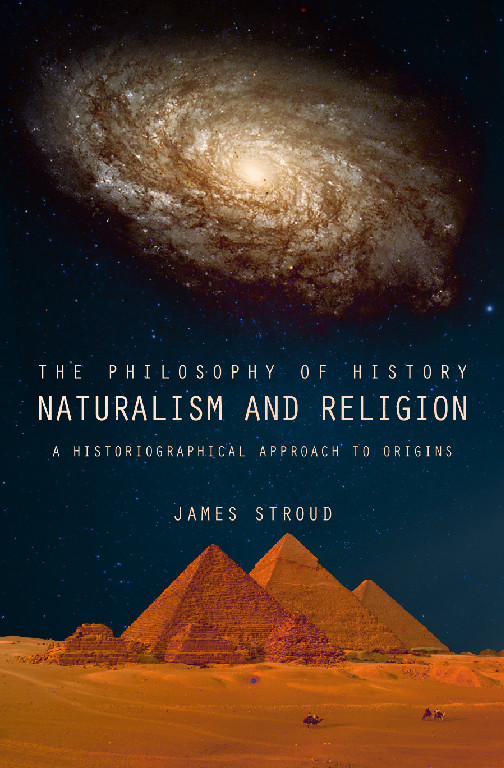
I don’t often (in fact, I can’t think of ever mentioning this before) discuss the cover of a book I’m reviewing, but I have to say this has what might be the coolest cover for an academic book I have seen. I mean seriously, look at it! It is awesome.
With The Philosophy of History James Stroud has provided much needed development for Christians who might want to look into the study of the methods of historical investigation to develop their own understanding of Christianity. He also applies these methods in sometimes surprising ways. I have noted a number of areas of difficulty found within the work, but it should be noted that these are comparatively minor when compared to the project as a whole. Stroud has provided some necessary development in an area of study that Christians should continue to develop. Historiography is an essential field for Christians to study and become involved in, and The Philosophy of History has provided a broad framework for others to continue the work (and hopefully for Stroud to continue, himself). It is an excellent, thought-provoking read which illumines areas of which many apologists, unfortunately, remain unaware.
Source
James Stroud, The Philosophy of History: Naturalism and Religion- A Historiographical Approach to Origins
Disclaimer: I was provided with a copy of this book for review. The author only asked that readers provide feedback of any kind, including negative, in order to broaden the dialogue in this area.
SDG.
——
The preceding post is the property of J.W. Wartick (apart from quotations, which are the property of their respective owners, and works of art as credited; images are often freely available to the public and J.W. Wartick makes no claims of owning rights to the images unless he makes that explicit) and should not be reproduced in part or in whole without the expressed consent of the author. All content on this site is the property of J.W. Wartick and is made available for individual and personal usage. If you cite from these documents, whether for personal or professional purposes, please give appropriate citation with both the name of the author (J.W. Wartick) and a link to the original URL. If you’d like to repost a post, you may do so, provided you show less than half of the original post on your own site and link to the original post for the rest. You must also appropriately cite the post as noted above. This blog is protected by Creative Commons licensing. By viewing any part of this site, you are agreeing to this usage policy.
Book Review: “Hardwired: Finding the God You Already Know” by James Miller
 Irreverent. That’s how I would describe Hardwired
Illustrative was his comment early on in the work. Miller was approached by a mother who was heartbroken over her son leaving the faith. She asked him, “‘How do I convince him there is a God?'” Miller’s answer is indicative of his apologetic method: “He already believes in God.” This startling statement forms the basis for the rest of the book. Miller’s approach revolved around showing people the God they “already know.”
How might one justify this outlandish claim? First, Miller argued that human beings are not “blank slates”–that is, the human mind is in fact shaping that which it observes even as it observes it: “You and I, witnessing events through the same pair of glasses, would not know the same thing, because your brain and my brain do different things with the knowledge” (42). All knowledge is filtered through the preconceptions one has that sorts it into different levels of experience. Miller provided several reasons for thinking that the notion of our minds as blank slates is wrong (42-44; see also 58-61).
The notion that we are not “blank slates” also means that we filter ideas through a number of pre-existing categories. It also means that a wholly objective approach to discovering truth is impossible; we simply cannot step entirely outside of our presuppositions about reality. Moreover, human beings seem to have a shared experience of certain affirmations, even though some may attempt to deny them. For example, “we assume that our perceptions of the world… are accurate… We assume that there are real moral rights and wrongs… We assume that life has a purpose… We assume that there can be meaningful communication in which two people accurately share what they are thinking” (26). These assumptions are not uncontroversial; indeed, many have sought to deny any or all of them. Hardwired featured concise arguments for the fact of each of these notions.
Apart from these seemingly universal human experiences, Miller also argued that the very position of agnosticism is one which does not cohere with reality. Agnosticism is fundamentally a witholding of belief, but that is itself based upon a supposed ignorance of all the available data. He compared it to a court case regarding evidence: “People are only off the hook when they can show both that they didn’t know and that there was no way they could have known.” It is not enough to plead ignorance: “they are still guilty if they didn’t know because they avoided finding out” (55). The Bible clearly states that all people are capable of knowing God, and stand without excuse (Romans 1). “The onus is on honest agnostics to produce a pretty substantial bibliography of failed research” (56).
The fact of God’s existence may be found throughout reality, argued Miller. First, there is the reality of religious experience, but Miller prefers to view these as “epiphanies” which are “a sudden piercing discovery…” which may “draw our attention to things we’ve previously taken for granted or ignored” (69). Second, the existence of moral absolutes is a universal experience. However, this is not to be taken as a proof for God; rather Miller suggested that it means we have “inclinations that cannot be filled by anything but the exisence of God” (91). Even the atheistic moral objection to the God of the Bible assumes objective morality, because it assumes that they are capable of discerning real right and wrong (91-92). The very fact of valuation hints at the Creator (108-111).
The Christian faith gives compelling reasons to believe because its story matches and exceeds the criterion of embarrassment: its “hero,” Jesus, is scorned and shamed, not glorified and given rule over all nations (121ff).
The existence of God, Miller argued, is not tied to arguments or debates, rather, “What convicts us of the existence of God [are]… the soft, subjective facts of an experience that resonates with human longing and confirms are deep suspicions” (156). Hardwired is Miller’s attempt to point to those experiential factors.
By way of analysis, I first note that I think Miller has done an excellent job summarizing a number of extremely complex and difficult issues in ways that the “person on the street” could pick up the book and understand. He is concise and clear. Moreover, I sympathize in many ways with his approach. It seems to me to be true that humans cannot approach a topic as though we are “blank slates” ready to take whatever input we are given without layers of interpretation. That, I think, is the greatest strength of Miller’s approach. He pointed out the deeply seeded assumptions we hold which influence the way we view reality and showed how these lead to God.
However, I wonder about the coherence to Miller’s approach. His critique of natural theology does not sit well with his appeal to some of the very types of arguments that natural theologians use. For example, his appeal to objective morality is essentially no different from the defense provided for the “moral argument” by natural theologians like William Lane Craig, whose approach Miller criticizes. His presuppositional argument itself depends upon some forms of evidentialism (and here I am intentionally wording this to avoid being accused of being unaware of the fact that presuppositional apologists do use evidence–it is manifestly true that even the staunchest presuppositional apologist uses evidence… my point is that the method Miller uses is often evidentialist in its approach). Ultimately, readers will be left with what essentially amounts to an existentialist evidentialism, which seems itself to rely upon natural theology in a number of traceable ways.
Another difficulty I had with Hardwired is that it seemed Miller sometimes overstated his case. Perhaps the most obvious example of this, in my opinion, is his discussion of evolution. He discussed natural selection and sought to evaluate it by looking at humans: “[I]f natural selection actually works, a few million years should make for some pretty shiny, strong, effective gladiators who have good teeth and rarely catch cold… Specifically, there are some traits of humanity that should by all means have been weeded out by now: sleep (which makes people vulnerable to predators for a third of their lives)… endoskeletons, appendices, wisdom teeth, birth defects, stupidity, and obesity” (94).
I’m not about to dive into biology, which is by no means an area of my expertise, but it seems to me that none of these are required expectations given Neo-Darwinism. Miller’s critique does not take into account the fact that humans have worked using their intelligence to circumvent many of these difficulties (i.e. we live in shelters which keep us safe while sleeping; appendices still have function; etc, etc.). The critique offered here also seems shamelessly teleological, which is the very thing Neo-Darwinists would deny within their system.
Hardwired is a brief missive which applies presuppositional apologetics in a straightforward, easy-to-understand fashion. Miller doesn’t fall into using terminology that will be difficult for the uninitiated to understand. Instead, he provides a coherent beginning-to-end approach in how to argue for faith from his presuppositional approach. It is a commendable work for its simplicity, and despite the areas of disagreement I noted above, I certainly think it is worth a read. Miller has a way of answering the difficulties that people raise against Christianity in concise but convincing fashion. It’s a mixed bag, but one well worth the time spent.
Source
James W. Miller, Hardwired: Finding the God you Already Know (Nashville, TN: Abingdon Press, 2013).
Disclaimer
I received a copy of Hardwired free of charge for review. I was only asked to give an honest review of the book.
SDG.
——
The preceding post is the property of J.W. Wartick (apart from quotations, which are the property of their respective owners, and works of art as credited; images are often freely available to the public and J.W. Wartick makes no claims of owning rights to the images unless he makes that explicit) and should not be reproduced in part or in whole without the expressed consent of the author. All content on this site is the property of J.W. Wartick and is made available for individual and personal usage. If you cite from these documents, whether for personal or professional purposes, please give appropriate citation with both the name of the author (J.W. Wartick) and a link to the original URL. If you’d like to repost a post, you may do so, provided you show less than half of the original post on your own site and link to the original post for the rest. You must also appropriately cite the post as noted above. This blog is protected by Creative Commons licensing. By viewing any part of this site, you are agreeing to this usage policy.

 J.W. Wartick - Reconstructing Faith