christian apologetics
Forgotten Arguments for Christianity: Undesigned Coincidences- The argument stated
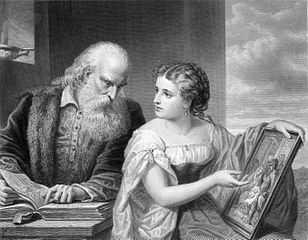 The argument from undesigned coincidences is one of the forgotten arguments for Christianity. It has seen a very recent resurgence through the work of some Christian apologists, such as the philosopher Timothy McGrew. The core of the argument is an investigation of the Bible. When one examines the Scriptures, one finds a number of historical, factual claims which either overlap and confirm others made independently or fill in gaps that authors familiar with current events at the time of the writings would have assumed their readers knew about. These coincidences are therefore undesigned–they are unintentional–but they show that the authors who wrote the books which contain them were telling historical truths.
The Argument Outlined
The argument from undesigned coincinces is not an argument which can be contemplated and accepted or dismissed within minutes or even a few hours of study. The argument must be analyzed by investigating individual instances of the undesigned coincidences for oneself and feeling the weight of the evidence begin to burden the mind.
The argument is an inductive argument. Basically, it argues for the conclusion that the Bible is historically accurate. However, it can be used to argue more specifically towards the conclusion that the miraculous accounts in the Bible did in fact happen.
John James Blunt, an early (1794-1855) proponent of the argument from undesigned coincidences, uses the argument as a challenge:
In our argument we defy people to sit down together, or transmit their writings one to another, and produce the like [undesigned coincidences]. Truths known independently to each of them, must at the bottom of documents having such discrepancies and such agreements as these in question. (J.J. Blunt, kindle location 89, cited below)
It would be hard to make the argument more succinct than this. The argument is built from an ever-growing number of independently observed statements throughout the Bible which coincidentally prove, confirm, or fill in historical gaps of other passages. Therefore, it can feature a huge number of steps, each one an additional piece of evidence. Because of this, it is most easily stated as a challenge. Once you have considered the massive weight of the evidence from untold numbers of undesigned coincidences, can you really maintain your skepticism of the historicity of the Bible?
The argument is used not just to establish the credibility of the Gospels but can be used for a number of other claims about the historicity of Christianity: “The argument deduced from coincidence without design has further claims, because… it establishes the authors of several books of Scripture as independent witnesses to the facts they relate; and this, whether they consulted each other’s writings or not; for the coincidences, if good for anything, are such as could not result from combination, mutual understanding, or arrangement” (Blunt, Kindle Location 78).
Undesigned Coincidences- What are they?
Tim McGrew explains the notion of an undesigned coincidence:
How can we say, no, really there are marks of authenticity [in the Bible]… We should look not for parallel passages in the same words but for what are called undesigned coincidences… Sometimes two works written by different authors incidentally touch on the same point in a manner that cannot be written off as copying or having a copy made from some third source… The two records interlock like the pieces of a jigsaw puzzle. [McGrew, cited below]
Undesigned coincidences overlap and interlock with each other. It is perhaps easiest to explain the concept through an example [I owe this example to Jonathan McLatchie in his post “Undesigned Coincidences: The Ring of Truth”:
Luke 23:1-4:
Then their whole assembly rose up and brought Him before Pilate. They began to accuse Him, saying, “We found this man subverting our nation, opposing payment of taxes to Caesar, and saying that He Himself is the Messiah, a King.”
So Pilate asked Him, “Are You the King of the Jews?”
He answered him, “You have said it.”
Pilate then told the chief priests and the crowds, “I find no grounds for charging this man.”
Wait, what? Isn’t it Pilate’s job to make sure the Jews do not revolt against Caesar? This guy just basically said he was king!
But then compare that to John 18:33-38:
Then Pilate went back into the headquarters, summoned Jesus, and said to Him, “Are You the King of the Jews?”
Jesus answered, “Are you asking this on your own, or have others told you about Me?”
“I’m not a Jew, am I?” Pilate replied. “Your own nation and the chief priests handed You over to me. What have You done?”
“My kingdom is not of this world,” said Jesus. “If My kingdom were of this world, My servants would fight, so that I wouldn’t be handed over to the Jews. As it is, My kingdom does not have its origin here.”
“You are a king then?” Pilate asked.
“You say that I’m a king,” Jesus replied. “I was born for this, and I have come into the world for this: to testify to the truth. Everyone who is of the truth listens to My voice.”
“What is truth?” said Pilate.
After he had said this, he went out to the Jews again and told them, “I find no grounds for charging Him.
John’s telling of the story therefore fills in the gap in Luke’s story. In Luke, there is no reason Pilate would not find grounds for charging Jesus. Only by reading the story in John does one discover that Pilate wanted to let Jesus go because Jesus had explained that his Kingdom was not an earthly kingdom.
If one looks again at these texts in context, one will find that in John, there is no explanation for why Pilate would think Jesus claimed to be a king anyway–it is just out of left field. But turning back to Luke, there is a scene in which the Jews accuse Jesus of claiming to be a king to Pilate. So there is, in these passages, a back-and-forth confirmation. You have to read them both to get the whole picture, and these kinds of details are not the types of things people could plan for.
This is just one example, but they can be multiplied almost beyond comprehension. The way they work is, as McGrew said, like interlocking pieces of a puzzle.
What about Miracles?
The argument can even be used to make a stronger claim. Again, see Blunt, “[I]n several instances the probable truth of a miracle is involved in the coincidences… [W]hen we see the writers of Scriptures clearly telling the truth in those cases where we have the means of checking their accounts… it is reasonable to believe that they are telling the truth in those cases where we have not the means of checking them…” (Kindle Location 89).
Thus, the argument from undesigned coincidences is not a religiously neutral argument. It can also be used to support the truths of miracles. The way this argument works is very subtle. It is not reducible to only the claim that because the Scriptures seem reliable on historical matters due to the undesigned coincidences, we should trust them on the miraculous. Rather, the fact is that the “probable truth of the miracle is involved in the coincidences” (Blunt, 89). “[W]here the natural and supernatural are in close combination, the truth of the former must at least be thought to add to the credibility of the latter” (ibid, 531). The miraculous is sometimes so intertwined with the historical that the confirmation of the historical cannot help but be evidence for the miraculous. Thus, the argument from undesigned coincidences provides a direct argument for the truth of the miraculous.
Conclusion: There’s more where that came from
I have written this post with the intended purpose only to show what the argument from undesigned coincidences looks like. We have seen that it is an inductive argument that is based upon a vast number of examples of varying weight. Furthermore, unlike many historical arguments for Christianity, the argument from undesigned coincidences offers a direct argument for the truth of miracles. I have not addressed possible objections to these arguments. Instead, I leave those for a later post. The next post in this series will outline a few principles of undesigned coincidences.
In closing, it is perhaps best to close with the words of another pre-1900 proponent of the argument:
[S]ince we decide many important worldly matters upon the mere preponderance of evidence and arguments, why should we not adopt the same principles here? It is not necessary in order to recommend the Gospel story for our adoption to insist that it be proved to a mathematical demonstration, and beyond the cavils of every doubter, or of every unreasonable skeptic. Why not adopt that conclusion which has the higher degree of probability rather than the opposite? [Bennett, Kindle Location 59, cited below]
Links
If you want to learn more about forgotten arguments for Christianity, check out my post “On the Shoulders of Giants: Rediscovering the lost defenses of Christianity.”
Tim McGrew has offered a number of other talks on the topic. Please check them out for more discussion of this argument. McGrew on Evidence4Faith. Another lecture by McGrew on undesigned coincidences. Check out McGrew’s interview with Apologetics 315.
Another great post on “undesigned coincidences” can be found at the Christian Apologetics Alliance blog: “The Ring of Truth.”
Cross Examined has a number of coincidences to examine in their post on undesigned coincidences.
Sources
The image is public domain. {{PD-1923}}
John James Blunt, Undesigned Coincidences in the Writings of both the Old and New Testament, New York, 1847.
Edmund Bennett, The Four Gospels from a Lawyer’s Standpoint, New York, 1893.
Timothy McGrew, “Undesigned Coincidences”- this talk can be accessed free of charge here.
William Paley, Evidences of Christianity, New York, 1794; 1865.
SDG.
——
The preceding post is the property of J.W. Wartick (apart from citations, which are the property of their respective owners, and works of art as credited) and should not be reproduced in part or in whole without the expressed consent of the author. All content on this site is the property of J.W. Wartick and is made available for individual and personal usage. If you cite from these documents, whether for personal or professional purposes, please give appropriate citation with both the name of the author (J.W. Wartick) and a link to the original URL. If you’d like to repost a post, you may do so, provided you show less than half of the original post on your own site and link to the original post for the rest. You must also appropriately cite the post as noted above. This blog is protected by Creative Commons licensing. By viewing any part of this site, you are agreeing to this usage policy.
Book Review: “Truth in the Flesh” by John Hartung
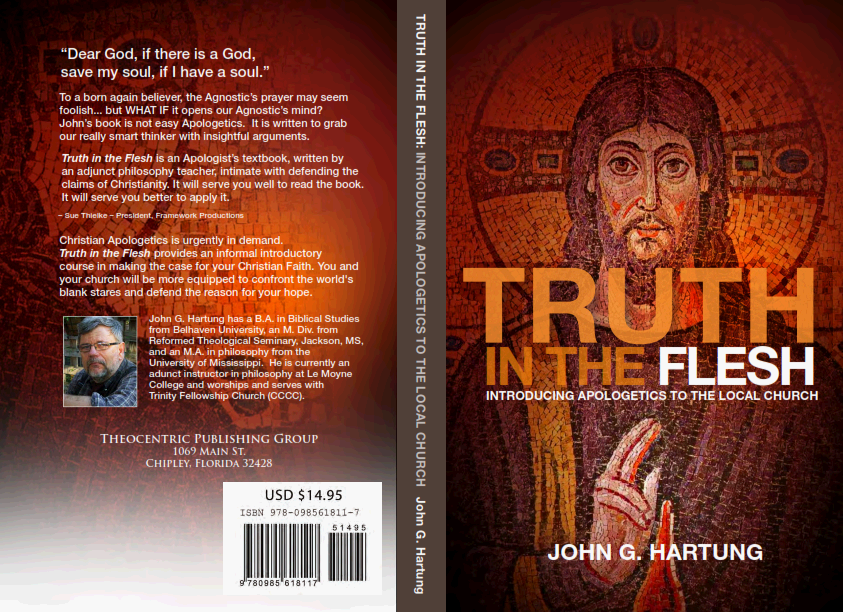 Truth in the Flesh
Hartung begins with an analysis of plausibility structures and “blank stares” (7ff). Throughout the work, Hartung works to make high level ideas accessible at the level where a lay person can come to an understanding, and the notion of a “blank stare” is just one example of how he does this. He notes that Christian claims are often met with a “blank stare.” Such incredulity is often based on one’s own presumption of “prestige” and “social gate-keeping.” To break through this kind of barrier, Hartung suggests pressing on by questioning the listener on why they seem incredulous, which will open the path to discussing plausibility. He notes that one must keep in mind the notion that worldviews are at odds here, not just opposing views on individual topics.
Hartung’s discussion of the problem of evil is multi-leveled and interesting. He addresses the notion of evil as a privation, something that is a lack of something rather than a thing-in-itself. Hartung then analyzes how evil could possibly be viewed as a challenge to the existence of God. He offers Christ as a solution to suffering. God who suffers with us cures our suffering.
Hartung then turns to two purported challenges to Christianity: science and faith and religious pluralism. Regarding the former, Hartung addresses a number of issues, including supposed incompatibility of faith and science, the “god of the gaps” objection, the possibility of making an inference to God, and more. Regarding the latter, he considers the possibility of testing truth claims of religion, relativism, religious experience, and a few other topics. Ultimately, he concludes that neither of these supposed challenges undermines Christian faith.
Hartung’s case for the Christian faith is built upon a cumulative case version of argument. He builds bottom up from God to Christ to Christian theism. One of the several highlights from the second part of Truth in the Flesh is the discussion of philosophical modernity. He traces modern thought from Plato on down through Locke and Hume and touches the important points of the development of their ideas. He continues to interact with these and other thinkers throughout the work.
Hartung’s arguments for the existence of God are concise and will give lay readers an introduction to a number of prominent philosophical arguments. He also offers a chapter in which he breaks apart the naturalistic worldview, arguing that it cannot account for meaning. Finally, the arguments for Christian theism specifically are added to the mix and the possibility of miracles, reliability of the New Testament, and the Incarnation are all defended.
Truth in the Flesh is an extraodinary work in a number of ways. Its breadth is impressive. Hartung manages to discuss extremely complex issues in such a way that those looking to learn about apologetics can understand, while those who have read thoroughly on the topic will get new insight and a great review. In particular, Hartung’s focus on some of the thinkers of modernity helps to make the work stand apart from the pack. I recommend Truth in the Flesh primarily as an introductory text for apologetics, but also as a great reference for those who are experienced in the field.
Source
John Hartung, Truth in the Flesh
Disclosure: I received a copy of the book for review from the publisher. I was not asked to endorse it, nor was I in any way influenced in my opinion by the publisher. My thanks to the publisher for the book.
SDG.
——
The preceding post is the property of J.W. Wartick (apart from citations, which are the property of their respective owners, and works of art as credited) and should not be reproduced in part or in whole without the expressed consent of the author. All content on this site is the property of J.W. Wartick and is made available for individual and personal usage. If you cite from these documents, whether for personal or professional purposes, please give appropriate citation with both the name of the author (J.W. Wartick) and a link to the original URL. If you’d like to repost a post, you may do so, provided you show less than half of the original post on your own site and link to the original post for the rest. You must also appropriately cite the post as noted above. This blog is protected by Creative Commons licensing. By viewing any part of this site, you are agreeing to this usage policy.
The Prayer of Judith: A Devotion from the Apocrypha
 The Apocrypha is a wealth of devotional reading that remains largely untouched by Protestants. No longer, I say! Martin Luther said of the Book of Judith (in the Apocrypha): “[T]his is a fine, good, holy, useful book, well worth reading by us Christians. For the words spoken by the persons in it should be understood as though they were uttered in the Holy Spirit by a spiritual, holy poet or prophet who, in presenting such persons in his play, preaches to us through them” (cited in The Apocrypha: The Lutheran Edition With Notes, 5-6). It should be noted that Luther is not suggesting that the Apocrypha is on par with the sacred canon. Instead, his view of the office of the ministry is that those ministering are speaking through the spirit. He and others view the book of Judith as a piece of historical fiction, made clear to its readers that it was fictional by its commingling of names from different cultural backgrounds and its generally ahistorical nature. Although it is fiction, that does not undermine the possibility of spiritual truths.
Here, we’ll explore the Prayer of Judith in Judith 9:1ff and see how it points to God as transcendent Lord of all creation.
[Y]ou have designed the things that are now and those that are to come. Yea, the things you intended came to pass, and the things you decided presented themselves and said, ‘Lo, we are here’; for all your ways are prepared in advance, and your judgment is with foreknowledge. (Judith 9:5ff, ESV translation of the Apocrypha)
Judith here acknowledges that all which God plans comes to be. Note that here, Judith does not affirm that God specifically intends for each and every thing that occurs. Rather, this passage reveals that God is in control over all things, accomplishing His plan in such a way that the things He intends will come to pass. Yet the author does not imply that God intends for all things which do happen. Judith does not pray thanking God for causing evil–such would be wildly inappropriate. Instead, Judith focuses upon God’s comprehensive plan which takes into account all things. God has “prepared in advance” all His ways. His judgment and execution of plans is “with foreknowledge.” God’s plans are with absolute foreknowledge of what occurs, and we can trust in God to execute rightly.
[T]hey [the Assyrians] trust in shield and spear, in bow and sling, and know not that you are the Lord who crushes wars; the Lord [YHWH] is your name. (9:7b)
One of my favorite lines in the entire book of Judith: “the Lord who crushes wars.” Think about the implications there: it is God who is control of the destinies of nations. Although the weapons of humanity may be raised against each other, the Lord crushes the war itself. We are reminded in Revelation that there will be a day with no more tears (Revelation 21:4). One day, God will crush the very possibility of war.
 Furthermore, it should be noted that in context, Judith is not suggesting that God is against any type of war per se; after all, Judith goes on to behead the leader of the Assyrians and the Israelites pursue the Assyrians from their land. Instead, it is the trust in human invention that is under assault here. The Assyrians put their trust into their own weapons instead of God. Rather, it is God who should be trusted, for it is God who has the power not only to wage war but to destroy war itself.
[C]rush their arrogance by the hand of a woman. (9:10b)
God uses the unexpected for His ends. Women were not the expected leaders; deliverance was more likely to have come from a great general–a man. Yet God uses the weak to bring down the strong.
[C]ause your whole nation and every tribe to know and understand that you are God, the God of all power and might and that there is no other who protects the people of Israel but you alone! (9:14)
Judith continues her prayer, exhorting God to bring His message to all peoples across the whole earth. Such is our own call as Christians. We are to carry out God’s plan in this mortal realm and bring God’s message to the whole earth. Yet we cannot forget that it is God alone who is our unfailing protector. We can trust only in God, not our weapons, not our might: we must trust in God who is far beyond such earthly powers.
Amen.
Source:
The Apocrypha: The Lutheran Edition With Notes
SDG.
——
The preceding post is the property of J.W. Wartick (apart from citations, which are the property of their respective owners, and works of art as credited) and should not be reproduced in part or in whole without the expressed consent of the author. All content on this site is the property of J.W. Wartick and is made available for individual and personal usage. If you cite from these documents, whether for personal or professional purposes, please give appropriate citation with both the name of the author (J.W. Wartick) and a link to the original URL. If you’d like to repost a post, you may do so, provided you show less than half of the original post on your own site and link to the original post for the rest. You must also appropriately cite the post as noted above. This blog is protected by Creative Commons licensing. By viewing any part of this site, you are agreeing to this usage policy.
Book Review: “Always Ready” by Greg Bahnsen – Presuppositional Apologetics
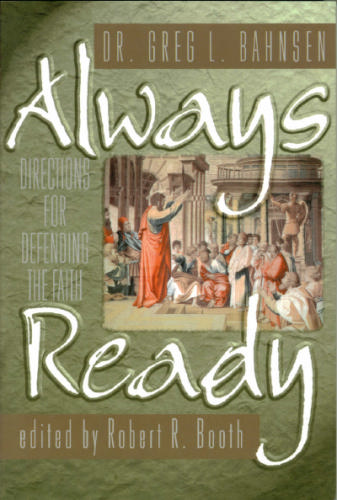 Greg Bahnsen is well-known within the community of presuppositional apologetics (with good reason–see his debate with prominent atheist Gordon Stein). But what is presuppositional apologetics? How is it distinctive from other approaches to defending the faith? Bahnsen seeks to answer those questions (and more) in his work, Always Ready
In section one, Bahnsen introduces one of the most important aspects of the presuppositional approach: the focus upon the impossibility of epistemic neutral ground. Often, in debates over the verifiability of the faith, the believer is encouraged to set aside their neutrality. Bahnsen argues forcefully that to do so is not just to give up a great weapon in the defense of the faith; it actually damages one’s defense irreparably (3ff). Because of the impossibility of neutral ground, Bahnsen urges apologists to begin not with any supposed neutral ground, but rather with “fear of the Lord” (5). What does he mean by this? Simply put, “the Christian presupposes the truthful word o f God as his standard of truth and direction” (19, emphasis his). The Bible, in other words, is the epistemological starting point for the presuppositional apologist. Rather than starting with a defense of the Bible, the apologist is to start with the Bible as given.
Bahnsen realizes that this point is the one which will likely be most contentious for those who oppose the presuppositionalist approach and thus he turns to a defense of the use of the Bible as an epistemological foundation. He argues that “God’s word has… absolute epistemic authority and it is the necessary presupposition of all knowledge which man possesses” (29). One argument against this presupposition is that it is dogmatic. The argument is made that one cannot simply presuppose their own position to take on all comers. Against this, Bahnsen argues that the presuppositional approach is in fact dogmatic because any approach is dogmatic. On a Christian perspective, knowledge without God’s Word is impossible. Therefore, a Christian cannot set that aside as though one could become “neutral”; in doing so, one has in fact rejected the Christian worldview (31, 7-9, 34, 36). Others may object that this seems to make any knowledge of non-Christians impossible. Again, Bahnsen corrects such a view, arguing that unbelievers “cannot but have them [knowledge of God as a presupposition for knowledge] as a creature made as God’s image and living in God’s created world” (38). In other words, he holds that the unbeliever unwittingly holds to Christian presuppositions in order to have any kind of knowledge. In principle, the unbeliever can have no knowledge; in practice, by borrowing from the Christian worldview, unbelievers have knowledge (ibid). Bahnsen does present several more arguments in favor of the presuppostional perspective, including an examination of the Christian perspective of the knowledge of unbelievers and the rebellion of those without God.
Part of the distinctiveness of the presuppositional approach is that rather than approaching the defense of the faith as a cumulative case, it presents Christianity as a worldview to line up against other worldviews in conflict. The importance of this is emphasized by Bahnsen.”The Christian,” he argues, “can never be satisfied to defend [the faith]… by merely stringing together isolated evidences…. [which] will be evaluated… by the unbeliver’s tacit assumptions; his general world-and-life view will provide the context in which the evidential claim is understood and weighted. What one presupposes as to possibility will even determine how he rates ‘probability'” (67). Thus, if one offers an argument for the existence of God, that argument will be evaluated by the unbeliever within their own assumptions. According to Bahnsen, only by destroying those assumptions–only by pitting whole worldviews side-by-side and showing how they rate on coherence with reality–can one adequately do apologetics. Bahnsen then turns to an evaluation of the conditions necessary for successful apologetics (81-106). Largely, this includes God’s soverein control over all things and fleeing from sin.
Perhaps the most illuminating portion of Always Ready is its presentation of various apologetic issues and the way that presuppositional apologetics provides answers to these arguments. For example, regarding the problem of evil, the presuppositionalist approach rests upon its usefulness as a paradigm of “worldviews in conflict.” Rather than trying to provide varied theodicies, the presuppositionalist argues, as does Bahnsen, “If the Christian presupposes that God is perfectly and completely good… then he is committed to evaluating everything within his experience in light of that presupposition” (171, emphasis his). Thus, on a presuppositional approach, the premise that “God has a morally sufficient reason for the evil which exists” is a given (172). For every evil, on the Christian worldview, God has a morally sufficient reason. Only by assuming that Christianity is false can one argue that the problem of evil is truly a problem. Thus, Bahnsen reevaluates the problem of evil as a psychological problem rather than a logical problem. It is a problem of trusting in God that God has good reasons for allowing evil (173).
Challenges to miracles are also assessed in light of presuppositionalism. At the core of the presuppositianalist response is again the centralization of the conflict of worldviews. Only by assuming that miracles do not occur can one exclude them a priori from investigation. Thus, the unbeliever has begged the question and their argument is undermined (225). Bahnsen answers a number of other arguments from a presuppositional perspective, including challenges from the possibility of metaphysics, religious language, faith, and the like.
The work ends with an extended investigation of Paul’s apologetic approach in Acts 17. Bahnsen argues that Paul’s approach was thoroughly presuppositional and that it acts as a model for the presuppositional approach to apologetics.
The strengths of Always Ready are immediately apparent. Bahnsen provides a thorough look at presuppositional apologetics which presents not just the outline of the approach but also several case studies in order to help people put it into practice. The distinctiveness of presuppositional apologetics shines throughout the book
There are a few flaws in the work, however. First, as is often the case, the presuppositionalism presented in this work is thoroughly Calvinistic. Simply being Calvinistic is not a flaw, but the way that Calvinism is presented by many defenders of presuppositionalism (Bahnsen, Van Til, Frame, and the like) is essentially as the one true faith. It is Calvinism or it isn’t Christianity. Frankly, that’s a huge problem. Setting that aside, the weakest point of the work is also its most important one: namely, the presupposition of the Bible as necessary for apologetics. There are a great many who are extremely skeptical of this approach. First, there is the charge of circularity, which presuppositionalists actually accept. Their response is that all worldviews are ultimately circular.The debate remains largely unsettled, but as for this reviewer, it is hard to accept that the entire Bible is a necessary presupposition for the defense of the faith. Finally, the dim view of individual evidences as useful for defense of the faith remains a problem within the presuppositional approach.
That said, even if one rejects the possibility of presupposing the Christian worldview wholesale, one can still utilize the presuppositional approach in their apologetic. By focusing squarely upon defense of the faith as a clash of worldviews, Bahnsen has highlighted the extreme usefulness of pointing out how presuppositions can color one’s outlook on the interpretation of evidences and the investigation of other positions. Although readers may not be ready to embrace the whole of presuppositionalism, after reading Always Ready, they may be ready to integrate a number of presuppositional approaches into their apologetic.
Source
Greg Bahnsen, Always Ready
SDG.
——
The preceding post is the property of J.W. Wartick (apart from citations, which are the property of their respective owners, and works of art as credited) and should not be reproduced in part or in whole without the expressed consent of the author. All content on this site is the property of J.W. Wartick and is made available for individual and personal usage. If you cite from these documents, whether for personal or professional purposes, please give appropriate citation with both the name of the author (J.W. Wartick) and a link to the original URL. If you’d like to repost a post, you may do so, provided you show less than half of the original post on your own site and link to the original post for the rest. You must also appropriately cite the post as noted above. This blog is protected by Creative Commons licensing. By viewing any part of this site, you are agreeing to this usage policy.
The Myth of “Religion”: Constructing the Other as an enemy
The myth of religious violence should finally be seen for what it is: an important part of the folklore of Western societies. It does not identify any facts about the world, but rather authorizes certain arrangements of power in the modern West… The myth also helps identify Others and enemies, both internal and external, who threaten the social order and who provide the requisite villains against which the nation-state is said to protect us. (William Cavanaugh, 226, cited below)

I recently discussed a phenomenal work by William Cavanaugh, The Myth of Religious Violence
The Myth Played Out
The religious other is said to be violent. Religions cause violence due to their scary propensity to link with irrationality, absolutism, and divisive. Religion caused wars and chaos. Religious persons engaged in wars for God over nothing but minute doctrinal differences raged across the time of the reformation and at other times as well. The rise of the secular nation-state and the squelching of religion in the public square allowed for the cessation of violence and for man to live in peace. Such goes the myth of religious violence. Cavanaugh refers to this myth as a “creation myth” of the nation-state (123).
Notice the themes that run through any discussion of religion and violence. The general theme is that religion causes division through doctrinal matters. Because person A believes x and person B believes y, they argue, Furthermore, because neither x nor y has sufficient rational grounds for A and B to resolve the issue, they must fight in order to determine is right. After all, religion deals with absolutes. A and B square off about salvation–their eternal souls are at stake!
Often, religious persons are tempted to come back and counter that those who are non-religious are often violent too. However, this is itself a reaction to the same factors that drive the notion of religious violence. Namely, the myth of religious violence is used to stigmatize the Other. It constructs temporary categories of “religious” and “secular,” groups people based upon that, and then delegates the worst types of violence to that which is called religious. The myth is part of the justification for the nation-state and nationalism. The Nation is that which protects us from the Others in our own society. Without the protection of the State, we would turn to violence to try to subjugate others for our own purposes. Therefore, the State becomes a sacred object. Its symbols become cultic objects, and we ritualize specific aspects of the State. After all, the Nation is our savior from violence of religion. People will willingly lay their lives down in the name of their country, but for their religion? Certainly not! The State is worth dying for because it defends all people, but a religion is an internalized, personal object.
Thus, those things deemed religious are stigmatized and forced into the personal sphere, while those deemed secular are allowed for public debate. As such, specific aspects of a person’s worldview are forcibly separated and parsed. The religious person is expected to act “secular” when it comes to the public sphere, but is allowed to do whatever he wishes in the private realm. The problems quickly become clear.
Religion as a Myth
Religion itself is a social construct. I have seen this personally in a number of works dealing with “religion.” Rarely do authors attempt anything more than a working definition, and even then the definitions do little to outline real differences between that which is “secular” and that which is “religion.” The definitions are either extremely vague or too specific.
A survey of literature on religion shows that this problem is pervasive. The problem is with the notion of religion itself as a category that can somehow cordon off that which is secular. It may be much more useful to speak simply of ideologies or worldviews. Thus, a side-by-side comparison of differing worldviews can indeed be made. There is no fast and hard distinction between secular and religious, for such a distinction is nothing but arbitrary.
How does one define religion in such a way that Taoism, Confucianism, Christianity, Buddhism, Hinduism, and Islam all somehow fit while Marxism, Communism, Nationalism, and the like do not? It seems an impossible task. Some who read my site may notice that I frequently file things under “philosophy of religion” [including this post!]. I’m not suggesting that “religion” is an entirely useless word. What I’m suggesting here is that we must admit that the category is a construction, pure and simple. When I use “religion,” I use it pragmatically to review to an arbitrarily dilineated set of worldviews. Ultimately, “philosophy of religion” is a philosophy of worldviews: putting them side by side for comparison.
By challenging the reigning paradigm of religion as a real, transcultural, category we may thus turn to the question of violence, rationality, and the like as an empirical, philosophical, and existential study. By stripping away the prejudices that come up when someone uses the word “religious” or “secular,” we may focus upon the actual data at hand. Regarding the question of violence, we can ask questions like: “In what circumstances will worldview U turn to violence?” or “Is worldview U more prone to violence than others?” As such, extremism like that of Marxism which has killed untold millions with an atheistic paradigm can be set up alongside extremism like that of Islamicism. Thus, categories outside of “religion” can be used to analyze these cases. Surely divisiveness, absolutism, and irrationality are involved in both cases? What causes them to arise? How do we slow that tide? How do we reason with the Other?
The category “religion” is a construct of the person utilizing it. As such, it can be wielded as a weapon. And, I charge, that is exactly what the category “religion” has been used for.
Controlling the Other
Those who argue that religion causes violence are, in particular, wielding the phrase as a weapon. The religious Other is irrational, violent, and to be feared. It is “us” or “them.” One can observe this in the literature. Some endorse violence against specific religions just because they assume that the myth of religious violence will apply to the view at large.
It is this kind of mentality that the construct of religion perpetuates. It is the Other which we must fear. We, who are rational, need to fear the irrational Other. The Other causes violence, they cannot be reasoned with, and they want absolutist control over society.
The key to this discussion is that the notion of a hard line between “secular” and “religious” is a social construct. The notion of religion is indeed a construction.
The myth of religion is therefore one step towards the myth of religious violence. The key is to construct a “religious other” who is irrational, divisive, and dangerous. Thus, we can feel free to stigmatize and fear this Other. We need to make sure that the Other does not threaten us, and indeed part of this may be to use violence against the Other. After all, they are incapable of reasoning and will not listen to our sound arguments. The only thing they are capable of understanding is violence, which they have used to try to subjugate us to their views.
It is in this way that the myth is used most dangerously. The religious other is a fearsome enemy, one who must be avoided and perhaps even destroyed in order to prevent one’s own destruction. By perpetuating the notion of religion as a transcultural, transhistorical, real entity distinct from that which is secular, the possibility is made to make the religious other the enemy, while glorifying those categories which one decides are not religious. It undermines the empirical study of the way violence comes about on particular worldviews.
An Alternative Way Forward
Rather than using the category of “religion” in order to stigmatize, I suggest that we instead discuss “worldviews.” In this way, all worldviews are on the same plain. Violence may arise in certain worldviews more easily than others, whether it is nationalism or a particular worldview which is deemed “religious.” It may be extremely difficult to avoid using the term “religion” so I will not even attempt to do so. The category is a construction, so it can be used as a useful fiction. Because it is indeed a temporal, cultural distinction, I can use “religion” in a meaningful sense so far as when I say it people will tend to think of Islam, Christianity, Hinduism, and the like.
However, it is just as important to focus upon all worldviews, not those which are somewhat arbitrarily deemed “religious,” when discussing truth claims. As such, it is important to avoid the secular/religious distinction and instead focus upon factual debate and discussion over the coherence of particular views. By doing so, we can advance the discussion about worldviews while avoiding the use of the myth of “religion” to stigmatize the other.
Links
Book Review: “The Myth of Religious Violence” by William T. Cavanaugh– I review the book which has led me to discuss the ways the category of religion is used to stigmatize the other and also forced me to rethink a number of issues. I highly recommend this book.
Source
William T. Cavanaugh, The Myth of Religious Violence
SDG.
——
The preceding post is the property of J.W. Wartick (apart from citations, which are the property of their respective owners, and works of art as credited) and should not be reproduced in part or in whole without the expressed consent of the author. All content on this site is the property of J.W. Wartick and is made available for individual and personal usage. If you cite from these documents, whether for personal or professional purposes, please give appropriate citation with both the name of the author (J.W. Wartick) and a link to the original URL. If you’d like to repost a post, you may do so, provided you show less than half of the original post on your own site and link to the original post for the rest. You must also appropriately cite the post as noted above. This blog is protected by Creative Commons licensing. By viewing any part of this site, you are agreeing to this usage policy.
Really Recommended Posts 9/21/12
 There are so many fantastic posts out there it has been hard for me to keep up. I actually have another RRP scheduled with all the backlogged posts I’ve run into. Let me know which posts you’ve enjoyed. I feature here a diverse spread of posts. The necessity of apologetics, atheism, the Gospel of Barnabas (!?), young earth creationism, and resisting sin are all featured. Check ’em!
Sarah Geis provides pointers for constructive debate and disagreement– A creative look at how to debate constructively by showing how not to do so.
Why Apologetics Should Be A Requirement For Every Pastor– Fellow Christians, I hope this post convicts you like it convicted me. We need to be doing apologetics. We owe it to our youths, we owe it to the adults in our congregations, and we owe it to ourselves.
Born Atheists?– Yes, you have heard it somewhere. We’re all born atheists. Really? What is that even supposed to mean? I found this post really excellent and it got me thinking. Check it out.
What is the Gospel of Barnabas?– Some Muslims have been claiming that the so-called Gospel of Barnabas falsifies the Christian doctrine of the Son of God. It is not, however, a serious threat. Check out this post to get some great historical information on this attempt to refute Christianity.
Atheism, Agnosticism, and the New Atheists– It never gets old. What does “atheist” mean? Don’t atheists just believe in one fewer god than believers? I’ve written about this topic myself. Check out this great post on the subject.
A Young Earth Chronometer?– One of my favorite websites has recently taken an intense three-part look at the claim that the amount of salt in the ocean is evidence for a young earth. I highly, heartily recommend the site itself to all my readers, Naturalis Historia.
How to Start a Preemptive Strike on a Sinful Inclination– Another one of my favorite and highly recommended sites, No Apologies Allowed, posted this thought-provoking comic about resisting sin.
Jesus’ wife? A survey of responses.
SEE UPDATE: It has become revealed that this fragment is almost certainly a fraud. But, if you’re still bothered by it, check out the links below.
UPDATE 2 (4/17/2014): The case has been reopened as some alleged new evidence has shown that the document might not be a forgery after all, which now makes the links below relevant again! I’ve also added a comedic video I found via Tim McGrew.
There has been a bit of an uproar about a 4th Century Coptic Manuscript which purportedly provides evidence that Jesus had a wife. Apart from the fact that it is 4th century and therefore a few hundred years after the events and during primetime for Gnostics making up facts about Jesus to undergird their own theological leanings, many seem to think this is somehow evidence against Christianity. Well, here are some great responses to the discovery.
Reality Check: The “Jesus’ Wife” Coptic Fragment– Daniel Wallace, an influential NT scholar, comments on the discovery. He really gets into some great textual-critical details here. I would say this is one of the more important responses. I highly recommend this response.
Durham University professor calls the “Jesus had a wife” manuscript fragment a forgery– Yep, folks, we might be cutting this one off pretty quickly. Some analyses are suggesting fragment is actually a hoax, and the arguments seem pretty decisive. See the next post:
The Gospel of Jesus’ Wife: How a Fake Gospel-Fragment Was Composed– This is a very interesting post which you can find Francis Watson, a professor of religion and theology at Durham University making a concise argument in a PDF which argues that the fragment is a fake. It’s a fascinating article, and perhaps destroys the whole controversy at the start. (To be fair, the late purported date of the fragment does little for me, anyway.)
New Coptic Fragment Says Jesus Was Married– A summary of skeptics’ attitudes towards historicity.
The Gospel of Jesus’ Wife?– Glenn Andrew Peoples has a simply fantastic discussion of the implications of this discovery. One of my favorite lines: “Prepare yourself. Suddenly, people are going to read a sensational article about a tiny scrap of parchment and become experts on early church history.”
Did Jesus Have a Wife?– A post which focuses on the authenticity of the document and the implications if it is indeed authentic. Another great response.
SHOCKING New Evidence Reveals 4th-Century Coptic Christians WONDERED If Jesus Was MARRIED!– What is the historical significance of the discovery, assuming it is genuine? A few very good, concise points.
So What if Jesus did Have a Wife?– Definitely an alternative approach. John Byron notes that Christians could grant that Jesus was married without somehow undermining the core doctrines of Christianity. This one is really interesting and I’m sure will be controversial. While not a response to this article, Aggie Catholics has a very different view of the implications of the discovery, while denying that it has historical import other than as showing the beliefs of Gnosticism: Proof That Jesus Was Married?
The Wife of Christ and the Bride of Christ– This post looks at the discovery from a more presuppositional type approach. We know the Bible is reliable, so what should we make of this discovery?
Stop the presses! Jesus was married! Oh no!– Carl Olson at the Catholic World Report comments on a number of issues with jumping to conclusions about the text. I found this one particularly insightful about how the discovery is being portrayed in the media.
Quick Thoughts on the New Jesus Wife Text– Darrell Bock, a prominent NT scholar, shares his thoughts on the implications of the text. It’s highly informative and concise.
Was Jesus Married?– A reflection on the way the media portrays stories like this along with an examination of the importance of the document and apologetics.
Get Ready for A Wave of Gnostic Looniness Again– James White notes that the discovery was made by a woman who loves to sensationalize gnosticism.
Shock! Horror! Jesus’ Wife! (Video)– a satirical video about the discovery and its alleged implications for Christian faith.
The Presumption of Pluralism: How religious pluralism devalues all religious persons
Everyone has their own truth.
What’s true for you is true for you, what’s true for me is true for me.
All religious backgrounds have a piece of the puzzle.
All roads lead to the same goal.

Pluralism is rampant in our society. People want to affirm everyone’s belief. Tolerance is the buzzword. Few want to talk about the differences in worldviews. It’s easier to affirm everyone’s beliefs as having a place in the interchange of ideas.
Pluralism is the position that all religions are true. This can be qualified in a number of ways. Often, the views are not well-thought out and amount to little more than saying that all ways get to heaven. However, there are thoughtful pluralists with highly developed structures for affirming their professed pluralism. For example, John Hick, a well known proponent of pluralism, writes:
[T]he Transcendent in ‘its’ inner nature is beyond human description or comprehension… it is ineffable or, as I would rather say, transcategorical, beyond the scope of our human concepts. It is to this ultimate transcategorical reality that the religions are oriented and to which they are human responses. (Hick, 163, cited below)
Thus, for Hick and most other pluralists, all religions are oriented towards some kind of Ultimate or Transcendent, from which they derive all of their beliefs. Thus, these pluralists can affirm the notion that all religions are “true” in a qualified sense.
The problem with pluralistic claims is that in their gusto to affirm all religions as true, what they’ve actually done is said that all religions are false. Again, Hick realizes a problem inherent in qualifying religions–and specifically Christianity–such that they can all be true. The problem is that some claim to have stated actual truths about transcendent reality. In other words, when a theologian claims that God is Triune, they are making a claim about objective reality. But Hick’s proposed solution is to simply place such theological claims into the reports of experiences about the “Real”: “according to our hypothesis, the different traditions are not reporting experiences of the Real in itself, but of its different manifestations within human consciousness” (171, cited below). Unfortunately for pluralists, what this has done is create what I find to be the real problem for pluralists.
The problem is that the pluralist is the only one whose claims about the Real/Transcendent are true.
The presumption of pluralism is that it assumes the invalidity of all religious claims. Only the pluralist can see that all religious claims to exclusivity are false. The exclusive claims of individual religions are dismissed offhand. After all, if all ways are true, then none can be exclusive.
Again, look at the reasoning from Hick: the claims of theologians are not actually claims about the Real itself. Rather, the claims of the theologian apply only to the Real-as-experienced in human consciousness. In other words, those making truth claims about individual religions are only expressing claims about their own subjective experience of an objective reality: the Real.
Thus, the pluralist undermines the truth claims of all religions, while simultaneously trying to affirm them. Only the pluralist is able to look beyond the truth claims of religion and see that when the Muslim claims that Allah is the only God, he is mistakenly reporting his experience as opposed to a claim about reality. Only the pluralist can see that the Christian who claims that Jesus is the only savior, she is only reporting her conscious experience of the Real. The Buddhist who says there is no God is similarly mistaken: perhaps there is? Who knows? Only the pluralist can see that all of these contradictory claims about religious reality are in fact merely the reports of conscious experience of a supra-reality: one which stands above all religions and is the true religion.
The bottom line is that the pluralist has become the exclusivist. Only the pluralist knows the true way. Thus, their system must collapse in on itself. It either relegates all religious claims to become mere reports of human consciousness and thus affirms itself as the only true religion, or it must affirm blatantly contradictory claims like “God exists” and “There is no God” or “Shiva is a god, Vishnu is a god, etc.” and “There is no God but Allah.” The pluralist has presumed much.
If all ways are true, then none are. Pluralism has failed.
Links
Can we evaluate worldviews?– I discuss how to evaluate rival worldviews and outline some criteria by which to do it.
A Vision for Christian Apologetics to World Religions– I outline a vision for Christians interacting with believers of other faiths. Integral to this approach is understanding others’ beliefs.
Source
John Hick, The New Frontier of Science and Religion (New York: Palgrave Macmillan, 2010).
SDG.
——
The preceding post is the property of J.W. Wartick (apart from citations, which are the property of their respective owners, and works of art as credited) and should not be reproduced in part or in whole without the expressed consent of the author. All content on this site is the property of J.W. Wartick and is made available for individual and personal usage. If you cite from these documents, whether for personal or professional purposes, please give appropriate citation with both the name of the author (J.W. Wartick) and a link to the original URL. If you’d like to repost a post, you may do so, provided you show less than half of the original post on your own site and link to the original post for the rest. You must also appropriately cite the post as noted above. This blog is protected by Creative Commons licensing. By viewing any part of this site, you are agreeing to this usage policy.
Book Review: “From God to Us” by Norman Geisler and William Nix
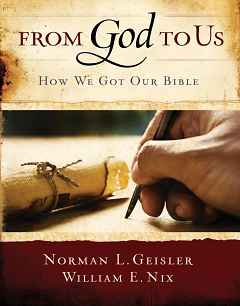 From God To Us
Inspiration
FGU outlines the nature of inspiration. It is important to note that “it is only the product that is inspired, not the persons” (17). Another misconception is that inerrancy/inspiration applies to copies. The sense in which it does must be limited: “Only the autographic [original] texts themselves (or perfect copies of them) are inerrant… Every other copy is inspired only insofar as it is an accurate reproduction of the original” (18).
The authors then turn to a defense of inspiration through the Biblical teaching of inspiration. By outlining the way the text is treated as inspired in both the Old and New Testaments, the authors make a case for the general inerrancy of the autographic texts. Finally, the authors provide an argument for the Bible as the word of God (68ff). The argument is 12 steps and they provide a basic defense of each premise.
Canonization
One of the most frequent objections brought up offhand to those who hold to a high view of the inspiration of the Bible is that of the canon. Some say that the canon was just arbitrarily chosen by a church council somewhere, and that there is no way to determine how books got into the Bible.
FGU provides a more historically accurate look at the canon. The authors first outline a number of factors that are faulty for determining canonicity. For example, age alone cannot determine canonicty because some books of the Bible drew from contemporary sources.
In direct opposition to the notion that a council alone could determine the canon, FGU underscores the notion that: “the role of the Christian church… is not to determine which books are in the canon but to discover which books God determined should be in the canon, namely, those that He had inspired” (91). The authors then explore a number of factors which play into discovering the canon.
Historically, FGU explores the extent and formation of the Old Testament and New Testament canons. The arguments are concise and direct readers to further areas of exploration, while providing enough information to refute most basic arguments.
Transmission
The Bible had to be transmitted: namely, God’s word had to be communicated to human persons. How was this done? Largely in the form of written languages. FGU explores the importance of written language as a means of communication and provides a brief background in the development thereof (164ff).
Of great importance to the reader is the extensive material on the manuscripts of the Bible. The details of the manuscript tradition are outlined and even several forms of extrabiblical manuscript evidence is brought into the picture. Such evidence is an important part of a believers’ background of Bible knowledge. FGU also does a fantastic job outlining the foundations of textual criticism and the valuable role it can play in determining the accurate reading of the text (221ff).
One of the most enlightening parts of FGU outlines the nature of finding “errors” in the transmission of Scripture. Often, one will hear the claim that there are 100s of thousands of errors in the Bible. Bart Ehrman has, in particular, focused upon this in order to cause some unrest in the notion of the accuracy of the Bible (243). But these are actually variants in manuscripts which are sometimes counted numerous times:
If a single word were misspelled in 3,000 different manuscripts, they are counted as 3,000 variants… Ironically, the way Ehrman counts ‘errors’ (variants), there were 1.6 million errors in the first printing of his book. For there were 16 errors, and the book printed an alleged 100,000 copies… Ehrman himself admits the biblical variants do not affect the central message of the Bible. (243)
The authors then turn to an analysis of variant readings and how they occur, from misspellings and unintentional changes to corrections to try to bring texts into concord (246ff).
Translation
FGU provides an intense look at a number of ways the Bible has been translated and the way that translations happen. The traditions of translation are outlined and traced through history (280ff) and the importance of individual translations are analyzed.
Another extremely valuable part of the book is the analysis of how translations come about as far as the emphasis placed upon form-driven versions, meaning-driven versions, and paraphrases. Readers interested in modern Bible translations will find a wealth of resources for analyzing the varied translations. There are nearly 70 pages of information on these translations, so readers will have a number of points to discuss with those asking questions about translations.
Analysis
FGU is a huge resource for those interested in not just defending but learning about the Bible and how it has arrived in its current state in our pews. The book covers a number of issues and it will have appeal to both lay readers and interested professionals. Christian apologists will find a treasure trove of information about the background of the Bible which is often glossed or ignored in a number of apologetics resources.
The authors come from a decidedly conservative background, but this does not prevent them from a generally fair analysis of a number of topics. For example, though they seem critical of the so-called “gender accurate” language of TNIV, the analysis of the translation is objective and simply outlines how the translation comes to its current form (350-353).
Conclusion
Norman Geisler and William Nix have provided a solid resource with From God to Us. It will appeal to those who want to get a lengthy introduction to a number of relevant apologetical issues related to the Bible. Furthermore, it provides a significant amount of background on various translations of the Bible. What is most surprising about the book is how it manages to provide so much information without becoming too dense or thin. It covers so many issues that the danger would seem to be either to err on the side of being too long or too brief on each issue. The authors admirably do not stray to either side, and in doing so, have provided an invaluable resource for both the interested lay reader and professional.
SDG.
——
The preceding post is the property of J.W. Wartick (apart from citations, which are the property of their respective owners, and works of art as credited) and should not be reproduced in part or in whole without the expressed consent of the author. All content on this site is the property of J.W. Wartick and is made available for individual and personal usage. If you cite from these documents, whether for personal or professional purposes, please give appropriate citation with both the name of the author (J.W. Wartick) and a link to the original URL. If you’d like to repost a post, you may do so, provided you show less than half of the original post on your own site and link to the original post for the rest. You must also appropriately cite the post as noted above. This blog is protected by Creative Commons licensing. By viewing any part of this site, you are agreeing to this usage policy.
Stephen Law, his evil god, and radical skepticism
 My contention is that Stephen Law’s epistemological approach to his “evil god challenge” to Christianity entails radical skepticism. Because his challenge entails radical skepticism, Law has forced his cohorts to choose between the seeming irrationality of that position or a denial of the power of the “evil God challenge.”
Entailment of Skepticism
Stephen Law’s “evil God challenge” presents the following:
Suppose the universe has a creator. Suppose also that this being is omnipotent and omniscient. But suppose he is not maximally good. Rather, imagine that he is maximally evil. His depravity is without limit. His cruelty knows no bounds. There is no other god or gods – just this supremely wicked being. Call this the evil-god hypothesis. (Law, “The Evil God Challenge,” 4, cited below)
Now, the point of this challenge is:
the challenge of explaining why the good-god hypothesis should be considered significantly
more reasonable than the evil-god hypothesis.
Law argues in his paper that any theodicy used for the “good god” can be equally used for the “evil god.” Therefore, the theist has yet to show why one should favor the good god over the evil god, and so cannot rationally hold to belief in the good god over the evil god.
Law’s primary support for this supposition is his symmetry thesis:
I shall call the suggestion that, in terms of reasonableness, there is indeed such a rough symmetry between the good-god and evil-god hypotheses, the symmetry thesis.
Nowhere does Law explain what “rough symmetry” means or how balanced the evidence really is between the good god and evil god. Rather, he just uses the phrase “rough symmetry” and argues as though this is enough to discredit the good god hypothesis.
Now notice that the very heart of Law’s argument is something similar to this:
1) If one has no reason to believe that hypothesis a is “significantly more reasonable” than hypothesis b, one cannot rationally hold a over b
It is exactly at this point that Law’s entire epistemology must collapse into radical skepticism. Why? Simply because I can construct parallel but contradictory accounts for nearly any object of knowledge that is not a necessary truth. Just because Law is able to [unsuccessfully, in my opinion] construct a “parallel” system of explanation to that of the ‘good god’ hypothesis does not mean that his parallel is on the same level or even a challenge to that hypothesis.
To see why constructing parallel explanation of reality does not somehow undermine reality, consider two scenarios I constructed to outline this exact point.
The 5 minutes ago challenge
Scenario 1: Our universe was created 5 minutes ago with all our memories and experiences implanted into us.
Those who are familiar with epistemology and philosophy of mind will recognize this as a very pervasive scenario throughout the literature. But how does one go about solving a problem like this? Consider a defense of what seems to be everyday experience.
a) it does not seem to me as though the universe was created 5 minutes ago. I have vivid memories of ten years ago and can interact with others about some of those memories.
The problem with a), of course, is that it exactly lines up with the notion that the universe was created 5 minutes ago with our memories and experiences implanted inside our heads.
Unless I’m very much mistaken, I think I could construct a similarly parallel account for any possible defense of experience of more than 5 minutes ago.
Therefore, I conclude with Law that because the “5 minutes ago” hypothesis is has “rough symmetry” with the hypothesis that our universe is 16 billion years old and the like, it is unreasonable to embrace either proposition. After all, the 5 minutes ago thesis seems extremely improbable, and it is roughly symmetric to the ‘everyday experience’ hypothesis. Law’s symmetry principle applies and undermines all of our experience.
 The Cartesian Demon Hypothesis
Scenario 2: A Cartesian Demon (again, those familiar with philosophical literature will likely recognize this one) has us all under some kind of magic Matrix-like spell where we live our whole lives in our minds even though in reality our bodies are being tortured. The demon delights in our blissful ignorance of the horrible state of our souls and so he continues to implant memories as our lives continue on.
Again, I can’t think of any defense of everyday experience I can’t parallel. Therefore, we should not believe that our everyday experience is correct, according to Law.
I could continue with examples. The problem of other minds is another that immediately jumps out: how do we know there are actually minds in those walking people we see around us. They could just as easily be [philosophical, not pop-fiction] zombies walking around mechanically acting as though they have minds inside them. Again, parallels=>skepticism about whether other minds exist.
Ultimately, Law’s “symmetry thesis” leads us into radical skepticism and even solipsism. That seems to me enough to reject it.
Challenge to Christianity?
So how exactly does Law’s evil god challenge present any difficulties for Christianity? Honestly, I’m not sure. Unless one is convinced of the solipsistic scenarios outlined above, one should not be convinced of Law’s evil god challenge. His symmetry thesis is the only way he can press this challenge, and that same thesis undermines all knowledge of experience and induction. It doesn’t seem like much of a challenge to me.
Law’s Odd Conclusion and My Conclusion all at once
Law’s conclusion states that:
The problem facing defenders of classical monotheism is this: until they can provide good grounds for supposing the symmetry thesis is false,
they lack good grounds for supposing that the good-god hypothesis is any more reasonable than the evil-god hypothesis – the latter hypothesis being something that surely even they will admit is very unreasonable indeed.
Now, one again must see exactly where this is leading. Suppose, as a theist, I find the evidence for the existence of a god to be very convincing. Suppose further that I find the theodicies Law parodies to be sound. Suppose that I think that Law’s evil god hypothesis meets these theodicies equally. Now, according to Law, I am in the state of “symmetry”; I have no reason to prefer the good god over the evil. Law maintains that this means not just that I can’t rationally hold to either, but rather that because the evil god hypothesis is “very unreasonable indeed” I should also reject the good god.
But of course the theist we are supposing to exist believes that the good good hypothesis is extraordinarily reasonable. And because Law’s thesis works, according to them, following Law, they have no reason to believe the evil god is any less probable than the good god. Thus, according to this theist, the evil god hypothesis is not improbable but rather extraordinarily probable.
What Law has done is pretty simple. He’s argued that the good and evil gods must be on the same level of rationality. Because he (apparently) and others reject the evil god out-of-hand, he argues that they are on equal footing and so one should reject the good god. But again, what if the theist agrees that these hypotheses must be on equal footing and that it’s not that both are improbable but rather that both are extraordinarily probable?
All Law has said in response to such a person is that the evil god is “very unreasonable indeed” but why? Law has just spent over 20 pages arguing that the evil god is actually reasonable. Suddenly, the evil god is worthy of rejecting a priori? How does that work out? Law hasn’t done anything to dissuade the convinced believer. The only way his argument works is if one thinks that the good god hypothesis is barely rational. If one follows his conclusion and thinks god’s existence is very likely, then they must follow it all the way through: the evil god’s existence is very likely too. Law just imports this unreasonableness from his own a priori denial of the existence of God.
So what, at this point, does the believer do? Well, it seems we’re back to my first point. One can either believe the symmetry thesis and thus devolve into radical skepticism, or one can reject it and thus throw Law’s argument out the window where it belongs.
Finally, it’s worth noting that there are other reasons to reject the “evil god challenge.” First, it doesn’t take into account the whole range of theistic argument. For example, the ontological argument is based upon the notion of God as maximally great. Law would have to argue that an evil being could be maximally great. Good luck.
Links
William Lane Craig and Stephen Law debated some time back. I wrote a review summarizing and analyzing the arguments.
Glenn Andrew Peoples presents Law with a formidable challenge on the Unbelievable? Podcast.
Edward Feser weighs in on the evil God challenge.
Glenn Andrew Peoples’ podcast on the evil God challenge is phenomenal.
Max Andrews weighs in, arguing that even though Law’s argument is much like the Cartesian demon, we should take it seriously.
Luke Nix at Faithful Thinker comments on the same argument from a different angle.
Source:
[Cited as directed here:] STEPHEN LAW The evil god challenge. Religious Studies, Available on CJO doi:10.1017/S0034412509990369
SDG.
——
The preceding post is the property of J.W. Wartick (apart from citations, which are the property of their respective owners, and works of art as credited) and should not be reproduced in part or in whole without the expressed consent of the author. All content on this site is the property of J.W. Wartick and is made available for individual and personal usage. If you cite from these documents, whether for personal or professional purposes, please give appropriate citation with both the name of the author (J.W. Wartick) and a link to the original URL. If you’d like to repost a post, you may do so, provided you show less than half of the original post on your own site and link to the original post for the rest. You must also appropriately cite the post as noted above. This blog is protected by Creative Commons licensing. By viewing any part of this site, you are agreeing to this usage policy.

 J.W. Wartick - Reconstructing Faith
