christian apologetics
The Book of Mormon: Introduction and Importance
 Mormonism is growing with great speed. There are few, however, who understand the limits of Mormonism’s truth claims. Mormon apologists have frequently made assertions which are either false or ungrounded. I have therefore decided to write a series of posts on the Book of Mormon, followed by a critique of Mormonism’s philosophical stances. This post will introduce the book of Mormon.
A man was born on December 23, 1805 in Vermont. He was known for digging for imagined buried treasure with his father and others.[1] He was also known for being a mystic,[2] for his conviction for disorderly conduct in a scam in which he tried to convince locals he had found treasure underground,[3] and for being the translator of golden plates: The Book of Mormon.[4] The man was Joseph Smith, Jr., the founder of the Mormon faith, “The Prophet.”[5] The Book of Mormon, according to the Church of Jesus Christ of Latter Day Saints (the official name of the Mormon Church), is “another witness that Jesus Christ… was and is God’s Son… It supports and verifies the Bible.”[6] If this is true, then the Book of Mormon is as much the Word of God as the Bible. However, the Book of Mormon’s validity as the Word of God is strongly undercut by scientific and historical evidence which contradicts its claims.
The Mormon Articles of Faith describe the Book of Mormon as “a volume of sacred scripture which, like the Bible, embodies the word of God.”[7] The Book of Mormon is supposed to record other prophecies about Jesus.[8] Perhaps the most striking enunciation of the contents of the Book of Mormon is found later in the Articles:
The Book of Mormon is a divinely inspired record, made by the prophets of the ancient peoples who inhabited the American continent for centuries before and after the time of Christ, which record has been translated in the present generation through the gift of God and by His special appointment. The authorized and inspired translator of these sacred scriptures… is Joseph Smith.[9]
Furthermore, the arguments for the authenticity of the Book of Mormon often parallel those arguments used to justify the Bible: it is said to be “internally consistent,”[10] prophetically fulfilled,[11] and supported by archaeology.[12] Yet there are also arguments unique to the Book: it was certified as genuine by three men who signed a statement confirming they witnessed the translation of the Book,[13] eight other witnesses claimed to have seen the gold plates from which the Book was purportedly translated,[14] and the ethnic background of Native Americans is said to be Israelite, which would demonstrate the Book’s truth.[15] It is clear that the Book of Mormon is the absolute bedrock of Mormon faith. If the evidences for the Book do not hold the evidential weight required to confirm its truth, then Mormon faith is undone.
The Book of Mormon’s veracity hinges on the claim that the lost tribes of Israel came to America, settled there, and wrote their history on gold plates which Joseph Smith later translated. Such claims at the time of Joseph Smith seemed irrefutable; they simply couldn’t conceive of technology which could test such ideas. Today, however, such technology is available. Unfortunately for Joseph Smith and the Mormon Church, the evidence runs contrary to what the Book of Mormon claims.
Over the coming weeks, I’ll investigate each of these claims in turn, while finding them wanting. The next post will demonstrate that the Book of Mormon cannot be true based upon a genetic analysis of Native Americans. Future posts will argue that the Book of Mormon does not reflect ancient near eastern writing and that the Mormon concept of God is philosophically untenable.
[1] Walter Martin. The Kingdom of the Cults (Bloomington, MN: Bethany, 2003), 197; Jerald and Sandra Tanner, Mormonism: Shadow or Reality? (Salt Lake City, UT: Modern Microfilm Company, 1972), 32.
[2] Martin, Kingdom, 197
[3] Wayne L. Cowdrey, Howard A. Davis, and Arthur Vanick, Who Really Wrote the Book of Mormon: The Spalding Enigma (St. Louis: Concordia, 2005), 395f.
[4] Martin, Kingdom, 201.
[5] Ibid., 197f.
[6] The Mormon Church, “Frequently Asked Questions,” The Church of Jesus Christ of Latter Day Saints, http://www.mormon.org/faq/#Book+of+Mormon|question=/faq/what-is-book-of-mormon/ (accessed October 14, 2010).
[7] James Talmage. A Study of the Articles of Faith (Salt Lake City, UT: The Church of Jesus Christ of Latter-day Saints, 1976), 251.
[8] Talmage, Articles of Faith, 252.
[9] Talmage, Articles of Faith, 255.
[10] Ibid, 278-279.
[11] Ibid, 274-275.
[12] Ibid, 283-293.
[13] Ibid, 270.
[14] Ibid, 271.
[15] Ibid, 283.
Image Credit: http://commons.wikimedia.org/wiki/File:Slc_mormon_tempel.jpg
SDG.
——
The preceding post is the property of J.W. Wartick (apart from citations, which are the property of their respective owners) and should not be reproduced in part or in whole without the expressed consent of the author. All content on this site is the property of J.W. Wartick and is made available for individual and personal usage. If you cite from these documents, whether for personal or professional purposes, please give appropriate citation with both the name of the author (J.W. Wartick) and a link to the original URL. This blog is protected by Creative Commons licensing. By viewing any part of this site, you are agreeing to this usage policy.
Book Review: “Who Made God?” by Edgar Andrews
 Who Made God?
Interestingly, Andrews gets the title of the book out of the way quickly. Andrews argues against the common atheistic retort, “Well if God made everything, who made God?” He writes, “Because cause and effect is only proven for the physical world, we can no longer insist that cause and effect are relevant when it comes to the origin of a spiritual entity like God.” I am not sure about the strength of this response. It seems to potentially put God outside the rules of logic, something of which most theists are very wary. A more convincing response, in my opinion, is to simply point out that the concept of God includes necessity. Theistic arguments are designed to show just this–that God is the uncaused ground of being.
Who Made God, however, quickly jumps into stride and doesn’t look back. Andrews lucidly argues that while science can describe events and put them to the test, it cannot explain things in the sense of a comprehensive explanation. Science, for example, “doesn’t tell us why there is [a force of gravity]” (30).
Without slowing down Andrews jumps into a clear explanation of String Theory and its attempts to be a “theory of everything.” Even were science to unify into a theory of everything, however, Andrews point would still stand. The theory would offer descriptions of how things happen, but it wouldn’t explain why the theory itself worked. He also offers a few critiques of string theory, such as the counter-intuitive nature of the theory (48).
Andrews continues on, offering God as a “hypothesis.” He argues that “the methodology of science” can be applied to God (58-59). He argues that Victor Stenger’s God: the failed hypothesis fails on a number of levels. Stenger claims that God “should be detectable: (1) by scientific ‘models’; (2) by scientific measurements… (3) by scientific ‘methods'” (67). Against this, Andrews points out that Stenger is trying to exclude God from existence by “having it both ways.” Stenger argues that God should be detectable, but cannot be because the measurements of science are restricted to the physical. Obviously, this begs the question against theism.
Andrews also addresses nothing, by which I mean the redefinition of “nothing” into “something” often done by atheists (see the debate between Lawrence Krauss and William Lane Craig). He points out that they often use “nothing” to reference vacuum and/or empty space or dark matter. But this is either deliberately misleading or just incomprehensible (97ff). As the atheists who say this often admit themselves, this “empty” space is hardly “nothing.” It is full of energy. But beyond space, beyond the existence of our universe, outside of space and time–that is what is meant by “nothing” (105).
The God hypothesis is vindicated when it comes to the evidence from astronomy and physics. The low entropy state of our universe (117-118), along with its origin (98ff) both point to a creator. Andrews moves on to argue that the origin of the laws of nature must also point to the God hypothesis (138-153). He then goes on to argue that our biological origins, the information found in cells, and the diversity of life have their best explanation with God. To cover these arguments fully would double the size of this review, but I found these arguments just as exciting as the rest of Who Made God. A sampling: proteins and DNA must have information in order to function correctly (181ff); origin of life theories can only be explained with the God hypothesis (196ff); evolution is nonfalsifiable (214-216); natural selection is a tautology (219-220); junk DNA isn’t junk (234ff); mutations really only help within dynamic populations and cannot lead to new species (230ff [through 240]). Andrews isn’t finished there, however, he tackles arguments for and against mind/body dualism (250ff).
Another strength of Who Made God is the format. There is a summary of each chapter prior to its contents, along with definitions of important terms. Humor is found throughout the work as the author tells funny stories or makes witty comments about the arguments. These aspects increase the readability of the book to a great degree.
This is not to say the book is without faults. Andrews’ treatment of the Ontological Argument was a bit abrupt. I’ve written on the argument before (see my posts here and here). Andrews’ critiques don’t apply to the most current versions of the argument. The most commonly used ontological argument is the modal version developed by Alvin Plantinga and others. This version of the argument doesn’t appeal to human ideas, but to modal necessity and possibility. To his credit, Andrews does point out that some philosophers find the argument compelling.
Another issue with Who Made God is the sometimes unconventional use of philosophical terms. For example, Andrews defines “phenomenology” as “The way phenomena… manifest themselves” (27). Phenomenology, however, is most commonly used (in philosophy) as the study of consciousness. Outside of philosophy, it generally refers to conscious experience or sense experience, not so much about the phenomena themselves. While the definition is not wrong, it caused some confuse, and may confuse other readers familiar with the other, more conventional uses. Another uncommon definition was given for “Monism.” Most often, the term refers to the idea that all of reality is one [i.e. it is all material, or all immaterial]. Andrews definition makes sense in context (he defines it as “The idea that mind is nothing more than the brain at work” [257] but that definition in philosophy of mind is more often used for “reductionism” which Andrews defines differently as well).
However, neither of these negatives outweigh the significant positives found throughout Who Made God. You know that I’m nitpicking when my main critique focuses on a couple unconventional definitions, particularly when Andrews uses valid definitions that simplify the terminology for the reader.
Edgar Andrews’ Who Made God is unique among the slew of apologetics books written at a popular level in that it offers a nearly comprehensive argument for Christianity based upon various scientific theories. Despite a few small flaws, I unreservedly recommend this book to all Christians looking to increase their knowledge of biology, physics, and astronomy. Andrews clearly and succinctly explains several scientific theories in terms which are easy to understand, while also showing the relevance for the “God hypothesis.” Readers will come away convinced that when it comes to science, their faith stands on firm ground. Books with scopes this broad most often shine their lights upon lots of topics and illumine none. Readers will find that Who Made God illumines nearly every topic it touches, bringing new insight and clarity into often confusing issues.
Source: Edgar Andrews, Who Made God?
Disclaimer: I was provided with a review copy free of charge by EP books. My thanks to both Edgar Andrews and EP books.
SDG.
——
The preceding post is the property of J.W. Wartick (apart from citations, which are the property of their respective owners) and should not be reproduced in part or in whole without the expressed consent of the author. All content on this site is the property of J.W. Wartick and is made available for individual and personal usage. If you cite from these documents, whether for personal or professional purposes, please give appropriate citation with both the name of the author (J.W. Wartick) and a link to the original URL. This blog is protected by Creative Commons licensing. By viewing any part of this site, you are agreeing to this usage policy.
Dawkins and Oppy vs. Theism: Defending the Kalam Cosmological Argument
 “[Arguments for God’s existence from an infinite regress] make the entirely unwarranted assumption that God himself is immune to the regress.” -Richard Dawkins, The God Delusion, 101.
Dawkins vs. the Kalam
Just over a year ago at Richard Dawkins’ site, someone asked Dawkins to respond to the Kalam Cosmological Argument (see an exposition of the argument here). The reader outlined the argument:
- Whatever begins to exist has a cause
- The universe began to exist
- Therefore, the universe has a cause
Dawkins is frequently witty, but often wrong. The argument is for broad theism. The Kalam is intended to show that the universe is caused, it is not an argument for Christianity specifically. I pointed out in another post that just because an argument is for broad theism (or just the brute existence of God), that doesn’t mean the argument is useless evidentially for Christianity. If we know the universe is caused, then we also know whatever caused the universe must be capable of causation (obviously), choice (it must select a moment to bring about the universe), powerful enough to bring the universe into existence out of nothing, etc. This would be powerful evidence and part of a cumulative case towards Christianity.
Then there’s Dawkins’ quote in The God Delusion which I have seen utilized to challenge the Kalam. First, I should note that Dawkins’ quote is in response to Aquinas’ Five Ways/Proofs. Further, it seems to be intentionally pointed towards a Leibnizian version of the Cosmological Argument (for a fuller defense of that argument, see here). But, a simple answer to Dawkins objection, which he seems to think is devastating, would be to point out that the universe and God are different types of entities. The universe is contingent, and God is necessary. That’s not arbitrary, that’s just the kind of things those entities are.
A Philosophical Attack On the Kalam
Not all atheists are as capable of blind, willful ignorance as Dawkins. Graham Oppy’s recent book Arguing About Gods has a thoughtful, challenging section dedicated to William Lane Craig’s exposition of the Kalam.
Oppy challenges Craig on every step of the Kalam, but I’m going to focus upon one. Oppy writes, “[I]t is quite unclear why one should suppose that the allegedly counter-intuitive behavior of the transfinite [numbers]… casts doubt on the idea that the very smallest transfinite cardinals do find application to ‘the real world'”(Arguing About Gods, 140).
This proposal is meant to challenge Craig’s contention that the infinite cannot actually exist. For, if there can be no actual infinites, then the objects we see around us–indeed, the universe itself–must have begun. Yet Oppy’s contention really only reflects mathematical truths. But surely this is a rather untenable claim. Oppy would have to provide evidence that the infinite actually exists and is not just an abstract mathematical concept. Craig’s contention is that the infinite can only be used in things like Cantor’s theory for mathematical equations. Why does Craig make this restriction? He cites David Hilbert, the famous German Mathematician, who points out that:
the infinite is nowhere found in reality. It neither exists in nature nor provides a legitmate basis for rational thought… the role for infinite to play is solely that of an idea… (David Hilbert Quoted in Craig, 87, cited below)
Yet Oppy provides no reason to think that there are actually infinite things found in reality. Rather, he resorts to claiming that Craig misinterpreted Hilbert’s paradoxes and that “If the Cantorian theory of the transfinite numbers is intelligible, then we can suppose that some parts of it find application ‘in the real world…'” (Oppy, 140). But is that true? Aren’t there plenty of things that are intelligible but for which we have no application ‘in the real world’? I abstract a bit when I point this out, but it is perfectly intelligible that there could be flying pigs, yet we don’t find an application of that in “the real world” other than as a false statement. There are nearly limitless examples of intelligible things we can think of, or intelligible theories, which have no application in the real world.
But perhaps Oppy isn’t making a claim quite as strong as saying actual infinites exist. Perhaps he is just referring to the possibility that they do. The problem then, however, is that, as Craig writes in a critique of Oppy’s position, “Oppy’s attempt to defend the possibility of the existence of an actual infinite is vitiated by his conflation of narrowly and broadly logical possibility.” The problem is that Oppy has confused broad logical possibility (that it is possible to construct a consistent set with an actual infinite) with modal (the notion that an infinite actually does exist in a possible world) or actual possibility in the real world. Again, Craig writes, ” Oppy… seems to take a proposition’s freedom from inconsistency in first-order logic to be indicative of that proposition’s being true in some possible world” (Craig b, cited below). So Oppy has not done anything to defeat the Kalam. Even were Craig to grant that Cantorian theory allows for broad logical possibility of actual infinites, it would not show that they are actually possible in our world. And again, even were they possible in the real world, an actual infinite would have to exist in order to discredit the Kalam. Thus, Oppy’s counter to the Kalam is quite weak–it’s based upon a conflation of broadly logical and actual possibility, and even were he to show that infinites are actually possible, the problem would remain that we have observed none.
Yet, and this is very important to note, even if actual infinites did exist, that wouldn’t undermine the idea that everything which began has a cause. It would only allow atheists to claim the universe did not begin. But how would they go about claiming that? They’d have to show that a model of the origins of the universe which allowed for an infinite past was plausible–more plausible than the alternative. Yet the only hope for showing this would be to make a theory as parsimonious as the Big Bang theory, which postulates an absolute beginning to the universe. So, even were there actually infinite things in the universe, which I very much doubt, that would not undermine the Kalam. It would make the argument more difficult to defend, but it would not falsify it. All it would show is that there are objects which are not caused.
Thus, I take it that the Kalam Cosmological Argument does not suffer defeat, either from vocal, misguided atheists like Dawkins, or thoughtful philosophers like Graham Oppy.
Links:
Again, see an outline and defense of the Kalam Cosmological Arugment here.
William Lane Craig discusses another objection: whether a beginningless past is actually infinite: here. He offers a number of critiques of Oppy’s position here. You can also access a review by Craig of Oppy’s book here (you will need to sign up for a free account on http://www.reasonablefaith.org/).
Check out my review of a recent debate between Craig and Lawrence Krauss, in which the Kalam was discussed here. (Includes a link to the actual debate.)
Wintery Knight writes about how to defend the Kalam at his site: http://winteryknight.wordpress.com/2009/04/08/how-to-defend-the-kalam-cosmological-argument-just-like-william-lane-craig/
Sources:
Graham Oppy, Arguing About Gods (New York, NY: Cambridge, 2006).
Richard Dawkins, The God Delusion (New York, NY: Houghton Mifflin, 2008).
William Lane Craig, The Kalam Cosmological Argument (Eugene, OR: Wipf and Stock, 1979).
William Lane Craig b, “Graham Oppy on the Kalam Cosmological Argument” (Leadership U, November 8, 2005), http://www.leaderu.com/offices/billcraig/docs/oppy.html, accessed 9/1/2011. Also found at http://www.reasonablefaith.org/site/News2?page=NewsArticle&id=5162.
Image credit: ESA/Hubble and NASA: http://spacetelescope.org/images/potw1021a/, found at http://commons.wikimedia.org/wiki/File:PGC_39058.jpg.
SDG.
——
The preceding post is the property of J.W. Wartick (apart from citations, which are the property of their respective owners) and should not be reproduced in part or in whole without the expressed consent of the author. All content on this site is the property of J.W. Wartick and is made available for individual and personal usage. If you cite from these documents, whether for personal or professional purposes, please give appropriate citation with both the name of the author (J.W. Wartick) and a link to the original URL. This blog is protected by Creative Commons licensing. By viewing any part of this site, you are agreeing to this usage policy.
Really Recommended Posts 9/4
“An Open Letter to Young Christian Apologists” over at “Thomistic Bent.” It is pretty self-explanatory: the post says many things to us youngsters!
http://humblesmith.wordpress.com/2011/08/30/an-open-letter-to-young-christian-apologists/
Geocreationism–a site about old earth creationism, theistic evolution, and refutations of young earth creationism. This site recently had a major, major makeover and you must check it out.
http://www.geocreationism.com/index.html
“You Skim, You Lose!” at InChristus by Paul D. Adams–this post briefly discusses our society’s tendency to blow through things without really reading them and then draws the discussion to the book of Proverbs.
http://inchristus.wordpress.com/2011/08/31/you-skim-you-lose/
From Jewish Worldview- A Plea to Atheists: Pedophilia is next on the Slippery Slope; Let us turn back before it’s too late–a post which talks about atheism as bereft of ontology for values.
http://www.jewishworldreview.com/0811/atheists_pedophilia.php3
Isn’t it arrogant and immoral for Christians to evangelize? Isn’t it? Find out:
“Diamonds in the Dust” –an upcoming novel about a woman’s life torn apart in South Africa. It looks quite promising. I’ve been promised a review copy and I’m looking forward to reading it!
Was Jesus Real? -Arthur over at Cold and Lonely Truth writes about this common objection to the existence of Jesus with lucidity and, more importantly, sources. Check it out:
Reading Mackie “Miracle of Theism”: Chapter 1
 I’ve been reading through The Miracle of Theism by J.L. Mackie. The book is known as one of the more powerful philosophical explications of atheism. You can read my thoughts on the introduction here (along with links to the rest of the series as they appear).
Chapter one thoughts:
Mackie begins with a brief outline of Hume’s argument, which he first outlines in five points, and refines it further thereafter. The five points from Hume, according to Mackie (p. 14-16) are: 1) “Hume says there are no really well-attested miracles…”; 2) “the human mind has a positive tendency to believe what is strange and marvelous”; 3) “reports of miracles ‘are observed chiefly to abound among ignorant and barborous nations’. Where they are believed by civilized peoples, these ‘will be found to have received them from ignorant and barbarous ancestors’, so that the stories will have acquired the authority of received opinions before the nations in question have developed powers of criticism and traditions of rational inquiry…”; 4) “different religions are in conflict: their claims therefore undermine and destroy one another…”; 5) “Hume says, the very fact that a miracle story is used to introduce a new religion or to support an existing one is an additional reason for skepticism. Many people have an intense desire to believe in some religious object…”
I see very little to commend among these five points. In fact, I find them all rather horribly mistaken. In regards to 1, this is simply begging the question. This “argument” is less a premise than it is an axiomatic denial of miraculous claims. It’s a broad, sweeping claim with no reason to accept it. There is nothing to support the second claim. I actually see it as a bit of “folk psychology of religion,” as it were. Isn’t it funny that the person, like Hume, who makes this point is believing a rather marvelous claim: that they are epistemically in a position to judge everyone else? It’s quite patronizing to make a point like 2, and given that the only evidence Mackie is willing to offer to support the claim is a vague hand wave towards people who believe in flying saucers, I don’t see any positive evidence to accept 2.
Regarding 3, we have a wonderful example of the genetic fallacy. Not only that, but I think we have a decent amount of evidence to show that this claim is simply false. While there are certainly persons who uncritically accept reports of miracles, there is a startling tradition within Christianity specifically which tells us to test such things for truth (cf. the comment to test the truth of spirits by the received Spirit in 1 John 4:1). And, of course, we could grant the third point and still find little reason to undermine the truth of miracles. Just because we have “received opinions” doesn’t mean these opinions are false. Mackie/Hume again just assume falsity, and apply folk psychology. It’s not a very objective method.
Point 4 is interesting because Mackie grants that “[4] has less force now than it had when Hume was writing.” But this is due, according to Mackie, not to the radical overvaluing of religious conflict, but because, according to him, various religions have made efforts to conform and take in aspects of each other—allowing for a broader spectrum and less internal conflict with claims of miracles from other religions. Fair enough, but I think there’s an even better reason to think the argument has little force: it doesn’t follow that because claims conflict, they are all false. Or, as I often like to put it, “Diversity of opinions does not entail the falsehood of them all.” I still struggle to see what the problem is supposed to be about miracle reports. It’s clearly false to say that they would cancel each other out, as Hume so ineloquently assumes. Suppose we apply this to another example: a murder investigation. One expert witness comes forward and says that the DNA evidence is positive. Another expert says it is negative. According to Hume’s standards, they’re both wrong, because they have conflicting opinons! But one of them has to be correct. I see no reason to accept 4 whatsoever because it literally tells us nothing useful.
Against 5, there must be some argument to show that 5 should be true, apart from more folk psychology. What evidence does Hume have to show us what he is saying is correct? I haven’t seen any offered.
Interestingly, Mackie actually grants a number of things which give credibility to the Resurrection. For example, he grants that independent witnesses increase the value of testimony (25). But, perhaps with the argument from the historicity of the resurrection in mind, he quickly modifies this account in an ad hoc way to provide himself a way out: “Not only in remote and barbarous times, but also in recent ones, we are usually justified in suspecting that what looks like distinct reports of a remarkable occurrence arise from different strands of a single tradition between which there has already been communication” (26). But of course Mackie gives no reason to accept this premise, and that is what it is: a premise. Mackie is positing that given a “remarkable occurrence” which is testified by different sources, we are justified in believing that they aren’t really independent, but are strands of a single tradition. Why should we believe him? What justifies us (epistemically) to do this? It is a rather monumental claim made by Mackie here, because he’s literally telling us that we are justified in question-begging any independent testimonies of miraculous reports out of existence.
Finally, Mackie closes the chapter with another remark similar to those he’s grown accustomed to throughout the chapter: “…it is all too easy to explain [a miracle/violation of a natural law] immediately by the automatic communication of beliefs between persons and the familiar psychological processes of wish fulfillment, and ultimately by what Hume himself was later to call ‘the natural history of religion’” (29). Well this sounds quite impressive, but Mackie has given us no reason to think that these explanations serve as the best explanation or presented us with evidence for the supposition that a natural explanation is always preferable to a supernatural one.
I can’t say I’m very impressed with Mackie’s critique of miracles. Hume’s argument fails to take into account anything but folk psychology, and Mackie’s additions really just amount to “Beg the question against the believer, and you’ve explained miracles.”
SDG.
——
The preceding post is the property of J.W. Wartick (apart from citations, which are the property of their respective owners) and should not be reproduced in part or in whole without the expressed consent of the author. All content on this site is the property of J.W. Wartick and is made available for individual and personal usage. If you cite from these documents, whether for personal or professional purposes, please give appropriate citation with both the name of the author (J.W. Wartick) and a link to the original URL. This blog is protected by Creative Commons licensing. By viewing any part of this site, you are agreeing to this usage policy.
What if? The “Job Answer” to the Problem of Evil
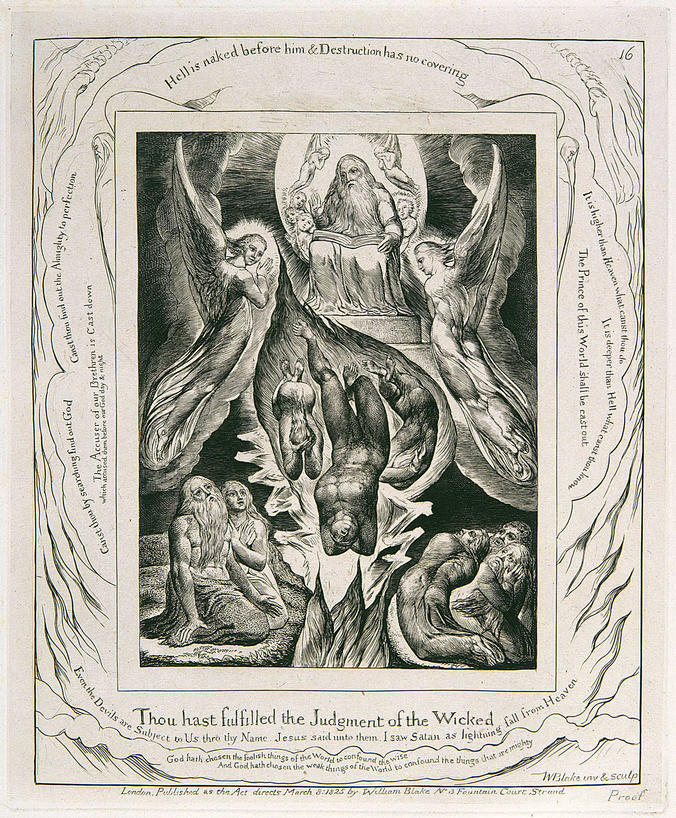 “Who has a claim against me that I must pay?
Everything under heaven belongs to me.” Job 41:11
There are many different kinds of theodicy or defenses to rebut the problem of evil. As I read the Bible I see a few different answers, but one extremely important theodicy in the Scriptures is what I shall deem the “Job Answer,” which is found in the book of Job, although a similar idea is touched upon by Paul in Romans.
Job was known as the most righteous of all the people on earth. Yet God allowed terrible things to happen to him, as part of a test to show Satan that Job was indeed as faithful and righteous as was thought.
But why? Why do bad things happen to good people? Why is it that Job, who God Himself called blameless and upright (1:8) has so many bad things happen to him?
Job’s friends gathered around him and offered various explanations. Job must have done something to deserve it, he must have erred in some way, etc, etc. Yet all of these, Job says, are wrong. He is indeed without blame, and he remains faithful. Yet despite this faith, he cannot help but complain to God. And in this defense of himself and appeal to God, he again points out that he is righteous (see Job 31).
God’s answer to this complaint is where I draw the “Job Answer.” God responds, basically, by saying “Job, you don’t know how I operate, but don’t you think it’s reasonable to conclude that I know what I’m doing?”
Is this a satisfactory answer? Can Job demand another answer? Should he?
That is often the route taken by atheists and even Christians when they investigate the problem of evil. They demand that God provide an answer they themselves find suitable. They act as though God owes them the answer, as if God cannot possibly be good unless the answer is found acceptable in their own eyes. But what does God say to that? In Job chapter 41, He says “Who has a claim against me that I must pay? Everything under heaven belongs to me.”
Is that easy? Is that the answer we Christians like to see? Not really. It would be so much easier if God just said “You know, I gave you guys freedom of will, so given your sinful nature (which you chose, by the way), wouldn’t you expect to see some pretty awful things happening?” That’s the kind of answer I find more appealing. That’s easy.
But that isn’t the answer God gave. He said “Everything belongs to me. Who must I repay?” Does that mean God is not good?
Francis Chan and Preston Sprinkle’s recent book Erasing Hell has had me reflecting on these very questions. Hell is a tough issue, and it has some serious implications for the problem of evil. In a particularly intriguing part of this book, the authors quote Scripture and follow it with a few questions. Specifically, they are reflecting on the idea that God knows who is going to hell before they themselves choose to do so. Check it out:
“What if God, desiring to show his wrath and to make known his power, has endured with much patience vessels of wrath prepared for destruction, in order to make known the riches of his glory for vessels of mercy, which he has prepared beforehand for glory?” (Rom. 9:22-23)
…What if God, as the sovereign Creator of the universe, decided to create ‘vessels of wrath prepared for destruction”? …And what if it’s His way of showing those He saves just how great His glory and mercy is? What would you do if He chose to do this? Refuse to believe in Him? Refuse to be a ‘vessel of mercy’? Does that make any sense? Would you refuse to follow him? Really? Is that wise? (p. 130, cited below)
The passage quoted is from Paul, writing to the Romans. Note how he phrases it: he starts it with what if. He’s not saying this is what God does, or that God does operate in this way, but he’s offering it as a possibility. Chan and Sprinkle continue this line of reasoning: What would we do if this is how God works? Would it make sense to rebel… to become a vessel of wrath just because we know they exist? Does it mean that God is doing wrong if this is how He operates?
Again, we turn back to Job to find the answer. God’s ways our not our own. God answers Job by listing things Job cannot do, and cannot even comprehend. ‘These things,’ God implies, ‘are outside of your comprehension… yet you expect to understand something even more incomprhensible?’ But that is not where God leaves it. He also tells us that ultimately, He will bring justice to all. Those who are now downtrodden will be lifted up, and justice will reign. How can Job respond? By repenting “in dust and ashes” (42:6).
So the “Job Answer” fits in a unique place among various defenses and theodicies for the problem of evil. Instead of using human nature and free will or a greater good to justify evil, the answer given to and by Job is that God, being good, has a reason, even if that reason is inscrutable for us. It is a response of faith.
But this does not mean the “Job Answer” is the only answer given in all of Scripture. Jesus is the ultimate answer to the problem of evil. He came and took our pain and suffering upon Himself, which in turn defeats evil ultimately and for all time. There are other Biblical answers to the problem of evil, but the answer Job gives is simple: Have faith. It does not promote an unphilosophical or unreflective faith, but points out the obvious: If we have good reasons to believe in God, and reasons which point to God as good, then we can simply trust that the apparent problem of evil is solved, ultimately, by God.
Thus, the “Job Answer” implies a second version of theodicy. Namely, that the evidence for the existence of God provides a rebutting defeater for the problem of evil. If we know that God exists and is good, then the problem of evil simply cannot be coherent.
In either case, the “Job Answer” provides a powerful, Biblical, answer to the problem of evil.
Source cited: Francis Chan and Preston Sprinkle Erasing Hell (Colorado Springs, CO: 2011, David C. Cook).
Response to an attack on this post found here (Search for “On Job.”)
SDG.
——
The preceding post is the property of J.W. Wartick (apart from citations, which are the property of their respective owners) and should not be reproduced in part or in whole without the expressed consent of the author. All content on this site is the property of J.W. Wartick and is made available for individual and personal usage. If you cite from these documents, whether for personal or professional purposes, please give appropriate citation with both the name of the author (J.W. Wartick) and a link to the original URL. This blog is protected by Creative Commons licensing. By viewing any part of this site, you are agreeing to this usage policy.
Quick Links: Craig on the Ontological Argument
A common objection to the ontological argument for the existence of God is that existence is not a property. People often misunderstand that modern versions of the argument don’t rely on making existence a property, but upon the idea that necessary existence is greater than contingent existence. William Lane Craig has some clarifying comments on the ontological argument in response to two questions regarding this confusion: here.
Reading “Miracle of Theism” by J.L. Mackie: Introduction
This post will serve as a base for links to the rest of the chapters as I read them:
One reader of my blog recently challenged me to take on the heady atheists. Rather than focusing on the kind of basic fallacies found in various atheistic objections to belief, he suggested I should devote some of my philosophical energy to rebutting the claims of atheists who should actually be taken seriously. I took the advice to heart, acquired copies of J.L. Mackie’s Miracle of Theism and Graham Oppy’s Arguing About Gods. I’ve started reading Mackie’s book. I will be posting thoughts as I continue to read through it, and tie it into an extended critique of his arguments. For today, I’ll discuss only the introduction.
I found a few areas of agreement. Mackie noted that a cumulative case would not point to certainty, but could overcome objections to individual arguments. I agree with him here. I tend to favor a “cumulative case” type of argument, though I think that some theistic arguments could easily stand on their own to prove general aspects of theism (like a first cause).
I find a bit of difficulty with Mackie’s rather dismissive attitude towards faith (p. 4-6). As tends to be the case when faith is discussed by non-theists, he just brought up arguments which he believes shows that reason must be the basis for belief, and then moved on. But I’m not totally convinced that faith can be tossed aside as it is so often. First, I think of Plantinga’s proper function account and I think that while it is ultimately based on reason, it allows for one to be justified in belief through faith. Second, I’m not persuaded that faith cannot work as a kind of reason or discovery of reality. Faith, as it were, seems to account for many of our beliefs (other minds, for example?). So I think while I tend to be an evidentialist when it comes to these things, I am skeptical of a simple dismissal of faith. If anyone could help me with these points, I’d appreciate it.
Mackie discussed the possibility of naturalistic explanations of religion. I’m continually perplexed by the pervasiveness of this idea.Why should the origin of a belief undermine its truth? This would only work if the origin would serve to discredit the belief itself (as in Plantinga’s Evolutionary Argument Against Naturalism).
And I’ve been similarly unconvinced when it comes to others who argue that an account of how religious came to be would undermine the belief. I know Plantinga gives the idea more credit than I: in Warranted Christian Belief, I think, I recall him arguing extensively against naturalistic accounts. But I don’t see them as much of a threat, and I admit I groaned a bit when Mackie started going in that direction. It always seems like the kind of “hidden weapon” atheists have: “We have an evolutionary account of religion!” Of course whether that is true or not, I don’t see it as very persuasive.
SDG.
——
The preceding post is the property of J.W. Wartick (apart from citations, which are the property of their respective owners) and should not be reproduced in part or in whole without the expressed consent of the author. All content on this site is the property of J.W. Wartick and is made available for individual and personal usage. If you cite from these documents, whether for personal or professional purposes, please give appropriate citation with both the name of the author (J.W. Wartick) and a link to the original URL. This blog is protected by Creative Commons licensing. By viewing any part of this site, you are agreeing to this usage policy.
Refutation of Zeitgeist the Movie/farce.
One popular atheistic movie is “Zeitgeist,” a movie which purports (basically) to show that Christianity is made up , among other things.
As Peter Van Inwagen once said, it’s better to be right than original (irony? he wrote this in An Essay on Free Will), so I suggest anyone interested in refuting this farce of a “documentary” should go listen to Glenn Peoples’ podcast on the topic, found: HERE. Also, check out this great article which breaks Zeitgeist down point-by-point: HERE.
Those interested enough to check it out, I recommend watching the documentary, then listening to the podcast. Peoples really does an excellent job taking it down.
Christians don’t need apologetics? Think again.
 “We don’t need apologetics. We just need the Holy Spirit.”
“We don’t need to ‘apologize’ for anything!”
“I just believe, and that’s all.”
“There doesn’t have to be a reason to believe in Jesus, you just have to feel it.”
Perhaps you’ve heard some variation of these mantras from leaders or members in your church. I have something to say:
They are wrong.
Consider Jesse Kilgore, a young man who read Richard Dawkins’ The God Delusion, lost his faith, and killed himself.
Yeah, this is an extreme example. But think about it for a second: if you’re a member of a church community, have you heard of youths losing their faith? Have you heard or experienced the day a child comes home and says “I’m an atheist?”
“Okay,” you say, “but what does any of this have to do with apologetics?”
Well, perhaps its best to define the term first. Apologetics can most basically be defined as the defense of the faith. Apologists are people who study philosophy, theology, and other fields in order to become equipped to argue for the central teachings of Christianity. Such argumentation can involve both scientific and philosophical evidence.
Why do we need it? Think once more of the youths who leave the church: how often do they have a rationalization for this lack of faith? It is, in my experience, every time. “There isn’t enough evidence to believe in God,” they may say, or “There is so much evil in the world, I can’t believe there is a good God watching it all.” Such objections are indeed challenges to the faith. But without apologetics we would be left treading water. To the first objection, the response could only be “There may not be, but why not just believe?”; to the second, we could only say “God has his reasons.”
What about to someone like Jesse Kilgore? Could apologetics have helped him? I’m not trying to make light of his suicide–but I think that yes, apologetics would have helped. Had he been exposed to arguments for the existence of God, he would have known Dawkins merely caricatures them and ignores their premises. Had he read books on perspectives on the Creation account (theistic evolutionism, intelligent design, or creationism), he would have been unphased by Dawkins’ arguments for evolution. The bottom line is there are rational arguments out there which easily rebut Dawkins’ claims. It is a failure in the church that Jesse hadn’t been exposed to them.
Christians, I challenge you to learn apologetics. Learn a “case for Christianity” which you can utilize whenever you are witnessing to someone who thinks there are no reasons to believe. My own example of such a case is here. Learn about some more of the basic arguments. Read Lee Strobel, read William Lane Craig. But don’t reject apologetics. Our youths need more. Those without faith deserve more. Apologetics is part of the core of our Christian heritage, let’s make it part of our lives.
Let us not forget the commands to go and make disciples of all nations (Matthew 28:19) and to always have a defense/reason (apologia) (1 Peter 3:15).
SDG.

 J.W. Wartick - Reconstructing Faith

