Christian theology
Against Christian Materialism
 Is it possible for Christians to be materialists? A number of Christians say that yes, it is. Here, I will argue that the conjunction of Christianity and materialism is indefensible.
The Biblical Witness
Having read a bit on this topic, I realize that many who are Christian materialists do not think that the Biblical data is conclusive. However, granting that this is their position, I would maintain that the Biblical evidence is very strong: we are more than a material body. Here, I will examine only a small collection of texts.**
Matthew 10:28- “Do not be afraid of those who kill the body but cannot kill the soul. Rather, be afraid of the One who can destroy both soul and body in hell.” (NIV)
What does this text mean if the soul and the body are not different things which compose the human being?
Ecclesiastes 12:7- “and the dust returns to the ground it came from, and the spirit returns to God who gave it.” (NIV)
When we die, our bodies–made of dust–return to the earth, but our spirit returns to God. What does this mean on materialism? Which part of our material selves go to God?
Revelation 6:9- “When he opened the fifth seal, I saw under the altar the souls of those who had been slain because of the word of God and the testimony they had maintained.” (NIV)
The souls of those killed for their faith cry out for justice from under the altar. The objection may be made that this is apocalyptic language. In answer, I would simply point out that even then it makes no sense on materialism even in that context. What are the souls that are crying out in this vision? What is the referent for the alleged metaphor?
In Matthew 17:1-8, Jesus speaks with Moses and Elijah, who have died. Did God raise them bodily, and did they then die again immediately afterwards and decompose when they are no longer visible?
1 Peter 3:18-19- “For Christ also suffered once for sins, the righteous for the unrighteous, to bring you to God.He was put to death in the body but made alive in the Spirit. After being made alive, he went and made proclamation to the imprisoned spirits…”
What was Jesus proclaiming the Gospel to? What is imprisoned? Where are the physical/material bodies in this passage? (Note that in context it is talking about those alive in Noah’s day–so again, where did their bodies go?)
Verses like these could be multiplied continually. Perhaps more telling is that the reasoning I’m using here regarding the texts and the distinction between body and soul is similar to the arguments put forth to justify the Trinity. That is, texts which discuss the Father and Son as different entities or even have all three persons of the Trinity in the same context are used to demonstrate that there really are three distinct persons in the Godhead. Yet this is exactly the type of argument I am here making for body and soul. They are used too many places together to be the same thing.
It seems to me utterly clear from the Biblical text that human beings are not purely material entities. Again and again texts can be shown to refer to the body on the one hand and the soul on the other. This is not to say that humans are necessarily one or the other; instead, it is to point out that humans are (at least) body and soul. (I say “at least” because there is a long tradition of trichotomy in Christianity wherein people hold that humans are body, soul, and spirit. I remain neutral in that debate and here only wish to show that humans are not merely material entities.)
The Philosophical Debate
Suppose that one maintains that the Biblical evidence is inconclusive. What then? Could we then say that Christianity and materialism are compatible, for materialism is not explicitly ruled out by the text? Here, I will offer two arguments against these conjoined propositions.
Identity Through Time
How do we maintain identity through time? Here, the problem must be answered by all materialists, not just Christian materialists.
The problem is, of course, that our bodies don’t maintain physical identity. We are continually replacing the physical parts of our body over time. Now, I am hesitant to make the oft-repeated claim that our entire bodies are replaced every so many years, as I have been unable to find any research confirming it. However, it simply is the case that large portions of our body are replaced. Given this fact, how do we maintain identity? What is it that keeps us the same person over time?
Another major problem is this: to which part of our body are we identical? Or, to put it another way, which parts of our body do we need to keep in order to be the same person? Here we can appeal to a thought experiment. A mad scientist has us captured and he wants to see how long we can maintain identity. Slowly, he replaces each part of our body with a new one with the exact same DNA, structure, etc. As he replaces these parts, he discards the old ones and destroys them. He starts with the legs. Then he moves to the midsection, replacing one organ at a time. Then the heart, the arms, the ears, the eyes. When he gets to the brain, he goes through and replaces only single neurons at a time.
The question is pretty obvious: When do we stop being the same person? The materialist simply has to admit that we are our bodies (for what else could we be?). But given that fact, to which part are we identical? The brain? If so, at one point in the experiment do we cease to exist? 51% of our brain is gone? 70%? All but one neuron? So is our identity grounded in that one neuron? If so, which one? Or is it just grounded in having any one neuron as the same? If so, how?
Frankly, I think this problem is devastating for materialists, but especially those who are Christians. Why would it be more acute for Christians? Well…
 Is There Hope in the Resurrection?
Central to the Christian hope is the hope for a future resurrection. The question which must be asked is this: Is this hope grounded in reality?
Suppose materialism were true. If that is the case, then humans are identical with their bodies in some fashion. I am intentionally vague here because I admit I’m not convinced as to how identity works within a Christian view of materialism (see above). If this were the case, then when we die and our material body decomposes, it may go on to become all sorts of different things, which themselves later pass away (plants may grow from the nutrients broken down from the body; then those plants may be harvested and eaten by other humans/animals/etc, which then die and are broken down, etc.). In the resurrection, then, God creates our body anew, complete–I assume–with our memories, experiences, etc. built in (perhaps they are simply functions of our brain, which God recreated perfectly, which thus contains our experiences).
Is there actual hope on this scenario?
Suppose the mad scientist were to come and kidnap you. He gleefully announces that he is going to use you for excruciatingly painful experiments which will take place over several years until you die. But, do not worry, because once you die, he is going to create a new body which is an exactly perfect copy of you, which will of course have all your experiences (minus this torturous one) and memories in place, and then he is going to give you billions of dollars.* Would you be comforted by this scenario? After all, you’re not going to remember the pain and you are going to come out the other end extremely rich!
Well there is a problem: the new body is not you. It is just a copy. For any materialist, this is problematic. We seem to know that identity transcends the body. But let us not delve into that difficulty right now. Instead, we will focus on Christian materialism. Now, it seems to me that this problem is almost the same for the Christian materialist with the Resurrection. After all, we are going to die. But we are told, don’t worry, we will be raised bodily by God! But whose body is going to be raised? How will God gather the material from our body (and at which time of our body–see above) in order to recreate us? And will not this body purely be a copy, rather than actually us?
There is a real disconnect here. Christian materialism cannot offer us the hope of the resurrection, without which our faith is worthless (1 Corinthians 15). Instead, it offers us the hope for our future copies, which will themselves have our memories and experiences, but will not be us. Our bodies will die and distribute throughout various portions of the world (even the universe–who knows if an asteroid might hit and distribute the molecules which made up our body elsewhere?). Then God will create us again in some fashion, and that body will live on in the Kingdom. But that body is not us. It will be a new body. This isn’t begging the question, it is merely stating a fact. The body that will be raised is not the body I have now. Thus, if I am my body, I am not raised.
Interestingly, Peter van Inwagen, a Christian philosopher who is himself a materialist, concedes the point I made in this section. In order to escape this extreme problem for Christian theology, he comes up with a rather unique solution: “Perhaps at the moment of each man’s death, God removes each man’s corpse and replaces it with a simulacrum which is what is burned or rots. Or perhaps God is not quite so wholesale as this: perhaps he removes for ‘safekeeping’ only the ‘core person’–the brain and the central nervous system–or even some special part of it… I take it that this story shows that the resurrection is a feat an almighty being could accomplish. I think it is the only way such a being could accomplish it…” (Van Inwagen, 121, cited below).
What response can we have to this? Well surely, it is possible for God to do this, but it raises all kinds of speculation. First, what Biblical evidence do we have to support that our bodies or our brains/nervous systems are transported by God somewhere in order to preserve them? Honestly, I think that someone who posits this kind of miraculous working holds a burden of proof to support it. Second, where is this storage yard of brains/nervous systems? This question is not intended to beg the question. Instead, my intent is to point out that they would have to be somewhere in the physical universe. Thus, we should be able to find a planet where all the brains/central nervous systems of everyone who ever died are being stored. Third, given this, could we potentially destroy this planet and thus destroy all possibility of the resurrection? Fourth, other than as a completely ad hoc measure to preserve the possibility of hope, what possible justification (philosophical, theological, and/or Biblical) do we have for this?
On the whole, it seems to me that Peter van Inwagen’s proposed solution fails. It fails because it is extremely ad hoc and because it may not even solve the problem it is intended to solve. Thus, it seems to me that Christian materialism fails as a worldview.
Conclusion
I have offered several arguments against the conjunction of Christianity and materialism. I think any one of these arguments is successful on its own (I should note that I also think the argument from the ego is successful–I have argued here against atheistic materialism, but this argument would be equally successful against Christian materialism). If any one is successful, the conjunction of Christianity and materialism must be false. Frankly, I think all the arguments are successful. I leave the Christian materialist to justify their position.
Links
Like this page on Facebook: J.W. Wartick – “Always Have a Reason.”
If Materialism, are there Subjects?– I contend that a materialist worldview cannot account for subjects. This post was written specifically to address atheistic materialism, but is perfectly relevant for theistic materialism as well.
Sources
*I am indebted to Alvin Plantinga and Stephen Parrish for this type of argument.
**I am indebted to Kevin A. Lewis for his list of texts provided in his “Essentials of Christian Doctrine II” syllabus.
Peter van Inwagen “The Possibility of Resurrection,” International Journal for Philosophy of Religion, 9:2 (1978), 114ff.
SDG.
——
The preceding post is the property of J.W. Wartick (apart from citations, which are the property of their respective owners, and works of art as credited) and should not be reproduced in part or in whole without the expressed consent of the author. All content on this site is the property of J.W. Wartick and is made available for individual and personal usage. If you cite from these documents, whether for personal or professional purposes, please give appropriate citation with both the name of the author (J.W. Wartick) and a link to the original URL. If you’d like to repost a post, you may do so, provided you show less than half of the original post on your own site and link to the original post for the rest. You must also appropriately cite the post as noted above. This blog is protected by Creative Commons licensing. By viewing any part of this site, you are agreeing to this usage policy.
Book Review: “The Biblical Flood” by Davis Young
 Davis Young seeks in his work, The Biblical Flood
Overview
Young, a Christian geologist, provides a detailed overview of the Church’s theological and scientific musings on the Flood. He develops this overview chronologically, beginning with early Jewish thought. The focus within the entirety of his book is directly centered upon how extrabiblical evidence was used to shape theology and vice versa. The relation should not be understood as binary. Throughout history, there was a spectrum of approaches to the extrabiblical evidence which included resistance (not infrequently forged by ignorance) as well as integration. Here, I will survey only the broadest outline of Young’s discussion.
Early Flood Views
Early Christians were aware of Pagan stories of floods but made little or no appeal to them as evidence for a universal flood, and in fact some argued that these other stories were clearly differentiated from the Biblical account because they were local as opposed to global. There was much speculation over the location of the Ark as well as the notion that fossils were the result of this universal deluge.
Middle Ages and Renaissance
Medieval thought regarding the Flood was steeped in the “ahistorical view of creation” found at the time. That is, the science of the time thought of creation as deductible from the character and nature of God. However, the discovery of the New World brought up many challenges to a universal deluge theory, which challenges began to get recognition. These included the vast number of species which would have had to fit onto the Ark and the discovery of people across the world. During this period, the discovery of flood stories in various cultures began to be viewed as evidence for a universal deluge (37).
New World
The New World continued to present challenges to the universal deluge theory. One of the foremost among these was animal migration. Entirely new and distinct species were discovered in the New World which did not exist in Europe. How did these animals get to these distant lands? More importantly, how did they get there without leaving any traces of themselves behind if they all only came from one location: the Ark? These challenges continue to vex those who hold to a universal deluge (60ff).
Geology’s Origins
The notion of a universal flood has contributed much to the development of geology as a science. The Christian worldview finally presented a picture of the universe which humans could explore in order to learn truths about reality. The Flood itself presented a theory about how to account for the geological features of the earth (65ff). Various features of the natural world were attributed to the flood, including the discovery of marine fossils on mountains and geological features like valleys. These early geologists were committed to an following the evidence where it led.
Diluvialism and Catastrophism
Various theories were put forward to explain the features of the earth. These included varied catastrophic notions, wherein the geological features were explained by a global, catastrophic flood. Such theories are repeated into today.
Geological Evidence Mounts into the Twentieth Century
Young establishes that the evidence against catastrophic diluvialism became weighty fairly early into the investigations of geologists (109ff). New discoveries related to mammoths and the way they died (over a period of time by a variety of causes rather than all at once) were greatly important, as the issue of these mammoths was found throughout the speculation about the flood. New dating methods were developed which were more accurate. Archaeological finds showed floods in areas of the Mesopotamia, but they were dated at different times. The discovery that humanity was widely spread over the earth and that there was no major extinction event throughout this spread raises a significant challenge for Flood Geologists (233). Other major challenges to Flood Geology include (but are by no means limited to): the dating of igneous formations, the cooling of the earth, metamorphism, and continental drift.
Theological Reflections
Throughout this period of discovery, theologians were not inert. Indeed, many theologians were at the front lines, actually participating in the discoveries themselves. Near Eastern Studies have revealed parallels with the Flood account which some have suggested show derivation. Others, however, argue these other flood stories merely show the perpetuity of such events and how ingrained they became on the human consciousness (236ff).
More recently, Flood Geologists have come into being once more. Their arguments parallel almost exactly those found spread in the early days of geology. Yet these arguments have been refuted by the evidence from the earth itself. Some continue to make false statements about the mammoths’ deaths, the formation of sedimentation, dating methods, and more. Young argues that this is largely due to the specialization of studies found within various fields like theology and geology. Theologians are rarely acquainted with the geological evidence, while geologists are rarely versed in theological language.
Theologians who were versed in geology began to see how interpretations of the text, rather than the text itself, had shaped the Christian response to geological evidence. People like Hugh Miller appealed to extrabiblical data in support of their intepretations of the Flood narrative (147ff).
Miller professed puzzlement that learned, respectable theologians would accept “any amount of unrecorded miracle” rather than admit a partial deluge. Could they not see that the controversy was not between Moses and the naturalists but between the readings of different theologians? (151)
More recently, many and varied theories of the flood as local have been developed and defended. The reaction from Flood Geologists has been vigorous, but theories of a global flood include a multitude of quotes from various scientists which would support competing theories of rock formation, sedimentation, and more. That is, Catastrophic Flood views present mutually exclusive theories for how the geological (and other) evidence came to be.
Appendix: Arkeology
The book is capped off with a discussion of “arkeology”: the search for Noah’s Ark. Young notes the array of locations which have been given as well as the mutually contradictory accounts of those who claim to have seen the Ark or evidence of the Ark. He warns Christians to remain cautious of any such claims.
Challenge
I believe that a good way to summarize the content of the book would be to view it as a challenge Young is issuing to those who allege that catastrophic theories are the only possible way to interpret the text and geological evidence. He himself writes, “If conservative and orthodox theology is to remain vital and relevant to a world in need of the Christian gospel… theologians will have to abandon their flirtation with flood geology and other forms of pseudo-science, reacquaint themselves with genuine scientific knowledge, and incorporate that knowledge into their thinking, secure in the realization that genuine insight into God’s creation… is still a gift of God to be treasured” (215).
Young’s book can be viewed through this lens. He shows how scientific knowledge challenged traditional readings of the text, but also how many theologians and Christian geologists alike interacted with this in order to gain “genuine insight” into God’s word and creation.
Conclusion
The Biblical Flood
I do not claim to have touched upon even all the major points found in Young’s work. The book is full of voluminous amounts of historical details which reveal interesting scientific and theological notions. The theory of a global flood was the one of the first major proposals for how the earth’s geological history was formed. As geological discoveries mounted, this theory was falsified. Moreover, theologians who interacted with the extrabiblical evidence had a wide array of responses, from downright rejection of the evidence or reinterpretation of it to attempt to fit a global flood to concordist views in which the extrabiblical evidence informed interpretation of the text. Which direction should we go? Young has presented a major challenge to those wishing to maintain a notion of the global flood. He presents mountains of evidence to challenge catastrophism, while also showing how, historically, thought on the Noahic Flood has comfortably incorporated the extrabiblical evidence without any necessary compromise of the text or faith. I commend the book to the reader without reservation.
Links
Like this page on Facebook: J.W. Wartick – “Always Have a Reason.” I often ask questions for readers and give links related to interests on this site.
Be sure to check out my posts on the “origins debate” which feature a wide range of posts on issues related to varying Christian views on evolution, creation, and more.
Davis Young, The Biblical Flood
SDG.
——
The preceding post is the property of J.W. Wartick (apart from citations, which are the property of their respective owners, and works of art as credited) and should not be reproduced in part or in whole without the expressed consent of the author. All content on this site is the property of J.W. Wartick and is made available for individual and personal usage. If you cite from these documents, whether for personal or professional purposes, please give appropriate citation with both the name of the author (J.W. Wartick) and a link to the original URL. If you’d like to repost a post, you may do so, provided you show less than half of the original post on your own site and link to the original post for the rest. You must also appropriately cite the post as noted above. This blog is protected by Creative Commons licensing. By viewing any part of this site, you are agreeing to this usage policy.
The Law Always Condemns, The Gospel Always Saves. Or, why I’m a Lutheran.
Comparing Holy Scripture with other writings, we observe that no book is apparently so full of contradictions as the Bible, and that, not only in minor points, but in the principal matter, in the doctrine how we may come to God and be saved… This riddle is solved when we reflect that there are in Scriptures two entirely different doctrines, the doctrine of the Law and the doctrine of the Gospel. C.F.W. Walther, The Proper Distinction Between Law and Gospel
, 6 (cited fully below)
How are Christians to view the relationship between Law and Gospel? The issue has generated countless views and debates. One recent work which illustrates the breadth of views on this topic is Five Views on Law and Gospel
C.F.W. Walther’s work, The Proper Distinction Between Law and Gospel
Law and Gospel
The most central point of all–that is, the point that I hope readers remember if nothing else–is this: The Law always condemns, the Gospel always saves. This point is emphasized throughout Lutheran theology. What does it mean? Simply put: it means that these two doctrines, found throughout Scripture, have entirely distinct meanings and usages. One cannot intermingle law and gospel while remaining true to either doctrine. Wherever the Gospel is presented as if it had requirements attached to it, there the Gospel is not rightly preached. Whenever the Law is preached as if it offered some kind of free gift, it is not rightly preached.
Law only has power to condemn. It cannot save. That is because none can keep God’s Law. All sin, and all fall short of the glory of God (Romans 3:23). The Law shows what God requires of us. It “issues only commands and demands” (Walther, Proper Distinction…, 9).
In contrast, the Gospel only gives offers without requirements attached (ibid). The Gospel shows us God’s promises and offer of grace.
At first face, one examines the whole of the Bible and finds these teachings throughout. The teachings seem so at odds with one another that one might suspect a contradiction throughout the Biblical teaching. However, the fact is that both doctrines are “equally necessary. Without the Law the Gospel is not understood; without the Gospel the Law benefits us nothing” (Ibid, 8). The reason this is so important is because Law and Gospel are not opposites working against each other. Instead, both “have their final aim [human] salvation” (Ibid, 7). They work together to present a full picture of how salvation comes unto men.
The Law, as we have noted, cannot bring salvation because none but God can fulfill it. That is, it gives the requirements for salvation but no one can meet these requirements! We would all be lost if this were the whole of Biblical teaching. Yet there is more to the story, for the Gospel offers only its promises. God has promised to save. He is mighty to save. God has accomplished our salvation. And this salvation does not come with requirements attached. Such is our hope.
Most simply put then, the purpose of the Law is to show our need for the Gospel because we cannot meet the requirements of the Law. The purpose of the Gospel is to show that God has already met these requirements for us in Jesus Christ and to offer us that fulfillment through Christ’s atoning work. So the Gospel, without the Law, would be empty promises. What need have we for Gospel if we are not sinners? Yet without the Gospel, the Law is only a terror which tells us that all are condemned.
 Some Distortions
A number of objections have been raised against this understanding of Law and Gospel. For example: “[The notion t]hat the law must be viewed as a single entity is one of the most common of all objections made against the Christian use of the Law” (Walter Kaiser, Jr., “The Law as God’s Guidance for the Promotion of Holiness,” 188, cited below). Kaiser then argues against viewing the Law as a single entity. He makes distinctions between Civil, Ceremonial, and Moral laws. I agree that we can make these distinctions, but they do not somehow mean it is impossible to refer to the “Law” as a whole entity with all of the commands God has issued.
Another common objection is that of dispensational thought. It is often charged that because we live in a new dispensation, the teachings of the Mosaic Law, for example, no longer apply to us. Without commenting on the plausibility of dispensationalism, I would simply answer that it seems extremely hard to reconcile the notion that the Mosaic Law has no applicability in our own context with Jesus’ words about the Law: “For truly I tell you, until heaven and earth disappear, not the smallest letter, not the least stroke of a pen, will by any means disappear from the Law until everything is accomplished” (Matthew 5:18). Note that this verse also shows Christ using the “Law” as a single, coherent entity.
Yet does this mean that everything recorded in the Mosaic Law has applicability exactly as written? No. A further discussion along this line of thought would take me too far afield, but I think that the Bible does clearly teach there is some discontinuity between the application of Mosaic Law to the Jew and the New Covenant with Christians (for example, the dietary laws do not apply to Christians). This hints back at the divisions Kaiser was keen to make within the Law, and I think the application to the Christian life can be viewed within the categories he discusses.
Conclusion
There is so much more worth saying about Law and Gospel, but in the interest of keeping this post at a readable length, I have had to set some aside. Interested readers should see the annotated sources below.
We have seen that the Law and Gospel must be properly divided in order to properly understand the whole of the Bible’s teaching. Why do I say that this is why I’m a Lutheran? I hope, at least, that other branches of Christianity teach these distinctions between Law and Gospel. But I have to admit that I have not seen it so consistently done as it is within the Lutheran perspective. Martin Luther was right to focus directly upon this teaching, and I believe it is central to the Reformation[s]. It touches upon soteriology, sanctification, the atonement, and more. Thus, I think it is vitally important to get this doctrine correct. In my studies, I have found no teaching so close to the Biblical truth as the Lutheran teaching on Law and Gospel. I’m not saying that everyone should go and become Lutherans. Instead, I think that everyone should benefit from learning the proper distinction between Law and Gospel and apply it to their lives.
The Law always condemns, the Gospel always saves.
Appendix: The Modified Lutheran View?
I think it is important to note that the view put forth as “The Modified Lutheran View” in Five Views on Law and Gospel
Those who have stuck with me this long should be able to immediately see how this is utterly different from the Lutheran view I proposed above. The distinction between law and gospel is not a temporal distinction whatsoever. The Law is still with us. Walther himself makes this explicit: “[W]e find both teachings in the Old as well as in the New Testament” (Proper Distinction… 62). There is no temporal dividing line between Old and New such that some new reality has dawned on Law and Gospel. Instead, the Law continues to condemn, while the Gospel continues to save.
Yet Moo goes so far as to say this is a point which needs to be “corrected” within the Lutheran view (ibid). He seems to think that Lutherans would deny that Jesus was able to speak law, while also mistakenly painting the Sermon on the Mount as being a preaching entirely of the Law. Indeed, Moo’s view seems to affirm many of the basic tenants the Lutheran view explicitly denies, such as mixing the uses of Law and Gospel.
I thus would say that Moo’s position is not at all the Lutheran view. It is not a modified Lutheran view at all. Instead, it seems to violate a number of the primary distortions noted above. That said, Moo does admirably to defend the notion of the Law as a coherent, cohesive whole. There is much to commend Moo’s essay, but it ultimately fails, I think, to provide a properly Lutheran view of Law and Gospel.
Links
Like this page on Facebook: J.W. Wartick – “Always Have a Reason.” I often ask questions for readers and give links related to interests on this site.
Annotated Sources
C.F.W. Walther, The Proper Distinction Between Law and Gospel
For a more succinct summary of what Walther argues in the above, see God’s No and God’s Yes: The Proper Distinction Between Law and Gospel
Five Views on Law and Gospel, ed. Stanley Gundry (Grand Rapids: MI: Zondervan 1999) – I specifically used the following essays: Walter Kaiser, Jr., “The Law as God’s Guidance for the Promotion of Holiness” in Five Views on Law and Gospel, ed. Stanley Gundry, 177-199, (Grand Rapids, MI: Zondervan, 1999); Douglas Moo, “The Law of Christ as the Fulfillment of the Law of Moses” in Five Views on Law and Gospel, ed. Stanley Gundry, 319-376, (Grand Rapids, MI: Zondervan, 1999). I found this book to be very helpful in outlining various views, but was disappointed with the “modified Lutheran view” (see my appendix here).
SDG.
——
The preceding post is the property of J.W. Wartick (apart from citations, which are the property of their respective owners, and works of art as credited) and should not be reproduced in part or in whole without the expressed consent of the author. All content on this site is the property of J.W. Wartick and is made available for individual and personal usage. If you cite from these documents, whether for personal or professional purposes, please give appropriate citation with both the name of the author (J.W. Wartick) and a link to the original URL. If you’d like to repost a post, you may do so, provided you show less than half of the original post on your own site and link to the original post for the rest. You must also appropriately cite the post as noted above. This blog is protected by Creative Commons licensing. By viewing any part of this site, you are agreeing to this usage policy.
Book Review: “Four Views on the Book of Revelation” (Zondervan Counterpoints Series)
 I have been researching eschatology quite a bit of late. Please be aware, therefore, that this review comes from one who has only read a limited amount on the subject. I will not be offering insights from an expert, and am fully ready to admit that I am still learning. That said, I chose Four Views on the Book of Revelation
Overview of Content
Introduction
The work begins with a rather lengthy introduction to the book of Revelation and the various views regarding its content. The bulk of this section is its introductions to each of the views featured in the work. Interestingly, the historicist view is basically dismissed out of hand in the introduction:
This volume incorporates the current, prevailing interpretations of Revelation. Thus, while the historicist approach once was widspread, today, for all practical purposes, it has passed from the scene. (18)
Preterist View
Kenneth Gentry, Jr. begins his exposition of preterism with a bold claim: “I am firmly convinced that even an introductory survey of several key passages, figures, and events in John’s majestic prophecy can demonstrate the plausibility of the preterist position” (37). Before diving into this survey, however, Gentry outlines the importance of understanding that Revelation “is a highly figurative book that we cannot approach with… literalism” (38). He defends this claim with a number of points, including the precedent of earlier prophets who used symbolism and the difficulty of consistent literal readings (38-40).
Gentry’s case for preterism focuses squarely on the introduction to the book. This is not to suggest that is the only part of his argument, but rather than he himself recognizes the introduction as a central tenant of preterism. He notes the continued refrain of Jesus “coming soon” and argues that this suggests a reading of the text as real prophecies occurring within the lifetimes of those present.
Much of the rest of Gentry’s survey is built upon tying the prophecies in Revelation to the historical events of the attack upon Jerusalem. A good representation can be found in tying the “Beast” 666 to Nero and the seven mountains to Rome (67-69).
Idealist View
Sam Hamstra, Jr. argues that the core of the idealist view of Revelation is found in a message: “While at this moment the children of God suffer in a world where evil appears to have the upper hand, God is sovereign and Jesus Christ has won the victory” (96).
The idealist case centers around seeing Revelation as apocalyptic literature, and interpreting it through that lens (97). However, Revelation is not exclusively apocalyptic but is rather “a mixture of literary styles” (99). The idealist interpretation sees the use of “like” throughout the descriptions of Christ and elsewhere as supportive of the non-literal nature of the book (101ff).
Hamstra’s survey of the book of Revelation continues to note what he holds are the symbolic use of symbols and other imagery. Representative is the use of the number seven, which suggests “completeness… the author is speaking of the church at all times and in all places” (102).
For the idealist, then, the book of Revelation can have multiple fulfillment throughout time. It is a book which comforts Christians who see the constant wars, plagues, and the like seen in Revelation by reminding them that God is in charge. Ultimately, Pate’s view can be summarized easily: “the best understanding… is that Jesus’ utterances about the Kingdom of God were partially fulfilled at his first coming… but remain forthcoming until his return” (175).
Progressive Dispensationalist View
C. Marvin Pate’s progressive dispensationalism is grounded in the theme of “already/not yet” (135). This notion hints at eschatological tension which can be found throughout the book of Revelation, according to Pate. That is, there are things which may seem fulfilled “already” but have “not yet” reached their fullest completion. As an example, he notes “with the first coming of Jesus Christ the age to come already dawned, but it is not yet complete; it awaits the Paraousia for its consummation” (136).
The notion of already/not yet allows Pate to interpret some texts in a kind of preterist light, while maintaining that they still have yet to find their fullest realization. An example can be found in the letters to the churches in which Pate notes that these are set against the background of Caesar worship while also pointing forward to future events (139ff).
Pate’s view is decidedly focused on the millennium and a more literal reading of the texts than the previous two views. The interpretation of Christ’s return is illustrative (166ff).
Classical Dispensationalist View
Robert Thomas argues that dispensationalism must be viewed in light of its hermeneutical system, which attempts to remain as literal as possible throughout the itnerpretation of a text (180). Thus, Thomas is an ardent futurist, waiting for the events recorded in Genesis to come about.
A major challenge for this view is the interpretation of texts about Christ coming “soon” and “quickly.” Thomas notes that this theme can be grounded in the notion of imminence in which we are to always be ready for Christ’s return as opposed to a notion of immediacy (189).
A typical classical dispensationalist reading of Revelation can be found in Thomas’ interpretation of the horsemen. He notes that the first “portrays a rider on a white horse, who represents a growing movement of anti-Christian and false Christian forces at work early in the period… the third… rider on a black horse [represents] famine-inducing forces….” (193-194). Thomas also argues that Israel is not the church and so must have the promises fulfilled to Israel as a nation (196ff).
Thomas argues that the major issue is dependent upon which hermeneutical system one employs. If one employs a literal hermeneutic, he contends, one will be dispensational. Period (211-214).
Analysis/Conclusion
I will only briefly comment on each view here.
Preterism
Gentry’s case is quite strong, but I have to wonder about the appeal to the language of “coming soon,” particularly in light of the constant refrain in the Hebrew Scriptures of the day of the Lord being “near.” These prophets clearly did not witness the “day of the Lord” (which, on preterist views is either the 70AD destruction of the Temple or still is yet to come), and so such language has a precedent for longer periods of time than the preterist appeals to.
Overall, however, some of the themes Gentry points to does hint at the possibility for interpreting certain prophecies as fulfilled in the destruction of Jerusalem.
Idealism
The idealist position has some draw for me because it focuses on the applicability of the book to all Christians in every time and place. In particular, the idealist interpretation of the letters to the churches is, I think, spot on. It allows for historicity while also noting the fact that we continue to live in an age in which all those types of churches still exist.
Yet I can’t help but also note that the idealist interpretation at times seems to play too fast and loose with the text, assuming that certain persons or events are types when it seems more clearly to point to a future fulfillment. Of course, the idealist could respond by saying many of these still are in the future after all.
Progressive Dispensationalism
There is great appeal in the notion of the already/not yet aspects of Revelation, which seems to give proper deference to the historical background of the book while also grounding it ultimately in the future promised fulfillment.
It is interesting to see that Pate is willing to interpret some aspects of the text figuratively, yet remains convinced that there will be a literal 1000 year reign, among other things. One could charge him with inconsistency here (as Robert Thomas does).
Classical Dispensationalism
I admit Thomas’ view was the most confusing for me. He insists that one must read the text literally, but then says that the white horse is not a white horse with a rider but rather “anti-Christian and false Christian forces.” Frankly, that is not the literal meaning of the text. It is commendable to desire to stay as true to the text’s meaning as possible, but using the word “literal” in this way seems to be abuse of language.
But Thomas’ view also has more to recommend it, such as his focus upon the future fulfillment. It is hard to read Revelation and not see many of the events as yet to occur, particularly if one desires to read the text as literally as possible.
General remarks
One thing I must note is that I did experience some great disappointment with the book in that it did not follow the standard format of the Zondervan Counterpoints series. Specifically, the book does not have each author interacting with the others after each view. Although the authors clearly had access to the other essays and were given the opportunity to interact via footnotes throughout their own essay, the level of interaction was not on par with other books in the series.
Others have expressed displeasure with the fact that the book does not present the historicist view of Revelation. I share some of that, though I would still maintain that–despite other reviewers [mostly on Amazon] are saying–there are definitely four distinct views presented in this book. They do not cover all the views as comprehensively as some might like, but the views which are included are each unique and worth reading. The quick dismissal of historicism in the introduction may be the consensus of scholarship, but historicism remains a major view among the laity as well as many clergy and some scholars. To have it not included is not the greatest crime, but it does hint at a lack of completeness with the survey here.
Overall, I would recommend this book as a way for those interested in Revelation and eschatology more generally to read. It presents four major views of the interpretation of Revelation by giving each author a rather lengthy section to make their case. Readers will be familiarized with the different views, along with arguments for and against each view. Although the book could be improved by the inclusion of the historicist position and greater interaction between the views, Four Views on the Book of Revelation
Links
Like this page on Facebook: J.W. Wartick – “Always Have a Reason.”
Book Review: “Understanding End Times Prophecy” by Paul Benware– I review a book on eschatology written from the premillenial dispensationalist position.
Source: Four Views on the Book of Revelation
SDG.
——
The preceding post is the property of J.W. Wartick (apart from citations, which are the property of their respective owners, and works of art as credited) and should not be reproduced in part or in whole without the expressed consent of the author. All content on this site is the property of J.W. Wartick and is made available for individual and personal usage. If you cite from these documents, whether for personal or professional purposes, please give appropriate citation with both the name of the author (J.W. Wartick) and a link to the original URL. If you’d like to repost a post, you may do so, provided you show less than half of the original post on your own site and link to the original post for the rest. You must also appropriately cite the post as noted above. This blog is protected by Creative Commons licensing. By viewing any part of this site, you are agreeing to this usage policy.
Analogical Language, Doctrine of God, and the World
In God’s world, everything is, after all, comparable to everything else. Granted, we tend to wince a bit when something we love or admire is compared to what we consider an unworthy object… Everything is related to everything else. There is nothing that ‘has nothing to do with’ anything else… To criticize a metaphor as such is to engage in criticism at the word-level, rather than the sentence-level, which is an illegitimate practice. (John Frame, The Doctrine of the Knowledge of God, cited below, 231-232)

One of the most interesting discussions in theology is the use of language about God and the world. Much ink has been spilled in writing about this topic, because it is of critical importance. If human language is incapable of meaning anything in relation to God, then we can say literally nothing about God. There is also much discussion over the relation of different things in creation to other things. Are there bits of creation which are absolutely unique?
Creation
It does not seem to be the case that any part of the created world is sui generis in the sense that it is absolutely unique from anything else in creation. Consider anything you like which exists. It is easy to draw parallels. A flower and an automobile are both made of matter; a lake and a grove each contain water. The analogies may take a while to think up, but they are there.
God and Analogy
Conversely, we find great difficulty when we try to relate creation back to God. We think of analogies for the Trinity and discover they all fall into one variety of Trinitarian heresy or another. The problem is because although creation gives us evidence for a creator, creation is not the creator. Using analogies to try to compare the deepest mysteries of God to the natural world is theologically dangerous. However, using analogies to discuss God is not always impossible. Indeed, the Bible is filled with analogies regarding God: God is like a rock, a mother hen, a fortress, and the like. Thus, it is possible in principle to compare the created world with the creator. The problems come when we try to turn the relations of the Godhead into relations of the natural order. So it is necessary to remember that though we can speak analogically of God, we should be careful in choosing what we are speaking of. To speak analogically of the Trinity to things such as the states of water invites heretical understandings of the Trinity.
Another difficulty is when we read human relationships back onto the Trinity as well. One error which has unfortunately become quite common is to look at the terms “Father” and “Son” and assume that these names for the divine persons must mean that the relationship between these persons in the Godhead entails eternal subordination. Such thinking is extremely anthropomorphic. It reads human relationships back onto God. Again, creation is not the creator. Human relationships should not be our model for the doctrine of God. One should never govern the doctrine of God by human analogy, and to eternally subordinate one of the persons of the Trinity introduces hierarchy into the Godhead and invites multiple theological mistakes.
Doctrine of God, therefore, should always be the guide. Analogies should flow from God to creation rather than from creation to God. Thus, we should say “God is like x”; not “x is like God.” Semantically, these two sentences are fairly equivalent. My point is that prioritizing God in such language helps us to focus on the necessity of prioritizing God’s reality over our own. When we speak analogously of God, we must remember that we are not saying God is like creation in that an aspect of creation is Godlike or somehow an exact replica of an attribute of God. Instead, when we speak analogously of God, we must speak from God to us.
Talk About God
God is the being which is absolutely unique. There is no one like God (2 Samuel 7:22; 1 Chronicles 17:20; Jeremiah 10:7). But does this mean that we are incapable of talking about God? Indeed, some theologians have favored the notion that we can only speak analogically of God. For example, when we say God is loving, what is meant by that phrase is not that God is loving in the sense that we are loving, but rather that God is something like loving is for us. However, this notion seems to me to be just as mistaken as attempting to describe Trinitarian mysteries in naturalistic forms. For if God cannot be known other than analogically, then we have no true knowledge of God. The claims of those who argue we can only speak analogically of God leads to a state of affairs in which we know nothing of God. After all, when I make the claim that “God loves us” my claim, on this view, is reducible to: “God loves us, but this love is qualified in some unknown [and unknowable!] sense.” For if we were able to know what it means to say “God loves us” that is itself univocal and not analogical. Thus, those who claim that we can only speak analogically of God eliminate the possibility of knowing anything at all about God.
Think on this for a moment with me. Suppose the claim is correct. We can only know God analogically. Thus, God is “like” something loving, but not actually something loving in the sense we mean when we say loving. If we say that God is Just, we cannot mean it in any sense which we know to be true univocally. The difficulty rating only increases when we consider those properties exclusive to God. We claim that God is omnipotent–all powerful. But on the view that we can only speak analogically or metaphorically of God, God is all-powerful, but only “like” having power in the sense that we conceive of when we think of power. God doesn’t actually have the capacity to do anything which is logically possible, for that is merely conceiving of power within the realms of human language; no, God, on this view, has omnipotence*, which is omnipotence + something that we cannot know. Thus, such an assertion undermines all knowledge of God.
Therefore, we must admit that talk about God has some sense of univocity to it. When the Bible teaches that God is just, that concept of justice is univocal in some sense with our own. We can understand some truths about God.
Once we have established this point, it is again extremely important to realize that the flow of such truths is from God to us and not vice-versa. God’s justice is the perfect form of what we understand to be just. God’s love is perfect love, which our human love can only imitate. Yet in that imitation, we have some understanding of what it is like to be loving. Thus, we can know God without knowing everything about God.
To Sum Up
Religious language is one of the areas of philosophical theology which is often just assumed. I think it is to our own discredit that we avoid such discussions. I have shown how misunderstandings of religious language can lead to theological errors which can be fairly easily avoided. The way we can avoid such errors, I have charged, is to remember that language about God should always flow from God to us. God is perfect, and our language about God should never be used to limit that perfection. Thus, we cannot limit God to human relationships or human understandings of deity. On the other hand, we should not be so pessimistic of our possibility of knowing God that we undermine any possibility of speaking truthfully of our Lord.
Links
Like this page on Facebook: J.W. Wartick – “Always Have a Reason”
Source
John Frame, The Doctrine of the Knowledge of God
SDG.
——
The preceding post is the property of J.W. Wartick (apart from citations, which are the property of their respective owners, and works of art as credited) and should not be reproduced in part or in whole without the expressed consent of the author. All content on this site is the property of J.W. Wartick and is made available for individual and personal usage. If you cite from these documents, whether for personal or professional purposes, please give appropriate citation with both the name of the author (J.W. Wartick) and a link to the original URL. If you’d like to repost a post, you may do so, provided you show less than half of the original post on your own site and link to the original post for the rest. You must also appropriately cite the post as noted above. This blog is protected by Creative Commons licensing. By viewing any part of this site, you are agreeing to this usage policy.
Review of “Love Wins” by Rob Bell: Chapters 7 and 8
 I have been reviewing Rob Bell’s book, Love Wins, with a particular interest in his theological views and how he argues for those views. I have not read the book before, so each review is fresh: I am writing these having just completed the chapter the post is on. This week, I wrap up the book by looking at Chapters 7 and 8. Within the next few weeks, I’ll publish a study guide and overview for the entire book.
Chapter 7
Outline
Rob Bell begins with an analysis of the parable of the Prodigal Son/Forgiving Father/Unforgiving Brother (Luke 15:11-32). He contrasts the prodigal with the older brother. The prodigal believes “he’s ‘no longer worthy’ to be called his father’s son” (165). But the father “tells a different story. One about return and reconciliation and redemption” (ibid). In contrast, the older brother sees himself as being cheated–he’s been “slaving for his father for years” (166). But the father turns the story around and points out he hasn’t been a slave–the older brother has “had it all the whole time… All he had to do was receive” (168).
Given this story, Bell concludes a number of things. He argues “Hell is our refusal to trust God’s retelling of our story” (170). This retelling assures us that we are loved, despite the way we choose to tell our own stories.
Then there is the notion that “Millions have been taught that if they don’t believe… and they were hit by a car and died later that same day, God would have no choice but to punish them forever in conscious torment in hell. God would, in essence, become a fundamentally different being to them in that moment of death, a different being to them forever” (173, emphasis his). He asks “Does God become somebody totally different the moment you die?” (174).
Bell continues to focus on this argument, arguing that there is something “wrong” with this notion of deity which is “loving one second and cruel the next… if your God will punish people for all eternity for sins committed in a few short years… [nothing] will be able to disguise that one, true, glaring, untenable, unacceptable, awful reality” (175). Thus, Bell feels he can conclude “Hell is refusing to trust” (ibid).
He continues, noting that the good news is better than merely the question of whether one will “get into heaven” (178-179). Instead, it is about “entering into this shared life of peace and joy as it transforms our hearts, until it’s the most natural way to live that we can imagine” (179).
Our sins are “simply irrelevant when it comes to the counterintuitive, ecstatic announcement of the gospel” (187). Indeed, so are our “goodness… rightness… church attendance… and all of the wise, moral, mature decisions” we make (ibid). Instead, what matters is the “unexpected declaration that God’s love simply is yours” (188). “Forgiveness is unilateral,” God doesn’t wait for us to clean ourselves up, but “has already done it” (189).
“The only thing left to do is trust” (190) Bell argues. “Everybody is at the party. Heaven and hell, here, now, around us, upon us, within us” (ibid).
Analysis
Bell is absolutely correct to note that the Gospel is about more than simply “getting into heaven.” There is a kind of gospel reductionism which changes the message of Christianity into heaven or hell and that’s all. It’s dangerous, and it distorts the proclamation of Christ.
However, there is something very bothersome about Bell’s arguments against the notion of eternal punishment. His entire argument is based around the notion that God is love, and that God won’t just change who he is. He continues to focus on God as love. Yet he does this at the expense of the rest of the Biblical teaching about who God is. God is not reducible to love. We can’t base our doctrine only on the notion that God is love, and therefore our ideas of what love is will define who God is. Instead, the Bible teaches us much more about God than that God is simply love.
But Bell is insistent on this point. He evaluates God through the lens of a human parent and argues that if God were a human parent on some views, we would want to put God in prison. Instead, he argues, we should see God as love… and apparently that’s it. That’s Bell’s God. Love. The Bible, on the other hand, does not teach us only that God is love. Consider:
For you are not a God who is pleased with wickedness;
with you, evil people are not welcome.
The arrogant cannot stand
in your presence.
You hate all who do wrong;
you destroy those who tell lies.
The bloodthirsty and deceitful
you, Lord, detest. (Psalm 5:4-6)
How does this fit into Bell’s analysis? Why does he refuse to address the fact that the Bible very clearly state that God hates wrongdoing? Nor does Bell acknowledge that one of God’s attributes is justice. God is absolutely just and we deserve God’s wrath. Period. Instead of even attempting to address these verses or the arguments around the notion of God’s justice, all Bell has done is argue that God is love and that anything else means God changes his essence. That is simplistic and borderline dishonesty. Bell his misportrayed the doctrine of God and invented his own, wherein only the verses about God being loving are those which dominate all doctrine. Again, he has created a canon within the canon, where the verses about love trump all others.
Another demonstration of this is in Bell’s declaration that our sins are “irrelevant.” Really? Orthodox Christianity has held that our sins are the reason Jesus had to die–as punishment for our sins. That sounds extremely relevant to me. Yet Bell, in his over-eagerness to argue that God is love, has vastly overstated his case.
God does not change (Malachi 3:6), but neither is God only defined by love. And even were God defined by love, that love would not be human love, which is what Bell has chosen to base his argument upon. Again and again he appeals to the relationship between human parents and their children. Yet God is not a human being (Numbers 23:19).
Not only that, but Bell’s assertion that hope continues after death is flatly contradicted in the Bible:
people are destined to die once, and after that to face judgment (Hebrews 9:27)
What room is there in this passage to allow for Bell’s scheme of salvation after death? People die, and after that there is judgment. Period. It doesn’t say “people are destined to die… then to have hope forever and eventually come to heaven.” Where does Bell ground his teaching in the Bible? I simply cannot find it. Instead, he continues only to press the notion that God is love, and by doing so he creates his own Bible outside of the Bible which trumps the passages with which he disagrees.
As Christians, we must take into account the whole of Biblical teaching. We can’t just ignore the passages which don’t agree with our theology, as Bell has done. Bell’s entire argument so far seems to be a house of cards. It is based on a few select verses with an idiosyncratic interpretation. Moreover, he simply declares that God is love, and then uses that to counter anything he thinks is not loving. In other words, Bell’s concept of love defines his theology of God. That is a huge problem.
Chapter 8
Outline
In this very short chapter/conclusion, Bell calls people to trust God. He tells readers that “love wins” (198). “Love is what God is” (197).
Analysis
There’s not much in this chapter which hasn’t been said before. It is worth noting that once again, Bell defines God merely as love. That’s it.
Conclusion
Bell doesn’t speak to God’s justice. He doesn’t speak to God’s covenant relationship with the people of God. He doesn’t even mention God’s hate of sin. Instead, it is all about love. That’s all. That is Bell’s theology. I am forced to ask: “Is that really all the Bible teaches?”
I believe I have shown Bell is mistaken on any number of points. His emphasis on God as love is wonderful. We do need to make sure that is part of our doctrine of God. But Bell’s doctrine of God just is love. Moreover, Bell has defined that doctrine of love through human categories instead of divine categories. He ignores the themes in the Bible about God’s justice. Indeed he ignores explicit statements of God’s justice and hatred for sin and even sinners. Doctrine of God must balance these statements in the Bible, not use one to trump the other. Bell has done the latter.
Within the next two weeks, I will be publishing a study guide for the book, along with a general overall review. As always, let me know what you think.
Links
Like this page on Facebook: J.W. Wartick – “Always Have a Reason”
The book: Rob Bell, Love Wins
Review of “Love Wins” by Rob Bell: Preface and Chapter 1– I discuss the preface and chapter 1 of Love Wins.
Review of “Love Wins” by Rob Bell: Chapter 2– I review chapter 2.
Review of “Love Wins” by Rob Bell: Chapter 3– I look at Chapter 3: Hell.
Review of “Love Wins” by Rob Bell: Chapter 4– I look at Chapter 4: Does God Get what God Wants?
Review of “Love Wins” by Rob Bell: Chapter 5– I analyze chapter 5.
Review of “Love Wins” by Rob Bell: Chapter 6– I review chapter 6.
Love Wins Critique– I found this to be a very informative series critiquing the book. For all the posts in the series, check out this post.
Should we condemn Rob Bell?– a pretty excellent response to Bell’s book and whether we should condemn different doctrines. Also check out his video on “Is Love Wins Biblical?“
Source
Rob Bell, Love Wins
SDG.
——
The preceding post is the property of J.W. Wartick (apart from citations, which are the property of their respective owners, and works of art as credited) and should not be reproduced in part or in whole without the expressed consent of the author. All content on this site is the property of J.W. Wartick and is made available for individual and personal usage. If you cite from these documents, whether for personal or professional purposes, please give appropriate citation with both the name of the author (J.W. Wartick) and a link to the original URL. If you’d like to repost a post, you may do so, provided you show less than half of the original post on your own site and link to the original post for the rest. You must also appropriately cite the post as noted above. This blog is protected by Creative Commons licensing. By viewing any part of this site, you are agreeing to this usage policy.
Mulan Among Us: Disney’s “Mulan” and Womanhood

Disney’s “Mulan
Warning: There are spoilers for Disney’s Mulan in the following discussion
Mulan and Cultural Expectations
Mulan is a warrior. She is powerful, capable, and determined.
Oh, and I forgot: she is a woman.
It is that “shocking” pronouncement which is the focus of the Disney’s Mulan
Mulan is challenged at numerous points throughout the movie. She does not fit into her society’s gender ideals. She is expected to be clean, quiet, submissive, and “womanly.” And she tries to fit into these expectations. The culture wants her to be a good wife, so she tries to match what her culture’s idea is in order to become a good wife. Those who have seen the movie knows she fails miserably. When she visits the matchmaker, she recites, in a stumbling way, the right sayings: “Fulfill your duties, calmly and respectively. Reflect before you… Act!” She lacks grace, poise, and ultimately ends up comically ruining the whole scene, setting the matchmaker on fire and dousing that fire with hot tea, running the matchmaker’s makeup and earning the pronouncement that she will never fit society’s expectations for her.
Yet this reveals another cultural shock: it is the very fact that Mulan is placed into a one-size-fits-all box to take on roles which do not match her abilities that leads to her triumph. It is not that she should be trying harder, or that she is wrong; instead, the fact is that it is her culture’s expectations which are wrong. Mulan destroys those expectations. She saves China, and the Emperor himself honors her. Thus, the expectations are shattered, and Mulan remains “true to herself.” Her abilities destroyed the cultural norms that people had tried to apply to her.
“So what!?” you may be asking. “I already knew this, though I may not have outlined it like this.” After all, telling women to be submissive and arguing that there are very specific roles that they should fit into is a thing of the past.
Is it?
Have you never heard the phrase “she wears the pants in that family”? That speaks to a division of roles that is still at least unconsciously acknowledged in our culture. What about “make me a sandwich” or “get in the kitchen”? What of more subtle distinctions? “I would never vote for a woman president.” “A man is in charge of the family.”
Moreover, some theological traditions continue to argue that there are very explicit roles for man and woman in leadership and the home. It is to that concept that we will turn to, with a focus on Mulan.
Mulan and Theology
The shock of Mulan’s story may seem almost comical to us, but the fact remains that there are women whose talents are not being acknowledged. They do not fit the mold. It is said within some branches of contemporary theology that women are to submit to their husbands. These theologians teach that women have very specific roles: that of “helper,” servant, or anything but “leader” or “teacher.” According to these views, women can teach other women and even male children, but when it comes to man, she is always subordinate. Consider the following passage, from a book endorsing this view (“Recovering Biblical Manhood and Womanhood
[I]t is simply impossible that from time to time a woman not be put in a position of influencing or guiding men. For example, a housewife in her backyard may be asked by a man how to get to the freeway. At that point she is giving a kind of leadership… But we all know that there is a way for that housewife to direct the man that neither of them feels their mature femininity or masculinity compromised. (John Piper, 50, cited below)
Moreover, women, on this view, must be careful about how they give their advice; they must remember that they are to be submissive:
A wife who ‘comes on strong’ with her advice will probably drive a husband into passive silence, or into active anger (Ibid, 52)
I can’t help but think of the scene from Mulan just before she saves the Emperor when she is trying to get people to listen to her about the great danger of the Huns in the Imperial City. They pull away from her forcibly, ignoring what she says. Finally, her trusty sidekick, Mushu, points out that “You’re a woman.”
Such is the way in which manhood and womanhood is supposed to play out within those branches of contemporary theology which lean towards complementarianism–the view that men and women are to occupy different “roles” in the church and the home. Women are to be submissive, even when they try to give directions to a man. Mulan, in this view, perhaps came on “too strong” in her insistence that the Emperor was in danger. If she had only been more submissive, then she would not have provoked “passive silence” or “active anger.”
The absurdity of this notion can be found in the fact that it is the victim who is blamed for the abuse. “Passive silence” can be just as harmful as “active anger.” Is it really acceptable to say that a woman, by offering advice, “provokes” the man? Moreover, is it really honorable to men to turn us into seething machines, who, if the right button is pressed, turn into active aggressors or passively-aggressive “victims”? Again, the movie “Mulan” has presented a more balanced approach: there are women who transcend society’s–and religion’s–expectations.
There are Mulans among us. There are women who challenge this perceived view of manhood and womanhood. There are women who are gifted greatly to be leaders, not followers. There are women with the gift of teaching. There are women whose very existence shatters the notion that woman’s role is to be submissive. Their talents and abilities call us to use them, not to force them to singular submission. The Bible calls us to mutual submission, not a singular silence from one gender. These Mulans are powerful missionaries, leaders, teachers, yes, even pastors: gifted and called by God to take on roles that their cultural milieu often wants to deny to them.
I pray that more of these women would arise and use their gifts for the church. Many women have already done so, but our church’s culture has too often tried to silence women. Instead, we need to acknowledge the Mulans we know.
Check the links below for more discussions of women and the church. For all my posts on the topic, check out my egalitarianism category (scroll down for more posts).
Links
Be sure to check out my looks at other movies. If you like Mulan, what about Brave?
For information on egalitarianism–the view that the Bible teaches us women and men should fill equal roles–check out “Christians for Biblical Equality.”
Women in the Ministry: The philosophy of equality and why complementarianism fails– I argue that the position in which women are excluded from church leadership entails inequality of being.
Book Review: “Good News for Women” by Rebecca Groothuis– I review an excellent book on the issue of gender equality in the Bible.
Religious Dialogue: A case study in science fiction with Bova and Weber– I take a look at how science fiction has dealt with theological topics, with a particular focus on dialogue about religion and women.
I discuss the notion of having my expectations of women shattered here.
Sources
John Piper, “A Vision of Biblical Complementarity: Manhood and Womanhood defined According to the Bible” in Recovering Biblical Manhood and Womanhood
Mulan
Image Credit
The image used in this post is credited to the Mulan Facebook page.
SDG.
——
The preceding post is the property of J.W. Wartick (apart from citations, which are the property of their respective owners, and works of art as credited) and should not be reproduced in part or in whole without the expressed consent of the author. All content on this site is the property of J.W. Wartick and is made available for individual and personal usage. If you cite from these documents, whether for personal or professional purposes, please give appropriate citation with both the name of the author (J.W. Wartick) and a link to the original URL. If you’d like to repost a post, you may do so, provided you show less than half of the original post on your own site and link to the original post for the rest. You must also appropriately cite the post as noted above. This blog is protected by Creative Commons licensing. By viewing any part of this site, you are agreeing to this usage policy.
Really Recommended Posts 3/8/13
 It really is difficult to keep up with all the excellent posts around the internet. But, I have taken the liberty of doing some of that work for you and found a diverse array of posts on fascinating topics. Read them, love them, comment! This week, we’ll be looking at the prosperity gospel, Calvinism, women in the Bible, Young Earth Creationism, the History Channel’s TV show on “The Bible”, and design flaws in creation.
The Prosperity Gospel Revisted– I found this post about the “Prosperity Gospel” quite fascinating. Dan offers critical interaction with the notion that the Gospel is about empowering us to gain. I also really recommend checking out the entire site, Rockadoodee, which is always thought-provoking.
Jerry Walls: What’s wrong with Calvinism? (Video)- One of the most interesting evangelical scholars writing right now, Jerry Walls, evaluates Calvinism. I found this video quite interesting. I’ve met Walls in person and I find him to be very gracious and thoughtful.
Correcting Caricatures: Women in the Bible [This link appears to be broken now… I don’t know why. Please let me know if you can view it]- Eminent scholar Walter Kaiser looks at several key texts related to women in the Bible. I found this fascinating and enlightening. Whether you are egalitarian or complementarian, it is worth reading.
2013 International Conference on Creationism– The Geochristian outlines a number of interesting discussions at this conference, which is where all the major scholars within the Young Earth Creation movement meet. Alongside this article, you should check out these articles on the state of Young Earth Creationism: The State of Creation Science as Measured by Scholarly Publishing– this one looks at scholarly works by YECs over a recent period of time and evaluates what it means for YEC; The Next Generation of Creation Scientists?– this post looks at who may be stepping in to fill the roles of the major YEC organizations.
The Bible–Night One Review– A look at the theology in the new TV series by the History Channel: The Bible.
If God Designed Humans, How Do We Account for “Design Flaws”?– One of my favorite blogs, “Well-Spent Journey” examines the notion that humans are flawed designs as an argument against intelligent design.
Book Review: “Understanding End Times Prophecy” by Paul Benware
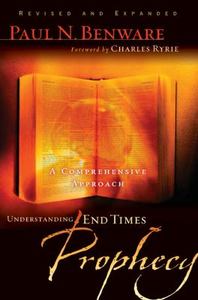 Understanding End Times Prophecy
Wait, What?
Yes, I just used the words dispensational premillenialism together in a sentence as though it made sense. It does. That is one of the many views Benware surveys in the book. Before reading Understanding End Times Prophecy (hereafter UEP), I admit I could not have distinguished a dispensational premillenialist from an amillenialist. Nor could I have identified a pre-wrath view in contrast with a post-wrath view. Benware’s book touches all of these and more, explaining the various positions out there on the various eschatological themes while also providing a thorough critique of those with which he disagrees.
Outline of Contents
Benware starts by outlining some principles for interpreting Biblical prophecy. Primary among these is the notion that prophetic passages must be interpreted literally. Benware explains: “Literal interpretation assumes that… [God] based His revelatory communication on the normal rules of human communication. Literal interpretation understands that in normal communication and in the Scriptures figures of speech are valuable as communication devices…” and it is therefore “not… a rigid ‘letterism’ or ‘mechanical understanding of the language’ that ignores symbols and figures” (23-24).
UEP then outlines a broad understanding of Biblical covenants, noting that the covenant God made with Abraham was unconditional, and so must be fulfilled.Next, Benware turns to a number of passages which outline the Palestinian, Davidic, and New Covenants. These he discusses in the context of promises God makes to Israel which must be fulfilled.
The next major section outlines the major views on the millennium. Benware favors the dispensational premillenial view and so spends some time outlining it.The dispensational view focuses on the covenants found throughout the Bible. It holds that there are different “economies” of God’s working. These dispensations are not time periods, nor are they different ways of salvation. Instead, they are specific truths about how God chooses to work with His people (86ff). This view also holds that God will fulfill promises through Israel as a literal nation in the place that God promised them (88ff).
The premillenial view holds that Christ returns before the millennial kingdom. It holds that the millennium is a literal thousand-year reign of Jesus on earth. Thus, there are two resurrections: first, before the millennial kingdom; second, after the millennial kingdom. Israel factors prominently into this view; Israel will be part of the thousand year reign and will occupy the land that God promised unconditionally to Abraham (94ff). Benware argues against the notion that Israel has become displaced or fulfilled in the church (103-120).
Then Benware turns to the view of amillenialism. Essentially, this view holds that the “millennium” is non-literal and is being fulfilled now during the church age. There is one resurrection, and the judgment comes immediately upon Christ’s return. Thus, the current period is the millennial kingdom (121-137).
Postmillenialism is the subject next discussed in UEP. This view tends to be tied into the notion that we are now living in the kingdom of God and so will usher in a golden age through social justice or action. After this undefined point, Christ will return to judge (139ff). Benware is highly critical of this view, noting that it relies upon the notion that we will continue improving the world (yet the world seems to be falling farther rather than progressing); as well as its rejection of the notion of a literal reign of Israel (150ff).
Finally, Benware evaluates preterism. Essentially, this view holds that the events prophesied in Revelation and elsewhere have either all or mostly been fulfilled already. There is much diversity within this perspective, but largely it is tied in with the notion that the destruction of the temple ushered in the end times (154ff).
The next major area of evaluation in UEP is that of the rapture. Benware analyzes pre-tribulation; post-tribulation; and other rapture views. Pre-tribulation is the view that the rapture will happen before the tribulation period. Post-tribulation is the view that the rapture happens after the tribulation. These directly tie into how one views the coming of Christ and the millennial kingdom (207ff).
Finally, UEP ends with outlines of the seventieth week of the book of Daniel, the Kingdom of God, death and the intermediate state, and the final eternal state. An enormous amount of exposition and discussion is tucked into these final chapters. For example, Benware includes a critique of annihilationism.
I have here only touched on the surface of UEP. Benware is exceedingly thorough and has managed to write an amazing resource on the issues related to End Times Prophecy.
Analysis
As has been noted, UEP is a simply fantastic resource for those who want to look at the various views which are discussed in contemporary evangelicalism. Benware has also provided an extremely detailed exposition of the dispensational premillenialist position. If someone wants to critique that view, UEP will be a book which they must reference. It is that good and that comprehensive.
Furthermore, Benware provides a number of excellent insights through the use of charts. Throughout UEP, there are charts scattered which summarize the content of what Benware argues, show pictorially what various views teach, and more. These charts will become handy for readers to reference later when they want to discuss the issues Benware raises. They also help interested readers learn what various views and positions teach.
Benware rightly shatters false notions that Biblical prophecy is some kind of indiscernible mystery language which humans weren’t meant to think on. His care for making clear what the Bible teaches on a number of issues is noteworthy.
Unfortunately, there are several areas in the book which are cause for caution. Benware’s use of proof texts is sometimes questionable. There is great merit to utilizing a series of related texts after an assertion in order to support one’s argument, but upon looking up several texts that Benware cites to make his points, it seems that he often stretched texts far out of their context or even cited texts which had nothing to do with the argument he made in the context in which he cited them. For just one example, Benware writes “The second phase of his [the Antichrist’s] careerwill take place during the first half of the tribulation… During his rise to power he will make enemies who will assassinate him near the midpoint of the tribulation (cf. Rev. 13:3, 12, 14). But much to the astonishment of the world, he is restored to life and becomes the object of worship (along with Satan)” (300). Note that Benware specifically says that the Antichrist will be assassinated and resurrected. Now, turn to the passages that Benware cites. Revelation 13:3, 12, and 14 state:
3: One of the heads of the beast seemed to have had a fatal wound, but the fatal wound had been healed. The whole world was filled with wonder and followed the beast… 12: It exercised all the authority of the first beast on its behalf, and made the earth and its inhabitants worship the first beast, whose fatal wound had been healed… 14: Because of the signs it was given power to perform on behalf of the first beast, it deceived the inhabitants of the earth. It ordered them to set up an image in honor of the beast who was wounded by the sword and yet lived. (NIV)
Now, where in this section does it say the Antichrist will be assassinated? Where in this section does it talk about the Antichrist dying and being raised to life? Strangely, Benware seems to reject the literal hermeneutic he advocates, and begins to interpret texts in ways that bend them to the breaking point.
The issue of these proof texts opens a broader critique of UEP. Benware constantly insists upon a literal reading of Revelation and other prophetic texts, while also criticizing those who hold other views of using an inconsistent hermeneutic. Yet, as I believe I demonstrated above, Benware often goes well beyond the literal meaning of the texts and comes to conclusions which stretch them past literal readings. In fact, it seems that Benware balances an often literalistic reading of the text with a non-literal reading. Thus, Benware seems to fall victim to the very error he accuses all other positions of falling into.
An overall critique of the position Benware holds would take far too much space and time for this reader to dedicate in this review, but I would note that the conclusions Benware comes to are often the result of the combination of literalistic readings and/or taking texts beyond what they say that I noted above. Some of the worrisome issues include the notion that the sacrificial system will be reinstated (334ff); a view in which the notion that the church seems in no way fulfill the Biblical prophecies about Israel (103ff); hyper-anthropomorphism of spiritual beings (i.e. demons, which are spiritual beings, being physically restricted [130]); and the insistence on literalizing all numbers in the Bible (168), among issues. It’s not that Benware doesn’t argue for these points; instead, it was that it seems his method to get his conclusions was sometimes faulty, and the case not infrequently was overstated.
One minor issue is Benware’s use of citations. It’s not that he fails to cite sources; rather, the difficulty is that he inconsistently tells the reader where the source is from. Very often Benware block quotes another text (with proper end note citation) without letting the reader know who or what he is quoting. Although this may be better for readers only interested in the argument, it can be very frustrating for those interested in knowing where Benware is getting his information to have to flip to the back of the book all the time to trace down sources. The problem is compounded by the fact that sometimes he does tell the reader where the quote is from (for example, he’ll write “so-and-so argues [quote]”) while at other times he just dives directly into the quote. The inconsistent application here may be a minor problem, but it did cause major frustration through my reading of the text.
Conclusion
Understanding End Times Prophecy
Source
Paul Beware Understanding End Times Prophecy
Disclaimer: I was provided a review copy of this book by the publisher My thanks to Moody Books for the opportunity to review the book..
SDG.
——
The preceding post is the property of J.W. Wartick (apart from citations, which are the property of their respective owners, and works of art as credited) and should not be reproduced in part or in whole without the expressed consent of the author. All content on this site is the property of J.W. Wartick and is made available for individual and personal usage. If you cite from these documents, whether for personal or professional purposes, please give appropriate citation with both the name of the author (J.W. Wartick) and a link to the original URL. If you’d like to repost a post, you may do so, provided you show less than half of the original post on your own site and link to the original post for the rest. You must also appropriately cite the post as noted above. This blog is protected by Creative Commons licensing. By viewing any part of this site, you are agreeing to this usage policy.
Genetics and Bioethics: Enhancement or Therapy?

[Note: Revised and expanded 6/15/2015.]
Bioethics is an expanding field with direct implications for our lives. Here, we’ll reflect on the possibility and implications of gene therapy and enhancement. While I was at the Evangelical Philosophical/Theological Society Conference in 2012, I had the pleasure of sitting in on a talk about this very topic, and that will be the focus of this post. Unfortunately, the speaker had been switched around and was not listed in the booklet that I have. Furthermore, I never caught the speaker’s actual name (I tried to write it down when he was introduced, and got Gary Alkins, though I have tried searching online for that and haven’t come up with it), so if someone knows what it is, please let me know. I’ll reference the speaker as “speaker” throughout this post.
The central relevant moral question under discussion was: “Should genetic technology be used to not only heal but also to enhance the human condition?”
A Vital Distinction
An important aspect of this discussion is the distinction between gene enhancement and therapy. Gene therapy is the use of genetic research and information to cure illness. Speaking very hypothetically, suppose that we were able to discover the exact genetic code for illnesses like sickle cell anemia, isolate it, and replace it with a non-anemic code before a person was even born; that would be gene therapy. Genetic enhancement takes this a step further. It allows for modifying people genetically to enhance certain features such as physical strength, endurance, mental aptitude, and the like. It would, in a sense, create “super humans.”
Therapy
Using our knowledge of genetics for therapy, the speaker argued, is perfectly justified. We are called by Christ’s example to treat illnesses, and gene therapy can be seen as an extension of this. There was little time spent defending the moral permissiveness of gene therapy, as the primary question was whether genetic enhancement is morally permissible.
Enhancement
There are several arguments for genetic enhancement. These include:
1) The “natural lottery” argument: if we have the capacity to genetically enhance humans but do not, that means we are, effectively, just playing a genetic lottery to see if our children turn out well. Parents have a moral duty to act against the natural lottery.
2) We encourage environmental enhancement (i.e. seeking better education, putting children in brain-stimulating environments, encouraging sports for their physical well-being, etc.), why is genetic enhancement any different?
3) We already manipulate chemicals (caffeine, vitamins, etc.) for our well-being, why not genetics? In the end, what matters is human well being.
4) Genetic enhancement is simply the next logical step for humanity. If we agree that therapy is good because it stops genetic defects, should we not also hold that enhancement is good because it pushes people to fill their greatest potential.
Against these arguments, the speaker argued [updated section 6/15/15 with some counter-responses]:
A) Genetic enhancement could never match the ideal outlined in these arguments, wherein every human being is enhanced on a number of levels. Instead, it would very likely increase the split between the haves and have-nots by allowing those who have much to increase their dominance over society. The haves could afford to continue enhancing and remain a kind of super-human society while the have-nots would never be able to catch up.
However, a possible counter-argument to this reasoning would be to note that there will always be people who are advantaged and people who are disadvantaged. It’s unclear as to how this should serve to undermine the moral base for genetic enhancement.
B) There is a great good in letting humans accomplish things which stretch their skill set. Think about the steroids controversy in sports. We intuitively know that those who used performance enhancing drugs had an unfair advantage over those who did not. Similarly, those who would be genetically enhanced would have an unfair advantage over those who were not enhanced in almost any conceivable area of human achievement.
It is unclear, though, whether genetic enhancement would undermine the good of accomplishment and human achievement. Indeed, one could argue that genetic enhancement, in fact, bolsters human achievement by widening the scope of possibility for humans. From a pragmatic perspective, though, it sure would make it hard to keep on top of sports records and the like! We’d have to build bigger baseball parks to make home runs harder to hit! But seriously, the argument from human achievement does not seem sound to me.
C) What of bodily autonomy? Who’s to say that it is a good for parents to meddle with their children’s genes. What if a child does not want to be extremely strong, or what of their parents choose to give them giftedness in music, but they simply don’t like to do music? What if the children hate what their parents chose for them: hair color, eye color, etc.? Unlike the “natural lottery,” such attributes related to enhancement actually do have blame to assign to someone. Is there no bodily autonomy involved?
However, as Elijah argues, parents violate “autonomy” of their children all the time. This means there is some difficulty with determining how genetic enhancement would be a qualitative, rather than quantitative difference for this violation of autonomy. The opponent of genetic enhancement must establish that there is an objective difference between enhancement and other forms of violating autonomy, and must also show this difference is enough to ground a rejection of enhancement.
Enhancement and Theology
There are numerous theological issues involved in the debate over genetic enhancement. First, what might it mean for the image of God? Humans were created as “very good” and in the “image of God.” What does it mean to be in that “image of God” and does enhancement change that in any way?
For Christians, the ultimate fulfillment of God’s plan comes in the New Creation. The notion that humanity needs a genetic upgrade reflects the worldview of naturalism. Christians do not hope in their own ingenuity but rather in God’s plan for creation. That does not mean we cannot get actively involved in healing, but it does mean that we do not need to violate persons’ humanity by enhancement. One might argue that the assumption involved in enhancement is that our bodies are not good enough and that we need to improve them. However, such an assumption is not the only possible basis for enhancement. One could argue, instead, that enhancement is based on the notion that we are to keep fighting against the impact of sin in the world and one way to do this is to become stronger, smarter, and the like through the tools God has given us through scientific research.
Although we are fallen creatures, that does not imply that we are creatures capable of getting out of our own fallenness. No enhancement we can do can bring us ultimate salvation.
Evaluation
It seems to me that the arguments against enhancement may seem initially sound, but each one has its own problems.
It seems that if parents select for certain attributes, then parents can be held morally culpable for the genes their children develop. Thus, if the child dislikes an attribute, they could feasibly hold their parents responsible for that selected attribute. Interestingly, this may work both ways too: a child could hold their parents responsible for not changing an attribute. Yet this latter argument seems to make a mockery of parenthood, holding parents responsible for nature. I’m not sure, though, that this culpability is enough of an argument against genetic enhancement.
In the theological sphere, one may wonder whether someone could just as easily argue that because we were created initially “very good,” a pursuit of bodily perfection could be viewed as a fight against the Fall and the curse. I tried to ask this as a question, but there wasn’t time at the end to get to all the questions. The speaker did an excellent job noting possible counter-arguments to their points, and I thought gave a very fair presentation overall. It seems that the best argument against genetic enhancement may be the bodily autonomy argument, but this one has its own significant problems.
I’d like to know what your thoughts are on this topic: Do you think enhancement is moral? Why or why not?
Links
I have written on a number of other talks I went to at the ETS/EPS Conference. I discuss every single session I attended in my post on the ETS/EPS Conference 2012. I also discuss a panel discussion on Caring for Creation, and a debate between a young earth and old earth proponent.
SDG.
——
The preceding post is the property of J.W. Wartick (apart from citations, which are the property of their respective owners, and works of art as credited) and should not be reproduced in part or in whole without the expressed consent of the author. All content on this site is the property of J.W. Wartick and is made available for individual and personal usage. If you cite from these documents, whether for personal or professional purposes, please give appropriate citation with both the name of the author (J.W. Wartick) and a link to the original URL. If you’d like to repost a post, you may do so, provided you show less than half of the original post on your own site and link to the original post for the rest. You must also appropriately cite the post as noted above. This blog is protected by Creative Commons licensing. By viewing any part of this site, you are agreeing to this usage policy.

 J.W. Wartick - Reconstructing Faith