christian
Book Review: “Men and Women in Christ: Fresh Light from the Biblical Texts” by Andrew Bartlett
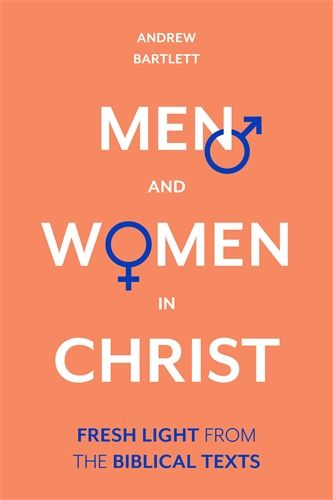
Andrew Bartlett’s Men and Women in Christ: Fresh Light from the Biblical Texts is a major study on the question of how women and men are to relate to each other according to the Bible. Bartlett approaches the question from a more judicial approach, using his experience as an arbitrator as well as his background in theology to shed light on the biblical texts.
The book is more than 400 pages of text and it is filled to the brim with exegetical insights. The first chapter is about tradition and unity; the second explores 1 Corinthians 7’s implications for marriage and male-female relations; the third interprets Colossians 3 and Ephesians 5; the fourth focuses more closely on Ephesians 5; the fifth examines what Genesis 1-3 has to tell us about men and women; the sixth looks at 1 Peter; the seventh through the eighth focus on 1 Corinthians 11; the ninth and tenth look at the meaning of 1 Corinthians 14:34-35 and its place in Scripture; the eleventh through the thirteenth are about 1 TImothy 2; the fourteenth surveys the biblical evidence for women leaders; the fifteenth asks about women elders in light of 1 Timothy 3; the sixteenth and final chapter brings the conclusions together and offers a way forward. Appendices explore methods of biblical interpretation, arguments against mutual submission, uses of the Greek word authenteo, the structure of 1 Timothy 2:12, interpretations of 1 Timothy 2:15, shortcomings in complementarian readings of 1 Timothy 2, and translation issues.
Bartlett begins with a chapter on “revising tradition, seeking unity” in which he looks into how these issues have become as divisive as they are alongside the development of various views. Here it is particularly of interest that Bartlett spends some time arguing that the “complementarian” view is not the traditional view of the church. It is demonstrably the case that complementarianism is not, in fact, that traditional view, despite many of its proponents claiming that title. Bartlett shows that the traditional view, in fact, viewed women as ontologically inferior to men. Woman, on that view, was by nature inferior. By contrast, Jesus explicitly went against his cultural conventions and elevated women throughout the NT. Additionally, modern complementarianism at least claims to support the equality of men and women, itself a direct contradiction to the traditional view.
1 Corinthians 7 is extremely important to the questions related to male-female relations. Bartlett notes that this chapter gives the only explicit details about how decisions are to be made in marriage. Despite the clear importance of this passage to the questions at hand, then, it is curious that so few complementarians offer thorough exegesis of the text. Bartlett notes the various qualities of male-female relations brought to the front in this text, including that they have equal duties in the marriage bed, equal authority to the other partner, the same advice to both widowers and widows, same restrictions on divorce, same rule about unbelievers for men and women, the spiritual impact of the spouses on each toher, the same advice for engaged persons of either sex, the same advice for married/unmarried persons of either sex, and more (25-26).
1 Peter finds that husbands are to give honor in the same way as wives are to do so. English translations may obfuscate the mutuality of the relevant passages, but in 1 Peter 3:7 there is a clear wording that parallels Peter’s other use of the same notion, thus leading to the conclusion that the honor/respect that many complementarians so often attribute only to the male side of the relationship is mistaken. Bartlett challenges egalitarians to see that there are specific biblical obligations for husbands to wives that he says are “asymmetrical” and thus not something wives must do. Specifically, the concept of self-sacrifice, argues Bartlett, is something husbands are called to do in marriage (62-64). His argument here is indeed challenging, but one might counter that the absence of evidence is not evidence of absence–having “asymmetry” in this specific instances does not imply asymmetry in function with certainty.
Bartlett’s careful exegesis of 1 Corinthians 11 deserves a thorough read. Essentially, he notes the various unjustified conclusions from word studies people have drawn from this text. Additionally, he notes problems with Trinitarian theology as taken from the text. The question of what exactly is the “veil/symbol of authority/etc.” looms large, and Bartlett makes a convincing case for reading these passages as referencing sources and hairstyles (143-148). Additionally, he argues that the reading of “a woman ought to have authority over her head” is to be preferred because it avoids major pitfalls of rival views (148ff). It both goes along with Paul’s context in which he specifically mentions women praying and prophesying and also fits in with the concepts related to “source” in the passages.
1 Corinthians 14:34-35 is one of the best known passages in this debate, and Bartlett makes a convincing case, going along with several other scholars, that this text is, in fact, an interpolation that was not in the original text. This is due to both internal and external evidence, such as preserving the unity of thought in the letter, questions about what the verses are supposed to be referencing, and numerous textual evidences related to the floating of the text in different locations as well as marks that indicate it is likely an interpolation.
1 Timothy 2 is another major section of the book, and Bartlett does a service by laying out the context of the text in great detail. There is little doubt that 1 Timothy was written to discuss false teachings and false teachers, with numerous mentions throughout the letter as well as in 2 Timothy of these problems. Bartlett, however, goes more deeply into the context and uses primary sources to note that it appears as though the letter is referencing astrology specifically in numerous places and that the false teaching is related to sorcery/astrology. This puts 1 Timothy 2:9-12 contextually in a discussion of wealthy women with ungodly conduct who should learn to do good works and learn in full submission to God. The nature of the letter as a periodical sent for a specific purpose must not be ignored.
A survey of women church leaders leads to numerous examples of women in various leadership roles in the church. This leads into a discussion of 1 Timothy 3 and whether women may be elders. English translations have mangled these verses in a number of ways, adding male pronouns prolifically where there are none. Additionally, interpreters have failed to take into account that the list of qualifications parallels qualifications Paul explicitly gives for women throughout the letter as well (318-319).
Bartlett ends the book with a call for Christian unity in spite of sharp disagreements on the place of men and women in the church and alongside each other.
If there is one point of critique of I have for Bartlett’s work, it is the occasional uncritical acceptance of anecdotal evidence in questions of modern application. Nowhere is this more clear than in Bartlett’s discussion of the alleged inherent differences of men and women on pages 82-83. Here, Bartlett chides egalitarians for being “sometimes shy of acknowledging innate differences between men and women” (82). What evidence does Bartlett offer for his own perspective, that some differences beyond child-bearing are “innate”? He offers a journalist’s comment from a game show in the UK, who, in trying to offer a good reason why two all-male teams should be the best representatives for a quiz show, offered the example of her husband who arranges his books in alphabetical and chronological order, and whose “proudest boast is that while on holiday in North Wales in 1974, he won a hubcap identification competition. Who could compete with that? Who would want to?” (82-83). It is honestly difficult to fathom how this single anecdote can be taken seriously as an example of alleged innate differences between the sexes. [Edit: The author contacted me and let me know this was intended as a joke–a possible cultural miss on my part not understanding the joke. I’ve made a correction in the rest of this paragraph.] He also offers a footnote referencing a study that argues for hard-wired differences in how male/female brains have differences. I haven’t read that study, so I can’t comment on it specifically. Again, this is a minor complaint in a massive text, but it seemed out of place and worth commenting on.
Men and Women in Christ: Fresh Light from the Biblical Texts is a monumental achievement. It sets standards for rigor as well as for Bartlett’s attempt to find unity in Christ among such hotly contested issues. Anyone who is truly interested in engaging in the questions related to women in the church and home from a Christian perspective will find this book a must read. Highly recommended.
Disclaimer: I was provided with a copy of the book for review by the publisher. I was not required to give any specific kind of feedback whatsoever.
Links
Be sure to check out the page for this site on Facebook and Twitter for discussion of posts, links to other pages of interest, random talk about theology/philosophy/apologetics/movies and more!
Book Reviews– There are plenty more book reviews to read! Read like crazy! (Scroll down for more, and click at bottom for even more!)
SDG.
——
The preceding post is the property of J.W. Wartick (apart from quotations, which are the property of their respective owners, and works of art as credited; images are often freely available to the public and J.W. Wartick makes no claims of owning rights to the images unless he makes that explicit) and should not be reproduced in part or in whole without the expressed consent of the author. All content on this site is the property of J.W. Wartick and is made available for individual and personal usage. If you cite from these documents, whether for personal or professional purposes, please give appropriate citation with both the name of the author (J.W. Wartick) and a link to the original URL. If you’d like to repost a post, you may do so, provided you show less than half of the original post on your own site and link to the original post for the rest. You must also appropriately cite the post as noted above. This blog is protected by Creative Commons licensing. By viewing any part of this site, you are agreeing to this usage policy.
Book Review: “A Theology of Interreligious Relations” by Henning Wrogemann
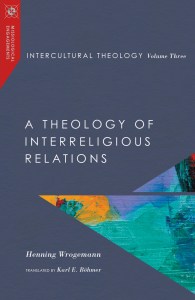 Henning Wrogemann has written a massive, detailed look at interreligious relations from a Christian perspective. A Theology of Interreligious Relations specifically provides a way forward in Christian interaction with other religions.
The book is divided into six parts. The first part focuses on recent Christian theologies of religion. The second part is about how Islam and Buddhism view other religions. The third part is about how to build a theology of interreligious relations. The fourth part is about the dialogical in religious relations. The fifth part builds a theology of interreligious relations. The sixth part discusses intercultural theology and mission alongside religious studies.
One surprising thing in the book was Wrogemann’s look at other religions’ own theologies of interreligious relations. The fascinating Part II of the work looks at how Islam and Buddhism view other religions. For my own part, I’ve only ever thought of religious diversity within a framework of Christian options of exclusivism, inclusivism, and universalism. But of course these categories are deeply steeped in Christian theology to begin with, and so do not come close to exhausting all the options for interreligious relations. This part of the book was particularly enlightening to me as a reader, as it opened my eyes into many more approaches to the religious “other” than I had been aware of, and also how other religious view Christianity.
The examination of recent theologies of religion was just as interesting. Wrogemann’s critical analysis of theses like John Hick’s universalism is worth the price of admission for the book on its own, but Wrogemann offers a whole spectrum of approaches and subjects them to this same critical, insightful analysis.
The building up of his own theology of interreligious relations provides several ways forward in speaking with people of other religious traditions and interacting with them in ways that do not compromise one’s own beliefs while also being true to the central aspects of Christianity. For example, addressing the question of the particularism of Trinitarian theology when it comes to interreligious dialogue, Wrogemann argues that we “must pay attention not only to God’s revealedness but also to the ongoing hiddenness of God’s action in the world…” (424, emphasis his). This means that Christian theology’s task is, at least in regards to interreligious dialogue, “to help interpret ongiong ambivalences” when it comes to such questions (ibid). Additionally, Wrogemann bases his theology for interreligious dialogue squarely in the space of biblical revelation, insisting that we may only build this theology from the revelation of God as revealed in God’s Word and, more explicitly even, in Christ himself (see, for example, Wrogemann’s discussion of the need to acknowledge one’s own faults and work towards understanding by way of exegesis of Matthew 5 on p. 383-384).
When I decided to read the book, I did not realize it was the third in a trilogy on the topic of intercultural theology by Wrogemann. Having read it, though, I would say that the book stand quite well on its own.
A Theology of Interreligious Relations is a surprising, challenging book that readers well return to time and again. Wrogemann’s work here has established a serious starting point for Christian theology of other religions, and one which takes other religious claims seriously. It comes highly recommended, particularly for anyone with an interest in how Christianity may relate to other religions.
Disclaimer: I was provided with a copy of the book for review by the publisher. I was not required to give any specific kind of feedback whatsoever.
Links
Be sure to check out the page for this site on Facebook and Twitter for discussion of posts, links to other pages of interest, random talk about theology/philosophy/apologetics/movies and more!
Book Reviews– There are plenty more book reviews to read! Read like crazy! (Scroll down for more, and click at bottom for even more!)
SDG.
——
The preceding post is the property of J.W. Wartick (apart from quotations, which are the property of their respective owners, and works of art as credited; images are often freely available to the public and J.W. Wartick makes no claims of owning rights to the images unless he makes that explicit) and should not be reproduced in part or in whole without the expressed consent of the author. All content on this site is the property of J.W. Wartick and is made available for individual and personal usage. If you cite from these documents, whether for personal or professional purposes, please give appropriate citation with both the name of the author (J.W. Wartick) and a link to the original URL. If you’d like to repost a post, you may do so, provided you show less than half of the original post on your own site and link to the original post for the rest. You must also appropriately cite the post as noted above. This blog is protected by Creative Commons licensing. By viewing any part of this site, you are agreeing to this usage policy.
“What is a Girl Worth?”- Rachael Denhollander’s Challenging, Thoughtful Memoir of exposing abuse
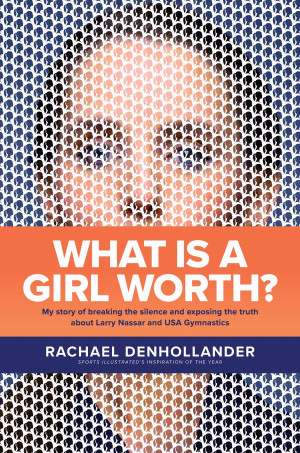
Rachael Denhollander rocketed into the public eye by speaking out against Larry Nassar, formerly a renowned therapist for USA Gymnastics who is now a convicted sex criminal. Her memoir, How Much is a Girl Worth? is a difficult read filled with moments of hope.
Denhollander describes how her interest in gymnastics rose and how her own dedication to the sport led to her getting into the top tier. That top billing ultimately led to recommendations to be treated by Larry Nassar, who was seen by many as having innovative treatments that could fix many symptoms and problems with gymnasts. Nassar, however, began a process of grooming and building trust that he betrayed to sexually abuse Rachael and more than 250 others.
Denhollander shows how abusers build the trust that leads to their being able to abuse others. She also describes how difficult it was to even acknowledge the abuse–coming to the realization that what Nassar was doing was not treatment but abuse. When someone is told by everyone with inside knowledge that someone else is trustworthy and doing innovative treatments, processing that as a child to discern that there is abuse happening is extremely difficult. Readers should be aware there are descriptions of the abuse in this book. It’s a challenging, disturbing read that exposes the abuse of Nassar and call readers to help prevent and prosecute more abuse.
Denhollander also offers critique of Christian cover-ups of abuse as well as how her own faith helped her. For example, Denhollander describes a Sunday school class in which the teacher and others said that King David did not abuse Bathsheba because should have gotten herself out of the situation he manipulated and used his power to get her into. Rather than seeing this as power rape, many of the people in her high school Sunday school class, including her teacher, said David did not abuse Bathsheba. As someone who had been abused and who recognized the signs, this was a disturbing moment for Denhollander, who writes, “This wasn’t just about me. I knew there was at least one rape victim sitting in that class too, and statistically, many more survivors… I knew they would feel guilt for their abuse–and the sting of those words [blaming Bathsheba for the abuse and/or exonerating David], untrue though they were, could be devastating…” (90). Denhollander’s own faith comes through poignantly when she recounts a scene using her notebook as she struggled coming to terms with God and her experiences (101ff). She began with the premise that “There is right and wrong” and as she developed her thoughts she decided that the things that she knew–that God defines good, that God is just and loving–couldn’t be contradicted by the answers she couldn’t figure out yet. It an exhausting (using her word) experience, but one that clearly helped ground her.
The book then recounts Denhollander’s developing relationship with Jacob, whom she met through talking online and who exemplified giving support throughout the rest of the book. From there, readers learn of her work to expose Larry Nassar as an abuser, the pushback she received from it, and, ultimately his being sentenced to prison for the rest of his life. She also describes her own frustration with the fact that time and again, victims were not being given voices are being allowed to make decisions about whether plea bargains would be offered or how various aspects of the case were handled. It’s a strong reminder that reform is needed in handling cases related to abuse.
How Much is a Girl Worth? should be read and digested in order to help ensure that abuse is caught when it happens and that covering it up should never be tolerated. More than that, it’s a testament to the power of faith and hope in awful situations.
Links
Be sure to check out the page for this site on Facebook and Twitter for discussion of posts, links to other pages of interest, random talk about theology/philosophy/apologetics/movies and more!
Book Reviews– There are plenty more book reviews to read! Read like crazy! (Scroll down for more, and click at bottom for even more!)
SDG.
——
The preceding post is the property of J.W. Wartick (apart from quotations, which are the property of their respective owners, and works of art as credited; images are often freely available to the public and J.W. Wartick makes no claims of owning rights to the images unless he makes that explicit) and should not be reproduced in part or in whole without the expressed consent of the author. All content on this site is the property of J.W. Wartick and is made available for individual and personal usage. If you cite from these documents, whether for personal or professional purposes, please give appropriate citation with both the name of the author (J.W. Wartick) and a link to the original URL. If you’d like to repost a post, you may do so, provided you show less than half of the original post on your own site and link to the original post for the rest. You must also appropriately cite the post as noted above. This blog is protected by Creative Commons licensing. By viewing any part of this site, you are agreeing to this usage policy.
Book Review: “Sacred Rhetoric: Dietrich Bonhoeffer and the Participatory Tradition” by Justin Mandela Roberts
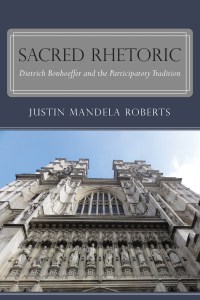 Dietrich Bonhoeffer’s influence stretches far and wide, and his concept of “worldly” or “religionless” Christianity is one of his most enduring traditions. That notion of the concreteness of his theology has led some to think that he rejected metaphysical aspects of the faith altogether. In Sacred Rhetoric: Dietrich Bonhoeffer and the Participatory Tradition, Justin Mandela Roberts pushes back against that thinking and argues that Bonhoeffer’s theology is, instead, one that stands alongside that of doxology, sacrament, and metaphysics.
The book is slim, but offers a wealth of detailed analysis of Bonhoeffer’s works from a number of angles that seem less common in Bonhoeffer scholarship. Bonhoeffer’s view of worship is analyzed, for example, as going beyond Barth while also integrating much of sacred tradition. Roberts’ analysis of Bonhoeffer’s thought on metanoia–the conversion or dark night of the soul–was a fascinating, personable read. The “Sacramental Interpretation” integrates Bonhoeffer’s sacramental theology with a view of the Word of God. Indeed, if there is a downside to reading the book, it may be found in the flurry of citations, musings, quotes, and ideas thrust at the reader in quick succession, making it difficult to absorb any one idea before moving swiftly onto the next. That said, Roberts’ analysis is helpful in many ways, both opening new interpretive lenses and new paths to explore for those interested in seeing how Bonhoeffer’s work may have opened up had he developed it further.
It was strange that Roberts opted to begin the book with a slight of Bonhoeffer. The second sentence of the introduction states “His academic pieces, including Sanctorum Communio, Act and Being, and Creation and Fall, offer nothing particularly remarkable as scholarly resources for the theological and philosophical traditions” (1). Given the fact that Creation and Fall is essentially the bulk of chapter 5’s focus is largely on Creation and Fall and each of the other works is cited as well, it seems Roberts would disagree with himself here, as he evidently finds these works quite remarkable indeed! Contextually, Roberts is opining on what it is that has made Bonhoeffer such an impactful figure on modern thought, possibly as an attempt to make him more real or down to earth for the average reader, but reading it was jarring in a book dedicated entirely to an interpretation of this apparently unremarkable figure.
Roberts’s work helps integrate Bonhoeffer’s thought into a broader Christian theology and practice. Sacred Rhetoric is an interesting, challenging read recommended for those looking to dig deeply into Bonhoeffer’s theological practices and metaphysics.
Disclaimer: I was provided with a copy of the book for review by the publisher. I was not required to give any specific kind of feedback whatsoever.
Links
Dietrich Bonhoeffer– many more posts, book reviews, and discussions of and about Dietrich Bonhoeffer and his life, theology, and thought (scroll down for more).
Be sure to check out the page for this site on Facebook and Twitter for discussion of posts, links to other pages of interest, random talk about theology/philosophy/apologetics/movies and more!
Book Reviews– There are plenty more book reviews to read! Read like crazy! (Scroll down for more, and click at bottom for even more!)
SDG.
——
The preceding post is the property of J.W. Wartick (apart from quotations, which are the property of their respective owners, and works of art as credited; images are often freely available to the public and J.W. Wartick makes no claims of owning rights to the images unless he makes that explicit) and should not be reproduced in part or in whole without the expressed consent of the author. All content on this site is the property of J.W. Wartick and is made available for individual and personal usage. If you cite from these documents, whether for personal or professional purposes, please give appropriate citation with both the name of the author (J.W. Wartick) and a link to the original URL. If you’d like to repost a post, you may do so, provided you show less than half of the original post on your own site and link to the original post for the rest. You must also appropriately cite the post as noted above. This blog is protected by Creative Commons licensing. By viewing any part of this site, you are agreeing to this usage policy.
Ted Chiang’s Religious Vision and Critique in “Exhalation”
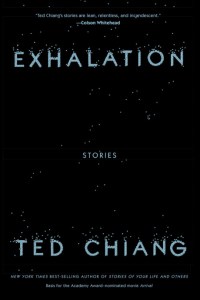 Ted Chiang is one of the more well-known names publishing science fiction and fantasy short stories today. His short story, “Stories of Your Life” was the basis for the film “Arrival” (which I discussed here). His latest collection, Exhalation: Stories is another thought-provoking, moving collection of stories that will make readers think deeply about many questions. What struck me is that, despite Chiang being an atheist, his is remarkably knowledgeable about religion and, though he challenges various religious traditions at points, he also writes stories that resonate with them. I wanted to discuss his religious vision and critique in this book. There will be SPOILERS for some of these stories ahead.
Omphalos
Readers who have done a lot of digging into the esoteric origins of young earth creationism will recognize the title of this short story a nod to one of the most obscure but also earliest examples of young earth literature, Omphalos: An Attempt to Untie the Geological Knot by Philip Henry Gosse. In Gosse’s book, written before the publication of Darwin’s On the Origin of Species, he argues that the fossil record was actually created with the appearance of age and thus doesn’t give evidence of the actual age of the earth. Gosse effectively introduced the argument of “appearance of age” into the young earth creationist repertoire of arguments for their position, and he did it before the evidence for evolution had reached the stage it has now.
In Chiang’s short story, he imagines a scientist interacting with the world that genuinely does appear to be young. In this world, fossils are found that show no evidence of prior age. Tree rings do not falsify a young earth. The evidence on the planet all gives way to yielding the result that the Earth really is young. But some evidence isn’t fixed. The multiplicity of language begins to show that it is from accident rather than by design. Moreover, some question comes into mind as to why the universe was created–was it really made for us, or for some other group of beings somewhere else? The evidence for the miraculous continues, but the purpose of the character we follow in the story begins to get called into question. This leads to the challenge that if this person was not created with a specific purpose, they are left to their own devices to find purpose, and they choose to search… for purpose.
“Omphalos” serves as a lens to question: what would it mean if the universe were not made for humans? (I don’t think it was, and wrote this article to that effect, though it has diverged some from my current views in 6 years.) Chiang’s story is a masterful look at how we might perceive the universe differently as what we think collapses around us. It also asks questions about purpose in a universe in which we don’t have our own, unique purpose. It’s a thought experiment but one that needs to challenge us.
The Merchant and the Alchemist’s Gate
The first story in the collection, “The Merchant…” is a series of smaller stories about how some different rings that allowed for time travel impacted people’s lives in a fantastic setting with explicitly Muslim religious expression. As the stories told by the merchant make the reader understand, the longing to be able to change the past and set events right to make up for mistakes is strong. But the concluding lines of the story make clear the point:
Nothing erases the past. There is repentance, there is atonement, and there is forgiveness. That is all, but that is enough. (36)
I have read this story before in another collection of Chiang’s, but it still struck me as forcefully as it did the first time. The deep yearning to change the past is found in so many of us now. But it is a longing we can’t fulfill. Yet even without magical rings that allow for time travel by passing through them, we can still find what is enough: repentance, atonement, and forgiveness.
Exhalation: Self-Destruction and Miracle
The title story of this collection, “Exhalation,” was a Hugo Award winner for best short story. In this story, there is a society of mechanical beings with brains that work based on pressure of the air. One of these beings discovers that its society is beginning to slow down in computations and the reason is due to the way they’re using their resources, pumping air from one place to another, which changes the air pressure and thus their capacities. From this, the being basically finds the second law of thermodynamics and posits that all things will eventually move towards equilibrium–dooming its society.
This short story has many intriguing threads. First, the notion of self-destruction by actions that are initially seen as good or profitable or beneficial. Clear parallels exist between this story and our own, as humanity continues to destroy the good creation of God through our own efforts to seek ease of transportation, luxury, and profit over all else.
Another startling aspect of “Exhalation” is the conclusion towards the end, that life itself is miraculous, because it manages to survive in a universe that is bent upon ultimately driving it out (the second law of thermodynamics means there will be an inevitable heat death of the universe). Life does seem to be a miracle: its diversity, persistence, the emergence of consciousness, and the very fact that life exists stand out. Though there may be natural explanations for these stages, the wonder of them cannot be totally explained in such naturalistic means. There is a sense of the miraculous in life.
Conclusion
There are many other themes found throughout this collection of stories, as well as his others. Questions about what it means to be a person; what mental life is like; how we destroy ourselves; and more. What are some themes you’ve picked up? What stories resonated with you? Check out Exhalation: Stories for some though-provoking stories.
Links
Be sure to check out the page for this site on Facebook and Twitter for discussion of posts, links to other pages of interest, random talk about theology/philosophy/apologetics/movies and more!
Book Reviews– There are plenty more book reviews to read! Read like crazy! (Scroll down for more, and click at bottom for even more!)
SDG.
——
The preceding post is the property of J.W. Wartick (apart from quotations, which are the property of their respective owners, and works of art as credited; images are often freely available to the public and J.W. Wartick makes no claims of owning rights to the images unless he makes that explicit) and should not be reproduced in part or in whole without the expressed consent of the author. All content on this site is the property of J.W. Wartick and is made available for individual and personal usage. If you cite from these documents, whether for personal or professional purposes, please give appropriate citation with both the name of the author (J.W. Wartick) and a link to the original URL. If you’d like to repost a post, you may do so, provided you show less than half of the original post on your own site and link to the original post for the rest. You must also appropriately cite the post as noted above. This blog is protected by Creative Commons licensing. By viewing any part of this site, you are agreeing to this usage policy.
Book Review: “Scientism and Secularism: Learning to Respond to a Dangerous Ideology” by J.P. Moreland
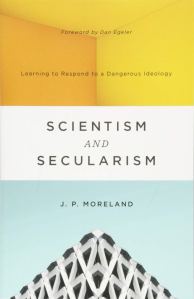 Scientism and Secularism: Learning to Respond to a Dangerous Ideology provides an introduction to and critique of the philosophical position of scientism.
Moreland defines scientism as “the view that the hard sciences–like chemistry, biology, phsyics, astronomy–provide the only genuine knowledge of reality” (Kindle location 263-271, hereafter citations are also Kindle locations). He provides several examples of how he’s encountered this belief in various realms.
The strength of the book is found in Moreland’s arguments that scientism is self-refuting, the possibility of nonscientific knowledge, several principles theism explains that scientism cannot, and the attempt to integrate science and Christian thought. For example, when arguing about scientism being self-refuting, Moreland notes that the claim of scientism itself is a philosophical claim that cannot be tested through the hard sciences. But he goes further, noting that many are aware of this significant difficulty in the theory and instead argue that it can be a kind of first principle. But again, such an attempt to insulate the claim from scientific inquiry itself is a philosophical endeavor, essentially establishing the first principles of knowledge on a basis that those principles themselves reject.
Moreland also offers a condensed form of Alvin Plantinga’s evolutionary argument against naturalism: basically, if we agree that evolution is true and that naturalism is true–all that exists is the material world–then, minimally, we have at least some small reason to believe our cognitive facilities may be untrustworthy.
Where Moreland struggles is when he tries to outline the vast influence he believes scientism has in our culture. Essentially anything Moreland perceives as a societal ill can be tied back to scientism, in his view. Universities having any sort of secular slant? Scientism is to blame. People believing evolution is true? Scientism is to blame. Specific instances of perceived moral decay? Scientism caused it.
The problem with this is it begins to read more like a screed against positions in disfavor with Moreland than a tightly argued philosophical attack on scientism. A specific example can be found in chapter 3, entitled “How scientism changed the universities.” After an introductory quote from Dallas Willard, who taught at USC from 1965-2013 and is thus taken, apparently, to be broad evidence for the totality of experience at all universities, Moreland argues following another scholar (see below) that American universities followed a specific, three-stage path from 1880-1930 that went from a “Religious Stage” through a “Scientific Stage” before ending up at a “Humanities and Extracurricular Stage” (Kindle location 561-570). Tellingly, Reuben is the only citation of any study in the entire chapter–a work from 1996 about which Moreland states “I have relied on Reuben’s insightful analysis for much of what follows in this chapter” (Kindle location 639).
But following this brief look at what is surely a substantial claim (did all universities in America follow this pattern? based on what evidence? what other studies back up this data?), Moreland goes on to state that the central problem is found in the fact/value distinction and, allegedly, that science became the only knowledge that universities–all of them, apparently–valued (577). This, in turn, de-centered Christian monotheism “from the cognitive domain” and led to the impossibility of having unified curriculums or even “justifying why one discipline should have anything at all to do with another…” (588). One may well wonder how such a claim can be justified when there are such clearly inter-related disciplines as critical theory or intersectionality on the rise which explicitly demand convergence of numerous disciplines, but one also wonders what the evidence is for these claims to begin with. More importantly for the thesis at hand, the question is whether scientism is specifically and verifiably to blame for such a shift in university cultures. Moreland states that it is rather explicitly, but does little to actually support that claim. The same goes for many other things he views as societal ills–scientism is clearly at fault for them all. How? It’s unclear.
Another problem is that Moreland, as he has elsewhere, is quick to assert that his own vision of reality just is the only possible biblical view of reality and so those who disagree with it just are influenced by scientism and secularism and ought to be condemned. In a revealing passage, Moreland writes:
Thus, the ‘dialogue’ between science and theology or biblical exegesis is really a monologue, with theologians asking scientists what the latest discoveries allow them to teach:
Homosexuality is caused by our DNA? No problem. The Bible doesn’t teach the immorality of homosexuality anyway. We have misread it for two thousand years.
Neuroscience shows there is no soul? No problem. Dualism and the soul are Greek ideas not found in the Bible, which is more Hebraic and holistic.
A completely naturalistic story of evolution is adequate to explain the origin and development of all life? No problem. After all, the Bible isn’t a science text.
Studies in the human genome suggested human life did not begin with Adam and Eve? No problem. We can reread the historical narrative in a new way.
And on and on it goes. (Kindle location 1025ff)
Moreland, of course, sees scientism to blame for all of this. Christians and even theologians, he asserts, are so steeped in scientism that they cannot see past it and instead conform all of their theological beliefs to the latest fashionable science. But Moreland doesn’t establish his claim in reality. This lengthy passage shows his feelings about all of these developments, but it fails to account for the fact that without scientific discoveries that may challenge interpretations of Scripture, these discussions wouldn’t be possible in the first place. That is, he complains about he lack of “dialogue” between science and theology, but is apparently upset when that dialogue leads some to differing conclusions from himself, which conclusions, of course, can only be due to the theologians total capitulation to scientism.
Never mind that science and theology have informed each other for much of history. Note that one of Moreland’s complaints is not “Exploration of space and mathematical models have shown that the Earth revolves around the sun? No problem. The Bible doesn’t actually teach that the Sun revolves around the Earth.” Never mind that Moreland would almost certainly hold that latter position, and that such a revision of reading the Bible did in fact take place. Never mind that some theologians actually did turn to seeing divine accommodation in Scripture when it came to scientific truths instead of demanding that a re-reading of the Bible make it so that the sun did not literally rise. No, this is an issue that Moreland himself agrees with, so it can’t be due to scientism, right?
These examples show a weakness in the book that is unfortunate, because on some other counts it is quite strong. Moreland is keen to cast aspersions on rival theological positions and to blame scientism for more than he can establish in reality that it may make readers of the book less interested in those parts of the book he does establish fairly well. For example, his critique of the possibility of rational thought given a purely scientistic worldview is spot-on, and his analysis of how scientism is self-defeating ought to seal the deal for most readers.
Scientism and Secularism: Learning to Respond to a Dangerous Ideology is a brief but solid critique of scientism contained within a broader attack on secularism in general. What’s unfortunate is that Moreland seems to see the latter as not just entirely encompassed (or at least caused by) the former, but also that he does so without reason for making such an equivocation. The book thus ends up as an uneven look at an important topic.
Disclaimer: I was provided with a copy of the book for review by the publisher. I was not required to give any specific kind of feedback whatsoever.
Links
Be sure to check out the page for this site on Facebook and Twitter for discussion of posts, links to other pages of interest, random talk about theology/philosophy/apologetics/movies and more!
Book Reviews– There are plenty more book reviews to read! Read like crazy! (Scroll down for more, and click at bottom for even more!)
SDG.
——
The preceding post is the property of J.W. Wartick (apart from quotations, which are the property of their respective owners, and works of art as credited; images are often freely available to the public and J.W. Wartick makes no claims of owning rights to the images unless he makes that explicit) and should not be reproduced in part or in whole without the expressed consent of the author. All content on this site is the property of J.W. Wartick and is made available for individual and personal usage. If you cite from these documents, whether for personal or professional purposes, please give appropriate citation with both the name of the author (J.W. Wartick) and a link to the original URL. If you’d like to repost a post, you may do so, provided you show less than half of the original post on your own site and link to the original post for the rest. You must also appropriately cite the post as noted above. This blog is protected by Creative Commons licensing. By viewing any part of this site, you are agreeing to this usage policy.
Sunday Quote!- “Death is Hell… if not…” – Bonhoeffer
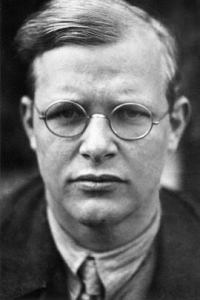 [Occasionally on] Sunday, I will share a quote from something I’ve been reading. The hope is for you, dear reader, to share your thoughts on the quote and related issues and perhaps pick up some reading material along the way!
Death is Hell… if not
I was really blown away by this passage from Bonhoeffer’s works as I was reading through today. Have had a lot of reason to reflect on death/dying recently, and this message was just so powerful to me:
Death is Hell and night and cold, if it is not transformed by our faith. But that is just what is so marvelous, that we can transform death. When the fierce apparition of the death’s head, which frightens us so, is touched by our faith in God, it becomes our friend, God’s messenger; death becomes Christ himself.- Dietrich Bonhoeffer, DBWE 13, 3/3 p. 335, “Sermon on Wisdom 3:3.”
Links
Be sure to check out the page for this site on Facebook and Twitter for discussion of posts, links to other pages of interest, random talk about theology/philosophy/apologetics/movies and more!
On Christian Music– I wrote a post about the label “Christian music” and how that can lead to a number of difficulties with discernment.
Christian Discernment Regarding Music: A Reflection and Response– I reflect in depth on how we can use our discernment properly when it comes to music.
Sunday Quote– If you want to read more Sunday Quotes and join the discussion, check them out! (Scroll down for more)
Eclectic Theist– Check out my other blog for my writings on science fiction, history, fantasy movies, and more!
SDG.
Book Review: “Christ and Revelatory Community in Bonhoeffer’s Reception of Hegel” by David S. Robinson
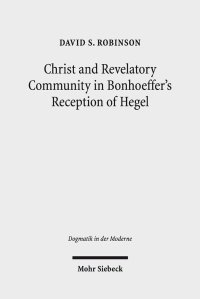 Robinson shows in Christ and Revelatory Community in Bonhoeffer’s Reception of Hegel that Bonhoeffer was influenced by, but also departed from GWF Hegel’s philosophy and theology on a number of key points. The book serves as a way to see Bonhoeffer through a Hegelian lens, and also note how Bonhoeffer developed Hegel’s thoughts in some key ways, particularly related to the community of the church.
Robinson begins with outlining some of Hegel’s thought related to the community and the somewhat elusive Geist (Spirit) in his thought. Then, he turns to Hegel’s incorporation of those ideas into the unfolding of Revelation in history and how Bonhoeffer specifically also incorporated revelation into history. The coming of Christ leads to a new community and the creator-human (Jesus Christ) opens new possibilities for the one and the many to come into conversation with each other. More explicitly, Robinson then turns to Christology in both Bonhoeffer and Hegel. Robinson argues Hegel’s Trinitarian theology–including the was not pantheistic but instead understood relationship as a central aspect of community. Bonhoeffer utilized similar themes in writing about Christ as existing in the community of the church.
One particularly fascinating chapter focused in on Bonhoeffer’s sacramental theology, contrasting it with how Hegel viewed the Eucharist. Bonhoeffer explicitly aligned himself against the Reformed objections to the Lutheran understanding of real presence of Christ in the bread and wine. Franz Hildebrandt, a friend of Bonhoeffer’s, utilized Hegelian thought to counter Karl Barth’s Reformed understanding of “this is my body” (132-134). Bonhoeffer himself incorporated Hegel’s concepts of seeing doctrine ad integral to the community to see Christ present in the Word preached as well as in the sacrament–the est of the sermon and sacrament (142). Hegel’s vision of the Eucharist sees union of objective and subjective into one through Christ, and he sees the Sacrament as the place where the Geist may become indwelling in the human person (146). Such a Lutheran understanding is reaffirmed and even made stronger in Bonhoeffer’s position, as he argues that one cannot distinguish idea from history/nature (though Robinson argues this was not necessarily Hegel’s position; see p. 147ff).
Community continues to be important as the concepts of freedom and revolution arise in Hegel and Bonhoeffer. These are questions of community that must be asked, and the thinkers diverge on this point. Hegel has been seen as an “apologist for Prussia” (169ff), though Robinson argues that he would better be understood as someone seeking Reform within existing institutions (172). Bonhoeffer addresses these questions through confessional space and seeing the church as the body of Christ–Christ existing as community in the church (177ff).
The concept of the Volk–folk–a kind of nationalist precursor to the Nazi ideology in Germany, is one that looms large in Hegel and Bonhoeffer in different ways. Robinson argues that Hegel’s Volkish tendencies were exacerbated and expanded by later Neo-Hegelian thinkers who sought exclusion based upon bloodlines and race, turning Hegel’s concepts of Geist into blood and “racialism” (197-198). Nevertheless, the dominant strand of Hegelian thought that arose in Bonhoeffer’s time was highly tied to Volk and bloodlines, an intensely racist theme that was used by the Nazis. Bonhoeffer, however, was exposed to thinkers apart from Hegel and one of those who helped shape his thought was W.E.B. Du Bois, whose The Souls of Black Folk, Robinson argues, was at least intrinsically influential for Bonhoeffer’s thinking. Both Hegel and Bonhoeffer criticized the state for its treatment of Jews and emphasized their humanity (204-206; 207-09). Hegel’s thought was Eurocentric, despite some aspects of criticizing the nationalism of his peers. Bonhoeffer’s thinking, Robinson argues, became transnational and ecumenical.
Robinson clearly carries the argument that Bonhoeffer was deeply influenced by Hegel’s thought. Whether it was by way of contrast or utilizing similar structure of arguments, Bonhoeffer’s training made him cognizant of Hegelian philosophy and interacted with it at many points.
Christ and Revelatory Community in Bonhoeffer’s Reception of Hegel is a fascinating look at Bonhoeffer’s reception of Hegelian thought. Robinson demonstrates that Bonhoeffer developed some ideas along Hegelian lines, while also sharply breaking from them in some respects. I highly recommend it for those looking to delve deeply into Bonhoeffer’s thought.
Disclaimer: I was provided with a copy of the book for review by the publisher. I was not required to give any specific kind of feedback whatsoever.
Links
Be sure to check out the page for this site on Facebook and Twitter for discussion of posts, links to other pages of interest, random talk about theology/philosophy/apologetics/movies and more!
Book Reviews– There are plenty more book reviews to read! Read like crazy! (Scroll down for more, and click at bottom for even more!)
SDG.
——
The preceding post is the property of J.W. Wartick (apart from quotations, which are the property of their respective owners, and works of art as credited; images are often freely available to the public and J.W. Wartick makes no claims of owning rights to the images unless he makes that explicit) and should not be reproduced in part or in whole without the expressed consent of the author. All content on this site is the property of J.W. Wartick and is made available for individual and personal usage. If you cite from these documents, whether for personal or professional purposes, please give appropriate citation with both the name of the author (J.W. Wartick) and a link to the original URL. If you’d like to repost a post, you may do so, provided you show less than half of the original post on your own site and link to the original post for the rest. You must also appropriately cite the post as noted above. This blog is protected by Creative Commons licensing. By viewing any part of this site, you are agreeing to this usage policy.
“The Dragon Reborn” by Robert Jordan – A Christian (re)reads “The Wheel of Time”
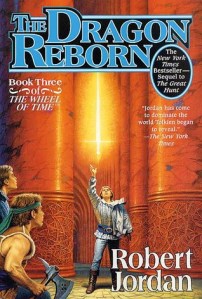 “The Wheel of Time” is a massive fantasy series by Robert Jordan (and, later, Brandon Sanderson) that is being developed into a television show for Amazon Prime. It’s cultural impact is huge, the series having sold more than 44 million copies. Here, we continue the series with Book 3, The Dragon Reborn. There will be SPOILERS in this post for the series.
The Creator, The Dark One, and the Pattern
There are extended portions in The Dragon Reborn that finally begin to draw out the relationship between the Pattern–a kind of stand-in for fate–as well as the Creator and the Dark One. The most extended discussion makes it clear that in this world, the Dark One and even the Creator are subject to the weaving of the Pattern. The Pattern itself runs along the Wheel of Time, setting a course for thousands of years, including the actions of individuals throughout the Pattern. Though the Pattern is active, weaving itself around individuals that have been picked out mysteriously as ta’veren, in the broadest sense, it is predetermined.
This leads to a kind of fatalism among the characters that many of them are constantly striving against. Rand is the most clear example, but the three ta’veren we’ve encountered–Rand, Mat, and Perrin–all work actively to try to thwart the pattern. Yet even their efforts seem to be taken into account and woven therein.
Again, even the Creator is explicitly said to be subject to the pattern, and this becomes an interesting point of worldview later in the series as speculation about the exact meaning of this abounds. Contrasted with the Christian worldview, in which God is radically free to act as God wills (though of course there is some debate about what this may mean), there is a great divide here between the world of The Wheel of Time and the real world.
The Creator
Now that we have some more insight into the notion of a Creator in “The Wheel of Time,” what is interesting is that the Creator here does not necessarily seem to be some kind of omnipotent or omniscient being. We already noted that the Creator seems bound by the Pattern, but we find here that the Creator seems to be a kind of demi-urge; an almost deistic creator who makes the world but then allows it to play out as woven by the pattern. “The Dragon Reborn” really only gives us a few hints of how this plays out, and so we will look at any other time the Creator appears to see what more is revealed.
Prophecy Fulfilled
Another dimension to all of this discussion is the notion of prophecy, which we find out from multiple Aes Sedai exists in huge amounts in the world. There are many, many prophecies of the Dragon, several of which appear to contradict. So for Rand to come and fulfill what is said to be the first step to revealing the Dragon Reborn remains yet something that some people reject. I can’t help but think about the prophecies of the Messiah in the Bible and how many yet did not believe in Jesus. Prophecy in The Wheel of Time can seem confusing and require the eyes of believers to see it. Is the same the case when it comes to Christianity? One example may be that of the virgin birth, a prophecy that was apparently fulfilled in the Old Testament (see Isaiah 7:10-17–the context shows that it was an immediate sign for Ahaz). Prophecy, it seems, is not as black and white as some would like it to be. It can take some discernment to draw out the meaning fully.
Conclusion
The Dragon Reborn is another fascinating step in the world of “The Wheel of Time.” Reflecting on its worldview, it is here we begin to find some of the greatest deviations from Christianity, particularly in its elevation of the Pattern/The Wheel over the power of the Creator and the character of the Creator. However, it is interesting to see how this notion of fatalism truly begins to play out in later books. We’ll delve into those as we go. For now, let me know your thoughts up to this point in the series!
Links
Be sure to check out the page for this site on Facebook and Twitter for discussion of posts, links to other pages of interest, random talk about theology/philosophy/apologetics/movies and more!
Book Reviews– There are plenty more book reviews to read! Read like crazy! (Scroll down for more, and click at bottom for even more!)
SDG.
——
The preceding post is the property of J.W. Wartick (apart from quotations, which are the property of their respective owners, and works of art as credited; images are often freely available to the public and J.W. Wartick makes no claims of owning rights to the images unless he makes that explicit) and should not be reproduced in part or in whole without the expressed consent of the author. All content on this site is the property of J.W. Wartick and is made available for individual and personal usage. If you cite from these documents, whether for personal or professional purposes, please give appropriate citation with both the name of the author (J.W. Wartick) and a link to the original URL. If you’d like to repost a post, you may do so, provided you show less than half of the original post on your own site and link to the original post for the rest. You must also appropriately cite the post as noted above. This blog is protected by Creative Commons licensing. By viewing any part of this site, you are agreeing to this usage policy.
Book Review: “Understanding Scientific Theories of Origins” by Bishop, Funck, Lewis, Moshier, and Walton
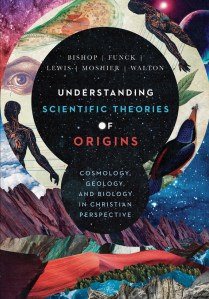 Understanding Scientific Theories of Origins: Cosmology, Geology, and Biology in Christian Perspective is a massive introduction to various sciences alongside Christian thought from the perspective of evolutionary creationists (also known as theistic evolution). It can fairly be said to be the most comprehensive book of which this reader is aware of for giving a broad look at the many related fields in the origins debate within Christianity.
The book is broken into 7 parts: Getting Started on the Journey, which offers 4 chapters on biblical interpretation, doctrine of creation, pursuing origins questions, and seeing science and theology together; Cosmic Origins, which has 6 chapters starting with a look at Genesis and then going through the details of Big Bang theory, Fine-Tuning, and biblical/theological perspectives; Origin and Geologic History of the Earth, which has 8 chapters on the origin and formation of the Earth and Solar system, the history of geology, discussions of the biblical Flood, how we know about geologic timescales, plate tectonics, finding history in rocks and fossils, and biblical/theological perspectives; Origin of Life on Earth, which has 5 chapters discussing spontaneous generation to abiogenesis, the chemistry of prebiotics, biological information, alternate scenarios, and biblical/theological perspectives; Origin of Species and Diversity of Life, which has 5 chapters on the history of the theory of evolution, the modern synthesis, evidence for evolution, developments in evolutionary theory, and biblical/theological perspectives; Human Origins, which has 4 chapters on the biblical story, physical anthropology, genomic evidence, and biblical/theological perspectives on the image of God; and a Concluding Postscript, which is 1 chapter tying things together. The book is about 630 pages of text, with a glossary, general index, and scripture index. Throughout the whole book, there are color illustrations and charts, and it is richly detailed.
To be sure, there are many books with a lot of this information that you can find elsewhere. The things that set this book apart are 1) its comprehensive scope, with experts from various fields contributing huge sections of data and reflections from a Christian standpoint; 2) its one-stop shop type of reference; 3) its extensive look at the scientific evidence for evolution alongside some counters to arguments against it; 4) its accessible format; 5) the wealth of its illustrations (in color!). Many books in the creation-evolution debate have tended to focus almost entirely on theological questions or scientific ones (though I acknowledge there are exceptions). Rarely is the evidence presented in such a balanced fashion, and with such detail when it comes to the scientific arguments. It’s a massive text that is a bit daunting to read cover-to-cover, but the tone is so accessible and the explanations so well-written that it remains interesting and readable throughout.
The book can be read either in individual chapters or front-to-back. Thus, it would be useful as a textbook in many classes, or as a study book, or as a reference tool for interested readers. This is the kind of book that people like this reader have been longing for: a truly broad introduction to the many, many topics that converge upon theories of origins that is presented from a perspective that remains thoroughly orthodox in its theology. Those who oppose evolution will find here not some conspiracy or lies, but rather evidence and data backed with a warm, winsome tone that encourages readers to explore these tough questions.
Some of the most contentious questions, of course, receive the most space. Human Origins, as noted above, has its own entire section with more than 50 pages dedicated to the topic. Some things that struck me in that section were, first, the theological introduction that shows some of the questions that come up even from a “simple” reading of the text. Second, the extensive look at the physical and genomic evidence for human evolution is presented in a straightforward way. From my own background, I tended to think that any such evidence was falsified or simply presented in a misleading way. It would be impossible to accuse the authors here of doing so, as they note (especially earlier in the discussion of evolution) some of the problems with classification. But these problems are not demonstrations of the theory being false; rather, they show that we will probably never have a complete picture. For example, one common charge I have seen is that because scientists cannot put together a sequence of fossils that show human evolution in a chain: A-B-C-D-E-F-G-H but rather that we have an idea that it may be A-D-G-J or something of the sort, this means there is no sequence. But that is demonstrably false. A ladder that is missing a step could still be identified as a ladder, just an incomplete one. Similarly, an incomplete fossil record does not demonstrate there is no such record or series. What’s particularly surprising, though, is how comprehensive the fossil record we do have is, particularly related to human origins. Though the exact sequence will likely be debate in perpetuity, the fact remains that there are many, many, many fossils of clear ancestors of humanity throughout the fossil record, and that a comparison of skulls, MRI measured brain sizes, etc. seems to demonstrate a sequence that does exist, even if incomplete. Of course, there is much more offered in regards to human evolution, such as population genetics, and the like, but the evidence is presented here and is fascinating.
Readers who are wondering about the scientific credibility of evolution will find this an excellent work to pick up. Those already convinced will have a superb introduction to the topic on hand that does not eschew faith for science or vice versa. The authors do a truly commendable job of showing that Christianity does not counter science, and neither does science show Christianity is false.
The chapters on geology are another excellent section, which teach the basics of geology alongside real-world examples that show the principles are sound. Coming from a young earth background, it was the geologic evidence that convinced me some years ago the Earth had to be much older. The authors present real, measurable evidence to show the earth is much more ancient than a few thousand years. But set alongside that is the valuable history of thought surrounding the age of the earth and how these discoveries were made, often by Christian geologists! To see how yes, science has changed as we’ve come to a fuller understanding helps readers understand that as well. The origins of life is another hotly contested area, and the authors do a good job of showing that it remains contentious while there is much work being done that suggests even biological information may have a natural origin. The many theories of origins will continue to be tested and improved, but we should be careful to attempt to plug God into the gap in understanding between what we don’t know yet and what may be discovered. Indeed, some of the scenarios presented for the origin of life continue to gain credibility as tests confirm aspects of their theorizing.
The authors have, with Understanding Scientific Theories of Origins: Cosmology, Geology, and Biology in Christian Perspective , written a book that is sure to be a reference point for years to come. Though science constantly updates and changes with new discoveries and insights, the book is destined to be fruitful for some time. It provides a serious, fairly comprehensive introduction to many of the most hotly contested issues within Christianity today. It comes highly recommended.
Disclaimer: I was provided with a copy of the book for review by the publisher. I was not required to give any specific kind of feedback whatsoever.
Links
Be sure to check out the page for this site on Facebook and Twitter for discussion of posts, links to other pages of interest, random talk about theology/philosophy/apologetics/movies and more!
Book Reviews– There are plenty more book reviews to read! Read like crazy! (Scroll down for more, and click at bottom for even more!)
SDG.
——
The preceding post is the property of J.W. Wartick (apart from quotations, which are the property of their respective owners, and works of art as credited; images are often freely available to the public and J.W. Wartick makes no claims of owning rights to the images unless he makes that explicit) and should not be reproduced in part or in whole without the expressed consent of the author. All content on this site is the property of J.W. Wartick and is made available for individual and personal usage. If you cite from these documents, whether for personal or professional purposes, please give appropriate citation with both the name of the author (J.W. Wartick) and a link to the original URL. If you’d like to repost a post, you may do so, provided you show less than half of the original post on your own site and link to the original post for the rest. You must also appropriately cite the post as noted above. This blog is protected by Creative Commons licensing. By viewing any part of this site, you are agreeing to this usage policy.

 J.W. Wartick - Reconstructing Faith