christian
Book Review: “Placemaking and the Arts” by Jennifer Allen Craft
 Jennifer Allen Craft’s Placemaking and the Arts: Cultivating the Christian Life is one of those books that lives at an intersection of topics one might not normally see as connected. Craft pulls together insights from the Bible and Christian theology on the concepts of place and embodiment with her extensive knowledge of the arts to draw readers’ attention to how our theology of place may be developed and grown.
After a brief introduction, Jennifer Allen Craft provides working definitions of place and art. Place is not merely physical; it involves social relationships, networks of people, and one’s mental states as well. Moreover, space is distinguished from place in that the former is a kind of universal denotation while the latter is particular (8-9). The reason to deal with place as Christians is because it helps answer who we are and why we are here–really here in a sense as embodied creations of God. Art is notoriously difficult to define, and Craft opts for a somewhat general definition, with a few qualifications: art, for her, “will be generally referring to some practice or object of the fine arts…” though she also includes craft, folk art, and other “making” practices (21). Art is important because it helps humans define themselves and relations to others.
Craft argues that the arts can help us to cultivate responsible relationships with the natural world. Integrating nature into our imagination helps us see it as valuable and calls us to protect it. Humans as the image of God can be seen as co-creators rather than simply those exercising conquest of the earth. We participate, through art, in creation and the natural world.
Art can also help in the processes of homemaking and hospitality, each aspects of place that allow us to form our own space. Craft notes the ways that people have created false dichotomies or devalued the arts as well as ways we can correct those misunderstandings. The arts can enter into church as well, leading to worship and the sense of community. Interaction with art can also help stir a sense of wonder at the majesty of God’s creation. The arts can also help Christians see the Kingdom of God on earth and the shaping of that Kingdom in the here and now.
The book is peppered throughout with images, both black-and-white and (in a set of plates in the middle) in color. These help illustrate Craft’s points more vividly and allow the reader to reflect directly upon the themes of the book.
Placemaking and the Arts is a fascinating look at the unity of two themes that aren’t often explored in conjunction. On a higher level, it is a call to Christians to be co-creators with God and to see the impact of the arts on every aspect of our lives.
Disclaimer: I was provided with a copy of the book for review by the publisher. I was not required to give any specific kind of feedback whatsoever.
Links
Be sure to check out the page for this site on Facebook and Twitter for discussion of posts, links to other pages of interest, random talk about theology/philosophy/apologetics/movies and more!
Book Reviews– There are plenty more book reviews to read! Read like crazy! (Scroll down for more, and click at bottom for even more!)
SDG.
——
The preceding post is the property of J.W. Wartick (apart from quotations, which are the property of their respective owners, and works of art as credited; images are often freely available to the public and J.W. Wartick makes no claims of owning rights to the images unless he makes that explicit) and should not be reproduced in part or in whole without the expressed consent of the author. All content on this site is the property of J.W. Wartick and is made available for individual and personal usage. If you cite from these documents, whether for personal or professional purposes, please give appropriate citation with both the name of the author (J.W. Wartick) and a link to the original URL. If you’d like to repost a post, you may do so, provided you show less than half of the original post on your own site and link to the original post for the rest. You must also appropriately cite the post as noted above. This blog is protected by Creative Commons licensing. By viewing any part of this site, you are agreeing to this usage policy.
Book Review: “Twelve Lies that Hold America Captive” by Jonathan Walton
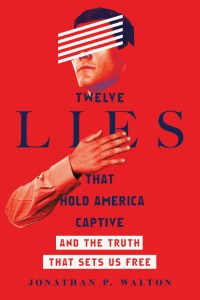 Twelve Lies that Hold America Captive is a provocative title for a book, and the subtitle: “And the Truth that Sets Us Free” only calls for a closer look. Jonathan Walton, in this work, calls for a close look at several pervasive ideas in the United States and calls them out for being mistaken on several counts.
Walton pulls no punches in his denunciation of the mixture of Christianity with nationalism. Early on, he notes that “Many Christians hold the same level of commitment to the Pledge of Allegiance that they hold to the Apostles’ Creed” (12). One could go on from this statement and note that plenty of Christians likely have the former memorized but know almost nothing about the formulation of the Apostles’ belief as outlined in the Creed. What does this say about the allegiance of American Christianity? Walton continues to press this kind of point throughout the book.
What are the twelve lies? They are: We are a Christian Nation; We All Are Immigrants, We Are a Melting Pot, All Men Are Created Equal, We Are a Great Democracy, The American Dream is Alive and Well, We are the Most Prosperous Nation in the World, We Are the Most Generous People in the World, America Is the Land of the Free, America Is the Home of the Brave, America Is the Greatest Country on Earth, and We Are One Nation. One’s visceral reaction to seeing these sentiments as “lies” is a good guide for how much this book is needed. I personally had a negative response to calling some of these lies, but as Walton drew out his meaning and the implications for a Christian life, came to find myself in agreement on most of his points.
Walton continues to make convicting points throughout the book. For example, while talking about the lie that “All Men are Created Equal,” Walton notes that it encourages us to see all achievement as personal success, thus leading to a kind of works righteousness in which if one just does what they ought, they receive (financial) reward. It’s a distortion of the Christian message, and ignores real, societal challenges to success that exist. It also encourages the vision of politeness rather than true kindness. Walton writes, “Preserving the image of a society that is polite and respectful and rewards hard work and grit is more important than genuine kindness, justice, and living like every person is made in the image of God” (65). It is this kind of insight and call to true Christianity that is found throughout the book.
Each chapter goes back to the Bible and Christianity to find a truth instead of the lie that nationalism and what Walton calls “White American Folk Religion” offers. For example, in the chapter on the “melting pot,” Walton points out that God’s kingdom is not a melting pot and instead that it will have every tribe, tongue, and nation–that God’s Kingdom is “shalom [peace] amid difference” (57). Again, the book is filled to the brim with this kind of insight.
Twelve Lies that Hold America Captive is a thoughtful, challenging book. It calls Christians to do better–to see beyond themselves and even their country to the ties that bind us all together in Christ. I recommend it very highly.
Disclaimer: I was provided with a copy of the book for review by the publisher. I was not required to give any specific kind of feedback whatsoever.
Links
Be sure to check out the page for this site on Facebook and Twitter for discussion of posts, links to other pages of interest, random talk about theology/philosophy/apologetics/movies and more!
Book Reviews– There are plenty more book reviews to read! Read like crazy! (Scroll down for more, and click at bottom for even more!)
SDG.
——
The preceding post is the property of J.W. Wartick (apart from quotations, which are the property of their respective owners, and works of art as credited; images are often freely available to the public and J.W. Wartick makes no claims of owning rights to the images unless he makes that explicit) and should not be reproduced in part or in whole without the expressed consent of the author. All content on this site is the property of J.W. Wartick and is made available for individual and personal usage. If you cite from these documents, whether for personal or professional purposes, please give appropriate citation with both the name of the author (J.W. Wartick) and a link to the original URL. If you’d like to repost a post, you may do so, provided you show less than half of the original post on your own site and link to the original post for the rest. You must also appropriately cite the post as noted above. This blog is protected by Creative Commons licensing. By viewing any part of this site, you are agreeing to this usage policy.
The Lutheran Church-Missouri Synod and Creationism: An Unnecessary Match
 The Lutheran Church-Missouri Synod, at their 2019 convention, re-iterated an affirmation and strengthened adherence to statements about creation and evolution made previously by Synod bodies. Res. 5-09A, according to the report from the LCMS, restates the position of earlier statements in the Synod, including a 1932 doctrinal statement that states, among other things:
We reject every doctrine which denies or limits the work of creation as taught in Scripture. In our days it is denied or limited by those who assert, ostensibly in deference to science, that the world came into existence through a process of evolution; that is, that it has, in immense periods of time, developed more or less of itself. Since no man was present when it pleased God to create the world, we must look for a reliable account of creation to God’s own record, found in God’s own book, the Bible. We accept God’s own record with full confidence and confess with Luther’s Catechism: “I believe that God has made me and all creatures.”
In effect, the Resolution (Res. 5-09A) is a significant and modern reiteration of creationism within the LCMS, specifically of young earth creationism. Thus, it also more emphatically excludes and alienates those within the Synod who do not affirm such a position and who have explored the possibility of other positions within the church.
I believe God has made me and all creatures?
There are a number of problems, of course, with such a statement. The quote provided above issues a bald appeal to Luther’s Small Catechism with the statement that “I believe God has made me and all creatures.” On the surface, this appears to be an attempt to use that quote to support direct, fiat creationism. Yet when one reads the rest of that section of the Small Catechism, one finds that the same exact section also states “[God] also gives me clothing and shoes, food and drink, house and home, wife and children, land, animals, and all I have. He richly and daily provides me with all that I need to support this body and life.” Yet the LCMS is not also passing resolutions that affirm direct, fiat action by God in the providing of our clothes, food, drink, shoes, house, and home. They’re not passing resolutions in which Synod laity is expected to affirm that God literally created their clothing and gave it to them directly. But the Catechism does make those statements in the exact same context, without any such qualification. This means that the Catechism does not exclude means when it comes to divine providence regarding these matters. God uses means to provide us with food, home, and clothing. Similarly, God may have used means when it comes to “God made me and all creatures.”
The appeal to the lack of humans being present at creation cuts both ways. No member or pastor in the LCMS was present when God created the heavens and the Earth, so how is it that they may define in more exacting detail how God created them? Indeed, they say that we ought to look at God’s own record, which explicitly states that the heavens declare God’s glory. Scientists have looked to the heavens to see direct evidence of God’s glorious creation. Such evidence, God’s “speech” from the heavens (Psalm 19), points to a universe much, much more ancient than the six- to ten-thousand years most young earth creationists affirm, especially those who are so exacting in defining days as “6 natural days” (more on that below, though).
Six Natural Days?
The Resolution (5-09A) reiterates that creation is in “6 natural days.” But the fact is that the concept of a day as 24 hours is itself a giving into cultural norms of our own time. The length of a day has changed through history, as is demonstrable from such things as the variance in Earth’s rotation, tidal forces, and more can and have changed the length of the day, either permanently or for short periods of time (read more on this phenomenon here). Now, these fluctuations are extremely minor, so the objection may be lodged that this doesn’t impact the concept of a “24 hour day” or a “natural day.” Once one does admit that minor variations are acceptable, however, it becomes much less clear why major variations or even different meanings may not be explored. After all, nothing in the Bible states that God held the Earth in a completely still, static state as the creation week continued. It may be the case that even with a “standard” or “natural” day, the actual duration of each of the 6 days of creation could have varied. So, again, the very concept itself is flawed, for it both reads into the Bible things that are not there and ignores actual observational evidence that it is wrong. In attempting to circumvent science and purely affirm Scripture, the LCMS has fallen into the trap of bringing along scientific presuppositions that are hidden in the premises of their statements, thus doubling the error by both affirming a non-scientific viewpoint and smuggling in scientific assumptions that undermine their position.
Consequences of the Position
The fact is that the LCMS attempt to “take a stand” on this issue places it squarely and officially outside of any possibility for youths or adults to reconcile the official stance of their denomination with modern science. As someone who was within the LCMS and is no longer, I can say that this is one of the reasons I left. The total disregard for any viewpoint that went against a (then unofficial) stance on the timing and/or means of creation as well as the lack of regard for science generally was a massive difficulty for me within the denomination. Making this the official stance will do nothing but exacerbate that same concern for many, many more. I distinctly recall several conversations with other LCMS people, young and old, about how the denomination’s stance on creation was a significant hurdle for them in their faith life.
This is about much larger issues than whether the LCMS will lose or gain members; it is about the actual faith lives of those within the denomination. By drawing the wagons in tighter in the circle, the LCMS pastors have rejected the duty to be pastoral to their congregants and aligned their church body with a statement that cannot be reconciled with mainstream science with mountains of data and evidence to support it. Youths will be told that not to affirm this “6 natural day” creation is to oppose the Bible, and because the LCMS has so strongly emphasized that to believe as they do just is to trust the Bible, such a rejection will lead to crises of faith. As someone who experienced this in my own life, this is deeply disturbing and disappointing. The church body has effectively taken a stance on a non-essential that will lead to many questioning essential issues.
There are many, many more issues with the stance of the LCMS here, as well. For example, in my own experience I have seen several LCMS churches utilize program materials from creationist organizations like Answers in Genesis. Yet, for all the LCMS purports to value doctrinal purity and affirm centrally Lutheran beliefs, their support for groups like Answers in Genesis shows that the Synod is far more interested in aligning with broad evangelical theology than in maintaining a distinctive Lutheranism. The use of youth materials from Answers in Genesis is troubling, not only because it stands so clearly against modern science, but because Answers in Genesis also uses its website to promote non-and even anti-Lutheran positions on things like baptism. For example, a search for “baptism” on the Answers in Genesis Website yields immediate links like this one, a sermon from Charles Spurgeon, in which he states:
the very great majority of Christian people think infant children are fit and proper subjects for this ordinance [baptism]; we, on the other hand, believe that none are fit and proper subjects for the ordinance of baptism, except those who really believe and trust in the Lord Jesus Christ as their Saviour and their King.
Yet the LCMS, an unashamedly Lutheran organization, is perfectly willing to hold hands with an organization that promotes strictly anti-Lutheran materials as top results on its website? Why? Because, again, the LCMS has fallen into the trap of valuing evangelicalism and the narrative of the “culture wars” more than it values its own adherence to Lutheran doctrine. This strong and hard stance on young earth creationism is just one of the many results of such a capitulation, but it is also one of the most vehement positions the LCMS is promoting within its churchwide body.
A Personal Appeal
The LCMS recently published a report in which it was revealed that the “2017 Confirmation Survey identified around a 1-in-3 rate of retention for individuals after confirmation” in the LCMS. This number spawned a number of discussions and responses to it. One such response, the “Executive Summary” of the survey, stated as a category that “Congregations must be safe places for young people to wrestle with life and faith in order for them to faithfully reach out to today’s culture.” Taking such a hard stance on a scientific issue that the LCMS is unwilling or unable to actively engage with (as shown by reliance on outside resources like Answers in Genesis) is the exact opposite of being a “safe place for young people to wrestle with life and faith…” It was not a safe place for me, personally, as I dealt with some of these difficult topics. I came very near to leaving the faith entirely, and it was ironically an LCMS person who said that Jesus resurrection didn’t hinge upon whether the Earth was 10,000 or 10 billion years old that helped me rethink my faith. But now, the LCMS has made even that slight possibility outside the bounds. Their statement has tied people’s faith with the age of the Earth, and that should not and must not be the foundation for any Christian faith whatsoever.
Links
Be sure to check out the page for this site on Facebook and Twitter for discussion of posts, links to other pages of interest, random talk about theology/philosophy/apologetics/movies and more!
Gregg Davidson vs. Andrew Snelling on the Age of the Earth– I attended a debate between an old earth and young earth creationist (the latter from Answers in Genesis like Ken Ham). Check out my overview of the debate as well as my analysis.
Ken Ham vs. Bill Nye- An analysis of a lose-lose debate– In-depth coverage and analysis of the famous debate between young earth creationist Ken Ham and Bill Nye the science guy.
SDG.
——
The preceding post is the property of J.W. Wartick (apart from quotations, which are the property of their respective owners, and works of art as credited; images are often freely available to the public and J.W. Wartick makes no claims of owning rights to the images unless he makes that explicit) and should not be reproduced in part or in whole without the expressed consent of the author. All content on this site is the property of J.W. Wartick and is made available for individual and personal usage. If you cite from these documents, whether for personal or professional purposes, please give appropriate citation with both the name of the author (J.W. Wartick) and a link to the original URL. If you’d like to repost a post, you may do so, provided you show less than half of the original post on your own site and link to the original post for the rest. You must also appropriately cite the post as noted above. This blog is protected by Creative Commons licensing. By viewing any part of this site, you are agreeing to this usage policy.
Book Review: “Bonhoeffer’s Black Jesus: Harlem Renaissance Theology and an Ethic of Resistance” by Reggie L. Williams
 Reggie L. Williams’s Bonhoeffer’s Black Jesus is a deep look at how Bonhoeffer’s experience in New York, and more specifically in Harlem, shaped him as a theologian of resistance against Hitler. It’s not just that, though, as it also traces Bonhoeffer’s intellectual development, specifically about racism, both before and after this epochal change.
First, Williams outlines the early theological development of Bonhoeffer, tracing his early intellectual development as well as his struggles to find a church home while visiting the United States. Here, in the United States, Bonhoeffer first encountered white racial terrorism in the form of lynching. Later, he would appeal to a German theologian to speak out against the charade of trials against in Scottsboro, in which nine black men were falsely accused of raping two white women. Eight of them were sentenced to death and killed. This caused something of an awakening for Bonhoeffer to racial violence, though he still had to become aware of his own biases.
The movement of Bonhoeffer from a proponent of volk (the German word for “Folk) type nationalism to a race-conscious and anti-racist perspective is one of the most fascinating portions of Williams’s research. While Bonhoeffer retained several core convictions throughout his life, his thought about race was directly impacted by his time in Harlem. Germany had been a colonial power until the Treaty of Versailles assigned the nation’s colonies to the winning powers, and many German people longed for that Imperial power once again. Williams demonstrates that Bonhoeffer’s own thought was impacted by this, particularly when he surveys Bonhoeffer’s early sermons and discussions of the concept of volk.
Williams then draws an outline of the Harlem Renaissance, including major thinkers and themes, as well as how some of these thinkers and themes explicitly or implicitly show up in Bonhoeffer’s works. Unfortunately, at least one of the works that would provide more insight into this has been lost (a paper Bonhoeffer wrote on black thinkers while in the United States). Nevertheless, Williams demonstrates that the themes of the Harlem Renaissance, along with Bonhoeffer’s own time in Harlem, became deeply influential on his later life. It is in this section that Williams does the most to bring to light strands of thought in Bonhoeffer that might otherwise be missed. Specifically, he traces the constant theme of Jesus identifying with the marginalized as something that would lead to active theology of resistance in Bonhoeffer’s thought. This theme is highlighted both in the thought of W.E.B. Du Bois and the poem “Black Christ” by Countee Cullen, which Bonhoeffer was aware of. The latter is lain out in detail, and shows both how Harlem Renaissance theology could be linked to liberation theology and how Bonhoeffer’s thought developed along that direction as well. It was black thinkers who helped awaken in Bonhoeffer a truly great desire for resistance against racism.
Another major theme of Williams’s work is that of empathy. He argues throughout that Bonhoeffer’s move towards empathy was something that he found through observing segregation in the United States and the resistance to it in Harlem. This, Williams argues, developed into a “Christ-Centered Empathic Resistance,” which is the last part of Bonhoeffer’s life as he actively worked against the Nazis in Germany.
The bulk of Williams’s work focuses on Bonhoeffer’s time in the United States, supporting his theses with meticulous notes and documentary evidence. The endnotes are full of additional argumentation as well as sources and reading.
Bonhoeffer’s Black Jesus is an essential read for those interested in Bonhoeffer’s theology of resistance. More than that, Williams provides here both an historic overview of Bonhoeffer’s thought and the ways in which one might develop him further. The unity of Bonhoeffer’s thought with Harlem Renaissance thinking and the movement of that into modern movements for societal justice is another major theme in the book. It’s a rare work that surveys the thought of a thinker while also offering insight into how modern thought might move forward along the same lines or go beyond its subject. Highly recommended.
Links
Be sure to check out the page for this site on Facebook and Twitter for discussion of posts, links to other pages of interest, random talk about theology/philosophy/apologetics/movies and more!
Book Reviews– There are plenty more book reviews to read! Read like crazy! (Scroll down for more, and click at bottom for even more!)
SDG.
——
The preceding post is the property of J.W. Wartick (apart from quotations, which are the property of their respective owners, and works of art as credited; images are often freely available to the public and J.W. Wartick makes no claims of owning rights to the images unless he makes that explicit) and should not be reproduced in part or in whole without the expressed consent of the author. All content on this site is the property of J.W. Wartick and is made available for individual and personal usage. If you cite from these documents, whether for personal or professional purposes, please give appropriate citation with both the name of the author (J.W. Wartick) and a link to the original URL. If you’d like to repost a post, you may do so, provided you show less than half of the original post on your own site and link to the original post for the rest. You must also appropriately cite the post as noted above. This blog is protected by Creative Commons licensing. By viewing any part of this site, you are agreeing to this usage policy.
Book Review: “Phoebe: A Story” by Paula Gooder
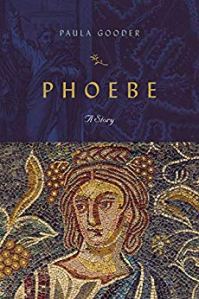 Phoebe: A Story by Paula Gooder is two books in one: a fictional picture of what Phoebe’s life and society might have looked like; and an academic exploration of this same society, world, and individual.
Paula Gooder writes in a style that is engaging and informative. The plot of the narrative section grabbed my interest from the get-go with its interweaving of biblical details with background information from historical studies as well. The main plot is of interest, following Phoebe through potential struggles and a narrative that gives readers rich imagery of what house churches were like and how these could have differed in different places due to income levels, the patrons, and the like. Gooder gives a vital look into the life of early Christians, doing so in a way that is winsome in style. What’s interesting is that, due to the integration of some biblical persons, I as a reader was hyper-aware of these characters. I have to say, I was a bit sad that I didn’t love Junia as a character in Gooder’s book as much as I’d have hoped. But Gooder makes these characters seem true to life, with real motivations and interests beyond simply being set pieces for teaching readers about early Christianity.
The second part is full of notes that bring historical and theological insight into the narrative woven throughout the book. They provide justification for various narrative choices, background information about how things may have been in the early church, and are full of rich details about Christian life. Gooder’s research is quite thorough and will give interested readers more avenues for exploration.
Readers should note that the book is probably best enjoyed with one finger in the endnotes to integrate those notes into their reading of the narrative. I saw the notes section at the back, but read the book front-to-back, thinking that since the notes were called “Part 2,” it made sense to read Part 1 and then 2. But doing so meant I missed out on several key points of interest within the narrative, which meant I went back and re-read portions to make more sense of what Gooder was saying. The book doesn’t have an introduction or preface to recommend this reading order, so be aware of it.
Readers will find much of interest in Phoebe: A Story. From the background information to the more intimate picture of what life may have looked like in the early church, this book is well-worth the time investment. Recommended.
Disclaimer: I was provided with a copy of the book for review by the publisher. I was not required to give any specific kind of feedback whatsoever.
Links
Be sure to check out the page for this site on Facebook and Twitter for discussion of posts, links to other pages of interest, random talk about theology/philosophy/apologetics/movies and more!
Book Reviews– There are plenty more book reviews to read! Read like crazy! (Scroll down for more, and click at bottom for even more!)
SDG.
——
The preceding post is the property of J.W. Wartick (apart from quotations, which are the property of their respective owners, and works of art as credited; images are often freely available to the public and J.W. Wartick makes no claims of owning rights to the images unless he makes that explicit) and should not be reproduced in part or in whole without the expressed consent of the author. All content on this site is the property of J.W. Wartick and is made available for individual and personal usage. If you cite from these documents, whether for personal or professional purposes, please give appropriate citation with both the name of the author (J.W. Wartick) and a link to the original URL. If you’d like to repost a post, you may do so, provided you show less than half of the original post on your own site and link to the original post for the rest. You must also appropriately cite the post as noted above. This blog is protected by Creative Commons licensing. By viewing any part of this site, you are agreeing to this usage policy.
Book Review: “Atheism? A Critical Analysis” by Stephen E. Parrish
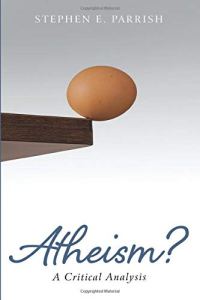 Stephen E. Parrish analyzes atheism with the sharpest tools of analytic philosophy in his latest book, Atheism? A Critical Analysis. After an introductory chapter looking at the issues at hand (circularity, the meaning and extent of worldview, definitions of key words like faith, and the specific type of atheism he’s analyzing–the most prominent one in contemporary philosophy today, naturalistic atheism), Parrish takes up the task of inspecting atheism from all sides, with chapters on competing theories of existence, the existence and order of the universe, the existence of the mind, ethics, and beauty and evil.
The chapter on competing theories of existence is insightful as it both helps divide different worldviews and categorize them and offers a fuller look at what Parrish calls ‘perfect being theism’ which is essentially classical theism sans a strong view of divine simplicity. With definitions under the belt, Parrish then dives into the critical analysis of naturalistic atheism.
The first question explored is that of the universe’s existence and order. Here, Parrish surveys the various possibilities. On naturalistic atheism, the universe may either exist by chance or necessity. He then offers deep analysis of each possibility. The concept of brute fact–that the universe just exists as it does by chance–is, frankly, brutalized in Parrish’s analysis. For example, the idea that our universe is the way it is and ordered because it just happens to be the one in an untold trillions chance that we exist and observe it, and that any other universe would have been just as likely, so we just happened to be likely, does not stand up to scrutiny when one also factors in the selection of an orderly, life-permitting universe like our own. As Parrish’s example points out, if we roll one trillion fair/unloaded dice, what is the likelihood of getting a six on every roll? Each additional sequence would be exponentially less likely. Then, if one rolls the trillion dice a trillion times, the odds of getting this sequence is remote in the extreme. That is, unlikely dice rolls are much, much, much more likely than lucking out and selecting the desired sequence of all 6 rolls. So even if there are an infinite number of possible universes, there is still a set of universes within that overall set of possible universes which would be infinitely less likely to exist, for we’d be trying to select a specific universe with a specific set of circumstances (eg. our own, as opposed to one in which no life is possible, or all that exists is a single star, or a black hole or something of the sort). So brute fact theory still has not accounted for the unlikely nature of our own universe. It is, effectively, equivalent to hand waving and saying the odds don’t matter, we just exist. Calling that an explanation for the existence of the universe is a misnomer at best (see Parrish’s analogy on p. 118). The universe as existing with necessity is analyzed by Parrish in a similar, thought-provoking fashion.
The existence of mind is the next question, and Parrish has done significant work on this question from a philosophical perspective in another work of his, The Knower and the Known (see my two part review: part 1, part 2). Here, Parrish offers a more succinct but nevertheless thorough analysis of the major philosophical positions on the mind from a naturalistic perspective. After a survey of the main options (eg. eliminativism, identity theory, supervenience, and more), he turns to pointing out problems with materialism such as the relationship between the brain and consciousness (146-147), the notion that consciousness is an illusion (147-148), and intentionality–that thoughts sem to be about things (148). Dualism, Parrish notes, has its own set of difficulties, but theism is able to offer a better explanatory power than naturalism because theism has reality as fundamentally personal due to the personal nature of God, thus allowing for an explanation for mind that does not reduce it to nothing, make it illusory, or any other position that suffers from the problems of effectively making consciousness a fiction, or, minimally, a non-intentional state (163).
The next two chapters cover ethics, value, and beauty and note how though these things seem to be observable aspects of our universe, naturalistic atheistic attempts to explain them fail on a number of levels. In particular, they struggle to explain how they can either exist or be objective. Two appendices at the end of the book provide a look at atheism’s ideological development and the social impacts of atheism. The latter appendix is particular aimed to be an answer to those that charge religion specifically is the cause of the worst of society’s ills.
Of the admirable aspects of this book, there is a noted effort to both present the strongest arguments atheists have to offer, including such noted names as J.L. Mackie and Graham Oppy, and an effort in tandem to avoid making arguments that not all Christians could agree with (eg. avoiding making something like ID theory a primary pillar of analyzing atheism in regards to natural order).
It should be noted that this work is intended for a more general audience, with more analogies and basic information presented than in Parrish’s other work. Nevertheless, it still remains deep and incisive in its reasoning and analysis, and readers of any level of expertise in relevant areas will find parts of interest. It would be hard to find a more well-reasoned, deeper look at analyzing atheism in the analytic tradition in a way that is written with accessibility to a more general readership in mind. Words and phrases like “worldview” and “probability structure” are utilized throughout the text, but Parrish defines them in the introductory chapters in such a way that readers will be able to grasp them. When it comes to the analysis itself, because of his engagement with major thinkers and positions in modern atheism, the book will be useful to any reader who finds the topic of interest. Atheism? A Critical Analysis comes recommended without reservations. Any reader can benefit from this extraordinary work.
Full Disclosure: I am named in the acknowledgements of the book, read an early draft, and provided some feedback on the early draft as well. I received a review copy from the author.
Links
Be sure to check out the page for this site on Facebook and Twitter for discussion of posts, links to other pages of interest, random talk about theology/philosophy/apologetics/movies and more!
The Knower and the Known by Stephen E Parrish– I wrote an extensive two-part review of Stephen E. Parrish’s book on dualism and naturalistic theories of mind. See the second part as well.
Book Reviews– There are plenty more book reviews to read! Read like crazy! (Scroll down for more, and click at bottom for even more!)
SDG.
——
The preceding post is the property of J.W. Wartick (apart from quotations, which are the property of their respective owners, and works of art as credited; images are often freely available to the public and J.W. Wartick makes no claims of owning rights to the images unless he makes that explicit) and should not be reproduced in part or in whole without the expressed consent of the author. All content on this site is the property of J.W. Wartick and is made available for individual and personal usage. If you cite from these documents, whether for personal or professional purposes, please give appropriate citation with both the name of the author (J.W. Wartick) and a link to the original URL. If you’d like to repost a post, you may do so, provided you show less than half of the original post on your own site and link to the original post for the rest. You must also appropriately cite the post as noted above. This blog is protected by Creative Commons licensing. By viewing any part of this site, you are agreeing to this usage policy.
Junia and Bayesian Epistemology: Philosophical probability trumping Biblical scholarship?
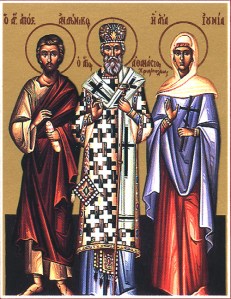 Alexander Pruss is one of the smartest people I’ve encountered. Though I don’t always agree with his conclusions, the sharpness of his intellect and his wit is always fascinating. His blog is frequently a place to flex mental muscles, as he offers small, one-off arguments to spur discussion. Recently, he wrote a post entitled “Junia/Junias and the base rate fallacy” Pruss argued that application of Bayesian analysis to biblical scholarship would help solve the question of whether Junia/Junias was an apostle. Apologies in advance for possible lack of care with terms like “factor,” “probability,” and “odds”; I tried to be careful but I’m tired.
The Argument
The preliminaries are explanations of Bayes’ Theorem and the meaning of the “base rate fallacy,” both of which are easily searched online, but I provided the links here (with all the caveats that a little bit of knowledge is a dangerous thing and Wikipedia articles don’t make anyone an expert). With that information in mind, we approach Pruss’s argument.
Pruss does fudge the numbers some, admitting he hasn’t explored the question on the actual numbers for some of these probabilities. So, for example, he begins by giving a 9:1 factor for Junia:Junias names in the early church. With that, and with the note that to avoid the base rate fallacy, we ought to assign a probability (he gives .9) to the question of whether this person was “among” the apostles, it yields a .19 rate of false positives for people who are not woman apostles to be assigned the notion of being a woman apostle. Moreover, if we say that there are 12 male apostles (the disciples) for every one female apostle (Junia), the probability of an apostle being a woman is now 1/13. Finally, because “not everyone Paul praises is an apostle” we have to assign a probability to whether Paul is praising an apostle here (Pruss gives it .3). This means that “the chance that a randomly chosen person that Paul praises is a female apostle even given the existence of female apostles is only about (1/13)×(1/3) or about three percent.”
Plugging in the .19 we got above for false positives and doing more math (read his post), we now discover that “even assuming that some apostles are female, the probability that Junia/s is a female apostle is at most about 14%, once one takes into account the low base rate of women among apostles and apostles among those mentioned by Paul.”
Pruss immediately notes the numbers are made up and could change the overall results.
Analysis
There are some significant problems with Pruss’s argument here. First, the fact is that there is no extant name “Junias/Junianias” found anywhere in lexical evidence whatsoever. Thus, instead of .9 for Junia being a woman, it should be 1. One comment pointed this out and Pruss pressed the argument that even in this case, the math would still be “significantly less than 50%” for Junia to be a female apostle. Doing the math is too hard for my tired brain, but let’s just say he’s right. The question still remains of why the chances for Junia to be a female apostle would be so low.
Looking at his other percentages, it seems a large part of the argument, once we’ve established Junia is female, turns on whether it is the case that she may not be “among” the apostles. Pruss’s position here falls into the goalpost moving arguments that complementarians have engaged in since the lexical evidence turning her into a man came up dry. Typically, this is how it goes:
Junia was not a man => Okay, Junia was not an apostle => Okay, Junia was not the type of apostle that was authoritative
The third stage above is one that is essentially a theological fiction supported almost entirely by punting to the fallacious importation of the semantic range of a word into a foreign context. When Paul wrote to say that Junia was an apostle, according to this argument, but she was one only in the semantic meaning of the word apostle as witness/sent one/messenger. Never mind that the word is used for an office in the New Testament, including in the writings of Paul (1 Corinthians 12:28). No, because it does not serve the purpose of continuing to prevent women from holding pastoral office, the entire semantic range of meaning for the word “apostle” must be imported in order to reduce Junia in status once again. This fallacious importation of meaning is a demonstration of an ad hoc explanation. (Unfortunately, Pruss himself succumbs to this goalpost moving argument in the comments on this post when he questions whether Junia as an apostle would be an authoritative apostle or not.)
But it is the second stage that is at question initially, and here, once again, it seems that the importation of complementarian assumptions into the text has occurred, for this reading goes against the earlier known readings from church fathers (see here, for example) which saw Junia as an apostle and did not import the lexical range of the word into “among” either. So, again, the factor needs to be moved from .9 to 1.
The proportion of male:female apostles is made up, as Pruss acknowledges. It’s possible that the reality is 1:1 or 100:1. So it would be possible to move numbers around to make it either extraordinarily likely Junia was a woman apostle or unlikely. It also seems to me the 1/3 possibility that Paul is praising an apostle seems high. So again, this would potentially lower the probability for Junia as a woman apostle. It could raise it, though that seems unlikely given the biblical text. Nevertheless, significant gains were made with “Junia” being established as the name and being among the apostles. And, the question of just how likely something ought to be in order to be epistemically justified in believing it is itself a matter of very hot debate. If, say, the likelihood for Junia being a woman apostle were 33%, would someone be justified in holding that belief? The answer to that question is very messy indeed.
But the most relevant evidence, the most clear counter-point to Pruss wasn’t even considered. That is this: using prior probability to determine the likelihood of an event does not matter if the event has already occurred. That is, if it is the case that Paul does name a woman apostle, then whether or not this was likely or unlikely given any number of other prior probability considerations does not change what Paul does in Romans 16:7. And while Pruss tries to say that his use of Bayesian theorem ought to somehow guide biblical scholars in their reading of this text, what he doesn’t consider is that highly improbable events do occur and that if they do, whether or not the event is improbable does not impact the event’s actually having occurred. Indeed, it is unclear as to why a biblical scholar should take such prior probability into account to begin with (apart from, potentially, taking caution with offering interpretations that are particularly unlikely). Suppose that the name were not Junia but Rebecca and the Greek text were so clear as to make it impossible to take it as anything but “among the authoritative apostles” (despite their being no use of this term in the NT and it being a demand for evidence by complementarians that they cannot meet for people they themselves admit to being apostles). What then? Would a scholar be justified in dismissing the sentence written by Paul that “Rebecca was an authoritative office-holding apostle” simply because of prior probabilities? It seems obvious the answer is no. So then the question is why should the biblical scholar be beholden to prior probabilities in a supposedly less clear case (and again, I by no means grant that it is unclear)? Again, the answer seems to be that the scholar ought not to worry about that, given the relevant data is directly in front of them.
Conclusion
Bayesian reasoning is interesting. I’ve enjoyed reading about it and learning about it from time to time. Whether or not it is helpful to theological questions is a concern for a different time, though it is a fascinating question to ponder (related questions such as how can we fill in sometimes arbitrary probabilities for certain events/people/etc. and still think the theological reasoning is sound would be interesting to explore in depth). In this specific case, though, it seems clear that Pruss’s argument fails for several reasons. All of these center around the actual meaning of the text (the name Junia and the meaning of “among the apostles”) which no amount of external probabilities can alter. Pruss’s argument is a fun mental exercise that need not undermine confidence in the data of the text itself: Junia was a female apostle. Pruss’s claim that biblical theologians ought to use Bayesian reasoning in their exegesis does not seem to be sustained by this example.
Links
A Brief Biblical Proof for Women Pastors– Read why 1 Corinthians 12:28 is an even bigger problem for complementarians, as it effectively guarantees women may hold the same or more authority than that of pastors.
On the Femnization of the Church– It is frequently alleged that the church is being “feminized” and that this is a bad thing. Check out this post, wherein I analyze this notion from a few different angles.
Women in the Ministry: The philosophy of equality and why complementarianism fails– I argue that the position in which women are excluded from church leadership entails inequality of being.
SDG.
——
The preceding post is the property of J.W. Wartick (apart from quotations, which are the property of their respective owners, and works of art as credited; images are often freely available to the public and J.W. Wartick makes no claims of owning rights to the images unless he makes that explicit) and should not be reproduced in part or in whole without the expressed consent of the author. All content on this site is the property of J.W. Wartick and is made available for individual and personal usage. If you cite from these documents, whether for personal or professional purposes, please give appropriate citation with both the name of the author (J.W. Wartick) and a link to the original URL. If you’d like to repost a post, you may do so, provided you show less than half of the original post on your own site and link to the original post for the rest. You must also appropriately cite the post as noted above. This blog is protected by Creative Commons licensing. By viewing any part of this site, you are agreeing to this usage policy.
What if?
What if we loved our neighbor as much as we loved our soldiers?
Who is my neighbor?
Illegal immigrant
Refugee from afar
What if we loved illegals as much as we loved our soldiers?
What if we loved our neighbor as ourselves?
What if we didn’t say #notall but instead said #nomore?
What if we didn’t say #alllives but asked what can we do?
What if we loved the “other” as ourselves?
What if we let Jesus be as radical a challenge to our lives as we ought?
What if we took it seriously that “it is easier for a camel to go through the eye of a needle than for someone who is rich to enter the kingdom of God”?
The United States is one of the wealthiest countries in the world
What does that mean for us?
What if we asked ourselves to examine what we believe?
In which place does “America First” leave God?
“Frederick Douglass: Prophet of Freedom” by David W. Blight- A prophet for then and now
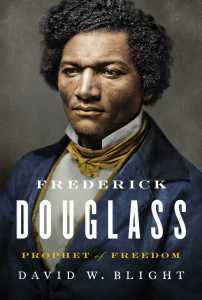
[H]e is the lover of his country who rebukes and does not excuse its sins. –Frederick Douglass (quoted on p. 361)
Frederick Douglass is one of the most important thinkers in the history of the United States. David W. Blight’s fantastic biography, Frederick Douglass: Prophet of Freedom shows the man in a way I hadn’t met him before, despite reading one of his three (!) autobiographies. I write in this post that he is a prophet for then and now because much of what Douglass had to say can still apply to today. His philosophical insight, his way of speaking, and his life’s devotion to a cause are things we can think on and emulate to this day.
Frederick Douglass was born into slavery, took help where he could, taught himself to read and write, and escaped from slavery. He became one of the most traveled people of his century, a prolific speaker, writer, abolitionist, and philosopher. Blight uses the term “prophet” in the way that highlights Douglass’s words to moral persuasion, just as so many of the Old Testament prophets did. And Douglass was a deeply Christian man who saw two faiths that were incompatible co-existing in the United States: the religion of slaveholding and the religion of Christ.
Douglass existed in a place where few others did. A former slave, he told firsthand accounts of the brutality of that horrific system and its injustice. Working with white abolitionists, he favored more radical views and even, at times, the perfectionism of some aspects of the abolitionist movement, while also moderating some of his positions depending upon the crowd to which he spoke. An insightful, lucid thinker, he called injustice to account and pointed out the true hypocrisy of people calling themselves Christians while perpetrating awful deeds. One example of the clarity of thought he provided united with his “radical” persuasions about antislavery can be found in his philosophical argument about the morality of the slaveholder and slave: “The morality of a free society can have no application to slave society. Slaveholders have made it almost impossible for the slave to commit any crime, known either to the laws of God or to the laws of man. If he steals, he takes his own; if he kills his master, he imitates only the heroes of the revolution” (quoted on page 57). This kind of sharp logic is revolutionary and world-changing, and many saw it as such.
Douglass’s life would be impossible to summarize here. Blight’s biography is one of those which goes for a fairly comprehensive look at the life of its subject. A few notes along the way: Douglass reacted to and changed his view on some things over time. His bootstrap-type thinking for African Americans was moderated in later years as he saw how inequality could be enforced through Jim Crow laws and the like. He married a white woman after his first wife died, causing no small amount of controversy and showing his–and Helen Pitts’s–commitment to the equality of all people regardless of skin color. He leveled vicious attacks on slaveholders and their cruelty but later in life moderated some of these claims, perhaps in order to try to assist with the reunification of a country he saw as died and resurrected after the Civil War. There is no shortage of rich detail to his life. Blight points out how Douglass was, as any would be, prone to shaping his personal narrative to fit current needs. He was also one who enjoyed the spotlight and did not wish to cede it to other rising stars, though he did help mentor many African Americans and was generous with his often overestimated wealth.
Though Blight does little reflection on Douglass’s application to our day, the parallels could be drawn out. For one, racism continues to exist to this day. Organizations that are white nationalist, KKK, and the like continue to exist. Less overt racism continues in supposed color-blind laws that are unequally applied. Moreover, the co-existence of true faith–the faith in Christ–with radical heresy and anti-Christian beliefs continues to this day in movements like the Prosperity Gospel. Any Christianity which tears people down rather than freeing them with grace, which divides rather than unites (as in Galatians 3:28) is a Christianity without Christ. Let us allow Douglass to continue to be our prophet of freedom and listen to his words today.
Frederick Douglass: Prophet of Freedom is a truly monumental work on the life of a monumental human being. Douglass is a name that every American ought to be familiar with. He was a prophet of our country and one whose words should continue to stir us to fight inequality on every level. Biographies that truly shake and shape the reader are few and far between, but this is one that did so for me.
Links
Be sure to check out the page for this site on Facebook and Twitter for discussion of posts, links to other pages of interest, random talk about theology/philosophy/apologetics/movies and more!
Book Reviews– There are plenty more book reviews to read! Read like crazy! (Scroll down for more, and click at bottom for even more!)
SDG.
——
The preceding post is the property of J.W. Wartick (apart from quotations, which are the property of their respective owners, and works of art as credited; images are often freely available to the public and J.W. Wartick makes no claims of owning rights to the images unless he makes that explicit) and should not be reproduced in part or in whole without the expressed consent of the author. All content on this site is the property of J.W. Wartick and is made available for individual and personal usage. If you cite from these documents, whether for personal or professional purposes, please give appropriate citation with both the name of the author (J.W. Wartick) and a link to the original URL. If you’d like to repost a post, you may do so, provided you show less than half of the original post on your own site and link to the original post for the rest. You must also appropriately cite the post as noted above. This blog is protected by Creative Commons licensing. By viewing any part of this site, you are agreeing to this usage policy.
Book Review: “Interpreting Eden” by Vern Poythress
 Vern Poythress offers a contribution to the interpretation of Genesis with his book Interpreting Eden. His arguments are primarily centered around targeting rival readings of Genesis.
One of the more controversial claims in a book full of such claims is Poythress leveling his sites on interpreting the language in the Bible about the state of the universe. Poythress is keen to demonstrate that the author of Genesis and authors of Scripture did not believe, as many have argued, that the earth had a solid dome over its sky. He draws several lines of evidence in support of his theory that, basically, these authors had an accurate view of the Earth. First, he argues throughout the work that the biblical authors write with a perspectival view in mind. That is, they are writing from the perspective of how things appear. So, for example, saying that the sun rises in the east is not a claim about objective reality but rather accurately reflects how one observing the sun from the Earth might see it.
Interestingly, Poythress couches his discussion of the “dome of the sky” language in the Bible not in interactions with experts in the Ancient Near East who make this argument and seemingly make it clear that this is exactly what the ancient Israelites believed, but rather he makes his interlocutor a “modern student” who somewhat naively reads the Bible literally (see, for example, Kindle locations 1196-1210). So, rather than critically interacting with the many scholarly accounts by experts on the Ancient Near East, Poythress presents the readings of cosmology as a cacophony of voices, strangely concluding that “My point is not to decide between various interpretations [of ANE evidence or cosmology], but to point out that the existence of variant interpretations constitutes a difficulty” (location 1228). But Poythress would hardly allow this same level of critical uncertainty when it comes to, say, biblical texts that are favored by Reformed theologians to make their point. Yet it is unclear that the many, many variant interpretations of virtually any text in the Bible present such a similar difficulty which, for Poythress, ultimately leads him to conclude that readings which allow for ANE background to be carried along with the biblical text “border… on incoherence” (1255). Would he make this same conclusion in regard to the dissonant voices of his own preferred texts to back his theological conclusions elsewhere? Doubtful.
Moreover, Poythress’s use of analogies obfuscates issues rather than clarifying him. His notion of the vehicle-cargo approach virtually insists upon a lieralistic interpretation of the analogy while he uses it to make vague and metaphorical points. Here again, he fails to interact with experts in the ANE and instead attacks what he sees as a “physicalist” reading of the Old Testament, without allowing these rival interpreters to even make their arguments. He then simply concludes that “Modern physicalist readings run the danger of not recognizing analogy and metaphor in ancient texts” (1280) despite himself acknowledging that these same modern readers make analogies between other ANE texts and Genesis!
Poythress also tries to show that a comprehensive picture of providence is required and then contradicted by some views within Christianity. He writes:
Among people who claim to be Christian, something akin to deism still exists in our time. It consists in the idea that… created things are sufficient in themselves to develop under their own power. In other words, God is basically uninvolved in detailed development. (Kindle location 424)
This appears to be a somewhat veiled jab at theistic evolutionists (or evolutionary creationists, depending upon one’s preferred parlance), who would see evolution as proceeding generally under its own power. It is here worth noting that Poythress does not acknowledge the vast diversity within those who affirm evolution and Christianity. For example, many evolutionary creationists affirm that while evolution may appear random, that does not preclude it from being directed by God or ordained and ordered by God. Indeed, Poythress himself has argued at length that we humans may perceive something as chance when it is in fact ordered by God. To then turn around and claim that this means people are only “claiming” to be Christian when they would affirm this same approach to evolution seems disingenuous at best. Moreover, Poythress goes on to say that “The deistic view affirms that God sustains the existence of the wind and the water” (Kindle loc. 431). This left me wondering what definition of deism Poythress is operating under, as deism is explicitly the view that God creates the universe but then does not interact with it. The act of sustaining existence is itself a miraculous act of God, and so would contradict a deistic perspective, which instead is explicitly mechanistic in its understanding of creation after the deistic god has created it (see, for example, the Stanford Encyclopedia of Philosophy’s discussion of Deism alongside the Enlightenment). So Poythress’s charge is off base and, again, seems disingenuous, particularly for him to say these people “claim to be Christian…”
Time and again, Poythress makes it clear that there is an agenda in this book. He isn’t going to the text as often as one might think, given the subtitle of the book as a “Guide to faithfully reading and understanding Genesis 1-3.” Instead, he continually uses his presupposed interpretive lens to bash his theological opponents, who are referred to as deists, who “claim to be Christian,” who are “old fashioned liberals,” who are naive, etc. This judgment-laden language ought to show readers exactly what is happening in the book. It isn’t an attempt to objectively approach the text; it is a practice in using one’s own presupposed lenses to then conclude all other positions are in the wrong. Oddly, for example, after spending quite a large portion of the early part of the book in critiquing the notion that the biblical text is a vehicle for some ANE views that may be wrong or scientifically misinformed, Poythress himself acknowledges that “distinct cultures and subcultures may have shared some stock images” (2797). Does this mean the text of Scripture is a vehicle carrying the cargo of ANE allusions to “stock images” like the “contrast between chaos and order”? It certainly seems that is what Poythress is saying, yet he already claimed that such a view is “incoherent” earlier in the book. Yet it becomes clear that Poythress himself cannot help but acknowledge the ANE influence on the biblical text. Thus, despite his aversion to seeing parts of the biblical text as ANE background, which he argues allows readers to “simply excise anything they want by labeling it in their minds as merely a vehicle” (1454) he allows himself the leeway to claim that this “stock imagery” is present. Is it impossible for Poythress, then, to decide parts of the text are “stock images” when he finds them too difficult to assimilate into his own perspective? He doesn’t seem to think so, but his own position is effectively the same, here, as those he claims to oppose. He just arbitrarily assigns his position the label of “conservative” and “inerrancy” while excluding others from the Kingdom for their “claims to be Christian.”
Ultimately, Interpreting Eden is a book that will benefit most those who already agree with Poythress’s theological presuppositions. His arguments against “physicalist” interpretations and his unsubtle attempts to paint those with whom he disagrees as “deists” make it clear there is a theological agenda at play here rather than an attempt to grapple with the very real problem many of these texts present to the modern reader (who is, ironically, his main interlocutor).
Disclaimer: I was provided with a copy of the book for review by the publisher. I was not required to give any specific kind of feedback whatsoever.
Links
Be sure to check out the page for this site on Facebook and Twitter for discussion of posts, links to other pages of interest, random talk about theology/philosophy/apologetics/movies and more!
Book Reviews– There are plenty more book reviews to read! Read like crazy! (Scroll down for more, and click at bottom for even more!)
SDG.
——
The preceding post is the property of J.W. Wartick (apart from quotations, which are the property of their respective owners, and works of art as credited; images are often freely available to the public and J.W. Wartick makes no claims of owning rights to the images unless he makes that explicit) and should not be reproduced in part or in whole without the expressed consent of the author. All content on this site is the property of J.W. Wartick and is made available for individual and personal usage. If you cite from these documents, whether for personal or professional purposes, please give appropriate citation with both the name of the author (J.W. Wartick) and a link to the original URL. If you’d like to repost a post, you may do so, provided you show less than half of the original post on your own site and link to the original post for the rest. You must also appropriately cite the post as noted above. This blog is protected by Creative Commons licensing. By viewing any part of this site, you are agreeing to this usage policy.

 J.W. Wartick - Reconstructing Faith