christian
Jews and the Book of Concord: Why we cannot affirm “unconditional subscription”
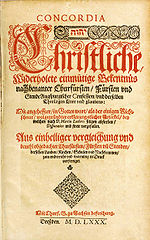
A title page of the Book of Concord
I’m a Lutheran, though some would say I am not. Why? Because many try to define out of existence those who adhere to the Book of Concord “in so far as” it agrees with Scripture as opposed to “because” it agrees with Scripture. Entire denominations argue that the affirmation “because” is the only way to be a genuine Lutheran. I have argued that this places adherents in an impossible situation before. First, I’ve argued that there are actually wrong interpretations of Scripture in the Book of Concord. There is also at least one etymological error. Must Lutherans, to be Lutheran, be saddled with these? According to the “because” position, the answer is yes, they must affirm these errors.
But it gets worse. In light of the despicable act of evil that occurred in Pittsburgh and with Reformation Day having just passed, I’ve been reading about Martin Lutherr and also decided to look up what the Book of Concord says about Jews. I believe the latter demonstrates conclusively that we cannot and must not give the Book of Concord “unconditional subscription.”
Unconditional Subscription?
I take my definition from one of the conservative Lutheran sites that is pushing for this as the definition of Lutheran:
What is an “unconditional subscription” to the Confessions?
Confessional Lutheran pastors are required to “subscribe,” that is, to pledge their agreement unconditionally with the Lutheran Confessions precisely because they are a pure exposition of the Word of God. This is the way our pastors, and all laypeople who confess belief in the Small Catechism, are able with great joy and without reservation or qualification to say what it is that they believe to be the truth of God’s Word. (Lutheran Reformation emphasis removed)
Unconditional subscription, then, is the notion that Lutherans must pledge to agree without reservation to the entirety of the Lutheran Confessions, which are those contained in the Book of Concord.
Jews and the Book of Concord
I have not cited every instance of the occurrence of “Jew” or “Jewish” in the Book of Concord. Rather, here I’ll be citing three instances which I believe demonstrate beyond a doubt that we cannot affirm unconditional subscription without seriously compromising our morality.
The first section comes from the Apology of the Augsburg Confession, Article XIII, section 18:
This is absolutely a Jewish opinion, to hold that we are justified by a ceremony, without a good disposition of the heart, i.e., without faith.
There are a number of problems with this sentence even apart from the use of “Jewish” here. First, it doesn’t just imply but states that Jewish “opinion” believes in justification without faith. Yet this contradicts the New Testament’s own teaching on the faith of Jewish people. For example, Hebrews 11:8-10:
By faith Abraham obeyed when he was called to go out to a place that he was to receive as an inheritance. And he went out, not knowing where he was going. By faith he went to live in the land of promise, as in a foreign land, living in tents with Isaac and Jacob, heirs with him of the same promise. For he was looking forward to the city that has foundations, whose designer and builder is God.
So Abraham, the father of Judaism, acted by faith, looking forward to the city whose designer is God. This famous passage in the New Testament goes on to affirm the faith of Rahab, Sarah, Jacob, the Israelites coming out of Egypt, and many, many more Jews, noting, ultimately, that though they acted on faith none of them received the promised final perfection (Hebrews 11:39-40). So the Book of Concord appears to simply be wrong in this offhanded remark about how “Jewish opinion” holds to a position that is “without faith.”
The next sentence in the Apology states that this “Jewish opinion,” now united with the Pope, is “impious” and “pernicious.” This ascribed to a view of faith that was simply assigned offhandedly to the Jewish people without proof!
The Large Catechism is one of the most important expositions of Lutheran faith, and therein, regarding the Ten Commandments, it is stated (Conclusion of the Ten Commandments, section 330):
Therefore it is not in vain that it is commanded in the Old Testament to write the Ten Commandments on all walls and corners, yes, even on the garments, not for the sake of merely having them written in these places and making a show of them, as did the Jews…
Here, a practice of Jews is simply dismissed offhand as “making a show” of the Ten Commandments. Jewish practice surrounding the Ten Commandments is dismissed as simply for the sake of having them written; as if the Jewish people had no more regard for the Ten Commandments than anyone else. I hope it need not be stated that we should not “unconditionally subscribe” to this.
A final example comes from the Solid Declaration VII, section 30:
Whosoever shall eat this bread, and drink this cup of the Lord, unworthily, [1 Corinthians 11:27] sins not merely against the bread and wine, not merely against the signs or symbols and emblems of the body and blood, but shall be guilty of the body and blood of the Lord Jesus Christ, which, as there [in the Holy Supper] present, he dishonors, abuses, and disgraces, as the Jews, who in very deed violated the body of Christ and killed Him; just as the ancient Christian Fathers and church-teachers unanimously have understood and explained this passage.
Here is a seriously problematic passage, though it is historically tied to the context. The Germany of Luther’s day was filled with anti-Semitic imagery, sayings, and practices. Churches had imagery of Jews suckling on pigs; the notion of Jews as killers of Christ was quite common. And here, in the Book of Concord, we see that leaking in, as Jews generally, not just a handful of people but all Jews are blamed for the “violation” of the body of Christ and killing him. Not only that, but it is alleged that the Church Fathers and “church-teachers” unanimously agree upon this language. This is exactly the language that is used to this day to attack Jews as “Christ-killers” and to raise anti-Semitic sentiment among Christians. This is the kind of language that we must take a firm stand against.
I realize some may stand up and try to cite 1 Thessalonians 2:14-16 here, arguing that the New Testament teaches specifically that Jews killed Jesus. Such would be a mistaken conclusion, because it also speaks of “the Jews” as killing the prophets. Jesus and the prophets were Jewish, and the common use of the phrase “Jews” in the New Testament refers to the leaders (see its use in the Gospels, each written by people who were Jewish, to refer to certain factions among Judaism).
Conclusion
I have already argued that the Book of Concord has errors of etymology and interpretation. In this post, we see that its treatment of the Jews is deeply problematic. Those who argue that we must have “unconditional subscription” to the Book of Concord must affirm these problematic statements in the name of being a “true” Lutheran. But what is more Lutheran than self-examination, confession of sins (like those of anti-Semitism), and the continuing Reform of the church? What can be more Lutheran than demanding that any document with which we agree, we will only agree with “in so far as” it agrees with Scripture?
Links
Be sure to check out the page for this site on Facebook and Twitter for discussion of posts, links to other pages of interest, random talk about theology/philosophy/apologetics/movies and more!
Adhering to the Book of Concord “In So Far As” or “Because” it Agrees with Scripture?– I argue that Lutherans must hold the position that we adhere to the Book of Concord In So Far As it Agrees with Scripture.
Another Problem for Book of Concord Inerrantists– I discuss an etymological error in the Book of Concord.
Eclectic Theist– Check out my other blog for posts on Star Trek, science fiction, fantasy, books, sports, food, and more!
SDG.
——
The preceding post is the property of J.W. Wartick (apart from quotations, which are the property of their respective owners, and works of art as credited; images are often freely available to the public and J.W. Wartick makes no claims of owning rights to the images unless he makes that explicit) and should not be reproduced in part or in whole without the expressed consent of the author. All content on this site is the property of J.W. Wartick and is made available for individual and personal usage. If you cite from these documents, whether for personal or professional purposes, please give appropriate citation with both the name of the author (J.W. Wartick) and a link to the original URL. If you’d like to repost a post, you may do so, provided you show less than half of the original post on your own site and link to the original post for the rest. You must also appropriately cite the post as noted above. This blog is protected by Creative Commons licensing. By viewing any part of this site, you are agreeing to this usage policy.
Book Review: “The Battle for Bonhoeffer” by Stephen R. Haynes
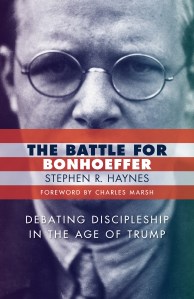 The Battle for Bonhoeffer by Stephen R. Haynes highlights the ways that people across theological, social, and political spectrums have played tug-of-war with Bonhoeffer’s thought, words, and legacy. As Charles Marsh puts it in his Foreword, “It is understandable… that readers with different theological and ideological perspectives would desire to claim Bonhoeffer as their own. ‘Excerpting Bonhoeffer’ has become a familiar exercise in each team’s effort to win…” (ix). Yet Bonhoeffer’s legacy is far more complex than a simple Google quote mine would allow. In my own reading of Bonhoeffer’s works, it is clear that it would be simple to find conflicting messages even within the same sermons at times. Like Martin Luther, for example, reading Bonhoeffer and interpreting him is like peeling away the layers of an onion, trying to get to the core. It takes care, precision, and thought. Unfortunately, as Haynes notes throughout this book, few people are concerned with doing so.
Though the subtitle is “Debating Discipleship in the Age of Trump,” there is far more to the book than dealing with the recent Trump phenomenon. Haynes notes how people on both the right and left have distorted or ignored aspects of Bonhoeffer’s legacy to turn in him into a supporter of their own positions. Marsh sets the table well, asking: “Have you heard progressive Christians cite the passage in Ethics calling abortion ‘nothing but murder’? Or recall Bonhoeffer’s preference for monarchy over democracy?” (xii). Haynes notes how Bonhoeffer was cited on one hand by Vietnam draft resisters, peace activists, liberation theologians, death-of-God thinkers on the left, and on the right by people who oppose abortion or same-sex marriage (and, regarding the latter, Haynes notes insights from both Charles Marsh’s Strange Glory and Diane Reynolds The Doubled Life of Dietrich Bonhoeffer [which I reviewed here] for reasons this may be quite inaccurate]). The baffling array of topics Bonhoeffer is alleged to have endorsed or condemned suggests that the quote mining being done through his legacy belies an inner complexity that is far deeper.
Haynes surveys the history of interpretation of Bonhoeffer, particularly in America, through the next several chapters. He places a special emphasis on seeing how evangelicals have viewed Dietrich Bonhoeffer. What is interesting in this latter topic is that, initially at least, Bonhoeffer was viewed positively but with some “warning flags” by American evangelicals who interacted with his works. Several appreciated his resistance to Nazi ideals, but were put off by his apparent lack of concern for things like “a high view of Scripture/inerrancy” and his being influenced by liberal German theologians. This portrait by the early evangelicals of Bonhoeffer is far more accurate than the one that has been passed into our own time, in part because it allowed for a multifaceted Bonhoeffer who was complex enough to resist being easily integrated into any one position.
Fairly early on, however, the complexities of Bonhoeffer’s thought and life began to be ignored in favor of seeing him as a figurehead for resistance to one’s own preferred ideas. Haynes demonstrates how Bonhoeffer was used to resist George W. Bush and the “war on terror,” and then ironically turned around to resist the “culture of death” under Barack Obama. The raising of the “Bonhoeffer flag” behind such opposed viewpoints should have served as a warning sign, but it unfortunately did not.
Enter Eric Metaxas. Metaxas’s biography, Bonhoeffer: Pastor, Martyr, Prophet, Spy was an extreme departure from Bonhoeffer scholarship generally. For one thing, Metaxas himself admitted to virtually ignoring or explicitly shunning the conclusions of 70 years of Bonhoeffer scholarship both at home and abroad. The cover flap for the book features a spurious quote from Bonhoeffer “Silence in the face of evil is evil itself…” that has since been passed all over the world and even “quoted” multiple times in Congress on record. To say that using an invented quote from Bonhoeffer on the cover of a biography of the man is a bad sign is an understatement. Haynes notes many, many problems with the biography, from a lack of engagement with Bonhoeffer’s actual works (and ignoring, for example, his Letters and Papers from Prison, which is one of the most important works for understanding his developed thought) to a recasting of Bonhoeffer into an American Evangelical. Yet it is Metaxas’s biography that has become the torch-bearer for the populist Bonhoeffer, making an image of the man that is incredibly distorted. For my own part, when I read Metaxas’s work, I was struck by how entirely de-Lutheranized Metaxas had made Bonhoeffer. Dietrich Bonhoeffer was a man who explicitly stated that, for example, without the Lord’s Supper there is no Christianity and who certainly supported infant baptism and regeneration, but Metaxas excised such details from his own dim look at Bonhoeffer’s theology, preferring to pull out those things which were more amenable to the typical American evangelical.
It was the populist view of Bonhoeffer which lead to notions of a “Bonhoeffer Moment” at various times before, during, and after the 2016 election cycle. Haynes spends some time noting how it was frequently said during the Obergefell v. Hodges Supreme Court case that American Christians were facing a “Bonhoeffer Moment” in which they would need to resist the government’s tyranny. Haynes notes how many evangelicals made comparisons to previous Supreme Court rulings, conveniently ignoring those unjust rulings they supported or the just ones they opposed. More decisively, Haynes notes that after Obergefell, evangelicals rallied around a woman who was part of an anti-Trinitarian sect to be their martyr for the cause. In the time since, though, very little has been done by evangelicals in their supposed “Bonhoeffer Moment.” This kind of co-option of the man’s legacy is a disservice to all involved.
Haynes doesn’t limit his analysis of the “battle for Bonhoeffer” to just the positives of Bonhoeffer’s life. Metaxas and others have argued Bonhoeffer is a “Righteous Gentile” (Metaxas even made “righteous gentile” part of his additional subtitle to his biography). But Bonhoeffer has explicitly been turned down for that technical categorization for a few reasons: 1) he wrote or supported some things that were seemingly anti-Semitic; and 2) though he did become a martyr, it wasn’t specifically due to his efforts to help the Jews during the Holocaust, which is a criterion for being deemed a “Righteous Gentile.” Bonhoeffer certainly opposed the Nazi treatment of the Jews and did help some Jews escape Germany (though at arm’s length for the most part–simply helping get proper papers from afar); but that was not his project or his main reason for opposing Nazi Germany. And that’s okay. It is important not to lionize Bonhoeffer for things he didn’t actually do, and Haynes is careful to help readers realize that.
The Battle for Bonhoeffer isn’t very long, but its length shouldn’t be taken for a lack of depth. It’s a thoughtful, critical, and sometimes convicting read. As one who is deeply indebted to Dietrich Bonhoeffer in my own theology and thought, I found ways in which I had been distorting him in this book as well. Haynes’ book provides an invaluable correction to distortions on the man’s life, times, and thought. I very highly recommend it.
Disclaimer: I was provided with a copy of the book for review by the publisher. I was not required to give any specific kind of feedback whatsoever.
Links
Be sure to check out the page for this site on Facebook and Twitter for discussion of posts, links to other pages of interest, random talk about theology/philosophy/apologetics/movies and more!
Book Reviews– There are plenty more book reviews to read! Read like crazy! (Scroll down for more, and click at bottom for even more!)
SDG.
——
The preceding post is the property of J.W. Wartick (apart from quotations, which are the property of their respective owners, and works of art as credited; images are often freely available to the public and J.W. Wartick makes no claims of owning rights to the images unless he makes that explicit) and should not be reproduced in part or in whole without the expressed consent of the author. All content on this site is the property of J.W. Wartick and is made available for individual and personal usage. If you cite from these documents, whether for personal or professional purposes, please give appropriate citation with both the name of the author (J.W. Wartick) and a link to the original URL. If you’d like to repost a post, you may do so, provided you show less than half of the original post on your own site and link to the original post for the rest. You must also appropriately cite the post as noted above. This blog is protected by Creative Commons licensing. By viewing any part of this site, you are agreeing to this usage policy.
Book Review: “Last Call for Liberty” by Os Guinness
 Os Guinness issues a call to question ourselves and what we mean by “freedom” and “liberty” in the United States in his book Last Call for Liberty. He argues that the United States must work to restore its faith in the “covenant” of the Constitution and help preserve liberty through its republican system.
Perhaps the most prominent theme throughout the book is that of 1776 vs. 1789. The dates refer to the American Revolution and the French Revolution. Guinness never really delves into defining this alleged conflict, though he does stick with the definition of “classical liberal” vs. “left/liberal.” The pervasiveness of this theme would lead readers to think that there would be some elucidation of the specifics of this distinction, but those readers are left wanting. Guinness simply refers to those dates throughout the book as though readers will just know and agree how horrible the French Revolution was for “liberty” (however defined) and how wonderful and perfect the American Revolution was for liberty. That is supposed to be obvious to anyone reading the book, apparently, because there is no point at which Guinness argues the point. In the introduction, for example, when he first introduces the theme, he writes:
Either the classical liberalism of the republic will prevail and 1776 will defeat 1789, or the Left/liberalism of 1789 will defeat 1776, and the republic will fail and become a republic in name only. (4)
Those are some dire words. Probably they should have some basis in argument, definition, and reality. But readers will never know if this distinction has a reality from the arguments presented in the book, because Guinness blithely assumes readers will go with his argument, despite never actually having made it.
The 1776/89 theme is pervasive throughout the book, and is continually used either as the point of an argument or as a way to hammer opposing views. For example, at one point Guinness states that “There can be no truce between 1776 and 1780. The clash of freedoms has to be settled in favor of one way or another, for they lead in entirely different directions” (179). Readers won’t really have a firm idea of what those directions are beyond 1776 is good and 1789 bad; but beyond that point is the absurdity of the actual statement made. “No truce” between the two can exist? How about the fact that, historically, the United States did, in fact have a truce with the Revolutionaries of 1789 and ultimately even an alliance? Sure, the relationship between the two countries soured to the point of a pseudo war, but it healed again shortly thereafter. Why? Because the United States was more favorably inclined towards a French country that had thrown off its monarchy than other countries that were dedicated to preserving theirs (eg. Britain). I admit I have simplified things historically, but even this analysis provides more historical background to the two years than Guinness does in close to 300 pages of text! Not only that, but Guinness had, at an earlier point, argued that history is the test for different systems to work, citing, of course, the worst possible examples of political systems that are different from a republic in his argument. But if history is the test for truth claims, his absurd claim that there can be no truce between 1776/1789 has been tested and is false.
Much of the rest of the book is filled with vague or explicit notions of American exceptionalism. The United States has the best system because it does, right? For example, only pages after Guinness condemns Athenian democracy for its limits on freedom because it only gave certain men the right to vote and Athens didn’t give in to reasoned arguments against slavery (77-78), he goes on to praise the United States for its own wonderful adherence to liberty. I don’t know whether to be amused by the irony or saddened by the apparent intentional ironing out of history’s wrinkles. After all, the 1776 liberty and freedom-loving republic Guinness wants us to all to hearken back to as the best example itself only allowed certain men the right to vote and endorsed and made laws for slavery. I cannot emphasize enough how deeply conflicted Guinness’s words are with his own thesis throughout the book. Whose liberty and freedom is Guinness really concerned with here? I can’t help but ask the question, because his ignoring of the wrongs of slavery and limited votes in the earliest days of the republic are set alongside nearly worshipful praise of the wisdom of the Founders demands that we ask whose power Guinness is concerned with.
Another major problem with the book is the style of writing Guinness has. At very few points was I able to draw out a thread of an argument. Rather, throughout the work, waxing eloquently is taken in the place of argument. It’s the kind of writing style that will pump up an audience already firmly in agreement with the thesis, but it doesn’t advance the argument or really even state it in any way. Alongside these vague statements that nevertheless provide good quote-mining is the notion that the United States somehow, in 1776, did something akin to making a proper covenant with God by being “under God” in the formation of the nation. I am still not sure I understand Guinness’s point here, but neither do accept fault for not understanding it. Like most other points in the book, this covenant/constitution/under God unity is never explained but merely assumed and orated upon.
Guinness apparently also felt the need to jump on the bandwagon of at least referencing the concept of calling younger people “snowflakes” and restating some of the mockery directed towards those who were upset by results of an election. For a man who literally wrote a book about how we must work to preserve freedom and liberty, it is deeply ironic to read condemnations of people feeling passionately about the results of efforts to do so. Sure, Guinness probably disagrees with how these others are voting, but for him to complain about the passion people felt about elections is asinine. How can Guinness seriously place this complaint having just written a book trying to put forward a passionate cry for liberty? Oh, and don’t forget to blame 1789 for people not conforming to Guiness’s standards of how people should react to elections, as well. Not content to stop with that self-condemning thought, Guinness also equivocates between the notion of political correctness and “newspeak” from the book 1984. It’s not a sick take down of the “Left” (or the Right, really) unless we bring up some of our favorite dystopic novels, right? This equivalency is stunning, because it seems to imply that Guinness actually believes that calls to, say, use accurate language for people groups is the same as literally changing truth to falsehood. Maybe he does believe that, in which case his own position seems much more dangerous to liberty than those he condemns.
Really, the entire book reads like someone who is having to face the fact that his position–that of an elder white male–is no longer valued simply by virtue of being an elder white male. Liberty is easily defined into power for his own position, and this definition is made almost explicit when he, as noted above, praises the United States’ republican system that excluded all non-white people, females, and non-land owners from voting in the glorious year of 1776. It’s hard to take seriously a man who can make such a heartless statement in praise of that system who then turns around and complains about others not liking his viewpoint.
Last Call for Liberty is the kind of alarmist and elitist work that Guinness purports to condemn in the book itself. By aligning himself so closely with the notion that the United States is under (or should be under) some kind of divine mandate and “covenant,” Guinness preaches to the choir of American exceptionalism. By sweeping the faults of our form of “liberty” under the rug, he engages in the very immunization against facts that he criticizes the “left/liberal” of doing. It is at times baffling to see such contradictory sentiments contained in the same book. Unfortunately, I believe that its primary audience will find it as faultless as they find our country.
Disclaimer: I was provided with a copy of the book for review by the publisher. I was not required to give any specific kind of feedback whatsoever.
Links
Be sure to check out the page for this site on Facebook and Twitter for discussion of posts, links to other pages of interest, random talk about theology/philosophy/apologetics/movies and more!
Book Reviews– There are plenty more book reviews to read! Read like crazy! (Scroll down for more, and click at bottom for even more!)
SDG.
——
The preceding post is the property of J.W. Wartick (apart from quotations, which are the property of their respective owners, and works of art as credited; images are often freely available to the public and J.W. Wartick makes no claims of owning rights to the images unless he makes that explicit) and should not be reproduced in part or in whole without the expressed consent of the author. All content on this site is the property of J.W. Wartick and is made available for individual and personal usage. If you cite from these documents, whether for personal or professional purposes, please give appropriate citation with both the name of the author (J.W. Wartick) and a link to the original URL. If you’d like to repost a post, you may do so, provided you show less than half of the original post on your own site and link to the original post for the rest. You must also appropriately cite the post as noted above. This blog is protected by Creative Commons licensing. By viewing any part of this site, you are agreeing to this usage policy.
Book Review: “Homeland Insecurity: A Hip Hop Missiology for the Post-Civil Rights Context” by Daniel White Hodge
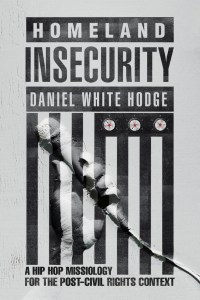 Daniel White Hodge’s Homeland Insecurity: A Hip Hop Missiology for the Post-Civil Rights Context is much more than a book about missions, though it has plenty there. It challenges readers to broaden perspectives, think critically about their own assumptions, and engage with cultures they may not have otherwise done.
The book starts off with an exploration of Christianity and “the theological turn of the twentieth century.” This theological turn was, in part, a moving away from seeing Christianity as a kind of turning everyone into white people with ways of thinking and culture. After World War II, there was a questioning of authority and the structures that were set in place to maintain authority that began to be challenged. But missiology hasn’t kept up with all the trends. As communities of black people began to be formed outside the church in the Post Soul context, these communities relied less upon the church, which then attempted outreach, turning it again, unfortunately, into a viewpoint where the dominant white culture and hierarchy became enshrined as part of the church and, therefore, of the mission preached to the community.
Throughout this first section, we see how racism in the church and the accompanying silencing of the voices of people of color led to multiple challenges in the American church. As people began to associate the church with oppression, they began to see Christ and orthodox Christianity as inherently wound up in the same systems. Opposition to doctrines that were taught by missionaries who seemed to care much more for the numbers they could draw than for the people or empowerment of the oppressed became part of the experience of many people of color. Hodge, here, shows through both anecdotes and broader analysis that this opposition to orthodoxy in some sections of the church arose from opposition to those associated with the orthodoxy. And here’s where the book begins to truly challenge its readers. After all, I personally cannot say how often I’ve heard about how much it is ideas that matter rather than the people who put the ideas forward. Objective truth, that is, is true no matter who shares it. I believe that. But when the people who share objective truth are actively oppressing you and preventing, sometimes by force, family members from doing things like voting, it becomes difficult to see where the lines should be drawn between the objective truths and the objective lies and distortions being put forward by the same individuals or groups of people.
There is a kind of blithe assumption that we–all people, that is–can just separate whatever someone believes or teaches from the person. Truth is supposed to be impersonal, and so it doesn’t matter if the one who is teaching the Gospel is a Klansman, because it still is the true Gospel. Objectively, that is true, but the message it sends is that the Gospel is associated with the Klan, whether we want it to be or no. That means the challenges faced by missiology must include not just teaching objective truths, but demonstrating that these objective truths are capable of objectively changing reality for both the one sharing the truths and for those who hear them. And that is exactly what the Gospel of Christ is about, for it ushers in salvation through the Kingdom of God. Hodge’s book continues to challenge readers throughout. Nowhere does he say that heresy is good or that it should be accepted, but he does call readers to see how heresy might become appealing when orthodoxy is associated with structures that oppress.
Hodge weaves data and anecdotes throughout the book. The segments from interviews are particularly poignant, as readers learn about young people of color who faced challenges of racism even in their small Christian groups. One example I remember is of a large black man who did his best to be cheerful, funny, and self-deprecating in order to come off as non-threatening to his church community only to have that community doubt his reports of aggression from police and white people outside that community purely based on his status as a large black man.
Then, Hodge turns to Hip Hop and an analysis of some major works in that genre to see how they’ve helped shape the thought and even theology of communities. Though often dismissed offhand as sinful due to content including cuss words, sex, violence, and drugs, hip hop is one way that people are trying to make sense of the world. But the analysis of Hip Hop isn’t an attempt to excuse its content; rather, it is a demonstration of the power of that content for communities experiencing that content and a call to develop missiology that acknowledges this context. It shows how Hip Hop has its own missiology and theology, deeply spiritual and often developed out of a Christian context and background.
Homeland Insecurity: A Hip Hop Missiology for the Post-Civil Rights Context is a challenging, fulfilling read. It’s a call to readers to go beyond the straightforward and look, truly look at the way we impact our communities. Moreover, it is a call to action. I highly recommend it.
Disclaimer: I was provided with a copy of the book for review by the publisher. I was not required to give any specific kind of feedback whatsoever.
Links
Be sure to check out the page for this site on Facebook and Twitter for discussion of posts, links to other pages of interest, random talk about theology/philosophy/apologetics/movies and more!
Book Reviews– There are plenty more book reviews to read! Read like crazy! (Scroll down for more, and click at bottom for even more!)
SDG.
——
The preceding post is the property of J.W. Wartick (apart from quotations, which are the property of their respective owners, and works of art as credited; images are often freely available to the public and J.W. Wartick makes no claims of owning rights to the images unless he makes that explicit) and should not be reproduced in part or in whole without the expressed consent of the author. All content on this site is the property of J.W. Wartick and is made available for individual and personal usage. If you cite from these documents, whether for personal or professional purposes, please give appropriate citation with both the name of the author (J.W. Wartick) and a link to the original URL. If you’d like to repost a post, you may do so, provided you show less than half of the original post on your own site and link to the original post for the rest. You must also appropriately cite the post as noted above. This blog is protected by Creative Commons licensing. By viewing any part of this site, you are agreeing to this usage policy.
Jehovah’s Witnesses are in your community. What do you do?

The headquarters of the Jehovah’s Witnesses, the Watch Tower Bible & Tract Society- credit: By Sergio Herrera – Sergio Herrera’s (Q.Entropy) Flickr page, CC BY-SA 2.0, https://commons.wikimedia.org/w/index.php?curid=15112279
Over the weekend, there were Jehovah’s Witnesses that had flown in to go door-to-door in our community. I typed up a brief list of things to think about or discuss if they are in your own neighborhood. I do not claim this is comprehensive; this is just a starting point for discussions.
Above all else, please be courteous and kind in all of your interactions with Jehovah’s Witnesses.
If you are interested in having a discussion, be aware of a few things:
1) They have certain passages they have been trained to expect (eg. John 1:1) and will not deviate from their own “translation” which, though wrong, will not be fruitful in trying to dissuade them from.
2) They are seeking the truth, just as we are.
3) They do not believe Jesus is God, but rather Michael the Archangel (though I have had some deny this)–see below for a few verses to discuss this.
4) They believe they must work to get to heaven. Emphasize God’s grace in your own interactions with them.
If you do want to go into some depth, here are some good passages:
1. Compare Isaiah 44:24 (YHWH/The LORD [they’d say Jehovah] is speaking and says that God made the heavens “by myself.” to Colossians 1:16 in which the son creates all things–if the Son creates all and God creates all “by myself,” who is the Son? [Note: their translation will say that the Son creates all “other” things in Colossians 1, inserting the word “other” many times in the opening chapter where it doesn’t exist in the Greek manuscripts, but this doesn’t undermine the point, because even if it says “other” things, those other things are things Jehovah creates “by myself” in Isaiah]
2. Compare Revelation 22:8-9 [John bows down to an angel, thinking, apparently, the angel is God or worthy of worship] to Hebrews 1:5-6 (and following) [the Son is listed as being worshiped and even angels must worship the Son].
3. Walk through Jeremiah 23:5-6 in their own translation. Ask who the first verse is about–who is the one from the branch of David? Jesus, clearly, and they’ll agree. Then in verse 6, what is the name that Jesus will be called–JEHOVAH our righteousness. It says this in their own translation. So if the prophecy is about Jesus, and Jehovah says the name of this coming king will be Jehovah…. who is Jesus?
Finally, pray for those with whom you disagree.
SDG.
Book Review: “A Light So Lovely: The Spiritual Legacy of Madeleine L’Engle” by Sarah Arthur
 A Light So Lovely is a remarkable look at an intriguing woman’s life and contributions to spirituality. At times challenging while at others biographical, Sarah Arthur weaves together tale with theology, fact with fiction in a compelling way.
Madeleine L’Engle is almost certainly best remembered for her book A Wrinkle in Time, but Sarah Arthur exposes readers to the broad range of L’Engle’s work, which seems to rival C.S. Lewis’s output in both range and output. Arthur draws on this comparison herself a number of times, though she never comes to rely upon it. L’Engle is her own person, and one with complexities that demand careful reading.
The book is organized around a number of themes within L’Engle’s thought and work. Arthur notes that one of L’Engle’s driving spiritual themes is that of the “both/and” rather than the “either/or.” As a Lutheran, this resonates with me quite a bit because Lutherans tend to see themes in life as both/and as well (e.g. that Christians are sinner/saints). The chapters reflect this “both/and” narrative with titles like “Icon and Iconoclast” and “Faith and Science.” In each chapter, the both/and that L’Engle affirms becomes clear.
L’Engle’s spirituality is tied up in both fiction and nonfictional works. At times, it challenges the bounds of what some would demand for orthodoxy. Her apparent affirmations of things like ultimate universalism and the like caused some controversy in her own time and continue to do so to this day. L’Engle explored spirituality through myth and mythmaking (using the terms in the technical sense). Arthur draws upon fiction, nonfiction, anecdotes, interviews, the Bible, and more for sources in outlining L’Engle’s thought and spirituality.
So what is L’Engle’s spirituality? It would be hard to sum it up even in paragraph form, but Arthur’s focus in the chapters already points towards a way to do so. Specifically, L’Engle’s spirituality was one which was inclusive almost to a fault, focused on uniting truths together that some would see as at odds with each other. Her spirituality was also deeply practical, with her honest looks at the struggles of working as a mother, dealing with doubt, and more. Another theme Arthur explores is the way L’Engle tied her spirituality into her fiction. It is remarkable, looking back, to see that a book like A Wrinkle in Time, with its explicitly Christian themes, managed to win a Newbery Award, for such awards typically avoid anything explicitly religious. But L’Engle’s work is so magical, so captivating, and her Christianity so matter-of-fact that it becomes its own kind of light, the “light so lovely” that it can inspire others to learn more and seek it out. This central theme of the book is also central to L’Engle’s spirituality.
A Light So Lovely is a delightful work. The highest laud I can give it is that it has led me to seek out more writings of L’Engle to seek a deeper understanding and try to help make my own light shine. Recommended.
Disclaimer: I was provided with a copy of the book for review by the publisher. I was not required to give any specific kind of feedback whatsoever.
Links
Be sure to check out the page for this site on Facebook and Twitter for discussion of posts, links to other pages of interest, random talk about theology/philosophy/apologetics/movies and more!
Book Reviews– There are plenty more book reviews to read! Read like crazy! (Scroll down for more, and click at bottom for even more!)
SDG.
——
The preceding post is the property of J.W. Wartick (apart from quotations, which are the property of their respective owners, and works of art as credited; images are often freely available to the public and J.W. Wartick makes no claims of owning rights to the images unless he makes that explicit) and should not be reproduced in part or in whole without the expressed consent of the author. All content on this site is the property of J.W. Wartick and is made available for individual and personal usage. If you cite from these documents, whether for personal or professional purposes, please give appropriate citation with both the name of the author (J.W. Wartick) and a link to the original URL. If you’d like to repost a post, you may do so, provided you show less than half of the original post on your own site and link to the original post for the rest. You must also appropriately cite the post as noted above. This blog is protected by Creative Commons licensing. By viewing any part of this site, you are agreeing to this usage policy.
Book Review: “Paul and Gender: Reclaiming the Apostle’s Vision for Men and Women in Christ” by Cynthia Long Westfall
[U]ntil very recently (ca. 1980s), traditional readings [of Bible passages related to women] have assumed the ontological inferiority of women through the entire history of interpretation, and it is implausible to think that an interpreter can effectively shed the foundational assumptions of the traditional view and still coherently maintain the remainder of interpretations and applications virtually intact. (4)
[T]raditional readings of the texts have been used and are being used overtly in a social construction of a theology of power and control that privileges one group over another (males over females), and those readings are controlled by the privileged group (males). (4)
Cynthia Long Westfall’s Paul and Gender: Reclaiming the Apostle’s Vision for Men and Women in Christ brings forward insights from hermeneutics, linguistics, sociology, history, and insight into the ancient world to present a consistent reading of the Pauline corpus in regards to gender. Westfall contends that the traditional reading of the text must face the challenge that it does not consistently read the Pauline corpus, but rather tends to prioritize certain readings of texts over other texts, rather than trying to unify them. A lack of consistent methodology is also a problem, as hermeneutic method changes depending upon what the text is taken to defend (3). Moreover, traditional readings of the texts are “problematic,” she argues, for several reasons: first, the traditional readings of the texts “have not resulted in making sense of Paul’s Letters” (ibid); second, these readings of the texts are making a theology of power (4); third, the ontological basis for the traditional reading has largely been acknowledged as mistaken (see the first quote, above); fourth, both the individual and the group can make significant contributions to and impact on interpretation. For these reasons, Westfall suggests a return to the texts to see what they actually mean in context, again, drawing on linguistics, contemporary cultural studies, and many more disciplines.
Westfall organizes the book topically, looking at how various topics relate to Paul and gender. These topics are culture, stereotypes, creation, the Fall, eschatology, the body, calling, authority, and an extended look at 1 Timothy 2:11-15. By organizing the book largely around these important topics in Paul’s thought, Westfall avoids the somewhat common theme of books about sexuality in Christianity of looking at one proof text after another to come down on one side or the other. Instead, Westfall presents a cohesive, rational way for looking at the whole of the Pauline corpus, yes, through looking at individual texts, but also by uniting Paul’s thought and bringing in insights from various fields.
Time and again throughout Paul and Gender, I came upon a way of looking at things I hadn’t considered before. Westfall’s use of linguistics and deep knowledge of the cultural context of the New Testament leads to arguments and conclusions that are powerful and compelling. Some of her points seem obvious on reflection, but were points I have rarely if ever seen discussed in literature related to men and women in Christ. For example, regarding 1 Timothy 2:13, she notes that in Genesis, from which Paul is drawing his point, primogeniture is constantly reversed. That theme is one I had learned and put forward myself, but I hadn’t thought about how it could be applicable to understanding Paul’s use of Adam first/Eve next in 1 Timothy. Why is it that complementarians repeatedly make a bald assumption that primogeniture is seen by Paul as an inherent hierarchy between man and woman when Paul is specifically using an example from a book where primogeniture is consistently overthrown by God? Her extensive look at 1 Corinthians 11 helps to make it even more clear how difficult it is to adequately understand some of these texts as English speakers. Through conversation with many contemporary sources, she conclusively demonstrates that the notion of the man being “head” is not a hierarchy. Moreover, her reading of what is meant by calling woman the glory of man as well as her interpretation of why women should have a kind of covering over their heads is one that answers many, many questions for me as a reader. By showing what, culturally, was going on in Corinth and the church in general, she presents readings that explain the text rather than obscure it further–or turn it into a proof text for a specific position.
The greatest strength of Westfall’s approach is that it truly does present a unified look at the Pauline corpus. Rather than having to look at texts piecemeal and form a series of doctrinal theses therefrom, Westfall’s reading of the texts related to gender present a consistent, holistic view of Paul’s teaching on gender. It is a truly remarkable book that deserves careful reading. I spent several hours on the chapter on “culture” alone, finding many deep insights both in the main text and the footnotes. As a reader, I feel as though I have a much deeper and more complete understanding of Paul on these topics than I did before I read it.
With Paul and Gender, Cynthia Long Westfall has created one of the most profoundly exegetical and deep challenges to the complementarian reading of the Pauline Corpus in existence. Her breadth of knowledge of many different fields of studies is effectively utilized to present a cohesive, persuading reading of Paul regarding gender. May all who are interested in finding what the New Testament teaches on gender read this book.
Disclaimer: I was provided with a copy of the book for review by the publisher. I was not required to give any specific kind of feedback whatsoever.
Links
Be sure to check out the page for this site on Facebook and Twitter for discussion of posts, links to other pages of interest, random talk about theology/philosophy/apologetics/movies and more!
Book Reviews– There are plenty more book reviews to read! Read like crazy! (Scroll down for more, and click at bottom for even more!)
SDG.
——
The preceding post is the property of J.W. Wartick (apart from quotations, which are the property of their respective owners, and works of art as credited; images are often freely available to the public and J.W. Wartick makes no claims of owning rights to the images unless he makes that explicit) and should not be reproduced in part or in whole without the expressed consent of the author. All content on this site is the property of J.W. Wartick and is made available for individual and personal usage. If you cite from these documents, whether for personal or professional purposes, please give appropriate citation with both the name of the author (J.W. Wartick) and a link to the original URL. If you’d like to repost a post, you may do so, provided you show less than half of the original post on your own site and link to the original post for the rest. You must also appropriately cite the post as noted above. This blog is protected by Creative Commons licensing. By viewing any part of this site, you are agreeing to this usage policy.
Book Review: “Reformation Commentary on Scripture: New Testament XIII- Hebrews, James” edited by Ronald K. Rittgers
 The Reformation Commentary on Scripture series focuses on sharing insights from Reformation theologians on the Bible. Here, we’ll take a look at the Hebrews, James volume of this extensive series.
I was particularly excited to read and review this volume of the series, because Hebrews and James were especially controversial in the Reformation period. The editor of this volume, Ronald K. Rittgers, does an excellent job of both showing that controversy over these books while also bringing forward some unified themes of the Reformers in regards to them. As a Lutheran, I found the various quotes and notes from Luther and other early Lutherans (particularly Veit Dietrich) to be of great interest. Luther infamously called James an epistle of straw, and here we have his quote in its context. It seems clear that the notions of inerrancy of modern evangelicalism cannot easily be read back onto many of these Reformers. When you have one explicitly stating that James is “worthy of censure in some places” (Veit Dietrich), it is hard to say that the Reformers unanimously would have affirmed modern notions of biblical inerrancy. Reading what these reformers actually said about specific Christian doctrines may serve as a corrective to some clearly false statements.
Of course, reading these Reformers also means we get insight into the controversies of their time, and we see, for example, John Calvin hitting back at those “who do not think [James is] entitled to authority” because he sees “no just cause for rejecting it” (quoted p. 202). Other major controversies dealt with Christology, human and divine responsibility for evil, and works righteousness. These issues are presented with multiple Reformation perspectives given, making the volume an essential resource for those wishing to look more deeply into some major modern controversies as well. Other areas are less controversial, such as the teaching of the eternally begotten Son–an orthodox position unfortunately rejected by some today.
Both the general introduction and the Editor’s introduction to this volume were informative and well worth reading on their own. They each provided much-needed background for understanding some of the controversies, as well as the names, involved in the text.
Volume XIII of the New Testament series of Reformation Commentary on Scripture is a simply excellent resources for those interested in reading and understanding Scripture. Reformation thinkers share much wisdom and insight. The conflicts that happened then, in some ways, still impact us today. By reading these voices from the past we can begin to understand our present more fully. I highly recommend this volume.
Disclaimer: I was provided with a copy of the book for review by the publisher. I was not required to give any specific kind of feedback whatsoever.
Links
Be sure to check out the page for this site on Facebook and Twitter for discussion of posts, links to other pages of interest, random talk about theology/philosophy/apologetics/movies and more!
Book Reviews– There are plenty more book reviews to read! Read like crazy! (Scroll down for more, and click at bottom for even more!)
SDG.
——
The preceding post is the property of J.W. Wartick (apart from quotations, which are the property of their respective owners, and works of art as credited; images are often freely available to the public and J.W. Wartick makes no claims of owning rights to the images unless he makes that explicit) and should not be reproduced in part or in whole without the expressed consent of the author. All content on this site is the property of J.W. Wartick and is made available for individual and personal usage. If you cite from these documents, whether for personal or professional purposes, please give appropriate citation with both the name of the author (J.W. Wartick) and a link to the original URL. If you’d like to repost a post, you may do so, provided you show less than half of the original post on your own site and link to the original post for the rest. You must also appropriately cite the post as noted above. This blog is protected by Creative Commons licensing. By viewing any part of this site, you are agreeing to this usage policy.
Book Review: “Lewis on the Christian Life” by Joe Rigney
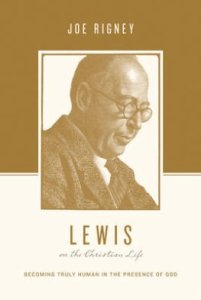 Lewis on the Christian Life is another installment in the “Theologians on the Christian Life” series from Crossway. This time, the subject is the extremely popular Christian thinker, C.S. Lewis.
It is clear from the start that Rigney has a monumental task. Lewis wrote a lot and clearly had development in his thought throughout his life. Some of this is briefly touched upon by Rigney, but other aspects of it are skipped over (especially Lewis’s development of thought on men and women). Rigney makes it clear early on that he intentionally draws from many of Lewis’s lesser known works in order to try to bring some balance on people’s thoughts regarding Lewis. Rigney divides his look at Lewis’s theology of Christian living up topically, including such things as Prayer, Christian Hedonics, Healthy Introspection, “The Choice,” “The Gospel,” and more (17 different topics worth!).
Of particular interest to me were the sections on prayer and choice. Lewis’s theology is worked through with the idea of choice for the Christian and the person–whether it is heaven or hell. As Rigney puts it, “This is the Choice: God or self. Happiness or misery. Heaven or hell” (Kindle Location 468). People’s choices lead to right (or wrong) living and play out into eternity. This idea of choosing doesn’t meld very well with some forms of theology, particularly a more Reformed or Calvinist one–which is typically what the publisher Crossway leans towards. Rigney touches on some parts of this notion showing how he thinks Lewis’s thought may be compatible with Reformed thought, while also offering some critique. Rigney draws heavily from The Screwtape Letters to discuss many aspects of Lewis’s theology of Christian living, including prayer. I find this work fascinating, and was edified by Rigney’s many looks at aspects of it.
One area I thought was odd was how much time Rigney spent on Lewis’s doctrine of atonement. Lewis was no systematic theologian, but RIgney seems quite concerned to make Lewis one when it comes to the doctrine of the atonement. Particularly, he is keen to show Lewis affirmed penal substitutionary atonement. I’ve been surprised by how frequently this view of the atonement is seen by its adherents as almost equivalent to the Gospel, and this is no exception. I’ve always seen the scene with Aslan in The Lion, The Witch, and the Wardrobe as more of a ransom theory notion of atonement, but Rigney takes it penal substitutionary, with a slight nod to how it could be seen as ransom theory. For myself, I don’t see a huge gap between the two, and also honestly don’t understand much of the debate. It seems clear to me penal substitution is found in the Bible, but so are many, many other aspects of the various theories put forward. Is not a holistic view more preferable because it easily integrates everything? Why must we be mutually exclusive? More relevant for this book, why must Lewis become one who endorses penal substitution when it doesn’t actually seem that clear from his writings? Such questions remain unanswered.
Lewis’s idea of Christian living also allowed for pretty much anything not forbidden. This doesn’t go well with more Puritan-like aspects of thought, but it is, I think, generally correct. Rigney, oddly, takes this as a chance to try to explore what is allowed or forbidden in worship services (kindle loc 4612ff). I didn’t really get how this was relevant or why it mattered, but that might be my own theological background showing through (as a Lutheran, I believe much of this is adiaphora).
Lewis’s views of male and female are certainly a product of his time, and Rigney, apparently endorsing complementarian doctrine, seems to delight in some of the frankly silly things Lewis said in some of his works. Particularly silly was the idea of the oh-so-manly Mars in the Space Trilogy. Why is it manly? Because it has Mountains ‘n’ stuff! Yep, no distorted cultural expectations of masculinity and femininity reflected there, right? Wrong. Rigney seems particularly affirming of these aspects of Lewis’s theology, which frankly seem like the strangest aspects to affirm. Moreover, there is debate over whether Lewis actually maintained this kind of strong complementarian doctrine throughout his life. For example, Mary Stewart Van Leeuwan dedicated an entire book to the topic.
Perhaps my biggest complaint with the book, which I’ve already touched on, is how much space is dedicated to correcting Lewis’s theology, which most frequently means moving him more in line with the kind of Reformed Baptist theology that Crossway promotes. I’ve read numerous books in this series of theologians on the Christian life (see more here by scrolling down), and there are some (like the one on Luther) that seem to fulfill the series’ mission of expositing the various theologians’ views on the Christian Life. This one offers much more by way of analysis than some of the others, and I think I have gotten more out of those that focus almost entirely on showing what the titular thinker had to say than what the author wanted to correct.
Lewis on the Christian Life is an uneven but interesting look at the breadth of C.S. Lewis’s theology of Christian living. Rigney opens up whole fields of investigation into Lewis’s thought, but spends a bit too much time on analysis relative to other books on the series. I recommend it for those interested in investigating what Lewis has to teach us about living life in Christ.
Disclaimer: I was provided with a copy of the book for review by the publisher. I was not required to give any specific kind of feedback whatsoever.
Links
Be sure to check out the page for this site on Facebook and Twitter for discussion of posts, links to other pages of interest, random talk about theology/philosophy/apologetics/movies and more!
Book Reviews– There are plenty more book reviews to read! Read like crazy! (Scroll down for more, and click at bottom for even more!)
SDG.
——
The preceding post is the property of J.W. Wartick (apart from quotations, which are the property of their respective owners, and works of art as credited; images are often freely available to the public and J.W. Wartick makes no claims of owning rights to the images unless he makes that explicit) and should not be reproduced in part or in whole without the expressed consent of the author. All content on this site is the property of J.W. Wartick and is made available for individual and personal usage. If you cite from these documents, whether for personal or professional purposes, please give appropriate citation with both the name of the author (J.W. Wartick) and a link to the original URL. If you’d like to repost a post, you may do so, provided you show less than half of the original post on your own site and link to the original post for the rest. You must also appropriately cite the post as noted above. This blog is protected by Creative Commons licensing. By viewing any part of this site, you are agreeing to this usage policy.
“Didaskolos” by Bertil Gärtner, Part 2, in “Women Pastors?” edited by Matthew C. Harrison and John T. Pless
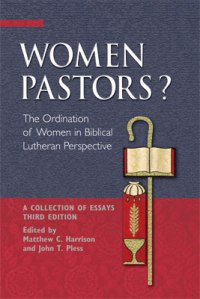 I grew up as a member of the Lutheran Church-Missouri Synod, a church body which rejects the ordination of women to the role of pastor. The publishing branch of that denomination, Concordia Publishing House, put out a book entitled Women Pastors? The Ordination of Women in Biblical Lutheran Perspective edited by Matthew C. Harrison (who is the current President of the LCMS) and John T. Pless. I have decided to take the book on, chapter-by-chapter, for two reasons. 1) I am frequently asked why I support women pastors by friends, family, and people online who do not share my position, and I hope to show that the best arguments my former denomination can bring forward against women pastors fail. 2) I believe the position of the LCMS and other groups like it is deeply mistaken on this, and so it warrants interaction to show that they are wrong. I will, as I said, be tackling this book chapter-by-chapter, sometimes dividing chapters into multiple posts. Finally, I should note I am reviewing the first edition published in 2008. I have been informed that at least some changes were made shortly thereafter, including in particular the section on the Trinity which is, in the edition I own, disturbingly mistaken. I will continue with the edition I have at hand because, frankly, I don’t have a lot of money to use to get another edition. Yes, I’m aware the picture I used is for the third edition.
Didaskolos: The Office, Man and Woman in the New Testament Part 2
We analyzed Gärtner’s arguments about the context for women in the New Testament. Now we turn to his notion of “The Basic Concept of Saint Paul in First Corinthians.” First, he notes that 1 Corinthians 12 provides “a distribution, a division… of services and gifts of grace in the congregation.” The point here is quite well taken because it is true that 1 Corinthians 12, especially verse 28 makes explicit a listing of gifts in the church which ranks prophets above that gift of teachers. Yet it is very clear in the New Testament that women may be prophets, and so they may, according to Paul, outrank the role of teacher, which is typically taken as the pastoral role (see my exposition of this argument, below, and more explicitly, with Alice Guinther, here ). (I should note that Gärtner himself maintains that “teacher” is equivalent to pastor on page 37.) This order, Gärtner maintains, remains in the church despite the unity in Christ as seen in Galatians. Once again, I agree, though it is interesting that Galatians 3:28, which he alludes to, explicitly makes it clear that in Christ there is “no male and female,” as the Greek states. Thus, Gärtner’s interpretation has the difficulty of trying to separate what Christ has united, dividing male and female from each other and plugging them into different levels and roles in the church. A better interpretation, and one that does not require one to maintain that 1 Corinthians 12:28 can work against Galatians 3:28, is that the roles of 1 Corinthians 12:28 remain in place, but the artificial divisions that we so often make–Jew-Gentile; slave-free; male-female–are not the basis for those roles.
Second, Gärtner turns to 1 Corinthians 14. He appeals to the notion of order of creation to say that women may not be pastors (33). Yet it is unclear exactly how this connection is made. The notion of “order of creation” is left rather abstractly, and, as we have seen, seems to be confusing on Gärtner’s own account because he inconsistently applies it in different contexts. He then goes on to state that “What women’s duties are in the congregation is not described in detail” (34), though he apparently is certain one of the duties cannot be administration of the Eucharist or some other aspect of the “office” (still undefined). He argues that women being silent is “not a crass command to forbid women from taking part in the service” but rather, like being silent instead of speaking in tongues without an interpreter, is qualified (38). What that qualification is is not derived from the text–for the text does not say anything about the “office” or “ministry” related to silence. Instead, Gärtner assumes that’s what the silences is meant to apply to. He goes so far as to say that it would be “absurd to say that the apostle meant to speak about women who sat and whispered, disturbing the service…” (38). “Absurd”! Yet he himself has already granted that the text must be qualified in its silencing. Why is it then absurd to think that it is about women disturbing the service? I don’t know, and Gärtner doesn’t give any insight into that except for saying that such an interpretation “cannot be drawn from either text or context” (ibid). Why not? Gärtner doesn’t say. But throughout the entirety of 1 Corinthians, we find Paul is interested in order of worship. Over and over again, Gärtner appeals to order of creation, as Paul appeals to order in worship, giving us insight into the roles and spiritual gifts found in the church (1 Corinthians 12) as well how to pray (1 Corinthians 11), etc. So why would it be absurd to think that Paul, in 1 Corinthians 14, is continuing his thought process, instructing the specific church of Corinth in maintaining order in church by not having women asking questions and disrupting the service, especially when it is followed by an instruction for women to learn from their husbands at home (eg. perhaps saving their questions for a more appropriate time)? I can’t say, but Gärtner seems intent on dismissing it. Nevertheless, it seems clear that rather than being absurd, such an interpretation would be directly in line with the rest of Paul’s purpose in the letter! Gärtner’s thesis about what Paul means in 35 by a “law of the Lord” could just as easily align with order in worship.
Finally, Gärtner ends with a section on the subordination of women. He alleges that “the Christian idea of man and woman signifies something completely new, that is not at all the same as that found in the Jewish conception of woman and marriage” (41). Not at all the same? So when the Jewish conception of woman and marriage included things like… monogamy… the Christian conception is “not at all the same”? Really? I certainly hope not, because that would mean that there is a radical disconnect on the doctrine of humanity between Christian and Jew at the time of Christ, yet most of the early followers of Christ were Jewish. Yes, I agree with Gärtner that life in Christ changes things and leads to a new creation, but to suggest that Christianity is somehow a complete overthrow of the faith of the Jews at the time–that of the Hebrew Scriptures–seems clearly mistaken. As we have already seen, Gärtner continues to overstate his case.
Once again, to 1 Corinthians 12:28, Gärtner as almost any interpreter I have read, maintains that “teacher” in 1 Corinthians 12:28 is the role we would take to mean “pastor.” Moreover, he grants that 1 Corinthians 12:28 is a list of roles being differentiated, specifically as an “order” given by God (35). From that, all we have to do is show that women may be in one of the roles above that of teacher. And because women are explicitly stated in both the Old and New Testaments as being prophets, which explicitly rank above teachers in 1 Corinthians 12:28, we find that women may have–and have had–more authority than pastors. Thus, to exclude women from the pastoral ministry due to some notion of “authority” is nonsensical. Nevertheless, Gärtner makes the effort, without apparently being aware of the inherent contradiction in his position.
Now that we’ve finished our look at Gärtner’s arguments, we can return to the thesis he presented at the beginning of the chapter, as we outlined in Part 1. He wrote, “Does the New Testament contain any direct teaching about the relationship between man and woman in the office of the ministry? The answer to this question is an unequivocal yes” (27). Did Gärtner prove this thesis? In the first part, we saw that the only thing Gärtner did was look at the context of the passages, none of which provides a definitive or “unequivocal” verse that has direct teaching about the relationship between man and woman in the office of the ministry. Indeed, the very fact that he spends so long merely on context makes one wonder about his thesis. In the analysis here, Gärtner finally does try to present 1 Corinthians 14:34-35 as a kind of proof text, but even there he merely alludes to the order of creation to try to make his point. There is no direct verse that Gärtner presents anywhere, and the one time he finally attempts to site a verse, he doesn’t claim it fulfills his thesis but instead appeals to a completely different context (Genesis) and the assumption that this ties back into women pastors. Gärtner’s thesis does not carry. He has presented nothing to show that the NT contains “direct teaching about the relationship between man and woman in the office of the ministry,” let alone done so “unequivocally.” Yet he claims that is exactly what is there. His claim fails on his own grounds, and, as we have shown throughout these two posts, the few claims he does make have serious issues as well.
Links
Be sure to check out the page for this site on Facebook and Twitter for discussion of posts, links to other pages of interest, random talk about theology/philosophy/apologetics/movies and more!
Book Reviews– There are plenty more book reviews to read! Read like crazy! (Scroll down for more, and click at bottom for even more!)
SDG.
——
The preceding post is the property of J.W. Wartick (apart from quotations, which are the property of their respective owners, and works of art as credited; images are often freely available to the public and J.W. Wartick makes no claims of owning rights to the images unless he makes that explicit) and should not be reproduced in part or in whole without the expressed consent of the author. All content on this site is the property of J.W. Wartick and is made available for individual and personal usage. If you cite from these documents, whether for personal or professional purposes, please give appropriate citation with both the name of the author (J.W. Wartick) and a link to the original URL. If you’d like to repost a post, you may do so, provided you show less than half of the original post on your own site and link to the original post for the rest. You must also appropriately cite the post as noted above. This blog is protected by Creative Commons licensing. By viewing any part of this site, you are agreeing to this usage policy.

 J.W. Wartick - Reconstructing Faith