christian
On “Mary Did You Know?”
Mary did you know that your baby boy will…
Someday walk on water?
Save our sons and daughters?
Give sight to the blind man?
Calm a storm with his hand? [selected lyrics by Mark Lowry]
I’ve seen a surprising amount of comments on this song each Christmas, but it seems like many of the comments have sever tensions built in from specific theological perspectives. One of the comments I saw recently, for example, complained about the backlash against the song and attributed it a bit conspiratorially to Catholicism allegedly making its way into evangelicalism.
Well, I’m a Lutheran, so I’ve found myself on the outside looking in when it comes to many allegedly evangelical discussions (see my posts on Bonhoeffer, for example), but I think that this kind of commentary is, frankly, silly. I decided to write a few quick comments about the song, without any allegations of conspiracy or heterodoxy included.
As you can see from the lyrics, the song is basically a list of rhetorical questions asked of Mary which basically imply that she could not have known just how great and marvelous and powerful Jesus was going to be. Strictly speaking, such an implication is not definitively false. After all, it doesn’t seem to be the case that Mary knew with certainty that Jesus was God, or that some specific miracles would be performed. On the other hand, the song also names some specific things that Mary may very well have known. How? Well, if she was familiar with the Old Testament, there are some passages that would inform her that, yes, she could know the answer to some of these questions. Let’s look at one example:
Then will the eyes of the blind be opened and the ears of the deaf unstopped. – Isaiah 35:5
Contextually, this verse occurs within an eschatological promise of the blessings that will be brought to God’s chosen people. Now, if Mary was familiar with this, and we can’t definitively say one way or another, and if she interpreted the verses to refer to her own time with the coming Messiah, then it would seem she could say “Yeah, I did know that my baby boy would be curing the blind.” Of course, those are some big ifs. Can we get more specific?
More explicitly, there is the Magnificat (Luke 1:46-55), the song which Mary sang in praise to God. Here are a few selections:
My soul glorifies the Lord and my spirit rejoices in God my Savior… He has performed mighty deeds with his arm… He has helped his servant Israel, remembering to be merciful to Abraham and his descendants forever, just as he promised our ancestors.
Here are some much clearer statements made by Mary herself about what she did know. Specifically, she calls God her savior and says mighty deeds have been performed by God and that God has fulfilled the promise to her ancestors. So it seems that Mary at least did know that God was fulfilling the promise of the Messiah and that that would mean, well, salvation, mighty deeds, and mercy.
So Mary, did you know? Well, it seems that in some sense we could pretty easily say yes. She herself says of her unborn child that he is the fulfillment of God’s promises to the people of Israel. Such a fulfillment necessarily included mighty deeds (healing the blind, walking on water, etc.) and the salvation of the people. So you could argue she could answer yes to all of the questions. On the other hand, you could argue that the very specific nature of some of the lyrics (walking on water is one example) would undermine that; after all, she never says that her son will walk on water. So really, the answer to the question “Mary, did you know?” is “Through a mirror, dimly.”
Really Recommended Parallel 12/16/16- Roe vs. Wade, “Anthropoid,” God the Son, and more!
 Hello, dear readers! I hope you live somewhere warmer than I do. Anyway, I’ve collected some reading for you to peruse as you warm up inside, preferably with a cup of hot cocoa or some eggnog. The topics this week include the movie “Anthropoid,” Kevin Giles lecturing on the divinity of God the Son, Governor John Kasich taking action against abortion, and a dinosaur tail.
Governor John Kasich Signs Landmark Bill to Challenge Roe– I have seen too many friends criticizing John Kasich for his vetoing of a “heartbeat” bill to end abortions once heartbeats begin, but the courts have continually overturned such bills, meaning that they save no lives. By contrast, Kasich signed a 20 weeks bill that has a much better chance of standing up in court, according to legal experts. Thus, he’s making a move that saves lives now. This is the kind of thing pro-life people ought to be celebrating, not denigrating.
Lessons about Evil: Reflections on the movie “Anthropoid”– The “Anthropoid” operation was an attempt to assassinate “The Man with the Iron Heart,” Reinhard Heydrich. Here is an analysis of that film from a Christian worldview perspective.
How Have Young Earth Creationists Responded to Feathered Dinosaurs?– One of the most startling discoveries in paleontology that I’ve ever read about has been reported recently: the discovery of a dinosaur tail with feathers on it in a piece of amber. How have Young Earth Creationists responded to this and similar discoveries?
Kevin Giles: The ETS Response to Grudem and Ware– Kevin Giles, an expert on historical theology and the Trinity in particular, gave this stirring presentation at the Evangelical Theological Society conference, in which he takes down theology that eternally subordinates the Son. He argues that such doctrines ultimately undermine the unity of the Trinity, and that we ought to work against such teachings.
Book Review: “Insider Jesus” by William A. Dyrness
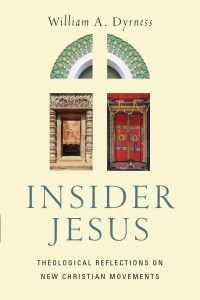 What does it mean to be a follower of Jesus in non-Western cultures? Could it mean something different than it does in places like the United States and Europe? These are some of the questions that Insider Jesus by William A. Dyrness seeks to answer.
Dyrness, in this pithy book, focuses on contextualization and the frequent misunderstanding of the same. Contextualization is often seen by some as being the distortion of Christianity to fit a culture; at the opposite extreme, it is seen as a kind of imperialistic co-opting of whatever culture is being witnessed to. Dyrness calls us to move past these extremes and come to understand that we must take a critical look at our assumptions about what other Christians should do and how they should behave. Often, these “shoulds” reflect our culture rather than a biblical understanding of Christianity.
Dyrness utilizes a number of case studies to highlight examples of “insider movements” in which Christians are not abandoning their culture while still following Jesus. These studies include Latin America and Africa with interfaith dialogues, emergent Christianity in places like India, and more. Each shows some ways in which Christianity is making headway in places that it might not have otherwise done. Each may make readers uncomfortable as we are forced to see that many of the things we take for granted culturally are not even understood in other cultures.
It is this last point that is perhaps most important to Dyrness’s thesis. Spreading the Gospel of Christ does not mean spreading our culture. As Christians, we’re called to be all things to all people, and that may, at times, make us uncomfortable. Some may here charge Dyrness with syncretism–a dreaded word in interfaith discussions–but such an accusation would be off-base. As Dyrness argues, using the thought of Kang-San Tan, a Christian from a Buddhist background, that we must
…distinguish between the danger of external identification with two religious communities and the possibility, even the necessity for those from these religious backgrounds, of maintaining an inward multireligious identity… Christianity itself necessarily exhibits an integration that reflects its historical and cultural situation… Every Christian religious expression represents some combination of indigenous values and religious practices… and the impact of the Christian Gospel… on this (124-125, emphasis his)
The point is that many of the things we think of as normal for Christian worship (standing during the Gospel reading, for instance) are clearly a use of cultural context to worship our God. Such things are not necessary for other groups, but when they are absent, it may lead us to wrongly think these other groups are mistaken.
Insider Jesus provides a much-needed critical perspective on insider movements that encourages readers to be aware of these movements and how their own faith is influenced by many similar aspects. It’s an uncomfortable read at times because it highlights areas of our own blindness about our religion. Several points Dyrness makes are controversial, but he provides enough argument and context that readers will be challenged even where they disagree.
The Good
+Provides framework for thinking through controversial questions
+Further study encouraged with sources to pursue
+Good job introducing complex topics
The Bad
-Exegetical sections brief with sometimes questionable conclusions
Disclaimer: I received a copy of the book from the publisher for review. I was not obligated to provide any specific kind of feedback whatsoever.
Links
Be sure to check out the page for this site on Facebook and Twitter for discussion of posts, links to other pages of interest, random talk about theology/philosophy/apologetics/movies and more!
Book Reviews– There are plenty more book reviews to read! Read like crazy! (Scroll down for more, and click at bottom for even more!)
Eclectic Theist– Check out my other blog for my writings on science fiction, history, fantasy movies, and more!
SDG.
——
The preceding post is the property of J.W. Wartick (apart from quotations, which are the property of their respective owners, and works of art as credited; images are often freely available to the public and J.W. Wartick makes no claims of owning rights to the images unless he makes that explicit) and should not be reproduced in part or in whole without the expressed consent of the author. All content on this site is the property of J.W. Wartick and is made available for individual and personal usage. If you cite from these documents, whether for personal or professional purposes, please give appropriate citation with both the name of the author (J.W. Wartick) and a link to the original URL. If you’d like to repost a post, you may do so, provided you show less than half of the original post on your own site and link to the original post for the rest. You must also appropriately cite the post as noted above. This blog is protected by Creative Commons licensing. By viewing any part of this site, you are agreeing to this usage policy.
Really Recommended Posts 12/9/16- Jack Chick, Modesty, movies, and more!
I’ve been feeling pretty gross this week, but thankfully had already scoured the internet for some good reads for you to peruse this weekend. Check them out, and be sure to let me know what you think. It’s a snowy owl edition because it’s actually feeling and looking a bit like winter now.
Jack Chick’s Vision of the World was a Fear-Filled Caricature– The passing of the famous (infamous?) writer of so many tracts presenting a vision of Christianity has led to various reflections. Here is one that I think is fairly accurate to what many experienced.
Christian Thinkers 101- A Crash Course on Justin Martyr– Justin Martyr is one of the earliest Christian apologists, but also remains vastly important reading.
Nietzche and the New Atheists– An interesting read about the intellectual background of some atheistic discussions now and the difficulty putting forward a philosophical vision of atheism as has occurred in the past.
Modesty and Respect for Women- Do they fit together in your worldview?– The “modesty movement” has taken hold of some forms of Christianity today. The debate over the meaning of modesty has led some to look to the Bible for answers, but they often provide over-simplified readings of the Bible that don’t actually match what it says.
John Ray in 1965: The Flood, Fossils, and Extinction– John Ray was one of the geologists who participated in the debate over whether fossils were vestiges of living things or whether they were simply tricks of the rock. Here’s an interesting look at some aspects of his life and work.
Book Review: “Ministering in Honor-Shame Cultures” by Jayson Georges and Mark D. Baker
 Understanding the context to which we are ministering is one of the most important aspects of mission–and other–work. Jayson Georges and Mark D. Baker have provided, in Ministering in Honor-Shame Cultures, a way to understand cultural practices that are far from what many in the West experience. I found it to be enlightening, and a little alarming, because it showed many times where I may have given offense without even realizing it.
Georges and Baker utilized a number of stories to illustrate some of the difficulties in understanding honor-shame cultures when one’s background is not in that culture. For those, like me, with a limited grasp of the topic, honor-shame cultures ought to be defined, but that itself is difficult. Basically, these cultures have a system where the community is valued more highly than the individual, and shame, rather than guilt, is the result of violations of the strictures of society. Such a perspective means that, for example, the core problem with one’s violation of the codes of society is not that we make mistakes (as in our individualistic societies) but rather that our very being has been corrupted. Thus, rather than trying to justify or apologize for our mistake, it is more important to cover that mistake (see especially the table on page 38).
We often see honor-shame cultures as silly or backwards–possibly even morally wrong or bankrupt–because our very understanding of human interaction is built upon a different system. Why should we have to highlight someone else’s importance in order to get what we deserve? Just as easily, the other could ask why we refuse to honor them with the standing in society that they possess? These stories help highlight both the strangeness of the “other” in the honor-shame culture and the way that we may be equally seen as brusque at best to people of other cultures. The early chapters, in particular, highlight these points.
Even more importantly–and the above is certainly vital–we may be misreading the Bible due to our misunderstanding of honor-shame cultures. For example, the many rules about purity and what makes someone unclean are almost impossible to understand without some grasp of honor-shame culture. The chapters on biblical background for understanding this and other aspects of Christianity that can really only be fully understood in honor-shame contexts.
Finally, Georges and Baker provide a number of practical applications for what they highlighted in the first 100 or so pages. These applications range across spirituality, relationships, evangelism, conversion, ethics, and community. Three appendices provide (lots of) key scripture passages on honor-shame, biblical stories that address honor-shame cultures, and resources for further reading.
Throughout the book, smart use of tables and graphs helps readers visualize the differences in cultures that lead to many misunderstandings. If there is one complaint I have the book it is that I desired more exegetical considerations, which is basically to say that I’d love a follow-up work that focuses on understanding critical biblical passages. In other words, there’s little to complain about here. It is a book full of insights that are both practical and engaging.
Ministering in Honor-Shame Cultures is one of those rare books that makes you sit back and think–really think–about how you understand the “other.” For that alone, it is worth the read. Set that alongside a good helping of practical applications and biblical theology, and the book is a must-read. It comes highly recommended.
The Good
+Provides numerous examples to help think through the issues
+Use of graphics smartly done
+Highlights very important, but often misunderstood topics
+Encourages critical interaction
The Bad
-More exegesis of some key passages would be helpful
Disclaimer: I received a copy of the book from the publisher for review. I was not obligated to provide any specific kind of feedback whatsoever.
Links
Be sure to check out the page for this site on Facebook and Twitter for discussion of posts, links to other pages of interest, random talk about theology/philosophy/apologetics/movies and more!
Book Reviews– There are plenty more book reviews to read! Read like crazy! (Scroll down for more, and click at bottom for even more!)
Eclectic Theist– Check out my other blog for my writings on science fiction, history, fantasy movies, and more!
SDG.
——
The preceding post is the property of J.W. Wartick (apart from quotations, which are the property of their respective owners, and works of art as credited; images are often freely available to the public and J.W. Wartick makes no claims of owning rights to the images unless he makes that explicit) and should not be reproduced in part or in whole without the expressed consent of the author. All content on this site is the property of J.W. Wartick and is made available for individual and personal usage. If you cite from these documents, whether for personal or professional purposes, please give appropriate citation with both the name of the author (J.W. Wartick) and a link to the original URL. If you’d like to repost a post, you may do so, provided you show less than half of the original post on your own site and link to the original post for the rest. You must also appropriately cite the post as noted above. This blog is protected by Creative Commons licensing. By viewing any part of this site, you are agreeing to this usage policy.
Book Review: “A Shared Mercy: Karl Barth on Forgiveness and the Church” by Jon Coutts
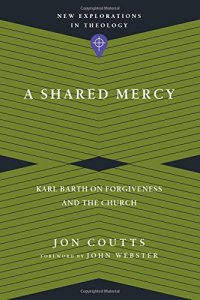 Jon Coutts’ A Shared Mercy explores the doctrine of forgiveness from the perspective of Karl Barth. Because it is the perspective of Karl Barth, it also reflects on doctrine of the church, as this was central to Barth’s thought. However, Coutts argues we must be careful not to subordinate all doctrines Barth taught under his doctrine of the church.
The book is organized into 6 chapters that largely center on two parts: Barth’s doctrine of forgiveness and what a full doctrine of forgiveness based on Barth might look like in application. Throughout the book there is a kind of unity between these topics as Coutts takes what Barth taught on forgiveness and applies it.
First, Coutts notes that because Christ taught that forgiveness is central to the lives of his followers, it follows that forgiveness is central to the church (1). Thus, exploring Barth’s Church Dogmatics, we ought to expect to find forgiveness as a central, not tertiary teaching. Coutts argues throughout the book that this is, indeed, what we find, though little has been studied in regards to Barth on forgiveness in the church in contemporary theology.
Readers may be concerned that a book so focused on a somewhat obscure topic may lack applicable insights, but Coutts does a great job not merely reporting Barth’s beliefs but also deriving thoughts therefrom that have application to the contemporary Christian. One example is the question of whether forgiveness first requires one to wait for repentance:
A legitimate practical concern… [is] the perpetuation of victimhood that seems to be implied when the imperative [to forgive] is self-giving and forgiving love. But this is founded on a misconception of the call to cruciform discipleship… Even if the abusive party is unrepentant, the result is not unforgiveness, but an acknowledgement of nonreconciliation… Forgiving the abuser is not the perpetuation of victimhood but the free offer of further reconciliation. (154-155)
This and many other passages provide direct application to the lives of believers. At several points, then, Coutts ably demonstrates the way to bring scholarship to the person in the pew, something that is too-often lacking in scholarly works.
As a Lutheran, I appreciated the highlighting of the importance of baptism and the Lord’s Supper for Christian community, though I think Barth’s teaching on these sacraments falls short of the biblical teaching. Yes, baptism is a sign of community, but Barth and Coutts each seem to err in seeing baptism as a kind of political action of the church rather than a gracious action of God. Similarly, the view of the Lord’s Supper as being primarily a work of the church rather than a gracious gift of God takes away the greatness of the gift.
Because the book is so focused on a specific aspect of Barth’s teaching, it does at times read a bit too much like a journal article–engaging with very specific opponents with little context. However, these moments are thankfully few and far between.
A Shared Mercy is an interesting, surprisingly applicable study on forgiveness in Barth’s doctrine. More importantly, it shares information that can be applied directly to the broader church. The importance of a doctrine of forgiveness ought never to be understated, as it is so central to Christian teaching. As such, this book is an important contribution to understanding what we as Christians, and the church, are called to do.
The Good
+Insights into Barth’s theology of the church, in balanced perspective
+Background for modern discussions of forgiveness
+More applicable material than me be expected
The Bad
-Sometimes reads a bit more like a journal article than a book
-Reduces both baptism and the Lord’s Supper to human act
Disclaimer: I received a copy of the book from the publisher for review. I was not obligated to provide any specific kind of feedback whatsoever.
Links
Be sure to check out the page for this site on Facebook and Twitter for discussion of posts, links to other pages of interest, random talk about theology/philosophy/apologetics/movies and more!
Book Reviews– There are plenty more book reviews to read! Read like crazy! (Scroll down for more, and click at bottom for even more!)
Eclectic Theist– Check out my other blog for my writings on science fiction, history, fantasy movies, and more!
SDG.
——
The preceding post is the property of J.W. Wartick (apart from quotations, which are the property of their respective owners, and works of art as credited; images are often freely available to the public and J.W. Wartick makes no claims of owning rights to the images unless he makes that explicit) and should not be reproduced in part or in whole without the expressed consent of the author. All content on this site is the property of J.W. Wartick and is made available for individual and personal usage. If you cite from these documents, whether for personal or professional purposes, please give appropriate citation with both the name of the author (J.W. Wartick) and a link to the original URL. If you’d like to repost a post, you may do so, provided you show less than half of the original post on your own site and link to the original post for the rest. You must also appropriately cite the post as noted above. This blog is protected by Creative Commons licensing. By viewing any part of this site, you are agreeing to this usage policy.
Book Review: “No Skin in the Game: The God of the Jehovah’s Witness” by Frank H. Armstrong
 Frank Armstrong’s No Skin in the Game is a pithy introduction to defending orthodox Christianity against Jehovah’s Witness beliefs. Central to Armstrong’s book is the notion that we must not focus merely on firing proof-texts back and forth, but rather that we ought to see the meta-narrative of Scripture and keep that in mind as we evaluate claims of how to interpret key texts.
Armstrong focuses on this meta-narrative of God as love and uses it to show that God the Son and the Father must be co-eternal. Moreover, he continues to note the continuity of Scriptures between the Testaments by showing that those things ascribed to the Father (which Jehovah’s Witnesses call Jehovah) are then ascribed to Christ (eg. creation). It is truly remarkable how many applicable examples Armstrong manages to pack into a short work.
The book provides not just a grab-bag of important verses but a guide for how to use the Bible to reason with Jehovah’s Witnesses. Several examples of verses shown with key phrases changed to reflect Jehovah’s Witness theology highlight this. The book is therefore thoroughly practical and will be useful to those hoping to engage with Jehovah’s Witness theology.
If I had one critique it is that the example of conjoined twins alongside the Trinity may cause some confusion. Armstrong argues that conjoined twins show in principle that one being may be the center of multiple persons, and as far as demonstrating that, it may not be objectionable. The problem is that such a comparison begs further comparison, and the example quickly breaks down as one considers whether conjoined twins really are one being or are two that happen to occupy the same space. Other difficulties arise upon further reflection. For what Armstrong was trying to demonstrate, it works alright, but the problem with any analogy of the Trinity is that it breaks down and may cause confusion if pressed.
No Skin in the Game is an exciting, economical introduction to witnessing to Jehovah’s Witnesses. I recommend it.
The Good
+Brief, readable style
+Puts forward many key texts
+Focuses on core ideas
The Bad
-Example of conjoined twins may cause confusion.
Disclaimer: I received a copy of the book from the publisher for review. I was not obligated to provide any specific kind of feedback whatsoever.
Links
Be sure to check out the page for this site on Facebook and Twitter for discussion of posts, links to other pages of interest, random talk about theology/philosophy/apologetics/movies and more!
Book Reviews– There are plenty more book reviews to read! Read like crazy! (Scroll down for more, and click at bottom for even more!)
Eclectic Theist– Check out my other blog for my writings on science fiction, history, fantasy movies, and more!
SDG.
——
The preceding post is the property of J.W. Wartick (apart from quotations, which are the property of their respective owners, and works of art as credited; images are often freely available to the public and J.W. Wartick makes no claims of owning rights to the images unless he makes that explicit) and should not be reproduced in part or in whole without the expressed consent of the author. All content on this site is the property of J.W. Wartick and is made available for individual and personal usage. If you cite from these documents, whether for personal or professional purposes, please give appropriate citation with both the name of the author (J.W. Wartick) and a link to the original URL. If you’d like to repost a post, you may do so, provided you show less than half of the original post on your own site and link to the original post for the rest. You must also appropriately cite the post as noted above. This blog is protected by Creative Commons licensing. By viewing any part of this site, you are agreeing to this usage policy.
Arrival: Your Life Matters – A Christian Perspective
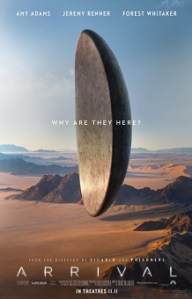 I had the chance to watch “Arrival” this past weekend. It was excellent. I can’t emphasize enough how much good science fiction is steeped in worldview and forces us to reflect upon humanity. “Arrival” is just that: excellent science fiction. Here, I will discuss worldview issues the film brought forward from a Christian perspective. There will be SPOILERS in what follows.
Your Life Matters
Perhaps the most poignant aspect of the film is one that could not be fully appreciated until the end. Once we see that Louise has been having not flashbacks but rather flash-forwards, we come to realize that she is seeing what will happen in the future. But that means the scene at the beginning, in which Louise has a daughter, Hannah, who eventually dies from cancer, will play out as she has seen it. And if that’s the case, then Louise’s decision to marry Ian and have a baby with him is something that leads, directly or indirectly, to her daughter’s death.
The question that arises, then, is whether such a life was worth living? The film presents what is one of the most beautiful ways of looking at such a question I have seen. The answer is yes. Without Hannah’s life, her poetry, joy, song, and dance could not have been part of the world. All of that would have been lost. Even the inevitable pain and tragedy that Louise and Ian will experience is part of that future world Louise saw: one in which love had a chance to play out in Hannah’s all-too-short life. It’s a message that says: Yes, your life matters, even if it is not perfect; even if it goes poorly.
And really, what right would Louise have to cut that life from the world? What right would she have to destroy that future life of Hannah, however painful it would become for herself and for her daughter? Would it really be better to cut off all the joy and beauty that her daughter would bring into the world just because Louise knew it would end badly? Such questions are monumentally important in an age in which choices of life and death are increasingly available.
Linear vs. Non-Linear Time
I found the theme of time to be quite engaging in the film. One may think that it was just a novelty to discuss non-linear time, but a number of major ancient cultures had non-linear views of time. I have much interest in studying Mesoamerica, for example, and basically across the board the Inca, Maya, Aztec, etc. had non-linear, cyclical views of time. Why does that matter? What does it have to do with worldview?
Well, in the film it was used largely as a way to tie the whole plot back together and show that one’s ideas about reality can be shaped by the way one conceptualizes of very basic ideas. But more importantly, one’s view of time impacts how one views reality itself. I have read time and again how a linear view of time helped to spur scientific discovery, among other things. A linear view of time allows for a logical A => B sequence of events in which causation is linked through time. A cyclical, or non-linear view of time would change that. In “Arrival,” it is unclear as to whether the ultimate non-linearity of time is viewed as cyclical (though the emphasis on circular imagery for the language might point in that direction). One wonders whether a non-linear view of time, taken to its conclusions, could actually ground such things as cause and effect. The movie provided a framework to think through such questions, and as someone who’s very interested in philosophy of time, I found that utterly engaging.
Time, Part 2
Another aspect of the discussion of time in the film is the implication that Louise sees the future, but also that she may be able to change it. Indeed, it seems pretty clear that Louise makes a conscious choice to allow the future she saw to play out. Does that mean the future is set in stone, or that her decisions actually will yield the future she saw? This may not seem very important for worldview, but a simple shift to examining divine omniscience might show how such a concept could impact worldview directly. If God knows the future, as I believe God does, what does that mean for human action? What does it mean if God does not comprehensively know the future, as open theists claim?
Such questions are not directly referenced in the film, but a moment’s reflection on how Louise responds to her own knowledge of the future makes these questions loom in the distance. I think it is important to think about how things like one’s view of time and God’s knowledge of the future impact things like human free choice, salvation, and the like.
Conclusion
“Arrival” is the best kind of science fiction: one that raises questions not just about the future but about humanity. I highly recommend readers go see the film. It’s phenomenal. Let me know what worldview questions were raised in your mind from watching the film.
Links
Be sure to check out the page for this site on Facebook and Twitter for discussion of posts, links to other pages of interest, random talk about theology/philosophy/apologetics/movies and more!
SDG.
——
The preceding post is the property of J.W. Wartick (apart from quotations, which are the property of their respective owners, and works of art as credited; images are often freely available to the public and J.W. Wartick makes no claims of owning rights to the images unless he makes that explicit) and should not be reproduced in part or in whole without the expressed consent of the author. All content on this site is the property of J.W. Wartick and is made available for individual and personal usage. If you cite from these documents, whether for personal or professional purposes, please give appropriate citation with both the name of the author (J.W. Wartick) and a link to the original URL. If you’d like to repost a post, you may do so, provided you show less than half of the original post on your own site and link to the original post for the rest. You must also appropriately cite the post as noted above. This blog is protected by Creative Commons licensing. By viewing any part of this site, you are agreeing to this usage policy.
Jeremiah teaches that the Messiah is God
“In those days and at that time
I will make a righteous Branch sprout from David’s line;
he will do what is just and right in the land.
In those days Judah will be saved
and Jerusalem will live in safety.
This is the name by which it will be called:
The Lord [ Hebrew = YHWH] Our Righteous Savior.’” – Jeremiah 33:15-16 (NIV)
These verses are clearly a prophecy about the coming Messiah. They also clearly state that that Messiah, a human from David’s line, will be called YHWH. In other words, this prophecy proclaims, hundreds of years before the birth of Christ, that the savior would be God incarnate. The one from the branch of David will be called YHWH, the righteous one.
Life as a Cubs Fan – Eschatology Fulfilled
 I’m writing this as the Cubs are tied 1-1 in the 2016 World Series with Cleveland. I’ll be finishing it just after the World Series, and I hope beyond hope that it will be in celebration of a victory of the Cubs in the World Series, for the first time in 108 years. I’ll clearly mark the point I wrote after the World Series. Go Cubs!
There was one night I was in bed but could not fall asleep. I believe it was when the Cubs had just tied the NLCS 2-2 with the Dodgers. I was bubbling with joy because they’d just tied the series. It meant there was a chance, however remote, that the Cubs could make it to the World Series for the first time since 1945. It meant that, maybe, there wouldn’t have to be a “Next Year” this year. Maybe, just maybe, it could happen.
As I was lying there, thinking, I realized that it was at this point I truly understood the joyful anticipation that the writers of the New Testament experienced. Jesus Christ had promised to return, and soon. How great that joyful day would be! But each day, each year, there was the thought: there’s always tomorrow. One day we will experience the reality that there is no more tomorrow, and our joy will be complete.
With our eschatological hope, we know that there’s not just a chance. It’s a matter not of if Christ will return, but when. And that is something that I feel overjoyed about and also terrified. What does it mean to say Christ will return? The world will be not just a different place–a changed place–it will be made anew.
Post World Series
I just re-read a blog post I wrote back in 2012 entitled “The Eschatology of a Cubs Fan.” In that post, I wrote:
I still hold out hope though, it’s almost like an eschatological promise: “There’s always next year.” Boy, we’ve been saying that for a long time. But I really do believe it: one day, the Cubs will win one, and it will be during my lifetime. When they do, I’ll be like the fan standing up, looking at the skyline, and just rejoicing. I’ll say “This one was for you, grandpa” and I’ll see him sweeping the streets in heaven [my grandpa would get a broom out and sweep the floors when the Cubs swept a series]. If it happens, I will get to Chicago, I don’t care when it is or how it happens. I won’t have to be at a game, or even there while one happens, but I’ll get back to Chi-town, the place I love, and I’ll kiss the walls of Wrigley, wearing my “World Series Champions” hat.
One day, Cubs.
One day.
That day has come. I can’t believe it. I will write up a lengthy reflection on the win later, but for now I want to put it in perspective of this post. The consummation of so much hope, so many shattered dreams that suddenly got repaired, is one of the greatest feelings I’ve had in my entire life. But this is nothing to compare to that which will come at the final eschaton–the return of Jesus Christ. That’s not to say the World Series win for the Cubs doesn’t matter–far from it, the world really did change, and it feels new as I wake up each morning. What I’m saying, instead, is that this feeling, this joy, is one of the ways God gives us to see a greater thing to come. It’s a kind of typology, but one that can be found in the mundane–even something as simple as a human swinging a stick at a ball.
And that, really, is what Christianity (and, really, Lutheranism) is all about. Christ has come into this world, become incarnate, and is in this world now. Our God came and dwelt among us. And those blessings given us reflect God’s good reality, and a better one that is to come.
I think it is true that I, and many other Cubs fans, can now say we know what a slice of heaven looks like, what it feels like. Hope will one day be fulfilled. That long-awaited day shall come. Christ will return. Come quickly, Lord Jesus. Amen.
Links
Be sure to check out the page for this site on Facebook and Twitter for discussion of posts, links to other pages of interest, random talk about theology/philosophy/apologetics/movies and more!
Eclectic Theist– Check out my other blog for my writings on science fiction, sports, history, movies, and more!
SDG.
——
The preceding post is the property of J.W. Wartick (apart from quotations, which are the property of their respective owners, and works of art as credited; images are often freely available to the public and J.W. Wartick makes no claims of owning rights to the images unless he makes that explicit) and should not be reproduced in part or in whole without the expressed consent of the author. All content on this site is the property of J.W. Wartick and is made available for individual and personal usage. If you cite from these documents, whether for personal or professional purposes, please give appropriate citation with both the name of the author (J.W. Wartick) and a link to the original URL. If you’d like to repost a post, you may do so, provided you show less than half of the original post on your own site and link to the original post for the rest. You must also appropriately cite the post as noted above. This blog is protected by Creative Commons licensing. By viewing any part of this site, you are agreeing to this usage policy.

 J.W. Wartick - Reconstructing Faith