christian
“Manual of Christian Evidences”- Fisher Chapter 4 Guided Reading

All rights reserved.
I am leading a guided reading of the Manual of Christian Evidences by George Park Fisher. It is freely available online and will serve as a base for discussing Christian apologetics throughout this series. The chapters are short and readable. I encourage you to join in by reading the chapters and commenting with your thoughts. When I discuss the book, I will be citing page numbers from the edition linked above.
Chapter 4
Fisher wrote:
Before proceeding further, it is well to remind the reader how much there is in Christianity that is not a subject of dispute. (28)
I think it is important to note immediately that almost none of the points he raises following this declaration would be without dispute anymore. People wish to deny that Jesus existed, and so would certainly deny the preceding ministry of John the Baptist. Indeed, basically every historical fact about Jesus is thrown into dispute because of the existence of people that think Jesus did not exist. This is not to say that the “Jesus myth” is a legitimate historical hypothesis that has any basis in reality; it is just to say that the claim that something is beyond dispute is difficult to maintain.
Fisher then gave an overview (very briefly) of the spread and benefits of Christianity. Moreover, he argued that violence “done in the name of the Christian religion, is due… not to the religion itself, but to the perversion and corruption of it.” The part I took out with ellipses again says “generally conceded.” I think that this is generally conceded now among anyone who has even a working understanding of Christian theology and history, but the problem is that the task of those interested in the defense of the faith must start, in part, with simply informing others.
There are so few things which we may call “admitted facts” anymore that it can be daunting to know where to begin. That’s why it is important to begin an apologetic with a relationship–get to know those with whom you’re discussing your faith so that you can relate to them on a level that addresses specific concerns they have rather than making assumptions about them.
Links
Be sure to check out the page for this site on Facebook and Twitter for discussion of posts, links to other pages of interest, random talk about theology/philosophy/apologetics/movies and more!
Apologetics Read-Through: Historical Apologetics Read-Along– Here are links for the collected posts in this series and other read-throughs of apologetics books (forthcoming).
Dead Apologists Society– A page for Christians interested in the works of historical apologetics. There is also a Facebook group for it.
SDG.
——
The preceding post is the property of J.W. Wartick (apart from quotations, which are the property of their respective owners, and works of art as credited; images are often freely available to the public and J.W. Wartick makes no claims of owning rights to the images unless he makes that explicit) and should not be reproduced in part or in whole without the expressed consent of the author. All content on this site is the property of J.W. Wartick and is made available for individual and personal usage. If you cite from these documents, whether for personal or professional purposes, please give appropriate citation with both the name of the author (J.W. Wartick) and a link to the original URL. If you’d like to repost a post, you may do so, provided you show less than half of the original post on your own site and link to the original post for the rest. You must also appropriately cite the post as noted above. This blog is protected by Creative Commons licensing. By viewing any part of this site, you are agreeing to this usage policy.
Celebrating 50 Years of Star Trek: Top 25 Moments, Times Two #5-1
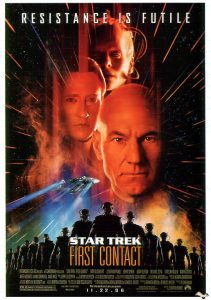 Readers of this blog know that I’m a huge science fiction fan. Science fiction is a genre that has more worldview seeping into it and through it than almost any other one, in my opinion. To celebrate the 50th Anniversary of Star Trek, I have teamed up with Mike Poteet of The Sci-Fi Christian (an excellent site and podcast you should follow in all forms) to share our top 25 moments each (50 total!) from all of Star Trek on screen. That’s right, from The Original Series all the way through Star Trek Beyond, we’re bringing you our favorite moments. Some of these are steeped with worldview, and some are just fun or interesting. Check them out, and let us know your favorites in the comments.
5.
J.W. – Pretty Much All of It (Star Trek: First Contact, 1996)
It’s difficult to pick a single moment from First Contact, which is my favorite Star Trek film. As a kid I found myself looking up at the sky outside to see if Borg were descending on me that very moment. Watching it now, I enjoy the strong plot and characters.
Mike – Captain Borg (“The Best of Both Worlds, Part I,” TNG, 1990)
Composer Ron Jones uses Alexander Courage’s classic Trek fanfare to ironic and chilling effect as the camera reveals Locutus of Borg, formerly our hero, Jean-Luc Picard. It’s a moment that fires on all cylinders, heralding Trek’s coming-of-age as a modern storytelling force to be reckoned with.
4.
J.W. – “KHAAAAN!!” (Star Trek II: The Wrath of Khan, 1982)
It appears all is lost for Kirk and gang as Kirk yells his rival’s name bitterly into his communicator. In reality, Kirk has once again cheated the system, and it is this revelation that made the movie, to my younger self, utterly compelling. It remains captivating to this day.
Mike – The Kobyashi Maru Scenario (Star Trek II: The Wrath of Khan, 1982)
Viewers who dreamed of attending Starfleet Academy vicariously got their wish watching Saavik learn that “how we deal with death is… as important as how we deal with life.” (It’s also a brilliant fake-out, “killing off” Spock so fans lowered their guard before the movie lowered the real boom later.)
3.
J.W. – Klingon Jesus Appears (“Rightful Heir,” TNG, 1993)
Worf goes to find himself but ends up finding the long-awaited Kahless has returned. Not only that, but Kahless specifically calls him back to an enlivened faith. Kahless turns out to be a clone, and the episode remains thought-provoking and intense throughout.
Mike – “The Meld” (Star Trek: The Motion Picture, 1979)
Jerry Goldsmith’s lush score accompanies some of Trek’s most beautiful special effects as Decker, Ilia and V’Ger achieve transcendence. One of the franchise’s highest concept moments, dramatizing a yearning to “join with the Creator” that we Christians believe God perfectly fulfilled by coming to us (not vice versa) in Christ.
2.
J.W. – Darmok and Jalad at Tanagra (“Darmok,” TNG, 1991)
Although it seems obvious a species that can only communicate through metaphor would have problems building spaceships, this episode poignantly portrays the struggles to communicate cross-culturally while serving up some choice quotes. Not watching this is like Shaka when the walls fell.
Mike – The Phoenix Takes Flight (Star Trek: First Contact, 1997)
The movie makes up for Zefram Cochrane’s earlier, cringeworthy name check of the franchise by showing us humanity’s first warp-powered spaceflight, accompanied by the strains of Steppenwolf’s “Magic Carpet Ride.” It’s thrilling and inspiring, and a heck of a lot of fun—as Star Trek’s future, at its best, always is.
1.
J.W. – Picard Lives a Second Life (“The Inner Light,” TNG, 1992)
Picard lives an entire lifetime’s memories in just a few short minutes “real time.” Coming to, he realizes it was all the memories of a lost civilization, and the episode ends with him playing a flute from the lost world alone in his cabin. It’s absurdly beautiful.
Mike – Stealing the Enterprise (Star Trek III: The Search for Spock, 1984)
The heist is perhaps out of character for our heroes and the franchise, but friendship is at stake. Horner’s scoring is masterful, the cast’s acting is tops, and Kirk’s determination to go even when warned he’ll “never sit in the captain’s chair again” reminds us what really matters in life.
Links
The Sci-Fi Christian– There is so much to discuss when it comes to the intersection of faith and culture, and science fiction is often at the forefront of ways to drive this discussion forward. Check out The Sci-Fi Christian’s website and podcast for tons of discussion of related topics.
Eclectic Theist– Follow my “other interests” blog for discussion of sci fi, fantasy, movies, sports, food, and much, much more.
Be sure to check out the page for this site on Facebook and Twitter for discussion of posts, links to other pages of interest, random talk about theology/philosophy/apologetics/movies and more!
SDG.
Celebrating 50 Years of Star Trek: Top 25 Moments, Times Two #10-6
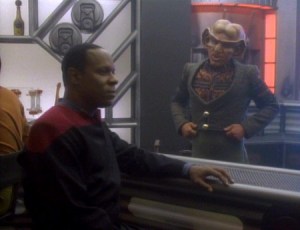 Readers of this blog know that I’m a huge science fiction fan. Science fiction is a genre that has more worldview seeping into it and through it than almost any other one, in my opinion. To celebrate the 50th Anniversary of Star Trek, I have teamed up with Mike Poteet of The Sci-Fi Christian (an excellent site and podcast you should follow in all forms) to share our top 25 moments each (50 total!) from all of Star Trek on screen. That’s right, from The Original Series all the way through Star Trek Beyond, we’re bringing you our favorite moments. Some of these are steeped with worldview, and some are just fun or interesting. Check them out, and let us know your favorites in the comments.
10.
J.W. – Worf is Shunned (“Sins of the Father,” TNG, 1990)
One of the most poignant scenes in TNG is the Klingon High Council all turning their backs on a lonely Worf in the middle of a circle. It’s a radically unfair moment that contrasts Worf’s true honor with the subterfuge of his rivals.
Mike – “What does God need with a starship?” (Star Trek V: The Final Frontier, 1989)
Yes, really. Kirk shows us the importance of iconoclasm—challenging false gods—with this wonderful question. He may not believe in God, but he at least knows enough to “test the spirits” (1 John 4.1). Not every claimant of our ultimate trust, obedience and worship is deserving. Discernment is demanded.
9.
J.W. – Dealing with a Violent Past (“Duet,” DS9, 1993)
The Cardassian/Bajor conflict was apparent all through DS9 and certainly parts of TNG as well, but here it comes into true focus in beautiful ways rarely explored on Star Trek. It remains one of the better episodes of Star Trek across all series.
Mike – “I won’t kill you!” (“Arena,” TOS, 1967)
Kirk relies on his intelligence, ingenuity and mercy to survive, refusing to kill the Gorn he earlier wanted to destroy. He proves to the Metrons’ satisfaction (but not Spock’s) that humanity is “a most promising species.” One of the classic series’ most iconic and memorable hours, and deservedly so.
8.
J.W. – Invading Fleet “Can’t Stand It” (Star Trek: Beyond, 2016)
The latest Trek movie has all kinds of fun moments, but the self-referential humor of blowing away an invading fleet with music that hearkens back to the first reboot film tops them all. Tune into a modern classic to fight baddies.
Mike – Spock Melds with the Horta (“The Devil in the Dark,” TOS, 1967)
In a day when science fiction on TV often meant scary monsters (as in TOS’ own first-aired episode), Trek challenged the idea that the unknown, the alien, the “other” must, by definition, be the enemy. Innovative costuming and Nimoy’s empathetic acting sell the series’ most memorable moment of first contact.
7.
J.W. – We Learn What’s Important (“Family,” TNG, 1990)
Picard must try to reconcile with his brother back home in France as viewers get not only a tantalizing look at life on Earth in the future, but also an education in what’s important. Hint: it’s the episode title.
Mike – Benny Russell Dreams (“Far Beyond the Stars,” DS9, 1998)
Trek’s most direct assault on racial bigotry remains too timely in 2016. Sisko, in a Prophet-induced vision, learns the dangers of being black in 1950s America. It’s also one of the franchise’s most stirring affirmations of hope’s power: “You can pulp a story, but you cannot destroy an idea!”
6.
J.W. – That’s How You Premiere a Series (“Emissary” DS9, 1993)
“Emissary” was a rare moment for me- a pilot episode of a Star Trek series that was genuinely amazing. Sisko’s backstory was intriguing, all the other characters gave hints of potential, and the tension was ratcheted up with the discovery of a wormhole.
Mike – Tasha’s Farewell (“Skin of Evil,” TNG, 1987)
While Trek’s theology of immortality (living on in others’ memories) offers less hope than the Gospel, Tasha’s memorial shows the power of ritual and the necessity of community when coping with grief. Ron Jones’ score sings with heartbreak but also, as if by grace, healing. Season one’s most beautiful moments.
Links
The Sci-Fi Christian– There is so much to discuss when it comes to the intersection of faith and culture, and science fiction is often at the forefront of ways to drive this discussion forward. Check out The Sci-Fi Christian’s website and podcast for tons of discussion of related topics.
Eclectic Theist– Follow my “other interests” blog for discussion of sci fi, fantasy, movies, sports, food, and much, much more.
Be sure to check out the page for this site on Facebook and Twitter for discussion of posts, links to other pages of interest, random talk about theology/philosophy/apologetics/movies and more!
SDG.
Celebrating 50 Years of Star Trek: Top 25 Moments, Times Two #15-11
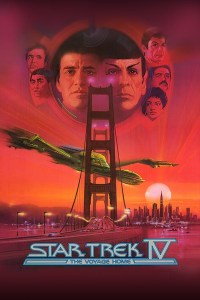 Readers of this blog know that I’m a huge science fiction fan. Science fiction is a genre that has more worldview seeping into it and through it than almost any other one, in my opinion. To celebrate the 50th Anniversary of Star Trek, I have teamed up with Mike Poteet of The Sci-Fi Christian (an excellent site and podcast you should follow in all forms) to share our top 25 moments each (50 total!) from all of Star Trek on screen. That’s right, from The Original Series all the way through Star Trek Beyond, we’re bringing you our favorite moments. Some of these are steeped with worldview, and some are just fun or interesting. Check them out, and let us know your favorites in the comments.
15.
J.W. – Ro Chooses Sides (“Preemptive Strike,” TNG, 1994)
Ro Laren had been in and out of TNG for several episodes, and her Bajoran roots linked her plot with what was happening on DS9. Here, we see her go from favored protégé of Picard to betraying his trust to follow what she feels is the greater good.
Mike – Worf’s Bedside Manner (“Disaster,” TNG, 1991)
Pressed into medical service after catastrophe strikes the Enterprise (as it does), Worf makes ready to set a crewman’s broken leg with this blunt assessment: “This will hurt. Prepare yourself.” Afterward, he praises his patient: “You bore that well.” A pitch-perfect note of character-based comedy, at which mature TNG excelled.
14.
J.W. – Finally Home (“Endgame,” Voyager, 2001)
Though we may not get as much of the story as we’d like, fans finally got to see the return of Voyager to, approximately, home. The whole premise of the show was based on the culmination of this event, and the payoff is emotionally captivating.
Mike – “Hello, computer!” (Star Trek IV: The Voyage Home, 1986)
It’s hard to pick a favorite funny scene in a film full of them, but Scotty’s (admittedly unrealistic) ignorance of a 1980s computer—”The keyboard; how quaint”—is always a contender. The scene is also the template for Spock Prime’s “invention” of transwarp beaming for Scotty in Star Trek (2009).
13.
J.W. – Blue Shirt? Kill me now! (“Tapestry,” TNG, 1993)
Picard must relive moments of his life that he would like to change as Q guides him to the realization that those choices made him who he was. The best part: when he ends up a blue shirt, he immediately demands death instead of continuing as a lowly science officer.
Mike – Khan Revealed (Star Trek II: The Wrath of Khan, 1982)
Ricardo Montalban’s performance as an older, crazier Khan so riveted me, I memorized much of it, including this scene. Montalban swings from nostalgic bitterness (“On Earth… 200 years ago…”) to unbridled outrage (“This is Ceti Alpha Five!”) All memories of Mr. Roark evaporate; here is the Trek films’ greatest villain.
12.
J.W. – “Would you mind stopping that noise?” (Star Trek IV: The Voyage Home, 1986)
Kirk asks a punk on the bus to turn off his boombox; in response, the punk turns it up. So Spock shuts him down and the bus applauds. This is one of the most memorable moments in all of Star Trek, in my opinion.
Mike – U.S.S. Enterprise, NCC-1701-A, Revealed (Star Trek IV: The Voyage Home, 1986)
A cathartic moment that restores order to the recently chaotic Trek universe. The unveiling of the new Enterprise, to the strains of Alexander Courage’s fanfare, is arguably the franchise’s first overt acknowledgment that (as Roddenberry’s own, unused lyrics to the old theme say), this “star trek will go on forever.”
11.
J.W. – Data is a Person (“The Measure of a Man,” TNG, 1989)
Riker must try to demonstrate Data is not a person, and does so by taking an arm off… he thinks. But Picard’s case comes out on top and Data is demonstrated to be a person with all the rights that entails. It’s a suspenseful, heartwarming moment early in TNG.
Mike – “This is 13 years ago…” (“The Menagerie,” TOS, 1966)
Gene Roddenberry faced the unenviable “no-win scenario” of needing to air the show’s unsold, radically different first pilot episode in order to fill out TOS’ first season. His solution was elegant, enveloping it in a frame story that instantly gave the Trek universe a “pre-history” and Spock a richer backstory.
Links
The Sci-Fi Christian– There is so much to discuss when it comes to the intersection of faith and culture, and science fiction is often at the forefront of ways to drive this discussion forward. Check out The Sci-Fi Christian’s website and podcast for tons of discussion of related topics.
Eclectic Theist– Follow my “other interests” blog for discussion of sci fi, fantasy, movies, sports, food, and much, much more.
Be sure to check out the page for this site on Facebook and Twitter for discussion of posts, links to other pages of interest, random talk about theology/philosophy/apologetics/movies and more!
SDG.
Celebrating 50 Years of Star Trek: Top 25 Moments, Times Two #20-16
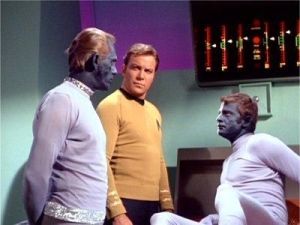 Readers of this blog know that I’m a huge science fiction fan. Science fiction is a genre that has more worldview seeping into it and through it than almost any other one, in my opinion. To celebrate the 50th Anniversary of Star Trek, I have teamed up with Mike Poteet of The Sci-Fi Christian (an excellent site and podcast you should follow in all forms) to share our top 25 moments each (50 total!) from all of Star Trek on screen. That’s right, from The Original Series all the way through Star Trek Beyond, we’re bringing you our favorite moments. Some of these are steeped with worldview, and some are just fun or interesting. Check them out, and let us know your favorites in the comments.
20.
J.W. – Odo Can Turn Into ANYTHING (DS9)
Okay, it might not quite be true to say that Odo can turn into anything, but close enough. Throughout the course of DS9 fans see Odo shapeshift into all kinds of strange things, from vases to a combadge. The combination of ability and campiness makes Odo an intriguing character.
Mike – Spelled Out in Black and White (“Let That Be Your Last Battlefield,” TOS, 1969)
When I was younger, I dismissed classic Trek’s most overt criticism of racial prejudice as “about as subtle as a sledgehammer.” Now, sadly, I’m not so sure white Americans don’t need as many blunt reminders about the dangers and sheer stupidity of racial prejudice and intolerance as we can get.
19.
J.W. – Tribbles (“The Trouble with Tribbles,” TOS, 1967)
There’s a reason everybody remembers this episode. It may not be the greatest piece of film shot for Star Trek—far from it—but it got nominated for a Hugo award and is some of the most straightforward fun I’ve had watching an episode of Star Trek.
Mike – Fizzbin (“A Piece of the Action,” TOS, 1968)
Kirk’s knack for fast thinking and fast-talking his way out of tough spots has never been on more hilarious display. His impromptu “rules” aren’t internally consistent even as he makes them up, which only adds to the fun. Shatner’s clearly having a good time, and viewers do, too.
18.
J.W. – Learning How to Mourn (“Dark Page,” TNG, 1993)
Lwaxana Troi, one of my least favorite characters, is given an astonishingly sympathetic role as one suffering mental trauma from the loss of a child. As a viewer, you learn that sometimes, there is little you can do to help but weep with those who mourn.
Mike – “Don’t Destroy the One Named Kirk (“Balance of Terror,” TOS, 1966)
McCoy encourages a self-doubting Kirk by putting him in his cosmic place: “In this galaxy, there’s a mathematical probability of three million Earth-type planets. And in all of the universe, three million million galaxies like this. And in all of that, and perhaps more, only one of each of us.”
17.
J.W. – Eugenics = Bad (“The Masterpiece Society,” TNG, 1992)
Star Trek is sometimes at its best when introducing ethical questions, and “The Masterpiece Society” asks many. In particular, what price are we willing to pay for alleged perfection? It’s an ethical quandary that takes center stage in this thought-provoking episode.
Mike – Ambassador Kollos (“Is There in Truth No Beauty?,” TOS, 1968)
The semi-corporeal alien deemed too hideous to behold is one of classic Trek’s most truly “science fictional” aliens—and Dr. Miranda Jones’ impassioned challenge of conventional wisdom (“Who is to say whether Kollos is too ugly to bear, or too beautiful to bear?”) is an eloquent plea for embracing diversity. IDIC!
16.
J.W. – The Power of Religion (“Accession,” DS9, 1996)
Though it could be faulted for portraying a somewhat pragmatist view of religion, “Accession” also shows at several points that faith is something that goes beyond simplistic stereotypes and into deeper aspects of personhood. It’s a moving episode that sees Sisko reinstalled as Emissary.
Mike – “The Klingon Battle” (Star Trek: The Motion Picture, 1979)
Another standout musical moment from Goldsmith. The insistent clacks of his heavily percussive Klingon theme underscore the doomed aliens’ encounter with V’Ger, “voiced” by the wonderful “blaster beam.” Spectacular new Klingon ships, a high-tech Federation space station, and an immediately gripping threat to Earth, all in a few minutes’ time.
Links
The Sci-Fi Christian– There is so much to discuss when it comes to the intersection of faith and culture, and science fiction is often at the forefront of ways to drive this discussion forward. Check out The Sci-Fi Christian’s website and podcast for tons of discussion of related topics.
Eclectic Theist– Follow my “other interests” blog for discussion of sci fi, fantasy, movies, sports, food, and much, much more.
Be sure to check out the page for this site on Facebook and Twitter for discussion of posts, links to other pages of interest, random talk about theology/philosophy/apologetics/movies and more!
SDG.
Celebrating 50 Years of Star Trek: Top 25 Moments, Times Two #25-21
 Readers of this blog know that I’m a huge science fiction fan. Science fiction is a genre that has more worldview seeping into it and through it than almost any other one, in my opinion. To celebrate the 50th Anniversary of Star Trek, I have teamed up with Mike Poteet of The Sci-Fi Christian (an excellent site and podcast you should follow in all forms) to share our top 25 moments each (50 total!) from all of Star Trek on screen. That’s right, from The Original Series all the way through Star Trek Beyond, we’re bringing you our favorite moments. Some of these are steeped with worldview, and some are just fun or interesting. Check them out, and let us know your favorites in the comments.
25.
J.W. – Trek is back to TV… kind of (Star Trek: Discovery Announced, 2016)
https://www.youtube.com/watch?v=Cxba2WjlN90
Finding out that Star Trek was returning in series form was massive news for Star Trek fans. It’s always been the format Trek has excelled in, and I know that the announcement of a new series was one of the best moments I’ve had with Star Trek.
Mike – “Is that classical music?” (Star Trek Beyond, 2016)
The perfect fusion of “nuTrek” and old: Instead of firing phasers or photon torpedoes, our heroes unexpectedly use music as a weapon against Krall’s “bees”—and the song of choice? The Beastie Boys’ “Sabotage,” a callback to the 2009 film. (We all like the beats and the shouting, Jaylah!)
https://www.youtube.com/watch?v=CeGHr9l-o1E
24.
J.W. – Data is an A-Bomb (“Thine Own Self,” TNG, 1994)
Data shows up at in a village with no memory of who he is, or that he’s carrying a container full of radiation poisoning. When the camera pans onto that case with the radiation warnings on it, it is one of the more chilling moments in TNG.
Mike – The Tragedy of Red Squad (“Valiant,” DS9, 1998)
One of Trek’s most haunting examinations of war and its costs. Jake and Nog’s friendship is tested past the breaking point aboard a Starfleet vessel crewed by cadets who want to become (depending on who you ask) heroes or martyrs. A powerful, not preachy morality tale in Trek’s finest tradition.
23.
J.W. – Seven of Nine is Revealed (“Scorpion, Part 2,” VOY, 1997)
The Borg are perhaps the most feared of all Star Trek villains, and for good reason. Here, however, viewers are introduced to a character who would later become a seeming paradox: a sympathetic, rehabilitated (?) Borg.
Mike – Tribbles Keep Fallin’ On Kirk’s Head (“Trial and Tribble-ations,” DS9, 1996)
An overrated TOS episode is redeemed with witty scripting and ingenious, seamless editing just in time for Trek’s 30th birthday. We learn those fuzzballs kept raining down on Kirk because, off camera, time-traveling Sisko and Dax were tossing them aside in order to find a bomb!
22.
J.W. – Data is Impersonal (“In Theory,” TNG, 1991)
Data experiments with humanity, but it turns out that much of his work is just that—experimentation. When his girlfriend breaks up with him, his utterly bleak—and apparently inhuman—reaction is to delete the program routine he wrote to date her.
Mike – Captain Proton to the Rescue!!! (“Bride of Chaotica,” VOY, 1999)
Buck Rogers and zap guns are an often overlooked part of Trek’s DNA, but not here! The pulp sci-fi tradition is on full, garish black-and-white display as Tom Paris’ B-movie holodeck program goes terribly—and hysterically—wrong. The “Voyager” cast always shone when set free to unleash their comedic chops.
21.
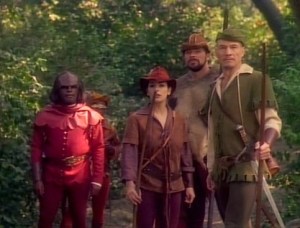
J.W. – I turned on the wrong channel (“Qpid,” TNG, 1991)
A rollicking good time in this episode of TNG, wherein Q attempts to give Picard a love interest by transporting him and select crew members to Sherwood Forest. If you start this episode in the middle, you’d be confused about what you’re watching.
Mike – “Why are they banging their heads?” (“Little Green Men,” DS9, 1995)
Arguably the funniest of Trek’s many trips to the past, wherein we learn that none other than Ferengi crashed in Roswell in 1947. “I’d always heard primitive hew-mons lacked intelligence,” Quark observes, “but I had no idea they were this stupid!” Out of the mouths of extraterrestrials.
Links
The Sci-Fi Christian– There is so much to discuss when it comes to the intersection of faith and culture, and science fiction is often at the forefront of ways to drive this discussion forward. Check out The Sci-Fi Christian’s website and podcast for tons of discussion of related topics.
Eclectic Theist– Follow my “other interests” blog for discussion of sci fi, fantasy, movies, sports, food, and much, much more.
Be sure to check out the page for this site on Facebook and Twitter for discussion of posts, links to other pages of interest, random talk about theology/philosophy/apologetics/movies and more!
SDG.
Book Review: “Justification” by N.T. Wright
 N.T. Wright’s views about the doctrine of justification have continued to be quite controversial, and his book Justification is a brief summary of his entire project. Essentially, Wright is attempting to go back to the Pauline corpus to see exactly what Paul means by the doctrine of justification. Part of this project, for Wright, is to become aware of the idea that we may be asking the texts the wrong questions from the get-go. We need to understand the context to which Paul was writing before we can even properly formulate questions.
Wright begins with a number of preliminary comments. He first outlines the difficulties faced by biblical interpreters when they do start with the wrong questions. He argues that a number of our interpretations are based less on the text than an interpretation of the text itself. He argues that the Reformation tradition ought to continue to lead us to question even Reformation conclusions about texts like Galatians–and Luther’s “mistaken” reading (according to Wright) thereof. In other words, we need to acknowledge that we could be deeply mistaken, and have been deeply mistaken, about the meaning of these texts for hundreds of years. It’s a tough pill to swallow, but one that ought to be taken seriously. Acknowledging the possibility that an interpretation is based less on the text than on tradition or modern assumptions is one of the first steps to understanding the text.
Then, Wright proceeds to show the context to which Paul was writing. Specifically, much of the context he was writing to makes certain parts of the text make a lot more sense than they may otherwise. When you realize what was happening in the early church it becomes easier to understand some of the basic questions Paul was asking and answering. Next, Wright outlines his view of justification, which is admittedly never distilled (so far as I can tell) down to a single sentence. It is thus difficult to say exactly what his view is without an extended excursus longer than a book review, but the bare-bones basics, at risk of being overly simplistic, is that justification is God’s work through Israel of bringing the whole world to himself, declaring it righteous not through imputed righteousness, but through a law court declaration of righteousness. Yes, before those who understand Wright’s position better than I do, this is very simplistic and misses some key points of his doctrine. Yet, I have to make the attempt to summarize as best I can what he was arguing.
Finally, Wright concludes with lengthy exegesis of a number of Pauline passages. Though he himself says these are but the first steps along the lines of understanding Paul, it ought to be noted that it is in this section of the book that Wright engages most thoroughly with critics of his position as well as providing a positive statement of his view. This new edition that I’m reviewing adds an additional introduction from Wright, which outlines the continuing debates over Pauline theology.
One difficulty with Wright’s approach that many may object to is the notion that it undermines the perspicuity of Scripture. Now, I’m one who hates throwing that term around, because perspicuity is used as a kind of battering ram doctrine to try to silence critics on all sorts of topics. However, the real doctrine of perspicuity of Scripture, yes, inherited from the Reformation, is that the Bible is clear in that which is necessary to understand for salvation. If, however, Wright is correct in saying that must understand a great deal of historical context before we can even get to the right questions for the doctrine of justification, this seems to make it quite complex indeed to get to the knowledge that people need for salvation. Of course, Wright would–and did–argue that this is already starting off on the wrong track, because Paul was not so much interested in individual salvation as he was interested in the plan of Salvation through Israel of the whole world. And that is a fair answer, though it does seem to–in some sense–undermine the clarity of Scripture as has been taught. Once again, Wright would probably accept this and argue that that idea is itself an inherited tradition that the Reformers themselves would call us to examine and test by Scripture.
Perhaps the strangest aspect of the book to me was the continued targeting of Luther and Lutheran theology by Wright. I know of some Lutheran pastors who have argued Wright’s position is not far at all from the Lutheran one, and others who believe he is as far from Lutheranism on justification as possible. Though this may simply show confusion within Lutheran theology, it may also show–and I think does–that Wright’s position (and probably Luther’s) is not so clearly stated as he thinks. Moreover, I am curious about the continued calling out of Lutherans (and, yes, Reformed thinkers) by Wright, considering that his position seems, on the face of it, so utterly close to what Lutherans do believe about justification, and much farther from some other denominational perspectives.
Justification is required reading for those interested in Pauline theology, whether one agrees with Wright or not. That said, it is unfortunate that a decent amount of the work seems to be polemical against perceived enemies rather than embracing potential allies.
The Good
+Leads readers to a deeper look at biblical texts
+Provides solid background to understanding Pauline corpus
+Outlines Wright’s ways in a concise fashion
The Bad
-Strangely focused on the Lutheran position
-Not always very clear
Disclaimer: I received a copy of the book for review from the publisher. I was not required to provide any specific kind of feedback whatsoever.
Source
N.T. Wright, Justification (Downers Grove, IL: InterVarsity, 2016).
Links
Be sure to check out the page for this site on Facebook and Twitter for discussion of posts, links to other pages of interest, random talk about theology/philosophy/apologetics/movies and more!
Book Reviews– There are plenty more book reviews to read! Read like crazy! (Scroll down for more, and click at bottom for even more!)
Eclectic Theist– Check out my other blog for my writings on science fiction, history, fantasy movies, and more!
SDG.
——
The preceding post is the property of J.W. Wartick (apart from quotations, which are the property of their respective owners, and works of art as credited; images are often freely available to the public and J.W. Wartick makes no claims of owning rights to the images unless he makes that explicit) and should not be reproduced in part or in whole without the expressed consent of the author. All content on this site is the property of J.W. Wartick and is made available for individual and personal usage. If you cite from these documents, whether for personal or professional purposes, please give appropriate citation with both the name of the author (J.W. Wartick) and a link to the original URL. If you’d like to repost a post, you may do so, provided you show less than half of the original post on your own site and link to the original post for the rest. You must also appropriately cite the post as noted above. This blog is protected by Creative Commons licensing. By viewing any part of this site, you are agreeing to this usage policy.
Book Review: “Introduction to World Christian History” by Derek Cooper
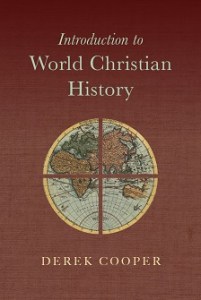 Derek Cooper’s Introduction to World Christian History provides a look at the development of Christianity across the world. It is a broad introduction to Christianity around the globe.
The book is formatted both by space and time. That is, sections on each general area (i.e. Asia) are traced for a specific time period (i.e. First through Seventh Centuries). Thus, readers looking to have a reference to work from need not look much farther than this book. Other readers, who may simply be interested in the broad development of world Christianity will not be disappointed either. Cooper does an excellent job showing the ebb and flow of Christianity’s spread across vast regions of time and place. Individual stories of prominent Christians are told in historical context to highlight specific periods or ideas. These individual stories accompany a broader narrative that is delivered in a readable, engaging style.
What makes the book particularly excellent is the way it provides all levels of readers with more to explore. It is an introductory text, for sure, but the notes are excellent and the topics explored are so broad that even readers with serious knowledge of Christian history will find more to explore. It is such a vast topic that no one can grasp each area, and Cooper gives glimpses into history that entice, like stained glass windows, much study.
The only real downside here is unavoidable: with so much material covered, it is impossible to get a complete picture of any one topic. Readers must go beyond this introduction. But again, kudos to Cooper for making readers want to do so with such a rich narrative style.
Introduction to World Christian History is the kind of book that will broaden readers minds in a number of ways. From those merely interested in a specific region to those who want to know just how we got to where we are, the book has broad appeal. Cooper’s style makes it extremely accessible for any level of reader, with plenty to tantalize more advanced readers as well. I recommend it highly.
The Good
+Fantastic overview covering large swathes of time and space
+Provides readers with broader understanding of Christianity
+Written in an interesting, readable style
The Bad
-Extremely brief on many interesting points
Disclaimer: I received a copy of the book for review from the publisher. I was not required to provide any specific kind of feedback whatsoever.
Links
Be sure to check out the page for this site on Facebook and Twitter for discussion of posts, links to other pages of interest, random talk about theology/philosophy/apologetics/movies and more!
Book Reviews– There are plenty more book reviews to read! Read like crazy! (Scroll down for more, and click at bottom for even more!)
Eclectic Theist– Check out my other blog for my writings on science fiction, history, fantasy movies, and more!
SDG.
——
The preceding post is the property of J.W. Wartick (apart from quotations, which are the property of their respective owners, and works of art as credited; images are often freely available to the public and J.W. Wartick makes no claims of owning rights to the images unless he makes that explicit) and should not be reproduced in part or in whole without the expressed consent of the author. All content on this site is the property of J.W. Wartick and is made available for individual and personal usage. If you cite from these documents, whether for personal or professional purposes, please give appropriate citation with both the name of the author (J.W. Wartick) and a link to the original URL. If you’d like to repost a post, you may do so, provided you show less than half of the original post on your own site and link to the original post for the rest. You must also appropriately cite the post as noted above. This blog is protected by Creative Commons licensing. By viewing any part of this site, you are agreeing to this usage policy.
Really Recommended Posts 8/26/16
 Hello, dear readers. I have another round of Really Recommended Posts to share with you this week. I hope you enjoy them as much as I did!
The Knower and the Known- Interview with Stephen E. Parrish– Stephen Parrish is a Christian philosopher who has written a wonderful tome on philosophy of mind. Here’s an interview with Parrish about the central themes of the book. See also my review of the book. I’ve read it a few times now, and it is phenomenal.
Ben Hur: An Epic Movie of Christian Forgiveness in an Empire of Hate– A great look at the Christian themes that can be found in the latest iteration of the classic story of “Ben Hur.” Also check out my own reflections on the film.
Obama’s Pardons– Whatever one’s political affiliation, I believe this post from Thinking Christian will be a thought-provoking read. It is by someone who was incarcerated, and speaks to the real injustice in some portions of the United States’ criminal justice system.
Science and the Optimistic Naturalist– Is it truly rational to punt to possible future scientific understanding to answer what are currently understood as metaphysical questions?
“Ben Hur” – Gods, Faith, Baptism, and Forgiveness
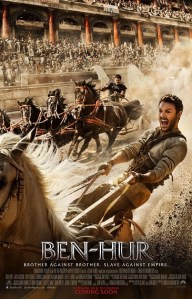 I had the chance to go see the new “Ben Hur” movie this past weekend. I think it is fair to say that I’m a huge fan of Ben Hur in many forms. I read the novel (at least) annually. I watch the Charlton Heston version of the film several times a year. It is one of the most utterly compelling plots I know of. It’s a tale of betrayal and revenge that turns into much more than that. (Be sure to see the Links at the end for several more of my posts about the book and other movie.) Here, I will look at this particular retelling of the story of Ben Hur and the worldview themes found therein. There will be SPOILERS in what follows.
Gods and Faith
A contrast of faiths is found throughout the movie, yet it isn’t just a two-sided picture. We see Messala’s devotion to Roman gods early on in the film, as he prays to those gods for the safety of his adopted brother, Judah Ben Hur (in this version, Messala was orphaned and adopted by the House of Hur). Judah’s mother chastises him, saying that they serve a different God under her household. At a later point, the Hurs are celebrating a Jewish festival, and Messala acts somewhat left out. Judah Ben Hur asks him about this and comments that wine knows no specific god (implying that Messala can at least enjoy himself with the festal wine). Judah is indeed portrayed as something of a skeptic throughout much of the film, and that’s where we see some of the most subtle but intriguing aspects of the journey of faith found here.
Judah’s journey includes doubts about God, and he even speaks these in one of his encounters with Jesus. He asks Jesus how, if God has a plan that includes us, we are any better than slaves. Jesus replies in a way that is reminiscent of so many of his responses in the Bible, nodding to Esther, a former slave who at this point is Judah’s wife, and saying “ask her.” Cynically, this could be interpreted as a non-answer, but it also shows a similarity in fashion to the way Jesus often answered such questions that were posed not as genuine questions but as challenges. He turned the question inward and forced him to confront his own life.
Judah’s ultimate turning point comes after his defeat of Messala through a chariot race in the circus. He stands before the crucified savior and he hears Jesus utter the words, “Father forgive them, for they know not what they do.” Judah breaks down and weeps, coming to a full realization that those words are not just empty: they are for him and about him. It is at the cross that Judah comes to a realization of his own inadequacy and need for forgiveness, and, yes, true faith.
Baptism
After the cross, the Hur family is healed by the water that mingles with the blood of Christ, just as in the earlier film version. This water washing away the dead flesh of leprosy is a perfect allegory for baptism, which saves through the washing of regeneration (Titus 3:5). To see the water wash away the physical ailment here is a great allegory for baptism.

Certainly one of the most interesting characters in the film.
Women in Ben Hur
The film does a pretty phenomenal job portraying women. First, there are women in the garden with Jesus when the Romans come to take him away. I think this almost certainly would have been the case, given how many women were close followers and later proclaimers of Christ. It was good to see the filmmakers decided not to skip over them. Second, the character of Esther was just as the image I shared here describes her- a defender, a confidant, and a believer. She remains faithful throughout the movie, despite having a few flaws.
Forgiveness
Perhaps the central theme in the movie is forgiveness. Indeed, they took some liberty with the plot to highlight this theme more effectively, leaving Messala alive and vengeful towards the end, only to forgive Judah as Judah forgives him. It is a beautiful scene, though it feels a tad rushed. The book doesn’t have this scene, though it also highlights forgiveness. Once again, it is clear that this is a Christian theme shown through the film.
Conclusion
“Ben Hur” is different from the Charlton Heston version of the story in several key ways, and diverges radically from the book on a few key points. That said, it is one of the most Christian messages I have seen recently in any movie. It has many wonderful portrayals of worldview found therein, and it does so in a much more intriguing way than almost any other film I know of recently.
Links
Be sure to check out the page for this site on Facebook and Twitter for discussion of posts, links to other pages of interest, random talk about theology/philosophy/apologetics/movies and more!
Ben Hur- The Great Christian Epic– I look at the 1959 epic film from a worldview perspective. How does the movie reflect the deeply Christian worldview of the book?
What About Those Who Haven’t Heard? – Part 1 of a case study on religious pluralism from Lew Wallace’s “Ben Hur”– I examine two of the most popular answers to the question about those who have not heard about Jesus (and their eternal fate) from the book.
Religious Pluralism- A case study from “Ben Hur” by Lew Wallace– The post introducing this entire series on “Ben Hur.” It has links to all the posts in the series.
SDG.
——
The preceding post is the property of J.W. Wartick (apart from quotations, which are the property of their respective owners, and works of art as credited; images are often freely available to the public and J.W. Wartick makes no claims of owning rights to the images unless he makes that explicit) and should not be reproduced in part or in whole without the expressed consent of the author. All content on this site is the property of J.W. Wartick and is made available for individual and personal usage. If you cite from these documents, whether for personal or professional purposes, please give appropriate citation with both the name of the author (J.W. Wartick) and a link to the original URL. If you’d like to repost a post, you may do so, provided you show less than half of the original post on your own site and link to the original post for the rest. You must also appropriately cite the post as noted above. This blog is protected by Creative Commons licensing. By viewing any part of this site, you are agreeing to this usage policy.

 J.W. Wartick - Reconstructing Faith