christian
The “Mistborn Trilogy” by Brandon Sanderson- Religion(s), Intrigue, and a Messiah
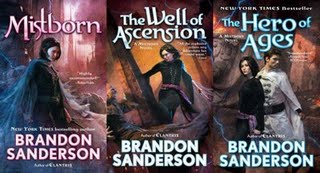 Brandon Sanderson’s Mistborn Trilogy is a wonderfully unique fantasy adventure that is absolutely filled to the brim with political intrigue and religious reflection. Here, we’ll take a look at some of the themes in this series from a worldview perspective. There will be SPOILERS below.
Religion(s)
The character Sazed is a specialist in religions. Indeed, he has the memories of three hundred religions in the trinkets he keeps on his body and preaches them to different characters throughout the first two books of the trilogy. His goal is less to convert than it is to pass on knowledge. Through the foil of Sazed, readers learn about some interesting religions which used to exist before the Lord Ruler began to eradicate them all. Sazed himself asserts that he believes all the religions are true, but in The Well of Ascension, his faith is crushed when he is confronted by the notion that his long search for the religion of his people–and its prophecies–is fruitless.
Sanderson thus presents us with an interesting perspective, through Sazed, of religion. On the one hand, Sazed is seemingly a pluralist. He tries to affirm all the religions he knows about: “I believe them all,” he declares (Well… 504). But on the other hand, his faith in the truth of these religions is decimated by his discovery of direct refutation. The tension of these two views ends up shattering Sazed’s worldview. But, as we’ll see below, it turns out that all religions were false in some sense, but they all had some truth, which Sazed himself uses to piece together the world as it should be (Hero… 716-717).
Interestingly, this resonates in some fashion with what I think is the best way to approach other religions. Rather than assuming everything the religious other believes is false, we should seek the truth in other religions and show how Christianity provides a better and fuller explanation of the same.
Messiah
The “Hero of Ages” is thought by many to be a hero who will come to save them from the oppressive rule of the Lord Ruler and Ruin. Some think that it is Kelsier after the hero of Mistborn helps to destroy the Lord Ruler and then uses a body double to act as though he has been resurrected in order to give hope to the common people. This image alone is an interesting foil for thinking about Jesus and the rise of Christianity. There is no denying the parallels in the story of Kelsier and of Christ in the sense of being seen as resurrected saviors.
But the narrative of Kelsier is intentionally subversive, it has a political aspect to it that is intentionally driven towards the overthrow of the Final Empire. Moreover, his life and times don’t match up quite right with the expected prophecies. A final aspect that is missing is the divine claims and historical evidence. It is all well and good to invent a fantastical narrative of a risen savior by means of a morphing creature; it is another thing to actually account for the historical evidence of a risen human being as confirmation of divine approval.
Ultimately, however, the Hero of Ages turns out not to be a coming hero but rather “A Hero who would preserve mankind throughout all its lives and times. Neither Preservation nor Ruin, but both. God.” (Hero, 718.) Interestingly, it is not completely clear whether the “God” referenced here is Sazed himself taking on the powers of Ruin and Preservation or whether these powers are granted by means of a transcendent deity. One’s interpretation of the final few chapters on this point will radically change how one views the book from a worldview perspective. Regardless of how one does take it, it is still quite intriguing to note that the final solution to the problem is deity. In a sense, it is a case of deus ex machina but in a way that absolutely lines up with the plot and expectations of the world Sanderson created. The ultimate source of salvation is found in deity.
Conclusion
Sanderson’s Mistborn Trilogy is a fascinating look in a fantastical world of how religion may develop and grow. It also features a number of questions which Christians should resonate with. It is a simply wonderful read for those interested in worldview questions. There is so much more with discussing in these books, so please do let me know your own thoughts and again, I highly recommend you go read them!
Links
Be sure to check out the page for this site on Facebook and Twitter for discussion of posts, links to other pages of interest, random talk about theology/philosophy/apologetics/movies and more!
Popular Books– Read through my other posts on popular books–science fiction, fantasy, and more! (Scroll down for more.)
SDG.
——
The preceding post is the property of J.W. Wartick (apart from quotations, which are the property of their respective owners, and works of art as credited; images are often freely available to the public and J.W. Wartick makes no claims of owning rights to the images unless he makes that explicit) and should not be reproduced in part or in whole without the expressed consent of the author. All content on this site is the property of J.W. Wartick and is made available for individual and personal usage. If you cite from these documents, whether for personal or professional purposes, please give appropriate citation with both the name of the author (J.W. Wartick) and a link to the original URL. If you’d like to repost a post, you may do so, provided you show less than half of the original post on your own site and link to the original post for the rest. You must also appropriately cite the post as noted above. This blog is protected by Creative Commons licensing. By viewing any part of this site, you are agreeing to this usage policy.
Really Recommended Posts 4/24/15- abortion and evangelicals, apologetics, and more!
 Winter is back, apparently, here in Minnesota. It’s COLD! And it snowed on Monday and Tuesday. Anyway, here we have some reading to keep you entertained on chilly nights. The topics are abortion and evangelicals, raising kids, apologetic methods, science fiction, and a debate over the Reformation.
Evangelicals Opposed Abortion Much Earlier than You Think– It has been said that evangelicalism wasn’t originally pro-life or oriented against abortion. Is that true? Moreover, does it even matter? Here’s an article examining the historical claim. My own thoughts are that it doesn’t matter when evangelicals began working against abortion. The question is whether abortion is morally permissible (or not). Whether a group historically opposed it or not doesn’t do much to the current debate other than provide a rhetorical flair. This post takes away some of that rhetorical flair.
4 Reasons the Internet May Influence Your Kids’ Faith More Than You– What influence does the internet have on kids exploring questions about the faith? How might awareness of this influence help us to confront worldview issues?
Comparing Apologetics Systems: Methodology and Practice– How should we do apologetics? Here is a post outlining some different approaches to apologetics and how they might be applied.
Spec[ulative]-Fic[tion] Subgenres: Superheroes & Fairy Tales– Christian publisher (of science fiction and fantasy) Enclave has an interesting post comparing the genres of superhero writing to fairy tales. They’re the same publisher who is re-releasing Kathy Tyers’ works. I had an interview with this awesome sci-fi author regarding worldview questions and science fiction here.
Revelation TV Debate: Church would have been better off without the Reformation?– Here’s an interesting debate about whether the Reformation was a good development in church history. The debaters are James White and Rev. Dr. Thomas Norris.
Interview with Christian Science Fiction Author Kathy Tyers
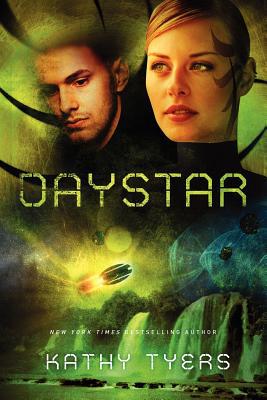 I am extremely pleased to be able to present my readers with an interview with New York Times-Bestselling author Kathy Tyers. Kathy Tyers has been instrumental in growing the genre of Christian science fiction and has published multiple books, including her award-winning “Firebird” series in this genre. She received the Mount Hermon Christian Writers Conference’s Pacesetter award for her work in developing science fiction. She has also published two Star Wars novels and appeared on the New York Times Bestseller list. She currently resides in Montana, where she continues to mentor other authors and work on her own future novels.
I have written several posts on Tyers’ “Firebird” saga (click here and scroll down or see links at the end of this post), and have immensely enjoyed her works.
What were some of the biggest science fiction influences on your writing?
The first SF novel I devoured was The Star Conquerors, an early space opera by Ben Bova. I was also a big fan of Zenna Henderson’s “People” novels. The original Star Wars movies swept me away, of course. I discovered Lois McMaster Bujold’s Miles Vorkosigan series when the first novel came out, and I kept up as she released titles in the series. Whenever I’m called to teach the craft in a classroom, I draw on Orson Scott Card’s excellent book on writing SF and Fantasy.
How has your faith inspired you to write?
My faith inspires my writing as it inspires everything I do; it’s the air I breathe, the ground I walk on, the light by which I can see and the gravity that keeps me grounded. If ever I shut my eyes, quit walking and stop breathing, it surely shows in my writing.
What do you think of the categorization of “Christian” fiction? Is it helpful to have a distinct category of “Christian” fiction?
Some people want to know, before opening a novel, whether it’s going to challenge them to think more deeply about God. Should all fiction come with a worldview alert about the author? That’s probably impractical. But if I open a novel that I know was written by a fellow Christian, or by someone of another faith, of course I approach it with different expectations.
What value do you think Christian speculative fiction has for evangelism, defense of the faith, and theology?
Whether or not we see ourselves as evangelists, we’re ambassadors for a Kingdom that is not of this world. That applies to every Christian in every profession. An author who’s known to be a Christian will have his or her books analyzed accordingly by some of the reviewers. If the book survives scrutiny as a good witness to the craft and the Kingdom, AND if it’s a good story well told, the author has accomplished what good fiction is supposed to accomplish—even if it gets the occasional one-star review.
How awesome was it to write Star Wars books?
Absolutely.
What is one piece of advice for aspiring writers?
Writing will take more time than you could possibly imagine. Don’t use that as an excuse to stop reading, because you’ll unconsciously (or consciously) emulate the books you’ve been reading. So read the good stuff.
What’s next on your plate? Any new books to look forward to?
I’ve written a contemporary supernatural novel set in Montana that I’m looking into indie publishing. Just looking, so far. Haven’t decided.
Conclusion
I would like to once more extend my thanks to Kathy Tyers for being willing to get interviewed for my site and for her excellent work in the field of science fiction.
Links
Kathy Tyers’ “Firebird” Trilogy- Faith, Humanity, and Conflict in the Far Future– The “Firebird” trilogy is one of my fondest memories of a read from when I was much younger. I recently re-read the series and was once more blown away. Here, I reflect on several issues of humanity and faith that Tyers raises in the novels.
Enter [Science] Fictional Messiah- Kathy Tyers’ “Wind and Shadow” and “Daystar”– I look into several worldview themes that Tyers raises in these sequels to her Firebird trilogy. What would a Messiah in the future look like?
Be sure to check out the page for this site on Facebook and Twitter for discussion of posts, links to other pages of interest, random talk about theology/philosophy/apologetics/movies and more!
Microview: “The Annotated Firebird Trilogy” by Kathy Tyers– I review the trilogy with a brief look at the plot and some positives and negatives in the book.
SDG.
——
The preceding post is the property of J.W. Wartick (apart from quotations, which are the property of their respective owners, and works of art as credited; images are often freely available to the public and J.W. Wartick makes no claims of owning rights to the images unless he makes that explicit) and should not be reproduced in part or in whole without the expressed consent of the author. All content on this site is the property of J.W. Wartick and is made available for individual and personal usage. If you cite from these documents, whether for personal or professional purposes, please give appropriate citation with both the name of the author (J.W. Wartick) and a link to the original URL. If you’d like to repost a post, you may do so, provided you show less than half of the original post on your own site and link to the original post for the rest. You must also appropriately cite the post as noted above. This blog is protected by Creative Commons licensing. By viewing any part of this site, you are agreeing to this usage policy.
Book Review: “Total Church” by Tim Chester and Steve Timmis
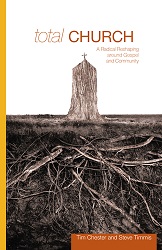 Tim Chester and Steve Timmis aim to present a gospel-centered vision of the local church as a fellowship community oriented towards missions in Total Church: A Radical Reshaping around Gospel and Community.
The notion that the church must be community- and gospel- oriented is absolutely central to the whole book. Time and again examples are put forward towards how the house church can make a huge impact on individuals. The authors rightly emphasize the notion that sometimes measuring success by pure numbers is misleading and, yes, misguided. Throughout the book, a commendable call is issued to seek using the gospel of Christ and making missions a priority in church.
Many stories are provided throughout the book to help make these insights into a practical application. They are appreciated because it gives readers some hands-on ways to deal with situations. I also enjoyed much of the discussion on youth groups and “children’s church.” Basically, it was argued that we cannot simply make the kids a separate unit from the rest of the church. Youth groups cannot just be a game night, because once the youths get past that, “real, adult” church is so vastly different. We need to emphasize the truths of Christianity throughout our children’s lives from the very earliest stages.
The book, however, has some deeply problematic elements. First, the view put forward of counseling and psychology was, frankly, disturbing. There’s a lot going on in this chapter, but it really seems to come down to the authors saying that “secular” psychological treatment doesn’t help, only the gospel can. We just need to embrace the truths of the gospel and all will be well. One representative quote: “The Bible addresses the entire range of problems we experience in living in this world… It addresses all the basic and essential issues of what it means to be human, both in our sin and in our salvation” (Kindle location 1802; all references are to Kindle locations hereafter). Later, this is made into an application that if we just focus on Christ, our sufferings won’t seem significant. At the end of all of this, there is a vague reference to how some kind of counseling outside of church might also be needed, but it is too little, too late, too vaguely stated.
I think this is a deeply misguided attempt to describe a “Christian” view of counseling which simply is–ironically–not outlined in the Bible. Choosing a couple quotes about how our present suffering can be alleviated or overcome by God does not mean that going to “secular” [whatever that means–and in exclusion of the reality of Christian] psychologists and therapists is a poor decision. Yes, we should try to deal with and help with these issues in the context of a community of faith. But God forbid that we approach someone who self-harms [one example they used] and just tell them that their problem is reducible to a spiritual problem, as the authors do: “The term ‘spiritual’ is not simply another category alongside biological, physical, environmental, upbringing, or relationships. Each of those forms of suffering, passive or active, is always and at some point a spiritual and theological issue” (1881). This seems clearly reductionistic and potentially damaging. I felt this whole section was quite disturbing.
Second, there is a very dim view of academic theology put forward. The authors complain that academic theology is often just for academics and compare the probably legendary story of medieval debates over the number of angels on the head of a pin to modern evangelical theological journals as “no less obscure” (2159)! This is another huge difficulty in the book because it ignores the wide implications of “obscure” theology being done in academia for the church at large. By reducing theology to the task merely of the local church (2148), it seems there is something of a denial of the Holy Spirit’s work in guiding the church at large, and, yes, a danger of local churches simply deciding that soul-destroying heresy is sound theology without any support from those “obscure” academics. A blithe dismissal of this enterprise relegates authors like Augustine, Aquinas, Calvin, and more into the scrap heap of obscurity.
Third, the book largely dismisses the enterprise of apologetics as dealing with issues of the mind and instead argues that “The problem is not that we cannot know God. The problem is that we will not know God. It is a problem of the heart rather than the head” (2344). Later, this leads the authors to the claim that the goal of apologetics must be to “demonstrate that unbelief is a problem of the heart rather than a problem with the head” (2419). Apologetics is envisioned as not being intellectually engage but rather engaged with trying to show people the relational problems they have with God (2467). Not only does this reduce apologetics quite a bit in scope, but it also performs some serious psychoanalysis of those who do not believe by saying that the ultimate problem with every non-Christian is that they somehow have some passionate anger against God.
Now, unless we are to assume that all of these people are lying to us, plenty of atheists throughout history have grounded their rejection quite clearly in intellectual issues. Numerous modern studies have shown that the people leaving the church often do so because of perceived anti-intellectualism or a failure to engage the mind. The task of apologetics can not, and dare not do this, be reduced to vague exploration of the heart rather than the mind. We must engage with the intellectual attacks on Christianity and put forward our position in a winsome manner.
Fourth, the Chester and Timmis often say they are not saying their position is the only way to do something, but then continually pound the notion that their way is the only biblical or gospel-oriented way so often that one wonders whether they do believe other approaches might work. The discussion of the biblical warrant for house churches is but one example, where, after asserting that there is nothing inherently wrong with larger churches, the authors compares them to pagan temples founded due to Constantine’s making Christianity the civil religion of the Roman Empire [a historical reality that should be questioned, as it was not the official or exclusive religion until Theodosius I, though this is a complex topic not worth getting deeply into here] (1255). If one approach is “biblical” and other other is merely capitulation to replicate paganism, which one is acceptable? Speaking inclusive approaches but following up with things like this makes me wonder whether there is much generosity happening towards those with whom the authors disagree.
The kindle edition of the book also has some typos, such as replacing “initially” with “Initial” (yes, capitalized in the middle of sentences) at several places in the text. Another one is this portion: “I have used the Initial person, but not to trumpet my experience… I have used the Initial person to show that what I am describing is not impossible rhetoric or unrealistic idealism… At Initial they expressed concern that we did not have an accountability structure over and outside us…” (2782). Looking at the print edition on Amazon, I find that it says “first” in all these places. I don’t know if this is the same with all Kindle editions or just the one I received for review.
The Good
+Several good insights into how we might build communities in church
+Emphasis on holistic approach to youths and children
The Bad
-Extremely problematic discussion of counseling
-Often paints an inclusive picture, but then contradicts it with exclusion
-Some questionable exegesis
-Largely dismisses academic theology
-Largely undermines the majority of Christian apologetics
Conclusion
Total Church: A Radical Reshaping around Gospel and Community was, unfortunately, not what I had hoped for. Will readers get insights into founding house churches and making communities therefrom? Yes. But unfortunately there is an awful lot of baggage to go along with those insights, including, but not limited to, rejection of massive amounts of Christian academic theology, undercutting Christian apologetics, distorting a Christian view of therapy and psychological treatment, sometimes questionable exegesis, and more.
Crossway provided me with a copy of the book for review purposes. I was not obligated by the publisher to write any kind of review whatsoever.
Links
Be sure to check out the page for this site on Facebook and Twitter for discussion of posts, links to other pages of interest, random talk about theology/philosophy/apologetics/movies and more!
Book Reviews– There are plenty more book reviews to read! Read like crazy! (Scroll down for more, and click at bottom for even more!)
Source
Tim Chester and Steve Timmis, Total Church: A Radical Reshaping around Gospel and Community (Wheaton, IL: Crossway).
SDG.
——
The preceding post is the property of J.W. Wartick (apart from quotations, which are the property of their respective owners, and works of art as credited; images are often freely available to the public and J.W. Wartick makes no claims of owning rights to the images unless he makes that explicit) and should not be reproduced in part or in whole without the expressed consent of the author. All content on this site is the property of J.W. Wartick and is made available for individual and personal usage. If you cite from these documents, whether for personal or professional purposes, please give appropriate citation with both the name of the author (J.W. Wartick) and a link to the original URL. If you’d like to repost a post, you may do so, provided you show less than half of the original post on your own site and link to the original post for the rest. You must also appropriately cite the post as noted above. This blog is protected by Creative Commons licensing. By viewing any part of this site, you are agreeing to this usage policy.
Book Review: “Faith, Freedom, and the Spirit” by Paul Molnar
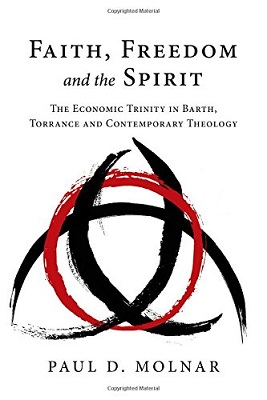 Paul Molnar’s Faith, Freedom and the Spirit
The book is packed with insights into numerous topics, whether readers are interested in learning more about Barth and Torrance (and Rahner) or the relations within the Trinity, Molnar sweeps broadly but takes the time to dissect many topics in helpful ways.
A primary topic is how we relate to God, and through Barth (though alongside other theologians), Molnar argues that God is perfectly free in relation to us and frees us through grace. It is not our work that saves us but rather God entirely and miraculously revealing Himself to us through Christ by the power of the Spirit.
Throughout the entire book, the aforementioned theologians are highlighted, often providing readers with lengthy quotes and expositions of their positions in order to lend more detail and analysis to topics related to the Trinity.
There seems to be a bit bit too much discussion of various other scholars’ dissent from Molnar’s position or misunderstanding it. At times it reads as though there are journal articles put into the book rather than developing as a book itself. Responses to specific authors seem to often be esoteric rather than helpful, though I’m sure in the broader project Molnar is tracing, it makes sense.
Another downside is that it seems that at a few points the “low hanging fruit” is that which is engaged. For example, Molnar’s discussion of eternal subordination was interesting–in particular his insight from Barth and Torrance about how such a position confuses the immanent and economic Trinity–but then he went on to focus on specific views of select scholars which were blatantly subordinationist in the Arian sense rather than on some of the more nuanced approaches of others. Another example is his discussion of natural theology, which did not seem to take into account the various ways in which Barth’s attack on the notion are undermined by other considerations.
Overall, Faith, Freedom and the Spirit
The Good
+Insight into many aspects of the economic and immanent Trinity
+Deeply thought-provoking
+Solid critique of some views of the Trinity which (potentially or actually) stray from orthodoxy
The Bad
-A few too many rabbit trails make it feel like pieced-together journal articles at times
-Fails to distinguish adequately between types of apologetics
-At times feels repetitious
I received a review copy of the book from InterVarsity. I was not required to give any kind of review whatsoever. My thanks to the publisher for the book.
Links
Be sure to check out the page for this site on Facebook and Twitter for discussion of posts, links to other pages of interest, random talk about theology/philosophy/apologetics/movies and more!
Book Reviews– There are plenty more book reviews to read! Read like crazy! (Scroll down for more, and click at bottom for even more!)
Source
Paul D. Molnar, Faith, Freedom and the Spirit (Downers Grove, IL: InterVarsity, 2015).
SDG.
——
The preceding post is the property of J.W. Wartick (apart from quotations, which are the property of their respective owners, and works of art as credited; images are often freely available to the public and J.W. Wartick makes no claims of owning rights to the images unless he makes that explicit) and should not be reproduced in part or in whole without the expressed consent of the author. All content on this site is the property of J.W. Wartick and is made available for individual and personal usage. If you cite from these documents, whether for personal or professional purposes, please give appropriate citation with both the name of the author (J.W. Wartick) and a link to the original URL. If you’d like to repost a post, you may do so, provided you show less than half of the original post on your own site and link to the original post for the rest. You must also appropriately cite the post as noted above. This blog is protected by Creative Commons licensing. By viewing any part of this site, you are agreeing to this usage policy.
Is Natural Theology Excluded for Apologetics? – Sunday Quote!+
Here’s a special edition Sunday Quote which features a more extended discussion. Let me know what you think in the comments.
Is Natural Theology Excluded for Apologetics?
Paul Molnar’s Faith, Freedom and the Spirit
If contemporary theologians were to make explicit the role of the Holy Spirit in enabling our knowledge of the triune God, then there could be wide agreement that natural theology of whatever stripe is not only unhelpful but is directly excluded from any serious understanding of theological epistemology. (82)
Now, “natural theology” is, according to Justo Gonzalez’s Essential Theological Terms, “A theology that claims to be based on the natural gifts of the human mind, and on the ‘general revelation’ granted to all… rather than on a ‘special revelation’ in Scripture or Jesus Christ” (118). Natural theology, that is, is the attempt to show that God exists and certain other truths through looking at the world. From this quote, it seems that Molnar is arguing that if we had a better notion of the role of the Holy Spirit, we would basically think that natural theology is worthless related to knowledge of God.
Molnar develops this notion further throughout the next 50 pages or so. His argument basically is that if we acknowledge that it is the Holy Spirit who enables faith and knowledge of God, then any “knowledge” of God which is not directly through faith (i.e. through something like a cosmological argument) is not objective knowledge of God.
Although some of what Molnar argues resonates with me–particularly the notion that the Holy Spirit is the one who imparts faith rather than it being some kind of choice we make–I think that his dismissal of natural theology is unnecessary and mistaken. First, the most obvious question to be asked is whether the Spirit can use natural theology to create faith. If it is the case that the Holy Spirit can work through natural theology–something which seems to be clearly correct to me–then the objection that natural theology ignores the role of the Spirit is mistaken.
Second, Molnar’s argument seems to rely on a concept of natural theology which is entirely about trying to impart knowledge of God to those who do not have faith. This, however, ignores the use of apologetics in strengthening the faith of believers. Natural theology can be a valuable tool for those who have faith to pursue the call of 1 Peter 3:15 and have a reason for the hope within them. Whatever one’s view of whether natural theology can bring people to the true God, it seems that it can and should be used for believers to explore the natural world and bolster their faith.
Third and finally, it seems to me that Romans 1 in particular demonstrates that natural theology is not a worthless project. If God’s invisible attributes are capable of being discovered in the things God has made, then surely natural theology has some value in tracing God’s handiwork.
Should we think that natural theology is a failed project? Can it have other uses like those I listed? Is it possible to go from God to Christ? What of the role of the Spirit in apologetics?
Faith, Freedom and the Spirit
Links
Be sure to check out the page for this site on Facebook and Twitter for discussion of posts, links to other pages of interest, random talk about theology/philosophy/apologetics/movies and more!
Sunday Quote– If you want to read more Sunday Quotes and join the discussion, check them out! (Scroll down for more)
Source
Paul D. Molnar, Faith, Freedom and the Spirit (Downers Grove, IL: InterVarsity, 2015).
SDG.
——
The preceding post is the property of J.W. Wartick (apart from quotations, which are the property of their respective owners, and works of art as credited; images are often freely available to the public and J.W. Wartick makes no claims of owning rights to the images unless he makes that explicit) and should not be reproduced in part or in whole without the expressed consent of the author. All content on this site is the property of J.W. Wartick and is made available for individual and personal usage. If you cite from these documents, whether for personal or professional purposes, please give appropriate citation with both the name of the author (J.W. Wartick) and a link to the original URL. If you’d like to repost a post, you may do so, provided you show less than half of the original post on your own site and link to the original post for the rest. You must also appropriately cite the post as noted above. This blog is protected by Creative Commons licensing. By viewing any part of this site, you are agreeing to this usage policy.
Really Recommended Posts 4/10/15- raising a son, tropical islands, self-harm, and more!
 Another round of awesome posts for you, dear readers. Please keep me in your prayers as I have a kidney stone. Sad me. But happy you, because you have some great reading ahead! Self-harm, Easter, raising a son, tropical islands and creationism are all featured topics this week. Let me know your thoughts in the comments here, and be sure to let the authors of the posts know as well.
My Depression and Self Harm vs. Jesus Passion and Sacrifice– Christianity can speak to people in all walks of life and circumstances. Here is a beautiful post that compares the struggles of someone dealing with self-harm to the hope found in the sufferings and death of Christ.
Thoughts on Raising a Son– What is it like to raise a son in our day and world? My wife shares some thoughts on raising a son and the difficulties we face as parents. How can we teach him to not give in to a culture of inequalities?
My Favorite Atheist Easter Memes of 2015– Here, Jason Wisdom shares and analyzes a number of Easter memes atheists put out to “celebrate” this most holy day–the resurrection of God Incarnate. He provides some thoughtful insights into the mindset behind them.
Origins of a Tropical Island – The long road from lava to colonization– Do the formation of islands and their ecology fit into a young earth paradigm? Short answer: no. Check out this post for some reasons why.
The Greatest Risk of All– It is often noted that women were the first evangelists. Does this have any implications for our faith?
The Wheel of Time “Towers of Midnight” and “A Memory of Light” – Reflection from a Christian
 The conclusion to the Wheel of Time series has arrived at long last. It is a worth finish (well, there are no endings, nor beginnings in the Wheel of Time… but it was an ending) to the sprawling epic fantasy. There are not enough superlatives for me to describe how much I enjoyed the series. Here, we’ll discuss Towers of Midnight and A Memory of Light, the concluding volumes in the Wheel of Time. There are, of course major SPOILERS for the entire series in this post.
The Plight of the Outsiders
The last several books of the Wheel of Time series highlight at points the plight of those who are not main characters. Refugees, those who have had their homes destroyed, the people who are not often even referenced in other works of fiction. In Towers of Midnight, there is a poignant vision of the future, one in which the Aiel have been downtrodden and their power broken. A family of Aiel are starving and they beg for food from some people passing through what used to be their land. They show no mercy:
[The mother’s] tears did come then, quiet, weak. They rolled down her cheeks as she undid her shirt to nurse Garlvan, though she had no suck for him.
He didn’t move. He didn’t latch on. She lifted his small form and realized that he was no longer breathing… (1038-1039)
One wonders how often this kind of story plays out in our world. How easily we dehumanize those who are in need, and how easily we ignore them or disregard their need. Embedded in this sorrowful tale, we learn that there are always “outsiders”; always those in need, for whom we should be caring.
Disability?
Rand lost a hand earlier in the series, and it leads him to wonder about his own sufficiency as a person. A Memory of Light eloquently deals with this issue in a scene which depicts Tam, Rand’s adoptive father, sparring with Rand and forcing him to “let go.” As they spar, Rand admires his father’s swordsmanship and his ability to fight with one hand. He continues to realize that one hand may not be such a disadvantage in life and even uses his hand-less arm to block a bow. As the fight ends, the scene drives home the point:
Sweating, Rand raised his practice sword to Tam… Tam stepped back, raising his own sword. The older man wore a grin.
Nearby, standing near the lanterns, a handful of Warders [elite bodyguards of Aes Sedai–female magic users] began clapping. Not a large audience–only six men–but Rand had not noticed them. The Maidens [warrior women] lifted their spears in salute.
“It has been quite a weight, hasn’t it?” Tam asked.
“What weight?” Rand replied.
“That lost hand you’ve been carrying.”
Rand looked down at his stump. “Yes. I believe it has been that.” (312-313)
The fight has opened Rand to an awareness of his sense of loss, but also to a new sense of completeness. He has one hand, but that doesn’t make him less a man.
Fate or Free Will?
Throughout the series, the question of whether people are free in their choices or whether they are fated to have certain destinies is found front-and-center. The notion that all destinies are woven into a Pattern is used by some characters to argue for fatalism, while others believe the Pattern can be manipulated. In A Memory of Light, Egwene’s dream–a way of seeing into the future–provides a way for exploring this issue. Rand, Moiraine, and Egwene debate the meaning of a dream in which Rand is stepping into the Dark One’s prison, but there is not enough information to tell them the course of action they should take.
The debate suggests more about the world than may appear at first glance. It seems in the world of A Wheel of Time there is a tension between determinism and freedom, one which appears quite a bit in Christian thinking as well. How are we to forge our way in the world? Has everything been set before us in a Pattern, or are we able to choose our own destinies? Most importantly, A Memory of Light leaves the ambiguity there. The tension remains. Though Rand ultimately seems freed from the Pattern in some ways, it is a freedom which is never fully fleshed out. I think there is much to be said for this approach. One wonders whether the dichotomy of free/determined should be maintained, or whether more complexity exists in this world than that.
Evil and Good
When Rand confronts the Dark One in A Memory of Light, he comes to a point in which he is shown a depiction of the world without evil (679ff). It is a hideous place; the people are without the stories of their lives which shaped them in ways beyond reckoning. Bravery is impossible; as is conviction. The scene makes one wonder about the problem of evil–the notion that the existence of evil shows an omnipotent good deity does not exist–and various answers given to it. One prominent response to the problem of evil argues that evil may be used to make greater goods. Without the possibility of harm, there is no possibility of true bravery. Richard Swinburne is a well-known proponent of this response.
We live in a world which has been deeply harmed by evil. We also live in a world in which God has provided the answer to evil in the person of God’s Son. One day, God will wipe away every tear. We won’t live in the hellish nightmare of a world in which our characters have been sucked away from the elimination of all possible ills; but rather in a world that God has planned for us, a world of overpowering good.
Conclusion
The Wheel of Time series is easily my favorite fantasy series of all time. I read it through in the span of about a year. The books raise an enormous number of worldview issues, and they are also epic fantasy stories with gripping tales that will, I think, never let me go. It’s a saga of epic proportions, and one which I think any fan of literature should experience.
Links
Be sure to check out the page for this site on Facebook and Twitter for discussion of posts, links to other pages of interest, random talk about theology/philosophy/apologetics/movies and more!
Popular Books– Take a look at the other posts I’ve written on major works of fiction.
Sources
Robert Jordan and Brandon Sanderson, Towers of Midnight (New York: Tor, 2010).
Robert Jordan and Brandon Sanderson, A Memory of Light (New York: Tor, 2012).
SDG.
——
The preceding post is the property of J.W. Wartick (apart from quotations, which are the property of their respective owners, and works of art as credited; images are often freely available to the public and J.W. Wartick makes no claims of owning rights to the images unless he makes that explicit) and should not be reproduced in part or in whole without the expressed consent of the author. All content on this site is the property of J.W. Wartick and is made available for individual and personal usage. If you cite from these documents, whether for personal or professional purposes, please give appropriate citation with both the name of the author (J.W. Wartick) and a link to the original URL. If you’d like to repost a post, you may do so, provided you show less than half of the original post on your own site and link to the original post for the rest. You must also appropriately cite the post as noted above. This blog is protected by Creative Commons licensing. By viewing any part of this site, you are agreeing to this usage policy.
Really Recommended Posts 4/3/15- Golden Son, Tyndale, Judaism, and more!
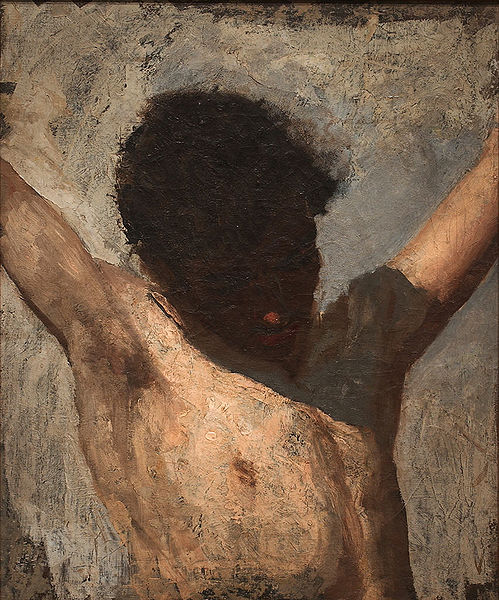
Sketch for the Crucifixion by Thomas Eakins
Today is Good Friday. Let us reflect upon the greatness of God and the power of the Son for our salvation. Amen!
Now, be sure you also dive into this reading material as I have collected it from all corners of the internet for you, dear readers. A broad array of topics is here for your reading pleasure.
Golden Son (Red Rising)– Golden Son is book two of a trilogy by Pierce Brown which is quite interesting. I reviewed the first book myself here. Anthony Weber’s look at the second book provides some solid insights into this YA novel and human nature.
Reject Jesus for Judaism?– A great question and answer about whether it is more reasonable to reject Jesus and embrace Judaism.
“Feminist” is not a Dirty Word– Too often, we see the word “feminist” and react against it with a whole slew of beliefs about what the word must mean before we ask the person who self-identifies as such what it does mean. Here’s a good read to get some insight into the matter.
Tyndale (Comic)- Who was Tyndale and why does he matter? Here’s a neat little comic that answers these and other questions.
Evaluating RC Sproul’s Objection to Presuppositional Apologetics at the Inerrancy Summit– Apologetic method is a debate I try to avoid generally because I think that we need to realize that different approaches will work better for different people and situations. I favor an integrated approach with different methods meshed together. Here’s a look at one objection to the presuppositional method and a response from a presuppositional apologist. What are your thoughts on the matter?
Book Review: “The Lost World of Adam and Eve” by John Walton
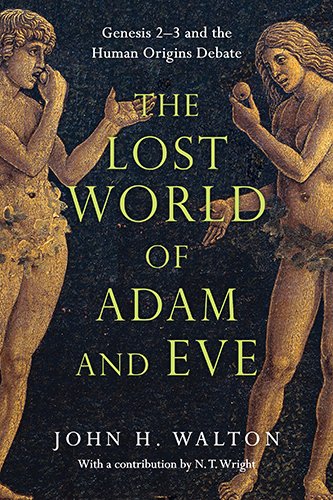 John Walton’s latest book, The Lost World of Adam and Eve
Walton argues that the Genesis creation account does not specifically tell us how Adam and Eve materially came to be but rather is an account of God giving them their functions as the image of God, ushering in order against the chaos. His view is one which sees Adam as archetypical head of humanity rather than necessarily being the first ever human. Adam and Eve were chosen by God to become God’s representatives in the world.
Many intriguing arguments are put forward by Walton once he has established what is the central thesis–that the text is concerned with functional, not material origins. These include reading Genesis 2 as a sequel to rather than recapitulation of Genesis 1, the use of the term “very good” and “good” in the text, the meaning of “formed from dust” and from the rib, the archetypal meaning of Adam and Eve, the real existence of this couple, the priesthood of the couple in sacred space, our role as bringing order from disorder, the “serpent” in the Garden, and more. Each chapter is filled with compelling arguments and sometimes surprising conclusions.
Because the worldview of the ANE was not concerned with material origins, the questions we often ask of the text like “Were Adam and Eve the first humans?”; “Are we all descended from Adam?” and the like are questions which the text is not intended to answer. These are questions from our background, not from the background of the text. Thus, Walton argues that there can be much openness to the answers to these questions. When we come to the New Testament discussions of Adam and Eve, Walton (and the contribution from NT Wright) argue that this is why the notion of federal headship (though not necessarily material/genetic headship) is probably in mind.
Readers who are unconvinced by the notion that we should apply ANE insights to our reading of the text will be challenged to support that claim. Walton cogently argues that although there is not a 1-to-1 correspondence between the worldview of the ANE and the Bible, it is highly questionable to assume that the writers and audience of the Bible would not have been influenced by their background and cultural understanding.
Regarding the science, Walton readily points out that he is not an expert in the area but defers largely to the experts. He applies the exegetical arguments to questions of original sin, federal headship, and the like in the context of modern scientific findings, though he does so in such a way that he retains his commitment to teach what the text does rather than trying to force it to speak of our concerns.
Many (most?) readers will find this book challenging on a number of levels because Walton so readily exposes our presuppositions about what the text should say. Very often Walton simply points readers back to the text to reveal how often we have our expectations bring meaning to the text rather than allowing it to speak for itself.
The Good
+Excellent insight into the ANE background of the Old Testament
+Strong exegetical argument with a commitment to understanding the text
+Coherent with the rest of Walton’s thought
+Challenges our presuppositions about the text
The Bad
-A bit difficult to pin down exactly what his view is of original sin
Conclusion
The Lost World of Adam and Eve
Disclaimer: I was provided with a review copy of the book courtesy of InterVarsity Press. I was not obligated to write any sort of review whatsoever. My thanks to the publisher for the copy.
Links
Be sure to check out the page for this site on Facebook and Twitter for discussion of posts, links to other pages of interest, random talk about theology/philosophy/apologetics/movies and more!
Origins Debate– Read a whole bunch more on different views within Christianity of the “origins debate.” Here I have posts on young and old earth creationism, intelligent design, theistic evolutionism, and more!
Source
John Walton, The Lost World of Adam and Eve
SDG.
——
The preceding post is the property of J.W. Wartick (apart from quotations, which are the property of their respective owners, and works of art as credited; images are often freely available to the public and J.W. Wartick makes no claims of owning rights to the images unless he makes that explicit) and should not be reproduced in part or in whole without the expressed consent of the author. All content on this site is the property of J.W. Wartick and is made available for individual and personal usage. If you cite from these documents, whether for personal or professional purposes, please give appropriate citation with both the name of the author (J.W. Wartick) and a link to the original URL. If you’d like to repost a post, you may do so, provided you show less than half of the original post on your own site and link to the original post for the rest. You must also appropriately cite the post as noted above. This blog is protected by Creative Commons licensing. By viewing any part of this site, you are agreeing to this usage policy.

 J.W. Wartick - Reconstructing Faith