christian
On the Alleged Atheism of Early Christians
 It is interesting to note that modern atheists of the internet-infidel variety share much with Pagan counterparts in the first few centuries after Christ. “How can this be?” one might ask. Well, the charge of atheism against Christians is shared both by the common internet-infidel comment that “We’re all atheists, I [the atheist] just take it one god further” and Pagans in the Roman Empire. Oddly, some atheists have gone so far as to suggest that the Pagan accusation is somehow evidence for their position.
The early Christians, it is true, were accused of being atheists. However, to suggest that this is somehow synonymous with contemporary usage of the term “atheist” is ahistorical and anachronistic. Frances Young notes several facets of the charge of atheism leveled against Christians:
What the charge [of atheism leveled against Christians] really amounted to was an expression of dismay and distaste over the fact that people were abandoning conventional ritual practices… The charge of atheism against Christians focused on their refusal after conversion to continue to participate in traditional religious customs… Religion, embedded in the ethnic cultures, was a matter not of belief but of loyalty. (99, 101, cited below)
The charge against Christians, then, was that they were abandoning the ways of the Romans. They were outsiders, outcasts, and, by extension, atheists. By refusing to worship the gods of Rome, they became targets. The fact that the Christians did this conscientiously–they intentionally abandoned the gods–led to the charge of atheism. It was a charge related not to belief in deity, but rather to rejection of shared societal practice, with a culturally charged impetus for making it.
In fact, others who yet believed in the gods were also charged with atheism. The Epicureans were accused of atheism, despite believing that the gods existed:
It is significant that these ‘atheists’ [Epicureans] did not question the existence of the gods. Rather, they liberated people from religion by suggesting that the blessed immortals were not the slightest bit interested in what goes on among human beings… (ibid, 100)
Thus, when modern atheists continue to perpetuate the claim that “we’re all atheists,” and then move on to argue that Christians should agree with them because, after all, Christians were considered ‘atheists’ by the Romans, it is difficult to take them seriously. The Pagan charge was made for cultural reasons, and is tied up in the notion of rejection of the societal norms of the time. It was also made even against those who acknowledged those gods existence. This last point is very important, because one attempted rebuttal I have seen from the modern atheist is that “You are an atheist to other religions.” Well, according to ancient Pagans, you could even be an atheist to your own religion! Of course, the point is that Christians are not atheists, but theists.
The word “atheism” was used back then as a damning charge of societal blasphemy–rejecting the ethnic practices of your own society in pursuit of another’s. Now, modern atheists attempt to forcibly include others in atheism with this kind of pithy phrase. The historical charge is interesting, but clearly entirely different from the modern one. Either charge, however, is inaccurate. Christians, by definition, are not atheists–theists cannot be atheists. The ancient cultural charge is of interest for its historical implications, but it is hardly evidence for the modern use of the charge of atheism against Christians.
I suspect that this post won’t silence many who will continue to persist in saying Christians are atheists. At that point, I suggest to others the following: the people who persist in this mislabeling should be written off as being just as irrelevant as the ancient Pagans with whom they share at least this part of their worldview.
Links
Be sure to check out the page for this site on Facebook and Twitter for discussion of posts, links to other pages of interest, random talk about theology/philosophy/apologetics/movies and more!
On the statement that “We are all atheists”– I evaluate the claim that atheists make which say that “we are all atheists.” I evaluate it from a philosophical point of view here.
On the Shoulders of Giants: Rediscovering the lost defenses of Christianity– I have written on how we may discover these enormous resources historical apologists have left behind for us. Take and read!
Source
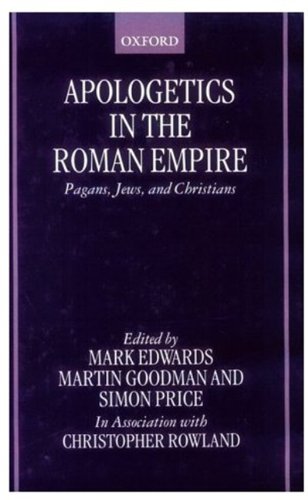
Frances Young, “Greek Apologists of the Second Century” in Mark Edwards, Martin Goodman, and Simon Price, eds., Apologetics in the Roman Empire
SDG.
——
The preceding post is the property of J.W. Wartick (apart from quotations, which are the property of their respective owners, and works of art as credited; images are often freely available to the public and J.W. Wartick makes no claims of owning rights to the images unless he makes that explicit) and should not be reproduced in part or in whole without the expressed consent of the author. All content on this site is the property of J.W. Wartick and is made available for individual and personal usage. If you cite from these documents, whether for personal or professional purposes, please give appropriate citation with both the name of the author (J.W. Wartick) and a link to the original URL. If you’d like to repost a post, you may do so, provided you show less than half of the original post on your own site and link to the original post for the rest. You must also appropriately cite the post as noted above. This blog is protected by Creative Commons licensing. By viewing any part of this site, you are agreeing to this usage policy.
Sunday Quote!- Spiritual Warfare and Mapping the Land?
 Every Sunday, I will share a quote from something I’ve been reading. The hope is for you, dear reader, to share your thoughts on the quote and related issues and perhaps pick up some reading material along the way!
Spiritual Warfare and Mapping the Land?
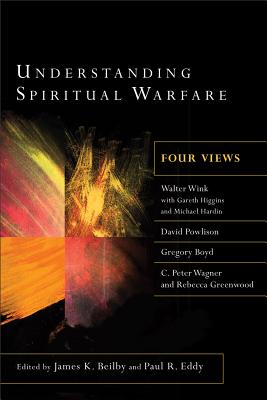
I recently read through Understanding Spiritual Warfare: Four Views
Spiritual mapping is the practice of identifying the spiritual conditions at work in a given community, city, or nation. By gathering objective information (including key historical facts… locations of bloodshed, idolatrous practices, [etc…]) and combining it with spiritual impressions (prophecy, revelation, words of knowledge, dreams, and visions), believers can prayerfully combine all of this information and draw a map that identifies the open doors between the spiritual world and the material world (182-183, cited below).
Now I admit that I come from a background in which spiritual warfare was little (if at all) discussed, but this does seem a little bit more than we can glean from the biblical image of spiritual warfare. Where, for example, are we instructed to try to use dreams and revelation in order to find “open doors” of the spiritual world? Where are we instructed that there might be doors for the spiritual world into our own that are identifiable? I think some aspects of this notion might be helpful for witnessing and the like–after all, knowing the landscape in this fashion would be helpful for identifying areas of conflict in a community and offering Christlike compassion in those areas–but I hesitate to think that the way they can be applied is in this fashion.
What are your thoughts on this? What do you think of spiritual warfare?
Again, I highly recommend this book with its very wide range of diverse views presented on the topic in order to get an introduction.
Links
Be sure to check out the page for this site on Facebook and Twitter for discussion of posts, links to other pages of interest, random talk about theology/philosophy/apologetics/movies and more!
Microview: Understanding Spiritual Warfare: Four Views– I briefly review this highly interesting book on different views of spiritual warfare.
Sunday Quote– If you want to read more Sunday Quotes and join the discussion, check them out! (Scroll down for more)
Source
C. Peter Wagner and Rebecca Greenwood, “The Strategic-Level Deliverance Model” in James Beilby and Paul Rhodes Eddy, eds., Understanding Spiritual Warfare: Four Views
SDG.
Really Recommended Posts 1/30/15- early Christianity, Neanderthals, and the church!
 Another week, another set of great reads for you, dear readers. As always, let me know what you think! Be sure to let the authors of the posts know as well.
They Say the Church is “Too Feminine”– People often complain about the alleged “feminization of the church.” Here is an excellent post looking into the notion that the church is “too feminine.” I have also written on the notion of the “feminization of Christianity.”
James White debates Adnan Rashid on trustworthiness of Bible vs. Qur’an– Very often, Muslim apologists charge that we no longer have the Gospel because it has become corrupted and that the Qur’an is more trustworthy. Check out this post summarizing a debate (with a link to the debate) between two apologists on either side of this debate.
Christian Responses to the Spiritual and Physical Status of Neanderthals– How do Christians analyze the evidence for the existence of Neanderthals and their genetic lineage? Here’s an excellent post on some Christian responses to the evidence with some insightful commentary.
Three Questions to Break the Ice– Here are some excellent ways to break the ice in church (and other) groups! Timothy Siburg is a bit of an expert on church relations and topics related to it, so I recommend you follow his blog if you’re interested in that topic.
One of the Clearest (and Earliest) Summaries of Early Christian Beliefs– Early summaries of Christian beliefs reveal a world in which Christianity developed fairly early on, not with the great difficulties some allege. Check out this post about one of the earliest summaries of Christian belief.
The Wheel of Time “Winter’s Heart” and “Crossroads of Twilight” – A Christian Reflection
 Robert Jordan’s epic fantasy series, “The Wheel of Time,” has much to reflect upon from a Christian perspective. Here, I’ll be examining books nine and ten, “Winter’s Heart” and “The Crossroads of Twilight.” There are SPOILERS from both books here. Please do not share spoilers from later books for the sake of readers.
Violence and the Sword
In Winter’s Heart, we find that great restrictions are placed on the use of weapons in Far Madding, a city which has great buffers against use of the Power. The question is, does violence cease when weapons are taken away? A guard in the city explains the reasoning:
“No need for any man to defend himself in Far Madding… The Street Guards take care of that. Let any man as wants start carrying a sword, and soon we’d be as bad as everyplace else…” (538)
However, the guardsman apparently was scarred–from some previous conflict. Moreover, the pages preceding this quote and afterwards spoke of how violence continued whenever the Guards were not immediately in sight. Yes, it may have been thwarted to some extent, but people still found ways to fight and murder. How is it that in a place which attempted so much to restrict violence, violence was perpetuated? It seems that it is because people continued to find ways to do violence, despite said restrictions. The world is in need of redeeming from its own self-centeredness and focus on doing harm.
Deism
Perhaps the most lengthy theological discussion which has occurred in The Wheel of Time yet is found in Crossroads of Twilight, as Rand reflects upon the way things are playing out:
Did he think the Creator had decided to stretch out a merciful hand after three thousand years of suffering? The Creator had made the world and then left humankind to make of it what they would, a heaven or the Pit of Doom by their choosing. The Creator had made many worlds, watched each flower or die, and gone on to make endless worlds beyond. A gardener did not weep for each blossom that fell. (558)
The quote speaks to a kind of deism found in The Wheel of Time. The Creator laid down the pattern, which continually repeats throughout history. It weaves as the Creator willed it. But the Dark One continually tries to make the pattern “fall into the shadow.” One wonders, then, whether Rand al’Thor is correct here. After all, the Creator has held off the Dark One from utterly overthrowing the Pattern–perhaps only through setting it up in such a way that it could correct things. But even that much foresight refutes the notion that the Creator would not have cared whatsoever about the suffering of men cursed to insanity.
I look forward to seeing how theology develops in the Wheel of Time as the final battle approaches.
Fatalism
The Pattern itself is something which garners much discussion, and it seems to point to a kind of fatalism found in the beliefs of many in the universe. For example, Perrin has a discussion with an Aes Sedai about how the Pattern weaves in Crossroads of Twilight:
“You are ta’veren, yes, but you still are only a thread in the Pattern, as am I. In the end, even the Dragon Reborn is just at thread to be woven into the Pattern. Not even a ta’veren thread chooses how it will be woven.” [Annoura–the Aes Sedai–said]
“Those threads are people,” Perrin said wearily. “Sometimes maybe people don’t want to be woven into the Pattern without any say.”
“And you think that makes a difference?” Not waiting on an answer she lifted her reins and [galloped off]. (588)
The notion of fatalism is prevalent throughout the series, but one wonders whether it will hold sway. After all, it really does appear as though some people are able to change things for the better or worse, even working against the Pattern (or going outside/beyond it).
Back to Our World
These themes hare found in many discussions outside of the world of fantasy. Is God so distant that we may not approach Him? Are our destinies simply wrapped up in uncaring fate? Can we stop violence by taking away all weapons? These are questions which speak to moral and transcendent spheres of reality, and interaction with them is beneficial. The Christian view would note that the “Creator” in fact cared so much about creation–each individual–that God sent the Son to redeem the world. It’s a powerful message–one which goes beyond that found in the world of fantasy and takes us into a new plane of reality in which we are redeemed people living in Christ.
We need not worry about fatalism or the possibility of evil overcoming a plan simply wound up and left to unravel. Instead, God intimately cares for and about each individual.
Links
Be sure to check out the page for this site on Facebook and Twitter for discussion of posts, links to other pages of interest, random talk about theology/philosophy/apologetics/movies and more!
Sources
Robert Jordan, Winter’s Heart (New York: Tor, 2000).
Robert Jordan, Crossroads of Twilight (New York: Tor, 2003).
SDG.
——
The preceding post is the property of J.W. Wartick (apart from quotations, which are the property of their respective owners, and works of art as credited; images are often freely available to the public and J.W. Wartick makes no claims of owning rights to the images unless he makes that explicit) and should not be reproduced in part or in whole without the expressed consent of the author. All content on this site is the property of J.W. Wartick and is made available for individual and personal usage. If you cite from these documents, whether for personal or professional purposes, please give appropriate citation with both the name of the author (J.W. Wartick) and a link to the original URL. If you’d like to repost a post, you may do so, provided you show less than half of the original post on your own site and link to the original post for the rest. You must also appropriately cite the post as noted above. This blog is protected by Creative Commons licensing. By viewing any part of this site, you are agreeing to this usage policy.
Sunday Quote!- Can Adam be (merely) a federal head?
 Every Sunday, I will share a quote from something I’ve been reading. The hope is for you, dear reader, to share your thoughts on the quote and related issues and perhaps pick up some reading material along the way!
Can Adam be (merely) a federal head?
I recently finished reading the thought-provoking book, Adam, the Fall, and Original Sin
Adam’s imputed sin has no ontological basis [on this view]. If only Africans and Asians, let us say, are true physical descendants of Adam, God will still impute Adam’s sin to Britons and Americans since Adam was also the federal head of all his contemporaries (among whom would have been their ancestors). This divine decree seems unfair and arbitrary since it is not grounded in an antecedent natural reality. (217, cited below)
I found this to be an argument that could trouble those who hold to Adam as mere federal head (rather than “natural head”–here being used to mean that Adam and Eve were the first of all humans and all are descended from them), but I think a few responses would be possible from the theistic evolutionist perspective. First, one could argue that there need be no grounding in a natural reality for Adam’s federal headship. After all, divine fiat should settle the question! Second, one might instead argue that God’s decree of Adam as federal headship itself just is the ontological basis. That is, there is an ontological basis for the condemnation: God’s decree. Third, one might argue that the federal headship of Adam went alongside the giving of the human soul to Adam and Eve and that the other humans were also given souls with Adam as their federal head. I think other possibilities are possible as well.
What do you think? Does this argument undermine the possibility of theistic evolutionism? Are the possible responses good rebuttals? Are there other possible responses?
Links
Be sure to check out the page for this site on Facebook and Twitter for discussion of posts, links to other pages of interest, random talk about theology/philosophy/apologetics/movies and more!
Sunday Quote– If you want to read more Sunday Quotes and join the discussion, check them out! (Scroll down for more)
Source
Michael Reeves and Hans Madueme, “Threads in a Seamless Garment: Original Sin in Systematic Theology” in Adam, the Fall, and Original Sin
SDG.
Really Recommended Posts 1/23/15- Creationism, Gender Jokes, and more!
Here’s a set of awesome posts for your to peruse, dear readers. We have topics that range from all over the board, including some new details on the fragment of Mark’s Gospel that was found a few years ago, a difficult challenge for young earth creationism, discussion of gender based jokes, and a parenting challenge. Let me know what you think in the comments here, and be sure to let the authors of the articles know your thoughts as well! Thanks for reading.
Earliest Fragment of Mark’s Gospel Apparently Found– Scholars who argue that the Gospels couldn’t be earlier than 200AD have already been shown to be wrong by discoveries of fragments from earlier dates. Now, a fragment of Mark’s Gospel has been found which apparently dates to pre-90AD. Frankly, this exposes the fraudulent argument about how the Gospels were apparently written so late no one could have known about the events. If this is but an early fragment, how many other copies were there, and how much earlier was the original? Wintery Knight also sums up some information from various sites about the find in his post on some new details.
The Lost World of South American Ungulates: A YEC Ungulate Problem– Can the YEC paradigm adequately account for the diversity of species? It may be easy to simply hypothesize God built in adaptability, but when it comes to examination of individual species, does it succeed?
5 Reasons Not to Use Gender-Based Jokes in the Pulpit– Here’s a fascinating post and it really applies to more than simply “from the pulpit.” I’d suggest this applies just in general to gender jokes. A follow up post shares some thoughts that the readers of this first post responded with.
How to Get your Christian Parenting Priorities Right– What do you think of when asked what you want for your kids? Here’s a challenging post to rethink our parenting priorities for our kids.
“Leave it to the Early Church”- A Young Earth challenge
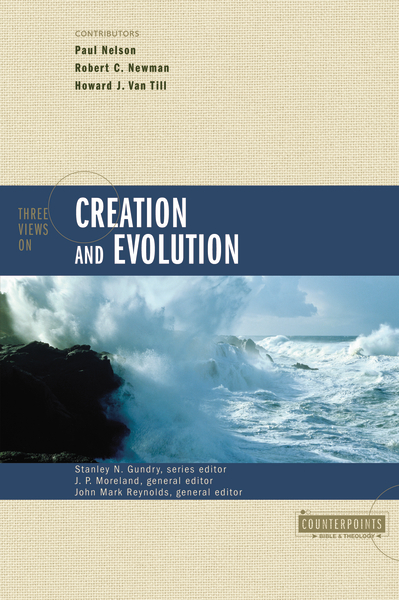 It’s no secret: I consume just about any book I can get my hands on related to the debate over the duration and means of creation within Christianity. Recently, I read through Three Views on Creation and Evolution, part of the Zondervan Counterpoints series. The young earth creationists (John Mark Reynolds and Paul Nelson) in this volume were more even than many I have read, and I appreciated their contribution in many ways and even found myself agreeing with portions of it. However, they did make a few remarkable claims, one of which will be my focus here. Namely, they suggested we leave interpretation of Genesis behind us and just assume the early church got it right.
Here is the quote:
Our advice, therefore, is to leave the issues of biblical chronology and history to a saner period. (100)
Why should we do that, you ask? Well, before offering this advice, Reynolds and Nelson argue:
Whatever the truth of the matter may be in regard to biblical history, we are… least likely to find it. Nothing about the education of most moderns leaves them disposed to be sympathetic to traditional readings of the biblical text… The almost overwhelming temptation is to “trim” [the portions of text which may be hard to swallow]. Suddenly, new ways of reading the text of Scripture are discovered, which to no one’s surprise allow for accommodation between at least some of the reigning paradigms and traditional religion. (99-100)
I find this simply astonishing! There are a number of reasons to reject this entire line of reasoning immediately. First, it is, in effect, poisoning the well. Second, it abandons any notion that new evidence can challenge established traditions. Third, it begs the question. Fourth, it undermines the need for the church to be semper reformanda – always reforming. We’ll examine these briefly in order.
Poisoned Well
The way Nelson and Reynolds present their argument poisons the well against any who would disagree with them. The insinuation is that the only reason anyone would come to a different conclusion is either because they don’t have an “educational” background which allows them to consider traditional readings or because they are in such a hurry to compromise the text to align with science. Although it is certainly possible that many readings come from these motivations, to suggest that we must put a ban on any future looks at the interpretation of Genesis shows the authors seem to think these motivations apply to all novel interpretations.
New Evidence
To put an interpretation of Genesis on an indisputable pedestal and say “that came from a ‘saner’ time and so we must follow it” undermines any possibility for new evidence to challenge established readings. Yet the fruit of research in many areas of biblical interpretation continues to yield great insight into the biblical text. Moreover, to make an interpretation like that indisputable is to perhaps set up stumbling blocks for future generations, who may in good faith find more evidence which challenges that interpretation.
Question Begged
By saying we need to leave the interpretation of Genesis to the past, Reynolds and Nelson have begged the question by assuming this interpretation is correct. In fact, they seem to assume it is so obviously correct that they don’t even bother to defend it. But of course this is not how theology ought to be done. We should not just relegate interpretations to the ecclesial past because we don’t want to face the challenges of today. Rather, we should explore the new evidence and new interpretations to see if they might in fact better match God’s revealed truths. By simply assuming we can leave an interpretation of Genesis as is, Reynolds and Nelson just assert their view is obviously correct without argument.
Semper Reformanda
The notion that the church needs to continually be reforming seems to be correct. When we find truths revealed in God’s natural revelation, we should be prepared to realize this may not align with our established paradigms. We need not reject these discoveries merely because the historical church didn’t know about them. Instead, we should realize that as an imperfect church waiting for our Lord’s return, we may get things wrong. We are always going to need to reform.
Conclusion
Thus, I think that any young earth creationist who simply asserts we must hold to the historic understanding of the text of Genesis is mistaken. Of course, I would also point out that the “historic” understanding is hardly what the modern young earth creationist would believe (such as the duration of the entire universe only lasting 6000 years in order to align with the creation days, etc.), but that is a matter for a different post. For now, it should be acknowledged that we should not just abandon attempts to understand God’s revelation in Genesis.
Links
Be sure to check out the page for this site on Facebook and Twitter for discussion of posts, links to other pages of interest, random talk about theology/philosophy/apologetics/movies and more!
Origins Debate– Check out all my posts on the discussion within Christianity over the duration and means of creation.
Source
Paul Nelson and John Mark Reynolds, “Conclusion” in Three Views on Creation and Evolution
SDG.
——
The preceding post is the property of J.W. Wartick (apart from quotations, which are the property of their respective owners, and works of art as credited; images are often freely available to the public and J.W. Wartick makes no claims of owning rights to the images unless he makes that explicit) and should not be reproduced in part or in whole without the expressed consent of the author. All content on this site is the property of J.W. Wartick and is made available for individual and personal usage. If you cite from these documents, whether for personal or professional purposes, please give appropriate citation with both the name of the author (J.W. Wartick) and a link to the original URL. If you’d like to repost a post, you may do so, provided you show less than half of the original post on your own site and link to the original post for the rest. You must also appropriately cite the post as noted above. This blog is protected by Creative Commons licensing. By viewing any part of this site, you are agreeing to this usage policy.
Sunday Quote!- Charismata and Authority of Scripture
 Every Sunday, I will share a quote from something I’ve been reading. The hope is for you, dear reader, to share your thoughts on the quote and related issues and perhaps pick up some reading material along the way!
Charismata and the Authority of Scripture
I have been reading through Jon Mark Ruthven’s On the Cessation of the Charismata
the implicit attack on the sufficiency of scriptural authority made by those claiming miracles and extraordinary gifts of the Holy Spirit… Such claims [of spiritual gifts]… represented a direct challenge to Protestant religious authority in that it was specifically based upon a closed canon of Scripture. (32, cited below)
Now I have not finished the book, so I’m not sure whether Ruthven would affirm this point. Indeed, he calls this a “polemical” argument against spiritual gifts, so I suspect he’s going to argue that the “continuationist” position–that which affirms spiritual gifts moving into the modern era–does not need to deny the closedness of the canon or affirm a denial of the sufficiency of Scripture. I’m looking forward to seeing how his argument proceeds, and whether he will indeed argue against this or affirm the openness of the canon.
What do you think? Do charismata–spiritual gifts–entail this position? If so, how problematic is it? What is your position? I’d love to read your thoughts in the comments.
Links
Be sure to check out the page for this site on Facebook and Twitter for discussion of posts, links to other pages of interest, random talk about theology/philosophy/apologetics/movies and more!
“Are Miraculous Gifts for Today?”- A look at four views in Christian Theology– I provide a look at four positions on miraculous/spiritual gifts in contemporary theology.
Sunday Quote– If you want to read more Sunday Quotes and join the discussion, check them out! (Scroll down for more)
Source
Jon Mark Ruthven, On the Cessation of the Charismata
SDG.
Really Recommended Posts 1/16/15- Abortion, Jesus, Science Fiction, and More!
 I am really proud of this lineup today, folks. I feel like it’s gotta be one of the broadest ranges of topics I’ve had in a while and they are all very interesting reads, at least in my opinion! Several of them are not just about what the title implies, but about something interesting related to that topic (like the one on pro-life being not just about the pro-life position but about how it might relate to evangelism). I’m pumped to share these posts. Let me know what you think in the comments here, and be sure to let the authors know you enjoyed their posts as well!
How Pro-Life Apologetics Helps Strengthen Your Evangelism– The case for the pro-life position is, in my opinion, absolutely philosophically and scientifically insurmountable. Here, Wintery Knight shares some thoughts on how learning the ins-and-outs of pro-life apologetics can also help evangelism.
Ehrmann Errors on Jesus’ Authority to Forgive– Noted skeptic Bart Ehrmann has argued that the notion that Jesus is divine was a later development in Christianity. What might the Bible itself–the earliest documents we have on the topic–reveal?
Observations About Commenting on Young Earth Creationist Facebook Pages– Let’s clear the water: commenting on Facebook pages is almost always going to get into some random fight about something… probably something completely unrelated to the original comment. The greater the importance of the topic, the more off the rail it often gets. That happens everywhere. However, here, the “Geochristian” shares some insights specific to discussing young earth creationism.
In the Image of Man they Created God; Male They Created Him– God is not male. God is Spirit. It is not inappropriate to use biblical pronouns for God like “He”; however, the danger is that we begin to think of God as a kind of Grandpa in the sky. Here’s some insight into the problems with assigning gender to God.
Scientific Mythologies: How Science and Science Fiction Forge New Religious Beliefs– Here, Anthony Weber shares a brief book review along with some insights related to this wonderful work by James Herrick. I do highly recommend the book to my readers. I shared a Sunday Quote about it some time ago.
Book Review: “Salvation Applied by the Spirit” by Robert Peterson
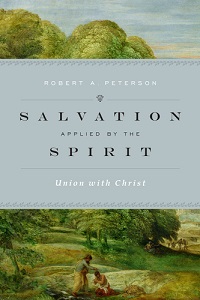 Robert Peterson’s Salvation Applied by the Spirit
The first part of the book is comprised of a comprehensive (to my knowledge) survey of texts related to the notion of being “in the Spirit.” Peterson goes across the whole of the biblical witness in order to draw several conclusions, including the notion that being “in Christ” simply is salvation and that this is brought about by union with Christ, which is the work of the Holy Spirit.
This first section brings up many intriguing points of inquiry alongside the central theme of union with Christ. Included among these are the meaning and application of the Sacraments (the Lord’s Supper and Baptism), the doctrine of justification and its application, and more.
The second part of the book draws broad theological conclusions from the exegetical work done in the first section. Broadly, Peterson uses this to explain the work of the Spirit in santification, justification, and salvation. Other primary theological topics that are necessary for understanding these concepts–such as the Incarnation–are also briefly discussed.
The exegetical portion of the book is fantastic and provides not only a solid understanding of the Bible’s understanding of the Spirit’s work in salvation (and particularly that of Paul), but also several insights of the applicability of these discussions to other areas.
The discussion of the Sacraments and the Holy Spirit’s work therein, along with the Incarnational perspective, was interesting and somewhat neutral. The notion that the indwelling of Christ may come through a Sacrament like the Lord’s Supper was wonderful to see (from my perspective as a Lutheran), though the somewhat dismissive language of “symbol” applied alongside this discussion gave it a sense of schizophrenia related to the Sacraments.
The theological threads of the second part of the book are interesting, as was the choice to spend some time covering topics like the Incarnation while spending lesser time on things like the specific view of justification of the author. The latter synthesis of both a covenantal perspective similar to N.T. Wright’s and the emphasis on imputation of righteousness was intriguing and deserving of deeper exploration.
Perhaps the greatest downside to the book is an amorphous sense of audience. It is written at a level which laity will find understandable, but its length will likely be off-putting. Similarly, those looking for a technical discussion will be edified by the quantity of exegetical insights, but perhaps disappointed by the lack of depth. It seems a book a bit caught in the middle between wanting to convey information to the general audience while also appealing to readers with academic interest. Unfortunately, it ultimately doesn’t quite hit its stride with either.
Overall, this is a good book looking at an interesting topic. It would just benefit from being either more or less technical. It will benefit greatly readers interested in the work of the Holy Spirit.
Disclaimer: I received a review copy of the book through Crossway. I was not obligated by the publisher to give any specific type of feedback whatsoever.
Source
Robert Peterson, Salvation Applied by the Spirit
Links
Be sure to check out the page for this site on Facebook and Twitter for discussion of posts, links to other pages of interest, random talk about theology/philosophy/apologetics/movies and more.
SDG.
——
The preceding post is the property of J.W. Wartick (apart from quotations, which are the property of their respective owners, and works of art as credited; images are often freely available to the public and J.W. Wartick makes no claims of owning rights to the images unless he makes that explicit) and should not be reproduced in part or in whole without the expressed consent of the author. All content on this site is the property of J.W. Wartick and is made available for individual and personal usage. If you cite from these documents, whether for personal or professional purposes, please give appropriate citation with both the name of the author (J.W. Wartick) and a link to the original URL. If you’d like to repost a post, you may do so, provided you show less than half of the original post on your own site and link to the original post for the rest. You must also appropriately cite the post as noted above. This blog is protected by Creative Commons licensing. By viewing any part of this site, you are agreeing to this usage policy.

 J.W. Wartick - Reconstructing Faith