christian
Guest Post: Rev. Kent Wartick on “The Virgin Birth”
“Behold, the virgin shall conceive and bear a son,
and they shall call his name Immanuel”
(which means, God with us). Matthew 1:28 ESV.
Familiar words to most Christians, aren’t they? Along with His Death and Resurrection, the virgin birth of Jesus is among the most celebrated and unifying events in all of Christianity. Nativity scenes can be found in front of Roman Catholic, Lutheran, Baptist, Methodist, and all sorts of churches of all denominations. The virgin birth is counted as among the fundamental doctrines of Christianity, and was important enough to be counted as one of the twelve articles of the Apostolic Creed. For centuries, the account that Jesus Christ was born of a virgin woman, Mary of Nazareth, was undisputed, at least as far as any known challenges can be documented.
But, then, along came the Enlightenment. With it came the idea that science and reason were the test of Scripture and all truth, and not the reverse. Therefore, if Scripture says that Jesus was born of a virgin, and that is not logical nor scientifically provable, then it must be rejected. Thus, the Jefferson “Bible” excludes any reference to the virgin birth as well as Jesus’ miracles, Deity, resurrection, etc. As time went on, through the historical critical method and other destructive methods of using reason not to teach but to judge Scripture, the Enlightenment principle of reason and science over Scripture slowly infiltrated the thinking of many churches. Surveys confirm this infiltration.
1998: A poll of 7,441 Protestant clergy in the U.S. showed a wide variation in belief. The following ministers did not believe in the virgin birth:
- American Lutherans- 19%
- American Baptists- 34%
- Episcopalians- 44%
- Presbyterians- 49%
- Methodists- 60%
2007-DEC: The Barna Group sampled 1,005 adults and found that 75% believed that Jesus was born to a virgin. 53% of the unchurched, and 15% of Agnostics and Atheists believe as well. Even among those who describe themselves as mostly liberal on political and social issues, 60% believe in the virgin birth. (Source for surveys.)
It is a great travesty in the Church today that many clergy find themselves looking at their positions only as a job, and will say what they must to preserve their positions. From the source of the polls previously cited comes this quote:
“…one Hampshire vicar was typical: ‘There was nothing special about his birth or his childhood – it was his adult life that was extraordinary….I have a very traditional bishop and this is one of those topics I do not go public on. I need to keep the job I have got.’
Such hypocrisy and blatant deceit is unworthy of anyone, let alone one who claims to proclaim the Word of God and represent Him to the people. yet such is the state of much of the clergy, as indicated by the above polling figures. No wonder the Church is in such disarray, and seems so powerless in the world today!
If Christianity is only a “nice” way of life that is only about love and compassion, then I suppose the virgin birth is not so essential, But if Christianity is an intimate and personal relationship by faith with the Creator of the Universe, then Who that Creator is makes all the difference. And if being born of a virgin is something He says about himself, even once, in His Book, then it might be best if we believe it. After all, wouldn’t you like to know a bit about, say, the pedigree of a dog or horse that you were to buy, or even more so, wouldn’t you like to know all about a future spouse that you profess to love before marriage? (Please forgive the analogy, which is not meant to cheapen God, spouses, dogs, or horses).
The virgin birth of Christ—and I would say, the historical fact that Jesus was conceived by a miracle like unto creation itself—does not travel alone. It ties intimately into other doctrines-the Holy Trinity, the Deity of Christ, the substitutionary atonement, the inspiration, inerrancy, and infallibility of Scripture, and more. “Scripture cannot be broken”, Jesus said in John 10:35. Even so, the most basic teachings of the Christian faith cannot be broken off and accepted like items on a buffet table. They are all one. Accept all of them-or none of them. That is the challenge that the catechumen, the seeker, the growing disciple of Christ is faced with. Finally, you see, the importance of the virgin birth is found, like all things, bound in the Person and Work of Jesus Christ.
As far as the prophecy quoted by Matthew, namely Isaiah 7:14, much ink has been spilled on this by scholars with more degrees than I have. Some modern Bible translations, notably the NRSV, CEB, TEV and others use “young woman” to translate the Hebrew word almah. Others, such as the NASB, ESV, NKJB, TNIV (=NIV 2011), use the more traditional “virgin.” The LXX also translates the word “virgin.” While the matter is not as simple as some might make it, certainly I would think that the Septuagint scholars would have known Hebrew and Greek well enough to have chosen a different word besides the Greek word for “virgin” if “young woman” would have been indicated. They had no agenda to support a virgin birth or not. The same cannot be said of some modern translators. The sainted Dr. William Beck wrote a study on this subject, available at www.wlsessays.net/.
Human reason helps us put all of these things together systematically from Scripture; but human reason cannot accept and believe them itself. That, too, is a special creative work of the Holy Spirit. What a delight to know that God wants everyone to know Him as He reveals Himself in Scripture. It is through the very words of Scripture that God creates faith. Through those Holy Spirit given and empowered words He keeps one in the faith. As I stand in awe that God chose this supernatural way to join our human race, so I stand in awe that He created faith in my heart, and has kept that faith to this day. All glory and praise to Him forever!
Finally, though, the virgin birth is a matter of faith. For the individual, it is a matter of personal faith whether one accepts what Scripture says about the miraculous conception and birth of Jesus or not. But the virgin birth is also a matter of THE Faith; that is to say, it is an article of Christian doctrine that is beyond dispute. To accept it is to accept a fundamental, essential doctrine of all Christianity. To reject it is to put one outside the bounds of the Christian faith. I pray that this Advent and Christmas season you will join with me, and with all the Christian world, in celebrating the supernatural way that God chose to enter our human race to bear our sin and be our savior.
Rev. Kent Wartick is the pastor of Faith Lutheran Church in Kent, Ohio. He has been preaching for over 26 years in the Lutheran Church – Missouri Synod. He’s my dad, and an inspiration for the faithful.
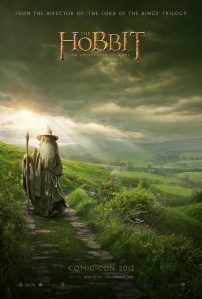
The Hobbit: An Unexpected Journey- A Christian perspective
 Unless you’ve been living in a Hobbit-hole somewhere (forgive me!), you know that The Hobbit: An Unexpected Journey was just released in theaters. Short, spoiler free review: It was amazing, go see it. Hereafter, I offer my thoughts on the themes present in the film from a Christian worldview perspective, followed by some links to great posts on the movie and related items. Yes, there are SPOILERS ahead.
An Unexpected Journey
Yes, there is an unexpected journey which begins in this film, believe it or not. Yet the journey was not just unexpected but also vehemently resisted. Bilbo Baggins did not want to go. He was too comfortable with his armchair, his full cabinet, and his total lack of adventure. He was comfortable in his home. He liked it there, and as long as nothing was bothering him, he’d like to stay put, thank you very much.
I can’t help but think of how so many people today are in that same position. We are too comfortable in our pleasant (or at least largely undisturbed) lives, living as though we haven’t a care in the world. We avoid those things which make us uncomfortable. We don’t want to think about them, and we’d rather not even say the words that have anything to do with these hard topics which have become our “adventures.”
For the Christian, this is especially poignant. The scene where Bilbo finally decides to go on the journey has him waking up the next morning after his refusal. He sees his hobbit-hole cleaned up and looking as though the previous night had never happened. But then he sees the contract from Thorin Oakenshield on a table. He picks it up and realizes what he has been called to do. He has to step out and live that life in the great beyond. It is as Gandalf tells him: the world is not contained in books and maps, it is “out there.” Similarly, we cannot become too comfortable in our lives. We are to be in the world, changing it through our actions and through the call to repent and believe. Yes, we can have all the books, we can pray the prayers, but what are we doing? Are we running, leaping, yelling like Bilbo to join the adventure, to spread the Gospel?
Big Evil
Defeating Evil
When the party comes to Rivendell, they encounter Saruman, who had summoned Galadriel. After a brief conference on whether the dwarves should continue their quest and a debate over the existence of a Necromancer, Galadriel privately confronts Gandalf. She asks him why he chose a Hobbit, Bilbo, to embark on such a dangerous quest as a burglar. Gandalf’s insight is telling. He says that “Sarumon thinks evil must be defeated with great power.” But Gandalf is not so convinced. He argues that it is the little things, the everyday choices, which can lead to the defeat of evil. When enough choices are made for good, evil cannot overcome the turning tide against it. Bilbo is weak, but he will become strong in his actions. He will be used for good, despite not having great power.
We can fight evil in that same way. The choices we make everyday have larger consequences. How will I spend my time? Will I make that nasty remark? Will I forgive? There is big evil in this world, but it can be fought, by God’s grace.
Its Reality and Our Resistance
Evil is real. There is evil everywhere in the world, and we need only to look at the headlines to see it. Gandalf is aware of the rising evil in Middle Earth as well. The evils which confront the adventurers are “big.” There are trolls, stone giants, a goblin with a grudge, and more. They are resisted at every turn.
Who can help but see how this theme ties into the last one? Christians are called into a world of big evil. We are called to go into a world which is resisting them–often violently–at every turn.
Evil’s Foothold
Evil seeks places to dwell. The things which are evil must be actively resisted, for any foothold evil gains, it will utilize. Bilbo, Gandalf, Thorin, and Radagast the Brown must all fight against evil as it seeks its foothold in their lives. Radagast is a particularly poignant example. He runs through the forest, fighting evil as much as can be done. He is eccentric and seems crazy, yet he does what he can to fight the evil which seeks to penetrate at every level into the forest. Our hearts are too often willing dwelling places for evil. We must fight it.
 Small Mercies
Courage is the strength to show mercy. Gandalf urges Bilbo to remember this as he considers the adventure. A mercy shown can have important ramifications in the future, as those who know not only the Hobbit but also the Lord of the Rings trilogy should note. By sparing Gollum, Bilbo opened the door for the defeat of a much greater evil far into the future. What mercies can we show? Certainly, we don’t often have a life-or-death situation placed at our feet, but we have the capacity to show mercy on a day-to-day basis.
Evidence and Will
Saruman was confronted by Gandalf with evidence for the existence of a great evil, a Necromancer, who had been discovered by Radagast. Saruman–perhaps already in the thrall of Sauron–seeks any avenue to redefine the evidence. He says that Radagast cannot be trusted, for he is too eccentric and perhaps crazy. Saruman says Radagast spends too much time in the forest, eating mushrooms. Even when confronted with physical evidence, a blade full of evil, he seeks to offer an alternative explanation.
This dialogue between Gandalf, Elrond, Galadriel, and Gandalf is a powerful example of how our will can change the evidence. If we do not wish something to be true, we will seek every avenue to escape its truth. Perhaps Saruman was not yet in the thrall of Sauron, perhaps he merely did not want to think evil could gain such a foothold in his world, but he nevertheless made a decision to doubt his brother wizards. If he had trusted them, he perhaps would not have trodden down the path he takes in Lord of the Rings.
Back Again- Conclusion
JRR Tolkien wrote one of the greatest fantasy epics of all time. He was also a deeply thoughtful Christian. The themes which appear throughout his novels are portrayed vividly on screen. I urge readers to see this movie. When you put on those 3-D glasses, don’t forget to put on your worldview glasses as well. What themes are occurring in this film? How do they relate to my worldview? What worldview can account for these things? The Hobbit: An Unexpected Journey was a fantastic exploration of these themes. We are called to live in the world, we are called to adventure, no matter how much we want to resist. We are called to Christ.
Links
The Call to Adventure– What does the call to adventure mean? Garret Johnson offers a thought-provoking look at the call to adventure in literature and how it can inform our worldview.
Tolkien Experts Talk About His Christian Themes– A video with a number of experts on Tolkien offering their thoughts on the Christian themes in his body of work. Definitely worth watching.
Big Truths from the Hobbit– An excellent post calling Christians to step out of their hobbit-holes.
SDG.
——
The preceding post is the property of J.W. Wartick (apart from citations, which are the property of their respective owners, and works of art as credited) and should not be reproduced in part or in whole without the expressed consent of the author. All content on this site is the property of J.W. Wartick and is made available for individual and personal usage. If you cite from these documents, whether for personal or professional purposes, please give appropriate citation with both the name of the author (J.W. Wartick) and a link to the original URL. If you’d like to repost a post, you may do so, provided you show less than half of the original post on your own site and link to the original post for the rest. You must also appropriately cite the post as noted above. This blog is protected by Creative Commons licensing. By viewing any part of this site, you are agreeing to this usage policy.
Book Review: “Cold Case Christianity” by J. Warner Wallace
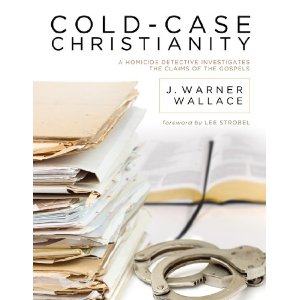 I’ll forego the preliminaries here and just say it: this is the best introductory apologetics book in regards to the historicity of the Gospels I have ever read. If you are looking for a book in that area, get it now. If you are not looking for a book in that area, get it anyway because it is that good. Now, on to the details.
Cold-Case Christianity
He begins the work with a section on method. He argues that we must learn to acknowledge our presuppositions and be aware of them when we begin an investigation. Like the detective who walks into a crime scene with a preconceived notion of how the murder played out, we can easily fall into the trap of using our expectations about a truth claim to color our investigation of the evidence for that claim. Learning to infer is another vastly important piece of the investigation. People must learn to distinguish between the “possible” and the “reasonable” (34ff). This introduction to “abductive reasoning” is presented in such a way as to make it understandable for those unfamiliar with even the term, while also serving as great training on how to teach others to reason for those involved in apologetics.
Chapter 3, “Think Circumstantially” is perhaps the central chapter for the whole book. Wallace notes that what is necessary in order to provide evidence “beyond a reasonable doubt” is not necessarily “direct evidence.” That is, direct evidence–the type of evidence which can prove something all by itself (i.e. seeing it rain outside as proof for it actually raining)–is often thought of to be the standard for truth. Yet if this were the standard for truth, then we would hardly be able to believe anything. The key is to notice that a number of indirect evidences can add up to make the case. For example, if a suspected murderer is known to have had the victim’s key, spot cleaned pants (suspected blood stains), matches the height and weight a witness saw leaving the scene of the crime, has boots that matched the description, was nervous during the interview and changed his story, has a baseball bat (a bat was the murder weapon) which has also been bleached and is dented, and the like, these can add up to a very compelling case (57ff). Any one of these evidences would not lead one to say they could reasonably conclude the man was the murderer, but added together they provide a case which pushes the case beyond a reasonable doubt–the man was the murderer.
In a similar way, the evidences for the existence of God can add up to a compelling case for the God of classical theism. Wallace then turns to examining a number of these arguments, including the moral, cosmological, fine-tuning, and design arguments. These are each touched on briefly, as a kind of preliminary to consider when turning to the case for the Gospels. Furthermore, the notion of “circumstantial” or cumulative case arguments hints towards the capacity to examine the Bible and the Gospels to see if they are true.
Wallace then turns to examining the Gospels–Mathew, Mark, Luke, and John–in light of what he has learned as a detective. He utilizes forensic statement analysis as well as a number of other means by which to investigate witnesses and eyewitness reports to determine whether the Gospels can be trusted. He first turns to Mark and makes an argument that Mark had firsthand contact with Peter, one of the Disciples and an Apostle. He shows how we can search for and find “artifacts”–textual additions that were late into the accounts of the Gospels. None of these are surprises, because we know about them by investigating the evidence we have from the manuscript tradition. By piecing together the puzzle of the evidences for the Gospels, we form a complete picture of Christ (106ff).
It is easy to get caught up in “conspiracy theory” types of explanations for the events in the Bible. People argue that all kinds of alternative explanations are possible. Yet Wallace notes again that there is a difference between possible and reasonable. Simply throwing out possible scenarios does nothing to undermine the truth claims of the Gospels if the Gospels’ own account is more reasonable. Furthermore, drawing on his own knowledge from investigating conspiracy theories, Wallace notes that the Gospels and their authors do not display signs of a conspiracy.
A very important part of Cold-Case Christianity is the notion that we can trace back the “chain of custody” for the Gospels. By arguing that we are able to see how the New Testament was passed authoritatively from one eyewitness to disciple to disciple and so on, Wallace argues that conspiracy theories which argue the Gospel stories were made up have a much less reasonable explanation than that they are firsthand accounts of what happened. Much of the information in these chapters is compelling and draws on knowledge of the Apostles’ and their disciples. It therefore provides a great introduction to church history. Furthermore, Wallace notes that a number of things that we learn from the Gospels are corroborated not just by other Christians, but also by hostile witnesses (182ff). He also argues that we can know that the people who wrote the Gospels were contemporaries of the events they purported to report by noting the difficulties with placing the authors at a later date (159ff). This case is extremely compelling and this reviewer hasn’t seen a better presentation of this type of argument anywhere.
There are many other evidences that Wallace provides for the historicity of the Gospels. These include undesigned coincidences which interlink the Gospel accounts through incidental cross-confirmations in their accounts. I have written on this argument from undesigned coincidences before. Archaeology also provides confirmation of a number of the details noted in the Gospel accounts. The use of names in the Gospels place them within their first century Semitic context.
Again, the individual evidences for these claims may each be challenged individually, but such a case is built upon missing the forest for the trees. On its own, any individual piece of evidence may not prove that the Gospels were written by eyewitnesses, but the force of the evidence must be viewed as a complete whole–pieces of a puzzle which fit together in such a way that the best explanation for them is a total-picture view of the Gospels as history (129ff).
All of these examples are highlighted by real-world stories from Wallace’s work as a detective. These stories highlight the importance of the various features of an investigator’s toolkit that Wallace outlined above. They play out from various viewpoints as well: some show the perspective of a juror, while others are from the detectives stance. Every one of them is used masterfully by Wallace to illustrate how certain principles play out in practice. Not only that, but they are all riveting. Readers–even those who are hostile to Christianity–will be drawn in by these examples. It makes reading the book similar to reading a suspense novel, such that readers will not want to put it down. For example, when looking at distinguishing between possible/reasonable, he uses a lengthy illustration of finding a dead body and eliminating various explanations for the cause of death through observations like “having a knife in the back” as making it much less probable that accidental death is a reasonable explanation, despite being possible.
Throughout the book there are also sidebars with extremely pertinent information. These include quotations from legal handbooks which describe how evidence is to be viewed, explanations of key points within the text, and definitions of terms with which people may be unfamiliar. Again, these add to the usefulness of the book for both a beginner and for the expert in apologetics because it can serve either as a way to introduce the material or as helpful guides for using the book to teach others.
Overall, Cold-Case Christianity
Links
View J. Warner Wallace’s site, Please Convince Me, for a number of free and excellent resources. I highly recommend the blog and podcast.
I would strongly endorse reading this book alongside On Guard
Source
J. Warner Wallace, Cold-Case Christianity
Disclosure: I received a copy of the book for review from the publisher. I was not asked to endorse it, nor was I in any way influenced in my opinion by the publisher. My thanks to the publisher for the book.
SDG.
——
The preceding post is the property of J.W. Wartick (apart from citations, which are the property of their respective owners, and works of art as credited) and should not be reproduced in part or in whole without the expressed consent of the author. All content on this site is the property of J.W. Wartick and is made available for individual and personal usage. If you cite from these documents, whether for personal or professional purposes, please give appropriate citation with both the name of the author (J.W. Wartick) and a link to the original URL. If you’d like to repost a post, you may do so, provided you show less than half of the original post on your own site and link to the original post for the rest. You must also appropriately cite the post as noted above. This blog is protected by Creative Commons licensing. By viewing any part of this site, you are agreeing to this usage policy.
Jesus’ Birth: How undesigned coincidences give evidence for the truth of the Gospel accounts
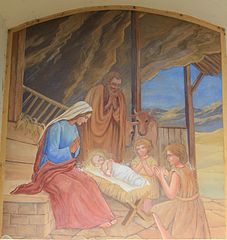 There are many charges raised against the historicity of the birth narratives of Jesus Christ. These run the gamut from objections based upon alleged contradictions to inconsistencies in the genealogies to incredulity over the possibility of a virgin birth. Rather than make a case to rebut each of these objections in turn, here I will focus upon using undesigned coincidences to note how these birth narratives of Christ have the ring of truth. How exactly do undesigned coincidences work? Simply put, they are incidental details that confirm historical details of stories across reports. I have written more extensively on how these can be used as an argument for the historicity of the Gospels: Undesigned Coincidences- The Argument Stated. It should be noted that the birth narrative occurs only in Matthew and Luke. John begins with a direct link of Christ to God, while Mark characteristically skips ahead to the action. Thus, there are only a few places to compare these stories across different reports. However, both Mark and John have incidental details which hint at the birth account. These incidental details lend power to the notion that the birth narratives of Jesus are historical events.
Joseph
First, there is one undesigned coincidence that is such a gaping hole and such a part of these narratives most people will probably miss it. Namely, what in the world was Joseph thinking in Luke!? Do not take my word for this–look up Luke chapters 1-2. Read them. See anything missing? That’s right! Joseph, who is pledged to a virgin named Mary (1:27) doesn’t say anything at all about the fact that his bride-to-be is suddenly pregnant. There is no mention of him worrying at all about it.
So far as we can tell from Luke, Joseph, who we only know as a descendant of David here, is going to be wed to a virgin and then finds out that she’s pregnant. He’s not the father? What’s his reaction? We don’t find out until Luke 2, where Joseph simply takes Mary with him to be counted in the census, dutifully takes Jesus to the Temple, and that’s about it. Isn’t he wondering anything about this child? It’s not his! What happened?
Only by turning to Matthew 1:18ff do we find out that Joseph did have his second thoughts, but that God sent an angel explaining that Mary had not been unfaithful, and that the baby was a gift of the Holy Spirit. So we have an explanation for why Joseph acted as he did in Luke. Now these are independent accounts, and it would be hard to say that Luke just decided to leave out the portion about Joseph just because he wanted to have Matthew explain his account.
The genealogies of Jesus that Matthew and Luke include are different, but they reflect the meta-narratives going on within each Gospel. Luke’s narrative generally points out the women throughout in a positive light, and it is often argued that his genealogy traces the line of Mary. Matthew, writing to a Jewish audience, traces through Jesus’ legal father, Joseph. Now it could be argued that these are simply reflections of the authors’ imaginations within their fictional accounts, but surely including names with descendants tracing all the way back to Abraham and beyond is not a good way to construct a fictional account. No, Matthew and Luke include the genealogies because their accounts are grounded in history.
Incidental Details
Interestingly, the birth narratives of Jesus also help explain the events reported in Mark and John, which do not report His birth. What of the apparent familiarity John had with Jesus in Mark 1:3ff and John 1:19ff? It seems a bit odd for John to go around talking about someone else “out there” who will be better in every way than he himself is without knowing who this other person is. Well, looking back at Matthew and Luke, we find that Mary and Elizabeth (John’s mother) knew each other and had visited each other during their pregnancy. It seems a foregone conclusion that they continued to interact with each other after the births of their sons, which would explain John’s apparent familiarity with Jesus in Mark and John.
Strangely, Mark never mentions Joseph as Jesus’ father. If all we had was Mark’s Gospel, we would be very confused about who Jesus’ father is. The oddness is compounded by the fact that Mary is mentioned a number of times. Well okay, that still seems pretty incidental. But what about the fact that Mark explicitly has a verse where he lists Mary as well as Jesus’ siblings?
Is not this the carpenter, the son of Mary and brother of James and Joses and Judas and Simon? And are not his sisters here with us?” And they took offense at him. (Mark 6:3, ESV)
This verse seems extremely weird. After all, Joseph was a carpenter (well, a more accurate translation is probably “craftsman”) and yet despite Mark explicitly using that word for Jesus, as well as listing Mary and Jesus’ siblings, we still see nothing but silence regarding Jesus’ father. Well, of course! After all, when we turn to the birth narratives in Matthew and Luke, we find that Jesus was born of a virgin. Jesus had no human father. Thus, Mark, ever the concise master of words, simply omits Joseph from details about Jesus’ life. But to not mention Jesus’ father in a largely patriarchal society alongside his mother and siblings seems extremely strange. It is only explained by the fact of the virgin birth, with which Mark would have been familiar. However, Mark didn’t see the birth narrative as important in his “action Gospel.” Only by turning to Matthew and Luke do we find an explanation for the strange omission of Joseph from Mark’s Gospel.
Conclusion
I have listed just a few undesigned coincidences to be gleaned from the birth narratives of Jesus. The fact of the matter is that these can be multiplied almost indefinitely if one looks at the whole of the Gospels, and even moreso if one investigates the whole Bible. These incidental details fit together in such a way as to give the Gospels the ring of truth. The way that Matthew fills in details of Luke, Mark demonstrates his familiarity with the birth narratives, and the intimate connections of Jesus and John are all cross-confirmed is both incidental and amazing. The claim is not that based upon these incidences alone the Gospel accounts are true. No, the claim is that those who challenge the truth of these accounts must account for these incidences in a way that is more plausible than that they simply occur when people relate history. It seems that the only way to do that would be to resort to outlandish narratives that involve the four authors sitting together and discussing which portions of stories to leave out so the others can fill them in. No, instead it seems much more likely that these four authors were writing what they had witnessed–or received from eyewitness testimony, and just as we do when recounting events (think of 9/11, for example, and the different things people remember) they wrote specific details they felt were important or part of the narrative, while the others found other things more important or had other incidental knowledge related to the events they recorded.
SDG.
——
The preceding post is the property of J.W. Wartick (apart from citations, which are the property of their respective owners, and works of art as credited) and should not be reproduced in part or in whole without the expressed consent of the author. All content on this site is the property of J.W. Wartick and is made available for individual and personal usage. If you cite from these documents, whether for personal or professional purposes, please give appropriate citation with both the name of the author (J.W. Wartick) and a link to the original URL. If you’d like to repost a post, you may do so, provided you show less than half of the original post on your own site and link to the original post for the rest. You must also appropriately cite the post as noted above. This blog is protected by Creative Commons licensing. By viewing any part of this site, you are agreeing to this usage policy.
Saint Nicholas- A Christian life lived, a story told
It has been remarked, with much truth, that all of us lead double lives, a life of our fancy, in a world of things as they should be, or as we should like them to be, and a life in a world of things as they really are. And this is as it should be. We can lift the level of real existence by thinking of things as we should like them to be. It is well not to walk with one’s eyes always fixed on the ground. (McKnight, cited below, Kindle location 401)
It is easy to hear the “real story” of Santa Claus, but few investigate further than looking it up to see the parallels between the Bishop of Myra’s life and that of the story of Santa Claus. There is so much more to his story–and indeed to stories in general–than that.
Saint Nicholas (270-343 AD) was a valiant man who fought prostitution, abortion, and poverty. He attended the council at Nicaea, from which we received the Nicene Creed. At that council, he defended vigorously the orthodox doctrine of the Trinity. He was an exemplar of Christian teaching put into practice. Not only that, but the legend which has grown up around his life has inspired and enthralled untold numbers of people through the Christian era.
It is important to note the intertwining of legend and truth in the stories about St. Nicholas, and the impact that has had upon innumerable people. George McKnight, writing in the early 1900s, explored a number of issues related to the mingling of fact and fiction in the life of St. Nicholas. The quote highlighted above touches on many of these topics.
First, there is power in narrative. A story which is told well is one which can effect change. We are impacted by fantasy in ways which cause us to reflect upon reality with new–perhaps better trained–eyes. Second, we, as spirited people in a world which we so often see only as the physical, are called to heights of reality by fiction. As McKnight noted, “It is well not to walk with one’s eyes always fixed on the ground.” Our eyes are driven upwards and outwards by the stories we hear–they cause us to interact with others in new ways, and they also cause us to think about topics which perhaps we had not even considered before.
The story of St. Nicholas is no different. Yes, legend has crept into the accounts of this godly man, but what is the purpose of that legend? Not only that, but is it possible to separate out the fiction?, McKnight also commented upon the nature of radical skeptical history being done in his time (about 100 years ago). He bemoaned the fact that nearly every facet of Nicholas’ life is thrown into question with the arrival of critical scholarship. But of course to focus merely upon what is historical fact or fiction is to miss the entire point of the life of St. Nicholas. McKnight goes on:
The story of St. Nicholas consists almost entirely of a series of beneficent deeds, of aid afforded to humanity in distress, accomplished either by St. Nicholas… or through his intervention… The conception of St. Nicholas, then, is almost that of beneficence incarnate. (Kindle Location 469-481).
That is, the story of St. Nicholas, and the legends that surround him, turn him into a type of Christ–one who is deeply concerned for humanity and showing Christian love for God and neighbor.
Yet this is not all there is to the life of the Saint. Although difficult to sift from the legends, there is a historical core to the life of St. Nicholas which is just as profoundly Christian as the legends which have grown up around him. With that said, we turn to the story of St. Nicholas, with an eye toward how his life is one of a Christian lived as well as a story told.
Nicholas is well-attested to have attended the council of Nicaea. There is a possibly apocryphal story about his 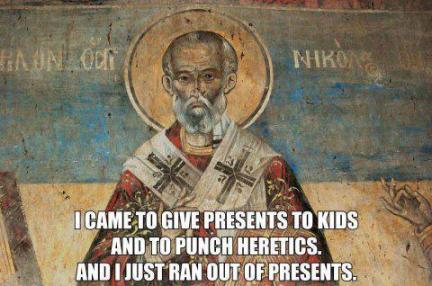 attendance there wherein he confronted the heretic Arias himself and slapped him in the face. The story continues, telling of how Nicholas was initially exiled for his act but later allowed to return after Arianism had been thoroughly acknowledged as heresy. Although it is nearly impossible to know whether this story is historically accurate, there is at least some truth behind the story in that Nicholas was known to vehemently defend the orthodox doctrine of the Trinity.
Nicholas actively opposed prostitution. However, instead of simply condemning the practice, he also gave money to young women in need to keep them from turning to prostitution to feed themselves. Again, this truth served as the basis for a possibly historic legend in which Nicholas learned of three women who were about to turn to prostitution (or be sold into slavery, depending on the account) because they couldn’t pay their dowries in order to be wed. Nicholas is said to have thrown a bag of gold for each young woman through their window so that they could be married instead of sell their bodies. Again, this legend may not be true–but it points to the truth about Nicholas’ life–he gave to those in need and fought against the evils of prostitution. It also points beyond itself towards an ideal.
Nicholas fought against the Pagan practices, which led to his persecution and imprisonment by those angered by his preaching against false idols. Furthermore, his opposition to paganism included working against a number of practices in the pagan world, including abortion. Roman Catholics have continued to spearhead St. Nicholas’ commitment to helping children. A search for “Nicholas of Myra” turns up adoption agencies one after another. Christians have used Nicholas’ example as a call to end human trafficking and slavery. One can see throughout these historical kernels how myth and legend could grow up around this figure–fighting heresy, giving to those in need, and having utmost concern for the innocent were all aspects of St. Nicholas’ life. We don’t necessarily know the extent of his actions in these areas, but we know enough to be inspired.
Therefore, we turn to another part of McKnight’s thought-provoking quote at the beginning of this post:
…all of us lead double lives, a life of our fancy, in a world of things as they should be, or as we should like them to be, and a life in a world of things as they really are. And this is as it should be. We can lift the level of real existence by thinking of things as we should like them to be.
Take a moment to consider what McKnight is saying here: we know there is a realm of absolutes–a way that things should be. We also have a way that we should like things to be. But the way the world “really is” does not often reflect that. Yet we can enact change upon our realm of existence–we can “lift it up”–by focusing on the way that things should be, and living our lives differently because of that. St. Nicholas enacted this in his life, working towards the ideal while living in an imperfect world. The legends of St. Nicholas inspire us to do the same. We are not to focus so much on the critical challenge–which stories are true and which are “only” legends. Instead, we are to focus on St. Nicholas as a story–one which inspires us to change the world around us.
Nicholas’ life was one which fought against poverty, paganism, heresy, prostitution, and idolatry. He incorporated sound doctrine into his life and then lived it. There can hardly be a better example of a Christian life lived than that of St. Nicholas. Yet that is not all there is to the story of the “real” saint. No, his life is one of calling us to live a life for Christ as well. His life is action. It is a life incarnate with truth and the beneficence that comes from the Christian worldview. It is a call to follow Christ.
Sources
James Parker III, “My Kind of Santa Claus.”
Robert Ellsberg, “St. Nicholas, Bishop of Myra.”
George Harley McKnight, St. Nicholas (New York: G.P. Putnam’s sons, 1917). This book is available legally free of charge in a number of digital formats through Open Library.
SDG.
——
The preceding post is the property of J.W. Wartick (apart from citations, which are the property of their respective owners, and works of art as credited) and should not be reproduced in part or in whole without the expressed consent of the author. All content on this site is the property of J.W. Wartick and is made available for individual and personal usage. If you cite from these documents, whether for personal or professional purposes, please give appropriate citation with both the name of the author (J.W. Wartick) and a link to the original URL. If you’d like to repost a post, you may do so, provided you show less than half of the original post on your own site and link to the original post for the rest. You must also appropriately cite the post as noted above. This blog is protected by Creative Commons licensing. By viewing any part of this site, you are agreeing to this usage policy.
Caring for Creation: A discussion among evangelicals
 I recently had the wonderful opportunity to attend the Evangelical Philosophical Society annual meeting (check out my thoughts on the whole thing). The theme of the meeting was “Caring for Creation” and although I generally went to other talks with topics that interested me more, I did get the chance to listen to a talk by Douglas Moo, “Biblical Theology and Creation Care” followed by a panel discussion on caring for creation. The talk by Moo was one of the best papers I attended, and the panel discussion afterwards was both informative and contentious. Readers, I hope you’ll look through the whole thing and engage in some dialogue here. This is an extremely interesting topic and I’d love to read your thoughts on it. I’ll start here by summarizing the highlights of Moo’s paper. Then I’ll look at the panel discussion.
Douglas Moo- “Biblical Theology and Creation Care”
The thrust of Moo’s argument was twofold: first, to outline a “Biblical Theology” and apply that to the notion of stewardship; second, to hint at a strategy going forward for evangelicals interacting with creation care.
There are three ways to look at the texts in regards to creation care: resistance (a pattern which allows one specific interpretation or approach to trump all others and therefore forces all texts into a certain paradigm); recovery (look at different texts and incorporate a broad view that supports an ecological interpretation); and revisionism (adopt a constructive and creative approach that makes meaning from the text while recognizing broad continuity with the text). Moo noted difficulties with all three of these and endorsed a kind of recovery/revisionist approach which “sees the ‘Green'” in the texts while also not forcing texts to be about environmentalism in every case. Furthermore, a sparseness of texts does not necessarily entail that no theology can be drawn from a topic. Instead, there are enough verses which can address creation care to paint in broad strokes.
From this approach, Moo argued that there is a pattern of fulfillment in the New Testament which does not abrogate the Old Testament teachings on creation care but rather incorporates them into the whole world. We are called, Moo argued, to see our authority over the earth as not our own but as Christ’s as Creator.
Moo argued that we must not ignore God’s broad interpretation of “neighbor.” God’s view of neighbor includes not just your friends and your enemies but also those yet unborn. Our culture can be a positive influence in some ways by informing how we can prioritize our work in caring for creation. Furthermore, the concerns of our surrounding culture can inform the directions theology must take. For example, he noted that it was no accident that theologians turned to investigating texts in light of personhood debates in the 1970s with the abortion movement: culture can inform the direction that theology needs to explore, thus giving a more robust theology for coming generations. “When faced with challenges or large scale movements, the church rightly turns to the Bible to see what it may say on that issue.”
Moo then turned to the created world. We are able to learn truths about the world through scientific research. Moo argued that “truth discovered by scientists in the natural world” can inform our worldview because they are viewing the evidence left behind from Creation. It is not scientific theory vs. scientific fact or science vs. the Bible. Instead, Christians must see truth as both interpretations of the science as well as interpretations of the Bible. “We cannot dictate Scripture by science but… current scientific data should not be dismissed unless there is an extremely solid Biblical ground that contradicts this data.” Yes, science changes, but so do interpretations. Sometimes science can inform us of a faulty interpretation of the text. It can cause us to turn to the text to look for a better understanding of both special and natural revelation.
 Moo argued that there is a broad scientific consensus regarding climate change. It is happening and it is at least partially caused by humans. Not all scientists are saying the exact same thing in regards to climate change, but the broad consensus is that it is at least partially anthropogenic.–caused by humans.
Thus, Moo argued, “Biblical theologians have no basis as laity in science to reject what science is telling us on this topic [global warming].” The Bible informs us of the disastrous effects humans can have on the earth, from the fall to Israel’s continued rebellions, which brought harm to the earth itself. Similarly, our own modern rebellions can lead to horrifying effects on the earth.
Moo concluded with a call to Christian philosophers and theologians–and more generally, to Christians at large. “We should be at the forefront of confronting” climate change. We must be concerned with caring for creation.
Panel Discussion
The panel discussion after Moo’s talk quickly became contentious. E. Calvin Beisner began by arguing that we must not lose the distinction between scientific models and reality. He noted that a scientific consensus does not necessarily mean reality, and that dissenting scientists were often those whose careers couldn’t be threatened by loss of livelihood. He generally expressed skepticism over the extent of humanity’s causing climate change.
After Beisner’s general response, the moderator began a Q+A session in which all the panelists- Moo, Beisner, Russell Moore, and Richard Bauckham would be allowed to respond to each question. The first question asked about the political nature of the discussion. All the panelists generally agreed that the discussion goes beyond politics and into interdisciplinary studies of geology, climatology, philosophy, theology, and beyond.
Next, “What can churches do to enhance creation care?” Moo argued that it needs to become an agenda item that churches regularly touch upon. He also said there are a number of easy ways to reduce one’s climate impact that can be incorporated in one’s daily routines. Bauckham expressed a desire for every church to have a ‘care of creation’ group which would inform their church on issues involved in creation care. Beisner also advocated easy things that can be incorporated into one’s life to take care of creation. Moore was concerned with a tangible connection to creation–he advocated getting people out into nature for walks and camping and a fuller understanding of God’s creation.
The next question related to the facts that each would say are agreed upon by all panelists despite their some contradictory opinions. It seemed that across the board they agreed that some climate change is happening. Moo noted that it is easy to find someone to disagree with any fact, but that doesn’t undermine truth.
Another question that came up was where the panelists thought creation care should rank in regards to a priority for Christians. The general view expressed across the board was that there is no easy way to say this should be a number one concern or where it fell in line with other major concerns like abortion, evangelism, and the like. Instead, all the scholars seemed to say that it is people’s duty to be informed on this topic and to do what they can.
 Interestingly, the question: “What are areas of agreement with the other panelists?” was the one that generated the most controversy. It started off well enough with the panelists noting actual areas of agreement. However, once the moderator (whose name I didn’t catch) noted the problem of the West’s excessive consumption, the discussion became heated. Beisner followed this comment with a rather lengthy argument that we need to move past the current scenario of reducing CO2 as a brute cure to the problem. He argued that this could be disastrous to the developing world. The developing world often is still using wood for fuel and to try to prevent them from using coal and other carbon-dioxide producing fuels would not only slow their development but also possibly cause deaths now due to inadequate heating, poor quality water, and the like. He made note of a few studies to this effect and argued that we can’t reduce climate change at the cost of humans who are here now struggling to get enough food and water to survive. He noted one study which showed that the more money spent on reducing climate change, the less the per capita income in the developing world becomes. Thus, he expressed concern for the people on earth now who might suffer from these measures.
Moo then noted truth in what Beisner was saying–we need to be aware of the harm we can cause and see if certain methods of prevention have a cost too high–but dissented from Beisner in arguing that we must also take into account sustainability and future generations, even if that may not make for the ideal “now” for everyone.
Bauckham really turned up the heat when he started his response by saying “Remember Galileo.” He noted that Galileo was initally condemned due to Scripture, but his example shows how trying to “predict from Scripture what science must observe is extremely dangerous.” He said that we need to stop playing “silly games with pseudoscience” [clearly aimed at Beisner’s use of arguments against the consensus Moo and the others argued was in place] and step outside of the Amero-centric view of the world. Regarding the developing world, he responded to Beisner by saying that whole nations are afraid of being consumed by the oceans, which is of course of utmost concern. He expressed worry that Christians in other countries saw Christians in the U.S. as disregarding the ecological crises of our time. Finally, he made a jab at Beisner saying that denying anthropogenic climate change is to the scientific community like denying the existence of Jesus would be to the panel.
Beisner immediately responded, saying that Bauckham had been disingenuous and that he felt the language used was troubling. He argued that the supposed consensus is not a true consensus and that there is debate among experts related to the extent of anthropogenic climate change.
Moore closed this part of the discussion by noting that it is easy to attack each other but that there is a general agreement: things need to change. He advocated change on a local level, with everyone trying to carry a bit of the load for a “full reform of culture.”
Conclusion
There were a number of themes I took away from this discussion. First, I think Moo is spot on when he notes that Biblical theologians have no right to tell scientists what their data is. Moo’s presentation has reverberations for other issues, such as the age of the earth. Not only that, but his general notion of culture driving theology and vice versa was a very interesting concept of which people should take note. Finally, his call to Christians to be at the forefront of confronting climate change and being good stewards of Creation must be taken to heart.
Despite the generally contentious nature of the panel discussion, it remains the case that all the panelists advocated a need to care for creation. The debate was over how that must take place. Clearly, the notion of anthropogenic global warming was a hot topic, but again all the panelists agreed that we need to be doing better than we are now.
What do you think of all these discussions? What can we do? What should we do? Let’s hear it!
Image
The third image is credited to: http://commons.wikimedia.org/wiki/File:Forest_in_Yakushima_30.jpg.
SDG.
——
The preceding post is the property of J.W. Wartick (apart from citations, which are the property of their respective owners, and works of art as credited) and should not be reproduced in part or in whole without the expressed consent of the author. All content on this site is the property of J.W. Wartick and is made available for individual and personal usage. If you cite from these documents, whether for personal or professional purposes, please give appropriate citation with both the name of the author (J.W. Wartick) and a link to the original URL. If you’d like to repost a post, you may do so, provided you show less than half of the original post on your own site and link to the original post for the rest. You must also appropriately cite the post as noted above. This blog is protected by Creative Commons licensing. By viewing any part of this site, you are agreeing to this usage policy.
Really Recommended Posts 11/30/12
 Today’s Really Recommended Posts were honestly really hard for me to select. There are so many good posts out there that I’ve had to prep posts for over a month out so far. Soon I’ll have these things set up for years. Oh well, I guess that will mean the blog will keep going! Anyway, pacifism, literary apologetics, magicians, creationism, Dawkins, and more are featured this week. Like ’em? Let me know!
Pacifism, Matthew 5, and “Turning the other cheek”– Glenn Andrew Peoples is, in my opinion, one of the most lucid and fun bloggers on the planet. I don’t always agree with him, but when I do…. I almost made a tired joke. Anyway, this post is lengthy, but it is worth a thorough read. I can’t wait for his podcast episode to come out on it… sometime.
HP Lovecraft and Christian Thought– Readers, if you have not followed Hieropraxis, let me tell you right now to just go ahead and do it. Holly Ordway’s site is just full of phenomenal posts on cultural apologetics, and the posts are always fascinating. This one discusses HP Lovecraft’s view of the universe and compares it to the theistic picture.
Shouldn’t a magician be a skeptic?– A very insightful post on the distinctions between illusion and the Creator. Can magicians be Christians?
The Toba Super Eruption and the Polar Ice Cores– Some very interesting scientific data which may bring into question a young earth.
Friedrich Nietzsche Was not a Nihilist– Max Andrews argues that Nietzche saw an “abyss” from which he could find no value and thus the development of the übermensch served his need for value and teleology.
Defecting from Darwinian Naturalism: A review of Thomas Nagel’s Mind and Cosmos– does Darwinian Naturalism have an adequate worldview? Nagel argues no, and this look at his fascinating book draws out several reasons why.
Atheist’s Reviews of Dawkins’ The God Delusion– Some fascinating insights into Dawkins’ book from atheists.
Book Review: “Truth in the Flesh” by John Hartung
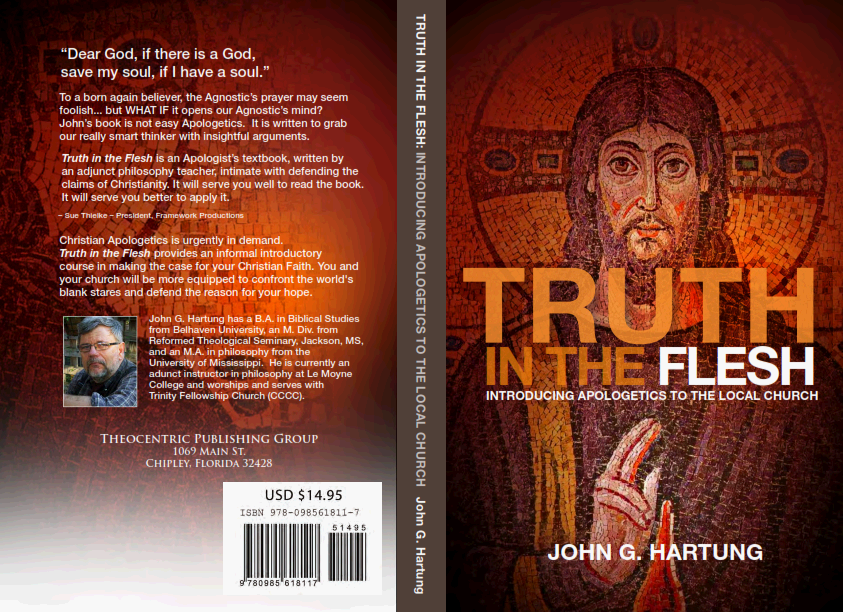 Truth in the Flesh
Hartung begins with an analysis of plausibility structures and “blank stares” (7ff). Throughout the work, Hartung works to make high level ideas accessible at the level where a lay person can come to an understanding, and the notion of a “blank stare” is just one example of how he does this. He notes that Christian claims are often met with a “blank stare.” Such incredulity is often based on one’s own presumption of “prestige” and “social gate-keeping.” To break through this kind of barrier, Hartung suggests pressing on by questioning the listener on why they seem incredulous, which will open the path to discussing plausibility. He notes that one must keep in mind the notion that worldviews are at odds here, not just opposing views on individual topics.
Hartung’s discussion of the problem of evil is multi-leveled and interesting. He addresses the notion of evil as a privation, something that is a lack of something rather than a thing-in-itself. Hartung then analyzes how evil could possibly be viewed as a challenge to the existence of God. He offers Christ as a solution to suffering. God who suffers with us cures our suffering.
Hartung then turns to two purported challenges to Christianity: science and faith and religious pluralism. Regarding the former, Hartung addresses a number of issues, including supposed incompatibility of faith and science, the “god of the gaps” objection, the possibility of making an inference to God, and more. Regarding the latter, he considers the possibility of testing truth claims of religion, relativism, religious experience, and a few other topics. Ultimately, he concludes that neither of these supposed challenges undermines Christian faith.
Hartung’s case for the Christian faith is built upon a cumulative case version of argument. He builds bottom up from God to Christ to Christian theism. One of the several highlights from the second part of Truth in the Flesh is the discussion of philosophical modernity. He traces modern thought from Plato on down through Locke and Hume and touches the important points of the development of their ideas. He continues to interact with these and other thinkers throughout the work.
Hartung’s arguments for the existence of God are concise and will give lay readers an introduction to a number of prominent philosophical arguments. He also offers a chapter in which he breaks apart the naturalistic worldview, arguing that it cannot account for meaning. Finally, the arguments for Christian theism specifically are added to the mix and the possibility of miracles, reliability of the New Testament, and the Incarnation are all defended.
Truth in the Flesh is an extraodinary work in a number of ways. Its breadth is impressive. Hartung manages to discuss extremely complex issues in such a way that those looking to learn about apologetics can understand, while those who have read thoroughly on the topic will get new insight and a great review. In particular, Hartung’s focus on some of the thinkers of modernity helps to make the work stand apart from the pack. I recommend Truth in the Flesh primarily as an introductory text for apologetics, but also as a great reference for those who are experienced in the field.
Source
John Hartung, Truth in the Flesh
Disclosure: I received a copy of the book for review from the publisher. I was not asked to endorse it, nor was I in any way influenced in my opinion by the publisher. My thanks to the publisher for the book.
SDG.
——
The preceding post is the property of J.W. Wartick (apart from citations, which are the property of their respective owners, and works of art as credited) and should not be reproduced in part or in whole without the expressed consent of the author. All content on this site is the property of J.W. Wartick and is made available for individual and personal usage. If you cite from these documents, whether for personal or professional purposes, please give appropriate citation with both the name of the author (J.W. Wartick) and a link to the original URL. If you’d like to repost a post, you may do so, provided you show less than half of the original post on your own site and link to the original post for the rest. You must also appropriately cite the post as noted above. This blog is protected by Creative Commons licensing. By viewing any part of this site, you are agreeing to this usage policy.
The Prayer of Judith: A Devotion from the Apocrypha
 The Apocrypha is a wealth of devotional reading that remains largely untouched by Protestants. No longer, I say! Martin Luther said of the Book of Judith (in the Apocrypha): “[T]his is a fine, good, holy, useful book, well worth reading by us Christians. For the words spoken by the persons in it should be understood as though they were uttered in the Holy Spirit by a spiritual, holy poet or prophet who, in presenting such persons in his play, preaches to us through them” (cited in The Apocrypha: The Lutheran Edition With Notes, 5-6). It should be noted that Luther is not suggesting that the Apocrypha is on par with the sacred canon. Instead, his view of the office of the ministry is that those ministering are speaking through the spirit. He and others view the book of Judith as a piece of historical fiction, made clear to its readers that it was fictional by its commingling of names from different cultural backgrounds and its generally ahistorical nature. Although it is fiction, that does not undermine the possibility of spiritual truths.
Here, we’ll explore the Prayer of Judith in Judith 9:1ff and see how it points to God as transcendent Lord of all creation.
[Y]ou have designed the things that are now and those that are to come. Yea, the things you intended came to pass, and the things you decided presented themselves and said, ‘Lo, we are here’; for all your ways are prepared in advance, and your judgment is with foreknowledge. (Judith 9:5ff, ESV translation of the Apocrypha)
Judith here acknowledges that all which God plans comes to be. Note that here, Judith does not affirm that God specifically intends for each and every thing that occurs. Rather, this passage reveals that God is in control over all things, accomplishing His plan in such a way that the things He intends will come to pass. Yet the author does not imply that God intends for all things which do happen. Judith does not pray thanking God for causing evil–such would be wildly inappropriate. Instead, Judith focuses upon God’s comprehensive plan which takes into account all things. God has “prepared in advance” all His ways. His judgment and execution of plans is “with foreknowledge.” God’s plans are with absolute foreknowledge of what occurs, and we can trust in God to execute rightly.
[T]hey [the Assyrians] trust in shield and spear, in bow and sling, and know not that you are the Lord who crushes wars; the Lord [YHWH] is your name. (9:7b)
One of my favorite lines in the entire book of Judith: “the Lord who crushes wars.” Think about the implications there: it is God who is control of the destinies of nations. Although the weapons of humanity may be raised against each other, the Lord crushes the war itself. We are reminded in Revelation that there will be a day with no more tears (Revelation 21:4). One day, God will crush the very possibility of war.
 Furthermore, it should be noted that in context, Judith is not suggesting that God is against any type of war per se; after all, Judith goes on to behead the leader of the Assyrians and the Israelites pursue the Assyrians from their land. Instead, it is the trust in human invention that is under assault here. The Assyrians put their trust into their own weapons instead of God. Rather, it is God who should be trusted, for it is God who has the power not only to wage war but to destroy war itself.
[C]rush their arrogance by the hand of a woman. (9:10b)
God uses the unexpected for His ends. Women were not the expected leaders; deliverance was more likely to have come from a great general–a man. Yet God uses the weak to bring down the strong.
[C]ause your whole nation and every tribe to know and understand that you are God, the God of all power and might and that there is no other who protects the people of Israel but you alone! (9:14)
Judith continues her prayer, exhorting God to bring His message to all peoples across the whole earth. Such is our own call as Christians. We are to carry out God’s plan in this mortal realm and bring God’s message to the whole earth. Yet we cannot forget that it is God alone who is our unfailing protector. We can trust only in God, not our weapons, not our might: we must trust in God who is far beyond such earthly powers.
Amen.
Source:
The Apocrypha: The Lutheran Edition With Notes
SDG.
——
The preceding post is the property of J.W. Wartick (apart from citations, which are the property of their respective owners, and works of art as credited) and should not be reproduced in part or in whole without the expressed consent of the author. All content on this site is the property of J.W. Wartick and is made available for individual and personal usage. If you cite from these documents, whether for personal or professional purposes, please give appropriate citation with both the name of the author (J.W. Wartick) and a link to the original URL. If you’d like to repost a post, you may do so, provided you show less than half of the original post on your own site and link to the original post for the rest. You must also appropriately cite the post as noted above. This blog is protected by Creative Commons licensing. By viewing any part of this site, you are agreeing to this usage policy.
Really Recommended Posts: 11/09/2012
 I have featured literary apologetics, apologetics to Muslims and Jehovah’s Witnesses, geocreationism, and more. Check out the posts. Let me know what you liked. Come back for more.
Elves, Orcs, and Freaks: The Shared Authorial Vision of JRR Tolkien and Flannery O’Connor– Garret Johnson has written a very interesting look into the works of Tolkien and O’Connor. He notes that they viewed fiction as reality from a different outlook. It’s a fascinating post, and there is a second part, which can be viewed here.
An Encounter with a Jehovah’s Witness– It is easy for Christians to slam their doors on those who come door-to-door. What if, instead, we engaged them? This post is a model for engagement and provides some ways forward to engage with Jehovah’s Witnesses.
The Day After: My Thoughts on the Presidential Election– Michael Licona, author of The Resurrection of Jesus: A New Historiographical Approach
Human Footprints in Dinosaur Footprints– Over at GeoCreationism (a highly recommended site), Mike addresses the notion that human and dinosaur footprints have been found together or side by side. Some argue that this supports young earth creationism. Mike explores the paleontological evidence.
Meet the Multiverse– Edgar Andrews, author of what I think is the best introduction to Christian apologetics with a scientific emphasis, Who Made God?
Did Jesus Claim to be Divine? (Answering Islam)– I found this look at answering Muslim objections to the deity of Christ refreshing. It offers an essentially presuppositional approach, which I have found to be very useful when engaging with Muslims. Check it out.

 J.W. Wartick - Reconstructing Faith
