christian
“The Hunger Games” movie reviewed and discussed by a Christian
 I have already written about the Hunger Games trilogy and offered some uniquely Christian insights into the Hunger Games movie, but here I wanted to give a brief review of The Hunger Games
Rather than giving an overview of the plot (any interested reader can get such an overview here), I’m going to dive right into a review.
Review
The movie is definitely not for children. There is a great deal of violence in the film as well as a number of scary images. Anyone who looks at my previous posts on the Hunger Games and sees the comments will realize there is a great deal of controversy over whether it is appropriate viewing for the Christian. I will comment on that shortly.
I enjoyed the movie a great deal. The moral conflict is pervasive throughout the film is so dense and immediate that it almost presses on one as a viewer. On the other hand, the conflict is not blatantly obvious, nor does the film clearly portray who is in the right or wrong. Everyone has dirty hands. It’s a movie that seems to reflect life in its parallels with the real world. Obviously, these parallels are blown out of proportion in some ways (for example, we do not sacrifice children in a battle to the death for our pleasure), but on reflection one can easily find disturbing ties into our own society (child trafficking, child pornography, and the like–these can easily be seen as parallels to the Hunger Games).
The action in the film is great but I have to admit the occasional use of camera waggle to try to make the action intense is unneeded and distracting. I think this is a modern convention among filmmakers that has far outlived its welcome. For a few movies it seems to work, but now it seems every film uses camera waggle for every explosion, every punch, every fall to the ground. It can be really, really distracting.
Back to the controversy: a number of Christians have spoken out against viewing this film. For example, some who commented on my previous posts argue that we should not view it because it shows violence (or even glorifies it) and that such things are not good for the Christian to view. But the Bible itself depicts all kinds of horrifically violent scenes. Surely these same Christians would not object to reading the Bible! The question to ask ourselves is this: what is the point of the violence? Is there a purpose in the portrayal of the horrors on screen? It seems to me, as far as the Hunger Games is concerned, there is indeed a purpose. I’ve written in extended detail on this in my post on the trilogy, but I’d like to point it out here one more time: the impact of this film and its story is not so much that it is an action flick that gets your blood going; the impact is rather that we are so close to being the Capitol in so many ways. The film practically screams that we must stop this unnecessary violence. We must work against injustice in our world. And those who are affected most by the conflicts, greed, and malevolence in our world are children. Having that portrayed on screen is a powerful call to Christians to fight for justice.
Talking Points for Christians
Why is what’s happening in the Hunger Games wrong?
Think about this question for a moment. If you think that there is something inherently wrong about what the Capitol is doing to the people of the Districts in the movie, then there must be some kind of basis for your moral reasoning. But, as I’ve argued extensively (for example, in my post on secular humanism), on an atheistic worldview there really is no ultimate moral code. How then, do we consistently condemn violence like this, even if it is someone else’s belief that such things are good or necessary?
Is there anything wrong with the lives of those in the Capitol?
As Christians, we can use this as a talking point. The people of the Capitol seem to be doing pretty well for themselves. They have others to do their every bidding and they can effectively enjoy life to its fullest. Yet it is interesting to note that there are a few characters who seem to be unfulfilled. President Snow is an obvious example–he is a despot who must maintain his power. Why is it that these people are unsatisfied? Do we need more than limitless pleasure and leisure to have a satisfactory life?
What is unjust in our world and how are we working to stop it?
Let us be frank. There are things in our own “backyard” that are reflected in the hunger games. Any time a child is abused, we can see that injustice portrayed and subtly condemned in this movie. What are we going to do to stop injustices like these? Is the Capitol really so different from our everyday lives?
Conclusion
Overall I think The Hunger Games is a movie that Christians can watch in good conscience. In fact, I think there are any number of talking points that Christians can bring to the movie and discuss with those who are talking about it. Some of these talking points were illustrated above. The movie is a call to fight injustice, and yes, it is a good action flick while it makes this point. I recommend it.
SDG.
Links
Deeper Hungers and Darker Games– The Hunger Games reflects a world without God. What does it mean?
The Hunger Games: The Atheist’s Utopia– No God: Utopia?
Christian Reflection on the Hunger Games Trilogy– My thoughts on the entire book trilogy.
——
The preceding post is the property of J.W. Wartick (apart from citations, which are the property of their respective owners, and works of art as credited) and should not be reproduced in part or in whole without the expressed consent of the author. All content on this site is the property of J.W. Wartick and is made available for individual and personal usage. If you cite from these documents, whether for personal or professional purposes, please give appropriate citation with both the name of the author (J.W. Wartick) and a link to the original URL. If you’d like to repost a post, you may do so, provided you show less than half of the original post on your own site and link to the original post for the rest. You must also appropriately cite the post as noted above. This blog is protected by Creative Commons licensing. By viewing any part of this site, you are agreeing to this usage policy.
Christianity, Hope, and Art- An Interview with Lisa Guinther
 Recently, I had the opportunity to talk to Lisa Guinther. Lisa is a late-in-life college student who has been accepted as a philosophy major (undergraduate) at CU Boulder (2014 expected graduation) She had been a student at Colorado Christian (College of Adult Studies) since 2009 with an undergraduate Certificate in Biblical Studies.
She is the owner/designer of Woman of Wisdom Creations and is an illustrator who was published in a national Christian magazine, and is illustrating a children’s book scheduled to be in book stores summer 2013.
J.W.: Describe for me your journey as an artist.
Lisa: I started being involved in art in high school. I was a freshman in an art department and surrounded by art majors. I was surrounded by people starting to experiment in art. I learned from some sessions and took some classes. So I’ve always fiddled around with art, a lot of classes in oil painting, water colors, and acrylics. It never really was encouraged, but I never let it go.
I never considered how my art could affect my Christian walk until recently.
I was apostate for almost 12 years. Within a year or two of my “coming back”, so to speak, I went to the Denver Museum of Art. They had a featured handwritten Bibles and they just caught my attention and wouldn’t let me turn away. They were pre-Gutenberg press, handwritten Bibles, and the care that it took to write out and draw out the words and frame each passage clicked with me. I began thinking what if I could make the Bible art? That was when I started Illuminated Texts [Lisa’s Blog].
I was making presents… eventually I was done with that and decided to express Bible verses in a painting.
J.W.: How has your Christian worldview influenced your art?
Lisa: Something I noticed with art in the Christian tradition: I find when I visit the Lutheran churches that they still have a tradition of promoting art. But in a lot of other evangelical-type churches, there is little promotion of art. There’s not a lot of art. It’s gotten really short shrift.
An artist friend who used to be involved in the Abstract-Expressionism movement explained to me that the whole ideology of abstract impressionism is actually idol making. About the time of impressionism, which started with Monet, at that point people thought art was dead. Paintings were seen as a framed window. But with the camera, artists had to see art in a different way. They began to put themselves onto canvas and put themselves on the wall. Artists kept trying to outdo each other—this is a truncated explanation—but it became creating idols. It became the artist’s impression of nature, and then it became the artist emotional expression.
If you’re creating art that’s just that—the inner expression of a moment—then you can put anything on a canvas. Now is that really art? I don’t know! What is the nature of art? Nicholas Wolterstorff gave a lecture on this topic—is art an intrinsic good or an instrumental good? It may be both, I don’t know.
Is there a part of this that we could get possibly back to a definition of art as representing God’s creation and the beauty within that creation that’s there because beauty is a part of God’s nature? …[T]here is just so much gratuitous beauty in the created world. I think that’s one way to do natural theology, a way to point to God. Is there a way to get back to a representation of beauty in art that would point us back to God?
We can be authentically Christian and authentically artists. You have to engage… [some kinds of] art to begin to see its beauty. The Bible is kind of like that. You can surface read it and you learn things and this is good, but you don’t really get the deep level of beauty in Scripture until you really dig in and study it.
At times when I’m painting or drawing, it’s almost as though I’m praying. There is a mystical aspect—I feel like there are times when I’m thinking about prayers or meditating on Scripture or just thinking about God as I’m painting or drawing and I know these are God’s gifts that He gives me, but I feel like in some tangible way I’m showing what I feel. It’s a tangible way to express other than in writing—it’s the way abstract impressionism should be.
I think we need a better working definition of art. A paperclip… might be under the definition of instrumental art, but we need to bring back representational art but we can also see abstract art that can draw us into a deeper understanding just like the way we read Scripture.
J.W.: What are some ways for the Church to promote art and artists?
Lisa: Look at the history of art in the church. You needed people for stained glass, for alter decorations, and there was a whole system in place that would support artists. But we haven’t been doing that since the Reformation.
People don’t understand what a painting costs. A 30×40 canvas is 100$, along with the palette of colors, and the other costs—tubes of paint as 4-12$—and I have a full palette of colors. It’s expensive.
J.W.: How could the church support artists more effectively, in light of that?
Lisa: In a larger church, there could be an art show. Some churches do this every quarter or even every month. You generally find that within every church there are artists. They’re there. You just need to put up a sign up sheet and people will come out of the wordworks. Remind parents that if you really want to stimulate imagination—the same skills you need in math are important in art and music—to promote kids to do artwork is to promote their reading skills, creativity, and math skills.
We want creative expression in how we worship. Worship is creativity and if you’re worshiping you generally have some spark in you of artistic talent. If we could encourage art as a form of worship, we can’t lose that.
I’d like to share a quote from Hans Urs von Balthasar [The Glory of the Lord: A theological aesthetics 1967 as “Herrichkeit: Eine theologische Asthetic, I: Schau der Gestalt” Ignatius Press, San Francisco Translated to English in 1982]:
Beauty is the last thing which the thinking intellect dares to approach, since only it dances as an uncontained splendor around the double constellation of the true and the good and their inseparable relation to one another. Beauty is the disinterested one, without which the ancient world refused to understand itself, a word which the ancient world refused to understand itself, a word which both imperceptibly and yet unmistakably has bid farewell to our new world, a world of interests, leaving it to its own avarice and sadness. Now longer loved or fostered by religion, beauty is lifted from its face as a mask, and its absence exposes features on that face with threaten to become incomprehensible to man. We no longer dare to believe in beauty and we make of it a mere appearance in order the more easily to dispose of it. Our situation today shows that beauty demands for itself at least as much courage and decision as do truth and goodness, and she will not allow herself to be separated and banned from her two sisters without taking them along with herself in an act of mysterious vengeance. We can be sure that whoever sneers at her name as if she were the ornament of a bourgeois past—whether he admits it or not—can no longer pray and soon will no longer be able to love. (p. 18)
Within Roman Catholicism there always was a theology of beauty as an attribute of God.
J.W.: What can you tell us about the “Bold Girls of the Bible” and your illustrations?

(c) Lisa Guinther 2012
Lisa: One of the points I’d like to make is that I’ve tried to keep the illustrations as real as possible. I think it is important that we not present Biblical stories in some kind of airbrushed, phony way. I’ve always been a history buff. I’d like to present these characters in a way that people see them as real—the kids can see them as real. I don’t think that beautiful pristine white robes is historically accurate.
Can I present characters that illustrate the stories in as real way as possible so that kids can relate? Can I make it real for the kids reading it so they can relate to the people? When I was growing up I saw the Bible as something not really real. Can I, in artwork, make it real for us? And that’s what my friend Mary [the author of Bold Girls of the Bible] tries to do in her writing.
Can we make the characters in the Bible real enough that little girls can relate to them? Everyone knows about David and Goliath, but I never had a Bible hero.
J.W.: How are you composing the art?
Lisa: I pose kids, take a photograph, print out the picture, and do an outline sketch. Then I put the backers on it, drape the clothing, create the character, and create the image from the sketch.
J.W.: Do you have a Bible hero now?
Lisa: Hands down, St. Paul. I often try though, if I had to pick a character that I could write a story around or draw a picture of, I wonder a lot about Deborah and what she had to go through.
J.W.: You mentioned natural theology, how would you look to integrate your art with apologetics?
Lisa: We all have a sense of beauty in art and in nature and in music even though it may be amorphous. Everyone has a universal sense called “beauty” and the only way there can be a [Platonic] universal is if there is a creator. It’s why we have the idea of good, beauty, truth.
I agree with the idea that we know good because God is the exemplar of that. We know beauty because it is a part of God’s very nature. I think we know beauty and we can see it in the world around us because we are created in the image of God. We also want to, in our own way, create. That creative spark within us is really a part of the image of God in man.
——————-
My thanks to Lisa for this wonderful interview. I think we both had a lot of fun talking about God, apologetics, and art.
You can view some of Lisa’s art at Illuminated Text…. by Lisa.
Lisa has her own apologetics site, Insights from the Furnace, which integrates the arts with apologetics.
SDG.
——
The preceding post is the property of J.W. Wartick (apart from citations, which are the property of their respective owners, and works of art as credited) and should not be reproduced in part or in whole without the expressed consent of the author. All content on this site is the property of J.W. Wartick and is made available for individual and personal usage. If you cite from these documents, whether for personal or professional purposes, please give appropriate citation with both the name of the author (J.W. Wartick) and a link to the original URL. If you’d like to repost a post, you may do so, provided you show less than half of the original post on your own site and link to the original post for the rest. You must also appropriately cite the post as noted above. This blog is protected by Creative Commons licensing. By viewing any part of this site, you are agreeing to this usage policy.
The Consolation of Counterfactuals: The Molinism of Boethius
Whence comes this powerful understanding
That all things sees and all discerns?
…This is a cause more powerful
More forceful and effectual
Than that which passively awaits… (Boethius, The Consolation of Philosophy, Book V, section IV)
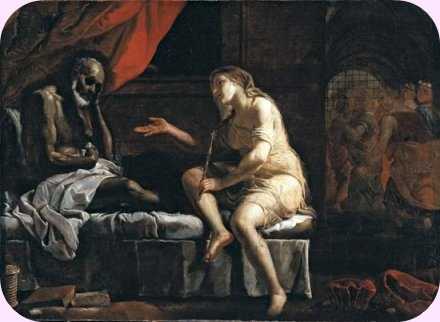
Molinism is holds that God has counterfactual knowledge of every situation. What this boils down to is that God knows conditional statements for every possible situation, such that God knows statements like “If J.W. has free time, then he will read.”
One prominent challenge to molinism is the notion that such counterfactuals about future choices cannot exist or that God simply couldn’t know them. I was startled as I read Boethius’ (480-525 AD) work, The Consolation of Philosophy, to see that he had anticipated this objection and provided the outline of an answer to it about 1500 years ago.
Boethius wrote the work as a dialog between himself and Philosophy, a woman who represented, well, philosophy. The last book focuses upon God’s foreknowledge and human freedom.
Writing as philosophy, Boethius states
All those things which happen without happening of necessity are, before they happen, future events about to happen, but not about to happen of necessity… But this, you will say, is the very point in question–whether there can be any foreknowledge of things whose occurrence is not inevitable. (Book V, section IV)
Again, it was amazing to see that Boethius had anticipated an objection to molinism–a system of theological thought which hadn’t been conceived fully yet (and wouldn’t be for about 1100 years!)–and provided an answer. The objection was seen above: many modern philosophers and theologians contend that God could not know that which is not necessitated to happen.
Yet Boethius answers the problem in a unique way:
The cause of this mistake [believing that God couldn’t know things that will not happen by necessity] is that people think that the totality of their knowledge depends on the nature and capacity to be known of the objects of knowledge. But this is all wrong. Everything that is known is comprehended not according to its own nature, but according to the ability to know of those who do the knowing. (Book V, section IV)
Before developing this argument, it is important to note that it rests squarely within Boethius’ later reflection upon the eternity of God–a being who has “the complete, simultaneous, and perfect possession of everlasting life” (Book V, section VI). Because Boethius holds that God is eternal in this sense–timeless–he can reasonably hold that God’s capacity to know is not limited by temporal constrictions.
Thus, we get back to the nature of his response to the counterfactual objection to molinism. Boethius, holding that God is eternal and therefore not limited by time, grounds the knowledge of counterfactuals not in their own inherent ability to be known or not known, but rather in the ability of the knower to know them.
It is worth emphasizing how radical and powerful this response is to the modern argument against molinism. If God is indeed timeless in the sense Boethius presses, then God would have access to the entirety of time as far as knowledge and action are concerned. Thus, by grounding knowledge not in the objects of knowledge themselves but in the capacity of the knower, Boethius grounded counterfactual knowledge.
Objection
Now, modern opponents of molinism would take this in stride and argue either against the contention that God is timeless or against the contention that knowledge is based in the capacity of the knower rather than the known. Exploring either of these objections is beyond the scope of this post, but it is worth noting that Boethius’ rebuttal to the problem of counterfactual knowledge works if both of his contentions are true. The question is, of course, whether they are.
A Final Objection and Response
Another way to attack Boethius’ defense of God’s knowledge of counterfactuals is to argue that even if it is the case that God is eternal and that His knowledge is grounded in the knower rather than the known, then it still would only mean that God knows what will happen, not what would happen if something were to happen. In other words, one could hold that Boethius’ answer doesn’t actually apply to counterfactual knowledge.
It seems possible, however, to modify Boethius’ defense to counter this argument as well. One could note that because God is eternal, any event that would happen, God would know about it. In other words, if x were z instead, then God’s knowledge would simply be z instead of x. This response turns the counterfactual into a counterfactual about God’s knowledge rather than about freedom. The response offered turns the question from whether God could know that “If x, then y” about John Smith into a question of “If z instead of x, then God knows z.”
Conclusion
It seems clear to me that there is much to develop yet in the objections and responses offered above. The last critique offered and my response certainly opens a number of areas of inquiry. However, for now it seems clear that Boethius has offered a unique way to look at the problem of counterfactual knowledge. Whether his perspective is correct remains a matter for further inquiry.
Boethius offered a unique and stirring defense of molinism over a thousand years before it was fully articulated by Luis de Molina. It is worth looking into his answer, even if it fails, simply for the foresight it provided. But Boethius’ work is known as an astounding discussion of divine eternity as well, among other things. Thus, I encourage readers to look into his short work, The Consolation of Philosophy. Who knows, you may even find the consolation of counterfactuals therein.
Edition Used: For this post I used the Penguin Classics edition of The Consolation of Philosophy (New York: Penguin, 1999).
SDG.
——
The preceding post is the property of J.W. Wartick (apart from citations, which are the property of their respective owners) and should not be reproduced in part or in whole without the expressed consent of the author. All content on this site is the property of J.W. Wartick and is made available for individual and personal usage. If you cite from these documents, whether for personal or professional purposes, please give appropriate citation with both the name of the author (J.W. Wartick) and a link to the original URL. If you’d like to repost a post, you may do so, provided you show less than half of the original post on your own site and link to the original post for the rest. You must also appropriately cite the post as noted above. This blog is protected by Creative Commons licensing. By viewing any part of this site, you are agreeing to this usage policy.
Really Recommended Posts 8/3/12
 Wow, there are some really excellent posts out there. I am constantly blessed by reading or viewing great material from others. This week, the topics covered are all over the board: abortion, Leviticus, 50 Shades of Grey, apologetics methodology, and more! Check out these really recommended posts.
Grey Areas: How explicit literature went mainstream– You’ve heard of 50 Shades of Grey. What’s all the fuss about? And what kind of junk are we putting on the bookshelves?
The Mistake of Leviticus– Leviticus is one of those books in the Bible many balk at reading. Check out the insight provided here by Credo House. I really, really recommend this post.
Some Standard Definitions From the Doublespeak Dictionary– Bigot, Christian, and Intolerant tie together so well! Check out this great apologetic cartoon.
The Bibliographical Test Updated– Clay Jones, a professor over at Biola University, offers an update to the number of ancient manuscripts available for the various “bibliographic tests” for the accuracy of the New Testament. A brief, readable, and important post.
Is Abortion Really Wrong?– A great introduction to the debate over abortion.
Why I don’t reply to everyone (and neither should you)– It’s easy to get caught up in online debates or try to respond to everyone who comments on a blog or forum. Glenn Andrew Peoples offers an excellent post on why he doesn’t respond to everyone. He also gives some good guidelines for deciding whether you’re going to respond to someone.
The Atheist War Against Logic and Philosophy– I’m not sure this video is fairly named, because it seems like it is more the extreme views on philosophy of a number of people dismissed by the vast majority of others. Good watch if you want to pull your hair out at people rejecting logic while using it.
Apologetic Taxonomy: Methodological Approaches– Readers of my blog know I’ve been exploring a few other apologetic approaches. Here’s an excellent post which outlines the various methodological approaches to apologetics in a brief, readable format.
Book Review: “The Closing of the Muslim Mind” by Robert Reilly
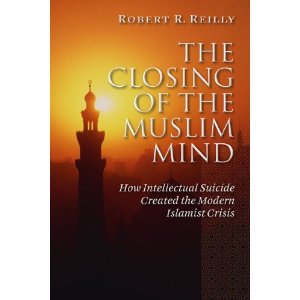 One can tell from the outset that Robert Reilly’s The Closing of the Muslim Mind
The central point of the book is “the story of how Islam grappled with the role of reason after its conquests exposed it to Hellenic thought and how the side of reason ultimately lost in the ensuing, deadly struggle” (1). Reilly contrasts this with how the West dealt with some of the same issues: “The radical voluntaraism (God as pure will) and occasionalism (no cause and effect in the natural order) found in them [Muslim theologians in the 9th-12th centuries] were not seen to any significant extent in the West until… David Hume began writing in the eighteenth century. By that time the recognition of reality had become firmly enough established to withstand the assault… Unfortunately, this was not true in Sunni Islam, where these views arrived much earlier” (7).
Reilly maps out the history of the development of Muslim thought. Initially, once Islam came into contact with western philosophy, there was a great amount of interplay (11ff). One early struggle was between man’s free will and fate. This struggle was over the meaning of key verses in the Qur’an as well as a debate over whether the Qur’an is temporal or eternal and uncreated. The notion that the Qur’an is eternal and uncreated, in turn, restricted rationality from evaluating the meaning therein (19).
The development of Muslim reflection on the Qur’an and Allah’s will led to the replacement of reason with rationality (45-46). Similarly, because the Qur’an was Allah’s will, and it did not explicitly endorse kalam (a branch of Muslim philosophy and theology), this rational discourse was to be abandoned (47). Furthermore, this entailed the destruction of the notion of the “autonomy of reason.” Only within the structures of revelation could reason operate effectively (48).
Furthermore, creation itself has no inherent reason. Each moment is merely a “second-to-second manifestation of God’s will” (51). While one may be tempted to say Christianity is exactly like this (and some branches may indeed hold to this teaching), there is an important distinction between the two views, for on the Christian view of God, God’s action is driven by His nature, and so He will operate within His promises as well as within the boundaries He has set for himself. God, on most Christian views, is inherently rational and so will operate in rational ways. So while creation indeed subsists moment-by-moment because of the will of God, God does not arbitrarily change His will (56ff). On the Muslim view, Reilly argues, God’s will is absolute (as opposed to His nature) and so there is absolute voluntarism. At any time, Allah could will that which before Allah did not will (51-53). Furthermore, one cannot say one “knows” God because God is pure will. As pure will, there is no reason for any particular action, and so God is inherently unknowable (54ff).
Another consequence of viewing God as pure will is that good and evil are essentially vacuous terms. “If Allah is pure will, good and evil are only conventions of Allah’s–some things are halal (permitted/lawful) and others are haram (forbidden/unlawful), simply because He says so and for no reasons in themselves” (70). Allah is therefore above morality and the problem of evil is made meaningless, for evil is merely that which God forbids. Essentially, the system is voluntaristic theism (71ff).
Reilly argues that these theological positions have had dire consequences for Islam in the political realm as well. These positions undermine the inherent worth of human beings and posit the primacy of power over reason (128); democracy is the answer to a question the Muslim world has not asked (130), for if God is pure will, then His regents on earth are operating merely under his whims, and can be just as arbitrary in their decisions (131); “Man’s only responsibility is to obey” (131); finally, “there is no ontological foundation for equal human rights in Islam, which formally divides men and women, believer and unbeliever, freeman and slave” (133).
The consequences reach farther, however, and touch the sciences as well. For if Allah’s will is that which causes all things, then to say that there are “natural” explanations is to insult Allah. Instead of saying that hydrogen and oxygen yield water, people are instructed to say “when you bring hydrogen and oxygen together… by the will of Allah water was created…” (142). Of course, the denial of secondary causation touches upon more pragmatic areas of life as well. After all, if Allah wants something to happen, then it will; if not, then it won’t.
Reilly presents a number of contemporary sources demonstrating how these aspects have been radically undermined in the Muslim world, where often anything can pass as a news story and anything can be stated as true (147ff). Furthermore, the Muslim world trends towards underdevelopment and illiteracy. Reilly maintains that some of this is due to the consequences of the theological views outlined above.
Historically, the dilemma within Islam over reason vs. voluntarism came to a head when the Muslim conquests began to be turned back. When defeats happened, Muslims had to ask why it was that they were losing when, presumably, Allah desired them to win (165ff). Some viewed it as a consequence of the stagnation of science and intellectual development in the Muslim world. Others, however, viewed it as a need to go back to the roots of Islam and become even more radical. The world, therefore, according to Reilly, is faced with a crisis: can reason be re-introduced into the Muslim theology and trickle down into every aspect of life, thus freeing the Muslim world from the shackles of voluntarism? Or, will Islam continue down its path and overemphasize the radical occasionalism of nature and God, while undermining reason? Such is the crisis.
It is striking how well Reilly has supported his theses with quotes from the writings of various Muslim theologians and philosophers. Throughout the work, he quotes numerous scholars from both modern and ancient sources. What these quotes reveal is that his points are not found in a vaccuum–rather, the notion that the absolute, determinating, arbitrary will of Allah underlies everything that happens does indeed undermine rationality.
It is interesting here to reflect briefly upon the notion that some of these same themes are found within certain branches of Christianity. Whenever God’s will is placed as the ultimate source of all activity on earth (voluntarism/occasionalism) rather than as a providential will which guides such activity, reason and rationality can be jettisoned just as easily as they were in the development of Muslim thought. Similarly, if Scripture is seen as above any kind of rational inquiry to determine its meaning, one can replace man’s cognitive abilities with blind faith. Reilly’s book can therefore serve as much a warning for Christians engaging in doctrinal reflection as it is a call to Muslims to restore rationality to their faith.
Reilly’s work, The Closing of the Muslim Mind should be seen as required reading for those interested in interfacing with the Muslim faith. Reilly ties together compelling chains of thought which have led to the current Muslim crisis and demonstrates how current thinking is a result of the past. It is a thoroughly researched book and those opposed to his conclusions will be hard-pressed to show the cracks in his theses. I highly recommend this work. Once one gets past the title, which may be seen as inflammatory by some, Reilly presents well-reasoned, compelling, historically grounded argument about how the theology of Islam has led to the destruction of its intellectual capacity.
Robert Reilly, The Closing of the Muslim Mind
SDG.
——
The preceding post is the property of J.W. Wartick (apart from citations, which are the property of their respective owners) and should not be reproduced in part or in whole without the expressed consent of the author. All content on this site is the property of J.W. Wartick and is made available for individual and personal usage. If you cite from these documents, whether for personal or professional purposes, please give appropriate citation with both the name of the author (J.W. Wartick) and a link to the original URL. If you’d like to repost a post, you may do so, provided you show less than half of the original post on your own site and link to the original post for the rest. You must also appropriately cite the post as noted above. This blog is protected by Creative Commons licensing. By viewing any part of this site, you are agreeing to this usage policy.
Debate Review: Greg Bahnsen vs. Gordon Stein
 Advocates of the presuppositional approach to Christian Apologetics have long hailed the debate between Greg Bahnsen (the late Christian theologian and apologist, noted for his achievements in presuppositional apologetics and development of theonomy–a view of the Law for Christians, pictured left) and Gordon Stein (the late secularist noted for his links to Free Inquiry among other things, pictured below, right) as a stirring triumph of presuppositional apologetics over atheism in a point-by-point debate. Recently, I listened to the debate and thought I would share my impressions here.
Debate Outline
Bahnsen Opening Statement
From the outset, it was clear this debate was going to be different from others I’d listened to or watched. Bahnsen outlined what he means by “God,” outlined a few general points about subjectivism, and then quickly dove into a presuppositional type of argument. He began with an attack on the idea that all existential questions can be answered in the same way:
The assumption that all existence claims are questions about matters of fact, the assumption that all of these are answered in the very same way is not only over simplified and misleading, it is simply mistaken. The existence, factuality or reality of different kinds of things is not established or disconfirmed in the same way in every case. [All quotes from the transcript linked below. My thanks to “The Domain for Truth” for linking this.]
Bahnsen then mounts an argument which is perhaps the most important innovation of presuppositional apologetics: the attack on neutrality. He notes that Gordon Stein in his writings puts forth a case for examining evidence in order to determine if God exists. He relies upon the laws of logic and seems to think that this avoids logical fallacies. Yet, Bahnsen argues, Stein has just argued in a circle as well. By presupposing the validity of the laws of logic and other forms of reasoning, he has fallen into the trap he has stated he is trying to avoid. As such, Stein’s outlook is not neutral but it is colored by his presuppositions. Bahnsen notes:
In advance, you see, Dr. Stein is committed to disallowing any theistic interpretation of
nature, history or experience. What he seems to overlook is that this is just as much begging the question on his own part as it is on the part of the theists who appeal to such evidence. He has not at all proven by empirical observation and logic his pre commitment to Naturalism. He has assumed it in advance, accepting and rejecting all further factual claims in terms of that controlling and unproved assumption.Now the theist does the very same thing, don’t get me wrong. When certain empirical
evidences are put forth as likely disproving the existence of God, the theist regiments his
commitments in terms of his presuppositions, as well.
Therefore, what Bahnsen presses is that it is only on the Christian theistic presupposition that things like the laws of logic, the success of empirical sciences, and the like can make sense. He makes the transcendental argument for the existence of God:
we can prove the existence of God from the impossibility of the contrary. The transcendental proof for God’s existence is that without Him it is impossible to prove anything.
Gordon Stein Opening Statement
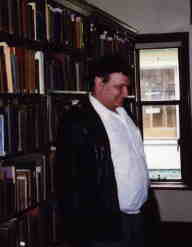 Stein opens by clarifying what he means by “atheist”: “Atheists do not say that they can prove there is no God. Also, an atheist is not someone who denies there is a God. Rather, an atheist says that he has examined the proofs that are offered by the theists, and finds them inadequate.”
Stein then argues that the burden of proof is definitely in the theist’s court. He goes on to address a number of theistic proofs and finds them wanting. In fact, the rest of his opening statement is spent addressing 11 separate arguments for the existence of God, including the major players like the moral, cosmological, and teleological arguments.
Cross Examination 1
In the first cross-examination, Bahnsen asked Stein whether the laws of logic were material or immaterial. Stein finally, quietly, admits that the laws of logic are not material. Yet then Stein turns around and in his own cross examination presses triumphantly a point he thinks will be decisive. He asks Bahnsen, “Is God material or immaterial”; Bahnsen responds, “Immaterial.”; after a brief segway, Stein poses the following question which, by the tone of his voice, he seems to think carries some weight: “Apart from God, can you name me one other thing that is immaterial?” To this question, Bahnsen responds quickly, “The laws of logic.” The crowd erupts. Stein lost that one.
First Rebuttal: Bahnsen
Bahnsen spends most of his rebuttal arguing that the laws of logic are not mere conventions, and that Stein cannot make them such. If Stein does, then, argues Bahnsen, he can’t actually participate in a logical debate, because they could each declare a convention in which they each win the debate.
He goes on to re-stress the transcendental argument and point out that Stein failed to address it. He develops it a bit further by attacking the notion that an atheistic worldview can make sense of logic:
And that’s because in the atheistic world you cannot justify,you cannot account for, laws in general: the laws of thought in particular, laws of nature,cannot account for human life, from the fact that it’s more than electrochemical complexesin depth, and the fact that it’s more than an accident. That is to say, in the atheist conceptionof the world, there’s really no reason to debate; because in the end, as Dr. Stein has said, allthese laws are conventional. All these laws are not really law-like in their nature, they’re just,well, if you’re an atheist and materialist, you’d have to say they’re just something that happensinside the brain.
But you see, what happens inside your brain is not what happens inside my brain.
Stein First Rebuttal
Stein argues that laws of logic are indeed conventions, saying:
The laws of logic are also consensuses based on observations. The fact that they can predict something correctly shows they’re on the right track, they’re corresponding to reality in some way.
Oddly, Stein continues to act as though Bahsnen’s argument was a variety of cosmological argument. He argues that before we can ask “what caused the universe” we must ask whether the universe is actually caused. He then tries to address the argument more explicitly, saying that it is “nonsense” and that various cultures do indeed have different logic. His most direct argument against the trasncendental argument is that “If matter has properties that it behaves than we have order in the universe, and we have a logical, rational universe without God.”
Debate Segment Two
Stein Opening 2
Stein argues that the problem of evil is an evidential argument against the existence of God. He states that it raises the probability that there is no God. He asserts that there is no physical evidence for God. Stein then argues that God has not provided evidence for his existence, but that He should do so. Finally, he turns to the problem of religious diversity, asking why God would allow other religions if there is only one God.
Bahnsen Opening 2
Bahnsen argues that Stein placing the laws of logic into a matter of consensus undermines their usefulness and in fact defeats the purpose of rational inquiry and debate. He argues further that Stein’s definition of laws of logic within pragmatic terms doesn’t come close to the extent of the laws of logic.
Stein Rebuttal
Stein argues that bahnsen hasn’t actually done anything to explain the laws of logic. He argues that simply saying they are the thoughts of God doesn’t mean anything, and that it does nothing to explain them. He therefore argues that Bahnsen fails to provide an adequate explanation for the facts of the universe.
Bahnsen Rebuttal
Bahnsen presses the point that Stein’s entire system is based upon presuppositions which he cannot justify. Induction is undermined in an atheistic worldview because there is no reason to believe that things will continue to happen as they do currently happen. He briefly addresses the problem of evil by saying that within an atheistic universe there simply is no evil, so it makes no sense from Stein’s perspective to press that issue.
Closing Statement: Stein
Stein’s closing statement seems to be more of a rebuttal than anything. He argues that there can be evil defined in an atheistic universe as that which decreases the happiness in people. Yet even this, he says, “We don’t know”–we don’t know that there is evil in an atheistic universe, rather it is a consensus and pragmatically useful.
He argues that we can know about induction because of statistical probability: it is highly improbable that the future will be different from the past because it has been similar in activity to the past for as long as we know.
Closing Statement: Bahnsen
Bahnsen finally presses the transcendental one last time. He argues that while Stein has called it hogwash and useless, he hasn’t actually responded to it. Bahnsen states that once more the atheistic worldview can’t make sense of itself. For example, saying the future will be like the past due to probability begs the question: there is nothing in the atheistic worldview to say that probability can help determine what the future will be like. It might work pragmatically, but it fails to give any explanation. Finally, Bahnsen argues that you cannot be a rational, empirical human being an an atheistic universe.
Analysis of the Debate
It is abundantly clear throughout this debate that the presuppositionalist takes a very different approach to debate and apologetics than those from other methods. One can see this immediately when Gordon Stein delivers his opening statement, which was presumably prepared beforehand, and goes to answer common theistic arguments like the cosmological and teleological argument. But Bahnsen never once used either of these arguments, and took an entirely different approach. I think this initially caught Stein off guard and that impression remained throughout the debate.
Stein’s responses to Bahnsen were extremely inadequate. This became very clear in their debate over induction and empiricism. For example, although Stein held that he could say the future will be like the past based upon probability, he had no way to say that the world was not spontaneously created 5 minutes ago with implanted memories and the notion that the future will be like the past. Bahnsen didn’t make this argument, but it seems like it would line up with his reasoning. Of course, he would grant that the theist has to presuppose that God exists in order to make sense of induction, but that was exactly his point: without God, nothing can be rational.
I found it really interesting that Stein kept insisting that the laws of logic are mere social conventions. He kept pressing that some cultures do not hold that they are true as defined. But of course, cultural disagreement about a concept doesn’t undermine the truth value of a concept. If, for example, there were a culture that insisted that 2+2=5, that wouldn’t somehow mean that 2+2=4 is a logical convention, it would mean the culture who insisted the sum was 5 would be wrong. Similarly, the laws of logic may be disagreed upon by some, but to deny them is to undermine all rationality.
Overall, I have to say I was shocked by how this debate turned out. I have long been investigating presuppositional apologetics and continually wondered how it would work in an applied situation. It seems to me that to insist on a presupposition in order to debate would not work, but Bahnsen masterfully used the transcendental argument to reduce Stein to having to argue that logic is merely a social convention while ironically using logic himself to attack theism.
It seems to me that this debate showed what I have suspected for some time: presuppositional apologetics is extremely powerful, when used correctly. Now I’m not about to become a full-blown presuppositionalist here. My point is that it is another approach Christians can use in their witnessing to those who do not believe. I envision a synthesis of presuppositional apologetics with evidentialism. Some may say this is impossible, that they are anathema to each other, but I do not think so. They can be used in tandem: the presuppositional approach to question the worldview of others, while the evidentialist approach can be used to support the notion that the Christian worldview provides the best explanation for the data we have.
Links
Listen to the debate yourself. Get it here. The transcript I used was also from this page. Thanks to the author for such a great resource.
I’ve been researching and writing about presuppositional apologetics. For other posts about presuppositional apologetics, check out the category.
I highly recommend starting with the introduction to the most important thinker in the area, Cornelius Van Til.
Choosing Hats– A phenomenal site which updates fairly regularly with posts from a presuppositional approach (the author uses the term “covenental apologetics”). The best place to start is with the post series and the “Intro to Covenental Apologetics” posts.
The Domain for Truth– Another great presuppositionalist web site. I highly recommend browsing the topics here.
SDG.
——
The preceding post is the property of J.W. Wartick (apart from citations, which are the property of their respective owners) and should not be reproduced in part or in whole without the expressed consent of the author. All content on this site is the property of J.W. Wartick and is made available for individual and personal usage. If you cite from these documents, whether for personal or professional purposes, please give appropriate citation with both the name of the author (J.W. Wartick) and a link to the original URL. If you’d like to repost a post, you may do so, provided you show less than half of the original post on your own site and link to the original post for the rest. You must also appropriately cite the post as noted above. This blog is protected by Creative Commons licensing. By viewing any part of this site, you are agreeing to this usage policy.
“The Dark Knight Rises”- A Christian Reflection
 The epic tale begun with Batman Begins


Here’s the last warning: THERE ARE SPOILERS HERE. BIG ONES.
I’m going to eschew giving a plot summary because what I want to contribute to the conversation is a discussion on the themes. If you don’t feel like bothering with the movie, it would be good to at least know about the plot before reading this post. Check here for a brief summary.
Faith
Throughout the movie I kept noticing faith as a major theme. There were those who had maintained faith in a lie: Harvey Dent. Batman had taken the fall for him in The Dark Knight in order to provide Gotham with a needed hero. This faith was misplaced, and Jim Gordon, the police commissioner of Gotham City, almost destroyed himself keeping it inside himself. He said, at one point, “I knew Harvey Dent. I was his friend. And it will be a very long time before someone… Inspires us the way he did. I believed in Harvey Dent.” Yet the whole time Gordon knew he was speaking a lie. He believed in Dent, but he no longer believes in him.
Batman placed his faith in Catwoman/Selina Kyle. He firmly believed that there was more to her than the anger she continually expressed. This interplay was made more interesting by the interaction between Batman’s and Catwoman’s alter egos, Bruce Wayne and Selina Kyle. Selina Kyle, who seemed generally upset with all the rich and famous in Gotham and the decadence found therein–told the rich billionaire Bruce Wayne, “You think this can last? There’s a storm coming, Mr. Wayne. You and your friends better batten down the hatches, because when it hits, you’re all gonna wonder how you ever thought you could live so large and leave so little for the rest of us.” More on the interaction between the two later.
Alfred put his trust in Bruce Wayne. He strongly wanted Wayne to have a satisfying, fulfilling life, and throughout the film he worried that Batman would destroy Wayne. When push came to shove, Alfred was willing to leave Wayne in order to try to save him. Again, more on this later.
Finally, there were those who had faith in Batman. Batman, to them, was more than just a hero, he was a symbol of hope and justice.
One thing viewers should note is that the use of “faith” in The Dark Knight Rises is not some kind of hack definition. It doesn’t mean “belief in the face of insurmountable evidence to the contrary” or “belief in something you know ain’t true.” Instead, faith in the movie is faith in–a trusting faith based on evidence. Those who believed in Harvey Dent were mistaken, but that wasn’t due to evidence, it was active deception. Batman’s faith in Selina Kyle was firmly based on his ability to read her character. Others’ faith in Batman was based upon either a personal knowledge of the secret (Gordon) or knowledge of his actions as Batman (John Blake, others). It is very similar to the faith of the Christian, which is based upon knowledge.
 Rise
Rise
The most obvious theme in the movie was that of “arising.” Bruce Wayne had to overcome his doubts, fears, and become something greater. Yet he had to rely on others to build this journey. The knowledge of his fellow prisoners in ‘the pit’–a prison into which people were thrown, but could climb out. Only one had ever managed it, however, and that was Ra’s Al Ghul’s daughter, who had subsequently saved Bane. Ironically, then, the rise of his enemies forced the Dark Knight to meet their challenge. He had to transcend his limits and become that which Gotham needed in order to save it.
Yet Batman/Wayne wasn’t the only one who rose in the movie. Selina Kyle also experienced a major transition. As a character, she was initially powerfully motivated by anger and a desire to escape. She was portrayed as being very frustrated and angry with the social imbalance of the world and determined to not only try to balance it–in her favor, of course–but also to punish those who made it so imbalanced. When Batman returns to Gotham after his exile by Bane, he confronts Selina. He points out that the storm she predicted earlier has hit, and it doesn’t seem like it was what she wanted. Still, however, she seems determined to be in it all for herself. Yet ultimately she comes back to fight with the Dark Knight against the evil powers that are trying to destroy Gotham. In the end, she does manage to rise, with the guidance and help of Bruce Wayne/Batman.
John Blake–the incorruptible cop–also rose. It is revealed shortly before the film’s end that he is Robin–and that he is about to take up the cowl of Batman, to become the symbol for Gotham. Here, I sensed a feeling of fulfillment. We encourage others to walk in our shoes and left them up when they are down. Without Batman, Blake would not have survived. Yet he goes on to [presumably] become the next Batman, to save others.
Corruption
The world is not all sunshine and daisies. The world is full of corruption and sin. Interestingly, The Dark Knight Rises has much less corruption on the part of the police force than the previous movies. The turn was a noticeable, perceptible shift. As far as the plot goes, I wonder if any of that was due to the “Dent Act” which effectively ended organized crime in Gotham. Despite the relative “cleanness” of the police force, however, there was plenty of corruption to go around. Once Bane overthrows the city, there are “people’s courts” where “justice” is dole out on those already deemed guilty. The prisons are ripped open due to the lie [Harvey Dent] that many were imprisoned by. One wonders, how much of this is justice? Is any of what Bane says true?
Furthermore, it is a powerful reminder of the human condition. Given the chance to rule themselves, Gotham erupted into violence and brutality. It is little wonder that this should happen, given a Christian worldview, because all are sinful and need grace. All deserve justice.
Justice and Freedom
Is there justice? Was Batman just in continuing his adventures as the Caped Crusader? Is violence ever a justifiable means to an end?
Within Christianity there is a long history–traceable to Augustine, at least–of the concept of a “Just War.” There will be much debate over whether the actions of someone like Batman could be justified. Is it ever permissible to take justice into one’s own hands? I leave the question open.
Yet more important questions loom. What is justice? Who is to determine it?
One wonders what worldview could plug these holes that continue to open as human nature is probed by director Christopher Nolan throughout the Batman Trilogy. From the irrational desire to cause fear and anarchy of Scarecrow to the anarchist nihilism of the Joker to the over-reactive retribution of Bane, Nolan has exposed viewers to the depths of human freedom. What price, freedom? Bane tells Gotham he has set them free, yet he has truly imprisoned them by their own nature. What occurs is a vivid portrayal of human nature and destruction.
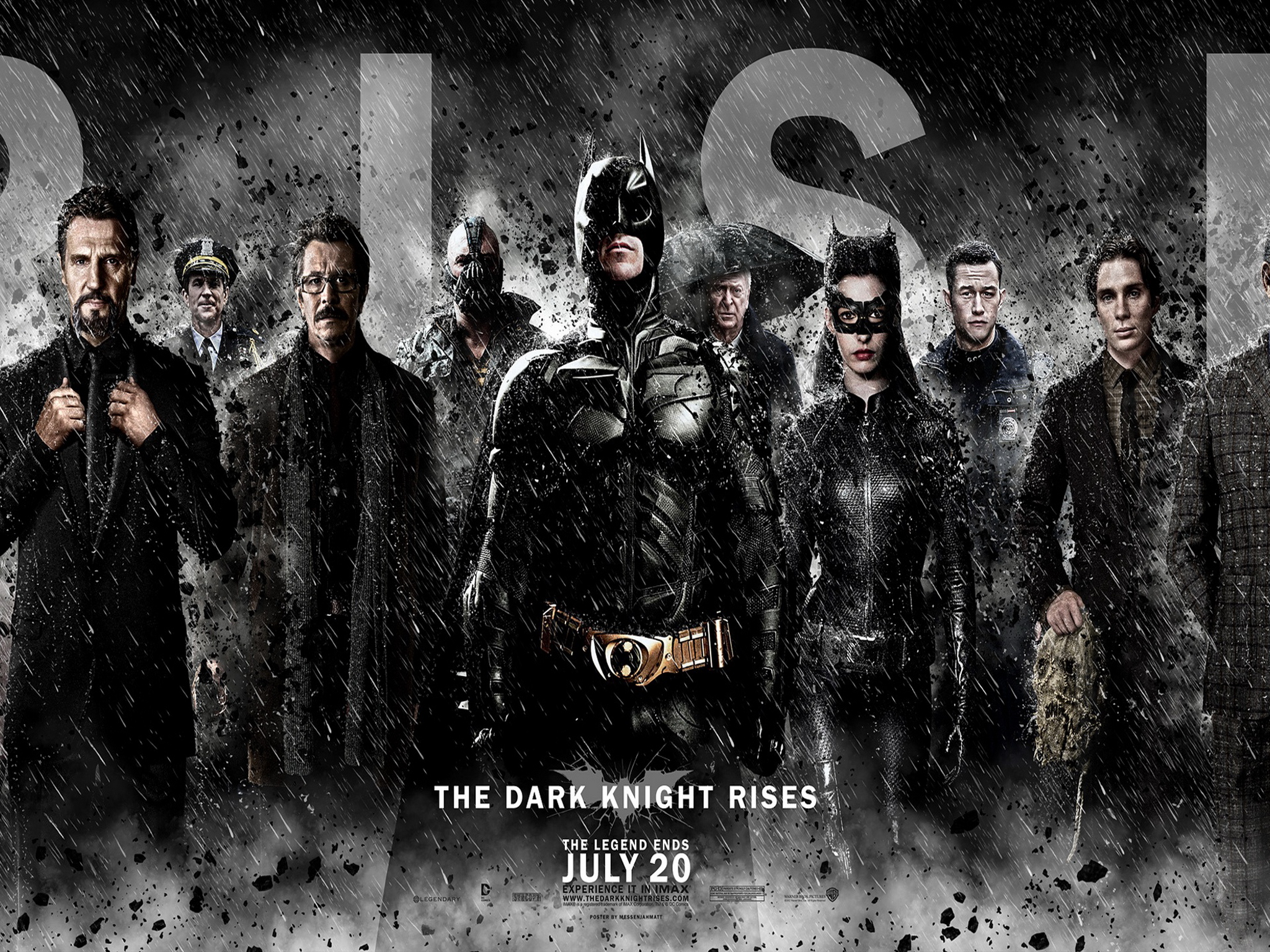 Christian Threads- Redemption and Cleansing
I can’t help but think of Bruce Wayne’s ascension from the pit to the chants of “rise” without thinking of the Christian faith. We sinners are in our own pits of sin. Yet just as Wayne we have a very real lifeline. Yes, Bruce Wayne shunned the physical lifeline, but he clung to an idea: he clung to faith. Similarly, the Christian shuns the physical realm and is saved by faith. Rise.
There is the notion of a “clean slate.” Selina Kyle is primarily motivated by her desire to have such a clean slate. She wants to start over. Batman offers it as a tantalizing price to pay for her help in the final battle. Yet in the end, Selina comes back and redeems herself more than was required by the Bat. At the end of the movie, however, it is revealed that both Bruce Wayne and Selina Kyle have managed to use the “clean slate.” They have started afresh. Again, a Christian allegory or overlay could be applied here. We are all sinners in search of a clean slate, yet we cannot provide it for ourselves. While have no nearly-magical technology to give us a clean slate, we do have salvation by grace through faith. And that, my friends, is something worth considering.
Finally, Wayne’s “rise” coincides with the need I described earlier. The fact that enemies had arisen meant that Batman had to also rise to the challenge. Christians know that once sin came into the world, the only way to cure it would be for God to come into the flesh to save us. Such is poignantly portrayed when Jim Gordon talked to John Blake. Gordon talks about the evils of Gotham and describes how Batman transcends the filth, but he “puts his hands into the filth [with us]” [I believe he says filth, but I have a suspicion it may have been muck–correct me if I’m wrong here]. Wayne, though having no obligation to these people, still loves Gotham, and he is willing to condescend to get his hands dirty–to put his hands into the filthy muck and dirty them in order to save it. Is it an allegory? It certainly works as one. Jesus is God incarnate. A God who loved His creatures so much that He was willing to become one of them–to put his hands into the filth and reach down to save us. Just as Batman did what was necessary to save while also dealing justice, Christ did what was necessary in order to save humanity from its own sin. The Son Rises.
Links
Check out more of my reflections on movies. If you liked The Dark Knight Rises, check out my look at The Avengers.
SDG.
——
The preceding post is the property of J.W. Wartick (apart from citations, which are the property of their respective owners) and should not be reproduced in part or in whole without the expressed consent of the author. All content on this site is the property of J.W. Wartick and is made available for individual and personal usage. If you cite from these documents, whether for personal or professional purposes, please give appropriate citation with both the name of the author (J.W. Wartick) and a link to the original URL. If you’d like to repost a post, you may do so, provided you show less than half of the original post on your own site and link to the original post for the rest. You must also appropriately cite the post as noted above. This blog is protected by Creative Commons licensing. By viewing any part of this site, you are agreeing to this usage policy.
Next Challenge, Please! Dealing with Doubt
 You’ve heard it before, and you will hear it again.
Sensational Find: Jesus’ Body Found in Ossuary
The Passover Plot: Jesus’ Disciples’ Conspiracy to Form New Religion
100 Bible Errors
Was Jesus Married?
The headlines could be multiplied. We are confronted on a daily basis by challenges to the Christian faith. A simple search on Google turns up thousands upon thousands of results of anti-theists and proponents of other religions with sites to challenge Christianity. Radical claims in archaeology supposedly undermine Biblical truths. You name it.
It can be easy to be swept up in a fire-fighting mentality. As you run into one challenge, you find a quick-and-easy fix for it and then jump to the next one. You want to make sure that you believe the right thing; you want to know that you’re right.
How can a Christian deal with doubt?
In his article, “How Should We Treat New Challenges to the Christian Faith?” in The Apologetics Study Bible, Gary Habermas makes five points Christians should follow when dealing with doubts.
1) Divorce our emotions from the challenge- Rather than spending emotional energy constantly doubting due to every new challenge, realize that the Bible has “successfully withstood innumerable attacks over the centuries.”
2) Assume the Bible is true- Habermas urges this presuppositional approach for Christians. Rather than assuming the Bible is guilty until proven innocent, it should be treated with the same historical standard as other texts, and be given a chance to stand on its own before being subjected to hyper-criticism.
3) Carefully analyze each critical allegation against the Bible- Instead of jumping from challenge to challenge with only a superficial understanding, dig into each challenge individually. One thing I always told my students when I taught apologetics classes was that if you run into a question or doubt, I can guarantee someone smarter than me has already written on it. Look into the rich intellectual past of Christianity. Become familiar with the arguments. It will be enlightening and faith-strengthening.
4) Get help from Christian Scholars- Okay I jumped the gun on this one a bit! Do this! Christian brothers and sisters, we have extraordinary access to nearly limitless resources online and in person to deal with doubts. Take advantage of this. Don’t fall into blind faith or dogmatic skepticism; instead, seek to understand.
5) Be patient! Instant answers aren’t always going to happen. Search the Scriptures; follow the above steps; trust in God. I’ve found that dealing with doubt can be a rewarding experience as you pursue a question into the ground. Your faith will be stronger for the experience.
What about archaeological finds? Well again, there’s something to be said for a cautious skepticism about sensational finds. Reasons to Believe has an excellent article on the topic: “Avoiding Crackpot Archaeology”. In it, Krista Bontrager provides a 6-step process for analyzing these sensational claims. I’ll let you read the article for the full details, but here it is in summary: 1) Check the research; 2) check the credentials of the one making the claim; 3) Check for verification; 4) Was it published/where?; 5) What are other scholars saying?; 6) Caution: Is it too good (or bad?) to be true?
Christian brothers and sisters, we owe it to ourselves to pursue the truth. Jesus is the truth. When dealing with doubt, do not forget you’re not alone. All truth is God’s truth, and the pursuit of truth will not leave you ungrounded. Thank God.
SDG.
——
The preceding post is the property of J.W. Wartick (apart from citations, which are the property of their respective owners) and should not be reproduced in part or in whole without the expressed consent of the author. All content on this site is the property of J.W. Wartick and is made available for individual and personal usage. If you cite from these documents, whether for personal or professional purposes, please give appropriate citation with both the name of the author (J.W. Wartick) and a link to the original URL. If you’d like to repost a post, you may do so, provided you show less than half of the original post on your own site and link to the original post for the rest. You must also appropriately cite the post as noted above. This blog is protected by Creative Commons licensing. By viewing any part of this site, you are agreeing to this usage policy.
The Presuppositional Apologetic of Cornelius Van Til
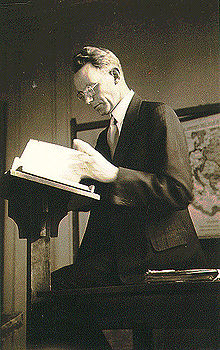 Cornelius Van Til pioneered the field of “presuppositional apologetics” primarily through his works Christian Apologetics

The Presuppositional Apologetic: Theory
Van Til was very adamant that believers cannot and should not give up any ground to those who are non-Christian. He argued that “Christian theism is a unit. Christianity and theism are implied in one another… Christianity can never be separated from some theory about the existence and the nature of God” (Christian Apologetics, 17). Again, he is adamant: “We must defend Christian-theism as a unit” (The Defense of the Faith, 28).
Along with his emphasis on defending Christianity as a unit, Van Til equally impressed the point of the extreme divergence of views between the Christian and the non-Christian. Apologetics must acknowledge the nature of man. Van Til placed particular emphasis upon the notion that apologists cannot ignore that “we shall have to choose between two theories of knowledge. According to one theory God is the final court of appeal; according to the other theory man is the final court of appeal” (The Defense of the Faith, 58). Because of this, “it becomes quite impossible…. [to] agree with the non-Christian in his principles of methodology to see whether or not Christian theism be true” (The Defense of the Faith, 118-119).
The key to understand here is that Van Til does not accept that there is a neutral reason “out there” by which Christians and non-Christians can arbitrate the truth of Christianity; his point is that there is no neutral ground and that one’s presuppositions will determine one’s end point. Again, he writes, “this [apologetic method] implies a refusal to grant that any area or aspect of reality, any fact or any law of nature or of history, can be correctly interpreted except it be seen in the light of the main doctrines of Christianity” (Christian Apologetics, 124).
However, Van Til takes it even further and argues that one must presuppose the truth of Christianity in order to make sense of reality: ” What is the content of this presupposition, then? It is this: “I take what the Bible says about God and his relation to the universe as unquestionably true on its own authority” (The Defense of the Faith, 253); again, “The Bible is thought of as authoritative on everything of which it speaks. Moreover, it speaks of everything” (Christian Apologetics, 19). Thus, Van Til’s apologetic does not make Christianity the conclusion of an argument; rather, Christianity is the starting presupposition.
The presuppositional approach here cannot be stressed enough. For Van Til, one simply cannot grant to the non-Christian any epistemic point. “We cannot avoid coming to a clear-cut decision with respect to the question as to whose knowledge, man’s or God’s, shall be made the standard of the other. …[O]ne must be determinative and the other subordinate” (The Defense of the Faith 62-63).
What place is had for evidences in Van Til? At some points, he seems to be very skeptical of the use of Christian evidences. In particular, the fact that he argues there is no neutral evaluation grounds between the Christian and non-Christian seems to imply that there can be no real evaluation of such arguments apart from Christianity. One of Van Til’s most famous illustrations of the use of evidences can be found in The Defense of the Faith pages 332 and following. He uses three persons, Mr. Black (non-Christian), Mr. Grey (Christian non-presuppositionalist), and Mr. White (presuppositional/reformed apologist):
Mr. Grey… says that, of course, the “rational man” has a perfect right to test the credibility of Scripture by logic… by experience… [Mr. Grey then takes Mr. Black a number of places to show him various theistic evidences. Mr. Black responds:] “you first use intellectual argument upon principles that presuppose the justice of my unbelieving position. Then when it it is pointed out to you that such is the case, you turn to witnessing [subjectively].
…At last it dawned upon Mr. White that first to admit that the principles of Mr. Black, the unbeliever, are right and then to seek to win him to the acceptance of the existence of God the Creator… is like first admitting that the United States had historically been a province of the Soviet Union but ought at the same time to be recognized as an independent and all-controlling power… If one reasons for the existence of God and for the truth of Christianity on the assumptions that Mr. Black’s principles of explanation are valid, then one must witness on the same assumption [which makes witnessing wholly subjective.] (p. 332-339)
It can be seen here that even evidences for Van Til must be based within a presupposition. There is no way to look at evidences in the abstract. One can either offer them within the presuppositions of Christianity or outside of Christianity. For Van Til, once one has agreed to offer evidences outside of Christianity, one has granted the presuppositions of the non-believer, and therefore is doomed to fail.
 His argument is therefore a type of “transcendental argument.” He argues that only within the Christian worldview can even the rationalism of the unbeliever make sense. Non-Christians may reject belief in God, but this is not a rational rejection, according to Van Til. Rather, “Sin will reveal itself in the field of knowledge in the fact that man makes himself the ultimate court of appeal… Man has declared his autonomy as over against God” (The Defense of the Faith, 58). Mankind is actively suppressing the knowledge of God. “It is not that we are merely brought into existence by God, but our meaning also depends upon God” (The Defense of the Faith, 63).
To sum up Van Til’s apologetic, then, there are three major points:
1) There is no neutral starting point between the Christian and non-Christian. One must presuppose either.
2) Christians should therefore presuppose Christianity in their apologetic and seek to show how only upon Christian presuppositions can one make sense of reality.
3) The transcendental argument: Only if God exists can their be a basis for morality, science, history, and rationality.
Analysis and Application
I admit that I am quite sympathetic to those who argue this type of apologetic is viciously circular. For example, one proponent of Van Tilian apologetics is John Frame. In his defense of presuppositional apologetics, he writes, “Premise 1: Whatever the Bible says is true. Premise 2: The Bible says it is the Word of God. Conclusion: Therefore, the Bible is the Word of God” (Frame, 356, cited below). I can’t help but think that while this argument is deductively valid, using P1 is to beg the question against the non-Christian. But of course, that’s exactly what Van Til urges. One must start with Christian theism and the Bible as presuppositions and reason from there. Therefore, I’m inclined to think that presuppositionalism cannot stand on its own. However, I do think that Van Til’s method can be saved from logical absurdity and made applicable in a part of a “cumulative case” type of reasoning (or certainly, it could be paired with a type of Reformed Epistemology).
The way I would propose for this is to utilize Van Til’s apologetic by showing Christians and non-Christians how philosophical presuppositions can color one’s evaluation of evidence and even of reasoning itself. Instead of offering only evidences or only witness in a vacuum, the Christian apologist should indeed focus upon how one’s presuppositions change one’s evaluation of evidence or witnessing. One presuppositional approach to the problem of evil can be found, I’ve suggested, in Job.
Furthermore, it seems to me that the transcendental argument is extremely potent. By arguing that even the process of reasoning cannot make sense apart from God, Christians can effectively place the burden of proof upon their opponents to show how their system can cohere with reality.
Finally, I can’t help but appreciate the tenacity with which presuppostional apologists, in the spirit of Van Til, pursue incoherent positions and actively turn people back to the presuppositional approach. The presuppositional apologetic, while not necessarily one I think can stand on its own, is extremely powerful.
Conclusion
Reading Van Til leaves me at points breathless with his innovation and boldness; but at other points it leaves me frustrated. He is not easy to understand, nor are his arguments always convincing. Too often, he axiomatically states a position and assumes his argument has carried his point. However, one can hardly dismiss the whole of Van Til’s thought as useless to Christian apologetics. Van Til’s transcendental argument has staying power, and his urges to focus upon presuppositions cannot be ignored.
This is but the first in a series of posts I have planned on presuppositional apologetics. I will be analyzing Van Til’s thought further, as well as diving into some other well-known proponents of presuppositionalism like John Frame, K. Scott Oliphant, and Greg Bahnsen. A few posts will focus on applied presuppositional apologetics.
Sources
Cornelius Van Til, The Defense of the Faith
—-, Christian Apologetics
John Frame, “A Presuppositional Apologist’s Closing Remarks” in 5 Views on Apologetics (Grand Rapids, MI: Zondervan, 2000).
Links [Will update as series continues]
Proof that God Exists– an insightful view of presuppositional apologetics in practice.
Choosing Hats– A mammoth collection of articles from a presuppositional apologetic.
SDG.
——
The preceding post is the property of J.W. Wartick (apart from citations, which are the property of their respective owners) and should not be reproduced in part or in whole without the expressed consent of the author. All content on this site is the property of J.W. Wartick and is made available for individual and personal usage. If you cite from these documents, whether for personal or professional purposes, please give appropriate citation with both the name of the author (J.W. Wartick) and a link to the original URL. If you’d like to repost a post, you may do so, provided you show less than half of the original post on your own site and link to the original post for the rest. You must also appropriately cite the post as noted above. This blog is protected by Creative Commons licensing. By viewing any part of this site, you are agreeing to this usage policy.
Book Review: “Heresy: A History of Defending the Truth” by Alister McGrath
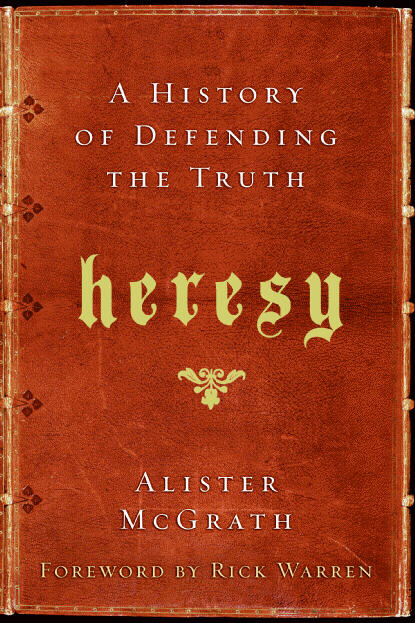 There is a trend today to see heresy as a forbidden fruit. What is heresy?; Who says these views are wrong?; Aren’t heresies just the losers in a power struggle?–these are but a few examples of the questions being asked about heresy. Alister McGrath’s book,Heresy: A History of Defending the Truth
“A heresy,” states McGrath, “is a doctrine that ultimately destroys, destabilizes, or distorts a mystery rather than preserving it… A heresy is a failed attempt at orthodoxy, whose fault lies not in its willingness to explore possibilities or press conceptual boundaries, but in its unwillingness to accept that it has in fact failed.” (31, emphasis his).
One might wonder why McGrath utilizes this view of heresy, and it is important to see that his definition stands between two misunderstandings of the historical context of the development of heresy. McGrath argues that there are two positions about the history of heresy which are extremely popular but also highly anachronistic. The first is that heresy is something from outside of the church which was able to somehow “get into” the church and corrupt it (34); the second erroneous view is that “What determines whether a set of ideas is heretical or not is whether those ideas are approved and adopted by those who happen to be in power. Orthodoxy is simply the set of ideas that won out, heresies are losers” (81). Both positions suffer from an anachronistic view of the history of heresy and tend to over-emphasize certain aspects of that development.
The notion that heresy is some kind of “Trojan horse” smuggled into Christianity from without is historically untenable (34). Furthermore, this view generally holds that “Heresy was a later deviation from [the] original pure doctrine” (65). Instead, “heretics were insiders who threatened to subvert and disrupt [the church]….” (35). However, the fact is that the notion of early Christianity holding to the best orthodoxy is a purely fictional historical concept. Rather, doctrine developed as new challenged were presented to the Christian faith or new truths were explored (66-67). Heresy was part of this development. Heresies were ideas that failed to take hold within Christianity because it was deemed to undermine the strength of the Christian faith as a whole (83).
Therefore, McGrath argues, it can be seen that the second view of the development of heresy is also historically mistaken. There was an orthodox core from which doctrine developed, and heresies were seen as defective (81ff). “The process of marginalization or neglect of these ‘lost Christianities’ generally has more to do with an emerging consensus within the church that they are inadequate than with any attempt to impose an unpopular orthodoxy on an unwilling body of believers” (81-82). Heresy was “an intellectually defective vision” of Christianity (83), rejected because it could not stand up to the theological challenges raised against it (83ff).
McGrath provides more development of the concept of heresy, and then turns from his analysis of the rise and rejection of heresy to a historical account of several early heresies. His analysis of these early heresies (ebionitism, docetism, valentinism, arianism, donatism, and pelagianism) provides significant historical support for his thesis that heresies are ultimately insufficient accounts of Christian theology and were rejected thereby. Against the thesis of Walter Bauer, who held that orthodoxy was an “ideological accident,” it is rather the case that “The relative weakness of institutional ecclesiastical structures at this time, including those at Rome, suggest that the quality of the ideas themselves played a significant role in their evaluation…” (133).
It is also important to note that heresies are not necessarily tools aimed to destroy Christianity from within. McGrath is particularly concerned with the contextualization of heresies. These were often developed within a context of a question, like “What is the nature of Christ?” (Ebionitism). “The problem [of heresy] lay not with the motivations of [heretics], but rather with the outcomes of their voyages of theological exploration” (171).
McGrath ends Heresy with an exploration of the origins and development of heresy. Heresy, he argues, develops through 5 major strands, each of which usually involves turning theology towards: cultural norms, rational norms, social identity, religious accomodation, and ethical concerns (180ff). Heresies will continue to emerge as Christianity faces new challenges. Furthermore, orthodoxy is itself a process of ongoing development (221).
McGrath concludes with a vision for orthodoxy: “If Christ is indeed the ‘Lord of the Imagination’… the real challenge is for the churches to demonstrate that orthodoxy is imaginatively compelling, emotionally engaging, aesthetically enhancing, and personally liberating. We await this development with eager anticipation” (234).
Heresy is indeed something which has caught the popular imagination. McGrath’s book offers a reasonable, sound defense of Christian orthodoxy in an era wherein heresy is often portrayed as an unfairly suppressed system which should be resurrected. By providing a significant investigation of the historical background and development of heresy, McGrath avoids the two ahistorical extreme views of heresy: that it was entirely a plague from outside the church or that it was merely one of many competing ideas that happened to lose.
Christians would do well to have knowledge of the development of Christian doctrine. As more challenges are raised to the Christian faith, orthodoxy will have to continue to respond. Without a historical grounding firmly in place, Christianity is liable to change with the winds. Heresies repeat themselves (232), and Christians need to be ready to respond to these alterations of the faith. Heresies have historically been rejected not due to an internal power struggle, but rather due to their insufficient intellectual bases.
Alister McGrath’s Heresy: A History of Defending the Truth is one of those books Christians should have within reach on their shelf in order to readily access it as challenges arise. He provides an enormously useful historical evaluation of heresy which allows readers to avoid the pitfalls of ahistorical views. Furthermore, McGrath convincingly demonstrates the reasoning behind labeling a position as heretical follows from a corruption of Christianity which makes it less theologically or intellectaully viable. By providing Christians with a vision of orthodoxy and heresy that is both aware of its past and looking towards the future, McGrath has written an invaluable source.
Heresy: A History of Defending the Truth
SDG.
——
The preceding post is the property of J.W. Wartick (apart from citations, which are the property of their respective owners) and should not be reproduced in part or in whole without the expressed consent of the author. All content on this site is the property of J.W. Wartick and is made available for individual and personal usage. If you cite from these documents, whether for personal or professional purposes, please give appropriate citation with both the name of the author (J.W. Wartick) and a link to the original URL. If you’d like to repost a post, you may do so, provided you show less than half of the original post on your own site and link to the original post for the rest. You must also appropriately cite the post as noted above. This blog is protected by Creative Commons licensing. By viewing any part of this site, you are agreeing to this usage policy.

 J.W. Wartick - Reconstructing Faith