Christianity and Science
Book Review: “Thriving with Stone Age Minds: Evolutionary Psychology, Christian Faith, and the Quest for Human Flourishing” by Justin L. Barrett with Pamela Ebstyne King
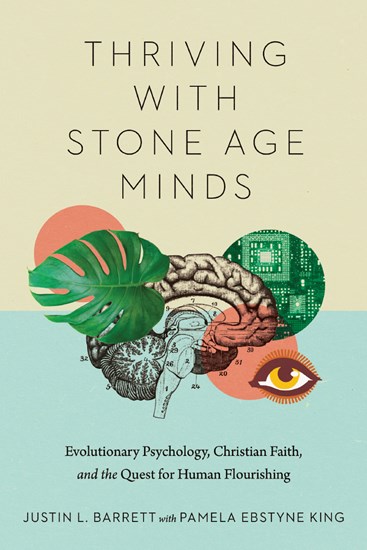
Thriving with Stone Age Minds is a fascinating journey into looking at a combination of evolutionary psychology and Christian faith.
First, this book is not located in the space of debating Christianity and evolution. It simply assumes mainstream science is correct and that Christianity remains viable given that. Frankly, that makes the book more useful, in my opinion, than it would have been if it spent pages trying to justify those premises. There is an introductory chapter that goes over some basic assumptions and background knowledge necessary for at least diving in to the later chapters.
Next, there’s the question of what it means to “thrive.” The definition is more complex than a reader may think, especially when one is attempting to balance both evolutionary and Christian theological assumptions. Thriving in this space means there can be gaps in understanding, and that finding a niche means more than successful procreation and passing on of genetic code. Humans also tend to expand into whatever space they find and modify nature to suit their needs; this creates a kind of nature-niche gap that is crossed repeatedly by humans, but might not also yield thriving.
The authors go over various features of human anatomy and what those features might suggest about human nature. For example, humans have large white sclerae in our eyes that allows others to see where we’re directing our attention. The nature-niche gap also refers to how quickly humans are moving various aspects of our lives ahead of nature. For example, our nutrition is linked to our evolutionary past, when finding sugar and fat-rich foods would have been important sources of large nutritional importance; but they are hyper-abundant now and our bodies and minds haven’t been trained or evolved to combat this massive availability.
Some focus of the book is on contrasting the pace of revolutionary change and adaptation and the extremely rapid advancement of technology and–tying into the above–diet and availability of food. Evolutionary psychology can help us understand some of the gaps in understanding and the necessity of learning more about how technology is changing our minds and bodies. Each chapter has a number of ways to focus on the concept of thriving and tying it into both Christian theology and evolutionary biology.
Thriving with Stone Age Minds is a highly recommended read. It rewards careful reading and spurs quite a bit of thought.
All Links to Amazon are Affiliates
Links
Be sure to check out the page for this site on Facebook and Twitter for discussion of posts, links to other pages of interest, random talk about theology/philosophy/apologetics/movies and more!
Book Reviews– There are plenty more book reviews to read! Read like crazy! (Scroll down for more, and click at bottom for even more!)
SDG.
——
The preceding post is the property of J.W. Wartick (apart from quotations, which are the property of their respective owners, and works of art as credited; images are often freely available to the public and J.W. Wartick makes no claims of owning rights to the images unless he makes that explicit) and should not be reproduced in part or in whole without the expressed consent of the author. All content on this site is the property of J.W. Wartick and is made available for individual and personal usage. If you cite from these documents, whether for personal or professional purposes, please give appropriate citation with both the name of the author (J.W. Wartick) and a link to the original URL. If you’d like to repost a post, you may do so, provided you show less than half of the original post on your own site and link to the original post for the rest. You must also appropriately cite the post as noted above. This blog is protected by Creative Commons licensing. By viewing any part of this site, you are agreeing to this usage policy.
Young Earth Creationism and the Problem of Multiple Dating Methods for a Tyrannosaur Fossil

When I was a young earth creationist (here after YEC), I often heard about the absurdity of dating methods used to arrive at millions of years for the age of fossils. One such argument I have seen repeated is that scientists determine the date of fossils based upon presuppositions about the age of each layer in the fossil record. What I want to emphasize is that this massively oversimplifies the way scientists date fossils. When we look at how scientists actually do date individual fossils, the evidence for the age of the Earth against YEC mounts quickly.
There are many, many more methods of dating fossils that continue to show that entirely independent strands of evidence yield the same ages or relative ages. In an essay in Tyrannosaurid Paleontology edited by Parrish et al., the authors show the age of a juvenile Tyrannosaurid based upon pollen, leaves, and paleomagnetism. What is important to note is that these are independent ways of measuring the age of this specific fossil. That is, the data that needs to be explained by the YEC is not simply dismissal of Carbon dating or something, but rather that each of these data points must be independently falsified, along with an explanation for why they would all align. Additionally, the paper summarized below shows how much more complex dating methods based upon looking at the layer in which a fossil is found. In other words, it helps to show that the creationist teaching that remains fairly common on YouTube and elsewhere that scientists simply look at the layer a fossil is in and assume the age is quite complex and based upon a series of data points.
Brief Summary of the Evidence
Note: I am not a trained scientist. I am summarizing the content of the paper cited, and attempting to put quotations at every point I’m directly quoting. This section is largely a glossed summary of points of the paper, and any errors and misunderstanding thereof in such a summary are on me.
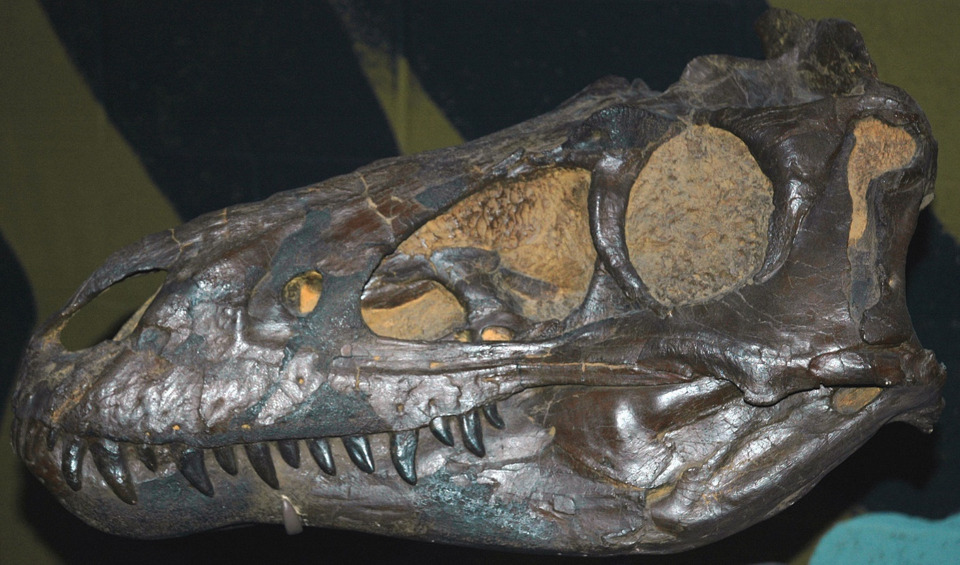
In an essay entitled “Using Pollen, Leaves, and Paleomagnetism to Date a Juvenile Tyrannosaurid in Upper Cretaceous Rock” by William F Harrison et al., the authors argue that a juvenile fossil tyrannosaurid fossil (named and sometimes hereafter referred to as “Jane”) can be confidently dated to about 66 million years ago. The juvenile tyrannosaurid (still an astonishing 7 meters in length!) was discovered in the Hell Creek formation in southeastern Montana in Carter County. The authors give details of the find, including the longitude/latitude, the place within the Hell Creek formation in which it was found, and other relevant details.
One of these is that the place the fossil was found was missing the top of the Hell Creek Formation with the Cretaceous-Tertiary boundary. This is a common part of the formation and other parts of the formation were visible from the site but the paleontologists were not granted access to the other sites within view to conduct a direct survey of the geologic columns there. This meant that they had to rely on additional dating methods.
First, they used a borehole log, which is made by cutting a cylindrical hole into the ground and extricating a section therefrom, allowing geologists to make a detailed summary of the formation. Another survey of nearby Blacktail Creek area of Montana was able to locate a magnetic reversal, which could then be used at the site of the Jane find to help place it in the formation. A stratigraphic section of the formation at the Jane site is provided, showing in detail each of these layers and correlations thereof. Jane, after death, was “buried within a 40 cm thick lens of poorly sorted silt, sand, and clay balls… This clay ball conglomerate contains abundant plant and animal fossils…” Again, a photograph shows a polished section of the clay ball conglomerate and siderite (a mineral compound) in which Jane was found.
Interestingly, from this conglomerate in which Jane was buried, scientists were able to extract fossilized pollen, vegetational residue, and more for analysis. This allowed them to determine what kind of plants the residue and pollen came from. The pollen was demonstrably from aquilapollenites and wodehouseia, each of which are entirely extinct now (more on that later). Fossil leaves were also collected from the Jane site, and these correspond to “the stratigraphic position indicated by the pollen and support the determination of its geologic age.” Once again, these leaves were determined to genus and species and they correspond to a “very narrow megafloral zone.” This is important, because, again, this megafloral zone is a zone in which only certain species occur within a stratigraphic layer on the Earth, and at the Jane site, only leaves from certain megaflora in a specific zone were found. Other types of plant leaves found are restricted in the fossil record to very specific parts of the Hell Creek formation. For conventional scientists, this marks their extinction [for YEC possibilities and problems thereof, see the section below]. The greatly delimited range of these plants allows scientists to narrow down the age of the Jane site even more, because it occurs only within a very specific stratigraphic range alongside very specific other fossils.
Additionally, the scientists collected samples from the fine grained sediment at the Jane site and analyzed them at the Paleomagnetics Laboratory of the University of California, Davis. There, based on the way the clay balls were sorted within the samples, they found the magnetic polarity of the sample corresponded to normal polarity and thus set another limit on the age of the Jane site (based upon stratigraphic samples showing differing magnetic polarity above or below it). Because these polarity shifts–reverse-normal-reverse-etc.–can be measured through stratigraphic analysis essentially globally, this allowed the scientists at the Jane site to determine that the age range of 65.9-66.0 million years ago is the correct age for the Jane fossil. The precision was possible because of both the paleobotanical and palynological–ancient plants and microorganisms–samples from the site.
Some Conclusions and Issues
It worth noting that the pollen at the Jane site was from two types of plants which are entirely extinct now. Young Earth Creationists often argue that all or most fossils, including the overwhelming majority (or all) dinosaurs were deposited by Noah’s Flood. One wonders, then, why in this great conglomeration and mixture of plants and animals, there is no fossilized pollen found from species that exist now. Why only extinct species? How did it just so happen that only extinct pollen–microscopic pollen!–settle onto this site? And how is that the case time and again, at site after site after site? To say that all this pollen and all these plants were washed away by the Flood but then somehow sorted into extinct and non extinct species, remarkably from bottom to the top of the geologic column, should be enough to stretch even the most credulous minds.
Similarly, the determination of just a few species of megaflora found at the Jane site demands explanation. Here, because leaves are obviously much larger than pollen, the creationist could theoretically just say that it so happened this area was only covered with that type of plant during the pre-Flood time and so it happened that only that kind of plant was preserved here. That does not, however, explain why totally different and distinct layers of plants are found in layers above and below this generalized stratigraphic layer, or why this specific megafloral zone is consistent across not just the Hell Creek Formation but elsewhere, and why examples of this can be multiplied essentially indefinitely. Time and again, specific fossils are only found with other specific fossils. There’s no mixing of them all together. You don’t find rabbit fossils with dinosaur fossils with the type of megaflora fossils found with Jane. Why not? Were there no rabbits roaming the pre-Flood world of Montana? Were there no flowering plants close enough to have their leaves cast about massive expanses of fossilized land? Again, it is far, far more parsimonious and plausible to acknowledge that, instead, the YEC narrative is simply mistaken on this. It cannot handle the sheer weight of the evidence.
The evidence here does not rely on Carbon-14 dating directly. Instead, it relies upon generally acknowledged dates for things like the Cretaceous-Tertiary (K/T) boundary, which again was sheered off by weather or some other events at the Jane site. This, along with the pollen fossils, microorganism fossils, and botanical fossils allowed scientists to make determinations to continue narrowing the date of the site from a broad range (before the K/T boundary) to a much more narrow range. These dating techniques were done independently. That is, the identification of the leaves was not used to determine the age of the polarity shifts in the magnetism of Earth. Instead, the way the sediments were sorted in the samples was used to determine a date; the specific pollen of megaflora was used to determine a specific date range because they only lived during a certain time range; the leaves were used to determine a specific range (here, independently, based upon botanical analysis of the age range possible with these plants). These all independently yielded a similar and narrow range. It was narrowed not arbitrarily but by noting the relative ages of each range.
So, for example, if you discovered a text fragment from the ancient world, you could narrow down the timeline in which it was made or discussing by finding out more about it. If, for example, it was in Latin and talking about events in the Roman Empire, that would broadly limit the possible dates to within the existence of the Roman Empire; then, if it talked about a specific province of Rome that wasn’t conquered until a certain time, that would narrow the possible timeline even more, and then if it talked about a governor of that province, it would narrow the dates to within the rule of that governor, etc. Similarly, since certain plants or microorganisms can be known to only occur in certain stratigraphic layers–and this is consistently determined by actual digs finding actual evidence of this assortment and lack of mixing–one can set ever-narrowing limits on the age based upon the overlaps of these events. Adding in the polarity shifts to the dating method was just icing on the cake. And again, why should all these data methods correspond unless the Earth is actually as old as conventional science supposes?
One obvious objection in all of this is the question of how the scientists determined the relative ages of things like the leaves, pollen, etc. While it seems, on the surface, problematic that these all correspond to ages in the millions of years that all align, just having a leaf in a fossil layer is not enough to put a date on it. Aren’t those dates slapped on based on radiometric dating of some kind, thus making the whole thing one line of evidence, not many? The objection has some weight at first glance because, to my knowledge, it is true that the ages for the stratigraphic layers were determined, in part, by radiometric dating, and thus saying that a certain layer has a consistent date across the region is reliant upon that dating method. Setting aside the many, many arguments and clarifications about radiometric dating, however, the problems in this paper go far beyond reliance upon radiometric dating. They also are grounded upon measurements about the magnetic polarity of Earth, as well as independent, multiple lines of evidence showing a narrow range of dates for when Jane was possibly alive. Supposing radiometric dating is entirely unreliable and that it just somehow continually yields similar age ranges for similar layers and fossils and consistently is measured in the same ranges across regions and beyond, the fact remains that Jane was identified in a unique stratigraphic layer with unique and exclusive megaflora pollen, unique and exclusive leaves, unique and exclusive microorganisms, and unique and exclusive polarity measurements through the clay ball sediment sorting present.
Why, given Noah’s Flood’s deposition of these layers, would this even possibly be the case? There’s not even one piece of pollen out of place from a plant in a different stratigraphic layer; there’s not even one piece of evidence of sediment being sifted in a different direction by changing tides of Flood water; there’s not even one leaf from an olive tree or any modern botanical features that happened to show up in this entire layer of deposited sediment; there’s not even one microorganism out of place; there’s not even one out of place animal fossil from a different sedimentary layer; there’s not even one post K-T Boundary layer creature found out of place. Not. Even. One. Did God miraculously sort each grain of sediment, each microorganism, each animal washed away by the Flood, each leaf, each pollen grain, each plant, each megafloral layer so that they would layer upon each other in distinct and evidentially detectable ways? It’s absurd to suppose this. It’s not that this would be impossible for God. No, it’s that there’s no biblical or extrabiblical evidence to suggest that God interacts in the world in this way. The only reason to even posit it is a desperate attempt to save modern young earth creationism from scientific absurdity. And that means that acts of God are being determined by modern science after all, in an ironic twist–YECs are determining how and why God acted based upon scientific evidence. The whole thing collapses on examination.
Additional Evidence and Conclusion
I have argued elsewhere about the stunning congruity of such divergent dating methods as tree rings, varves (annual layers of sediment), and Carbon-14. If YEC is true, there seems to be no explanation for why tree rings, Carbon-14, and varves should all align on the age of the Earth. I’ve also noted the argument from GPS measurement of the movement of the Hawaiian Islands and Carbon-14 dating of those same islands. Again, why should the measured movement rate of the Hawaiian Islands align with C-14 dating methods on YEC? And, as argued above, why should leaves, pollen, and paleomagnetism align as well? There is a stunning and constant refrain from these various and independent ways for measuring the age of fossils or the Earth generally: they point to an age that is orders of magnitude larger than that of YEC.
Young Earth Creationism, therefore, must contend either that all of these independent methods for dating fossils are mistaken in multiple independent ways or come up with a plausible explanation for why God would provide all these independent methods to provide false data. Proposals I have seen for the latter (eg. God intentionally creating with the appearance of age) suffer from severe theological problems, while proposals for the former are essentially nonexistent. It seems far more plausible, then, to suppose that it is Young Earth Creationism that is falsified.
Links to Amazon are Affiliates Links
Links
Be sure to check out the page for this site on Facebook and Twitter for discussion of posts, links to other pages of interest, random talk about theology/philosophy/apologetics/movies and more!
Gregg Davidson vs. Andrew Snelling on the Age of the Earth– I attended a debate between an old earth and young earth creationist (the latter from Answers in Genesis like Ken Ham). Check out my overview of the debate as well as my analysis.
Ken Ham vs. Bill Nye- An analysis of a lose-lose debate– In-depth coverage and analysis of the famous debate between young earth creationist Ken Ham and Bill Nye the science guy.
SDG.
——
The preceding post is the property of J.W. Wartick (apart from quotations, which are the property of their respective owners, and works of art as credited; images are often freely available to the public and J.W. Wartick makes no claims of owning rights to the images unless he makes that explicit) and should not be reproduced in part or in whole without the expressed consent of the author. All content on this site is the property of J.W. Wartick and is made available for individual and personal usage. If you cite from these documents, whether for personal or professional purposes, please give appropriate citation with both the name of the author (J.W. Wartick) and a link to the original URL. If you’d like to repost a post, you may do so, provided you show less than half of the original post on your own site and link to the original post for the rest. You must also appropriately cite the post as noted above. This blog is protected by Creative Commons licensing. By viewing any part of this site, you are agreeing to this usage policy.
Book Review: “What Hath Darwin to do with Scripture?” by Dru Johnson- A breath of fresh air in the science-Christianity discussion
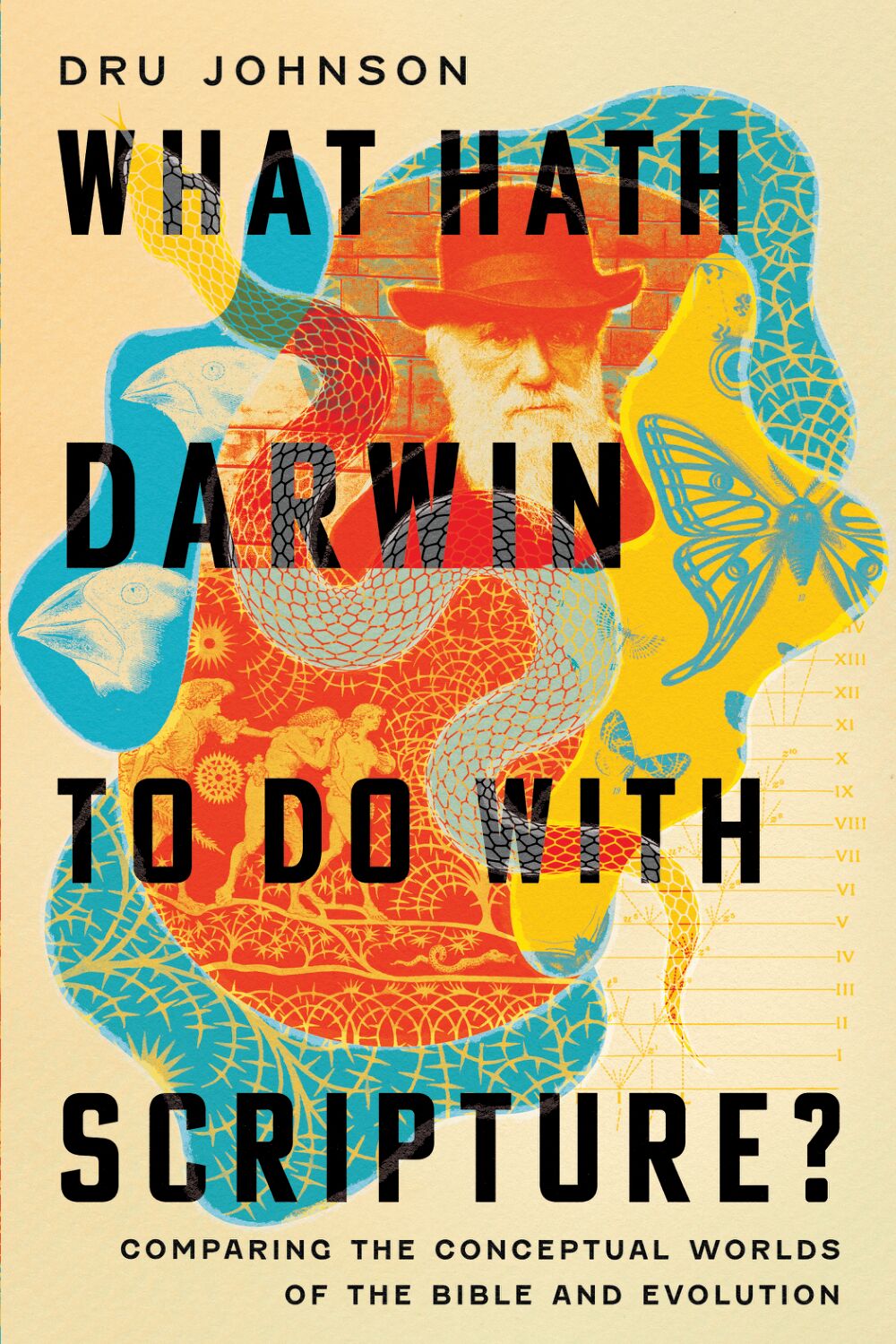
What Hath Darwin to do with Scripture? is a rarity in an overflowing market of books on Christianity and science. It brings something that feels fresh and new to the table. Having read it, I find myself sitting back and reflecting on the book, and wanting to discuss and share it with others. The first chapter puts the book’s thesis in perspective: “This is not the Creation-Evolution Debate You’re Looking For” (3). Indeed, it goes far beyond other works I’ve seen focused on interpretation of Scripture and evolution.
Dru Johnson’s work here presents a look not at debates about individualized texts and whether they can be reconciled with evolution. Instead, Johnson focuses on the conceptual worlds of evolution and the Bible to see if there is any overlap or conflict. Thus, instead of offering a text-by-text approach and asking whether this text over here precludes evolution or this one here hints at natural selection, he looks at overarching themes and stories in Scripture and how those might resonate (or not) with evolution. More specifically, Johnson argues the question shouldn’t be on pitting origin stories right next to each other in a verse-by-verse or thesis-by-thesis throwdown; instead, looking at how origin stories conceive of the world presents a more “apples to apples” approach (18-20).
There are three main themes Johnson focuses on in order to make comparisons between conceptual worlds. These themes are “scarcity,” “fit,” and “generation.”
“Scarcity” is clearly part of the Darwinian thesis and later evolutionary theory (25ff), and is often linked to violence. Johnson explores how the Bible also approaches language about scarcity and how it is also approached through violence at times (54ff). One aspect of his exploration is to point out that we have a skewed view of agrarian society and this entails a misunderstanding of the earliest parts of Genesis with its focus upon a life free of scarcity and threats emerging from the same (51ff, 56-57). The theme of scarcity doesn’t stay in Genesis, but can be found throughout the OT narratives and extends into the NT visions of a New Kingdom (83-84). The God-creation relation and covenants involved therein found in the Bible present, for Johnson, some of the places that it may be most at odds with evolutionary thinking (90). While this is the case, Johnson argues that biblical concepts related to scarcity have some resonance with evolutionary conceptualization of the world.
One of the most fascinating sections in the book is less about evolution than it is about the development of languages. In a lengthy section on the “fit” of people and creatures to their habitats, Johnson delves into the way that experts in linguistics have shown that the very geography of peoples’ regions shapes their language–complicated, high pitched noises being shouted through a rainforest, for example, doesn’t work as well as simple “e” or “a” sound. Differences between sounds used in languages can be identified and linked to geographic features (115ff). What has any of this got to do with the Bible? Johnson then turns around and examines concepts behind the story of Babel and the story of Pentecost, showing how each also shows the way geography and regional dialects could emerge (118-120).
“Generation” is the final aspect Johnson interrelates between Scripture and evolution. Sex and procreation are obvious hallmarks of both conceptual worlds, guiding the drive for selection and survival in one and becoming deeply important to the continuity of God’s promises in the other. Lengthy discussions of the seeming strangeness of monogamy from an evolutionary and even biblical perspective, discussion of norms related to sex, the natural bent towards violent sexual encounters, and more are discussed and related between the two conceptual worlds Johnson is exploring. Highlighting any number of fascinating points would be possible here. For example, discussing the prohibitions in Leviticus, Johnson points out that the focus seems to be upon aspects of generation, not on the inherent evil of whatever acts are being ruled out (162-165). Whether this could foster some additional discussion of morality and ethics is beyond Johnson’s point here, but certainly could be worth exploring.
Johnson is even in his messaging throughout the book, rarely claiming to have some grandiose answer to questions about science and Christianity. Instead, his modest conclusion is that he “retain[s] a healthy and hopeful agnostic curiosity about the integration of these two conceptual worlds–evolutionary and Hebraic–whether they can be reconciled and how so” (201). He goes on to express hope that the discussion here will lead to colleagues correcting, agreeing, discussing, opening dialogue, etc. on these topics. I wholeheartedly agree.
What Hath Darwin to do with Scripture? breathes new life into the interplay between Christianity and science. It’s a book that demands careful reading and reflection and, I hope, will spur discussion of the dialogue into new, unexplored directions. Highly recommended.
All Links to Amazon are Affiliates links
Links
Be sure to check out the page for this site on Facebook and Twitter for discussion of posts, links to other pages of interest, random talk about theology/philosophy/apologetics/movies and more!
Book Reviews– There are plenty more book reviews to read! Read like crazy! (Scroll down for more, and click at bottom for even more!)
SDG.
——
The preceding post is the property of J.W. Wartick (apart from quotations, which are the property of their respective owners, and works of art as credited; images are often freely available to the public and J.W. Wartick makes no claims of owning rights to the images unless he makes that explicit) and should not be reproduced in part or in whole without the expressed consent of the author. All content on this site is the property of J.W. Wartick and is made available for individual and personal usage. If you cite from these documents, whether for personal or professional purposes, please give appropriate citation with both the name of the author (J.W. Wartick) and a link to the original URL. If you’d like to repost a post, you may do so, provided you show less than half of the original post on your own site and link to the original post for the rest. You must also appropriately cite the post as noted above. This blog is protected by Creative Commons licensing. By viewing any part of this site, you are agreeing to this usage policy.
Book Review: “The God of Monkey Science” by Janet Kellogg Ray

The God of Monkey Science: People of Faith in a Modern Scientific World by Janet Kellogg Ray explores the interactions of Christians and science in a post-Covid world.
The book explores many topics related to Christianity and science. Kellog Ray includes historical notes about the ways Christians have interacted with science, examples from more recent events such as the rise of the Intelligent Design movement and associated anti-evolution arguments, and even the recent Covid-19 pandemic and Evangelicalism’s largescale embracing of anti-science positions in that time period as well.
A particularly fun aside- one of my blog posts is quoted in the book. Kellogg Ray quotes from one of my posts about leaving my former denomination and how science was a big part of that.
What is especially helpful in the book is how so many real examples of anti-science thinking are provided and then contrasted with context. Some of the examples are especially egregious, such as the attempts to portray Anthony Fauci as anti-mask because of an early video in which he talked about not needing to wear masks at the time but then later, following additional, substantial studies, switching the messaging. This is part of how sciience works–updating guidelines and expectations based on additional or new evidence.
The book is not at all a bash-fest on Christians, either. The author is unabashedly an evangelical Christian, but she writes the book as a kind of long form exhortation to Christians to do better, have humility, and perhaps listen to experts when it comes to science. It’s written in a winsome manner, and will hopefully make some rethink the way they approach science reporting and misinformation.
The God of Monkey Science is a refreshing look at the need for Christians to interact with science more honestly and fruitfully. It is recommended.
All Links to Amazon are Affiliates links
Links
Be sure to check out the page for this site on Facebook and Twitter for discussion of posts, links to other pages of interest, random talk about theology/philosophy/apologetics/movies and more!
Book Reviews– There are plenty more book reviews to read! Read like crazy! (Scroll down for more, and click at bottom for even more!)
SDG.
——
The preceding post is the property of J.W. Wartick (apart from quotations, which are the property of their respective owners, and works of art as credited; images are often freely available to the public and J.W. Wartick makes no claims of owning rights to the images unless he makes that explicit) and should not be reproduced in part or in whole without the expressed consent of the author. All content on this site is the property of J.W. Wartick and is made available for individual and personal usage. If you cite from these documents, whether for personal or professional purposes, please give appropriate citation with both the name of the author (J.W. Wartick) and a link to the original URL. If you’d like to repost a post, you may do so, provided you show less than half of the original post on your own site and link to the original post for the rest. You must also appropriately cite the post as noted above. This blog is protected by Creative Commons licensing. By viewing any part of this site, you are agreeing to this usage policy.
Why I Left the Lutheran Church – Missouri Synod: Points of Fracture (Part 2): Science as a Young Adult

For several posts, I will be writing about specific things that came up while I was within the LCMS–that is, at its schools, churches, and university–that made me start to think that the LCMS way of things didn’t align with some aspect of reality, something I learned in the Bible, or something else.[1]
Points of Fracture: Science as a Young Adult
The cognitive dissonance that I experienced regarding Christianity and science continued to mount as I got older. My previous post went over times in which I recall finding those points of fracture. I left off there in about 8th grade at an LCMS school. Here, I’ll share some of the times as a young adult in which I truly began to struggle with science and my faith.
In college, the hints of fracture at the edges of my view in the world became fault lines. I so often see the narrative of how allegedly secular colleges will destroy the faith of kids, but I was at an LCMS University, and being there nearly destroyed my faith. There are more reasons for this than science, as we’ll see in future posts. For now, though, the focus on questions of science loomed large when I was in college.
I came to college as a faithful Lutheran, though I had my ups and downs. For the first time, I really could not go to church all the time and it wouldn’t matter or hardly even be noticed by most people. Then, I had a major religious experience and realized I wanted to learn about and know God more every day. One way that manifested is that I started reading apologetics. It quickly became clear that issues of science and faith loomed large, and for the first time I truly began to think about the implications of some of these issues.
Then, I had a geology class in college. The professor was an adjunct who, I’m fairly sure, was neither Lutheran nor particularly interested in the theology of the university. He seemed blissfully unaware, as he taught his geology course, that what he was teaching would be worldview-shattering at least for one of his students. It was a course full of students who were on campus for many reasons, not just to attend an LCMS school. Many of them there were on athletics scholarships, and I heard some openly talking about the only reason they were at the school was because it was the only one that offered them such a scholarship. No one was dissenting from this professor, who stood there teaching mainstream geology. This was all stuff I’d never even been exposed to before. How beaches formed, how we could accurately predict how long some formations would take to form, how rock layers could be formed apart from Noah’s Flood. Indeed, Noah’s Flood was never even mentioned in the class. What I thought was the explanation for basically every geological feature on the planet wasn’t even in the index of my geology textbook!
I was totally devastated. Here was evidence, presented in the most mundane, disinterested fashion possible, that the Earth simply could not be merely 10,000 years old or so. While I didn’t really have a grasp on the science, the course taught me enough to realize that something had to give. The way I had been raised made the choice quite stark. The Bible just clearly taught that the Earth was young. “Millions of years” was a lie. Either the Earth really is six to ten thousand years old because the Bible says so or the Bible is untrustworthy and Christianity is false.
We had leaders in our dorms who were called “Spiritual Life Representatives” (SLRs). Think of an RA, but who you could go to in order to discuss spiritual questions or crises. They’d lead devotions and generally make themselves available to students to talk to. I went to my SLR and I was weeping in his dorm room. I was convinced that the geology I had learned had proven that the Earth could not be young, and so how could I possibly continue to believe Christianity was true? He said something that has stuck with me ever since: “If the Earth is more than 10,000 years old, would it really mean that Christ has not been raised from the dead?”
I sat there, tears streaming down my face, and I realized it wouldn’t mean that. He said other things, of course, like that he wasn’t as confident as I was about geology proving things differently, that there were other resources to read. But in that moment, he said something that allowed me to preserve my collapsing faith. I realized then that my faith was built on Christ, not on the age of the Earth.
I threw myself even more into apologetics now, because I felt even more confident that Christianity was true and that I needed to prove it to other people. The freedom provided to me by this conversation with my SLR had me flirt briefly with theistic evolution, but when I mentioned that in apologetics groups I was in, it got shot down hard. Instead, Young Earth Creationism (YEC) was the way to go. I needed to start seeing science the right way, they said. I searched around for groups to help build my faith and defense thereof, and started subscribing to Acts & Facts Magazine from the Institute for Creation Research (ICR). I was hugely impressed by the production values of this creationist publication, with its gorgeous pictures and lengthy articles about things like RATE research and the like. For the uninitiated, RATE stands for Radioisotopes and the Age of The Earth. I was convinced by these publications that, among other things, radiometric dating was falsified, that the Grand Canyon was evidence for a young earth, and that if you just looked at things in nature in the right ways, you’d see a young earth all around you. Reading about creationism in some LCMS literature convinced me even further, and speaking with a few pastors about the topic had me once more feeling rock-solid about my YEC convictions.
I love walking in nature, and I went for a hike somewhere in Michigan and I saw the distinct layers in the rocks. I walked up to them and put my fingers on them. I could trace the layers with my fingers and see how they were distinct in coloration after a certain point. I remember very clearly the feeling of washing over myself of total confidence that these layers were laid down by Noah’s Flood. Later in the hike, I saw a different formation of rocks thrust up through the other ones, so that they were nearly perpendicular to the other layers surrounding them. I stood staring at it for some time, trying to figure out how this could have happened due to Noah’s Flood. I simply couldn’t come up with such a scenario, but I trusted further study would alleviate the stress. I left the hike somewhat disturbed, but mostly confident in my young earth beliefs.[2]
Then, I started noticing that many of the published apologists I was reading weren’t convinced of YEC. I started to dive deep into Old Earth Creationism, which is very similar to YEC except that the direct creation of all animal life happened over long periods of time instead of in a single week of seven 24-hour days. I became deeply engrossed with another creationist organization, Reasons to Believe. This organization taught that there were real, scientific models that could show both that the Bible was true and that you could effectively map it out with special creation of creatures over time. It was a kind of chimerical creature, picking and choosing scientific discoveries that aligned with it while also finding isolated verses in the Bible to say it taught modern science (eg. using Psalm 104:2 to suggest it taught Big Bang cosmology).
Then, I took another science class in college. This one was a biology class to finally knock off my requirements for graduation. The professor had some extremely non-mainstream views. I remember him frequently talking about smoking and insisting that smoking doesn’t cause lung cancer. How did he know? His repeated refrain was: “Correlation is not causation.” If I’d known more at the time about science, I would have pushed back harder on this. At the time, though, it still seemed pretty ludicrous. My grandpa had died of lung cancer, and I was very well aware of it being caused by smoking. The same professor would go wildly off topic during class, frequently shifting to pet issues that he would lecture us about. Several students offered pushback on some of these topics, most of which I don’t remember.
I do recall, though, one day when he talked about creationism. He was very adamant that YEC was the only way to believe, basically pulling the LCMS party line about it being essential to affirm that in order to believe the Bible. But even for the LCMS, some of this guy’s views were far afield. For example, he insisted that the Earth wasn’t tilted before the Fall, which he said meant the Garden of Eden would cover the whole planet as the whole planet would therefore have the same weather as the equator currently does. Dinosaurs, he insisted, all ate plants, and even the teeth we associate with Tyrannosaurus Rex were adapted for eating plants before the Fall.
The whole thing seemed preposterous to me, even as someone who had been steeped in YEC literature. It was at this point I basically realized going back to YEC views was impossible. As someone who wanted to be an LCMS pastor (at the time), that caused me no small amount of trepidation. After all, I’d already heard a story from a pastor who approvingly cited a large group pastors literally shouting down two other pastors who tried to introduce a resolution to even discuss the possibility of anything but a Young Earth in the LCMS. I was aware of the many, many pastors I knew who were totally convinced of YEC. How would I survive in a denomination that was so firmly entrenched? Even the few exceptions I knew about were just that–exceptions. For that reason, I still held my views close to my chest.
Online, I started to write a series of blog posts examining four major views (as I saw them) in Christianity: Young Earth and Old Earth creationism, theistic evolution, and Intelligent Design. The pushback I got for even mentioning theistic evolution from apologetics-interested friends was massive. I’d get warning messages on Facebook about even considering publishing posts about anything but YEC that could be remotely positive.
In an art class, our professor casually went over dates of artwork. We came to some cave paintings, and this professor said they were dated to 13-16,000 years ago. One pre-seminary student raised his hand and pushed back on the date. “The Earth isn’t even more than 10,000 years old. How could there be cave paintings that are older than the Earth?” How, indeed? I wondered. Again, I was a closet Old Earth Creationist at this point. The professor, to their credit, took it in stride. They answered, “I’m reporting the dates that mainstream art historians have given these works. To get credit, you’ll need to give those answers on the test. But you can definitely do your research project on how art dating works!” It was a masterful response.
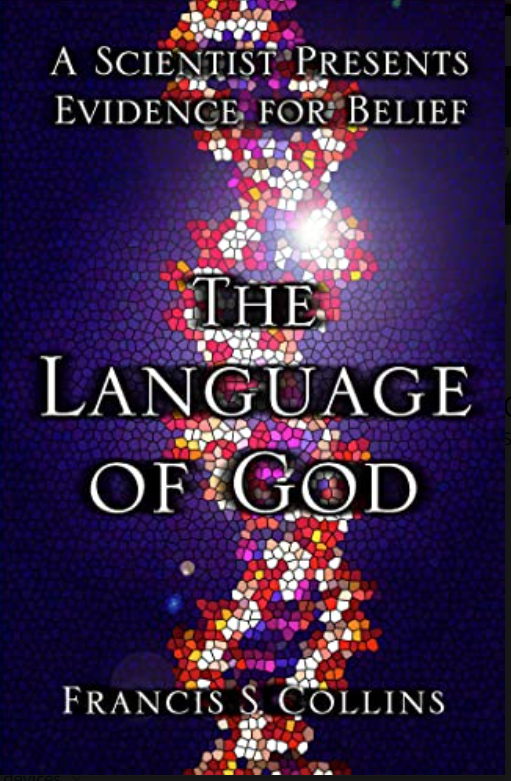
Later, I was at a bookstore with some LCMS members. We were milling about the shelves and I went straight to the Christianity section to see if there were any apologetics books. There, I saw this book with a striking cover that said it was written by a scientist exploring faith. The Language of God , by Francis Collins, unapologetically defended the view of theistic evolution, and I found myself paging through it quickly. I felt guilty for even reading it. Evolution, as I knew, was the enemy of Christianity. But this author was writing about evolution with such confidence as a Christian scientist. He’d had a religious experience himself, and he wrote accessibly and in a winsome fashion. I bought the book away from the others, afraid they might ask me about it. When I read it, it opened my eyes to many possibilities. I wouldn’t immediately come to believe evolution and Christianity were compatible, but I believed that it was possible to believe they were. That wording is intentional, because I want my readers to understand how many steps I had to take along this journey. At this point, I’d come from believing scientists were liars trying to deceive people about the age of the Earth for well, some reason anyway, to believing that it was vaguely possible someone could be a Christian and believe evolution and Christianity were compatible. I cannot emphasize enough how difficult it was to get to that point, and how many side roads and challenges and tears were along the way.
It would take several more years before I could become comfortable with affirming evolution while remaining Christian. I do, now. My first post mentioned religious trauma as part of my time in the LCMS. I haven’t had a lot of ways to portray that so far, but one way I believe I experienced religious trauma from within the LCMS was in the extreme, repeated resistance I experienced regarding science. I adored science, and the religious teachings I experienced led me to be mistrustful of science, and scientists in particular. Christians who were scientists were questionable at best. Like, why would you engage a field full of lies? It would take me more than a decade as an adult to undo that mistrust. Alongside that, it has forced me to question many other things. When you believe things that are easily falsifiable (such as men having one fewer rib than women) and discover that they are, in fact false, it causes a kind of lingering cognitive dissonance that is hard to overcome.
Science is one of the reasons I left the LCMS, but it was intertwined with emotional highs and lows. I experienced crises of faith due to my false beliefs about science. I thought I could no longer believe the Bible because I found evidence in nature that contradicted what I was taught it said. These may seem like small issues to some, but I cannot emphasize how important they were to me, and how important they remain to many others.
Next, we’ll begin exploring other reasons I left the LCMS.
Next: Points of Fracture Part 3
[1] I’ve addressed this in my previous post, but want to point out here that not everything held positionally by the LCMS is spelled out in their teachings. One friend pointed out the helpful categorization related to the LCMS and creationism: the LCMS has a de facto affirmation of young earth creationism, though it is not always made explicit. The evidence is abundant, though one may point to the occasional, very rare exception. On the flip side, the evidence that the LCMS is intrinsically tied to young earth creationism continues to mount. See, for example, my post about an official stance in 2019 that reaffirmed a creationist position.
[2] To tell this story and other parts of this post, I’ve had to very quickly summarize or even skip over parts of creationist arguments. I was fully engaged with YEC at this point and to this day could very easily rattle off numerous arguments in favor of YEC, though I now believe they are mistaken. I know some YEC explanations do exist for these types of formations, but here my goal is to list things that, in the moment, caused me to realize points of departure.
Links
Formerly Lutheran Church – Missouri Synod (LCMS) or Wisconsin Synod (WELS)– A Facebook group I’ve created for people who are former members of either of these church bodies to share stories, support each other, and try to bring change. Note: Anything you post on the internet has the potential to be public and shared anywhere, so if you join and post, be aware of that.
Why I left the Lutheran Church – Missouri Synod Links Hub– Want to follow the whole series? Here’s a hub post with links to all the posts as well as related topics.
Be sure to check out the page for this site on Facebook and Twitter for discussion of posts, links to other pages of interest, random talk about theology/philosophy/apologetics/movies and more!
SDG.
——
The preceding post is the property of J.W. Wartick (apart from quotations, which are the property of their respective owners, and works of art as credited; images are often freely available to the public and J.W. Wartick makes no claims of owning rights to the images unless he makes that explicit) and should not be reproduced in part or in whole without the expressed consent of the author. All content on this site is the property of J.W. Wartick and is made available for individual and personal usage. If you cite from these documents, whether for personal or professional purposes, please give appropriate citation with both the name of the author (J.W. Wartick) and a link to the original URL. If you’d like to repost a post, you may do so, provided you show less than half of the original post on your own site and link to the original post for the rest. You must also appropriately cite the post as noted above. This blog is protected by Creative Commons licensing. By viewing any part of this site, you are agreeing to this usage policy.
Book Review: “Science and the Doctrine of Creation: The Approaches of Ten Modern Theologians” edited by Geoffrey H. Fulkerson and Joel Thomas Chopp

The question of how the doctrine of creation interacts with science (and vice versa) has loomed large in the past few hundred years. Many theologians have offered a whole realm of responses to questions about how these two relate. Science and the Doctrine of Creation brings the views of ten theologians to the forefront, highlighting through essays by different authors the way these theologians interacted with science and creation.
The theologians in this collection range from the late 19th century through the early 21st century. They also span a wide range of denominational backgrounds. This gives the volume a robust look at several different strands of theological thought being applied to the doctrine of creation (though see below, on women).
B.B. Warfield has been at the center of several debates regarding Christianity and science because several different sides want to enlist his writings in their defense. Bradley J. Gundlach clarifies that Warfield’s views on evolution–that it’s complicated–while also showing Warfield’s fascinating piloting of a doctrine of creation that navigates several hot button topics in fairly unique ways. Jürgen Moltmann’s doctrine of creation operates seemingly apart from science, though the author of the essay on his theology, Stephen N. Williams, shows that there is more subtlety there that might provide a way forward in science-faith discussions. Abraham Kuyper’s discussion of science and creation is highlighted by aspects that show that one’s approach and intent may matter just as much as their outcomes, argues Craig Bartholomew (my words summarizing some of his content–see esp. 40-41). These and other highlights of the book show just how deep readers can go in thinking in different ways about the doctrine of creation in light of modern science.
I was disappointed by the overall lack of women in this volume. Only one of the ten essays was written by a woman, and not a single woman was selected as a subject of any of the essays. It is remarkable to me that among all modern theologians, not even one woman was selected to give voice to her view on science and creation. This is particularly egregious given that many women are involved in studying the intersection of the doctrine of creation and science. The book would have been improved by diversifying its sample of theologians and authors.
Science and the Doctrine of Creation shows a broad spectrum of views on the titular topics, but doesn’t integrate as many diverse voices as it may have been nice to see. That said, readers interested in Christianity and science will want to check out this book, particularly to see how wide the range of views there are even among just 10 theologians.
Disclaimer: I was provided with a copy of the book for review by the publisher. I was not required to give any specific kind of feedback whatsoever.
All Links to Amazon are Affiliates links
Links
Be sure to check out the page for this site on Facebook and Twitter for discussion of posts, links to other pages of interest, random talk about theology/philosophy/apologetics/movies and more!
Book Reviews– There are plenty more book reviews to read! Read like crazy! (Scroll down for more, and click at bottom for even more!)
SDG.
——
The preceding post is the property of J.W. Wartick (apart from quotations, which are the property of their respective owners, and works of art as credited; images are often freely available to the public and J.W. Wartick makes no claims of owning rights to the images unless he makes that explicit) and should not be reproduced in part or in whole without the expressed consent of the author. All content on this site is the property of J.W. Wartick and is made available for individual and personal usage. If you cite from these documents, whether for personal or professional purposes, please give appropriate citation with both the name of the author (J.W. Wartick) and a link to the original URL. If you’d like to repost a post, you may do so, provided you show less than half of the original post on your own site and link to the original post for the rest. You must also appropriately cite the post as noted above. This blog is protected by Creative Commons licensing. By viewing any part of this site, you are agreeing to this usage policy.
Book Review: “Thinking About Evolution: 25 Questions Christians Want Answered” by Anjeanette Roberts, Fazale Rana, Sue Dykes, and Mark Perez

Reasons to Believe is a science-faith thinktank that operates from the perspective of Old Earth Creationism. Essentially, they hold that the earth and universe are billions of years old, but that God created progressively. Individual species or families were created by God ex nihilo at different points in time. Recently the organization published a book, Thinking About Evolution: 25 Questions Christians Want Answered that explores the evidence for evolution.
The book is written around 25 chapters corresponding to the eponymous questions. These questions are: “Does Evolution Explain Life on Earth?; Is Religious Belief the Only Reason to Question Evolution?; What’s Philosophy Got to Do With Evolution?; How Can We Keep Our Thinking Free from Fallacy?; Is Evolution Really a Problem for the Christian Faith?; What is Chemical Evolution?; Is Microevolution a Fact?; Does Microbial Evolution Prove Evolution is True>’ Is Natural Selection the Blind Force Driving Evolution?; Is There a Novelty Problem for Evolution?; What to Do with Teleology in Evolution? Can Evolutionary Processes Generate New Information?; Does Evolution Explain the Fossil Record?; What about the Genetic Similarity between Humans and Chimps?; Are the Hominin Fossils Evidence for Human Evolution?; Did Humans and Neanderthals Interbreed?; Did Neanderthals Create Art?; Can Evolutionary Processes Explain the Origin of Eukaryotic Cells?; Can Evolution Repeat Outcomes?; Can Evolutionary Co-option Explain the Irreducible Complexity of Biochemical Systems?; Has Evolution Refuted the Watchmaker Argument?; Is the Watchmaker Really Blind?; Is Junk DNA Evidence for Evolution?; Why Are We Progressive Creationists?; What if Big-E Evolution is True?
I wrote all these chapter titles out because it’s worth seeing that this is the content of the book. At a glance, readers interested in science-faith intersections probably have a number of assumptions about the answers to these questions, given the creationist background of Reasons to Believe. These assumptions may line up, but there are also sure to be some surprises mixed in there. For example, microevolution is most definitely affirmed as factual, but a significant amount of ink is spilled about trying to guarantee Neanderthals aren’t in any way associated with humans.
One thing that’s evident throughout the book is that there are numerous assumptions guiding the way evidence is interpreted by the authors. This is, of course, totally impossible to avoid. We all have assumptions that go into how we interpret anything. But some of these assumptions are put forward as almost obvious statements as though all Christians can or should agree. For example, in the chapter on “Is Evolution Really a Problem for the Christian Faith?” by Fazale Rana, he writes “Science should have no problem detecting a Creator’s handiwork–and even determining a Creator’s attributes,” (72). Prior to this remarkable statement, SETI is cited as an example of scientists attempting to find intelligence based on scientific assumptions. But of course, SETI and similar endeavors are predicated on the notion that intelligence wants to be discovered or that it is, in principle, discoverable. Yet many Christians may oppose this. For example, there is a lengthy tradition and numerous writings related to the hiddenness of God. Paul K. Moser, a philosopher, has written a few books on the topic of evidence for God only being available purposively (for example, The Elusive God). If, as Christian theology affirms, God is personal, then it seems quite possible that a person would have reasons to perhaps hide from or not be available for evidence in conventional means, especially given that person’s goals may be relational to humans rather than purely evidentiary. All of this is to say that certain assumptions made by the authors in this book are worth challenging. The very model that Reasons to Believe operates upon–a kind of strong concordism in which science will ultimately reveal God (or, minimally, unveil that the Bible is unchallenged by science, properly interpreted)–relies upon such assumptions. If they’re mistaken, significant questions about the inputs and outputs of the model would be raised.
The evidence for evolution is extremely strong. I don’t think the authors would seriously dispute that statement, given that they frankly acknowledge microevolution and microbial evolution. However, when confronted by this evidence, and the rather reasonable inference that one can move from small changes over large time to bigger changes, the authors shut down. For example, in the chapter on microbial evolution, Anjeanette Roberts writes, “But does microbial evolution involve production of totally novel protein products, cellular structures, cellular functions, metabolic pathways, or stepping stones to major transitions between kinds of organisms? …That’s highly debatable” (106). One might want to debate this, but the mere fact that just a sentence before, it had been acknowledged that microbial evolution does occur means that such “stepping stones” are in place. If we can observe microbial evolution in such small time spans, then given hundreds of millions of years, it seems to be little more than a lack of imagination to insist that such larger changes could not possibly occur. Of course, that’s not how strongly worded the objection is here. Throughout the book, the authors dance along this fine line of implying the evidence for evolution is highly contentious or questionable while also having to acknowledge that evolution just does occur.
For example, Sue Dykes makes it clear that she questions the existence of transitional forms, but then has to explain away the transitional forms that have been discovered in the fossil record (161ff). The reason to dismiss transitional forms appears to be that Dykes prefers to define transitional forms in the now-archaic way Darwin did as finding exacting step-by-step A-to-B lineages that we know for certain show the transition from A-Z. But this is not how evidence works. If we had the evidence to plays someone at the scene of a crime at the time in which it occurred with the weapon and intent to commit murder, someone coming along and saying “Ah ha! You cannot tell me the exact sequence in which the victim was stabbed!” wouldn’t be a compelling reason to question the suspect’s guilt. The sequence is there, though the order may be hotly contested. Examples Dykes investigates include whale evolution, which is quite frankly a compelling series of transitional fossils. Why are they questioned, then? Because there is the occasional discovery that may perhaps have a fossil dated differently or one form showing up earlier than expected! But that doesn’t really undermine the sequence any more than having one’s ancestor (grandparent, say) still alive today would mean one could not have been born yet. On a total-species level, it would be surprising to see entire species that were successful and ubiquitous enough for there to have actually been preserved fossils of them just dying off the exact moment a somewhat more adapted creature came along. Moreover, it is difficult for me to take seriously the questioning of transitional fossils when so many striking examples have been found. Not just the ones that exist in the public’s memory writ large, but also numerous amazing examples, like turtles, having “halfway” point type fossils. I wrote about some of these elsewhere. Again, do we have every one of the presumably hundreds of species preserved to get from point A-to-Z? No. But missing C, D, F, G, H, and I hardly precludes calling B, E, J, and M transitional forms.
The authors occasionally fall into the unfortunate position of implying that because scientists have updated predictions and models due to changing evidence, we can question the core idea. Sue Dykes writes about Hominin fossils, “It seems that the more we dsicover and the more we test, the more frustrated paleontologists become. New discoveries regularly undermine the ideal of a clear, single evolving lineage leading to modern humankind” (177). Well yes, because I doubt there are any paleontologists who actually that that “ideal” is attainable in actuality. Evolution is messy. It doesn’t produce simple chains. There are offshoots, branches that break off, never to come back, divergence, convergence, and more. Simply having a ton of fossils that fit to show evolution is occurring and not being able to find an “ideal” lineage doesn’t undermine the evidence for evolution. The stunning number of fossils and traits that can be found amongst them instead shows the compelling notion of evolution over time.
I was also surprised to see Fazale Rana seem to argue that evolutionary biologists would think that if we turned back the clock, evolution would just repeat results (225). I believe it was in Dawkins’s work that I read (reading it as a skeptic of evolution, more than a decade ago) that evolution would do the exact opposite. The metaphor was a videotape: if we rolled back the tape, the movie evolution would play would be completely different, because the forces acting upon nature that drive evolution couldn’t possibly be replicated. This seems to undermine the whole chapter in which Rana makes this statement about replicating results. Convergent evolution doesn’t really seem to be evidence against evolution, either, which is the somewhat confusing point that may be alluded to in this chapter (“Can Evolution Repeat Outcomes?”). Instead, Rana argues convergence points to progressive creationism due to shared features. But this was not established in the text, and the point Rana made about rewinding the clock seems to me to be mistaken.
A few chapters hint at more difficult problems for evolution. The question of irreducible complexity was compelling to me for quite a while, but though the authors here make the case, it still seems that co-option is but one of the several possible ways evolution could account for seemingly irreducible complexity. As has been pointed out by others much more in the know than I, irreducible complexity itself is something of a construct. For example, it may be the case that taking out a part of the eye that allows us to focus upon something would make the eye unable to function as an eye, but it would hardly make it useless. The mere ability to sense light/dark would be extremely advantageous on a number of levels. Another problem that is raised in the book is the question of generating information. I myself have become pretty skeptical of this argument, though, because it seems something of a category error. Yes, there is a strong metaphorical connection between human written language and the “language” of DNA, but to equate them to the point that is required for introducing intelligent design into the process is a stretch at best. Rana makes his case by pointing to the stunning improbability of randomly producing a functional cytochrome (153), but the very nature of evolution makes this nonsensical. Evolution isn’t randomly generating series of DNA strands in order to, hopefully, come up with a functional and beneficial protein. Instead, it is operating upon existing, functional (and even deleterious or non-functional) features. Simply stating blind probabilities is to massively overstate the range of actual possibility.
The concluding chapter is perhaps the best chapter of its kind I’ve read in any creationist literature anywhere. Anjeanette Roberts writes, “there are many faithful Christians today who confess Christ as Lord, hold the Bible as the authoritative Word of God, and believe in real miraculous events… while also holding that God used the initial conditions he established at the creation along with evolutionary processes to accomplish his purposes for life’s biological history on Earth” (282).
Later, she writes, “After all, it is not one’s view of origins that determines a person’s Christian status” (ibid). Then, she writes this great counterfactual: “If at some point in the future, the scientific evidence shows that evolutionary mechanisms are the mechanisms of god’s creation, then interpretive models… will fill a needed space in biblical Christian thought,” (283). Though not fully stating it, it is clear the implications here are that Roberts, and presumably other RTB scholars, are acknowledging that if evidence existed to convince them evolution were true, they would utilize some of the models for reconciling that with biblical truth that they already see as viable. This is an extraordinarily honest position, particularly for a creationist organization. Too often, people accuse creationists of being liars and/or deceivers, obfuscating truth. I have noted numerous points of disagreement with the book in my own review here. But let it be said that I think that RTB has done extremely valuable work, and that they’ll continue to do so. I can’t help but admire the integrity and honesty of their scholars, and am honored to work alongside them for God’s Kingdom.
Thinking About Evolution will give readers a solid base for understanding the most prominent old earth creationist perspective. While I think that the case it builds against evolution is lacking, I appreciate the candor, the integrity, and the genuine searching for truth the authors are pursuing. Readers interested in the intersection of Christianity and science will appreciate this book.
Disclaimer: I was provided with a copy of the book for review by the publisher. I was not required to give any specific kind of feedback whatsoever.
Links
Be sure to check out the page for this site on Facebook and Twitter for discussion of posts, links to other pages of interest, random talk about theology/philosophy/apologetics/movies and more!
Book Reviews– There are plenty more book reviews to read! Read like crazy! (Scroll down for more, and click at bottom for even more!)
SDG.
——
The preceding post is the property of J.W. Wartick (apart from quotations, which are the property of their respective owners, and works of art as credited; images are often freely available to the public and J.W. Wartick makes no claims of owning rights to the images unless he makes that explicit) and should not be reproduced in part or in whole without the expressed consent of the author. All content on this site is the property of J.W. Wartick and is made available for individual and personal usage. If you cite from these documents, whether for personal or professional purposes, please give appropriate citation with both the name of the author (J.W. Wartick) and a link to the original URL. If you’d like to repost a post, you may do so, provided you show less than half of the original post on your own site and link to the original post for the rest. You must also appropriately cite the post as noted above. This blog is protected by Creative Commons licensing. By viewing any part of this site, you are agreeing to this usage policy.
Book Review: “Embracing Evolution: How Understanding Science Can Strengthen Your Christian Life” by Matthew Nelson Hill
 Embracing Evolution by Matthew Nelson Hill is a surprising and engaging book about Christianity and science. Hill is also the author of Evolution and Holiness (my review here), another novel book that looked at how evolutionary science could inform specifically Wesleyan notions of holiness and perfection. Here, Hill calls Christians to come to understand that, far from being something that undermines Christianity, evolution can provide a fruitful grounds for exploration of the Christian life.
The intriguing premise of Embracing Evolution means that as a reader, I was hoping it would provide even more exploration of that premise–that evolution can be grounds for exploring the Christian life. I was somewhat surprised to then see several chapters dedicated to showing the basics of reading the Bible and understanding the science of evolution and its relation to theology. These are good chapters to introduce readers who may not have considered this intersection in a positive light before, or who need some background on evolution to understand its potential applications.
The rubber does finally meet the road in the final three chapters of this pithy book, as Hill explores how evolution can inform various aspects of Christian living. The first thing Hill points out is that acknowledging evolutionary heritage gives us knowledge which allows us to bring about change. Genetic lineage can help trace disease as well as potential mental illness, and this can help us care for our bodies. Additionally, instincts to eat certain kinds of food at all times have been outpaced by the changes we have made in the way we live. Because we have access to agriculture and (generally) more than just meat, humans have outpaced the rate at which built-in instincts with the brain can operate. This means that we need to shape behavior to work against various temptations which may entrap us. But, as Hill writes, evolutionary heritage isn’t just baggage, it can also bring about avenues for hope. We can work to “overcome [our] genes and live holy lives” (113, emphasis his). Here, Hill advocates again a Wesleyan approach that sees the Holy Spirit’s action and human free will working together to live holiness, as God works within creation (114-115).
Embracing Evolution is an intriguing book full of new avenues for exploration. Readers interested in finding out how Christianity might be positively impacted by evolutionary theory–particularly if they favor a Wesleyan theology–will see this as a must-read.
Disclaimer: I was provided with a copy of the book for review by the publisher. I was not required to give any specific kind of feedback whatsoever.
Links
Be sure to check out the page for this site on Facebook and Twitter for discussion of posts, links to other pages of interest, random talk about theology/philosophy/apologetics/movies and more!
Book Reviews– There are plenty more book reviews to read! Read like crazy! (Scroll down for more, and click at bottom for even more!)
SDG.
——
The preceding post is the property of J.W. Wartick (apart from quotations, which are the property of their respective owners, and works of art as credited; images are often freely available to the public and J.W. Wartick makes no claims of owning rights to the images unless he makes that explicit) and should not be reproduced in part or in whole without the expressed consent of the author. All content on this site is the property of J.W. Wartick and is made available for individual and personal usage. If you cite from these documents, whether for personal or professional purposes, please give appropriate citation with both the name of the author (J.W. Wartick) and a link to the original URL. If you’d like to repost a post, you may do so, provided you show less than half of the original post on your own site and link to the original post for the rest. You must also appropriately cite the post as noted above. This blog is protected by Creative Commons licensing. By viewing any part of this site, you are agreeing to this usage policy.
Book Review: “Weathering Climate Change” by Hugh Ross
 Hugh Ross is the founder of Reasons to Believe, a science-faith think-tank that approaches the topics from an Old Earth Creationist perspective. Ross’s latest book, Weathering Climate Change, presents a view of climate change from that same perspective. Ross, however, does not succumb to the pitfalls of denying climate change or trying to sugarcoat humanity’s impact on it. Instead, the book provides an in-depth look at the factors causing climate change, its potential impact, on ways that humanity might mitigate some of the impact, all set alongside a perspective that sees humanity as called by God to care for creation.
The majority of the book is occupied by presenting readers with the data. This is surely intentional, given the vast array of misinformation available a click away online. Ross presents chart after chart with data from reputable sources, showing the clear fact that what we’re experiencing now is irregular and not simply part of a broader pattern of Earth’s climate change. However, he also notes the historical data and how the Earth has undergone severe climate changes, and notes that our current period of relative stability is an exception.
That said, Ross doesn’t use that climate change to dismiss our current situation–time and again, he notes the severe nature of human impact on the climate and demonstrates that it is much more than another part of Earth’s natural cycle. This care for approaching the data, both modern and ancient, means that Ross is able to present readers with a fuller picture, hopefully leading them to grasp more accurately the state of the climate today.
Ross also analyzes several paths forward to combat climate change. What’s interesting is that he offers these while recognizing human’s sinful propensity to avoid long term problems and continue harmful behaviors that make them comfortable. Many of these solutions are outside of the box. For example, ending all consumption of red meat would make a huge impact, but it would also drive black markets for red meat and many likely would rebel against restrictions on such consumption. So an alternative solution, offers Ross, is to switch the kind of red meat consumed. In a surprising turn, he argues that ostriches could provide a middle way, allowing people to consume red meat (apparently similar to beef), while also mitigating much of the methane (and other) problem(s) related to wide consumption of beef.
Other, more enormous solutions, are also proposed. Re-planting parts of the Sahara, creating massive solar panels that can both block some sunlight while using it for energy, and more are analyzed both for the potential impact they could have and also for their practicality. It’s a quite refreshing turn, and certainly not what skeptics of creationism (honestly, including myself), might expect from someone who’s avowedly a creationist (of the Old Earth variety). The presentation of the data, analysis of solutions, and look at long-term trends are all, so far as this reviewer can tell (as someone who reads science texts but is by no means an expert), quite accurate and informative.
Ross also offers all of this alongside comments that the trends are part of God’s plan for humanity, allowing for humans to be–on his view–created at just the right moment for use of fossil fuels, for climate stability, and more. While some readers may balk at this, it is imperative to underscore the importance of a work like this, that introduces audiences who might otherwise not interact with the climate change data to hard science that backs up broader scientific consensus.
Weathering Climate Change is an unexpected delight. Ross offers a thorough look at the evidence for climate change, the recent history of Earth’s climate (in geologic terms), and potential solutions from the perspective of a creationist, without ever balking at the scientific challenges to his own perspective. He also offers it alongside his characteristic grace with competing views and his heart for speaking about God to those who will hear. I recommend it, even if you (like me), do not necessarily agree with all of his position. It will inform you and maybe even surprise you, as it did me.
Disclaimer: I was provided with a copy of the book for review by the publisher. I was not required to give any specific kind of feedback whatsoever.
Links
Be sure to check out the page for this site on Facebook and Twitter for discussion of posts, links to other pages of interest, random talk about theology/philosophy/apologetics/movies and more!
Book Reviews– There are plenty more book reviews to read! Read like crazy! (Scroll down for more, and click at bottom for even more!)
SDG.
——
The preceding post is the property of J.W. Wartick (apart from quotations, which are the property of their respective owners, and works of art as credited; images are often freely available to the public and J.W. Wartick makes no claims of owning rights to the images unless he makes that explicit) and should not be reproduced in part or in whole without the expressed consent of the author. All content on this site is the property of J.W. Wartick and is made available for individual and personal usage. If you cite from these documents, whether for personal or professional purposes, please give appropriate citation with both the name of the author (J.W. Wartick) and a link to the original URL. If you’d like to repost a post, you may do so, provided you show less than half of the original post on your own site and link to the original post for the rest. You must also appropriately cite the post as noted above. This blog is protected by Creative Commons licensing. By viewing any part of this site, you are agreeing to this usage policy.
Book Review: “The Genealogical Adam and Eve” by S. Joshua Swamidass
There is little doubt that an enormous amount of ink has been spilled over the question of the historicity of Adam and Eve given an evolutionary account. Often, the charge against theistic evolutionists is that they cannot or do not affirm what is thought to be required of biblical theology related to Adam and Eve. At other times, appeal to Adam and Eve is looked down upon as a quaint, outdated, and clearly mistaken view. Into that fray steps S. Joshua Swamidass with the book The Genealogical Adam & Eve: The Surprising Science of Universal Ancestry. Swamidass argues that there is a way past these seemingly endless debates.
The genealogical hypothesis is central to Swamidass’s argument. Swamidass’s thesis is genealogical, not genetic. Genetics can be used to provide a “tunnel vision” for ancestry (31), but genealogical ancestry is a broader, common language way of looking at ancestry. The hypothesis has 6 main components: 1. Adam and Eve lived recently in the Middle East; 2. they are the genealogical ancestors of everyone (specifically by AD 1); 3. They are specially, or de novo created; 4. interbreeding occurred between the lineage of Adam and Eve and others; 5. no additional miracles apart from special creation of Adam and Eve are allowed (for the purpose of the hypothesis); 6. assume two findings of evolutionary science: human descent common with the great apes and that the size of the human population never dipped to a single couple (p. 26-27).
Swamidass argues that rather than looking at trying to tie all humans together genetically, we may be able to do so genealogically. Once one traces ancestry back by a certain number of generations, one will effectively have so many ancestors that the number would exceed the number of humans who were alive at the time. That’s an absurd conclusion, of course, but it doesn’t account for the way that family trees intermingle and mesh together in many different ways. Nevertheless, due to the exponential way that tracing one’s family history back, Swamidass argues that it’s likely that we can argue that all humans have common ancestors as recently as several thousand years ago.
Swamidass takes this extrapolation and notes that because of this, one can affirm most of the major tenets of traditional Christian belief regarding Adam and Eve. Adam and Eve could have been specially created–science cannot test for this either way–a few thousand years ago, and still be the common ancestors of all living humans. What his thesis does have, of course, is humans outside the garden. But Swamidass notes that even traditional readings of the text have struggled with that due to questions of who Adam and Eve’s children married, or who Cain was afraid of, etc.
One could easily see how Swamidass’s hypothesis could be tweaked in different ways depending upon one’s own conclusions about the data or theological presuppositions. Some theistic evolutionists would likely dispute thesis 3, while creationists would dispute several theses. But what Swamidass has done is effectively offered a possible solution to the many, many science-faith controversies related to Adam and Eve. One can, on Swamidass’s thesis, affirm both the findings of evolutionary biology as well as virtually every aspect of the traditional view of Adam and Eve. The extraordinary import of this should not be understated: Swamidass has offered a defense of a hypothesis that virtually anyone who has written on the topic will need to contend with.
The Genealogical Adam & Eve is sure to be a controversial book. Yet hopefully, within that controversy, there can be a discussion of coming to agreement on specific doctrinal topics, and a broadening of areas where unity can be found. Swamidass has done serious, scholarly work here that anyone who wants to deal with the topic of Adam and Eve will need to address.
Disclaimer: I was provided with a copy of the book for review by the publisher. I was not required to give any specific kind of feedback whatsoever.
Links
Be sure to check out the page for this site on Facebook and Twitter for discussion of posts, links to other pages of interest, random talk about theology/philosophy/apologetics/movies and more!
Book Reviews– There are plenty more book reviews to read! Read like crazy! (Scroll down for more, and click at bottom for even more!)
SDG.
——
The preceding post is the property of J.W. Wartick (apart from quotations, which are the property of their respective owners, and works of art as credited; images are often freely available to the public and J.W. Wartick makes no claims of owning rights to the images unless he makes that explicit) and should not be reproduced in part or in whole without the expressed consent of the author. All content on this site is the property of J.W. Wartick and is made available for individual and personal usage. If you cite from these documents, whether for personal or professional purposes, please give appropriate citation with both the name of the author (J.W. Wartick) and a link to the original URL. If you’d like to repost a post, you may do so, provided you show less than half of the original post on your own site and link to the original post for the rest. You must also appropriately cite the post as noted above. This blog is protected by Creative Commons licensing. By viewing any part of this site, you are agreeing to this usage policy.

 J.W. Wartick - Reconstructing Faith