Christianity
Book Review: “No Other God: A Response to Open Theism” by John Frame
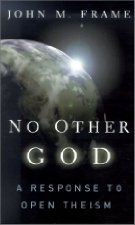 I recently finished No Other God
Areas of Agreement
One of the strengths of Frame’s book is how clear his thinking is. His style of argumentation is precise, and he clearly lays out what he considers evidence for his positions. He is unafraid to make statements with huge implications.
A particularly interesting aspect of Frame’s work was a brief historical look at the roots of Open Theism, leading it back to the Socinianism. Frame points out that advocates of Open Theism tend to portray their view as the “new theology on the block” despite the fact that it has been around (and rejected) for quite some time.
I believe Frame is correct when he argues against the centralization of any one attribute of God. Specifically, the centralization of love on Open Theism tends to ignore other important attributes of God (49ff). (Interestingly, Frame’s own account of God unnecessarily over-emphasizes Sovereignty, though he disguises this by calling it “Lordship.)
Frame levels strong critiques against Open Theism’s reading of Scripture. Open Theists tend to advocate the “straightforward” reading of texts which help their case. One of Open Theist’s favorite passages is God testing Abraham. Yet Frame rightly notes that if there is a straightforward reading of the text, then God did not know the present truth of Abraham’s heart, whereas Open Theists attempt to use this to support God not knowing the future (47). Further, if God was trying to figure out how Abraham would act in the future, then He was trying to do something He couldn’t (determine what the libertarian free choices of humans would be) according to Open Theism. So the story’s straightforward reading does not work to support Open Theism. Frame urges a similar examination of other passages, though he doesn’t expand on it.
Areas of Disagreement
Despite these areas of agreement, I vehemently oppose Frame’s position on several issues. Most notably, on theistic determinism, compatibilism, and libertarianism.
First, libertarianism. Frame correctly notes that the core of Open Theism is the assumption of libertarianism. Yet his critique of libertarianism is wrongheaded. He caricatures libertarians as believing that choices are made in the absence of any motivation. He writes, commenting on the libertarian view, “if our decisions are caused by anything or anyone (including our own desires), they are not properly our decisions… to be responsible, we must be able to do otherwise” (121). Yet this is explicitly not libertarianism. Peter van Inwagen, for example, explicates libertarianism by saying “…that someone’s acts are undetermined does not entail that they are uncaused” (van Inwagen, An Essay on Free Will, Oxford: 1983, p. 14).
But Frame explicitly centers his critique of libertarianism on a contra-causal account of freedom, saying, for example, “If guilt presupposed libertarian freedom, then in order to show that Hubert [a man accused of robbing a bank] is guilty, the prosecutor would have to show that his decision to rob a bank had no cause…” (126). But again, libertarians deny this very type of contra-causal freedom, so Frame is arguing against a straw man. Because Frame thinks libertarianism is so utterly central to Open Theism, this means that the core of his critique fails to hit home.
The problem with Frame’s counter against libertarianism is that it barely touches the surface of the philosophical arguments for the position. He correctly rails against the idea that our actions are just random occurrences, but incorrectly assumes that this is libertarianism.
Finally, the greatest area of disagreement I have with Frame is on his view of omnidetermination. Consider the following two quotes:
“The uniform witness of Scripture is that the evils of this life come from God” (140).
“…[I]t is important to see that God does in fact bring about the sinful behavior of human beings, whatever problems that may create in our understanding” (68).
I’d be curious to see how Frame reconciles these assertions with the constant witness of Scripture that God is just; fair; good; opposed to evil; etc. Frame utilizes several verses to support his position, but he makes primary those which say God uses “all things” and verses which say calamities are from God. But regarding the former, this can easily refer simply to permissive will, and regarding the latter, the verses he uses are out of context (and even were one to grant the “straightforward reading,” one could counter by saying the calamities are not every evil action, but merely those things which God uses–i.e. storms, other nations, etc.–to instruct His people). Frame, like many theological determinists, is not building even on sand, but on a void. Literally saying that God causes evil is so utterly repugnant and contrary to Scripture that this view overshadows all the good things Frame has to say.
Conclusions
Ultimately, No Other God is on target in a few ways, but it is wildly gunning the wrong direction on too many issues. Frame’s philosophical case against libertarianism is off the mark, he fails to deal with the strong philosophical arguments for libertarianism, and his view that God literally causes evil is baseless. Interestingly, while I went in reading this book looking for some good arguments against Open Theism, I came out with the realization that theological determinism is a far more dangerous doctrine indeed.
SDG.
Check out other posts about Open Theism here.
John Frame,No Other God
——
The preceding post is the property of J.W. Wartick (apart from citations, which are the property of their respective owners) and should not be reproduced in part or in whole without the expressed consent of the author. All content on this site is the property of J.W. Wartick and is made available for individual and personal usage. If you cite from these documents, whether for personal or professional purposes, please give appropriate citation with both the name of the author (J.W. Wartick) and a link to the original URL. This blog is protected by Creative Commons licensing. By viewing any part of this site, you are agreeing to this usage policy.
Refutation of Zeitgeist the Movie/farce.
One popular atheistic movie is “Zeitgeist,” a movie which purports (basically) to show that Christianity is made up , among other things.
As Peter Van Inwagen once said, it’s better to be right than original (irony? he wrote this in An Essay on Free Will), so I suggest anyone interested in refuting this farce of a “documentary” should go listen to Glenn Peoples’ podcast on the topic, found: HERE. Also, check out this great article which breaks Zeitgeist down point-by-point: HERE.
Those interested enough to check it out, I recommend watching the documentary, then listening to the podcast. Peoples really does an excellent job taking it down.
Book Review: “Eternal God: A Study of God Without Time” by Paul Helm
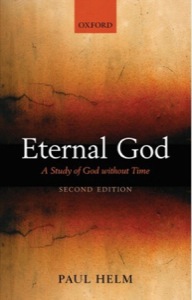 Paul Helm is, in my opinion, one of the most lucid thinkers on the topic of God and Time. His Eternal God
Helm points out early in his book that the issue of divine temporality/atemporality is “underdetermined” in Scripture (7). This means it’s one of those fun issues that lies most squarely in philosophy of religion.
And that is where Helm excels. Chapter-by-chapter he outlines a cohesive case for divine atemporality. Where Paul is most successful, I think, is in his rebuttals of arguments for temporality. For example, a well-known argument for temporality is that if God interacts in time, he must be temporal. Helm counters by pointing out that a precisely parallel argument could be constructed for God and space. Yet few Christian philosophers accept that God is spatial (49ff). While this doesn’t rebut the argument, it does point out something important: it doesn’t seem as though the conclusion (God is temporal) follows from the premise (God interacts in time) any more than it would if it were spatial (God is spatial/God interacts with space).
There are many different accounts of divine timelessness, from Brian Leftow’s spaceless timelessness (see his work Time and Eternity) to relative timelessness, and beyond. Helm takes the much less popular route and takes the tough pill of saying that God created spacetime as a static bloc. This allows Helm to easily deny many of the arguments for temporality which stem from a-theory or dynamic time. But it also raises many problems. Foremost among these (in my opinion) is human freedom. For, on the B-Theory of time (static theory), everything which will ever happen, has happened, and in a sense exists. As we go from moment to moment, we’re really just passing through a bloc of spacetime, we aren’t literally moving through a present. Presentness is a subjective phenomenon, given static/B-theory. It’s just our perspective. So where does human responsibility and freedom come in?
Helm here turns to compatibilism. He freely admits that timeless creation entails determinism (170). Thus, he denies that humans have free will in the libertarian sense. But this, he argues, does not undermine human responsibility. I don’t think I can do justice to the nuances of his argument, but the basic idea is that Helm argues that just because past actions/events determine our actions in the future, that doesn’t mean that we aren’t responsible for what we do. As I said, this is a really, really watered down version of his argument, but I think this is one of the weaker points of his work.
Why? Because the idea of responsibility simply does not make sense on determinism, particularly when it is theistic determinism. For consider the idea proposed here. God has created all of time and space as one bloc. Thus, everything I do or have ever done was created by God once he brought the universe into being. Literally, everything I did, I do because God created the universe such that I would do x. So how could it be that I am responsible for doing x, if I never chose to do x. I simply do x because I have to, I have “already” done it, on the static theory. If I could create a time travel device, I could travel forward in time and see myself doing x, and could not prevent it, because God created the world such that I would do x. But the core of responsibility is that I chose to do x. While we punish people for things they do by accident (vehicular manslaughter, for example, or accidentally breaking a window), these things still resulted from prior choices (playing baseball near breakable window/driving carelessly). I simply do not see how any account of responsibility could make sense unless someone can choose to do what they do.
There are several different positions about divine temporality/atemporality. Helm swallows the hard pill of going with the static theory of time to ground his divine atemporality. This, I believe, grants his account extreme philosophical plausibility. If God created the entire universe as a space-time continuum (I’ve always wanted to use that phrase from Star Trek!), then there’s no reason to suppose God would be affected by time. It’s ontologically outside of God, and all of his interactions already have taken place. While I’ve already pointed out some of the problems with this view, these problems are not with the coherence of the view but with the theological nature of it. Thus, I think it possible to say that Helm has adequately defended a position of divine eternity.
It would be impossible to cover everything of interest in such a comprehensive look at the topic of divine timelessness. Helm analyzes an extraordinary number of arguments in great detail. I cannot recommend the book more highly. Although I ultimately reject Helm’s second contention (B-theory), I believe his view is extremely coherent, and I can find little fault in it. Anyone interested in the issue of God’s relationship to time must read this book. It’s a book I think I shall re-read so that I can better grasp his arguments.
(Note: This review is based on the recently published second edition of this text, which includes several new chapters with much of interest, including a rebuttal of William Lane Craig’s arguments against timelessness. I recommend interested readers get their hands on the newer edition.)
SDG.
Source:
Paul Helm, Eternal God
——
The preceding post is the property of J.W. Wartick (apart from citations, which are the property of their respective owners) and should not be reproduced in part or in whole without the expressed consent of the author. All content on this site is the property of J.W. Wartick and is made available for individual and personal usage. If you cite from these documents, whether for personal or professional purposes, please give appropriate citation with both the name of the author (J.W. Wartick) and a link to the original URL. This blog is protected by Creative Commons licensing. By viewing any part of this site, you are agreeing to this usage policy.
Letter to a free thinker.
Dear Free Thinker,
What does it mean to think freely?
Does it mean I must be an atheist?
You tell me there is no evidence for the existence of God.
You say that there is more evidence for unicorns than the object of my worship.
You tell me that I’m an atheist too.
Why do you say “we’re all atheists” when I believe in God?
You tell me “That’s just your interpretation”; “You’re wrong”; “I’m right.”
I reject science, according to you. I don’t know how to open my eyes. I’m blind, foolish, and stubborn.
You say that I’m delusional, and that my belief is a disease.
I have a final question:
Am I allowed to think freely…
Or is it just you?
Sincerely,
J.W. Wartick
——
The preceding post is the property of J.W. Wartick (apart from citations, which are the property of their respective owners) and should not be reproduced in part or in whole without the expressed consent of the author. All content on this site is the property of J.W. Wartick and is made available for individual and personal usage. If you cite from these documents, whether for personal or professional purposes, please give appropriate citation with both the name of the author (J.W. Wartick) and a link to the original URL. This blog is protected by Creative Commons licensing. By viewing any part of this site, you are agreeing to this usage policy.
Atheists and Unicorns: Emotional Appeal

 You may have heard it before. “I’m an a-unicornist, just like I’m an atheist.” “I don’t believe in unicorns, nor do I believe in God.” “There’s as much evidence for unicorns as for God.”
What are these statements supposed to show?
Whether intended or not, these kinds of statements are simply emotional appeals. The atheist is attempting to psychologically discredit Christianity without ever engaging any kind of logical reasoning.
Think about it, when you hear these phrases, what rational process goes on? There is no rational link between unicorns and theism. There is no reason to correlate the two.
Theists could just as easily use psychological appeals, but there is no need to do so. Such pejorative language doesn’t serve to foster discussion. It’s preaching to the choir. It is useful only for increasing dogmatism. So why do atheists use it so frequently?
Again, the key is to note that those who use this phrase are not doing so in the interest of academic honesty or discussion, but in the interest of psychologically weighting the discussion in their favor before it even begins. Rather than looking at the evidence, they dismiss it.
But what about another common use of the unicorn within atheism? Namely “I can’t prove there is no God, just like I can’t prove there are no unicorns.”
While this initially seems plausible, it only remains plausible if one assumes positivism. We can actually prove there is no God. If the Christian’s account of God was found to be incoherent, then God would not exist. It would, in fact, be impossible for God to exist were his nature contradictory.
So even in this use of the phrase we find that the atheist is committed to a dogmatic assumption of positivism. By assuming that God can only be disproven by empirical evidence, they uncritically advance a philosophical enterprise which has largely been abandoned within modern philosophy.
A word of advice: focus on the arguments at hand, not pejorative language.
SDG.
——
The preceding post is the property of J.W. Wartick (apart from citations, which are the property of their respective owners) and should not be reproduced in part or in whole without the expressed consent of the author. All content on this site is the property of J.W. Wartick and is made available for individual and personal usage. If you cite from these documents, whether for personal or professional purposes, please give appropriate citation with both the name of the author (J.W. Wartick) and a link to the original URL. This blog is protected by Creative Commons licensing. By viewing any part of this site, you are agreeing to this usage policy.
Against Open Theism: Scrooge and God’s knowledge of the Future
 I was listening to William Lane Craig’s Defenders podcast (Doctrine of God: Part 13) and he brought up an interesting analogy about omniscience. He discussed Scrooge in Dickens’ “Christmas Carol.” The last spirit to appear to Scrooge is the ghost of Christmas to come. He takes Scrooge around and shows him all sorts of disturbing imagery that will happen. Scrooge asks the ghost whether these are things that must happen, or whether he can stop them. The spirit remains silent.
Craig pointed out the spirit would have to remain silent to have any sort of effect. For suppose the spirit knows what will happen: that Scrooge will repent and so these awful things won’t happen. But then if he tells Scrooge what he knows, Scrooge will feel little remorse about not acting to prevent them. Yet if the spirit told Scrooge these things would happen, then Scrooge has no reason to modify his behavior, for he cannot prevent the events from happening.
Craig suggests, then, that we should look at omniscience and instances of God “changing his mind” in the same fashion. This has some interesting applications in the case of Open Theism, because it undermines one of the core exegetical arguments for the position: cases of God “repenting” or “changing his mind.”
God, on classical theism, knows what will happen in every circumstance. He comprehensively knows the future (contra Open Theism). If this is so, then God would have to withhold some of his knowledge in order to bring things about, despite his knowledge that it would occur. Like the Ghost of Christmas Yet to Come, God would know the answer to Scrooge’s question, but would not answer him, so that he could bring it about that Scrooge would repent.
Consider Jonah. Open Theists often point to the story of Nineveh as an example of God not comprehensively knowing the future. Because God sends Jonah with the message that Nineveh will be destroyed, but then, when Nineveh repents, he shows mercy, many people say that God did not know the Ninevites would have such a reaction. Yet why should this be the case? Isn’t it plausible that God did know they would repent and that God sent the message that they would be destroyed because that is the only way Nineveh would be led to repentance? This is, in fact, hinted at later in the book, when Jonah says to God, “Isn’t this what I said, LORD, when I was still at home? That is what I tried to forestall by fleeing to Tarshish. I knew that you are a gracious and compassionate God, slow to anger and abounding in love, a God who relents from sending calamity” (4:2).
But if God had told the Ninevites “I will not destroy you” because he knew that he would not, would not the impetus of Jonah’s message lose its strength. With the threat of destruction, the Ninevites repented. Without, would they have done so? Imagine Jonah’s message going through the streets “Forty more days and Nineveh will not be destroyed!” I think it obvious that this would probably not have the same effect that the initial message was.
So it seems quite plausible that God, like the Ghost of Christmas Yet to Come (in our analogous case), may refrain from telling all he knows at many points throughout Scripture. For if he told people everything he knew, he would know that they would not repent, turn aside from their evil ways, or bring about the actions he desired. The instances wherein God ‘changes his mind’ or ‘repents’ are instances of this: rather than revealing his knowledge, God withholds it, in order to bring about the ends that he desires to (and knows will) happen. We, like Scrooge, would not respond to calls for repentance if we felt it didn’t make a difference in the end.
Final note: the above account implicitly assumes molinism to be the case. So much the better for it, I say!
SDG.
This is part of a series I’ve written against the doctrine of Open Theism. If you’d like to read more, check out the original post for discussion and links.
——
The preceding post is the property of J.W. Wartick (apart from citations, which are the property of their respective owners) and should not be reproduced in part or in whole without the expressed consent of the author. All content on this site is the property of J.W. Wartick and is made available for individual and personal usage. If you cite from these documents, whether for personal or professional purposes, please give appropriate citation with both the name of the author (J.W. Wartick) and a link to the original URL. This blog is protected by Creative Commons licensing. By viewing any part of this site, you are agreeing to this usage policy.
Book Review: “God Behaving Badly” by David Lamb
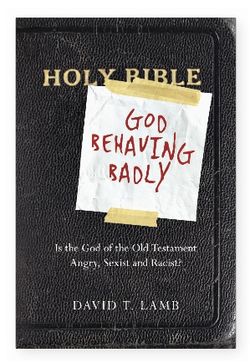 David Lamb’s God Behaving Badly
Throughout the book, Lamb follows a similar outline through each chapter: introduce tough texts, provide answers, synthesize general remarks. Lamb is unafraid to take on the toughest Scripture passages (1 Sam 4-5; Gen 3; Josh 10, 11, etc.). He points out rightly that people who line up on either side of these issues tend to ignore the texts on the other side. Those who call God angry, racist, sexist, and the like tend to ignore those passages which portray God as loving, welcoming, and empowering. Similarly, too many Christians ignore the ‘tough’ passages.
Lamb’s book excels in many specific areas. When discussing issues related to women, Lamb follows William Webb’s “redemptive/progressive” hermeneutic and points out that God is not sexist, but affirming. His treatment of the oft-misunderstood Genesis account is superb. Most interestingly in relation to women in the Bible, he writes, “If it is okay for women to compose sections of the Bible, perhaps we should let them teach it?”(64). Lamb’s scholarship in the Old Testament shines through on numerous occasions throughout the work. He points out the Ancient Near Eastern tendency to utilize hyperbole in descriptions of conquests (77).
There is one major point of divergence I feel with Lamb, however, and that is in the area of mutability/immutability. Without getting too far afield, it is worth noting that Lamb’s treatment of God’s interaction with people is a bit off, in my opinion. While noting texts which say God does not change, Lamb also notes those in which God appears to change his mind. He goes on to say,
Is it good that God changes his mind? …If you are a child who deserves to be punished, it is good when a parent changes his mind about your punishment. If you are a car buyer, it is bad when a used-car dealer changes his mind about the low price he had promised (151).
The words I wrote in my notes were “gross anthropomorphism.” The reason is because while it may be written that God “changes his mind” it would be very strange to say that He could be compared to the cases Lamb points out. God, knowing the future, would know what was going to happen, and so to say that God is like a parent changing their mind seems a bit out of place. I’ll not delve into a major argument with this, but Lamb brings up the case of Jonah as an example for this. Yet it seems from the book of Jonah that God knew Nineveh would repent–the very reason he sent Jonah in the first place (and the reason Jonah did not initially want to go). For it would not make sense for Jonah to be so upset about being sent to Nineveh to tell them to repent if he felt God would punish them regardless. In any case, this does little to undermine Lamb’s overall argument, but it is worth noting as a flaw. A final note I’d like to make is that Lamb frequently uses God’s divine name. This may be off-putting to some readers who feel it should only be presented as the Tetragrammaton, YHWH.
The conclusion of GBB is simply fantastic. Lamb sums up his points in each chapter (a feature I think every conclusion should have).
God Behaving Badly is a great introductory look at a well-known challenge to Christianity. Lamb doesn’t ignore the hard issues in the Bible and tackles them with sincerity and intelligence. I recommend the book to those looking to start exploring issues related to God’s moral nature.
SDG.
——
The preceding post is the property of J.W. Wartick (apart from citations, which are the property of their respective owners) and should not be reproduced in part or in whole without the expressed consent of the author. All content on this site is the property of J.W. Wartick and is made available for individual and personal usage. If you cite from these documents, whether for personal or professional purposes, please give appropriate citation with both the name of the author (J.W. Wartick) and a link to the original URL. This blog is protected by Creative Commons licensing. By viewing any part of this site, you are agreeing to this usage policy.
The Unacknowledged Teachers: an argument for women pastors.
 An argument for the position of egalitarianism (the position that women are not to be restricted from certain offices in the church):
1) Women say things in Scripture which are not condemned (cf. Deborah’s song, Mary’s Magnificat which is used in liturgical worship, Ruth’s words which are used in wedding ceremonies, Esther’s story and her actions, etc., etc.). [Edit: this premise must be made more clear. The things women say in Scripture are not simply not condemned, but are often explicitly centralized. The Song of Deborah; Ruth’s words to Naomi; the magnificat; etc. These words are made into liturgies and used for teaching. Yet they are the words of women. Thanks to Adam at Unworthy Yet Redeemed for pointing out this flaw in the argument. Consider P1 to be modified to “Women say things in Scripture which are centralized and utilized for church liturgies and teaching.”]
2) All Scripture is useful for teaching, rebuking, correcting, and training in righteousness (1 Timothy 3:14-17).
3) Those things which women say in Scripture teach us truths useful for teaching, rebuking, correcting, and training in righteousness (1, 2).
4) If we use truths women teach us in Scripture to teach doctrine/righteousness/etc., we should not exclude women from the ministry. (Premise)
5) We use truths women teach us in Scripture to teach doctrine/righteousness/etc. (1-3)
6) Therefore, we should not exclude women from the ministry (4, 5, modus ponens).
Defense of premise 1: I cited examples in the argument itself. See Judges 4-5; Luke 1:46-56; Ruth 1:16-17 (and the rest of the book); the book of Esther; these are just a few examples.
Defense of premise 2: Again, directly from Scripture: 1 Timothy 3:14-17.
3 follows from 1 and 2.
Premise 4 is likely to be the most controversial of these premises. The position of those who hold that women should not be ordained into the office of the ministry (complementarianism) is generally based upon the suggestion that women should not teach doctrine in a public setting (see more on this below). Therefore, I think that premise 4 must be accepted by complementarians because a denial of this premise would undermine their position. In other words, if one wants to hold that premise 4 is false, they would have to provide a different reason to exclude women from the ministry. Premise 4 simply states that which the sides agree upon. Ultimately, the strength of premise 4 will depend upon one’s definition of “the office of the ministry.” However, if one’s definition of “office of the ministry” includes “teaching”; “teaching doctrine”; “rebuking” [those who need correction]; etc., then premise 4 is correct.
Further, premise 4 could be weakened so that its conclusion would be not quite as strong. Instead, one could reword it as:
4′) If we use truths women teach us in Scripture to teach doctrine/righteousness/etc., we should not exclude women from teaching doctrine/righteousness/etc. to others.
This modified premise will not yield the conclusion that women should not be excluded from the “office of the ministry” but it would yield the conclusion that women should be allowed to teach doctrine, righteousness, and other things no matter who the audience happens to be.
Premise 5 follows from 1-3. 6 follows via modus ponens from 4 and 5. The same could be said for 4′ and the perceived 5′ and 6′.
The language used by those who are against women preaching must be very carefully selected because they do not wish to say women cannot be teachers at the university, or that they cannot teach elsewhere–rather, it is restricted to the church. Yet the argument above would be specifically useful for permitting women to teach in the church. After all, their words are used to teach continually. Whenever the Magnificat is sung or spoken, we use the words of Mary to teach us truths about Jesus. Whenever we read the story of Ruth or use her words in our wedding vows, we use them authoritatively.
Another way we could put this argument would be “If it is okay for women to compose sections of the Bible, perhaps we should let them teach it?” (quoted from Lamb, 64, citation below). I think the answer to the question is eminently obvious: yes
Therefore, women are already acting as a kind of “unacknowledged teacher” in the church: their very words are being used to tell us about God. I conclude that women should not be excluded from the ministry.
Note on terminology: by “teach” I am explicating the role of “teacher” in the church–the pastor.
Part of this argument was developed from a reading of God Behaving Badly by David Lamb (Downers Grove, IL: InterVarsity Press, 2011), 64-65, wherein he states “If it is okay for women to compose sections of the Bible, perhaps we should let them teach it?” (64).
SDG.
——
The preceding post is the property of J.W. Wartick (apart from citations, which are the property of their respective owners) and should not be reproduced in part or in whole without the expressed consent of the author. All content on this site is the property of J.W. Wartick and is made available for individual and personal usage. If you cite from these documents, whether for personal or professional purposes, please give appropriate citation with both the name of the author (J.W. Wartick) and a link to the original URL. This blog is protected by Creative Commons licensing. By viewing any part of this site, you are agreeing to this usage policy.
Immortal, Invisible: Do Christians believe something crazy?

 I was singing a hymn in church today, one of my favorites: “Immortal, Invisible”; also known as “Immortal, Invisible God Only Wise”
Looking through the lyrics I could see objections to Christianity arise:
“Immortal, invisible, God only wise… Unresting, unhasting, and silent as light… ‘Tis only the splendour of light that hides thee.”
I could see the objection that would be raised almost instantly: Why do Christians believe in something they cannot see? Are Christians crazy?
Simple answer: No, we all believe in invisible things, whether we know it or not.
Long answer: Think of all the things we cannot see that we believe in, and judge for yourself.
1) We believe in the reality of others’ thoughts. This cannot be observed. Although we can observe, in some sense, the brain functioning, we cannot literally see others’ thoughts.
2) Other minds. This one is very similar to the previous one; we believe other people have minds (not to beg the question against materialist–this could be reworded to say we believe other people have brains which trigger phenomena).
3) The ‘real world.’ It is impossible to prove that we are not brains-in-vats. We cannot prove that everything we know is not being projected into our minds by some outside source. Yet we are justified in believing in a world outside of ourselves.
4) Causation. We cannot “see” causation; we can only see its effects. While some philosophers (Hume, for example) deny causation; we are justified in believing that events can cause each other.
5) Gravity. I can’t “see” gravity, I can only infer that it’s there based upon its effects and/or measurements from instruments which don’t show me pictures of gravity.
6) Dinosaurs lived. We have not observed living, breathing dinosaurs. Yet we feel are within our epistemic rights believing that, at one time, dinosaurs walked on the earth. But think about it: we’ve never seen a dinosaur–we’ve only seen its bones. What allows us to think that those bones were once covered with flesh and walking around?
To deny the above examples (which could be multiplied continually) rightly seem ludicrous, yet they are based on similar reasoning as those who object to God’s existence simply because we cannot see God. Think about it: the inference is “I cannot see God, therefore, God does not exist.” Yet the same types of argument would dispute belief for any of the above examples.
These things are known only by their effects. But the Christian believes God is known by His effects as well. God responds to prayer; He keeps the universe in existence; He causes miracles; He caused the universe. Not only that, but we have philosophical arguments which justify belief in God. The case for the existence of God does not rest on whether we can “see” Him or not.
Those who ridicule Christians for their belief in a God who cannot be seen but by His effects may want to reevaluate their arguments; as with most fallacious arguments, they either prove too much (all things we can’t see don’t exist) or nothing at all (the argument is false).
SDG.
——
The preceding post is the property of J.W. Wartick (apart from citations, which are the property of their respective owners) and should not be reproduced in part or in whole without the expressed consent of the author. All content on this site is the property of J.W. Wartick and is made available for individual and personal usage. If you cite from these documents, whether for personal or professional purposes, please give appropriate citation with both the name of the author (J.W. Wartick) and a link to the original URL. This blog is protected by Creative Commons licensing. By viewing any part of this site, you are agreeing to this usage policy.
Book Review: Natural Law: A Lutheran Reappraisal
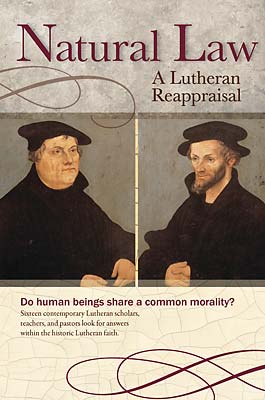 Natural Law: A Lutheran Reappraisal
The individual essays presented in NLL are almost all extremely strong. The topics covered include the views of early Lutherans on natural law (including Luther and the authors of the Confessions) , the view of several later Lutheran individuals (like Barth and Forde), and a kind of “applied ethics” section which uses natural law in individual instances.
The strength of many of these essays is a credit to the Lutheran scholarship which went into the work. The insight into Lutheran thinkers’ views on natural law helps to refute some notions that Lutherans do not “believe in” natural law. In fact, it seems the opposite is the case. “Luther,” argues Thomas Pearson, “understands natural law not as a Christian teaching, but as an observation of human nature in general” (63). Later, Carl Rockrohr expands on this idea to view natural law as a place of common ground for evangelism (196-197).
NLL really shines when it demonstrates that even topics which may at first seem unimportant (like an essay on Friedrich Stahl’s rejection of natural law) can serve to develop a modern view of natural law (Jacob Corzine argues in the aforementioned essay that Stahl’s critique helps ground a Christian natural law theory not in reason but in God [115]).
The applied ethics section of NLL has its ups and downs. “Natural Science, Natural Rights, and Natural Law: Abortion in Historical Perspective” by Korey D. Maas is a simply amazing critique of abortion which presents the case for pro-life not as a religious issue, but as one which can be established on common grounds of natural law (228ff). On the other hand, Albert Collver III’s argument against the ordination of women struggles because it only presents one Lutheran view on the issue (more on that below). The section (and book) concludes with Matthew Cochran’s great summing up and case for the use of natural law as a “Way Forward” for discussions of epistemology and natural law (see esp. 274ff).
The strength of NLL is therefore found in the fact that the essays manage to cohere to the point of building off one another. Whether this was intentional or not, it strengthens the whole work. The early essays provide the framework for the later developments into applied ethics.
This is not to say the book is without faults. One such fault is the woefully inadequate glossary. While the terms included are defined in detail, some terms are inexplicably left out. For example, while the glossary takes lengths to define idealism, it makes no mention of “epistemology,” a concept which was referenced several times. This makes the book seem at times unsure of its purpose. Is it written for the layperson or the professional, the philosopher or the theologian? It includes study questions and a glossary, which suggests use as a textbook in undergraduate (or high school) theology classes, but the very nature of the essays included and the inadequacy of the glossary suggests that only those already familiar with some of the issues will get the most bang for their buck. A final criticism I would level against the book is that while it does present essays from various Lutheran traditions, it is clearly founded specifically upon LCMS teaching. This is unsurprising, given that it is published by Concordia Publishing House (the official publishing arm of the LCMS), but this could cause some confusion when the book devotes an entire chapter to a critique of a different Lutheran tradition (the ELCA). This small shortcoming can also be seen when the book only presents a complementarian view of natural law (that is, a view that natural law excludes women from the ministry) despite the fact that other Lutheran traditions (for example, the NALC or ELCA) are egalitarian (ordain women).
NLL is a simply fantastic work. Lutherans looking to learn about the concept of natural law would be well served to pick the book up and read it cover-to-cover. Those outside of the Lutheran tradition would surely find NLL useful as well, as the essays on applications of natural law can serve as foils for the development of one’s own position. For those wishing to explore the important issue of natural law, I recommend the book highly.
SDG.
——
The preceding post is the property of J.W. Wartick (apart from citations, which are the property of their respective owners) and should not be reproduced in part or in whole without the expressed consent of the author. All content on this site is the property of J.W. Wartick and is made available for individual and personal usage. If you cite from these documents, whether for personal or professional purposes, please give appropriate citation with both the name of the author (J.W. Wartick) and a link to the original URL. This blog is protected by Creative Commons licensing. By viewing any part of this site, you are agreeing to this usage policy.

 J.W. Wartick - Reconstructing Faith