Christianity
Book Review: “Reading Mark’s Christology Under Caesar” by Adam Winn
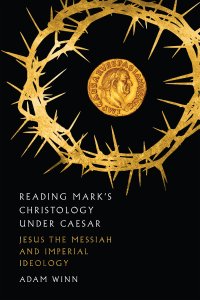 Reading Mark’s Christology Under Caesar by Adam Winn makes the convincing argument that Mark’s Christology is largely a counter to the cult that grew up around Emperor worship in Rome. Accompanying this argument is a fantastic array of contextual evidence both from the text and from references to other ancient works about Rome and her emperors.
After an informative introduction, Winn begins his argument with a look at the cultural context of Mark and an extended analysis of the cultic practices and beliefs centered around Caesar. Emperor Vespasian was pushing his victory over Jerusalem and destruction of the temple in theological motifs, and these were seen as a major challenge, particularly to Roman Christians, to the Messiahship of Jesus Christ. Winn then argues that Mark, therefore, with his use of Christological titles, prophecies of Christ, and discussions of the Temple acts as a direct counter to Vespasian’s claims.
For Mark, Jesus is both powerful and suffering, and this shows Christians that not only is he triumphant and victorious, but also one who is willing to humble himself and lay down his life for his Kingdom. This is a direct contrast and attack on the Vespasian propaganda that made the Emperor into the ideal citizen and conqueror. By being willing to suffer and die, Jesus demonstrates his superiority over Caesar as leader and shepherd of his people.
I am personally no expert in the subject material, so it is difficult for me to judge exactly how on target Winn may be in the book. So far as I can tell, his argument is quite compelling. The appendix included at the end was welcome, noting that those who argue that Mark has a high Christology are not thwarted by the argument in the book. The thesis that Mark is writing against the Caesar cult is an independent question from how high his Christology truly is. I found Winn’s analysis fascinating and convincing, though I’d be interested in seeing what those who are less amenable to his thesis may have to say. It’s the kind of work that is sure to spur further discussion and research.
Reading Mark’s Christology Under Caesar was a book that surprised me. I had seen some making comparisons between Caesar and Christ before, but never had I seen it integrated so fully into the reading of a book of the Bible. It is a fascinating book and I recommend it.
Disclaimer: I was provided with a copy of the book for review by the publisher. I was not required to give any specific kind of feedback whatsoever.
Links
Be sure to check out the page for this site on Facebook and Twitter for discussion of posts, links to other pages of interest, random talk about theology/philosophy/apologetics/movies and more!
Book Reviews– There are plenty more book reviews to read! Read like crazy! (Scroll down for more, and click at bottom for even more!)
SDG.
——
The preceding post is the property of J.W. Wartick (apart from quotations, which are the property of their respective owners, and works of art as credited; images are often freely available to the public and J.W. Wartick makes no claims of owning rights to the images unless he makes that explicit) and should not be reproduced in part or in whole without the expressed consent of the author. All content on this site is the property of J.W. Wartick and is made available for individual and personal usage. If you cite from these documents, whether for personal or professional purposes, please give appropriate citation with both the name of the author (J.W. Wartick) and a link to the original URL. If you’d like to repost a post, you may do so, provided you show less than half of the original post on your own site and link to the original post for the rest. You must also appropriately cite the post as noted above. This blog is protected by Creative Commons licensing. By viewing any part of this site, you are agreeing to this usage policy.
Book Review: “Early Christian Readings of Genesis One” by Craig D. Allert
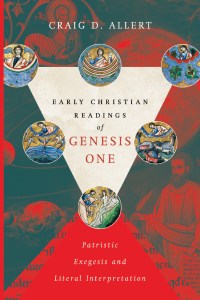 The Christian church has an interesting relationship with the earliest Christians. In the United States, at least, there is a kind of distrust at times of these early Christians, who seemingly got so much wrong. But alongside that there is an attempt to appeal to them, when convenient, to make theological points, claiming that one’s own belief stretches back to the earliest Christian era. Craig D. Allert, in Early Christian Readings of Genesis One: Patristic Exegesis and Literal Interpretation, shares insights into what these early Christians believed and taught about Genesis chapter 1 and literal readings of the same.
Allert begins the book by providing some context. First, he argues for why Christians today should care about what the early Christian writers (Church Fathers) thought about anything. Second, he argues that Christians have tended to distort or appropriate the Fathers into their own view, often without warrant. He explores this through several “real world” examples, including demonstrating that Ken Ham (a young earth creationist and founder of “Answers in Genesis”) and Hugh Ross (an old earth creationist and founder of “Reasons to Believe”) are mistaken in their reading of the Fathers in aligning with their positions. Then, he goes into the meaning of “literal” in the early church and shows how the term cannot easily be unilaterally applied even to individuals.
Next, Allert surveys a few specific Fathers and topics to show how they read Genesis one. Basil of Caesarea (329-379) is one who is often taken to be a literalist, but Allert demonstrates that Basil’s reading of Genesis one, despite his argument about needing to read it as the “common reading” cannot be taken to insist upon a “literal” or young-earth reading of the text. Origen and Augustine are also prominent Fathers in the text, as the former is taken to be a prime example of an analogous or spiritualizing of the text (not always the case) and the latter is taken as an ally for both sides. There is an extended discussion on the “days” of Genesis one, which the fathers read quite differently than most anyone does today.
Early Christian Readings of Genesis One is an excellent look at the way Christians read Genesis one in the earliest periods. It helps dispel a number of incorrect views of the same, and lets readers read large portions of these early writings for themselves. It is a valuable resource.
Disclaimer: I was provided with a copy of the book for review by the publisher. I was not required to give any specific kind of feedback whatsoever.
Links
Be sure to check out the page for this site on Facebook and Twitter for discussion of posts, links to other pages of interest, random talk about theology/philosophy/apologetics/movies and more!
Book Reviews– There are plenty more book reviews to read! Read like crazy! (Scroll down for more, and click at bottom for even more!)
SDG.
——
The preceding post is the property of J.W. Wartick (apart from quotations, which are the property of their respective owners, and works of art as credited; images are often freely available to the public and J.W. Wartick makes no claims of owning rights to the images unless he makes that explicit) and should not be reproduced in part or in whole without the expressed consent of the author. All content on this site is the property of J.W. Wartick and is made available for individual and personal usage. If you cite from these documents, whether for personal or professional purposes, please give appropriate citation with both the name of the author (J.W. Wartick) and a link to the original URL. If you’d like to repost a post, you may do so, provided you show less than half of the original post on your own site and link to the original post for the rest. You must also appropriately cite the post as noted above. This blog is protected by Creative Commons licensing. By viewing any part of this site, you are agreeing to this usage policy.
Book Review: “Faith in the Shadows” by Austin Fischer
 Austin Fischer’s Faith in the Shadows is a competent introductory apologetics book in a cluttered field. As is always the case when I read any introductory level apologetics work, the question is “What makes this one different?” What is it about this work that sets it apart from others? Fischer’s book deals with the topic of doubt in greater depth than most apologetics works, creating a space for believers to deal honestly with the problem(s) of evil.
The greatest strength here is that Fischer doesn’t sidestep the problem(s) of evil, introducing multiple examples and how Christians doubt. He also looks at some examples of how Christians have dealt with evil in their own lives. Particularly poignant in this regard was Fischer’s comparison of Everett Koop and Nicholas Wolterstorff’s books on dealing with the losses of their sons. Kroop insists that God took his son, sovereignly bringing him to the Kingdom; Wolterstorff reacts strongly against this and argues that God overcomes death and God is appalled at death as the wages of sin (53-54). Fischer uses these differing perspectives as a springboard for looking at what the Bible and various theologians have said about the problem of evil and loss. These sections are sometimes heart-rending and often engaging.
Other chapters deal with science and the challenges some believe it presents to the faith, Hell, and more. Throughout, both Scripture and theologians are engaged, from Hodge to Lewis and beyond. It’s a kind of introduction to some deeper explorations, allowing readers to begin their own apologetics journeys.
Faith in the Shadows is a basic look at the problem of evil and dealing with doubts in the lives of Christians. Coming in at a pithy 164 pages of text, it is an ideal book to hand to someone interested in exploring some of the basics of apologetics.
Disclaimer: I was provided with a copy of the book for review by the publisher. I was not required to give any specific kind of feedback whatsoever.
Links
Be sure to check out the page for this site on Facebook and Twitter for discussion of posts, links to other pages of interest, random talk about theology/philosophy/apologetics/movies and more!
Book Reviews– There are plenty more book reviews to read! Read like crazy! (Scroll down for more, and click at bottom for even more!)
SDG.
——
The preceding post is the property of J.W. Wartick (apart from quotations, which are the property of their respective owners, and works of art as credited; images are often freely available to the public and J.W. Wartick makes no claims of owning rights to the images unless he makes that explicit) and should not be reproduced in part or in whole without the expressed consent of the author. All content on this site is the property of J.W. Wartick and is made available for individual and personal usage. If you cite from these documents, whether for personal or professional purposes, please give appropriate citation with both the name of the author (J.W. Wartick) and a link to the original URL. If you’d like to repost a post, you may do so, provided you show less than half of the original post on your own site and link to the original post for the rest. You must also appropriately cite the post as noted above. This blog is protected by Creative Commons licensing. By viewing any part of this site, you are agreeing to this usage policy.
Book Review: “New Testament Christological Hymns” by Matthew E. Gordley
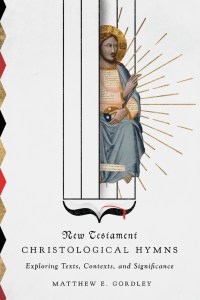 Christianity has a history of confessions and liturgy that goes back all the way to the New Testament. In New Testament Christological Hymns, Matthew E. Gordley, the hymnody of the New Testament is brought into the limelight.
New Testament hymnody? Are there actually hymns in the New Testament, and, if so, how might we identify them? Gordley begins with a chapter answering exactly these questions, dealing with some of the best scholarship and critical questions about the texts themselves. Having established the existence of New Testament hymns included within the text, Gordley turns to showing how these hymns might have been used in NT worship and how the hymns reflect some of the cultural struggles and theological issues the early church was dealing with.
The next several chapters deal with individual hymns included in the New Testament text. In each case, Gordlye provides a substantive analysis of the hymn, analyzes it theologically, discusses any textual critical issues that exist with the text, and draws out its implications for Christians to this day. These analyses are invaluable for anyone who is interested in the theology of the New Testament, Christology, or the beliefs of the early Christian church.
Gordley’s tone and method throughout are highly scholarly, as he engages the forefront of NT scholarship. Footnotes throughout the text direct readers both to sources and further reading, making the book valuable as a research tool as well.
The things I found most valuable in the text were Gordley’s look at the cultural context of the New Testament hymns, showing how they often paralleled and subverted things like Latin hymns for emperors or gods, and the deep concern for discerning the Christological implications of these hymns in the New Testament and their usage in the early church.
New Testament Christological Hymns is a fascinating, scholarly look at the Christology of the New Testament church. Anyone interested in seeing what the earliest Christians believed and how they worshiped should pick this book up and read it carefully.
Disclaimer: I was provided with a copy of the book for review by the publisher. I was not required to give any specific kind of feedback whatsoever.
Links
Be sure to check out the page for this site on Facebook and Twitter for discussion of posts, links to other pages of interest, random talk about theology/philosophy/apologetics/movies and more!
Book Reviews– There are plenty more book reviews to read! Read like crazy! (Scroll down for more, and click at bottom for even more!)
SDG.
——
The preceding post is the property of J.W. Wartick (apart from quotations, which are the property of their respective owners, and works of art as credited; images are often freely available to the public and J.W. Wartick makes no claims of owning rights to the images unless he makes that explicit) and should not be reproduced in part or in whole without the expressed consent of the author. All content on this site is the property of J.W. Wartick and is made available for individual and personal usage. If you cite from these documents, whether for personal or professional purposes, please give appropriate citation with both the name of the author (J.W. Wartick) and a link to the original URL. If you’d like to repost a post, you may do so, provided you show less than half of the original post on your own site and link to the original post for the rest. You must also appropriately cite the post as noted above. This blog is protected by Creative Commons licensing. By viewing any part of this site, you are agreeing to this usage policy.
Book Review: “Reconstructing the Gospel: Finding Freedom From Slaveholder Religion” by Jonathan Wilson-Hartgrove
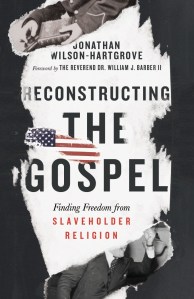 Reconstructing the Gospel: Finding Freedom from Slaveholder Religion is about as no-holds barred as the title seems to suggest. The book starts with a broadside from Rev. Dr. William J. Barber II: “So-called white evangelicals, who say so much about what God says so little–and so little about what God says so much–have dominated public discourse about religion in America for my entire adult life. They have insisted that faith is not political, except when it comes to prayer in school, abortion, homosexuality, and property rights… What these so-called evangelicals have done is nothing short of theological malpractice” (1). From there, Jonathan Wilson-Hartgrove issues a call to recognition and repentance that deserves a hearing.
The book is divided into two parts. The first part goes over the history of Christianity in America with an emphasis on both slaveholders and religion and modern anecdotes about religion in some parts of America. The second part focuses on redirecting some aspects of faith back towards true Christian perspective on justice and Gospel.
Wilson-Hartgrove’s account is at least partially autobiographical as he traces his own experiences with observing racism and living in areas steeped with a history of slaveholding religion. He also discusses how we might go about changing the narrative going forward, working to restore Christ to the church.
Reconstructing the Gospel: Finding Freedom from Slaveholder Religion is a difficult read. It issues a strong call to realize the alliance with racist perspectives that the church in the United States historically has participated in. Though it may not be as robust in possible solutions as some other works, it does a good job issuing a call to action for Christians everywhere.
Disclaimer: I was provided with a copy of the book for review by the publisher. I was not required to give any specific kind of feedback whatsoever.
Links
Be sure to check out the page for this site on Facebook and Twitter for discussion of posts, links to other pages of interest, random talk about theology/philosophy/apologetics/movies and more!
Book Reviews– There are plenty more book reviews to read! Read like crazy! (Scroll down for more, and click at bottom for even more!)
SDG.
——
The preceding post is the property of J.W. Wartick (apart from quotations, which are the property of their respective owners, and works of art as credited; images are often freely available to the public and J.W. Wartick makes no claims of owning rights to the images unless he makes that explicit) and should not be reproduced in part or in whole without the expressed consent of the author. All content on this site is the property of J.W. Wartick and is made available for individual and personal usage. If you cite from these documents, whether for personal or professional purposes, please give appropriate citation with both the name of the author (J.W. Wartick) and a link to the original URL. If you’d like to repost a post, you may do so, provided you show less than half of the original post on your own site and link to the original post for the rest. You must also appropriately cite the post as noted above. This blog is protected by Creative Commons licensing. By viewing any part of this site, you are agreeing to this usage policy.
“‘As In All the Churches of the Saints’: A Text-Critical Study of 1 Corinthians 14:34, 35” by David W. Bryce in “Women Pastors?” edited by Matthew C. Harrison and John T. Pless
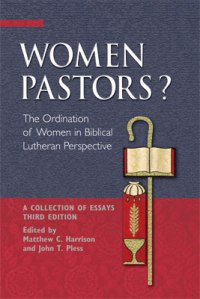 I grew up as a member of the Lutheran Church-Missouri Synod, a church body which rejects the ordination of women to the role of pastor. The publishing branch of that denomination, Concordia Publishing House, put out a book entitled Women Pastors? The Ordination of Women in Biblical Lutheran Perspective edited by Matthew C. Harrison (who is the current President of the LCMS) and John T. Pless. I have decided to take the book on, chapter-by-chapter, for two reasons. 1) I am frequently asked why I support women pastors by friends, family, and people online who do not share my position, and I hope to show that the best arguments my former denomination can bring forward against women pastors fail. 2) I believe the position of the LCMS and other groups like it is deeply mistaken on this, and so it warrants interaction to show that they are wrong. I will, as I said, be tackling this book chapter-by-chapter, sometimes dividing chapters into multiple posts. Finally, I should note I am reviewing the first edition published in 2008. I have been informed that at least some changes were made shortly thereafter, including in particular the section on the Trinity which is, in the edition I own, disturbingly mistaken. I will continue with the edition I have at hand because, frankly, I don’t have a lot of money to use to get another edition. Yes, I’m aware the picture I used is for the third edition.
“‘As In All the Churches of the Saints’: A Text-Critical Study of 1 Corinthians 14:34, 35” by David W. Bryce
The first thing to note in this chapter is that it directly contradicts the previous chapter. In the previous chapter, Kriewaldt and North made the claim that the textual integrity of this passage, 1 Corinthians 14:34-35 is “certain.” That word is a very strong claim. Yet at the very beginning of this chapter by David W. Bryce, we find that there are textual critical issues that indicate it does not have “certainty” when it comes to textual integrity. Indeed, the entire chapter is dedicated to just that issue. Of course, Bryce ultimately concludes that the text is not an interpolation, which could hardly be anything but a foregone conclusion given his theological commitments, but the very fact that there is enough material to even question whether the text is an interpolation must surely indicate it is not “certain.”
Bryce begins by noting an argument for the text here being an interpolation. Though no ancient manuscripts omit the verses, the placement is unclear because some manuscripts have it placed after verse 40, while others have it where it generally appears in modern English translations after verse 33. Bryce surveys the manuscripts and argues that the placement of the verses after verse 40 stems from a single, no longer extant Western manuscript (61).
Interestingly, Bryce then turns to a section in which he tries to discern who the alleged scribe is who may have tried to take 1 Cor. 14:34-35 out of the text. One of the aspects of the profile of this alleged single scribe is that “He opposed the exclusion of women from the ordained ministry and sought to reverse the traditional ecclesiastical practice of his day” (63). But what is this based upon? Nothing more than a conclusion that a non-extant single manuscript led to the verses being seen as a possible interpolation in the Western text type. Of course, those who have read a lot of textual criticism know conclusions based on extrapolated manuscripts aren’t uncommon; but to go from that extrapolation to theological conclusions about the alleged single (and male) scribe who may have taken the verses out of their context seems to be an exercise in mythmaking.
Yet Bryce is not content to merely leave it at some unnamed scribe of allegedly questionable theological motivations. Instead, he goes on to argue that the scribe is none other than the heretic Marcion! Just in case readers are confused by this jump, I want to outline the argument here. Bryce argues first that the evidence for 14:34-35 coming after verse 40 (and therefore possibly being an interpolation due to it being a “floating text” is only found in the Western tradition. Because it is only in a few manuscripts, he posits that the evidence comes originally from a single, earlier manuscript that no longer exists. Because it being an interpolation would aid those who believe women may be pastors [never mind any other possible motivations], he argues that it must be from a scribe who stood against his own tradition’s practice of not ordaining women. Now, he argues that this scribe was Marcion because Paul was “Marcion’s hero” and Marcion practiced exegesis by cutting out verses he didn’t like wholesale (64). Marcion used the Western text type, Bryce argues, and he would have had the motivation to take out these verses from the original text. From there, Bryce concludes that “Marcion had motive, opportunity, and an established modus operandi to excise this offensive passage and reclaim, what was for him, the pure text of St. Paul” (65).
Simply reading through this maze of reasoning ought to be enough to lead readers to question it, but there are any number of problems with his hypotheses. First, he has presented no actual reason to even think that the omission or movement of the text was intentional other than that it is a convenient text for his own position (and therefore someone would want to remove it). Second, Marcion’s creation of his own texts seems to have been rather notorious even in his own time, as Bryce notes in his own argument. If that’s the case, then why would a man who went from basically cutting out the Old Testament from the Bible go to such effort to try to remove a single verse? Why not simply publish an entirely new New Testament with all of his excisions therein instead of trying to plant a single manuscript somewhere to deceive later generations? Third, Bryce’s argument assumes quite a bit about how manuscripts can be transmitted intentionally by reading intention behind such a transmission of an alleged non-interpolation. After all, to read intent rather than error into the “mistake” is an evaluation of purpose of the scribe, one clearly not warranted when by Bryce’s own admission we don’t even have the alleged single original source manuscript. Fourth, Bryce’s own analysis of the text does not warrant his conclusion that the verses in question must have been original to the text (see next paragraph). Fifth, Bryce’s attempt to place a notorious heretic as the one to blame for evidence for an interpolation looks unfortunately like an attempt to poison the well against his opponents. Sixth, Bryce’s analysis of the textual critical data is mistaken (see below).
Philip B. Payne has argued forcefully for the text being an interpolation. In his work, Man and Woman: One in Christ he lays out the case, and while Bryce downplays or doesn’t include elements such as scribal distigme notating potential interpolations in the text. Moreover, directly in contradiction to Bryce’s conclusion, Payne notes that:
Codex Vaticanus’s evidence that 1 Cor 14:34-35 is an interpolation is especially important for several reasons. Its distigme (mark of a textual variant) at the end of v. 33 with no corresponding distigme at the end of v. 40 is evidence of a textual variant that was not the Western displacement was written prior to Codex Vaticanus.
So Bryce’s conclusion that the textual evidence can or should be traced back to a single Western manuscript is incorrect. Codex Vaticanus’s textual evidence reveals that the textual variant goes beyond the Western text type. This single piece of counter-evidence guts much of Bryce’s theorizing both regarding how pervasive the variant is and, certainly, all of his hypotheses about Marcion being responsible. Payne’s article also notes several issues with Bryce’s analysis of MS. 88, as interested readers can peruse.
Bryce’s essay, then, is mistaken on several counts. First, his theorizing about the source of the textual variant (again, which simple existence contradicts the previous chapter in this very book) is based upon tenuous evidence at best. Second, his analysis of the textual critical evidence misses key points regarding the Western tradition and beyond. It seems that those who argue that 1 Corinthians 14:34-35 indeed an interpolation may be on to something, and that Bryce’s argument, though requiring an answer, doesn’t overcome the evidence of the text being just such an interpolation. Surely Bryce, with his commitment to ensuring we only follow those texts that are original to the Bible, would therefore agree that 1 Corinthians 14:34-35 must not be followed in “all the churches of the saints.”
Links
Be sure to check out the page for this site on Facebook and Twitter for discussion of posts, links to other pages of interest, random talk about theology/philosophy/apologetics/movies and more!
Book Reviews– There are plenty more book reviews to read! Read like crazy! (Scroll down for more, and click at bottom for even more!)
Interpretations and Applications of 1 Corinthians 14:34-35– Those wondering about egalitarian interpretations of this same passage can check out this post for brief looks at some of the major interpretations of the passage from an Egalitarian viewpoint.
SDG.
——
The preceding post is the property of J.W. Wartick (apart from quotations, which are the property of their respective owners, and works of art as credited; images are often freely available to the public and J.W. Wartick makes no claims of owning rights to the images unless he makes that explicit) and should not be reproduced in part or in whole without the expressed consent of the author. All content on this site is the property of J.W. Wartick and is made available for individual and personal usage. If you cite from these documents, whether for personal or professional purposes, please give appropriate citation with both the name of the author (J.W. Wartick) and a link to the original URL. If you’d like to repost a post, you may do so, provided you show less than half of the original post on your own site and link to the original post for the rest. You must also appropriately cite the post as noted above. This blog is protected by Creative Commons licensing. By viewing any part of this site, you are agreeing to this usage policy.
Jews and the Book of Concord: Why we cannot affirm “unconditional subscription”
A title page of the Book of Concord
I’m a Lutheran, though some would say I am not. Why? Because many try to define out of existence those who adhere to the Book of Concord “in so far as” it agrees with Scripture as opposed to “because” it agrees with Scripture. Entire denominations argue that the affirmation “because” is the only way to be a genuine Lutheran. I have argued that this places adherents in an impossible situation before. First, I’ve argued that there are actually wrong interpretations of Scripture in the Book of Concord. There is also at least one etymological error. Must Lutherans, to be Lutheran, be saddled with these? According to the “because” position, the answer is yes, they must affirm these errors.
But it gets worse. In light of the despicable act of evil that occurred in Pittsburgh and with Reformation Day having just passed, I’ve been reading about Martin Lutherr and also decided to look up what the Book of Concord says about Jews. I believe the latter demonstrates conclusively that we cannot and must not give the Book of Concord “unconditional subscription.”
Unconditional Subscription?
I take my definition from one of the conservative Lutheran sites that is pushing for this as the definition of Lutheran:
What is an “unconditional subscription” to the Confessions?
Confessional Lutheran pastors are required to “subscribe,” that is, to pledge their agreement unconditionally with the Lutheran Confessions precisely because they are a pure exposition of the Word of God. This is the way our pastors, and all laypeople who confess belief in the Small Catechism, are able with great joy and without reservation or qualification to say what it is that they believe to be the truth of God’s Word. (Lutheran Reformation emphasis removed)
Unconditional subscription, then, is the notion that Lutherans must pledge to agree without reservation to the entirety of the Lutheran Confessions, which are those contained in the Book of Concord.
Jews and the Book of Concord
I have not cited every instance of the occurrence of “Jew” or “Jewish” in the Book of Concord. Rather, here I’ll be citing three instances which I believe demonstrate beyond a doubt that we cannot affirm unconditional subscription without seriously compromising our morality.
The first section comes from the Apology of the Augsburg Confession, Article XIII, section 18:
This is absolutely a Jewish opinion, to hold that we are justified by a ceremony, without a good disposition of the heart, i.e., without faith.
There are a number of problems with this sentence even apart from the use of “Jewish” here. First, it doesn’t just imply but states that Jewish “opinion” believes in justification without faith. Yet this contradicts the New Testament’s own teaching on the faith of Jewish people. For example, Hebrews 11:8-10:
By faith Abraham obeyed when he was called to go out to a place that he was to receive as an inheritance. And he went out, not knowing where he was going. By faith he went to live in the land of promise, as in a foreign land, living in tents with Isaac and Jacob, heirs with him of the same promise. For he was looking forward to the city that has foundations, whose designer and builder is God.
So Abraham, the father of Judaism, acted by faith, looking forward to the city whose designer is God. This famous passage in the New Testament goes on to affirm the faith of Rahab, Sarah, Jacob, the Israelites coming out of Egypt, and many, many more Jews, noting, ultimately, that though they acted on faith none of them received the promised final perfection (Hebrews 11:39-40). So the Book of Concord appears to simply be wrong in this offhanded remark about how “Jewish opinion” holds to a position that is “without faith.”
The next sentence in the Apology states that this “Jewish opinion,” now united with the Pope, is “impious” and “pernicious.” This ascribed to a view of faith that was simply assigned offhandedly to the Jewish people without proof!
The Large Catechism is one of the most important expositions of Lutheran faith, and therein, regarding the Ten Commandments, it is stated (Conclusion of the Ten Commandments, section 330):
Therefore it is not in vain that it is commanded in the Old Testament to write the Ten Commandments on all walls and corners, yes, even on the garments, not for the sake of merely having them written in these places and making a show of them, as did the Jews…
Here, a practice of Jews is simply dismissed offhand as “making a show” of the Ten Commandments. Jewish practice surrounding the Ten Commandments is dismissed as simply for the sake of having them written; as if the Jewish people had no more regard for the Ten Commandments than anyone else. I hope it need not be stated that we should not “unconditionally subscribe” to this.
A final example comes from the Solid Declaration VII, section 30:
Whosoever shall eat this bread, and drink this cup of the Lord, unworthily, [1 Corinthians 11:27] sins not merely against the bread and wine, not merely against the signs or symbols and emblems of the body and blood, but shall be guilty of the body and blood of the Lord Jesus Christ, which, as there [in the Holy Supper] present, he dishonors, abuses, and disgraces, as the Jews, who in very deed violated the body of Christ and killed Him; just as the ancient Christian Fathers and church-teachers unanimously have understood and explained this passage.
Here is a seriously problematic passage, though it is historically tied to the context. The Germany of Luther’s day was filled with anti-Semitic imagery, sayings, and practices. Churches had imagery of Jews suckling on pigs; the notion of Jews as killers of Christ was quite common. And here, in the Book of Concord, we see that leaking in, as Jews generally, not just a handful of people but all Jews are blamed for the “violation” of the body of Christ and killing him. Not only that, but it is alleged that the Church Fathers and “church-teachers” unanimously agree upon this language. This is exactly the language that is used to this day to attack Jews as “Christ-killers” and to raise anti-Semitic sentiment among Christians. This is the kind of language that we must take a firm stand against.
I realize some may stand up and try to cite 1 Thessalonians 2:14-16 here, arguing that the New Testament teaches specifically that Jews killed Jesus. Such would be a mistaken conclusion, because it also speaks of “the Jews” as killing the prophets. Jesus and the prophets were Jewish, and the common use of the phrase “Jews” in the New Testament refers to the leaders (see its use in the Gospels, each written by people who were Jewish, to refer to certain factions among Judaism).
Conclusion
I have already argued that the Book of Concord has errors of etymology and interpretation. In this post, we see that its treatment of the Jews is deeply problematic. Those who argue that we must have “unconditional subscription” to the Book of Concord must affirm these problematic statements in the name of being a “true” Lutheran. But what is more Lutheran than self-examination, confession of sins (like those of anti-Semitism), and the continuing Reform of the church? What can be more Lutheran than demanding that any document with which we agree, we will only agree with “in so far as” it agrees with Scripture?
Links
Be sure to check out the page for this site on Facebook and Twitter for discussion of posts, links to other pages of interest, random talk about theology/philosophy/apologetics/movies and more!
Adhering to the Book of Concord “In So Far As” or “Because” it Agrees with Scripture?– I argue that Lutherans must hold the position that we adhere to the Book of Concord In So Far As it Agrees with Scripture.
Another Problem for Book of Concord Inerrantists– I discuss an etymological error in the Book of Concord.
Eclectic Theist– Check out my other blog for posts on Star Trek, science fiction, fantasy, books, sports, food, and more!
SDG.
——
The preceding post is the property of J.W. Wartick (apart from quotations, which are the property of their respective owners, and works of art as credited; images are often freely available to the public and J.W. Wartick makes no claims of owning rights to the images unless he makes that explicit) and should not be reproduced in part or in whole without the expressed consent of the author. All content on this site is the property of J.W. Wartick and is made available for individual and personal usage. If you cite from these documents, whether for personal or professional purposes, please give appropriate citation with both the name of the author (J.W. Wartick) and a link to the original URL. If you’d like to repost a post, you may do so, provided you show less than half of the original post on your own site and link to the original post for the rest. You must also appropriately cite the post as noted above. This blog is protected by Creative Commons licensing. By viewing any part of this site, you are agreeing to this usage policy.
“The Count of Monte Cristo” – Faith, Vengeance, and Destiny
 I have decided to mix in some classics with my constant reading of sci-fi/fantasy, philosophy, theology, and biographies. In order to pick which classics to read, I have largely crowdsourced recommendations of which classic literature they have enjoyed, combining this with lists of major classic works. So yeah, pretty subjective, but we can deal. As I read through the classics, there will be SPOILERS, because I want to actually talk about them. Maybe it will encourage you to read them, or, if you have read them already, you can join in a deeper discussion of these great works. Feel free to recommend your favorites, as well.
The Count of Monte Cristo
Several friends had recently talked about finishing this book and how much they enjoyed it. I also recalled seeing the recent-ish movie several years ago (though, having finished the book, I threw it on hold at the library, so I’ll be watching it again!). Also, there’s a delicious sandwich that I at least assume got its name from this book, which makes it even better. But other than these fleeting glimpses, I knew pretty much nothing about Alexandre Dumas’s The Count of Monte Cristo going in. The memory of the movie had faded, and I just recalled there was some guy who wanted revenge. Yeah, there’s a lot more to the novel than that.
The Count of Monte Cristo is, on the surface level, a novel of vindication and revenge. It’s an adventure that spans more than a thousand pages. Yet it remains a page-turner that demands to be devoured in sitting after sitting. But on the deeper level, it is a fantastically Christian look at the world and God’s action therein.
The set up for the plot involves the man who would be the count getting set up by several who wish him ill for various reasons. But throughout even that section, “Providence” is constantly in view. Providence is historically one way people talked about divine activity in the world, so the reader is led to see Dumas’s viewpoint as having a divine hand in many acts. And, indeed, as our lead character begins his quest for vindication and vengeance, bringing blessings and curses upon those who helped or hindered him, we as readers cannot help but associate his actions with those of God. We want the Count to succeed in his quest for revenge; it is so well planned, and he has become a man of almost limitless poise and focus. It is not until the count has one part of his vengeance go “too far” that he starts to have second thoughts.
These second thoughts translate into an awareness that our Count’s activity is not just the hand of God acting. Though we as readers have been rooting for him throughout, it becomes clearer that the assumptions we’ve made about how the story is going are wrong. It’s as though Dumas played into our expectations, allowing us to think that, perhaps, here is the kind of “divine vending machine” that we so often wish to turn God into. Here, in at least this story, God is working in the way that we want, dispensing a kind of hard justice on wrongdoing and giving great benefit to those who deserve it. But our Count realizes that this is not, in fact, what is happening. His own actions have been, well, his own. Has he been aided by God? Yes, in the sense that his endeavors could not have all succeeded without some acts of Providence. But he has presumed too much. Like Job in the Bible, he has questioned God; nay, he has gone farther and turned himself into the hand of God, dishing out vengeance and blessing as he wished. And his actions have led to a great wrong with the death of innocents.
So Dumas asks us to take ourselves back out of the shoes of the Count, to stop assuming that we know what is supposed to happen. Instead, he has lured us into this complacency, thinking we know how things ought to be, when instead we should be approaching the acts of God with fear and trembling, carefully avoiding the notion that we can make God act in the ways we desire. Hidden in plain sight within this apparent adventure novel, we have a serious theological commentary that forces us to re-examine who God is and how God acts. How often we make God into what we want, thinking we can control God! Yet here we see how foolish that is, and how we must once again evaluate the assumptions we have made.
So apart from this deep theological discussion, is there a good book? Yes, yes, yes, a thousand times yes. The novel is so well written. I found it un-put-down-able. It’s a true page turner even at its doorstop-like heft. The story is full of beautiful description and overflowing with heart and depth.
There is far more that I could say about The Count of Monte Cristo. It’s such a phenomenal achievement. It definitely stands among my favorite works of all time, and I cannot recommend it highly enough to you, dear readers.
Links
Be sure to check out the page for this site on Facebook and Twitter for discussion of posts, links to other pages of interest, random talk about theology/philosophy/apologetics/movies and more!
Book Reviews– There are plenty more book reviews to read! Read like crazy! (Scroll down for more, and click at bottom for even more!)
SDG.
——
The preceding post is the property of J.W. Wartick (apart from quotations, which are the property of their respective owners, and works of art as credited; images are often freely available to the public and J.W. Wartick makes no claims of owning rights to the images unless he makes that explicit) and should not be reproduced in part or in whole without the expressed consent of the author. All content on this site is the property of J.W. Wartick and is made available for individual and personal usage. If you cite from these documents, whether for personal or professional purposes, please give appropriate citation with both the name of the author (J.W. Wartick) and a link to the original URL. If you’d like to repost a post, you may do so, provided you show less than half of the original post on your own site and link to the original post for the rest. You must also appropriately cite the post as noted above. This blog is protected by Creative Commons licensing. By viewing any part of this site, you are agreeing to this usage policy.
Book Review: “The Battle for Bonhoeffer” by Stephen R. Haynes
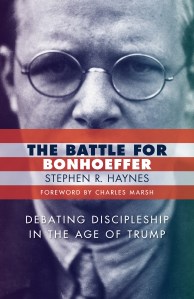 The Battle for Bonhoeffer by Stephen R. Haynes highlights the ways that people across theological, social, and political spectrums have played tug-of-war with Bonhoeffer’s thought, words, and legacy. As Charles Marsh puts it in his Foreword, “It is understandable… that readers with different theological and ideological perspectives would desire to claim Bonhoeffer as their own. ‘Excerpting Bonhoeffer’ has become a familiar exercise in each team’s effort to win…” (ix). Yet Bonhoeffer’s legacy is far more complex than a simple Google quote mine would allow. In my own reading of Bonhoeffer’s works, it is clear that it would be simple to find conflicting messages even within the same sermons at times. Like Martin Luther, for example, reading Bonhoeffer and interpreting him is like peeling away the layers of an onion, trying to get to the core. It takes care, precision, and thought. Unfortunately, as Haynes notes throughout this book, few people are concerned with doing so.
Though the subtitle is “Debating Discipleship in the Age of Trump,” there is far more to the book than dealing with the recent Trump phenomenon. Haynes notes how people on both the right and left have distorted or ignored aspects of Bonhoeffer’s legacy to turn in him into a supporter of their own positions. Marsh sets the table well, asking: “Have you heard progressive Christians cite the passage in Ethics calling abortion ‘nothing but murder’? Or recall Bonhoeffer’s preference for monarchy over democracy?” (xii). Haynes notes how Bonhoeffer was cited on one hand by Vietnam draft resisters, peace activists, liberation theologians, death-of-God thinkers on the left, and on the right by people who oppose abortion or same-sex marriage (and, regarding the latter, Haynes notes insights from both Charles Marsh’s Strange Glory and Diane Reynolds The Doubled Life of Dietrich Bonhoeffer [which I reviewed here] for reasons this may be quite inaccurate]). The baffling array of topics Bonhoeffer is alleged to have endorsed or condemned suggests that the quote mining being done through his legacy belies an inner complexity that is far deeper.
Haynes surveys the history of interpretation of Bonhoeffer, particularly in America, through the next several chapters. He places a special emphasis on seeing how evangelicals have viewed Dietrich Bonhoeffer. What is interesting in this latter topic is that, initially at least, Bonhoeffer was viewed positively but with some “warning flags” by American evangelicals who interacted with his works. Several appreciated his resistance to Nazi ideals, but were put off by his apparent lack of concern for things like “a high view of Scripture/inerrancy” and his being influenced by liberal German theologians. This portrait by the early evangelicals of Bonhoeffer is far more accurate than the one that has been passed into our own time, in part because it allowed for a multifaceted Bonhoeffer who was complex enough to resist being easily integrated into any one position.
Fairly early on, however, the complexities of Bonhoeffer’s thought and life began to be ignored in favor of seeing him as a figurehead for resistance to one’s own preferred ideas. Haynes demonstrates how Bonhoeffer was used to resist George W. Bush and the “war on terror,” and then ironically turned around to resist the “culture of death” under Barack Obama. The raising of the “Bonhoeffer flag” behind such opposed viewpoints should have served as a warning sign, but it unfortunately did not.
Enter Eric Metaxas. Metaxas’s biography, Bonhoeffer: Pastor, Martyr, Prophet, Spy was an extreme departure from Bonhoeffer scholarship generally. For one thing, Metaxas himself admitted to virtually ignoring or explicitly shunning the conclusions of 70 years of Bonhoeffer scholarship both at home and abroad. The cover flap for the book features a spurious quote from Bonhoeffer “Silence in the face of evil is evil itself…” that has since been passed all over the world and even “quoted” multiple times in Congress on record. To say that using an invented quote from Bonhoeffer on the cover of a biography of the man is a bad sign is an understatement. Haynes notes many, many problems with the biography, from a lack of engagement with Bonhoeffer’s actual works (and ignoring, for example, his Letters and Papers from Prison, which is one of the most important works for understanding his developed thought) to a recasting of Bonhoeffer into an American Evangelical. Yet it is Metaxas’s biography that has become the torch-bearer for the populist Bonhoeffer, making an image of the man that is incredibly distorted. For my own part, when I read Metaxas’s work, I was struck by how entirely de-Lutheranized Metaxas had made Bonhoeffer. Dietrich Bonhoeffer was a man who explicitly stated that, for example, without the Lord’s Supper there is no Christianity and who certainly supported infant baptism and regeneration, but Metaxas excised such details from his own dim look at Bonhoeffer’s theology, preferring to pull out those things which were more amenable to the typical American evangelical.
It was the populist view of Bonhoeffer which lead to notions of a “Bonhoeffer Moment” at various times before, during, and after the 2016 election cycle. Haynes spends some time noting how it was frequently said during the Obergefell v. Hodges Supreme Court case that American Christians were facing a “Bonhoeffer Moment” in which they would need to resist the government’s tyranny. Haynes notes how many evangelicals made comparisons to previous Supreme Court rulings, conveniently ignoring those unjust rulings they supported or the just ones they opposed. More decisively, Haynes notes that after Obergefell, evangelicals rallied around a woman who was part of an anti-Trinitarian sect to be their martyr for the cause. In the time since, though, very little has been done by evangelicals in their supposed “Bonhoeffer Moment.” This kind of co-option of the man’s legacy is a disservice to all involved.
Haynes doesn’t limit his analysis of the “battle for Bonhoeffer” to just the positives of Bonhoeffer’s life. Metaxas and others have argued Bonhoeffer is a “Righteous Gentile” (Metaxas even made “righteous gentile” part of his additional subtitle to his biography). But Bonhoeffer has explicitly been turned down for that technical categorization for a few reasons: 1) he wrote or supported some things that were seemingly anti-Semitic; and 2) though he did become a martyr, it wasn’t specifically due to his efforts to help the Jews during the Holocaust, which is a criterion for being deemed a “Righteous Gentile.” Bonhoeffer certainly opposed the Nazi treatment of the Jews and did help some Jews escape Germany (though at arm’s length for the most part–simply helping get proper papers from afar); but that was not his project or his main reason for opposing Nazi Germany. And that’s okay. It is important not to lionize Bonhoeffer for things he didn’t actually do, and Haynes is careful to help readers realize that.
The Battle for Bonhoeffer isn’t very long, but its length shouldn’t be taken for a lack of depth. It’s a thoughtful, critical, and sometimes convicting read. As one who is deeply indebted to Dietrich Bonhoeffer in my own theology and thought, I found ways in which I had been distorting him in this book as well. Haynes’ book provides an invaluable correction to distortions on the man’s life, times, and thought. I very highly recommend it.
Disclaimer: I was provided with a copy of the book for review by the publisher. I was not required to give any specific kind of feedback whatsoever.
Links
Be sure to check out the page for this site on Facebook and Twitter for discussion of posts, links to other pages of interest, random talk about theology/philosophy/apologetics/movies and more!
Book Reviews– There are plenty more book reviews to read! Read like crazy! (Scroll down for more, and click at bottom for even more!)
SDG.
——
The preceding post is the property of J.W. Wartick (apart from quotations, which are the property of their respective owners, and works of art as credited; images are often freely available to the public and J.W. Wartick makes no claims of owning rights to the images unless he makes that explicit) and should not be reproduced in part or in whole without the expressed consent of the author. All content on this site is the property of J.W. Wartick and is made available for individual and personal usage. If you cite from these documents, whether for personal or professional purposes, please give appropriate citation with both the name of the author (J.W. Wartick) and a link to the original URL. If you’d like to repost a post, you may do so, provided you show less than half of the original post on your own site and link to the original post for the rest. You must also appropriately cite the post as noted above. This blog is protected by Creative Commons licensing. By viewing any part of this site, you are agreeing to this usage policy.
Book Review: “Since the Beginning: Interpreting Genesis 1 and 2 through the Ages” edited by Kyle R. Greenwood
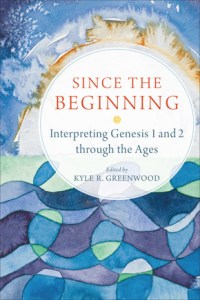 Since the Beginning: Interpreting Genesis 1 and 2 through the Ages is an invaluable resource to understanding the book of Genesis and creation. The book’s scope is impressive, encompassing not only Christian interpretations but also early Rabbinic interpretations, Second Temple Judaism, and the rediscovery of the Ancient Near East with its implications for understanding Genesis. The book is a wealth of information for anyone interested in learning about Genesis.
Each chapter in the book is full of valuable insights. Greenwood himself starts it off by tracing the impact of these creation accounts across the Old Testament. Michael Matlock’s chapter on Second Temple Jewish literature and Genesis 1 and 2 is fascinating, both for its providing a brief introduction to that body of literature and for insights into how later traditions would shape one’s reading of the text. Some Jewish interpreters (eg. Josephus) seemed comfortable expanding on the story themselves, adding whatever details they believed might add interest or even theological emphasis to the text. Of course that doesn’t undermine much careful attention to details of the texts that modern interpreters sometimes miss. Ira Brent Driggers’ chapter uses the intriguing word “appropriations” to describe the New Testament’s use of the Genesis account. Among other things of interest, this chapter leads readers to wonder exactly how NT authors used the Old Testament and what that may mean for our own interpretations. Early Rabbinic interpretation is the subject of Joel S. Allen’s chapter, in which he shows some of the ways post-destruction of the temple Judaism saw figures like Adam and Eve.
Stephen O. Presley’s chapter on the Ante-Nicene Fathers touches on a number of major early Christian thinkers and shows how the interpretation of Genesis continued to develop in sometimes divergent ways. C. Rebecca Rine’s entry on the Nicene and Post-Nicene interpretations shows how Scripture was seen as a pathway to transformation (121) and so a focus on application of the text led to some unique readings (such as creating a baseline for spiritual writings based on the 6-day pattern). Questions raised by these Nicene/Post-Nicene thinkers included wondering why days were in the narrative at all–something that some modern interpreters would be baffled by for all their own emphasis on the importance of the days. Medieval Jewish theology is the center of Jason Kalman’s chapter, which demonstrates the sometimes radical divergence Christian vs. Jewish readings of the same verses could have. Some of these readings included seeing that Genesis didn’t actually entail an order of creation whatsoever (157). Timothy Bellamah’s chapter provides the Christian Medieval contrast to the previous chapter, showing how much fruitful theology continued in this period, often dismissed. Aquinas, of course, is the giant of this era, and he gets some due attention here. The Protestant Reformers were interested in Genesis 1 and 2 in part for their own polemical purposes and in part as their project to go back to the source continued. Jennifer Powell McNutt draws from this rich Christian tradition to highlight various points of emphases by the Reformers.
Another important aspect of the book is the chapter on the Ancient Near East by David T. Tsumura. Because much of this knowledge was lost for a lengthy period of time, many interpretations of Genesis through the ages did not take into account the actual cultural milieu from which it sprang. The Protestant Reformers, for example, had no access to these materials, so their call to go ad fontes–to the source–could not actually complete the task. The interpretation of Genesis ought not to be considered a settled matter from the Reformation to today, and even allegedly literal readings of Genesis owe as much to modern discoveries as to the texts themselves. Aaron T. Smith’s chapter on Post-Darwinian interpretations shows both how yes, in some ways evolution impacted readings of Genesis, but in others it caused a true pursuit of going back to the beginning. Cosmology is central to debates over how Genesis is to be read.
If it hasn’t already become clear, it should be stated plainly that this book is an absolute treasure trove of information, with many, many strands of further research to be pursued upon its completion. Each chapter is worthy of inclusion, and each is well-written and as intriguing as the next. That in itself is an achievement because the book is consistently engrossing.
I very highly recommend Since the Beginning to you, readers. It’s a book that will have you thinking about your own reading of the text, and may even give you insight into where that reading may have its origins.
Disclaimer: I was provided with a copy of the book for review by the publisher. I was not required to give any specific kind of feedback whatsoever.
Links
Be sure to check out the page for this site on Facebook and Twitter for discussion of posts, links to other pages of interest, random talk about theology/philosophy/apologetics/movies and more!
Book Reviews– There are plenty more book reviews to read! Read like crazy! (Scroll down for more, and click at bottom for even more!)
SDG.
——
The preceding post is the property of J.W. Wartick (apart from quotations, which are the property of their respective owners, and works of art as credited; images are often freely available to the public and J.W. Wartick makes no claims of owning rights to the images unless he makes that explicit) and should not be reproduced in part or in whole without the expressed consent of the author. All content on this site is the property of J.W. Wartick and is made available for individual and personal usage. If you cite from these documents, whether for personal or professional purposes, please give appropriate citation with both the name of the author (J.W. Wartick) and a link to the original URL. If you’d like to repost a post, you may do so, provided you show less than half of the original post on your own site and link to the original post for the rest. You must also appropriately cite the post as noted above. This blog is protected by Creative Commons licensing. By viewing any part of this site, you are agreeing to this usage policy.

 J.W. Wartick - Reconstructing Faith