Christianity
Book Review: “A Shared Mercy: Karl Barth on Forgiveness and the Church” by Jon Coutts
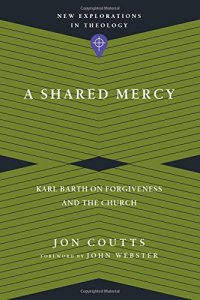 Jon Coutts’ A Shared Mercy explores the doctrine of forgiveness from the perspective of Karl Barth. Because it is the perspective of Karl Barth, it also reflects on doctrine of the church, as this was central to Barth’s thought. However, Coutts argues we must be careful not to subordinate all doctrines Barth taught under his doctrine of the church.
The book is organized into 6 chapters that largely center on two parts: Barth’s doctrine of forgiveness and what a full doctrine of forgiveness based on Barth might look like in application. Throughout the book there is a kind of unity between these topics as Coutts takes what Barth taught on forgiveness and applies it.
First, Coutts notes that because Christ taught that forgiveness is central to the lives of his followers, it follows that forgiveness is central to the church (1). Thus, exploring Barth’s Church Dogmatics, we ought to expect to find forgiveness as a central, not tertiary teaching. Coutts argues throughout the book that this is, indeed, what we find, though little has been studied in regards to Barth on forgiveness in the church in contemporary theology.
Readers may be concerned that a book so focused on a somewhat obscure topic may lack applicable insights, but Coutts does a great job not merely reporting Barth’s beliefs but also deriving thoughts therefrom that have application to the contemporary Christian. One example is the question of whether forgiveness first requires one to wait for repentance:
A legitimate practical concern… [is] the perpetuation of victimhood that seems to be implied when the imperative [to forgive] is self-giving and forgiving love. But this is founded on a misconception of the call to cruciform discipleship… Even if the abusive party is unrepentant, the result is not unforgiveness, but an acknowledgement of nonreconciliation… Forgiving the abuser is not the perpetuation of victimhood but the free offer of further reconciliation. (154-155)
This and many other passages provide direct application to the lives of believers. At several points, then, Coutts ably demonstrates the way to bring scholarship to the person in the pew, something that is too-often lacking in scholarly works.
As a Lutheran, I appreciated the highlighting of the importance of baptism and the Lord’s Supper for Christian community, though I think Barth’s teaching on these sacraments falls short of the biblical teaching. Yes, baptism is a sign of community, but Barth and Coutts each seem to err in seeing baptism as a kind of political action of the church rather than a gracious action of God. Similarly, the view of the Lord’s Supper as being primarily a work of the church rather than a gracious gift of God takes away the greatness of the gift.
Because the book is so focused on a specific aspect of Barth’s teaching, it does at times read a bit too much like a journal article–engaging with very specific opponents with little context. However, these moments are thankfully few and far between.
A Shared Mercy is an interesting, surprisingly applicable study on forgiveness in Barth’s doctrine. More importantly, it shares information that can be applied directly to the broader church. The importance of a doctrine of forgiveness ought never to be understated, as it is so central to Christian teaching. As such, this book is an important contribution to understanding what we as Christians, and the church, are called to do.
The Good
+Insights into Barth’s theology of the church, in balanced perspective
+Background for modern discussions of forgiveness
+More applicable material than me be expected
The Bad
-Sometimes reads a bit more like a journal article than a book
-Reduces both baptism and the Lord’s Supper to human act
Disclaimer: I received a copy of the book from the publisher for review. I was not obligated to provide any specific kind of feedback whatsoever.
Links
Be sure to check out the page for this site on Facebook and Twitter for discussion of posts, links to other pages of interest, random talk about theology/philosophy/apologetics/movies and more!
Book Reviews– There are plenty more book reviews to read! Read like crazy! (Scroll down for more, and click at bottom for even more!)
Eclectic Theist– Check out my other blog for my writings on science fiction, history, fantasy movies, and more!
SDG.
——
The preceding post is the property of J.W. Wartick (apart from quotations, which are the property of their respective owners, and works of art as credited; images are often freely available to the public and J.W. Wartick makes no claims of owning rights to the images unless he makes that explicit) and should not be reproduced in part or in whole without the expressed consent of the author. All content on this site is the property of J.W. Wartick and is made available for individual and personal usage. If you cite from these documents, whether for personal or professional purposes, please give appropriate citation with both the name of the author (J.W. Wartick) and a link to the original URL. If you’d like to repost a post, you may do so, provided you show less than half of the original post on your own site and link to the original post for the rest. You must also appropriately cite the post as noted above. This blog is protected by Creative Commons licensing. By viewing any part of this site, you are agreeing to this usage policy.
Really Recommended Posts 11/18/16- Star Trek, historical apologetics, creationism, and more!
 I have gone all over the internet to bring you these Really Recommended Posts for your weekend reading. As always, be sure to let the authors know what you think, and let me know as well.
Wyoming Fossils: Coming to Grips with the Absurdity of the Flood Geology Model of Fossil Origins– The sheer amount of fossils we can observe and their arrangement leads to some serious difficulties with young earth creationism and its scenarios of the Flood. (The picture of fossils here is from my private collection. The pictured fossils were found in Kansas, not Wyoming.)
Why the ESV’s “contrary to” in Genesis 3:16 matters– A decision to change the translation in Genesis 3:16 has wide ramifications.
Beyond the Final Frontier: A Christ and Pop Culture Tribute to Star Trek– Yep, the title pretty much says it all. Don’t forget to check out my own tribute to Star Trek’s 50th anniversary.
The Two Guys to Blame for the Myth of Constant Warfare Between Religion and Science– Some historical perspective on the idea that science and religion are at war with each other.
Dalrymple Responds to Gibbon Concerning the Spread of Christianity– “The History of the Decline and Fall of the Roman Empire” is one of the best known works of history in the West. Edward Gibbon, the author, was an urbane skeptic who used the work to aim skeptical arguments at Christianity. One of his contemporaries fired back.
Book Review: “No Skin in the Game: The God of the Jehovah’s Witness” by Frank H. Armstrong
 Frank Armstrong’s No Skin in the Game is a pithy introduction to defending orthodox Christianity against Jehovah’s Witness beliefs. Central to Armstrong’s book is the notion that we must not focus merely on firing proof-texts back and forth, but rather that we ought to see the meta-narrative of Scripture and keep that in mind as we evaluate claims of how to interpret key texts.
Armstrong focuses on this meta-narrative of God as love and uses it to show that God the Son and the Father must be co-eternal. Moreover, he continues to note the continuity of Scriptures between the Testaments by showing that those things ascribed to the Father (which Jehovah’s Witnesses call Jehovah) are then ascribed to Christ (eg. creation). It is truly remarkable how many applicable examples Armstrong manages to pack into a short work.
The book provides not just a grab-bag of important verses but a guide for how to use the Bible to reason with Jehovah’s Witnesses. Several examples of verses shown with key phrases changed to reflect Jehovah’s Witness theology highlight this. The book is therefore thoroughly practical and will be useful to those hoping to engage with Jehovah’s Witness theology.
If I had one critique it is that the example of conjoined twins alongside the Trinity may cause some confusion. Armstrong argues that conjoined twins show in principle that one being may be the center of multiple persons, and as far as demonstrating that, it may not be objectionable. The problem is that such a comparison begs further comparison, and the example quickly breaks down as one considers whether conjoined twins really are one being or are two that happen to occupy the same space. Other difficulties arise upon further reflection. For what Armstrong was trying to demonstrate, it works alright, but the problem with any analogy of the Trinity is that it breaks down and may cause confusion if pressed.
No Skin in the Game is an exciting, economical introduction to witnessing to Jehovah’s Witnesses. I recommend it.
The Good
+Brief, readable style
+Puts forward many key texts
+Focuses on core ideas
The Bad
-Example of conjoined twins may cause confusion.
Disclaimer: I received a copy of the book from the publisher for review. I was not obligated to provide any specific kind of feedback whatsoever.
Links
Be sure to check out the page for this site on Facebook and Twitter for discussion of posts, links to other pages of interest, random talk about theology/philosophy/apologetics/movies and more!
Book Reviews– There are plenty more book reviews to read! Read like crazy! (Scroll down for more, and click at bottom for even more!)
Eclectic Theist– Check out my other blog for my writings on science fiction, history, fantasy movies, and more!
SDG.
——
The preceding post is the property of J.W. Wartick (apart from quotations, which are the property of their respective owners, and works of art as credited; images are often freely available to the public and J.W. Wartick makes no claims of owning rights to the images unless he makes that explicit) and should not be reproduced in part or in whole without the expressed consent of the author. All content on this site is the property of J.W. Wartick and is made available for individual and personal usage. If you cite from these documents, whether for personal or professional purposes, please give appropriate citation with both the name of the author (J.W. Wartick) and a link to the original URL. If you’d like to repost a post, you may do so, provided you show less than half of the original post on your own site and link to the original post for the rest. You must also appropriately cite the post as noted above. This blog is protected by Creative Commons licensing. By viewing any part of this site, you are agreeing to this usage policy.
Arrival: Your Life Matters – A Christian Perspective
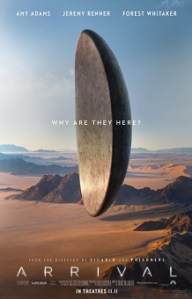 I had the chance to watch “Arrival” this past weekend. It was excellent. I can’t emphasize enough how much good science fiction is steeped in worldview and forces us to reflect upon humanity. “Arrival” is just that: excellent science fiction. Here, I will discuss worldview issues the film brought forward from a Christian perspective. There will be SPOILERS in what follows.
Your Life Matters
Perhaps the most poignant aspect of the film is one that could not be fully appreciated until the end. Once we see that Louise has been having not flashbacks but rather flash-forwards, we come to realize that she is seeing what will happen in the future. But that means the scene at the beginning, in which Louise has a daughter, Hannah, who eventually dies from cancer, will play out as she has seen it. And if that’s the case, then Louise’s decision to marry Ian and have a baby with him is something that leads, directly or indirectly, to her daughter’s death.
The question that arises, then, is whether such a life was worth living? The film presents what is one of the most beautiful ways of looking at such a question I have seen. The answer is yes. Without Hannah’s life, her poetry, joy, song, and dance could not have been part of the world. All of that would have been lost. Even the inevitable pain and tragedy that Louise and Ian will experience is part of that future world Louise saw: one in which love had a chance to play out in Hannah’s all-too-short life. It’s a message that says: Yes, your life matters, even if it is not perfect; even if it goes poorly.
And really, what right would Louise have to cut that life from the world? What right would she have to destroy that future life of Hannah, however painful it would become for herself and for her daughter? Would it really be better to cut off all the joy and beauty that her daughter would bring into the world just because Louise knew it would end badly? Such questions are monumentally important in an age in which choices of life and death are increasingly available.
Linear vs. Non-Linear Time
I found the theme of time to be quite engaging in the film. One may think that it was just a novelty to discuss non-linear time, but a number of major ancient cultures had non-linear views of time. I have much interest in studying Mesoamerica, for example, and basically across the board the Inca, Maya, Aztec, etc. had non-linear, cyclical views of time. Why does that matter? What does it have to do with worldview?
Well, in the film it was used largely as a way to tie the whole plot back together and show that one’s ideas about reality can be shaped by the way one conceptualizes of very basic ideas. But more importantly, one’s view of time impacts how one views reality itself. I have read time and again how a linear view of time helped to spur scientific discovery, among other things. A linear view of time allows for a logical A => B sequence of events in which causation is linked through time. A cyclical, or non-linear view of time would change that. In “Arrival,” it is unclear as to whether the ultimate non-linearity of time is viewed as cyclical (though the emphasis on circular imagery for the language might point in that direction). One wonders whether a non-linear view of time, taken to its conclusions, could actually ground such things as cause and effect. The movie provided a framework to think through such questions, and as someone who’s very interested in philosophy of time, I found that utterly engaging.
Time, Part 2
Another aspect of the discussion of time in the film is the implication that Louise sees the future, but also that she may be able to change it. Indeed, it seems pretty clear that Louise makes a conscious choice to allow the future she saw to play out. Does that mean the future is set in stone, or that her decisions actually will yield the future she saw? This may not seem very important for worldview, but a simple shift to examining divine omniscience might show how such a concept could impact worldview directly. If God knows the future, as I believe God does, what does that mean for human action? What does it mean if God does not comprehensively know the future, as open theists claim?
Such questions are not directly referenced in the film, but a moment’s reflection on how Louise responds to her own knowledge of the future makes these questions loom in the distance. I think it is important to think about how things like one’s view of time and God’s knowledge of the future impact things like human free choice, salvation, and the like.
Conclusion
“Arrival” is the best kind of science fiction: one that raises questions not just about the future but about humanity. I highly recommend readers go see the film. It’s phenomenal. Let me know what worldview questions were raised in your mind from watching the film.
Links
Be sure to check out the page for this site on Facebook and Twitter for discussion of posts, links to other pages of interest, random talk about theology/philosophy/apologetics/movies and more!
SDG.
——
The preceding post is the property of J.W. Wartick (apart from quotations, which are the property of their respective owners, and works of art as credited; images are often freely available to the public and J.W. Wartick makes no claims of owning rights to the images unless he makes that explicit) and should not be reproduced in part or in whole without the expressed consent of the author. All content on this site is the property of J.W. Wartick and is made available for individual and personal usage. If you cite from these documents, whether for personal or professional purposes, please give appropriate citation with both the name of the author (J.W. Wartick) and a link to the original URL. If you’d like to repost a post, you may do so, provided you show less than half of the original post on your own site and link to the original post for the rest. You must also appropriately cite the post as noted above. This blog is protected by Creative Commons licensing. By viewing any part of this site, you are agreeing to this usage policy.
Jeremiah teaches that the Messiah is God
“In those days and at that time
I will make a righteous Branch sprout from David’s line;
he will do what is just and right in the land.
In those days Judah will be saved
and Jerusalem will live in safety.
This is the name by which it will be called:
The Lord [ Hebrew = YHWH] Our Righteous Savior.’” – Jeremiah 33:15-16 (NIV)
These verses are clearly a prophecy about the coming Messiah. They also clearly state that that Messiah, a human from David’s line, will be called YHWH. In other words, this prophecy proclaims, hundreds of years before the birth of Christ, that the savior would be God incarnate. The one from the branch of David will be called YHWH, the righteous one.
Life as a Cubs Fan – Eschatology Fulfilled
 I’m writing this as the Cubs are tied 1-1 in the 2016 World Series with Cleveland. I’ll be finishing it just after the World Series, and I hope beyond hope that it will be in celebration of a victory of the Cubs in the World Series, for the first time in 108 years. I’ll clearly mark the point I wrote after the World Series. Go Cubs!
There was one night I was in bed but could not fall asleep. I believe it was when the Cubs had just tied the NLCS 2-2 with the Dodgers. I was bubbling with joy because they’d just tied the series. It meant there was a chance, however remote, that the Cubs could make it to the World Series for the first time since 1945. It meant that, maybe, there wouldn’t have to be a “Next Year” this year. Maybe, just maybe, it could happen.
As I was lying there, thinking, I realized that it was at this point I truly understood the joyful anticipation that the writers of the New Testament experienced. Jesus Christ had promised to return, and soon. How great that joyful day would be! But each day, each year, there was the thought: there’s always tomorrow. One day we will experience the reality that there is no more tomorrow, and our joy will be complete.
With our eschatological hope, we know that there’s not just a chance. It’s a matter not of if Christ will return, but when. And that is something that I feel overjoyed about and also terrified. What does it mean to say Christ will return? The world will be not just a different place–a changed place–it will be made anew.
Post World Series
I just re-read a blog post I wrote back in 2012 entitled “The Eschatology of a Cubs Fan.” In that post, I wrote:
I still hold out hope though, it’s almost like an eschatological promise: “There’s always next year.” Boy, we’ve been saying that for a long time. But I really do believe it: one day, the Cubs will win one, and it will be during my lifetime. When they do, I’ll be like the fan standing up, looking at the skyline, and just rejoicing. I’ll say “This one was for you, grandpa” and I’ll see him sweeping the streets in heaven [my grandpa would get a broom out and sweep the floors when the Cubs swept a series]. If it happens, I will get to Chicago, I don’t care when it is or how it happens. I won’t have to be at a game, or even there while one happens, but I’ll get back to Chi-town, the place I love, and I’ll kiss the walls of Wrigley, wearing my “World Series Champions” hat.
One day, Cubs.
One day.
That day has come. I can’t believe it. I will write up a lengthy reflection on the win later, but for now I want to put it in perspective of this post. The consummation of so much hope, so many shattered dreams that suddenly got repaired, is one of the greatest feelings I’ve had in my entire life. But this is nothing to compare to that which will come at the final eschaton–the return of Jesus Christ. That’s not to say the World Series win for the Cubs doesn’t matter–far from it, the world really did change, and it feels new as I wake up each morning. What I’m saying, instead, is that this feeling, this joy, is one of the ways God gives us to see a greater thing to come. It’s a kind of typology, but one that can be found in the mundane–even something as simple as a human swinging a stick at a ball.
And that, really, is what Christianity (and, really, Lutheranism) is all about. Christ has come into this world, become incarnate, and is in this world now. Our God came and dwelt among us. And those blessings given us reflect God’s good reality, and a better one that is to come.
I think it is true that I, and many other Cubs fans, can now say we know what a slice of heaven looks like, what it feels like. Hope will one day be fulfilled. That long-awaited day shall come. Christ will return. Come quickly, Lord Jesus. Amen.
Links
Be sure to check out the page for this site on Facebook and Twitter for discussion of posts, links to other pages of interest, random talk about theology/philosophy/apologetics/movies and more!
Eclectic Theist– Check out my other blog for my writings on science fiction, sports, history, movies, and more!
SDG.
——
The preceding post is the property of J.W. Wartick (apart from quotations, which are the property of their respective owners, and works of art as credited; images are often freely available to the public and J.W. Wartick makes no claims of owning rights to the images unless he makes that explicit) and should not be reproduced in part or in whole without the expressed consent of the author. All content on this site is the property of J.W. Wartick and is made available for individual and personal usage. If you cite from these documents, whether for personal or professional purposes, please give appropriate citation with both the name of the author (J.W. Wartick) and a link to the original URL. If you’d like to repost a post, you may do so, provided you show less than half of the original post on your own site and link to the original post for the rest. You must also appropriately cite the post as noted above. This blog is protected by Creative Commons licensing. By viewing any part of this site, you are agreeing to this usage policy.
“Silence” by Shusaku Endo – The Hidden God, the Crucified Lord
 Shusaku Endo’s Silence is one of the most moving, deeply theological novels I have ever read. Here, I will discuss but a few worldview-level issues found in the book. There will be SPOILERS below.
The Hidden God
The most pervasive theme throughout the book is that of silence. The hiddenness of God is pressed home poignantly in scene after scene. Early in the book, the main character, a Jesuit priest from Portugal named Sebastião Rodrigues has confidence that no matter what, we will find out a purpose for any and all suffering in the world. His thought is that because God is good, there must be a reason behind each and every possible evil.
Yet as the book continues, the persecution of Christians intensifies and is made extremely clear to Rodrigues. Time and again he witnesses Christians being tortured to death and prays. Each time, a refrain is found in the book: he is answered by silence.
Again and again, the please of Christians and of the priest, Rodrigues, are answered by silence. He looks out to sea surrounding Japan and sees only blackness.
Silence confronts us with the problem of evil front-and-center, and offers some of the most frequently used answers in response. Yet many of these answers seem inadequate when set alongside the continued suffering of Christians being tortured.
The Absurdity of Life Without God
Life without God is absurd. Yet even this point, as found in Silence, points to the silence of God. Rodrigues reflects on his life, and finds that it is completely absurd if there is no God. But rather than focusing on big picture points on this topic, he points it to his own life and laments the absurdity of how he’s lived it if there is no God.
Christ, the Crucified Lord
Rodrigues is captured, and he is forced to endure the screams of tortured victims as time and again they ask him to apostasize. What is required of him is that he trample on an image of Christ. If he does not do so, the suffering of others will continue. He begins to wonder about the mercy of God and whether it would, indeed, be better to trample on this image of Christ and be seen as an apostate. Finally, he decides he will do it, if only to prevent further torture of others:
How his foot aches! And then the Christ in bronze speaks to the priest: ‘Trample! Trample! I more than anyone know of the pain in your foot. Trample! It was to be trampled on by men that I was born into this world. It was to share men’s pain that I carried my cross.’
The priest placed his foot on the fumie [image of Christ]. Dawn broke. And far in the distance the cock crew. (171)
Christ came to suffer, and our sin is part of that suffering. Yet, Christ calls to us, letting us know his mercy is boundless, and that it was for our sake he “was born into this world.”
Ultimately, the silence of God is not silence at all. As the priest says it in the closing lines of the novel: “Even now I am the last priest in this land. But Our Lord was not silent. Even if he had been silent, my life until this day would have spoken of him” (191). Christ works in us and through us.
The dialogue Rodrigues has with Christ in the end is just as poignant:
“Lord, I resented your silence.”
“I was not silent. I suffered beside you.” (190)
Conclusion
Silence is one of those rare books that is sure to be remembered from the time you read it onward. I don’t know that I will ever forget the vivid scenes in which priests are forced to choose between allowing continued torture or being labeled as apostates. It is a stirring, heart-rending book of faith in the face of apparent silence. But the ultimate message is more hopeful: Christ is in us.
Links
Be sure to check out the page for this site on Facebook and Twitter for discussion of posts, links to other pages of interest, random talk about theology/philosophy/apologetics/movies and more!
Popular Books– Read through my other posts on popular books–science fiction, fantasy, and more! (Scroll down for more.)
Source
Shusaku Endo, Silence (New York: Taplinger Publishing Company, 1980). Edition linked is a newer edition.
SDG.
——
The preceding post is the property of J.W. Wartick (apart from quotations, which are the property of their respective owners, and works of art as credited; images are often freely available to the public and J.W. Wartick makes no claims of owning rights to the images unless he makes that explicit) and should not be reproduced in part or in whole without the expressed consent of the author. All content on this site is the property of J.W. Wartick and is made available for individual and personal usage. If you cite from these documents, whether for personal or professional purposes, please give appropriate citation with both the name of the author (J.W. Wartick) and a link to the original URL. If you’d like to repost a post, you may do so, provided you show less than half of the original post on your own site and link to the original post for the rest. You must also appropriately cite the post as noted above. This blog is protected by Creative Commons licensing. By viewing any part of this site, you are agreeing to this usage policy.
Policy, or, Why I’m not voting for Donald Trump
 I try to avoid straight-up politics on this blog, but I think it is important to discuss the election this year. Too often, as I’ve voiced my intention to not vote for Donald Trump, I’ve been told that we aren’t voting for a moral leader, but a President or something of the sort (a President, not a pastor… however you want to put it). But apart from the fact that separating morals from policy is impossible, the fact is that the reason I’m anti-Trump was, from the beginning, a matter of policy. Here are just a few of the policy-oriented reasons I’m not voting for Trump. Period. And they’re based, in part, on conservative values.
Religious Liberty
What is one of the most important thing for most conservatives? Freedom of religion. I find this a paramount part of our country’s greatness, myself. The fact that you may freely believe and practice your faith, whether it be Pentecostal, Calvinist, Lutheran, Hindu, or Buddhism is an ideal that is beautiful and necessary. Conservatives across the board point to the importance of religious freedom. Thus, with conservatives telling people they ought to vote for Trump based on policy, it is worth asking: do Trump’s policies support religious liberty?
The plain and clear answer is: no, obviously.
Think about it. Suppose Donald Trump had come out saying “We need a total and complete ban of all Christians entering the United States.” How do you think conservatives would have reacted? As they should have: by exploding. Such a statement would be a direct violation of religious freedom. It would be seeing someone’s faith as the sole reason for denying them entry into our country. But because he said it about Muslims, suddenly it’s seen as okay. Here’s the thing: religious liberty is, and always has been, religious liberty for all religions. Yes, if someone decides that their religion is to kill everybody, that would be a religion that could not be allowed liberty, but Islam is demonstrably diverse, with several distinct factions and offshoots, many of which denounce violence in the name of their faith. It’d be like banning all Christians because of the Branch Davidians or banning all Lutherans because the BTK killer happened to be, ostensibly, Lutheran.
But the point of this is not to debate whether Islam is violent or not (it’s not, inherently; with 1 billion Muslims in the world, if Islam was automatically violent, why are not all of these 1 billion Muslims killing people?). The point is that Trump explicitly made a statement in which religion was the single reason for exclusion from our country. That is a terrifying reality to think about, because as many conservative beliefs begin to be seen as oppressive, it is not very hard to see how conservatives could be next on the list of those banished from the country.
First they came for the Socialists, and I did not speak out—
Because I was not a Socialist.
Then they came for the Trade Unionists, and I did not speak out—
Because I was not a Trade Unionist.
Then they came for the Jews, and I did not speak out—
Because I was not a Jew.
Then they came for me—and there was no one left to speak for me.
-Pastor Martin Niemöller speaking of the Nazis
*Note: I realize Trump has somewhat scaled back this talk to having “extreme vetting,” but it is important to take into account the fact that his initial position of simply banning people based on religion.
Freedom of Speech
Freedom of speech and the freedom of the press stand alongside religious freedom as some of the most important parts of our constitution and, frankly, our country. Yet, once again, we find that Donald Trump is no defender of such a freedom–a freedom that is put forward by conservatives as vastly important.
Donald Trump, frustrated with the media coming after him, Tweeted his frustration suggesting that “It is not ‘freedom of the press’ when newspapers and others are allowed to write whatever they want even if it is completely false!”
Um, yes it is, actually. That’s one of the things freedom of the press explicitly permits. Moreover, Trump has suggested libel and slander laws ought to be opened up to allow him to more easily sue and defeat others who speak badly of him. This is a terrifying reality in which we have a candidate who doesn’t respect freedom of speech because he doesn’t like what others say about him.
So here we have a Presidential candidate who believes it is acceptable to suggest changing the Constitution because he doesn’t like when people speak ill of him. I think that’s a real problem, and would suggest freedom of speech is yet another policy that should have conservatives fleeing from Trump, not flocking to him. For more on this topic, see this article from Red State, a conservative web publication.
Fiscal Policy
“The free market works–it just needs leadership, not dictatorship… We need legislation that gives American companies the tax priorities and financial support to create more of their technology and redirect more of their manufacturing here at home.” –Donald Trump, “Crippled America,” 81, 86-87.
“Nobody can build a wall like me. I will build a great wall on our southern border… Construction of the wall needs to start as soon as possible. And Mexico has to pay for it… Mexico will pay for it. How? We could increase the fees on temporary visas. We could even impound remittance payments derived from illegal wages. Foreign governments could tell their embassies to start helping, otherwise they risk troubled relations with America. If necessary we could pay for the wall through a tariff or cut foreign aid to Mexico…” – Donald Trump, “Crippled America,” 23-25.
Each of these quotes demonstrates that Trump is by no means a conservative when it comes to fiscal policy. One of the cornerstones of conservative fiscal policy is free trade. Yet in the first quote, Trump encourages protectionism in economics, which is the opposite of free trade. In the second quote, he supports tariffs as a possibility for paying for his projects. Again, raised tariffs are the opposite of free trade. Moreover, Trump has been vocal in opposition to NAFTA and other free trade agreements. Each of these shows beyond any question that Trump is not a conservative when it comes to fiscal policy.
Foreign Policy
“If we’re going to continue to be the policemen of the world, we ought to be paid for it. …There is another way to pay to modernize our military forces. If other countries are depending on us to protect them, shouldn’t they be willing… To pay for the servicemen and servicewomen and the equipment we’re providing? …We defend Germany. We defend Japan. We defend South Korea. These are powerful and wealthy countries. We get nothing from them.” –Donald Trump, “Crippled America,” 32, 34.
Whatever Trump has said about nuclear missiles and the like aside, this quote shows that Trump has very little grasp of foreign policy. He sees the United States as a mercenary that hasn’t been paid. He sees our military forces as dollars and cents. More astonishingly, he sees American lives lost defending allies as price tags. How much is the life of one soldier worth? Trump would put a price on it, and then sell that to the highest bidder. I’m not making that up: just read what he himself wrote in his election book!
Later in the same chapter he asks rhetorically why we didn’t make a deal with the leaders of Kuwait “that outlined how they would pay for us to get their country back for them…” (35) before Desert Storm.
Effectively, Trump here suggested we should have extorted money from the leaders of another sovereign nation before we went into military action. Thank goodness he wasn’t in charge of our country during World War 2! We would have had to negotiate with the Allies on the price of our help before we sent our brave soldiers to the shores of Normandy!
Trump has also been vocal about his opposition to NATO, an immensely important military alliance. The dismissal of many of our closest allies by Trump, often accompanied by accusations that the United States must pay too much money, once again shows that Trump’s foreign policy is based upon nothing but the bottom line. But of course foreign policy based purely on flawed economic theory (see “Fiscal Policy,” above) is not the best way to practice foreign policy. Neither is dismissing allies as though they have done “nothing” for us (see his quoted comments above on Germany, South Korea, and Japan).
Time and again, we see Trump’s foreign policy largely can be summed up by dollars and cents. When those dollar signs are set alongside the lives of Americans, as they clearly are in Trump’s mind, there’s a huge problem with his foreign policy.
SCOTUS
Look, simply appealing to the Supreme Court as the reason to select a President shows already how broken the system is. First of all, one’s alleged Supreme Court nominee list is not a “policy,” per se, so I’m confused by my conservative friends continuing to say that policy is the reason, and then citing SCOTUS as the only reason. That said, I don’t for a minute believe that we, conservatives or not, want Donald Trump selecting SCOTUS nominees. For one thing, as already mentioned, Trump believes the constitution should serve his whims when it comes to freedom of speech. Think he doesn’t know that the Supreme Court could help him achieve that if he can appoint judges he wants? Think again.
Of course, Trump has also said his pro-choice sister would make a great Supreme Court justice. He may have changed his mind about that–and it seems some are very willing to believe anything that Trump has changed his mind on–but for conservatives, that should have warning sirens blaring at full.
This article explores this difficulty further.
Abortion
It’s no secret that Trump is repeatedly on record voicing pro-choice ideals throughout his life. Only once he began to run for President–ostensibly as a conservative Republican–did Trump begin to say he was pro-life. But time and again, Trump has been blindsided by pro-life basics. When asked about what should happen if abortion were made illegal, he waffled his answer, saying there should be “some kind” of punishment for women who have abortions. More recently, in the third Presidential debate, he botched an explanation of partial birth abortion and failed to nail Clinton to the wall for her radically pro-choice perspectives that go against both science and logic.
Let’s be honest here, anyone who is truly convinced of the pro-life position ought to be able to articulate it, right? But Trump has demonstrated time and again that he cannot do exactly that. It should be extremely easy to expose Clinton’s talk about abortion for what it is: euphemism. But Trump could just repeat what seemed a memorized piece of rhetoric.
So we have an allegedly conservative Presidential candidate who can’t even articulate and defend the pro-life view beyond some catch phrases, and who fails to press the attack against what should be a fairly easy target.
Conclusion
There are many other reasons I would refuse to vote for Donald Trump, but I hope this post makes it clear that policy is one of those reasons. If my conservative friends and family and acquaintances–and I love you all, don’t let this sound any different–really, truly are conservative, they need to provide for me answers to all of the above. How is it that any of the above policies are conservative?
Grace and peace.
SDG.
Really Recommended Posts 10/21/16- Reading the Bible, a pro-life argument, and more!
 Go Cubs! Enjoy the reads.
The What-He-Did: The Poetic Science Fiction of Cordwainer Smith– Cordwainer Smith was a Christian who also happened to be an expert in psychological warfare, among other things. He wrote science fiction that is strange and alluring and poetic all at once, and imbued with his worldview.
Spoilers– Too often, we assume that because we’ve read it before, or know the “spoilers” of the story, we know exactly what the Bible is teaching. Is that really the case?
The Most Undervalued Argument in the Pro-Life Movement– A defense of a rather simple argument for the pro-life position.
Let’s All Be Nicene– The continuing debate over eternal subordination of the Son is, frankly, disturbing to me. I think the call to be Nicene is an appropriate one. This is a post highlighting some of the issues with those who are for eternal subordination of the Son and its problems.
6 Myths About Advocating for Women in Ministry– Don’t be deceived by false arguments that advocating for women in the ministry is somehow detrimental to the church.
“Here I stand, I can do no other, so help me God. Amen.”– A brief account and reflection on Luther’s famous words.
Did the Son have a beginning? – Origen vs. heresies
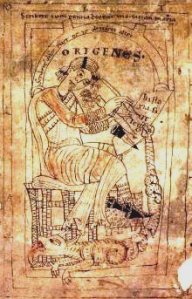
Image credit: https://commons.wikimedia.org/wiki/File:Origen3.jpg – Public Domain
Origen (184-253 AD) was one of the earliest defenders of the Christian faith.* In his work, Contra Celsum, he engaged with a Greek skeptic who brought many arguments against Christianity. In his De Principiis, he laid out the foundations of the Christian faith. (Both works are availble in The Works of Origen.) The latter work demonstrates key points to understanding the relationship between God the Father and God the Son:
John… says in the beginning of his Gospel, “And God was the Word, and this was in the beginning with God.” Let him, then, who assigns a beginning to the Word or Wisdom of God, take care that he be not guilty of impiety against the unbegotten Father Himself, seeing he denies that He had always been a Father, and had generated the Word…
This Son, accordingly, is also the truth and life of all things which exist… For how could those things which were created live, unless they derived their being from life? (Origen, De Principiis, Book I Chapter 2)
Origen, then, notes that the very descriptor of “Father” for God the Father entails that the Son has always been generated. Otherwise, one must deny that God was always the Father. But in that case, the Son must also always have been. And to deny this, one would have to deny creation itself, for all things were made through the Son.
Again, this point must not be lost: Origen, one of the earliest defenders of the church, saw the Father and the Son as distinct from each other and also co-eternal. Effectively, this goes against many false teachings, including modalism (the idea that the Father, Son, and Holy Spirit are different aspects of one God), any form of Arianism (that Jesus is not fully God), and the like. For a modern example, Jehovah’s Witnesses teach that Jesus is not fully God and not co-eternal with God the Father (whom they call Jehovah). Origen would repudiate this, noting that the Father can only right so be called in eternity, which entails the Father has always been the Father, and so the Son is co-eternal with the Father.
Reading many of these ancient historians reveals much truth about Christianity and helps to correct false teachings of today. I recommend readers read the Works of Origen.
*Origen did hold many unorthodox views which were later condemned as heretical. His faith was clearly one influenced by Platonic thought in which the human soul pre-existed and was eternal. Moreover, his view of the relations between the persons of the Trinity is deficient on many levels. My point in this post is specifically to show that Origen showed that the Son is co-eternal with the Father.
Links
Be sure to check out the page for this site on Facebook and Twitter for discussion of posts, links to other pages of interest, random talk about theology/philosophy/apologetics/movies and more!
Faith is Belief Without Evidence? Origen contra Boghossian (and others)– Origen countered the claim that faith is to be categorized as belief without evidence, as many atheists continue to claim to this day.
Eclectic Theist– Check out my other blog for posts on Star Trek, science fiction, fantasy, books, sports, food, and more!
SDG.
——
The preceding post is the property of J.W. Wartick (apart from quotations, which are the property of their respective owners, and works of art as credited; images are often freely available to the public and J.W. Wartick makes no claims of owning rights to the images unless he makes that explicit) and should not be reproduced in part or in whole without the expressed consent of the author. All content on this site is the property of J.W. Wartick and is made available for individual and personal usage. If you cite from these documents, whether for personal or professional purposes, please give appropriate citation with both the name of the author (J.W. Wartick) and a link to the original URL. If you’d like to repost a post, you may do so, provided you show less than half of the original post on your own site and link to the original post for the rest. You must also appropriately cite the post as noted above. This blog is protected by Creative Commons licensing. By viewing any part of this site, you are agreeing to this usage policy.

 J.W. Wartick - Reconstructing Faith
