Christianity
On Acquiring Books- How to get scholarly books to read
 A recent comment on my blog about how to get one’s hands on a pricey philosophy of religion book without having to fork over the near-100$ price tag got me thinking. I figured I would write this post to give some pointers for how to acquire books (not necessarily own, but get them in-hand) to further one’s study. I will be sharing specific insights for Christian scholarship, but overall this should be useful for anyone looking to read scholarly (or any!) books.
I will explore a number of ways, some of which may be familiar to you, to get these books in order to consume more awesome reading. Be aware: some of these which may seem obvious at first (library) will, I hope, have more insight beyond the obvious.
Please leave comments if you think of something that I’m missing here. As I live in the U.S., this list will have some things which may only be relevant for that. International readers, feel free to share some of your own insights in the comments.
Library
We’ll start with the obvious: use your local library. You’d be surprised what they might have access to. Inter-Library Loan is a great way to get books not immediately available. Often, your local library will have partnerships with university libraries across the nation and they’ll be able to get you that book to read. If you aren’t taking advantage of this, do so. Best of all this will be free! Well, apart from the taxes you pay. So you may as well use the library because you pay for it anyway!
Another thing to look out for is any local seminary libraries. Often, they’ll let you come in and at least sit down and read, and you may even be allowed a guest pass to check books out. It’s worth exploring and the seminary will have a robust collection of philosophy of religion and theology books. I very much recommend this route if at all possible.
E-Books
Look, I know your thoughts because they were mine: “I like the smell of books”; “I like to hold the book in my hand and page through it”; “I don’t want some newfangled device!”
I hear you.
But now, be silent, because I’m going to explain why you should go for e-books and probably spring some cash for an e-reader (or at least get a Kindle app on your smart phone or something!).
1) Shelf space- a constant struggle for we book-a-holics is shelf space. E-books provide a library at your fingertips without needing anything more than a single device.
2) Old books are freely available- Literally hundreds of thousands of books are now public domain, and many are available online for free through places like Open Library. You can access things like historical apologetics books by the “armful” and they’re all free. Beat that.
3) New books are often free- Many publishers cycle through books being free for a day on Amazon. It’s worth your time to check there frequently to see if a book you may want is free. Go off of your wish list and check on Kindle to see if a book might be free, and be aware that these do change fairly frequently. It may be worth signing up for some Facebook groups or e-mail lists about free books so that you don’t miss as many (and find some you didn’t even know about).
4) Major savings on books- Have you been eyeing that 200$ treatise on a topic of interest? Oh look, it’s 50$ on Kindle. Why not save the shelf space and 150$ and just get the Kindle version? This example is extreme, but you can usually save at least a few bucks by getting the e-book version.
5) Reading e-books isn’t as bad as it sounds- Again, I hear you, I resisted for a while. Now that I have my Kindle, though, we’re inseparable. I do miss the smell of books, but the screen looks like the page of a book, and I can highlight and even take notes and bookmark pages. Moreover, it’s lightweight and small so it is easy to carry. Also, imagine that vacation: instead of trying to lug a backpack full of 25 books, you could bring your e-reader and have access to an entire library (I have well over 200 books on mine).
Buy Books
Another obvious instruction, but there is an art to this. That is, pretty much everyone has a limited budget for buying books (if any–I know how that goes!), along with limited shelf space. So it’s not as simple as just saying: “Yeah, go spend that 150$ on that latest book from Brill” (very pricey publisher). Here are some things I’ve done to both discipline myself and acquire books in a more meaningful fashion.
1) Set a clear budget- obviously, without this you either have no way to buy books, or you will buy too many and not eat. Whether it’s 1$ a week and you save up for 50 weeks before you buy that one book or it’s 50$ a week and you’re drowning in books, set a budget.
2) Be aware of space requirements- once more this seems obvious, but try to keep in mind the space books take. If you have limited shelf space (and we probably all do), keep in mind that a 500 pager is going to take up a lot more space than a 150 page book. For that 500 page monstrosity, it might be better to look at E-Books above.
3) Make AND MAINTAIN a wish list- We all have wish lists, but have you thought of this as a way to limit or direct your buying? While browsing through Amazon and throwing things on your wish list, why not also try to think along the lines of expense and need? A good rule is this: leave a book on your wish list for at least 2 weeks before buying. If those two weeks are up and you still really want the book and have budged for it, then it’s more likely it wouldn’t just be an impulse purchase. Another thing to keep in mind is to prioritize your buying: some books we have an idle interest in reading; others are necessary for our research. The one’s in the latter category should almost always trump the former.
Look Into Review Programs
Many publishers are willing to give you free books in exchange for reviews. For example, Crossway has a blog program in which they make available some e-books to bloggers and you can review 2 a month or up to 12 a year. That’s 12 books you both don’t have to buy and also which don’t take up shelf space. Other publishers are often willing to send you books if you contact them. If there’s a new book out that you want to read, try contacting the publisher and offering to review it on your blog if they send you a copy. It’s a mutually beneficial system.
Links
Be sure to check out the page for this site on Facebook and Twitter for discussion of posts, links to other pages of interest, random talk about theology/philosophy/apologetics/movies and more!
SDG.
——
The preceding post is the property of J.W. Wartick (apart from quotations, which are the property of their respective owners, and works of art as credited; images are often freely available to the public and J.W. Wartick makes no claims of owning rights to the images unless he makes that explicit) and should not be reproduced in part or in whole without the expressed consent of the author. All content on this site is the property of J.W. Wartick and is made available for individual and personal usage. If you cite from these documents, whether for personal or professional purposes, please give appropriate citation with both the name of the author (J.W. Wartick) and a link to the original URL. If you’d like to repost a post, you may do so, provided you show less than half of the original post on your own site and link to the original post for the rest. You must also appropriately cite the post as noted above. This blog is protected by Creative Commons licensing. By viewing any part of this site, you are agreeing to this usage policy.
Honoring Giftedness- Women in David Weber’s science fiction
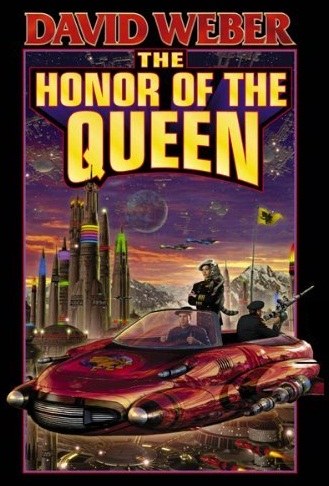 David Weber is the author of a few New York Times Bestselling science fiction series. One, the Honor Harrington series, follows a woman who starts off as a captain of a starship sent on routine (and initially boring) missions. The second book in the series, The Honor of the Queen
The two nations are complementarian in nature. Complementarianism is the theological belief that men and women are “complementary” in roles, which means that men should be in charge in the church and home. I have discussed it and the rival view that women should be ordained/treated as equals (egalitarianism) at length elsewhere [scroll down to see other posts].
What really struck me is that David Weber fairly presented firm theistic believers as a spectrum. In the future, the Christian Church has continued to reform and have splinter groups form because of this. Weber’s presentation of the issue showed that believers–even some who might be considered extreme–can be reasoned with and even persuaded to believe differently based upon evidence. Furthermore, he showed that even those who may line up on the side with which he disagrees are not all (or even mostly) blinded by faith or foolishness. Rather, although there are some truly evil and disillusioned people, Weber shows that many are capable of changing their position or at least acknowledging that rival views are worth consideration.
The most vivid portrayal of this theme is found in a conversation between Admiral Courvosier and Admiral Yakanov. Courvosier is from the same nation as Honor Harrington and wholly endorses his female officer in a position of command. They discuss Captain Honor Harrington:
[Yanakov responds to Courvosier’s question about his society’s reaction to Honor]: “If Captain Harrington is as outstanding an officer as you believe–as I believe–she invalidates all our concepts of womanhood. She means we’re wrong, that our religion is wrong. She means we’ve spent nine centuries being wrong… I think we can admit our error, in time. Not easily… but I believe we can do it.”
“Yet if we do[” Yanakov continues, “]what happens to Grayson [Yanakov’s world]? You’ve met two of my wives. I love all three of them dearly… but your Captain Harrington, just by existing, tells me I’ve made them less than they could have been… Less capable of her independence, her ability to accept responsibility and risk… How do I know where my doubts over their capability stop being genuine love and concern?” (96, cited below)
The exchange is characteristic of the way Grayson’s people are treated throughout the book. They are real people, capable of interacting with other views in honest ways. They feel challenged by a view contrary to their own. Some react poorly, and there are extremists who are blinded by hatred and anger. Yet all of them are treated as people with real concerns shaped by their upbringing and backgrounds.
Honor Harrington ends up saving Grayson, and at the end of the book, she is commended by the rulers of that planet. She talks to the “Protector” [read: king/president] of Grayson:
“You see,” [said the Protector] “we need you.”
“Need me, Sir?” [Responded Honor]
“Yes, Grayson faces tremendous changes… You’ll be the first woman in our history to hold land… and we need you as a model–and a challenge–as we bring our women fully into our society.” (419)
Weber thus allows for even ardent supporters of specific religious backgrounds to respond to reasoned argument and to change. They are capable of interacting on a human level and deserve every bit of respect as those who disagree with them. Again, there are those who are radicals and will not be reasoned with, but they are the minority and they do not win out.
The dialogue presented in this book provides some interesting insight into facets of the present dialogue between complementarians and egalitarians. David Weber’s fictional character presented a challenge to the Grayson’s notions of what it meant to be a woman by being an excellent officer and professional. There are, it seems, real “Honor Harringtons” out there, challenging preconceived notions of what it is to be a woman. When, for example, a woman takes on the role of leadership in the church and succeeds, that should not be dismissed as a fluke, but rather a challenge to a paradigm which may itself be undercutting women’s ability to succeed.
On a personal note, I have been challenged in exactly this way. When I was younger, I was a complementarian and was confronted by a woman who destroyed my presuppositions about what a woman “could do” spiritually. She showed that she could be a leader and present Christ to all without having to fit into role I defined for her. This real challenge caused me to realize that my notions of what a woman “should be” were themselves social constructs, not anything derived from the Bible. Like Yanakov, I had to rethink what my words and actions had done to perhaps limit the women around me. By God’s grace, this woman’s very existence forced me to rethink what I had assumed as truth and go back to God’s word to see where I had gone wrong.
David Weber’s own presentation of Honor Harrington as a paradigm-shattering woman is something that hits close to home for me. For you, dear reader, I think it is worth considering the same: who has challenged your view of what they are “supposed to be”? Is your view of someone’s giftedness directly drawn from the Bible or is it something that you’ve just always assumed? As for me, I think we need more Honor Harringtons in our lives.
Links
Be sure to check out the page for this site on Facebook and Twitter for discussion of posts, links to other pages of interest, random talk about theology/philosophy/apologetics/movies and more!
Check out my posts on egalitarianism (scroll down for more).
Source
David Weber, The Honor of the Queen
SDG.
——
The preceding post is the property of J.W. Wartick (apart from quotations, which are the property of their respective owners, and works of art as credited; images are often freely available to the public and J.W. Wartick makes no claims of owning rights to the images unless he makes that explicit) and should not be reproduced in part or in whole without the expressed consent of the author. All content on this site is the property of J.W. Wartick and is made available for individual and personal usage. If you cite from these documents, whether for personal or professional purposes, please give appropriate citation with both the name of the author (J.W. Wartick) and a link to the original URL. If you’d like to repost a post, you may do so, provided you show less than half of the original post on your own site and link to the original post for the rest. You must also appropriately cite the post as noted above. This blog is protected by Creative Commons licensing. By viewing any part of this site, you are agreeing to this usage policy.
Sunday Quote!- Pragmatic Use of Arguments for God
 Every Sunday, I will share a quote from something I’ve been reading. The hope is for you, dear reader, to share your thoughts on the quote and related issues and perhaps pick up some reading material along the way!
Pragmatic Use of Arguments for God
One of my favorite books on any argument for the existence of God is Caroline Franks Davis’ The Evidential Force of Religious Experience. I re-read it recently and came upon a number of awesome insights I hadn’t even marked the first time (how’s that as a case for re-reading books?)! One pertained to the notion that some theistic arguments might be successful, but not useful when it comes to trying to provide evidence to a skeptic:
Some arguments which have been proposed in favor of theism… suffer so many defects or are so controversial that they do not contribute a great deal to the theistic case. (242-243, cited below)
The point is not that all the arguments which may fall into this category are in fact irrational or mistaken (though some may be!), but rather that the usefulness of the arguments are hampered, in particular, by the controversy surrounding said arguments. The central thrust of her passage here is that some arguments may inspire so much objection (even if reasonable), that bringing them up may not contribute to a dialogue. I think this point is fascinating, though the philosophical side of me cries out saying “But if the argument is sound, why not use it!?” I wonder, however, whether this is the right approach.
Are there some theistic arguments which–apart from their soundness–are simply not useful in the case of presenting an apologetic? Should we base our use of these arguments on their utility in that case, or simply upon the logical soundness of the arguments? Which arguments might fall into this category?
Links
Be sure to check out the page for this site on Facebook and Twitter for discussion of posts, links to other pages of interest, random talk about theology/philosophy/apologetics/movies and more!
Sunday Quote– If you want to read more Sunday Quotes and join the discussion, check them out! (Scroll down for more)
Source
Caroline Franks Davis, The Evidential Force of Religious Experience
SDG.
Really Recommended Posts 9/26/14- Jesus Seminar, atheists and kids, and creationism!
 First, I gotta brag: I have a son! He was born 9/17 and he’s just the cutest darling ever. Yay! I’ve been greatly blessed.
Now, I have still put together some awesome posts for your persual, dear readers! Here we have a nice variety of topics from the need to realize the dangers of a hardened heart to the Jesus seminar to talking about atheism with kids (I’m sure this last one won’t be controversial). Check them out and let me know what you thought!
Chemostratigraphy: silent objector to ‘Flood Geology’– Young Earth Creationists often argue that the Noachian Flood is to be seen as the explanation for the layers of sediment we find all over the planet. Can this claim stand up to scrutiny?
Who Were the Jesus Seminar? Should anyone have taken them seriously?– Christians have long faced challenges thrown at the historical faith by historical critics like those in the Jesus Seminar. But should the Jesus Seminar really be (or have been) taken seriously? Check out this post which addresses some issues related to this group.
14 Ways for Christian Parents to Teach Kids about Atheism– How might we as Christians approach the topic of atheism when speaking with children? Natasha Crain provides some much-needed insights into this area. I think this is a must-read even for those who are not parents so that we can think about how to interact in age-appropriate ways.
The Dangers of a Hardened Heart– The heardening of one’s heart presents a number of dangers for both a life of faith and a life without faith. Eric Chabot addresses these dangers in this thought-provoking post.
Is Your View Falsifiable?– Luke Nix points out a number of helpful ideas regarding whether one’s view is falsifiable. Does this matter? Read the post for many insights related to falsifiability and the Christian life.
A Brief Musing on the “Prosperity Gospel” – Psalm 4:6-7
 I have been reading back through the Psalms, because, you know, it’s what the cool kids do. Anyway, I came upon a passage which I thought may have some relevance for the “Prosperity Gospel” teaching (check out this brief summary and critique of this movement):
“Many, LORD, are asking, ‘Who will bring us prosperity?’
Let the light of your face shine on us.
Fill my heart with joy
When their grain and new wine abound.” Psalm 4:6-7 [7-8 in Hebrew Bible]
The text may not immediately seem to have anything to say about the notion that God will grant us ‘health, wealth, and prosperity.’ However, I think it actually does serve as a brief refutation of this alleged “gospel.” I’ll break it down.
Many, LORD, are asking “Who will bring us prosperity?”
There are those who call out to anyone, seeking prosperity rather than seeking after the LORD. Rather than asking the King of the Universe to let His will be done, they seek out prosperity from whatever place it may come. The modern teaching of the “prosperity gospel” is a form of this, but it smuggles in the notion that God is going to provide such wealth to those who ask.
Let the light of your face shine on us.
Rather than asking the LORD for prosperity, the Psalmist David seeks only to have God “shine” on him. Happiness comes from the presence of God.
Fill my heart with joy when their grain and new wine abound.
Here is what I would consider the dramatic turnaround: the first quoted section speaks of how there are others who are seeking after wealth from wherever it may come. Now, David asks from God, the only true provider, to give joy to him even when those who seek such prosperity actually get it.
Thus, we have a very real contrast: those who seek wealth as opposed to those who realize that the rain falls even upon the wicked and so they should rejoice in the light of God’s presence. The difficulty is not purely that the “others” are seeking from others; rather it is that they are seeking prosperity (more literally “happiness”) from God rather than simply rejoicing in God’s presence and Word.
Am I on Track?
I decided to take the time to look up these verses in a commentary after writing the above to see if I may be on the right track. There’s something to be said for the notion that we shouldn’t be doing theology in a vacuum. Samuel Terrien, in his commentary on Psalms from the Eerdman’s Critical Commentary series, argues that Psalm 4 should be seen as an evening prayer, likely even sung in the bedroom/prayed as one was getting into bed. His comments on the relevant passage note that “the poet is… saddened by the discovery of a certain skepticism around [him]… Happiness… which is lacking around him, may be due to a satiety of a materialist kind… For the pious, however, happiness arises from a grateful acceptance of God’s presence” (98-99, cited below).
Again, we see that the problem is that we should be finding our joy in the presence of God rather than material blessings from wherever they may come. Those who seek “health, wealth, and prosperity” are in fact pursuing the latter rather than the former. Psalm 4 should serve as a corrective to the prosperity “gospel.”
Links
Be sure to check out the page for this site on Facebook and Twitter for discussion of posts, links to other pages of interest, random talk about theology/philosophy/apologetics/movies and more!
Source
Samuel Terrien, The Psalms: Strophic Structure and Theological Commentary (Grand Rapids, MI: William B. Eerdmans, 2003).
SDG.
——
The preceding post is the property of J.W. Wartick (apart from quotations, which are the property of their respective owners, and works of art as credited; images are often freely available to the public and J.W. Wartick makes no claims of owning rights to the images unless he makes that explicit) and should not be reproduced in part or in whole without the expressed consent of the author. All content on this site is the property of J.W. Wartick and is made available for individual and personal usage. If you cite from these documents, whether for personal or professional purposes, please give appropriate citation with both the name of the author (J.W. Wartick) and a link to the original URL. If you’d like to repost a post, you may do so, provided you show less than half of the original post on your own site and link to the original post for the rest. You must also appropriately cite the post as noted above. This blog is protected by Creative Commons licensing. By viewing any part of this site, you are agreeing to this usage policy.
Book Review: “The Stories We Tell” by Mike Cosper
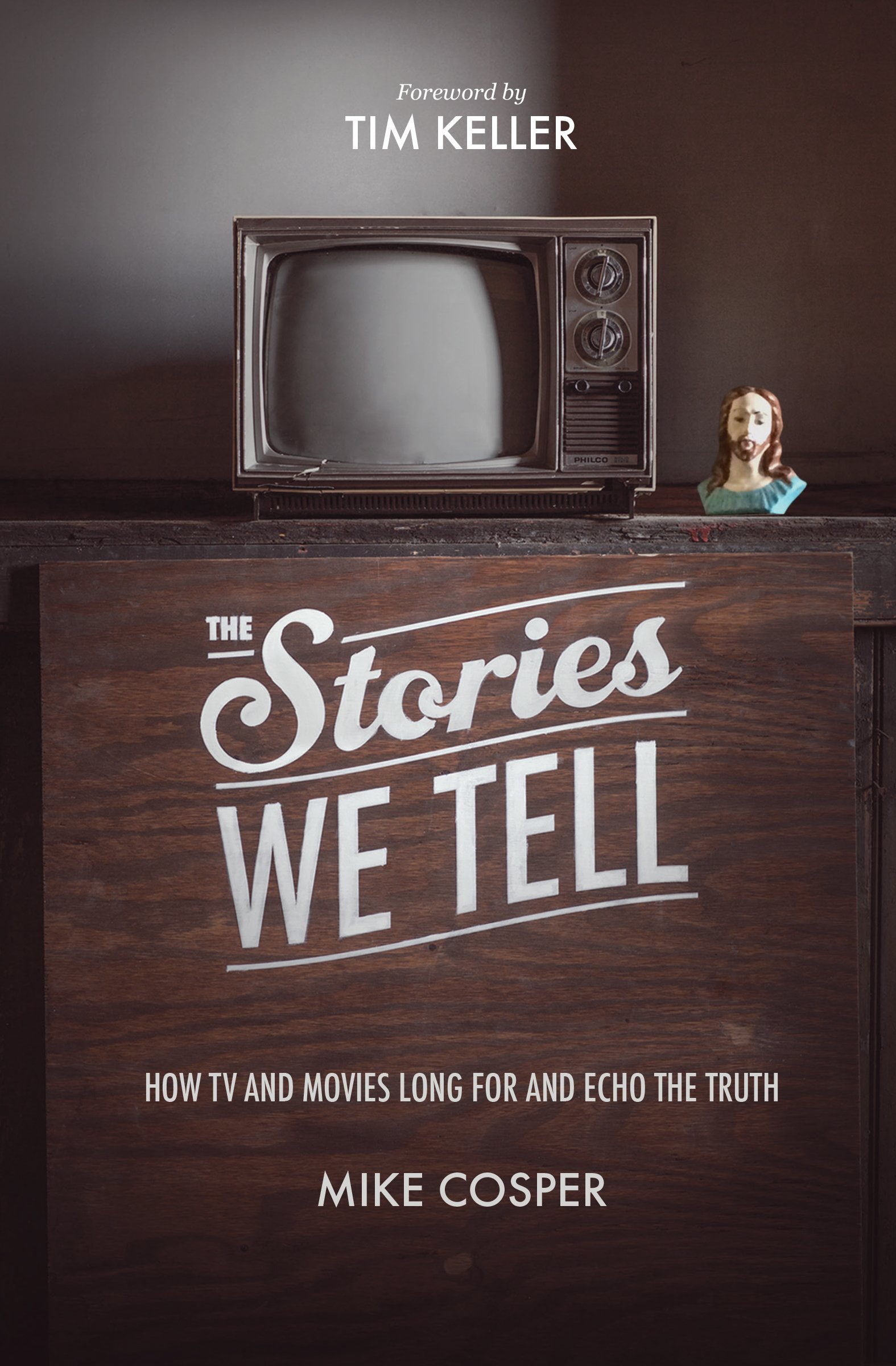
Mike Cosper’s The Stories We Tell
Cosper analyzes several television shows from Mad Men to Project Runway and looks at themes with redemptive value. He doesn’t present a one-size-fits-all picture of how individual genres or specific movies or shows reflect all one specific picture, but rather analyzes the stories told in these forms of media from the perspectives of various aspects of the Christian worldview. These include themes of creation, sin, redemption, love, the fall and success of heroes, and more.
This holistic vision of analyzing stories in TV and at the movies allows readers to open their own avenues for perspectives and reflection in ways that not all books on a topic like this provide. Not only that, but Cosper’s writing is genuinely fascinating. I haven’t watched most of the television shows he discussed, but his presentation of them was enough to allow me to feel as though I knew what was happening and even got me deeply interested in the stories he described. This is not just a good book on how to discuss movies, but it’s also a genuinely interesting overview of a number of stories, whether they’ve been encountered already or not.
Another excellent insight Cosper provided was his look at whether certain stories, movies, and television are appropriate for Christians. He presented a very balanced and insightful look at this topic. First, he noted that the question “how far is too far” is often used to draw boundaries either to allow oneself to get as far as possible or to try to denigrate or call out others. Then, he used two examples of the extremes when it comes to appropriateness: the “overanxious teenager” who wants to get right up to the boundary in order to see as much as they can and the “church lady” who wants to stand as judge to show how others are sinners. He uses these examples to great effect, but does not leave it merely at that. He argues that either extreme is mistaken and also offers a way for Christians to explore appropriateness of various shows and movies.
Conscience and community are to be our guideposts when it comes to the appropriateness of media. Conscience allows us to have an inner arbiter of whether something is appropriate: “If you’re struggling with whether to watch something, ask yourself if you’re sturrling against a conscience that knows better” (Kindle Location 671). A community will help as well by offering a group of others with different experiences and advice. The community will only be helpful, however, if one commits to being honest about viewing habits and having friends who are willing to confront one over the viewing. I found this to be remarkably insightful and Cosper’s perspective on appropriateness is a solid way for Christians to evaluate their viewing habits.
There are many books about Christianity and visual arts like movies and television. Mike Cosper’s The Stories We Tell
Disclaimer: I received a review copy of the book through Crossway. I was not obligated by the publisher to give any specific type of feedback whatsoever.
Links
Be sure to check out the page for this site on Facebook and Twitter for discussion of posts, links to other pages of interest, random talk about theology/philosophy/apologetics/movies and more.
Book Review: “Hollywood Worldviews” by Brian Godawa– Speaking of worldviews in the movies, why not check out my review of this book which seeks to provide a method for analyzing film from a worldview perspective? Let me know what you think.
Engaging Culture: A brief guide for movies– I outline my approach to evaluating movies from a worldview perspective.
I have a number of ways in which I have critically engaged with culture in movies, books, and other arts in my posts on current events (scroll down for more posts).
Source
Mike Cosper, The Stories We Tell (Wheaton, IL: Crossway, 2014).
SDG.
——
The preceding post is the property of J.W. Wartick (apart from quotations, which are the property of their respective owners, and works of art as credited; images are often freely available to the public and J.W. Wartick makes no claims of owning rights to the images unless he makes that explicit) and should not be reproduced in part or in whole without the expressed consent of the author. All content on this site is the property of J.W. Wartick and is made available for individual and personal usage. If you cite from these documents, whether for personal or professional purposes, please give appropriate citation with both the name of the author (J.W. Wartick) and a link to the original URL. If you’d like to repost a post, you may do so, provided you show less than half of the original post on your own site and link to the original post for the rest. You must also appropriately cite the post as noted above. This blog is protected by Creative Commons licensing. By viewing any part of this site, you are agreeing to this usage policy.
Sunday Quote: Aliens and Paganism?
 Every Sunday, I will share a quote from something I’ve been reading. The hope is for you, dear reader, to share your thoughts on the quote and related issues and perhaps pick up some reading material along the way!
Aliens and Paganism?
I’ve been entering notes into my computer and because of that I’ve been rereading a bunch of books. Scientific Mythologies: How Science and Science Fiction Forge New Religious Beliefs
[W]e are witnessing nothing less than the emergence of new transcendent narratives–new myths–to answer our deepest questions. We appear to have entered a second pagan era, complete with a new mythology in which minor deities once again descend from the stars, seek intimate involvement in our lives, direct our course into the future… Our mythologies… have a way of shaping who we are and what we are becoming. (17, cited below)
Have you witnessed any kind of “new mythologies” being followed or created through science or science fiction? I think that sci-fi is a great way to convey a worldview, and I’ve commented often on various ways people have used it for just that purpose. What ways might new scientific mythologies shape our perceptions of ourselves and others? Do you think Herrick’s point is to be well taken, or is he wrong? Why/not? I encourage you to check out the fascinating book. Thanks to my friend Josh over at No Apologies Allowed for so long ago introducing me to it.
Links
Be sure to check out the page for this site on Facebook and Twitter for discussion of posts, links to other pages of interest, random talk about theology/philosophy/apologetics/movies and more!
Sunday Quote– If you want to read more Sunday Quotes and join the discussion, check them out! (Scroll down for more)
Materialists: Where is hope? Look to the stars!– I analyze one aspect of materialism: the way that some look to hope in the “beyond” of the outer limits of the universe. Hope, for materialists, may come from the stars. Our salvation may lay beyond our solar system, in benevolent aliens who will bring great change and advances to us.
Source
James Herrick, Scientific Mythologies: How Science and Science Fiction Forge New Religious Beliefs
“Elysium” – Our Hopes, Greed, Class, and Suffering
 “Elysium” is one of a string of recent action flicks which have taken to exploring bigger issues than how to make the biggest explosion. Here, we’ll look at some themes in the movie and reflect on how they might resonate with the Christian worldview. There will be SPOILERS for the film in what follows. I will not summarize the plot, though a summary may be found here.
Greed and Suffering
The story seems to center around the issue of greed. After all, the premise is essentially that human greed leads to great suffering. The question of whether there is a moral obligation to end suffering is front and center in the movie. The citizens of Elysium live a life of luxury, conveniently located far away from the strife that inhabitants of Earth must undergo. There is a clear and obvious dichotomy between the lives of the people planetside and those on the space colony.
It’s a premise which seems obvious, but there is a twist in the film, which impacts the force of this question. Once the final outcome is determined, and the reprogramming of citizenship is brought about to include all people, Elysium’s automated defenses and medical robots immediately begin helping the people of Earth. Medical shuttles are dispatched with instant-healing devices to help the new citizens. This twist throws a wrench into the reasoning of the question of obligation to end suffering: what if one has nothing to lose in order to help others?
Thus, the question goes beyond mere greed. It is a question of how humans will seek to hold on to what they have, even when it costs nothing to help others. It’s a poignant way to portray the issue, and one which forces viewers to think upon their own attitudes regarding what we have and seek to hold on to.
Of course, this portrayal of the issue doesn’t take away from the question of whether there is an obligation to end suffering. I think the answer, from a Christian perspective, is that we of course do. Then, the question must be asked of how to best alleviate suffering. These and other questions are raised by the film, and in ways which provoke much continued thought.
Class
The issues of greed and suffering are also bookended in the film by the question of class. Even on Earth, where poverty seemed to be ubiquitous, class was an issue. There were those with jobs, those who begged, and those who turned to crime. The sharp distinction between citizens of Elysium and those of Earth makes the point even more obvious. Once again, as Christians, we are forced to ask how we might address this issue of inequality. There are to be no such distinctions in the body of Christ (Galatians 3:28), so how might we help to work towards ending racial, class, and other inequalities on Earth?
Hope
There is a constant theme of hope in what seems like a hopeless world. The people of Earth realize that help could come from Elysium, but they must get there first. They turn their hope to the stars, but there is a Nun who educates the young Max that there is beauty on Earth as well–beauty in humanity, despite our fallen nature.
Conclusion
“Elysium,” though featuring some objectionable content, is a film with much to ponder from a Christian perspective. How are we to approach other humans in a way which doesn’t undermine their dignity? We are to work to end suffering, to bring about equality. We are to prevent a scenario like “Elysium” from ever happening.
Links
Be sure to check out the page for this site on Facebook and Twitter for discussion of posts, links to other pages of interest, random talk about theology/philosophy/apologetics/movies and more.
Engaging Culture: A brief guide for movies– I outline my approach to evaluating movies from a worldview perspective.
I have a number of ways in which I have critically engaged with culture in movies, books, and other arts in my posts on current events (scroll down for more posts).
Elysium: Fighting for Paradise– Anthony Weber addresses a number of other worldview issues brought up in the movie on his fantastic site, Empires and Mangers. Be sure to follow his great blog.
The picture in this post is from a movie poster and I use it under fair use.
SDG.
——
The preceding post is the property of J.W. Wartick (apart from quotations, which are the property of their respective owners, and works of art as credited; images are often freely available to the public and J.W. Wartick makes no claims of owning rights to the images unless he makes that explicit) and should not be reproduced in part or in whole without the expressed consent of the author. All content on this site is the property of J.W. Wartick and is made available for individual and personal usage. If you cite from these documents, whether for personal or professional purposes, please give appropriate citation with both the name of the author (J.W. Wartick) and a link to the original URL. If you’d like to repost a post, you may do so, provided you show less than half of the original post on your own site and link to the original post for the rest. You must also appropriately cite the post as noted above. This blog is protected by Creative Commons licensing. By viewing any part of this site, you are agreeing to this usage policy.
An Apologist’s Insights on “God’s Not Dead”
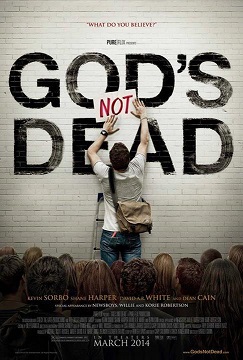 I recently had the chance to watch “God’s Not Dead,” a film which presents a story in which a college student decides to take a stand for his faith against the pressure of an atheistic philosophy professor. A summary of the plot may be found here. As an apologist with an MA in the field, I thought my comments might help provide some insight into the film. I’ll offer a look at some aspects of the film which I wanted to address. Feel free to chime in in the comments with your own thoughts.
Apologetics
The movie presents a clear picture of the need for apologetics. When challenged by attacks on the faith it is important to always have a reason for the hope within (1 Peter 3:15). Josh Wheaton–the protagonist–put together a decent presentation of various evidences for theism in the snippets that viewers get through the film. Of course, these are very simplified and don’t address several major issues with the arguments, but it gets the point across. It also, I have noted through conversations with others, spurred much interest in the area of apologetics. That’s awesome!
That said, I think there are some issues with even the arguments presented in the film. First, after Wheaton has presented the cosmological, design, and other arguments for theism, he is challenged by Professor Radisson on the notion that one just has to choose between atheism and theism. Wheaton acknowledges that yes, it is a choice. Now, there are a number of issues with this portrayal. First, it treats the balance of evidence as a kind of 50/50 proposition, which is, I would think, hardly the position of anyone. Second, it presents a view of belief in which we can just choose what we believe. This is called “doxastic voluntarism” which is a fancy way of saying that one can believe propositions at will. But that is a highly controversial position (just try to force yourself to believe that “Fairies fill my refrigerator every morning” and you’ll see the folly of it) and also flies in the face of biblical accounts of what faith is. Third, here I’ll tip my bias a bit and say I’m fairly well convinced that the balance of evidence is hardly 50/50 but actually compelling.
Another difficulty with the apologetic in the film is that it seems like the lynchpin argument offered was actually just a point of rhetoric. Wheaton presses Professor Radisson and asks “Why do you hate God?” and follows it up with [paraphrased]: “How can you hate someone who doesn’t exist?” This is the last straw and what prompts the class to vote by standing to say that “God’s not dead.” Although I think rhetoric has a clear place in the Christian apologetic (and has since the earliest times: see the apologetic works of Lactantius and Arnobius in the 200-300s AD), I thought it was an odd choice to make it the climactic argument for God. Perhaps it was because this added to the drama of the moment–and I suspect that’s right–but it did so at the cost of detracting from whatever apologetic the film could put forward.
I did, however, appreciate the interaction with some top scholars like Hawking and Lennox. I think it is very important for Christians interested in apologetics to read the top scholars in their fields in order to best get acquainted to the arguments.
Characters or Caricatures?
The way the Muslim father was portrayed was problematic. In the beginning of the film we see him dropping off his daughter and showing great concern for her. Later, he shares an intimate discussion of his faith and the importance of obedience in his background. But then, when it is revealed his daughter has converted to Christianity, he not only kicks her out of the house, but he also immediately hits her more than once. Now, I make no claims to being an expert on this, but I know from anecdotal evidence only that people are indeed kicked out of their homes for converting to Christianity (and sometimes for deconverting), and this is surely a bad thing. It’s not a bad thing to address this as an issue.
But the problem I saw was that the Muslim father’s immediate reaction was violence, without any explanation or any background for thinking this would be a reaction. The rest of the film up to this point had shown him as a caring father who was concerned for the faith and well-being of his daughter. To have him immediately turn to violence when she converted was jarring and I think it speaks to our cultural presuppositions about the religious “Other” to portray the “Other”–the Muslim–in that way. We need to move beyond such stereotypes and into genuine dialogue with those of other faiths, always looking to share the light and love of Christ with them.
On the positive side, the film did do a great job speaking to the importance of reaching out to others like the young man from China. It also emphasized missions in a number of ways, like centering some major plot points around a very amiable character as a missionary.
Pastoral Care
I appreciated the comments about the work of a pastor, in which Pastor Dave in the film was comparing his own work to that of a missionary friend’s and felt his own day-to-day tasks were mundane and trivial. The answer given by the missionary, however, was essentially that such work is part of the work of God as well and that we each occupy a place which God has put us in to make an impact on the world. I thought this was a great message and one that deserves further exploration.
On the other hand, I thought that the pastoral care at points in the movie presented some difficulties. For example, Pastor Dave’s conversation with Josh Wheaton before Wheaton decides to for sure stand up to his professor boiled down to a couple citations (not even quotations) of Bible verses to look up later and the comment that “It’s not easy, but it’s simple” [I may have the order in this quotation wrong]. I’ll be blunt: I think that this is actually a gross oversimplification. Quoting Matthew 10:33 (click for reference) does not actually make the issue facing Wheaton “simple.”
For example, would it be “denying” Christ to acknowledge that one might not have the resources available as a freshman student in a general studies philosophy class (and not a major) to take on a philosophy professor on the topic of God’s existence? I don’t think so. One could instead acknowledge that both the clearly adversarial tone taken in the environment and one’s own lack of knowledge or expertise in the area make it likely that one may actually harm the body of Christ by, well, looking like a freshman non-philosophy student outmatched by an atheistic philosophy professor. Wheaton, of course, has the benefits of film, so he is able to put together a beautiful powerpoint each week and manages to pound the books so hard that he can articulate the cosmological, design, and other arguments within a few days. But is this a realistic perspective? Moreover, is it a “simple” application of the passage to our lives?
Conclusion
“God’s Not Dead” awakens people to the need for apologetics. That is a great compliment, because it is a much-needed awakening. However, it has several issues (including those mentioned above) with the presentation of apologetics, its portrayal of the “Other,” and the oversimplification of several arguments, positions, and even pastoral care and reading of texts. In short, it’s a mixed bag.
Links
Be sure to check out the page for this site on Facebook and Twitter for discussion of posts, links to other pages of interest, random talk about theology/philosophy/apologetics/movies and more!
SDG.
——
The preceding post is the property of J.W. Wartick (apart from quotations, which are the property of their respective owners, and works of art as credited; images are often freely available to the public and J.W. Wartick makes no claims of owning rights to the images unless he makes that explicit) and should not be reproduced in part or in whole without the expressed consent of the author. All content on this site is the property of J.W. Wartick and is made available for individual and personal usage. If you cite from these documents, whether for personal or professional purposes, please give appropriate citation with both the name of the author (J.W. Wartick) and a link to the original URL. If you’d like to repost a post, you may do so, provided you show less than half of the original post on your own site and link to the original post for the rest. You must also appropriately cite the post as noted above. This blog is protected by Creative Commons licensing. By viewing any part of this site, you are agreeing to this usage policy.
Really Recommended Posts 9/12/14- science and faith, questioning leaders, and more!
I have sought out another round of really recommended posts for you, dear readers. I hope these posts bring you edification, as they did for me. Let me know what you thought in the comments here, and be sure to drop a comment on those you appreciated!
Is Christian Belief A Science-Stopper: 7 Quick Points– It is often alleged that Christianity becomes a science-stopper. People who are Christians, it is said, are somehow defective intellectually in ways which stall science; or perhaps it is instead that Christian belief leads to a kind of gullibility regarding scientific explanation. Here are seven points which argue that Christianity does not stop science.
The forgotten lesson of Bonhoeffer and the American Church– What might the story of Bonhoeffer have to tell us for today? Has his life as a Christian been misunderstood? Check out this interesting article on the man, Dietrich Bonhoeffer.
Beelzebul: Poop god– Who said the Bible has no comedy in it? Check out this post which talks about Beelzebul, the poop god, among others.
Two Paths Affirming Women’s Ordination– How might one go about arguing for women’s ordination? Check out this post, which traces two ways that women’s ordination has been achieved historically and in modernity.
Christology: Deity and Eternality– An excellent resource for those of us wanting to look into how to show the deity and eternality of Christ. I highly recommend keeping a copy of this somewhere close at hand.
When Questionable Leaders Make Us Doubt– There have too often been Christian leaders in the news for poor decisions, making mistakes, or even being abusive. What do we do when these failures in Christian leadership make us doubt? My own thought is that we need to recognize that being Christian doesn’t automatically make us cease sinning, but here are some deeper insights I thought were helpful.

 J.W. Wartick - Reconstructing Faith