egalitarianism
Really Recommended Posts 1/3/14- Dinosaurs, Evangelists, Down Syndrome, and more!
 Every week I search to find the best the web has to offer to you, dear reader. Check out my Really Recommended Posts this week, which feature everyone’s favorite topic: dinosaurs. Also featured are egalitarianism, Down Syndrome and abortion, creationism, a comic (and who doesn’t love comics!), and the worship wars. If you see something you like, let me know! Also, feel free to share your own recommendations here. I’d be happy to look into them. If you do share a link, be sure to drop a comment to let me know what it’s all about.
Rapid Burial Allows Preservation of a Hadrosaur Fleshy Head Comb– There have been a few finds of late with soft tissue preservation of dinosaurs. This allegedly presents a problem for the time scales proposed by contemporary science, according to some young earth creationists. Here, the author explores the preservation of soft tissue and argues that it actually presents a difficulty for young earth creationists.
‘If I don’t protect them, I am nothing’: The man who discovered Down syndrome– Down syndrome is a reason that many children are aborted today. It’s horrifying. The story of the man who discovered Down syndrome is a powerful testament to the need to protect and preserve life.
Women Evangelists in Acts– A brief but compelling argument that those who dismiss the notion of women in the ministry may not be taking the entire biblical witness into account. For example, what of those women who evangelized?
How Young-Earth Creationism Became a Core Tenet of American Fundamentalism, Part 1– It is often assumed that young earth creationism is simply a product of the Bible. The history of the movement is informative in correcting this misconception. Get informed yourself and check out this article.
Humans in Light of Biblical Revelation– A comic which shares an uncomfortable truth.
Worship Wars–faulty (and hurtful) logic– Does contemporary Christian music, by necessity, entail a lack of depth and wanton emotionalism? Check out this article exploring some issues related to a recent critique of CCM in general.
Really Recommended Posts 11/15/13 The Quran, egalitarianism, the Dark ages, and more!
 I have searched the four corners of the internet to bring you, dear readers, these really recommended posts. This week, we explore the Quran, egalitarianism, evidence for the truth of the Bible, the Dark Ages, and more! Check them out. As always, drop a comment to let me know what you thought! Have a post you think I’d be interested in? Here’s your place to share it (but don’t just leave a link! Tell me why I’d like it).
Is the Quran the Book of God? Debate Transcript– This is a very lengthy written debate between a Muslim and Christian on the topic: “Is the Quran the Book of God?” It is well worth a read as it shows the methodology that Muslims frequently use in debates. The cross-examinations, in particular, are highly useful. Although it is lengthy, I do really recommend that you read through this to get a better understanding of the places Christians and Muslims differ. The Christian, I think, did a fantastic job of showing that the Quran claims the Old and New Testaments are inspired, while also showing that one cannot simply claim corruption. The Quran says the Bible is the word of God, but then contradicts the Bible.
Why I’m an Egalitarian– An excellent post in which Leslie Keeney gives the reasons she holds to an egalitarian view–that women should be allowed full participation in leadership in the church and home. She addresses several biblical and social arguments.
Undesigned Coincidences– Tim McGrew points out, in this phenomenal post, the evidences for the truth of the Bible we can find even in those portions we so often skim past. Paul’s greetings provide us with confirmation of the details of his travels as found in Acts, for example. This post is Part 4, but it is standalone in content. Check out my own posts on this argument.
The Dark Age Myth: An Atheist Reviews “God’s Philosophers”– Christianity really slowed down scientific progress during the Dark Ages, right? Wrong. Here, an atheist explains how ridiculous such claims are historically.
Bad– Another great comic post from Adam4d, this one poignantly shows the truths about human nature.
Ad hominems, Special Pleading, Straw Men & Red Herrings: John Loftus’ Response to MandM– John Loftus has written a number of works attacking Christian theism from multiple angles. Here, MandM respond to a critique he leveled against their satirical moral argument. In this post, they analyze Loftus’ arguments in a number of different lights.
Women and the Reformation: Hope, Silence, and Circumstance
 It is Reformation Day and this year we are going to reflect upon a topic that is all-too-often overlooked: women in the Reformation. We shall consider the impact of women on the Reformation and the impact of the Reformation upon women from a theological perspective. I admit that covering such a broad topic within a blog post means I am very short on detail. I encourage readers to check out the sources at the end of this post in order to explore further avenues.
The Impact of the Reformation Upon Women
The Reformation brought about some changes for women both theologically and socially. Theologically, the issue of inequality between men and women socially and spiritually was more widely discussed. Although the concept had existed before, the Reformers largely held to the notion that men and women were spiritually equal. Spiritual equality led some to wonder whether women could perhaps be social equals, or–if that was to far afield–perhaps they could at least be less inequal (Spierling, 181-183, cited below). Seeds for social and spiritual change were sown during this period, but it must be admitted that there was not as much development as some may allege.
For example, Martin Luther’s notion of the “priesthood of all believers” is sometimes taken to mean that women and men could stand alongside each other as spiritual equals in teaching, preaching, etc. However, when Luther himself was challenged on this issue by the Roman Catholics, he answered by making it very explicit that although women could teach in extraordinary circumstances, he believed the Bible mandated that men were in charge in both church and home (Spierling, 186; see Luther’s Works 36: 151-152). Spiritual equality was seen as equality in the eyes of God, not in the roles that men and women actually took on earth. However, Luther also fought against some of the double standards regarding men and women and was outspoken against brothels and other abuses of women (Lindberg, 360-361, cited below).
The Reformers remained influenced by early Christian views of men and women, which were, in turn, influenced by earlier non-Christian scholars whose pre-scientific views of biology and psychology were adopted. Diarmaid MacCulloch traced the impact of Aristotle and the ancient medical expert Galen upon figures like Augustine and Clement. He described the Reformers’ view of manhood and womanhood as viewed through this lens thus:
What Christian theologians asserted about men, women, and sexuality was nonsense, but it was ancient nonsense, and humanity has always been inclined to respect the assertion of ancient wisdom. The… package of ideas also had a lunatic coherence: it seemed to make sense, explained a baffling aspect of human experience, and contained a good deal of room for flexibility of interpretation. No doubt our own medical theories will seem equally lunatic to generations to come. (MacCulloch,611, cited below)
Carter Lindberg’s own discussion of the impact of the Reformation upon women is bracketed by the question: “Was the Reformation a help or a hindrance to women?” He answers, a bit tongue-in-cheek, “It depends.” The Reformers denied that marriage was a sacrament, which allowed, later, for the dissolution of abusive or even loveless marriage. Women also began to become more actively involved in theology, though their voices were often silenced or ignored. The encouragement to leave convents may have reduced the possibilities for single women to have careers in the church or any sort of involvement (Lindberg, 358-361).
The social expectations for men and women during the Reformation period were shaped by the cultural expectations of “gender” which were themselves handed down to today through the theological writings of the Reformers (Ibid, 360). The concept may be termed “patriarchy” and was theologically adapted to continue to make it appropriate for the culture through the 1800s and into today (MacCulloch, 611).
Women’s Impact on the Reformation
Women had little voice within the Reformation, largely due to some of the issues mentioned above. However, that is not to say that women had no voice whatsoever within the theological developments of the Reformation. There were several women who wrote theological treatises alongside their male counterparts, though their efforts were often ignored (Spierling, 187, 180-181).
Among these was Marie Dentière, who defended her own authority to teach in Galatians 3:28. Dentière was a noblewoman who defended the Reformers through the use of the Bible and who vehemently encouraged women to leave the Catholic faith. She wrote to defend Calvin during his exile. Women were called to teach and take up their Bibles to defend the Christian faith. Dentière’s defense of women’s capacity to teach was grounded in the biblical examples of godly women, among them the first herald of Jesus’ Resurrection, Mary Magdalene (Lindberg, 360; see also McKinley, 155-159, cited below).
Interestingly, Dentière’s writings spurred other women, Catholics, to speak against her in defense of convents. Jeanne de Jussie was directly called upon by Dentière to close her convent, but responded with a theological defense of convents and an attack on Calvinism (Lindberg, 359).
Other women acknowledged the subordination of women in the church and home, but nevertheless argued that the situation of the Reformation had brought about exactly the types of emergency situations Luther had granted women may teach in. Argula von Grumbach wrote defending Arsacius Seehofer, who had been arrested and prosecuted for “holding Lutheran ideas.” She felt the need to defend Seehofer because no one else had done so. Thus, her authority was granted due to the priesthood of all believers.The emergency situation was brought about by Seehofer’s continued imprisonment and the fact that no men had stood up to defend him.
Thus, Reformation theology was seen as the grounds for some women to speak; even those who acknowledged the categories of subordination found within the theology of the Reformers. Others spoke up due to the wielding of Reformation theology against Roman Catholicism. Still others felt that sola scriptura had led them to discover real, biblical grounds for women to teach.
Conclusion
I’m a huge fan of Reformation theology, but it must be admitted that the Reformers’ views on women were essentially a product of their societal background. They embraced, rightfully, sola scriptura, but as I have noted elsewhere (Who Interprets Scripture?), this itself raised a number of issues regarding the interpretation and meaning of a text. Moreover, sola scriptura does not entail that one is able to interpret the Bible in a socio-cultural vaccuum. It seems to me the Reformers view of women as essentially child-bearers and home-makers was more a product of their cultural background than something the text of the Bible specifically taught. Of course, that is a debate for a different time.
To end on a positive note, it is worth noting that the Reformers’ teaching sowed the seeds for greater gender equality. The notion of the “priesthood of all believers” should not be abused in order to be taken as an endorsement of women teaching; but it nevertheless did have within it a concept of spiritual equality which provided a basis, however small, for believing that men and women could be spiritual and social equals. Moreover, women began to take up the torch and teach in “emergency” situations and thus provided a basis for others to do the same. Finally, still other women turned to the Bible itself as a justification for their voice alongside that of men. Their authority to teach was, they argued, itself biblical.
Let us continue that Reformation.
Sources
Carter Lindberg, The European Reformations
Diarmaid MacCulloch The Reformation
Mary McKinley, “Dentiere, Marie” in Handbook of Women Biblical Interpreters
Karen Spierling, “Women, Marriage, and Family” in T&T Clark Companion to Reformation Theology
The Image is of Marie Dentiere and is public domain.
SDG.
——
The preceding post is the property of J.W. Wartick (apart from quotations, which are the property of their respective owners, and works of art as credited; images are often freely available to the public and J.W. Wartick makes no claims of owning rights to the images unless he makes that explicit) and should not be reproduced in part or in whole without the expressed consent of the author. All content on this site is the property of J.W. Wartick and is made available for individual and personal usage. If you cite from these documents, whether for personal or professional purposes, please give appropriate citation with both the name of the author (J.W. Wartick) and a link to the original URL. If you’d like to repost a post, you may do so, provided you show less than half of the original post on your own site and link to the original post for the rest. You must also appropriately cite the post as noted above. This blog is protected by Creative Commons licensing. By viewing any part of this site, you are agreeing to this usage policy.
Back-Alley Abortions, Apologetics, Male Hierarchy, and more! – Really Recommended Posts 10/18/13
 I have given you, dear reader, this edition of “Really Recommended Posts” which is simply bulging at the seams with great content. Herein, you shall discover the myth of the back alley abortion, an analysis of male rule, sociology and religion’s impact on society, Augustine and the creation/evolution debate, and more! Check ’em out. Let me know what you think!
Is Male Rule a Biblical Ideal?– Here, Mimi Haddad confronts some of the common arguments for male rule in the church and home. These arguments include the fact that Jesus was male, that the 12 disciples were male, etc.
Sociologist Rodney Stark discusses whether religion is good for society– A highly interesting post in which a sociologist takes on claims that religion could be bad for society. Looking into the actual statistics and facts of the matter makes an extraordinary difference to one’s perception.
Pro-Choice “Facts”: Illegal Abortion Deaths– One of the very common arguments for abortion is that we need to keep such things safe. After all, if women will get abortions anyway, we should try to keep them safe. This article examines the myth of the back-alley abortion and exposes it for what it is: a fraud.
The dangers of apologetics– My wife linked me to this article which I think makes some extremely valuable points regarding the nature and practice of apologetics. I particularly liked that the author did not throw apologetics out the window but rather offered pieces of advice for apologists and what to avoid as an apologist. What are your thoughts?
Augustine’s Origin of Species– Within the creation/evolution debate, many continue to allege that one cannot consistently be a Christian and hold to certain views of the age of the universe or the origin of species. Here, Alister McGrath analyzes these claims alongside the wonderful Christian theologian, Augustine.
Signs that the New Atheist Movement May be Collapsing– A post which examines the intellectual collapse of the New Atheism. I think the most fascinating point is the third, that New Atheists are suppressing intellectual dialogue.
John Loftus Exits in Infamy– Speaking of the New Atheists, David Marshall analyzes his own recent dialogue with John Loftus, a[n] [in]famous atheist. The way the dialogue proceeded is highly telling.
Really Recommended Posts 3/15/13
I have found another round of excellent posts around the internet, and I will share them with you! This week, we look at zombies, complementarianism, moralistic therapeutic deism, Faith, video games, and Oz. As always, drop a comment about what you liked!
Warm Bodies: Exhuming Humanity– Anthony Weber looks into both the book and movie “Warm Bodies” to find a too-true account of humanity, with some confusing messages along the way.
How Complementarian is the Bible? (video)– Philip Payne, author of Man and Woman, One in Christ (my review is linked), offers a presentation on the Bible’s view of women and whether it entails complementarianism–the view that women are to be subordinate to men.
What is moralistic therapeutic deism?– A fascinating post outlining the state of beliefs in contemporary Christianity. The post also goes into “debunking” this position. This is well-worth the read because we have essentially an entire generation of children who hold this position growing up in our churches.
Hebrews 11:1-3- Defining Faith– Edgar Andrews has a fantastic post up on how we define faith, in contrast to many modern notions and distortions. Edgar Andrews is the author of what I think is one of the greatest introductions to apologetics available: “Who Made God?”
Review: Of Games and God– I found this post on a book about video games and Christianity pretty interesting. I appreciated the notion that the issue is much more complex than some people paint it: “The simple truth is that those not significantly invested in the world of video games often lack a point of reference to understand and interpret this artistic culture. Rather than condemning those who have genuine concerns about this new medium, however, Schut takes the time to work through what they may have missed—as well as the places where their impressions may be correct.” Check out this interesting review.
Recommending Viewing: DIsney’s “Return to Oz” (1985)– One of my new favorite sites (and podcasts!) is “The Sci-Fi Christian” (readers know this is for good reason: I LOVE science fiction). Check out their excellent look at a 1985 Disney movie on Oz, which offers a different look into the world than either the new movie or the old classic.
Mulan Among Us: Disney’s “Mulan” and Womanhood
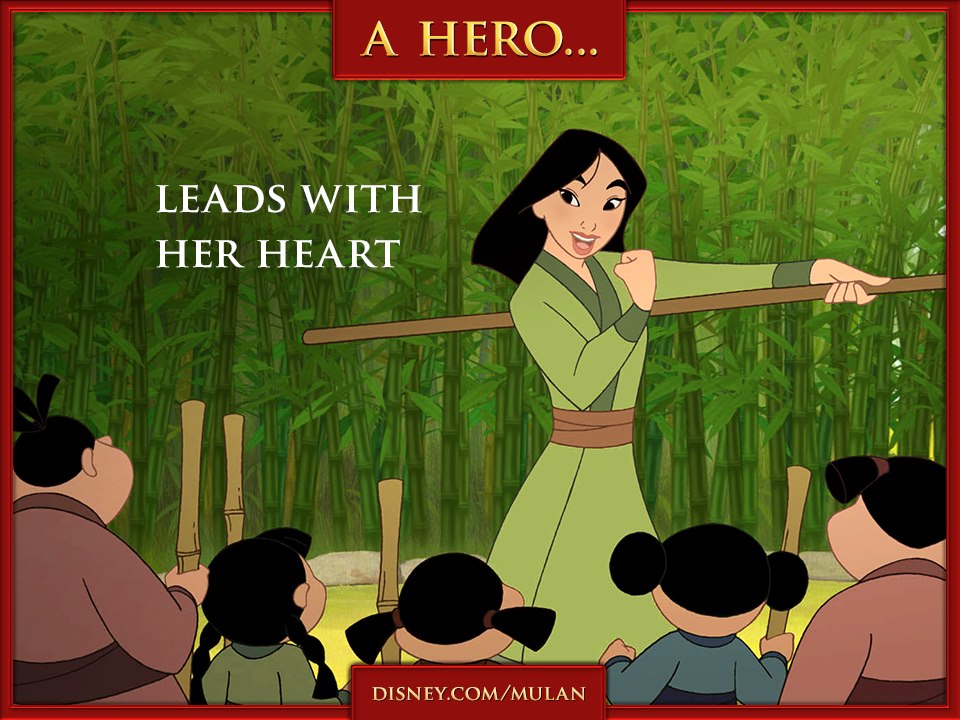
Disney’s “Mulan
Warning: There are spoilers for Disney’s Mulan in the following discussion
Mulan and Cultural Expectations
Mulan is a warrior. She is powerful, capable, and determined.
Oh, and I forgot: she is a woman.
It is that “shocking” pronouncement which is the focus of the Disney’s Mulan
Mulan is challenged at numerous points throughout the movie. She does not fit into her society’s gender ideals. She is expected to be clean, quiet, submissive, and “womanly.” And she tries to fit into these expectations. The culture wants her to be a good wife, so she tries to match what her culture’s idea is in order to become a good wife. Those who have seen the movie knows she fails miserably. When she visits the matchmaker, she recites, in a stumbling way, the right sayings: “Fulfill your duties, calmly and respectively. Reflect before you… Act!” She lacks grace, poise, and ultimately ends up comically ruining the whole scene, setting the matchmaker on fire and dousing that fire with hot tea, running the matchmaker’s makeup and earning the pronouncement that she will never fit society’s expectations for her.
Yet this reveals another cultural shock: it is the very fact that Mulan is placed into a one-size-fits-all box to take on roles which do not match her abilities that leads to her triumph. It is not that she should be trying harder, or that she is wrong; instead, the fact is that it is her culture’s expectations which are wrong. Mulan destroys those expectations. She saves China, and the Emperor himself honors her. Thus, the expectations are shattered, and Mulan remains “true to herself.” Her abilities destroyed the cultural norms that people had tried to apply to her.
“So what!?” you may be asking. “I already knew this, though I may not have outlined it like this.” After all, telling women to be submissive and arguing that there are very specific roles that they should fit into is a thing of the past.
Is it?
Have you never heard the phrase “she wears the pants in that family”? That speaks to a division of roles that is still at least unconsciously acknowledged in our culture. What about “make me a sandwich” or “get in the kitchen”? What of more subtle distinctions? “I would never vote for a woman president.” “A man is in charge of the family.”
Moreover, some theological traditions continue to argue that there are very explicit roles for man and woman in leadership and the home. It is to that concept that we will turn to, with a focus on Mulan.
Mulan and Theology
The shock of Mulan’s story may seem almost comical to us, but the fact remains that there are women whose talents are not being acknowledged. They do not fit the mold. It is said within some branches of contemporary theology that women are to submit to their husbands. These theologians teach that women have very specific roles: that of “helper,” servant, or anything but “leader” or “teacher.” According to these views, women can teach other women and even male children, but when it comes to man, she is always subordinate. Consider the following passage, from a book endorsing this view (“Recovering Biblical Manhood and Womanhood
[I]t is simply impossible that from time to time a woman not be put in a position of influencing or guiding men. For example, a housewife in her backyard may be asked by a man how to get to the freeway. At that point she is giving a kind of leadership… But we all know that there is a way for that housewife to direct the man that neither of them feels their mature femininity or masculinity compromised. (John Piper, 50, cited below)
Moreover, women, on this view, must be careful about how they give their advice; they must remember that they are to be submissive:
A wife who ‘comes on strong’ with her advice will probably drive a husband into passive silence, or into active anger (Ibid, 52)
I can’t help but think of the scene from Mulan just before she saves the Emperor when she is trying to get people to listen to her about the great danger of the Huns in the Imperial City. They pull away from her forcibly, ignoring what she says. Finally, her trusty sidekick, Mushu, points out that “You’re a woman.”
Such is the way in which manhood and womanhood is supposed to play out within those branches of contemporary theology which lean towards complementarianism–the view that men and women are to occupy different “roles” in the church and the home. Women are to be submissive, even when they try to give directions to a man. Mulan, in this view, perhaps came on “too strong” in her insistence that the Emperor was in danger. If she had only been more submissive, then she would not have provoked “passive silence” or “active anger.”
The absurdity of this notion can be found in the fact that it is the victim who is blamed for the abuse. “Passive silence” can be just as harmful as “active anger.” Is it really acceptable to say that a woman, by offering advice, “provokes” the man? Moreover, is it really honorable to men to turn us into seething machines, who, if the right button is pressed, turn into active aggressors or passively-aggressive “victims”? Again, the movie “Mulan” has presented a more balanced approach: there are women who transcend society’s–and religion’s–expectations.
There are Mulans among us. There are women who challenge this perceived view of manhood and womanhood. There are women who are gifted greatly to be leaders, not followers. There are women with the gift of teaching. There are women whose very existence shatters the notion that woman’s role is to be submissive. Their talents and abilities call us to use them, not to force them to singular submission. The Bible calls us to mutual submission, not a singular silence from one gender. These Mulans are powerful missionaries, leaders, teachers, yes, even pastors: gifted and called by God to take on roles that their cultural milieu often wants to deny to them.
I pray that more of these women would arise and use their gifts for the church. Many women have already done so, but our church’s culture has too often tried to silence women. Instead, we need to acknowledge the Mulans we know.
Check the links below for more discussions of women and the church. For all my posts on the topic, check out my egalitarianism category (scroll down for more posts).
Links
Be sure to check out my looks at other movies. If you like Mulan, what about Brave?
For information on egalitarianism–the view that the Bible teaches us women and men should fill equal roles–check out “Christians for Biblical Equality.”
Women in the Ministry: The philosophy of equality and why complementarianism fails– I argue that the position in which women are excluded from church leadership entails inequality of being.
Book Review: “Good News for Women” by Rebecca Groothuis– I review an excellent book on the issue of gender equality in the Bible.
Religious Dialogue: A case study in science fiction with Bova and Weber– I take a look at how science fiction has dealt with theological topics, with a particular focus on dialogue about religion and women.
I discuss the notion of having my expectations of women shattered here.
Sources
John Piper, “A Vision of Biblical Complementarity: Manhood and Womanhood defined According to the Bible” in Recovering Biblical Manhood and Womanhood
Mulan
Image Credit
The image used in this post is credited to the Mulan Facebook page.
SDG.
——
The preceding post is the property of J.W. Wartick (apart from citations, which are the property of their respective owners, and works of art as credited) and should not be reproduced in part or in whole without the expressed consent of the author. All content on this site is the property of J.W. Wartick and is made available for individual and personal usage. If you cite from these documents, whether for personal or professional purposes, please give appropriate citation with both the name of the author (J.W. Wartick) and a link to the original URL. If you’d like to repost a post, you may do so, provided you show less than half of the original post on your own site and link to the original post for the rest. You must also appropriately cite the post as noted above. This blog is protected by Creative Commons licensing. By viewing any part of this site, you are agreeing to this usage policy.
Really Recommended Posts 3/8/13
It really is difficult to keep up with all the excellent posts around the internet. But, I have taken the liberty of doing some of that work for you and found a diverse array of posts on fascinating topics. Read them, love them, comment! This week, we’ll be looking at the prosperity gospel, Calvinism, women in the Bible, Young Earth Creationism, the History Channel’s TV show on “The Bible”, and design flaws in creation.
The Prosperity Gospel Revisted– I found this post about the “Prosperity Gospel” quite fascinating. Dan offers critical interaction with the notion that the Gospel is about empowering us to gain. I also really recommend checking out the entire site, Rockadoodee, which is always thought-provoking.
Jerry Walls: What’s wrong with Calvinism? (Video)- One of the most interesting evangelical scholars writing right now, Jerry Walls, evaluates Calvinism. I found this video quite interesting. I’ve met Walls in person and I find him to be very gracious and thoughtful.
Correcting Caricatures: Women in the Bible [This link appears to be broken now… I don’t know why. Please let me know if you can view it]- Eminent scholar Walter Kaiser looks at several key texts related to women in the Bible. I found this fascinating and enlightening. Whether you are egalitarian or complementarian, it is worth reading.
2013 International Conference on Creationism– The Geochristian outlines a number of interesting discussions at this conference, which is where all the major scholars within the Young Earth Creation movement meet. Alongside this article, you should check out these articles on the state of Young Earth Creationism: The State of Creation Science as Measured by Scholarly Publishing– this one looks at scholarly works by YECs over a recent period of time and evaluates what it means for YEC; The Next Generation of Creation Scientists?– this post looks at who may be stepping in to fill the roles of the major YEC organizations.
The Bible–Night One Review– A look at the theology in the new TV series by the History Channel: The Bible.
If God Designed Humans, How Do We Account for “Design Flaws”?– One of my favorite blogs, “Well-Spent Journey” examines the notion that humans are flawed designs as an argument against intelligent design.
Really Recommended Posts 2/1/13
Thinking About ‘Future Things,’ Part 1– One area I will admit I have very little knowledge about in relation to Christian theology is eschatology. This series by Reasons to Believe provides an introductions to many aspects of eschatology and provides a fairly balanced view. I enjoyed it greatly and came away feeling much better informed. I recommend checking out the whole series.
Wukong’s Dilemma– An interesting look at Buddhist philosophy and the dilemma of a works-based religious system. I found this a very fascinating post.
Lance Armstrong, Thor and Ideal Heroism– A comparison of ‘real life heroes’ to the idealized heroes we construct. I found this post very insightful. I highly recommend it.
Christianity and High Beauty (With Pictures!)– A simply excellent post on the relation of the Christian worldview to beauty. There is much to be said about the importance of aesthetics in reality. This post hints at many of these themes.
Tim Keller, Women, and Ignoring your own rules– I found this post really excellent. It evaluates some of the Gospel Coalition’s stance on women in light of the rules that one of its adherents, Tim Keller, holds regarding discussion with other people. The problem is that they make many claims about egalitarians which simply are not true.
Critiquing Mormon Theology: An Innovative Approach– A presuppositional apologist examines various doctrines of Mormonism and offers a critique. It’s an interesting look into how the presuppositional approach can be integrated into a broad apologetic.
The Cross and the Stars– This is a fascinating look at some Roman Catholic science fiction authors. Readers of this site know I love science fiction and write about it frequently under popular books.
“Fitzpatrick’s War”- Religion, truth, and forgiveness in Theodore Judson’s epic steampunk tale
The roar of our guns was more than my ears could hear. The slaughter in the two rivers was more than one man’s mind could absorb… A sort of madness over came us; we had an infinity of bullets and an infinity of Chinese before us. Every one of our men felt he was killing thousands… Death ran wild. How terrible it is, I thought, that the Yukons should be so good at this. (Judson, 319-320)
Fitzpatrick’s War
Brief Overview of the Plot
Fitzpatrick’s War is written as an autobiographic tell-all from the perspective of Sir Robert Mayfair Bruce. He is writing about Lord Isaac Prophet Fitzpatrick, a man who, like Alexander the Great, had conquered the world at a young age and also died young. Bruce was a close friend of Fitzpatrick (whom he calls Fitz) and so reveals a number of less-than-flattering aspects of his personality in his account of the life of the former ruler. It describes Fitzpatrick’s rise to power, his preparations for war during behind his father’s back, and his post-war rule.
Fitzpatrick is revealed as a man who lusted for power and ruled ruthlessly. He participated in assassinations, set up deaths, and mercilessly slaughtered his enemies. He used biological and chemical weapons and burned his enemies to the ground, all simply because of a desire to conquer the world. He had delusions of grandeur, envisioning himself as a kind of modern Alexander who would outdo the other man in every way.
The Timermen are another major player throughout the book. They are mysterious in their motivations and have supreme power over all space travel and most communications. Bruce reveals a number of unflattering details about these people as well.
The book has been edited by Doctor Professor Roland Modesty Van Buren, who is hostile to Bruce’s recounting of the events. Van Buren does not believe that Bruce is telling the truth about the great Fitzpatrick and believes he is instead attempting to make his own name live on through his lies. Thus, the book is footnoted throughout with Van Buren’s corrections to Bruce’s “lies.”
Religion
Religion is pervasive throughout Judson’s work. The characters constantly quote from the Bible to justify their positions which frequently seem unbiblical and evil. Although the society at large seems to think highly of the Bible, the United Yukon Church itself seeks to take over all religion and has repressed other expressions of religion for quite some time.
Yet Bruce is fully aware of how the Christian faith is being abused throughout the work for evil ends. In one scene, he is speaking privately with Fitzpatrick, who asks Bruce whether God can love someone who will wreak such evil on the world. Specifically, he asks about King David in the Bible. Fitzpatrick wants to know whether he himself is like King David and why God would love someone who so frequently strayed from righteousness. Bruce realizes that it is here that he could have influenced Fitzpatrick to turn from the great evils he would perpetuate. Yet, coveting power, Bruce makes the decision he would regret for the rest of his life and backs Fitzpatrick’s notions of glory and God. He writes:
I would today give up my soul if I could go back to that moment and tell Fitz he could still turn back from his awful destiny. I grant that he had at this date already committed murder. It was equally true that he had not yet made his oceans of blood… The world could have still been saved from his wrath… (204)
Instead, Bruce caves into his own lust for power and desire to please Fitzpatrick. He tells Fitzpatrick:
God loves you… There are a few special men… who, like David, walk through History as Angels walk through thunderstorms. Those about them become wet with sin, while they remain untouched. They may seem to be bad men, these special ones. If we judge them by the standards we hold ordinary men to, they are the worst of men. Ordinary standards do not apply to them. They are doing God’s work here on earth, and as we do not know God’s motives or His ends we cannot judge His servants… You [Fitzpatrick] will be said to be God’s beloved. (204-205)
Bruce regrets this discussion with Fitzpatrick for the rest of his life and struggles with the notion that he can be redeemed.
Fitzpatrick himself seeks a kind of syncretism of all religions, but realizes that it will not ultimately work. He keeps his old tutor, Dr. Flag, around mostly to feel superior about himself. But he had initially attempted Dr. Flag’s project of making all faiths equally valid. One discussion in the book is particularly revealing. Dr. Flag is expounding upon the notion that all religions are essentially the same, but Marshal Jeremiah Truth Hood challenges him on this notion:
“Sir, am I to understand you believe all major religions profess the same core beliefs?” [Hood Asked]
“Yes…” [replied Flag]
“Then that would mean, let us say, that the Chinese and the Arabs share the same beliefs on marriage and family?” asked Hood… “Can we say,” asked Hood, “that Arabs and the Chinese value life to the same degree? Or is human life another secondary question?”
“I mean specific, general matters. You see, such as treating others well.” [Responded Flag]
“You say cultures are essentially the same,” continued Hood. “How would you explain, sir, the different Histories of North and South America? Both continents are inhabited by Christians. The majority in both continents are of European descent…” (364-366)
Hood’s point is well taken. The fact of the matter is that all religions are not the same and to say otherwise devalues the religious persons themselves. The way that Judson presents this dialogue allows for some real insight into the issue: how is it possible to say that, at their core, all cultures or religions are the same when they are so radically different?
Evil, Repentance, and forgiveness
There is great evil in the world, and Bruce’s world is no different. Much of the evil is caused by Fitzpatrick and the war which he created in his lust for power.
Ultimately, Fitzpatrick is reduced to a broken, suspicious man who becomes incapable of even doing the simplest tasks on his own. Marshal Hood is greatly distressed over his own incapacity to make amends for the evils he had done during the War. Hood is sitting with Fitzpatrick and several other Lords when they watch a video from an aerial shot of China and see the destruction their war had done to the country. The bodies were strewn about and death was everywhere. Bruce, too, feels the need for repentance: “There were no words in my vocabulary I could utter that could justify this abomination, no act of contrition that could ever take away what I had done” (410). Hood himself begins quoting from the Bible, Joel chapter 1. He relates the evils they have done to the crimes that Joel cries out against. Later, Hood is found among the Chinese, trying to help them by growing food and feeding them. It was his way of making amends.
Bruce himself finds forgiveness only through his wife, who speaks with clarity on God’s will and his grace. It seems to me that this theme of forgiveness is grounded thoroughly in the Christian notion wherein people are to forgive each other. We act as God’s agents here on earth, and so we are called to repentance and forgiveness.
Charlotte
Bruce’s wife, Charlotte, is a paradigm example of a powerful, spiritual, loving woman. Van Buren, the hostile editor of the book, has several choice words to describe Charlotte, whom he believes is overstepping her bounds by attempting to be equal to Bruce. She often seems overbearing, but ultimately she strives to be equal to Bruce, and to temper the poor qualities of Bruce’s character. Charlotte is Roman Catholic, a religion which is violently oppressed in Yukon, until Fitzpatrick allows for religious freedom to endorse his own pluralism. Charlotte’s character is important throughout the work as one who provides the positive example of womanhood and the equality of men and women.
History and Doing History
History (always with a capital “H”) is an area of extreme interest in the world of Fitzpatrick’s War. Fitzpatrick himself continues to utter a recurring theme: History is written by the winners. Above, there was a discussion of King David. Fitzpatrick in that same conversation presses the notion that King David rewrote the history books in order to paint him in the most positive light. Later, in his own life, Fitzpatrick would do the same thing. He had the greatest poets and historians of his age come and write histories about him which were highly favorable in their portrayals of himself.
There is active repression of historical knowledge due to the fact that the culture at the time the book is set in believes that the “Electronic Age” (20th and 21st centuries) was a blight upon all History. During one scene, Bruce is being questioned about the Electronic Age and readers discover that only one history exists from that period. The reason is because “[A]ll other Histories of that era were perverted by the strange ideologies of the day…” (35).
As one who has studied historiography (and written on the method regarding Jesus), I can’t help but think of all the issues these discussions raise throughout the book. Interested readers should check out the post linked in the parentheses for one brief account of historiographic method.
Conclusion
I have read few books which have had such a great depth of knowledge about so many subjects as is demonstrated in Fitzpatrick’s War. The book is just phenomenal, and it touches upon so many areas of great importance for Christians and non-Christians alike. As with all great fiction, it does this without becoming overbearing, but instead focuses upon the story. Judson develops wonderful characters whom the reader can relate to, love, or loathe. He explores heady themes with wit and precision. I highly recommend this book to my readers.
Links
Religious Dialogue: A case study in science fiction with Bova and Weber– I explore two excellent science fiction books alongside each other to see how they speak to religious dialogue.
The Presumption of Pluralism: How religious pluralism devalues all religious persons– I discuss religious pluralism, a topic which is brought up throughout Fitzpatrick’s War and show how it fails.
Check out more of my looks at popular level books. (Just scroll down to see more!)
Hieropraxis is an excellent site which focuses upon a number of cultural issues and how they relate to Christianity. I really cannot recommend this site highly enough.
Empires and Mangers– Another phenomenal site which looks at many popular level works from a Christian perspective. The posts are consistently fantastic. I encourage you to follow this site closely.
SDG.
——
The preceding post is the property of J.W. Wartick (apart from citations, which are the property of their respective owners, and works of art as credited) and should not be reproduced in part or in whole without the expressed consent of the author. All content on this site is the property of J.W. Wartick and is made available for individual and personal usage. If you cite from these documents, whether for personal or professional purposes, please give appropriate citation with both the name of the author (J.W. Wartick) and a link to the original URL. If you’d like to repost a post, you may do so, provided you show less than half of the original post on your own site and link to the original post for the rest. You must also appropriately cite the post as noted above. This blog is protected by Creative Commons licensing. By viewing any part of this site, you are agreeing to this usage policy.
“Cross Roads” by Wm. Paul Young- An Evangelical’s Perspective
 One of the biggest publishing phenomena of late, The Shack

Free Will
The notion of crossroads is a major theme throughout the work, and Young utilizes the imagery to discuss free will metaphorically. Anthony Spencer (Tony), the main character, finds himself inside his mind, which is portrayed as a kind of land with various roads and places inside it. Initially, he begins exploring this land and finds himself coming to numerous forks in the road. He continues to find these forks and realizes that as he continues to make choices, “it occurred to Tony that the number of direction decisions was diminishing; options were significantly decreasing” (35). Young doesn’t expand on this much, but it seems like a vivid illustration of libertarian free will, wherein one’s choices in the past do indeed influence their choices in the future. As Tony makes choices on his path, he finds that the choices available to him decrease. The reason, it seems, is because his choices have started to form his world. It seems to me that this is a great way to show libertarian free will in literature.
Church
A robust theology of church and salvation is something that I think is necessary for an adequate theology. I find one reason for this illustrated well by Young:
Church, thought Tony. He hadn’t set foot inside one of those since his last foster family had been religious. He and Jake [Tony’s brother] had been required to sit silently for what seemed like hours… He smiled to himself, remembering how he and Jake had schemed together and ‘gone forward’ one night at church, thinking it would win them points with the family, which it did. The attention their conversions garnered was initially rewarding, but it soon became clear that ‘asking Jesus into your heart’ dramatically increased expectations for strict obedience to a host of rules they hadn’t anticipated. He soon became a ‘backslider,’ in a category, he discovered, that was profoundly worse than being pagan in the first place. (124)
It seems clear to me that here the act of conversion has itself become a work, rather than a gift of grace. Tony’s concept of conversion at this point in the book is that of “asking Jesus into your heart.” Unsurprisingly, when he fails to perform other adequate works–obeying a set of rules. The problem with this theology should become clear immediately. By suggesting that Christianity is about “going forward” and publicly affirming a faith, this form of theology puts the believer in the position of affirming faith, rather than receiving it as a gift. When faith becomes a public work, it becomes the Law instead of the Gospel. When demands for works are made on faith, then faith itself becomes a work. Unfortunately, this kind of works-righteousness sneaks into theology at all levels, ever seeking a place to grow.
The problems with this theology are portrayed vividly in this illustration. The notion that people need to make a public declaration of faith leads to its abuse, as Tony and Jake attempted to do, but it also leads to difficulties for those who believe their declaration was itself true (unlike Tony and Jake, who simply did it to glorify themselves in the eyes of their foster parents). When someone makes their “decision for Christ,” their faith life becomes wrapped up in that decision. Their walk with God is contingent upon their continuing to make this decision. Unfortunately, this type of theology makes faith all about one’s own decisions, rather than Christ’s justification and the free gift of faith.
Women
There are many church bodies who do not ordain women to the office of the ministry. That is, they hold beliefs that say women should not be spiritual leaders of men in the church. Young explores this issue when Pastor Skor shows up and challenges Maggie, one of the main characters, regarding her outburst during a church service. Pastor Skor takes Maggie’s outburst and disruptive behavior as a clue to him from God that he has been too lax in his instructing his congregation in the Bible. He makes an argument that women should not be leaders in church and should remain silent:
And we affirm the Word, which declares there is no longer male or female [Galatians 3:28], but… the Word is speaking of how God sees us, not about how we function in the church, and we must always remember that God is a God of order. It is vital that each person play their part, and as long as they stay within the roles that God has mandated, the church functions as it was meant to… (167)
The pastor goes on to quote 1 Corinthians 14:34-35 to support his position. Yet Young, through Clarence, an elder who is with the pastor to talk with Maggie, provides a counter-argument to this reasoning:
It is sarcasm… I believe that the apostle Paul was being sarcastic when he wrote what you read… He is quoting a letter that these folk sent him with questions, and he is in total disagreement with what they have written to him. (168-169)
Clarence defends this position by alluding to 1 Corinthians 14:36, apparently using the KJV: “What? came the word of God out from you? or came it unto you only?” Given the way this verse is worded, Clarence holds that verses 34-35 are a quote from a letter the Corinthians sent to Paul which Paul then responds to sarcastically by wondering whether the Corinthians think that God’s word came only to them.
Young’s offered interpretation seems possible, but perhaps not made explicit enough. It seems to me possible that Paul would have made it more clear that he was quoting another’s writing here. The KJV seems to support the interpretation given to 1 Cor 14:36 here, but other translations phrase it differently, in such a way that the verse seems to be more of a challenge to readers to dismiss what Paul is declaring in 34-35.
Of course, one could still argue that Young’s interpretation has great strength, noting that nowhere in the Bible do we see this command in the Scripture “as the law also says” and so we may infer that Paul is referencing an extra-biblical teaching and rebutting it. In fact, this seems to line up with Young’s argument perfectly because we can see that Paul would be citing a Judaizer’s teaching in the church in Corinth–who would hold that the silence of women is taught by the Law [Jewish extra-biblical law]–and then refuting this by noting that the word of God did not come from them alone (see Katharine Bushnell’s God’s Word to Women
Therefore, it seems to me that Young offers a fairly decent egalitarian interpretation of the passage, though he could have given other arguments which would take into account the passage’s cultural context, in which women were speaking out of turn in worship. The core of the statement seems to me to be that the women in this specific context needed to learn from their husbands at home and remain silent in church so that they did not cause disruption.
The way the scenario plays out in the book is also difficult to evaluate because Maggie definitely was disrupting the church service and would have appeared at least slightly crazy to those around her. She was screaming about a demon speaking to her and was, in fact, mistaken about that. I think she can be forgiven for her extreme reaction given the strange situation in which she found herself, but the Corinthians passage is in context all about order in worship in general, and certainly people bursting in screaming about demons would be disorderly worship.
Thus, it seems to me that Young offers a possible interpretation of 1 Corinthians 14:34-35, but he has made his case problematic by the narrative context in which he placed it. It is worth noting that this work will get people talking about the issue. Young has given a somewhat strong version of a lengthy egalitarian argument in the form of narrative.
Practical Ethics and Disability
Cabby, a boy with Down’s Syndrome, is featured prominently throughout the book. Young uses him as a foil to show that those with disabilities have much to contribute to modern society. Perhaps the most poignant way he does this is through the negative portrayal of Tony’s view of Cabby:
Tony had never known a ‘retarded’ person. He wasn’t sure if that is what you called them… His opinions on most nonbusiness matters may not have been founded on evidence or experience, but he was sure of them. People like Cabby were an unproductive drain on the resources of society; they were valuable only to their families. He believed they were tolerated because of liberal persuasions, not because such people had any intrinsic worth… It is easy to create a category of persons, like retarded or handicapped, and then pass judgment on the group as a whole. He wondered if that was not the heart of all prejudice. (108-109)
In contrast to Tony’s view, Cabby turns out to be insightful and delightful. He is shown to have positive value in a number of ways that go beyond his immediate family. He ultimately shows the practical usefulness of inherent human worth.
God
For Young, understanding God as relationship is central to the concept of deity. The concept of deity that is presented is that of Trinity. Much ink will be spilled, I feel certain, on whether or not Young portrays the persons of the Trinity correctly, just as there was in The Shack (see my own discussion here).
Young’s position seems to be largely unchanged from that in The Shack, and so much of the commentary will follow the same line. I think he does a very good job of exploring the inter-relational character of God and the temporal submission of Christ in the incarnation to God the Father. Some may see the primary difficulty with Young’s portrayal of God is that the Father makes very little appearance in the book, but near the end readers find out that is not the case. In fact, the Father is intricately involved in all aspects of God and the life portrayed in the novel.
Those who conceptualize God as inherently male will have a problem with the book, however. Unfortunately, some paganism has indeed hung on in the church, wherein some view God as a gendered being. In the Bible, however, we find that God is spirit and not a man. Thus, I think that Young’s use of gender with God may shock some but also underscores the fact that God is not a gendered being, and instead transcendent.
Historical Theology
Young offers a short discussion of historical theology and God that seems to me to at least partially miss the mark. It is very brief, but I think it is worth discussing. Young puts the following commentary in the mouth of Jesus himself:
The Greeks, with their love for isolation [of deity] influence Augustine and later Aquinas… and a nonrelational religious Christianity is born. Along come the Reformers, like Luther and Calvin, who do their best to send the Greeks back outside the Holy of Holies, but they are barely in the grave before the Greeks are resuscitated and invited back to teach in their schools of religion. The tenacity of bad ideas is rather remarkable, don’t you think? (73)
There are a number of problems with this small passage. First, Augustine heavily influenced both Calvin and Luther. In fact, Calvin’s theology is tied very intricately to Augustine’s view of free will and original sin. Similarly, Luther’s view of original sin derives directly from Augustine’s exposition in City of God. Second, it seems unfair to view Aquinas as a kind of anti-relationalist when it comes to God’s nature. Aquinas very much emphasized the triunity of God, which was (and is!) an extremely important topic. To thus accuse Aquinas of undermining God’s relational-ness seems unfair. Finally, the notion that the influence of Greek philosophy on Christianity is somehow inherently bad seems a bit shortsighted. There are innumerable positive contributions that reflection on Greek thought has brought into the fold of Christianity. Among these are the very concept of free will that Young pushes in his book, along with a number of aspects of Trinitarian and Incarnational theology that Young seems to support. This may seem to be a nitpick, but it seems to me that if Young is going to use his book to make comments about historical theology, it is vastly important to get that historical development right.
Conclusion
Cross Roads
SDG.
——
The preceding post is the property of J.W. Wartick (apart from citations, which are the property of their respective owners, and works of art as credited) and should not be reproduced in part or in whole without the expressed consent of the author. All content on this site is the property of J.W. Wartick and is made available for individual and personal usage. If you cite from these documents, whether for personal or professional purposes, please give appropriate citation with both the name of the author (J.W. Wartick) and a link to the original URL. If you’d like to repost a post, you may do so, provided you show less than half of the original post on your own site and link to the original post for the rest. You must also appropriately cite the post as noted above. This blog is protected by Creative Commons licensing. By viewing any part of this site, you are agreeing to this usage policy.

 J.W. Wartick - Reconstructing Faith