eschatology
“Theological Colonialism”? On theological issues which are ‘only popular in America’
 I recently picked up the latest in the Zondervan “Counterpoints” series: “Five Views on Biblical Inerrancy.” One of the essays, by Michael F. Bird, is entitled “Inerrancy is Not Necessary for Evangelicalism Outside the USA.” I flipped through it and I thought the author certainly had some good things to say. But, I admit that I find the apparent thrust of Bird’s argument is quite mistaken.
The notion that certain theological issues are essentially uninteresting to folks on the other side of either ocean is one I have read (and heard in person) on more than one occasion related to various Christian doctrines. Bird’s own presentation, regarding inerrancy, argues that the CSBI (Chicago Statement on Biblical Inerrancy, a document he is critiquing) demonstrates “An Unfortunate Trend toward Theological Colonialism” (the capitalization is due to this being a section heading). This trend might be discerned thus: “there are thousands of churches around the world that are both evangelical and orthodox and get on with their ministry without ever having heard of the CSBI and without ever using the word inerrancy in their statement of faith” (153-154, cited below).
Very well. Suppose we grant Bird this fact. I’m sure it actually is a fact. But so what? What possible relevance does this have for the truth and claims of inerrancy? Bird’s own conclusion is that, basically, we should not expect evangelicals across the world to saddle themselves with a view that is essentially unfamiliar to them. I think this may be a fair point, but it raises a couple concerns: first, the actual truth value of whatever doctrine is in question; second, concern for continuing to grow in knowledge and faith.
Suppose that you believe a doctrine is of great importance to how one might view other doctrines. Now, someone comes along and informs you that there are people in some area of the world who don’t know about that doctrine or that that area of the world is generally unconcerned with it. Should this somehow lead you to think that the doctrine is unimportant because people outside of your own cultural milieu do not view it as such? Certainly not! It may cause you to reflect upon its alleged importance and perhaps even come to a new view, but the notion that a specific doctrine is largely unimportant to certain groups of people does nothing, in itself, to downplay the actual importance of that doctrine. Nor does it impact the truth value of that doctrine in any way.
Now, at risk of being accused of “theological colonialism,” I am going to also suggest that the apparent disinterest in an important doctrine is less reason to think the doctrine is unimportant than it is reason to perhaps try to inform others of the doctrine’s actual importance. Returning to the example above, suppose the disinterest caused you to reflect upon the doctrine and you concluded that yes, it is actually deeply important. Would you not be concerned that others do not share your conviction, such that perhaps you may feel obligated to inform others about the centrality of said doctrine?
I’m not trying to suggest anyone without concern for inerrancy is ignorant or foolish. But I do think there is something to be said for the notion that a doctrine like inerrancy (or eschatology, or a view of creation, etc., etc.) is something worth exploring and learning about. We are called to expand our knowledge, not be content to sit in the knowledge of the faith we already have. I have become aware of entire realms of theological debates which I didn’t even know existed by reading authors–both international and, yes, American. I have found topics I was disinterested in to be deep, engaging, and edifying. I was subsisting on milk, but I have pursued solid food, and continue to do so [Hebrews 5:12ff]. I hope to continue to be enlightened by international theologians. But I would also hope that international theologians would not dismiss a doctrine because it comes from America.
Finally, is not the very notion that ‘if a doctrine is only of concern to American Evangelicals, then it should be moderated or reigned in’ itself a form of theological colonialism?
Links
Be sure to check out the page for this site on Facebook and Twitter for discussion of posts, links to other pages of interest, random talk about theology/philosophy/apologetics/movies and more!
Source
Michael Bird, “Inerrancy is Not Necessary for Evangelicalism Outside the USA” in Five Views on Biblical Inerrancy (Grand Rapids, MI: Zondervan, 2013), 145-173.
SDG.
——
The preceding post is the property of J.W. Wartick (apart from quotations, which are the property of their respective owners, and works of art as credited; images are often freely available to the public and J.W. Wartick makes no claims of owning rights to the images unless he makes that explicit) and should not be reproduced in part or in whole without the expressed consent of the author. All content on this site is the property of J.W. Wartick and is made available for individual and personal usage. If you cite from these documents, whether for personal or professional purposes, please give appropriate citation with both the name of the author (J.W. Wartick) and a link to the original URL. If you’d like to repost a post, you may do so, provided you show less than half of the original post on your own site and link to the original post for the rest. You must also appropriately cite the post as noted above. This blog is protected by Creative Commons licensing. By viewing any part of this site, you are agreeing to this usage policy.
Really Recommended Posts 8/30/13- Dinosaurs, Mumford and Sons, Design, and more!
 Another search of the internet has turned up a number of excellent posts. I have found another diverse array of topics for you to browse at your leisure. This week, we’ll look at dinosaurs, Ray Comfort’s Evolution vs. God, cave diving, preterism, design, the economy, and Mumford and Sons!
Dinosaurs, Dragons and Ken Ham: The Literal Reality of Mythological Creatures– Often, the claim is made that legends about dragons sprang from humans living alongside dinosaurs. Young earth creationists cite this as evidence for their position. Here, the Natural Historian sheds some light on these claims in a well-researched post with plenty of pictures for those of us with short attention spans. I highly recommend following this blog as it remains an outlet for great analysis of young earth claims.
Evolution vs God– Another issue which has been making the rounds on apologetics/Christian sites has been the recent video by Ray Comfort, “Evolution vs God.” The video is available to watch for free on youtube. Feel free to check it out yourself (you can find a link to it here). My good friend over at No Apologies Allowed seems to endorse it to a limited extent (see his comment on this post), and his comments have touched off a great discussion: [DVD] Evolution vs. God. On the other hand, the Christian think-tank Reasons to Believe has offered their own brief video review (the link will stat playing instantly) of the movie which has a very different perspective. What are your thoughts?
Some Questions Concerning my Preterism– I am not a preterist, but I appreciate well thought out positions and the insights they provide into their positions. Here, Nick Peters shares a number of question-and-answers related to his preterist views. Preterism is the view that the majority of the prophecies found in Revelation and the like have been fulfilled, usually in the destruction of the Temple in AD 70.
The theory of intelligent design (Video)- As one friend sharing this video put it: “A video on MSN featuring Michael Behe narrated by Morgan Freeman? What world did I wake up in?” My thoughts exactly. This video is a very basic exposition of the theory of intelligent design. Check it out.
Cave Diving and Apologetics– I like caves, though I have never done cave diving and almost certainly never will. I found this post to be fairly helpful in regards to drawing out some of the dangers of apologetics and going everywhere at once. I wasn’t terribly appreciative of the explicit appeal to defense of Catholic dogma, but apart from that the post is pretty solid.
Mumford & Sons: Five Songs With All Sorts of Christian Undertones– A really excellent look into several Mumford & Sons songs. I admit I’m not a big fan of the style of music, but I found this post fascinating nonetheless. Check it out.
What happened to the economy after Democrats won the House and Senate in 2007?– People who know me personally realize that I am a complete mishmash of political views. I frankly despise both major political parties because I think they are both ridiculously partisan and do little correctly. That said, I found this post to be a pretty interesting look at the economics of policy. Let me know what you think.
The Binding of Satan: An Eschatological Question
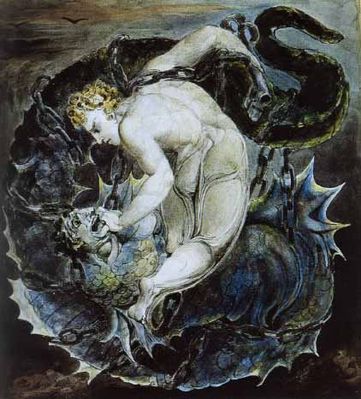 When does the binding of Satan occur? Is it something yet to come, or is it something which has already happened? Here, I will analyze the futurist position on these questions: the notion that Satan and his minions are yet to be bound.*
Futurism is, essentially, the position that the prophecies in Daniel and Revelation (and many elsewhere) are largely yet to be fulfilled. This is in contrast to historicism– the view that these prophecies have been fulfilled through the church age (with some yet future); preterism– the view that many of these prophecies have already been fulfilled in the past; and idealism– the view that these prophecies have spiritual meanings which may be fulfilled multiple times through history until the End.
The central passage for the question at hand is Revelation 20:1-3:
And I saw an angel coming down out of heaven, having the key to the Abyss and holding in his hand a great chain. He seized the dragon, that ancient serpent, who is the devil, or Satan, and bound him for a thousand years. He threw him into the Abyss, and locked and sealed it over him, to keep him from deceiving the nations anymore until the thousand years were ended. After that, he must be set free for a short time. (NIV)
The futurist interpretation of this passage would be fairly straightforward: at some point in the future, before the millennium, Satan will be bound. Many futurists hold that this also includes Satan’s minions. Representative is Paul Benware: “With the removal of Satan comes the removal of his demonic forces and his world system” (Benware, 334, cited below). It is on this point that the question I have turns. Consider Jude 6:
And the angels who did not keep their positions of authority but abandoned their proper dwelling–these he has kept in darkness, bound with everlasting chains for judgment on the great Day. (NIV)
Note the interesting parallels with the passage from Revelation 20. Both use the language of “chains” and reference a time when something will happen after this binding. Yet Jude 6 seems to imply the definite binding of these demonic forces from the time it was written or even before. Why? Jude 5 gives the temproal context, which is sandwiched in between discussion of the Exodus and Sodom and Gomorrah. Of course, Sodom and Gomorrah predate the Exodus, but the overall context of the passage is given by Jude as being around that time period (“I want to remind you…” v. 5).
Moreover, 2 Peter 2:4 states:
For if God did not spare angels when they sinned, but cast them into hell and committed them to chains of gloomy darkness to be kept until the judgment…
Again, in context Peter is discussing a number of past events. So it certainly seems that at least some demonic forces have already been bound. Benware writes of these passages: “The Scriptures reveal that Satan and his angelic followers will be judged for their sin and rebellion…” (329, emphasis mine). Now, Benware is clearly saying that there will be a judgment in the future, and that seems correct from both passages. However, he does not note anywhere in his major work the difficulty these verses present to his own view, for he insists elsewhere that amillenialists are incorrect when they view this binding as being a present reality (129ff). But he does grant that at least some demonic forces are bound now.
The question, then, is how is it that futurists can consistently insist upon the impossibility of Revelation 20:1-3 being a present reality while already granting that it is, at least in part, fulfilled? That is, if one grants that at least some demonic forces are bound, it seems that one cannot insist that certain spiritual forces cannot possibly be bound at present. Thus, it seems to me this particular aspect of futurism is not on as strong a ground as many insist.
Indeed, one may read Jude 6 and 2 Peter 2 and get the impression that these things have already occurred. There is no stipulation within the text to say that only some wicked angels have been bound. Indeed, they both seem to imply the total binding of all demonic forces. But this would not be compatible with the standard futurist interpretation of Revelation 20:1-3.
*Readers should note that I am not here intending to critique the overall futurist position. Instead, I am merely wondering about one specific aspect of some futurist interpretations.
Links
Check out my other posts on eschatology (scroll down for more).
Also, read my review of Benware’s massive work on premillenial dispensationalism, Understanding End Times Prophecy.
Sources
Paul Beware Understanding End Times Prophecy
SDG.
——
The preceding post is the property of J.W. Wartick (apart from citations, which are the property of their respective owners, and works of art as credited) and should not be reproduced in part or in whole without the expressed consent of the author. All content on this site is the property of J.W. Wartick and is made available for individual and personal usage. If you cite from these documents, whether for personal or professional purposes, please give appropriate citation with both the name of the author (J.W. Wartick) and a link to the original URL. If you’d like to repost a post, you may do so, provided you show less than half of the original post on your own site and link to the original post for the rest. You must also appropriately cite the post as noted above. This blog is protected by Creative Commons licensing. By viewing any part of this site, you are agreeing to this usage policy.
Book Review: “Four Views on the Book of Revelation” (Zondervan Counterpoints Series)
 I have been researching eschatology quite a bit of late. Please be aware, therefore, that this review comes from one who has only read a limited amount on the subject. I will not be offering insights from an expert, and am fully ready to admit that I am still learning. That said, I chose Four Views on the Book of Revelation
Overview of Content
Introduction
The work begins with a rather lengthy introduction to the book of Revelation and the various views regarding its content. The bulk of this section is its introductions to each of the views featured in the work. Interestingly, the historicist view is basically dismissed out of hand in the introduction:
This volume incorporates the current, prevailing interpretations of Revelation. Thus, while the historicist approach once was widspread, today, for all practical purposes, it has passed from the scene. (18)
Preterist View
Kenneth Gentry, Jr. begins his exposition of preterism with a bold claim: “I am firmly convinced that even an introductory survey of several key passages, figures, and events in John’s majestic prophecy can demonstrate the plausibility of the preterist position” (37). Before diving into this survey, however, Gentry outlines the importance of understanding that Revelation “is a highly figurative book that we cannot approach with… literalism” (38). He defends this claim with a number of points, including the precedent of earlier prophets who used symbolism and the difficulty of consistent literal readings (38-40).
Gentry’s case for preterism focuses squarely on the introduction to the book. This is not to suggest that is the only part of his argument, but rather than he himself recognizes the introduction as a central tenant of preterism. He notes the continued refrain of Jesus “coming soon” and argues that this suggests a reading of the text as real prophecies occurring within the lifetimes of those present.
Much of the rest of Gentry’s survey is built upon tying the prophecies in Revelation to the historical events of the attack upon Jerusalem. A good representation can be found in tying the “Beast” 666 to Nero and the seven mountains to Rome (67-69).
Idealist View
Sam Hamstra, Jr. argues that the core of the idealist view of Revelation is found in a message: “While at this moment the children of God suffer in a world where evil appears to have the upper hand, God is sovereign and Jesus Christ has won the victory” (96).
The idealist case centers around seeing Revelation as apocalyptic literature, and interpreting it through that lens (97). However, Revelation is not exclusively apocalyptic but is rather “a mixture of literary styles” (99). The idealist interpretation sees the use of “like” throughout the descriptions of Christ and elsewhere as supportive of the non-literal nature of the book (101ff).
Hamstra’s survey of the book of Revelation continues to note what he holds are the symbolic use of symbols and other imagery. Representative is the use of the number seven, which suggests “completeness… the author is speaking of the church at all times and in all places” (102).
For the idealist, then, the book of Revelation can have multiple fulfillment throughout time. It is a book which comforts Christians who see the constant wars, plagues, and the like seen in Revelation by reminding them that God is in charge. Ultimately, Pate’s view can be summarized easily: “the best understanding… is that Jesus’ utterances about the Kingdom of God were partially fulfilled at his first coming… but remain forthcoming until his return” (175).
Progressive Dispensationalist View
C. Marvin Pate’s progressive dispensationalism is grounded in the theme of “already/not yet” (135). This notion hints at eschatological tension which can be found throughout the book of Revelation, according to Pate. That is, there are things which may seem fulfilled “already” but have “not yet” reached their fullest completion. As an example, he notes “with the first coming of Jesus Christ the age to come already dawned, but it is not yet complete; it awaits the Paraousia for its consummation” (136).
The notion of already/not yet allows Pate to interpret some texts in a kind of preterist light, while maintaining that they still have yet to find their fullest realization. An example can be found in the letters to the churches in which Pate notes that these are set against the background of Caesar worship while also pointing forward to future events (139ff).
Pate’s view is decidedly focused on the millennium and a more literal reading of the texts than the previous two views. The interpretation of Christ’s return is illustrative (166ff).
Classical Dispensationalist View
Robert Thomas argues that dispensationalism must be viewed in light of its hermeneutical system, which attempts to remain as literal as possible throughout the itnerpretation of a text (180). Thus, Thomas is an ardent futurist, waiting for the events recorded in Genesis to come about.
A major challenge for this view is the interpretation of texts about Christ coming “soon” and “quickly.” Thomas notes that this theme can be grounded in the notion of imminence in which we are to always be ready for Christ’s return as opposed to a notion of immediacy (189).
A typical classical dispensationalist reading of Revelation can be found in Thomas’ interpretation of the horsemen. He notes that the first “portrays a rider on a white horse, who represents a growing movement of anti-Christian and false Christian forces at work early in the period… the third… rider on a black horse [represents] famine-inducing forces….” (193-194). Thomas also argues that Israel is not the church and so must have the promises fulfilled to Israel as a nation (196ff).
Thomas argues that the major issue is dependent upon which hermeneutical system one employs. If one employs a literal hermeneutic, he contends, one will be dispensational. Period (211-214).
Analysis/Conclusion
I will only briefly comment on each view here.
Preterism
Gentry’s case is quite strong, but I have to wonder about the appeal to the language of “coming soon,” particularly in light of the constant refrain in the Hebrew Scriptures of the day of the Lord being “near.” These prophets clearly did not witness the “day of the Lord” (which, on preterist views is either the 70AD destruction of the Temple or still is yet to come), and so such language has a precedent for longer periods of time than the preterist appeals to.
Overall, however, some of the themes Gentry points to does hint at the possibility for interpreting certain prophecies as fulfilled in the destruction of Jerusalem.
Idealism
The idealist position has some draw for me because it focuses on the applicability of the book to all Christians in every time and place. In particular, the idealist interpretation of the letters to the churches is, I think, spot on. It allows for historicity while also noting the fact that we continue to live in an age in which all those types of churches still exist.
Yet I can’t help but also note that the idealist interpretation at times seems to play too fast and loose with the text, assuming that certain persons or events are types when it seems more clearly to point to a future fulfillment. Of course, the idealist could respond by saying many of these still are in the future after all.
Progressive Dispensationalism
There is great appeal in the notion of the already/not yet aspects of Revelation, which seems to give proper deference to the historical background of the book while also grounding it ultimately in the future promised fulfillment.
It is interesting to see that Pate is willing to interpret some aspects of the text figuratively, yet remains convinced that there will be a literal 1000 year reign, among other things. One could charge him with inconsistency here (as Robert Thomas does).
Classical Dispensationalism
I admit Thomas’ view was the most confusing for me. He insists that one must read the text literally, but then says that the white horse is not a white horse with a rider but rather “anti-Christian and false Christian forces.” Frankly, that is not the literal meaning of the text. It is commendable to desire to stay as true to the text’s meaning as possible, but using the word “literal” in this way seems to be abuse of language.
But Thomas’ view also has more to recommend it, such as his focus upon the future fulfillment. It is hard to read Revelation and not see many of the events as yet to occur, particularly if one desires to read the text as literally as possible.
General remarks
One thing I must note is that I did experience some great disappointment with the book in that it did not follow the standard format of the Zondervan Counterpoints series. Specifically, the book does not have each author interacting with the others after each view. Although the authors clearly had access to the other essays and were given the opportunity to interact via footnotes throughout their own essay, the level of interaction was not on par with other books in the series.
Others have expressed displeasure with the fact that the book does not present the historicist view of Revelation. I share some of that, though I would still maintain that–despite other reviewers [mostly on Amazon] are saying–there are definitely four distinct views presented in this book. They do not cover all the views as comprehensively as some might like, but the views which are included are each unique and worth reading. The quick dismissal of historicism in the introduction may be the consensus of scholarship, but historicism remains a major view among the laity as well as many clergy and some scholars. To have it not included is not the greatest crime, but it does hint at a lack of completeness with the survey here.
Overall, I would recommend this book as a way for those interested in Revelation and eschatology more generally to read. It presents four major views of the interpretation of Revelation by giving each author a rather lengthy section to make their case. Readers will be familiarized with the different views, along with arguments for and against each view. Although the book could be improved by the inclusion of the historicist position and greater interaction between the views, Four Views on the Book of Revelation
Links
Like this page on Facebook: J.W. Wartick – “Always Have a Reason.”
Book Review: “Understanding End Times Prophecy” by Paul Benware– I review a book on eschatology written from the premillenial dispensationalist position.
Source: Four Views on the Book of Revelation
SDG.
——
The preceding post is the property of J.W. Wartick (apart from citations, which are the property of their respective owners, and works of art as credited) and should not be reproduced in part or in whole without the expressed consent of the author. All content on this site is the property of J.W. Wartick and is made available for individual and personal usage. If you cite from these documents, whether for personal or professional purposes, please give appropriate citation with both the name of the author (J.W. Wartick) and a link to the original URL. If you’d like to repost a post, you may do so, provided you show less than half of the original post on your own site and link to the original post for the rest. You must also appropriately cite the post as noted above. This blog is protected by Creative Commons licensing. By viewing any part of this site, you are agreeing to this usage policy.
“Love Wins” by Rob Bell- A Brief Review and Study Guide
 I have spent a great deal of time evaluating Rob Bell’s controversial work, Love Wins
General Review
Over the past several weeks, I have gone through Love Wins chapter by chapter. There have been several positive themes found throughout the book. Of these, the ones most important are the notion that we often trivialize the message of the Bible into “getting in” to heaven and the argument that we cannot turn Jesus into a slogan or the cross into a symbol for whatever we like.
Bell has rightly brought the focus onto eschatology, something which is often ignored or avoided in modern settings.
Yet throughout my reviews of the book (see links at the end), I have noted numerous errors found therein. First, Bell makes errors regarding historical theology. He makes claims about the history of the church which are falsified upon closer examination. Second, his interpretive method is very problematic, as he will often take merely a single part of a verse (sometimes two words completely torn from their context!) in order to make an entire argument about how all of Scripture needs to be interpreted through his chosen phrase [see the review of Chapter 2 and search for “enter life” for a thorough analysis of this]. Third, his exegesis is problematic in still other ways. For example, he will often cite a single verse as an argument for a theological position, even though his argument is contradicted in the very next verse or in the same paragraph. Fourth, he fails to present his arguments. Instead, he chooses to simply ask leading questions. Although this is not problematic in itself, it is clear that this style is intended to lead people into the conclusions Bell wants without any critical analysis. If Bell merely stated his arguments, I suspect people would be more skeptical of his conclusions. Fifth, Bell’s method of argument, when he makes arguments, is often confused. For example, he will ask whether a phrase is found in the Bible in order to refute it. But of course, Bell’s entire thesis “love wins” is a phrase not found in the Bible.
Finally, Bell’s entire argument, once finally revealed, is found to be based around the notion that “God is love.” That’s it. He essentially creates a doctrine of God around just that notion, then defines it in human terms of a parent-child relationship, and then concludes that everyone will eventually be saved because God is love. This is a horribly deficient doctrine of God which does not take into account the whole of Biblical teaching about God. Unfortunately, because this is Bell’s central thesis, it seems the book falls apart upon closer examination.
Ultimately, I cannot recommend this book. Although it gives a few positive points, the major errors found throughout the text weigh against the usefulness of the book for study. I would recommend, however, that leaders in the church do read the book, as it has been so immensely popular that they are bound to run into it. I hope that my reviews and study guide [below] will be helpful for those who wish to engage with the book critically.
Study Guide Questions
General Questions
Let me be clear: I think these questions must be asked in any study of this book.
These questions are intended to be asked after each chapter or at the end of the book:
1) What arguments does Rob Bell present in this chapter? Are they valid? Were any arguments presented?
2) What questions does Bell ask that you feel are hardest to answer? Why? What answers did he provide?
3) Look up a passage Bell interprets. Read it in context. Do you think that Bell’s interpretation of this passage is correct? Why/why not?
Questions for Preface and Chapter 1
1) Do you feel comfortable talking about hell? Why/why not?
2) Can we know that a specific person is in hell?
3) What problems do you see in our culture’s understanding of hell?
4) If a word or phrase isn’t in the Bible, does that mean it is not biblical? Is “Love Wins” a phrase found in the Bible?
Resource: I review the preface and chapter 1.
Questions for Chapter 2
1) What do you think of when you envision heaven? Why do you imagine this? Can you support this imagery with the Biblical text?
2) Look up Matthew 19:16-30 and read it. What do you think of Bell’s focus on “enter life” as the thrust of this passage?
3) Consider popular cultural pictures of heaven or of heavenly imagery (Angels in the Outfield; All Dogs Go to Heaven; etc.). What do you think of these images? Are they grounded on Biblical truth?
4) Bell wrote: “Eternal life doesn’t start when we die; it starts now. It’s not about a life that begins at death; it’s about experiencing the kind of life now that can endure and survive even death” (59). What do you think of this quote? What does it say about what we do for salvation? Do we live in such a way as to usher in our survival of death?
Resource: I review Chapter 2.
Questions for Chapter 3
1) What do you think Bell means by “there are all kinds of hells” (79)? Do you see this in the Biblical text he cites (Luke 16:19-31)?
2) Read Luke 16:19-31. What do you think of Bell’s analysis of the meaning of this parable? Why do you think this?
3) Bell argued that Jesus’ teachings weren’t about right belief but rather about love of neighbor (82). How does this tie into the theme of salvation by grace through faith?
4) Read Matthew 10:5-15. Does the text imply there is still hope for Sodom and Gomorrah, as Bell argues (84-85)?
Resource: I review Chapter 3.
Questions for Chapter 4
1) Read Bell’s statements about the greatness of God on p. 97-98. Why do you think he chooses to focus the discussion on God’s greatness rather than on specific texts? What textual support does Bell use to support this passage?
2) Bell claims there have been a number of views about the salvation of people throughout church history. Does a plurality of views make any view valid? Bonus: During the Civil War era, Christians on either side argued the Bible supported or condemned slavery, respectively. Does this mean a valid interpretation of the Bible is that it justifies slavery?
3) Bonus points: Look up the church fathers Bell cites to support the notion that his view has been at “the center” of Christian orthodoxy. Do these church fathers really support that view? Consider the following from Augustine (The City of God
Origen was even more indulgent; for he believed that even the devil himself and his angels, after suffering those more severe and prolonged pains which their sins deserved, should be delivered from their torments, and associated with the holy angels. But the Church, not without reason, condemned him for this and other errors…
Resource: I review Chapter 4.
Questions for Chapter 5
1) What do you think of when you picture the image of a cross? How have you used/worn/displayed crosses in your life? Do your answers to these questions reflect the glory and misery of the cross?
2) How have you pictured the “Gospel”? Is it just a way to “get to” heaven?
Resource: I review Chapter 5.
Questions for Chapter 6
1) How have you used the label “Christian” or the name “Jesus” in your life?
2) Read John 12:47-50 and compare to Bell’s notion that God is not about judgment. How do Bell’s assertions read in light of the context of the single verse he cites (i.e. “There is a judge for the one who rejects me and does not accept my words; the very words I have spoken will condemn them at the last day.” [48])? Does Bell deal with this context?
3) Did Jesus come to overthrow religion? Read Matthew 5:17-18. How does this passage line up with Bell’s notion that Jesus was a- or even anti- religious?
Resource: I review Chapter 6
Questions for Chapter 7 and 8
1) Rob Bell focuses upon the notion that God is love. What else does the Bible tell us God is? Does Bell discuss these other attributes? What do these other attributes us tell us about God? (Bonus: Check out 2 Thessalonians 1:6; Psalm 5; Isaiah 46:9-10; or use a concordance to look up various attributes of God.)
2) Bell’s focus in this chapter is on God as love. How does God respond to sin? Consider Psalm 5:4-6:
For you are not a God who is pleased with wickedness;
with you, evil people are not welcome.
The arrogant cannot stand
in your presence.
You hate all who do wrong;
you destroy those who tell lies.
The bloodthirsty and deceitful
you, Lord, detest. (Psalm 5:4-6)
3) Bell writes that sins are “irrelevant” (187). Did Jesus come to die for sins? Does this mean they are irrelevant?
4) Bell seems to argue that there are more chances after death. What does the Bible say about this? (Consider Hebrews 9:27.)
Resource: I review chapters 7 and 8.
Links
Like this page on Facebook: J.W. Wartick – “Always Have a Reason”
The book: Rob Bell, Love Wins
Review of “Love Wins” by Rob Bell: Preface and Chapter 1– I discuss the preface and chapter 1 of Love Wins.
Review of “Love Wins” by Rob Bell: Chapter 2– I review chapter 2.
Review of “Love Wins” by Rob Bell: Chapter 3– I look at Chapter 3: Hell.
Review of “Love Wins” by Rob Bell: Chapter 4– I look at Chapter 4: Does God Get what God Wants?
Review of “Love Wins” by Rob Bell: Chapter 5– I analyze chapter 5.
Review of “Love Wins” by Rob Bell: Chapter 6– I review chapter 6.
Review of “Love Wins” by Rob Bell: Chapters 7 and 8– I review the final chapters of the book.
Be sure to check out other book reviews. (Scroll down for more)
Source
Rob Bell, Love Wins
SDG.
——
The preceding post is the property of J.W. Wartick (apart from citations, which are the property of their respective owners, and works of art as credited) and should not be reproduced in part or in whole without the expressed consent of the author. All content on this site is the property of J.W. Wartick and is made available for individual and personal usage. If you cite from these documents, whether for personal or professional purposes, please give appropriate citation with both the name of the author (J.W. Wartick) and a link to the original URL. If you’d like to repost a post, you may do so, provided you show less than half of the original post on your own site and link to the original post for the rest. You must also appropriately cite the post as noted above. This blog is protected by Creative Commons licensing. By viewing any part of this site, you are agreeing to this usage policy.
Review of “Love Wins” by Rob Bell: Chapter 6
I have been reviewing Rob Bell’s book, Love Wins, with a particular interest in his theological views and how he argues for those views. I have not read the book before, so each review is fresh: I am writing these having just completed the chapter the post is on. This week, I look at Chapter 6: There Are Rocks Everywhere.
Chapter 6
Outline
Rob Bell begins with a number of stories illustrating how we often come into contact with what some people take to be God or some kind of abstract “love.” He ponders this and wonders “are we alone in the world?… what does any of this have to do with Jesus?” (142). He argues that the rock which Moses struck in the desert from which the people drank was Jesus, utilizing 1 Corinthians 10:3-5 and applying it back to Exodus 17. He asks: “That rock was… Christ? Jesus? Jesus was the rock?” He notes that Paul interprets the story to show how Christ was there.
Bell then turns to the notion of that “There is an energy in the world, a spark, an electricity that everything is plugged into” (144). It has been called the Force, life, “Spirit” and other things. Bell argues that there is such a force and it is found in the “Word of God,” for “God speaks… and it happens. God says it… and it comes into being” (145).
Jesus, Bell argues, shows “what God has been up to all along” (148). God is bringing all people together under Christ.
Moreover, according to Bell, “Jesus is bigger than any one religion. He didn’t come to start a new religion, and he continually disrupted whatever conventions or systems or establishments that [sic] existed in his day” (150). Jesus came to draw all people to himself, a point Bell emphasizes through repetition and restating it in numerous ways.
Regarding this drawing all people, Bell argues for “inclusivity” which he defines as “exclusivity on the other side of inclusivity. This kind insists that Jesus is the way, but holds tightly to the assumption that the all-embracing, saving love of this particular Jesus the Christ will of course include all sorts of unexpected people from across the cultural spectrum” (155). Jesus, Bell argues, leaves the door “wide open” which provides the possibility for any to enter.
Bell notes that we must wonder what people mean when they say “Jesus.” Do they mean “tribal membership, the source of “imperial impulse,” or some kind of “political, economic, or military system through which they sanctify their greed and lust for power?” (156).
No one has “cornered the market” on Jesus. We cannot contain him. Bell reemphasizes the importance of not pre-judging people’s eternal destinies. He writes, “it is our responsibility to be extremely careful about making negative, decisive, lasting judgments about people’s eternal destinies. As Jesus says, he ‘did not come to judge the world, but to save the world’ (John 12[:47])” (160).
Analysis
There is much to commend in this chapter, just like I pointed out in my review of Chapter 5. First, Bell rightly warns against trying to bottle Jesus in one form or another. It is not an individual denomination which owns Jesus. Second, Bell again makes the very important point that it is not our place to say whether one person’s eternal destiny is heaven or hell. We do not know how God may be working on that person. Third, he is correct in emphasizing Jesus as the “only way.” Finally, he is right to note how some people attempt to make Jesus into a slogan or a cry for some specific cause they are doing. Doing so undermines the message of Jesus and should be avoided.
Yet there are also many areas to critique in this chapter. First, there is the notion of questionable exegesis. For example, Bell cites John 12:47 to show that Jesus is not about judgment, but fails to cite the very next verse which states: “There is a judge for the one who rejects me and does not accept my words; the very words I have spoken will condemn them at the last day” (NIV). Bell spends the whole section centered around 12:47 and how God isn’t about judgment, but rather “exclusivity on the other side of inclusivity.” One wonders, then, why he fails to read the next verse of the passage he cites in context. I find this a gross example of proof-texting wherein a part of a verse is ripped from its context and used to rant against the very thing the next verse affirms. The importance of looking at the entire context of individual verses is paramount, and Bell continues to fail to be attentive to the evidence against his positions.
Again, Bell emphasizes the notion of an “open door.” We discussed this at some length in my look at Chapter 4. Once more, the “open gates” in context show a city without any enemy. That is, the enemies of that city have been utterly defeated. Yet Bell takes it to mean wide openness in the sense that people can always come [and go?–does Bell imply that we can leave heaven if we so choose? Is our salvation not secure?]. He emphasizes this over and over again, but then he has yet failed to cite Matthew 7:14, in which Jesus describes the gate and the road to eternal life “narrow” and says “only a few find it.” Why this emphasizing on some texts while ignoring others? Certainly, we need to balance these Biblical teachings, but we cannot ignore one at the expense of the other. Bell seems to do the latter time and again. He cites a text out of its context and ignores anything in the text which goes against his own interpretation. He doesn’t interact with the other parts of the text, he just pretends they don’t exist. I find this highly problematic.
I am also wary of Bell’s statement that Jesus is beyond any one religion. Clearly, Jesus saw himself as a Jew. Making this argument would take me well beyond the scope of this post, but suffice to say that Jesus’ language and imagery regarding himself as the temple places him exactly within the Jewish religion. Yes, he interpreted things in startling ways which led Jews to call him blasphemous, but other Jews saw his resurrection and what did they do? They began to proclaim Christ glorified as the Son of God. Did Jesus really come to overthrow religion, as Bell seemingly implies? Again, such an assertion abuses the Bible. I say this in strong words because it needs to be said. What does Jesus actually say about the religious system in place at the time? Yes he criticized it, but when it came down to the core of the Hebrew faith, the Torah, Jesus said:
“Do not think that I have come to abolish the Law or the Prophets; I have not come to abolish them but to fulfill them. For truly I tell you, until heaven and earth disappear, not the smallest letter, not the least stroke of a pen, will by any means disappear from the Law until everything is accomplished.” Matthew 5:17-18 NIV
That doesn’t sound to me like Jesus overthrew that religion. Instead, he argues he came to be the reality of that faith. Jesus came to fulfill the expectations of the Law. Again, Bell’s selective reading of the texts undermines the core of Christian teaching.
Conclusion
There are many positive things to say about this chapter of Love Wins. Bell has rightly emphasized a number of themes to which Christians should be attentive. We need to avoid making Jesus too small and turning him into our personal example or slogan. Yet Bell has also continued to perpetuate a number of errors, and his exegesis is very selective. The way he reads texts seems to have theological blinders on. When he finds the verse he wants, he uses it to trump anything else. We have seen how problematic this is in a number of examples. Next week, we will explore Chapter 7.
Links
Like this page on Facebook: J.W. Wartick – “Always Have a Reason”
The book: Rob Bell, Love Wins
Review of “Love Wins” by Rob Bell: Preface and Chapter 1– I discuss the preface and chapter 1 of Love Wins.
Review of “Love Wins” by Rob Bell: Chapter 2– I review chapter 2.
Review of “Love Wins” by Rob Bell: Chapter 3– I look at Chapter 3: Hell.
Review of “Love Wins” by Rob Bell: Chapter 4– I look at Chapter 4: Does God Get what God Wants?
Review of “Love Wins” by Rob Bell: Chapter 5– I analyze chapter 5.
Love Wins Critique– I found this to be a very informative series critiquing the book. For all the posts in the series, check out this post.
Should we condemn Rob Bell?– a pretty excellent response to Bell’s book and whether we should condemn different doctrines. Also check out his video on “Is Love Wins Biblical?“
Source
Rob Bell, Love Wins
SDG.
——
The preceding post is the property of J.W. Wartick (apart from citations, which are the property of their respective owners, and works of art as credited) and should not be reproduced in part or in whole without the expressed consent of the author. All content on this site is the property of J.W. Wartick and is made available for individual and personal usage. If you cite from these documents, whether for personal or professional purposes, please give appropriate citation with both the name of the author (J.W. Wartick) and a link to the original URL. If you’d like to repost a post, you may do so, provided you show less than half of the original post on your own site and link to the original post for the rest. You must also appropriately cite the post as noted above. This blog is protected by Creative Commons licensing. By viewing any part of this site, you are agreeing to this usage policy.
Questions of the Week: March 10-16, 2013
 I have begun a new “thing” over on the Facebook page for this site. If you haven’t checked that out, go over and like the page: “J.W. Wartick- Always Have a Reason.” What is this thing? Well, I’m asking you, dear readers, to respond to various questions throughout the week, which I will then post here. The goal is to get you thinking about a number of issues, and to get some great interaction both on the Facebook page and here. Each week, I will ask questions on the Facebook page, and wait eagerly for responses. Then, I will post the questions here with perhaps some commentary. I don’t know, I’m figuring it out too. This will be a series to go alongside the “Really Recommended Posts” where I send you all to other awesome sites. Give me feedback on what you like about this, or what you don’t like. With no further ado:
Questions of the Week
What is your view on Christianity and the Environment?
I have seen in discussion on this site that people hold an array of views on how we should answer this question. I wrote a post discussing “Caring for Creation” and reactions were very diverse. Skepticism was expressed over global warming, while others expressed the notion that such skepticism is unfounded. The bigger issue, however, is the issue of caring for creation more broadly and how to interact on that level. The answers there were diverse as well. You should check out the post, and let me know here what your thoughts are on this hot-button topic.
Do you have a view on the eschatological millennium? If so, what is it?
One of the most hotly-contested issues in Christian doctrine is that of eschatology. There are various views of the “millennium” which compete for adherents. I recently reviewed a book outlining premillenialism, but it also provided an overview of the various positions “out there.” Check out the review, and let me know what your view is on this contentious issue. Responses to this question on the page covered a diverse array, from those who felt the issue focused around Israel to a recommendation of amillennialism to one who held to a diverse pick-and-choose approach. What do you think?
“The Big One”: What are your thoughts on the Newly Selected Pope?
Judging from my Twitter feed and Facebook, reactions to this question were wildly diverse. Some people decried the “most recent antichrist” while others celebrated their new “papa.” Pope Francis’ second blessing was for a pregnant woman and her child, which gives me great comfort in knowing that the Roman Catholics will continue to stand firmly against abortion. I know little else of this Jesuit man from Argentina, so let me know your thoughts.
Image:
The image is a picture I took of my NIV Study Bible (copyright for the pages to Zondervan, but image copyright as below).
SDG.
——
The preceding post is the property of J.W. Wartick (apart from citations, which are the property of their respective owners, and works of art as credited) and should not be reproduced in part or in whole without the expressed consent of the author. All content on this site is the property of J.W. Wartick and is made available for individual and personal usage. If you cite from these documents, whether for personal or professional purposes, please give appropriate citation with both the name of the author (J.W. Wartick) and a link to the original URL. If you’d like to repost a post, you may do so, provided you show less than half of the original post on your own site and link to the original post for the rest. You must also appropriately cite the post as noted above. This blog is protected by Creative Commons licensing. By viewing any part of this site, you are agreeing to this usage policy.
Review of “Love Wins” by Rob Bell: Chapter 4
I have been reviewing Rob Bell’s book, Love Wins, with a particular interest in his theological views and how he argues for those views. I have not read the book before, so each review is fresh: I am writing these having just completed the chapter the post is on. This week, I look at Chapter 4: “Does God Get what God Wants?”
Chapter 4
Outline
Bell starts the chapter by surveying a number of statements from church’s web sites regarding hell. These statements range from the unsaved being separated from God forever to eternal conscious torment. He seems to be pointing readers towards a kind of discontinuity between these statements and the statements about God’s power and love:
I point out these parallel claims: that God is mighty, powerful, and “in control” and that millions of people will spend forever apart from this God… even though it’s written in the Bible that “God wants all people to be saved and to come to a knowledge of the truth” [1 Timothy 2:4- seems to be NIV]
…How great is God? Great enough to achieve what God sets out to do… but in this, the fate of billions of people, not totally great. Sort of great. A little great. (97-98)
Bell asks a poignant question: “Will all people be saved, or will God not get what God wants?” (98). He then goes through a number of verses focused around God’s love. He notes the parables in Luke 15 about people pursuing their desires and concludes, “The God that Jesus teaches us about doesn’t give up until everything that was lost is found. This God simply doesn’t give up. Ever” (101).
Bell turns to the reason that many people think God may fail in his desire to save everyone. From the perspective of those who advocate the views he outlined at the beginning of the chapter, “love, by its very nature, is freedom… God has to respect our freedom to choose to the very end” (103). However, Bell argues that “We aren’t fixed, static beings–we change and morph as life unfolds.”
Tied into this notion of the unfixed nature of our lives, he seems to hold that it is possible that people can choose to come to Christ after they die. He asks, “why limit that chance [the chance to come to Christ] to a one-off immediately after death? And so they expand the possibilities… [The chance is given for] as long as it takes, in other words” (106-107).
Bell then traces this notion through Clement of Alexandria, Origen, Gregory of Nyssa, and Eusebius. He goes so far as to cite Augustine saying “‘very many’ believed in the ultimate reconciliation of all people to God” (108).
He argues that “central to their trust that all would be reconciled was the belief that untold masses of people suffering forever doesn’t bring God glory” (ibid). Moreover, he argues that “At the center of the Christian tradition since the first church have been a number who insist that history is not tragic, hell is not forever…” (109). He notes that “serious, orthodox followers of Jesus have answered these questions [about hell and salvation] in a number of ways” (ibid).
Next, Bell turns to an analysis of the book of Revelation. he notes that the book ends with notion that the gates of the city “never shut” and infers that “gates are for keeping people in and keeping people out. If the gates are never shut, then people are free to come and go” (114-115).
Bell ends the chapter with what seems like a poetic inference. He goes into prose and concludes that: “[Love] always leaves room for the other to decide. God says yes, we can have what we want, because love wins” (119).
Analysis
There is much to discuss in this chapter. First, it is important to note that Bell has done much to cause reflection upon the subject of hell. It is something that we as a group of believers need to be thinking on. Too often, the subject is cast aside. Bell has done admirably in bringing the topic to the table.
Moreover, Bell is correct to note that confusion can be caused by simply throwing statements on hell “out there” in a void. It is important to contextualize statements about heaven and hell and make clear what is meant by the phrases that are used in the discussion.
Bell seemingly just assumes that there will be more chances to “accept Christ” in the afterlife. His discussion of the possibility of people changing after death implies this perspective, but he has done nothing to establish it. Perhaps he will do so in a later chapter, at which point we will evaluate his argument for that perspective. Indeed, thus far his argument seems to be a kind of straw man: he asserts the notion that people are changeable beings even in the afterlife as a counterpoint to those who hold that people will continue to choose evil in the hereafter as though this choice is the reason people hold to the eternal hell view. Yet this is not the case; many who hold this position do argue that people will continue to choose evil, but the reason that people are condemned to hell is because they rejected the God, whose existence and power are obvious (Romans 1) in their lives. No one has an excuse (Romans 1:20).
Bell’s utilization of church fathers is problematic. I can’t help but think there is a subtle twisting of some of their views to fit his position. In particular, he cites Augustine as “acknowledging” that “very many” believed in “ultimate reconciliation of all people” (107-108). Yet Augustine himself categorically denies and denounces this position. In fact, almost the entirety of Book XXI of The City of God
I hate to beat a dead horse here, but let’s look what Augustine says (The City of God
Origen was even more indulgent; for he believed that even the devil himself and his angels, after suffering those more severe and prolonged pains which their sins deserved, should be delivered from their torments, and associated with the holy angels. But the Church, not without reason, condemned him for this and other errors…
So we see that Augustine, far from being anywhere near Origen’s view on the topic, endorses the Church’s condemnation of Origen as a heretic in this regard. Yet where does Bell reveal this? Where does Bell interact with historical theology? No, he seems perfectly content to throw out a bunch of names out of context together and let readers make their own assumptions. I realize this is a popular level book, but I can’t help but be very worried about Bell’s style here. It is very misleading. Maybe he does note later in the book that Origen was condemned as a heretic for this view, and that Augustine endorses this condemnation, but considering Bell seemingly endorses Origen’s view, I very much doubt that he will reveal that it was condemned by the Church.
More damning is the fact that Bell is able to, seemingly seriously, say that “At the center of the Christian tradition since the first church have been a number who insist that history is not tragic, hell is not forever…” (109). I admit that I agree in one sense–there have been many universalists throughout church history. However, that view was condemned as heretical. Augustine upholds that condemnation in The City of God
Here again we see one of Bell’s biggest methodological problems: he simply introduces a notion, argues that there are diverse views, and then assumes that they are all equally legitimate. but this is simply mistaken. Multiplication of viewpoints does not mean they are equally valid. Furthermore, Bell’s lack of interaction with historical theology on this point, when he himself is the one who introduces several of the church fathers, is questionable at best. Moreover, he says these teachers were “orthodox” when in fact Origen specifically was far from orthodox in his beliefs, as even a cursory study of Origen would reveal. Origen lived at a time before certain views were made explicit, yes, so he in a sense gets a pass in that his theology was intentionally exploratory. However, many of his views were later condemned, including the one Bell endorses. For Bell to turn around and use Origen to support his diversity of orthodox views on the topic is seemingly dishonest.
Moreover, one must wonder about Bell’s analysis of the meaning of the gates of heaven as open. Instead of looking at this passage in context, in which the notion of a city with open gates would imply a city unthreatened by outsiders because all enemies were defeated (which fits much better into the book of Revelation), Bell states explicitly “If gates are never shut, then people are free to come and go” (115). Think on this for a moment. What Bell has stated here undermines the notion of security of salvation. Now I do not hold to the doctrine of eternal security; however, I do affirm that once people are saved and in the New Creation in heaven, they are not about to change their status. They aren’t “going” anywhere. Bell’s view here undermines the assurance of salvation. His view of “love winning” also serves to illustrate this point, for if there is “always room for the other to decide” we must ask: is there always room to choose hell? Can “love win” by letting us walk away from the eternal salvation we are promised in Christ?*
Conclusion
I admit I have been highly critical in this chapter. I have tried throughout so far to find positive things to say about Bell’s work, and as I noted, Bell does well in this chapter to center discussion around the hard questions.
However, there are numerous problems with Bell’s work in this chapter. His use of the church fathers is highly problematic. I won’t rehearse the arguments again (see above). Oddly, his view also seems to imply that we have absolute autonomy and the ability to simply walk out of heaven whenever we wish. That in itself is another great difficulty, for it undermines the assurance of salvation we have in Christ: “I give them eternal life, and they shall never perish; no one will snatch them out of my hand” (John 10:28).
Bell continues to use the method of argumentation in which he simply notes diverse views on a topic and concludes that all are somehow equally at the table or equally valid.
Next week, we will look at Chapter 5: Dying to Live.
*My thanks to my wife for this point.
Links
The book: Rob Bell, Love Wins
Review of “Love Wins” by Rob Bell: Preface and Chapter 1– I discuss the preface and chapter 1 of Love Wins.
Review of “Love Wins” by Rob Bell: Chapter 2– I review chapter 2.
Review of “Love Wins” by Rob Bell: Chapter 3– I look at Chapter 3: Hell.
Review of “Love Wins” by Rob Bell: Chapter 5– I analyze chapter 5.
Love Wins Critique– I found this to be a very informative series critiquing the book. For all the posts in the series, check out this post.
Should we condemn Rob Bell?– a pretty excellent response to Bell’s book and whether we should condemn different doctrines. Also check out his video on “Is Love Wins Biblical?“
Source
Rob Bell, Love Wins
SDG.
——
The preceding post is the property of J.W. Wartick (apart from citations, which are the property of their respective owners, and works of art as credited) and should not be reproduced in part or in whole without the expressed consent of the author. All content on this site is the property of J.W. Wartick and is made available for individual and personal usage. If you cite from these documents, whether for personal or professional purposes, please give appropriate citation with both the name of the author (J.W. Wartick) and a link to the original URL. If you’d like to repost a post, you may do so, provided you show less than half of the original post on your own site and link to the original post for the rest. You must also appropriately cite the post as noted above. This blog is protected by Creative Commons licensing. By viewing any part of this site, you are agreeing to this usage policy.
Book Review: “Understanding End Times Prophecy” by Paul Benware
 Understanding End Times Prophecy
Wait, What?
Yes, I just used the words dispensational premillenialism together in a sentence as though it made sense. It does. That is one of the many views Benware surveys in the book. Before reading Understanding End Times Prophecy (hereafter UEP), I admit I could not have distinguished a dispensational premillenialist from an amillenialist. Nor could I have identified a pre-wrath view in contrast with a post-wrath view. Benware’s book touches all of these and more, explaining the various positions out there on the various eschatological themes while also providing a thorough critique of those with which he disagrees.
Outline of Contents
Benware starts by outlining some principles for interpreting Biblical prophecy. Primary among these is the notion that prophetic passages must be interpreted literally. Benware explains: “Literal interpretation assumes that… [God] based His revelatory communication on the normal rules of human communication. Literal interpretation understands that in normal communication and in the Scriptures figures of speech are valuable as communication devices…” and it is therefore “not… a rigid ‘letterism’ or ‘mechanical understanding of the language’ that ignores symbols and figures” (23-24).
UEP then outlines a broad understanding of Biblical covenants, noting that the covenant God made with Abraham was unconditional, and so must be fulfilled.Next, Benware turns to a number of passages which outline the Palestinian, Davidic, and New Covenants. These he discusses in the context of promises God makes to Israel which must be fulfilled.
The next major section outlines the major views on the millennium. Benware favors the dispensational premillenial view and so spends some time outlining it.The dispensational view focuses on the covenants found throughout the Bible. It holds that there are different “economies” of God’s working. These dispensations are not time periods, nor are they different ways of salvation. Instead, they are specific truths about how God chooses to work with His people (86ff). This view also holds that God will fulfill promises through Israel as a literal nation in the place that God promised them (88ff).
The premillenial view holds that Christ returns before the millennial kingdom. It holds that the millennium is a literal thousand-year reign of Jesus on earth. Thus, there are two resurrections: first, before the millennial kingdom; second, after the millennial kingdom. Israel factors prominently into this view; Israel will be part of the thousand year reign and will occupy the land that God promised unconditionally to Abraham (94ff). Benware argues against the notion that Israel has become displaced or fulfilled in the church (103-120).
Then Benware turns to the view of amillenialism. Essentially, this view holds that the “millennium” is non-literal and is being fulfilled now during the church age. There is one resurrection, and the judgment comes immediately upon Christ’s return. Thus, the current period is the millennial kingdom (121-137).
Postmillenialism is the subject next discussed in UEP. This view tends to be tied into the notion that we are now living in the kingdom of God and so will usher in a golden age through social justice or action. After this undefined point, Christ will return to judge (139ff). Benware is highly critical of this view, noting that it relies upon the notion that we will continue improving the world (yet the world seems to be falling farther rather than progressing); as well as its rejection of the notion of a literal reign of Israel (150ff).
Finally, Benware evaluates preterism. Essentially, this view holds that the events prophesied in Revelation and elsewhere have either all or mostly been fulfilled already. There is much diversity within this perspective, but largely it is tied in with the notion that the destruction of the temple ushered in the end times (154ff).
The next major area of evaluation in UEP is that of the rapture. Benware analyzes pre-tribulation; post-tribulation; and other rapture views. Pre-tribulation is the view that the rapture will happen before the tribulation period. Post-tribulation is the view that the rapture happens after the tribulation. These directly tie into how one views the coming of Christ and the millennial kingdom (207ff).
Finally, UEP ends with outlines of the seventieth week of the book of Daniel, the Kingdom of God, death and the intermediate state, and the final eternal state. An enormous amount of exposition and discussion is tucked into these final chapters. For example, Benware includes a critique of annihilationism.
I have here only touched on the surface of UEP. Benware is exceedingly thorough and has managed to write an amazing resource on the issues related to End Times Prophecy.
Analysis
As has been noted, UEP is a simply fantastic resource for those who want to look at the various views which are discussed in contemporary evangelicalism. Benware has also provided an extremely detailed exposition of the dispensational premillenialist position. If someone wants to critique that view, UEP will be a book which they must reference. It is that good and that comprehensive.
Furthermore, Benware provides a number of excellent insights through the use of charts. Throughout UEP, there are charts scattered which summarize the content of what Benware argues, show pictorially what various views teach, and more. These charts will become handy for readers to reference later when they want to discuss the issues Benware raises. They also help interested readers learn what various views and positions teach.
Benware rightly shatters false notions that Biblical prophecy is some kind of indiscernible mystery language which humans weren’t meant to think on. His care for making clear what the Bible teaches on a number of issues is noteworthy.
Unfortunately, there are several areas in the book which are cause for caution. Benware’s use of proof texts is sometimes questionable. There is great merit to utilizing a series of related texts after an assertion in order to support one’s argument, but upon looking up several texts that Benware cites to make his points, it seems that he often stretched texts far out of their context or even cited texts which had nothing to do with the argument he made in the context in which he cited them. For just one example, Benware writes “The second phase of his [the Antichrist’s] careerwill take place during the first half of the tribulation… During his rise to power he will make enemies who will assassinate him near the midpoint of the tribulation (cf. Rev. 13:3, 12, 14). But much to the astonishment of the world, he is restored to life and becomes the object of worship (along with Satan)” (300). Note that Benware specifically says that the Antichrist will be assassinated and resurrected. Now, turn to the passages that Benware cites. Revelation 13:3, 12, and 14 state:
3: One of the heads of the beast seemed to have had a fatal wound, but the fatal wound had been healed. The whole world was filled with wonder and followed the beast… 12: It exercised all the authority of the first beast on its behalf, and made the earth and its inhabitants worship the first beast, whose fatal wound had been healed… 14: Because of the signs it was given power to perform on behalf of the first beast, it deceived the inhabitants of the earth. It ordered them to set up an image in honor of the beast who was wounded by the sword and yet lived. (NIV)
Now, where in this section does it say the Antichrist will be assassinated? Where in this section does it talk about the Antichrist dying and being raised to life? Strangely, Benware seems to reject the literal hermeneutic he advocates, and begins to interpret texts in ways that bend them to the breaking point.
The issue of these proof texts opens a broader critique of UEP. Benware constantly insists upon a literal reading of Revelation and other prophetic texts, while also criticizing those who hold other views of using an inconsistent hermeneutic. Yet, as I believe I demonstrated above, Benware often goes well beyond the literal meaning of the texts and comes to conclusions which stretch them past literal readings. In fact, it seems that Benware balances an often literalistic reading of the text with a non-literal reading. Thus, Benware seems to fall victim to the very error he accuses all other positions of falling into.
An overall critique of the position Benware holds would take far too much space and time for this reader to dedicate in this review, but I would note that the conclusions Benware comes to are often the result of the combination of literalistic readings and/or taking texts beyond what they say that I noted above. Some of the worrisome issues include the notion that the sacrificial system will be reinstated (334ff); a view in which the notion that the church seems in no way fulfill the Biblical prophecies about Israel (103ff); hyper-anthropomorphism of spiritual beings (i.e. demons, which are spiritual beings, being physically restricted [130]); and the insistence on literalizing all numbers in the Bible (168), among issues. It’s not that Benware doesn’t argue for these points; instead, it was that it seems his method to get his conclusions was sometimes faulty, and the case not infrequently was overstated.
One minor issue is Benware’s use of citations. It’s not that he fails to cite sources; rather, the difficulty is that he inconsistently tells the reader where the source is from. Very often Benware block quotes another text (with proper end note citation) without letting the reader know who or what he is quoting. Although this may be better for readers only interested in the argument, it can be very frustrating for those interested in knowing where Benware is getting his information to have to flip to the back of the book all the time to trace down sources. The problem is compounded by the fact that sometimes he does tell the reader where the quote is from (for example, he’ll write “so-and-so argues [quote]”) while at other times he just dives directly into the quote. The inconsistent application here may be a minor problem, but it did cause major frustration through my reading of the text.
Conclusion
Understanding End Times Prophecy
Source
Paul Beware Understanding End Times Prophecy
Disclaimer: I was provided a review copy of this book by the publisher My thanks to Moody Books for the opportunity to review the book..
SDG.
——
The preceding post is the property of J.W. Wartick (apart from citations, which are the property of their respective owners, and works of art as credited) and should not be reproduced in part or in whole without the expressed consent of the author. All content on this site is the property of J.W. Wartick and is made available for individual and personal usage. If you cite from these documents, whether for personal or professional purposes, please give appropriate citation with both the name of the author (J.W. Wartick) and a link to the original URL. If you’d like to repost a post, you may do so, provided you show less than half of the original post on your own site and link to the original post for the rest. You must also appropriately cite the post as noted above. This blog is protected by Creative Commons licensing. By viewing any part of this site, you are agreeing to this usage policy.
Review of “Love Wins” by Rob Bell: Chapter 3
I have been reviewing Rob Bell’s book, Love Wins, with a particular eye towards evaluating not only his arguments, when they are made, but also the way he makes those arguments. I have not read the book before, so each review is fresh: I am writing these having just completed the chapter the post is on. Here, I’ll go over Chapter 3: Hell. First, I will outline the chapter, then I will analyze its content. Be sure to check the end of the posts to links for the other posts in this series, as well as a few other links.
Chapter 3: Hell
Outline
Rob Bell begins his discussion of hell by framing it around this issue: “God is loving and kind and full of grace and mercy–unless there isn’t confession and repentance and salvation in this lifetime, at which point God punishes forever. That’s the Christian story, right? Is that what Jesus taught?” (64). In order to answer this question, Bell says, he will show “every single verse in the Bible in which we find the actual word, ‘hell'” (ibid).
In order to do this, he first turns to the Hebrew Scriptures. As he explores these passages, Bell concludes that God has power over life and death and that God is present and involved in life after death. However, the words “life” and “death” have different meaning for the Hebrew Scriptures than we give them, argues Bell. Instead of some kind of fixed point of either being alive or dead, Bell notes that they view life and death as “two ways of being alive” (66). To conclude with his discussion of the Old Testament, Bell sums up: “simply put, the Hebrew commentary on what happens after a person dies isn’t very articulated or defined” (67).
Then, Bell turns to the New Testament. Here, he notes that the word for hell was often “Gehenna,” which in Jesus’ day was a fiery garbage dump (68). Bell skims through a few passages here, simply quoting individual sentences without context. Then he evaluates a few verses related to “Hades,” which Bell argues is “essentially the Greek version of… “Sheol” (69).
Then, Bell turns to a number of stories about using strong language to describe human suffering, with examples from Rwanda, as well as rape, divorce, adultery, etc. Next, he turns to an analysis of Luke 16:19-31, the story of Lazarus and the rich man. He makes much of the notion that the rich man is still alive in the fire, and that he still expects Lazarus to serve him (74ff). His analysis of this story ends with his conclusion: “He [the rich man] fails to love his neighbor… It’s a story about individual sin, but that individual sin leads directly to very real suffering at a societal level. If enough rich men treated enough Lazaruses outside their gates like that, that could conceivably lead to a widening gap between the rich and the poor” (78).
Because of this analysis, Bell argues that “What we see in Jesus’ story… is an affirmation that there are all kinds of hells… There are individual hells… There is hell now, and there is hell later, and Jesus teaches us to take both seriously” (79).
After an aside on Jesus’ eschatological warnings as very real and immediate, Bell turns to what seems to be the core of his argument for the chapter. Here I’ll quote at length:
Many people… have only ever heard hell talked about as the place reserved for those who… don’t believe… People who don’t believe the right things…
[I]n reading all of the passages in which Jesus uses the word ‘hell,’ what is so striking is that people believing the right or wrong things isn’t his point… he’s talking about… how [listeners] conduct themselves, how they interact with their neighbors. (82)
Analyzing texts which don’t explicitly discuss hell, but which are taken as teaching on the topic, is the next task Bell turns to. He notes Jesus’ discussion of Sodom and Gomorrah, when Jesus said “It will be more bearable for Sodom and Gomorrah on the day of judgment than for you.” Bell states, “More bearable for Sodom and Gomorrah? …There’s still hope? And if there’s still hope for Sodom and Gomorrah, what does that say about all of the other Sodoms and Gomorrahs?” (84-85). He then explores the theme of restoration throughout the Bible.
Then, he explores Matthew 25’s passage about the sheep and the goats. He makes much of the Greek word, kolazo. He argues that it could have the meaning of “pruning” rather than punishment, and so “the phrase can mean ‘a period of pruning'” in contrast to “eternal punishment” (91). He puts the possibility forward that this could be “an intense experience of correction” (ibid).
In the next chapter, Bell says he will turn to what happens after we die.
Analysis
Bell shows a great concern for the need to avoid views which ignore hell or desire to cut it out of the picture. There is a tendency towards avoiding a “literal” hell or even pretending the teaching isn’t part of Christianity at all. Bell rightly notes that this cannot be reconciled with Scriptural teaching, and that we need to think on the topic.
Bell’s discussion of “life” and “death” as having implications beyond merely physical death is correct. However, the place he draws it from (the Deuteronomic Code) is a bit strange. The blessings and curses, as well as the choice between “life” and “death” are based on the corporate promises given to the nation of Israel. That’s not to say it doesn’t have individual application, but the way Bell discussed it may cause some confusion.
Properly speaking, Bell’s statement that “there is hell now” seems simply mistaken. The reason is because he makes this as an application to our present lives being hell. No, he doesn’t make this as an analogy, as in our lives are hellish or like hell on earth. Instead, his point seems to be that people, when they are making life-destroying decisions, are currently experiencing the realities of hell. It seems that this may be an unfortunate tie-in to the apparent works righteousness explored in chapter 2.
However, Bell does seem correct at least in part when he asserts that Jesus’ teachings had much to say about the ills of society and how we must work to avoid bringing in even greater suffering through class warfare, independent choices, and the like.
Yet even in this, Bell’s primary points seems to be a kind of works-based righteousness yet again. In contrast to the notion that salvation is based around beliefs [faith?], Bell bases Jesus’ teaching in this area upon the love of neighbor. While this is clearly part of Jesus’ teachings, Bell’s position on this seems to be wrong again. Christ did explicitly teach that right belief [faith] is a criterion for salvation: “Whoever believes and is baptized will be saved. But whoever does not believe will be condemned” (Mark 16:16). No, this is not in the context of the verses on “hell,” which was the focus of Bell’s quote above, but the way Bell states his argument makes it sound as though what he has stated is the teaching of Christ on the topic.
This leads us to another overarching problem with Bell’s argument so far: namely, his tendency to atomize the texts he disagrees with in order to filter their teachings through specific texts he uses as control verses. He seems to create a canon-within-the-canon, utilizing certain proof texts as the filter through which he views all other texts. Even worse is the fact that he simply ignores texts which explicitly teach the opposite of what he states.
Bell demonstrates a truly confusing view of Jesus’ statement about Sodom and Gomorrah. Note that Jesus says that it will be better for Sodom and Gomorrah; Jesus does not say there is still hope. The text is pretty clear: Sodom and Gomorrah have already been condemned, but those who are rejecting Christ now will be under even worse judgment. I have very serious difficulties seeing any possible way that Bell could realistically conclude that this passage is teaching there is still hope for Sodom and Gomorrah. Instead, Jesus is using those cities as the paradigm example of evil. They are already condemned, and if those who are listening to Jesus at that point do not repent, their condemnation will be worse.
Finally, Bell’s interpretation of kolazo is also problematic. The reason is because he uses a translation from classical Greek as opposed to the Greek used in the New Testament (Koine Greek). He fails to acknowledge that although words can have meanings at one time, that doesn’t seal their possible range of meanings for all time. We can see this in some modern words, like “brave,” which used to mean “cowardly.” The point is that simply having a meaning at some point in time doesn’t make that meaning of a word useful at all other points in time. Furthermore, the meaning for kolazo as “punishment” is attested throughout early Christian literature as well as late classical literature. I tried to find the meaning Bell suggests for the word in a few New Testament lexicons I have sitting on the shelf and failed to find it. They unanimously give “punish” as the only or the primary meaning, and nothing related to pruning or horticulture, as Bell suggests, is even hinted at. I conclude that Bell is mistaken.
Conclusion
Bell gives some important points related to the need to reflect on Jesus’ teaching as well as a right emphasis on the reality of hell. Unfortunately, there are some pretty major exegetical errors found in chapter 3. My study of kolazo suggests that Bell is simply wrong on this topic. His interpretation of the passage related to “Sodom and Gomorrah” is odd, to say the least. Finally, although he doesn’t explicitly state his position, Bell seems to continue to imply that it is our actions, rather than faith, which determine the reality of heaven or hell for our life on earth and in the hereafter.
Next week, we’ll evaluate chapter 4, which is entitled “Does God get what God wants?”
Links
Review of “Love Wins” by Rob Bell: Preface and Chapter 1– I discuss the preface and chapter 1 of Love Wins.
Review of “Love Wins” by Rob Bell: Chapter 2– I review chapter 2.
Review of “Love Wins” by Rob Bell: Chapter 4– I look at Chapter 4: Does God Get what God Wants?
Review of “Love Wins” by Rob Bell: Chapter 5– I analyze chapter 5.
Love Wins Critique– I found this to be a very informative series critiquing the book. For all the posts in the series, check out this post.
Should we condemn Rob Bell?– a pretty excellent response to Bell’s book and whether we should condemn different doctrines. Also check out his video on “Is Love Wins Biblical?“
Source
Rob Bell, Love Wins
SDG.
——
The preceding post is the property of J.W. Wartick (apart from citations, which are the property of their respective owners, and works of art as credited) and should not be reproduced in part or in whole without the expressed consent of the author. All content on this site is the property of J.W. Wartick and is made available for individual and personal usage. If you cite from these documents, whether for personal or professional purposes, please give appropriate citation with both the name of the author (J.W. Wartick) and a link to the original URL. If you’d like to repost a post, you may do so, provided you show less than half of the original post on your own site and link to the original post for the rest. You must also appropriately cite the post as noted above. This blog is protected by Creative Commons licensing. By viewing any part of this site, you are agreeing to this usage policy.

 J.W. Wartick - Reconstructing Faith