evolution
Back-Alley Abortions, Apologetics, Male Hierarchy, and more! – Really Recommended Posts 10/18/13
 I have given you, dear reader, this edition of “Really Recommended Posts” which is simply bulging at the seams with great content. Herein, you shall discover the myth of the back alley abortion, an analysis of male rule, sociology and religion’s impact on society, Augustine and the creation/evolution debate, and more! Check ’em out. Let me know what you think!
Is Male Rule a Biblical Ideal?– Here, Mimi Haddad confronts some of the common arguments for male rule in the church and home. These arguments include the fact that Jesus was male, that the 12 disciples were male, etc.
Sociologist Rodney Stark discusses whether religion is good for society– A highly interesting post in which a sociologist takes on claims that religion could be bad for society. Looking into the actual statistics and facts of the matter makes an extraordinary difference to one’s perception.
Pro-Choice “Facts”: Illegal Abortion Deaths– One of the very common arguments for abortion is that we need to keep such things safe. After all, if women will get abortions anyway, we should try to keep them safe. This article examines the myth of the back-alley abortion and exposes it for what it is: a fraud.
The dangers of apologetics– My wife linked me to this article which I think makes some extremely valuable points regarding the nature and practice of apologetics. I particularly liked that the author did not throw apologetics out the window but rather offered pieces of advice for apologists and what to avoid as an apologist. What are your thoughts?
Augustine’s Origin of Species– Within the creation/evolution debate, many continue to allege that one cannot consistently be a Christian and hold to certain views of the age of the universe or the origin of species. Here, Alister McGrath analyzes these claims alongside the wonderful Christian theologian, Augustine.
Signs that the New Atheist Movement May be Collapsing– A post which examines the intellectual collapse of the New Atheism. I think the most fascinating point is the third, that New Atheists are suppressing intellectual dialogue.
John Loftus Exits in Infamy– Speaking of the New Atheists, David Marshall analyzes his own recent dialogue with John Loftus, a[n] [in]famous atheist. The way the dialogue proceeded is highly telling.
Really Recommended Posts 9/20/13- Apologetics, Textual Variants, Evil, and more!
One Year Ago, Apologetics Saved My Life– A simply wonderful, raw, existential post on the necessity of apologetics for the life of faith.
The Number of Textual Variants: An Evangelical Miscalculation– Humans are fallible, and as such we often get things wrong. Daniel Wallace has written an excellent article to correct a common miscalculation made in apologetics works regarding the number of textual variants. Thankfully, the response from many authors has been to request changes in their works and strive to correct the error. Even better, it is worth noting Wallace’s conclusion: “All this is to say: a variant is simply the difference in wording found in a single manuscript or a group of manuscripts (either way, it’s still only one variant) that disagrees with a base text.”
Why does God allow so much natural evil from phenomena like earthquakes?– Wintery Knight has gathered together a number of resources to present a sound response to the challenge of “natural” evil like earthquakes, tsunamis, and the like.
Natural Selection is Empty– A short but fairly technical write-up on a work by two atheists which argues that natural selection is incapable of being the lynchpin of the argument for the origin of species.
Book Plunge: There was no Jesus, There is no God– A lengthy critique (with great discussion afterwards) of a recent self-published work arguing that there was no Jesus and is no God.

“Ender’s Game” by Orson Scott Card: A Christian reflection
 Ender’s Game
The Children
Ender himself is a child. Yet throughout the book he ranges from trying to simply be a child to an admiral. He has a calculating, almost “killer” mentality and cannot bear to lose. He insists on excellence. Yet he is shaped by his past, while trying to avoid it. When he is confronted with a situation of survival–or at least one he perceives as such–he reacts with the cold efficiency of a practiced soldier. He escalates the scenario to the point that the “enemy” can never cause harm to him again.
Ender has been selected to be the future leader of Earth’s International Fleet, which is heading off to the worlds of the “Buggers” (also known as the “Formics”) to destroy them. The Buggers are a race of sentient creatures who have attacked Earth twice and almost destroyed humanity both times.
Ender’s brother, Peter, is a sadist. There is no other way to describe him. He loves to inflict pain and scare people. He uses his power to attack the powerless. The scenes in which Peter abuses his brother and sister, Valentine, are disturbing. He also tortures animals. He is evil… or is he?
Valentine is perhaps the paradigm of good in the book. She was “too soft” to be the commander of the International Fleet. She ends up reforming Peter to some degree, though she loses some of herself in that process.
There are a number of children with whom Ender interacts with in Battle School, and they range from friends to enemies. He ends up killing one of them, Bonzo, in self-defense, though he doesn’t learn he actually killed him until much later.
Death, Evolution, and Ethics
The death of Bonzo leads to a number of interesting moral issues. Did Ender step over the line? He continually thinks in terms in which he needs to destroy any possibility of an “enemy” coming back to hurt him, but this mentality is fostered by those who have trained him. Ender has to learn to become a military leader, and he is guided in this learning by Colonel Graff and Mazer Rackham. They guide him, but they do so with a distinctly hands-off approach in which they try to teach him he can rely on no one but himself. This gives Ender a kind of do-or-die mentality that becomes literal a number of times throughout the book.
Bonzo’s death is viewed by Graff as a necessary sacrifice for the fate of humanity. Both Ender and Graff reflect a kind of evolutionary morality wherein the strong survive. They view the war with the Buggers as yet another aspect of this morality. If it comes down to it, it may be that either the Buggers or humans can survive. Graff and Ender seem to agree that this means that humans must be the ones to survive; they are tied to their evolutionary mentality. They must choose to survive.
Yet the book does not seem to actually endorse that kind of morality, for it leads to an untold amount of suffering and indeed the destruction of an entire species of sentient beings. Not only that, but when Ender encounters more knowledge about the Buggers later, he mourns with the Buggers who lamented over the fact that the two species could not reconcile.
Just War and Genocide/Xenocide
The fact that the Buggers did not know what they were doing gives Ender’s Game
Was this lack of effort a realization that humans were sentient? Was it an offer of peace?
Card seems to write that it is, though he never makes it explicit in the book. Yet humans have been attacked and nearly destroyed twice by these aliens, so they mount a counter-offensive. Ultimately, this counter-offensive destroys the Buggers entirely. It is an act of genocide–in fact, it is xenocide, the destruction of an entire species.
However, Ender continues to think that what he is doing when he is commanding the International Fleet is just a game. They never inform him that he is commanding the real army. He ends up making a decision which destroys the Bugger homeworld, and with it, their entire civilization. It kills all the Buggers [except one, as we will see].
One is forced to grapple with the questions that this raises. The fact is that the Buggers attempted to exterminate humanity in order to populate Earth as another colony. But it is possible that they didn’t know what they were doing, and stopped once they seemingly realized humans were sentient. Conversely, humans didn’t know what the Buggers were doing in not attacking. For all the humans knew, the Buggers could have been preparing themselves to attack again with better weapons and even more superior numbers.
I think this book would be a great one for bringing up discussions of Just War, because it doesn’t portray it as a black-and-white issue. Is it possible for war to be just? The issues Card raises here will foster some great discussion of that very question.
Redemption
Yet the book does not end with the destruction of the buggers. Ender goes to colonize one of the planets, now devoid of intelligent life, which make perfect colony worlds for Earth’s overflowing population. The realization that he has destroyed an entire species haunts Ender, but he chooses to go to one of the colonies with his sister.
While he is the governor of this colony, he discovers that one Bugger has survived. A queen larva had been hidden by the Buggers in such a way that only Ender could find her. She shares the memories of the Buggers with him. Here we see one of the most poignant scenes in the book:
If only we could have talked to you, the hive queen said in Ender’s words. But since it could not be, we ask only this: that you remember us, not as enemies, but as tragic sisters, changed into a foul shape by fate or God or evolution. If we had kissed, it would have been the miracle to make us human in each other’s eyes. Instead, we killed each other. (322, cited below)
Ender publishes a work which reflects on the Buggers.It begins a new spiritual/religious movement, which has someone called a “Speaker for the Dead,” who speaks the truth about people who died, no matter how painful it would be. The teachings of this faith are from Ender’s book, which reflects the need for harmony and truth.
Ultimately, redemption is left open. Ender travels the stars in search of a place that the Buggers can be planted such that they live on. He seeks to undo the evil he caused. We are left with the last line of the book: “He looked for a long time” (324).
Other Themes
The concept of overpopulation is found throughout the book. People are limited to only two children. Ender, however, is a “third,” which means that the government had to explicitly let his family have another child. The complexities of this issue are only touched upon, but couuld help drive discussion in a small group or reflection for an individual.
Religion only makes a few passing mentions in the book. It is largely feared/suppressed in the book, though the “Speaker for the Dead” becomes a new religion or kind of spirituality. It is unclear of how this religion is specifically apart from any other religion, but it seems like it is because the teachings come from the “Speaker for the Dead” as a kind of religious text.
 Conclusion
Ender’s Game
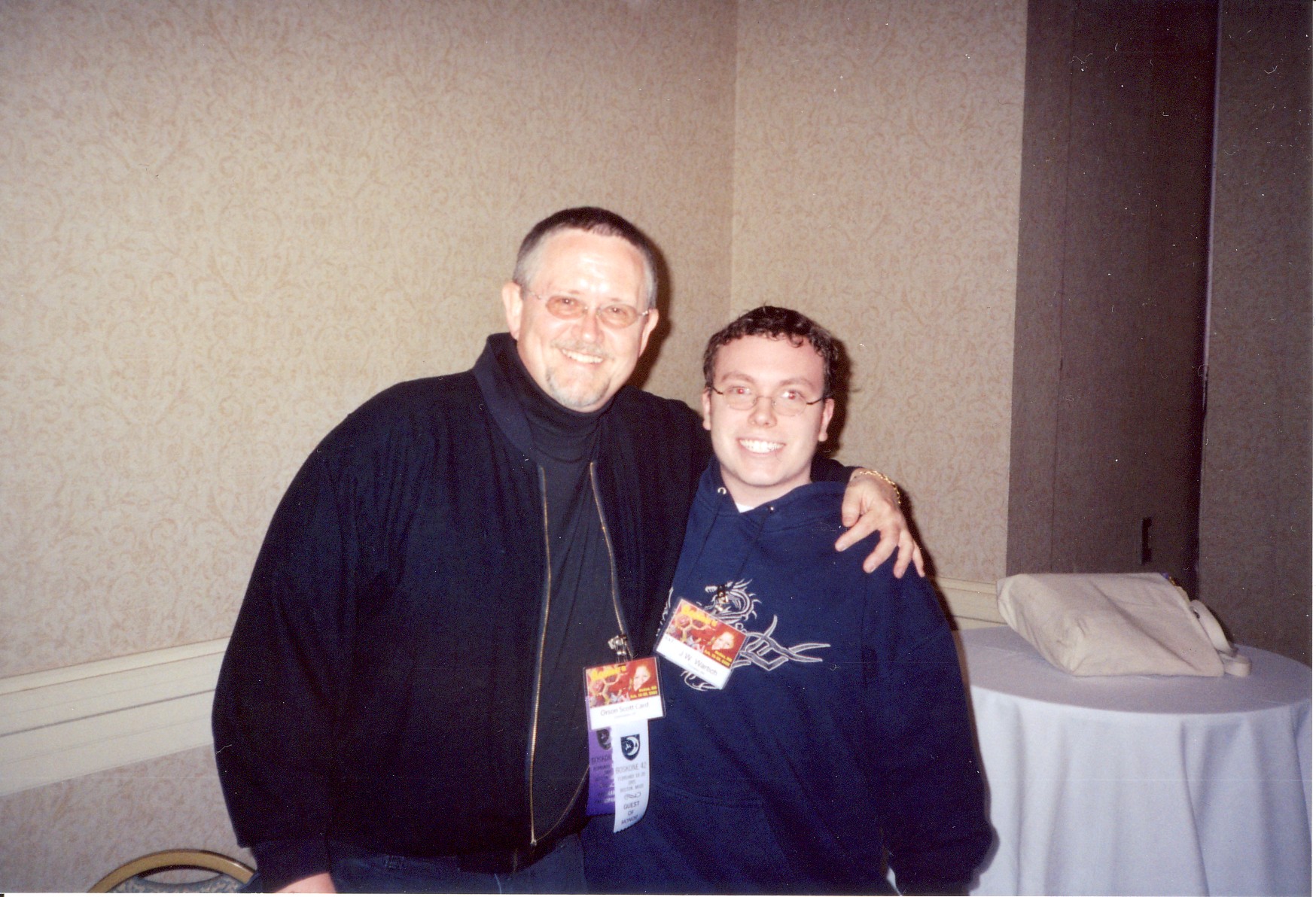
I can’t help but share the picture on the right of me (about 7-8 years ago) with Orson Scott Card. It was one of the most exciting experiences of my life. I found Card to be a gracious, wonderful man who was perfectly willing to sit down with a fanboy teenager and discuss heady issues about philosophy, teaching children about moral issues, and science fiction.
Be sure to check out my look at the movie.
Source
Orson Scott Card, Ender’s Game
Links
Religious Dialogue: A case study in science fiction with Bova and Weber– I take a look at how science fiction has dealt with theological topics, with a particular focus on dialogue about religion.
Be sure to check out my other looks at popular books [scroll down on this link for a number of posts].
Also look into my reviews of several popular movies.
There is No Combat Without Movement– A very different look at Ender’s Game which explores the use of military tactics in the book.
SDG.
——
The preceding post is the property of J.W. Wartick (apart from citations, which are the property of their respective owners, and works of art as credited) and should not be reproduced in part or in whole without the expressed consent of the author. All content on this site is the property of J.W. Wartick and is made available for individual and personal usage. If you cite from these documents, whether for personal or professional purposes, please give appropriate citation with both the name of the author (J.W. Wartick) and a link to the original URL. If you’d like to repost a post, you may do so, provided you show less than half of the original post on your own site and link to the original post for the rest. You must also appropriately cite the post as noted above. This blog is protected by Creative Commons licensing. By viewing any part of this site, you are agreeing to this usage policy.
Debate Review: Fazale Rana vs. Michael Ruse on “The Origin of Life: Evolution vs. Design”
 Fazale Rana recently debated Michael Ruse on the topic of the origin of life. Essentially, the question of the debate was whether the origin of life is best explained by naturalism or design. Here, I will provide brief comments on the debate.
Please note I make no claims to being a scientist and I am fully aware that I evaluate this debate as a lay person.
Michael Ruse Opening
Michael Ruse was careful to note that he is not keen on saying design is not possible. Rather, his claim is that naturalism is the most plausible explanation for the origins of life.
Ruse’s argued that design is implausible. Specifically, he noted that if design is the hypothesis put forward, there are any number of ways that one might consider that hypothesis. Is the designer a natural being within the universe or a supernatural being like God? Is there only one designer, or was there a group of designers (and he notes that a group of designers seems more plausible because automobiles require many designers to bring them about)? Finally, he raised the issue of bad design choices. He asked why, if there were a “hands-on” designer, would that designer not grant immunity to HIV and the like.
Ruse also argued that one can fall into the fallacy of selective attention- if one focuses upon only one example in isolation, then one might come to a conclusion that certain laws/theories may not be correct. But placing these same problems in context shows that they can be explained against “the background of our knowledge.”
Finally, Ruse ended with a number of examples for how problems which were seemingly insoluble were explained by naturalistic means. He also argued that one of the popular arguments for design, the flagellum, has so many different varieties (and is sometimes found to be a vestigial organ), and so cannot be shown to be designed.
Fazale Rana Opening
The problems which must be accounted for within an origins of life model are numerous. One must account for self-replication, the emergence of metabolism, the formation of protocells, the synthesis of prebiotic materials, the formation of life’s building blocks, and more.
Rana then turned to some primary models used by researchers to explain origin of life (hereafter OOL). First, there was the replicator-first model, which was problematic because in order for a molecule to be a self-replicator, it must be a homopolymer. But the complexity of the chemical environment on early earth rendered the generation of a homopolymer on the early earth essentially impossible. Next, the metabolism-first model runs into problem due to the chemical networks which have to be in place for metabolism. But the mineral surfaces proposed for the catalytic systems for these proto-metabolic systems cannot serve as such; Leslie Orgel held that this would have to be a “near miracle” and Rana argues that it is virtually impossible. Finally, the membrane-first model requires different steps with exacting conditions such that the model is self-defeating.
Rana argued positively that OOL requires an intelligent agent in order to occur. The reason is because the only way that any of these models can be generated is through the work on OOL in a lab. Thus, they can only be shown to be proof-of-principle and the chemistry breaks down when applied to the early earth. The fact that information is found in the cell is another evidence Rana presented for design. The systems found in enzymes with DNA function as, effectively, Turing machines. Moreover, the way that DNA finds and eliminates mistakes is machine-like as well. The fact that the needed component for success in lab experiments was intelligence hinted, according to Rana, at positive evidence for design.
Finally, Rana argued that due to the “fundamental intractable problems” with naturalistic models for the OOL and the fact that the conditions needed for the OOL and the processes required to bring it about have only been demonstrated as in-principle possible with intelligent agents manipulating the process.
First Cross Examination
At this point, Ruse and Rana engaged in a dialogue. Ruse first challenged Rana to show how the OOL model based on design could actually be based upon Genesis, as he quoted from Rana’s book (written with Hugh Ross), Origins of Life. He pointed out a few difficulties with using the Genesis account in this manner. Rana answered by putting forth his view of the Genesis account as an account of the origins of life on earth–a view which sees the Genesis account as corresponding with the scientific account (concordism). Yet the Genesis account is itself written from the perspective of a hypothetical observer found on the face of the earth rather than a perspective above the earth.
Rana asked Ruse for his thoughts on how much impact philosophy has on the debate over the OOL. He noted that it may be a presupposition of naturalism which lends itself to interpreting the OOL. Ruse answered by saying it is a good point and that philosophy cannot be denied a role in the discussion. But the question is not simply one of “gut commitments” and that one has to also take into account the scientific evidence and a “pragmatic reason” for holding to naturalism: naturalism works. It continually explains problems, even if it takes time.
Ruse Rebuttal
The difficulty with the OOL debate is that it is too easy to take things out of context in order to show how many problems there are with a model. He argued that it is “peculiar” to take the results of a group of researchers and yet somehow go “flatly” against the “overall interpretation that each and every one of these people” would have taken from the research.
Despite all the difficulties, Ruse argued, researchers are starting, slowly, to get some view of how to explain the OOL. He pointed to some successes within the OOL sciences to show how eventually we may discover a naturalistic explanation.
Rana Rebuttal
Rana began with the notion of a creation model. He argued that models are not always drawn from the data, but rather models and theories are constructed from a number of different points.
Regarding the science itself, Rana noted that there is no established source of prebiotic materials on the early earth. The popular theories for how these materials might be generated fail for a number of reasons.
The argument, Rana said, is not a god-of-the-gaps argument. Instead, it is an observation of the breadth of scientific evidence which shows that in-principle experiments have been successful, but when applied to the scenarios for the early earth, the only way for success to be achieved is through intelligent agency (scientists in a lab manipulating the conditions).
 Second Cross Examination
Rana asked Ruse to respond to the notion that OOL research is similar to literary criticism in that all the different theories continue to be debated but none have come into dominance or can be established over the others. Ruse responded by noting that OOL research does have some “just so” stories but that science has taken seriously the criticisms and come towards the possibility of answering some of the questions.
Ruse asked why God would not intervene for things like cancer. Rana answered by noting that in the broad scope of a model with intelligent agency, poor design is no problem. But because Rana believes it is the God of the Bible, he says it may be a legitimate criticism of the design position. However, things which appear to be bad designs can turn out later to have some reason for the way they are used. Moreover, once a creator has put in place designs, they are subjected to the laws of nature and so they could become decayed or break down.
Ruse Closing Argument
Ruse argued that when one takes a “Biblical position” one is “not doing science any more.” If one wants to assert that the science points to miracles, then Ruse said he would argue that the nature of our experience is not “blank” in relation to the OOL, but rather that the previous successes of naturalism means we should fall back upon naturalism regarding the OOL because it has worked in so many other areas. Thus, the problem with the OOL is not with the problems themselves but rather with our own ability to solve the problems.
Rana Closing Argument
The OOL and complexity of the cell require an intelligent agency in order to account for the OOL on earth, Rana maintaned. The problems with naturalistic accounts appear to be intractable, and the role of intelligent agency in lab work cannot be ignored because that same agency is what leads to the allegedly naturalistic successes. The information found in biological systems also give evidence for design.
Finally, methodological naturalism turns science into a game to be played in which the goal is always to find a naturalistic explanation, even if none is forthcoming. Instead, science should be, in practice, open to the possibility of agency within the natural world. Ruse’s argument is essentially an appeal to the future in which the notion is just that one day the answers will come forth.
Analysis
First, I would note how pleased I was with the nature of this dialogue. Unlike some other debates, Ruse and Rana were largely cordial and even amiable towards each other. It is clear that they each had respect for the other’s work and arguments.
The debate itself was very interesting. Fazale Rana continually went back to the science and pointed out the difficulties which remained, while Ruse seemed to continually appeal to the overall success of the naturalistic paradigm. Regarding Ruse’s position, I think it was perhaps disingenuous to conflate naturalism with science, particularly considering that very point was largely at the center of the debate. Is it indeed the case that we must be methodological naturalists? It seems that even Ruse agreed that our answer to this question will largely shape one’s interpretation of the problems and reactions to the problems brought up.
Regarding the science itself: Ruse brought up several successes which scientific research has yielded, but it seemed clear that none of these offered evidence which countered Rana’s arguments of the intractable problems for the OOL. Rana did an excellent job showing how the models which are in vogue right now for the OOL all fail on a number of levels to account naturalistically for the OOL.
Moreover, the fact that current research does rotate around the actions of intelligent agents. Given that such intelligent agents are necessary to bring about even the in-principle results for the OOL, it seems that Rana’s argument that this hints at an intelligent agent in the overall OOL schema was largely successful. It seems to me to count as positive evidence for design.
Overall, I have to say this was a great debate. I think one’s conclusions regarding the outcome of the debate largely will come down to a matter of worldview.
Links
Be sure to check out my extensive writings on the origins debate within Christianity.
The debate can be found here. It is worth a watch/listen due to the complexity of the issues involved. Or you could just watch it here:
Be sure to check out the Reasons to Believe web site, which is the organization Fazale Rana is part of.
SDG.
——
The preceding post is the property of J.W. Wartick (apart from citations, which are the property of their respective owners, and works of art as credited) and should not be reproduced in part or in whole without the expressed consent of the author. All content on this site is the property of J.W. Wartick and is made available for individual and personal usage. If you cite from these documents, whether for personal or professional purposes, please give appropriate citation with both the name of the author (J.W. Wartick) and a link to the original URL. If you’d like to repost a post, you may do so, provided you show less than half of the original post on your own site and link to the original post for the rest. You must also appropriately cite the post as noted above. This blog is protected by Creative Commons licensing. By viewing any part of this site, you are agreeing to this usage policy.
Abortion, fundamentalists, physicalism, and evolution: Sawyer’s “Calculating God” and some contentious issues
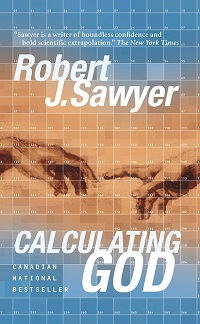 I have already written on Sawyer’s Calculating God
Fundamentalism, Religion, and Abortion
Sawyer lumps fundamentalism in with the discussions about abortion. Unfortunately, fundamentalism is portrayed in the worst possible light, not unlike in the work of Ben Bova. The religious fundamentalists here are extremists bent on destroying anything that counts as evidence against their worldview. As such, they are first introduced as blowing up an abortion clinic (86-87). Frequent readers of my site know that I write often from a pro-life perspective but also that I am very much opposed to violence in this opposition. Unfortunately, such principled opposition is not portrayed as an option in Sawyer’s work.
Interestingly the discussion of abortion in the book–intentionally or not–reveals some important details about the abortion debate. The alien, Hollus, notes the irony in being “pro-life” while also killing people who perform abortions. Yet in this discussion, Hollus reveals something of note:
Hollus looked at me [Tom Jericho, the main character] for the longest time. “These–what did you call them? Fundamentalist extremists? These fundamentalist extremists believe it is wrong to kill even an unborn child?”
“Yes” [Tom responded].
It may take a moment, but think about it: Sawyer expresses incredulity at this notion through the alien Hollus, yet in what may have been a Freudian slip, calls the unborn “children.” Yes, of course I’m opposed to killing an unborn child! In fact, this dialogue reveals exactly what is at stake in the abortion debate: if the unborn is not a human person, then who cares what you do with it? But if it is, then what relevant status difference is there between a child who is located inside the mother as opposed to outside the mother? Again, I’ve written more on this issue elsewhere, but it is important to note that even in expressing incredulity about this, there is a revealing phrase: child. It is an unborn child killed in abortion.
Disturbingly, the book touches on an issue very relevant to the personhood debate: children who are screened for disabilities. In one scene, Hollus is confronted by a child with Down’s Syndrome. He notes nonchalantly that a similar disease is almost always “screened for” in the wombs of the alien mothers (115-116). Unfortunately, this exact thing is happening right now. Unborn children who are shown as having Down’s Syndrome are being aborted inside their mothers at an alarming rate. I can’t help but see this as a modern eugenics movement: killing those we deem unworthy of life for a genetic reason. The logic that this entails is even more disturbing.
Of course the same fundamentalists who bombed the abortion clinic were also out to destroy any evidence for evolution. They sought to destroy a fossil exhibit which they saw as an affront to God. Thus, I can’t help but think that the way Sawyer presents fundamentalists is a bit disingenuous. Not all fundamentalists are incapable of reason and violent. Indeed, almost no fundamentalists are like this! Thankfully, there are positive examples of religious persons in Calculating God, including Tom’s wife.
In one poignant scene, Tom–who is dying from cancer–struggles with the fact that he has been confronted with evidence for the existence of a god. He considers famous atheists who purportedly went to death, all the while denying God’s existence to the end. Yet Tom himself gets down on his knees to pray. When he does so, though, he considers the words of someone from his past: “The Lord works in mysterious ways.” He can’t help but react violently against this:
Such bull. Such unmitigated crap. I felt my stomach knotting. Cancer didn’t happen for any purpose. It tore people apart; if a god did create life, then he’s a shoddy workman, churning out flawed, self-destructing products. “God,” [he prayed] “I wish–I wish you had decided to do some things differently.” (230-231)
Interestingly, in the book, cancer turns out to actually have a purpose… in the sense of being a side-effect of something great: the ability to fuse genetic codes with other intelligently designed species. Here it seems Sawyer has employed a great deal of imaginative techno-babble to explore the notion of a physical god, but it also has hints of a greater good theodicy akin to that of Swinburne.
Physicalism
The discussion of physicalism in Sawyer’s work is very brief, but enlightening. There is a variety of substance dualism here in the sense of emergence. That is, in Sawyer’s fictional world, intelligence and “mind” emerges from matter once complexity reaches a certain threshold. This is similar to the theories of emergence theorists like William Hasker. I can’t help but find this a bit strange. The people who argue for this type of theory are frequently the same who are very hostile to the notion of anything beyond the physical realm, yet they argue that something aphysical can indeed “emerge” from matter itself. Surely this is a leap of the imagination! That matter has creative force simply because it can reach a certain level of complexity seems to me patently absurd.
Not only that, emergence suffers from a second major problem. Namely, if our “mind” is simply a product of complexity in matter, then our “intelligence” is entirely supervenient upon physical complexity. Indeed, our intelligence is a product of that complexity and therefore cannot operate independently of that matter. Therefore, it is hard to see any kind of properties that our minds would have that would be capable of maintaining free will or even rational thought on this theory. Indeed, I have trouble seeing how this theory would be any different from physicalistic monism.
Evolution
The simple notion of evolution is a given in the book. No, it is not friendly to any who are unwilling to accept the notion of “macroevolution,” as the term is used in relevant literature. All the intelligent beings depicted in the book had evolved from a (potentially distinct) distant ancestor.
Darwinian evolution is simply assumed as truth in Calculating God. Or is it? The deity presented in the book is not very conducive to undirected evolution via natural selection and chance. It is portrayed as hurling asteroids at the planets where life was developing in order to press a “reset” button on the creatures that were currently dominant there. It also shown that this deity prevented other catastrophes from happening on these planets, thus interfering with natural selection. Indeed, the evolution depicted here is eerily similar to intelligent design, wherein the process is guided by a deity with a specific aim.
Indeed, one could argue that the entire book is an argument for intelligent design, albeit divorced from much of the theological framework that many of that movement’s frameworks operate within. Yet I can’t help but find this part of Sawyer’s argument (if, indeed, the intention is to make the argument that theists have it all wrong) is completely off. After all, the “god” of Sawyer’s universe is imperfect and concrete in the sense of physically existing. But this works against his concept of deity as being capable of coordinating the events it brings about. Granted, he could perhaps continue to increase the power of this deity beyond what is clearly outlined in the book, but there are hints that the deity is capable of knowing what is happening on places where it is not present, that it is capable of knowing what will happen with certain directions for evolution, and what will happen at the end of the universe. These work against the notion of God as a kind of blundering physical entity that just happens to be supremely powerful. Indeed, the god of calculating God may not be as hostile to Christianity as it initially seems. It serves as a pointer towards the true God of spacetime.
Links
Like this page on Facebook: J.W. Wartick – “Always Have a Reason”
Check out my other post on this book: Aliens that believe in God: The theological speculations of Robert Sawyer’s “Calculating God”
I have discussed the use of science fiction in showing how religious persons act. Check out Religious Dialogue: A case study in science fiction with Bova and Weber.
What would it mean if we discovered life? I have reflected on the possibility: Alien Life: Theological reflections on life on other planets.
Our Spooky Universe– I make the case for the intelligent design argument for the existence of God, which is heavily used throughout Calculating God.
Check out my other looks at popular level books. (Scroll down to see more!)
Source
Robert Sawyer, Calculating God
SDG.
——
The preceding post is the property of J.W. Wartick (apart from citations, which are the property of their respective owners, and works of art as credited) and should not be reproduced in part or in whole without the expressed consent of the author. All content on this site is the property of J.W. Wartick and is made available for individual and personal usage. If you cite from these documents, whether for personal or professional purposes, please give appropriate citation with both the name of the author (J.W. Wartick) and a link to the original URL. If you’d like to repost a post, you may do so, provided you show less than half of the original post on your own site and link to the original post for the rest. You must also appropriately cite the post as noted above. This blog is protected by Creative Commons licensing. By viewing any part of this site, you are agreeing to this usage policy.
Aliens that believe in God: The theological speculations of Robert Sawyer’s “Calculating God”
The interplay between worldviews and science fiction is very strong. In any writing, an author’s viewpoint will show through, but I think that it is particularly true in sci-fi. For in science fiction, the author is most frequently presenting a view of the world as it should be or as it should not be. The speculative future can be used as a foil through which the reader views reality in a new way. Often, science fiction will touch upon theological issues.
Robert Sawyer’s Calculating God
Fine Tuning
The most immediately striking and pervasive theme of Calculating God is that aliens show up on earth, and they believe in God. In fact, they take the existence of God to be a scientific certainty. The main character of the book, a paleontologist named Tom Jericho, is very skeptical throughout. Here’s the kicker, though, the aliens have been convinced of the existence of God through the evidence–specifically, the fine-tuning argument. Said argument is presented throughout the course of the book in interactions between Tom and Hollus, an alien paleontologist.
What is surprising is how much depth the book goes into while exploring the argument. Yes, Sawyer does fudge the argument a bit by allowing the aliens the possibility of a grand unified theory of science as well as a few other fictionalized aspects of the argument, but overall the fine-tuning argument he presents is very similar to the modern fine-tuning argument.
Not only that, but the characters Sawyer created go to great lengths to explore objections to and defenses of the fine tuning argument. For example, there is a discussion on p. 144ff (mass market paperback edition) in which Hollus and Tom discuss some objections to fine tuning. Tom is arguing against the probability of God:
“All the actions you ascribe to God could have been the doing of advanced aliens” [said Tom].
“There are… problems with your argument,” said Hollus, politely. “[E]ven if you dispense with the need for a god in recent events–events of the last few billion years; events after other conscious observers had emerged in this universe–you have done nothing to dispense with the relative strengths of the five fundamental forces [its science fiction, so there is an extra force], who designed the thermal and other properties of water, and so on. And therefore what you are doing is contrary to the razor of Occam you spoke of: you are increasing, not reducing the number of entities that have influenced your existence…”
The book is replete with debates like this, and the inevitable conclusion is that, shock of all shocks, God exists. I don’t say that sarcastically, I mean that I was genuinely surprised that the book affirmed God exists. But what kind of God?
God Exists… but?
It should be clear that in Calculating God, God is nowhere near the God of classical theism. In fact, one could almost argue that what Sawyer has offered here is a materialistic supplanting of God. The “god” of this work is essentially a super-powerful alien which is capable of swallowing the enormous energy output of a supernova, while also capable of designing our biology and fixing the constants of the universe during the early stages of the Big Bang.
God’s action is described purely in non-transcendent language. For example, the aliens confirm that god caused ice ages and mass extinctions on all the planets with intelligent life. The way this was accomplished was a matter of some speculation–perhaps God generated a dust cloud by using particles from across the galaxy to shield the planets from light and lower the temperature, or perhaps God redirected an asteroid or two to send them hurtling at the planets with life that needed a ‘jump start’ of evolution (146ff).
So why think that this is an image of god supplanting the classical theistic God? Well, clearly many who use the teleological argument are intending for it to point towards a creator God. What Sawyer has offered is a more naturalistic explanations of these events. Yes, there is a ‘god’ in the sense of a being capable of tampering with the very fabric of our universe, but that ‘god’ is itself trapped within the spatio-temporal boundaries of the known universe. In fact, god is said to subsist by recreating itself via a kind of reproductive method and passing one generation through a Big Crunch (think of a bouncing universe model).
Now what?
Calculating God offers a unique look at theology from a science fiction perspective. The fine tuning argument is presented in full force–even enhanced by some fudging of the science–and it leads to the inevitable conclusion that god exists. Yet this ‘god’ is not at all amenable to the god of Christianity or classical theism. So what should we do with this book?
Well, it is important to note that it is a work of fiction. The author clearly adds in some extra ‘fluff’ to make the fine tuning argument more powerful than it is (and I think it is quite powerful as it stands). And really Sawyer’s shoehorning in of a materialistic entity that is able to fiddle with physics boils down to hand-waving. Again, it is fiction, but it is important to note that Sawyer’s attempt to supplant the God of classical theism simply doesn’t work. Think of it this way: how would a purely physical being, however powerful, manage to transcend the physical universe in such a way as to literally rewrite the laws of physics? Extremely interesting science fiction? Yes. Compelling argument? No.
So where are we left? Sawyer does present the fine tuning argument in a way that is quite compelling, even when one strips away all the layers of fiction over it. It seems to me that, at a minimum, readers are left with a rock in their shoe: how do we explain away all this fine tuning without going beyond the cosmos? Sawyer’s own proffered answer, while entertaining fiction, remains that: fiction.
Other Issues
I have not yet even begun to delve into the depths of Sawyer’s Calculating God. The book covers an extremely broad array of topics related to science and faith as well as the secular-religious [false] dichotomy. For example, he discusses abortion in a few places, and I think the view the characters favor is very inconsistent. There is also some clear portrayal of the religious “other” as only a fundamentalist who seeks to halt scientific advancements. Yes, Sawyer panders to Christians in a few places, but the overall look at religious persons seems to be fairly negative (apart from Tom’s wife). I wish I could do justice to each of these topics, so I think I may follow this post up with another touching on more. For now…
Conclusion
Ultimately, Sawyer’s work is a simply phenomenal read. The amount of scientific, ethical, and religious issues upon which it touches is stunning, and readers will be forced to deal with the argument. Sawyer has done an excellent job using fiction for what I think it is called to do: inspire, entice, and force thought. Readers will be uncomfortable. The work will challenge people to really think about the arguments, and to think about the offered solutions.
Links
I have discussed the use of science fiction in showing how religious persons act. Check out Religious Dialogue: A case study in science fiction with Bova and Weber.
What would it mean if we discovered life? I have reflected on the possibility: Alien Life: Theological reflections on life on other planets.
Our Spooky Universe– I make the case for the intelligent design argument for the existence of God, which is heavily used throughout Calculating God.
Check out my other looks at popular level books. (Scroll down to see more!)
Source
Robert Sawyer, Calculating God
SDG.
——
The preceding post is the property of J.W. Wartick (apart from citations, which are the property of their respective owners, and works of art as credited) and should not be reproduced in part or in whole without the expressed consent of the author. All content on this site is the property of J.W. Wartick and is made available for individual and personal usage. If you cite from these documents, whether for personal or professional purposes, please give appropriate citation with both the name of the author (J.W. Wartick) and a link to the original URL. If you’d like to repost a post, you may do so, provided you show less than half of the original post on your own site and link to the original post for the rest. You must also appropriately cite the post as noted above. This blog is protected by Creative Commons licensing. By viewing any part of this site, you are agreeing to this usage policy.
Really Recommended Posts 10/12/12
 Another great run around the internet today. I noticed that this edition of Really Recommended Posts has a lot on Christianity and Science, Islam, and religious or activist violence. Abortion, biochemistry, the Qur’an, violence in Islam, Mitt Romney, and more are all featured. Check out the posts. If you like them, let me know.
Cataloging the Historical Anachronisms in the Qur’an– Does the Qur’an potray accurately the period that it purports to describe in historical narrative? It does not seem so. Check out some of the anachronisms which crept in.
New peer-reviewed paper in Nature falsifies Darwinian junk DNA prediction– Darwinian Evolution has long used the notion of “junk DNA” as confirmation of its naturalistic processes. However, recent study has confirmed one of the predictions of the Intelligent Design movement: this supposed junk DNA would prove to be useful. I don’t claim to be a scientist at all, but I find this very intriguing. Check out the article.
Hey Atheists, Just Shut Up Please [LANGUAGE WARNING]- I found this article very interesting. An atheist discusses how people can tend to hate the “other” in their over-enthusiastic attempts to refute them. I was pleased with the article in general, but be aware that there is some strong language there. I myself have written about how religion is often used as a mechanism to hate the “religious other.”
Would a Romney presidency boost Mormonism?– Some Christians have come out saying they are afraid to vote for Romney because it would boost Mormonism. A pastor responds briefly to these claims.
Why Abolition Must be Non-Violent– The Abolish Human Abortion blog discusses why we in the pro-life movement must not resort to violence. The struggle is between worldviews, and pro-life persons cannot say they are pro-life while using violence.
Modern Muslims Who Choose the Path of Violence– Nabeel Qureshi discusses violence in Islam and the fact that Islam is not monolithic. The important thing to think about is how and when Islam turns violent. As I have emphasized elsewhere, religion and violence must be analyzed empirically, not with a mind towards demonizing the religious “other.”
Yes, the media does deliberately misrepresent and demonize creationists– Readers of my blog know I do not hold to a young-earth position. However, like Glenn Andrew Peoples I am still offended when the media blatantly misrepresents my Christian brothers and sisters. Check out this thoughtful post.
Ken Ham on “Compromise” and Stand to Reason
Ken Ham recently released a rant about compromise in the church. Rather than evaluating any single point, I’m just going to go through a short, point-by-point response. Quotes from the article are in block quotes.
…a big part of our mission is to bring reformation to the church, so of course we expect opposition to our efforts. Sadly, the worst opposition from my perspective is from within the church, since we should expect opposition from the world.- Ham
I would like to know what the “reformation” is that Answers in Genesis (hereafter AiG) hopes to bring about. I suspect it is a reformation of young earth creationism, but that seems to be a fairly major position within the average church anyway. A “reformation” is never restricted to just one point, however, so one must wonder what theology it is that AiG hopes to bring to the forefront.
Stand to Reason states its mission as teaching people “not just what to think, but how to think.” Sadly, their supposed teaching people “how to think” is actually teaching them to think in terms of millions of years and evolutionary ideas. -Ham
Ken next turned to an attack on the ministry group, “Stand to Reason.” Note that the reason it is under attack is because the group is teaching “to think in terms of millions of years and evolutionary ideas…” I found this quote particularly strange, considering that Stand to Reason is a specific and vocal advocate of Intelligent Design. The group goes so far as to offer Intelligent Design as “a scientific alternative to evolution.” As far as “millions of years,” one may say that this is indeed part of teaching people “how to think.” Let’s investigate the evidence. Let’s come to our own conclusions. Let’s think about it.
It seems particularly strange to see an AiG person complaining about others teaching “how to think” because anyone who disagrees with the AiG position on the age of the universe is labeled, ironically, a “compromiser.” Only if you hold the position AiG desires you to hold are you someone who knows “how to think.” Seems like a very strange way to teach “how to think,” doesn’t it?
Hugh Ross believes in an old earth and promotes the day-age and progressive theories of creation. He says God created over millions of years in the same basic order as the secularists claim life evolved (in reality, this is a form of theistic evolution). -Ham
Hugh Ross is a favorite target of groups like AiG. Why? I suspect it is because Ross doesn’t focus exclusively on scientific evidence (which young earth creationists tend to reject as “a different interpretation of the same evidence”) but instead offers alternative theological interpretations.
That aside, this quote from Ken Ham is factually incorrect. It makes me wonder whether he has interacted with Ross’ works on a thoughtful level. Ross certainly doesn’t hold the position outlined above. Ross does believe the timeline science has uncovered matches up with the Biblical account. The important distinction is that Ross leans towards progressive creationism (in the writings of his I have read); in other words, God created species over time. When one species passed away, God brought forth a new one. Initially it may seem that this is how Ham described Ross’ position, but note the last clause in which Ham says this is a form of theistic evolution. That is absolutely incorrect. I know of no theistic evolutionist who would agree that God brings forth new species over time in special creative events. None. Rather, it seems Ham is just using the scare word “evolution” and associating it with any position he disagrees with (see Stand to Reason above).
[Skipping over a number of point-counterpoint rebuttals in Ham’s post.]
They [Stand to Reason/other groups like them] can try to modify things all they want, but what they are doing is compromising man’s ideas of millions of years with the Bible and reinterpreting the clear text of Scripture, thus undermining the authority of the Word of God. They do believe in evolution—it’s just that they just don’t accept the naturalistic neo-Darwinian view but modify their beliefs to suit their purposes of having God create but over millions of years. -Ham
Another juicy quote. Let me break it down. First, Ham is tugging the standard YEC line that anyone who disagrees with their interpretation of Scripture is “compromising” by using “man’s ideas.” Essentially, if you are a Christian who doesn’t believe the universe is 6000-10,000 years old, you are compromising Scripture. Never mind a huge amount of exegetical evidence to the contrary (one thinks of C. John Collins’ study of Genesis; Hugh Ross’ own theological work; Sailhamer; Walton’s important study of Genesis in light of ANE cosmology; etc.), if you disagree, you can’t possibly take Scripture seriously. I have run into this personally a number of times. If you disagree, your position simply cannot even have any merit. Never mind if you offer a reading of Genesis which more closely matches the theological/cultural/historical aspects of the text, you’re just wrong.
Moving on, Ham, in baffling fashion, wrote that Stand to Reason does “believe in evolution.” Again, this is a simple misrepresentation of STR’s position. In fact, Young Earth Creationists “believe in evolution” in the abstract too. What? It’s true. Consider the research YECs do in journals of their own publication. Not only that, but even the “Answers in Genesis Research Journal” does a study of “kinds” in the Bible and asserts, “the Bible’s description of created kinds implies an information model which uses variables. The findings in this paper show that a model which uses variables forms a stronger basis for true scientific understanding of biology and, by implication, the Bible provides a superior foundation for scientific investigation.” Wow, looks like AiG believes in microevolution through variables too! I should therefore reject the site as “compromise.”
The problem is that, as is typical in these types of discussions, such a rejection would be an unfair reading of the opposition. Ham and others put scare words like “evolution”; “compromise”; and “man’s ideas” in the context of their opposition. The tactic is highly rhetorical and has little, if any, substance. The fact remains that Ham is cherry-picking ideas from the opposition, putting them in context with scare words, and then declaring victory.
Overall, one must wonder about a few things based simply upon this recent article. 1) What kind of theology is a group like AiG trying to “reform”? Is their perspective limited only to the age of the universe, or do they have a broader vision? 2) Did AiG inaccurately represent their opposition? 3) No matter what side we take in this debate, should we not try to be fair and honest about the other side’s view? 4) Was Ken Ham fair and honest?
Source: “Compromise Being Spread” Ken Ham, http://blogs.answersingenesis.org/blogs/ken-ham/2012/05/08/compromise-being-spread/.
Book Review: “Where the Conflict Really Lies” by Alvin Plantinga
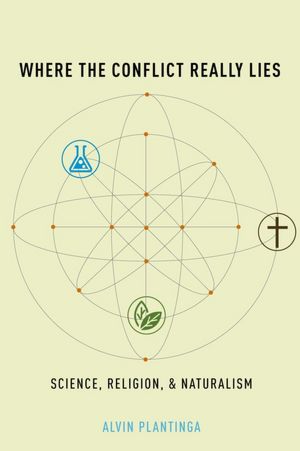 There are few names bigger than Alvin Plantinga when it comes to philosophy of religion and there are few topics more hotly debated than science and religion. Plantinga’s latest book, Where the Conflict Really Lies
Plantinga minces no words. The very first line of the book outlines his central claim: “there is superficial conflict but deep concord between science and theistic religion, and superficial concord and deep conflict between science and naturalism.”1
The first part of the book is dedicated to the superficial conflict between science and religious belief. The reason this alleged conflict is important is due, largely, to the success of the scientific enterprise. Because science has shown itself to be a reliable way to come to know the world, if religion is in direct conflict with science, then it would seem to discredit religion. Not only that, but, Plantinga argues, Christians should have a “particularly high regard” for science due to the foundations of the scientific enterprise on a study of the world.2
In order to examine this alleged conflict, Plantinga first takes on the article of science most often taken to discredit religion: evolution. Here, readers may be surprised to find that Plantinga does not try to argue against evolution itself. Rather, Plantinga draws a distinction between the notion of evolution and Darwinism. The former, argues Plantinga, is consistent with Christian belief, whether or not it is the way the variety of life came to be, while the latter is not consistent with Christianity because central to its account is the notion that the process of evolution is unguided.3
WCRL then turns to Richard Dawkins. Plantinga argues that “A Darwinist will think there is a complete Darwinian history for every contemporary species, and indeed for every contemporary organism.”4 Here again there is nothing which puts such a theory in conflict with Christian belief. Writes Plantinga, “[The process of evolution] could have been superintended and orchestrated by God.”5 But Dawkins (and others) claim that evolution “reveals a universe without design.” But what argument is provided towards this conclusion? Plantinga draws out Dawkins reasoning and shows that the only logic given is that evolution could have happened by way of unguided evolution. But then:
What [Dawkins] actually argues… is that there is a Darwinian series of contemporary life forms… but [this series] wouldn’t show, of course, that the living world, let alone the entire universe, is without design. At best it would show, given a couple of assumptions, that it is not astronomically improbable that the living world was produced by unguided evolution and hence without design. But the argument form ‘p is not astronomically improbable’ therefore ‘p’ is a bit unprepossessing… What [Dawkins] shows, at best, is that it’s epistemically possible that it’s biologically possible that life came to be without design. But that’s a little short of what he claims to show.6
Plantinga then moves on to argue that Daniel Dennett’s argument is similarly flawed.7 Paul Draper’s argument that evolution is more likely on naturalism than theism is more interesting, but assumes that “everything else is equal.”8 But then, everything is not equal. Theism provides a number of relevant probabilities which weigh the argument in favor of theism instead.9
The arguments against theism from evolution are therefore largely dispensed. What of the possibility of divine action? Some argue that God doesn’t actually act in the world—in fact, the argument is made that even most theologians don’t believe this, despite writing that God does act in various ways. The argument is made that because of natural laws, God cannot or does not intervene.10 However, one can simply argue that the correct view of a natural law is that “When the universe is causally closed (when God is not acting specially in the world), P.”11
Plantinga does acknowledge that there are some fields in science which do provide at least superficial conflict with theism. These include evolutionary psychology and (some) historical critical scholarship.12 Evolutionary psychology generally doesn’t challenge religious belief. “Describing the origin of religious belief and the cognitive mechanisms involved does nothing… to impugn its truth.”13 Now some suggest that religious beliefs are due to devices not aimed at truth, and this would provide a reason to doubt religious belief.14 However, the way that most do this is by conjoining atheism with psychology or operating under other assumptions which undermine religious belief a priori. While this may mean that specific conclusions in psychology are in conflict with theism, these conclusions only follow from the anti-theistic assumptions at the bottom. Thus, while some accounts of evolutionary psychology are in conflict with theism, they don’t provide a solid basis for rejecting it.15 Similarly, varied methods of historical concept may draw some conclusions which are in conflict with Christian theism, but these methods are themselves undergirded by assumptions that theism is, at best, not to be entered into historical discussion.16
There are, Plantinga argues, significant reasons to think that theism is in concord with science. First, the argument from cosmological fine-tuning, he argues, gives “some slight support” for theism.17 The section on fine-tuning has responses to some serious criticisms of such arguments. Most interesting are his responses to Tim and Lydia McGrew and Eric Vestrup—in which Plantinga argues that we can indeed get to the point where we can assess the fine-tuning argument;18 Plantinga’s discussion of the multiverse;19 and his discussion of relevant probabilities regarding fine-tuning.20
Michael Behe’s design theory is discussed at length in WCRL.21 Plantinga offers some additional insights into the Intelligent Design debate. He argues that one can view design not so much as a probabilistic argument but instead as simple perception.22 He reads both Behe and William Paley in this light and argues that they are offering design discourses as opposed to arguments.23 This, in turn, allows him to argue that design is a kind of “properly basic belief” and he offers a robust discussion of epistemology to support this intuition.24
Further, there is deep concord between Christian Theism and Science when one looks at the very roots of the scientific endeavor. Here, rather than simply listing various theists who helped build the empirical method, Plantinga argues that science relies upon various theistic assumptions in order for its methods to succeed. These include the “divine image” in which humans are capable of rational thought;25 God’s order as providing regularity for the universe;26 natural laws;27 mathematics;28 induction;29 and simplicity and “other theoretical virtues” (like beauty).30
Finally, Plantinga turns to naturalism: does it really resonate so well with science? Plantinga grants for the sake of argument that there is at least superficial concord between naturalism on science, if only because so many naturalists trumpet this “fact.”31 Yet there is, he argues, a deep conflict between science and naturalism: namely, that if evolution is true and naturalism is true, there is no reason to trust our cognitive abilities.32 “Suppose you are a naturalist,” he writes, “you think there is no such person as God, and that we and our cognitive faculties have been cobbled together by natural selection. Can you then sensibly think that our cognitive faculties are for the most part reliable?”33
Plantinga argues you cannot. The reason is because we have no way to suppose that evolution is truth aimed, but rather it is merely survival aimed (if indeed it is aimed at all!). He also argues that because naturalists are almost all materialists, there is no way to adequately ground beliefs.34 Finally, because naturalism and evolution conjoin to give a low probability that our rational abilities are reliable, we have received a defeater for every belief we have, including naturalism and evolution.35 Thus, the conflict “is not between science and theistic religion: it is between science and naturalism. That’s where the conflict really lies.”36
WCRL covers an extremely broad range of topics, and will likely be critiqued on each topic outlined above and more. The book touches on issues that are at the core of the debate between naturalists and theists, and as such it will be highly contentious. That said, the book is basically required reading for anyone interested in this discourse. Plantinga provides extremely valuable insights into every topic he touches. His discussion of biological design, for example, provides unique insight into the topic by locating it within epistemology as opposed to biology alone. Further, his “evolutionary argument against naturalism” continues to live despite endless criticism. The list of important topics Plantinga illumines in WCRL is extensive.
Where the Conflict Really Lies
——
1 Alvin Plantinga, Where the Conflict Really Lies (New York, NY: Oxford, 2011), ix.
2 Plantinga, Where the Conflict Really Lies, 3-4. (Unless otherwise noted, all references are to this work.)
3 12 (emphasis his).
4 15 (emphasis his).
5 16.
6 24-25.
7 33ff, esp. 40-41.
8 53.
9 53ff.
10 69ff.
11 86, see the arguments there and following.
12 129ff.
13 140.
14 141ff.
15 143ff.
16 152ff.
17 224.
18 205-211.
19 212ff.
20 219ff.
21 225-264.
22 236ff.
23 240-248.
24 248ff; see esp. 253-258, 262-264.
25 266ff.
26 271ff.
27 274ff.
28 284ff.
29 292ff.
30 296ff.
31 307ff.
32 311ff.
33 313.
34 318ff.
35 339ff.
36 350.
This review was originally posted at Apologetics315 here: http://www.apologetics315.com/2012/02/book-review-where-conflict-really-lies.html
SDG.
——
The preceding post is the property of J.W. Wartick (apart from citations, which are the property of their respective owners) and should not be reproduced in part or in whole without the expressed consent of the author. All content on this site is the property of J.W. Wartick and is made available for individual and personal usage. If you cite from these documents, whether for personal or professional purposes, please give appropriate citation with both the name of the author (J.W. Wartick) and a link to the original URL. This blog is protected by Creative Commons licensing. By viewing any part of this site, you are agreeing to this usage policy.
Really Recommended Posts 3/3/12
 The really recommended posts this go-round feature Richard Dawkins, bioethics, philosopher’s opinions, women in the ministry, and more!
Arguments about Jesus’ resurrection are fascinating, and can be extremely useful in the question of theism. See this great article which features rigorous application of probability theory to the arguments from the resurrection.
Richard Dawkins’ book, The Greatest Show On Earth claims to show the undeniable evidence for evolution. Does it succeed? Jonathan Mclatchie does not think so and has written an excellent, lengthy review to show how Dawkins fails.
Philip Payne, the author of “Man and Woman, One in Christ” (which I reviewed here) has an excellent web site which responds to many criticisms of his positions. Those interested in the issue of women in the ministry should look into it.
No peer reviewed papers advocating intelligent design? False! Check out this list.
After birth abortions? Basically the logical conclusions of the general pro-choice position. Read more.
Prosblogion conducted a survey about philosopher’s opinions on theistic arguments. The results are mostly unsurprising, but interesting nevertheless. Check it out.

 J.W. Wartick - Reconstructing Faith