evolutionary morality
“X-Men: Days of Future Past” – A Christian Perspective
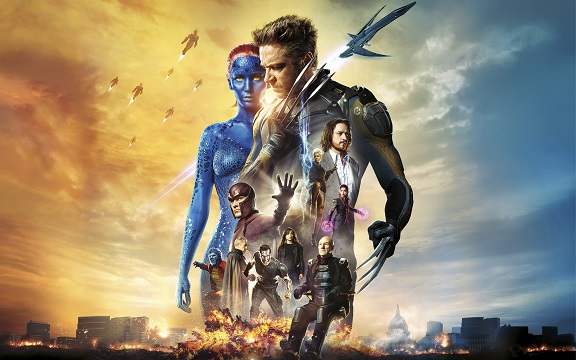 The X-Men franchise has been my favorite of the Marvel franchises for some time, largely because of the worldview questions it brings up. Here, we’ll take a look at the themes in “X-Men: Days of Future Past.” There will be SPOILERS for the film in what follows.
Evolution
Evolution continues to be at the heart of many of the questions raised by the X-Men franchise. What does it mean to say that Mutants are perhaps the next step in evolution for humanity? For some, it means that Mutants should overthrow humanity; after all, they are the lesser-evolved form of life. How should humans and Mutants interact? Are they really a step of evolution, or is it simply a different expression of humanity?
These questions are obviously speculative, but I think the most poignant of them center around the notion of an evolutionary morality. If all we see is merely the product of naturalistic evolution without any sort of grounding for objective morality, who is to say that those Mutants and humans who say that there is a fundamental war between Mutants and humanity are wrong? It seems as though they are exactly right: it is a competition for resources, pure and simple. Yet the questions the movie brings up go beyond such simplistic reasoning. After all, it seems, there is right and wrong that goes beyond the reasoning centered around survival-of-the-fittest. Again, we must wonder: why? Moreover: how is it grounded? These questions get at the heart of worldview questions, and viewers who are left thinking that it is wrong to perpetuate a war between Mutant and human should wonder what grounds they have for thinking it is wrong.
The Heart of Hum…utant?
Many strands of Christian expression view humanity as depraved. That is, humans are sinful at heart, rather than being generally good. “Days of Future Past” aligns with this vision of humanity in a number of ways, but it also, interestingly, portrays mutants as just as frequently evil-leaning as humankind.
The inherent fear of the “Other” was felt throughout, as both Mutant and human worked to destroy each other. However, Mystique’s quest for revenge was a deeper look at aspects of character and worldview. Her quest, despite it being a futile gesture, was telling: she sought revenge despite the possibility that it could destroy all of her own kind. Professor X’s words, however, echoed through time: “Just because someone stumbles and loses their way doesn’t mean they are lost forever.” Mystique, through her choice to refuse to pursue the way of violence into oblivion, ultimately plays a kind of figure of reconciliation. The theme of darkness in the heart which may be redeemed is one which resonates powerfully with the Christian worldview.
A Spectrum of Morality
I think one area that is not explored frequently enough is the notion that there really is a spectum when it comes to that which is moral. I’m not advocating any kind of relativism, but rather the notion that there aren’t always (or even often) black and white moral choices. “Days of Future Past” brings this to the forefront as viewers are confronted with various ways to approach the question of the Mutant. Does one opt for a warfare model which is put forth by Magneto and Dr. Trask, a model which allows for coexistence with separation/secrecy as was generally being followed in the 1970s of the film, or perhaps even cooperation as Dr. X seeks? Perhaps instead, one should forge one’s own way like Mystique or (old) Wolverine, seeking a personal agenda in order to follow one’s own ends.
These aspects are front-and-center throughout the film, as viewers most likely will unconsciously lean towards a certain expression themselves. We discussed above the aspects of evolutionary morality, but I think the movie goes even deeper, trying to get at more basic questions like “What is truth?” and “What is moral/right?” The way viewers answer these questions may lead to further conversations. It seems to me the film clearly favored the kind of mediation road in which Mutant and Human could coexist. But what does that mean for those who favored evolutionary morality or a warfare model? Perhaps such notions are themselves outdated and put to rest because they are of a “Future Past.”
Conclusion
The latest X-Men movie has received much critical acclaim and box-office success. I think that’s for a good reason. It has a compelling plot, great action, and excellent pacing. Our analysis of various themes throughout the movie shows there is thoughtfulness behind it as well. Issues of morality are front and center, though many other themes are worth discussing as well. This is a movie that could be used to start discussions about the faith from many different aspects.
There are many more issues which could be explored in the movie. What are some that resonated with you? Let me know your own thoughts in the comments.
Links
Be sure to check out the page for this site on Facebook and Twitter for discussion of posts, links to other pages of interest, random talk about theology/philosophy/apologetics/movies and more!
Movies– Read other posts I have written on the movies. Scroll down to see more!
The image is a movie poster for the film and I use it under fair use.
SDG.
——
The preceding post is the property of J.W. Wartick (apart from quotations, which are the property of their respective owners, and works of art as credited; images are often freely available to the public and J.W. Wartick makes no claims of owning rights to the images unless he makes that explicit) and should not be reproduced in part or in whole without the expressed consent of the author. All content on this site is the property of J.W. Wartick and is made available for individual and personal usage. If you cite from these documents, whether for personal or professional purposes, please give appropriate citation with both the name of the author (J.W. Wartick) and a link to the original URL. If you’d like to repost a post, you may do so, provided you show less than half of the original post on your own site and link to the original post for the rest. You must also appropriately cite the post as noted above. This blog is protected by Creative Commons licensing. By viewing any part of this site, you are agreeing to this usage policy.
Problems With Evolutionary Morality
Recently, i discussed the problems atheism has with establishing a base for moral discussions (see here). Now it is time to delve into the problems with one of the most commonly used ethical theories of non-theists–evolutionary morality (or, to use a phrase coined by Koukl, “monkey morality”).
Evolutionary Morality generally argues that our moral beliefs arose by some kind of naturally-selected process. Notably, ethical judgments which benefited the survival of the species tended to be favored (thus, murder was frowned upon), while those judgments which prevented the spread of one’s genes tended to be disfavored (hence the reason rape is not permitted, for now it makes one stigmatized socially, thus leading to difficulties propagating genes).
Without much further ado, I find numerous problems with this ethical theory. Here, I shall present only a few.
1) How can we get an “ought” from matter in motion? Ultimately, evolutionary moralists assert that all there is in the universe is the physical realm. As such, a “person” is reducible to matter in motion. But then how exactly is it that there can be a moral “ought” if everything is matter in motion. Evolutionary morality reduces ethical decisions to the point of being mere wishes at best. There is no “ought” or “should” in evolutionary morality, for there cannot be. Ought’s can only be issued from sources to which one has obligations. It is hard to see how a person owes obligation to one’s species or matter.
2) Evolutionary Morality assumes that what is best for a being is the survival of the species. How is it that we can say what is best for an individual being is to insure survival of the species? What is it that makes it “good” or “right” to propagate genes? Furthermore, what if an individual does not wish to help insure survival of his/her species. Suppose there is a species of sentient beings, the Plargons, who are in all ways horrible. They travel the galaxies, taking over lush worlds, burning them to the ground and using every available resource until it is depleted, and then move to the next planet. Suppose now that Judy, a Plargon woman, decides it would be better for her species to be eradicated from the galaxy, for they are without capacity for reform. She therefore manages to destroy all other Plargons, and then retires to a corner of the galaxy alone until she dies, exterminating the Plargon race. Would this be a good or bad thing? Such a hard question should take much consideration from any thinking person, but evolutionary morality circumvents the hard question and simply delcares that Judy has done the greatest evil imaginable, for she has gone against the survival of her own species.
3) Evolutionary Morality assumes that all beings “should” desire the continuity of the species, yet this assumes a higher morality. Again, what makes it “good” or “right” to do things for the survival of our species. Humanism suffers from this glaring problem. It’s all well and good to say that what is good for humanity is what we should strive for. But whence does this “should” come?
4) Evolutionary Morality destroys altruism. Altruism, on evolutionary morality, is generally stupid. For to sacrifice oneself to save another (or several others) is to destroy one’s own place in the gene pool, thus eradicating one’s very reason for existence. Yet it seems intuitively as though altruism is a great good. Evolutionary morality therefore goes against our common sense notions of morality.
5) Evolutionary Morality is arbitrary. That which is good for the species may change over time. Recall the case of rape. I have heard it said that at one time rape was considered “okay” or “good” because it was one way to ensure the survival of the human race. Now, however, due to societal constraints, rape is “bad” or at least “stigmatized” and therefore is viewed negatively. But it seems intuitively that rape is a great horror, no matter what the circumstances! This is another case of Evolutionary Morality violating our moral senses. Furthermore, suppose the nuclear apocalypse happens, leaving only a few hundred humans alive. Evolutionary Morality could allow for rape to once more be a great good, for after all, we would need to repopulate the earth! Why should the feelings of some women or men get in the way of the survival of the species!? Again, the bankruptcy of Evolutionary Morality shines through.
It seems to me that the problems with moral systems which do not include God are endless. Without a lawgiver, anything can be right. Without a lawgiver, there are no “oughts”. Morality therefore dies.
——
The preceding post is the property of J.W. Wartick (apart from citations, which are the property of their respective owners) and should not be reproduced in part or in whole without the expressed consent of the author.

 J.W. Wartick - Reconstructing Faith