fundamentalism
Inerrancy Undermines Interpretive Method?

James Barr’s work, Fundamentalism (1977) remains incredibly relevant to this day. I have been reading through it and offering up thoughts as I go. I’m reading the chapter about the Bible and Barr has enormous insight into the Fundamentalist (and here it is okay to substitute in “Evangelical”) reading of the Bible.
I’ve already written about how Barr notes that fundamentalists do not have a consistent hermeneutic of the Bible because their adherence to inerrancy forces them to read passages in light of their own understanding of truth. Barr isn’t done firing his salvoes at this issue, though he also notes that many people misread fundamentalists on their use of literalism:
“It is thus certainly wrong to say… that for fundamentalists the literal is the only sense of truth. Conservative apologists are right in repudiating this allegation. Unfortunately, the truth is much worse than the allegation that they rightly reject. Literality, though it might well be deserving of criticism, would at least be a somewhat consistent interpretative principle, and the carrying out of it would deserve some attention as a significant achievement. What fundamentalists do pursue is a completely unprincipled – in the strict sense unprincipled, because guided by no principle of interpretation – approach, in which the only guiding criterion is that the Bible should, by the sorts of truth that fundamentalists respect and follow, be true and not in any sort of error” (49).
Here Barr notes first that fundamentalists/evangelicals are right to push back against the accusation that they simply see literalism as the only way to read the Bible. However, he goes on to point out that their approach is significantly more problematic, because they eschew all principles of interpretation other than the one that the Bible should not be found to be in error on any point.
Who determines how to interpret any given passage, then, and how? Pontius Pilate asked “what is truth?” and has been lampooned time and again–but the question could be posed to conservative readers of Scripture, who, in their attempts to define truth, go to extraordinary lengths to massage the word into what they need it to mean to preserve the Bible (the Chicago Statement on Biblical Inerrancy is full of this). Who determines what is an error?
In my own life, I experienced this unprincipled–again, using the word technically as meaning literally without principle–approach to reading the Bible. At a Lutheran Church – Missouri Synod college, I was taught that we needed to use certain principles of interpretation, specifically those following a supposed “historical grammatical” method of interpretation. This method, among other things, aims at attempting to find the authors’ original intent in meaning in the Biblical text. Yet, when I pointed out that our knowledge of the thinking of the Ancient Near Eastern world meant that interpreting the passages which depict a flat earth with four corners seem to be the right interpretation, I was told that we suddenly didn’t follow a method that went to the authors’ original meaning. Another pastor told me very specifically that we couldn’t know the authors’ original intent in writing the words of Scripture, but the same pastor later countered my doubting of young earth creationism by claiming that the author of Genesis knew the Earth was young–and so intended us to believe so as well.
The shifting sand of interpretation would seem entirely odd if it wasn’t placed in the context of inerrancy, which is the tail that wags the dog. All conservative interpretation now centers itself around this new doctrine. Reading books about the Canaanite conquest from conservative scholars is telling in this regard, as are questions about exactly what happened with certain miraculous events in the Bible. The debates often center around just how far one can push inerrancy without it breaking. Can one say that the walls of Jericho didn’t literally fall to pieces after being marched around and shouted at a certain number of times and still hold to inerrancy? It seems silly, but this is a real debate that is happening in literature right now. The same question is asked, time and again, for any number of things–whether Jonah was really swallowed by a fish (or a whale?)–whether one has to affirm Job was a real person to affirm inerrancy. The questions in evangelical and conservative scholarship related to the Bible are so often not about what the text is actually teaching us but rather on what exactly is allowed to be said in the context of inerrancy. And when someone does do some serious hermeneutical work that pushes at a supposed boundary of inerrancy, they are inevitably called to account in conservative academic journals.
Inerrancy controls the narrative, it controls the hermeneutic, and it strangles the interpretation of the Bible. It ought to be abandoned.
Fundamentalism continues to provide fruit for thought, almost 50 years after its initial publication. I highly recommend it to readers.
SDG.
How Inerrancy Displaces God
James Barr (1924-2006) was a renowned biblical scholar who, in part, made some of his life’s work pushing back against fundamentalist readings of Scripture and Christianity. I have found his work to be deeply insightful, even reading it 40 or more years after the original publications. His most controversial and perhaps best-known work was Fundamentalism (1977), in which he offered a survey and critique of fundamentalism, which applies incredibly strongly to Evangelicalism and conservative Christianity to this day.
One of the many incredible insights Barr provides is how the doctrine of inerrancy actually displaces God by making the Bible a or the primary focus of Christianity. We’re going to take an extended look at what he writes about the Bible under fundamentalism, along with some commentary, below [all these quotes are from pages 36-38 in the edition I have):
“For fundamentalists the Bible is more than the source of verity for their religion… It is part of the religion itself, indeed it is practically the centre of the religion, the essential nuclear point from which lines of light radiate into every particular aspect. In the fundamentalist mind the Bible functions as a sort of correlate of Christ. Christ is the personal Lord… the Bible is a verbalized, ‘inscripturated’ entity, the given form of words in which God has made himself known, and thus the Bible equally enters into all relations, its words cannot be quoted too often, its terms, cadences and lineaments are all to be held dear.”
Barr here starts his fusillade by noting that for the fundamentalist, the BIble is nearly on par with Christ. Why? Because like Christ, the Bible is in every relationship, and because it is visualized as verbally inspired–the very individual words God intended–it becomes in a way like the deity Christ-self.
“While Christ is the divine Lord and Saviour, the Bible is the supreme religious symbol that is tnagible, articulate, possessable, accessible…”
Christ is far off, almost mythical compared to the reality of the Bible one can just hold in one’s hand. Barr does moderate this a bit:
“From this point of view it is wrong to say, as is sometimes said, that they put the Bible in the place of Christ. But from another point of view the Bible is really more important: it is the Bible, because it is the accessible and articulate reality, available empirically for checking and verification, that provides the lines that run through the religion and determine its shape and character.”
So while it may be wrong to say the Bible is put in place of Christ, in reality the inerrantist almost makes the Bible even more important than Christ. Again, Christ is not immediately available, in their minds, to pick up and interact with. But the Bible is. So one can open the Bible and verify what is supposed to be reality.
“The Bible is thus the supreme tangible sacred reality.”
I think here of my own (Lutheran) tradition in which we believe we can experience sacred reality through Christ’s promises and literally being present in, say, the Lord’s Supper.
“…once the symbolic elevation of the Bible goes beyond a certain point it begins to alter the shape and character of evangelical religion altogether. Certain kinds of biblical criticism and theology are felt to threaten the status of the Bible as absolute and perfect symbol of the religion; and in order to protect that symbolic status of the Bible the religion itself has to be adjusted or distorted.”
I think here of the many, many times I heard inerrancy as the central part of Christianity. Not Christ; inerrancy. Because–it was reasoned–after all, if the Bible has an error, why trust it about Christ? And so you lose everything if even one error exists. And here we see how the Bible is absolutely the central religious symbol.
“The fundamentalist position about the infallibility and inerrancy of the Bible is an attempt to prevent this tradition from being damaged through modes of interpretation that make the Bible mean something else… Especially in its intellectual and apologetic work… [fundamentalism] finds that it gradually has to alter and even abandon essential elements in the very religious tradition form which it started out. When this happens it is valid to say that the Bible as symbol, rather than the Christ who speaks through the Bible, has become the supreme controlling factor.”
I think here of my background as a young earth creationist, in which certain elements of geology were seen as specifically threatening to my faith in a way that no Christians prior to the 1900s would have been able to even comprehend.
“This symbolic function of the Bible has a deep effect on personal behaviour… [such as] the incantational use of Scripture.”
This hits hard–the idea that merely repeating utterances of the exact wording of Scripture has some kind of power or reality-bringing for it.
“In a religion lacking in ritual, the citation of Scripture has often functioned as a practically ritualistc procedure. The Bible… undergirds and harmonizes with the fundamentalist tradition of religion. It is a matter of course that preaching will use biblical texts, celebrate the centrality and infallibility of the Bible, and quote it frequently. It is by no means, however, a matter of course that it will make a careful exegetical examination of the meaning of the passages. Most fundamentalist preaching merely reiterates the traditional evangelical point of view, quoting the accepted proof texts but not really asking openly after the meaning.”
Yes! I have found it deeply ironic that in the conservative Lutheran circles I grew up in, the attempt to actually find what the Bible means was avoided. While saying they wanted to use the “historical grammatical” method of interpretation rather than the “historical critical” method, I’d encounter pastors and theologians who would explicitly tell me I “shouldn’t” be using actual historical facts about the Bible or its setting in the interpretation thereof. It was far more important to affirm the tenets of conservative Lutheranism rather than ask questions about what the text might “really” mean. Indeed, asking what a text might “really” mean was compared to the snake in the Garden asking if God “really” said something.
I haven’t even gotten to Barr’s chapter in this book on the Bible itself, but it has already provided immense food for thought. Insisting on Biblical inerrancy not only undermines how Scripture works, but it also displaces God, making the Bible the ultimate symbol of faith.
SDG.
Abortion, fundamentalists, physicalism, and evolution: Sawyer’s “Calculating God” and some contentious issues
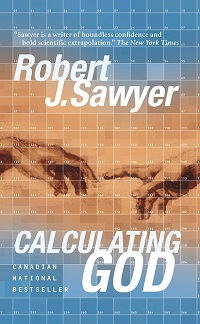 I have already written on Sawyer’s Calculating God
Fundamentalism, Religion, and Abortion
Sawyer lumps fundamentalism in with the discussions about abortion. Unfortunately, fundamentalism is portrayed in the worst possible light, not unlike in the work of Ben Bova. The religious fundamentalists here are extremists bent on destroying anything that counts as evidence against their worldview. As such, they are first introduced as blowing up an abortion clinic (86-87). Frequent readers of my site know that I write often from a pro-life perspective but also that I am very much opposed to violence in this opposition. Unfortunately, such principled opposition is not portrayed as an option in Sawyer’s work.
Interestingly the discussion of abortion in the book–intentionally or not–reveals some important details about the abortion debate. The alien, Hollus, notes the irony in being “pro-life” while also killing people who perform abortions. Yet in this discussion, Hollus reveals something of note:
Hollus looked at me [Tom Jericho, the main character] for the longest time. “These–what did you call them? Fundamentalist extremists? These fundamentalist extremists believe it is wrong to kill even an unborn child?”
“Yes” [Tom responded].
It may take a moment, but think about it: Sawyer expresses incredulity at this notion through the alien Hollus, yet in what may have been a Freudian slip, calls the unborn “children.” Yes, of course I’m opposed to killing an unborn child! In fact, this dialogue reveals exactly what is at stake in the abortion debate: if the unborn is not a human person, then who cares what you do with it? But if it is, then what relevant status difference is there between a child who is located inside the mother as opposed to outside the mother? Again, I’ve written more on this issue elsewhere, but it is important to note that even in expressing incredulity about this, there is a revealing phrase: child. It is an unborn child killed in abortion.
Disturbingly, the book touches on an issue very relevant to the personhood debate: children who are screened for disabilities. In one scene, Hollus is confronted by a child with Down’s Syndrome. He notes nonchalantly that a similar disease is almost always “screened for” in the wombs of the alien mothers (115-116). Unfortunately, this exact thing is happening right now. Unborn children who are shown as having Down’s Syndrome are being aborted inside their mothers at an alarming rate. I can’t help but see this as a modern eugenics movement: killing those we deem unworthy of life for a genetic reason. The logic that this entails is even more disturbing.
Of course the same fundamentalists who bombed the abortion clinic were also out to destroy any evidence for evolution. They sought to destroy a fossil exhibit which they saw as an affront to God. Thus, I can’t help but think that the way Sawyer presents fundamentalists is a bit disingenuous. Not all fundamentalists are incapable of reason and violent. Indeed, almost no fundamentalists are like this! Thankfully, there are positive examples of religious persons in Calculating God, including Tom’s wife.
In one poignant scene, Tom–who is dying from cancer–struggles with the fact that he has been confronted with evidence for the existence of a god. He considers famous atheists who purportedly went to death, all the while denying God’s existence to the end. Yet Tom himself gets down on his knees to pray. When he does so, though, he considers the words of someone from his past: “The Lord works in mysterious ways.” He can’t help but react violently against this:
Such bull. Such unmitigated crap. I felt my stomach knotting. Cancer didn’t happen for any purpose. It tore people apart; if a god did create life, then he’s a shoddy workman, churning out flawed, self-destructing products. “God,” [he prayed] “I wish–I wish you had decided to do some things differently.” (230-231)
Interestingly, in the book, cancer turns out to actually have a purpose… in the sense of being a side-effect of something great: the ability to fuse genetic codes with other intelligently designed species. Here it seems Sawyer has employed a great deal of imaginative techno-babble to explore the notion of a physical god, but it also has hints of a greater good theodicy akin to that of Swinburne.
Physicalism
The discussion of physicalism in Sawyer’s work is very brief, but enlightening. There is a variety of substance dualism here in the sense of emergence. That is, in Sawyer’s fictional world, intelligence and “mind” emerges from matter once complexity reaches a certain threshold. This is similar to the theories of emergence theorists like William Hasker. I can’t help but find this a bit strange. The people who argue for this type of theory are frequently the same who are very hostile to the notion of anything beyond the physical realm, yet they argue that something aphysical can indeed “emerge” from matter itself. Surely this is a leap of the imagination! That matter has creative force simply because it can reach a certain level of complexity seems to me patently absurd.
Not only that, emergence suffers from a second major problem. Namely, if our “mind” is simply a product of complexity in matter, then our “intelligence” is entirely supervenient upon physical complexity. Indeed, our intelligence is a product of that complexity and therefore cannot operate independently of that matter. Therefore, it is hard to see any kind of properties that our minds would have that would be capable of maintaining free will or even rational thought on this theory. Indeed, I have trouble seeing how this theory would be any different from physicalistic monism.
Evolution
The simple notion of evolution is a given in the book. No, it is not friendly to any who are unwilling to accept the notion of “macroevolution,” as the term is used in relevant literature. All the intelligent beings depicted in the book had evolved from a (potentially distinct) distant ancestor.
Darwinian evolution is simply assumed as truth in Calculating God. Or is it? The deity presented in the book is not very conducive to undirected evolution via natural selection and chance. It is portrayed as hurling asteroids at the planets where life was developing in order to press a “reset” button on the creatures that were currently dominant there. It also shown that this deity prevented other catastrophes from happening on these planets, thus interfering with natural selection. Indeed, the evolution depicted here is eerily similar to intelligent design, wherein the process is guided by a deity with a specific aim.
Indeed, one could argue that the entire book is an argument for intelligent design, albeit divorced from much of the theological framework that many of that movement’s frameworks operate within. Yet I can’t help but find this part of Sawyer’s argument (if, indeed, the intention is to make the argument that theists have it all wrong) is completely off. After all, the “god” of Sawyer’s universe is imperfect and concrete in the sense of physically existing. But this works against his concept of deity as being capable of coordinating the events it brings about. Granted, he could perhaps continue to increase the power of this deity beyond what is clearly outlined in the book, but there are hints that the deity is capable of knowing what is happening on places where it is not present, that it is capable of knowing what will happen with certain directions for evolution, and what will happen at the end of the universe. These work against the notion of God as a kind of blundering physical entity that just happens to be supremely powerful. Indeed, the god of calculating God may not be as hostile to Christianity as it initially seems. It serves as a pointer towards the true God of spacetime.
Links
Like this page on Facebook: J.W. Wartick – “Always Have a Reason”
Check out my other post on this book: Aliens that believe in God: The theological speculations of Robert Sawyer’s “Calculating God”
I have discussed the use of science fiction in showing how religious persons act. Check out Religious Dialogue: A case study in science fiction with Bova and Weber.
What would it mean if we discovered life? I have reflected on the possibility: Alien Life: Theological reflections on life on other planets.
Our Spooky Universe– I make the case for the intelligent design argument for the existence of God, which is heavily used throughout Calculating God.
Check out my other looks at popular level books. (Scroll down to see more!)
Source
Robert Sawyer, Calculating God
SDG.
——
The preceding post is the property of J.W. Wartick (apart from citations, which are the property of their respective owners, and works of art as credited) and should not be reproduced in part or in whole without the expressed consent of the author. All content on this site is the property of J.W. Wartick and is made available for individual and personal usage. If you cite from these documents, whether for personal or professional purposes, please give appropriate citation with both the name of the author (J.W. Wartick) and a link to the original URL. If you’d like to repost a post, you may do so, provided you show less than half of the original post on your own site and link to the original post for the rest. You must also appropriately cite the post as noted above. This blog is protected by Creative Commons licensing. By viewing any part of this site, you are agreeing to this usage policy.

 J.W. Wartick - Reconstructing Faith