geology
Reconstructing the Past: Florrisant Fossil Beds National Monument and Young Earth Creationism
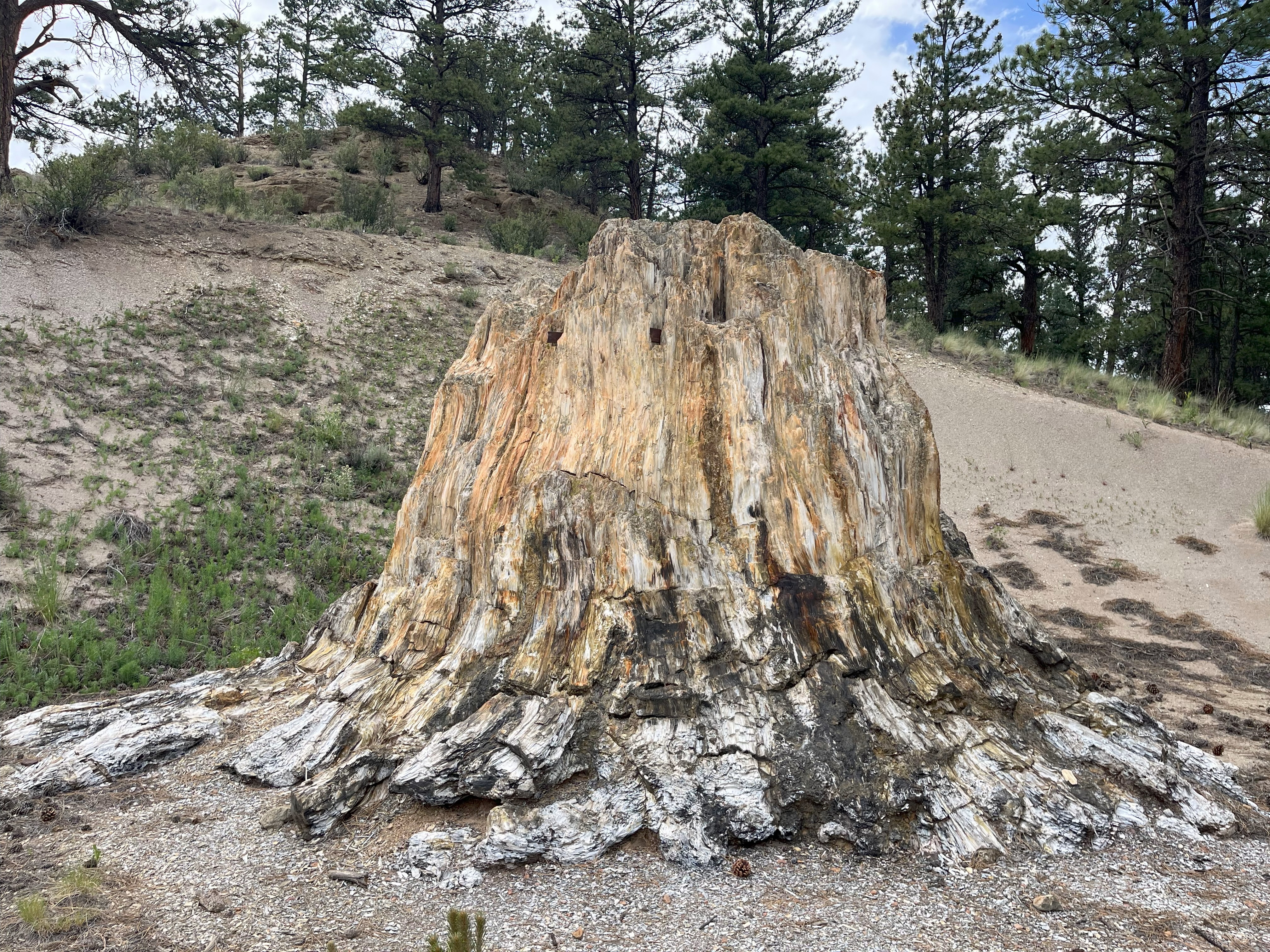
Florissant Fossil Beds National Monument preserves an incredible piece of geological and paleontological time in Colorado. The uniqueness of its geologic history helped preserve incredible details of tiny animals, all the way down to insects, including one of the most famous fossils in the world: a butterfly’s imprint preserved in ash. What struck me most as I wandered this beautiful National Monument and learned more about it was how intricately we can construct the past in this region. Geologists and paleontologists are able to use the clues spread across the landscape to see what happened in great detail. Those details, however, either directly contradict or at least present major difficulties for the narrative told by some Christians known as young earth creationists. Here, we will examine the two narratives alongside the region itself and ask which presents a better picture of the past.
The Narrative told by Conventional Geology and Paleontology
The National Park Service actually has a wonderful video that tells about how Florissant was formed, along with how it was discovered, used, and preserved by humans. My own narrative of conventional science is largely based on that video as well as on placards and other things I read and observed around the site itself.
About 37 million years ago, a volcano’s crater exploded, covering the region with ash. Volcanic activity continued for millions of years, forming layers of ash across the region. Eventually, heavy rainfall dislodged a massive amount of this ash, creating a kind of avalanche of volcanic material known as a lahar. This fast-moving mudflow was enormous, stretching for miles as it spread and eventually covering about 15 feet of the area we now know as the area within Florissant. This mud covered the bottoms of a number of enormous trees, which eventually died and decomposed. Life recovered and the region began to grow again, but another lahar blocked a stream and that stream formed a shallow lake across the area. The water that covered the area had deposited minerals into the ash-covered stumps of these trees, eventually preserving them as petrified wood. Meanwhile, diatoms–tiny algae observable on a microscopic level that persist into today–bloomed in massive quantities in the lake. Along with occasional volcanic eruptions that layered ash in the lake, the diatom blooms dying off also formed layers at the bottom of the lake. These layers alternated (not in a specific pattern), eventually forming paper-thin shale.
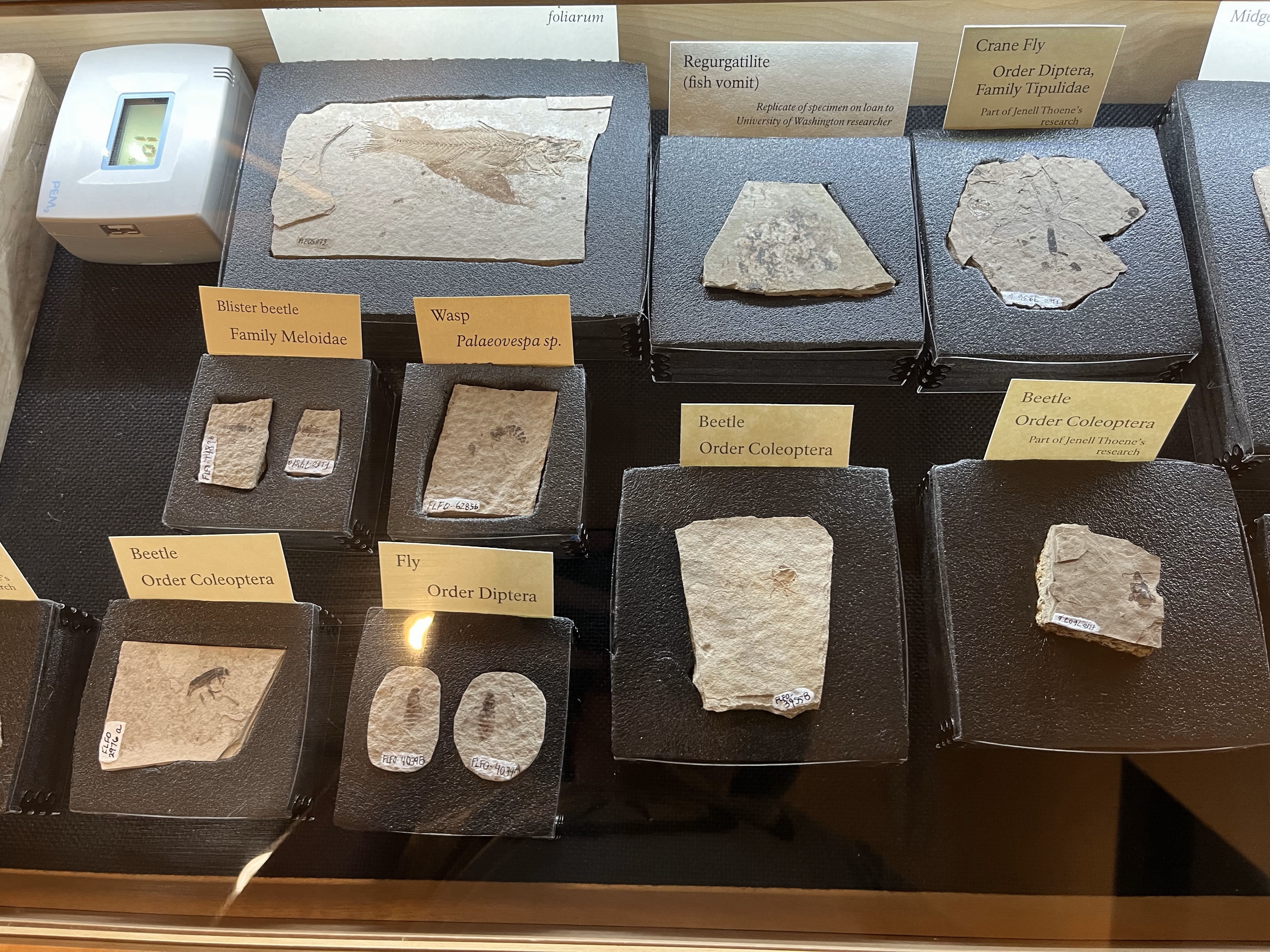
As creatures like fish, birds and even insects died and settled to the bottom of the lake, they were covered with these layers of diatoms and ash. Their bodies were mineralized, and to this day paleontologists can chip apart these incredibly thin layers of shale and find one of the richest deposits of well-preserved insect and plant life in the entire world. Large mammals also roamed the region, including brontotheres, an extinct rhinocerous-like mammal whose bones can be found across the area and into the Badlands. Their bones can also be found. Volcanic activity can be mapped across the region by observing directly the path of lava flows that have hardened into rock. Additionally, distant mountains can be seen to have blown off their tops in volcanic activity of that same time period, demonstrating the violent geologic past of the area.
The uniqueness of this site is due to the many factors involved in its formation: the volcanic activity that led to a lahar covering and preserving enormous ancient trees (including the largest petrified trees by diameter in the entire world); another lahar blocking a stream; additional volcanic activity that mostly spewed ash instead of lava in the area, allowing for preservation of fossils as the ash was cooled and settled in the water; intense periods of diatom activity due to whatever nutrients were provided by rich volcanic soil and plant deposits. For all of these, geologists can quite literally trace lines across the region and map where lava flows hit, where ash fell, whence came some of the volcanic activity (I had a park ranger literally point to the distance at a group of mountains; when looking more closely at the mountains later in the trip, you could see how they were partially collapsed from their volcanic past, blowing parts of themselves almost 100 miles across the landscape), and more. These were observable evidences of a past that linked all of these facets together to create the world-famous fossil site. It was incredible to see how well geologists could use the tools at their disposal to tell the story of the ancient past.
One last broad point in this section: the paleontological record here shows a dramatically different world than what we see in the same region today. The brontotheres are obviously extinct as we don’t see them anymore, but another facet of the discussion is that while the insects look incredibly similar to those of today, there are many with key differences that have changed over the 30+ million years since they were preserved. Some of them aren’t extinct and live into today, but in entirely different parts of the world. One prominently displayed fossil was of a tsetse fly, which once inhabited the land we now know as Colorado, but today lives in tropical Africa. The climate, in other words, has changed so dramatically that this kind of fly can no longer live in the snowy peaks of Colorado, but we have a record of its having done so in a past that was much warmer, and the other fossils in the area confirm the same observations. Conventional timelines don’t have difficulty explaining this, as the long timespan involved allowed for plate tectonics, glacier movement, ice age(s), and more to impact the climate.
Young Earth Creationism’s Two (or more) Narratives
Before diving too far into the narrative told by young earth creationism, we must realize that that movement itself is not monolithic. For a believe system that claims to be the plain reading of the Bible and that can be understood quite simply, it actually ends up teaching incredibly complex and continually edited narratives about the past. Its practitioners disagree on timelines and on how Earth’s geological history formed. So to tell a narrative of Florissant from that perspective, I have to do so knowing that there could be any number of “well, actually” type statements. That said, I believe that death by a thousand caveats is an issue that plagues young earth creationism generally. As YECs have to continually edit their narratives to try to force evidence to fit into a specific favored timeline, the constant ad hoc amendments serve to show just how mistaken YEC is generally. There are at least two broad narratives YECs could offer for Florissant.
The Noah’s Flood Narrative[s]
The Noahic Deluge truly did cover the entire surface of the Earth. In doing so, it churned up enormous amounts of dirt and sediment, remaking it and setting down virtually all sediment layers that we see across the entire Globe. An alternate version of this has a more tranquil Flood, which settled over the surface of the Earth but didn’t greatly impact the geologically observed history. This latter theory is largely abandoned in the literature as it has no explanation for the many aspects of geologic history we see to this day. The former is beset with difficulties, but the one I want to highlight here is that if we assume this is what happened, places like Florissant are almost entirely nonsensical. How would a churning Flood lay down deposits that happen to align in such ways that they can be traced across a region and layered, such that we can see a lahar covered the region, then another blocked a stream, forming a lake, volcanic lava flowed across nearby, and more, and more? It seems to be a non-starter. Why would random bits of sediment get deposited in ways that suggest a geologic past?
The Post-Flood Deposits Narrative
Increasingly, thoughtful YECs are being forced to draw lines to designate pre- and post-Flood deposits in the geologic record. There are a number of reasons for this, but one of the most obvious is that we can see geologic deposits being made today, so the obvious question is asked about how far into the past these records extend before one hits layers that were set down by a supposed global Flood. Many of the difficulties with the YEC narrative in which the Flood explains Florissant are assuaged by claiming that those deposits really were set down in the manner described, but that they were done so in a much more condensed timeline than mainstream geology teaches.
Going along with this, some YECs have suggested the Flood itself is responsible for almost none of the geologic record or, perhaps, only a tiny portion of it. The rest was formed largely as mainstream geologists suggest, but at a pace accelerated by hundreds or even thousands (millions?) of times the speed suggested by mainstream geology. This latter notion has its own massive difficulties, among them being the now well-known (among those involved in debating creationism) heat problem, but also that it doesn’t really provide an explanation for the geologic record other than “it moves fast.” So we’re going to set that one aside and focus on the more mainstream YEC view that Noah’s Flood formed the majority of the geologic column, but that some of it is post-Flood (and pre-, but we’re setting that aside, too). On this view, Florissant is post-Flood and so the way it formed geologically is essentially exactly as the geologists stated with lahars, lava flows, and more leading to what we observe today. The timeline, of course, is off (only a few thousand years instead of 37 million), but this YEC view at least has some kind of attempt to allow for us to learn about such features.
There are many problems with this view, too, however. One is that when we observe layering of sediment in the ways suggested at Florissant, it takes much longer than YECs could allow. While they often point to places like Mount Saint Helens to suggest that such formation could be much faster, this is problematic for a couple reasons. The first is that no mainstream geologist suggests catastrophes like Mount Saint Helens don’t happen in the past; rather, their timelines and observations align with such catastrophic events happening. The second is that Mount Saint Helens has been greatly exaggerated in YEC literature, taking features and labeling them with geologic terms that do not correspond with reality. Thus, an alleged canyon at Mount Saint Helens formed with the eruption is really just ash deposited and then cut through with runoff, which will continue to erode it rapidly in ways expected by mainstream geology. It’s not analogous to something like the Grand Canyon. Finally, a major problem with this “it just went fast” scenario is that it does nothing to explain the observation of different climate zones found in Colorado than what exist today. Are we to believe that alongside layering of ash and diatoms turning to rock and an immensely accelerated rate, the region also went from tropical to Mountainous and snow-covered during the winter in just a thousand or so years?
The answer from YECs of course is, yes, we are supposed to believe that. But what mechanisms do they suggest for this actually occurring? One is the notion that the Flood led to an ice age which, as the Flood waters receded, then changed the climate of the Earth. Another mechanism is the acceleration of nuclear decay (which again runs into the heat problem). Here we find YECs must continue to invent extrabiblical scenarios to explain extrabiblical observations, thus undermining their claim to be simply observing what the Bible says as their scientific starting point.
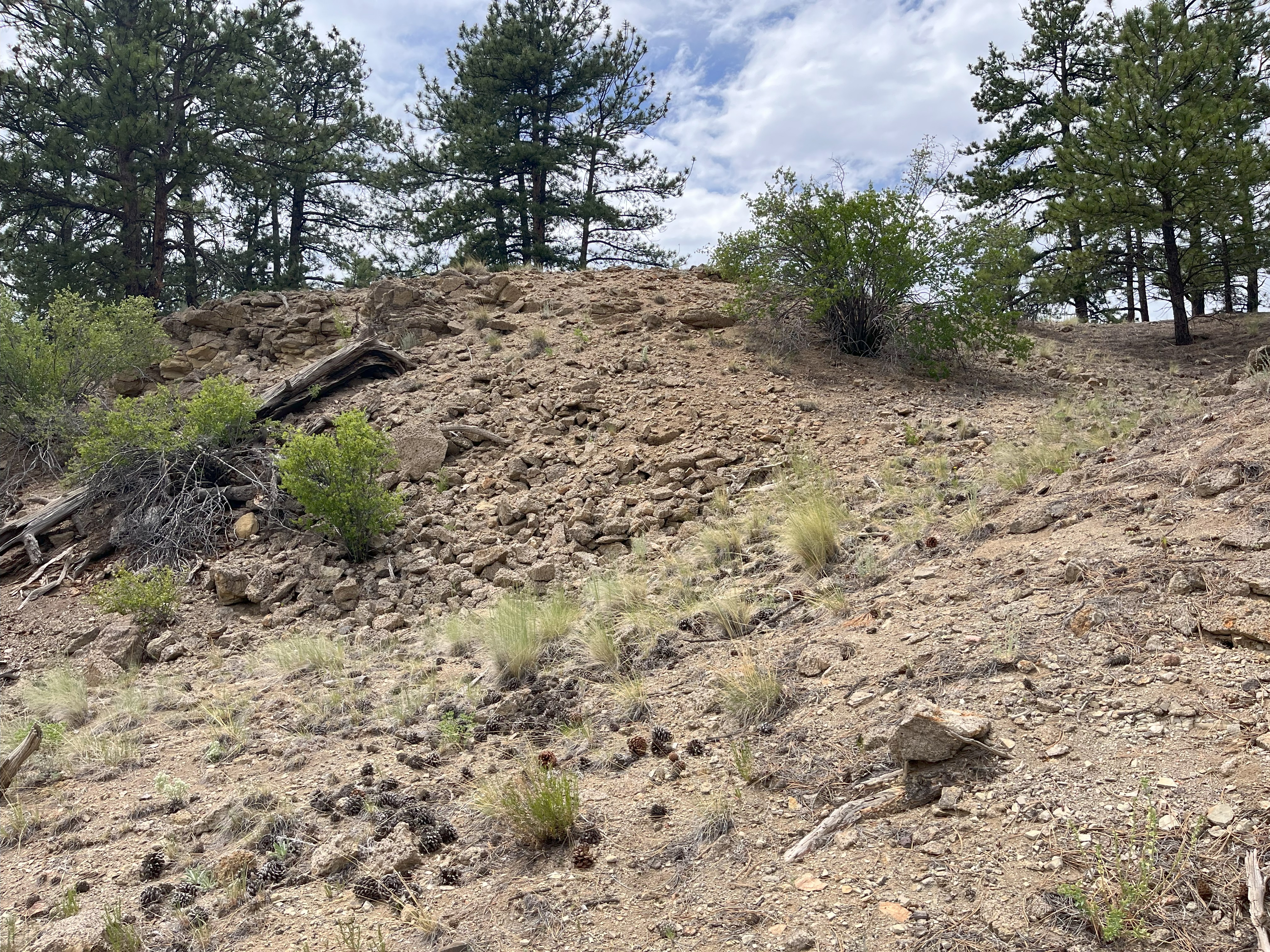
A final problem (not the final problem, simply the last one I’m touching on here) with the YEC scenarios is the sheer amount of deposition at even a relatively tiny site like Florissant. The photograph above shows just one hill composed of shale. This entire hill could be dug into and one could pull out paper-thin pieces of shale layering the entire hill (one should not do this as it is a National Park site and is very illegal; I’m saying this for the sake of observation!). This hill stands far taller than I do, and taller than surrounding trees, and is just one of many hills composed of the same material. All of this managed to get layered, ash-diatom-ash-ash-diatom-diatom-ash, etc. in such minute, miniscule layers that you literally can push them apart with a wedge and see the rock crumble in your hand because each layer is so thin. And for YECs, all of this is supposed to have happened in just a few thousand years, with the ash and diatoms getting compressed into those thin layers of rock, but in such an immense volume that it can cover hills, and in such precision that one can see where the trees were covered with mud from a lahar, and in such a careful way that it settled softly enough to cover but not destroy butterfly wings. Such a belief stretches the imagination beyond the breaking point. And this is but one site.
Conclusion
The first thing I want to conclude is that if you get the chance to visit Florissant Fossil Beds National Monument, you should do so. The hikes are fairly short- it isn’t a massive site. But for a day of exploring and learning about Earth’s past, it is nearly unrivaled.
Florissant provides an incredibly rich look at Earth’s geologic past. In just this one small region, one can literally see where volcanoes once spewed ash and covered parts of the area with lava, one can walk up to rock layers showing deposition of lava that flowed from nearly 100 miles away, one can see the world’s largest (by diameter) petrified trees, one can see the depositions of shale that led to some of the best insect fossils in the entire world, and more. It is an immensely wonderful experience to be able to see firsthand how geologists really can see the landscape and form conclusions about our past. And for all of that, it also provides a set of major problems for young earth creationism, a theory that is continually forced to evolve and add explanations simply to try to wave away the many, many difficulties with it.
Finally, Christians should know that young earth creationism is not even remotely a necessary doctrine for believing the Bible or remaining Christian. It is a theory with almost no connection to church history, and one which is a modern invention to try to counter modern science. The eternal truths of God do not rely upon human innovation of doctrine.
Links
Be sure to check out the page for this site on Facebook and Twitter for discussion of posts, links to other pages of interest, random talk about theology/philosophy/apologetics/movies and more!
Young Earth Creationism– This link will take you to the all my posts on YEC (scroll down for more).
Gregg Davidson vs. Andrew Snelling on the Age of the Earth– I attended a debate between an old earth and young earth creationist (the latter from Answers in Genesis like Ken Ham). Check out my overview of the debate as well as my analysis.
Ken Ham vs. Bill Nye- An analysis of a lose-lose debate– In-depth coverage and analysis of the famous debate between young earth creationist Ken Ham and Bill Nye the science guy.
SDG.
——
The preceding post is the property of J.W. Wartick (apart from quotations, which are the property of their respective owners, and works of art as credited; images are often freely available to the public and J.W. Wartick makes no claims of owning rights to the images unless he makes that explicit) and should not be reproduced in part or in whole without the expressed consent of the author. All content on this site is the property of J.W. Wartick and is made available for individual and personal usage. If you cite from these documents, whether for personal or professional purposes, please give appropriate citation with both the name of the author (J.W. Wartick) and a link to the original URL. If you’d like to repost a post, you may do so, provided you show less than half of the original post on your own site and link to the original post for the rest. You must also appropriately cite the post as noted above. This blog is protected by Creative Commons licensing. By viewing any part of this site, you are agreeing to this usage policy.
Book Review: “A Worldview Approach to Science and Scripture” by Carol Hill
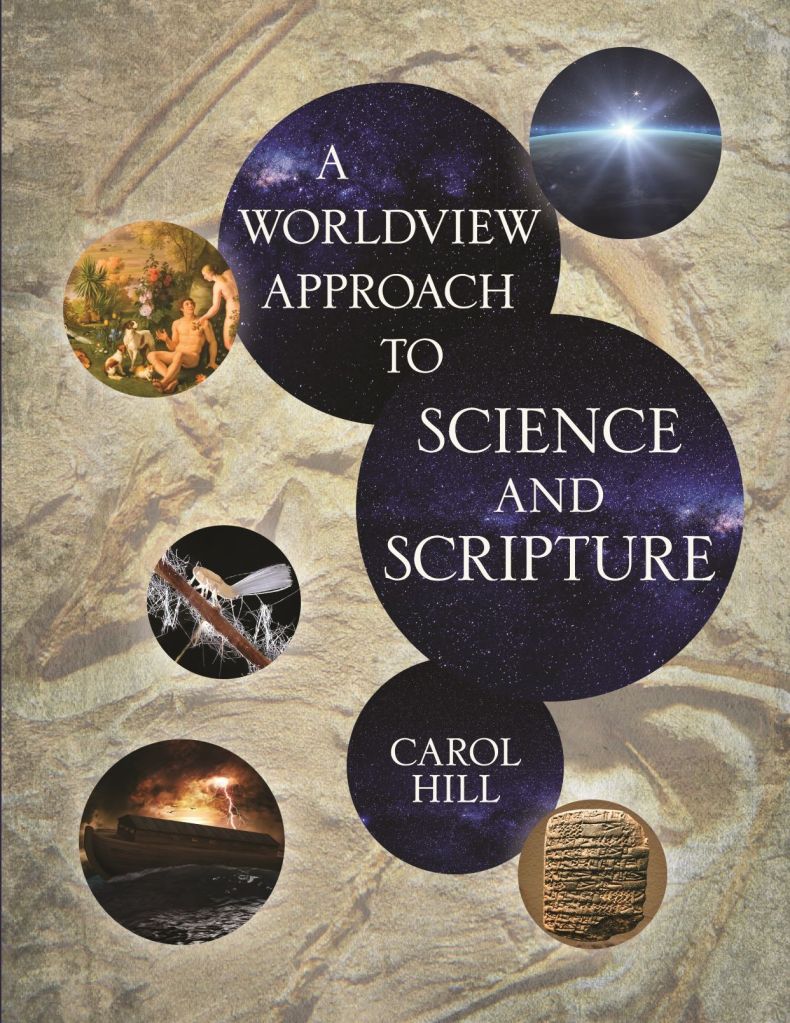
There are many textbooks out there purporting to put forward the best view of science from a Christian standpoint, but most come from a young earth creationist point of view. Carol Hill, with A Worldview Approach to Science and Scripture, provides an alternative that unites mainstream science with thoughtful reading of the biblical text. But the book is more than one might think if one gets the impression of a dry textbook from this description–it’s an introduction to how Christians can think about numerous science-faith topics, a survey of competing literature, and an analysis of various views of science and faith.
The book is divided into 10 chapters, beginning with a chapter that defines the notion of a “worldview approach” to science and Christianity. A worldview approach is a holistic look at how to approach the Bible, scripture, and more–allowing one to integrate insights from various positions into one coherent whole. Hill outlines the basic premise of the worldview approach as: “the Bible in its original context records historical events if considered from the worldview of the biblical authors who wrote it” (12-13). This is important: it allows Hill to affirm historicity of the biblical account while not settling for simplistic answers in interpretation.
The second through fourth chapter deal with the Six Days of Creation, the Garden of Eden, and the book of Numbers/Chronologies of Genesis respectively. The chapter on the Garden of Eden is of particular interest because Hill both makes a strong argument for a real, true to life location for the Garden of Eden while also noting that the Flood Geology that young earth creationists so often espouse cannot account for the actual location of the Garden. The ages of the patriarchs is also a notable section as Hill notes the numbers being used in specifically theological and analogical ways by the author.
Chapters 5-7 deal with Noah’s Flood from a number of points, and it is an extremely helpful section both for analyzing the young earth creationist/flood geology account and for noting the language of the Bible and the local nature of the Flood. Hill, once again, sides with seeing the Flood as historical (as she sees the Garden of Eden as a historical possibility) while also noting the real difficulties with a literalistic reading. A number of interesting points related to Mount Ararat and the attempts to locate the actual Ark are made here, as well. The analysis is keen, showing difficulties with various theories, while also showing the misguided nature of such attempts to find the Ark. Hill argues for a local flood, but does so both from the text and geology, offering a holistic approach to the question.
Chapter 8 considers evolution and genetics, noting the attempts by some to turn the word “kind” in the Bible into something that would allow for immense speciation after the Flood. Hill also notes some of the apparent problems with evolutionary theory, while also showing the evidence for evolution and how powerful that evidence is. Chapter 9 considers Adam and Eve. The question of people outside the Garden is not a problem for Hill’s “Worldview Approach” because she argues that the purpose of the authors was to write the story of God’s interaction with their ancestors and not to write the story of everybody everywhere at all times (151). Chapter 10 presents Hill’s view in short, “Putting it All Together” to present it to readers. Here, Hill outlines the entirety of her position, bringing together everything from the previous chapters.
I should note that the book is richly printed with color photography throughout. Like The Grand Canyon: Monument to an Ancient Earth, this book uses the illustrations both for beauty and for specific points. The beauty of the book should not be understated, and the color photography helps it function as intended: a text that can be used to explore Christianity and science.
A Worldview Approach to Science and Scripture is an invaluable text that presents, in readable form, a fairly comprehensive (though compact) view of Christianity related to some of the biggest questions that arise when considering science. Recommended.
Disclaimer: I was provided with a copy of the book for review by the publisher. I was not required to give any specific kind of feedback whatsoever.
Links
Be sure to check out the page for this site on Facebook and Twitter for discussion of posts, links to other pages of interest, random talk about theology/philosophy/apologetics/movies and more!
Book Reviews– There are plenty more book reviews to read! Read like crazy! (Scroll down for more, and click at bottom for even more!)
SDG.
——
The preceding post is the property of J.W. Wartick (apart from quotations, which are the property of their respective owners, and works of art as credited; images are often freely available to the public and J.W. Wartick makes no claims of owning rights to the images unless he makes that explicit) and should not be reproduced in part or in whole without the expressed consent of the author. All content on this site is the property of J.W. Wartick and is made available for individual and personal usage. If you cite from these documents, whether for personal or professional purposes, please give appropriate citation with both the name of the author (J.W. Wartick) and a link to the original URL. If you’d like to repost a post, you may do so, provided you show less than half of the original post on your own site and link to the original post for the rest. You must also appropriately cite the post as noted above. This blog is protected by Creative Commons licensing. By viewing any part of this site, you are agreeing to this usage policy.
“The Rocks Don’t Lie” by David Montgomery: Chapters 11-13
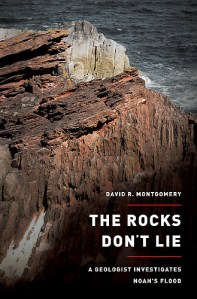 After a 5 year hiatus, I decided to continue my look at David Montgomery’s work, The Rocks Don’t Lie. For a refresher, the book is from the perspective of a geologist as he looks at Noah’s flood in light of geology, but he also includes material on contemporary accounts and some reflections on faith.
Chapters 11-13
The stark impact of catastrophic events on our planet’s past is clear in the geologic record. Montgomery uses his own experience as a geologist and the history of geology to show how catastrophism is part of modern geology, despite young earth creationists often claiming modern geology only appeals to uniformitarianism. Geologists began integrating catastrophe and uniformity almost from the beginning, as challenges to Lyell’s strictest uniformitarianism emerged from geologic evidence. Thus, far from what is too often portrayed as an either/or situation, geology truly is both/and when it comes to the two streams of evidence.
It is even possible that one such catastrophic event led to the stories of the flood as found in the Ancient Near East, including in the Bible. Glacial events led to massive buildups of water, and as the ice would melt in front of that water, it would release huge torrents that could carve canyons and flood enter massive regions quickly. Clear evidence of this having happened through ice dam failures is seen in both North America and Eurasia (210ff). One such massive event helped fill Hudson bay and the Great Lakes. It is possible that a similar event occurred with the Black Sea that could have led to so many stories in the region about massive floods. Yet creationists are unwilling to accept this evidence. Montgomery writes:
There was a time when both geologists and conservative Christians would have interpreted the evidence of a catastrophic Black Sea flood as proof of Noah’s Flood and confirmation of the historical veracity of Genesis. But times have changed. Now geologists present evidence in support of Noah’s Flood, and creationists hold out for belief in a global flood for which no evidence can be found (223).
In Chapter 12, Montgomery explores reasons why some Christians reject so much compelling evidence for a truly ancient earth and the lack of a global flood. One of the primary reasons, he thinks, is due to a belief that such evidence undercuts the truth of the Bible. He notes the impact of Whitcomb and Morris and their book The Genesis Flood upon this movement. It continues to have immense impact despite being rejected by geologists–including Christians–as clearly mistaken. The attacks upon conventional geology fall short of the truth and often show basic misunderstandings of geology. Christian geologists have continued to push back against this “flood geology,” yet it persists in some corners.
In the final chapter, entitled “The Nature of Faith,” Montgomery reflects upon his own journey. He came in with a clear goal of refuting creationist claims wholesale, but as he explored evidence for major local floods as well as reading Christians on the topic, his view of the nature of faith changed. He notes that he sees science and faith not as enemies but “as an awkward egalitarian waltz” (247). Montgomery, though not (to my knowledge) a Christian, suggests that Christianity has much to offer and has done some work for science as well as against it. He argues that one thing needed is “a historically informed understanding of how people read and interpreted sacred texts in the past” (249) so that we can form a better picture of the past. Similarly, “Genesis 1 remains powerful and relevant today if read as a symbolic polemic intended for early monotheists rather than as a Bronze Age scientific treatise” (251). Too often, “We will only look for evidence that confirms our beliefs” rather than challenging ourselves and keeping our minds open (253). Though religion cannot answer every scientific question, neither can science make religion an illusion (255).
I found Montgomery’s final chapter, in particular, extremely helpful. It’s the kind of outsider perspective that is truly constructive and helpful. It makes me wonder how his own outlook may have changed in the 6 years since the publication of this book. He is articulate and fair. Indeed, his suggestions for people of faith ought to be well-taken, alongside his critiques of skeptical perspectives. The idea that faith is a sickness or illusion is too prominent today, but people of faith also need to acknowledge that some of that stems from a denial of clear evidence. If we set our faith on things that are clearly wrong (for example, young earth creationism), it discredits our faith.
Links
“The Rocks Don’t Lie” by David Montgomery: Preface and Chapter 1– Montgomery surveys the intent of the book and how his own investigation of the flood led him to some surprising results. He expected a straightforward refutation of creationism, but found the interplay with science and faith to be more complex than he thought.
“The Rocks Don’t Lie” by David Montgomery: Chapters 2-3– First, Montgomery gives a survey of the basics of geology. Then he notes some serious problems with young earth paradigms related to the Grand Canyon and fossils in the Americas as well as on mountains.
“The Rocks Don’t Lie” by David Montgomery: Chapter 4– Montgomery surveys a number of early flood geological theories and shows how theological interpretations continued to change as evidence was discovered through time.
“The Rocks Don’t Lie” by David Montgomery: Chapters 5-7– A brief early history of the study of geology and paleontology is provided, and early theories about the flood begin to form alongside them.
Be sure to check out the page for this site on Facebook and Twitter for discussion of posts, links to other pages of interest, random talk about theology/philosophy/apologetics/movies and more!
Book Reviews– There are plenty more book reviews to read! Read like crazy! (Scroll down for more, and click at bottom for even more!)
SDG.
——
The preceding post is the property of J.W. Wartick (apart from quotations, which are the property of their respective owners, and works of art as credited; images are often freely available to the public and J.W. Wartick makes no claims of owning rights to the images unless he makes that explicit) and should not be reproduced in part or in whole without the expressed consent of the author. All content on this site is the property of J.W. Wartick and is made available for individual and personal usage. If you cite from these documents, whether for personal or professional purposes, please give appropriate citation with both the name of the author (J.W. Wartick) and a link to the original URL. If you’d like to repost a post, you may do so, provided you show less than half of the original post on your own site and link to the original post for the rest. You must also appropriately cite the post as noted above. This blog is protected by Creative Commons licensing. By viewing any part of this site, you are agreeing to this usage policy.
“The Rocks Don’t Lie” by David Montgomery: Chapters 8-10
After a 5 year hiatus, I decided to continue my look at David Montgomery’s work, The Rocks Don’t Lie. For a refresher, the book is from the perspective of a geologist as he looks at Noah’s flood in light of geology, but he also includes material on contemporary accounts and some reflections on faith.
Chapters 8-10
There is no question that there are flood stories across many times and cultures. Indeed, some young earth creationists cite this as the single best evidence for a global flood. What is most interesting, however, is the total similarity between some earlier flood stories from the same Ancient Near Eastern time and place as what the Noahic deluge story would later originate. Montgomery surveys this early history, noting the amazing discovery of more ancient flood myths in Sumerian writings. At least 3 different flood stories were discovered in these ancient fragments, and they yielded many similarities with the biblical flood account (153ff). Alongside discoveries like this, the rise of deism threatened Christianity and led to some reactionary responses to both the discoveries and the age. On the other hand, many Christian theologians moved to see Genesis as “a synopsized or allegrical explanation of how the world came to be rather than a comprehensive history of everything that ever existed” (167).
Other issues with the Genesis flood account as history began to be realized by other Christian theologians. The question of how to fit all the animals on the ark became a major issue (169). Some began to abandon both the idea of a local flood as well as the idea of a global flood, seeing the story as a theological point rather than literal history, though the idea failed to gain much steam (170). Another response was more reactionary and came with it the rejection of much of the evidence against a global flood–the birth of the creationist movement.
Montgomery interacts with modern creationism by pointing to the Creation Museum from Answers in Genesis, noting how much of the alleged evidence presented there is in stark contrast to what we can learn from geology now. After a brief look at the museum, he looks at the history of modern creationism, noting, as many others have, its roots in Seventh Day Adventism and reactionary fundamentalism. Time and again in the history of creationism, Montgomery notes how science has been misrepresented or ignored. For example, he uses a graph showing radiocarbon dating and its correlation with known samples, demonstrating the reliability of the method for certain ages (192-193).
These chapters once again show the range of Montgomery’s book and the importance of looking into many different angles of investigating the flood and other biblical accounts. It isn’t enough to just do what so many creationists insist upon and just read the accounts at a surface level, importing our own assumptions about what the text should mean and say as we go. The fact that many flood stories predate the biblical story and share details must lead one to account for that in their worldview. Similarly, a reactionary approach will not do.
Links
“The Rocks Don’t Lie” by David Montgomery: Preface and Chapter 1– Montgomery surveys the intent of the book and how his own investigation of the flood led him to some surprising results. He expected a straightforward refutation of creationism, but found the interplay with science and faith to be more complex than he thought.
“The Rocks Don’t Lie” by David Montgomery: Chapters 2-3– First, Montgomery gives a survey of the basics of geology. Then he notes some serious problems with young earth paradigms related to the Grand Canyon and fossils in the Americas as well as on mountains.
“The Rocks Don’t Lie” by David Montgomery: Chapter 4– Montgomery surveys a number of early flood geological theories and shows how theological interpretations continued to change as evidence was discovered through time.
“The Rocks Don’t Lie” by David Montgomery: Chapters 5-7– A brief early history of the study of geology and paleontology is provided, and early theories about the flood begin to form alongside them.
Be sure to check out the page for this site on Facebook and Twitter for discussion of posts, links to other pages of interest, random talk about theology/philosophy/apologetics/movies and more!
Book Reviews– There are plenty more book reviews to read! Read like crazy! (Scroll down for more, and click at bottom for even more!)
SDG.
——
The preceding post is the property of J.W. Wartick (apart from quotations, which are the property of their respective owners, and works of art as credited; images are often freely available to the public and J.W. Wartick makes no claims of owning rights to the images unless he makes that explicit) and should not be reproduced in part or in whole without the expressed consent of the author. All content on this site is the property of J.W. Wartick and is made available for individual and personal usage. If you cite from these documents, whether for personal or professional purposes, please give appropriate citation with both the name of the author (J.W. Wartick) and a link to the original URL. If you’d like to repost a post, you may do so, provided you show less than half of the original post on your own site and link to the original post for the rest. You must also appropriately cite the post as noted above. This blog is protected by Creative Commons licensing. By viewing any part of this site, you are agreeing to this usage policy.
“The Rocks Don’t Lie” by David Montgomery: Chapters 5-7
After a 5 year hiatus, I decided to continue my look at David Montgomery’s work, The Rocks Don’t Lie. For a refresher, the book is from the perspective of a geologist as he looks at Noah’s flood in light of geology, but he also includes material on contemporary accounts and some reflections on faith.
Chapters 5-7
Montgomery goes over what is little-known history (to the general public): the debate over what fossils even were in early paleontology and geology. For some time, geologists debated whether fossils were truly vestiges of the ancient past or not. Some did recognize them as dead life forms, but wantonly miscategorized them. An example Montgomery visits is the identification of Homo diluvii, alleged to be a fossil of someone who died in the Noahic flood, but which is in fact simply a large amphibian. Thus, faith and science interacted in ways which led to mutual learning, with geologists often interpreting finds through their faith (often leading to errors), but then correcting the mistakes and examining interpretations of Scripture.
Geologists continued to find evidence that the Earth was much more ancient than had been previously thought. The concept of geologic time itself evolved over time, but not due to the theory of evolution as young earth creationists so often assert. Rather, geological finds continued to stretch the limits of time and change on the planet. Bishop Ussher’s chronology was neither the first nor last, and was based upon faulty assumptions that continue to be challenged both inside and outside the church.
One of the constant refrains of young earth creationists is the notion that they hold to catastrophism related to the history of the planet, while mainstream geologists rely upon uniformitarianism. But Montgomery demonstrates that this is a false dichotomy. It is one that, historically, was a true battle as evidence initially seemed to refute catastrophism and then showed that catastrophes did indeed form major events in the geologic record. Thus, geology today continues to take both catastrophe and uniformity into account. The young earth view of either/or is deeply mistaken and stuck in historical, rather than modern, understandings of science. Indeed, it was Georges Cuvier (1769-1832) who first developed a synthesis of the theories, though he favored catastrophic understandings due to his own discoveries. Cuvier died more than 20 years before the publication of Darwin’s Origin of Species and so can hardly be charged with changing his geological views due to evolutionary theory. Once again, young earth arguments fail to hold up to the challenge of history and science.
Cuvier’s theory allowing for a sequence of catastrophes was, on his own part, allowed to include the biblical flood. Montgomery continues to survey the changing views on the Deluge and William Buckland contributed both to this theorizing and the expansion of the age of the earth through his own studies. Buckland, however, ultimately discovered that fossils could not all be attributed to a single flood event or the biblical flood. Nevertheless, as a Christian, he felt “Secure as ever in his faith in both nature and the Bible” (129). Lyell’s own study of geology once again expanded the lengths of times required for the shaping of our planet. It didn’t take long, however, for people to push back against this theorizing, and William Cockburn helped champion some of the earliest of what would become young earth theories. He did so mostly by dismissing evidence rather than directly engaging with it (137-138).
Links
“The Rocks Don’t Lie” by David Montgomery: Preface and Chapter 1– Montgomery surveys the intent of the book and how his own investigation of the flood led him to some surprising results. He expected a straightforward refutation of creationism, but found the interplay with science and faith to be more complex than he thought.
“The Rocks Don’t Lie” by David Montgomery: Chapters 2-3– First, Montgomery gives a survey of the basics of geology. Then he notes some serious problems with young earth paradigms related to the Grand Canyon and fossils in the Americas as well as on mountains.
“The Rocks Don’t Lie” by David Montgomery: Chapter 4– Montgomery surveys a number of early flood geological theories and shows how theological interpretations continued to change as evidence was discovered through time.
Be sure to check out the page for this site on Facebook and Twitter for discussion of posts, links to other pages of interest, random talk about theology/philosophy/apologetics/movies and more!
Book Reviews– There are plenty more book reviews to read! Read like crazy! (Scroll down for more, and click at bottom for even more!)
SDG.
——
The preceding post is the property of J.W. Wartick (apart from quotations, which are the property of their respective owners, and works of art as credited; images are often freely available to the public and J.W. Wartick makes no claims of owning rights to the images unless he makes that explicit) and should not be reproduced in part or in whole without the expressed consent of the author. All content on this site is the property of J.W. Wartick and is made available for individual and personal usage. If you cite from these documents, whether for personal or professional purposes, please give appropriate citation with both the name of the author (J.W. Wartick) and a link to the original URL. If you’d like to repost a post, you may do so, provided you show less than half of the original post on your own site and link to the original post for the rest. You must also appropriately cite the post as noted above. This blog is protected by Creative Commons licensing. By viewing any part of this site, you are agreeing to this usage policy.
Really Recommended Posts 1/20/17- deism, geology, and more!
 Hello dear readers! Sorry for the long absence from Really Recommended Posts. It’s been insanely busy, and with a baby due any day now, I may not have another of these for a bit. So enjoy the posts I have compiled here!
Young Earth Creationists arguing in circles– I’ve seen the claim made time and again: the fossils date the rocks, and the rocks date the fossils–it’s a circle! Young Earth Creationists frequently make this claim. Here is a look at one such instance of the claim and the facts behind the tools of geology.
Lies about Relics– An interesting look at the proliferation of relics in the Middle Ages, what Martin Luther had to say about them, and the meaning and usage of the term. I highly recommend readers subscribe to the Christian History magazine. It is free (donations encouraged) and excellent.
John Leland– John Leland was a pastor who wrote extensively on the deist controversy in the 17th and 18th centuries. He wrote a two-volume work that surveys the entire field, offering both exposition and refutation of the works of basically every major player in the controversy. Read more about him and his work here.
Herodotus, Osiris, Dionysus, and the Jesus Myth– A brief look at the historical method of those who claim Jesus is a myth, with a specific look at Herodotus and his discussion of Osiris and Dionysus.
Book Review: “The Grand Canyon: Monument to an Ancient Earth- Can Noah’s Flood Explain the Grand Canyon?” Edited by Carol Hill, Gregg Davidson, Tim Helble, and Wayne Ranney
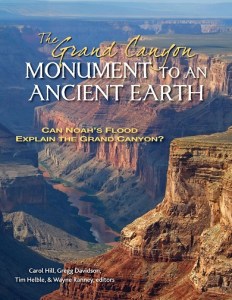 The Grand Canyon: Monument to an Ancient Earth is one of the best analyses of young earth creationism on the market. In this beautifully illustrated text, the Grand Canyon is used as a test site to analyze Flood Geology, the notion that Noah’s Flood radically shaped the face of the Earth and can account for much of the sedimentary layers we observe. The Grand Canyon is an especially appropriate test case because there are young earth creationist (hereafter YEC) books published on the Canyon, and many YEC works reference the Grand Canyon in explanations of their theories.
Part 1 outlines two views of the Grand Canyon: that of flood geology, in which the vast majority of the Canyon’s sediment was laid down during Noah’s Flood; and that of conventional geology, in which long time periods and observable, repeated processes can account for the Canyon. This part includes chapters contrasting the time frames of flood geology and conventional geology, showing the massive difference between the two views conclusions about how the Canyon formed. Part 2 is entitled “How Geology Works” and covers things like sedimentary rocks, plate tectonics, and time measurements. Part 3 looks at fossils and what they tell us about the age of the Grand Canyon. Part 4 surveys how the Grand Canyon was carved. Part 4 gives a verdict on flood geology from the evidence provided.
The authors provide an introduction to geology generally speaking, and then focus what is covered onto the Grand Canyon. Throughout the whole book, the Grand Canyon serves as the testing ground for what modern geology teaches about the Earth. Then, it is contrasted with what YECs claim about the age of the earth and the processes that formed it. Time and again, this shows that YEC claims are found wanting. The chapters on fossils are particularly telling in this regard.
For example, Joel Duff demonstrates, in “Tiny Plants – Big Impact: Pollen, Spores, and Plant Fossils” that there are entire, massive chunks of sediment without any pollen or plant spores contained therein. And these layers aren’t just randomly distributed; they’re in the oldest layers of the rock, such that it demonstrates what conventional scientists have claimed, that there simply were no pollinating plants long ago. But if flood geology is to be believed, these sediments were laid down during Noah’s Flood, which would have entailed all kinds of mixing of dead plants and animals as the surface of the Earth was radically changed. How then, are there thousands of feet of sediment without any pollen? How did microscopic plant matter manage to get sifted out in such a clear distinction from other layers? This is the kind of in-depth look at the specifics of flood geology that abound everywhere in the book. YEC arguments are subjected time and again to direct refutation like this, making the book invaluable.
The book is also valuable simply as an introduction to geology as well as some biology and other sciences. I learned an extraordinary amount from the book, and I feel fairly confident that I had a working knowledge of geology. In other words, the book is not simply a refutation of flood geology in the Grand Canyon, it can also serve as a valuable introduction to several related topics.
I would be remiss if I did not call out the beauty of the book. There are breathtaking full-color photographs of the Grand Canyon throughout the book, accompanied by numerous graphs and charts. But these illustrations do more than just look pretty, they are almost always explicitly tied into the text in meaningful ways. I found myself thoroughly poring over each and every one, whether I was looking for the division between layers of rock in a photograph or flipping back to a chart repeatedly as I came to understand it better. These illustrations are perhaps made more impressive by the modest price of the book ($26.99 regular price on Amazon). Simply put, you can’t get books with this much information and as beautifully put together as this for that price, yet here it is.
There are only two minor points I’d like to mention as negatives, but they are closer to nitpicking than anything else. First, although the introductory chapters (and a few other places) note that the young earth creationist arguments about the Grand Canyon are scientific and expressly stated as being testable, I suspect many YECs will respond to the book by appealing to some presuppositional theological perspective. Though this would be a mistaken response, it would have helped the book to perhaps include one chapter showing how the YEC claims about the Canyon are inherently scientific and can be tested without a specific theological narrative. Again, this point is made, I just think it could have been elaborated a bit more. Second, there was the briefest mention of one of the most popular arguments for Intelligent Design, that of the Cambrian explosion. The mention was so short that it is difficult to see what the authors were intending.
I have read dozens, perhaps hundreds of books on the debate over science and religion. That said, The Grand Canyon: Monument to an Ancient Earth is a remarkable achievement. It provides some of the most thorough, in-depth analysis of young earth creationist reasoning that is available to date. It is beautifully illustrated with photos and charts that are directly related to the text, and it is reasonably priced. If you’re looking for analysis of flood geology from a scientific perspective, this book gives you the perfect test scenario. I cannot recommend it enough.
The Good
+Huge amount of information from geology to biology
+On-point analysis of flood geology
+Helpful charts and graphs
+Stunning photographs throughout linked to the text
+Features women’s voices
+Direct engagement with prominent YEC writings
+Reasonable price
The Bad
-Perhaps too light on the theological side
-Only the briefest engagement with ID
Disclaimer: I was provided with a review copy of the book by the publisher. I was not required to provide any specific kind of feedback whatsoever.
Source
The Grand Canyon: Monument to an Ancient Earth (Kregel, 2016).
Links
Be sure to check out the page for this site on Facebook and Twitter for discussion of posts, links to other pages of interest, random talk about theology/philosophy/apologetics/movies and more!
Book Reviews– There are plenty more book reviews to read! Read like crazy! (Scroll down for more, and click at bottom for even more!)
Eclectic Theist– Check out my other blog for my writings on science fiction, history, fantasy movies, and more!
SDG.
——
The preceding post is the property of J.W. Wartick (apart from quotations, which are the property of their respective owners, and works of art as credited; images are often freely available to the public and J.W. Wartick makes no claims of owning rights to the images unless he makes that explicit) and should not be reproduced in part or in whole without the expressed consent of the author. All content on this site is the property of J.W. Wartick and is made available for individual and personal usage. If you cite from these documents, whether for personal or professional purposes, please give appropriate citation with both the name of the author (J.W. Wartick) and a link to the original URL. If you’d like to repost a post, you may do so, provided you show less than half of the original post on your own site and link to the original post for the rest. You must also appropriately cite the post as noted above. This blog is protected by Creative Commons licensing. By viewing any part of this site, you are agreeing to this usage policy.
Really Recommended Posts 5/6/16- creationism and the Grand Canyon, Deborah, and more!
Deborah judging in Israel
It’s another week and I’m here to bring you some more great reading for your weekend. Be sure to let the authors know what you think, and let me know here as well. Topics for this week include the Grand Canyon and the biblical Flood, Deborah as leader, Jehovah’s Witnesses, and more!
Deborah and the “no available men” argument– A refutation of the notion that Deborah was only chosen to lead Israel because there were “no available men” who could or would do so. Unfortunately, this argument is fairly common among those who do not wish to affirm the Bible’s teaching on women’s equal leadership.
The Grand Canyon’s Magnificent Witness to Earth’s History– Often, young earth creationists argue that the Grand Canyon can only be explained (or at least is better explained) by the biblical Flood as a global flood. A new book is challenging that perception. Check out this post to learn more.
7 Things to Know about Jehovah’s Witnesses– It is important to understand others’ beliefs. Here is a post outlining 7 points of belief for Jehovah’s Witnesses.
Calamity (The Reckoners)– Superheroes and villains face off with those who seek vengeance against those villains who destroyed their world. Check out this look at worldview issues in Brandon Sanderson’s latest Young Adult novel, Calamity. Also check out my own reflection on the book.
Really Recommended Posts 3/13/15- Fantasy, Feminism, and Formations, OH MY!
 It feels like summer! It’s in the 60s here in Minnesota and it’s gorgeous. I’ve been taking Luke on walks all over. But fear not, dear readers! That does not mean I’ve neglected my sworn duty to you to provide the best reading on the web. Here’s a great and diverse list for your reading pleasure!
On Being a Jesus Feminist– My wonderful wife has been published over at the Junia Project with her thoughts on being a “Jesus Feminist.” A what? Read on and find out.
A Ranking of 1980s Fantasy that would please Crom himself!– I love fantasy books and movies but was distressed to see this list and realize I’ve only seen two movies on it! WHAT? Thus, I have embarked on a quest to watch the rest of them. Check out my quest, and check the list yourself to see your 80s fantasy knowledge.
Creationism and the Grand Conjectural Canyon– Were you there? Can we know the history of the Grand Canyon? Was it formed at some point in the last 6-10 thousand years because of Noah’s Flood?
Modern Idolatry (Comic)- What is it that we are dedicating our lives to? It’s too easy to get caught up in the multi-tasking of the “everyday” and neglect the God who made us. Check out this poignant reminder.
The Last Man on Earth: Becoming the Person We Hope to Be– A look at the new TV series “The Last Man on Earth” as it stands so far, written from a worldview perspective. I very much recommend you follow Empires and Mangers–the site this link is on! It’s fantastic.
Really Recommended Posts 11/21/14- St. Francis, Science, gender, and more!
 I have rustled up another set of links for you, dear readers, to enjoy! Let me know what you thought of them, and be sure to drop a comment or “like” on their posts as well! We have a diverse set today, so everyone will find something to read!
A Pictorial Representation of the Perils of Pornography (Comic)- Pornography is a major struggle in the lives of many. Sometimes, a wake up call is needed. Here’s a poignant image on the perils of pornography.
St. Francis of Assisi was No Lover of “Nature”– A provocative title with an interesting point related to St. Francis of Assisi. What was his view of nature and the natural world? Check it out!
What I would Tell my 12-year-old self about gender roles– How might we think about gender roles? How can we discuss these with children? Here’s an excellent post on this topic.
Mt. Sodom: A Huge Pile of Salt– Who wants to discuss geology and young earth creationism? *Raises hand ecstatically!* Seriously, check out this excellent post on some difficulties the massive Mt. Sodom causes for a young earth perspective.
Science and God: Is there a conflict?– Is it true that there must be conflict between theism and science? Here are a few points related to this alleged conflict.

 J.W. Wartick - Reconstructing Faith