God
Arguing for Deism?

One curious objection I have seen and heard to arguments for the existence of God is that these arguments apply to deism, not Christianity. For example, Michael, an atheist blogger, writes, “Note that these are effectively arguments for deism, not Christianity!” about the Moral Argument (here). Another example is found in the irrational and rather virulent attack on theistic argument (laughably, they use Dawkins as the primary source for saying that all arguments for God’s existence have been refuted) can be found here. The author, confused about the implications of the cosmological argument, writes, “YECers actually deny the Big Bang, but Craig appears to be a deist.”
I must confess at least a little confusion about these comment and others which I have seen and heard. The objection seems to be that an argument for the existence of God (such as the cosmological argument) that could be utilized for deism doesn’t help the epistemic justification for belief in the Christian God. This objection is completely misguided, however, for a number of reasons.
First, Michael objects in this way in his discussion of the Moral Argument. But deism is the belief in “a creator who has established the universe and its processes but does not respond to human prayer or need” (Honderich, 195 cited below). Clearly, then, this god of deism cannot be the God towards which the Moral Argument points. The moral argument places God as the objective standard of morality for the universe (note, it doesn’t place God as the arbitrary decision maker for what is right or wrong–but argues that God has objective goodness necessarily or essentially, thus avoiding the Euthyphro dilemma Michael presses). It is hard to see how a god which doesn’t care about or respond to human need could be the objective standard of morality.
Second, the classic arguments for the existence of God don’t each point specifically to the Christian God, but serve as a cumulative case to demonstrate His existence and attributes. The Moral Argument argues for omnibenevolence; the teleological argument demonstrates omniscience and omnipotence (along with omnibenevolence, to a lesser extent); the cosmological argument illustrates omnipotence, transcendence, and necessary existence; the transcendental argument shows God’s transcendence and necessity; the ontological argument combines all of the attributes into its first premise (usually); the argument from consciousness demonstrates God as mind; the argument from reason demonstrates the rationality of God; the list could continue. Furthermore, almost all of these arguments show that God is personal, and therefore, by definition, not deistic but theistic. The objection is specious already.
Furthermore, how is it an objection to these arguments to say that they don’t each individually demonstrate the Christian God is the one true God? This seems to be a confusion about how arguments work. Argumenst for the existence of a god, as long as they don’t contradict the God of Christianity, can be taken as evidence for the existence of the God, namely, the Christian God.
Take an example of a case in court. A man is accused of committing murder. The victim was found hung in his room. The prosecuting attorney argues that the accused had the means–he recently bought some rope. He then argues the accused had motive–the victim had recently gotten a promotion for which the accused was vying. He also shows that the accused has rope marks on his hand and scratch marks on his face, which show the struggle which occurred as the accused allegedly hung the victim. He argues, finally, the accused had opportunity–he was in the room at the time the victim died and he was also the only other person in the room.
Now imagine how ridiculous it would be if the defense attorney stood up and complained that these arguments don’t really apply to the case at hand, because none of them demonstrates the accused committed the murder! They just show, individually, that he had means, motive, and opportunity; not to mention the strong evidence for the accused being involved in a struggle with some rope and another person. But to demonstrate the guilt of the accused, the defense continues, the prosecution must come up with an argument that demonstrates all of these things at once! Otherwise, they just demonstrate the other things individually!
Obviously, the defense attorney has something wrong here. But then the atheistic objector also has something wrong. The Christian philosopher of religion has argued that God is omnipotent, omniscient, omnibenevolent, transcendent, necessary, etc.; the atheist responded by saying “those arguments individually only demonstrate a deistic God!” [Discounting, for the moment, that a deistic God wouldn’t share some of these attributes.] But that isn’t how the arguments work. Any argument which demonstrates that a God exists, as long as that God is not contradictory to the Christian God, can serve as evidence for the existence of the Christian God.
Source:
Ted Honderich, ed., The Oxford Guide to Philosophy (New York, NY: Oxford, 2005).
——
The preceding post is the property of J.W. Wartick (apart from citations, which are the property of their respective owners) and should not be reproduced in part or in whole without the expressed consent of the author. All content on this site is the property of J.W. Wartick and is made available for individual and personal usage. If you cite from these documents, whether for personal or professional purposes, please give appropriate citation and provide a link to the original URL. By viewing any part of this site, you are agreeing to this usage policy.
Our Longing For God
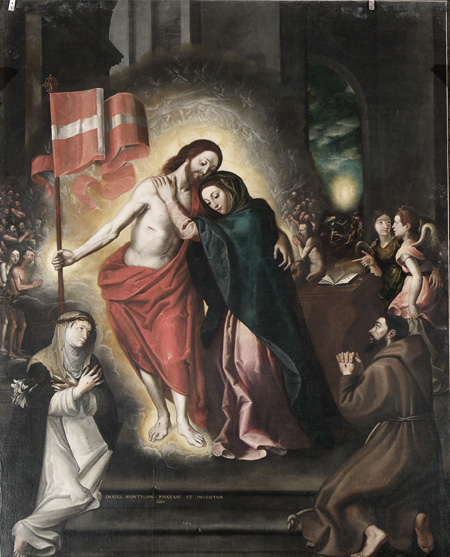 Recently, I had a discussion with my fiancée about the idea of Song of Songs being utilized as an analogy for Christ and the Church. Song of Songs is clearly a book about love, even erotic (eros) love. There are verses like 1:4 “Draw me after you; let us run. The king has brought me into his chambers” or 6:3a “I am my beloved’s and my beloved is mine.” If we are to apply such verses to the life of a Christian and his or her relation to God, we can see it sometimes as an almost uncomfortably close relationship. We aren’t comfortable thinking of our love of God as this kind of intimate desire; a desire for union, to be brought into the chambers of our God.
Yet it is exactly this kind of intimacy–this kind of eros love–which God has planned for us. Song of Songs is such a beautiful book because of this exact thing. It teaches us that we need not be ashamed of the kind of union we desire with God. We are sheep lead astray, and our one desire should be to return to our Lord, in whose arms we find peace and love.
There are other verses in Scripture wherein we can see this idea. Psalm 84:2 states “My soul yearns, even faints for the courts of the Lord; my heart and my flesh cry out for the living God.” Psalm 63:1 puts it eloquently, “Oh God, you are my God, earnestly I seek you; my soul thirsts for you, my body longs for you.”
My favorite exposition of these ideas is found in Alvin Plantinga’s Warranted Christian Belief, of all places. In this monumental work, Plantinga discusses the very idea of God’s love as eros. I feel compelled to quote him at length:
This love for God isn’t like, say an inclination to spend the afternoon organizing your stamp collection. It is longing, filled with desire and yearning; and it is physical as well as spiritual… It is erotic; and one of the closest analogues would be with sexual eros. There is a powerful desire for union with God… What is to be made of this phenomenon? Most psychiatric literature has tended to follow Freud in understanding religion as a kind of neurosis, the ‘universal obsessional neurosis of humanity.’ From this point of view, the religious eros is to be understood as a kind of analogue, displacement, or sublimation of (broadly) sexual energy…
From a Christian perspective… here (as often) Freud has things just backwards. It isn’t that religious eros, love for God, is really sexual eros gone astray or rechanneled… It is sexual desire and longing that is a sign of something deeper: it is a sign of this longing, yearning for God that we human beings achieve when we are graciousliy enabled to reach a certain level of the Christian life. It is love for God that is fundamental or basic, and sexual eros that is the sign or symbol or pointer to something else and something deeper.
[S]exual eros points to two deeper realities… human love for God… [and] a sign, symbol, or type of God’s love. (Plantinga, 311-318)
Those who have had religious experiences in which they felt a kind of union with God can attest to what Plantinga is describing. The kind of mystical union we experience when we are granted the chance to commune with God in a relation of creature-creator is beautiful, to the point of being even sensual. It is something which we long for; something we look forward to in the hereafter.
This also serves to help describe the kind of feelings involved in religious experience. It is a kind of fulfillment of a yearning and a quenching of thirst. Our longing for God is part of humanity. Plantinga argues it is part of our sensus divinitatis–our inborn sense of divine reality. Only when we submit to God and experience relation with him can our deepest desires be realized.
Source:
Alvin Plantinga. Warrented Christian Belief (New York, NY: 2000, Oxford).
——
The preceding post is the property of J.W. Wartick (apart from citations, which are the property of their respective owners) and should not be reproduced in part or in whole without the expressed consent of the author. All content on this site is the property of J.W. Wartick and is made available for individual and personal usage. If you cite from these documents, whether for personal or professional purposes, please give appropriate citation and provide a link to the original URL. By viewing any part of this site, you are agreeing to this usage policy.
The Life Dialogue: Theistic Evolution 4
This is part of a series of posts on the “Life Dialogue” within Christianity. Check out other posts in the series here.
 I recently read a very interesting article on theistic evolution by Loren Haarsma and Terry M. Gray entitled “Complexity, Self Organization, and Design.” Interestingly, I found what I think are some of the most interesting arguments for the theistic evolutionist position, but I also found some of the hardest objections to the position (scientifically) that I have stumbled across.
I’ll start with the interesting evidence for their position. First, they note that the word “design” doesn’t belong exclusively to the Intelligent Design theorists, because theistic evolutionists argue that God designed the initial laws which gave rise to evolution and eventually humanity. In other words, God foreknew and intended for mankind to evolve, and set up the laws such that we would (or at least that some sentient beings with which God intended to interact would arise, 289).
They further argue that “With the right set of rules, a random, iterative process can start with a simple environment and self-assemble a complex environment” (293, emphasis theirs). The arguments for this position are interesting to me, and I am no scientist, but it seems to me that the three ways from which they argue for this possibility make more sense to me if there is some kind of intelligence behind the process.
The three strategies for self-organized complexity they argue are:
1) Preprogrammed self assembly– “…pieces are designed so that random interactions between them eventually lead to assembly of the desired complex object(s)”
2) Information transfer from the environment– objects incorporate information from the environment through “a process of random exploration and feedback”
3) Interaction among agents– “random interactions and feedback” lead to “increased productivity or survivability” (290)
It seems to me that 1) could be simply incorporated into laws at the beginning of the universe (but these laws would have to be designed, as the authors point out). 2) seems to me as though it simply couldn’t be totally random. For evolution to work, on the understanding I’ve gleaned from my readings, the complexity would have to aid the survivability of the entity. I think a problem here is that there is no way to determine when/why/how the random interactions suddenly latch onto those things which are helpful. If it truly is a random process, then it would randomly continue to select for characteristics, casting off old ones and making room for new ones.
Incorporating natural selection doesn’t seem like it would help much here either, because then those random selections which are negative would terminate the species. So my problems with 2) are twofold (even granting that God Designed the laws such that these interactions would occur): 1. there doesn’t seem to be an explanation for the process stopping the random selections (and therefore keeping the trait); 2. we aren’t talking about computer algorithms here, we’re talking living entities–if they select the wrong traits, they die.
Ultimately I found these arguments interesting reading, but I just don’t see how they support Theistic Evolutionism more than, say Intelligent Design. The authors do make the interesting point that it could have been the case that God set up/designed the laws such that life would arise, but the ways that complexity is integrated into the process seems to me, at least, to demand further explanation.
Source:
Haarsma, Loren and Terry M. Gray, Complexity, Self-Organization, and Design, in Perspectives on an Evolving Creation, edited Keith B. Miller, p. 288-309.
——
The preceding post is the property of J.W. Wartick (apart from citations, which are the property of their respective owners) and should not be reproduced in part or in whole without the expressed consent of the author.
The Life Dialogue: Matt Moss Guest Post Part 4
This is part 4 of a series of guest posts by Matt Moss on the Genesis Creation account. Check out the first post here, the second here, and the third here.
It would now be my contention that day two and its parallel day four are the building and filling of the Cosmic Temple. In the religious Tabernacle/Temple of Israel this comes off a bit differently because of the Fallen status of the world. Day 2’s establishment of the expanse parallels the setting up of the tent of the Tabernacle and the walls of the Temple. Notice then that day 5 is the creation/assignment of the birds of the sky (above the tent’s curtain) and the sea creatures (below the tent’s foundation). What fills the temporal Temple will come on days 3 and 6.
For now I would like to add one more decorative indicator of Temple cosmology. If you remember your temple diagrams that you’ve seen and the Levitical procedures you may have read about in various OT courses/studies, you will surely remember the pools and the washings! Priests had to regularly wash themselves and their robes before proper use in the Temple. For the Tabernacle, see Exodus 30:17-21. And for the Temple see 1 kings 7:23-26; 2 Chron 4:2-5. As with the lampstand above, these serve a symbolic purpose as well as a practical one! They are part of the Temple precisely because they are part of the Cosmic Temple in Genesis 1!
Genesis 1:11-13 and 24-25, “And God said, “Let the earth sprout vegetation, plants yielding seed, and fruit trees bearing fruit in which is their seed, each according to its kind, on the earth.” And it was so. 12 The earth brought forth vegetation, plants yielding seed according to their own kinds, and trees bearing fruit in which is their seed, each according to its kind. And God saw that it was good. 13 And there was evening and there was morning, the third day… [day 6] And God said, “Let the earth bring forth living creatures according to their kinds—livestock and creeping things and beasts of the earth according to their kinds.” And it was so. 25 And God made the beasts of the earth according to their kinds and the livestock according to their kinds, and everything that creeps on the ground according to its kind. And God saw that it was good.”
As foreshadowed above, on day 3 we have a further establishment of the Cosmic Temple and on day 6 we have the first part of the filling of the Cosmic Temple. First I will deal with day 3. While travelling through the wilderness, the Israelite Tabernacle did not uproot and replant trees in the Tabernacle every where they went. However! You will read and see Acacia wood being used in everything from the Ark of the Covenant to the pillars that hold up the curtain and the walls of the Holy Place (see The Lutheran Study Bible page 141 for a great breakdown of materials used). The tent posts all the way around the outer court too serve as a garden image with all their rich colours. Later in the Solomonic Temple, there is a similar tree-like architectural feature. First we note that cedar and cypress timber from Lebanon was used (1 Kings 5:8-9; 6:14-18). Just as the trees and vegetation of day 3 served to decorate the Cosmic Temple, so also the acacia, cedar and cypress wood are used to decorate Israel’s Tabernacle & Temple.
As for day six, I have isolated the first part from the second part (mankind) simply because man deserves a bit of time on his own. Much like the birds and fish are to fill the Cosmic Temple but are kept out of the temporal Tabernacle/Temple, so too these animals are included in the Cosmic Temple BUT are only brought into the Israelite Tabernacle/Temple to be sacrificed (more on this later!).
Genesis 1:26-31- “Then God said, “Let us make man in our image, after our likeness. And let them have dominion over the fish of the sea and over the birds of the heavens and over the livestock and over all the earth and over every creeping thing that creeps on the earth.”
27 So God created man in his own image,
in the image of God he created him;
male and female he created them.
28 And God blessed them. And God said to them, “Be fruitful and multiply and fill the earth and subdue it and have dominion over the fish of the sea and over the birds of the heavens and over every living thing that moves on the earth.” 29 And God said, “Behold, I have given you every plant yielding seed that is on the face of all the earth, and every tree with seed in its fruit. You shall have them for food. 30 And to every beast of the earth and to every bird of the heavens and to everything that creeps on the earth, everything that has the breath of life, I have given every green plant for food.” And it was so. 31 And God saw everything that he had made, and behold, it was very good. And there was evening and there was morning, the sixth day.”
I’ll cut right to the chase. Man is the priest of the Cosmic Temple. This becomes even more explicitly clear in 2:15, “The LORD God took the man and put him in the garden of Eden to work it and keep it.” These two tasks, “to work it and keep it” (avad and shamar) are only used together in reference to the Levitical priesthood. Upon God’s resting of day seven, the Cosmic Temple is fully ordered and filled, that is, it is fully functional! God is present and he places His man in the Garden of Eden, the Holy of Holies of this Cosmic Temple, to be the High Priest who serves God by working and keeping this Temple. And at the centre of this Cosmic Temple stands the Tree of Life and the Tree of the Knowledge of Good & Evil. Man is given one command by which he might serve and love the gracious Creator, “You may surely eat of every tree of the garden, but of the tree of the knowledge of good and evil you shall not eat, for in the day that you eat of it you shall surely die (Gen 2:16-17).”
Despite avoiding material creation questions throughout his book, Walton appears to lean toward the special creation of mankind. He therefore rejects the evolution of man even though he allows room for evolution of animals. For him, Genesis 2 allows us to have a material understanding of man’s formation/creation (out of the dust). I don’t think it’s the strongest part of his book, but for now I am too fixated on the notion of the man as priest of the Cosmic Temple.
God then makes a suitable helper for the man (gender roles, order of creation, marriage, and the like are topics for further discussion in other forums). We all know what happens next. The perfect, complete, finished, and functional Cosmic Temple, perfectly and wonderfully ordered by God that He might live in communion with His creation, is disturbed. No, that’s too weak a description. The fully ordered creation is hurled into disorder, chaos, and disarray. SIN enters in 3:7.
The next post will discuss Thesis 6.
The Life Dialogue: Matt Moss Guest Post Part 3
This is part 3 of a series of guest posts by Matt Moss on the Genesis Creation account. Check out the first post here, and the second here.
Thesis 5– Genesis 1 – 2 describes the whole of creation as God’s (pre-fall) Temple.
When examining the seven days of creation we see several factors that indicate something cultic (meaning religious) taking shape. The first three days show a forming of the earth which (in v. 2) was “without form.” In the second set of three days you see a filling of the earth which (in v. 2) was “void.” Walton, in keeping with his functional model suggests a better translation of these words tohu and bohu (without form and void). Similar to bara’ he provides a survey of tohu’s use in the Bible (bohu occurs three times, always with tohu) and shows that the word “describes that which is non-functional, having no purpose and generally unproductive in human terms (48-9).” In light of this, the state of tohu and bohu means that the earth has a functional non-existence. Thus, when God begins His bara’ work, the functional bringing into existence of all that He does, Genesis 1 wants us to see what purpose everything serves.
Examining the functions in Genesis 1 we will find many parallels to the religious life of ancient Israel as studied in Exodus, Leviticus, and the rest of the OT. I’d like to turn now to days 4 – 7 of the Genesis 1 account (1:14 – 2:3) to examine the indicators that the Genesis 1 cosmology is a temple cosmology.
Genesis 1:14-19 (ESV) – “And God said, “Let there be lights in the expanse of the heavens to separate the day from the night. And let them be for signs and for seasons, and for days and years, 15 and let them be lights in the expanse of the heavens to give light upon the earth.” And it was so. 16 And God made the two great lights—the greater light to rule the day and the lesser light to rule the night—and the stars. 17 And God set them in the expanse of the heavens to give light on the earth, 18 to rule over the day and over the night, and to separate the light from the darkness. And God saw that it was good. 19 And there was evening and there was morning, the fourth day.”
So let’s look at what functions these lights in the sky are given:
1) to separate the day from the night
2) to be for signs and for seasons (moed) and years
3) to give light upon the earth
4) to rule the day & night
5) to separate the light from the darkness
Now you may be asking yourself, “I don’t see anything here that is particularly temple focused. First I would like to point out that in a society where watches & clocks are not present, the Sun, Moon, and stars are what tell you when it is time to worship (they did so much more often than once a week). Second, we can see throughout the OT that specific days of specific months are given festivals and holidays. These were mapped out by using these very lights, after all that is their given purpose in point two, “to be for signs and for moediym and years.”
The word moed occurs 223 times in the OT, so we have a large cross section of uses to help us nail down the possible meanings and the intended meaning within this context. The basic lexical entry is “appointed time.” However it is important to note that in Exodus 23:15, God says, “You shall keep the Feast of Unleavened Bread. As I commanded you, you shall eat unleavened bread for seven days at the moed in the month of Abib, for in it you came out of Egypt.” At the very beginning of the cultic/religious life of Israel upon exiting Egypt this word is tied to their religious festivals! Throughout Exodus, Leviticus, & Numbers moed is unanimously used in the phrase “tent of meeting (moed)” for the tent in the centre of the Tabernacle (the travelling version of the Temple before Solomon builds the first Temple). Now, beyond this there are countless uses of moed as “appointed time” in the worship life of Israel. I would thus maintain that Genesis 1 claims the functional purpose of the Sun, Moon, and stars is to indicate the daily, weekly, monthly, and yearly worship schedules of God’s people. In other words, when the ancient Israelite children asked their parents, “why is that moon shining in the sky?” the parents would answer in accord with Psalm 104:19 and say, “God made the moon to remind us when to observe the Feast of Passover and the other feasts/festivals.”
There is one more minor indicator that I would like to bring up when discussing the functional creation of Light. When we examine Genesis 1 as a Temple cosmology we realize just why something seemingly inconsequential like the Golden Lampstand (Ex. 25:31ff) is present in the Temple. Not only does it serve to light the room, but it is absolutely necessary to have this light in the Temple because this Temple reflects the Cosmic Temple corrupted in the Fall. If the Cosmic Temple has Light (Gen 1:3-5, 14-19) so must the Tabernacle/Temple have that Light (Ex. 25:31-40; 2 Chron 4:7).
Genesis 1:20-23- “And God said, “Let the waters swarm with swarms of living creatures, and let birds fly above the earth across the expanse of the heavens.” 21 So God created the great sea creatures and every living creature that moves, with which the waters swarm, according to their kinds, and every winged bird according to its kind. And God saw that it was good. 22 And God blessed them, saying, “Be fruitful and multiply and fill the waters in the seas, and let birds multiply on the earth.” 23 And there was evening and there was morning, the fifth day.”
Granted, there is not much here that we would directly relate to the Temple if we did not first see that days 4-6 are paralleling days 1-3. Now, when we look back to verses 6-8 and read it in the light of other ancient Near Eastern cosmologies we see that on days two and four more than any other we find the physical shape of a temple. The Lutheran Study Bible footnote on these verses is very helpful in pointing out the structural/functional aspect of how the “expanse” works and the image it evokes. “The point of the image is the function rather than the substance: the sky serves as a divider. The Israelites often used figurative terms to describe the cosmos as it appeared to them (cf. Is 40:22, where the sky is described as a “curtain” and a “tent”).”
[Further expansion of thesis 5 coming later this week]
Book Review: “On a Complex Theory of a Simple God” By Christopher Hughes
Christopher Hughes’ work, On a Complex Theory of a Simple God: An Investigation in Aquinas’ Philosophical Theology (hereafter CTSG), is part of a series of books (on independent topics by different authors—meaning one can jump in on whichever book one wants) called the “Cornell Studies in the Philosophy of Religion.” It is the first book in the series which I have read (though I have 5 more sitting on my shelf), but if it is any indicator of things to come, I highly recommend this series.
CTSG mostly focuses on Thomistic Philosophy, but it specifically highlights St. Thomas Aquinas’ arguments for Divine Simplicity and his discussions of the Trinity and the Incarnation. I must admit that initially I found it hard to maintain interest in this work. Thomistic Philosophy is by no means a specialty of mine, and I got the book mostly because I was vaguely interested in whether or not Divine Simplicity—that is, the idea that God is “omnino simplex”, altogether simple, and “in no way composite” (Hughes, 4). Hughes, however, manages to make a topic in which I displayed only a passing interest into a page-turner of a philosophical work.
Divine Simplicity was appealing for a few reasons. First, if God is composite in no way, then it seems as though many objections to the compatibility of properties of God—say, of omnipotence and omniscience—fail to be objections at all. For if God is absolutely simple, omnipotence just is omniscience (following the example) and vice versa, and if this is the case then to object that omniscience and omnipotence are incompatible would be to object that two things which are identical are incompatible. Aquinas holds to this very view. On Aquinas’ view, “His [God’s] existence is also His goodness, wisdom, justice, omnipotence, and so on” (22). Second, if God is perfectly simple, then it seems as though God as a hypothesis, if you will, increases in merit, granting Occam’s Razor. For, if God is absolutely simple, then to object to God’s existence as being too complex (as some do) is entirely specious, as God is not complex at all. Third, philosophical interest in Divine Simplicity had me longing to learn more about it.
Hughes’ analysis and critique of the arguments for Divine Simplicity are fantastic. His capabilities in discerning and detailing the complexities involved in Thomistic Philosophy are spectacular. It is his unbiased analysis, however, which most characterizes CTSG. Throughout pages 28-57, he destroys (in my opinion) Aquinas’ arguments for Divine Simplicity. Then, he argues that God cannot be identical to His insular attributes, which counters the argument in defense of Divine Simplicity that, roughly, ‘omnipotence and omniscience may appear to be different, but perfection of either quality shows that they are actually the same’ (60-68).
Yet despite his rather convincing arguments against Divine Simplicity as drawn out by most proponents, Hughes also outlines a possibility for a defense for that very idea. For if 1) God exists necessarily in the logical sense, and 2) if all things are contingent upon God’s existence (two premises Hughes disagrees with, but does not offer an argument to refute per se—instead he refers to Humean thinking as a reason not to accept 1)), then
“[b]y 2), any individual substance in world w distinct from B exists there only at the sufferance of B, and would not have existed if B had exercised its will in a way it might have. By 1), we know that there is an individual substance—the individual in our world which is (a) God—which exists in w, and does not exist at the sufferance of B, that is, could not have failed to exist through any possible exercise of B’s will. It follows that the individual who is a God in our world is identical to B. Since B and w were chosen arbitrarily, we may conclude that nothing actual or possible could have the specific nature Deity without also being the very same individual as God. In other words, God’s individual essence is no different from His specific essence” (99).
This allows the defender of Divine Simplicity a “way out,” if you will. For she can hold that 1) and 2) are both true, and then argue (though, as Hughes notes, in “a flavor more Leibnizian than Thomistic” [100]) that God exists and his specific and individual essence must be identical. This allows for a modification of Divine Simplicity which avoids the downfalls Hughes points out in the other formulations.
Another fantastic section of Hughes’ work is his defense of omniscience. He suggests (following David Lewis) that omniscience can be defined as “X is omniscient if and only if X knowingly (that is, in such a way as to satisfy the conditions for knowledge) self-ascribes all and only those properties that X exemplifies” (126). This suggested definition of omniscience has much to recommend it. First, it clearly avoids any problems with the supposed incompatibility of a timeless deity and knowledge, thus allowing those who favor Divine Timelessness (such as myself) to have an adequate, defensible view of omniscience. Second, it allows for the compatibility of a timeless, changeless, and omniscient deity (127).
The rest of CTSG is made up of Hughes analyzing Aquinas’ view of the Trinity and the Incarnation. This covers approximately half the work, but I feel the need to sum up Hughes wonderful analysis simply by saying that it seems he has shown there are serious problems with Aquinas’ formulation of the Trinity, granting Aquinas’ presuppositions about identity, simplicity, etc., but it seems that Hughes “way out” for the defender of Divine Simplicity outlined above could potentially be a “way out” for those desiring to defend the Trinity and the Incarnation on a modified account. Hughes himself offers possibilities for defending each of these doctrines which may not necessarily require abandoning Simplicity (cf. 251-253 for one example). As it stands, however, it seems that Aquinas himself has not provided an adequate defense of the propositions he wishes to claim as “compossible.” Rather, defenders of Thomistic philosophy must turn outside of that realm–towards analytic or Liebniz–to reconcile those doctrines which Aquinas wishes to defend.
Hughes does a simply fantastic job of outlining Aquinas’ arguments, analyzing them, critiquing them, supplementing them, and then providing a final analysis. Hughes remains fair and, I would say, unbiased throughout his work. He allows for the possibilities that central theses of Aquinas’ “philosophical theology” are indeed correct, granting formulations Hughes himself does not share. I, however, do share many of the premises of those who can defend Divine Simplicity, and therefore continue to find it a “bruised, not beaten” doctrine. Hughes’ insightful work should command a place of care on any philosopher of religion’s bookshelf, as he has not only written a wonderfully compelling investigation into Aquinas’ philosophical theology, he has also contributed to modern Thomistic and analytic philosophy, but most of all he demonstrated a willingness to concede possibilities on the “other side” of the debate and a rigorous approach to analytic philosophy of religion which one can only hope will be emulated.
Source:
Hughes, Christopher. On a Complex Theory of a Simple God: An Investigation in Aquinas’ Philosophical Theology. Cornell University Press. 1989.
——
The preceding post is the property of J.W. Wartick (apart from citations, which are the property of their respective owners) and should not be reproduced in part or in whole without the expressed consent of the author.
Book Review: “Revelation” by Richard Swinburne
“Revelation: From Metaphor to Analogy” by Richard Swinburne is one of those rare books which forces one to think about and analyze every argument it contains, whether one agrees or disagrees with the conclusions. It addresses claims of revelation. Can it be true that a religion’s books or creeds contain truth?
The book starts off with a section on “Meaning” which analyzes terminology, presupposition, analogy and metaphor, and genre in turn. This section is fantastic reading for the philosopher of religion as it takes some higher notions found in philosophy of language and applies them to religious studies. The chapter on presupposition was the first part I found particularly striking. It is here that Swinburne first begins to lay the groundwork for his overarching argument about the Christian Revelation and Scripture. He argues that presuppositions are not contained in the message conveyed in spoken or written word. He writes, “In order to separate statement from presupposition, we must ask, whatever the speaker’s actual beliefs, are there any common beliefs of the clture presupposed in the utterance which can be siphoned off, leaving what the culture would naturally suppose to be its message intact?” (30). This “siphoning” of meaning is necessary because “[a]lthough speakers may use declarative sentences for many different purposes… the paradigm job of such sentences is to convey information, to ad to the hearer’s stock of beliefs” (29). Swinburne offers the following example to demonstrate his argument. Suppose a Roman historian wrote that “The divine Augustus traveled to Brindisi.” This sentence is not intended to convey the information that Augustus is divine. That Augustus is divine is presupposed by the author of the sentence. Rather, the sentence is intended to tell the reader that Augustus traveled to Brindisi (29). Swinburne also outlines and describes various genres and how they can relate to a religious revelation.
The next part of the book argues for four possible tests to determine whether a divine revelation has occurred. These tests are 1) whether the content is the “kind of thing which God would have chosen to reveal to humans” 2) “whether the method of expression is one to be expected of God, 3) whether “the church has developed the original revelation in a way which plausibly brings out what was involved in it …”, and 4) “whether the interpretations provide the sort of teaching which God would have chosen to give to humans” (107-108). He argues convincingly for each of these tests applying to the Christian Revelation.
The third part of “Revelation” examines the Christian Revelation specifically. Swinburne argues that Jesus and His message were the “original revelation” provided to believers (145ff). It is in his discussion of the Church and the Bible, however, wherein he forwards his most controversial claims.
The Church, argues Swinburne, is responsible for more than simply establishing the canon of Scripture. He argues that the Church has a central place alongside Scripture in the Christian Revelation, for without the church, interpretation could not happen. The creedal statements central to Christian faith may not have been derived had it not been for the Church (see page 189ff). Further, the Church acts as a method for assessing “rival interpretations” of various Scriptural truths (200). It is undeniable that Swinburne advocates the Church as a high authority–perhaps even on a higher level than Scripture, for he argues that many conflicting interpretations of Scripture can receive almost equal footing on Scripture alone, so the Church is required to determine which of these should be approved (again see p. 200 for an example of this). Swinburne’s view of the Church is one of the most important things in this book, in my opinion, for the Christian to read and digest, regardless of whether one agrees or disagrees. For one’s view of the authority of a church body is vastly important with regards to how one views other doctrines. As Swinburne writes, “Which doctrines are to count as central Christian doctrines… depend[s] very much on which ecclesial bodies we judge to be part of the Church. The wider our Church, the fewer such doctrines there will be” (214). This is undoubtedly true, for if one takes only the Roman Catholic Church, for example, as a valid ecclesial body, then one’s net of central Christian doctrines can include everything sanctioned by the Roman Catholics. But let us say that one takes both the Lutheran Church and the Roman Catholic church to be authoritative, or perhaps they take the Orthodox, Roman, and Reformed churches as authoritative. Well then it seems that only those doctrines which all these bodies agree on can be regarded as central, or essential to, true faith. For if one church contains a doctrine which the others do not, it cannot be regarded as absolutely essential if the other churches are still legitimate. If it were essential and the other bodies disagreed, then those other bodies would not be legitimate, by the criterion of not agreeing on an essential Christian doctrine.
This then provides a valuable springboard for thought about central Christian teaching and what doctrines and ecclesial bodies one regards as valid or central. Swinburne’s discussion on this topic cannot be downplayed. He goes into various criteria which can be used to determine whether a Church body is legitimate. These arguments are incredibly in-depth and interesting. His arguments force the reader to consider his ideas.
The Bible is the final major topic Swinburne addresses in “Revelation.” Here we see all the groundwork laid in Part 1 come into play. What do genre, presuppositions, etc. tell us about the meaning and interpretation of Scripture? This section is another which the Christian would do well to ponder. Swinburne argues that we must take Scripture as being entirely true, but he qualifies this claim by arguing we must also realize what Scripture is–a collection of books written with divine approval but by human hands. Thus, he argues, we should take great care to realize the difference between presupposition and message, history and allegory, etc. While I do not agree with Swinburne on every point, I find his insights particularly interesting. He notes that “[t]he falsity of the presuppositions does not, therefore… affect the truth-value of a sentence which uses them” (244). This kind of argument can be of direct worth to the apologist, for example. He utilizes Genesis 8:2(“The fountains of the deep and the windows of the heavens were closed, the rain from the heavens was restrained” ESV) as an example: “The sky has no windows out of which the rain comes, but the quoted sentence is just the author’s way of saying, within the presuppositions of his culture, that the rain ceased” (244-245). This is a different approach apologetically than the one I would tend to favor, which would argue that the word “window” is used here in a metaphorical or analogous way.
Swinburne’s high view of the church is necessary alongside his view of Scripture. Swinburne writes that “The slogan of Protestant confessions , ‘the infallible rule of interpretation of Scripture is the Scripture itself’, is quite hopeless” (255). For it is the Church which determines acceptable interpretations of Scripture. He writes that “Scripture belongs to the Church” (256). Reading and interpreting Scripture requires a guide. This guide “…is the Church’s theological definitions and other central teaching, its tradition of the proper way to interpret the Bible, and its tradition of how particular passages should be interpreted” (256).
Swinburne’s final chapter seeks to discuss and interpret moral teaching found in Scripture.
Swinburne’s central argument is strong. God has given us a Revelation and has given us the tools to discover what it means. This Revelation is found in Scripture and historically in the life, death, and resurrection of Christ. It is the nuances of Swinburne’s argument which make the book so wonderfully useful. I found myself at times nodding, agreeing with everything Swinburne wrote. At other times I shook my head, jotting rebuttals alongside his text. But the vast majority of the book found me engaged on a new level with topics I thought I had addressed and laid to rest. While I disagree with details of Swinburne’s argument (i.e. he accepts the JEDP view of Scripture, denies the historicity of the person of Jonah, etc.), I found his core arguments compelling. We do need to remember the genre(s) we read as we read Scripture. We need to realize that the ultimate author of Scripture is God, but that Scripture was written within a set of presuppositions distinct from our own.
Swinburne’s analysis of the authority of the church was equally compelling. While he holds a higher view of church authority than I do, his view intertwines the Church with Scripture in compelling ways which absolutely must be considered.
It has been over a month since I finished this work by Swinburne, yet I have found myself consistently turning back to it, and even while writing this review, I found myself contemplating his arguments and drawing truths from him while still disagreeing with him on other areas. I reiterate that I find this work absolutely essential reading for the Christian philosopher. It will challenge and reward the reader in ways that may be entirely unexpected.
Source:
Swinburne, Richard. Revelation: From Metaphor to Analogy. 2nd Edition. Oxford. 2007.
——
The preceding post is the property of J.W. Wartick (apart from citations, which are the property of their respective owners) and should not be reproduced in part or in whole without the expressed consent of the author.
God and Logical Priority
Logical priority, broadly defined, is the way things are ontologically ordered. That is, to say that for two factors, x and y, x is logically prior to y if and only if x takes precedence over y. An example could be to use miracles and God (note this is just for the sake of example, I realize that some would argue miracles can exist without God, but I’m simply using it as an illustration). The existence of God is logically prior to miracles in the sense that if God does not exist, then miracles do not. In this case, God would be x, while miracles would be y. In order for y to be the case, x must also be the case, thus making x logically prior to y.
So what does this have to do with God? Very much, I would say. For one of the most common objections to the existence of God is that there is no (or not enough) scientific evidence to demonstrate God’s existence. I have addressed such objections before, but now I would like to take a completely different approach. That is, I believe that the existence of God is logically prior to the question of scientific evidence.
The reason I take the existence of God to be logically prior to scientific evidence is be cause logic is prior to science. Take the case of necessity, for example, and combine it with the case of scientific laws. Now, in science, a law is generally something like “if x occurs, then y will occur.” But it is not the case that such laws operate on a logically necessary level. For it is not the case that “Necessarily, If x occurs, then y will occur” (or, □(x⊃y) for those who enjoy ‘logic-ese’). It is simply the case that this is what happens in all observed cases. It could even (possibly, but not modally) be said that “If x occurs, then, necessarily y will occur” (again, logic-ese: x⊃□y), but this does not establish logical necessity in the modal and broader sense.
The type of necessity which can therefore be ascribed to scientific laws is a contingent or “accidental” necessity. They operate in a necessary sense in that in this world (out of all possible worlds) it is the case that if x then y, but they do not operate necessarily in the sense that in every possible worlds it is the case that “if x then y.”
Logical necessity, however, is prior to this. For, on logical necessity, that which is necessary is necessary in all possible worlds. Logical necessity is the very thing which scientific necessity lacks.
Again, we may ask, what does this have to do with God? Well, if it is the case that it can be demonstrated that God exists out of logical necessity, then the question of scientific evidence is irrelevant. For logical necessity is prior to scientific necessity. This is not to say that scientific evidence is not useful when exploring the “God question”, if you will, but it is to say that if it can be demonstrated that God is logically necessary, then demands for scientific evidence to demonstrate or even make probable the existence of God are misplaced. For if God is logically necessary, then to deny the existence of God is incoherent in the strong sense (that is, it is illogical). The logical demonstration would be prior to and therefore supersede the scientific evidence or lack thereof (I believe that there are at least some reasons scientifically to believe God exists, but that is off topic).
But then, we must ask, can it be demonstrated that God is logically necessary? Well yes, I believe so. I have argued this at length elsewhere, so I won’t reiterate it (see here). If any of these arguments are sound (as I believe they are), then the question of scientific evidence for God’s existence is simply a non-factor. Certainly, the scientific (and other) evidences may be seen as providing further justification for believing that God exists, but if it is the case that the arguments for God’s logical necessity are sound, then such arguments are the only tools needed to defend the claim that God exists. Further, to dispute such a claim (that is, God’s existence) would be incoherent in the strongest possible sense.
——
The preceding post is the property of J.W. Wartick (apart from citations, which are the property of their respective owners) and should not be reproduced in part or in whole without the expressed consent of the author.
God and Moral Obligation, or Euthyphro, rethought
Euthyphro’s dilemma is so frequently discussed in philosophy that I don’t see a need to thoroughly present it. The horns, however, are going to be the topic of this post, so I’ll outline them below:
It seems that if God makes commands which create moral duties for humans (and others), then there may only be two options for the theist:
1) We ought to do what God commands because God commands it (and thus he could have commanded any random thing to be dutiful–i.e. torturing cute rabbits)
or
2) God commands us to do things because they are what we ought to do (and therefore there is some standard to which even God answers–see Richard Swinburne’s Revelation for an interesting description of a potential way around this problem)
If these are the only two options, it seems as though theists are in an uncomfortable position indeed! Normally, most theists would attack one of the horns of the dilemma or hit between the horns and find a way out. The late William Alston, however, ingeniously argues in Divine Nature and Human Language that the theist can accept both horns of the dilemma, albeit with some interpretation (DNHL 255).
The most important part of Alston’s solution is to assume that God is perfectly good essentially, that is, necessarily, God is perfectly good (257). In other words, God cannot perform a morally imperfect action. Alston makes no argument for this position, though I think that Stephen Parrish argues this rather well in God and Necessity. Regardless, I’m going to follow Alston’s assumption for the presentation of his argument, for now ignoring the potential problems with removing libertarian free will from God.
If it is the case that God is essentially perfectly good, then moral “oughtness” words such as “required”, “forbidden”, “duty”, etc. do not apply to God. This is because these terms “apply to a being only if that being has a choice between doing or failing to do what it ought to do” (257). But if God cannot fail to do good, then His own nature “prevents him from acting freely in a way that is required for moral obligation… it is metaphysically impossible that God should do anything that is less than supremely good” (257). But then this means that horn 1 of the dilemma serves as no problem–God can not order things which would be arbitrarily evil, but it also means horn 2 is no problem either–God is not restricted by any “ought” statements.
Further, implicit in the dilemma is the idea that some form of Platonism is correct, that is, there are some objective morals as ideas somewhere. But again the theist can adapt this to theism and say that instead of some morals that just exist of necessity on their own (though again see Swinburne, Revelation for a defense of this very idea of theistic morality), God Himself is the “supreme standard of goodness. God plays the role in evaluation that is… assigned… to Platonic Ideas or principles” (268). Moral obligations are what we ought to do (horn 2 of the dilemma) because they are features of God (269).
Therefore, by accepting that God is essentially perfectly good, and further supposing that God Himself is the standard for goodness, the theist can accept the horns of the dilemma while arguing that they don’t really serve as objections to theism as classically supposed. God, having no “ought” statements apply to him, cannot be the subject of 2), while his very existence as essentially perfectly good means that 1) cannot apply to him either.
Sources:
Alston, William P. Divine Nature and Human Language. Cornell University Press. 1989.
Parrish, Stephen. God and Necessity. University Press of America. 2001.
Swinburne, Richard. Revelation. Oxford University Press. 2007.
——
The preceding post is the property of J.W. Wartick (apart from citations, which are the property of their respective owners) and should not be reproduced in part or in whole without the expressed consent of the author.
God and Time: Initial Thoughts
God’s relationship to time is a topic of vast philosophical import. I can honestly say I didn’t even know it was so hotly debated until very recently. The topic has served to show me once again that the more I read, the more I learn, the more I will realize I have so much more to learn.
So why the heated debate? What are the sides? How do we research such a topic?
The sides of the debate are (probably not limited to):
1. God is timeless- on this view, God transcends time altogether (Craig, 29). It is also defined by saying, “God… exists, but exists at no time” (Leftow, xi)
2. God is temporal (or, keeping with the trend of listing God’s attributes as the omni-‘s–omnitemporal)- on this view (usually), God existed timelessly before the creation of the world, but is temporal once time and the world have come into being. “God co-exists only with the present moment or ‘now.’ He is eternal in the sense that He endures forever” (Craig, 77).
Why the heated debate? Again, it may be surprising that I have never been attuned to this debate once the implications of God’s relationship with time become clear. Indeed, God’s relationship with time is almost basic to any understanding of God’s attributes. God’s omnipotence, omniscience, etc. will be entirely different if God is temporal as opposed to timeless and vice-versa. How so? Let’s look at just one example. Take the conjunction “God is omniscient and omnipotent” (hereafter O). Now, if God is temporal, O seems to have a few problems that need working through. For if God is omniscient and temporal, then He knows in advance what He is going to do, which seems to limit God’s power, thus making O seem unlikely. However, if God is timeless, then He doesn’t really know anything in advance, He just knows all things tenselessly (in other words, He knows things in advance from our, temporal view, but because God is outside of time, such temporal terms simply do not apply to God). This means there is no limit on God’s omnipotence because such a problem relies on a tensed, temporal view of God (there is much more to be said on this issue, but I am simplifying it for the sake of an example). Further, any view on God’s relationship with time will also involve God’s relationship with His creation.
Thus, it seems extremely important to develop a view on God and time, which is exactly what I intend to do in this series of posts. I will be exploring the issue by looking through Bible passages which discuss God and time, by reading books and articles on the subject, and by condensing my studies into posts.
Sources:
Craig, William Lane. Time and Eternity: Exploring God’s Relationship to Time. Crossway. 2001.
Leftow, Brian. Time and Eternity. Cornell University Press. 1991.

 J.W. Wartick - Reconstructing Faith