hugh ross
Resource Review: “RTB Live! ‘Beyond the Cosmos’ with Hugh Ross”
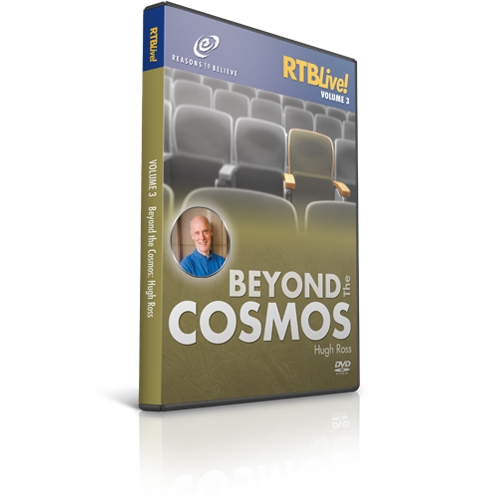 Reasons to Believe is a science-faith think tank that seeks to show that Christianity is a profound source of knowledge. They come out with a number of resources from podcasts to articles to books. One such resource is their “RTB Live!” video series which explores a number of topics on science and Christianity by varied lecturers. I recently had the opportunity to watch “Beyond the Cosmos” which is the third in the series.
Hugh Ross presents this lecture which largely focuses on integrating science and Christian doctrine. He prefaces his comments by letting the audience know that he’s not necessarily suggesting that the ideas he presents are the way things happened, but rather that they show that certain Christian doctrines are possible in light of scientific findings.
God, according to Christianity, is “transcendental.” Ross refers to this as “transdimensional.” He begins his presentation by saying that given that God is beyond the dimensions, a number of interesting scientific findings about dimensions can show how God could bring about certain actions.
Ross discusses the Biblical portrait of God as both transcendent and immanent. God is beyond the universe, but is “everywhere within the universe” and capable of interacting with God. He outlines a number of Bible verses to show these doctrinal truths.
He then moves on to general relativity. General relativity has been confirmed to an amazing degree by big bang cosmology as well as other evidence. Rather than going into detail on this section–which should be familiar to those interested in such a topic–the rest of this review will focus upon the theological implications Ross draws out from current cosmology.
One of the central questions people ask is “If God created the cosmos, who made God?” Ross notes “everybody asks that question!” However, he argues that “these spacetime theorems give us an answer to that question… What these theorems tell us is that there is cause and effect going on before the universe comes into existence.” Ross argues that these cause and effects are due to a causal agent which is itself outside of space and time.
Because God is not confined to linear time, Ross argues, God has access to “at least a plane of time.” It’s hard to convey Ross’ argument here because he utilizes a drawing to depict what he’s saying. But basically if one sees two timelines running independently, they are on the same plane. God could see this plane and therefore interact with all the timelines.
Ross goes on to use a very interesting illustration of “Mr. and Mrs. Flat.” He uses paper cutouts of a male and a female that are two dimensional figures. Now because they are 2D, they exist on a plane. But God, being transcendental, could, in a sense, “poke a finger” through that plane and God would be experienced as a circle (the finger). God could also poke three fingers through the plane and be experienced as three circles. Furthermore, God could see Mr. and Mrs. Flat in their entirety, even though they would appear as straight lines to each other.
This thought illustration was intended to show how God, having access to all dimensions–indeed, being beyond them–could interact with all of spacetime and know what’s happening.
Similarly, because God has access to limitless dimensionality, He could listen to every single prayer on earth by utilizing each point in a “timeline” as an infinite timeline running perpindicular to that moment of time. Thus, God could spend infinite time listening to each prayer.
The atonement is often raised as an objection to Christianity because some ask how God could pay for the sins of the whole world by just suffering for a few hours on a cross. Ross points out that, just as God can expand any single moment of time into an infinite timeline to listen to prayer, so too could Christ have suffered on the cross for a potentially infinite period of time.
Reasons to Believe, as an organization, strives to show that the Christian faith can be put to the test. Ross pointed out several testable predictions that their model brings to the table:
- Evidence for a single cosmic beginning will increase.
- Evidence for finite past time will grow.
- Evidence for general relativity describing cosmic beginnings will increase.
- The grip of spacetime theories will become more “relentless”.
- The case for a transcendent creator will grow stronger.
- The evidence for other miraculous events will increase.
These 6 testable predictions are not strictly hypotheses that could be used in a lab and some criticism from skeptics could come at Ross from this angle. However, it seems clear in the context of the video that Ross was painting in broad strokes here. From his writings, one could see that he parses these 6 predictions into much more precise hypotheses.There are a number of other theological issues Ross touches upon, and as someone who is constantly involved in grappling with these questions, I couldn’t help but have my mind expanded and think on how some of these ideas could affect my perception of Christianity. There do seem to be a number of ways that science can provide possibilities for several Christian doctrines.
Finally, it would be remiss to review a resource like this without commenting on the visuals presented by Ross. There weren’t any extremely flashy slides or demonstrations. Rather, Ross used a whiteboard to illustrate a few things and brought a few objects (some balls, Mr. and Mrs. Flat, etc.) to demonstrate some points. What was interesting was the way he used them. In particular, the aforementioned Mr. and Mrs. Flat was very interesting.
The video was extremely thought-provoking and certainly would be a good watch for a study group on science and religion. As someone who specializes more in the realm of philosophy, I would say that a few of Ross’ ideas have larger implications than is illustrated in the video. For example, it seemed as though the way Ross described God’s interactions in time would entail something like William Lane Craig’s view that God is timeless sans creation and temporal subsequent to Creation. However, from some of Ross’ writings, I am fairly sure he holds that God is in fact “still” timeless (a view I share). Thus, one would have to take the views he puts forth here as perhaps more speculation than reality. Such a discussion over whether God is timeless or in time was beyond the scope of the video, but I think the video could be used to bring up discussions like it.
Overall I enjoyed the video very much. As usual, Hugh Ross was a thought-provoking speaker whose ability to combine his knowledge of astrophysics with theology is often startling. The video would be perfect for a small group and could go hand-in-hand with Ross’ book of the same name (Beyond the Cosmos). Furthermore, the video could be used for a higher-level apologetics group in order to discuss some implications for God and time or science and faith. It is highly recommended.
Disclaimer: I was given this DVD to review by Reasons to Believe. I was not asked for a positive review, nor was I asked to focus upon any particular content. My thanks go to RTB for the video.
SDG.
——
The preceding post is the property of J.W. Wartick (apart from citations, which are the property of their respective owners) and should not be reproduced in part or in whole without the expressed consent of the author. All content on this site is the property of J.W. Wartick and is made available for individual and personal usage. If you cite from these documents, whether for personal or professional purposes, please give appropriate citation with both the name of the author (J.W. Wartick) and a link to the original URL. If you’d like to repost a post, you may do so, provided you show less than half of the original post on your own site and link to the original post for the rest. You must also appropriately cite the post as noted above. This blog is protected by Creative Commons licensing. By viewing any part of this site, you are agreeing to this usage policy.
Ken Ham on “Compromise” and Stand to Reason
Ken Ham recently released a rant about compromise in the church. Rather than evaluating any single point, I’m just going to go through a short, point-by-point response. Quotes from the article are in block quotes.
…a big part of our mission is to bring reformation to the church, so of course we expect opposition to our efforts. Sadly, the worst opposition from my perspective is from within the church, since we should expect opposition from the world.- Ham
I would like to know what the “reformation” is that Answers in Genesis (hereafter AiG) hopes to bring about. I suspect it is a reformation of young earth creationism, but that seems to be a fairly major position within the average church anyway. A “reformation” is never restricted to just one point, however, so one must wonder what theology it is that AiG hopes to bring to the forefront.
Stand to Reason states its mission as teaching people “not just what to think, but how to think.” Sadly, their supposed teaching people “how to think” is actually teaching them to think in terms of millions of years and evolutionary ideas. -Ham
Ken next turned to an attack on the ministry group, “Stand to Reason.” Note that the reason it is under attack is because the group is teaching “to think in terms of millions of years and evolutionary ideas…” I found this quote particularly strange, considering that Stand to Reason is a specific and vocal advocate of Intelligent Design. The group goes so far as to offer Intelligent Design as “a scientific alternative to evolution.” As far as “millions of years,” one may say that this is indeed part of teaching people “how to think.” Let’s investigate the evidence. Let’s come to our own conclusions. Let’s think about it.
It seems particularly strange to see an AiG person complaining about others teaching “how to think” because anyone who disagrees with the AiG position on the age of the universe is labeled, ironically, a “compromiser.” Only if you hold the position AiG desires you to hold are you someone who knows “how to think.” Seems like a very strange way to teach “how to think,” doesn’t it?
Hugh Ross believes in an old earth and promotes the day-age and progressive theories of creation. He says God created over millions of years in the same basic order as the secularists claim life evolved (in reality, this is a form of theistic evolution). -Ham
Hugh Ross is a favorite target of groups like AiG. Why? I suspect it is because Ross doesn’t focus exclusively on scientific evidence (which young earth creationists tend to reject as “a different interpretation of the same evidence”) but instead offers alternative theological interpretations.
That aside, this quote from Ken Ham is factually incorrect. It makes me wonder whether he has interacted with Ross’ works on a thoughtful level. Ross certainly doesn’t hold the position outlined above. Ross does believe the timeline science has uncovered matches up with the Biblical account. The important distinction is that Ross leans towards progressive creationism (in the writings of his I have read); in other words, God created species over time. When one species passed away, God brought forth a new one. Initially it may seem that this is how Ham described Ross’ position, but note the last clause in which Ham says this is a form of theistic evolution. That is absolutely incorrect. I know of no theistic evolutionist who would agree that God brings forth new species over time in special creative events. None. Rather, it seems Ham is just using the scare word “evolution” and associating it with any position he disagrees with (see Stand to Reason above).
[Skipping over a number of point-counterpoint rebuttals in Ham’s post.]
They [Stand to Reason/other groups like them] can try to modify things all they want, but what they are doing is compromising man’s ideas of millions of years with the Bible and reinterpreting the clear text of Scripture, thus undermining the authority of the Word of God. They do believe in evolution—it’s just that they just don’t accept the naturalistic neo-Darwinian view but modify their beliefs to suit their purposes of having God create but over millions of years. -Ham
Another juicy quote. Let me break it down. First, Ham is tugging the standard YEC line that anyone who disagrees with their interpretation of Scripture is “compromising” by using “man’s ideas.” Essentially, if you are a Christian who doesn’t believe the universe is 6000-10,000 years old, you are compromising Scripture. Never mind a huge amount of exegetical evidence to the contrary (one thinks of C. John Collins’ study of Genesis; Hugh Ross’ own theological work; Sailhamer; Walton’s important study of Genesis in light of ANE cosmology; etc.), if you disagree, you can’t possibly take Scripture seriously. I have run into this personally a number of times. If you disagree, your position simply cannot even have any merit. Never mind if you offer a reading of Genesis which more closely matches the theological/cultural/historical aspects of the text, you’re just wrong.
Moving on, Ham, in baffling fashion, wrote that Stand to Reason does “believe in evolution.” Again, this is a simple misrepresentation of STR’s position. In fact, Young Earth Creationists “believe in evolution” in the abstract too. What? It’s true. Consider the research YECs do in journals of their own publication. Not only that, but even the “Answers in Genesis Research Journal” does a study of “kinds” in the Bible and asserts, “the Bible’s description of created kinds implies an information model which uses variables. The findings in this paper show that a model which uses variables forms a stronger basis for true scientific understanding of biology and, by implication, the Bible provides a superior foundation for scientific investigation.” Wow, looks like AiG believes in microevolution through variables too! I should therefore reject the site as “compromise.”
The problem is that, as is typical in these types of discussions, such a rejection would be an unfair reading of the opposition. Ham and others put scare words like “evolution”; “compromise”; and “man’s ideas” in the context of their opposition. The tactic is highly rhetorical and has little, if any, substance. The fact remains that Ham is cherry-picking ideas from the opposition, putting them in context with scare words, and then declaring victory.
Overall, one must wonder about a few things based simply upon this recent article. 1) What kind of theology is a group like AiG trying to “reform”? Is their perspective limited only to the age of the universe, or do they have a broader vision? 2) Did AiG inaccurately represent their opposition? 3) No matter what side we take in this debate, should we not try to be fair and honest about the other side’s view? 4) Was Ken Ham fair and honest?
Source: “Compromise Being Spread” Ken Ham, http://blogs.answersingenesis.org/blogs/ken-ham/2012/05/08/compromise-being-spread/.
Book Review: “Hidden Treasures in the Book of Job” by Hugh Ross
 Hidden Treasures in the Book of Job
Ross begins with an exhortation to Christian leaders to stop avoiding the issue of Creation and to come up with a reasonable “strategy of engagement. Christians who take the Bible as a trustworthy revelation from God need to study science and engage with scientists at the highest academic and research levels” (12). I pray Ross’s words will not fall on deaf ears.
Ross goes on to point out the historical backdrop of the book. The debaters present, Job, Eliphaz, Zophar, and Bildad were “likely the intellectual powerhouses of their day…” (28). Along with Elihu, who most likely recorded the book, they comprise the major characters. Interestingly, Eliphaz was named as a Temanite. Teman, Ross points out, “was famous in the ancient world for its exceptionally wise scholars” (28). Contrary to some who may accuse Ross of demeaning the historical value of Scripture, it is clear that he affirms the historical realism of the Book of Job.
Interestingly, HTBJ doesn’t start with the scientific questions; it dives in to “timeless questions” about God. Ross points out answers given throughout Job about the reason for death (39-40), the shorter lifespans of humans (40-41), blessings for the wicked (43ff), and more. Ross provides an argument about what is often called “natural evil.” He points out Job’s rejection of a “direct cause-and-effect relationship between destructive natural events and the people affected by them” and goes on to argue that scientifically, these “acts of God” are necessary for life (49). Hurricanes, for example, bring a number of benefits (51).
Ross quickly moves into scientific questions throughout the book of Job. He argues that God’s challenges to Job and friends reject naturalism, deism, evolutionism, and young-earth creationism (54). Job specifically points out that God continually interacts with creation. Perhaps most interestingly, Ross points out that in Job the Bible specifically points towards the Big Bang–with language of God “stretching out the heavens.” This, thousands of years before any scientific evidence existed (56-58). Not only that, but the book also alludes to dark matter. Rather than treating darkness as the “absence of light” as was the belief historically, Job points out the actual existence of darkness and its separation from light. Here again there is evidence that Job lines up powerfully with science (60-63).
Another fascinating aspect of the Book of Job, argues Ross, is its ability to speak to current situations like Global Warming (63ff).
Central to Ross’ argument in HTBJ is the thesis that the book of Job can be used as an interpretive backdrop for the Genesis creation account. Ross argues that Job 38-39 can be read in their entirety as a creation account (72). This opens the gate for interpreting other creation accounts through the lens of Job 38-39. He points out that there are areas of Moses’ creation account that Job makes explicit. Some of these points include a correct interpretation of “heavens and earth” (74); an outline of when plants were created (78-79); and perhaps most interestingly, one of the best explanations of the problem of light before the sun I’ve ever seen (80-84). Ross argues that, contrary to most interpretations, the Genesis account does not explicate that there was no sun before light, but rather that the light had been hidden by the atmosphere (82-83). Again, this would serve as powerful scientific confirmation of the Bible.
Ross is unafraid to pull his punches. He takes on the question of the extent of the flood (92ff) and argues convincingly that the flood was localized to all of humanity. Perhaps the most controversial point Ross makes is in regards to one of the best arguments for young-earth creationism–death and the Fall. Often, the young-earth argument is that the Bible excludes any possibility of death before the Fall. Ross argues that, given Job 38-39’s creation account, that interpretation can no longer be valid. He urges that Job 38:39-41 coincides with creation day five, and because these verses include death before the fall, this argument for a young-earth is unsuccessful. Ross’s argument here will really depend upon how convincing his assertion is that all of Job 38-39 lines up with the days of creation. Ultimately, I think, most young-earth creationists will remain unconvinced and argue that only the early part of Job 38 is a creation account. In Ross’s favor is the continuing tense (it appears as though the verbs throughout the section are in the Qal stem). But Ross doesn’t make this argument. Thus, it seems that this part of Ross’s argument will be convincing only to those willing to agree that Job 38-39 are, in their entirety, a creation account.
Later, Ross soundly demolishes the young-earth argument that Job provides evidence for dinosaurs living with humans. He convincingly argues that the behemoth is a hippopotamus (178-180) and the leviathan a crocodile (180-183).
Ross doesn’t leave the book of Job without discussing what seems like its primary question: suffering. He presents evidence that Job argues for both a greater good theodicy along with a free-will defense (190ff). Both of these sections are interesting, if brief.
There are many areas of interest within HTBJ I have left unexplored. Ross focuses extensively on soulish creatures and the differences between humans and animals. Most interestingly is Ross’s explication of the list of 10 “soulish” creatures named in Job and their import for humans (150-165). Suffice to say that there is much more content in the book worth reading.
There were times as I read Hidden Treasures in the Book of Job that I was filled with marvel at the magnificence of creation. At one point I stood up and surprised my wife, saying “Can you believe what God has made? And we know it from the Book of Job! Can you believe this!?” as I described some of the things Ross reveals in the book. There are some astounding ways that the Bible lines up with the evidence we have from cosmology, astronomy, biology, and other sciences. While some Christians may remain unconvinced by Ross’s argument for interpreting Genesis 1 through the lens of all of Job 7-39, the book deserves a reading and response by even those who disagree. Ultimately, readers of Hidden Treasures in the Book of Job will come away with some powerful evidence from science for the truths of Scripture–and vice versa.
Disclaimer: I was provided with a review copy of this book by Reasons to Believe. You can learn more about this science-faith think tank at reasons.org.
Source: Hugh Ross, Hidden Treasures in the Book of Job
SDG.
——
The preceding post is the property of J.W. Wartick (apart from citations, which are the property of their respective owners) and should not be reproduced in part or in whole without the expressed consent of the author. All content on this site is the property of J.W. Wartick and is made available for individual and personal usage. If you cite from these documents, whether for personal or professional purposes, please give appropriate citation with both the name of the author (J.W. Wartick) and a link to the original URL. This blog is protected by Creative Commons licensing. By viewing any part of this site, you are agreeing to this usage policy.
The Life Dialogue: Old Earth Creationism 4
 This is part of a series of posts on the “Life Dialogue/Origins Debate” within Christianity. View other posts in the series here.
The obvious point of contention between Old and Young Earth Creationism (hereafter OEC and YEC) is the age of the Earth/Universe. Hugh Ross argues powerfully for an old universe from both a theological and scientific perspective in A Matter of Days: Resolving a Creation Controversy.
The argument against the YEC position (derived from A Matter of Days) runs as follows:
1) The most coherent YEC position to explain the appearance of age in the universe is to hold that the universe appears to be old, but is not old in fact. (YECs often hold that God created light already traveling to earth, created Earth already to the point it could sustain life, etc.)
2) Scripture states that God does not lie. God is not a deceiver.
3) Scripture states that nature provides an accurate record of reality, though not a complete record.
4) 1) Scientific evidence (nature) demonstrates the universe is about 14 billion years old, as opposed to the 10,000(ish) years YECs grant.
5) Therefore, the universe is actually old. This follows from the accurate evidence of nature combined with 2) that God doesn’t deceive. If the universe is, in fact, 10,000 years (or so) old, then God has deceived humanity by making it in such a way that it appears to be much older than it is.
Premise 1) seems to definitely be the case. First, because the universe, according to the most modern science, is anywhere between 13-16 billion years old. Second, while YEC potentially has theories to explain why earth looks so old without relying on it being created already aged to a certain point (i.e. hydroplate theory), this does nothing to explain the background cosmic radiation; how we can see light from stars that are too far away to be seen yet were the universe 10,000 years old, etc. It therefore seems as though the only way to explain the apparent age of the universe is to argue that it is just that: apparent only. On this theory, God created the earth universe enough to support life, about 10,000 years ago.
Premise 2) doesn’t really need a defense (but if desired: Romans 3:4; Numbers 23:19; Deuteronomy 32:4; 1 Samuel 15:29; Titus 1:1-2).
Premise 3) can be seen in things like Psalm 19:1-4a:
“The heavens declare the glory of God;
the skies proclaim the work of his hands.
Day after day they pour forth speech;
night after night they reveal knowledge.
They have no speech, they use no words;
no sound is heard from them.
Yet their voice goes out into all the earth,
their words to the ends of the world.”
Premise 4) is at least implicitly accepted by YECs because they argue that even though science shows the universe is very old, it is not actually that old. It is worth noting that some YECs would claim that “real” and “unbiased” science would not lead to the conclusion that the universe is very old. There is little one can do to counter this claim other than argue that were that true, the YEC account would be able to present a fully testable, verifiable scientific model that shows that things like the background cosmic radiation are false.
Finally, the conclusion seems to follow from the preceding argument. God told us nature is an accurate record; He also created the universe (on YEC) in such a way that it appears to be billions of years old, but is not actually that old. Therefore, He created a universe that would deceive us into thinking, falsely, that the universe is old. But, God does not lie, so this cannot be true. Therefore, the universe is old.
I find this argument very convincing. It underscores my main problem with the YEC position: namely, that the best evidence does show the universe is old, and so God would be a deceiver were He to make it thusly.
SDG.
——
The preceding post is the property of J.W. Wartick (apart from citations, which are the property of their respective owners) and should not be reproduced in part or in whole without the expressed consent of the author. All content on this site is the property of J.W. Wartick and is made available for individual and personal usage. If you cite from these documents, whether for personal or professional purposes, please give appropriate citation and provide a link to the original URL. By viewing any part of this site, you are agreeing to this usage policy.
The Life Dialogue: Old Earth Creationism 3
This is part of a series of posts on the “Life Dialogue” within Christianity. Check out other posts in the series here.
Hugh Ross has been the subject of the last two posts on Old Earth Creationism (hereafter OEC) I wrote in this series on the “Life Dialogue” within Christianity. His work in fields related to this debate has been invaluable to Christians seeking an understanding of the world and Scripture. Thus, I’m continuing the trend of writing about his works for the OEC side of the debate.
Hugh Ross argues in Why the Universe is the Way It Is that the incredible fine-tuning of the universe shows that God planned the universe specifically for: 1) the rise of human advanced civilization at the earliest possible time, 2) the triumph of God through Christ over evil, while also keeping the natural laws constant and using a process which took literally billions of years.
Ross argues, among other things, that the universe must be quite old. This is the point of contention which is most prevalent in his book, so it is the part I will focus upon.
The universe must be old, argues Ross, for several reasons. First, there is the most oft-cited reason: the measured age of the universe, judging from the latest technology, shows that the universe is about 13.73 billion years old (Ross, 44). Second, heavy elements required for life needed time to build up (44), along with radioactive isotopes (45), while “dangerous events” such as supernova eruptions needed to subside (47). Ross further argues that the earth must be quite old (the latest measurements indicate about 9.2 billion years) in order to sustain life. This was because the sun needed time to stabilize, while there also had to be fewer bombardments from asteroids and the like (48ff). Further, continental landmasses had to form in order to sustain advanced civilizations (50ff).
Further, Ross believes Scripture backs up claims about the universe. He cites Psalm 104:2 and Isaiah 40:22 as passages which describe the universe as “stretching out” like a tent. These verses, he argues, show a divine inspiration of Scripture, as that is exactly what has been happening with our universe since the Big Bang (131). He goes on to cite extensively verses which point to Scripture lining up exactly with current scientific discoveries (cf. particularly p. 126-145).
So what can the Christian take from such an argument? This particular work of Ross’s will (mostly) mesh well with not just OEC but also the theories of Theistic Evolution (TE) and Intelligent Design (ID). It is in Ross’s expansion of his ideas that his view becomes distinct (see this post for a wider exploration of Ross’s arguments). But the conclusions he draws will remain contested by Young Earth Creationists (YEC).
The Christian desiring to combat Ross will have to attack the verses he cites while also attacking his scientific model. Again, the YEC could appeal to differing interpretations of the same evidence, arguing that while it may appear that the universe is as old as 14ish billion years (what’s a few million years when we’re talking billions?), that is only because, as Ross frequently points out, God would know exactly how old the universe would have to be to sustain life. However, God, being all-knowing and all-powerful, could have simply created the universe already capable of sustaining life. Ross would answer by arguing (as he does on p. 147ff) that it may be a false assumption to say that God only wanted to make an environment for humans to live comfortably in (153). Rather, argues Ross, God set the universe up in such a way that humans would not only exist, but also have opportunities to learn, grow, confront evil, explore and wonder at His Divine Nature and His conquest of evil through Christ (153-158).
Ross may be challenged from the “other camp”—that is, ID and TE—that he is arguing anachronistically and trying to read science into Scripture. I’m not sure what answer Ross would provide, but I believe he could counter that if God truly did inspire Scripture, then it seems as though God would know how the universe came to be. Not only that, but he could have left “markers” or “indicators” of inspiration throughout Scripture by revealing various truths about the origins and nature of the universe to the authors of Scripture. Thus, Ross might argue, it is entirely valid to treat the Bible as a “science book”, but only secondarily so. Interestingly, those who desire to read Scripture literalistically and apply it to science often fall under the YEC label, given Genesis 1ff, but Ross argues (rather well, imo), that the Bible can be read fairly literally while discovering an Old Earth scenario.
Source:
Ross, Hugh. Why The Universe is the Way It Is. Baker Books. 2008.
——
The preceding post is the property of J.W. Wartick (apart from citations, which are the property of their respective owners) and should not be reproduced in part or in whole without the expressed consent of the author.
The Life Dialogue: Theistic Evolution 3
This is part of a series of posts on the “Life Dialogue” within Christianity. Check out other posts in the series here.
Theistic Evolution’s (hereafter TE) primary problem for the Christian is, of course, theological in nature. Perhaps the greatest challenge to TE is the doctrine of original sin. Recently, I investigated what advocates of TE had to say about this doctrine.
Robin Collins argues in his essay “Evolution and Original Sin” that the doctrine of original sin should be redefined into what he calls the “historical ideal” (HI) view (469). Regrettably, I believe Collins fails to provide an adequate theological defense of his view. Further, I believe there is actually a stronger way for TEs to defend against the “problem” of original sin. Collins’ argument has several key features:
1) Adam and Eve were not historical figures, but rather representatives of early mankind, having evolved from hominids (470). Collins does allow that perhaps Adam represents the “stem father” of humanity–that is, representing the first group of early hominids which arose as the human race (486)
2) The Garden story “represents an ideal state that was never realized… Genesis 2 falls into the category of a ‘golden age’ story” (470)
3) Original sin refers to the “sinful choices” of early hominids, the “continuing sinful choices” of their ancestors, and “the resulting bondage to sin and spiritual darkness that is inherited from our ancestors and generated by our own choices” (471)
Collins continues by interpreting Scripture in this light. First it should be noted that Collins takes science as one of the means by which we can interpret Scripture, despite his own assertions that the Bible is not a science or philosophy book (compare 475 to 482ff). He begins by interpreting Romans 1:18-32, but he believes the more important verses are in Romans 5:15-19. Paul writes in Romans 5 that:
“For if the many died by the trespass of the one man, how much more did God’s grace and the gift that came by the grace of the one man, Jesus Christ, overflow to the many! Again, the gift of God is not like the result of the one man’s sin: The judgment followed one sin and brought condemnation, but the gift followed many trespasses and brought justification. For if, by the trespass of the one man, death reigned through that one man, how much more will those who receive God’s abundant provision of grace and of the gift of righteousness reign in life through the one man, Jesus Christ. Consequently, just as the result of one trespass was condemnation for all men, so also the result of one act of righteousness was justification that brings life for all men. For just as through the disobedience of the one man the many were made sinners, so also through the obedience of the one man the many will be made righteous.”
These passages seem to suggest that Adam was indeed one man, just as Jesus is one man. Collins argues, utilizing Swinburne’s argumentation in Revelation, that a speaker’s message does not necessarily include the presuppositions as part of the intentional conveyance. One immediate problem with this (though Collins seems to view it as a bonus) is that Paul is seen as either not necessarily believing what he was saying–which seems unlikely–or he was profoundly mistaken in his presuppositions. The statement is to be distinguished from the presupposition. “The statement is whatever the speaker, by public criteria, is seeking to add to the existing beliefs of the hearers” (Swinburne, Revelation, 30). The problem is that I don’t think this argument applies here, for it seems that Paul is not just presupposing that there is one man, but also utilizing that presupposition as part of what he is seeking to add to his hearers’ existing belief. For Paul is saying that it is one man through whom all mankind fell, so, too, is it one man through whom all mankind is saved.
The argument that Paul and his hearers shared the presupposition of one man, and therefore this is not part of his intended message, misses the context of Paul’s message. For Paul makes this statement in his letter to the Romans, not to fellow Jews who shared his presuppositions! Therefore, it seems to me that although the “one man” part of the statement could be taken as a Pauline presupposition, it is also part of the message conveyed. He is intending to add to his hearer’s existing belief (borrowing from Swinburne’s phrasing) that one man fell for all and one man atoned for all. This message is almost vacuous on an account which inserts possibly thousands of hominids in for the first “one man” (something Collins has no hesitation doing, see page 481 “…understand Adam… as theologically representing both everyman and the very first members of the evolving group of hominids that had gained moral self-consciousness”). I see no reason to accept such an interpretation textually.
I’ll leave out Collins’ interpretation of Genesis 1-4 for now, as I believe summing it up in the above points is sufficient. Rather, I want to turn now to an evaluation of his argument. First, I note that it seems necessary to add to the above outline of Collins argument the following clause:
4) Scripture is not inerrant–it is inspired in the sense that God “enlighten[s]” humans to “grasp new truths about the nature of reality and God” (473)
I reject 4 as incompatible with sound formulation of doctrine. I’ll not specifically address his argument point-by-point as that would fill up too much space. The main problem with Collins’ account of original sin is that it trivializes certain Bible passages (notably Psalm 51:5) and misinterprets others. But I don’t want to get into the finer details of his account. I think that Collins’ account is actually extremely weak. Only those willing to accept point 4) above will be able to take such a view on original sin as possible. Is there a way for TEs to avoid this uncomfortable assumption? I think there is.
Original sin, on TE, can be almost what it is on other views. The key feature is to point out (as Hugh Ross, an Old Earth Creationist does) that it is only human death that is explicitly seen as the consequence of sin. Thus, God can be seen as letting evolution happen until beings capable of moral reasoning evolve, then specially creating souls within humans or setting souls up in such a way that they emerge from humans (the latter view seems less plausible, but I’ll ignore that for now). God chose two specific hominids, planted souls in them, and placed them in a garden. The rest of the Genesis story can be taken fairly literally, with some modifications here and there, and original sin loses no meaning. Thus, the TE needs to acknowledge special creation of 1) The universe/matter/etc. and 2) Human souls. This doesn’t seem like an implausible “out” for the theistic evolutionist.
Finally, I want to address a few minor points in Collins’ essay. The first is that he seems to think special creation is somehow a negative thing. When critiquing other views, for example, he asserts that if God brought Adam and Eve into the garden to speak with them, He’d have to teach them a language, “which would involve a major act of special creation” (493). This is counted as a negative against a sort of Old Earth Creationist account. But I’m then curious as to what Collins thinks of the creation of the universe! Surely this “special creation” is an even more major act than teaching some animals to speak a language! I don’t see any plausible way for a Christian to use the presence of divine action as an argument against other views. Second, Collins seems to reveal some tendencies of agreeing with Intelligent Design (p. 496ff, for example, he argues for “theistically guided evolution”–how does this differ from ID?).
Thus, I think Collins’ view of original sin on TE is actually a weaker argument than that which can be made. I think the theistic evolutionist can augment his/her view with some acts of “special creation” and thus maintain a view that allows for inerrancy of Scripture without having to twist it as much as Collins does. Perhaps, however, I’m merely reflecting my own tendencies rather than accurately representing TE. If this is the case, however, and TE simply cannot coincide with the doctrine of inerrancy, for example, then I find this a strong reason for rejecting TE, particularly in light of competing models like intelligent design or Hugh Ross’s RTB Model.
Sources:
Collins, Robin. “Evolution and Original Sin.” Perspectives on an Evolving Creation. Edited Keith B. Miller. Wm. B. Eerdman’s. 2003.
Swinburne, Richard. Revelation. Oxford University Press. 2007. (A later edition than that cited by Collins, I’m utilizing my own text)
——
The preceding post is the property of J.W. Wartick (apart from citations, which are the property of their respective owners) and should not be reproduced in part or in whole without the expressed consent of the author.

 J.W. Wartick - Reconstructing Faith