J.W. Wartick
Sunday Quote!- Sola Scriptura and Reading the Bible
 Every Sunday, I will share a quote from something I’ve been reading. The hope is for you, dear reader, to share your thoughts on the quote and related issues and perhaps pick up some reading material along the way!
Sola Scriptura and Reading the Bible
Alister McGrath has done much work in the area of Reformation theology. Here, he has some extremely important words about how sola scriptura does not, in and of itself, yield a way to read Scripture:
The Reformation principle of sola scriptura is rendered either meaningless or unusable without a reliable hermeneutical program… The hermeneutical presuppositions of theologians inevitably exercise considerable influence over their theological conclusions. (148, cited below)
Too often, people assume that if we just look at the text, we’ll know what it says. If we just read the words, that’s the meaning. But everyone presupposes a hermeneutical system, and the danger is that if we are not aware of this, we may be using an unreliable one, and our presuppositions will influence us to read the text as meaning something it does not, in fact mean. McGrath shares this and many other insights in this important work.
What do you think of this? How important is it to be aware of the way we’re reading the Bible?
Links
Be sure to check out the page for this site on Facebook and Twitter for discussion of posts, links to other pages of interest, random talk about theology/philosophy/apologetics/movies and more!
Microview: “Intellectual Origins of the European Reformation” by Alister McGrath- I reviewed this highly interesting book by Alister McGrath. Be sure to read this as well!
Sunday Quote– If you want to read more Sunday Quotes and join the discussion, check them out! (Scroll down for more)
Source
Alister E. McGrath, The Intellectual Origins of the European Reformation
SDG.
On Racial Injustice
There is neither Jew nor Gentile, neither slave nor free, nor is there male and female, for you are all one in Christ Jesus. -Galatians 3:28 NIV
There have been a couple very high-profile cases in which grand juries did not indict police officers related to the deaths of two African American men. I know this is not new news to my readers, but I wanted to briefly offer a reflection.
First, regardless of the evidence in either case, regardless of what happened, it is clear that racism continues to be a very real and deadly threat in our country.
Second, we as Christians are called to fight against this injustice. The Galatians passage above is a clear demonstration: the distinctions that matter to the world are not to divide the body of Christ. A valid inference is that we as Christians should work against these unjust divisions. Whether it is Jew or Gentile, slave or free, black or white, male or female, or some other form of injustice: we must work at all points to end it.
Third, it is unacceptable to dismiss the concerns of others. Here I reiterate: whatever your view is of the evidence related to Eric Garner or Michael Brown, that does not matter in this context. What I am saying is that when others are expressing concern about racism it is inexcusable to dismiss their concern by saying the evidence in a specific case points against it being a racial incident. We can debate individual cases; what cannot be debated is the fact that racism continues to be a gross cause of injustice in our world. If you don’t believe me, feel free to slog through the comments on web sites about these cases. Don’t say I didn’t warn you.
Fourth, we should ever be working towards reconciliation. This means that we should seek to understand, offer forgiveness, and work to walk arm-in-arm with our neighbor. This does mean obeying Jesus’ call to love even our enemies. We must constantly strive, pray, and work to end racial injustice in our community and in the systems that exist on higher levels in our spheres of influence.
Fifth, it is not enough to shake our heads and say “What a tragedy” when confronted with racism. When we hear a racist joke; a racist comment; it must immediately be addressed. It is unacceptable. It is unbecoming a Christian. This does not mean we react violently. It does mean that we condemn and actively work against injustice.
Finally, I would note that I am by no means an expert in this area. I simply felt the deep need to comment.
God has given us a higher calling, brothers and sisters. God has given us a higher calling.
“The Hunger Games: Mockingjay Part 1”- A Christian Perspective
 “The Hunger Games: Mockingjay Part 1” is yet another blockbuster hit in the Hunger Games Trilogy. Here, I will reflect on a number of themes found in the movie, drawing out places the film resonates with the Christian worldview. There will be SPOILERS in what follows.
Social Contract?
The concept of a “social contract” theory of government is put forward by President Snow. At one point, he is speaking out for peace (ironically, while executing several prisoners), and his argument is that the Districts are in a contract with the Capitol, which is to provide “order” and justice.
The scene is deeply ironic–and meant to be. It shows what is inherently wrong in a system which relies upon a contract (in this case, one that a side is forced into) as the basis for morality. Simply having such a contract does not, in and of itself bring about a moral system. Ultimately, people are able to distort meanings of terms and ask things like “what does ‘order’ mean?” and change it to suit their needs. The only sound basis for morality is something which cannot be changed on a semantic issue or on the whims of the masses.
If We Burn, You Burn With Us!
There is such a strong sense of injustice that pervades the film that I think little time has been spent thinking on this phrase that has become somewhat a tagline for the movie: “If we burn, you burn with us!” It’s a kind of “eye for an eye” statement which seems at first to have some sense of retributive justice but perhaps ultimately falls into a kind of self-administered vengeance. However, when one probes more deeply one wonders whether it is a species of a “just war” argument.
Such an argument opens up all kinds of avenues for debate, but I think it ultimately does come down to the question of which is greater injustice: allowing a clearly evil system to continue interminably, or stopping it with the only means that can bring about change. It’s a thorny issue, but one I think Christians should consider thoughtfully.
Slaves Among Us
Finnick Odair, one of the Victors, was sold by President Snow into sex slavery. It’s an extremely uncomfortable issue, but one I am glad the film raised. Snow used the threat of violence against loved ones to force Finnick into this system–a disgusting evil. Unfortunately, the reality of sex slavery, including for children, is an extremely real and pervasive vileness that continues in our present age. The United States has many hot spots for sex slavery, and it continues abroad as well. We must work to end this horrific injustice and bring down the systems of evil that help prop it up.
Conclusion
“Mockingjay Part 1,” like the Hunger Games titles before it, brings up many issues for Christians to consider. I encourage you to see it and discuss it with others. Let me know what you think in the comments! Check out the links below for a number of my previous discussions of other films and books in the series.
Links
Be sure to check out the page for this site on Facebook and Twitter for discussion of posts, links to other pages of interest, random talk about theology/philosophy/apologetics/movies and more!
Christian Reflection on The Hunger Games Trilogy– I discuss the entire Hunger Games Trilogy, with a number of comments upon the themes and events found therein.
The Hunger Games Movie: A Christian Perspective– I wrote about the movie, “The Hunger Games” and provided some insight into what Christians may take away as talking points from the film.
“Catching Fire”- A Christian Reflection on the Film–
The image is from an official movie poster and I claim no rights to it. I use it under fair use.
SDG.
——
The preceding post is the property of J.W. Wartick (apart from quotations, which are the property of their respective owners, and works of art as credited; images are often freely available to the public and J.W. Wartick makes no claims of owning rights to the images unless he makes that explicit) and should not be reproduced in part or in whole without the expressed consent of the author. All content on this site is the property of J.W. Wartick and is made available for individual and personal usage. If you cite from these documents, whether for personal or professional purposes, please give appropriate citation with both the name of the author (J.W. Wartick) and a link to the original URL. If you’d like to repost a post, you may do so, provided you show less than half of the original post on your own site and link to the original post for the rest. You must also appropriately cite the post as noted above. This blog is protected by Creative Commons licensing. By viewing any part of this site, you are agreeing to this usage policy.
Sunday Quote!- The Bible and Ancient Cosmology
 Every Sunday, I will share a quote from something I’ve been reading. The hope is for you, dear reader, to share your thoughts on the quote and related issues and perhaps pick up some reading material along the way!
The Bible and Ancient Cosmology
Often, people who are discussing the various positions in the Christian origins debate and lining up as young earth, old earth, theistic evolutionist, and the like on a continuum (see my post on different positions on Creation) do not take into account the way that God worked in the Ancient Near East to bring forth God’s revelation. John Walton has some perceptive words on this issue:
Yahweh did not reveal an alternative cosmic geography to Israel in the Old Testament. But there can be no discussion of creation or many other important issues without presupposing some sort of cosmic geography. With no alternative presented and no refutation of the traditional ancient Near Eastern elements, it is no surprise that much of Israel’s cosmic geography is at home in the ancient world rather than in the modern world. (175, cited below)
Of course, Walton does not suggest that this means we reduce all discussion of the OT into discussions of the ANE. There were important distinctions: “The difference was that the natural phenomena were emptied of deity… they were instruments for [God’s] purposes…” (175).
Nevertheless, we should be aware of the ANE cosmology and see how that impacts our reading of the text. Rather than settling for ignoring the context of the text and what it meant to those to whom it was revealed, we should take into account this background. Walton’s book is simply superb for this.
Links
Be sure to check out the page for this site on Facebook and Twitter for discussion of posts, links to other pages of interest, random talk about theology/philosophy/apologetics/movies and more!
Microview: “Ancient Near Eastern Thought and the Old Testament” by John Walton– I wrote a brief review of this book, which I consider one of the best books I’ve ever read.
Sunday Quote– If you want to read more Sunday Quotes and join the discussion, check them out! (Scroll down for more)
Source
Edward Feser, Scholastic Metaphysics: A Contemporary Introduction 
SDG.
Humanity on the Brink in Ben Bova’s “New Earth”
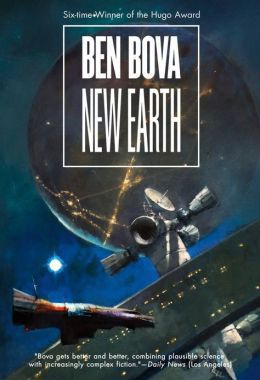
Ben Bova’s New Earth is a spectacular novel that mixes hard sci fi with a touch of space opera. I recently investigated a major theme of the novel: the notion that we may find hope in the stars. Here, we’ll explore some other major themes of the book, including exploration, the possibility of human extinction, and xenophobia. There will be major SPOILERS in what follows.
Exploration
A major theme found in New Earth is the urge to explore and possible benefits thereof. In a conversation between Anita Halleck–a wealthy investor, and Douglas Stavenger–the semi-retired leader of Selene, the independent sovereign nation on the moon, this theme is drawn out most poignantly:
“It’s a big universe,” said Stavenger.
“But what good is it [exploration of “New Earth”]?” she demanded. “What does it accomplish? So they explore another planet. Does that help anybody? Does that solve any real problems?”
…”There are always problems on Earth.[” said Stavenger. “]And here in Selene, too. That shouldn’t stop our push to explore.”
“Where will it end?”
“It won’t end. We keep on exploring, keep on learning. That’s where new knowledge comes from, the frontier. And new knowledge always leads to new wealth, new benefits for everyone.”
“Very philanthropic.”
“Very practical,” Stavenger corrected. (83)
There is some debate now over funding for NASA, for example. What good does it do to send people to the moon? Surely that funding could be better spent on, say, relieving world hunger. In fact, this exact argument is made within New Earth, because the planet Earth is itself suffering from catastrophes caused by global warming, among other issues.
Yet Bova, through Stavenger, makes an argument for exploration: the drive to explore, the imagination; these are things which drive invention and innovation. As Stavenger put it, the drive to explore leads to new wealth and new technology for everyone. It is interesting to see this debate play out in fiction, though this was largely where it dropped… However, one could argue that the ultimate revelation, that humanity was truly on the brink of destruction from the coming apocalypse from a local star, is itself an argument for the success of the project of human exploration.
Environmentalism
Our home planet is in serious trouble in the time of New Earth. Global warming has devastated the environment, causing flooding across coastal regions, precipitation cycles to reorient and move. Drought and inundations of rain alternatively destroy their respective climate zones. Humanity flees the shorelines.
Through this bleak look into humanity’s plight, Bova issues a call for humans now to work against environmental catastrophe. Of course, some dispute the trend towards global warming, but even if global warming is some sort of myth, it seems to me that we must work toward caring for creation in such a way that we minimize our destruction of ecological systems. We are God’s stewards on Earth and so we should work to take care of the gifts of God’s creation.
Of course, in New Earth the consequences of forsaking this gift of God–our charge to care for the Earth–are put into fictional perspective. The destruction to the planet leads to destruction of human life.
Xenophobia
The resistance the human characters have in New Earth to the information presented to them by the “humans” on New Earth is interesting and, in my opinion, helps to characterize the reality of human nature. Many of the humans on the excursion to New Earth are deeply suspicious of the alien life they have found. Moreover, the way they react to the friendliness of the aliens reflects a culture that the aliens (and the sentient machine) view as deeply barbaric. The human tendency to be distrustful, it is said, is due to their evolutionary history and the way that such distrust helped survival.
However, I think this same portrayal has theological significance. Humanity is fallen, and our past is littered with the results of our fallen nature. It is not at all hard to imagine humans reacting just as those did in New Earth. The reality of human nature is such that one cannot but think that no matter how tactfully and amiably such aliens approached us, the reaction would probably be negative. To trust the aliens to tell us about a coming destruction for which we should prepare to survive is to take it to another level.
What does this say about human nature?
Conclusion
Bova’s work New Earth is one of my favorites from one of the masters of science fiction. I’ve already discussed how it explored the issue of hope from the heavens in materialistic literature. Now, we’ve seen how it explores other issues which are both current and historic. Let me know what you think of the themes brought up in the book!
Links
Be sure to check out the page for this site on Facebook and Twitter for discussion of posts, links to other pages of interest, random talk about theology/philosophy/apologetics/movies and more!
Caring for Creation: A discussion among evangelicals– I write about creation care from a number of perspectives offered at a recent panel of prominent evangelical thinkers in this area.
Book Review: “For the Beauty of the Earth” by Steven Bouma-Prediger– Several issues related to the environment and Christian theology are drawn out in this extremely interesting book.
I have discussed the use of science fiction in showing how religious persons act. Check out Religious Dialogue: A case study in science fiction with Bova and Weber.
SDG.
——
The preceding post is the property of J.W. Wartick (apart from quotations, which are the property of their respective owners, and works of art as credited; images are often freely available to the public and J.W. Wartick makes no claims of owning rights to the images unless he makes that explicit) and should not be reproduced in part or in whole without the expressed consent of the author. All content on this site is the property of J.W. Wartick and is made available for individual and personal usage. If you cite from these documents, whether for personal or professional purposes, please give appropriate citation with both the name of the author (J.W. Wartick) and a link to the original URL. If you’d like to repost a post, you may do so, provided you show less than half of the original post on your own site and link to the original post for the rest. You must also appropriately cite the post as noted above. This blog is protected by Creative Commons licensing. By viewing any part of this site, you are agreeing to this usage policy.
Thomas Kinkade and Christianity- What do we learn from “The Painter of Light”?

A favorite of Kinkade’s works.
Thomas Kinkade is a polarizing figure. His art is beloved and hated. Some see the art as picturesque and hearkening back to a simpler time. Others see his art as gaudy and outlandish with terrible lighting effect. Whatever your own view, it must be admitted that an artist with paintings in thousands upon thousands of homes is vastly more influential than most. Here, we will examine Thomas Kinkade’s art from a few different angles.
The image featured in this post, “Sunday Evening Sleigh Ride,” exhibits a number of features of Kinkade’s art. Light is featured prominently. It is used in a kind of spiritual fashion–its warmth beckons from the church to the cold, snow-covered land around it. The viewer’s attention is not upon the sleigh itself, because the light is centered upon the place of worship: the church. Note also the fish symbol displayed above Kinkade’s signature. The image is one of familiarity–particularly for those who are most assuredly Kinkade’s audience: broadly mainstream protestants.
There is something to be had in the image for different parts of the country. The mountains could place it in the winter of Colorado, but the feel of chill found in the image reminds me, at least, of the Midwest. The Northeast may reflect upon their love for sleigh rides. The uniting theme, of course, is found in the call to the church as found in the image.
Others who are better equipped for critique of art have noticed these themes in Kinkade’s work as well. I have been reading through Thomas Kinkade: The Artist in the Mall. The book analyzes Kinkade’s work from a number of angles. Some of the contributors enjoyed his work–or at least appreciated it as art. Others dismissed it as clearly obscene or hideous. One undercurrent in many of the essays was the notion of Kinkade’s professed religious values and how those may come out in his art.
One of the essays actually seemed to accuse Kinkade of specifically exploiting foolish middle-class Protestants through the use of pseudo-religion to cause them to open their wallets and spend money on his works. Another explored the way in which Kinkade consciously displayed light and other features in his artwork to convey a message he clearly conceived of as evangelical, while also appealing to a kind of picturesque, idealistic view of Christian culture (45ff, cited below). The artist viewed nature as imbued with God’s beauty revealed, and felt he should paint it as such (46). In my opinion, the least flattering image portrayed of Kinkade was the essay entitled “The Painter of the Right.” In this essay, Micki McElya basically paints Kinkade’s project as one of glorifying a kind of civil religion of American Christianity (see especially p.73, 76 cited below).
There is clearly a broad spectrum of views as to the project Kinkade pursued through his life. The fact that he plastered his art over coffee mugs, blankets, ornaments, and anything else an image could be placed upon might strike the more cynical as truly an exploitation of the foolish religious masses with money to spend. However, one must wonder whether the sincerity of one’s professed religious beliefs must be reevaluated in light of consumer success. Of course, one might also suggest that Kinkade’s public failings regarding his marriage and alcohol may be grounds for doubting his religious affectation. But again, this would be to act in a fairly Pharisaic manner–to condemn another saint who remains yet a sinner while one is the same. Regardless, it seems there is much to perhaps learn about and from Kinkade, as ridiculous as that may sound to some.
Returning to the art itself, there is little doubt that Kinkade masterfully pursued his project of attempting to subtly evangelize through his art. The image I selected is more obvious than most, but the themes of light and other religious imagery may be found throughout his body of work. Perhaps one may see these as the marks of a man’s dedication to trying to use his skills most fully in the best way he knew how to adhere to his faith. Perhaps not. I tend to favor the former rather than the latter.
Although I realize some of the criticisms of his art may be on-point, I cannot help but be drawn in by his art. I don’t enjoy all of it, but “Sunday Evening Sleigh Ride” is one I particularly do enjoy. I realize it is constructed in such a way as to tug at my heart–I am most certainly part of Kinkade’s target audience–but that does not, in itself, belittle the art’s value. Nor does Kinkade’s own life, which stirred some controversy towards the end, destroy the possibility for his true belief. I’m keen to give people the benefit of the doubt, and I think that Kinkade’s did little to mar his own image as the “Painter of Light.” It is possible to be a sinner-saint, as are all the redeemed in this life. Kinkade’s art may not be your cup of tea, but it should be of interest to see how someone may integrate their faith into their life.
Links
Be sure to check out the page for this site on Facebook and Twitter for discussion of posts, links to other pages of interest, random talk about theology/philosophy/apologetics/movies and more!
Source
Alexis L. Boylan, Editor, Thomas Kinkade: The Artist in the Mall (Duke University Press, 2011).
The image is copyright Thomas Kinkade and I do not claim any credit for it. I am using it under fair use as a critical examination of the artwork. Be sure to check out Thomas Kinkade’s website if you would like to browse his art and purchase it in various forms.
SDG.
——
The preceding post is the property of J.W. Wartick (apart from quotations, which are the property of their respective owners, and works of art as credited; images are often freely available to the public and J.W. Wartick makes no claims of owning rights to the images unless he makes that explicit) and should not be reproduced in part or in whole without the expressed consent of the author. All content on this site is the property of J.W. Wartick and is made available for individual and personal usage. If you cite from these documents, whether for personal or professional purposes, please give appropriate citation with both the name of the author (J.W. Wartick) and a link to the original URL. If you’d like to repost a post, you may do so, provided you show less than half of the original post on your own site and link to the original post for the rest. You must also appropriately cite the post as noted above. This blog is protected by Creative Commons licensing. By viewing any part of this site, you are agreeing to this usage policy.
Visiting Churches: Non-Denominational? Or not?
Copyright Thomas Kinkade; this image just made me think of going to church this past Sunday–cold and snowy.
Over the course of this year, my wife and I, along with some friends, have been visiting a number of different churches in our area (there are many). The reasons for this are manifold, but primarily because we want to use it as a learning experience to see how other church families function, what works, what doesn’t, etc. I have lots of pastor friends/studying to be pastor friends so this is the kind of thing we do for fun! I’ve decided to offer up little reviews of the experience. I’ll not be naming the churches unless it would be made obvious by a comment (we’re planning, for example, to visit the St. Paul Cathedral).
On November 16th, my wife and I ventured out on our own for the experience and visited a local non-denominal (maybe–more on that bit later) congregation that I’d been interested in for some time. Their site also hosts a Japanese service and I thought it would be interesting to see what the church was all about. The web site made it seem possibly Reformed/Calvinist as it used the word “sovereign” for God a lot. I love that word for God (as a Lutheran), but I know that Reformed/Calvinist traditions tend to focus on it as a primary descriptor for God (not saying this is bad, just an observation).
Welcome
Anyway, the members were extremely welcoming. More than any other church I think I’ve been to for the first time. We were greeted at the door, as we hung our coats a member came to introduce herself and ask about our family and whether it was our first time there and to tell us about the church, another family introduced themselves and seemed quite genuinely pleased to have us there, and throughout the time after the service many others came to say hello and greet us. That was a major positive takeaway: we are not greeting well enough! I think it is vitally important to have the assembly be a place in which newcomers are immediately made welcome into Christ’s body.
Worship Format
The service consisted of several songs at the beginning interlaced with very brief prayers. The music was contemporary and lyrically fairly robust. Then there was an offering following a video on the current giving program and the children were dismissed for “Children’s Church” and the sermon/message began. This message was about 1/2 hour long and was on Ephesians 1:1-6. It was followed by two songs and a dismissal.
Commentary
The offering song seemed a bit manipulative, to be honest, as the lyrics–written from the perspective of Christ–were basically “I came down from heaven; what did you do for me?/I bled and died for you; what have you done for me?” etc. Ouch!
The sermon shattered my notion that the church might be Reformed/Calvinist as it was about how Ephesians 1:1-6 teaches that God doesn’t choose those who are condemned but that we choose to be chosen. A quote from D.L. Moody was proffered: “The elect are the whosoever wills; the non-elect, the whosoever won’t.” Yep, not Calvinist. I appreciated, however, the clear attempt to adhere to Scriptural teaching and to make it the norm for faith and life, despite my disagreeing with the interpretation happening (largely decision/choice theology).
They had “Children’s Church” in which all the children under 12 or so years old went to a different room to have some kind of Sunday School (I only observed in passing on way to nursery with Luke, my son). What are thoughts on children leaving for something like this? I admit I’m not a huge fan because it felt like we’re saying children aren’t a part of the body of Christ until a certain age or that if they’re noisy or something they’re distracting. I think that having children as part of the Divine Service is a blessing for both us and them. But I don’t want to over this without other voices. Do you have experience or thoughts related to a practice like this? I’d love to read them.
Overall it was an interesting experience. I haven’t really experienced much non-liturgical styled worship and this made it feel as if I had missed something. The welcoming was wonderful and really set the pace for the rest of the experience.
Also, the church never clearly made it seem like they were part of a denomination, but apparently they are part of the Christian and Missionary Alliance, a denomination founded in 1887 (according to Wiki). I know effectively nothing about this denomination, but there it is.
Have you visited churches recently? What was your experience? Do you have thoughts on “Children’s Church”? What are they?
Links
Be sure to check out the page for this site on Facebook and Twitter for discussion of posts, links to other pages of interest, random talk about theology/philosophy/apologetics/movies and more!
——
The preceding post is the property of J.W. Wartick (apart from quotations, which are the property of their respective owners, and works of art as credited; images are often freely available to the public and J.W. Wartick makes no claims of owning rights to the images unless he makes that explicit) and should not be reproduced in part or in whole without the expressed consent of the author. All content on this site is the property of J.W. Wartick and is made available for individual and personal usage. If you cite from these documents, whether for personal or professional purposes, please give appropriate citation with both the name of the author (J.W. Wartick) and a link to the original URL. If you’d like to repost a post, you may do so, provided you show less than half of the original post on your own site and link to the original post for the rest. You must also appropriately cite the post as noted above. This blog is protected by Creative Commons licensing. By viewing any part of this site, you are agreeing to this usage policy.
Book Review: “Pascal’s Wager” by Jeff Jordan
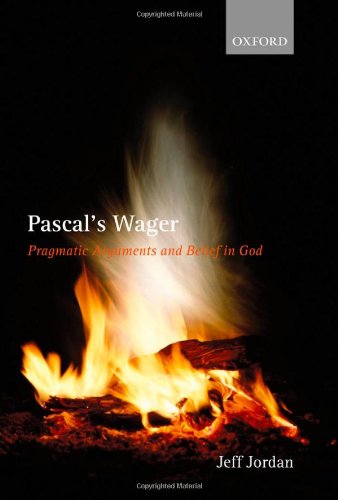
For some time, I’d been wanting to put some effort into studying Pascal’s Wager. I picked up Pascal’s Wager: Pragmatic Arguments and Belief in God by Jeff Jordan in order to familiarize myself more with the philosophical grounding behind the argument. Jordan approaches the Wager through a lens of analytic philosophy and, I think, demonstrates that the argument has some force to it.
Jordan’s work has great scope. Several aspects of the Wager are brought to light. He analyzes several different formulations of the argument, while also noting where the argument has been changed or modernized. For example, the notion that Pascal’s Wager was infinite bad vs. infinite good is a more recent innovation than Pascal’s original argument.
He studies the argument contextually to determine whether the Wager was intended as a generalized theistic proof or an argument for Christianity. Numerous objections from leading critics of the Wager are put to the test. Ultimately, a version of the Wager developed by William James is put forward as an argument that passes the philosophical muster. Jordan analyzes this argument from many angles, ultimately demonstrating that it overcomes the challenge of the “many gods” objection and provides grounds for Christian faith.
The value of Pascal’s Wager may is increased by the fact that many aspects of Jordan’s work are applicable to other arguments or areas of interest for philosophers of religion and apologists. For example, Jordan raises significant challenges to the notion that philosopher’s fictional deities may actually be counted as evidence for a “many gods” objection (75-76; 80-81). Another example is a rather interesting argument he derives from the work of James Beattie (1735-1803- Jordan notes Beattie is at times rightly accused of misrepresenting Hume’s arguments) about whether attempts to deconvert might bring about pragmatic wrongs (190-194). These and other tantalizing topics command even more interest than the book might otherwise have had.
Simply put, Pascal’s Wager: Pragmatic Arguments and Belief in God is a phenomenal, thought-provoking work that will have readers rethinking their evaluation not only of the (in)famous Wager but also of a number of related topics. Even at its steep price tag, the book is a bargain.
Links
Be sure to check out the page for this site on Facebook and Twitter for discussion of posts, links to other pages of interest, random talk about theology/philosophy/apologetics/movies and more!
Pascal’s Wager: The Utility Argument Examined– I outline and defend one of the versions of Pascal’s Wager which Jordan brings up in this work. I find it to be a very interesting argument and a great addition to the apologist’s toolkit.
Source
Jeff Jordan, Pascal’s Wager: Pragmatic Arguments and Belief in God
SDG.
——
The preceding post is the property of J.W. Wartick (apart from quotations, which are the property of their respective owners, and works of art as credited; images are often freely available to the public and J.W. Wartick makes no claims of owning rights to the images unless he makes that explicit) and should not be reproduced in part or in whole without the expressed consent of the author. All content on this site is the property of J.W. Wartick and is made available for individual and personal usage. If you cite from these documents, whether for personal or professional purposes, please give appropriate citation with both the name of the author (J.W. Wartick) and a link to the original URL. If you’d like to repost a post, you may do so, provided you show less than half of the original post on your own site and link to the original post for the rest. You must also appropriately cite the post as noted above. This blog is protected by Creative Commons licensing. By viewing any part of this site, you are agreeing to this usage policy.
Sunday Quote!- The Failure of Scientism
 Every Sunday, I will share a quote from something I’ve been reading. The hope is for you, dear reader, to share your thoughts on the quote and related issues and perhaps pick up some reading material along the way!
The Failure of Scientism
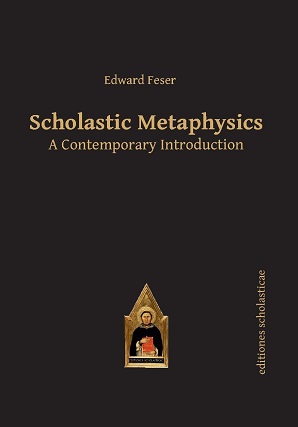
Edward Feser is a profoundly brilliant scholar. Every time I read something he writes–even if I disagree–I realize I must contend with his argument. In his latest book, Scholastic Metaphysics: A Contemporary Introduction, he provides a robust look at the ways in which Scholastic philosophy and Thomism may be applied to the modern day. He touches on any number of important and interesting topics, including scientism–the notion that the physical sciences are the only way to know anything. But he doesn’t have much nice to say about scientism:
[T]he glib self-confidence of its advocates notwithstanding, there are in fact no good arguments whatsoever for scientism, and decisive arguments against it… First, scientism is self defeating… Second, the scientific method cannot even in principle provide us with a complete description of reality. Third, the ‘laws of nature’ in terms of which science explains phenomena cannot in principle provide us with a complete explanation of reality. Fourth, what is probably the main argument in favor of scientism–the argument from the predictive and technological successes of modern physics and the other sciences–has no force. (10)
Now of course this is quite a bit to swallow, and Feser expands on these points over the next several pages, arguing that each of these points demonstrates the failure of scientism.
I’m still going through the book, but it has been a fantastic read so far.
Links
Be sure to check out the page for this site on Facebook and Twitter for discussion of posts, links to other pages of interest, random talk about theology/philosophy/apologetics/movies and more!
Sunday Quote– If you want to read more Sunday Quotes and join the discussion, check them out! (Scroll down for more)
Source
Edward Feser, Scholastic Metaphysics: A Contemporary Introduction
SDG.
“Star Wars: Darth Plagueis” by James Luceno- Morality, Darkness, and Politic

Science fiction is such an amazing genre for exploring issues of worldview. Here, I’m taking a look at Star Wars: Darth Plagueis, a book which explores the rise of Emperor Palpatine and his Sith Master before the events of the Prequel Trilogy. I’ll not summarize the plot, but interested readers can see the plot highlights along with my review of the book in my post on Eclectic Theist- Star Wars Expanded Universe Read-Through- Darth Plagueis.
Morality: What is it, really?
The Sith approach morality as something which is not evil, not divided as good vs. evil. One account of their approach to morality can be found poignantly stated in Darth Plagueis as Plagueis works to recruit Palpatine for the Sith:
Palpatine cut his eyes to Plagueis. “The Sith are considered to be evil.”
“Evil?” Plagueis repeated. “What is that? …Are you evil, or are you simply stronger and more awake than others? Who gives more shape to sentient history: the good, who adhere to the tried and true, or those who seek to rouse beings from their stupor and lead them to glory?” …
Palpatine’s lip curled in anger and menace. “Is this the wisdom you offer–the tenets of some arcane cult?”
“The test of its value is whether you can live by it, Palpatine” [Plagueis replied]. [179-180]
The exchange is chilling for a number of reasons. It is the kind of conversation which one can see play out in various discussions of ethics today. Relativists allow individuals to self-define what is right and wrong and would have no answer to the reasoning of the Sith. Pragmatists also fail to grasp the ultimate outcome of their moral system, which allows for the strong to dominate those whom they choose to dominate. The ends justify the means; or, perhaps more accurately, there need be no justification.
Only systems of morality which allow for objective good and evil have any answer for the reasoning of the Sith. Only with a strong sense of morality can their blurring of what is right and wrong be overcome.
Controlling the Others
There are many points throughout the book in which the concept of control is explored. The Sith believe that they have an imperative to rule and control others. After all, they are strong! One interesting element of this reasoning is the notion that those in charge should operate by one abiding principle: “We know what’s best for you” (204). The insidious nature of this teaching should be immediately obvious. Whenever people decide that they know better than others how those others should live/act/believe, suffering tends to follow. This is not to say that we should never work to change others, but rather that we should not rationalize it by means of thinking we are somehow inherently superior to the “Other.”
Conclusion
Darth Plagueis is a fantastic book in the Star Wars Expanded Universe, and it additionally has a number of philosophical questions ripe for exploration. Christians should work to engage with works of fiction because so often the allow for analysis of and interaction with the Christian worldview. Here, we find that the Christian’s basis for absolute morality is able to trump other moral systems which cannot provide a sound basis for critique of the Sith or others. Yet while acknowledging that one system has the truth, we should never seek to impose it on others because of some sense of superiority. Every story has a worldview.
Links
Be sure to check out the page for this site on Facebook and Twitter for discussion of posts, links to other pages of interest, random talk about theology/philosophy/apologetics/movies and more!
Star Wars: Fate of the Jedi- a Christian reflection on the most recently completed Star Wars series– I have written on another set of Star Wars books from a Christian perspective in this post, which features the Fate of the Jedi series. Discussions of world religions are prominent throughout the set.
Star Wars Expanded Universe Read-Through- Darth Plagueis– I review the book from the perspective of a huge Star Wars fan.
Source
James Luceno, Darth Plagueis (New York: Del Rey, 2012).
Disclaimer: The images in this post are copyright of the Star Wars universe and I use them under fair use. I make no claims to ownership of the images.
SDG.
——
The preceding post is the property of J.W. Wartick (apart from quotations, which are the property of their respective owners, and works of art as credited; images are often freely available to the public and J.W. Wartick makes no claims of owning rights to the images unless he makes that explicit) and should not be reproduced in part or in whole without the expressed consent of the author. All content on this site is the property of J.W. Wartick and is made available for individual and personal usage. If you cite from these documents, whether for personal or professional purposes, please give appropriate citation with both the name of the author (J.W. Wartick) and a link to the original URL. If you’d like to repost a post, you may do so, provided you show less than half of the original post on your own site and link to the original post for the rest. You must also appropriately cite the post as noted above. This blog is protected by Creative Commons licensing. By viewing any part of this site, you are agreeing to this usage policy.

 J.W. Wartick - Reconstructing Faith