J.W. Wartick
Book Review: “To the Ends of the Earth” by Michael Haykin and C. Jeffrey Robinson Sr.
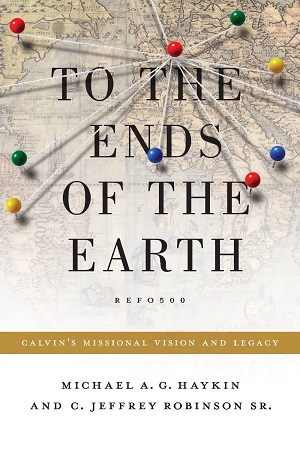 The question of “Why evangelize?” is one which is often leveled against Calvinism. After all, it is reasoned, if people are fore-ordained to be elect or one of the damned, then why bother to go out and evangelize them? Interestingly, this is a charge which I think may be leveled against virtually any view of foreknowledge, so the Calvinist answers given in To the Ends of the Earth: Calvin’s Missional Vision and Legacy
Contents
The book begins with a survey of the arguments made to suggest that Calvinism would not endorse evangelism or makes evangelism pointless. Clearly, the charge has come from many fronts throughout the history of the church. Then, Haykin and Robinson introduce the primary reason for others’ concerns about Calvinism’s evangelical prospects: that Calvin believed God had ordained some to be elect, and others to be damned, before the foundations of the world.
The authors defend the doctrine, taking on many of the key “all” passages which some argue make explicit the openness of salvation to all individual people. Calvin is brought to his own defense alongside a number of modern Calvinist theologians, ably presenting the Calvinist case for exegesis of these key passages, which basically is that when “all” or “world” is used, it is referring to the breaking open of salvation for all tribes and nations as opposed to merely the chosen people of Israel. The book goes beyond these basics and also outlines how other passages might be understood in this context.
Next, the authors turn to an exposition of Calvin’s theology of missions. Part of this theology was the notion that a Christian life lived was a profound witness to the Gospel. Word and deed were central to Calvin’s missions theology. This missional activity was to be for all people (Kindle location 993). Prayer was also central to Calvin’s theology, as he believed that it might be used by God to bring about change in persons (rather than change in God).
Historical Reformed missions are surveyed in the next sections. Calvin taught many going into France and certain torture and death if discovered, and even made significant efforts towards (ultimately failing) missions into Brazil. These efforts showed that through his actions, Calvin himself valued global missions.
Later Calvinist traditions and persons also demonstrated the urge to missions that the Reformer’s theology compelled. The Puritans sought to evangelize and frequently prayed for the same, though they may not have had the success of other contemporaries. Calvinist Baptists in England feverishly evangelized and planted churches, while also demonstrating concern for global evangelism (Kindle loc. 1420ff). Jonathan Edwards, contrary to some opinions, was also focused on missions by developing his own missional theology and also going on a mission to Native Americans himself.
The book closes with thoughts on “developing missional passion” through observations about Samuel Pearce, a theologian known in his time for fervent prayer and love of missions. Central to Pearce’s theology was the cross; Christ crucified was “his darling theme from first to last”; while the other primary theme of his life was a “passion for the salvation of his fellow human beings” (Kindle loc. 1978).
Evaluation
To the Ends of the Earth is a great, pithy read on a topic that should be of interest to many from a diverse array of backgrounds. It has appeal which goes beyond Calvinism in the way it demonstrates missions ought to be of central importance and also in its justification of missions even in light of the notion that there really do exist an elect people. Of course, the thrust of the book is to demonstrate that Calvinist theology does not undermine the need or motivation for missions. Those interested in that topic will find the most to benefit from the book. Regardless of one’s level of interest, however, the book generates its own avenues for exploration by introducing several little-known figures and historical events for further reading. It is short enough to enjoy in a single afternoon (as I did), yet deep enough to keep one’s mind occupied for some time afterwards.
Perhaps the greatest weakness of the book, however, is its length in that there is little ultimate exposition of the counter-arguments to those who would fault Calvinism with lack of evangelical fervor. That is, readers are often left to tie the arguments off themselves instead of having them drawn out and defended. This, however, is a minor fault in what is an otherwise excellent book, regardless of one’s position on the arguments made therein. It was well worth the read, in my humble opinion.
Links
Be sure to check out the page for this site on Facebook and Twitter for discussion of posts, links to other pages of interest, random talk about theology/philosophy/apologetics/movies and more!
Source
Michael Haykin and C. Jeffrey Robinson, Sr., To the Ends of the Earth: Calvin’s Missional Vision and Legacy
Disclaimer: I received a review copy of the book through Crossway. I was not obligated by the publisher to give any specific type of feedback whatsoever.
SDG.
——
The preceding post is the property of J.W. Wartick (apart from quotations, which are the property of their respective owners, and works of art as credited; images are often freely available to the public and J.W. Wartick makes no claims of owning rights to the images unless he makes that explicit) and should not be reproduced in part or in whole without the expressed consent of the author. All content on this site is the property of J.W. Wartick and is made available for individual and personal usage. If you cite from these documents, whether for personal or professional purposes, please give appropriate citation with both the name of the author (J.W. Wartick) and a link to the original URL. If you’d like to repost a post, you may do so, provided you show less than half of the original post on your own site and link to the original post for the rest. You must also appropriately cite the post as noted above. This blog is protected by Creative Commons licensing. By viewing any part of this site, you are agreeing to this usage policy.
On the Feminization of Christianity
Christianity is being feminized–men just don’t go to church anymore!
Worship is so feminine now, with all of its appeals to emotions.
Christianity has a “masculine” feel to it.

I had a conversation recently in which several men were bemoaning the “feminization of Christianity,” particularly worship. I asked them what they meant by this and one man illustrated it with a story: he was at a church one time and this guy was up front singing this lovey-dovey song he had written about how Jesus loved him and wanted to hold him or something and he–the one telling the story–thought it was ridiculous. This, he said, was an example of the feminization of worship. It makes men leave the church.
I pointed out that his example was about a man singing a song written by a man–himself–leading worship in a church in which (the man had told me) the only leaders were men. He nodded and reiterated his point. …This, it seems, is the result of feminizing the church.
I thought that was rather odd, to be frank, but the conversation has stuck with me for its message. I’ve had many like it over the past year or two. I’ve seen fellow bloggers post on this apparently insidious trend of the “feminization of Christianity.” A prominent apologist recently issued a similar complaint, noting that worship has gotten more “emotional” and therefore more “feminine.” Some theologians and books I’ve read have had similar concerns about this “feminine” aspect being brought into churches. Apparently, from my reading of these sources and the conversations I’ve had, the message is that this is A Bad Thing.
Do you really think that Christianity is masculine? What does that even mean?
What does it mean to say worship is “feminine” or “masculine”? Does that mean that if I, a man, worship, then my praise is somehow “manly,” while my wife’s praise is “womanly”?
I want to focus on this notion that “feminization of Christianity” is A Bad Thing. What does this say about men and women?
It seems to me that if feminizing Christianity inherently makes it somehow deficient, then that means females are also deficient. If “feminized” worship is bad, or at least not as good as “masculine” worship–whatever either one of those things means–then that means that what are identified as male patterns of worship have higher value. But can such patterns really even be identified? If “feminization of the Church” is to be avoided, while making it more “masculine” is to be lauded, then what does that say about our position, male and female, as the image of God? On the one hand, humanity, male and female, were each created in God’s likeness, in the image of God. On the other, we are told that “feminine” themes within Christianity are to be avoided and downplayed, while “masculine” themes are to be pursued and emphasized.
The most common answer I’ve gotten to questions about the nature of masculine or feminine worship is that that which is feminine is emotional or passive, while masculine is rational or active. I would like to ask: how is this reflected in God’s Word? Recall that God gets angry (Psalm 7:11) or grieved by sin (Genesis 6:6), takes pleasure in obedience (Psalm 147:111), delights (Zephaniah 3:17), etc. God is a God with emotions and whether we set this aside as anthropomorphism or not, it seems clear that Scripture understands God not rejecting emotions but rather, in some sense, taking part in them. But if God’s Word does not denigrate emotions and even attributes them to God, why should we not worship in emotional ways? And why are emotions treated as something to be avoided, as necessarily feminine and somehow not good, or at least not as good as that which is identified as masculine?
I’m not trying to advocate for one side or the other in the so-called “worship wars.” Instead, my point is that the narrative of complaints about the “feminization of Christianity” is misguided and far from the truth. Being female is not bad, nor is it somehow less perfect than being male. Similarly, having a “feminine” Christianity is not an imperfection. To be honest, I’d like to call my Christian brothers and sisters to a more complete understanding of God and God’s word.
There is hope for us that applies to us all as people:
There is neither Jew nor Gentile, neither slave nor free, nor is there male and female, for you are all one in Christ Jesus. – Galatians 3:28
These are words of hope, words of reconciliation. But they are also words which cut against the notion that in our church there is masculine worship vs. feminine worship; masculine music vs. feminine music; masculine sermons vs. feminine ones. “Nor is there male and female… you are all one in Christ Jesus.” My heart leaps at these words. These words tell me I need have no fear, for our God–a great God–has reconciled us in our Lord Jesus Christ.
Links
Be sure to check out the page for this site on Facebook and Twitter for discussion of posts, links to other pages of interest, random talk about theology/philosophy/apologetics/movies and more!
Check out my posts on egalitarianism – the belief that men and women are equally qualified and called in the church and home (scroll down for more).
I found the image on Bing searching for images of worshipers in church and I claim no rights to it and saw no claims to rights upon it.
SDG.
——
The preceding post is the property of J.W. Wartick (apart from quotations, which are the property of their respective owners, and works of art as credited; images are often freely available to the public and J.W. Wartick makes no claims of owning rights to the images unless he makes that explicit) and should not be reproduced in part or in whole without the expressed consent of the author. All content on this site is the property of J.W. Wartick and is made available for individual and personal usage. If you cite from these documents, whether for personal or professional purposes, please give appropriate citation with both the name of the author (J.W. Wartick) and a link to the original URL. If you’d like to repost a post, you may do so, provided you show less than half of the original post on your own site and link to the original post for the rest. You must also appropriately cite the post as noted above. This blog is protected by Creative Commons licensing. By viewing any part of this site, you are agreeing to this usage policy.
Sunday Quote!- Reframe the Origins Debate?
 Every Sunday, I will share a quote from something I’ve been reading. The hope is for you, dear reader, to share your thoughts on the quote and related issues and perhaps pick up some reading material along the way!
Reframe the Origins Debate?
I have been going through a number of books in the Zondervan Counterpoints series and completed Three Views on Creation and Evolution
Is the creation’s formational economy sufficiently robust (that is to say, is it equipped with all the necessary capabilities) to make it possible for the creation to organize and transform itself from elementary forms of matter into the full array of physical structures and life-forms that have existed in the course of time? (Van Till 185-186, cited below)
Howard J. Van Till is a theistic evolutionist (he does not like the term–or at least did not at the publication of this book), and he views that position as a “fully gifted creation”–one in which God, on creating, imbued creation with the capacities to develop naturally over the course of time. This is the “economy of creation” in which–according to Van Till–God created without the need for continual intervention.
Now, so far as this reframing is concerned, it seems to me that Van Till, in attempting to avoid the either/or dichotomy between creation and evolution, went a bit to the other extreme. Putting a word like “robust” in there suggests that anyone who would disagree is clearly questioning the capacity of the Creator in creating. However, I do think there is something to the notion that we do need to rethink exactly where the lines form in the origins debate. I have written on the various options for Christian origins positions and I think that we need to be aware of the fact there is more to it than even “three views” could begin to outline.
Regarding the question itself: what do you think? Do we need to outline the origins debate with different terms so that we can avoid a false dichotomy? Moreover, do you think that creation is indeed set up in such a way?
Links
Be sure to check out the page for this site on Facebook and Twitter for discussion of posts, links to other pages of interest, random talk about theology/philosophy/apologetics/movies and more!
What options are there in the origins debate? – A Taxonomy of Christian Origins Positions– I clarify the breadth of options available for Christians who want to interact on various levels with models of origins. I think this post is extremely important because it gives readers a chance to see the various positions explained briefly.
Sunday Quote– If you want to read more Sunday Quotes and join the discussion, check them out! (Scroll down for more)
Source
Howard J. Van Till, “The Fully Gifted Creation: ‘Theistic Evolution'” in Three Views on Creation and Evolution
SDG.
Question of the Week: What’s your favorite “worldview” movie?
 Each Week on Saturday, I’ll be asking a “Question of the Week.” I’d love your input and discussion! Ask a good question in the comments and it may show up as the next week’s question! I may answer the questions in the comments myself.
Worldview Movie
One of my favorite activities is to go to the movies and evaluate a film from a Christian worldview perspective. In light of that, I wanted to ask you, dear reader:
What’s your favorite movie in regards to the way it portrays a worldview? Why?
When we watch a movie, we must always realize it has a “worldview” in it. What movie has impacted you most in the way it portrays a worldview? Let’s hear it, in the comments.
Links
Be sure to check out the page for this site on Facebook and Twitter for discussion of posts, links to other pages of interest, random talk about theology/philosophy/apologetics/movies and more.
Book Review: “Hollywood Worldviews” by Brian Godawa– Speaking of worldviews in the movies, why not check out my review of this book which seeks to provide a method for analyzing film from a worldview perspective? Let me know what you think.
Engaging Culture: A brief guide for movies– I outline my approach to evaluating movies from a worldview perspective.
I have a number of ways in which I have critically engaged with culture in movies, books, and other arts in my posts on current events (scroll down for more posts).
SDG.
Really Recommended Posts 6/6/14- Hell, Pterosaurs, cessationism, and more!

I have once more found a number of excellent reads from all over the web before you, dear reader! Check out the list of topics: the continuation (or lack thereof) of spiritual gifts, a famous paleontologist–Mary Anning, gender and theology, wonder of God, and Hell. Oh yes, how’s that for a broad list? Anyway, be sure to drop a comment to let me know what you thought!
Does Cessationism Still Stand?– Cessationism is the view that spiritual gifts like prophecy, healing, and the like “ceased” after the apostolic period. Here, one author responds to a cessationist critique.
Mary Anning, Plesiosaurs, Pterosaurs, and the Age of Reptiles– Google recently had a celebration of Mary Anning on the search page. What’s the big deal? Here, Joel Duff explores some of the implications of Mary Anning’s discoveries about the “Age of Reptiles.” Want to read more on big lizards and time scales? Check out my post about dinosaurs, Noah’s Flood, and creationism.
Power, Gender, and Evangelicals: Ideas Have Consequences– What does it mean to say that “ideas have consequences”? Should women rely entirely upon men to shape their identity in Christ? Check out this excellent post exploring some if these and related issues.
Stars, sand, and God (Comic)- How important are you in the grand scheme of things? What does the massive scale of our universe say about God? In this comic, we are invited to bask in God’s glory.
Book Plunge: Rethinking Hell– The book Rethinking Hell asks us to do just that; consider hell as not eternal torment or punishment but rather annihilation. Check out this insightful review of the book.
Book Review: “Chance and the Sovereignty of God” by Vern Poythress
 When I saw the title Chance and the Sovereignty of God: A God-Centered Approach to Probability and Random Events, I pounced on the opportunity to review it. This is a topic I’ve been considering for doctoral work so I was extremely excited to dive in.
The book starts off well, with discussions on the nature of chance and exploration of the biblical material for anything dealing with seemingly random events. Poythress ably shows that the Bible clearly presents God as in control of all these events. Numerous verses suggest that God is in control over “all” events, while verses which explicitly mention seemingly random or chance occurrences also attribute such events to divine knowledge and control. Poythress’ look into these topics is detailed and broad. He addresses the weather, random events like the toss of a die, human free choices, the life and death of the smallest creature or plant, and even gambling! These things are all argued to be ultimately, biblically under the sovereignty of God.
Another area the book excels in is the discussion of chance in rival worldviews. Any view which denies the centrality of God is one which suppresses the knowledge of God (Romans 1). Poythress notes that this means that “chance” may become a God-substitute. Chance is seen as being not only the explanation of events but their actual cause:
People are implying that [Chance] has the power to bring about events… The word chance first gets associated with events that we as humans cannot predict or explain… Then, in a second step… [Chance] becomes a label that we offer as the new explanation for the unpredictable event… We say “Chance brought it about”… (Kindle Location 1707)
Chance as an explanation, Poythress argues, is ultimately empty. For chance is substituted to become whatever we cannot predict or explain, and is then used itself as the explanation. I found Poythress’ comments here interesting and very insightful. His application of this concept to other worldviews later in the book makes it worth the read for these sections alone.
One difficulty with the book is the question of audience. At times, the discussion of probability theory becomes complex and very scholarly, but the earlier sections of the book speak broadly and with words that seem aimed more at a general readership. This mixture of technical and general writing makes it hard to pinpoint the audience. Who is supposed to read this book? What is it supposed to be used for?
Another problem I saw in the book is the lack of thorough argumentation for many points. No complaint of this nature may be lodged against the book’s discussion of probability theory, which is well fleshed-out. But on God’s relation to probability theory and how that relates back to sovereignty, there are often only a few sentences at a time to make a claim about the nature of the interrelationship. For example, throughout Section IV on “Probability and Mathematics,” there are lengthy discussions of probability theory with passages on how it relates back to God seemingly tacked on throughout. Near the beginning of this section, one sample is representative:
Both of these [mathematical] principles [discussed above] have their foundations in God… The separations within this world have their ultimate foundation in the distinction among the persons of the Trinity… The unity and diversity in outcomes rest… on the original pattern of unity and diversity in God. God has caused the creation to reflect his glory and wisdom. (Kindle Location 3346)
Poythress does make some earlier references to this argument, but it just never seems to be fully established and surely a statement about mathematical separations for probability in the world being a reflection of distinction among persons in the Trinity may cause some skepticism. It is a point which begs for more argumentation than was dedicated to it here. Where Poythress does address it (Chapter 11), we find more detail to the arguments, but even more questions left unanswered. For example, granting that God is revealed in all things which are made, why think that a sequence of flipping coins is explicitly a revelation of the Trinity instead of simply a revelation of God’s imbuing the universe with order and regularity so that seemingly random events are possible? But Poythress takes it as the former–a revelation of the Trinity–without so much as a comment on alternative possibilities.
Perhaps more problematic is that Poythress never seems to tackle the broader implications of his biblical argumentation. Yes, he put much work into showing God is sovereign over the weather, chance events, free will, and the like. But I kept thinking, “And now what?” What does it mean to say God is in control over natural disasters? What does it mean to say that the roll of dice I make in a game of Risk, for example, is controlled by God? What are the implications of the biblical data Poythress has set before me? Topics like these are taken up at points, only to be quickly set aside by a paragraph or even just a sentence or two.
Overall, Chance and the Sovereignty of God is an interesting look at an oft-neglected topic, but its scope is too broad and its argumentation at times too vague to be helpful. On biblical issues Poythress has offered much to consider. His outline of probability theory is helpful but technical. What I found after reading the book is that I continued to hope for a more detailed discussion on how sovereignty would interlink with chance. Yes, the book makes it plain that God has sovereignty over seemingly random events, but exactly how does that work? What does that mean for everyday life? At times these topics are taken up, only to be set down after but a few sentences. At times helpful and stunningly insightful, at other times frustratingly vague and broad, it’s a book that will leave you longing for more.
Links
Be sure to check out the page for this site on Facebook and Twitter for discussion of posts, links to other pages of interest, random talk about theology/philosophy/apologetics/movies and more!
Source
Vern Poythress, Chance and the Sovereignty of God: A God-Centered Approach to Probability and Random Events (Wheaton, IL: Crossway, 2014).

Disclaimer: I received a review copy of the book through Crossway. I was not obligated by the publisher to give any specific type of feedback whatsoever.
SDG.
——
The preceding post is the property of J.W. Wartick (apart from quotations, which are the property of their respective owners, and works of art as credited; images are often freely available to the public and J.W. Wartick makes no claims of owning rights to the images unless he makes that explicit) and should not be reproduced in part or in whole without the expressed consent of the author. All content on this site is the property of J.W. Wartick and is made available for individual and personal usage. If you cite from these documents, whether for personal or professional purposes, please give appropriate citation with both the name of the author (J.W. Wartick) and a link to the original URL. If you’d like to repost a post, you may do so, provided you show less than half of the original post on your own site and link to the original post for the rest. You must also appropriately cite the post as noted above. This blog is protected by Creative Commons licensing. By viewing any part of this site, you are agreeing to this usage policy.
Dinosaurs, Noah’s Flood, and Creationism- An ecological challenge
 I recently visited the Science Museum of Minnesota to check out the exhibit “Ultimate Dinosaurs” which features a number of dinosaurs which aren’t typically displayed in North America. I heard one other museum-goer talking about how they always thought that dinosaurs just were dinosaurs–that they were the same all over the Earth. But they weren’t! In fact, there is great diversity in the types of dinosaurs found in different parts of the world. Some are found all over North America; others are restricted to small parts of Africa or South America.
That got me thinking on creationism. A standard young earth creationist account of the history of the world would state that dinosaur fossils are found where they lay because the Flood put them there. Many YEC accounts are catastrophic in nature, arguing that the Flood recreated the surface of the Earth and left most or all of the layers of sediment we now observe. The dinosaurs (and other creatures) we find were swept up in the Flood and then laid down once the water had settled.
Pictured above and left, there is a fossil of a Suchomimus. Suchomimus was a fish-eating dinosaur which has only been found in Niger, Africa. According to standard scientific explanations, it lived in the Early Cretaceous period, about 121-112 million years ago. According to a young earth creationist account, this dinosaur died either during the Flood or migrated to the location it was found after the Flood. Either way, this was no more than a few thousand years ago. Pictured below and to the right, there is a fossil of a Tyrannosaurus Rex. It lived in the Late Cretaceous period, about 66-67 million years ago and ranged across what is now North America. Again, a young earth creationist account would have it dying during the flood or going extinct afterwards.
 The Young Earth Creationist Explanation- A problem?
The young earth creationist (YEC) account is once more generally based upon the notion that the Noachian Deluge deposited these fossils where they are now found. The Flood is to explain how these fossils ended up in their present locations.
The fact that dinosaurs are found in different parts of the planet–and only in those parts–suggests an interesting problem for YECs: How is it that such a catastrophic event managed to destroy the surface of the Earth and then remake it through layers while creating the illusion of localized ecosystems at different points in history?
Such a challenge should not simply be dismissed. YEC literature sometimes suggests that the fossilized ecosystems which are proposed in different parts of the world at different (millions of years ago) times are merely products of the Flood depositing the fossils where they now lay. For example, according to YEC literature, many scientists believe that there was an ancient sea over North America merely because the Flood happened to deposit a bunch of mosasaur fossils and other marine life in a certain layer of the sediment it laid down.
The observed evidence, however, goes against this notion. Consider the Suchomimus (pictured above, left) once more. It has been found only in a localized area in what is now Africa. It is nearly certain it was a fish eater. This notion is not a mere product of accidental laying down of fish fossils near and around where Suchomimus has been found. Instead, it is based upon observational evidence. First, its large claws seem perfectly adapted to snagging large lungfish along the shore (large lungfish fossils have been found in the same area). Second, its narrow skull lined with extremely pointy teeth suggest a fishy diet, as it is once more adapted to eating them. Third, and most telling, fish fossils have been found with tooth marks from Suchomimus on their bones.
So what? How does this bring up a problem for YEC? Well, to put it simply, it demonstrates that the localized ecosystem found near and around Suchomimus is not a mere random product of fossils being jumbled together and then deposited during the Flood. Instead, predator and prey are found in a localized environment with other fossil specimens that fit neatly into the same ecosystem. But on the YEC account, how could this happen? Surely it would be an astounding happening if an entire ecosystem were swept away by the Flood, jumbled up with others along with sediment and the like, subjected to tidal waves across the surface, and then neatly deposited in a localized area, preserving that same ecosystem.
 A Possible Alternative
Some YECs (such as Kurt Wise) have instead suggested that the Flood did not destroy the whole surface of the Earth but was rather providentially brought about by God along with catastrophic plate tectonics. On this scenario, water rapidly rose and covered the face of the Earth, bringing with it sediment and the like which rapidly buried such localized ecologies.
Setting aside difficulties with such a scenario related to the means by which it would have allegedly occurred, it should be clear that this explanation is at least somewhat more palatable. It doesn’t turn ecosystems into mere fictions. However, this scenario doesn’t solve everything. For example, why are there separate and distinct ecosystems, one atop the other, in the same place? Going to North America, Tyrannosaurus Rex has been found across much of what is now North America. Again, we find prey with T-Rex tooth marks in their bones and the like. We have preserved ecosystems from this time. But different places (like the inland sea I discussed here) feature what appears to be a marine environment. Moreover, different layers, like those exposed through glaciation in the upper Midwest, show entirely different (and seemingly more primitive) marine lief. This raises a number of issues, most of which are relevant for any alleged Flood scenario.
First, if the Flood was a sudden event which covered the face of the Earth and thus preserved ecosystems in place, how did it manage to kill off and bury so much marine life? It seems like it must have been gentle enough to preserve the fossil evidence, so why did the marine life not simply swim away and get scattered across other layers as it died? Second, how do we have distinct and separate ecosystems preserved in different layers, one atop the other? Again, the suggestion was that ecosystems were preserved in place–so why do some places have different ecosystems above one another? Third, why are the types of sediment laid down distinct for each ecosystem? If the sediment was all due to one event, then why does the sediment type match the ecosystems which it buries?
 The Balance of Evidence
At this point, I think we must remember that we may evaluate such claims from a number of angles. First, the YEC explanations seem very ad hoc–that is, they are invented by adjusting the Flood scenario (or some other device like distant starlight moving faster)–in order to explain away the difficulties rather than pursuing the evidence. It is reactionary rather than investigative. [I edited this line after some insight from a comment below.]
Second, realistically, which portions of the YEC explanation might be found in the Bible, if any? Having read the accounts of the Flood and Creation many times, I have to say I have never once spotted a place wherein it discusses the distribution of dinosaurs, the way the Flood laid down sediment, or any number of things put forward by YECs.
Third, when YECs and others are offering alternative scientific explanations–i.e. an explanation for “how did this [dinosaur] get here?”–they must deal with the fact that we’re looking for the most likely explanation. As I discussed in another post on dinosaurs and creationism, the proposed alternative YEC explanation is very clearly more complex and less likely than that of the one already offered–that the dinosaurs simply existed at different times and/or in different places over the course of history. We should be honest in our evaluations of evidence and look to see which explanation is more likely. Remember, we should be investigating the evidence while trying to stay free of any a priori assumptions about what must have happened and instead look at the evidence to see which explanation best fits. As I pointed out in the post linked above, proposing a global catastrophic Flood as the alternative hypothesis demands an enormous burden of proof.
Links
Be sure to check out the page for this site on Facebook and Twitter for discussion of posts, links to other pages of interest, random talk about theology/philosophy/apologetics/movies and more!
“Oceans of Kansas,” Unexpected Fossils, and Young Earth Creationism– I discuss the alleged findings out out-of-sequences fossils in the fossil record and how YEC explanations fail to show they are attributable to a global catastrophic Flood.
What options are there in the origins debate? – A Taxonomy of Christian Origins Positions– I clarify the breadth of options available for Christians who want to interact on various levels with models of origins. I think this post is extremely important because it gives readers a chance to see the various positions explained briefly.
The photographs in this post were taken by me at the Science Museum of Minnesota with permission. Any use of these pictures should be only with express, written consent. The map is an image created by BBC and I do not claim any rights over it but use it through fair use.
SDG.
——
The preceding post is the property of J.W. Wartick (apart from quotations, which are the property of their respective owners, and works of art as credited; images are often freely available to the public and J.W. Wartick makes no claims of owning rights to the images unless he makes that explicit) and should not be reproduced in part or in whole without the expressed consent of the author. All content on this site is the property of J.W. Wartick and is made available for individual and personal usage. If you cite from these documents, whether for personal or professional purposes, please give appropriate citation with both the name of the author (J.W. Wartick) and a link to the original URL. If you’d like to repost a post, you may do so, provided you show less than half of the original post on your own site and link to the original post for the rest. You must also appropriately cite the post as noted above. This blog is protected by Creative Commons licensing. By viewing any part of this site, you are agreeing to this usage policy.
Sunday Quote!- Scripture Reports Things that Didn’t Happen?
 Every Sunday, I will share a quote from something I’ve been reading. The hope is for you, dear reader, to share your thoughts on the quote and related issues and perhaps pick up some reading material along the way!
Scripture Reports Things that Didn’t Happen?
I finished reading Four Views on The Historical Adam recently, and it gave me a lot of food for thought. The only view which categorically denied the existence of an historical Adam was written by Denis Lamoureux. Regarding the reports of the natural world found in the Bible, he wrote:
God’s very words… in the [Bible] do not align with the physical reality in the Book of [Nature]. To state the problem more incisively, Holy Scripture makes statements about how God created the heavens that in fact never happened. (54, cited below)
I think it is pretty clear this is a highly contentious claim. Interested readers should read the book to get the full context, but basically Lamoureux was saying that some aspects of the physical world found recorded in Scripture do not line up with reality. What did he do with this statement? Immediately after this text, Lamoureux wrote:
So, to ask the question once more, “Did God lie in the Bible?” Again, my answer is “No! The Lord accommodated in the Bible.” (54)
In other words, his answer was that God accommodated to the scientific beliefs of the people in their time in order to convey spiritual truths.
It seems to me that this way out is questionable, and each of the other authors commented on it. Three quick issues I have are that the reading of the various texts Lamoureux cites do not support his claim; that the notion that God intentionally brought about recording of falsehoods in God’s Word requires a stronger answer than accommodation; and that although accommodation is a valid category, the linking of theological truths to specific claims about natural history makes the reading of accommodation in regards to Adam problematic.
What are your thoughts? Do you think there is accommodation in the Bible? Is accommodation a strong enough answer for the claim that God may have allowed false statements recorded in God’s Word? Are there other alternatives you prefer?
Links
Be sure to check out the page for this site on Facebook and Twitter for discussion of posts, links to other pages of interest, random talk about theology/philosophy/apologetics/movies and more!
Source
Denis Lamoureux, “No Historical Adam: Evolutionary Creation View” in Four Views on The Historical Adam eds. Matthew Barrett and Ardel Caneday (Grand Rapids, MI: Zondervan, 2013).
Book Review: “Hollywood Worldviews” by Brian Godawa
I often say that every movie has a worldview. The same is true for any story. Brian Godawa’s book, Hollywood Worldviews: Watching Films with Wisdom & Discernment
First, Godawa introduces the concepts of a “cultural glutton” as opposed to a “cultural anorexic.” The point is that Christians are to be in the world not of it. It is one thing to say that violence in a movie is bad; but what of the context of the violence? The Bible also has many scenes which, if filmed, could even rate NC-17. The question is: what’s the point? When looking at film, Christians should look into the way the narrative shapes what happens in the movies.
In order to look into this theme, Christians must be equipped to seek out the context of stories as well as the explicit (and implicit) things they teach. In order to equip people to watch film critically, Godawa approaches this task is divided among several chapters by topics related to film and worldview. Each chapter begins with a summary of the topic of the chapter and how one might discover this theme in film. For example, in the chapter on “Postmodernism,” he begins with a definition and explanation of the concept. Then, he utilizes a slew of examples from various movies to show how postmodernism is found in them in either positive or negative light.
The chapters all cover interesting topics, and Godawa’s use of specific examples from movies are fantastic case studies for showing how critical engagement with worldviews can play out. Even better, Godawa’s explanations and applications could easily be used to apply outside of film and in areas like literature. Frankly, some of Godawa’s evaluation of popular films–including some I’ve enjoyed greatly–have forced me to rethink how I thought of the storyline. Movies which may appear to be fairly neutral or simply entertainment alone do indeed have their own way of approaching reality. Some of the movies which were brought to new light for me included “Gladiator,” “The Truman Show,” and “Groundhog Day.” Dozens of movies are treated throughout this book, and Godawa’s analysis is always interesting and thought provoking, encouraging the critical engagement he seeks.
Another great aspect of the book are the activities Godawa proposes for each chapter to apply what one has learned. These are frequently interesting and provide ways forward to put into practice the art of discernment when it comes to watching film.
One difficulty with a book like this is there is some necessary oversimplification. For example, Godawa, in his discussion of existentialism, writes: “Existentialism accepts the Enlightenment notion of an eternally existing materialistic universe with no underlying meaning or purpose” (95). Oddly, Godawa seems to downplay Kierkegaard’s very explicit Christian faith in light of his existential views, and Kierkegaard seems to become a kind of pariah through this analysis. Kierkegaard, for Godawa, is strangely aberrant from his general picture of existentialism as necessarily godless and without purpose.
At other points, films receive short shrift are are discussed in ways which seem a bit odd. Of course, engagement with these points actually encourages the sort of critical interaction Godawa is pursuing. Some offhand comments are a bit awkward and out of place (for example the bare assertion that “men are the leaders in home and public roles” in Christianity without qualification–in contrast with the declared equality of genders in Galatians 3:28 and the apostleship of a woman in Romans 16:7), but overall these negative points are outweighed by the service Godawa has done to provide critical perspective on worldviews in film.
Hollywood Worldviews is a great book which will encourage much discussion. It would serve as a good resource for those who wish to meaningfully engage the culture. People who read it will be equipped to have thoughtful conversations on the way movies put forth worldviews. The book should come with a warning, though, some of your favorite movies may not be what they seem!
Links
Be sure to check out the page for this site on Facebook and Twitter for discussion of posts, links to other pages of interest, random talk about theology/philosophy/apologetics/movies and more!
Engaging Culture: A brief guide for movies– I outline my approach to evaluating movies from a worldview perspective.
I have a number of ways in which I have critically engaged with culture in movies, books, and other arts in my posts on current events (scroll down for more posts).
Source
Brian Godawa, Hollywood Worldviews: Watching Films with Wisdom & Discernment
SDG.
——
The preceding post is the property of J.W. Wartick (apart from quotations, which are the property of their respective owners, and works of art as credited; images are often freely available to the public and J.W. Wartick makes no claims of owning rights to the images unless he makes that explicit) and should not be reproduced in part or in whole without the expressed consent of the author. All content on this site is the property of J.W. Wartick and is made available for individual and personal usage. If you cite from these documents, whether for personal or professional purposes, please give appropriate citation with both the name of the author (J.W. Wartick) and a link to the original URL. If you’d like to repost a post, you may do so, provided you show less than half of the original post on your own site and link to the original post for the rest. You must also appropriately cite the post as noted above. This blog is protected by Creative Commons licensing. By viewing any part of this site, you are agreeing to this usage policy.
“Is Faith a False Epistemology?”- Debate Review: Tim McGrew vs. Peter Boghossian
 Peter Boghossian, whose recently wrote a book, A Manual for Creating Atheists, recently met with Tim McGrew in a debate on the Unbelievable? radio program. Here, we’ll take a look at the debate and what we might conclude from it. The Unbelievable? show is set up like a moderated dialogue, and Justin Brierly often asks thoughtful questions throughout the dialogue. Unless otherwise noted, anything in quotation marks are the exact words of the speakers.
McGrew Opening
McGrew notes that he went into epistemology and philosophy of science due to his interest in evidence for his faith. He shares his chagrin that there doesn’t seem to be any “trickle down” from academic arguments about the faith into internet debates–though he tongue-in-cheek noted that it is “surprising” that someone on the internet might be wrong. He notes that philosophy of religion has given many different reasons to think that faith is grounded in evidence and good reasons to think Christianity is true.
Boghossian Opening
Boghossian notes his movement of “street epistemology” is not about evangelizing for atheism but rather a call to people to think more rationally. He says he wanted to write a book which was aimed at the kind of conversations people have on the street. Developed theology, he says, is “purposeful obfuscation” which has no respect for. Brierly asked Boghossian what, in his view, would believers reaction be when challenged on their thinking, to which Boghossian answered that people would be “disabused of… superstitions” and must be more careful with how they use the word “faith.” He sees people leaving their faith as a consequence of reasoning. His book, he says, is a way to equip people to dialogue about faith without being uncivil.
Dialogue Highlights
McGrew
McGrew states that Boghossian is defining terms in “irregular ways,” particularly the definition of “faith.” He states that he knows of no one outside of Boghossian and those he has encouraged, who defines faith as “pretending to know things you don’t know” (this is the actual definition Boghossian provides for the word “faith”).
Boghossian
The primary definition of “faith” should instead be seen as “belief without evidence.” He says he’s focused on how people use the word faith as opposed to dealing with definitions. He states that this is how “literally billions” of people define faith (belief without evidence). “Pretending to know what you don’t know” is “a very valid” definition of faith, though “belief without evidence” is to be seen as the primary definition.
McGrew
The vast majority of people do not use faith to mean belief without evidence. Even atheists like “The Good Atheist” are opposed to Boghossian’s definition of faith.
Boghossian
I’m concerned with how “people actually use terms.” When people use the term “faith” they mean there is confidence over and above the value of the evidence. Prominent Christians also use the word “faith” to mean belief without evidence.
McGrew
Boghossian has already changed his definition of faith by now saying that “faith” means “belief with confidence above that which is allowed by the evidence” (paraphrase). These definitions are not the same as belief without evidence. Well below 1% use faith in that same fashion. There may be different conceptions of what counts as evidence, but this does not mean that people think they are believing without evidence.
Faith should be defined as “trusting, holding to, and acting on what one has good reason to believe is true in the face of difficulties.” McGrew uses an example of a parachute: one who is going skydiving may be apprehensive about jumping out of a plane despite knowing that the vast majority of people make the ground alive when they go skydiving. One can know all of this evidence, but can still say they have “faith” that their instructor packed the parachute correctly. There is a distinction between hope and faith.
Boghossian
People use faith and hope as synonyms, but they are not. But where “does evidence stop and faith take over?”
McGrew
Putting it that way prejudices the outcome of the question, because it puts the question in such a way that faith has to “sometimes make up” evidence for action or belief. But when we act, we are not acting on percentages but rather we are acting or trusting in something on the basis of the evidence we have, despite not having complete certainty.
 Brierly
Justin Brierly eventually cut in and moved to refocus the conversation around Boghossian’s claims that faith should be seen as a mental illness, complete with entire institutions devoted to treating faith as a disease and working towards “interventions” to move people away from faith. Brierly was quoting from Boghossian’s book in this section, and he asked Boghossian to expand on this.
Boghossian
It is “very unfair” to say that I target the Christian faith. “I am deeply hostile to all faiths… My attempt isn’t to demean anybody.” Religions should be seen as possible mental illness, and to exclude faith from treatment as a mental illness is hampering science. Faith “hijacks the thinking process… We need to help people through these delusions they have.”
McGrew
There still seems to be no point of agreement. To define faith in this manner is to “reduce disagreement to derision.” By defining faith as belief without evidence, Boghossian has derided people of faith. Essentially, the definition is propaganda: defining faith as inferior by default and so demeaning those people of faith.
Boghossian
When people have conversations with people of faith, they should not have a one-on-one conversation with name calling. The advocating of putting religion on the DSM (a manual for diagnosing various mental disorders) is not connected with everyday conversation and is so not insulting.
McGrew
Boghossian’s overall body of work defines faith in a way which is demeaning: “pretending to know what you don’t know.” If this is the strategy, this is like “newspeak” in 1984 by George Orwell.
Boghossian
The difference is that in public lectures, one should not do this. Instead, we should have “interventions” with people. People who have faith are “not well.” Apologetics is confirmation bias and is damaging.
McGrew
Boghossian seriously misunderstands the role of apologetics, which is the pursuit of whether a conviction holds up under scrutiny. It is no more necessary to make a detailed scholarly study of every faith before coming to a settled belief that only one is true than to have to read every biography of every person who was alive at the time Lincoln was shot to conclude that John Wilkes Booth shot him. To say otherwise is to “pretend” that one can’t have good evidence unless one concludes one doesn’t have good evidence for other things. We don’t have to rule out all alternatives to a theory, rather, one just has to have good evidence to hold that which they do.
Analysis
It should be fairly clear that Boghossian’s attitude towards people of faith is not one that is friendly, as he apparently claims. When someone says that people of faith need to have “interventions” and be studied as mentally ill, that hardly is a way to respect them. Moreover, he then advocated a kind of split-personality: when someone is one-on-one, they should not bring up the notion that the person of faith is mentally ill because that would be insulting, but apparently it’s not insulting when someone writes a book saying that very thing.
Clearly the biggest issue in this debate was that of the definition of faith. Here it should be seen that once again, Boghossian’s view did not hold up. He ended up actually changing his definition in the course of the conversation, when pressed, to belief beyond the evidence. But he still claimed that “billions of people” use the term “faith” to mean “belief without evidence.” I would simply ask Boghossian: what is your evidence for that claim? Has he talked to billions of people to discover this? Where is his data to back up this claim? It seems to me that Boghossian’s definition of faith is based upon his “pretending to know something he doesn’t know”–namely, that this is how people of faith define faith.
Polemical use of the term aside, I strongly suspect that Boghossian truly does not have evidence for his use of that term faith as backed by “billions.” Moreover, I wonder whether Boghossian defines faith in that way simply because he rejects the evidence for, say, Christianity, and has gone from his own view that there is no evidence for Christianity to saying that Christians must be having faith as “belief without evidence.” But of course disagreeing with someone else’s assessment of the evidence does not entail that the religious “other” believes they are believing without evidence.
McGrew did a fantastic job of continually orienting the discussion around the topic at hand: epistemology. Boghossian’s continued appeal to certainty or the alleged need to explore every faith to know if one is true was thoroughly shredded. As McGrew pointed out, Boghossian could hardly hold a single belief if one truly had to reject every other possibility in order to hold to one as true. Boghossian’s epistemology, it seems, is the faulty one.
Links
Be sure to check out the page for this site on Facebook and Twitter for discussion of posts, links to other pages of interest, random talk about theology/philosophy/apologetics/movies and more!
“Peter Boghossian, Atheist Tactician”- A brief look at the e-book by Tom Gilson– Tom Gilson has challenged Boghossian on a number of points, including his view of the meaning of “faith,” in his e-book “Peter Boghossian, Atheist Tactician.” It is well worth the read, and this review provides a summary of the major points.
Check out Tom Gilson’s live blog of the debate.
SDG.
——
The preceding post is the property of J.W. Wartick (apart from quotations, which are the property of their respective owners, and works of art as credited; images are often freely available to the public and J.W. Wartick makes no claims of owning rights to the images unless he makes that explicit) and should not be reproduced in part or in whole without the expressed consent of the author. All content on this site is the property of J.W. Wartick and is made available for individual and personal usage. If you cite from these documents, whether for personal or professional purposes, please give appropriate citation with both the name of the author (J.W. Wartick) and a link to the original URL. If you’d like to repost a post, you may do so, provided you show less than half of the original post on your own site and link to the original post for the rest. You must also appropriately cite the post as noted above. This blog is protected by Creative Commons licensing. By viewing any part of this site, you are agreeing to this usage policy.

 J.W. Wartick - Reconstructing Faith