J.W. Wartick
“Pastrix: The Cranky, Beautiful Faith of a Sinner and Saint” by Nadia Bolz-Weber: Book Review
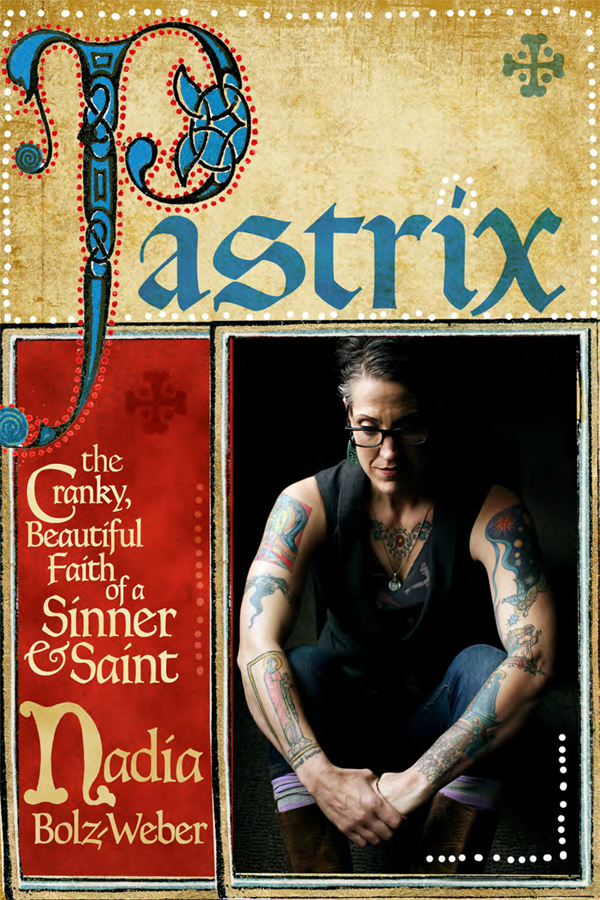 Nadia Bolz-Weber is an edgy, hard-hitting, and often witty pastor in the Evangelical Lutheran Church in America (ELCA). Her latest book is filled with autobiographical stories and a number of anecdotes which focus around the subtitle: they are often cranky, sometimes beautiful, and they reflect a sinner-saint.
The book traces Bolz-Weber’s path towards the ministry through her years in recovery from alcoholism to her starting a church: “House For All Sinners and Saints” and the struggles and triumphs she experienced throughout these events. I’ll not summarize the entire contents of the book but rather I have selected one story to give a brief sample of how the book flows.
The most poignant story in the entire book, in my opinion, is that of Bolz-Weber’s relationship with Chris Rosebrough from Pirate Christian Radio, a very conservative Lutheran (from the Lutheran Church–Missouri Synod [LCMS]) who runs a very conservative radio show. He is, in many ways, all that Bolz-Weber would oppose. And Rosebrough often criticized Bolz-Weber on his show. Then, one day, they had a chance to meet and they talked through the core of Lutheran theology: salvation by grace. Bolz-Weber wrote, “[The other people witnessing their meeting] saw us share a thirty-minute public dialogue about our own brokenness and need for confession and absolution, why we need the Gospel, and what happens in the Eucharist… God made my enemy my friend that day” (113).
Later, Bolz-Weber experienced criticism from her “own side”–liberals [her word, I’m not trying to use it in a derogatory fashion]–and talked with Rosebrough [who is, again, staunchly conservative] about it. They didn’t have to agree on the issues to carry on a conversation about God. “Chris [Rosebrough] doesn’t agree with me [about various issues]… But the one phone call I got in the middle of being attacked by my own tribe was from someone who is on the other side of the issue entirely… [H]e knew what it felt like… [He] said that he loved me and would pray for me. His enemy” (119-120).
Awesome, heart-stopping stories like this are scattered throughout the book. But they are in-between stories that will surely polarize readers. One is a story about a transgender girl turned boy and how Bolz-Weber helped hold a ceremony to help recognize “Asher”‘s new name and identity as a boy. Another story is about her time away from Christianity in which she worshiped a “goddess” instead.
Pastrix ends on a note about Bolz-Weber’s vision of church. Mary Magdalene becomes her foil as she reflects upon the meaning and purpose of church. She wrote, “Like Mary Magdalene, the reason we can stand up and weep and listen for Jesus is because we, like Mary, are bearers of resurrection, we are made new” (201).
Evaluation
There are no words minced in this book. The f-word is sprinkled throughout (and even featured twice in one chapter title). Bolz-Weber continually describes situations or feelings as “s***.” She is completely unapologetic in her approach in this regard.
This raised red flags for me. What does the Bible tell us about the Christian life, and does it say anything about the requirements for teacher, overseer, elder, and deacon? How might Bolz-Weber apply these to her life as a pastor? No, I’m not saying that as a woman she shouldn’t be a pastor–I’m firmly egalitarian. But I wonder about how she would take a passage like James 3 (specifically 3:1-2; 9-10):
Not many of you should become teachers, my fellow believers, because you know that we who teach will be judged more strictly. We all stumble in many ways. Anyone who is never at fault in what they say is perfect, able to keep their whole body in check… With the tongue we praise our Lord and Father, and with it we curse human beings, who have been made in God’s likeness. Out of the same mouth come praise and cursing. My brothers and sisters, this should not be.
Teachers are called to a higher standard. James noted that obviously people stumble, but that does not mean that we should give up or simply embrace whatever wrong behavior we are engaged in. “This should not be!” I wish Bolz-Weber had engaged with this issue in her book.
Another huge issue with the book for me is Bolz-Weber’s exegesis. It seems to me her preconceptions about what the text should mean often shape how she reads it. Specifically, this relates to the question of sanctification. Are Christians really in the process of being made new? If so, how does she reconcile this with the way she seems to conceive of “sinner-saint”–a valid concept–by which she seems to simply mean that one does not even have to try to change? She wrote:
Repentance in Greek means something much closer to ‘thinking differently afterward’ than it does ‘changing your cheating ways.’ Of course repentance can look like a prostitute becoming a librarian, but it can also look like a prostitute simply saying, “OK, I’m a sex worker and I don’t know how to change that, but I can come here and receive bread and wine and I can hold onto the love of God without being deemed worthy of it by anyone but God.”
It seems her primary point in this passage is that God’s grace is firm and sure and we, as sinners, can hold onto that. But I can’t help but feeling Bolz-Weber misses the mark at an astonishing margin in that she never discusses the need to go beyond that. Paul discussed various types of sins in 1 Corinthians 6, and then he went on to say “And that is what some of you were. But you were washed, you were sanctified, you were justified in the name of the Lord Jesus Christ and by the Spirit of our God.” That is, God’s work does not simply end with justification, it continues on into sanctification. We are sinner-saints in the sense that we are yet sinners but God has saved us; but also, we are being made saints by the work of the Holy Spirit. We are to flee from sin, not ignore it.
Bolz-Weber’s entire autobiographical account does speak to the way that the powerful message of grace changes someone, but she never draws this point into the open. Moreover, when she speaks about the life of others, sin is often treated lightly or even entirely ignored. It seems that she is fully willing and able to apply the Law to her own life, but she does not universalize it; she does not make the Law applicable to everyone. Thus, it seems to me she fails to properly preach Law and Gospel.
Pastrix, was a book I really wanted to love. But… I didn’t. There are a number of great insights and anecdotes scattered through the pages, but ultimately readers have to slog through gobs of unnecessary cursing, shock-value stories, and more to find them. One moment, it had me cheering along with Bolz-Weber; the next, I found myself confused about what she was trying to communicate. Ultimately, the book left me wondering who, exactly, the intended audience was supposed to be. It’s not the type of book I’d hand to someone to try to convince them of Bolz-Weber’s view. Nor is it the type of book that I, as someone who agrees in part with her, particularly enjoyed. It seems to me the audience is ultimately those who already agree with her on basically everything. That isn’t a problem, as it is perfectly acceptable to write books that preach to the choir, but I am left confused as to why Bolz-Weber actually did write Pastrix.
Throughout the book it seemed that she was trying to convince me of something, but it never really became clear what that message was. There are times when I really did “get it.” It was like she grabbed that which is Lutheran in me and just played it for all it was worth. But then she failed to make it universal; it applied to her, but she never made Law and Gospel universal. She would discuss intense need for grace which is free and abundant and ever-flowing. She would point out how we need not do works to access this. But then, so often, it seemed she would conflate this with the notion that Christians are not all called to move away from sinner and towards saint. There seemed to be no sanctification in the work. It was all about the initial call to grace; but little about the enduring, sanctifying work of the Spirit.
SDG.
——
The preceding post is the property of J.W. Wartick (apart from quotations, which are the property of their respective owners, and works of art as credited; images are often freely available to the public and J.W. Wartick makes no claims of owning rights to the images unless he makes that explicit) and should not be reproduced in part or in whole without the expressed consent of the author. All content on this site is the property of J.W. Wartick and is made available for individual and personal usage. If you cite from these documents, whether for personal or professional purposes, please give appropriate citation with both the name of the author (J.W. Wartick) and a link to the original URL. If you’d like to repost a post, you may do so, provided you show less than half of the original post on your own site and link to the original post for the rest. You must also appropriately cite the post as noted above. This blog is protected by Creative Commons licensing. By viewing any part of this site, you are agreeing to this usage policy.
Some quick thoughts on the “Noah” trailer
 It’s coming, folks. A big-budget movie about Noah and the Flood. A trailer was recently released for the film, in which Russell Crowe plays Noah.
I thought I’d share some thoughts on the brief glimpse we’ve had on the film, after a brief narration of the trailer. See the end of the post in which I reflect on a couple things not in the trailer.
The Scene
The trailer opens with Noah having some weird vision which seems to depict the Fall of humanity. He wakes up and says “He’s going to destroy the world.” Some old dude tells Noah about a story passed down from his father about how if humans continued in their wicked ways, the “Creator would annihilate this world.”
The old man also tells Noah that this Creator is able to communicate with him in a way he understands, which is apparently by dunking Noah in water and showing lots of burning things and then a flower growing, because, you know, that is really understandable. But apparently Noah gets it because he decides to build a big boat. One problem: the local King is upset about it for some undisclosed reason.
Lots of animals come to load up the Ark. It starts to rain. People try to get on the Ark but get blown up by water. The fountains of the deep are depicted as big geysers blowing up all over the place. Rain.
By the way, Hermione plays someone [I looked it up and she plays “Ila” who is apparently Noah’s adopted daughter and a heartthrob to Shem(?)], so that’s kind of cool.
Thoughts
Well, it looks like we have some Hollywoodization here. I’m not really sure what to think. First, I appreciate the fact that in the trailer the responsibility for the Flood is placed upon humans, who continued to behave in clearly brutal ways.
Clearly the random king showing up with some reason to be angry with Noah is fictitious in the sense that it is not recorded in the Bible. I suspect it is there to add drama to the narrative, but what will it add in addition to that? What plot exposition will be given that diverges from the biblical account? The Old Testament in many places is very terse, not many details are given. It is tempting to fill in the details, and it is clear this film will do so.
The movie also seems to be thankfully not avoiding the theological issues. I will be very interested to see how God interacts with humanity. Despite my tongue-in-cheek narration above, I think there is a point to be had that God may communicate in phenomenological ways, and that the biblical narratives often do report things from the viewer’s perspective.
Also: those clothes! Why is Noah wearing a tailored shirt made out of some weird attempted period-piece? What kind of styling is this!?
Joking aside it looks kind of cool. As a film, it looks like it will be exciting. Lots of special effects; extra tension added in; you name it. But how much correction of faulty understanding of the biblical narrative will need to be done afterwards? I don’t know. On the other hand, perhaps it will get people talking more about the Bible. It may help spur discussion of the issues raised in that passage, which could expand beyond that. Could this be a tool for believers? It may be best to read up on the Flood story yourself.
The movie is clearly generating a lot of discussion already, and having drawn in a big-name director as well as actors/resses, it will likely be discussed broadly.
Be assured that, God willing, I will reflect on the movie when it comes out next year. Until then, let me know your thoughts!
Having Written This, I discovered something else:
Apparently there may be quite significant additions to the film from the pseudepigraphal Book of Enoch, including some scenes with 6-armed angels and the like. I’m disappointed to learn about this divergence from the Biblical story. I get creative license, but this is a bit much.
Check out this excellent post which discusses the screenplay. My disappointment continues to mount as I read more about it. Note that I wrote this post 100% based upon the trailer, with almost no prior knowledge of the movie. The post I just linked to has major spoilers for the differences from film to movie. It looks like what we’re getting is something which is not faithful to the biblical story. I find that deeply disappointing. I get the use of creative license, but based upon this reading of the screenplay, it goes beyond creative license and into exploitation of the Bible to forward a specific agenda.
I wonder whether the rumors floating around about the studio wanting to make significant cuts to the film might be do to this negative reaction from Christian viewers. I suspect that it is possible that the studio wants to make it more palatable to Christian audiences.
The Image was found on Google and is not mine. I could not find rights to it, and do not claim them.
SDG.
——
The preceding post is the property of J.W. Wartick (apart from quotations, which are the property of their respective owners, and works of art as credited; images are often freely available to the public and J.W. Wartick makes no claims of owning rights to the images unless he makes that explicit) and should not be reproduced in part or in whole without the expressed consent of the author. All content on this site is the property of J.W. Wartick and is made available for individual and personal usage. If you cite from these documents, whether for personal or professional purposes, please give appropriate citation with both the name of the author (J.W. Wartick) and a link to the original URL. If you’d like to repost a post, you may do so, provided you show less than half of the original post on your own site and link to the original post for the rest. You must also appropriately cite the post as noted above. This blog is protected by Creative Commons licensing. By viewing any part of this site, you are agreeing to this usage policy.
“Ender’s Game”: Fear and Hope in the Face of Annihilation- A Christian look at the film
 Ender’s Game is one of my all-time favorite books, so it was with some great anticipation that I looked forward to the release of the film. Here, we shall investigate some of the major themes that the film adaptation brings up in its portrayal of this epic science fiction novel. There will be MAJOR SPOILERS for the film in what follows.
Children and Violence
The first and most pervasive feature throughout the film is that of the boundaries crossed when placing children in situations which they should be protected from. It is much like the Hunger Games [I want to clarify: Ender’s Game was written long before Hunger Games and so any connections flow from Card to Collins!] in this regard, though Orson Scott Card’s book and the film take it much deeper.
The first and perhaps most poignant example of this is found early in the film, when Ender thinks he has been washed out from the possibility of command and so he no longer has the protection of adults monitoring him to make sure he is safe. He is approached by a group of bullies, but he uses his strong tactical sense to shame them into fighting him one-on-one. Then, he ruthlessly beats down one of the larger boys and continues kicking him while he is down. He does this, he explains later, because he wanted to make it so that his enemy could never come back and hurt him again. The key, for Ender, is to ensure not just that the enemy is unable to fight back now, but that they will be unable to do so ever. This survival instinct leads Colonel Graff to believe that Ender is right for battle school. But it leaves the viewer wondering about justice.
Elsewhere, the film deals rather pointedly with bullying. Ender continues to be alienated by his fellow students and they react with two common bullying tactics: they ostracize him and eventually, one tries to physically harm him. One scene shows how one can break the grip of bullying: by simply reaching out to the one who is bullied. The camera shifts to a top-down view and shows as one-by-one, students begin to sit next to Ender and abandon the bully. If we teach our youths to do the same: to reach out to understand instead of to conform to the pattern of the world and ignore the downtrodden, we could make steady strides against bullying.
The scenes of violence involving the children also do something that very few scenes of violence with adults are able to convey: the complete horror that is involved in such activities. One cannot help but be gripped by sorrow when one sees children reacting violently to each other. Very often, movies are unable to capture the wrongness of violence. I do not think it is far afield to suggest that blockbusters are even worse at doing so. One can imagine the amount of collateral damage wrought in a movie like “The Avengers,” yet the heroes are glorified and the violence justified by the end. “Ender’s Game” incredibly portrays the real awfulness of violence of human against human, and even of human against environment or nature. It is raw, powerful, and gut-wrenching.
Ends Justify…?
The viewer wonders throughout the entire film whether the cost is too high. Colonel Graff and Major Anderson engage in a brief dialogue on the question late in the story. Anderson notes that using children used to be a war crime, but Graff counters by arguing that humanity must do what they have to in order to ensure survival. In a way, his reasoning takes Ender as a foil. Both he and Ender agree upon the notion that the ends may justify the means.
However, the film doesn’t end with that message. Instead, Ender is forced to confront the reality that he has been used–lied to–in order to bring about the utter extinction of an entire alien sentient race. When faced with this truth, he reacts with extreme remorse and anger. Graff tries to reason with Ender, suggesting once more that they struck the enemy in such a way so as the enemy might never strike them back. But Ender suddenly realizes–with horror–that this is insufficient reason to justify his wiping out an entire species. He reacts angrily and is eventually sedated. The viewer is left to reflect upon the sheer enormity of what has happened. An entire sentient race has been extinguished by the activity of a child who was deceived into thinking he was merely playing games.
The child realizes it is horrible; the adults are the ones rejoicing.
From Death, Life: From Xenocide, Hope
I’ve already pointed out the way “Ender’s Game” depicts violence in such a way as to prevent it from being gloried. I’ll admit I was unsure of how I would react to the big reveal towards the end, when Ender discovers that he has been fooled into exterminating the “Buggers” [Formics–the alien race]. I wasn’t sure if the movie would depict it in such a way as to make the audience cheer and delight in the destruction of the enemy. However, I was totally blown away by the way it showed the scene. I couldn’t but be horrified when Ender turned to Graff and the other commanders of Earth’s military and said triumphantly, “Game Over.” I knew the twist that was coming, and that perhaps made it even more horrifying to me. Ender thought he was playing games, but those in charge knew he was not and cheer gleefully in the complete annihilation of a species which wasn’t even acting the aggressor any longer.
That alone would be an incredibly powerful message to leave viewers with, but Orson Scott Card did not write a book[and, by extension, the movie it spawned] that merely shows the horrors of such violence. Instead, the seeds of hope are scattered therein. The very end of the film shows the birth of life from death. One of the “Bugger” Queens has survived, and one egg for a new queen has been preserved. The Buggers had been trying to communicate with Ender, and they succeeded in getting him to find their last hope for preservation. Ender realizes almost immediately what he should do: take the egg to a place it will be safe. The film ends with Ender’s voice echoing the future story: that he would seek out a new home for the Buggers so that they could begin life anew.
Conclusion
“Ender’s Game” is a fantastic film. It is one with powerful messages for today. Yes, it has the moral message against bullying, and people who walk away only with that will have done well. But more deeply–and more powerfully because of this–it also shows the absolute horrors of violence. Harming others is not in any way glorified in this film. Ender realizes the wrongness of his own actions too late. Yet viewers are not spoon-fed this message. Indeed, the story begs to be debated. Do the ends justify the means in this case? Or perhaps Ender is right–understnading is more important. The themes provide much for anyone who watches the film to discuss.
Yet the most powerful message is saved for the very end: Life comes from death. It is brought about by an outsider, using means which could not have been predicted. And that is the most powerful and true message of all. It is a message which Christianity teaches: hope comes from the most hopeless situation, and it comes from the least expected direction, provided by God.
Links
“Ender’s Game” by Orson Scott Card: A Christian Reflection– I analyze a number of themes from the classic science fiction novel. It is extremely important to look into the
The Importance of Being Ender: A Closer Look at Orson Scott Card’s Modern Classic– Check out this look at the book by Anthony Weber at one of my favorite blogs, “Empires and Mangers.” It is well worth the read and also ha some very interesting links for more discussion of the book.
You liked Ender’s Game? Check out John Carter.
The Image is one of the official movie posters. I claim no rights to it.
SDG.
——
The preceding post is the property of J.W. Wartick (apart from quotations, which are the property of their respective owners, and works of art as credited; images are often freely available to the public and J.W. Wartick makes no claims of owning rights to the images unless he makes that explicit) and should not be reproduced in part or in whole without the expressed consent of the author. All content on this site is the property of J.W. Wartick and is made available for individual and personal usage. If you cite from these documents, whether for personal or professional purposes, please give appropriate citation with both the name of the author (J.W. Wartick) and a link to the original URL. If you’d like to repost a post, you may do so, provided you show less than half of the original post on your own site and link to the original post for the rest. You must also appropriately cite the post as noted above. This blog is protected by Creative Commons licensing. By viewing any part of this site, you are agreeing to this usage policy.
Women and the Reformation: Hope, Silence, and Circumstance
 It is Reformation Day and this year we are going to reflect upon a topic that is all-too-often overlooked: women in the Reformation. We shall consider the impact of women on the Reformation and the impact of the Reformation upon women from a theological perspective. I admit that covering such a broad topic within a blog post means I am very short on detail. I encourage readers to check out the sources at the end of this post in order to explore further avenues.
The Impact of the Reformation Upon Women
The Reformation brought about some changes for women both theologically and socially. Theologically, the issue of inequality between men and women socially and spiritually was more widely discussed. Although the concept had existed before, the Reformers largely held to the notion that men and women were spiritually equal. Spiritual equality led some to wonder whether women could perhaps be social equals, or–if that was to far afield–perhaps they could at least be less inequal (Spierling, 181-183, cited below). Seeds for social and spiritual change were sown during this period, but it must be admitted that there was not as much development as some may allege.
For example, Martin Luther’s notion of the “priesthood of all believers” is sometimes taken to mean that women and men could stand alongside each other as spiritual equals in teaching, preaching, etc. However, when Luther himself was challenged on this issue by the Roman Catholics, he answered by making it very explicit that although women could teach in extraordinary circumstances, he believed the Bible mandated that men were in charge in both church and home (Spierling, 186; see Luther’s Works 36: 151-152). Spiritual equality was seen as equality in the eyes of God, not in the roles that men and women actually took on earth. However, Luther also fought against some of the double standards regarding men and women and was outspoken against brothels and other abuses of women (Lindberg, 360-361, cited below).
The Reformers remained influenced by early Christian views of men and women, which were, in turn, influenced by earlier non-Christian scholars whose pre-scientific views of biology and psychology were adopted. Diarmaid MacCulloch traced the impact of Aristotle and the ancient medical expert Galen upon figures like Augustine and Clement. He described the Reformers’ view of manhood and womanhood as viewed through this lens thus:
What Christian theologians asserted about men, women, and sexuality was nonsense, but it was ancient nonsense, and humanity has always been inclined to respect the assertion of ancient wisdom. The… package of ideas also had a lunatic coherence: it seemed to make sense, explained a baffling aspect of human experience, and contained a good deal of room for flexibility of interpretation. No doubt our own medical theories will seem equally lunatic to generations to come. (MacCulloch,611, cited below)
Carter Lindberg’s own discussion of the impact of the Reformation upon women is bracketed by the question: “Was the Reformation a help or a hindrance to women?” He answers, a bit tongue-in-cheek, “It depends.” The Reformers denied that marriage was a sacrament, which allowed, later, for the dissolution of abusive or even loveless marriage. Women also began to become more actively involved in theology, though their voices were often silenced or ignored. The encouragement to leave convents may have reduced the possibilities for single women to have careers in the church or any sort of involvement (Lindberg, 358-361).
The social expectations for men and women during the Reformation period were shaped by the cultural expectations of “gender” which were themselves handed down to today through the theological writings of the Reformers (Ibid, 360). The concept may be termed “patriarchy” and was theologically adapted to continue to make it appropriate for the culture through the 1800s and into today (MacCulloch, 611).
Women’s Impact on the Reformation
Women had little voice within the Reformation, largely due to some of the issues mentioned above. However, that is not to say that women had no voice whatsoever within the theological developments of the Reformation. There were several women who wrote theological treatises alongside their male counterparts, though their efforts were often ignored (Spierling, 187, 180-181).
Among these was Marie Dentière, who defended her own authority to teach in Galatians 3:28. Dentière was a noblewoman who defended the Reformers through the use of the Bible and who vehemently encouraged women to leave the Catholic faith. She wrote to defend Calvin during his exile. Women were called to teach and take up their Bibles to defend the Christian faith. Dentière’s defense of women’s capacity to teach was grounded in the biblical examples of godly women, among them the first herald of Jesus’ Resurrection, Mary Magdalene (Lindberg, 360; see also McKinley, 155-159, cited below).
Interestingly, Dentière’s writings spurred other women, Catholics, to speak against her in defense of convents. Jeanne de Jussie was directly called upon by Dentière to close her convent, but responded with a theological defense of convents and an attack on Calvinism (Lindberg, 359).
Other women acknowledged the subordination of women in the church and home, but nevertheless argued that the situation of the Reformation had brought about exactly the types of emergency situations Luther had granted women may teach in. Argula von Grumbach wrote defending Arsacius Seehofer, who had been arrested and prosecuted for “holding Lutheran ideas.” She felt the need to defend Seehofer because no one else had done so. Thus, her authority was granted due to the priesthood of all believers.The emergency situation was brought about by Seehofer’s continued imprisonment and the fact that no men had stood up to defend him.
Thus, Reformation theology was seen as the grounds for some women to speak; even those who acknowledged the categories of subordination found within the theology of the Reformers. Others spoke up due to the wielding of Reformation theology against Roman Catholicism. Still others felt that sola scriptura had led them to discover real, biblical grounds for women to teach.
Conclusion
I’m a huge fan of Reformation theology, but it must be admitted that the Reformers’ views on women were essentially a product of their societal background. They embraced, rightfully, sola scriptura, but as I have noted elsewhere (Who Interprets Scripture?), this itself raised a number of issues regarding the interpretation and meaning of a text. Moreover, sola scriptura does not entail that one is able to interpret the Bible in a socio-cultural vaccuum. It seems to me the Reformers view of women as essentially child-bearers and home-makers was more a product of their cultural background than something the text of the Bible specifically taught. Of course, that is a debate for a different time.
To end on a positive note, it is worth noting that the Reformers’ teaching sowed the seeds for greater gender equality. The notion of the “priesthood of all believers” should not be abused in order to be taken as an endorsement of women teaching; but it nevertheless did have within it a concept of spiritual equality which provided a basis, however small, for believing that men and women could be spiritual and social equals. Moreover, women began to take up the torch and teach in “emergency” situations and thus provided a basis for others to do the same. Finally, still other women turned to the Bible itself as a justification for their voice alongside that of men. Their authority to teach was, they argued, itself biblical.
Let us continue that Reformation.
Sources
Carter Lindberg, The European Reformations
Diarmaid MacCulloch The Reformation
Mary McKinley, “Dentiere, Marie” in Handbook of Women Biblical Interpreters
Karen Spierling, “Women, Marriage, and Family” in T&T Clark Companion to Reformation Theology
The Image is of Marie Dentiere and is public domain.
SDG.
——
The preceding post is the property of J.W. Wartick (apart from quotations, which are the property of their respective owners, and works of art as credited; images are often freely available to the public and J.W. Wartick makes no claims of owning rights to the images unless he makes that explicit) and should not be reproduced in part or in whole without the expressed consent of the author. All content on this site is the property of J.W. Wartick and is made available for individual and personal usage. If you cite from these documents, whether for personal or professional purposes, please give appropriate citation with both the name of the author (J.W. Wartick) and a link to the original URL. If you’d like to repost a post, you may do so, provided you show less than half of the original post on your own site and link to the original post for the rest. You must also appropriately cite the post as noted above. This blog is protected by Creative Commons licensing. By viewing any part of this site, you are agreeing to this usage policy.
By Whose Authority? The question of authority in the church

The Question of Authority
One cannot question that perhaps the most central issue which divides the Roman Catholic Church from Protestants is the question of authority. The issue touches upon a number of others. Who has the authority to interpret Scripture (ultimately)? What is the structure of a church? How do we learn doctrines? It must be acknowledged by all that the Roman Catholic Church’s claims to authority are paramount. It is possible for the Church to claim infallible authority for its teachings, however few claims they have actually made.
The question of authority persists in its importance today. If one church body–the Roman Catholic Church–is capable of infallibly defining doctrine for the whole of the Christian world, and some deny these doctrines, then that automatically means that those who deny these doctrines are in some sense denying God. It is important to note what the Church itself has said regarding this doctrine. Here is part of the definition of infallibility from the First Vatican Council (Section 4, Chapter 4):
[W]e teach and define as a divinely revealed dogma that when the Roman Pontiff speaks EX CATHEDRA, that is, when, in the exercise of his office as shepherd and teacher of all Christians, in virtue of his supreme apostolic authority, he defines a doctrine concerning faith or morals to be held by the whole Church, he possesses, by the divine assistance promised to him in blessed Peter, that infallibility which the divine Redeemer willed his Church to enjoy in defining doctrine concerning faith or morals.
What is to be said about those who deny any teaching that the Pope declares infallible? Again, I’ll allow the Church to speak for itself:
So then, should anyone, which God forbid, have the temerity to reject this definition of ours: let him be anathema.
Because I personally do reject some of the infallible teachings of the Church (such as the Marian Dogmas of perpetual virginity, immaculate conception, and the asumption), I, by virtue of this teaching, am anathema. Thus, it should be clear that the authority of the church is at the core of the divide between Catholics and Protestants.
Discordant Voices
The problem of authority is often pressed by Roman Catholic thinkers as a kind of argument against Protestantism. The way in which it is is presented is often through an argument for unity. For example, the claim is made that the Magisterium is capable of preserving doctrinal unity to a higher degree than the Protestant denomination. The claim is also often accompanied by an offhand remark about the number of Protestant Denominations. What is the implication? The discordant voices within Protestantism are, in some way, to be viewed as a discrediting piece of evidence when it comes to the nature of the truth claims of these churches. The implication (as quoted here) that some Roman Catholic apologists draw is that this proves the necessity of an infallible interpreter of doctrine/Scripture.
Infallible Magisterium?
Initially, the claim sounds a bit appealing. One may trust in the infallible Church to settle the debate on various theological topics once and for all. One need not try to draw out the implications of specific texts for themselves, leading to any number of diverging interpretations and arguments and ultimately, the splitting of the church into ever-smaller units each warring against each other and saying they have the truth.
There’s one major problem, though. By whose authority does one make the decision to trust in the infallible magisterium? This question should be on the mind of any individual who chooses to join the Roman Catholic Church based upon the argument from authority. After all, it is the decision of the individual to trust the Church which leads to accepting the Church as the infallible authority.
One must then ask the question: are you infallible? That is, is your [fallible] decision to make the Roman Catholic Church your infallible authority itself an infallible decision? Could you be mistaken? If the answer is that you are indeed fallible and you may be mistaken, then it must follow that any trust placed in the allegedly infallible Church must be equally fallible and stand upon shaky ground. For it is the person who joins the church who has joined the Church, not vice versa. The decision rests upon the individual, and it is therefore a fallible decision to make the Church infallible for one’s faith.
This argument therefore tears down any grounds one might have for asserting that one should trust the infallible Church in order to eliminate the discordant voices of Protestantism or choose-your-own-theology which may be the case outside of the Roman Catholic Church.*
*This is not to mention the often discordant voices within the Roman Catholic Church itself and the fact that fallible persons must interpret allegedly infallible statements in order to discern what they mean. Are you an infallible interpreter? Surely not.
Sola Ecclesia?
Moreover, suppose it is correct that the Church is the infallible interpreter of the Bible and tradition. Does this not mean that any allegations that one is under the authority of the Bible, Tradition, and the Church really boil down to the authority of the Church? After all, the last and final authority in interpreting the Bible, Tradition, or the Church is the Church. If one has a dispute about the meaning of a biblical teaching, the Church may (but does not have to) make the ultimate, infallible decision regarding its meaning. If one argues that tradition hints at something which the Church does not teach, the Church is the ultimate arbiter of tradition as well. Thus, it seems like the final authority in every case lies with the Church. The system, I would argue, ultimately boils down into sola ecclesia.
A Final Note for my Roman Catholic Readers
I want to end with a call to my Roman Catholic readers. First, I would note that in this post I have not sought to insult or denigrate Roman Catholics or their beliefs. I have allowed the Vatican to give its own definitions and presented them, I hope, without distortion. Second, I think that we need to be honest about the differences that we have rather than covering them up. Third and finally, these differences should not, I hope, lead us to be incapable of working together in social and yes–at times–even theological issues. I hope that you will be comfortable interacting with me on this topic and others. I appreciate whatever insight you would like to share.
Links
The Church Universal- Reformation Review– I discuss the possibility of maintaining a universal church in light of the breakup of the church into ever smaller groups. I place this discussion against the background of Reformation theology.
“20,000 denominations”– an in-depth analysis of the claims of those who wish to use denominationalism as an argument against sola scriptura. The link for the article the author evaluates is now down.
Much of the argument found herein has been learned from listening to or reading James White, and although I do not directly quote his work I am greatly indebted to him. A particularly helpful work was The Roman Catholic Controversy
SDG.
——
The preceding post is the property of J.W. Wartick (apart from quotations, which are the property of their respective owners, and works of art as credited; images are often freely available to the public and J.W. Wartick makes no claims of owning rights to the images unless he makes that explicit) and should not be reproduced in part or in whole without the expressed consent of the author. All content on this site is the property of J.W. Wartick and is made available for individual and personal usage. If you cite from these documents, whether for personal or professional purposes, please give appropriate citation with both the name of the author (J.W. Wartick) and a link to the original URL. If you’d like to repost a post, you may do so, provided you show less than half of the original post on your own site and link to the original post for the rest. You must also appropriately cite the post as noted above. This blog is protected by Creative Commons licensing. By viewing any part of this site, you are agreeing to this usage policy.
Answering “More Questions for Old Earth Creationists”

One of my primary areas of interest revolves around the debate over origins, specifically within Christianity. Is the universe “young” (~6-10k years) or “old” (about 13.79 billion years)? How do we look at creation texts in the Bible? What do they teach us?
Last week, I wrote on an article in which a young earth creationist on a radio show I enjoy asked a number of questions of old earth creationists. I noted that many of these questions were off-base because they don’t actually address something that is an issue for old earth creationists. For those who follow this debate within Christianity, I want to make it clear that it is extremely important to accurately represent your opponents’ views. It is all well and good to engage in dialogue with and critical examination of other views, but in doing so you should represent those other views accurately.
Pastor Todd Wilken recently wrote a follow up to the article I responded to last week. The first thing of note is that Wilken does nothing to expound on his previous questions. The assumption seems to be that they are left unanswered. But, as I demonstrated before, Wilken’s questions for “old earth creationists” were wildly off-base in a number of ways. The question is, has Wilken now (as he notes, more than a decade later) come to an understanding of the distinctions between views on origins? Do his questions reflect this?
Old Earth Creationism?
One immediate hint at an answer to my questions here is found in the introduction to his paper. He writes:
The Old-Earth Creationist wants to keep the idea of a Creator. But, he also wants to accommodate the latest theory of the age of the Universe, about 15 billion years. The Old-Earth Creationist wants to keep the Genesis Creation account. But, rather than read that account as a record of seven consecutive days of God’s miraculous creation, the Old-Earth Creationist wants to read it as a record of those 15 billion years. Thus the name “Old Earth Creationist.”
There are a number of distortions which already hint that Wilken has not attempted to understand the view he opposes. First, the number of “15 billion years.” Certainly, that date was accurate… many years ago. As the old earth creationist think-tank Reasons to Believe notes (the link will immediately begin playing audio), however, direct measurements place the age at around 13.79 billion years of age. To be fair, Wilken may just be rounding up. However, he says it is the “latest theory.” His number does not reflect that.
More importantly, Wilken misrepresents what old earth creationists think of the text. This is very serious problem. He writes, “…rather than read that account as a record of seven consecutive days of God’s miraculous creation, the Old-Earth Creationist wants to read it as a record of those 15 billion years.” In the broadest sense this may be correct (other than the number), but old earth creationists (hereafter OECs/OEC) such as Hugh Ross specifically read the account as seven days. The question, of course, is what the days are. But Wilken begins his definition of OEC with this question-begging statement. Before even attempting to interact with the view he criticizes, he misrepresents their position.
After this introduction, though, Wilken confidently states that his previous article–which, as I argued, totally misrepresents old earth creationists–was so powerful that it demonstrated that “[The OEC] is reading into that text considerations outside the text. He must go outside the text of Genesis, and of Scripture as a whole to support his 15 billion year reading of the Genesis account.” I demonstrated beyond a reasonable doubt that at least some of Wilken’s questions don’t actually address OEC at all. He quite seriously had no idea what the positions were for OECs related to human origins, the actual dating of processes, and the like. Yet he continues to allege that he has somehow single-handedly demonstrated the project of OEC (which he doesn’t seem to understand) is unbiblical.
 The Questions
I skipped through the next section of Wilken’s paper, in which he basically just argues that OECs cannot be exegetically consistent. What I want to jump to is Wilken’s questions once more. They reflect what he must think OECs actually believe, so if his questions once more show that he is mistaken, I think it is fair to say that Wilken cannot fairly think that he has done anything to refute OEC. Unfortunately for him, his questions do portray exactly that: he again demonstrates that he has little understanding of what OECs actually believe. I will write his questions here in bold/italics. The wording is exactly the same as in the paper. I do not take credit for anything he wrote. My responses will be immediately after each question.
1. How do you reconcile the sequence of events recorded in the Genesis account with the prevailing theories of the formation of the Universe –In particular, the formation of the Earth first before the rest of the Universe, including the Sun, Moon and stars; and the assertion that the early Earth had both liquid water and plant life before the formation of the Sun?
My mouth literally dropped open as I read this question. Why? Well, the fact is that this question is the one that OECs have directly addressed time and again. There is no attempt by Wilken whatsoever to acknowledge that many OECs have written, nor does he attempt to engage with or refute these interpretations.
That said, Wilken’s question here shows that he is spot-on in understanding that this is a project for OEC. But the fact that he asks the question makes me wonder whether he has ever even interacted with any of those works which answer the question. Representative is Hugh Ross’ work, A Matter of Days
2. What does the numbering of the days in the Genesis account signify, if not six, discrete, sequential days or time periods?
As I continued to read the article, my impression that Wilken is unaware of even the most basic tenets of OEC increased. Here is another major blunder. Nearly every major OEC of whom I am aware holds that the days of creation are six discrete time periods. So why even bother to ask this question? The answer for most OECs would be “I don’t know, because they are six discrete time periods.” Once more, Wilken betrays a lack of study in this area.
3. How should the six days of Creation in the Genesis account be rearranged to better reflect the actual events of the Universe’s 15 billion year history?
Again, OECs don’t rearrange the days. Framework theorists do–depending on what is meant by “rearrange”–but the vast majority of OECs today do not hold to the framework view. They hold to the “day-age” view. So again, Wilken shows he is not interacting with OEC.
4. How should the sequence of events within those individual days be rearranged to better reflect the actual events of the Universe’s 15 billion year history?
See above. OECs would answer almost unanimously: “They shouldn’t.”
 5. If the six days of the Genesis account are really six parts of the Universe’s 15 billion year history, how long was the seventh day described in Genesis 2:1-4?
OECs tend to note that the 7th day seems to be continuing. Creation is done, and God is no longer creating. Therefore, the 7th day has continued into the present. I am willing to see someone show any OECs who hold different views on this. I suspect there are at least some who may hold the 7th day is 24 hours or has ended at some point in the past, but those OECs of whom I am aware would say the 7th day continues.
6. To what specifically does the seventh day of Genesis 2:1-4 correspond in the Universe’s 15 billion year history?
The end of God’s creative activity. God is no longer creating distinct species ex nihilo.
7. What is the real chronological relationship between the events describing [sic] in Genesis, chapter one (the six days of Creation), and Genesis chapter two (the specific creation of man)? Is the second chapter a reiteration of the sixth day, focusing on man, or it is a event separate from and subsequent to the six days described in the first chapter?
Great care must be exercised in answering this question. I am trying to answer broadly from the consensus of OECs I have read. I realize there are a number of views OECs hold on these specific questions. I will answer what I think is the majority opinion, but feel free to comment and share other opinions. Genesis chapter two is a reiteration of the sixth day, zooming in on the creation of humankind. It is not a separate event.
8. What is the real chronological relationship between the events describing [sic] in Genesis, chapter one, and Genesis chapter three? Does the Fall described in the third chapter involve the same particular individuals created in chapter two? Are they the same particular individuals created in chapter one?
I admit that the first sentence of this question confuses me. I’m not entirely sure what Wilken is asking, so I will not try to answer it. The second question can easily be answered: “Yes.” OECs, again, hold to the special creation of Adam and Eve. They do not deny this. The insinuations of these questions that OECs hold some other view of human origins is startling, because it is so off-base. Regarding the third question, again the answer is “Yes.” As I noted in my previous response to Wilken’s other article, one of the distinguishing features of OEC is precisely that OECs hold to the special creation of Adam and Eve. It is telling that Wilken seems to be ignorant to this point. Gerald Rau in his work Mapping the Origins Debate explicitly cites this as an area in which young earth creationists and old earth creationists agree (as I noted in my previous response). Wilken seems to be unaware of his agreement with the side he so adamantly opposes (and misrepresents) on this issue.
9.Where in the entire book of Genesis is the transition to “real time”? What in the text itself specifically marks this transition?
I would note the subtle stacking the deck in this question. What is meant by “real time”? After all, we don’t have, in the rest of the Bible, a counting of days. It’s not as though, on the young earth view, one can reference the first week and then simply start adding individual days. The Bible has no running clock in it counting off days and weeks. So Wilken’s term of “real time” seems disingenuous or confused. I am not sure what is meant by the term. Presumably, Wilken means for it to connect to the young earth view of seven 24 hour days as “real time” and the rest of the Bible also using days to mean 24 hours. But again, this is mistaken, because the Bible doesn’t continue to count off days.
As for the transition, it is hard to answer because I’m not sure what the transition is supposed to be between. From “real time” to what? What is meant by “real time”? Would not several billion years be “time” and if it is time, is it not “real”?
10. When the word “day” means something other than 24 hours in Scripture, it most often means a period of less than 24 hours. Why ignore this possibility regarding the Genesis account?
OECs do not ignore this possibility. In fact, they frequently cite Augustine, who held (at one point) that God created the universe in an instant. Why do OECs cite this ultra-young earth interpretation? Because YECs tend to present church history as though everyone throughout history agrees with their interpretation of 7 24-hour days. They don’t. So the possibility is not ignored.
Conclusion
So we return, finally, to the question: Does Wilken’s paper reflect actual knowledge of the distinctions between views on origins? Frankly, the answer is no. It honestly seems to me that Wilken is either blissfully unaware of the actual positions of old earth creationists or he is intentionally misrepresenting them. This seems to be reinforced by the fact that he never once cites any major old earth creationist when representing the position. Instead, he simply reports what he thinks OEC is. But then he goes on to misrepresent OEC and confuse categories. I find this deeply troubling.
The surprising thing is that Wilken has actually demonstrated how much his own view agrees with OEC. In asking questions to try to distinguish himself from OEC, he shows that he and OECs agree on the sequence of days, the days representing distinct time periods, human origins, and a few other minor areas. Unfortunately, Wilken has continued–apparently for over a decade–to misrepresent old earth creationists. I call on him to stop doing so. Read some items from Reasons to Believe. Read Gerald Rau’s book, Mapping the Origins Debate so that one can make the distinctions between differing groups. But stop misrepresenting the views one may oppose. That is disingenuous, and it doesn’t help readers or listeners.
Source
Todd Wilken, “More Questions for Old Earth Creationists” Issues, Etc. Journal (Fall 2013). Accessible here: http://issuesetc.org/podcast/FALL2013.pdf.
SDG.
——
The preceding post is the property of J.W. Wartick (apart from quotations, which are the property of their respective owners, and works of art as credited; images are often freely available to the public and J.W. Wartick makes no claims of owning rights to the images unless he makes that explicit) and should not be reproduced in part or in whole without the expressed consent of the author. All content on this site is the property of J.W. Wartick and is made available for individual and personal usage. If you cite from these documents, whether for personal or professional purposes, please give appropriate citation with both the name of the author (J.W. Wartick) and a link to the original URL. If you’d like to repost a post, you may do so, provided you show less than half of the original post on your own site and link to the original post for the rest. You must also appropriately cite the post as noted above. This blog is protected by Creative Commons licensing. By viewing any part of this site, you are agreeing to this usage policy.
“Evermore: Edgar Allan Poe and the Mystery of the Universe” by Harry Lee Poe
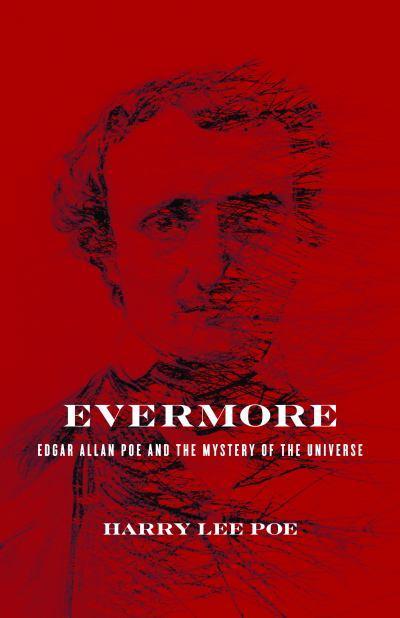 Edgar Allan Poe. His name immediately calls to mind images: a black raven haunting one’s thought, the beating of a heart driving one mad, gruesome, macabre deaths. It also brings to mind thoughts on the man himself: twisted, slightly mad, alcoholic, broken.
Are these images of the man’s work and life accurate? Harry Lee Poe (a cousin of Poe’s) argues that they are not. Instead, this kind of imagery is a result of both the popularization and the character assassination of one of the great American literary giants.
Harry Lee Poe’s work, Evermore: Edgar Allan Poe and the Mystery of the Universe
The Myth of Edgar Allan Poe
It is interesting to note that from the time he died, Edgar Allan Poe’s person was the target of a character assassination which would give rise to the popular portrayal of him as a dark, haunted drunkard. Rufus Griswold, a man who portrayed himself as a minister despite having never been ordained, published a work which has remained in the popular consciousness through the present day. In it, he falsified information about Poe and heavily edited a number of letters from the author in order to portray him as the dark, fearsome man he is often imagined even today. Harry Lee Poe exposes this mythos by noting the work of Arthur Hobson Quinn, who in 1942 published the letters Poe wrote alongside the altered letters Griswold used to make the image he created.
Thankfully, Edgar Allan Poe’s (hereafter EAP) image has been recovering in scholarship, but the damage at a popular level continues to be seemingly ubiquitous. The image of Poe as a brooding man matches what people wish to see when they read his works of horror and thrills. However, Harry Lee Poe (hereafter HLP) notes that there is much more to EAP’s body of work than is often known.
The Broader Poe
EAP’s body of work had its share of horror and mystery, but it also featured humor and satire, science fiction, and beauty. Remarkably, EAP contributed to the formation and even creation of entire genres which are extremely popular today. His science fiction was, at the time, known as “hoaxes” because no actual genre existed in order to encompass them. He also wrote the first detective mystery works to be known in literature. He was innovative and unique in his contributions to literature. He truly stands easily among the literary giants of all time.
The distribution of his works is also worth noting. EAP intentionally wrote in a number of different ways about a number of different things. HLP documents his major tales, numbering each under headings of genre. The results are surprising: EAP wrote more humor and satire than he did horror. Yet he is largely known today only for the latter (24-27). It is worth looking at Poe’s entire body of work in order to understand the man.
Mystery and Reality
One of the central parts of Poe’s work involves the writing of mystery stories. As has been noted, EAP was the first to write in the specific genre of detective mystery stories. EAP’s use of the mystery story shows that he assumed the problem of evil as a very real difficulty. However, the concept of a detective mystery story, in which the reader, through the characters, seeks to solve the mystery and find the one who committed the crime. In short, there is a broader concept of justice involved in a mystery story. Unless there is justice in the universe, the problem of evil cannot present a difficulty for one’s worldview, for evil could just be a given.
EAP, who had written horror stories already, moved the blood and gore from the climax of the story (horror) to the beginning (mystery). The rest of the story would not be about the blood and gore, but about righting a wrong: “injustice cannot be allowed to continue… the sense of justice assumes the basica rationality and order of the universe so that Truth may be discovered. The reader wants to know the truth” (115).
Beauty and Love
The concept of beauty was central to EAP’s work. He used the concept to evoke a particular feeling related to the injustice of crime, but he also saw beauty as a way to point beyond the mundane. “Beauty constituted to Poe evidence that human experience is not bound by time but belongs to eternity” (83).
The different varieties of love are exemplified throughout Poe’s works. Affection, friendship, and passion are developed by HLP to explain EAP’s concepts of how these related to the world at large. Each of these concepts could be forces for the positive or for ill. Affection, friendship, and passion could each become corrupted, and each would lead to devastating results if one allowed this to happen (86ff). Love provided a difficulty for EAP, for he saw that it may tell us about something beyond the world: it may inform us about God. But if it could be perverted, does that suggest an outside source from which love sprang, which we corrupted (107-108).
Eureka
Perhaps the most interesting portion of Evermore is the discussion of EAP’s own views as he expounded them in his work, Eureka. In this work, Poe examined the mystery of the universe. He held that the universe had a beginning and was actually expanding. He argued that light and electricity belonged “to the same continuum.” His view was close to the modern theory of the Big Bang. Yet EAP thought of this around a century before the latter came into vogue. Because the universe began, “Poe concluded that a God exists who created the universe for his pleasure. Love and Beauty provide a glimpse of God… Pain, suffering, evil, and death are the contingencies of physical existence that are left behind” (55). EAP saw the universe as a grand story, which was “the plot of God” (ibid).
The reasoning behind EAP’s amazingly prophetic vision of cosmology was found in his own observations. He noted the difficulties presented by the notion of an infinite universe, including the fact that the night sky had places where there were no stars to be seen (known as “Olber’s Paradox”).
In Eureka, EAP postulated a deity. It seemed intuitively obvious to him that if the universe began to exist, God must exist. Given that his own observational evidence led him to the conclusion that the universe began, he concluded that God exists. Moreover, he posited that this deity would have to design the universe and guide its expansion from a primordial particle (152). However, this deity was essentially pantheistic, which was his solution to the problem of evil. Each individual person would become Spirit individualized. God would become all-in-all, thus bringing holiness to all.
Edgar Allan Poe’s Beliefs?
HLP argues that EAP may indeed have become an orthodox believer late in life. Having already come to the conclusion that God exists and that the universe had a beginning (itself something EAP noted matched remarkably with the Biblical account), Poe would come forward at a Sons of Temperance meeting. HLP notes that such a move cannot be abstracted purely as coming out against alcoholism (something EAP struggled with himself). Instead, the group was explicitly evangelical in nature. Coming forward would be similar to someone today coming forward at a Billy Graham meeting (166). Those interested in Poe’s beliefs must therefore come to one of two conclusions: either he was “the charlatan and scoundrel that Griswold said he was” or “he had a conversion experience.” The Sons of Temperance taught explicitly evangelical Christianity, which would suggest that if EAP was genuine, he had come to accept a more evangelical, orthodox faith before he died.
Conclusion
Few works have intrigued me as much as Evermore has. Edgar Allan Poe has been a favorite of mine for some time, but I admit that I had bought into the stereotypical picture of the man as much as anyone else. Having only really read his horror and some poems, I have not had a complete vision of his actual body of work. Harry Lee Poe does an exemplary job of showing how EAP explicitly viewed his works as a growing body of interconnected themes, seeking to find the mysteries of the universe.
Edgar Allan Poe was a visionary. He was a great American author whose writings paved the way for hundreds of years to come. He was also well ahead of the science of his day, and similarly had already deduced the theological conclusions well before others had attempted to do so. Harry Lee Poe has presented a convincing, thorough look at EAP’s entire body of work. Having done so, he makes the man even more interesting than the myth. Edgar Allan Poe’s explorations of the mysteries of the universe leaves me profoundly interested in the man and his body of work. I highly recommend Evermore: Edgar Allan Poe and the Mystery of the Universe
Source
Harry Lee Poe, Evermore: Edgar Allan Poe and the Mystery of the Universe
SDG.
——
The preceding post is the property of J.W. Wartick (apart from citations, which are the property of their respective owners, and works of art as credited) and should not be reproduced in part or in whole without the expressed consent of the author. All content on this site is the property of J.W. Wartick and is made available for individual and personal usage. If you cite from these documents, whether for personal or professional purposes, please give appropriate citation with both the name of the author (J.W. Wartick) and a link to the original URL. If you’d like to repost a post, you may do so, provided you show less than half of the original post on your own site and link to the original post for the rest. You must also appropriately cite the post as noted above. This blog is protected by Creative Commons licensing. By viewing any part of this site, you are agreeing to this usage policy.
Resource Review: “Flight: The Genius of Birds”
 “Flight: The Genius of Birds
The Complexity of Birds
The film traces the incredible development of birds from single cells into babies and the way in which their bodies must work in order to achieve flight. One of the people interviewed in the film notes that flight is not an incremental phenomenon; the entire body must be set up in order to accomplish it. The way feet work, the shape of the wing, the structure of muscles, and the weight of bones are all factors which must come into play in order to make up an animal capable of flight.
Hummingbirds
“Flight” presents a number of different birds as case studies the complexity which the systems that make up a bird show. Hummingbirds’ flight muscles comprise, on average, 43% of the bird’s body mass. This allows the birds to have an enormous amount of precision in order to move in the ways that they can, such as hovering, moving backwards, laterally, etc. The hummingbird generates lift both on the back and the front strokes of their wings. This capability is grounded in the shoulder joints found in the bones which are at the bases of the wings. The hummingbird’s heart must beat at an enormous rate, which means that it also must eat quite a bit in order to sustain the energy level required for the bird’s metabolism and constant movement. The hummingbird’s tongue is particularly interesting, for it has a number of functions on it which allow it to draw up nectar far more efficiently than had been thought.
European Starlings
These starlings, sometimes flying in groups in the hundreds of thousands, move in a stirring, beautiful way, seeming to shift as if they comprised one organism. The way that these birds continue flying without running into each other is by monitoring those starlings which are closest to each other. Rather than monitoring the entire formation, they simply move when those around them move, which lends itself to the movement of a flock as one kind of organism. Their movements must take place within very minuscule spans of time in order to maintain the formation. They follow air flows to minimize the turbulence they encounter, and their formation also serves as a defense mechanism.
Arctic Terns
Arctic terns have the longest migration of any animal on earth. They cross the planet from pole-to-pole to seek out nesting and feeding grounds. From the North Atlantic, they head south, eventually splitting as half go along the African coast while the other half goes along the coast of Brazil. In the south, near Antartica, they feast upon small fish before heading back north. They must arrive back near Greenland and other areas in the north for a nesting period of about 8 weeks. Then, as winter sets in in the north, they head back south.
How did the complexity arise?
The film here presents an argument that a materialist must use Darwinian evolution to explain the unique functions of flight. No design may be invoked in order to explain these things in a materialistic worldview. Dinosaurs were the precursors of birds, and natural selection selected for those dinosaurs which began to develop better means by which to avoid predators and catch prey.
The Feather
One feather may contain around a million individual parts, from the shaft to the individual strands, barbs, which compose the feather, and each of these are made up of barbules. These are constructed in such a way as to interlock with each other. Yet the feather is but one of the many factors which must go into the mechanisms required for flight.
Other Mechanisms
Other than those already noted (muscles, bones, etc.), birds require a navigational system which allows them to migrate and follow food. They must have instincts to cue and direct their movements across continents and even oceans. One could see how these latter functions came into play in the case study of the Arctic Terns.
Natural Selection?
The film makes the argument that natural selection cannot account for the mechanisms required for flight. The primary problem presented by “Flight” is the “lack of foresight.” Natural selection cannot look ahead and select for various factors in order to put them together into an integrated whole. The argument is that the multiple and independent functions needed in order to get a functional bird which would have some chance at survival is impossible to get to by means of a process which is blind.
Evaluation
First, I have to say that there were moments I found myself with my mouth hanging open and the gorgeous imagery in “Flight.” This was particularly the case following the starlings’ movements, the icy regions the terns flew through, and the overall imagery related to the hummingbirds.
The use of particular case studies over the middle section of the film was particularly effective at showing the problems which may come up when trying to describe certain characteristics and behaviors which birds exemplify that cannot be explained so easily by naturalistic mechanisms.
The film also did a good job of noting that there are presuppositions when it comes to the scientific enterprise. Given naturalism, neo-Darwinism is the only game in town. However, as was asked repeatedly throughout the film, if one is capable of acknowledging design and intelligence when it comes to certain things, why should one preclude the possibility of an intelligent agent when it comes to higher orders?
One problem with the film can be found in the format. It is necessarily short, making only the briefest points and only touching upon those things which it discusses. I suspect that those who hold to a naturalistic worldview will be largely unimpressed, while those who hold to the possibility of intelligent agency in biology will see it as backing their own positions. However, those who may be on the fence will see that there are reasons to ask questions.
Overall, “Flight: The Genius of Birds
Disclosure
I was sent a copy of Flight: The Genius of Birds
SDG.
——
The preceding post is the property of J.W. Wartick (apart from citations, which are the property of their respective owners, and works of art as credited) and should not be reproduced in part or in whole without the expressed consent of the author. All content on this site is the property of J.W. Wartick and is made available for individual and personal usage. If you cite from these documents, whether for personal or professional purposes, please give appropriate citation with both the name of the author (J.W. Wartick) and a link to the original URL. If you’d like to repost a post, you may do so, provided you show less than half of the original post on your own site and link to the original post for the rest. You must also appropriately cite the post as noted above. This blog is protected by Creative Commons licensing. By viewing any part of this site, you are agreeing to this usage policy.
Book Review: “For the Beauty of the Earth” by Steven Bouma-Prediger
The practical consequences of… a radical faith are themselves radical. (182, cited below)
How should Christians think about creation care? More importantly, should Christians even bother with creation care? What is the state of the Earth? What does the Bible say about these issues? These are the primary topics which Steven Bouma-Prediger turns to in his work, For the Beauty of the Earth
Place
We are on Earth, and it is a place full of the glory of God. For the Beauty of the Earth (hereafter FBE) begins with a call to marvel at creation. Bouma-Prediger traces the beauty of the earth through ecological inter-connectedness of animals, plants, and geography in mountains, forests, and lakes. It is truly astounding to think of how the world interacts as a unit; it is still more fascinating to reflect upon how even the–to use a Biblical phrase–“least of these” has an extremely important part to play. I was reading this book while on a camping trip, and it was wonderful to resonate with FBE’s discussion of the wonders of the natural world. But what’s the point?
Bouma-Prediger notes that “We care only for what we love” (21). If we do not love the Earth, we will not care for it. Moreover, he points to the interconnections found throughout the world as a reflection of the importance of all things to creation. He draws ten primary points of importance, including a rejection of the notion that things can be “thrown away”–all things go somewhere; the fact that our actions never affect just one thing; the finitude of resources on the Earth; and the amazing complexity of Creation (19-20).
The Science
Having reflected on our place on Earth, FBE asks: What is the state of planet Earth? Put simply, it is not good. Population is booming while per-capita grain production has not increased, the extinction rates are vastly larger than ever in the past, deforestation is cutting down state-sized holes in the world forests (which leads to a decrease of plants capable of producing oxygen), water consumption is increasing exponentially, topsoil is eroding more quickly than it can be produced, and more.
Bouma-Prediger is careful to present a significant amount of documentation for the claims made in FBE. Consider “Global Warming”- there is an observable upward trend in the average global temperature. There is a real consensus on this topic, although there are always who will disagree with a consensus. It is important to note that “Global Warming” is something of a misnomer because it does not reflect the complexity of the issue. “Climate Change” is a better description, which captures the full range of the impact on the planet.
These issues remain controversial, but those who wish to deny humanity’s impact upon the planet must contend with all the lines of evidence. Bouma-Prediger notes that “The real scientific debate is not over whether global warming is real, but rather is over how much and how fast average global temperature might rise, whether other factors in the climate system will counter or amplify a temperature rise, and what the specific effects will be” (52). [2014 edit: it is interesting to observe that there seems to be some increasing skepticism among scientists over the phenomenon of global warming.]
Finally, he notes that the news is “not all doom and gloom,” for there are many bright spots regarding our care for the Earth as well. Unfortunately, “the case is overwhelming that we humans are responsible for the damage to our home planet” (55). The question it raises is: what now?
Ecological Apologetics
The charge has been made that Christianity is bad for the environment. That is, Christian belief tends to denigrate creation and thus should be rejected, for it cannot provide answers to the ecological crises discussed above. Bouma-Prediger presents a number of ways this objection can be stated and responds accordingly. The complaint ranges from charges that Christian eschatology entails a lack of concern for the current creation to (a very interesting) complaint that because a Christian worldview helped the rise of science, which has itself been the source of many things which harm creation, Christianity is to be blamed for the current crisis.
Bouma-Prediger offers multiple responses. Most importantly, the notion that there is any single root cause for our current ecological crisis is hard to sustain. He offers other responses related to eschatology and more. Christian theology, he argues, in fact gives extremely solid motivation for creation care.
Interestingly, at one point he notes that perhaps substance dualism could be divorced from Christianity (a thesis against which I have argued here). His argument is brief and largely just notes that there are other strands within Christianity which do not rely upon this substance dualism.
Finally, in an interesting spin, the charge is made that materialism actually denigrates the environment. In particular, materialism in the form of economic materialism: when wealth drives worth, the environment will suffer, period. Now, the book does not make the charge that this is the only or even the root cause of our crisis; instead, the point is that when one does value economic gain over other ends, the environment will suffer.
The Question for Christians
Clearly, the most important question is whether or not there is any reason for Christians to care about creation. Interestingly, Bouma-Prediger places this section towards the middle-end of the book as opposed to the beginning. In it, he offers an analysis of several Biblical texts to show that Christians should care for and about creation. Central to this is his conclusion that “Individual creatures and the earth as a whole have an integrity as created by God and as such have more than merely instrumental value” (136). When we view creation as a gift from God–a good gift–we see that no individual part of that creation should be denigrated or seen as merely an instrument.
He goes on to offer a number of ecological vices of excess and deficiency regarding a number of areas related to theology and ecology. These include addiction, belief in autonomy, and more.
A Vision for Creation Care
Finally, Bouma-Prediger presents a brief vision for creation care. He places this squarely within the context of the vice list and Biblical theology. Christians are to act in humility, wisdom, and virtue. As such, they are to care for that which God has given them and be aware that one should not destroy that which sustains oneself. Christians are called to emulate God’s benevolence and love for all creation as illustrated throughout the Biblical text. As such, to be dismissive of individual species or parts of creation does not line up with a Christian worldview.
Conclusion
There are many more themes found throughout FBE and in particular in the area of Christians and the environment. Overall, the book is an astounding, life-shifting read. It raises one’s awareness of the integration of their beliefs with the world around us. It is amazing to immerse oneself in a sense of place–be that a forest, mountain, lake, or elsewhere–and realize that this is truly a great good which God has created for us to enjoy. As embodied creations of God, we are to honor those other created aspects of His plan. We are to care for His creation. The book is commendable in its scope, erudition, and groundedness in those concerns which Christians would perhaps be most interested in. It comes highly recommended.
For the Beauty of the Earth.
Links
Like this page on Facebook: J.W. Wartick – “Always Have a Reason.”
Caring for Creation: A discussion among evangelicals– I write about creation care from a number of perspectives offered at a recent panel of prominent evangelical thinkers in this area.
SDG.
——
The preceding post is the property of J.W. Wartick (apart from citations, which are the property of their respective owners, and works of art as credited) and should not be reproduced in part or in whole without the expressed consent of the author. All content on this site is the property of J.W. Wartick and is made available for individual and personal usage. If you cite from these documents, whether for personal or professional purposes, please give appropriate citation with both the name of the author (J.W. Wartick) and a link to the original URL. If you’d like to repost a post, you may do so, provided you show less than half of the original post on your own site and link to the original post for the rest. You must also appropriately cite the post as noted above. This blog is protected by Creative Commons licensing. By viewing any part of this site, you are agreeing to this usage policy.
“Are Miraculous Gifts for Today?” A look at four views in Christian Theology
 What are we to make of the notion of miraculous gifts today? Have they continued into the modern era, or did they cease after the apostolic age?
I want to preface the following discussion by expressing the fact that I am by no means an expert in this area. I only recently finished reading Are Miraculous Gifts for Today?, which presents four views on the issue of miraculous gifts in the church now. The
Here, I will outline what I understand to be the four views on the topic (as outlined in the book–I am more than willing to concede there are likely more views), along with a few arguments and against each. After that, I will offer a brief analysis. I’m hoping that you, the reader, will help spur the discussion.
Miraculous Gifts?
Before progressing, it is important to know what is meant by miraculous gifts. Essentially, these are the gifts outlined in various passages of the Bible. 1 Corinthians 12 is illustrative. It lists as spiritual gifts the following: speaking in tongues, prophecy, the gift of wisdom, etc.
One must note the issue of the “gift of healing.” What is the “gift of healing” and does it exist today? James 5:14-16 is integral to understanding what is meant by this gift.
Perhaps the most central issue regarding miraculous gifts is this: do they continue into today? A secondary, but still very important question is: if these gifts do continue, in what way?
Cessationism
Cessationism is the view that miraculous gifts essentially ended after the formation of the Apostolic Church. Richard B. Gaffin, Jr. defends this view. He clarifies his position by noting that he is not arguing that all gifts of the Spirit have ceased. Rather, the question is “not whether but which spiritual gifts continue today” (41). He notes that God may choose to miraculously heal persons, but expresses doubt over people being granted a specific gift of healing. His greatest difficulty lies with the “word” gifts such as prophecy, speaking in and interpreting tongues, and the like.
The problem with these sorts of gifts, argues Gaffin, lies in the question of the sufficiency and closedness of the canon. Suppose that prophecy does continue today. What level of authority should be ascribed to it? If it is truly the utterances of the prophet guided by God, he reasons, should we not grant such utterances the same authority as the Scriptures (47)? Gaffin notes that those who hold to the continuation of these gifts generally assert that prophecy may be fallible and thus should not be given the same authority as the canon. Gaffin responds by countering that the Bible does not seem to support the notion of fallible prophecy as a possibility (48-52).
Moreover, the gifts of the Spirit were intended for the Apostolic Church as signs of God’s special activity during that period (56-58).
Open but Cautious
The “Open but Cautious” view is championed by Robert Saucy. He expresses the view that the Bible does not make clear whether specific miraculous gifts continue today or not. Thus, he remains open to continuation of these gifts, but cautious in their application and use.
Central to Saucy’s caution is the argument that miraculous gifts are centered around specific times and purposes within salvation history. Thus, according to Saucy, miraculous gifts act as signs of God’s activity within very specific contexts. The Apostolic Era is to be considered unique, and the expression of spiritual gifts during this time should not be read verbatim onto the present era (100-102). Moreover, the Biblical evidence for periods of miraculous activity is “uneven” and “particularly concentrated at certain times,” specifically “that of Moses and the Exodus, the ministries of Elijah and Elisha, and Christ and the apostles” (103). Miracles are thus to be understood explicitly as a “sign” with a specific purpose in mind to “give credibility to something” (105). Miracles are used to “authenticate” specific individuals in times of need (108).
Saucy appeals to the history of the church to make his point. He argues that throughout the history of the church, there is little miraculous activity noted. Thus, although we should be open to the possibility that such gifts may manifest themselves, we should remain cautious of claims to that effect. Saucy concludes with a discussion of individual gifts and what the Bible teaches about them. Representative is his discussion of prophecy, which notes several clarifications regarding how it should be used and understood (including that it is to be done in an “orderly fashion” and that the content will be “edifying to the community”) (128).
Third Wave
C. Samuel Storms argues that miraculous gifts do continue today, but that the doctrine of “subsequence” should be rejected. Subsequence is the notion that after conversion, there is a “baptism in the Holy Spirit” which is initially experienced by speaking in tongues and manifests itself in various spiritual gifts (176).
Storms argues that cessationists misrepresent those who argue for continuation, for cessationists often appeal to the “infrequency” of the miraculous in order to argue against the notion of miraculous gifts. They argue that this demonstrates that such events are purely the actions of a sovereign God acting whenever God chooses. In contrast, Storms notes that God’s spontaneous action may indeed empower individuals and indeed that the intermittent nature of the practice of such gifts does not undermine their classification as spiritual gifts.
Storms further asserts that although miracles have indeed been used as signs, this fact does not allow one to reduce the miraculous gifts to being only signs and nothing else (188-189). Storms analyzes a number of major arguments for cessationism and finds them all wanting. In particular, Storms presses the notion that the Bible nowhere declares that the gifts found in the Apostolic period would have some cutoff time period.
Pentecostal
Douglas Oss argues that defining Pentecostalism as a “second blessing” theology must clarify what they mean by “second blessing.” He notes that Pentecostals do believe that believers receive the Holy Spirit post-conversion as an empowerment for charismatic gifts. However, this filling is not part of salvation nor is it required for salvation. Instead it is part of sanctification: it is empowerment by the Spirit. Moreover, Oss notes that there may be several empowerments or “refillings” of the Holy Spirit, for there is diversity in the “manifestations” of the Spirit (242-243).
Oss traces the Biblical data and concludes that the Old Testament shows that there is both the “inner-transforming” work of the Holy Spirit and the “empowering” work located therein. In the New Testament, Oss notes that the Holy Spirit works to empower the believers with various manifestations of miraculous gifts.
The gifting of the Holy Spirit is initially observable through speaking in tongues, but again this is not required for salvation. It is merely the pattern of God’s gifting. First tongues, later other gifts, though this is not always the case or even a requirement (260-263). Oss appeals to Joel 2:28-32 to note that the last days will not conclude until Christ’s second coming and so we should expect giftings of the Spirit throughout the present era (266ff).
Analysis
It seems to me that there is little warrant for arguing negatively that the miraculous gifts do not continue today. Gaffin provided no textual basis that I could discern for holding that when the NT authors speak of these gifts within the church, they intended to limit the gifting in their own era. Moreover, I think that Joel 2:28ff does speak of the current age, though some of it seems to be yet future. The future fulfillment left for some of the passage does not seem to imply that it should all be taken is “not yet,” however.
That said, Gaffin’s concerns regarding the authority and inspiration of prophecy should be rightly noted. The issue of the nature and authority of prophecy in the modern period is one which the other offers attempted to address, but it seemed to me they came up short in virtually every case. Moreover, some of the Pentecostal position seemed to be a bit off to me. Why even argue that speaking in tongues comes first, but then qualify that by saying that it doesn’t need to or that it may not always be the case? Would that not suggest that the pattern isn’t much of a pattern after all?
Storms in particular did an excellent job of showing the error of arguing that miracles in the Bible centered only around certain periods of time in which “signs” were needed. Although it seems clear that the Bible is a selection of time periods and parts of history, God’s miraculous activity is observable throughout much of the Bible. To argue otherwise, and to then build a framework for interpreting miraculous gifts for today (as both Saucy and Gaffin did to an extent) seems to be an overreach given the data.
Thus, I would say my position seems to be closest to a synthesis of Storms and Saucy. I think Saucy does not go far enough in his allowing for gifts of the spirit, but I think that Storms struggles with the notion of the authority of such continuing prophecy.
So what do you think of this issue? What is your position? Share your thoughts in the comments below.
Source
Stanley Gundry and Wayne Grudem, editors, Are Miraculous Gifts for Today?
SDG.
——
The preceding post is the property of J.W. Wartick (apart from citations, which are the property of their respective owners, and works of art as credited) and should not be reproduced in part or in whole without the expressed consent of the author. All content on this site is the property of J.W. Wartick and is made available for individual and personal usage. If you cite from these documents, whether for personal or professional purposes, please give appropriate citation with both the name of the author (J.W. Wartick) and a link to the original URL. If you’d like to repost a post, you may do so, provided you show less than half of the original post on your own site and link to the original post for the rest. You must also appropriately cite the post as noted above. This blog is protected by Creative Commons licensing. By viewing any part of this site, you are agreeing to this usage policy.

 J.W. Wartick - Reconstructing Faith