J.W. Wartick
Questions of the Week: March 10-16, 2013
 I have begun a new “thing” over on the Facebook page for this site. If you haven’t checked that out, go over and like the page: “J.W. Wartick- Always Have a Reason.” What is this thing? Well, I’m asking you, dear readers, to respond to various questions throughout the week, which I will then post here. The goal is to get you thinking about a number of issues, and to get some great interaction both on the Facebook page and here. Each week, I will ask questions on the Facebook page, and wait eagerly for responses. Then, I will post the questions here with perhaps some commentary. I don’t know, I’m figuring it out too. This will be a series to go alongside the “Really Recommended Posts” where I send you all to other awesome sites. Give me feedback on what you like about this, or what you don’t like. With no further ado:
Questions of the Week
What is your view on Christianity and the Environment?
I have seen in discussion on this site that people hold an array of views on how we should answer this question. I wrote a post discussing “Caring for Creation” and reactions were very diverse. Skepticism was expressed over global warming, while others expressed the notion that such skepticism is unfounded. The bigger issue, however, is the issue of caring for creation more broadly and how to interact on that level. The answers there were diverse as well. You should check out the post, and let me know here what your thoughts are on this hot-button topic.
Do you have a view on the eschatological millennium? If so, what is it?
One of the most hotly-contested issues in Christian doctrine is that of eschatology. There are various views of the “millennium” which compete for adherents. I recently reviewed a book outlining premillenialism, but it also provided an overview of the various positions “out there.” Check out the review, and let me know what your view is on this contentious issue. Responses to this question on the page covered a diverse array, from those who felt the issue focused around Israel to a recommendation of amillennialism to one who held to a diverse pick-and-choose approach. What do you think?
“The Big One”: What are your thoughts on the Newly Selected Pope?
Judging from my Twitter feed and Facebook, reactions to this question were wildly diverse. Some people decried the “most recent antichrist” while others celebrated their new “papa.” Pope Francis’ second blessing was for a pregnant woman and her child, which gives me great comfort in knowing that the Roman Catholics will continue to stand firmly against abortion. I know little else of this Jesuit man from Argentina, so let me know your thoughts.
Image:
The image is a picture I took of my NIV Study Bible (copyright for the pages to Zondervan, but image copyright as below).
SDG.
——
The preceding post is the property of J.W. Wartick (apart from citations, which are the property of their respective owners, and works of art as credited) and should not be reproduced in part or in whole without the expressed consent of the author. All content on this site is the property of J.W. Wartick and is made available for individual and personal usage. If you cite from these documents, whether for personal or professional purposes, please give appropriate citation with both the name of the author (J.W. Wartick) and a link to the original URL. If you’d like to repost a post, you may do so, provided you show less than half of the original post on your own site and link to the original post for the rest. You must also appropriately cite the post as noted above. This blog is protected by Creative Commons licensing. By viewing any part of this site, you are agreeing to this usage policy.
Mulan Among Us: Disney’s “Mulan” and Womanhood

Disney’s “Mulan
Warning: There are spoilers for Disney’s Mulan in the following discussion
Mulan and Cultural Expectations
Mulan is a warrior. She is powerful, capable, and determined.
Oh, and I forgot: she is a woman.
It is that “shocking” pronouncement which is the focus of the Disney’s Mulan
Mulan is challenged at numerous points throughout the movie. She does not fit into her society’s gender ideals. She is expected to be clean, quiet, submissive, and “womanly.” And she tries to fit into these expectations. The culture wants her to be a good wife, so she tries to match what her culture’s idea is in order to become a good wife. Those who have seen the movie knows she fails miserably. When she visits the matchmaker, she recites, in a stumbling way, the right sayings: “Fulfill your duties, calmly and respectively. Reflect before you… Act!” She lacks grace, poise, and ultimately ends up comically ruining the whole scene, setting the matchmaker on fire and dousing that fire with hot tea, running the matchmaker’s makeup and earning the pronouncement that she will never fit society’s expectations for her.
Yet this reveals another cultural shock: it is the very fact that Mulan is placed into a one-size-fits-all box to take on roles which do not match her abilities that leads to her triumph. It is not that she should be trying harder, or that she is wrong; instead, the fact is that it is her culture’s expectations which are wrong. Mulan destroys those expectations. She saves China, and the Emperor himself honors her. Thus, the expectations are shattered, and Mulan remains “true to herself.” Her abilities destroyed the cultural norms that people had tried to apply to her.
“So what!?” you may be asking. “I already knew this, though I may not have outlined it like this.” After all, telling women to be submissive and arguing that there are very specific roles that they should fit into is a thing of the past.
Is it?
Have you never heard the phrase “she wears the pants in that family”? That speaks to a division of roles that is still at least unconsciously acknowledged in our culture. What about “make me a sandwich” or “get in the kitchen”? What of more subtle distinctions? “I would never vote for a woman president.” “A man is in charge of the family.”
Moreover, some theological traditions continue to argue that there are very explicit roles for man and woman in leadership and the home. It is to that concept that we will turn to, with a focus on Mulan.
Mulan and Theology
The shock of Mulan’s story may seem almost comical to us, but the fact remains that there are women whose talents are not being acknowledged. They do not fit the mold. It is said within some branches of contemporary theology that women are to submit to their husbands. These theologians teach that women have very specific roles: that of “helper,” servant, or anything but “leader” or “teacher.” According to these views, women can teach other women and even male children, but when it comes to man, she is always subordinate. Consider the following passage, from a book endorsing this view (“Recovering Biblical Manhood and Womanhood
[I]t is simply impossible that from time to time a woman not be put in a position of influencing or guiding men. For example, a housewife in her backyard may be asked by a man how to get to the freeway. At that point she is giving a kind of leadership… But we all know that there is a way for that housewife to direct the man that neither of them feels their mature femininity or masculinity compromised. (John Piper, 50, cited below)
Moreover, women, on this view, must be careful about how they give their advice; they must remember that they are to be submissive:
A wife who ‘comes on strong’ with her advice will probably drive a husband into passive silence, or into active anger (Ibid, 52)
I can’t help but think of the scene from Mulan just before she saves the Emperor when she is trying to get people to listen to her about the great danger of the Huns in the Imperial City. They pull away from her forcibly, ignoring what she says. Finally, her trusty sidekick, Mushu, points out that “You’re a woman.”
Such is the way in which manhood and womanhood is supposed to play out within those branches of contemporary theology which lean towards complementarianism–the view that men and women are to occupy different “roles” in the church and the home. Women are to be submissive, even when they try to give directions to a man. Mulan, in this view, perhaps came on “too strong” in her insistence that the Emperor was in danger. If she had only been more submissive, then she would not have provoked “passive silence” or “active anger.”
The absurdity of this notion can be found in the fact that it is the victim who is blamed for the abuse. “Passive silence” can be just as harmful as “active anger.” Is it really acceptable to say that a woman, by offering advice, “provokes” the man? Moreover, is it really honorable to men to turn us into seething machines, who, if the right button is pressed, turn into active aggressors or passively-aggressive “victims”? Again, the movie “Mulan” has presented a more balanced approach: there are women who transcend society’s–and religion’s–expectations.
There are Mulans among us. There are women who challenge this perceived view of manhood and womanhood. There are women who are gifted greatly to be leaders, not followers. There are women with the gift of teaching. There are women whose very existence shatters the notion that woman’s role is to be submissive. Their talents and abilities call us to use them, not to force them to singular submission. The Bible calls us to mutual submission, not a singular silence from one gender. These Mulans are powerful missionaries, leaders, teachers, yes, even pastors: gifted and called by God to take on roles that their cultural milieu often wants to deny to them.
I pray that more of these women would arise and use their gifts for the church. Many women have already done so, but our church’s culture has too often tried to silence women. Instead, we need to acknowledge the Mulans we know.
Check the links below for more discussions of women and the church. For all my posts on the topic, check out my egalitarianism category (scroll down for more posts).
Links
Be sure to check out my looks at other movies. If you like Mulan, what about Brave?
For information on egalitarianism–the view that the Bible teaches us women and men should fill equal roles–check out “Christians for Biblical Equality.”
Women in the Ministry: The philosophy of equality and why complementarianism fails– I argue that the position in which women are excluded from church leadership entails inequality of being.
Book Review: “Good News for Women” by Rebecca Groothuis– I review an excellent book on the issue of gender equality in the Bible.
Religious Dialogue: A case study in science fiction with Bova and Weber– I take a look at how science fiction has dealt with theological topics, with a particular focus on dialogue about religion and women.
I discuss the notion of having my expectations of women shattered here.
Sources
John Piper, “A Vision of Biblical Complementarity: Manhood and Womanhood defined According to the Bible” in Recovering Biblical Manhood and Womanhood
Mulan
Image Credit
The image used in this post is credited to the Mulan Facebook page.
SDG.
——
The preceding post is the property of J.W. Wartick (apart from citations, which are the property of their respective owners, and works of art as credited) and should not be reproduced in part or in whole without the expressed consent of the author. All content on this site is the property of J.W. Wartick and is made available for individual and personal usage. If you cite from these documents, whether for personal or professional purposes, please give appropriate citation with both the name of the author (J.W. Wartick) and a link to the original URL. If you’d like to repost a post, you may do so, provided you show less than half of the original post on your own site and link to the original post for the rest. You must also appropriately cite the post as noted above. This blog is protected by Creative Commons licensing. By viewing any part of this site, you are agreeing to this usage policy.
Review of “Love Wins” by Rob Bell: Chapter 4
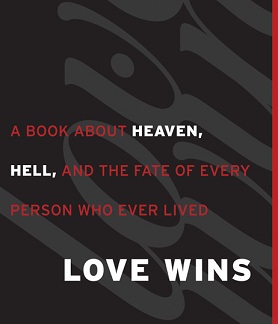 I have been reviewing Rob Bell’s book, Love Wins, with a particular interest in his theological views and how he argues for those views. I have not read the book before, so each review is fresh: I am writing these having just completed the chapter the post is on. This week, I look at Chapter 4: “Does God Get what God Wants?”
Chapter 4
Outline
Bell starts the chapter by surveying a number of statements from church’s web sites regarding hell. These statements range from the unsaved being separated from God forever to eternal conscious torment. He seems to be pointing readers towards a kind of discontinuity between these statements and the statements about God’s power and love:
I point out these parallel claims: that God is mighty, powerful, and “in control” and that millions of people will spend forever apart from this God… even though it’s written in the Bible that “God wants all people to be saved and to come to a knowledge of the truth” [1 Timothy 2:4- seems to be NIV]
…How great is God? Great enough to achieve what God sets out to do… but in this, the fate of billions of people, not totally great. Sort of great. A little great. (97-98)
Bell asks a poignant question: “Will all people be saved, or will God not get what God wants?” (98). He then goes through a number of verses focused around God’s love. He notes the parables in Luke 15 about people pursuing their desires and concludes, “The God that Jesus teaches us about doesn’t give up until everything that was lost is found. This God simply doesn’t give up. Ever” (101).
Bell turns to the reason that many people think God may fail in his desire to save everyone. From the perspective of those who advocate the views he outlined at the beginning of the chapter, “love, by its very nature, is freedom… God has to respect our freedom to choose to the very end” (103). However, Bell argues that “We aren’t fixed, static beings–we change and morph as life unfolds.”
Tied into this notion of the unfixed nature of our lives, he seems to hold that it is possible that people can choose to come to Christ after they die. He asks, “why limit that chance [the chance to come to Christ] to a one-off immediately after death? And so they expand the possibilities… [The chance is given for] as long as it takes, in other words” (106-107).
Bell then traces this notion through Clement of Alexandria, Origen, Gregory of Nyssa, and Eusebius. He goes so far as to cite Augustine saying “‘very many’ believed in the ultimate reconciliation of all people to God” (108).
He argues that “central to their trust that all would be reconciled was the belief that untold masses of people suffering forever doesn’t bring God glory” (ibid). Moreover, he argues that “At the center of the Christian tradition since the first church have been a number who insist that history is not tragic, hell is not forever…” (109). He notes that “serious, orthodox followers of Jesus have answered these questions [about hell and salvation] in a number of ways” (ibid).
Next, Bell turns to an analysis of the book of Revelation. he notes that the book ends with notion that the gates of the city “never shut” and infers that “gates are for keeping people in and keeping people out. If the gates are never shut, then people are free to come and go” (114-115).
Bell ends the chapter with what seems like a poetic inference. He goes into prose and concludes that: “[Love] always leaves room for the other to decide. God says yes, we can have what we want, because love wins” (119).
Analysis
There is much to discuss in this chapter. First, it is important to note that Bell has done much to cause reflection upon the subject of hell. It is something that we as a group of believers need to be thinking on. Too often, the subject is cast aside. Bell has done admirably in bringing the topic to the table.
Moreover, Bell is correct to note that confusion can be caused by simply throwing statements on hell “out there” in a void. It is important to contextualize statements about heaven and hell and make clear what is meant by the phrases that are used in the discussion.
Bell seemingly just assumes that there will be more chances to “accept Christ” in the afterlife. His discussion of the possibility of people changing after death implies this perspective, but he has done nothing to establish it. Perhaps he will do so in a later chapter, at which point we will evaluate his argument for that perspective. Indeed, thus far his argument seems to be a kind of straw man: he asserts the notion that people are changeable beings even in the afterlife as a counterpoint to those who hold that people will continue to choose evil in the hereafter as though this choice is the reason people hold to the eternal hell view. Yet this is not the case; many who hold this position do argue that people will continue to choose evil, but the reason that people are condemned to hell is because they rejected the God, whose existence and power are obvious (Romans 1) in their lives. No one has an excuse (Romans 1:20).
Bell’s utilization of church fathers is problematic. I can’t help but think there is a subtle twisting of some of their views to fit his position. In particular, he cites Augustine as “acknowledging” that “very many” believed in “ultimate reconciliation of all people” (107-108). Yet Augustine himself categorically denies and denounces this position. In fact, almost the entirety of Book XXI of The City of God
I hate to beat a dead horse here, but let’s look what Augustine says (The City of God
Origen was even more indulgent; for he believed that even the devil himself and his angels, after suffering those more severe and prolonged pains which their sins deserved, should be delivered from their torments, and associated with the holy angels. But the Church, not without reason, condemned him for this and other errors…
So we see that Augustine, far from being anywhere near Origen’s view on the topic, endorses the Church’s condemnation of Origen as a heretic in this regard. Yet where does Bell reveal this? Where does Bell interact with historical theology? No, he seems perfectly content to throw out a bunch of names out of context together and let readers make their own assumptions. I realize this is a popular level book, but I can’t help but be very worried about Bell’s style here. It is very misleading. Maybe he does note later in the book that Origen was condemned as a heretic for this view, and that Augustine endorses this condemnation, but considering Bell seemingly endorses Origen’s view, I very much doubt that he will reveal that it was condemned by the Church.
More damning is the fact that Bell is able to, seemingly seriously, say that “At the center of the Christian tradition since the first church have been a number who insist that history is not tragic, hell is not forever…” (109). I admit that I agree in one sense–there have been many universalists throughout church history. However, that view was condemned as heretical. Augustine upholds that condemnation in The City of God
Here again we see one of Bell’s biggest methodological problems: he simply introduces a notion, argues that there are diverse views, and then assumes that they are all equally legitimate. but this is simply mistaken. Multiplication of viewpoints does not mean they are equally valid. Furthermore, Bell’s lack of interaction with historical theology on this point, when he himself is the one who introduces several of the church fathers, is questionable at best. Moreover, he says these teachers were “orthodox” when in fact Origen specifically was far from orthodox in his beliefs, as even a cursory study of Origen would reveal. Origen lived at a time before certain views were made explicit, yes, so he in a sense gets a pass in that his theology was intentionally exploratory. However, many of his views were later condemned, including the one Bell endorses. For Bell to turn around and use Origen to support his diversity of orthodox views on the topic is seemingly dishonest.
Moreover, one must wonder about Bell’s analysis of the meaning of the gates of heaven as open. Instead of looking at this passage in context, in which the notion of a city with open gates would imply a city unthreatened by outsiders because all enemies were defeated (which fits much better into the book of Revelation), Bell states explicitly “If gates are never shut, then people are free to come and go” (115). Think on this for a moment. What Bell has stated here undermines the notion of security of salvation. Now I do not hold to the doctrine of eternal security; however, I do affirm that once people are saved and in the New Creation in heaven, they are not about to change their status. They aren’t “going” anywhere. Bell’s view here undermines the assurance of salvation. His view of “love winning” also serves to illustrate this point, for if there is “always room for the other to decide” we must ask: is there always room to choose hell? Can “love win” by letting us walk away from the eternal salvation we are promised in Christ?*
Conclusion
I admit I have been highly critical in this chapter. I have tried throughout so far to find positive things to say about Bell’s work, and as I noted, Bell does well in this chapter to center discussion around the hard questions.
However, there are numerous problems with Bell’s work in this chapter. His use of the church fathers is highly problematic. I won’t rehearse the arguments again (see above). Oddly, his view also seems to imply that we have absolute autonomy and the ability to simply walk out of heaven whenever we wish. That in itself is another great difficulty, for it undermines the assurance of salvation we have in Christ: “I give them eternal life, and they shall never perish; no one will snatch them out of my hand” (John 10:28).
Bell continues to use the method of argumentation in which he simply notes diverse views on a topic and concludes that all are somehow equally at the table or equally valid.
Next week, we will look at Chapter 5: Dying to Live.
*My thanks to my wife for this point.
Links
The book: Rob Bell, Love Wins
Review of “Love Wins” by Rob Bell: Preface and Chapter 1– I discuss the preface and chapter 1 of Love Wins.
Review of “Love Wins” by Rob Bell: Chapter 2– I review chapter 2.
Review of “Love Wins” by Rob Bell: Chapter 3– I look at Chapter 3: Hell.
Review of “Love Wins” by Rob Bell: Chapter 5– I analyze chapter 5.
Love Wins Critique– I found this to be a very informative series critiquing the book. For all the posts in the series, check out this post.
Should we condemn Rob Bell?– a pretty excellent response to Bell’s book and whether we should condemn different doctrines. Also check out his video on “Is Love Wins Biblical?“
Source
Rob Bell, Love Wins
SDG.
——
The preceding post is the property of J.W. Wartick (apart from citations, which are the property of their respective owners, and works of art as credited) and should not be reproduced in part or in whole without the expressed consent of the author. All content on this site is the property of J.W. Wartick and is made available for individual and personal usage. If you cite from these documents, whether for personal or professional purposes, please give appropriate citation with both the name of the author (J.W. Wartick) and a link to the original URL. If you’d like to repost a post, you may do so, provided you show less than half of the original post on your own site and link to the original post for the rest. You must also appropriately cite the post as noted above. This blog is protected by Creative Commons licensing. By viewing any part of this site, you are agreeing to this usage policy.
“A Place at the Table” – A Movie Review
 Sometimes, there are movies that come along and force you to think. “A Place at the Table
The film–a documentary–can be summed up by this: the issue of hunger is complex, and it is very much a problem in the United States. It shares a number of personal stories which reflect the truth of these statements. Although it touches on the lives of several people, “A Place at the Table” focuses its narrative around three people: Barbie, a single mother in Philadelphia who is struggling to find a job and feed her children; Rosie, a 5th-grader in Colorado whose family is trying to stay on their feet; and Tremonica, a 2nd-grader who is overweight, yet still involved in the food insecurity.
Food insecurity is, essentially, dealing with a lack of ensured access to food. Concretely, it means that those who suffer from food insecurity are unsure of where their next meal will come from. The statistics shared in the movie state that one in every six Americans are struggling with food insecurity.
These narratives serve to truly draw out the complexities of the issue of food insecurity. Barbie, at the start of the movie, is on food stamps. She is barely scraping together enough food to give to her children while also keeping herself fed. She is trying to find a job. Moreover, the amount that she gets for food doesn’t allow her to afford fruits and vegetables. Instead, she has to rely on feeding her children pastas and carb-rich foods. When she eventually gets a full-time job, she almost immediately loses her benefits, which leaves her with the same problem because she’s still trying to get on her feet.
Tremonica is overweight, but it is actually because her family doesn’t have enough to eat a healthy, balanced diet. Yes, she’s getting food, but her mom can’t afford to buy fruits and vegetables. Moreover, the area they live in makes it extremely difficult to get fresh produce because major shipping doesn’t get profitability in shipping to remote locations.
Rosie’s family of seven lives in one house in order to survive. They often run out of milk and food in the middle of the week, and so rely on dry cereal to eat for some meals. Rosie benefits from the food bags a local church distributes, but needs more support. A neighbor, who runs a ranch, has had to take on a second job in order to feed his family.
Barbie and Tremonica’s cases are also used to focus on the issue of subsidizing crops. Farm subsidies have been given billions of dollars, which keeps the costs of certain foods low (such as grain, corn, and the like). Yet other foods, like fruits, are not subsidized as heavily or at all, and so they are more expensive. When someone has a very limited budget for food, they see a pound of strawberries for five dollars while a bag of chips is 50 cents. It is easy to make that decision when you’re a parent just trying to make sure there is food on the table every day.
Rosie’s case also shows the complexities of food insecurity. She gets meals every day, but they are often small and lack the nutrients she needs to survive. Her education suffers because a lack of nourishment leads to inattentiveness in class. The broader issue is painted: when children are being sent to school hungry, they aren’t learning as well as they could, which perpetuates the cycle of poverty and food insecurity.
Another big issue discussed in the film is that of school lunches. The amount the government gives to schools to provide a meal is somewhere around two dollars (sorry, I don’t remember the exact amount the movie mentioned). This is not enough to pay for a well-balanced diet, and so contributes to the overall problem for children lacking nutrition.
Although the film claims to offer no answers, the people who are interviewed offer plenty. Perhaps the biggest complaint I have with the film is that it almost makes one ask too many questions. The people who are interviewed -some of them writers and experts on the topic–offer a variety of often contradictory solutions to the problem. Just as an example, one woman argued that a living wage is the solution: if we raise minimum wage to the point that people can live off of it, then we’ll solve the issue. Others argued that more funding for the government assistance programs already in place would at least reduce the issue. Yet the film only touched on the notion that perhaps this issue is more complex than a single solution.
Consider the solution of raising minimum wage to a “living wage.” First, there’s the question of what qualifies for a “living.” What does it mean to be able to “live”? Is there a certain standard of comfort? Is it more than arbitrary? Or is it just being able to some kind of food, shelter, and clothing? If minimum wage is increased, companies tend to cut hours or even employees, which may actually contribute to, rather than solve the problem. There’s also the notion that all companies have some kind of unlimited wealth of profit that they are unwilling to tap into, but that seems to be false. Some companies would not be able to afford to pay more. I’m not trying to say that any of these solutions are right or wrong. Instead, I’m saying that we can’t oversimplify the issue and make it one-dimensional. As one of my friends mentioned: it’s a matter of worldview.
That, I think, is the core of the issue. Worldview. How is it that we let people go hungry in a country in which we overproduce food? It was heartening to see that pretty much all the experts interviewed on the topic agreed that religious organizations have done much to help by providing free meals and more. However, that alone is not enough. There is a stigma attached to food insecurity which is unfair, at best. This was observed in the film as one of the men who had to go to a food pantry to get food talked about how he was embarrassed and ashamed to do so. Moreover, there is often a knee-jerk reaction against “handouts” when conversations come up like this. It is easy to find anecdotal stories of abuses of food stamps and the like.
Yet, for the Christian, it seems that we are called to feed the hungry. We are called to set aside our biases, our pride, and we are called to feed the hungry and take care of the poor. We are called to be worldview changers–working towards an end to hunger. This doesn’t mean the complexities just disappear. My point here is that we, as Christians, must be involved in this movement. Ignorance and apathy should not be an excuse.
All should also feel the powerful pull for the love-of-neighbor which is ingrained into us by our conscience. Moreover, as one of the experts pointed out, we can view this as a kind of patriotic issue: do we really want to say we’re proud of a country in which one-in-four children goes hungry?
Ultimately, “A Place at the Table” is worth seeing. One is left walking away from the movie with a new awareness of the problem of food insecurity. However, would have been nice to have lengthened the movie in order to explore some of the possible solutions and complexities more fully. It is important to neither oversimplify nor dismiss this issue.
SDG.
——
The preceding post is the property of J.W. Wartick (apart from citations, which are the property of their respective owners, and works of art as credited) and should not be reproduced in part or in whole without the expressed consent of the author. All content on this site is the property of J.W. Wartick and is made available for individual and personal usage. If you cite from these documents, whether for personal or professional purposes, please give appropriate citation with both the name of the author (J.W. Wartick) and a link to the original URL. If you’d like to repost a post, you may do so, provided you show less than half of the original post on your own site and link to the original post for the rest. You must also appropriately cite the post as noted above. This blog is protected by Creative Commons licensing. By viewing any part of this site, you are agreeing to this usage policy.
Book Review: “Understanding End Times Prophecy” by Paul Benware
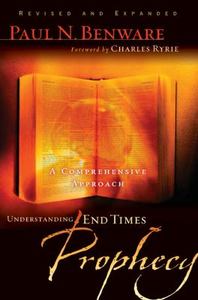 Understanding End Times Prophecy
Wait, What?
Yes, I just used the words dispensational premillenialism together in a sentence as though it made sense. It does. That is one of the many views Benware surveys in the book. Before reading Understanding End Times Prophecy (hereafter UEP), I admit I could not have distinguished a dispensational premillenialist from an amillenialist. Nor could I have identified a pre-wrath view in contrast with a post-wrath view. Benware’s book touches all of these and more, explaining the various positions out there on the various eschatological themes while also providing a thorough critique of those with which he disagrees.
Outline of Contents
Benware starts by outlining some principles for interpreting Biblical prophecy. Primary among these is the notion that prophetic passages must be interpreted literally. Benware explains: “Literal interpretation assumes that… [God] based His revelatory communication on the normal rules of human communication. Literal interpretation understands that in normal communication and in the Scriptures figures of speech are valuable as communication devices…” and it is therefore “not… a rigid ‘letterism’ or ‘mechanical understanding of the language’ that ignores symbols and figures” (23-24).
UEP then outlines a broad understanding of Biblical covenants, noting that the covenant God made with Abraham was unconditional, and so must be fulfilled.Next, Benware turns to a number of passages which outline the Palestinian, Davidic, and New Covenants. These he discusses in the context of promises God makes to Israel which must be fulfilled.
The next major section outlines the major views on the millennium. Benware favors the dispensational premillenial view and so spends some time outlining it.The dispensational view focuses on the covenants found throughout the Bible. It holds that there are different “economies” of God’s working. These dispensations are not time periods, nor are they different ways of salvation. Instead, they are specific truths about how God chooses to work with His people (86ff). This view also holds that God will fulfill promises through Israel as a literal nation in the place that God promised them (88ff).
The premillenial view holds that Christ returns before the millennial kingdom. It holds that the millennium is a literal thousand-year reign of Jesus on earth. Thus, there are two resurrections: first, before the millennial kingdom; second, after the millennial kingdom. Israel factors prominently into this view; Israel will be part of the thousand year reign and will occupy the land that God promised unconditionally to Abraham (94ff). Benware argues against the notion that Israel has become displaced or fulfilled in the church (103-120).
Then Benware turns to the view of amillenialism. Essentially, this view holds that the “millennium” is non-literal and is being fulfilled now during the church age. There is one resurrection, and the judgment comes immediately upon Christ’s return. Thus, the current period is the millennial kingdom (121-137).
Postmillenialism is the subject next discussed in UEP. This view tends to be tied into the notion that we are now living in the kingdom of God and so will usher in a golden age through social justice or action. After this undefined point, Christ will return to judge (139ff). Benware is highly critical of this view, noting that it relies upon the notion that we will continue improving the world (yet the world seems to be falling farther rather than progressing); as well as its rejection of the notion of a literal reign of Israel (150ff).
Finally, Benware evaluates preterism. Essentially, this view holds that the events prophesied in Revelation and elsewhere have either all or mostly been fulfilled already. There is much diversity within this perspective, but largely it is tied in with the notion that the destruction of the temple ushered in the end times (154ff).
The next major area of evaluation in UEP is that of the rapture. Benware analyzes pre-tribulation; post-tribulation; and other rapture views. Pre-tribulation is the view that the rapture will happen before the tribulation period. Post-tribulation is the view that the rapture happens after the tribulation. These directly tie into how one views the coming of Christ and the millennial kingdom (207ff).
Finally, UEP ends with outlines of the seventieth week of the book of Daniel, the Kingdom of God, death and the intermediate state, and the final eternal state. An enormous amount of exposition and discussion is tucked into these final chapters. For example, Benware includes a critique of annihilationism.
I have here only touched on the surface of UEP. Benware is exceedingly thorough and has managed to write an amazing resource on the issues related to End Times Prophecy.
Analysis
As has been noted, UEP is a simply fantastic resource for those who want to look at the various views which are discussed in contemporary evangelicalism. Benware has also provided an extremely detailed exposition of the dispensational premillenialist position. If someone wants to critique that view, UEP will be a book which they must reference. It is that good and that comprehensive.
Furthermore, Benware provides a number of excellent insights through the use of charts. Throughout UEP, there are charts scattered which summarize the content of what Benware argues, show pictorially what various views teach, and more. These charts will become handy for readers to reference later when they want to discuss the issues Benware raises. They also help interested readers learn what various views and positions teach.
Benware rightly shatters false notions that Biblical prophecy is some kind of indiscernible mystery language which humans weren’t meant to think on. His care for making clear what the Bible teaches on a number of issues is noteworthy.
Unfortunately, there are several areas in the book which are cause for caution. Benware’s use of proof texts is sometimes questionable. There is great merit to utilizing a series of related texts after an assertion in order to support one’s argument, but upon looking up several texts that Benware cites to make his points, it seems that he often stretched texts far out of their context or even cited texts which had nothing to do with the argument he made in the context in which he cited them. For just one example, Benware writes “The second phase of his [the Antichrist’s] careerwill take place during the first half of the tribulation… During his rise to power he will make enemies who will assassinate him near the midpoint of the tribulation (cf. Rev. 13:3, 12, 14). But much to the astonishment of the world, he is restored to life and becomes the object of worship (along with Satan)” (300). Note that Benware specifically says that the Antichrist will be assassinated and resurrected. Now, turn to the passages that Benware cites. Revelation 13:3, 12, and 14 state:
3: One of the heads of the beast seemed to have had a fatal wound, but the fatal wound had been healed. The whole world was filled with wonder and followed the beast… 12: It exercised all the authority of the first beast on its behalf, and made the earth and its inhabitants worship the first beast, whose fatal wound had been healed… 14: Because of the signs it was given power to perform on behalf of the first beast, it deceived the inhabitants of the earth. It ordered them to set up an image in honor of the beast who was wounded by the sword and yet lived. (NIV)
Now, where in this section does it say the Antichrist will be assassinated? Where in this section does it talk about the Antichrist dying and being raised to life? Strangely, Benware seems to reject the literal hermeneutic he advocates, and begins to interpret texts in ways that bend them to the breaking point.
The issue of these proof texts opens a broader critique of UEP. Benware constantly insists upon a literal reading of Revelation and other prophetic texts, while also criticizing those who hold other views of using an inconsistent hermeneutic. Yet, as I believe I demonstrated above, Benware often goes well beyond the literal meaning of the texts and comes to conclusions which stretch them past literal readings. In fact, it seems that Benware balances an often literalistic reading of the text with a non-literal reading. Thus, Benware seems to fall victim to the very error he accuses all other positions of falling into.
An overall critique of the position Benware holds would take far too much space and time for this reader to dedicate in this review, but I would note that the conclusions Benware comes to are often the result of the combination of literalistic readings and/or taking texts beyond what they say that I noted above. Some of the worrisome issues include the notion that the sacrificial system will be reinstated (334ff); a view in which the notion that the church seems in no way fulfill the Biblical prophecies about Israel (103ff); hyper-anthropomorphism of spiritual beings (i.e. demons, which are spiritual beings, being physically restricted [130]); and the insistence on literalizing all numbers in the Bible (168), among issues. It’s not that Benware doesn’t argue for these points; instead, it was that it seems his method to get his conclusions was sometimes faulty, and the case not infrequently was overstated.
One minor issue is Benware’s use of citations. It’s not that he fails to cite sources; rather, the difficulty is that he inconsistently tells the reader where the source is from. Very often Benware block quotes another text (with proper end note citation) without letting the reader know who or what he is quoting. Although this may be better for readers only interested in the argument, it can be very frustrating for those interested in knowing where Benware is getting his information to have to flip to the back of the book all the time to trace down sources. The problem is compounded by the fact that sometimes he does tell the reader where the quote is from (for example, he’ll write “so-and-so argues [quote]”) while at other times he just dives directly into the quote. The inconsistent application here may be a minor problem, but it did cause major frustration through my reading of the text.
Conclusion
Understanding End Times Prophecy
Source
Paul Beware Understanding End Times Prophecy
Disclaimer: I was provided a review copy of this book by the publisher My thanks to Moody Books for the opportunity to review the book..
SDG.
——
The preceding post is the property of J.W. Wartick (apart from citations, which are the property of their respective owners, and works of art as credited) and should not be reproduced in part or in whole without the expressed consent of the author. All content on this site is the property of J.W. Wartick and is made available for individual and personal usage. If you cite from these documents, whether for personal or professional purposes, please give appropriate citation with both the name of the author (J.W. Wartick) and a link to the original URL. If you’d like to repost a post, you may do so, provided you show less than half of the original post on your own site and link to the original post for the rest. You must also appropriately cite the post as noted above. This blog is protected by Creative Commons licensing. By viewing any part of this site, you are agreeing to this usage policy.
Review of “Love Wins” by Rob Bell: Chapter 3
I have been reviewing Rob Bell’s book, Love Wins, with a particular eye towards evaluating not only his arguments, when they are made, but also the way he makes those arguments. I have not read the book before, so each review is fresh: I am writing these having just completed the chapter the post is on. Here, I’ll go over Chapter 3: Hell. First, I will outline the chapter, then I will analyze its content. Be sure to check the end of the posts to links for the other posts in this series, as well as a few other links.
Chapter 3: Hell
Outline
Rob Bell begins his discussion of hell by framing it around this issue: “God is loving and kind and full of grace and mercy–unless there isn’t confession and repentance and salvation in this lifetime, at which point God punishes forever. That’s the Christian story, right? Is that what Jesus taught?” (64). In order to answer this question, Bell says, he will show “every single verse in the Bible in which we find the actual word, ‘hell'” (ibid).
In order to do this, he first turns to the Hebrew Scriptures. As he explores these passages, Bell concludes that God has power over life and death and that God is present and involved in life after death. However, the words “life” and “death” have different meaning for the Hebrew Scriptures than we give them, argues Bell. Instead of some kind of fixed point of either being alive or dead, Bell notes that they view life and death as “two ways of being alive” (66). To conclude with his discussion of the Old Testament, Bell sums up: “simply put, the Hebrew commentary on what happens after a person dies isn’t very articulated or defined” (67).
Then, Bell turns to the New Testament. Here, he notes that the word for hell was often “Gehenna,” which in Jesus’ day was a fiery garbage dump (68). Bell skims through a few passages here, simply quoting individual sentences without context. Then he evaluates a few verses related to “Hades,” which Bell argues is “essentially the Greek version of… “Sheol” (69).
Then, Bell turns to a number of stories about using strong language to describe human suffering, with examples from Rwanda, as well as rape, divorce, adultery, etc. Next, he turns to an analysis of Luke 16:19-31, the story of Lazarus and the rich man. He makes much of the notion that the rich man is still alive in the fire, and that he still expects Lazarus to serve him (74ff). His analysis of this story ends with his conclusion: “He [the rich man] fails to love his neighbor… It’s a story about individual sin, but that individual sin leads directly to very real suffering at a societal level. If enough rich men treated enough Lazaruses outside their gates like that, that could conceivably lead to a widening gap between the rich and the poor” (78).
Because of this analysis, Bell argues that “What we see in Jesus’ story… is an affirmation that there are all kinds of hells… There are individual hells… There is hell now, and there is hell later, and Jesus teaches us to take both seriously” (79).
After an aside on Jesus’ eschatological warnings as very real and immediate, Bell turns to what seems to be the core of his argument for the chapter. Here I’ll quote at length:
Many people… have only ever heard hell talked about as the place reserved for those who… don’t believe… People who don’t believe the right things…
[I]n reading all of the passages in which Jesus uses the word ‘hell,’ what is so striking is that people believing the right or wrong things isn’t his point… he’s talking about… how [listeners] conduct themselves, how they interact with their neighbors. (82)
Analyzing texts which don’t explicitly discuss hell, but which are taken as teaching on the topic, is the next task Bell turns to. He notes Jesus’ discussion of Sodom and Gomorrah, when Jesus said “It will be more bearable for Sodom and Gomorrah on the day of judgment than for you.” Bell states, “More bearable for Sodom and Gomorrah? …There’s still hope? And if there’s still hope for Sodom and Gomorrah, what does that say about all of the other Sodoms and Gomorrahs?” (84-85). He then explores the theme of restoration throughout the Bible.
Then, he explores Matthew 25’s passage about the sheep and the goats. He makes much of the Greek word, kolazo. He argues that it could have the meaning of “pruning” rather than punishment, and so “the phrase can mean ‘a period of pruning'” in contrast to “eternal punishment” (91). He puts the possibility forward that this could be “an intense experience of correction” (ibid).
In the next chapter, Bell says he will turn to what happens after we die.
Analysis
Bell shows a great concern for the need to avoid views which ignore hell or desire to cut it out of the picture. There is a tendency towards avoiding a “literal” hell or even pretending the teaching isn’t part of Christianity at all. Bell rightly notes that this cannot be reconciled with Scriptural teaching, and that we need to think on the topic.
Bell’s discussion of “life” and “death” as having implications beyond merely physical death is correct. However, the place he draws it from (the Deuteronomic Code) is a bit strange. The blessings and curses, as well as the choice between “life” and “death” are based on the corporate promises given to the nation of Israel. That’s not to say it doesn’t have individual application, but the way Bell discussed it may cause some confusion.
Properly speaking, Bell’s statement that “there is hell now” seems simply mistaken. The reason is because he makes this as an application to our present lives being hell. No, he doesn’t make this as an analogy, as in our lives are hellish or like hell on earth. Instead, his point seems to be that people, when they are making life-destroying decisions, are currently experiencing the realities of hell. It seems that this may be an unfortunate tie-in to the apparent works righteousness explored in chapter 2.
However, Bell does seem correct at least in part when he asserts that Jesus’ teachings had much to say about the ills of society and how we must work to avoid bringing in even greater suffering through class warfare, independent choices, and the like.
Yet even in this, Bell’s primary points seems to be a kind of works-based righteousness yet again. In contrast to the notion that salvation is based around beliefs [faith?], Bell bases Jesus’ teaching in this area upon the love of neighbor. While this is clearly part of Jesus’ teachings, Bell’s position on this seems to be wrong again. Christ did explicitly teach that right belief [faith] is a criterion for salvation: “Whoever believes and is baptized will be saved. But whoever does not believe will be condemned” (Mark 16:16). No, this is not in the context of the verses on “hell,” which was the focus of Bell’s quote above, but the way Bell states his argument makes it sound as though what he has stated is the teaching of Christ on the topic.
This leads us to another overarching problem with Bell’s argument so far: namely, his tendency to atomize the texts he disagrees with in order to filter their teachings through specific texts he uses as control verses. He seems to create a canon-within-the-canon, utilizing certain proof texts as the filter through which he views all other texts. Even worse is the fact that he simply ignores texts which explicitly teach the opposite of what he states.
Bell demonstrates a truly confusing view of Jesus’ statement about Sodom and Gomorrah. Note that Jesus says that it will be better for Sodom and Gomorrah; Jesus does not say there is still hope. The text is pretty clear: Sodom and Gomorrah have already been condemned, but those who are rejecting Christ now will be under even worse judgment. I have very serious difficulties seeing any possible way that Bell could realistically conclude that this passage is teaching there is still hope for Sodom and Gomorrah. Instead, Jesus is using those cities as the paradigm example of evil. They are already condemned, and if those who are listening to Jesus at that point do not repent, their condemnation will be worse.
Finally, Bell’s interpretation of kolazo is also problematic. The reason is because he uses a translation from classical Greek as opposed to the Greek used in the New Testament (Koine Greek). He fails to acknowledge that although words can have meanings at one time, that doesn’t seal their possible range of meanings for all time. We can see this in some modern words, like “brave,” which used to mean “cowardly.” The point is that simply having a meaning at some point in time doesn’t make that meaning of a word useful at all other points in time. Furthermore, the meaning for kolazo as “punishment” is attested throughout early Christian literature as well as late classical literature. I tried to find the meaning Bell suggests for the word in a few New Testament lexicons I have sitting on the shelf and failed to find it. They unanimously give “punish” as the only or the primary meaning, and nothing related to pruning or horticulture, as Bell suggests, is even hinted at. I conclude that Bell is mistaken.
Conclusion
Bell gives some important points related to the need to reflect on Jesus’ teaching as well as a right emphasis on the reality of hell. Unfortunately, there are some pretty major exegetical errors found in chapter 3. My study of kolazo suggests that Bell is simply wrong on this topic. His interpretation of the passage related to “Sodom and Gomorrah” is odd, to say the least. Finally, although he doesn’t explicitly state his position, Bell seems to continue to imply that it is our actions, rather than faith, which determine the reality of heaven or hell for our life on earth and in the hereafter.
Next week, we’ll evaluate chapter 4, which is entitled “Does God get what God wants?”
Links
Review of “Love Wins” by Rob Bell: Preface and Chapter 1– I discuss the preface and chapter 1 of Love Wins.
Review of “Love Wins” by Rob Bell: Chapter 2– I review chapter 2.
Review of “Love Wins” by Rob Bell: Chapter 4– I look at Chapter 4: Does God Get what God Wants?
Review of “Love Wins” by Rob Bell: Chapter 5– I analyze chapter 5.
Love Wins Critique– I found this to be a very informative series critiquing the book. For all the posts in the series, check out this post.
Should we condemn Rob Bell?– a pretty excellent response to Bell’s book and whether we should condemn different doctrines. Also check out his video on “Is Love Wins Biblical?“
Source
Rob Bell, Love Wins
SDG.
——
The preceding post is the property of J.W. Wartick (apart from citations, which are the property of their respective owners, and works of art as credited) and should not be reproduced in part or in whole without the expressed consent of the author. All content on this site is the property of J.W. Wartick and is made available for individual and personal usage. If you cite from these documents, whether for personal or professional purposes, please give appropriate citation with both the name of the author (J.W. Wartick) and a link to the original URL. If you’d like to repost a post, you may do so, provided you show less than half of the original post on your own site and link to the original post for the rest. You must also appropriately cite the post as noted above. This blog is protected by Creative Commons licensing. By viewing any part of this site, you are agreeing to this usage policy.
Genetics and Bioethics: Enhancement or Therapy?

[Note: Revised and expanded 6/15/2015.]
Bioethics is an expanding field with direct implications for our lives. Here, we’ll reflect on the possibility and implications of gene therapy and enhancement. While I was at the Evangelical Philosophical/Theological Society Conference in 2012, I had the pleasure of sitting in on a talk about this very topic, and that will be the focus of this post. Unfortunately, the speaker had been switched around and was not listed in the booklet that I have. Furthermore, I never caught the speaker’s actual name (I tried to write it down when he was introduced, and got Gary Alkins, though I have tried searching online for that and haven’t come up with it), so if someone knows what it is, please let me know. I’ll reference the speaker as “speaker” throughout this post.
The central relevant moral question under discussion was: “Should genetic technology be used to not only heal but also to enhance the human condition?”
A Vital Distinction
An important aspect of this discussion is the distinction between gene enhancement and therapy. Gene therapy is the use of genetic research and information to cure illness. Speaking very hypothetically, suppose that we were able to discover the exact genetic code for illnesses like sickle cell anemia, isolate it, and replace it with a non-anemic code before a person was even born; that would be gene therapy. Genetic enhancement takes this a step further. It allows for modifying people genetically to enhance certain features such as physical strength, endurance, mental aptitude, and the like. It would, in a sense, create “super humans.”
Therapy
Using our knowledge of genetics for therapy, the speaker argued, is perfectly justified. We are called by Christ’s example to treat illnesses, and gene therapy can be seen as an extension of this. There was little time spent defending the moral permissiveness of gene therapy, as the primary question was whether genetic enhancement is morally permissible.
Enhancement
There are several arguments for genetic enhancement. These include:
1) The “natural lottery” argument: if we have the capacity to genetically enhance humans but do not, that means we are, effectively, just playing a genetic lottery to see if our children turn out well. Parents have a moral duty to act against the natural lottery.
2) We encourage environmental enhancement (i.e. seeking better education, putting children in brain-stimulating environments, encouraging sports for their physical well-being, etc.), why is genetic enhancement any different?
3) We already manipulate chemicals (caffeine, vitamins, etc.) for our well-being, why not genetics? In the end, what matters is human well being.
4) Genetic enhancement is simply the next logical step for humanity. If we agree that therapy is good because it stops genetic defects, should we not also hold that enhancement is good because it pushes people to fill their greatest potential.
Against these arguments, the speaker argued [updated section 6/15/15 with some counter-responses]:
A) Genetic enhancement could never match the ideal outlined in these arguments, wherein every human being is enhanced on a number of levels. Instead, it would very likely increase the split between the haves and have-nots by allowing those who have much to increase their dominance over society. The haves could afford to continue enhancing and remain a kind of super-human society while the have-nots would never be able to catch up.
However, a possible counter-argument to this reasoning would be to note that there will always be people who are advantaged and people who are disadvantaged. It’s unclear as to how this should serve to undermine the moral base for genetic enhancement.
B) There is a great good in letting humans accomplish things which stretch their skill set. Think about the steroids controversy in sports. We intuitively know that those who used performance enhancing drugs had an unfair advantage over those who did not. Similarly, those who would be genetically enhanced would have an unfair advantage over those who were not enhanced in almost any conceivable area of human achievement.
It is unclear, though, whether genetic enhancement would undermine the good of accomplishment and human achievement. Indeed, one could argue that genetic enhancement, in fact, bolsters human achievement by widening the scope of possibility for humans. From a pragmatic perspective, though, it sure would make it hard to keep on top of sports records and the like! We’d have to build bigger baseball parks to make home runs harder to hit! But seriously, the argument from human achievement does not seem sound to me.
C) What of bodily autonomy? Who’s to say that it is a good for parents to meddle with their children’s genes. What if a child does not want to be extremely strong, or what of their parents choose to give them giftedness in music, but they simply don’t like to do music? What if the children hate what their parents chose for them: hair color, eye color, etc.? Unlike the “natural lottery,” such attributes related to enhancement actually do have blame to assign to someone. Is there no bodily autonomy involved?
However, as Elijah argues, parents violate “autonomy” of their children all the time. This means there is some difficulty with determining how genetic enhancement would be a qualitative, rather than quantitative difference for this violation of autonomy. The opponent of genetic enhancement must establish that there is an objective difference between enhancement and other forms of violating autonomy, and must also show this difference is enough to ground a rejection of enhancement.
Enhancement and Theology
There are numerous theological issues involved in the debate over genetic enhancement. First, what might it mean for the image of God? Humans were created as “very good” and in the “image of God.” What does it mean to be in that “image of God” and does enhancement change that in any way?
For Christians, the ultimate fulfillment of God’s plan comes in the New Creation. The notion that humanity needs a genetic upgrade reflects the worldview of naturalism. Christians do not hope in their own ingenuity but rather in God’s plan for creation. That does not mean we cannot get actively involved in healing, but it does mean that we do not need to violate persons’ humanity by enhancement. One might argue that the assumption involved in enhancement is that our bodies are not good enough and that we need to improve them. However, such an assumption is not the only possible basis for enhancement. One could argue, instead, that enhancement is based on the notion that we are to keep fighting against the impact of sin in the world and one way to do this is to become stronger, smarter, and the like through the tools God has given us through scientific research.
Although we are fallen creatures, that does not imply that we are creatures capable of getting out of our own fallenness. No enhancement we can do can bring us ultimate salvation.
Evaluation
It seems to me that the arguments against enhancement may seem initially sound, but each one has its own problems.
It seems that if parents select for certain attributes, then parents can be held morally culpable for the genes their children develop. Thus, if the child dislikes an attribute, they could feasibly hold their parents responsible for that selected attribute. Interestingly, this may work both ways too: a child could hold their parents responsible for not changing an attribute. Yet this latter argument seems to make a mockery of parenthood, holding parents responsible for nature. I’m not sure, though, that this culpability is enough of an argument against genetic enhancement.
In the theological sphere, one may wonder whether someone could just as easily argue that because we were created initially “very good,” a pursuit of bodily perfection could be viewed as a fight against the Fall and the curse. I tried to ask this as a question, but there wasn’t time at the end to get to all the questions. The speaker did an excellent job noting possible counter-arguments to their points, and I thought gave a very fair presentation overall. It seems that the best argument against genetic enhancement may be the bodily autonomy argument, but this one has its own significant problems.
I’d like to know what your thoughts are on this topic: Do you think enhancement is moral? Why or why not?
Links
I have written on a number of other talks I went to at the ETS/EPS Conference. I discuss every single session I attended in my post on the ETS/EPS Conference 2012. I also discuss a panel discussion on Caring for Creation, and a debate between a young earth and old earth proponent.
SDG.
——
The preceding post is the property of J.W. Wartick (apart from citations, which are the property of their respective owners, and works of art as credited) and should not be reproduced in part or in whole without the expressed consent of the author. All content on this site is the property of J.W. Wartick and is made available for individual and personal usage. If you cite from these documents, whether for personal or professional purposes, please give appropriate citation with both the name of the author (J.W. Wartick) and a link to the original URL. If you’d like to repost a post, you may do so, provided you show less than half of the original post on your own site and link to the original post for the rest. You must also appropriately cite the post as noted above. This blog is protected by Creative Commons licensing. By viewing any part of this site, you are agreeing to this usage policy.
Really Recommended Posts 2/22/13
 I have to say, the posts for this week are really the cream of the crop. Make sure you follow the blogs I link to here, because they are constantly amazing. We look at The Mortal Instruments, Richard Carrier and the Jesus Myth, the power of prayer, how pornography can destroy the brain, science fiction, and a fun interview!
Empires and Mangers: The Mortal Instruments– What’s all the buzz about surrounding the upcoming movie and the books called “The Mortal Instruments?” Anthony Weber analyzes the series in this fantastic post. I haven’t read the books and I was still fascinated. Do check this one out, as it will be all over culturally. Also, follow this blog because the posts are consistently at this quality. It’s a must-read every time.
Does Richard Carrier Exist?– A fun but rigorous look at whether Richard Carrier exists. Why? Richard Carrier is best known for his denial that a historical Jesus ever existed. Here, Glenn Andrew Peoples and Tim McGrew partnered to use Carrier’s methods on him, to devastating results.
C.S. Lewis on the efficacy of prayer– Have you ever heard the objection that prayer doesn’t work? Matt Rodgers takes on this argument through C.S. Lewis, the eminent Christian writer and theologian.
The Effects of Porn on the Mail Brain– This is a scary, uncomfortable post. The topic is pretty self-explanatory. Pornography is devastating. Let us pray for those under its chains and continue to work against it.
Grand Blog Tarkin– Have fun with this one. It is a blog dedicated to looking at the social and military themes in science fiction and fantasy. I cannot describe how nerd-awesome this is (just a hint: if you get the title, you’d love it… even if you don’t, you’ll still love it). You must check it out.
Mike Robinson interviews J.W. Wartick– A bit of a plug here: check out Mike Robinson interviewing me on his (great!) blog. I’d love your comments.
Review of “Love Wins” by Rob Bell: Chapter 2
I have been going through Love Wins
There are many other looks at Love Wins available online, both critical and positive. What do I hope to offer here? I will analyze Rob Bell’s arguments in three primary ways: in light of historical theology, in light of methodology, and in light of analytic theology. I believe this will offer a thorough look at several of Bell’s claims. I hope to offer as even-handed an analysis as possible.
Rob Bell’s argument will be examined for historical accuracy and philosophical rigor. Furthermore, I will examine how Rob Bell makes his argument, because method is often one of the primary ways that people err in their theology. I begin with an analysis of the Preface and Chapter 1. I am hoping to release one post a week as I analyze this text. I will post each section with an outline of the arguments followed by my analysis.
For other posts in the series, view the links below.
Chapter 2
Outline
Rob Bell begins with imagery of heaven, followed by a series of questions about the nature of heaven. He notes the cultural picture of heaven: “harps and clouds and streets of gold, everybody dressed in white robes” (24). Heaven leads us to ask questions like “What will we do all day? …What will it be like? Will there be dogs there?” (24-25). Bell uses these questions as a bridge into another question: “who will be there and who won’t be there” (25). He discusses a young woman who contemplates heaven and realizes her family won’t be there, based on a pastor’s answers to this question:
When she asks the pastor afterward if its true that, because they aren’t Christians none of her family will be there, she’s told that she’ll be having so much fun worshipping [sic] God that it won’t matter to her. Which is quite troubling and confusing, because the people she loves most in the world do matter to her. (25)
This leads Bell to ask the question:
Are there other ways to think about heaven, other than as that perfect floating shiny city hanging suspended there in the air above that ominous red and black realm with all that smoke and steam and hissing fire?
I say yes, there are. (26)
Bell then turns to an analysis of Jesus’ interaction with the rich man in Matthew 19:16-30. He notes that Jesus’ answer to the rich man’s question about “eternal life” restates his question as “Enter life” (28ff). He argues that “Heaven, for Jesus, was deeply connected with… ‘this age’ and ‘the age to come'” (30).
The Greek word aion is analyzed, and Bell concludes that it has multipple meanings such as “age” with a beginning and end, or “forever” (but not in the way we understand forever, he adds). He then surveys a number of passages in the Bible which discuss about the new creation/age, concluding by pointing out “Life in the age to come. If this sounds like heaven on earth, that’s because it is. Literally” (33).
Bell insists upon focusing on life now as opposed to in the future. “Jesus takes the man’s question [in Matthew 19:16] about his life then [in eternal life] and makes it about the kind of life he’s living now. Jesus drags the future into the present…” (41). This raises the question for Bell: “What does Jesus mean when he uses that word ‘heaven’?” (42).
Bell answers the question by noting a number of meanings for the word “heaven” in Jesus’ day. He concludes that heaven is “The day when God’s will would be done on earth as it is now in heaven. The day when earth and heaven will be the same place…. Life in the age to come” (43). This entails that “Taking heaven seriously… means suffering seriously, now. Not because we’ve bought into the myth that we can create a utopia… but because we have great confidence that God has not abandoned human history and is actively at work within it, taking it somewhere” (45). He notes that our beliefs about the future shape our actions now (46).
The analysis of heaven continues, as Bell notes that “the confusion [about heaven]… comes from the idea that in the blink of an eye we will automatically become totally different people who ‘know’ everything. But our heart, our character, our desires, our longings–those things take time” (51). He returns to aion and argues that “heaven is not forever in the way that we think of forever, as a uniform measurement of time…” instead, translators use the word “‘eternal.’ By this they don’t mean the literal passing of time; they mean transcending time, belonging to another realm altogether” (58).
Based on his understanding of heaven as heaven on earth, Bell suggests that “Eternal life doesn’t start when we die; it starts now. It’s not about a life that begins at death; it’s about experiencing the kind of life now that can endure and survive even death” (59).
Analysis
Bell’s critique of cultural notions of heaven should be well-received. The way that pop-culture has portrayed heaven is extremely inaccurate and perhaps even dangerously wrong. Harps and wings and the like are pop imagery, not necessarily Biblical imagery. We must look to the Bible to determine what it is that heaven will be like. It seems that Bell is correct to note that heaven will be a New Creation and that the notion of heaven and earth coming together is a theme in the Bible.
Furthermore, he seems spot on when he notes that there are confused notions of heaven which constitute humans suddenly, miraculously, entirely changing into all-knowing spirit creatures. I have yet to find anywhere in the Bible that it says anything at all about humans suddenly knowing everything in heaven, yet it is a claim that persists in everyday conversation.
Bell does once more commit a minor methodological error when he simply notes that there are other views on heaven as though the simple existence of other views about heaven somehow validates these other views. The context in which he says this was in his argument against the pop view of heaven, and so it seems he is correct in favoring a view of heaven that is closer to the Biblical account, but it remains an issue that Bell argues in this fashion. The mere existence of differing views on a topic does nothing to validate any or all of said views.
Furthermore, it seems that some of Bell’s conclusion go beyond the Biblical text. For example, his suggestion that eternal life is “about experiencing the kind of life now that can endure and survive even death” (59). It seems that at this stage Bell drifts dangerously close to a kind of works-righteousness. After all, who exactly is it that needs to live this kind of life? You, dear reader. According to Bell, it is each person’s task to live a kind of life which is capable of surviving death.
In fact, Bell illustrates this through his example from Matthew 19. He notes that the rich man does not live eternal life now because “The man can’t do it, and so he walks away” (41). It is hard to think about a view of eternal life more contrary to what Jesus did and what is taught in the Bible about salvation. Eternal life does not come because we are capable of living a life that somehow transcends our current reality. That is impossible for us to do.
It is truly unfortunate that Bell’s interpretation of the text he makes key for his point (Matthew 19) illustrates another methodological error. Namely, ignoring context. The entire section on the need for living eternal life now is based upon Bell’s reading of Jesus as reinterpreting the rich man’s question as asking about “enter[ing] life” (27ff). He takes two words from the middle of a phrase Jesus says and then bases what seems like his entire discussion of the doctrine of heaven around it. Yes, he cites many prophetic passages about the new creation, but instead of taking these to provide a broader commentary on the notion of eternal life, he reads them all through the filter of those two words: “enter life.” He therefore commits a serious methodological blunder, and it seems that it is this blunder which leads him to a doctrine of heaven which becomes tied into what it is that we do to get to heaven.
Conclusion
Overall, it seems that Bell has done a great job of providing some critiques of the “pop culture” view of heaven which is decidedly unbiblical. He even gets many things right about heaven, including the notion that it will be a new creation and that it will be tied to the creation we experience now.
In light of these positives, it is sad to say that Bell’s discussion of the nature of salvation seemingly turns upon an idiosyncratic reading of two words ripped from their context and used to reinterpret every other passage he references. It is even worse to note that Bell’s doctrine of heaven wavers right on the edge of works righteousness, if it does not step over into that camp altogether. The fact is that Bell discusses eternal life as something which we have to do. It is something which we can do if we just live a life that is capable of transcendence.
It is hard to imagine a doctrinal stance more removed from the notion of salvation by grace through faith. Sola gratia.
Next week, we will look at Chapter 3: Hell.
Links
Review of “Love Wins” by Rob Bell: Preface and Chapter 1– I discuss the preface and chapter 1 of Love Wins.
Review of “Love Wins” by Rob Bell: Chapter 3– I look at Chapter 3: Hell.
Review of “Love Wins” by Rob Bell: Chapter 4– I look at Chapter 4: Does God Get what God Wants?
Review of “Love Wins” by Rob Bell: Chapter 5– I analyze chapter 5.
Love Wins Critique– I found this to be a very informative series critiquing the book. For all the posts in the series, check out this post.
Should we condemn Rob Bell?– a pretty excellent response to Bell’s book and whether we should condemn different doctrines. Also check out his video on “Is Love Wins Biblical?“
Source
Rob Bell, Love Wins
SDG.
——
The preceding post is the property of J.W. Wartick (apart from citations, which are the property of their respective owners, and works of art as credited) and should not be reproduced in part or in whole without the expressed consent of the author. All content on this site is the property of J.W. Wartick and is made available for individual and personal usage. If you cite from these documents, whether for personal or professional purposes, please give appropriate citation with both the name of the author (J.W. Wartick) and a link to the original URL. If you’d like to repost a post, you may do so, provided you show less than half of the original post on your own site and link to the original post for the rest. You must also appropriately cite the post as noted above. This blog is protected by Creative Commons licensing. By viewing any part of this site, you are agreeing to this usage policy.
Young Earth Creationism and Presuppositionalism: An Analysis
 Young Earth Creationism stands or falls based upon the specific use of presuppositionalism as an epistemological groundwork. Here, I will challenge the very core of the young earth paradigm: I will charge that it is an invalid presuppositionalist approach to viewing science and theology.
Young Earth Creationism (YEC will be used hereafter for “young earth creationism,” “young earth creationist” and other forms of those words as needed), is, of course, the position that the Genesis account of the creation of the universe took place over the course of seven literal 24-hour days about 6-12,000 years ago. I have extensively explored various aspects of young earth creationism and other positions, and my posts can be found under the “Origins Debate” page.
Presuppositionalism is a type of apologetics (defense of the faith) which relies upon presupposing the truth of the Christian worldview in order to defend it. I have analyzed presuppositional apologetics a number of times. For an introduction into this position, check out “The Presuppositional Apologetic of Cornelius Van Til.”
Epistemology is the study of how we come to know things. Essentially, it asks questions like “How do we know that we know?”
Before proceeding, it is worth noting that many debates between YECs and people who believe in an ‘old earth’ perspective turn on the YEC use of presuppositionalism. A common theme for mocking YECs is to say they just refuse to hear evidence or shout over evidence, yet it seems that this is an unfair portrayal. As we evaluate the young earth position, it will become clear that the YEC perspective operates from within a presuppositional framework that explains much of the way YECs reason. It will also become clear, however, that the YEC use of this framework is invalid.
Thus, it is my contention that YEC is directly dependent upon a presuppositional approach to how we know things. For support of this contention, I note the fact that many YECs see this connection themselves. For example, Answers in Genesis has a number of posts on the topic, including a post outlining the meaning of and need for presuppositional apologetics. Or again, Nathaniel Jeanson of ICR presented a presuppositional case for YEC (analyzed by the Geochristian). However, this is not the only evidence. YECs tend to argue exclusively within a presuppositional framework.
Consider this argument:
The Bible clearly states that the earth was made in seven days. There is no room to interpret the text in any way other than as a literal week of creation.
Such an argument is extremely typical within the YEC community. However, it is also clearly a presuppositionalist approach to the question of the age of the earth. YECs will argue that science must be interpreted in such away as to line up with the creation account. A common theme is that “The data is the same, it is the interpretations of that data that differ,” another notion is that people are rejecting the “plain and obvious meaning of the text” when they offer an old earth interpretation. Such a position is often united with the notion that only by using “man’s fallible ideas” can one come up with a date of millions or billions of years.
The thought process goes in this order: we presuppose the truth of the Bible => the Bible teaches that the earth is 6-12,000 years old => all scientific evidence for the age of the earth must line up with the truth of the Bible. The Bible is the infallible word of God, and so it cannot be in error. Because, according to the YEC paradigm, the only possible interpretation for the Biblical account of creation is the young earth perspective, it therefore becomes clear that all science and truth must line up with YEC.
We are thus left with two possible ways to challenge YEC. Evidence simply is not the problem. Any evidence, if the YEC use of presuppositionalism is valid, simply must line up with YEC. Thus, to challenge YEC, one must confront directly its presuppositions. First, one can challenge the position by attacking the premise that the YEC paradigm is the only possible interpretation of the Genesis creation account. Second, one can challenge the position by directly attacking the presuppositional epistemological groundwork that the arguments are built upon. Rather than focus upon the first challenge, we will here explore whether or not the YECs have validly made use of the presuppositional approach.
 Assuming a Young Earth
It is important to note that the way the YEC argument works is to begin by simply assuming the truth of young earth creationism. I know this may sound radical, but it plays out time and again when discussing the various positions on the age of the earth. The young earth paradigm brokers no alternatives; only the young earth perspective is even possibly correct. How is it that YECs are so confident in their approach?
Simply put, the confidence is gained from the very way that they defend the young earth. YEC is not defended based upon evidence. It is not as though scientists are examining the earth and coming to the conclusion that the earth was formed only some thousands of years ago. Indeed, several prominent YECs assert that the very notion of finding the age of the earth from investigation of the geologic past is impossible or hampered by sin and fallible ideas. For just one example, Whitcomb and Morris, in their highly influential work, The Genesis Flood
[I]f He [God] did this [created a universe full-grown], there would be no way by which any of His creatures could deduce the age or manner of Creation by study of the laws of maintenance of His Creation. (238, emphasis theirs, cited below)
Such a notion persists throughout much YEC literature. In principle, the only way to conclude a young earth is to abandon supposed “uniformintarianism” (hold that the processes in place today continue at the same rate they did in the past–see an evaluation of one YEC’s use of this notion here) and view all of the history of the earth through the lens of God’s word. Now, whether or not it is valid to assume that the Genesis text is a scientific account, the argument here should be fairly clear. Namely, the young earth position is assumed. It is not something demonstrated by science, but rather a given before any scientific investigation takes place. Similarly, the position is assumed to be true before any exegesis has occurred. All scientific evidence and any exegetical hints at a different position are subsumed into the YEC position because it is assumed from the outset as correct. Because YEC is correct, all evidence must line up with it.
Some may object by arguing that frequently YECs offer evidence for their position. They may cite various catastrophic theories or flood geology as alternative explanations of Earth’s geologic past. However, even the authors of books like these (such as Whitcomb and Morris, or Walter Brown in his In the Beginning) admit that the key is to presuppose Scripture, which is of course, on their view, to presuppose a young earth.
The Validity of the Young Earth Assumption
It is clear that YEC turns upon presupposing its truth. YEC is assumed to be true, and all alternative views are simply wrong by default. Unfortunately, this is an abuse of presuppositional apologetics.
It is important to contrast the specifically YEC use of presuppositionalism with the wider use of presuppositional apologetics. Presuppositional apologetics in general is the method of engaging entire worldviews by granting their core assumptions and lining them up against reality in a competition of best explanation. The YEC use of presuppostionalism is to defend a single contention–a young earth–against all comers. There are very significant disanalogies here. What the YEC has done is use presuppositionalism not to enter into the square of debate over whole worldviews, but rather to insulate their interpretation against any possible counter-evidence.
There is a distinct difference between the use of presuppositional apologetics, and the use of YEC in presuppositionalism. The latter tends to simply reject outright any challenge as either against the “clear word of God” or as “assuming uniformitarianism.” By placing their own view beyond the realm of rational inquiry, they have undermined their own potential to know that it is true.
 The Faulty Grounds of the YEC Presuppositionalist
The foregoing evaluation leads us to the greatest difficulty facing the YEC approach: a faulty epistemology. Unfortunately, the way that the defense of YEC has been shown to work introduces a paradigm of knowledge which is impossible to sustain. Essentially, the YEC must assume what they think they know. Such an assumption seems to be viciously circular. The YEC must reason thus: “The Bible teaches a young earth=> The Bible is True=> the earth is young.” When presented with counter evidence, rather than engaging with the evidence, the YEC generally falls back to this same argument and reinterprets the evidence. That is where the whole system breaks down: the YEC has not made the right use of presuppositionalism, which allows for entire worldviews to be falsified. Instead, the YEC has misused presuppostionalism to put a young earth interpretation beyond falsification.
The objection will be made that everyone has core beliefs that must be assumed without evidence. Although such an assertion is itself hotly debated, I think it is possible to sidestep such a difficult discussion. Instead, one can note that even if one grants that core beliefs are necessarily assumed, the burden of proof is squarely placed upon the YEC to show how holding to a young earth is necessary for knowledge. Why is this the case? The simplest explanation is that if one assumes the epistemology needed for presuppositionalism is correct, then one has essentially a framework that involves the assumption of core beliefs that are necessary to allow for any knowledge. Thus, for example, the existence of God might be argued as necessary for knowledge (a la Alvin Plantinga, Cornelius Van Til, Greg Bahnsen, and the like) because without God to make us rational, there is no basis for thinking that our beliefs have any actual relationship to reality. Whether or not this is the case, it seems that a young earth is not one of these core beliefs.
Thus, we have finally come to the ultimate failing of the presuppositional defense of YEC: it abuses its epistemological framework to the point of breaking. The YEC has utilized an epistemological approach that allows for core beliefs to be assumed, but has done so in such a way that essentially any belief could be assumed with equal validity. An old earth creationist or theistic evoloutionist could equally argue that their position is based upon a core belief that must be assumed, in which case YEC is undermined. In turn, they could assume their reading of Scripture and make all others wrong by default.
Presuppositionalism must walk a fine line to determine which presuppositions are genuinely those which must be assumed for knowledge. When challenged, the presuppositionalist must make arguments to show that the presuppositions are indeed necessary for knowledge. Unless and until a YEC makes a case that by abandoning the notion of a young earth, one necessarily undermines all knowledge–a case which I must admit seems impossible–the YEC use of presuppositionalism is undermined. Rather than making a valid use of that apologetic approach, YECs have undermined its very principles, and have thus eliminated their own possibility of knowledge. They have relativized all truth by introducing as “first principles” things which are not necessary for knowledge.
A Final Defense
The YEC may object, saying that they have indeed established that YEC is necessary for knowledge. After all, if one denies YEC, which is the clear teaching of Scripture, one has denied God’s word, which is the basis for the entire presuppositional approach.
Setting aside a critique of presuppositionalism as the notion that one must assume the entirety of Scripture to have any knowledge, I would respond by simply noting that this argument does nothing to rebut my charge. I have argued that believing the notion that the earth is merely thousands of years old is not necessary for knowledge. The burden of proof rests squarely on the YEC to show how it is. By merely asserting that denying YEC undermines all of Scripture, one has begged the question. They have engaged in a presuppositional defense of something for which it has been charged that such an approach is epistemologically impossible. In order to defend it, one cannot simply assume that the other side is wrong, one must show how they are wrong.
Objective Knowledge
We have seen that YEC misuses presuppositionalism. A final point worth noting is that the YEC approach to apologetics actually undermines the possibility of objective knowledge. For, as we have noted, the YEC simply assumes their interpretation of the text without argument and then evaluates all science and theology through that lens. However, the YEC offers no reason for rejecting the notion that others could do exactly the same thing with their interpreatations of the text. The YEC has essentially made all truth relative. Anyone can simply assume their position is correct without argument, and then reinterpret all counter-evidence based on that approach. It therefore becomes clear that the YEC use of presuppositionalism must be rejected.
Unfortunately for YECs, the young earth position itself stands upon the bedrock of its faulty use of presuppositionalism. It remains to be seen whether it can adapt itself for a solid evidential base.
A Way Forward in the Age of the Earth Dialogue
It has become clear that YEC is based upon a faulty use of presuppositionalism and that its use of the presuppositional approach undermines the very possibility of objective knowledge.
How, then, can one proceed? It seems that the best way to proceed is to simply throw off the bindings of the misuse of presuppositionalism (taking note that presuppositionalism in general is not necessarily invalid if used properly–see discussion here) and engage in an honest debate over the evidence for either position. Rather than throwing out rote accusations at the other side (“You’re denying Scripture”; “That’s just because you’re assuming ‘uniformitarianism'”; etc, etc), let us engage in dialogue on the evidence at hand. Let’s look at the text in its cultural and linguistic context. Let’s examine the geological evidence of the earth and see where the evidence leads us. Let us not cut off the discussion before it has even begun by simply assuming we’re right and the others are wrong. We are called to always have a reason (1 Peter 3:15). By abandoning the necessity of reasoning when it comes to an issue such as young earth creationism, YECs have undermined the very possibility of a consistent apologetic.
Links
I examine a number of common young earth creationist arguments. Also check out my extensive writings on the origins debate.
Naturalis Historia is a phenomenal site which largely focuses upon investigating claims about a young earth. Some great starting places would be the series on the amount of salt in the oceans (Part 1 here) or some of the thoughts on baraminology.
Geocreationism is another site that examines evidence for the age of the earth with a theological approach. I highly recommend it.
Finally, the GeoChristian offers a number of critiques of the young earth theological and scientific perspectives.
Sources
John Whitcomb and Henry Morris, The Genesis Flood 50th Anniversary Edition
The last image is from NASA. The other images were personal photographs and protected by the copyright on this site.
SDG.
——
The preceding post is the property of J.W. Wartick (apart from citations, which are the property of their respective owners, and works of art as credited) and should not be reproduced in part or in whole without the expressed consent of the author. All content on this site is the property of J.W. Wartick and is made available for individual and personal usage. If you cite from these documents, whether for personal or professional purposes, please give appropriate citation with both the name of the author (J.W. Wartick) and a link to the original URL. If you’d like to repost a post, you may do so, provided you show less than half of the original post on your own site and link to the original post for the rest. You must also appropriately cite the post as noted above. This blog is protected by Creative Commons licensing. By viewing any part of this site, you are agreeing to this usage policy.

 J.W. Wartick - Reconstructing Faith