Jesus
Book Review: “How God Became Jesus” edited by Michael Bird
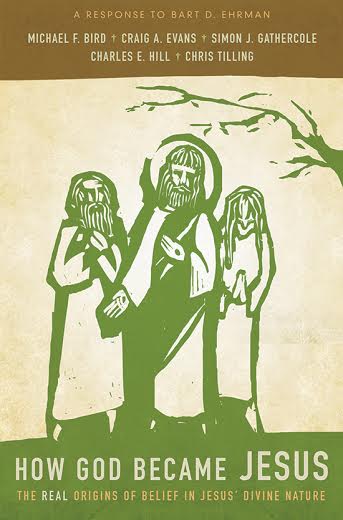 Bart Ehrman has made a name for himself through critical scholarship of Christianity. His latest challenge, a book called How Jesus Became God, contains an argument that the notion that Jesus is God was a later development in the church and not reflective of the earliest teaching. Interestingly, the book was published alongside a response book, How God Became Jesus, in which multiple scholars argue that, far from being a late development, high Christology was the belief of the church.
The book is a series of essays organized around responding to Ehrman’s book essentially point-by-point. Ehrman’s central thesis, that Jesus Christ was exalted from human to deity over the course of theological reflection and some centuries, is directly confronted in a number of ways. First, Michael Bird challenges the thesis by pointing out some major errors in the Ehrman’s use of angels and other exalted beings. Later, a kind of death blow is dealt to the thesis by pointing out that even within the earliest writings there is the alleged full “range” of development of the doctrine of Christ as divine (136ff). Simon gathercole provides interesting philosophical insight into the use of types of change in relation and actuality (114-115).
Other challenges brought against Ehrman include critical analysis of his methodology (Chris Tilling, 117ff), historical insight into the development of orthodoxy (Charles Hill, 151ff), and insight into Christ’s own claims of deity (Bird, 45ff). These present a broad-spectrum approach to analysis of Ehrman’s arguments and demonstrate the difficulty of maintaining his thesis. Readers are exposed to methodological, factual, exegetical, and other errors in Ehrman’s work.
However, the book should not be seen merely as a response to Ehrman. Although it is structured around just such a response, it is a worthy read in its own right because it provides background for exploration of the deity of Christ found throughout Scripture. It also helps readers place these writings in context by showing the cultural surroundings of the discussions over the deity of Christ. Moreover, by analyzing many of Ehrman’s skeptical claims, the authors provide responses to a broader range of objections to the Christian faith. For example, Craig Evans’ essay on the evidences for the burial traditions provides insight into how crucifixion worked in practice and, importantly, how the Biblical narratives line up with these practices.
Various excurses provide documentary evidence for things like 2nd and 3rd century belief in Christ’s deity. These help to break up the book, which can easily be read chapter-by-chapter or as individual essays.
How God Became Jesus is a great read. It provides insight not only for a response to Ehrman’s thesis but also for a number of other issues that come up when talking about the incarnate Lord Jesus Christ. Each essay has much to commend it, and the excurses found throughout provide ways forward to research various other topics. The book is a solid resource for those interested in the deity of Christ.
My thanks to Baker Book House for the book as a gift. Check out their awesome blog to read a number of theological posts a week.
Links
Be sure to check out the page for this site on Facebook and Twitter for discussion of posts, links to other pages of interest, random talk about theology/philosophy/apologetics/movies and more!
Source
How Jesus Became God edited by Michael Bird (Grand Rapids, MI: Zondervan, 2014).
SDG.
——
The preceding post is the property of J.W. Wartick (apart from quotations, which are the property of their respective owners, and works of art as credited; images are often freely available to the public and J.W. Wartick makes no claims of owning rights to the images unless he makes that explicit) and should not be reproduced in part or in whole without the expressed consent of the author. All content on this site is the property of J.W. Wartick and is made available for individual and personal usage. If you cite from these documents, whether for personal or professional purposes, please give appropriate citation with both the name of the author (J.W. Wartick) and a link to the original URL. If you’d like to repost a post, you may do so, provided you show less than half of the original post on your own site and link to the original post for the rest. You must also appropriately cite the post as noted above. This blog is protected by Creative Commons licensing. By viewing any part of this site, you are agreeing to this usage policy.
Jesus had a wife!? Special Really Recommended Posts Issue
 Today, I have changed the standard “Really Recommended Posts” to be all about the “Gospel” of Jesus’ Wife. Check out the updated list of links for responses to this discovery. Also, it snowed again here (yes, in mid/late April), so I made this an “owl post” edition.
SEE UPDATE: It has become revealed that this fragment is almost certainly a fraud. But, if you’re still bothered by it, check out the links below.
UPDATE 2 (4/17/2014): The case has been reopened as some alleged new evidence has shown that the document might not be a forgery after all, which now makes the links below relevant again! I’ve also added a comedic video I found via Tim McGrew.
UPDATE 3 (5/2/2014): It seems to actually be likely, after all, that it is a forgery! Which is it? Anyway, I added this link to a discussion of the evidence of forgery. (5/4/14): Another update with a post summarizing much of the evidence that the manuscript is a forgery.
There has been a bit of an uproar about a 4th Century Coptic Manuscript which purportedly provides evidence that Jesus had a wife. Apart from the fact that it is 4th century and therefore a few hundred years after the events and during primetime for Gnostics making up facts about Jesus to undergird their own theological leanings, many seem to think this is somehow evidence against Christianity. Well, here are some great responses to the discovery.
Reality Check: The “Jesus’ Wife” Coptic Fragment– Daniel Wallace, an influential NT scholar, comments on the discovery. He really gets into some great textual-critical details here. I would say this is one of the more important responses. I highly recommend this response.
Durham University professor calls the “Jesus had a wife” manuscript fragment a forgery– Yep, folks, we might be cutting this one off pretty quickly. Some analyses are suggesting fragment is actually a hoax, and the arguments seem pretty decisive. See the next post:
The Gospel of Jesus’ Wife: How a Fake Gospel-Fragment Was Composed– This is a very interesting post which you can find Francis Watson, a professor of religion and theology at Durham University making a concise argument in a PDF which argues that the fragment is a fake. It’s a fascinating article, and perhaps destroys the whole controversy at the start. (To be fair, the late purported date of the fragment does little for me, anyway.)
New Coptic Fragment Says Jesus Was Married– A summary of skeptics’ attitudes towards historicity.
The Gospel of Jesus’ Wife?– Glenn Andrew Peoples has a simply fantastic discussion of the implications of this discovery. One of my favorite lines: “Prepare yourself. Suddenly, people are going to read a sensational article about a tiny scrap of parchment and become experts on early church history.”
Did Jesus Have a Wife?– A post which focuses on the authenticity of the document and the implications if it is indeed authentic. Another great response.
SHOCKING New Evidence Reveals 4th-Century Coptic Christians WONDERED If Jesus Was MARRIED!– What is the historical significance of the discovery, assuming it is genuine? A few very good, concise points.
So What if Jesus did Have a Wife?– Definitely an alternative approach. John Byron notes that Christians could grant that Jesus was married without somehow undermining the core doctrines of Christianity. This one is really interesting and I’m sure will be controversial. While not a response to this article, Aggie Catholics has a very different view of the implications of the discovery, while denying that it has historical import other than as showing the beliefs of Gnosticism: Proof That Jesus Was Married?
The Wife of Christ and the Bride of Christ– This post looks at the discovery from a more presuppositional type approach. We know the Bible is reliable, so what should we make of this discovery?
Stop the presses! Jesus was married! Oh no!– Carl Olson at the Catholic World Report comments on a number of issues with jumping to conclusions about the text. I found this one particularly insightful about how the discovery is being portrayed in the media.
Quick Thoughts on the New Jesus Wife Text– Darrell Bock, a prominent NT scholar, shares his thoughts on the implications of the text. It’s highly informative and concise.
Was Jesus Married?– A reflection on the way the media portrays stories like this along with an examination of the importance of the document and apologetics.
Get Ready for A Wave of Gnostic Looniness Again– James White notes that the discovery was made by a woman who loves to sensationalize gnosticism.
Shock! Horror! Jesus’ Wife! (Video)– a satirical video about the discovery and its alleged implications for Christian faith.
Gospel of Jesus’ Wife– New evidence has come up (5/1/14) which may show that the Gospel of Jesus’ Wife is indeed a forgery. This additional analysis suggests the fragment is forged, though the material may be genuine. H/T Tim McGrew for the find.
Wall Street Journal: How the Jesus’ Wife Hoax Fell Apart (5/4/14)- A post summarizing much of the evidence that this “Gospel of Jesus’ Wife” is indeed a forgery. There are a few comments on the end which I think are a tad unnecessary about those who are interested in women’s roles in the church and the like–after all, what one chooses to study does not necessitate certain views–but the summary of the evidence is great.
Disney’s “Frozen”- A Christian reflection
 Disney’s “Frozen” has generated quite a bit of buzz, and for good reason. The movie is a feast for the eyes and ears. It’s a delight to watch, and it is filled with interesting thematic elements and humor. Moreover, as a Minnesotan, I feel right at home during this winter. Here, I’ll evaluate the movie from a worldview perspective. There will, of course, be SPOILERS hereafter.
Balance
The core of the tension in the movie is found in Elsa’s power. Her parents try to teach her to restrain it, but when put under duress, her power breaks free and she fled the castle. Interestingly, one may note that the total denial of her capability led to her cutting herself off from those who surround her.
Once she leaves the castle, she decides to break free of her self-restraint. The Oscar-nominated song “Let it Go” is indicative of this. Elsa sings:
Let it go, let it go!
Can’t hold it back anymore
Let it go, let it go!
Turn away and slam the door
I don’t care what they’re going to say
Let the storm rage on
The cold never bothered me anyway
It is interesting to see that there must be some balance between the two extremes. Elsa’s self-imposed restrictions upon her powers led to the separation from those she loved; her release endangers the entire kingdom. Her life, instead, must be lived along a balance. I can’t help but think of the words of Paul:
“I have the right to do anything,” you say–but not everything is beneficial. “I have the right to do anything”–but not everything is constructive.
Christian freedom is a freedom with restraint. There must be balance in the process of sanctification.
Women
Many have hailed “Frozen” for its portrayal of women. Neither Anna nor Elsa have a relationship foisted upon them for the main purpose of the plot. Anna’s developing relationship with Kristoff is made even more interesting by the contrast to her obsession with Prince Hans. Both women are independent. Some tongue-in-cheek humor could be found in the striking way in which both Kristoff and Elsa noted that Anna’s willingness to marry a man she just met that day was a bit absurd.
The plot is not driven by a love story; instead, it is driven by the need for reconciliation. Powerful, strong women are the ones who push the plot forward, while the men are sometimes helpful and even featuring shades of prince charming (Kristoff) or villainous and greedy (Hans). It is not that the portrayal of men is negative (as I just noted, there is a spectrum of motivations for the men involved); rather, it is that women are not seen as incapable of action. It is refreshing.
Our Own State
Elsa herself, far from being the quintessential villain, is someone with whom we may be capable of sympathizing. Like her, we are in a serious predicament brought about by our own actions: we live in need of aid. Our actions have sometimes horrific consequences. At other times, our consciences convict us of the wrongness of our deeds. We long to sing along with Elsa, crying out to “Let it Go” and stop caring anymore. But, like her, we realize that such a state is ultimately not be lauded but to be feared. We lash out at those we love due to our own guilt. Can there be salvation?
Christ
Interestingly, some have argued that the movie actually serves as an allegory of Christ. It is Anna who is wronged by Elsa, but it is only Anna who is able to right the wrong. The person who is wronged is the one who must make it right. Similarly, for the Christian, it is God who is wronged, but God is the only one capable of righting that wrong in the perrson of Christ. (I am here paraphrasing the post I linked to.)
The themes noted above come to fruition here. Our state is characterized by a recognition of the wrongness of our actions, but an incapability of bringing about the reconciliation required. Thus, it is up to the party wronged to bring about this reconciliation, through the true forgiveness offered in Christ.
Links
Be sure to check out the page for this site on Facebook and Twitter for discussion of posts, links to other pages of interest, random talk about theology/philosophy/apologetics/movies and more!
Disney’s Frozen might be the most Christian movie lately– This post reflects upon the movie as an allegory of Christ. As noted, I derived much of the last section from the argument made in this post.
The Image featured in this post is the intellectual property of Disney. I make no claims to ownership and have used it under fair use for the purpose of critical evaluation of the film. To my knowledge the image is freely available as promotional material.
SDG.
——
The preceding post is the property of J.W. Wartick (apart from quotations, which are the property of their respective owners, and works of art as credited; images are often freely available to the public and J.W. Wartick makes no claims of owning rights to the images unless he makes that explicit) and should not be reproduced in part or in whole without the expressed consent of the author. All content on this site is the property of J.W. Wartick and is made available for individual and personal usage. If you cite from these documents, whether for personal or professional purposes, please give appropriate citation with both the name of the author (J.W. Wartick) and a link to the original URL. If you’d like to repost a post, you may do so, provided you show less than half of the original post on your own site and link to the original post for the rest. You must also appropriately cite the post as noted above. This blog is protected by Creative Commons licensing. By viewing any part of this site, you are agreeing to this usage policy.
Christmas Edition Really Recommended Posts 2013
 Merry Christmas, everyone! It’s only 5 days away and I have to say I’m extremely excited myself. My in-laws will be visiting and it’s going to be a ton of fun. Then, in January, my wife and I are making a trip to visit my parents. But of course, at the center of it all, there is reflection upon the meaning of Christmas and its application to our lives. And, equally unsurprising, I’m most interested in those writings which explore the evidence. Check out my finds below. And again, Merry Christmas!
Was Jesus Born in Bethlehem?– Here, Tim McGrew takes on the suggestion that Jesus was not born in Bethlehem. He analyzes it from a number of angles, including the notion that the birth in Bethlehem was invented or that there was disagreement among the Gospel writers. This post comes highly recommended. For more on the evidence of the birth narrative of Christ, check out my post Jesus’ Birth: How undesigned coincidences give evidence for the truth of the Gospel accounts.
Was the Virgin Birth Incorrectly Prophesied?– A brief, interesting post opposing the notion that the virgin birth was not a prophecy about Christ. For a post on the importance and meaning of the virgin birth, check out a guest post on this site: Rev. Kent Wartick on “The Virgin Birth.”
A More Accurate Picture of the Original Christmas Morning– What would the Christmas morning really have looked like? Check out this post for a brief, interesting summary of what the surroundings of Jesus would most likely have been at his birth.
A Moment in Eternity– Ravi Zacharias is a phenomenal speaker and writer. Here, he reflects upon the meaning and celebration of Christmas from his time in Dubai and other Middle Eastern areas.
The Gift of Christmas Was Predicted With the Gift of Prophecy– J. Warner Wallace, author of Cold Case Christianity, has put together a nice brief summary of a number of prophecies which were fulfilled by Jesus’ birth and life. Check out this interesting post related to prophecy.
Should Christians Celebrate Christmas– Are Christians allowed to participate in an allegedly pagan holiday? Check out this brief post for some answers.
Ben Hur- The Great Christian Epic
 There was a time when Hollywood battled for which studio could churn out the best epic, the greatest film, the most splendor upon the big screen. “Ben Hur” was a film which towered above all the rest. It won 11 academy awards, a feat matched only by two other movies (“Titanic” and “The Return of the King”), but it was also the only one of those three to win for acting (Best Actor: Charlton Heston as Ben Hur and Hugh Griffith won Best Support Actor).
Although best remembered for its famous chariot race scene, the film’s themes continue to echo with our own times. At the heart of “Ben Hur” is a struggle between ways of viewing the world set alongside an epic story which relates that struggle to the cosmic struggle for redemption and salvation of the people of God. There will be SPOILERS for the film in what follows.
Background
It is important to note that “Ben Hur” is based upon the novel of the same name by Lew Wallace. Wallace, a general during the Civil War, was disturbed by a conversation he had with a prominent skeptic of the time, Robert Ingersoll. Ingersoll’s challenge against the historicity of Christianity gave Wallace a great desire to search the historical acconts around the time of Christ and compose Ben-Hur: A Tale of the Christ
A Battle of Worldviews
The question of worldview is explored throughout the film. What is it that makes hte people of the Roman colony of Judea so obstinate? They seek after Messiahs, after a different savior each day of the week. One conversation poignantly illustrates the heart of this conflict:
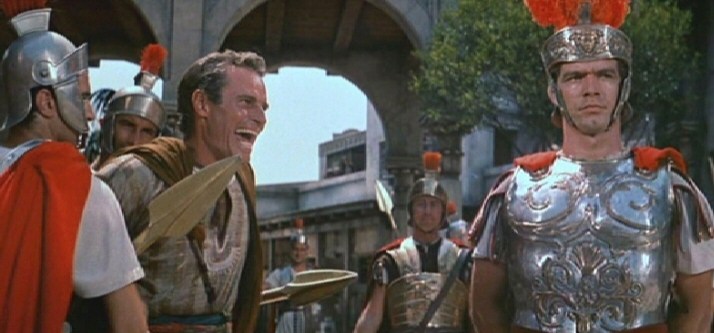
Sextus, a centurion in charge of the Roman garrison asks Messala, who has come to relieve him, “How do you fight an idea?”
Messala responds “You ask how to fight an idea? Well, I’ll tell you how: with another idea.”
Messala realizes that at the heart of the people’s will is their worldview. Their hope is in the destruction of Rome. They long for a Messiah who will lead them to a successful revolt to throw off the Romans. Yet Messala desires to fight this hope with his own worldview: that of the power of humankind. Rome is power, and for him, the Emperor is that power deified.
 Revenge
Vengeance. It’s a theme which seems initially to drive the movie. Messala betrays his friend, Judah Ben Hur, towards the beginning of the film. The Hur family is thrown into prison to languish there, and Judah is sent to the galleys to row as a slave. Judah swears to Messala that he will take revenge upon him upon his return. In a deeply ironic voice, Messala responds, “Return?” The life of a galley slave is not expected to be long.
But Judah does return. He rescues the Roman Quintus Arius who is in charge of his ship and is eventually adopted into the Arius family. He returns to Judea as the son of a consul, with all the power and privilege his rank implies. After learning of a way to take revenge upon Messala without the possible legal ramifications–by besting him in the circus maximus in a chariot race and leaving Messala destitute from debt–Judah succeeds in the arena.
The climax of the quest for vengeance can be found in the scene in which Judah Ben Hur confronts Messala for the first time since seeming to come back from the dead. He slams his seal–the seal of the Consul QUintus Arius–into a document and stares Messala down. Now, Judah is in the superior position. He is the one whose victory is inevitable. From this point on, his vengeance seems assured.
However, after Ben Hur’s epic defeat of Messala in the chariot race, which leaves Messala not only broke but also leaves his body broken, it turns out that revenge is not as sweet as it may seem. Messala informs Judah “the race goes on”–his family is still alive, but they are lepers, left to flounder on the edges of society as unclean, cursed wretches.
It is not revenge which pays. It may give some kind of satisfaction for the briefest moment, but Judah learns its satisfaction is only fleeting. His glory must be found elsewhere, and it is not a glory he can bring himself.
Redemption
Judah is devastated by his discovery that his mother and sister are lepers. He realizes there is nothing he can do to save them, and it seems Messala’s own plan has achieved victory after all. Judah, moved by compassion, takes up his mother and sister in his arms despite their protests, almost guaranteeing that he, too, will contract the terrible disease.
He and Esther, a servant of his former household, take his family through the streets of Jerusalem. The latest Messiah, Jesus, is set to be crucified, and a crowd gathers there to watch. As Jesus dies, his blood runs through the rainwater as it spreads out symbolically to the world. When it touches the Hur family, they are cleansed of their diseases, washed utterly by the blood of Christ. In a stunning twist, it is not the hero who brings about victory, but rather the Messiah who has only been seen briefly throughout the film at pivotal moments. It is Jesus to whom all glory is given, not to Judah Ben Hur.
We have seen that Messala hoped in a human who took upon deity for himself. But the film (and indeed Wallace’s earlier book) show that this hope is misplaced. The God-man that humans should look to is not the conqueror; he is not god because he has human power; instead, the God-man Jesus Christ took on flesh in order to save, to humble himself and become obedient to death on the cross. It is a subversive tale. It is a story of redemption and salvation. It is an idea against which the powers of humanity and the devil muster all their strength to attempt to overthrow, but the idea lives on. It is the idea which cannot be overcome, cannot be outshined.
Conclusion
“Ben Hur” is my favorite movie of all time. The epic clearly portrays the truth that is above all truths: we are powerless, but God is powerful. Judah Ben Hur is unable to save that which he loves and must ultimately rely upon another, who saves them through the washing of his blood. Ben Hur’s story is our own in many ways. We continually struggle against the powers of the world and we often have motivations which are, at best, questionable. But ultimately, we find that when we rely upon ourselves, we are unsuccessful. Only when we rely upon God do we find success.
Sources
Tim LaHaye, “Introduction” in Lew Wallace, Ben-Hur: A Tale of the Christ
Ben Hur.
SDG.
——
The preceding post is the property of J.W. Wartick (apart from citations, which are the property of their respective owners, and works of art as credited) and should not be reproduced in part or in whole without the expressed consent of the author. All content on this site is the property of J.W. Wartick and is made available for individual and personal usage. If you cite from these documents, whether for personal or professional purposes, please give appropriate citation with both the name of the author (J.W. Wartick) and a link to the original URL. If you’d like to repost a post, you may do so, provided you show less than half of the original post on your own site and link to the original post for the rest. You must also appropriately cite the post as noted above. This blog is protected by Creative Commons licensing. By viewing any part of this site, you are agreeing to this usage policy.
The Law Always Condemns, The Gospel Always Saves. Or, why I’m a Lutheran.
Comparing Holy Scripture with other writings, we observe that no book is apparently so full of contradictions as the Bible, and that, not only in minor points, but in the principal matter, in the doctrine how we may come to God and be saved… This riddle is solved when we reflect that there are in Scriptures two entirely different doctrines, the doctrine of the Law and the doctrine of the Gospel. C.F.W. Walther, The Proper Distinction Between Law and Gospel
, 6 (cited fully below)
How are Christians to view the relationship between Law and Gospel? The issue has generated countless views and debates. One recent work which illustrates the breadth of views on this topic is Five Views on Law and Gospel
C.F.W. Walther’s work, The Proper Distinction Between Law and Gospel
Law and Gospel
The most central point of all–that is, the point that I hope readers remember if nothing else–is this: The Law always condemns, the Gospel always saves. This point is emphasized throughout Lutheran theology. What does it mean? Simply put: it means that these two doctrines, found throughout Scripture, have entirely distinct meanings and usages. One cannot intermingle law and gospel while remaining true to either doctrine. Wherever the Gospel is presented as if it had requirements attached to it, there the Gospel is not rightly preached. Whenever the Law is preached as if it offered some kind of free gift, it is not rightly preached.
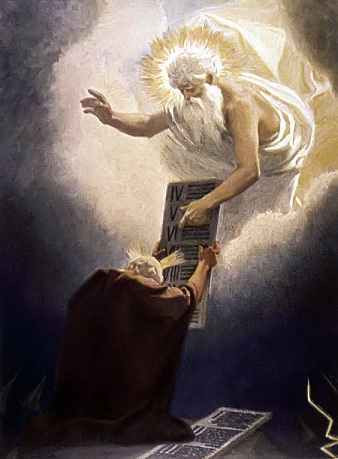
Law only has power to condemn. It cannot save. That is because none can keep God’s Law. All sin, and all fall short of the glory of God (Romans 3:23). The Law shows what God requires of us. It “issues only commands and demands” (Walther, Proper Distinction…, 9).
In contrast, the Gospel only gives offers without requirements attached (ibid). The Gospel shows us God’s promises and offer of grace.
At first face, one examines the whole of the Bible and finds these teachings throughout. The teachings seem so at odds with one another that one might suspect a contradiction throughout the Biblical teaching. However, the fact is that both doctrines are “equally necessary. Without the Law the Gospel is not understood; without the Gospel the Law benefits us nothing” (Ibid, 8). The reason this is so important is because Law and Gospel are not opposites working against each other. Instead, both “have their final aim [human] salvation” (Ibid, 7). They work together to present a full picture of how salvation comes unto men.
The Law, as we have noted, cannot bring salvation because none but God can fulfill it. That is, it gives the requirements for salvation but no one can meet these requirements! We would all be lost if this were the whole of Biblical teaching. Yet there is more to the story, for the Gospel offers only its promises. God has promised to save. He is mighty to save. God has accomplished our salvation. And this salvation does not come with requirements attached. Such is our hope.
Most simply put then, the purpose of the Law is to show our need for the Gospel because we cannot meet the requirements of the Law. The purpose of the Gospel is to show that God has already met these requirements for us in Jesus Christ and to offer us that fulfillment through Christ’s atoning work. So the Gospel, without the Law, would be empty promises. What need have we for Gospel if we are not sinners? Yet without the Gospel, the Law is only a terror which tells us that all are condemned.
 Some Distortions
A number of objections have been raised against this understanding of Law and Gospel. For example: “[The notion t]hat the law must be viewed as a single entity is one of the most common of all objections made against the Christian use of the Law” (Walter Kaiser, Jr., “The Law as God’s Guidance for the Promotion of Holiness,” 188, cited below). Kaiser then argues against viewing the Law as a single entity. He makes distinctions between Civil, Ceremonial, and Moral laws. I agree that we can make these distinctions, but they do not somehow mean it is impossible to refer to the “Law” as a whole entity with all of the commands God has issued.
Another common objection is that of dispensational thought. It is often charged that because we live in a new dispensation, the teachings of the Mosaic Law, for example, no longer apply to us. Without commenting on the plausibility of dispensationalism, I would simply answer that it seems extremely hard to reconcile the notion that the Mosaic Law has no applicability in our own context with Jesus’ words about the Law: “For truly I tell you, until heaven and earth disappear, not the smallest letter, not the least stroke of a pen, will by any means disappear from the Law until everything is accomplished” (Matthew 5:18). Note that this verse also shows Christ using the “Law” as a single, coherent entity.
Yet does this mean that everything recorded in the Mosaic Law has applicability exactly as written? No. A further discussion along this line of thought would take me too far afield, but I think that the Bible does clearly teach there is some discontinuity between the application of Mosaic Law to the Jew and the New Covenant with Christians (for example, the dietary laws do not apply to Christians). This hints back at the divisions Kaiser was keen to make within the Law, and I think the application to the Christian life can be viewed within the categories he discusses.
Conclusion
There is so much more worth saying about Law and Gospel, but in the interest of keeping this post at a readable length, I have had to set some aside. Interested readers should see the annotated sources below.
We have seen that the Law and Gospel must be properly divided in order to properly understand the whole of the Bible’s teaching. Why do I say that this is why I’m a Lutheran? I hope, at least, that other branches of Christianity teach these distinctions between Law and Gospel. But I have to admit that I have not seen it so consistently done as it is within the Lutheran perspective. Martin Luther was right to focus directly upon this teaching, and I believe it is central to the Reformation[s]. It touches upon soteriology, sanctification, the atonement, and more. Thus, I think it is vitally important to get this doctrine correct. In my studies, I have found no teaching so close to the Biblical truth as the Lutheran teaching on Law and Gospel. I’m not saying that everyone should go and become Lutherans. Instead, I think that everyone should benefit from learning the proper distinction between Law and Gospel and apply it to their lives.
The Law always condemns, the Gospel always saves.
Appendix: The Modified Lutheran View?
I think it is important to note that the view put forth as “The Modified Lutheran View” in Five Views on Law and Gospel
Those who have stuck with me this long should be able to immediately see how this is utterly different from the Lutheran view I proposed above. The distinction between law and gospel is not a temporal distinction whatsoever. The Law is still with us. Walther himself makes this explicit: “[W]e find both teachings in the Old as well as in the New Testament” (Proper Distinction… 62). There is no temporal dividing line between Old and New such that some new reality has dawned on Law and Gospel. Instead, the Law continues to condemn, while the Gospel continues to save.
Yet Moo goes so far as to say this is a point which needs to be “corrected” within the Lutheran view (ibid). He seems to think that Lutherans would deny that Jesus was able to speak law, while also mistakenly painting the Sermon on the Mount as being a preaching entirely of the Law. Indeed, Moo’s view seems to affirm many of the basic tenants the Lutheran view explicitly denies, such as mixing the uses of Law and Gospel.
I thus would say that Moo’s position is not at all the Lutheran view. It is not a modified Lutheran view at all. Instead, it seems to violate a number of the primary distortions noted above. That said, Moo does admirably to defend the notion of the Law as a coherent, cohesive whole. There is much to commend Moo’s essay, but it ultimately fails, I think, to provide a properly Lutheran view of Law and Gospel.
Links
Like this page on Facebook: J.W. Wartick – “Always Have a Reason.” I often ask questions for readers and give links related to interests on this site.
Annotated Sources
C.F.W. Walther, The Proper Distinction Between Law and Gospel
For a more succinct summary of what Walther argues in the above, see God’s No and God’s Yes: The Proper Distinction Between Law and Gospel
Five Views on Law and Gospel, ed. Stanley Gundry (Grand Rapids: MI: Zondervan 1999) – I specifically used the following essays: Walter Kaiser, Jr., “The Law as God’s Guidance for the Promotion of Holiness” in Five Views on Law and Gospel, ed. Stanley Gundry, 177-199, (Grand Rapids, MI: Zondervan, 1999); Douglas Moo, “The Law of Christ as the Fulfillment of the Law of Moses” in Five Views on Law and Gospel, ed. Stanley Gundry, 319-376, (Grand Rapids, MI: Zondervan, 1999). I found this book to be very helpful in outlining various views, but was disappointed with the “modified Lutheran view” (see my appendix here).
SDG.
——
The preceding post is the property of J.W. Wartick (apart from citations, which are the property of their respective owners, and works of art as credited) and should not be reproduced in part or in whole without the expressed consent of the author. All content on this site is the property of J.W. Wartick and is made available for individual and personal usage. If you cite from these documents, whether for personal or professional purposes, please give appropriate citation with both the name of the author (J.W. Wartick) and a link to the original URL. If you’d like to repost a post, you may do so, provided you show less than half of the original post on your own site and link to the original post for the rest. You must also appropriately cite the post as noted above. This blog is protected by Creative Commons licensing. By viewing any part of this site, you are agreeing to this usage policy.
Really Recommended Posts 4/19/13
 Here we have another excellent round of posts from across the net. Please, if you look at nothing else, look into the Gosnell case. The link I have here really puts the matter well. The other posts this week are just as important and interesting, however. We have posts on the divinity of Jesus, the “King James Only” debate [what’s that? check out the link!], Rob Bell and spiritual reality, the dominion of nature in Genesis, and Sam Harris on morality. As always, pass this post to your friends and let me know what you enjoyed!
The Gosnell Trial and Destroying the Image of God– Who is Gosnell? The horrific details of this trial confirm that the image of God is under assault. But that assault goes beyond the obviously criminal actions of this man. They extend to the fact that we have undermined the image of God in humanity by devaluing human life, period.
Did the divinity of Jesus emerge slowly after many years of embellishments?– Wintery Knight presents a fantastic summary of the evidence that the divinity of Christ was a belief tied to the earliest years of Christianity.
King James Only Debate (VIDEO)– It is depressing to admit that this is a debate, but there are in fact Christians who believe the King James Bible is the only Bible we should use because… well, watch this debate and find out. I think that James White did an excellent job refuting this position.
Rob Bell’s Recipe for Spiritual Disaster– Rob Bell has seemingly prided himself in asking the tough questions that no one is asking. But what about the answers? Are there answers? Check out this thoughtful post on Bell’s theological system. Be sure to also check out my study guide of his book, “Love Wins” which comes with links to a chapter-by-chapter review I did as well.
Does Genesis 1:27-28 authorize exploiting nature?– Dan Story has written a fantastic overview of the issues related to interpreting Genesis 1:27-28 (dominion over the earth) as a command to exploit nature. Be sure to also check out his further analysis. For more on that issue, check out my Caring for Creation: A discussion among evangelicals.
Sam Harris’ Equivocation on “The Good”– Max Andrews offers a brief yet poignant look at how Sam Harris has erred on his attempts to ground objective morality in a non-theistic system.
“Love Wins” by Rob Bell- A Brief Review and Study Guide
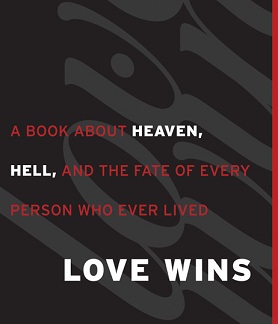 I have spent a great deal of time evaluating Rob Bell’s controversial work, Love Wins
General Review
Over the past several weeks, I have gone through Love Wins chapter by chapter. There have been several positive themes found throughout the book. Of these, the ones most important are the notion that we often trivialize the message of the Bible into “getting in” to heaven and the argument that we cannot turn Jesus into a slogan or the cross into a symbol for whatever we like.
Bell has rightly brought the focus onto eschatology, something which is often ignored or avoided in modern settings.
Yet throughout my reviews of the book (see links at the end), I have noted numerous errors found therein. First, Bell makes errors regarding historical theology. He makes claims about the history of the church which are falsified upon closer examination. Second, his interpretive method is very problematic, as he will often take merely a single part of a verse (sometimes two words completely torn from their context!) in order to make an entire argument about how all of Scripture needs to be interpreted through his chosen phrase [see the review of Chapter 2 and search for “enter life” for a thorough analysis of this]. Third, his exegesis is problematic in still other ways. For example, he will often cite a single verse as an argument for a theological position, even though his argument is contradicted in the very next verse or in the same paragraph. Fourth, he fails to present his arguments. Instead, he chooses to simply ask leading questions. Although this is not problematic in itself, it is clear that this style is intended to lead people into the conclusions Bell wants without any critical analysis. If Bell merely stated his arguments, I suspect people would be more skeptical of his conclusions. Fifth, Bell’s method of argument, when he makes arguments, is often confused. For example, he will ask whether a phrase is found in the Bible in order to refute it. But of course, Bell’s entire thesis “love wins” is a phrase not found in the Bible.
Finally, Bell’s entire argument, once finally revealed, is found to be based around the notion that “God is love.” That’s it. He essentially creates a doctrine of God around just that notion, then defines it in human terms of a parent-child relationship, and then concludes that everyone will eventually be saved because God is love. This is a horribly deficient doctrine of God which does not take into account the whole of Biblical teaching about God. Unfortunately, because this is Bell’s central thesis, it seems the book falls apart upon closer examination.
Ultimately, I cannot recommend this book. Although it gives a few positive points, the major errors found throughout the text weigh against the usefulness of the book for study. I would recommend, however, that leaders in the church do read the book, as it has been so immensely popular that they are bound to run into it. I hope that my reviews and study guide [below] will be helpful for those who wish to engage with the book critically.
Study Guide Questions
General Questions
Let me be clear: I think these questions must be asked in any study of this book.
These questions are intended to be asked after each chapter or at the end of the book:
1) What arguments does Rob Bell present in this chapter? Are they valid? Were any arguments presented?
2) What questions does Bell ask that you feel are hardest to answer? Why? What answers did he provide?
3) Look up a passage Bell interprets. Read it in context. Do you think that Bell’s interpretation of this passage is correct? Why/why not?
Questions for Preface and Chapter 1
1) Do you feel comfortable talking about hell? Why/why not?
2) Can we know that a specific person is in hell?
3) What problems do you see in our culture’s understanding of hell?
4) If a word or phrase isn’t in the Bible, does that mean it is not biblical? Is “Love Wins” a phrase found in the Bible?
Resource: I review the preface and chapter 1.
Questions for Chapter 2
1) What do you think of when you envision heaven? Why do you imagine this? Can you support this imagery with the Biblical text?
2) Look up Matthew 19:16-30 and read it. What do you think of Bell’s focus on “enter life” as the thrust of this passage?
3) Consider popular cultural pictures of heaven or of heavenly imagery (Angels in the Outfield; All Dogs Go to Heaven; etc.). What do you think of these images? Are they grounded on Biblical truth?
4) Bell wrote: “Eternal life doesn’t start when we die; it starts now. It’s not about a life that begins at death; it’s about experiencing the kind of life now that can endure and survive even death” (59). What do you think of this quote? What does it say about what we do for salvation? Do we live in such a way as to usher in our survival of death?
Resource: I review Chapter 2.
Questions for Chapter 3
1) What do you think Bell means by “there are all kinds of hells” (79)? Do you see this in the Biblical text he cites (Luke 16:19-31)?
2) Read Luke 16:19-31. What do you think of Bell’s analysis of the meaning of this parable? Why do you think this?
3) Bell argued that Jesus’ teachings weren’t about right belief but rather about love of neighbor (82). How does this tie into the theme of salvation by grace through faith?
4) Read Matthew 10:5-15. Does the text imply there is still hope for Sodom and Gomorrah, as Bell argues (84-85)?
Resource: I review Chapter 3.
Questions for Chapter 4
1) Read Bell’s statements about the greatness of God on p. 97-98. Why do you think he chooses to focus the discussion on God’s greatness rather than on specific texts? What textual support does Bell use to support this passage?
2) Bell claims there have been a number of views about the salvation of people throughout church history. Does a plurality of views make any view valid? Bonus: During the Civil War era, Christians on either side argued the Bible supported or condemned slavery, respectively. Does this mean a valid interpretation of the Bible is that it justifies slavery?
3) Bonus points: Look up the church fathers Bell cites to support the notion that his view has been at “the center” of Christian orthodoxy. Do these church fathers really support that view? Consider the following from Augustine (The City of God
Origen was even more indulgent; for he believed that even the devil himself and his angels, after suffering those more severe and prolonged pains which their sins deserved, should be delivered from their torments, and associated with the holy angels. But the Church, not without reason, condemned him for this and other errors…
Resource: I review Chapter 4.
Questions for Chapter 5
1) What do you think of when you picture the image of a cross? How have you used/worn/displayed crosses in your life? Do your answers to these questions reflect the glory and misery of the cross?
2) How have you pictured the “Gospel”? Is it just a way to “get to” heaven?
Resource: I review Chapter 5.
Questions for Chapter 6
1) How have you used the label “Christian” or the name “Jesus” in your life?
2) Read John 12:47-50 and compare to Bell’s notion that God is not about judgment. How do Bell’s assertions read in light of the context of the single verse he cites (i.e. “There is a judge for the one who rejects me and does not accept my words; the very words I have spoken will condemn them at the last day.” [48])? Does Bell deal with this context?
3) Did Jesus come to overthrow religion? Read Matthew 5:17-18. How does this passage line up with Bell’s notion that Jesus was a- or even anti- religious?
Resource: I review Chapter 6
Questions for Chapter 7 and 8
1) Rob Bell focuses upon the notion that God is love. What else does the Bible tell us God is? Does Bell discuss these other attributes? What do these other attributes us tell us about God? (Bonus: Check out 2 Thessalonians 1:6; Psalm 5; Isaiah 46:9-10; or use a concordance to look up various attributes of God.)
2) Bell’s focus in this chapter is on God as love. How does God respond to sin? Consider Psalm 5:4-6:
For you are not a God who is pleased with wickedness;
with you, evil people are not welcome.
The arrogant cannot stand
in your presence.
You hate all who do wrong;
you destroy those who tell lies.
The bloodthirsty and deceitful
you, Lord, detest. (Psalm 5:4-6)
3) Bell writes that sins are “irrelevant” (187). Did Jesus come to die for sins? Does this mean they are irrelevant?
4) Bell seems to argue that there are more chances after death. What does the Bible say about this? (Consider Hebrews 9:27.)
Resource: I review chapters 7 and 8.
Links
Like this page on Facebook: J.W. Wartick – “Always Have a Reason”
The book: Rob Bell, Love Wins
Review of “Love Wins” by Rob Bell: Preface and Chapter 1– I discuss the preface and chapter 1 of Love Wins.
Review of “Love Wins” by Rob Bell: Chapter 2– I review chapter 2.
Review of “Love Wins” by Rob Bell: Chapter 3– I look at Chapter 3: Hell.
Review of “Love Wins” by Rob Bell: Chapter 4– I look at Chapter 4: Does God Get what God Wants?
Review of “Love Wins” by Rob Bell: Chapter 5– I analyze chapter 5.
Review of “Love Wins” by Rob Bell: Chapter 6– I review chapter 6.
Review of “Love Wins” by Rob Bell: Chapters 7 and 8– I review the final chapters of the book.
Be sure to check out other book reviews. (Scroll down for more)
Source
Rob Bell, Love Wins
SDG.
——
The preceding post is the property of J.W. Wartick (apart from citations, which are the property of their respective owners, and works of art as credited) and should not be reproduced in part or in whole without the expressed consent of the author. All content on this site is the property of J.W. Wartick and is made available for individual and personal usage. If you cite from these documents, whether for personal or professional purposes, please give appropriate citation with both the name of the author (J.W. Wartick) and a link to the original URL. If you’d like to repost a post, you may do so, provided you show less than half of the original post on your own site and link to the original post for the rest. You must also appropriately cite the post as noted above. This blog is protected by Creative Commons licensing. By viewing any part of this site, you are agreeing to this usage policy.
Review of “Love Wins” by Rob Bell: Chapter 6
I have been reviewing Rob Bell’s book, Love Wins, with a particular interest in his theological views and how he argues for those views. I have not read the book before, so each review is fresh: I am writing these having just completed the chapter the post is on. This week, I look at Chapter 6: There Are Rocks Everywhere.
Chapter 6
Outline
Rob Bell begins with a number of stories illustrating how we often come into contact with what some people take to be God or some kind of abstract “love.” He ponders this and wonders “are we alone in the world?… what does any of this have to do with Jesus?” (142). He argues that the rock which Moses struck in the desert from which the people drank was Jesus, utilizing 1 Corinthians 10:3-5 and applying it back to Exodus 17. He asks: “That rock was… Christ? Jesus? Jesus was the rock?” He notes that Paul interprets the story to show how Christ was there.
Bell then turns to the notion of that “There is an energy in the world, a spark, an electricity that everything is plugged into” (144). It has been called the Force, life, “Spirit” and other things. Bell argues that there is such a force and it is found in the “Word of God,” for “God speaks… and it happens. God says it… and it comes into being” (145).
Jesus, Bell argues, shows “what God has been up to all along” (148). God is bringing all people together under Christ.
Moreover, according to Bell, “Jesus is bigger than any one religion. He didn’t come to start a new religion, and he continually disrupted whatever conventions or systems or establishments that [sic] existed in his day” (150). Jesus came to draw all people to himself, a point Bell emphasizes through repetition and restating it in numerous ways.
Regarding this drawing all people, Bell argues for “inclusivity” which he defines as “exclusivity on the other side of inclusivity. This kind insists that Jesus is the way, but holds tightly to the assumption that the all-embracing, saving love of this particular Jesus the Christ will of course include all sorts of unexpected people from across the cultural spectrum” (155). Jesus, Bell argues, leaves the door “wide open” which provides the possibility for any to enter.
Bell notes that we must wonder what people mean when they say “Jesus.” Do they mean “tribal membership, the source of “imperial impulse,” or some kind of “political, economic, or military system through which they sanctify their greed and lust for power?” (156).
No one has “cornered the market” on Jesus. We cannot contain him. Bell reemphasizes the importance of not pre-judging people’s eternal destinies. He writes, “it is our responsibility to be extremely careful about making negative, decisive, lasting judgments about people’s eternal destinies. As Jesus says, he ‘did not come to judge the world, but to save the world’ (John 12[:47])” (160).
Analysis
There is much to commend in this chapter, just like I pointed out in my review of Chapter 5. First, Bell rightly warns against trying to bottle Jesus in one form or another. It is not an individual denomination which owns Jesus. Second, Bell again makes the very important point that it is not our place to say whether one person’s eternal destiny is heaven or hell. We do not know how God may be working on that person. Third, he is correct in emphasizing Jesus as the “only way.” Finally, he is right to note how some people attempt to make Jesus into a slogan or a cry for some specific cause they are doing. Doing so undermines the message of Jesus and should be avoided.
Yet there are also many areas to critique in this chapter. First, there is the notion of questionable exegesis. For example, Bell cites John 12:47 to show that Jesus is not about judgment, but fails to cite the very next verse which states: “There is a judge for the one who rejects me and does not accept my words; the very words I have spoken will condemn them at the last day” (NIV). Bell spends the whole section centered around 12:47 and how God isn’t about judgment, but rather “exclusivity on the other side of inclusivity.” One wonders, then, why he fails to read the next verse of the passage he cites in context. I find this a gross example of proof-texting wherein a part of a verse is ripped from its context and used to rant against the very thing the next verse affirms. The importance of looking at the entire context of individual verses is paramount, and Bell continues to fail to be attentive to the evidence against his positions.
Again, Bell emphasizes the notion of an “open door.” We discussed this at some length in my look at Chapter 4. Once more, the “open gates” in context show a city without any enemy. That is, the enemies of that city have been utterly defeated. Yet Bell takes it to mean wide openness in the sense that people can always come [and go?–does Bell imply that we can leave heaven if we so choose? Is our salvation not secure?]. He emphasizes this over and over again, but then he has yet failed to cite Matthew 7:14, in which Jesus describes the gate and the road to eternal life “narrow” and says “only a few find it.” Why this emphasizing on some texts while ignoring others? Certainly, we need to balance these Biblical teachings, but we cannot ignore one at the expense of the other. Bell seems to do the latter time and again. He cites a text out of its context and ignores anything in the text which goes against his own interpretation. He doesn’t interact with the other parts of the text, he just pretends they don’t exist. I find this highly problematic.
I am also wary of Bell’s statement that Jesus is beyond any one religion. Clearly, Jesus saw himself as a Jew. Making this argument would take me well beyond the scope of this post, but suffice to say that Jesus’ language and imagery regarding himself as the temple places him exactly within the Jewish religion. Yes, he interpreted things in startling ways which led Jews to call him blasphemous, but other Jews saw his resurrection and what did they do? They began to proclaim Christ glorified as the Son of God. Did Jesus really come to overthrow religion, as Bell seemingly implies? Again, such an assertion abuses the Bible. I say this in strong words because it needs to be said. What does Jesus actually say about the religious system in place at the time? Yes he criticized it, but when it came down to the core of the Hebrew faith, the Torah, Jesus said:
“Do not think that I have come to abolish the Law or the Prophets; I have not come to abolish them but to fulfill them. For truly I tell you, until heaven and earth disappear, not the smallest letter, not the least stroke of a pen, will by any means disappear from the Law until everything is accomplished.” Matthew 5:17-18 NIV
That doesn’t sound to me like Jesus overthrew that religion. Instead, he argues he came to be the reality of that faith. Jesus came to fulfill the expectations of the Law. Again, Bell’s selective reading of the texts undermines the core of Christian teaching.
Conclusion
There are many positive things to say about this chapter of Love Wins. Bell has rightly emphasized a number of themes to which Christians should be attentive. We need to avoid making Jesus too small and turning him into our personal example or slogan. Yet Bell has also continued to perpetuate a number of errors, and his exegesis is very selective. The way he reads texts seems to have theological blinders on. When he finds the verse he wants, he uses it to trump anything else. We have seen how problematic this is in a number of examples. Next week, we will explore Chapter 7.
Links
Like this page on Facebook: J.W. Wartick – “Always Have a Reason”
The book: Rob Bell, Love Wins
Review of “Love Wins” by Rob Bell: Preface and Chapter 1– I discuss the preface and chapter 1 of Love Wins.
Review of “Love Wins” by Rob Bell: Chapter 2– I review chapter 2.
Review of “Love Wins” by Rob Bell: Chapter 3– I look at Chapter 3: Hell.
Review of “Love Wins” by Rob Bell: Chapter 4– I look at Chapter 4: Does God Get what God Wants?
Review of “Love Wins” by Rob Bell: Chapter 5– I analyze chapter 5.
Love Wins Critique– I found this to be a very informative series critiquing the book. For all the posts in the series, check out this post.
Should we condemn Rob Bell?– a pretty excellent response to Bell’s book and whether we should condemn different doctrines. Also check out his video on “Is Love Wins Biblical?“
Source
Rob Bell, Love Wins
SDG.
——
The preceding post is the property of J.W. Wartick (apart from citations, which are the property of their respective owners, and works of art as credited) and should not be reproduced in part or in whole without the expressed consent of the author. All content on this site is the property of J.W. Wartick and is made available for individual and personal usage. If you cite from these documents, whether for personal or professional purposes, please give appropriate citation with both the name of the author (J.W. Wartick) and a link to the original URL. If you’d like to repost a post, you may do so, provided you show less than half of the original post on your own site and link to the original post for the rest. You must also appropriately cite the post as noted above. This blog is protected by Creative Commons licensing. By viewing any part of this site, you are agreeing to this usage policy.
Review of “Love Wins” by Rob Bell: Chapter 5
I have been reviewing Rob Bell’s book, Love Wins, with a particular interest in his theological views and how he argues for those views. I have not read the book before, so each review is fresh: I am writing these having just completed the chapter the post is on. This week, I look at Chapter 5: Dying to Live.
Chapter 5
Outline
Rob Bell begins by noting the ubiquity of the cross. Crosses are everywhere. But we can “inoculate. Familiarity leads to unfamiliarity… ‘Jesus died on the cross for your sins.’ Yes, we know. We’ve seen that… countless times. Anything else?” (122). Of course, there is so much more to the cross! Bell argues that we have missed much of the message of the cross by our cultural apathy towards it.
Bell then turns to the notion of sacrifice. He outlines very generally what cultures believed about sacrifice and then focuses in upon Christ. “Jesus was the ultimate sacrifice that thoroughly pleased the only God who ever mattered” (125).
He then uses this as a backdrop for discussing the work of Christ. Jesus’ death on the cross is ultimately the fulfillment of a number of expectations including reconciliation, winning the battle, etc. (127). Jesus is “where life is” (129). The cross and resurrection were understood as “an event as wide as the world, extending to all creation” (132).
Bell asserts that we need to think of the Gospel as a big deal:
A gospel that leaves out its cosmic scope will always feel small. A gospel that has as its chief message avoiding hell or not sinning will never be the full story. A gospel that repeatedly, narrowly affirms and bolsters the “in-ness” of one group at the expense of the “out-ness” of another group will not be true to the story that includes “all things and people in heaven and on earth.” (135)
Jesus is the “source, the strength, the example, and the assurance” to us that death and resurrection lead us into life (136).
Analysis
There is much to commend in this chapter. Bell has masterfully highlighted the problems with trivializing the cross. It is easy in our culture to see a cross and react with complete indifference. Why is that? Bell rightly yearns to snap free from this apathy and see the cross for what it is: a symbol of hope, the truth of death defeated.
Furthermore, Bell is spot-on when he critiques the notion that the gospel is about living the right way or being “in” or “out.” The Gospel is more than any of the things he mentioned. A generous reading of bell in the passage block-quoted above shows his commitment to seeing the Gospel as applicable to all people: everyone is called to Christ.
Thus, I am left with only two very minor critiques. First, I am a bit concerned with the over-generalization on sacrifice, which I think has a deeper Biblical meaning than Bell outlined and also has a much broader spectrum of belief than he touched upon.
Second, Bell at one point mentioned the number seven and related it back to Genesis. He describes the creation account as: “In the poem that begins the Bible…” (133). Again, this is a very minor critique and well beyond the scope of his book, but I’d be very curious to see what Bell means by “Poem” here to refer to Genesis 1-2 (and beyond?). The Hebrew does not seem to reflect a poetic style, though it has a pattern with Days 1-3 relating to days 4-6. So yes, minor issue, but I found it interesting that he included this sentence with no real context when discussing numbers through the Bible.
Conclusion
Bell has done very well to highlight the importance of the Gospel message. He is rightly saddened by the fact that people have become disillusioned with the cross and its truth. Next week, we’ll look at Chapter 6.
Links
The book: Rob Bell, Love Wins
Review of “Love Wins” by Rob Bell: Preface and Chapter 1– I discuss the preface and chapter 1 of Love Wins.
Review of “Love Wins” by Rob Bell: Chapter 2– I review chapter 2.
Review of “Love Wins” by Rob Bell: Chapter 3– I look at Chapter 3: Hell.
Review of “Love Wins” by Rob Bell: Chapter 4– I look at Chapter 4: Does God Get what God Wants?
Love Wins Critique– I found this to be a very informative series critiquing the book. For all the posts in the series, check out this post.
Should we condemn Rob Bell?– a pretty excellent response to Bell’s book and whether we should condemn different doctrines. Also check out his video on “Is Love Wins Biblical?“
Source
Rob Bell, Love Wins
SDG.
——
The preceding post is the property of J.W. Wartick (apart from citations, which are the property of their respective owners, and works of art as credited) and should not be reproduced in part or in whole without the expressed consent of the author. All content on this site is the property of J.W. Wartick and is made available for individual and personal usage. If you cite from these documents, whether for personal or professional purposes, please give appropriate citation with both the name of the author (J.W. Wartick) and a link to the original URL. If you’d like to repost a post, you may do so, provided you show less than half of the original post on your own site and link to the original post for the rest. You must also appropriately cite the post as noted above. This blog is protected by Creative Commons licensing. By viewing any part of this site, you are agreeing to this usage policy.

 J.W. Wartick - Reconstructing Faith