literary apologetics
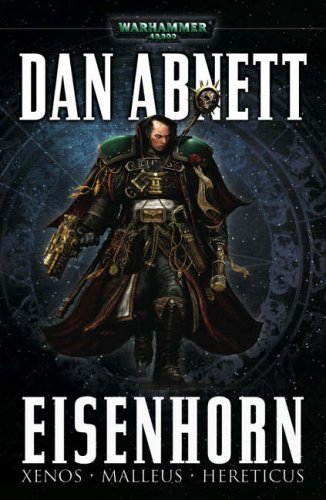
A World of Darkness and War- “Eisenhorn” by Dan Abnett
 Innocence Proves Nothing.
The world of Warhammer 40,000 (hereafter WH40k) is one that has few entry points for the uninitiated. Dan Abnett’s Eisenhorn Trilogy is one such entry point. I reviewed the omnibus on my general interests blog. Here we will be exploring some themes in the trilogy from a worldview perspective. There will be SPOILERS in what follows.
The Darkness
The world of WH40k is ostensibly one set in our very far future. The major tagline for the universe is “In the grim dark future, there is only war.” Confronted by this darkness, readers sometimes struggle to find light. But the light found in the universe is that of relationships: friendships and loyalty. Another light is the fight against the Warp and the forces of Chaos. Christians are similarly called to fight against evil and destroy it. The way that struggle plays out is hotly debated, but Eisenhorn is a kind of call to fight against evil where it is visible.
Puritan or Radical?
There are different sects of the Imperial Inquisition in the WH40k universe and the major way to divide them is along lines of Puritanism or radicalism. Largely, this comes down to whether an Inquisitor would use elements or even knowledge of “Chaos” in order to fight Chaos or whether they would not. This notion of Puritan/Radical is found throughout the Eisenhorn trilogy.
These lines of separation are relevant because in some ways they are paralleled in Christian thought. How literally is the Bible to be taken? How separated from the world should Christians be? What insights can be allowed for in other faith traditions? These are just a few questions that parallel this complex line that is brought to light by Abnett.
Interestingly, the way that Eisenhorn himself develops as a character points to how these might become a false dichotomy. He begins to realize that some of the insights from the Radical side have merit, and began to shift towards a more moderate position. One wonders whether we too often become bogged down in our conservative/liberal divisions to see how the “other side” might have some helpful insights.
War Against Chaos
In the WH40k universe, demons are manifested in the flesh, the forces of darkness work through psychic powers (psykers), aliens worship evil deities, and more. Through the realism of these elements, the universe is put forward as one in which evils are, at times, much easier to identify than the evils we find in our world. Christians have differing views about spiritual warfare (read the link in those words for a brief exploration of a few), but I think we too often pretend that there are no real evils out there or that they can be reduced purely to the evils of the human heart.
Conclusion
The world of WH40k is dark, but the way it portrays evil and the battle against it serves up not only a compelling narrative but one which has some points of contact with Christianity. Ultimately, WH40k ends up left in darkness, but Christianity has the one Story which offers ultimate hope; that found in Christ as victor over death and the devil.
Links
Be sure to check out the page for this site on Facebook and Twitter for discussion of posts, links to other pages of interest, random talk about theology/philosophy/apologetics/movies and more!
Book Reviews– There are plenty more book reviews to read! Read like crazy! (Scroll down for more, and click at bottom for even more!)
Source
Dan Abnett, Eisenhorn (Black Library, 2005).
SDG.
——
The preceding post is the property of J.W. Wartick (apart from quotations, which are the property of their respective owners, and works of art as credited; images are often freely available to the public and J.W. Wartick makes no claims of owning rights to the images unless he makes that explicit) and should not be reproduced in part or in whole without the expressed consent of the author. All content on this site is the property of J.W. Wartick and is made available for individual and personal usage. If you cite from these documents, whether for personal or professional purposes, please give appropriate citation with both the name of the author (J.W. Wartick) and a link to the original URL. If you’d like to repost a post, you may do so, provided you show less than half of the original post on your own site and link to the original post for the rest. You must also appropriately cite the post as noted above. This blog is protected by Creative Commons licensing. By viewing any part of this site, you are agreeing to this usage policy.
Really Recommended Posts 8/14/15- changing the Bible?, apologetics, carbon dating, and more!
 Another round of Really Recommended Posts for you, dear readers! This week we have textual criticism, an interview with an author, discussion of how stories change the way we think, historical apologetics, and examination of the reliability of carbon dating. Check out the posts and let me know what you think here!
Why Publishers Change the Bible (And That’s OK)! (infographic)- A very helpful, concise, and visual way to see how textual criticism works and why sometimes verses are taken out or added into the Bible.
Interview with God’s Crime Scene Author J. Warner Wallace– J Warner Wallace is a cold-case homicide detective but also a Christian apologist. Here’s a great interview with him about his apologetics ministry and his recently-released book, God’s Crime Scene, which I reviewed here.
The Best Stories– How do fictional stories impact us in “real world” ways? Here’s a post that discusses the impact that stories can have on our lives and the way we think.
A Look at the First Apologists– Here is a great post that shows how the first Christian apologists approached the task of defending the Christian faith. The interesting thing to note is that the first apologists were all Messianic Jews.
Can We Verify Carbon Dating’s Reliability?– Young Earth Creationists often question the reliability of dating methods used to verify an “old earth” perspective. Here’s a post that shows how carbon dating can be independently verified.
10 Questions for Target Critics Regarding “Boys’ Toys” and “Girls’ Toys”– I’ll admit it, I’m not a huge Rachel Held Evans fan. But I do think that the questions she asks here, although somewhat tongue-in-cheek, get at some good points of concern regarding some comments about Target’s “gender neutral toys” policy. Specifically, she references an article by the Council for Biblical Manhood and Womanhood and asks some pointed questions of it. I think it’s worth seeing a different perspective on the issue, and I think that some of the comments by CBMW are clearly ridiculous (see RHE’s question #s 3 and 4).
Robert Sawyer’s “The Neanderthal Parallax” – Faith, Scientism, and Humanity
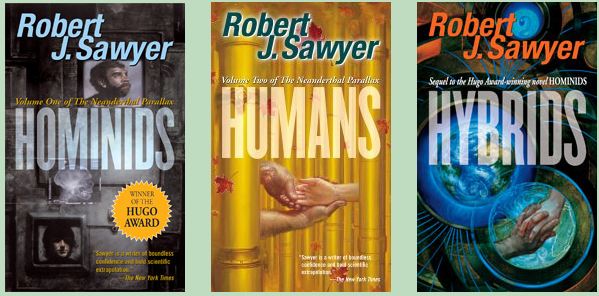 I recently finished reading Robert Sawyer’s trilogy “The Neanderthal Parallax.” I found the plot intriguing, but the worldview issues the books brought up had great difficulties in how they were conveyed and the kind of hidden premises smuggled in. Every story has a worldview, and the worldview of these books was surprisingly hostile and disingenuous particularly to Christians. I have enjoyed Robert Sawyer’s work in the past, but feel forced to interact with these books in a fairly critical fashion. There will be SPOILERS in what follows. I’ll not summarize the plot, but interested readers can see summaries on Wikipedia. I have written a review of the books here.
Faith
Perhaps the most unfortunate aspect of the books is that Sawyer seemingly did not put anything close to the amount of research and care into his portrayal of faith as he did his portrayal of biology, cosmology, and the like. On the latter topics, great detail is put into explaining aspects of various sciences and even invented science that Sawyer employs to support the plot. But people of faith are put up as frequently hypocritical but also lacking in erudition and thoughtfulness.
The central faith figure is Mary Vaughan, a specialist in ancient genetics. She consistently is put forth as the faithful counterweight to the faithlessness of the Neanderthals. However, she is a Roman Catholic who reveals objects to parts of her church’s official doctrines. She rejects the doctrine of original sin, for example. Having her put forward as the example of a religious person makes this even more difficult to swallow. I’m not suggesting that there are no people who have great cognitive dissonance in their beliefs–obviously many people do. The problem is that Sawyer uses Mary as the central image of Christianity throughout the novels, but she is woefully inept at even holding to the faith she claims for herself.
At one point in Humans, Ponter is talking to Mary at the Vietnam Memorial about life after death(188-207). He simply asserts that if you can’t see something it doesn’t exist. But of course this is as absurd as he claims “Gliskins'” (homo sapiens sapiens as opposed to the Neanderthals) belief in things like God is. I cannot see my own thoughts, yet they exist. Neither can I observe other people’s mental life, yet I am not irrational in believing that the people around me are also having thoughts.
In Hominids, Ponter speaks to Mary about the Gliskins’ viewing of a Mass taking place and again basically asserts that Christian belief in deity is absurd on its face. Mary struggles to articulate even the slightest defense of the Incarnation and other central Christian doctrines. Again, plenty of believers would struggle in this fashion, but Sawyer uses Mary as a kind of foil for all of Christianity. She’s got the best defenses Christians have to offer, and she can’t do anything but stutter when challenges to her faith are raised.
At several points, Big Bang Cosmology is challenged as something the Gliskins cling to because of their necessity of belief in a finite universe to support deity. Yet not only was Big Bang Cosmology initially rejected by the scientific community for this and other reasons (and only later accepted due to the mounting evidence for it), but even were the universe infinite, it would hardly follow that it is uncreated, as Ponter asserted without challenge. Sawyer seems to be unaware of–or at least makes his characters ignorant of–the entirety of Scholastic thought on the topic of continuous creation. Thomas Aquinas admitted this as a possibility. Thus, for Christians it is hardly an either/or of either eternal universe or finite universe. Either fits in with various strands of historic Christian theology. But again, Sawyer seems to have been either ignorant of this or willfully ignoring it to portray belief in deity in a more negative and indefensible light.
All of this wouldn’t be as unfortunate if Sawyer didn’t put discussions like this forward as if they were the best defenses Christians could come up with for their positions. Had they been simply believers who were also uninformed or insincere, it would not be as great an error. But Sawyer paints these interactions as though the defenses are the best Christians can come up with. As we have just surveyed very briefly, this is mistaken. I enjoyed the stories Sawyer put forward here, but his portrayal of people of faith is deeply flawed.
Religious Experience
Sawyer uses the books to explore the notion of a God part of the brain which, when triggered, can set off religious experiences. In Humans, it is discovered that Gliskins have a part in their brain which is able to have “religious experiences” triggered through electromagnetic interaction, while Neanderthals do not have a corresponding part of their brains.
A central scene in the entire series is near the end of Hybrids in Times Square, New York City. The Earth’s magnetic field is resetting and it triggers religious experiences, UFO sightings, and the like among the crowd gathered as this part of the Gliskin (homo sapien, remember) brain is triggered. People are crying out to their deities, fending off invading aliens, and the like all over Times Square. From this, Mary Vaughan’s faith is finally shattered:
The Pope had some ‘splainin’ to do.
All religious leaders did…
“It’s all a crock, isn’t it?” [Mary] said [to Ponter].
…”Look, I’ve changed my mind. About our child… Our daughter should not have the God organ…” (389)
Thus, we find that in Sawyer’s universe, the notion that we can induce religious experiences in the brain (and other types of experience like UFOs) means that these experiences are baseless in reality. Mary decides that her child should not have the capacity to have religious experience because it is all “a crock.” The Pope and others have some “‘splainin’ to do.” Presumably they are expected to take this as some kind of major challenge to their respective faiths.
The main problem with this is that we can conceivably trigger all sorts of things in the brain. It does not seem too outlandish to suppose that if we triggered a certain part of the brain, we might bring up a memory. If we extrapolate more, Sawyer’s vision of electromagnetically triggered religious experiences could be on par with memories as well, which could (in this scenario) be triggered in the same way. Should we start to distrust our perceptions or memories if we are able to trigger them with various impulses? Certainly not. This way lies (true) madness: distrust in our own memories and senses.
So what is left? What does the notion that religious experiences might be triggered by various brain activity demonstrate? Just that: religious experience may be triggered through manipulation. Full stop. This doesn’t in any way undercut evidence for theism or other beliefs from religious experience any more than our capacity to trigger scents, sounds, or memories would undercut our rational basis for believing this things to be real (or about real events).
Social Ills?
Sawyer uses the trilogy to attack all kinds of perceived and real social ills, from our treatment of the environment to gun control laws, and the like. But the question is how can he realistically put forward any kind of inter-cultural critique when the whole view he puts forward in the books is ultimately subjective. Mary Vaughan suffers a grotesque act of violence in a rape scene, but this is only used as an instrument in the plot (see my discussion here). Any moral critique Sawyer offers through his characters falls hollow because his only basis for it is some vague concept of pragmatism and self-preservation. Thus, it seems there is no ultimate basis for his criticisms of various ethical wrongs, and his use of several of these as mere instruments to advance the plot betrays this inability to provide an objective basis for right and wrong.
Conclusion
I’ve already written much on the difficulties with worldview in these novels. There are many more I could discuss. Again, I want to emphasize that it is very true that many Christians and believers would struggle to articulate their faith, be unable to defend various aspects of it, and not agree with at least some teachings of their church body. The problem is that Sawyer portrays this as the best Christianity can come up with. I was deeply disappointed to see that the overall thrust of the books was ultimately a kind of attack on my own faith, without any reasonable portrayal or interaction with stronger versions of it. Would that Sawyer had put the time into his depiction and study of faith as he had with the science behind this science fiction. For further reading, check out my reviews of the trilogy.
Links
Be sure to check out the page for this site on Facebook and Twitter for discussion of posts, links to other pages of interest, random talk about theology/philosophy/apologetics/movies and more!
Book Reviews: “The Neanderthal Parallax” – Hominids, Humans, and Hybrids by Robert Sawyer– I wrote a review of the trilogy on my other interests site. This review brings up some of the other worldview issues in the books, in addition to a brief summary of the plot outline and look at the science fiction elements.
Aliens that believe in God: The theological speculations in Robert Sawyer’s “Calculating God”– I write about a different Robert Sawyer book that I did enjoy quite a bit, Calculating God. I even wrote a second post discussing abortion, fundamentalism, and other issues the book raised.
Source
Robert Sawyer, Hominids (New York: Tor, 2002).
—, Humans (New York: Tor, 2003).
—, Hybrids (New York: Tor, 2003).
SDG.
——
The preceding post is the property of J.W. Wartick (apart from quotations, which are the property of their respective owners, and works of art as credited; images are often freely available to the public and J.W. Wartick makes no claims of owning rights to the images unless he makes that explicit) and should not be reproduced in part or in whole without the expressed consent of the author. All content on this site is the property of J.W. Wartick and is made available for individual and personal usage. If you cite from these documents, whether for personal or professional purposes, please give appropriate citation with both the name of the author (J.W. Wartick) and a link to the original URL. If you’d like to repost a post, you may do so, provided you show less than half of the original post on your own site and link to the original post for the rest. You must also appropriately cite the post as noted above. This blog is protected by Creative Commons licensing. By viewing any part of this site, you are agreeing to this usage policy.
“Dune” by Frank Herbert- Prophecy, Religion, and the Messiah
 Bless the Maker and His water. Bless the coming and the going of Him. May His passage cleanse the world. May He keep the world for his people.
Dune has been called “Science Fiction’s Supreme Masterpiece.” I say that this tagline is accurate. The depth of the saga is breathtaking, and its majesty is at times overpowering. Here, I’ll take a look at some key themes in the book from a Christian perspective. There will be SPOILERS in what follows.
Prophecy
Prophecy is found throughout the various factions in Dune. The Bene Gesserit is a school composed of women who are working to bring about a prophesied man–but to use him for their own ends. The Fremen, inhabitants of the desert, also have prophecies of one who would bring their world–Arrakis–to fertility and unite the Fremen against their enemies.
Prophecy has a function, which will be fulfilled one way or another. Often, this involves the conscious working of persons towards the fulfillment. This is unlike prophecy in the Bible, which is sometimes fulfilled in quite unexpected ways or even has double applications (such as the virgin birth).
Religion
Religion is a theme throughout the book, as there are many different philosophies of life on offer, but few which seem genuine. Herbert’s vision of religion is that it is essentially a function of humanity and one which is constructed through the interplay of power and belief. For example, in one biographical entry about Paul Atreides, the protagonist, the Princess Irulan writes:
You cannot avoid the interplay of politics within an orthodox religion. The power struggle permeates the training, educating and disciplining of the orthodox community… the leaders of such a community… must face that ultimate internal question: to succumb to complete opportunism as the price of maintaining their rule, or risk sacrificing themselves for the sake of the orthodox ethic. (401)
Hebert also channels much wariness about any engagement of politics and religion throughout the book. Representative is a saying allegedly from the Muad’Dib–the name given to Paul Atreides after he is seen as the fulfillment of various prophecies: “When law and duty are one, united by religion, you never become fully conscious, fully aware of yourself. You are always a little less than an individual” (408).
Yet this is not to say there is no genuine belief in the world of Dune. Debates over determinism and divinely decreed futures are placed throughout the book, and Paul Atreides himself struggles with his own role as an apparent Messiah.
The religious mixture of Buddhism, Islam, and Christianity found in the various factions provides much food for discussion and engagement for those who want to dialogue on these topics. How should we interact with those of other faiths? What lines of correlation may we see in other religions and how might we use these to engage believers in other faith traditions? These are questions which arise in Dune, and Herbert also offers challenges to believers to see what harm might be in their beliefs and to search out those aspects of their faith which lead astray from the truth.
Truth
There are many more philosophical, theological, and political questions which could be asked after reading a masterwork like Dune. A fundamental issue is that of truth. The issues of religion and prophecy listed above make one read the world of the work with a rather ambiguous eye: there seems to be some deception, but some truth, in various aspects of the different factions’ belief systems and what they present to the world as the truth.
From a Christian perspective, there is but one truth and that is found in Jesus Christ. Similarly, even on the world of Arrakis, we find that there is an objective standard of truth, it just isn’t always cut-and-dried as to how we might discern it. It is a reflection of the fallenness of the real world in which often the truth is intermingled with lies. We should work ever towards seeking the truth and working to bring it forward.
Conclusion
Weeks after reading Dune, I can still feel the hot sand under my feet, and still smell the Spice in the air. It is a simply incredible read which demands hours of reflection afterwards. I recommend it highly to you, dear readers. It will get your mind going, and it will also perhaps force some thought into one’s own faith and life–are we living a genuine life of faith, or have we turned it into a perversion?
Links
Be sure to check out the page for this site on Facebook and Twitter for discussion of posts, links to other pages of interest, random talk about theology/philosophy/apologetics/movies and more!
A Solar System and Cosmos Filled with Life?- A reflection on Ben Bova’s “Farside” and “New Earth”– I explore the notion that life should be expected all over the place in a post that looks at some of Bova’s most recent works.
“Fitzpatrick’s War”- Religion, truth, and forgiveness in Theodore Judson’s epic steampunk tale– I take a look at the book Fitzpatrick’s War, a novel of alternative history with steampunk. What could be better? Check out some of the worldview issues brought up in the book.
I have discussed the use of science fiction in showing how religious persons act. Check out Religious Dialogue: A case study in science fiction with Bova and Weber.
Source
Frank Herbert, Dune (New York: Ace, 1990). Originally printed 1965.
SDG.
——
The preceding post is the property of J.W. Wartick (apart from quotations, which are the property of their respective owners, and works of art as credited; images are often freely available to the public and J.W. Wartick makes no claims of owning rights to the images unless he makes that explicit) and should not be reproduced in part or in whole without the expressed consent of the author. All content on this site is the property of J.W. Wartick and is made available for individual and personal usage. If you cite from these documents, whether for personal or professional purposes, please give appropriate citation with both the name of the author (J.W. Wartick) and a link to the original URL. If you’d like to repost a post, you may do so, provided you show less than half of the original post on your own site and link to the original post for the rest. You must also appropriately cite the post as noted above. This blog is protected by Creative Commons licensing. By viewing any part of this site, you are agreeing to this usage policy.
The “Mistborn Trilogy” by Brandon Sanderson- Religion(s), Intrigue, and a Messiah
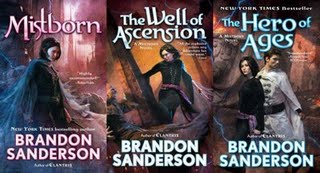 Brandon Sanderson’s Mistborn Trilogy is a wonderfully unique fantasy adventure that is absolutely filled to the brim with political intrigue and religious reflection. Here, we’ll take a look at some of the themes in this series from a worldview perspective. There will be SPOILERS below.
Religion(s)
The character Sazed is a specialist in religions. Indeed, he has the memories of three hundred religions in the trinkets he keeps on his body and preaches them to different characters throughout the first two books of the trilogy. His goal is less to convert than it is to pass on knowledge. Through the foil of Sazed, readers learn about some interesting religions which used to exist before the Lord Ruler began to eradicate them all. Sazed himself asserts that he believes all the religions are true, but in The Well of Ascension, his faith is crushed when he is confronted by the notion that his long search for the religion of his people–and its prophecies–is fruitless.
Sanderson thus presents us with an interesting perspective, through Sazed, of religion. On the one hand, Sazed is seemingly a pluralist. He tries to affirm all the religions he knows about: “I believe them all,” he declares (Well… 504). But on the other hand, his faith in the truth of these religions is decimated by his discovery of direct refutation. The tension of these two views ends up shattering Sazed’s worldview. But, as we’ll see below, it turns out that all religions were false in some sense, but they all had some truth, which Sazed himself uses to piece together the world as it should be (Hero… 716-717).
Interestingly, this resonates in some fashion with what I think is the best way to approach other religions. Rather than assuming everything the religious other believes is false, we should seek the truth in other religions and show how Christianity provides a better and fuller explanation of the same.
Messiah
The “Hero of Ages” is thought by many to be a hero who will come to save them from the oppressive rule of the Lord Ruler and Ruin. Some think that it is Kelsier after the hero of Mistborn helps to destroy the Lord Ruler and then uses a body double to act as though he has been resurrected in order to give hope to the common people. This image alone is an interesting foil for thinking about Jesus and the rise of Christianity. There is no denying the parallels in the story of Kelsier and of Christ in the sense of being seen as resurrected saviors.
But the narrative of Kelsier is intentionally subversive, it has a political aspect to it that is intentionally driven towards the overthrow of the Final Empire. Moreover, his life and times don’t match up quite right with the expected prophecies. A final aspect that is missing is the divine claims and historical evidence. It is all well and good to invent a fantastical narrative of a risen savior by means of a morphing creature; it is another thing to actually account for the historical evidence of a risen human being as confirmation of divine approval.
Ultimately, however, the Hero of Ages turns out not to be a coming hero but rather “A Hero who would preserve mankind throughout all its lives and times. Neither Preservation nor Ruin, but both. God.” (Hero, 718.) Interestingly, it is not completely clear whether the “God” referenced here is Sazed himself taking on the powers of Ruin and Preservation or whether these powers are granted by means of a transcendent deity. One’s interpretation of the final few chapters on this point will radically change how one views the book from a worldview perspective. Regardless of how one does take it, it is still quite intriguing to note that the final solution to the problem is deity. In a sense, it is a case of deus ex machina but in a way that absolutely lines up with the plot and expectations of the world Sanderson created. The ultimate source of salvation is found in deity.
Conclusion
Sanderson’s Mistborn Trilogy is a fascinating look in a fantastical world of how religion may develop and grow. It also features a number of questions which Christians should resonate with. It is a simply wonderful read for those interested in worldview questions. There is so much more with discussing in these books, so please do let me know your own thoughts and again, I highly recommend you go read them!
Links
Be sure to check out the page for this site on Facebook and Twitter for discussion of posts, links to other pages of interest, random talk about theology/philosophy/apologetics/movies and more!
Popular Books– Read through my other posts on popular books–science fiction, fantasy, and more! (Scroll down for more.)
SDG.
——
The preceding post is the property of J.W. Wartick (apart from quotations, which are the property of their respective owners, and works of art as credited; images are often freely available to the public and J.W. Wartick makes no claims of owning rights to the images unless he makes that explicit) and should not be reproduced in part or in whole without the expressed consent of the author. All content on this site is the property of J.W. Wartick and is made available for individual and personal usage. If you cite from these documents, whether for personal or professional purposes, please give appropriate citation with both the name of the author (J.W. Wartick) and a link to the original URL. If you’d like to repost a post, you may do so, provided you show less than half of the original post on your own site and link to the original post for the rest. You must also appropriately cite the post as noted above. This blog is protected by Creative Commons licensing. By viewing any part of this site, you are agreeing to this usage policy.
Interview with Christian Science Fiction Author Kathy Tyers
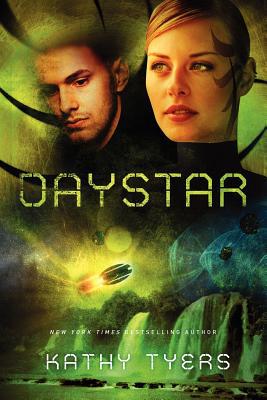 I am extremely pleased to be able to present my readers with an interview with New York Times-Bestselling author Kathy Tyers. Kathy Tyers has been instrumental in growing the genre of Christian science fiction and has published multiple books, including her award-winning “Firebird” series in this genre. She received the Mount Hermon Christian Writers Conference’s Pacesetter award for her work in developing science fiction. She has also published two Star Wars novels and appeared on the New York Times Bestseller list. She currently resides in Montana, where she continues to mentor other authors and work on her own future novels.
I have written several posts on Tyers’ “Firebird” saga (click here and scroll down or see links at the end of this post), and have immensely enjoyed her works.
What were some of the biggest science fiction influences on your writing?
The first SF novel I devoured was The Star Conquerors, an early space opera by Ben Bova. I was also a big fan of Zenna Henderson’s “People” novels. The original Star Wars movies swept me away, of course. I discovered Lois McMaster Bujold’s Miles Vorkosigan series when the first novel came out, and I kept up as she released titles in the series. Whenever I’m called to teach the craft in a classroom, I draw on Orson Scott Card’s excellent book on writing SF and Fantasy.
How has your faith inspired you to write?
My faith inspires my writing as it inspires everything I do; it’s the air I breathe, the ground I walk on, the light by which I can see and the gravity that keeps me grounded. If ever I shut my eyes, quit walking and stop breathing, it surely shows in my writing.
What do you think of the categorization of “Christian” fiction? Is it helpful to have a distinct category of “Christian” fiction?
Some people want to know, before opening a novel, whether it’s going to challenge them to think more deeply about God. Should all fiction come with a worldview alert about the author? That’s probably impractical. But if I open a novel that I know was written by a fellow Christian, or by someone of another faith, of course I approach it with different expectations.
What value do you think Christian speculative fiction has for evangelism, defense of the faith, and theology?
Whether or not we see ourselves as evangelists, we’re ambassadors for a Kingdom that is not of this world. That applies to every Christian in every profession. An author who’s known to be a Christian will have his or her books analyzed accordingly by some of the reviewers. If the book survives scrutiny as a good witness to the craft and the Kingdom, AND if it’s a good story well told, the author has accomplished what good fiction is supposed to accomplish—even if it gets the occasional one-star review.
How awesome was it to write Star Wars books?
Absolutely.
What is one piece of advice for aspiring writers?
Writing will take more time than you could possibly imagine. Don’t use that as an excuse to stop reading, because you’ll unconsciously (or consciously) emulate the books you’ve been reading. So read the good stuff.
What’s next on your plate? Any new books to look forward to?
I’ve written a contemporary supernatural novel set in Montana that I’m looking into indie publishing. Just looking, so far. Haven’t decided.
Conclusion
I would like to once more extend my thanks to Kathy Tyers for being willing to get interviewed for my site and for her excellent work in the field of science fiction.
Links
Kathy Tyers’ “Firebird” Trilogy- Faith, Humanity, and Conflict in the Far Future– The “Firebird” trilogy is one of my fondest memories of a read from when I was much younger. I recently re-read the series and was once more blown away. Here, I reflect on several issues of humanity and faith that Tyers raises in the novels.
Enter [Science] Fictional Messiah- Kathy Tyers’ “Wind and Shadow” and “Daystar”– I look into several worldview themes that Tyers raises in these sequels to her Firebird trilogy. What would a Messiah in the future look like?
Be sure to check out the page for this site on Facebook and Twitter for discussion of posts, links to other pages of interest, random talk about theology/philosophy/apologetics/movies and more!
Microview: “The Annotated Firebird Trilogy” by Kathy Tyers– I review the trilogy with a brief look at the plot and some positives and negatives in the book.
SDG.
——
The preceding post is the property of J.W. Wartick (apart from quotations, which are the property of their respective owners, and works of art as credited; images are often freely available to the public and J.W. Wartick makes no claims of owning rights to the images unless he makes that explicit) and should not be reproduced in part or in whole without the expressed consent of the author. All content on this site is the property of J.W. Wartick and is made available for individual and personal usage. If you cite from these documents, whether for personal or professional purposes, please give appropriate citation with both the name of the author (J.W. Wartick) and a link to the original URL. If you’d like to repost a post, you may do so, provided you show less than half of the original post on your own site and link to the original post for the rest. You must also appropriately cite the post as noted above. This blog is protected by Creative Commons licensing. By viewing any part of this site, you are agreeing to this usage policy.
“Never to Live” by Just B. Jordan – Madness, Self-Loathing, and Hope?
 Never to Live
Madness and Self-Loathing
The main character, Elwyn, is at least apparently insane. Through the first part of the book she is tortured by her own memories into self-loathing madness and must be brought forward out of that same madness in order to be used by God.
The notion of going into and coming out of madness was a unique way to convey the notion of human sinfulness and our incapacity to bring ourselves out of it. Only when Elwyn is confronted by the notion that she could not herself right her wrongs was she able to move beyond them and out of madness.
Moreover, the concepts of madness and self-loathing themselves are things that I think we as Christians need to be more cognizant of as we consider how these can impact a life of faith and our own witness. As with Elwyn, we need to be messengers bringing hope to those who have no hope, and the realization that Jesus is the only way to get beyond our own sinful desires and the self-loathing that comes with the consequences of our sinful activities.
Open Theism and the nature of God?
It is unclear as to whether the character “Weaver” is a God stand-in in this book, but there are many hints that this is the case. If so, the concept of deity put forward in Never to Live is interesting, as Weaver is portrayed as not knowing the entirety of the future. This would be akin to the concept of open theism (which I have discussed at length in various posts). To see this concept translated into fiction was interesting because it meant that the God stand-in had to work with people in a closer way and hope that they accomplished what was needed.
Weaver, if indeed the God stand-in, was also female, which was an interesting choice by the author. The notion that God can be conveyed through female imagery is something with a basis in the Bible as God is portrayed as nursing, as a mother hen, etc.
Conclusion
Never to Live
Disclaimer: I received a review copy of this book from Enclave publishing. I was not influenced or required by the publisher to write any kind of review.
Source
Just B. Jordan, Never to Live (
SDG.
——
The preceding post is the property of J.W. Wartick (apart from quotations, which are the property of their respective owners, and works of art as credited; images are often freely available to the public and J.W. Wartick makes no claims of owning rights to the images unless he makes that explicit) and should not be reproduced in part or in whole without the expressed consent of the author. All content on this site is the property of J.W. Wartick and is made available for individual and personal usage. If you cite from these documents, whether for personal or professional purposes, please give appropriate citation with both the name of the author (J.W. Wartick) and a link to the original URL. If you’d like to repost a post, you may do so, provided you show less than half of the original post on your own site and link to the original post for the rest. You must also appropriately cite the post as noted above. This blog is protected by Creative Commons licensing. By viewing any part of this site, you are agreeing to this usage policy.
The Wheel of Time: “Knife of Dreams” and “The Gathering Storm” – A Christian Perspective
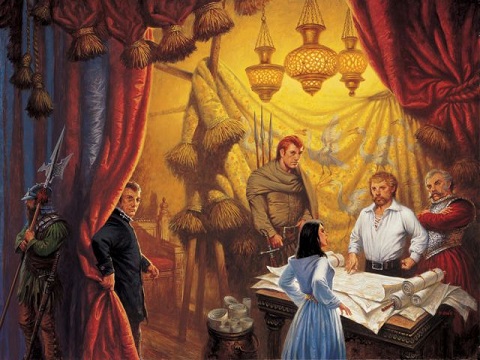 Robert Jordan’s epic fantasy series, “The Wheel of Time,” has much to reflect upon from a Christian perspective. Here, I’ll be examining books eleven and twelve, “Knife of Dreams” and “The Gathering Storm.” These fantasy books are masterworks and deserve to be read by any interested in the genre. There are SPOILERS from both books here. Please do not share spoilers from later books for the sake of readers.
Acting Becomes Reality
In Knife of Dreams, Faile and her companions are being held captive by the Shaido Aiel. In the process, they are forced into servitude and beaten at the whims of their overlords. Faile soon realized the best strategy would be to fain timidity, but also realized the dangers of this:
[Faile] hoped that Sevanna [one of the Aiel] thought her tamed… She hoped that she was not being tamed. Pretend something too long, and it could become truth… She had to escape before [her husband] got himself killed in the attempt [to rescue her]. Before she stopped pretending. (167, cited below)
There is a similar notion built into much discussion about Christianity. Pascal, for example, after outlining his famous wager (which I defend here), noted that one may align oneself towards belief. That is, when someone begins to act as though one believes a certain way, it can turn into a reality that one believes a certain way. From a worldview perspective, then, we should always be wary of how we live our lives and what we surround ourselves with. After all, it may be that our pretending becomes reality.
Preparing for War
The upcoming “Last Battle” is the primary theme of the entire series. In Knife of Dreams and The Gathering Storm, we get our first real experiences of that upcoming war. The series has built up towards this climax, and one can feel the coming “storm” in the books to come. For our world, we know that war is a constant reality. With the reality of terrorist organizations, civil unrest, deep-seated cultural hatred, and the like, war is a constant companion. The same is true in the Wheel of Time. There is an eschatological awareness in the series of this “Last Battle,” just as Christians have an awareness of the Second Coming. In one scene, a military man, one of the great captains, Bashere, reflected on the reality of war:
“Let’s hope it really is the Last Battle. If we live through that, I don’t think we’ll ever want to see another. We will, though. There’s always another battle. I suppose that will be the case until the whole world turns Tinker.” (459)
The awareness of the coming eschaton for the Wheel of Time comes with it a bitter awareness that people of all backgrounds continue to war with each other. Perhaps, it is said, the way of the Tinker–people who have sworn off violence–is best.
In The Gathering Storm, we find a dramatic reversal of the biblical theme of coming peace (found in passages like Isaiah 2:4) which speaks of a day when swords will be beaten into plowshares. Instead, the people of the Wheel of Time must prepare for a day of chaos and war:
“take your best scythes and turn them into polearms…” [advises one farmer to another]
“What do I know about making a sword? Or about using a sword, for that matter?” [the other replied]
“You can learn… Everyone will be needed.” [The first responded] (8, cited below)
The Last Battle is a day in which the nations will unite, but they will unite for war. Again, this is in contrast to the biblical theme of the abolition of war in the eschatological hope. It will be interesting to see how this plays out in the coming books.
Fighting the Darkness from Within
One of the most dramatic scenes in the entire series is found in The Gathering Storm as Verin, an Aes Sedai (female magic user in this series) who has seemed so loyal, reveals she is a darkfriend of the Black Ajah. However, it turns out that she is not wholly evil but rather did so, and did many evil things, in order to try to fight the Shadow from within its own ranks:
“You see, one rarely has a chance as this, to study a beast from inside… They [darkfriends] have many agents among us… Well, I thought it time that we had at least one of us among them. This is worth one woman’s life.” (836, 839)
Verin had sworn herself to evil, but did so in order to bring about great good. Her life was forfeit in order to expose wickedness within the ranks of the Aes Sedai. Her sacrifice forestalled a major weapon of the Dark One.
Thankfully, there is no need for we as Christians to go around swearing ourselves to evil. However, there is great need and sacrifice in going to communities in which Christians are persecuted and seeking to help in whatever ways we can.
Conclusion
The Wheel of Time continues to impress, both from the magisterial scope of its fiction and from the many issues of worldview it brings up. There are, of course, many, many more topics we could discuss related to the books and you may feel free to bring these up in the comments. There are many themes which resonate with the Christian worldview, but Jordan clearly borrowed from Eastern Mysticism as well as other religious traditions. This is a fantastic series to read and discuss at a worldview level.
Links
Be sure to check out the page for this site on Facebook and Twitter for discussion of posts, links to other pages of interest, random talk about theology/philosophy/apologetics/movies and more!
Sources
Robert Jordan, Knife of Dreams (New York: Tor, 2005).
Robert Jordan and Brandon Sanderson, Crossroads of Twilight (New York: Tor, 2009).
SDG.
——
The preceding post is the property of J.W. Wartick (apart from quotations, which are the property of their respective owners, and works of art as credited; images are often freely available to the public and J.W. Wartick makes no claims of owning rights to the images unless he makes that explicit) and should not be reproduced in part or in whole without the expressed consent of the author. All content on this site is the property of J.W. Wartick and is made available for individual and personal usage. If you cite from these documents, whether for personal or professional purposes, please give appropriate citation with both the name of the author (J.W. Wartick) and a link to the original URL. If you’d like to repost a post, you may do so, provided you show less than half of the original post on your own site and link to the original post for the rest. You must also appropriately cite the post as noted above. This blog is protected by Creative Commons licensing. By viewing any part of this site, you are agreeing to this usage policy.
“Eternity Falls” by Kevin Outerbridge – Faith, Extremism, and Cyberpunk
 Eternity Falls
Faith and Redemption
One of the primary themes running throughout Eternity Falls is that of redemption. Rick Macey was once a Christian, but like many people in the future (and present), he starts off the book thinking that religion has been proven to be irrational–an ancient belief with little to recommend it in the present. However, he also realizes his own imperfections and regrets. When he is confronted by Virgil, a man with whom he had strong disagreements in the past, he is also brought face-to-face with faith that is still genuine.
However, it is not left at this. Virgil’s beliefs have become a bit unhinged (see below), and in a beautiful twist of storytelling, it is Macey who is brought back to faith and confronts Virgil’s own self-righteousness.
Outerbridge’s tale here demonstrates something that we should all take to heart–God can and will use anyone to wake us up to our own failures and call us home.
Religious Extremism- What Rationale?
Perhaps the most poignant aspect of Eternity Falls are the conversations between Macey and Virgil about religious extremism. They both have backgrounds in combating terrorism, but their past experience led them in opposite directions and Virgil has come to conclude that facing death is the only way for humans to possibly turn to God. Virgil seeks to destroy the “Miracle Treatment” and thus make it so that everyone will once again die natural deaths, confronted with that moment when “eternity falls.” Macey, however, points out that God has used the extended lives of many of these people to bring them to the faith through their own realization of the pointlessness of an endless life of leisure.
Their conversations play out in this way through the book, and Macey ultimately makes a compelling case that God may, in sovereignty, use even things which may be apparently sinful to bring about great good. The melding of the concepts of human free will and God’s omnipotent control over events is powerful, and in what is truly a reflection of Outerbridge’s talent, it meshes very well into the plot of the book.
Moreover, the book portrays the impetus behind religious extremism in many philosophically interesting ways. It is not at all promoting extremism, but the fact that motivations beyond the tired “religious = violent” rhetoric that too often plays out in commentary on terrorism are brought up adds even more solid worldview-level bites to chew on. The key issue is that quote-unquote “religious extremists” certainly themselves believe they are acting rationally, and to have the story play this out in a way in which multiple extremists are spoken to on a logical level rather than simply discounted was fantastic.
Conclusion
Eternity Falls
Links
Be sure to check out the page for this site on Facebook and Twitter for discussion of posts, links to other pages of interest, random talk about theology/philosophy/apologetics/movies and more!
Microview: “Eternity Falls” by Kirk Outerbridge– I reviewed the book, including giving some “good” and “bad” points along with a letter grade. Check out the review!
Popular Books– Check out my looks into other popular books (scroll down for more).
Source
Kirk Outerbridge, Eternity Falls
SDG.
——
The preceding post is the property of J.W. Wartick (apart from quotations, which are the property of their respective owners, and works of art as credited; images are often freely available to the public and J.W. Wartick makes no claims of owning rights to the images unless he makes that explicit) and should not be reproduced in part or in whole without the expressed consent of the author. All content on this site is the property of J.W. Wartick and is made available for individual and personal usage. If you cite from these documents, whether for personal or professional purposes, please give appropriate citation with both the name of the author (J.W. Wartick) and a link to the original URL. If you’d like to repost a post, you may do so, provided you show less than half of the original post on your own site and link to the original post for the rest. You must also appropriately cite the post as noted above. This blog is protected by Creative Commons licensing. By viewing any part of this site, you are agreeing to this usage policy.
The Wheel of Time “Winter’s Heart” and “Crossroads of Twilight” – A Christian Reflection
 Robert Jordan’s epic fantasy series, “The Wheel of Time,” has much to reflect upon from a Christian perspective. Here, I’ll be examining books nine and ten, “Winter’s Heart” and “The Crossroads of Twilight.” There are SPOILERS from both books here. Please do not share spoilers from later books for the sake of readers.
Violence and the Sword
In Winter’s Heart, we find that great restrictions are placed on the use of weapons in Far Madding, a city which has great buffers against use of the Power. The question is, does violence cease when weapons are taken away? A guard in the city explains the reasoning:
“No need for any man to defend himself in Far Madding… The Street Guards take care of that. Let any man as wants start carrying a sword, and soon we’d be as bad as everyplace else…” (538)
However, the guardsman apparently was scarred–from some previous conflict. Moreover, the pages preceding this quote and afterwards spoke of how violence continued whenever the Guards were not immediately in sight. Yes, it may have been thwarted to some extent, but people still found ways to fight and murder. How is it that in a place which attempted so much to restrict violence, violence was perpetuated? It seems that it is because people continued to find ways to do violence, despite said restrictions. The world is in need of redeeming from its own self-centeredness and focus on doing harm.
Deism
Perhaps the most lengthy theological discussion which has occurred in The Wheel of Time yet is found in Crossroads of Twilight, as Rand reflects upon the way things are playing out:
Did he think the Creator had decided to stretch out a merciful hand after three thousand years of suffering? The Creator had made the world and then left humankind to make of it what they would, a heaven or the Pit of Doom by their choosing. The Creator had made many worlds, watched each flower or die, and gone on to make endless worlds beyond. A gardener did not weep for each blossom that fell. (558)
The quote speaks to a kind of deism found in The Wheel of Time. The Creator laid down the pattern, which continually repeats throughout history. It weaves as the Creator willed it. But the Dark One continually tries to make the pattern “fall into the shadow.” One wonders, then, whether Rand al’Thor is correct here. After all, the Creator has held off the Dark One from utterly overthrowing the Pattern–perhaps only through setting it up in such a way that it could correct things. But even that much foresight refutes the notion that the Creator would not have cared whatsoever about the suffering of men cursed to insanity.
I look forward to seeing how theology develops in the Wheel of Time as the final battle approaches.
Fatalism
The Pattern itself is something which garners much discussion, and it seems to point to a kind of fatalism found in the beliefs of many in the universe. For example, Perrin has a discussion with an Aes Sedai about how the Pattern weaves in Crossroads of Twilight:
“You are ta’veren, yes, but you still are only a thread in the Pattern, as am I. In the end, even the Dragon Reborn is just at thread to be woven into the Pattern. Not even a ta’veren thread chooses how it will be woven.” [Annoura–the Aes Sedai–said]
“Those threads are people,” Perrin said wearily. “Sometimes maybe people don’t want to be woven into the Pattern without any say.”
“And you think that makes a difference?” Not waiting on an answer she lifted her reins and [galloped off]. (588)
The notion of fatalism is prevalent throughout the series, but one wonders whether it will hold sway. After all, it really does appear as though some people are able to change things for the better or worse, even working against the Pattern (or going outside/beyond it).
Back to Our World
These themes hare found in many discussions outside of the world of fantasy. Is God so distant that we may not approach Him? Are our destinies simply wrapped up in uncaring fate? Can we stop violence by taking away all weapons? These are questions which speak to moral and transcendent spheres of reality, and interaction with them is beneficial. The Christian view would note that the “Creator” in fact cared so much about creation–each individual–that God sent the Son to redeem the world. It’s a powerful message–one which goes beyond that found in the world of fantasy and takes us into a new plane of reality in which we are redeemed people living in Christ.
We need not worry about fatalism or the possibility of evil overcoming a plan simply wound up and left to unravel. Instead, God intimately cares for and about each individual.
Links
Be sure to check out the page for this site on Facebook and Twitter for discussion of posts, links to other pages of interest, random talk about theology/philosophy/apologetics/movies and more!
Sources
Robert Jordan, Winter’s Heart (New York: Tor, 2000).
Robert Jordan, Crossroads of Twilight (New York: Tor, 2003).
SDG.
——
The preceding post is the property of J.W. Wartick (apart from quotations, which are the property of their respective owners, and works of art as credited; images are often freely available to the public and J.W. Wartick makes no claims of owning rights to the images unless he makes that explicit) and should not be reproduced in part or in whole without the expressed consent of the author. All content on this site is the property of J.W. Wartick and is made available for individual and personal usage. If you cite from these documents, whether for personal or professional purposes, please give appropriate citation with both the name of the author (J.W. Wartick) and a link to the original URL. If you’d like to repost a post, you may do so, provided you show less than half of the original post on your own site and link to the original post for the rest. You must also appropriately cite the post as noted above. This blog is protected by Creative Commons licensing. By viewing any part of this site, you are agreeing to this usage policy.

 J.W. Wartick - Reconstructing Faith