Lutheran Church Missouri Synod
Why I Left the Lutheran Church – Missouri Synod: Points of Fracture (Part 2): Science as a Young Adult

For several posts, I will be writing about specific things that came up while I was within the LCMS–that is, at its schools, churches, and university–that made me start to think that the LCMS way of things didn’t align with some aspect of reality, something I learned in the Bible, or something else.[1]
Points of Fracture: Science as a Young Adult
The cognitive dissonance that I experienced regarding Christianity and science continued to mount as I got older. My previous post went over times in which I recall finding those points of fracture. I left off there in about 8th grade at an LCMS school. Here, I’ll share some of the times as a young adult in which I truly began to struggle with science and my faith.
In college, the hints of fracture at the edges of my view in the world became fault lines. I so often see the narrative of how allegedly secular colleges will destroy the faith of kids, but I was at an LCMS University, and being there nearly destroyed my faith. There are more reasons for this than science, as we’ll see in future posts. For now, though, the focus on questions of science loomed large when I was in college.
I came to college as a faithful Lutheran, though I had my ups and downs. For the first time, I really could not go to church all the time and it wouldn’t matter or hardly even be noticed by most people. Then, I had a major religious experience and realized I wanted to learn about and know God more every day. One way that manifested is that I started reading apologetics. It quickly became clear that issues of science and faith loomed large, and for the first time I truly began to think about the implications of some of these issues.
Then, I had a geology class in college. The professor was an adjunct who, I’m fairly sure, was neither Lutheran nor particularly interested in the theology of the university. He seemed blissfully unaware, as he taught his geology course, that what he was teaching would be worldview-shattering at least for one of his students. It was a course full of students who were on campus for many reasons, not just to attend an LCMS school. Many of them there were on athletics scholarships, and I heard some openly talking about the only reason they were at the school was because it was the only one that offered them such a scholarship. No one was dissenting from this professor, who stood there teaching mainstream geology. This was all stuff I’d never even been exposed to before. How beaches formed, how we could accurately predict how long some formations would take to form, how rock layers could be formed apart from Noah’s Flood. Indeed, Noah’s Flood was never even mentioned in the class. What I thought was the explanation for basically every geological feature on the planet wasn’t even in the index of my geology textbook!
I was totally devastated. Here was evidence, presented in the most mundane, disinterested fashion possible, that the Earth simply could not be merely 10,000 years old or so. While I didn’t really have a grasp on the science, the course taught me enough to realize that something had to give. The way I had been raised made the choice quite stark. The Bible just clearly taught that the Earth was young. “Millions of years” was a lie. Either the Earth really is six to ten thousand years old because the Bible says so or the Bible is untrustworthy and Christianity is false.
We had leaders in our dorms who were called “Spiritual Life Representatives” (SLRs). Think of an RA, but who you could go to in order to discuss spiritual questions or crises. They’d lead devotions and generally make themselves available to students to talk to. I went to my SLR and I was weeping in his dorm room. I was convinced that the geology I had learned had proven that the Earth could not be young, and so how could I possibly continue to believe Christianity was true? He said something that has stuck with me ever since: “If the Earth is more than 10,000 years old, would it really mean that Christ has not been raised from the dead?”
I sat there, tears streaming down my face, and I realized it wouldn’t mean that. He said other things, of course, like that he wasn’t as confident as I was about geology proving things differently, that there were other resources to read. But in that moment, he said something that allowed me to preserve my collapsing faith. I realized then that my faith was built on Christ, not on the age of the Earth.
I threw myself even more into apologetics now, because I felt even more confident that Christianity was true and that I needed to prove it to other people. The freedom provided to me by this conversation with my SLR had me flirt briefly with theistic evolution, but when I mentioned that in apologetics groups I was in, it got shot down hard. Instead, Young Earth Creationism (YEC) was the way to go. I needed to start seeing science the right way, they said. I searched around for groups to help build my faith and defense thereof, and started subscribing to Acts & Facts Magazine from the Institute for Creation Research (ICR). I was hugely impressed by the production values of this creationist publication, with its gorgeous pictures and lengthy articles about things like RATE research and the like. For the uninitiated, RATE stands for Radioisotopes and the Age of The Earth. I was convinced by these publications that, among other things, radiometric dating was falsified, that the Grand Canyon was evidence for a young earth, and that if you just looked at things in nature in the right ways, you’d see a young earth all around you. Reading about creationism in some LCMS literature convinced me even further, and speaking with a few pastors about the topic had me once more feeling rock-solid about my YEC convictions.
I love walking in nature, and I went for a hike somewhere in Michigan and I saw the distinct layers in the rocks. I walked up to them and put my fingers on them. I could trace the layers with my fingers and see how they were distinct in coloration after a certain point. I remember very clearly the feeling of washing over myself of total confidence that these layers were laid down by Noah’s Flood. Later in the hike, I saw a different formation of rocks thrust up through the other ones, so that they were nearly perpendicular to the other layers surrounding them. I stood staring at it for some time, trying to figure out how this could have happened due to Noah’s Flood. I simply couldn’t come up with such a scenario, but I trusted further study would alleviate the stress. I left the hike somewhat disturbed, but mostly confident in my young earth beliefs.[2]
Then, I started noticing that many of the published apologists I was reading weren’t convinced of YEC. I started to dive deep into Old Earth Creationism, which is very similar to YEC except that the direct creation of all animal life happened over long periods of time instead of in a single week of seven 24-hour days. I became deeply engrossed with another creationist organization, Reasons to Believe. This organization taught that there were real, scientific models that could show both that the Bible was true and that you could effectively map it out with special creation of creatures over time. It was a kind of chimerical creature, picking and choosing scientific discoveries that aligned with it while also finding isolated verses in the Bible to say it taught modern science (eg. using Psalm 104:2 to suggest it taught Big Bang cosmology).
Then, I took another science class in college. This one was a biology class to finally knock off my requirements for graduation. The professor had some extremely non-mainstream views. I remember him frequently talking about smoking and insisting that smoking doesn’t cause lung cancer. How did he know? His repeated refrain was: “Correlation is not causation.” If I’d known more at the time about science, I would have pushed back harder on this. At the time, though, it still seemed pretty ludicrous. My grandpa had died of lung cancer, and I was very well aware of it being caused by smoking. The same professor would go wildly off topic during class, frequently shifting to pet issues that he would lecture us about. Several students offered pushback on some of these topics, most of which I don’t remember.
I do recall, though, one day when he talked about creationism. He was very adamant that YEC was the only way to believe, basically pulling the LCMS party line about it being essential to affirm that in order to believe the Bible. But even for the LCMS, some of this guy’s views were far afield. For example, he insisted that the Earth wasn’t tilted before the Fall, which he said meant the Garden of Eden would cover the whole planet as the whole planet would therefore have the same weather as the equator currently does. Dinosaurs, he insisted, all ate plants, and even the teeth we associate with Tyrannosaurus Rex were adapted for eating plants before the Fall.
The whole thing seemed preposterous to me, even as someone who had been steeped in YEC literature. It was at this point I basically realized going back to YEC views was impossible. As someone who wanted to be an LCMS pastor (at the time), that caused me no small amount of trepidation. After all, I’d already heard a story from a pastor who approvingly cited a large group pastors literally shouting down two other pastors who tried to introduce a resolution to even discuss the possibility of anything but a Young Earth in the LCMS. I was aware of the many, many pastors I knew who were totally convinced of YEC. How would I survive in a denomination that was so firmly entrenched? Even the few exceptions I knew about were just that–exceptions. For that reason, I still held my views close to my chest.
Online, I started to write a series of blog posts examining four major views (as I saw them) in Christianity: Young Earth and Old Earth creationism, theistic evolution, and Intelligent Design. The pushback I got for even mentioning theistic evolution from apologetics-interested friends was massive. I’d get warning messages on Facebook about even considering publishing posts about anything but YEC that could be remotely positive.
In an art class, our professor casually went over dates of artwork. We came to some cave paintings, and this professor said they were dated to 13-16,000 years ago. One pre-seminary student raised his hand and pushed back on the date. “The Earth isn’t even more than 10,000 years old. How could there be cave paintings that are older than the Earth?” How, indeed? I wondered. Again, I was a closet Old Earth Creationist at this point. The professor, to their credit, took it in stride. They answered, “I’m reporting the dates that mainstream art historians have given these works. To get credit, you’ll need to give those answers on the test. But you can definitely do your research project on how art dating works!” It was a masterful response.
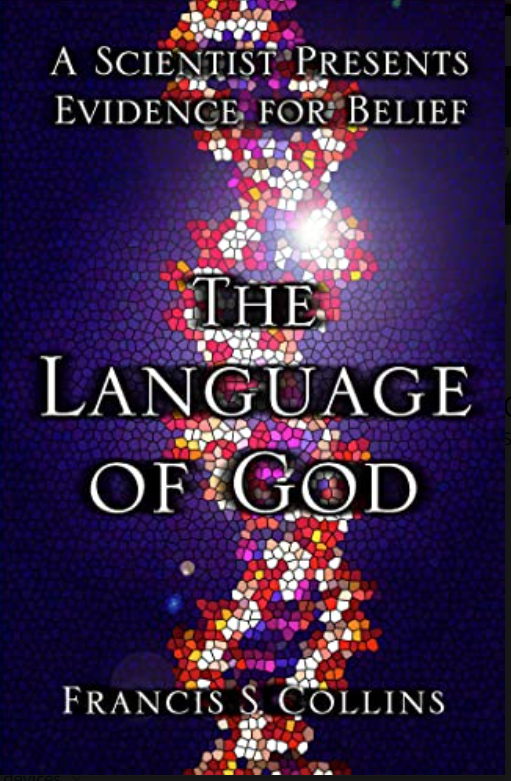
Later, I was at a bookstore with some LCMS members. We were milling about the shelves and I went straight to the Christianity section to see if there were any apologetics books. There, I saw this book with a striking cover that said it was written by a scientist exploring faith. The Language of God , by Francis Collins, unapologetically defended the view of theistic evolution, and I found myself paging through it quickly. I felt guilty for even reading it. Evolution, as I knew, was the enemy of Christianity. But this author was writing about evolution with such confidence as a Christian scientist. He’d had a religious experience himself, and he wrote accessibly and in a winsome fashion. I bought the book away from the others, afraid they might ask me about it. When I read it, it opened my eyes to many possibilities. I wouldn’t immediately come to believe evolution and Christianity were compatible, but I believed that it was possible to believe they were. That wording is intentional, because I want my readers to understand how many steps I had to take along this journey. At this point, I’d come from believing scientists were liars trying to deceive people about the age of the Earth for well, some reason anyway, to believing that it was vaguely possible someone could be a Christian and believe evolution and Christianity were compatible. I cannot emphasize enough how difficult it was to get to that point, and how many side roads and challenges and tears were along the way.
It would take several more years before I could become comfortable with affirming evolution while remaining Christian. I do, now. My first post mentioned religious trauma as part of my time in the LCMS. I haven’t had a lot of ways to portray that so far, but one way I believe I experienced religious trauma from within the LCMS was in the extreme, repeated resistance I experienced regarding science. I adored science, and the religious teachings I experienced led me to be mistrustful of science, and scientists in particular. Christians who were scientists were questionable at best. Like, why would you engage a field full of lies? It would take me more than a decade as an adult to undo that mistrust. Alongside that, it has forced me to question many other things. When you believe things that are easily falsifiable (such as men having one fewer rib than women) and discover that they are, in fact false, it causes a kind of lingering cognitive dissonance that is hard to overcome.
Science is one of the reasons I left the LCMS, but it was intertwined with emotional highs and lows. I experienced crises of faith due to my false beliefs about science. I thought I could no longer believe the Bible because I found evidence in nature that contradicted what I was taught it said. These may seem like small issues to some, but I cannot emphasize how important they were to me, and how important they remain to many others.
Next, we’ll begin exploring other reasons I left the LCMS.
Next: Points of Fracture Part 3
[1] I’ve addressed this in my previous post, but want to point out here that not everything held positionally by the LCMS is spelled out in their teachings. One friend pointed out the helpful categorization related to the LCMS and creationism: the LCMS has a de facto affirmation of young earth creationism, though it is not always made explicit. The evidence is abundant, though one may point to the occasional, very rare exception. On the flip side, the evidence that the LCMS is intrinsically tied to young earth creationism continues to mount. See, for example, my post about an official stance in 2019 that reaffirmed a creationist position.
[2] To tell this story and other parts of this post, I’ve had to very quickly summarize or even skip over parts of creationist arguments. I was fully engaged with YEC at this point and to this day could very easily rattle off numerous arguments in favor of YEC, though I now believe they are mistaken. I know some YEC explanations do exist for these types of formations, but here my goal is to list things that, in the moment, caused me to realize points of departure.
Links
Formerly Lutheran Church – Missouri Synod (LCMS) or Wisconsin Synod (WELS)– A Facebook group I’ve created for people who are former members of either of these church bodies to share stories, support each other, and try to bring change. Note: Anything you post on the internet has the potential to be public and shared anywhere, so if you join and post, be aware of that.
Why I left the Lutheran Church – Missouri Synod Links Hub– Want to follow the whole series? Here’s a hub post with links to all the posts as well as related topics.
Be sure to check out the page for this site on Facebook and Twitter for discussion of posts, links to other pages of interest, random talk about theology/philosophy/apologetics/movies and more!
SDG.
——
The preceding post is the property of J.W. Wartick (apart from quotations, which are the property of their respective owners, and works of art as credited; images are often freely available to the public and J.W. Wartick makes no claims of owning rights to the images unless he makes that explicit) and should not be reproduced in part or in whole without the expressed consent of the author. All content on this site is the property of J.W. Wartick and is made available for individual and personal usage. If you cite from these documents, whether for personal or professional purposes, please give appropriate citation with both the name of the author (J.W. Wartick) and a link to the original URL. If you’d like to repost a post, you may do so, provided you show less than half of the original post on your own site and link to the original post for the rest. You must also appropriately cite the post as noted above. This blog is protected by Creative Commons licensing. By viewing any part of this site, you are agreeing to this usage policy.
Why I Left the Lutheran Church – Missouri Synod: Links Hub

I wanted to have a place to collect all the links for my ongoing series of why I left the Lutheran Church – Missouri Synod in one post. Here, I share those links along with related reads.
Series
Finding My Voice– I wrote about why I wanted to write this series of posts, and why I thought it was time to do so.
A short history of my time in the LCMS– I go over my time in the LCMS and why I believe that makes my voice especially relevant in a critique of the Synod.
Points of Fracture (Part 1)- Science as a child– I begin to draw out the points of fracture I felt with the LCMS, starting with science I learned as a child.
Points of Fracture (Part 2)- Science as a young adult– Debates over science finally came to a head as fractures became faults in my faith.
By Their Fruits… (part 1)– I begin a miniseries that goes over a number of ways in which I discovered things within the LCMS practices that drove me away from that church body.
By Their Fruits… (Part 2)– I discuss the racism, anti-Semitism, and Islamophobia I encountered in the LCMS.
By Their Fruits… (Part 3)– I observed and encountered quite a bit of misogyny in the LCMS, and document some here.
By Their Fruits… (Part 4)– Homophobia is rampant in the LCMS at various levels.
By Their Fruits… (Part 5)– Nationalism, inconsistent practices of close/closed communion, and more are additional problems with LCMS practice.
Why I Left the Lutheran Church – Missouri Synod: Points of Fracture: Women in the Church Part 1– I write more about how I was confronted with the LCMS’s views about women in the church and the struggle I had with it.
Why I Left the Lutheran Church – Missouri Synod: Points of Fracture: Women in the Church Part 2– I discuss how intense prayer and fervent study of Scripture led me to believe that women can be pastors.
Why I Left the Lutheran Church – Missouri Synod: Points of Fracture: On the Other Side– I write about my experience as I actively left the LCMS and the spiritual abuse and other difficulties that entailed.
Why I Left the Lutheran Church – Missouri Synod: Still Faithful– I have been asked so many times about why I stayed in any church body after my experiences. Here, I attempt a short answer to the question.
Related Links
Formerly Lutheran Church – Missouri Synod (LCMS) or Wisconsin Synod (WELS)– A Facebook group I’ve created for people who are former members of either of these church bodies to share stories, support each other, and try to bring change. Note: Anything you post on the internet has the potential to be public and shared anywhere, so if you join and post, be aware of that.
Leaving the LCMS/WELS– Not sure about whether to leave or thinking about leaving? Do you want to others who are thinking along the same lines? I created a group for those who are contemplating leaving these denominations, as well.
The Lutheran Church – Missouri Synod and Creationism: An Unnecessary Match– I quote from a resolution passed by the LCMS in convention in 2019 and analyze how it’s a problematic view to put forward.
Unchristian Nonsense: A microcosm of what’s wrong in conservative Lutheranism– I look at some of the controversy surrounding the selection of a new President at one of the Concordias (the universities of the LCMS).
“Power, Politics, and the Missouri Synod” – A book from James C. Burkee that has me thinking about my former denomination– I take a brief look at an historical exploration of Seminex.
LCMS President Harrison’s Letter to Board of Regents of Concordia University Wisconsin – Ann Arbor– I provide my thoughts about President Harrison’s letter in which he addresses some alleged problems at CUWAA.
Why I left the Lutheran Church – Missouri Synod: Points of Fracture (Part 1): Science as a Child

I have written about why I am writing this series as well as my history within the LCMS. Now, it is time to turn to what I’m calling points of fracture. For several posts, I will be writing about specific things that came up while I was within the LCMS–that is, at its schools, churches, and university–that made me start to think that the LCMS way of things didn’t align with some aspect of reality, something I learned in the Bible, or something else.[1]
Points of Fracture: Science as a Child
Here, I’ll be sharing the points of fracture that I experienced related to science at a young age. At the outset, I want to point out that much of these points of fracture were discovered by me over time. So, for example, when I talk about my young childhood, it’s not as though I was immediately aware that something was off about what I was learning. Instead, it was a realization that came over time, and the memory of when I was young was something that I recall as an important stepping stone to get to where I am now.
Some of my first memories of conflict between what I believed and what others believed was as a child getting library books. I don’t remember how far we had to go to drive to the library from our tiny town, but I remember it seemed like forever, and that I would consume books on the way home, often falling asleep in the car before arriving at home. I, like many kids, was obsessed with dinosaurs.[2] That meant I raided the library’s section on dinosaurs. I’d memorize the names and facts about them, pore over images of them, and imagine what life would have been like alongside them. If the cover of a library book had a T-Rex ripping apart its prey, that was the book I was going for. But those dinosaur books talked about when dinosaurs lived. Those dates were given as the best scientific approximations based on various dating techniques, ranging from about 66 million years ago to 200 million or more for dinosaurs’ first appearance on Earth.
Those dates, I was told, were wrong. Whenever I saw “millions,” I was told to ignore it. As a young kid, I didn’t press back very hard on that. After all, I had no reason to do so. I knew that I could get facts wrong about all sorts of things, so the notion that basically every book I read about dinosaurs was wrong about how long ago dinosaurs lived wasn’t terribly mind-bending for me. I learned to just run my eyes over any time it said “millions of years,” because that was wrong. The rest of the facts, though, were basically unquestioned. I didn’t have the capacity at the time to put those two things into disharmony. That is, I didn’t realize how odd it was that the books and scientists seemed to be right about, say the ecosystem the dinosaurs lived in, or their diets, or debates about coloration while simultaneously being totally wrong and even untruthful about how long ago they lived.
That last bit is important. I used the word “untruthful” because part of what I was taught, whether directly or through creationist literature I would be exposed to a year or so later, was that scientists weren’t just wrong about the age of the Earth or when dinosaurs lived. No, instead, they were actively lying about it. I want to sit with this for a moment because it is an extremely important distinction. There’s a huge difference between someone being wrong while reporting something they think is factual and someone deliberately deceiving you about something they say is factual. That I came to believe that scientists were actively lying about the age of the Earth would temper my interest in science for more than a decade once it became fully engrained in me. Sometimes I genuinely think I would have ended up in geology or paleontology as a field of study and employment if I hadn’t come to be taught that, because of my deep interest in these topics. But I didn’t, at least in part because I thought scientists were liars.
No small part of that belief came from some of the approved dinosaur books I was gifted during my dinosaur obsession. These dinosaurs books portrayed a different history of the world, with humans walking alongside long-necked dinosaurs and feeding them fruits by hand. I distinctly remember a photograph of an alleged plesiosaur (see below) that had been caught by a fishing boat in one of them. These books didn’t have the same exciting illustrations of T-Rex or Deinonychus (my personal favorite) shredding their prey. Instead, I was taught that they had something more precious–the truth about dinosaurs. These books confronted head on topics like evolution and the age of the Earth, saying in no uncertain terms that evolution was a lie and scientists who taught millions of years were liars as well. I didn’t even understand what evolution was supposed to be at this point, but I knew it was a lie. Again, this disjunction between being mistaken and being liars was something that sucked away my enjoyment of science over time, and also would make it extremely difficult for me to fairly examine evidence.

Later, I remember talking to a child a few grades above me at my LCMS grade school. When I mentioned that I liked dinosaurs, she told me quite sincerely that dinosaurs had never existed. I was incredulous, asking “What about all the bones!?” Her answer surprised me: she said something to the effect of “Those bones were put there by God to test people’s faith.” The total somberness with which she expressed this sentiment took me off guard, but I do remember laughing at her because I thought it was so ridiculous to think that (I wasn’t the kid with the best manners). I would later recall the incident when I was studying more about these topics because it specifically showed me I could see beliefs about science that seemed obviously false and reject them, and that was okay. Even more importantly, it was a time my younger self was given an idea about God that did not seem to align with what I believed about God. Even as a child, the notion that God would be actively trying to deceive people seemed obviously, even hilariously wrong. That God doesn’t deceive us with nature, but that nature rather declares the glory of God (Psalm 19) would be hugely important to me as an adult.
Another topic I remember was about Adam and Eve. I specifically remember learning that all boys and men had one fewer rib than women. This was seen as evidence for the biblical account of Adam having been formed from Eve’s rib. I don’t remember my first source of hearing of this, but I do remember I heard it from more than one adult in my life. It wasn’t actually until college as I was searching online for various science-related things that I learned this was false. To this day, even typing that it’s false has me second-guessing myself, so firm was my belief that men had fewer ribs than women. It’s one of those things that is incredibly easy to disprove, to the point that when passed along, no one thinks to question it. It was honestly a shocking revelation to me when I discovered it wasn’t true, and it spurred me on to search for other things I could disprove or couldn’t confirm.
I believe it was in 6th grade, again at an LCMS school, that I had a single day in which we talked about plate tectonics. It was in a geography class, and we were learning quite briefly about how the map was formed. I recalled some of the maps I’d seen in dinosaur books of Pangaea and asked about that, noticing it appeared as though Africa and South America fit together. I don’t remember the exact answer, but what I got was enough for me to excitedly talk about plate tectonics later, only to be told by a pastor that they don’t exist. How did earthquakes happen, then? I asked. The answer was that God made them happen. I was disturbed even then by this answer. More, I was confused in getting entirely different answers about what caused earthquakes and how continents moved–or whether they moved at all–from two approved sources. Which should I believe? In the moment, I just bracketed it and stopped thinking about it. That was largely my answer for when things like this happened. I assumed others knew more than me, and it would become clear later.
One year in middle school at an LCMS school (I think it was 8th grade), we were super excited to be taking part in a science curriculum that would be shared by schools all over the country. The curriculum used the Hawaiian islands as a touch point for learning all sorts of things about science–whether geology by learning about volcanoes, biology by learning about ecosystems, and the like. I distinctly recall opening the binders we received and flipping through to see the contents. In among the thrilling sections on volcanoes and wildlife, I saw that there was a section about evolution on the islands. I had only the vaguest idea of what evolution meant. I knew it meant something like animals turned into other animals because of seeing it in some dinosaur books I’d read years before. I recalled learning that evolution was a lie, but seeing it show up in a text in my LCMS school made it feel safe… but only for a moment. When I turned to the pages indicated to see what might be said about this intriguing topic, I discovered the pages had been removed. I opened to the page, and found I was flipping from page 55 to page 75. It’s hard to fully capture my feelings at that moment. It was a truly disturbing incident for me. I believe I mentioned it to the teacher and was told that we wouldn’t be covering that topic. I remember flipping back and forth a few times, stunned. It was one of the clearest moments as a kid that I realized something was genuinely being covered up. It wasn’t just that scientists were wrong or lying. That, I could, in my childlike trust, accept. This was a revelation: what scientists taught was being actively covered up or suppressed, as if it would be dangerous to even know about it.
Earlier, I said this was one of the points of fracture that led me to think that maybe the LCMS way of things wasn’t accurate. I want to briefly address a possible objection here. I say “the LCMS view of things,” not necessarily to mean that they have specific teachings on everything I touch upon here or in other posts. For example, it is very clear that the LCMS holds that young earth creationism in some form is the view that ought to be taught to and held by its members. This view, however, is not codified in LCMS official positions. Indeed, according to the LCMS’s official web site about their views, they do not have an official position on the age of the earth. Thus, one could technically take issue with my pointing out that the LCMS’s view of things is a young earth creationist perspective.
However, this would indeed be nothing but a technicality, because in application and practice, no other views are allowed broadly in the LCMS. As one example, one pastor confidentially told me about how some of their peers attempted to introduce a resolution at a pastor’s conference to simply discuss the possibility of views apart from young earth creationism. This pastor approvingly told me that those pastors were literally shouted down by the rest of the pastors at this conference for their attempt. From my own experience, I know of at least 3 different LCMS pastors who questioned the faith of LCMS members who did not hold to a young earth creationist view. Additionally, tying belief in a young earth together with trust in the Bible is ubiquitous in LCMS leadership. In preparing this post, one classmate of mine pointed out that an LCMS professor who was a pastor explicitly taught an old Earth in a class we shared. This experience was perhaps the lone exception to an otherwise uniform experience that I and others have shared related to the LCMS’s views on the age of the Earth.
All of these final points are to say, just because something isn’t explicitly codified on the LCMS web site, for example, doesn’t mean that it’s not part of the DNA of the LCMS. Young Earth Creationism is absolutely integral to the overwhelmingly vast majority of LCMS belief and practice related to any questions about science and faith.
See also my post, The Lutheran Church – Missouri Synod and Creationism: An unnecessary match, in which I go over the 2019 convention’s affirmation of Young Earth Creationism, including a link to the official LCMS blog.
Next: Points of Fracture, Part 2
[1] I debated internally a bit about how to organize my thoughts related to the specific fracture points that led me to see that my views did not align with those of the LCMS. Should I organize them topically, chronologically, or in some other order? I ultimately settled on doing them topically, because it allowed me to arrange each topic chronologically and show how some of these built on themselves over time. I thought it would be less disjointed to present it this way, rather than skipping around.
[2] I say “was obsessed” but I truly remain obsessed with dinosaurs, and find learning about them is still one of my greatest joys.
Links
Formerly Lutheran Church – Missouri Synod (LCMS) or Wisconsin Synod (WELS)– A Facebook group I’ve created for people who are former members of either of these church bodies to share stories, support each other, and try to bring change. Note: Anything you post on the internet has the potential to be public and shared anywhere, so if you join and post, be aware of that.
Be sure to check out the page for this site on Facebook and Twitter for discussion of posts, links to other pages of interest, random talk about theology/philosophy/apologetics/movies and more!
What’s Wrong with Apologetics? – I take a look at some of the issues I’ve found to be broadly true in apologetics-related circles.
SDG.
——
The preceding post is the property of J.W. Wartick (apart from quotations, which are the property of their respective owners, and works of art as credited; images are often freely available to the public and J.W. Wartick makes no claims of owning rights to the images unless he makes that explicit) and should not be reproduced in part or in whole without the expressed consent of the author. All content on this site is the property of J.W. Wartick and is made available for individual and personal usage. If you cite from these documents, whether for personal or professional purposes, please give appropriate citation with both the name of the author (J.W. Wartick) and a link to the original URL. If you’d like to repost a post, you may do so, provided you show less than half of the original post on your own site and link to the original post for the rest. You must also appropriately cite the post as noted above. This blog is protected by Creative Commons licensing. By viewing any part of this site, you are agreeing to this usage policy.
Why I left the Lutheran Church – Missouri Synod: A short history of my time in the LCMS
I was born into the LCMS, baptized not long after my birth. My dad was an LCMS pastor. I was in LCMS parochial schools through 8th grade, went to public high schools, and went to college at an LCMS university.
The teachings of the LCMS were in my veins, and they still are. I memorized parts of Luther’s Small Catechism, recited memory verses, and answered dozens of questions about the catechism when I was confirmed. I went to church weekly. I was involved in several activities within the church, such as being the president of the Youth Group at my church and class president in 8th grade at my LCMS school. I had and still have multiple settings of the liturgy memorized, and frequently sing them to calm myself down or just sing praise when they pop into my mind.
Many of my earliest memories involve being in church or church-related things. For example, I remember being at a children’s sermon (my dad was my pastor, as he was for my whole life until college) in which my dad held up a wood block with “JESUS” silhouetted on it. He asked if anyone knew what it said. Confidently, I raised my hand and said we couldn’t know because it was in a different language! I’d mistaken the raised wood for the letters and assumed it was Hebrew or another language my dad had studied–he loved languages. I can’t tell you the number of memories I have of being with my dad on pastoral visits, sitting and drawing Star Trek ships or sharks as he spoke with members. I went along to several funerals as well.
Whenever the group came through town, I participated in Ongoing Ambassadors for Christ (OAFC), an LCMS ministry group that worked to train Lutherans to share their faith with others.[1] This included going door-to-door in my community and others nearby to tell people about Jesus and invite them to church. We hosted them at our church, and several of the leaders of the OAFC group would stay in our home. I remember a few nights where there’d be teenagers sprawled across multiple couches on the lower floor of the parsonage we lived in, and I’d stay up as late as I’d be allowed talking to the “cool kids” who were in my house. I wanted to be one of them.
I’d participated a few times in the youth group at my friend’s LCMS church. This was also where I went to middle school, as in the LCMS there is an emphasis on private schooling. They had a bigger group due to having a school and more populous community, and it was fun to connect with even more LCMS people my age and do things like the 30 Hour Famine, in which we fasted for 30 hours for solidarity with hungry people worldwide to raise money. These events had a different feel from much of my other church-related life, and for good reason. The events were sponsored by World Vision, a broadly evangelical service organization. It was one of the rare instances in which I participated in broader Christianity with a slightly different flavor from my own.
I went to the LCMS Youth Gathering the year I was eligible. This wasn’t some small event: the event attracted more than 30,000 youths from all over the country. It was an incredible experience at which I remember connecting to bands, meeting interesting people, and staying with a best friend. We’d sing songs, pray, praise, give thanks, and talk with other youths from all over the United States.
I also spent some time on forums debating theology and talking to other Christians. This was back when such things were pretty new. Instant messaging was pretty novel. I remember a relative proudly talking to church members about how I’d debate Lutheran theology with non-Lutherans in a chatroom. There was a darker side to it, though. I had an alarming experience with one of the adult members in the chatroom propositioning me, a minor. Nothing happened beyond that, but I was deeply shaken. It was the first real memory for me of a time in which I truly felt adults were unsafe. But it went beyond that. It was the first memory–an extremely vivid one–of when I discovered faith could be unsafe. It meant people could use an allegedly shared religion to try to go after a kid. Religion could be used, I’d discovered, for evil. I think I was about 10-11 years old. It’s a lesson I’d never forget.
In the first public high school I was at, it was a small town. There were many churches and it ended up that there were 4 other PKs (pastor’s kids) in my class. It was a small school and we’d frequently end up in classes together. I distinctly remember debating doctrine with some of these other PKs. One of them told some good friends of mine they were all going to hell. One of those friends came to me an asked what I thought. “J.W.,” he said, “am I going to hell because I smoke weed? Steve[2] says I will.” I was taken aback for a moment. “No,” I answered. I had no interest in any kind of drugs or underage drinking. Like I said in the first post, I’m a people pleaser, but I’m also a major rule follower, and those things didn’t really have any appeal for me. “No,” I answered. “He’s just wrong.” Steve overheard this, because we were all in a free period and he was just across the classroom. I don’t remember exactly how the conversation went, but I know he challenged me back on it and ended up questioning my salvation, too, because I believed in infant baptism. It was all very serious, but I ended up laughing at that final note. I wasn’t laughing because it was silly to think someone would be going to hell for a different view of baptism (at the time, I wasn’t sure exactly how right you had to be to go to heaven, after all); no, it was silly because the other person was so obviously wrong. The LCMS just was right; it just was the true church; it just taught the true way to believe. At this point, of course, my group of friends was entirely forgotten. The discussion was on a level that only PKs or other theologically-interested people could follow. I wasn’t just right, though, I was righteous. It was a feeling that was engrained into me from hundreds of times I’d been taught that the LCMS doctrines just were facts. Everyone else was mistaken no matter what.
When I went to college, I initially thought I would be an LCMS teacher. While there, I started to get more involved in acting on my faith. I also became interested in Christian apologetics. But a major turning point was still coming. One night, I was praying out under the stars. It was a cold night, but I was outside all on my own with my coat near the river that ran alongside the campus, begging God to end some of the wrongs in the world. I had an intense religious experience. That night, I went back to my dorm, wrote about the experience, and discovered a new and total devotion to God. I already believed in God, and I already was committed to following Christ, but this experience had reinvigorated me and convinced me that God was there and listening. I still believe this was a genuine experience from God.
This experience led me to rethink some of my life. Around this time, my then-fiancée broke up with me. It wasn’t a great time, but it also led me to refocus my life. It was around Thanksgiving that it happened, and when I contemplated what I had to be thankful for on a weekend over which someone I thought I would marry broke up with me, I realized the answer was: a heckuva lot. I decided around then that I wanted to change what I was studying and be a pastor instead. The reason wasn’t because I was particularly enamored with being a pastor. Rather, it was because when I thought of the question “What can I do to dedicate my life to God?” the answer that came most quickly to my mind was “be a pastor.” Clearly, my sense of vocation wasn’t entirely developed at that point (shout out here to Lutherans who get this).
I kept my major and minor, but shifted to the pre-seminary program, enrolling in Hebrew, some theology classes, and Greek. It was a whole different experience, in several unexpected ways. Deciding to become a pre-seminary student may be marked as one of the most major turning points in my life. College featured a number of turning points. What I thought when I decided to become a pastor is that I’d find a group of like-minded men (yes, only men, because only men are allowed to be pastors in the LCMS; women may be deaconesses, but not preach or lead worship). I did find several like-minded men, but I also found some of the most inward-looking, doctrine-obsessed, orthodox-rabid, self-righteous, and, unfortunately, misogynistic people I’d ever run into. I was one of them for a while.
All of this is to say that I was not an incidental layperson within the LCMS. I was fully involved for the majority of my life. This is important, because I believe that it gives some credence to the critiques I will share, and it should also give pause to those who want to simply dismiss my story as someone on the margins of the LCMS. I was in the LCMS from birth through adulthood. I wanted to be an LCMS teacher or pastor. I debated doctrine in favor of the LCMS, working to convince others to join. But the reasons to doubt my convictions about the LCMS were there. It took until I was in college for me to finally depart, and it was then only because I was forced to truly examine what I believed.
It should also be clear that many of these memories are pleasant. Where they aren’t pleasant, many were formative in beneficial ways. Within the LCMS, I developed a love of the Bible and was encouraged to read it continually, a practice I continue and which I believe brings spiritual growth. I made many friends and was encouraged by many mentors, some of whom I still remain in contact with and whom I admire. But even at a young age, the occasional thing would strike me as “off” about the experience and my beliefs. It would take many of these points of fracture for me to consider leaving the LCMS.
Next in series: Points of Fracture.
[1] I’m unsure of when/how it became an official LCMS ministry, as it says they are on the website. It’s been quite a while, so my memory might be foggy, but I remember some discussion about whether or not this group was Lutheran (read: LCMS) enough for us to participate with. There was some skepticism that I remember hearing from more than one LCMS-employed person about their practices and expressions of faith. Looking back, the group as I experienced it 20+ years ago felt like the closest thing to what many describe in mainstream evangelical churches from youth programs. While there were no altar calls, for example, the canvassing of the community, reading other people’s names into John 3:16, asking whether people knew if they’d go to heaven or hell, and the like are all similar to what I’ve heard described in those settings.
[2] Name amended, as will pretty much all the names used in this series.
Links
Formerly Lutheran Church – Missouri Synod (LCMS) or Wisconsin Synod (WELS)– A Facebook group I’ve created for people who are former members of either of these church bodies to share stories, support each other, and try to bring change. Note: Anything you post on the internet has the potential to be public and shared anywhere, so if you join and post, be aware of that.
Be sure to check out the page for this site on Facebook and Twitter for discussion of posts, links to other pages of interest, random talk about theology/philosophy/apologetics/movies and more!
What’s Wrong with Apologetics? – I take a look at some of the issues I’ve found to be broadly true in apologetics-related circles.
SDG.
——
The preceding post is the property of J.W. Wartick (apart from quotations, which are the property of their respective owners, and works of art as credited; images are often freely available to the public and J.W. Wartick makes no claims of owning rights to the images unless he makes that explicit) and should not be reproduced in part or in whole without the expressed consent of the author. All content on this site is the property of J.W. Wartick and is made available for individual and personal usage. If you cite from these documents, whether for personal or professional purposes, please give appropriate citation with both the name of the author (J.W. Wartick) and a link to the original URL. If you’d like to repost a post, you may do so, provided you show less than half of the original post on your own site and link to the original post for the rest. You must also appropriately cite the post as noted above. This blog is protected by Creative Commons licensing. By viewing any part of this site, you are agreeing to this usage policy.
Why I Left the Lutheran Church – Missouri Synod: Finding my voice
I’ve wanted to write about my reasons for leaving the Lutheran Church – Missouri Synod (LCMS) for some time. Some years ago, I received a survey sent out to LCMS and ex-LCMS youth. I was just within the age range of people they wanted to respond. I filled it out and sent it in. Reading through some of the results from that survey, it looks like approximately 1-in-3 millennials who were in the LCMS in their younger years have remained. I am not surprised by this. I’m one of the ones who left.
It is difficult for me to write about these things for a few reasons. The first reason is because there are many people I know and love within the LCMS, and there is such complexity in my feelings, thoughts, and beliefs about that. I don’t want to hurt people’s feelings. I am a people pleaser at heart, and I don’t like to be disliked. It is hard to be rejected, and much harder to cause pain to others, intentionally or not. I know that writing about these issues will bring pain to some. My hope, though, is that it can also bring understanding, conversation, and peace to others. I have received several anonymous (and not) e-mails and messages from people reflecting on some of the same issues I have and sharing the same concerns. I’m writing this, in part, for you. But I also write it for those who remain in the LCMS, because it is important to know what at least some people are experiencing therein, and why we are leaving.
The second reason it is difficult to write about is because I know that I will receive backlash. I have already experienced in person chastisement and insults, and received letters and e-mails, Facebook messages, and more from allegedly concerned LCMS leaders and laity. Nearly all of those conversations included some form of saying that I would be going to hell (though not always using those exact words). The reason for this was not because I rejected Jesus Christ as Lord and Savior (He is); it was not because I stopped affirming infant baptism (I do affirm it) or real presence in the Lord’s Supper (I do affirm it); the reasons were not because I rejected the Lutheran Confessions (which I continue to study to better understand). No, all of these messages were sent with their concern that I’d be going to hell because I’d left the LCMS for reasons other than these. It is not easy to be told time and again you’re going to hell. But I trust in Jesus Christ, who is Lord of the Universe, and in whom I trust for my salvation, far more than I trust people in whose interest it is to maintain the status quo and silence dissent from their insular denomination.
I also haven’t written about this more publicly for years because it is traumatic. I have experienced spiritual trauma from my time in the LCMS and from leaving it. Typing that remains difficult for me, not because I don’t believe it, but because it is so hard to acknowledge and name. Spiritual trauma and abuse aren’t easy to pin down and point at, and people so often try to wave it off and cover it up. Naming it as traumatic and difficult is part of the way to heal from it and move forward.
I am now at the point in my life in which I feel mentally and emotionally prepared to do this work. The work I refer to is to share my story in hope that it will benefit others who have similar experiences, thoughts, and concerns. The church should be a place in which Christ’s work is done. My hope is that by sharing my story, I can inspire others to continue to do Christ’s work. I also know that there are parts I still don’t feel ready to share. I am nervous about this, and I pray for peace and courage as I write.
For those reading this silently, for those who are reading and not commenting, I pray for you as well. I pray that my story will be edifying and enlightening. I pray that I don’t bring harm. I pray that if I “cause trouble,” that it is good trouble.
Next in series: a short history of my time in the LCMS.
Links
Formerly Lutheran Church – Missouri Synod (LCMS) or Wisconsin Synod (WELS)– A Facebook group I’ve created for people who are former members of either of these church bodies to share stories, support each other, and try to bring change. Note: Anything you post on the internet has the potential to be public and shared anywhere, so if you join and post, be aware of that.
Be sure to check out the page for this site on Facebook and Twitter for discussion of posts, links to other pages of interest, random talk about theology/philosophy/apologetics/movies and more!
What’s Wrong with Apologetics? – I take a look at some of the issues I’ve found to be broadly true in apologetics-related circles.
SDG.
——
The preceding post is the property of J.W. Wartick (apart from quotations, which are the property of their respective owners, and works of art as credited; images are often freely available to the public and J.W. Wartick makes no claims of owning rights to the images unless he makes that explicit) and should not be reproduced in part or in whole without the expressed consent of the author. All content on this site is the property of J.W. Wartick and is made available for individual and personal usage. If you cite from these documents, whether for personal or professional purposes, please give appropriate citation with both the name of the author (J.W. Wartick) and a link to the original URL. If you’d like to repost a post, you may do so, provided you show less than half of the original post on your own site and link to the original post for the rest. You must also appropriately cite the post as noted above. This blog is protected by Creative Commons licensing. By viewing any part of this site, you are agreeing to this usage policy.
“Power, Politics, and the Missouri Synod” – A book from James C. Burkee that has me thinking about my former denomination

The Lutheran Church – Missouri Synod (LCMS) is a denomination with which I’m intimately familiar, having grown up therein, studied at its schools, gone to one of its universities, and being related or knowing several pastors. Power, Politics, and the Missouri Synod: A Conflict that Changed American Christianity by James C. Burkee explores the way conservatives took control of the Missouri Synod and worked to rid it of those with whom they disagreed. It has a special focus on “Seminex” – a time when one of the LCMS Seminaries had such a conflict that many there went into “exile.”
Burkee’s analysis of the way conservatives came to power within the LCMS is exhaustively documented. Burkee quotes from letters, interviews, publicly available records, newsletters, and more as he meticulously draws out each stage of the conservative takeover of the LCMS.
The LCMS in the 1950s-1970s faced a crossroads. Many within the denomination were following contemporary scholarship, noting some difficulties with some interpretations taught or put forward by LCMS pastors or others, and making a push for joining the call for action on civil rights. For example, in 1964, the moderates within the denomination pushed for more action on civil rights, arguing that because of the Civil Rights Act, the longstanding LCMS interpretation of the Lutheran doctrine of the Two Kingdoms meant that the LCMS needed to take greater strides for integration and for future progress (50-51). These moderates received massive pushback, and it came in the actions of people like Herman Otten, a man who essentially built a conservative movement through his writings, and J.A.O. Preus, who would rise to become President of the Synod. Otten especially stirred up readers of his periodical, Christian News, calling supporters of Civil Rights “commies,” eviscerating anyone who would push for ecumenical work as “liberals” or “communists,” and comparing any dissent from what he saw as necessary doctrines as following Baal (see, eg. 64-65). The tactics Otten used weren’t subtle, but they were effective. Among the doctrines Otten and other conservatives held most dear was that of inerrancy. Moderates, on the other hand, argued that for conservatives, inerrancy of the Bible frequently equated to the inerrancy of the LCMS (25).
What becomes incredibly clear upon reading the book is that the seizing of power within the LCMS was not, as it is sometimes portrayed, some glorious blow struck in behalf and with the help of the Lord. Those who seized power did so through power politics, including backroom deals, threats, and maneuvering of voting blocs. Outlining the way this played out would effectively require tracing an overview of the book, but suffice to say Burkee demonstrates time and again how sometimes minority actors within the LCMS were able to stir up enough dissent and manipulate votes in order to take over the Synod. With the same breath, many of these conservatives condemned political takeovers while using the very tools they pledged to reject.
One thing the book had me contemplating is how things could have been. An endnote revealed a surprising (now) set of resolutions the LCMS had passed before the conservative forcible takeover. They pledged to work to combat racism, promote universal healthcare, and more (241, note 49). It’s incredibly unfortunate that this work was abandoned and even actively worked against after the conservative takeover.
Perhaps the most alarming thing I learned from reading this book was how the dog whistles used back in the 1960s-1970s within the LCMS to cover for outright racism or other ills persisted into my own time. I know this will likely be dismissed by many insiders, but I want to share my own experiences. Time and again, I recall people in positions of authority within the LCMS calling any move to fix societal ills communist. Insinuations about MLK were made that included him being communist. Communist, as Burkee has shown, was an easy way to code for “dismiss this person/concern/etc.” In other words, it was a useful dog whistle. I also have observed some within leadership utilizing even more overt language. One conversation I had with a pastor included them lauding a specific football program for not having many black players. They explicitly stated that was a reason to prefer that program to others. Less overt were the many times I observed lived experience being dismissed. One example was a report about youths who’d left the LCMS, in which the analysis included saying that the racism one youth reported was spurious and/or a localized event that was surely not emblematic of any systemic issues. “Liberal” is another dog whistle employed, a signal that tells insiders to ignore the words that certain teachers, professors, or anyone critical of the Synod might use.
Power, Politics, and the Missouri Synod is an absolutely fascinating read. It’s well-documented, and the revelations Burkee brings forward cannot reasonably be denied by any objective reader. What’s more alarming is that many of these same issues persist into today.
All Links to Amazon are Affiliates links
Links
Be sure to check out the page for this site on Facebook and Twitter for discussion of posts, links to other pages of interest, random talk about theology/philosophy/apologetics/movies and more!
Book Reviews– There are plenty more book reviews to read! Read like crazy! (Scroll down for more, and click at bottom for even more!)
SDG.
——
The preceding post is the property of J.W. Wartick (apart from quotations, which are the property of their respective owners, and works of art as credited; images are often freely available to the public and J.W. Wartick makes no claims of owning rights to the images unless he makes that explicit) and should not be reproduced in part or in whole without the expressed consent of the author. All content on this site is the property of J.W. Wartick and is made available for individual and personal usage. If you cite from these documents, whether for personal or professional purposes, please give appropriate citation with both the name of the author (J.W. Wartick) and a link to the original URL. If you’d like to repost a post, you may do so, provided you show less than half of the original post on your own site and link to the original post for the rest. You must also appropriately cite the post as noted above. This blog is protected by Creative Commons licensing. By viewing any part of this site, you are agreeing to this usage policy.
The Lutheran Church-Missouri Synod and Creationism: An Unnecessary Match
 The Lutheran Church-Missouri Synod, at their 2019 convention, re-iterated an affirmation and strengthened adherence to statements about creation and evolution made previously by Synod bodies. Res. 5-09A, according to the report from the LCMS, restates the position of earlier statements in the Synod, including a 1932 doctrinal statement that states, among other things:
We reject every doctrine which denies or limits the work of creation as taught in Scripture. In our days it is denied or limited by those who assert, ostensibly in deference to science, that the world came into existence through a process of evolution; that is, that it has, in immense periods of time, developed more or less of itself. Since no man was present when it pleased God to create the world, we must look for a reliable account of creation to God’s own record, found in God’s own book, the Bible. We accept God’s own record with full confidence and confess with Luther’s Catechism: “I believe that God has made me and all creatures.”
In effect, the Resolution (Res. 5-09A) is a significant and modern reiteration of creationism within the LCMS, specifically of young earth creationism. Thus, it also more emphatically excludes and alienates those within the Synod who do not affirm such a position and who have explored the possibility of other positions within the church.
I believe God has made me and all creatures?
There are a number of problems, of course, with such a statement. The quote provided above issues a bald appeal to Luther’s Small Catechism with the statement that “I believe God has made me and all creatures.” On the surface, this appears to be an attempt to use that quote to support direct, fiat creationism. Yet when one reads the rest of that section of the Small Catechism, one finds that the same exact section also states “[God] also gives me clothing and shoes, food and drink, house and home, wife and children, land, animals, and all I have. He richly and daily provides me with all that I need to support this body and life.” Yet the LCMS is not also passing resolutions that affirm direct, fiat action by God in the providing of our clothes, food, drink, shoes, house, and home. They’re not passing resolutions in which Synod laity is expected to affirm that God literally created their clothing and gave it to them directly. But the Catechism does make those statements in the exact same context, without any such qualification. This means that the Catechism does not exclude means when it comes to divine providence regarding these matters. God uses means to provide us with food, home, and clothing. Similarly, God may have used means when it comes to “God made me and all creatures.”
The appeal to the lack of humans being present at creation cuts both ways. No member or pastor in the LCMS was present when God created the heavens and the Earth, so how is it that they may define in more exacting detail how God created them? Indeed, they say that we ought to look at God’s own record, which explicitly states that the heavens declare God’s glory. Scientists have looked to the heavens to see direct evidence of God’s glorious creation. Such evidence, God’s “speech” from the heavens (Psalm 19), points to a universe much, much more ancient than the six- to ten-thousand years most young earth creationists affirm, especially those who are so exacting in defining days as “6 natural days” (more on that below, though).
Six Natural Days?
The Resolution (5-09A) reiterates that creation is in “6 natural days.” But the fact is that the concept of a day as 24 hours is itself a giving into cultural norms of our own time. The length of a day has changed through history, as is demonstrable from such things as the variance in Earth’s rotation, tidal forces, and more can and have changed the length of the day, either permanently or for short periods of time (read more on this phenomenon here). Now, these fluctuations are extremely minor, so the objection may be lodged that this doesn’t impact the concept of a “24 hour day” or a “natural day.” Once one does admit that minor variations are acceptable, however, it becomes much less clear why major variations or even different meanings may not be explored. After all, nothing in the Bible states that God held the Earth in a completely still, static state as the creation week continued. It may be the case that even with a “standard” or “natural” day, the actual duration of each of the 6 days of creation could have varied. So, again, the very concept itself is flawed, for it both reads into the Bible things that are not there and ignores actual observational evidence that it is wrong. In attempting to circumvent science and purely affirm Scripture, the LCMS has fallen into the trap of bringing along scientific presuppositions that are hidden in the premises of their statements, thus doubling the error by both affirming a non-scientific viewpoint and smuggling in scientific assumptions that undermine their position.
Consequences of the Position
The fact is that the LCMS attempt to “take a stand” on this issue places it squarely and officially outside of any possibility for youths or adults to reconcile the official stance of their denomination with modern science. As someone who was within the LCMS and is no longer, I can say that this is one of the reasons I left. The total disregard for any viewpoint that went against a (then unofficial) stance on the timing and/or means of creation as well as the lack of regard for science generally was a massive difficulty for me within the denomination. Making this the official stance will do nothing but exacerbate that same concern for many, many more. I distinctly recall several conversations with other LCMS people, young and old, about how the denomination’s stance on creation was a significant hurdle for them in their faith life.
This is about much larger issues than whether the LCMS will lose or gain members; it is about the actual faith lives of those within the denomination. By drawing the wagons in tighter in the circle, the LCMS pastors have rejected the duty to be pastoral to their congregants and aligned their church body with a statement that cannot be reconciled with mainstream science with mountains of data and evidence to support it. Youths will be told that not to affirm this “6 natural day” creation is to oppose the Bible, and because the LCMS has so strongly emphasized that to believe as they do just is to trust the Bible, such a rejection will lead to crises of faith. As someone who experienced this in my own life, this is deeply disturbing and disappointing. The church body has effectively taken a stance on a non-essential that will lead to many questioning essential issues.
There are many, many more issues with the stance of the LCMS here, as well. For example, in my own experience I have seen several LCMS churches utilize program materials from creationist organizations like Answers in Genesis. Yet, for all the LCMS purports to value doctrinal purity and affirm centrally Lutheran beliefs, their support for groups like Answers in Genesis shows that the Synod is far more interested in aligning with broad evangelical theology than in maintaining a distinctive Lutheranism. The use of youth materials from Answers in Genesis is troubling, not only because it stands so clearly against modern science, but because Answers in Genesis also uses its website to promote non-and even anti-Lutheran positions on things like baptism. For example, a search for “baptism” on the Answers in Genesis Website yields immediate links like this one, a sermon from Charles Spurgeon, in which he states:
the very great majority of Christian people think infant children are fit and proper subjects for this ordinance [baptism]; we, on the other hand, believe that none are fit and proper subjects for the ordinance of baptism, except those who really believe and trust in the Lord Jesus Christ as their Saviour and their King.
Yet the LCMS, an unashamedly Lutheran organization, is perfectly willing to hold hands with an organization that promotes strictly anti-Lutheran materials as top results on its website? Why? Because, again, the LCMS has fallen into the trap of valuing evangelicalism and the narrative of the “culture wars” more than it values its own adherence to Lutheran doctrine. This strong and hard stance on young earth creationism is just one of the many results of such a capitulation, but it is also one of the most vehement positions the LCMS is promoting within its churchwide body.
A Personal Appeal
The LCMS recently published a report in which it was revealed that the “2017 Confirmation Survey identified around a 1-in-3 rate of retention for individuals after confirmation” in the LCMS. This number spawned a number of discussions and responses to it. One such response, the “Executive Summary” of the survey, stated as a category that “Congregations must be safe places for young people to wrestle with life and faith in order for them to faithfully reach out to today’s culture.” Taking such a hard stance on a scientific issue that the LCMS is unwilling or unable to actively engage with (as shown by reliance on outside resources like Answers in Genesis) is the exact opposite of being a “safe place for young people to wrestle with life and faith…” It was not a safe place for me, personally, as I dealt with some of these difficult topics. I came very near to leaving the faith entirely, and it was ironically an LCMS person who said that Jesus resurrection didn’t hinge upon whether the Earth was 10,000 or 10 billion years old that helped me rethink my faith. But now, the LCMS has made even that slight possibility outside the bounds. Their statement has tied people’s faith with the age of the Earth, and that should not and must not be the foundation for any Christian faith whatsoever.
Links
Be sure to check out the page for this site on Facebook and Twitter for discussion of posts, links to other pages of interest, random talk about theology/philosophy/apologetics/movies and more!
Gregg Davidson vs. Andrew Snelling on the Age of the Earth– I attended a debate between an old earth and young earth creationist (the latter from Answers in Genesis like Ken Ham). Check out my overview of the debate as well as my analysis.
Ken Ham vs. Bill Nye- An analysis of a lose-lose debate– In-depth coverage and analysis of the famous debate between young earth creationist Ken Ham and Bill Nye the science guy.
SDG.
——
The preceding post is the property of J.W. Wartick (apart from quotations, which are the property of their respective owners, and works of art as credited; images are often freely available to the public and J.W. Wartick makes no claims of owning rights to the images unless he makes that explicit) and should not be reproduced in part or in whole without the expressed consent of the author. All content on this site is the property of J.W. Wartick and is made available for individual and personal usage. If you cite from these documents, whether for personal or professional purposes, please give appropriate citation with both the name of the author (J.W. Wartick) and a link to the original URL. If you’d like to repost a post, you may do so, provided you show less than half of the original post on your own site and link to the original post for the rest. You must also appropriately cite the post as noted above. This blog is protected by Creative Commons licensing. By viewing any part of this site, you are agreeing to this usage policy.
“Section II: Historical Studies” in “Women Pastors?” edited by Matthew C. Harrison and John T. Pless
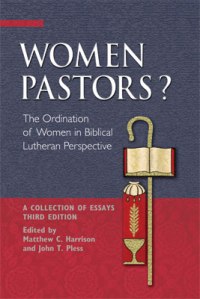 I continue my review of Women Pastors? edited by Matthew C. Harrison and John T. Pless here with a few brief comments on the introduction to Section II: Historical Studies. I thought it was worth commenting on due to the way it sets the table for the upcoming chapters.
Section II: Historical Studies Introduction
There are several claims made within this three paragraph introduction to the Historical Studies section. We will outline those claims, make a few comments, and then use this post to see whether these claims are supported and sustained by the arguments in the chapters that follow.
Claim 1: “The practice of ordaining women to the pastoral office is a novelty in the history of the church.” (107)
This claim is fairly straightforward, and the editors go on to clarify, noting that the first woman ordained in the United States was ordained in 1853. The implication seems to be that this was around the first time women were ordained into the pastoral office. This is a positive claim about a universal negative: to sustain the claim, the authors must demonstrate no women ever was ordained as a pastor in the history of the church before a time that could be called a “novelty.” We have already seen issues with this. One problem is the definition of the “pastoral office,” something the editors clearly struggled with. Some authors have simply not defined the pastoral office, assuming readers would fill in the gaps. Others have defined it in such a way that there is not a single example of anyone holding such an office anywhere in the New Testament. So the first step of a defense of this claim is to establish what the pastoral office is, and demonstrate it in the New Testament itself. The second step is to show the universal negative is true; something nearly impossible. Moreover, given that another author has granted some sects did ordain women (though they were, he claims, entirely Gnostic ones), one would have to demonstrate those were not examples of the early church whatsoever. Additionally, the examples in the New Testament of women leading (eg Phoebe, Prisca/Priscilla, Junia) have to be shown to clearly not be functioning as the pastoral office, however defined. Will these authors manage to show these to be true? If they do not, this claim is false.
Claim 2: “Fueled by theological movements that set the charismatic distribution of the Spirit in opposition to an established office, the emerging equalitarianism of the feminist movement, historical criticism’s distrust of the biblical text, and in some cases a pragmatism that saw the ordination of women as a way to alleviate the clergy shortage… many Protestant denominations took steps to ordain women.” (ibid)
The authors in the following section must show that these different influences are demonstrably what made churches ordain women rather than anything else, like a re-exploration of church history or the Bible’s teaching on women. We should see in-depth sociology happening here, done by authors with expertise in the history of ideas and social development of thought. They must outline the movement of theology from point A to point B by means of these various movements said to be the instrument thereby people ordained women. If not, this claim is falsified.
Claim 3: The women who are noted in the history of the church “were holy and learned but never pastors” (referencing an upcoming chapter’s claims).
I find this claim very important, but also very slippery. After all, we’ve already seen (links above) that the definition of “pastor” is unclear throughout this book. The authors must provide a very clear, textually sound definition of pastor. If not, how can they even claim that any one group of people were “never pastors”? So, again, we must see a clear definition of what a pastor is. Then, we should see the authors surveying many, many women throughout church history and showing how they do not meet that definition. The definition must not be tailored to make it beg the question against women pastors (eg. by saying “pastors are men who lead worship”). Instead, it must be a definition that can be used to show one person is a pastor, and another is not by virtue of the roles of the pastor. The author of whatever chapters involved in this should have expertise in church history.
Claim 4: “Ordination of women is a monumental turn in the history of the Church.” (107)
This claim is tied closely in with claims 1 and 3 and faces the same issues.
Claim 5: “[Ordination of women] puts those church bodies that practice it on dangerous ground, for it indicates that they are out of step not only with two thousand years of Christian history but with the will of the Lord of the Church.” (Ibid)
The first problem here is the editors already falsified this claim. 2000 years is a set period of time. Jesus died sometime around AD 33-35, though there are a few who move it a few years outside that range. Thus, 2000 years from AD 33 would be 2033. We have not yet reached that year, so people ordaining women are not outside of 2000 years of Christian history. The editors themselves note a woman ordained in 1853, which would be 1820 years of history, if it were the first ordination of any woman anywhere. One may object and say this is a petty complaint. But this section is the “historical studies” section. We should expect historical precision here, of all places. But “two thousand years” has better rhetorical value, so that’s what the editors used rather than an actual number corresponding to reality. The authors then have an impossible task: showing the history of the church is different from what it is. Moreover, they must demonstrate that the ordination of women goes specifically against the will of the Lord of the Church.
In the coming posts, we will see whether the authors sustain these lofty claims.
Links
Be sure to check out the page for this site on Facebook and Twitter for discussion of posts, links to other pages of interest, random talk about theology/philosophy/apologetics/movies and more!
Book Reviews– There are plenty more book reviews to read! Read like crazy! (Scroll down for more, and click at bottom for even more!)
Interpretations and Applications of 1 Corinthians 14:34-35– Those wondering about egalitarian interpretations of this passage can check out this post for brief looks at some of the major interpretations of the passage from an Egalitarian viewpoint.
SDG.
——
The preceding post is the property of J.W. Wartick (apart from quotations, which are the property of their respective owners, and works of art as credited; images are often freely available to the public and J.W. Wartick makes no claims of owning rights to the images unless he makes that explicit) and should not be reproduced in part or in whole without the expressed consent of the author. All content on this site is the property of J.W. Wartick and is made available for individual and personal usage. If you cite from these documents, whether for personal or professional purposes, please give appropriate citation with both the name of the author (J.W. Wartick) and a link to the original URL. If you’d like to repost a post, you may do so, provided you show less than half of the original post on your own site and link to the original post for the rest. You must also appropriately cite the post as noted above. This blog is protected by Creative Commons licensing. By viewing any part of this site, you are agreeing to this usage policy.
“1 Corinthians 14:33B-38, 1 Timothy 2:11-14, and the Ordination of Women” by Peter Kriewaldt and Geelong North, Part 1, in “Women Pastors?” edited by Matthew C. Harrison and John T. Pless
I grew up as a member of the Lutheran Church-Missouri Synod, a church body which rejects the ordination of women to the role of pastor. The publishing branch of that denomination, Concordia Publishing House, put out a book entitled Women Pastors? The Ordination of Women in Biblical Lutheran Perspective edited by Matthew C. Harrison (who is the current President of the LCMS) and John T. Pless. I have decided to take the book on, chapter-by-chapter, for two reasons. 1) I am frequently asked why I support women pastors by friends, family, and people online who do not share my position, and I hope to show that the best arguments my former denomination can bring forward against women pastors fail. 2) I believe the position of the LCMS and other groups like it is deeply mistaken on this, and so it warrants interaction to show that they are wrong. I will, as I said, be tackling this book chapter-by-chapter, sometimes dividing chapters into multiple posts. Finally, I should note I am reviewing the first edition published in 2008. I have been informed that at least some changes were made shortly thereafter, including in particular the section on the Trinity which is, in the edition I own, disturbingly mistaken. I will continue with the edition I have at hand because, frankly, I don’t have a lot of money to use to get another edition. Yes, I’m aware the picture I used is for the third edition.
“1 Corinthians 14:33B-38, 1 Timothy 2:11-14, and the Ordination of Women” by Peter Kriewaldt and Geelong North
Peter Kriewaldt and Geelong North seek to demonstrate that the titular verses show women may not be pastors. While Jesus “elevated the status of women,” they say, it is nevertheless the case that “Jesus entrusted the oversight of the Church to men only…” (45).
The first thing that strikes me in this chapter are the verses selected. Why begin at 14:33B and extend only to 38? Why do the authors cut verse 15 of 1 Timothy 2 out of its immediate context with the verses preceding it? Of course, the authors must limit the scope at some point. That’s not a question. But when there is a question of whether verse 33 is a continuous clause and when verse 15 is highly relevant to the interpretation of the rest of the passage, one must wonder why those verses were excised in this exegetical chapter. Readers can’t know. But especially with 1 Timothy 2:15, it is quite clear that it is a continuation of the previous thoughts and should not be cut off. From the outset, Kriewaldt and North miss out on key aspects of interpreting these texts.
1 Corinthians 14:33B-38
Kriewaldt and North acknowledge that we know “that Corinth had a number of cults that included priestesses…” (45). Thus, they argue, Paul’s silencing of women “runs counter to the pagan culture in Corinth. He is not culturally conditioned” (ibid).
Surprisingly, Kriewaldt and North feel confident enough to say “The integrity of this passage is certain. There is no manuscript evidence for the omission of these verses from chapter 14, though some manuscripts place them after v. 40” (46). In this, the authors are simply mistaken. Not only are they wrong to say that the textual integrity is “certain,” but also to say that there is no manuscript evidence for their omission. Certainty, as the word is typically understood, implies the kind of 100% clear textual integrity that rarely exists. But 1 Corinthians 14:34-35 does not have that integrity. Not only do the verses exist in different places (after 1 Corinthians 14:40) in some manuscripts–thus demonstrating that the passage does not have a “certain” place in the text–but as Philip B. Payne and others have demonstrated, there are some serious questions about the textual transmission of this text. As he notes, the fact of the movement of the passage itself is rather alarming for those who wish to claim textual certainty: “Similarly, it is highly unlikely that if the text were originally in Paul’s letter after v. 40, that any later scribe would move that text to follow v. 33. We know it is highly unlikely since no scribe of any surviving manuscript (and there are thousands) of any of Paul’s letters ever did anything like this in any other passage of Paul’s letters.” But apart from the movement in the text, there is the issue of textual markings that indicate textual variants “Codex Vaticanus’s evidence that 1 Cor 14:34-35 is an interpolation is especially important for several reasons. Its distigme (mark of a textual variant) at the end of v. 33 with no corresponding distigme at the end of v. 40 is evidence of a textual variant that was not the Western displacement was written prior to Codex Vaticanus.” So how is it that Kriewaldt and North may claim that the passage is “certain” in its integrity? How may they say that there is “no manuscript evidence for the omission of these verses…”? Simply put, it must be due either to misleading the reader or ignorance of the fact that just such evidence does exist. And if these passages are an interpolation, there is no need to even continue to engage them. Those unconvinced by the textual evidence–which is, again, quite strong–will see below that even when we do take the passage as original to the letter, there is little reason to think it means women may not be pastors.
Kriewaldt and North claim that “Paul says that his commands are followed in all the churches” (46). Though it is true that the passage begins “As in all the congregations of the saints,” but this is not the same as saying his commands are followed in all churches. The language itself seems more passive than that, and some English translations do not have this clause as the beginning of a sentence but rather as the conclusion of 14:33 and the clause preceding it (see examples here). However, the authors of this essay do not make an argument for preferring to cut the verse in half where they do, even though it is clearly germane to their interpretation as follows.
One of the places Kriewaldt and North attempt to drive a point of division between women and authority in the text is by challenging what it means to prophesy. “Prophecy is not preaching; it is speech directly inspired by God… Although instruction and learning are connected with prophecy, it is not an institution that is constantly ready for action…. It is quite different from preaching and official teaching of the apostolic word. Prophecy, then, is open also for women. Scripture refers to a number of women prophets…” (46). It has already been noted, however, that this concession makes it very clear women hold positions of authority higher than those of male teachers (see the argument here, for example). It is interesting, though, that on Kreiwald and North’s own discussion, they admit that women may give “speech directly inspired by God.” What is odd, then, is that they then seem to think that prophecy is less authoritative than the act of teaching or preaching. As if somehow having direct revelation from God (as noted p. 46) is less authoritative than simply expounding upon that same revelation! This seems backwards. If God chooses to use women to directly reveal God’s own word, is it not a strange position that would then say “Ah, but God would not actually let women teach about that word they delivered”? Yet that is what readers are expected to believe, and indeed to affirm as if it were just obvious from the text, for Kreiwaldt and North immediately go on to say that women are to “be silent” when it comes to “prophecy… being weighted and evaluated” (47).
The meaning of lalein is much discussed on the literature related to this passage, and Kriewaldt and North argue that it means “speak” but specifically “authoritative teaching,” for they insist that it is a “a synonym for authoritative teaching” (47). Indeed, they go so far as to say that lalein “certainly doesn’t mean chattering or strident speaking,” despite the fact that some studies have shown exactly that, and (as noted in the previous link), ancient evidence in a dictionary and elsewhere suggests that is exactly what it means.[1] Such studies would greatly undermine the interpretation the authors give here, but as we have seen throughout the book so far, serious studies by those who disagree are largely ignored or dismissed.
Kriewaldt and North give four reasons that “women are to be silent and are not to speak” (47). First, they claim it is “the ecumenical practice of all the churches” (ibid). As we’ve mentioned, this begs the question regarding where they put the clause about the commands from Paul. The authors don’t actually establish that it was this ecumenical practice; nor do they address serious NT counter-examples (eg. Phoebe, Junia), nor do they do anything to demonstrate that 1 Corinthians 14:34-35 is actually next to the clause about “all the congregations of the saints” despite their own admission that some manuscripts place it after verse 40! Each of these would be highly relevant to their claim here, but none of these points is addressed beyond the mere dismissal of opposing viewpoints. Second, they claim that the submission of women is due to the “Law” (capital “L,” of course, though no argument is made). This Law, they claim “probably has to do with the whole Pentateuch.” Yet as many interpreters have noted (see discussion of this part of the passage here), there is serious difficulty discerning exactly where this is supposed to be found in the Law. Some have suggested it is actually related to the culture surrounding Corinth, rabbinic teaching, or other extrabiblical sources. Our authors, however, say it is related to Genesis 2:18-25 (ibid). But nothing in Genesis 2 says anything specifically about woman submitting to man. There is nothing there. So how can it be that this is what Paul is referring to? It seems like the reason to suggest this is because it best fits Kreiwaldt and North’s preconceptions of what the text ought to say and refer to, rather than any relevant evidence from the texts themselves. They do go on to say that it is due to “order of creation” (47-48), which is certainly a weak argument. Too often, as here, a bare appeal is made to “order of creation” without any reference for what that is supposed to mean. Indeed, it seems the reader is just supposed to assume that that order of creation is submission of women, but that begs the question. Moreover, if we are serious about the mere order of creation–that is, what comes first in creation–as a grounding for submission, then men everywhere ought to be submitting to all other animals, the heavenly bodies, dirt, the seas, etc.–for according to the order of creation, all of these things were created first. Of course, I don’t actually believe that; but the point is it is incredibly easy to make the malleable term “order of creation” mean whatever one wishes, and much more difficult to ground it in the texts.
The third reason given, after a brief aside in which the authors dismiss “mutual submission” in Ephesians 5, is that “It is disgraceful” for women to speak (49). They argue that the shame is “theological rather than… social” (ibid) such that it is “shameful to God for a woman to assume a teaching role in the church…” (49). But again, given that women are already allowed to present direct revelation from God, it is hard to see why a much less authoritative form of speech would somehow be shameful. The authors once again ignore this intriguing dilemma. They then address briefly 1 Cor. 14:36, which seems a bit of a strange question given Kriewaldt and North’s view. Indeed, it seems more likely that Paul is here showing that he is answering a false teaching that originated in Corinth as he does elsewhere, but the authors of this essay take it to mean that the church must submit to Christ’s word, which is of course what they already told us it is.
The fourth and final reason for women to be silent is “because anyone filled with the Spirit would have to admit that what Paul is saying is really a command of the Lord!” (49). This is a blatant kind of poisoning the well. What Kriewaldt and North say here, seriously, is that anyone who disagrees with their interpretation is not filled with the Spirit! After all, if they were, then they would just accept this interpretation of the text and force women into silence. This kind of questioning the salvation of those with whom one disagrees is unbecoming and nothing more than an attack on fellow believers with whom the authors disagree. It is unfit for a scholarly work.
Thus far, we have seen that Kriewaldt and North essentially assume their position is correct and then turn to question the salvation of those with whom they disagree on whether women ought to be silenced. They fail to deal with the serious textual critical issues related to the placement of the passage at question; they appeal baldly to “order of creation” as if that term is a settled issue, and they fail to account for the cultural context of the Corinthian church.
[1] ‘Phrynichus, the ancient dictionarian, defined the term as “to talk nonsense.” The word is used of gossip, prattling, babbling, animal sounds, and musical instruments. During the classical period, it usually was employed in a contemptuous sense. Debrunner, writing in the Kittel-Friedrich Theological Dictionary of the New Testament, states “Lalein can also be used quite objectively of speech when there is reference to sound rather than meaning.”‘ See “Pandemonium and Silence at Corinth” by Catherine Clark Kroeger.
Links
Be sure to check out the page for this site on Facebook and Twitter for discussion of posts, links to other pages of interest, random talk about theology/philosophy/apologetics/movies and more!
Book Reviews– There are plenty more book reviews to read! Read like crazy! (Scroll down for more, and click at bottom for even more!)
Interpretations and Applications of 1 Corinthians 14:34-35– Those wondering about egalitarian interpretations of this same passage can check out this post for brief looks at some of the major interpretations of the passage from an Egalitarian viewpoint.
SDG.
——
The preceding post is the property of J.W. Wartick (apart from quotations, which are the property of their respective owners, and works of art as credited; images are often freely available to the public and J.W. Wartick makes no claims of owning rights to the images unless he makes that explicit) and should not be reproduced in part or in whole without the expressed consent of the author. All content on this site is the property of J.W. Wartick and is made available for individual and personal usage. If you cite from these documents, whether for personal or professional purposes, please give appropriate citation with both the name of the author (J.W. Wartick) and a link to the original URL. If you’d like to repost a post, you may do so, provided you show less than half of the original post on your own site and link to the original post for the rest. You must also appropriately cite the post as noted above. This blog is protected by Creative Commons licensing. By viewing any part of this site, you are agreeing to this usage policy.
“Didaskolos” by Bertil Gärtner, Part 1, in “Women Pastors?”edited by Matthew C. Harrison and John T. Pless
I grew up as a member of the Lutheran Church-Missouri Synod, a church body which rejects the ordination of women to the role of pastor. The publishing branch of that denomination, Concordia Publishing House, put out a book entitled Women Pastors? The Ordination of Women in Biblical Lutheran Perspective edited by Matthew C. Harrison (who is the current President of the LCMS) and John T. Pless. I have decided to take the book on, chapter-by-chapter, for two reasons. 1) I am frequently asked why I support women pastors by friends, family, and people online who do not share my position, and I hope to show that the best arguments my former denomination can bring forward against women pastors fail. 2) I believe the position of the LCMS and other groups like it is deeply mistaken on this, and so it warrants interaction to show that they are wrong. I will, as I said, be tackling this book chapter-by-chapter, sometimes dividing chapters into multiple posts. Finally, I should note I am reviewing the first edition published in 2008. I have been informed that at least some changes were made shortly thereafter, including in particular the section on the Trinity which is, in the edition I own, disturbingly mistaken. I will continue with the edition I have at hand because, frankly, I don’t have a lot of money to use to get another edition. Yes, I’m aware the picture I used is for the third edition.
Didaskolos: The Office, Man and Woman in the New Testament
Gärtner’s chapter begins by asking and answering a question “Does the New Testament contain any direct teaching about the relationship between man and woman in the office of the ministry? The answer to this question is an unequivocal yes” (27). Such a statement suggests that he will demonstrate that there is a verse, somewhere, that specifically teaches about the relationship between man and woman in the office of the ministry. After all, his claim is that one can unequivocally say that yes, the New Testament does contain such direct teaching. As we explore this chapter, we will return to this question a few times and ask whether Gärtner’s claim is correct.
Gärtner states that the ministry must be set into a larger New Testament context. Addressing 1 Corinthians 14:34 and 1 Timothy 2:12, intriguingly again pointed to as the apparent proof against women pastors, he states that a view that teaches that those verses are “intended to correct some irregularities” at the time of the writings of the letters “does not correspond with the material Paul presents” (27). To prove this, he notes that in 1 Corinthians, Paul “deals with a number of questions which have been put to him by the congregation” (ibid). He uses the example of eating meat sacrificed to idols and says that Paul “places the question in the larger context” because it “is considered in relation to the doctrine of God as the only God…” (27-28).
Expanding on the context, Gärtner appeals to the choosing of the apostles, Jesus’ conception of marriage and creation, the Christian as new creation, and heresy in Corinth in order to make his argument that women are excluded from the ministry. We’ll briefly sketch out his argument. Jesus’ apostles, Gärtner argues, are all men (29). He notes that these apostles are “leaders of the new people of God,” something important we will consider below. He also states that “although the most esteemed women… who were part of the closest circle of disciples, were present in Jerusalem during the Passover festival, it was only the apostles themselves who were invited to be present at the Last Supper… By immemorial custom both women and children shared in this dinner fellowship. Yet, this is the time that Jesus breaks that tradition and gathers only the twelve around Him” (ibid). Regarding Jesus’ concept of marriage and creation, Gärtner walks through Matthew 19:3ff in which Jesus discusses marriage (30-31). The Christian as new creation Gärtner states, after pointing to texts talking about the Christian as new creation, that “in the life of the church, the true relationship between male and female can take place” (31). Regarding Heresy in Corinth, Gärtner paints an image of the Corinthians as seeing themselves getting direct revelation from God and having everything spiritualized such that people could set above “the fundamental command of fellowship and love to the neighbor.” Then, he states that Paul teaches that “salvation rests upon creation” and that the “office” (he doesn’t, on p. 33, specify which one or the definition thereof) “is related to the order of creation; and according to the order of creation, the human race is divided into man and woman” (32-34).
There are already a number of interesting issues to explore in Gärtner’s essay. First, the question of what “office” he is referencing throughout is quite relevant. Though it is possible to divert conversation in important issues by constantly punting to definitions, the notion of “office” is a central aspect of Gärtner’s argument so far, yet it remains undefined. We do not find him providing his own definition of ordination, as Hamann did, and so are left to simply guess exactly what he means by the word throughout the essay. As Hamann found in trying to define ordination and the ministry, it is extremely difficult to find the modern idea of what a pastor is in the New Testament (Hamann ultimately admitted his own definition could not be found therein). But because Gärtner is so focused on showing that women may not hold the “office,” one must ask what that office itself is. One would not find the answer in Gärtner’s essay. The closest he comes is by stating it is the “office of the ministry” (27). Second, Gärtner’s admission that the apostles are leaders of the new people of God is particularly on point because one of the arguments against using Junia (Romans 16:7) as an example of a woman leading is that apostles are merely ones sent by God (turning the Greek literal than using it as it is throughout the NT, as an office. Gärtner here concedes this point, and so the fact that Junia was a woman apostle overthrows his entire position.
Third, Gärtner’s argument about only the Twelve being at the Last Supper is not part of the biblical text. Indeed, he even says that women were not invited to it, specifically (31). Yet in the accounts of the Last Supper, there is no such clear exclusion. Gärtner’s point relies upon an argument from silence, excluding those who were not explicitly mentioned. Yet if we used the exact same kind of argumentation, all kinds of contradictions in the NT occur. For example, Mark 16:5 mentions only one young man (angel) at the tomb of Jesus. Gärtner’s methodology would insist that this would entail there was only one angel. Yet Luke 24:4 and John 20:12 each state there were two. But if we use the lack of explicit mention to exclude those not mentioned, as Gärtner does in relation to the Last Supper, we have a direct contradiction in the Bible. Of course that is a poor argument for a contradiction, because having two angels means that at least one was present. The silence regarding the second angel does not exclude his presence in the tomb. Similarly, just because no women or children or other followers of Jesus are explicitly mentioned in the accounts of the Last Supper (though Matthew and Mark both use the generic term “disciples” and then mention specifically the Twelve as for sure being there, thus making it rather clearly open to others being there as “disciples” who had helped prepare for the Passover), one cannot exclude them any more than one could seriously charge Mark and Luke with a contradiction. Another way to think about it is this way: All of the Twelve were Jewish. Does this mean that pastors must be Jewish? After all, it is quite clear that no Gentiles were among the Twelve. So Jesus only invited Jews to dine with him at the Last Supper, suggesting that no Gentiles may be pastors, right? No. Gärtner wouldn’t agree, I’m sure, but then his point about the Twelve being men must also be conceded as incidental.
Fourth, Gärtner’s point about the new creation is to merely assert his point: that male and female are most exactly expressed in the church. But of course verses like Galatians 3:28, also Pauline, point to the reality that such distinctions as male and female in the body of Christ are not germane. Yet even if one disagrees with me on that point, Gärtner does nothing to make this aspect of his argument anything more than an assertion. Fifth, Gärtner does little to demonstrate that the heresy in Corinth is that which he asserts, and even less to show that even if he is correct that it all goes back to an kind of charismatic overthrow of the order of creation, that that has anything to do with women pastors. He simply assumes his readers will make a connection for him. But there doesn’t seem to be any relevant connection between his notion of the alleged heretical teaching at Corinth and that of women pastors. He doesn’t even argue for it. Sixth, allowing for the heresy in Corinth to be part of the interpretation actually works against him, because, as has been argued, it certainly seems possible that 1 Corinthians 14:34-35 is part of that heresy that Paul then argues against.
Thus far, context has done little for Gärtner.
Links
Be sure to check out the page for this site on Facebook and Twitter for discussion of posts, links to other pages of interest, random talk about theology/philosophy/apologetics/movies and more!
Book Reviews– There are plenty more book reviews to read! Read like crazy! (Scroll down for more, and click at bottom for even more!)
SDG.
——
The preceding post is the property of J.W. Wartick (apart from quotations, which are the property of their respective owners, and works of art as credited; images are often freely available to the public and J.W. Wartick makes no claims of owning rights to the images unless he makes that explicit) and should not be reproduced in part or in whole without the expressed consent of the author. All content on this site is the property of J.W. Wartick and is made available for individual and personal usage. If you cite from these documents, whether for personal or professional purposes, please give appropriate citation with both the name of the author (J.W. Wartick) and a link to the original URL. If you’d like to repost a post, you may do so, provided you show less than half of the original post on your own site and link to the original post for the rest. You must also appropriately cite the post as noted above. This blog is protected by Creative Commons licensing. By viewing any part of this site, you are agreeing to this usage policy.

 J.W. Wartick - Reconstructing Faith