Lutheranism
Perspicuity of Scripture in the Lutheran Reformers: Reformation 500
 2017 marks the 500th anniversary of what is hailed by many as the start of the Reformation: Luther’s sharing his 95 Theses. I’ve decided to celebrate my Lutheran Protestant Tradition by highlighting some of the major issues that Luther and the Lutherans raised through the Reformation period. I hope you will join me as we remember the great theological (re)discoveries that were made during this period.
Perspicuity of Scripture in the Lutheran Reformers
Luther himself wrote on perspicuity in no uncertain terms:
[T]hat in Scripture there are some things abstruse, and everything is not plain–this is an idea put about by the ungodly Sophists… I admit… that there are many texts in the Scriptures that are obscure and abstruse, not because of the majesty of their subject matter, but because of our ignorance of their vocabulary and grammar; but these texts in no way hinder a knowledge of al the subject matter of Scripture. (Luther, The Bondage of the Will, 110, cited below)
So far as I know, Luther did not change his stance on the perspicuity of Scripture. As the Reformation continued, however, it became clear that such a stance might not be appropriate regarding the entirety of every declaration of Scripture. Lutheran reformers qualified perspicuity, noting that it applied only to that which pertains to salvation.[1] Heinrich Schmid, in his Doctrinal Theology of the Evangelical Lutheran Church (translated 1875) compiles quotations from the major early Lutheran reformers to outline what Lutherans taught. Regarding perspicuity, Schmid notes:
If the Sacred Scriptures contain everything necessary to salvation, and if they alone contain it, they must necessarily exhibit it so clearly and plainly that it is accessible to the comprehension of every one; hence the attribute of Perspicuity is ascribed to the Sacred Scriptures… But whilst such perspicuity is ascribed to the Sacred Scriptures, it is not meant that every particular that is contianed in them is equally clear and plain to all, but only that all that is necessary to be known in order to salvation is clearly and plainly taught in them… it is also not maintained that the Sacred Scriptures can be understood without the possession of certain prerequisites [such as the language, maturity of judgment, unprejudiced mind, etc.].(Schmid, 87-88, emphasis his)
Schmid’s summary of Lutheran doctrine in the Reformation period sounds different from what Luther taught in The Bondage of the Will, but he shows from direct citations that this is the direction Lutherans moved in regarding perspicuity. To whit, Gerhard:
It is to be observed that when we call the Scriptures perspicuous, we do not mean that every particular expression, anywhere contained in Scripture, is so constituted that at the first glance it must be plainly and fully understood by every one. On the other hand, we confess that certain things are obscurely expressed in Scripture and difficult to be understood… (quoted in Schmid, 89)
Quenstedt:
We do not maintain that all Scripture, in every particular, is clear and perspicuous. For we grant that certain things are met with in the sacred books that are very obscure… not only in respect to the sublimity of their subject-matter, but also as to the utterance of the Holy Spirit… (ibid, 90, Quenstedt goes on to deny that there are doctrines that are so obscure that they “can nowhere be found clearly and explicitly”)
Hollaz:
The perspicuity of Scripture is not absolute, but dependent upon the use of means, inasmuch as, in endeavoring to understand it, the divinely instituted method must be accurately observed… (ibid, 91)
The whole section clarifies and explains the earliest Lutheran teaching regarding perspicuity of Scriptures, and it is clear that it is acknowledged that not every single text is plain, that the guidance of the Holy Spirit, among other things, is required to understand Scripture rightly, and that plain passage of Scripture are to be used to interpret those which seem obscure.
As I’ve argued elsewhere, this shift in perspective on perspicuity happened due to the very real differences on some major doctrines within the Protestant movement itself. If every single statement the Scriptures made about doctrine were so clear, how could such divisions exist within a movement that was upholding sola scriptura? The answer was that perspicuity applied to that which is essential for salvation, and that shift in perspective can be observed in the writings of the Lutherans listed here.
What applications might this have? The first is that the many attempts by Christians to argue for their own doctrinal perspectives simply by appealing to the perspicuity of Scriptures fails. To argue that someone else denies perspicuity of Scripture because they disagree on certain doctrinal positions is an abuse of the doctrine of perspicuity of Scriptures. It also shows an incapacity to show one’s own point clearly from the Scriptures themselves. A second application is that it acknowledges some of the difficulty in understanding Scripture rightly.
The doctrine of perspicuity is a major aspect of Reformation theology. It should not, however, be over-generalized and abused in the way that it has, unfortunately, often been used.
[1] In researching this post, I noticed that the Wikipedia page on the clarity of Scripture has been edited to suggest without qualification that all Lutherans hold to the notion that “Lutherans hold that the Bible presents all doctrines and commands of the Christian faith clearly. God’s Word is freely accessible to every reader or hearer of ordinary intelligence, without requiring any special education.” The citations provided to show that all Lutherans hold to this teaching are not to any of the early Lutheran reformers, nor are they citations of the Book of Concord; rather, they are references to two sources published by a publishing house of one form of American Lutherans. These sources are from 1934 and 1910, respectively, and not in the Reformation period nor do they, so far as I can tell, speak for all Lutherans. Given the evidence cited above from Quenstedt, Gerhard, and the like, I find it hard to believe such a claim could be substantiated.
Sources
Martin Luther, The Bondage of the Will in Luther and Erasmus: Free Will and Salvation edited by Rupp and Watson (Philadelphia, PA: Westminster Press, 1969).
Heinrich Schmid, The Doctrinal Theology of the Evangelical Lutheran Church.
Links
Be sure to check out the page for this site on Facebook and Twitter for discussion of posts, links to other pages of interest, random talk about theology/philosophy/apologetics/movies and more!
Please check out my other posts on the Reformation:
I discuss the origins of the European Reformations and how many of its debates carry on into our own day.
The notion of “sola scriptura” is of central importance to understanding the Reformation, but it is also hotly debated to day and can be traced to many theological controversies of our time. Who interprets Scripture?
The Church Universal: Reformation Review– What makes a church part of the Church Universal? What makes a church part of the true church? I write on these topics (and more!) and their origins in the Reformation.
The Continuing Influence of the Reformation: Our lives, our thoughts, our theology– I note the influence that the Reformation period continues to have on many aspects of our lives.
SDG.
——
The preceding post is the property of J.W. Wartick (apart from citations, which are the property of their respective owners, and works of art as credited) and should not be reproduced in part or in whole without the expressed consent of the author. All content on this site is the property of J.W. Wartick and is made available for individual and personal usage. If you cite from these documents, whether for personal or professional purposes, please give appropriate citation with both the name of the author (J.W. Wartick) and a link to the original URL. If you’d like to repost a post, you may do so, provided you show less than half of the original post on your own site and link to the original post for the rest. You must also appropriately cite the post as noted above. This blog is protected by Creative Commons licensing. By viewing any part of this site, you are agreeing to this usage policy.
Bonhoeffer As Reliable Guide?
 I seem to have made it something of a pastime explaining to others things about Lutheran belief, and often this pertains to discussions of Bonhoeffer. Almost everyone is trying to make Bonhoeffer in their own image. Whether it is the notion of calling Bonhoeffer an evangelical, or recruiting him to various other schools of thought, Bonhoeffer is enduring a kind of celebrity right now. That celebrity comes with its share of difficulties, including pushback. Some evangelicals have labeled Bonhoeffer dangerous. A recent article by William Macleod questions whether Dietrich Bonhoeffer may be a “reliable guide” when it comes to Christianity: Bonhoeffer – A Reliable Guide? That blog post levels a number of criticisms at the Lutheran theologian, and I would like to respond to this article, which I think misrepresents Bonhoeffer in many ways. I’ll not respond to every point, because Macleod overlaps points I’ve responded to before.
Methodological Notes
At the outset, I must point out a major problem with the article is that there is a distinct lack of citation throughout. Indeed, the only footnote is a reference to an article about Bonhoeffer, not a reference to Bonhoeffer’s works at all. Moreover, though many assertions are made about what Bonhoeffer wrote–as well as a few quotations–no references are provided, which makes it at many points impossible to easily track down the reference and so provide a full response. It is disturbing to me to see such lack of citation in an article that purports to correct evangelical thought on this theologian. How are we to evaluate an article that makes it difficult to even double-check the facts?
Second, Macleod does not define evangelical in this article, or provide a clear reference to what he means. Because there is great difficulty with the definition of “evangelical” in its modern and historical usage. Indeed, Bonhoeffer’s German Lutheran church historically simply referred to itself as evangelical–a tradition carried on to this day in my church body, the Evangelical Lutheran Church in America. The problem is that the term “evangelical” often means different things to different people, a problem acknowledged in many circles. The article would have been helped had Macleod provided exactly his meaning of evangelical to compare his statements to.
Bonhoeffer as Liberal Theologian?
Macleod alleges, “Far from being an evangelical, Bonhoeffer was more liberal than Barth. He considered himself a ‘modern theologian who still carries the heritage of liberal theology within himself’.” Here we already see a difficulty with the methodology–where is this quote from Bonhoeffer to be found? A search online turned up other blog posts that give this same quote, but this one, for example, writes a citation [5] in brackets but then there is no referent for [5]. I finally managed to possibly track down a reference on a different article, but don’t have the book in front of me at this point so I can’t confirm it. However, even granting he said that, I’d love to see the context. After all, he could have been saying it in the sense of saying that he has been influenced by liberal theology, which was certainly found all around him in Germany. But of course Bonhoeffer himself, at the end of his life, explicitly argued against liberal theology at multiple points.
Bultmann seems to have somehow found Barth’s limitations, but he misconstrues them in the sense of liberal theology, and so goes off into the typical liberal process of reduction – the ‘mythological’ elements of Christianity are dropped… My view is that the full content, including the ‘mythological’ concepts, must be kept… this mythology (resurrection etc.) is the thing itself… (Bonhoeffer, Letters and Papers from Prison, 328-329)
Those are Bonhoeffer’s words, written in 1944 from prison. Does that look like an acceptance of liberal theology? Bonhoeffer does engage liberal theologians, of that there is no doubt, but he explicitly notes the deficiencies of their theology and argues the opposite position. Macleod’s attempt to poison the well here fails.
Bonhoeffer as Martyr
Macleod, amusingly, questions whether Bonhoeffer was a martyr:
When we think of Christian martyrs we think of the early Christians thrown to the lions for refusing to worship Caesar. We think of Reformers like Patrick Hamilton and William Tyndale burnt at the stake for preaching the gospel and for translating the Scriptures into the language of the people. In no sense were these men involved in conspiracies against the state. Bonhoeffer died for being involved in a plot to assassinate Hitler… his death was not because of his beliefs, but rather for his ‘crime’ of conspiracy to murder.
I actually found myself chuckling here. I don’t know Macleod, and I know nothing about him. What I do know, and have seen many times, is a lack of understanding of church history among those broadly identifying themselves as evangelicals (I’m not the only one who bemoans this, on a different end of the spectrum than me stands James White, who I’ve heard on his podcast multiple times speak of the lack of knowledge of church history in evangelical circles). I preface that remark because Macleod’s comment about martyrs shows a bit of ignorance. If he wants to say Bonhoeffer’s not a martyr because he died for political reasons, perhaps he should go back and see that the worship of Caesar for which Christians were killed was, itself, a political killing. Virtually every book I’ve ever read on this early period of Christianity confirms this. For just one reference, check out the interplay between pagan and Christian apologists found in Apologetics in the Roman Empire.
Moreover, Macleod’s comment is amusing because the separation of belief from action is a very modernist/postmodernist separation, and one that could just as easily be used to say “the early Christian martyrs weren’t killed for their beliefs, they were killed for refusing to worship Caesar, a political act.” But of course that refusal is based on belief, just as Bonhoeffer’s ethical stance regarding Hitler was based on belief. Belief put into practice remains belief. The attempt to tarnish Bonhoeffer’s legacy as, yes, Christian martyr here bespeaks both lack of historical awareness and the overall tone of the article.
The Cross
Macleod accuses Bonhoeffer of decentralizing the cross because, according to Macleod, he did not believe in substitutionary atonement. More damningly, Macleod charges Bonhoeffer with seeing the cross as “an example and an inspiration.” I was astonished to read this from Macleod. Aside from the fact that Bonhoeffer wrote an entire book about Jesus Christ being the center not just of our faith but as the center of human history (Christ the Center, 59ff), he also repeatedly emphasized this in his other writings. Macleod stated, “For evangelicals the cross is at the centre of their faith.” I’m not at all sure why he thinks he should disagree with Bonhoeffer here, unless he just hasn’t read Bonhoeffer’s body of work.
Conversion
I’ve responded to this elsewhere, but Macleod’s words about conversion regarding Bonhoeffer are deeply troubling to me:
As a Lutheran he embraced the doctrine of baptismal regeneration – you are automatically born again when you are baptised. Around 1931 Bonhoeffer experienced a ‘conversion’, when he, as he puts it, discovered the Bible… Yet it was not what evangelicals normally call conversion, or what the Scriptures describe as the new birth. He rarely referred to it… He wrote, ‘We must finally break away from the idea that the gospel deals with the salvation of an individual’s soul’.
A number of things are problematic here. First, Macleod blatantly misrepresented the Lutheran view of baptismal regeneration by couching it in terms borrowed from Baptist theology. Baptismal regeneration is not about “automatically” being born again; it is about the gift of God that has been promised through baptism, even to infants. I’m not going to debate this rather obvious point here, but the fact that Macleod effectively dismisses Bonhoeffer simply because he’s Lutheran says something disturbing about his view of what it takes to be evangelical–apparently a view that excludes Lutherans entirely.
Moreover, Macleod once again conforms to modern American evangelicalism (not even sure if he’s from the United States, but the ideas he has are) by emphasizing the individual over the community. Any number of theologians have shown time and again that the evangelical focus on individual salvation is something born, historically, from a rather American emphasis on the individual rather than being something directly derived from Scripture. Not saying that individual salvation is not there, but as the primary theme? N.T. Wright, among others, has done some correction in this regard, and Bonhoeffer himself did in works like Life Together.
Universalist Bonhoeffer?
Macleod writes:
Bonhoeffer was a universalist, believing in the eventual salvation of all. He wrote that there is no part of the world, no matter how godless, which is not accepted by God and reconciled with God in Jesus Christ. Whoever looks on the body of Jesus Christ in faith can no longer speak of the world as if it were lost, as if it were separated from Christ. Every individual will eventually be saved in Christ.
There’s no citation here, or even a quote, so it is very hard to track down what he is referencing in Bonhoeffer’s writings. Of course, what he’s written here is not universalism, but rather a denial of limited atonement and, actually, the Lutheran view of incarnation. Luther himself emphasized that Christ is present in all of creation. With the incarnation, God is present with us. Macleod, again, doesn’t give a reference to track down, but based on the rest of the article I think he is just misunderstanding Bonhoeffer again. The Lutheran perspective denies limited atonement, and whether that is correct are not is hardly a specific accusation against Bonhoeffer. Of course, without a citation, all we can do is trust Macleod not to have misrepresented Bonhoeffer–something that, at this point, I’m unwilling to do. I haven’t read everything Bonhoeffer wrote, though I’ve read about 75% of his collected works at this point, and some of his books twice, and I don’t know of any reference that could be shown to be universalism explicitly rather than a denial of limited atonement. I await a citation.
Sabbath
Macleod again reveals how much he is reliant upon his presuppositions when he writes:
The Sabbath was given to man at creation. The command to keep the one day in seven holy was reiterated on Mount Sinai and written with the finger of God on tables of stone. Jesus kept the Sabbath and said that the Son of man is Lord of the Sabbath. Bonhoeffer, however, is quite happy to play table tennis on Sunday or to attend the theatre.
So, again, we have Bonhoeffer critiqued for being Lutheran. This is a pretty clear example of Macleod showing his stripes. It’s not so much Bonhoeffer that’s the problem; it is anyone who isn’t some kind of Reformed Baptist that’s the problem. Bonhoeffer was just a convenient target because people know who he is. Besides all that, Macleod’s words show very clearly that according to him, humans were made for Sabbath, not the other way around. But of course that makes gospel into law–and the proper distinction of law and Gospel is one of the central teachings of Lutheranism. But again, this is a debate for a different place. It’s fair enough to point out that Macleod’s argument here relies on a very specific presupposition, one that certainly not all evangelicals share, let alone Lutherans.
Conclusion
I have already written about twice as much as I meant to, and more could be said. It is clear that Macleod’s article is little more than a hit piece. There are no explicit citations to Bonhoeffer’s works (even when he is directly quoted, allegedly!), Macleod constantly condemns Bonhoeffer for clearly Lutheran views, and the whole article is based upon Macleod’s theological convictions, many of which I doubt he could demonstrate all evangelicals share. The pot shot at Bonhoeffer alleging he’s not a martyr shows the overall attitude Macleod has towards those he disagrees with, but it also–like many other points in the post–demonstrates a lack of historical awareness that pervades much of the church. Perhaps we can use his article in one positive way: rather than as a warning against Bonhoeffer–a faith-filled, Lutheran, courageous–yes–martyr–we can see it as a warning of the dangers of not taking history seriously.
Links
Be sure to check out the page for this site on Facebook and Twitter for discussion of posts, links to other pages of interest, random talk about theology/philosophy/apologetics/movies and more!
Bonhoeffer’s Troubling Theology?- A response to an article on Dietrich Bonhoeffer’s theological perspectives– I respond to a different article on Dietrich Bonhoeffer. We again see numerous misrepresentations and misunderstandings of Bonhoeffer and Lutheranism.
Eclectic Theist– Check out my other blog for my writings on science fiction, history, fantasy movies, and more!
SDG.
——
The preceding post is the property of J.W. Wartick (apart from quotations, which are the property of their respective owners, and works of art as credited; images are often freely available to the public and J.W. Wartick makes no claims of owning rights to the images unless he makes that explicit) and should not be reproduced in part or in whole without the expressed consent of the author. All content on this site is the property of J.W. Wartick and is made available for individual and personal usage. If you cite from these documents, whether for personal or professional purposes, please give appropriate citation with both the name of the author (J.W. Wartick) and a link to the original URL. If you’d like to repost a post, you may do so, provided you show less than half of the original post on your own site and link to the original post for the rest. You must also appropriately cite the post as noted above. This blog is protected by Creative Commons licensing. By viewing any part of this site, you are agreeing to this usage policy.
Book Review: “Eight Women of Faith” by Michael A.G. Haykin
 Haykin’s Eight Women of Faith sets out with an admirable goal: highlight the contributions of women at key points in church history. The women chosen each have biographical information reported alongside brief discussion of their primary contributions to theology. In this sense, the book achieves its goal.
One difficulty with the book is the lack of critical historical perspective. For example, Jane Austen is gently chastised for her aversion to evangelicalism(Kindle location 1994ff), while then being recruited for the same evangelical cause (Location 2005, 2064). But to see evangelicalism of today as the same as evangelicalism in Austen’s own time (the late 18th and early 19th centuries) does little justice to the development of what has been called “evangelical” over that time into today. This is perhaps the most glaring example in the book, but time and again similar oversight of historical perspective is demonstrated.
Another negative is that Haykin’s work is clearly written with a very specific doctrinal agenda in mind that undercuts the book’s value outside of the circle of those with whom he agrees. For example, he spends no small amount of time promoting the Calvinist view of the Lord’s Supper, attempting to cling both to a literal and figurative meaning of Christ’s words (see especially the excursus in the chapter on Anne Dutton starting around Kindle Location 903). Later, a lengthy section of the chapter on Ann Judson is dedicated to highlighting Judson’s autobiographical account of her change from pedobaptism (infant baptism) to a more Baptist position. Very few arguments are offered in favor of the latter position, other than highlighting that Judson herself believed the arguments for the it were stronger than for infant baptism. This is not a deep theological work, but this section again shows no interaction with opposing views and so provides those who come from a different background little reason to read or enjoy the book.
Perhaps the greatest problem with the book is the irony of continually attempting to silence women’s voices in a book that is, on the surface, about calling attention to them. This begins on the very first page of the Forword, as Karen Swallow Prior writes, “Both within the church and outside it, we too have treated in a similar fashion the biblical admonition against women preaching: we focus on the single thing that is off-limits and thereby fail to see the abundant opportunities and roles God has clearly offered…” (Kindle location 59-64). Of course, this biblical admonition is not cited–and could not be, for there is no Bible verse that says women cannot preach (it is instead an inference from a number of verses that are often misread)–but beyond that, the point is that the book highlights the silence of women throughout.
In the chapter on Anne Dutton, for example, we see that Dutton argued for the validity of her theological writings, so long as they were not read in churches or used in public worship but rather read privately (Kindle loc 825-834). But of course the line drawn in the sand here between private and public use is not drawn in the Bible but in human tradition. Moreover, the prior alleged admonition against women preaching comes from verses that, if read literally as must be the case for restring women in the ministry, also would prevent women from speaking at all in church, yet one of the women highlighted is Anne Steele, a prolific hymn writer.
All of this is to say that the book has a very limited appeal. Only those from the very specific perspective of Reformed Baptists will be able to see their perspective put forward without critique. This is not necessarily a bad thing, for the publisher, Crossway, continues to publish Reformed Baptist books. It’s not a bad thing to have books that appeal to your own readers. The problem is that anyone outside of that perspective has no reason to read the book. Their views are not presented well if they are presented at all, and there is an almost self-congratulatory feel to the way specific doctrines are presented. Moreover, the lack of historical perspective gives the book a simplistic feel that grants readers only the most surface-level understanding of the issues at hand.
The best that can be said for Eight Women of Faith is that it at least acknowledges that women have made significant contributions to the Christian faith. It just doesn’t acknowledge all of women’s contributions, and continues to limit women.
The Good
+Highlights importance of women in church history
The Bad
-Unbalanced perspective
-Uncritical look at historical development of theology
-Undermines women’s voices while ostensibly uplifting them
-Limited appeal beyond denominational lines
Disclaimer: I received a copy of the book from the publisher for review. I was not obligated to provide any specific kind of feedback whatsoever.
Links
Be sure to check out the page for this site on Facebook and Twitter for discussion of posts, links to other pages of interest, random talk about theology/philosophy/apologetics/movies and more!
Book Reviews– There are plenty more book reviews to read! Read like crazy! (Scroll down for more, and click at bottom for even more!)
Eclectic Theist– Check out my other blog for my writings on science fiction, history, fantasy movies, and more!
SDG.
——
The preceding post is the property of J.W. Wartick (apart from quotations, which are the property of their respective owners, and works of art as credited; images are often freely available to the public and J.W. Wartick makes no claims of owning rights to the images unless he makes that explicit) and should not be reproduced in part or in whole without the expressed consent of the author. All content on this site is the property of J.W. Wartick and is made available for individual and personal usage. If you cite from these documents, whether for personal or professional purposes, please give appropriate citation with both the name of the author (J.W. Wartick) and a link to the original URL. If you’d like to repost a post, you may do so, provided you show less than half of the original post on your own site and link to the original post for the rest. You must also appropriately cite the post as noted above. This blog is protected by Creative Commons licensing. By viewing any part of this site, you are agreeing to this usage policy.
Book Review: “Justification” by N.T. Wright
 N.T. Wright’s views about the doctrine of justification have continued to be quite controversial, and his book Justification is a brief summary of his entire project. Essentially, Wright is attempting to go back to the Pauline corpus to see exactly what Paul means by the doctrine of justification. Part of this project, for Wright, is to become aware of the idea that we may be asking the texts the wrong questions from the get-go. We need to understand the context to which Paul was writing before we can even properly formulate questions.
Wright begins with a number of preliminary comments. He first outlines the difficulties faced by biblical interpreters when they do start with the wrong questions. He argues that a number of our interpretations are based less on the text than an interpretation of the text itself. He argues that the Reformation tradition ought to continue to lead us to question even Reformation conclusions about texts like Galatians–and Luther’s “mistaken” reading (according to Wright) thereof. In other words, we need to acknowledge that we could be deeply mistaken, and have been deeply mistaken, about the meaning of these texts for hundreds of years. It’s a tough pill to swallow, but one that ought to be taken seriously. Acknowledging the possibility that an interpretation is based less on the text than on tradition or modern assumptions is one of the first steps to understanding the text.
Then, Wright proceeds to show the context to which Paul was writing. Specifically, much of the context he was writing to makes certain parts of the text make a lot more sense than they may otherwise. When you realize what was happening in the early church it becomes easier to understand some of the basic questions Paul was asking and answering. Next, Wright outlines his view of justification, which is admittedly never distilled (so far as I can tell) down to a single sentence. It is thus difficult to say exactly what his view is without an extended excursus longer than a book review, but the bare-bones basics, at risk of being overly simplistic, is that justification is God’s work through Israel of bringing the whole world to himself, declaring it righteous not through imputed righteousness, but through a law court declaration of righteousness. Yes, before those who understand Wright’s position better than I do, this is very simplistic and misses some key points of his doctrine. Yet, I have to make the attempt to summarize as best I can what he was arguing.
Finally, Wright concludes with lengthy exegesis of a number of Pauline passages. Though he himself says these are but the first steps along the lines of understanding Paul, it ought to be noted that it is in this section of the book that Wright engages most thoroughly with critics of his position as well as providing a positive statement of his view. This new edition that I’m reviewing adds an additional introduction from Wright, which outlines the continuing debates over Pauline theology.
One difficulty with Wright’s approach that many may object to is the notion that it undermines the perspicuity of Scripture. Now, I’m one who hates throwing that term around, because perspicuity is used as a kind of battering ram doctrine to try to silence critics on all sorts of topics. However, the real doctrine of perspicuity of Scripture, yes, inherited from the Reformation, is that the Bible is clear in that which is necessary to understand for salvation. If, however, Wright is correct in saying that must understand a great deal of historical context before we can even get to the right questions for the doctrine of justification, this seems to make it quite complex indeed to get to the knowledge that people need for salvation. Of course, Wright would–and did–argue that this is already starting off on the wrong track, because Paul was not so much interested in individual salvation as he was interested in the plan of Salvation through Israel of the whole world. And that is a fair answer, though it does seem to–in some sense–undermine the clarity of Scripture as has been taught. Once again, Wright would probably accept this and argue that that idea is itself an inherited tradition that the Reformers themselves would call us to examine and test by Scripture.
Perhaps the strangest aspect of the book to me was the continued targeting of Luther and Lutheran theology by Wright. I know of some Lutheran pastors who have argued Wright’s position is not far at all from the Lutheran one, and others who believe he is as far from Lutheranism on justification as possible. Though this may simply show confusion within Lutheran theology, it may also show–and I think does–that Wright’s position (and probably Luther’s) is not so clearly stated as he thinks. Moreover, I am curious about the continued calling out of Lutherans (and, yes, Reformed thinkers) by Wright, considering that his position seems, on the face of it, so utterly close to what Lutherans do believe about justification, and much farther from some other denominational perspectives.
Justification is required reading for those interested in Pauline theology, whether one agrees with Wright or not. That said, it is unfortunate that a decent amount of the work seems to be polemical against perceived enemies rather than embracing potential allies.
The Good
+Leads readers to a deeper look at biblical texts
+Provides solid background to understanding Pauline corpus
+Outlines Wright’s ways in a concise fashion
The Bad
-Strangely focused on the Lutheran position
-Not always very clear
Disclaimer: I received a copy of the book for review from the publisher. I was not required to provide any specific kind of feedback whatsoever.
Source
N.T. Wright, Justification (Downers Grove, IL: InterVarsity, 2016).
Links
Be sure to check out the page for this site on Facebook and Twitter for discussion of posts, links to other pages of interest, random talk about theology/philosophy/apologetics/movies and more!
Book Reviews– There are plenty more book reviews to read! Read like crazy! (Scroll down for more, and click at bottom for even more!)
Eclectic Theist– Check out my other blog for my writings on science fiction, history, fantasy movies, and more!
SDG.
——
The preceding post is the property of J.W. Wartick (apart from quotations, which are the property of their respective owners, and works of art as credited; images are often freely available to the public and J.W. Wartick makes no claims of owning rights to the images unless he makes that explicit) and should not be reproduced in part or in whole without the expressed consent of the author. All content on this site is the property of J.W. Wartick and is made available for individual and personal usage. If you cite from these documents, whether for personal or professional purposes, please give appropriate citation with both the name of the author (J.W. Wartick) and a link to the original URL. If you’d like to repost a post, you may do so, provided you show less than half of the original post on your own site and link to the original post for the rest. You must also appropriately cite the post as noted above. This blog is protected by Creative Commons licensing. By viewing any part of this site, you are agreeing to this usage policy.
Practical Lutheranism: What is Sabbath?
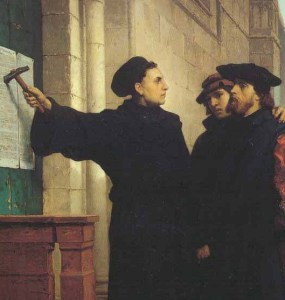 I have been reading through the Book of Concord. I think it is vitally important for one who, like me, claiming to be Lutheran to be familiar with the Lutheran Confessions. That is, after all, what we believe and confess. I have been writing a series of posts on Practical Lutheranism based on the Book of Concord. These teachings remain viable and valuable today.
What is Sabbath?
One of the debates that has raged within Christianity (with different levels of flame behind this raging, whether it be a mere flickering candle or a roaring fire) has been the meaning of “Sabbath” and how it is integrated into the Christian life. Volumes have been written, multi-view books published, denominations split or created, and the like on this topic.
Luther’s Large Catechism offered a way forward in this debate, offering an understanding of keeping the day holy that could be lived by the Christian. He wrote:
Accordingly, when you are asked what “You are to hallow the day of rest” means, answer: “Hallowing the day of rest means to keep it holy.” What is meant by “keeping it holy”? Nothing else than devoting it to holy words, holy works, and holy living… [The Sabbath Day] becomes holy or unholy on your account, depending on whether you spend it doing something holy or unholy. How does such sanctifying take place? Not when we sit behind the stove and refrain from hard work, or place a garland on our head and dress up in our best clothes, but… when we make use of God’s Word and exercise ourselves in it. [The Large Catechism, Part I, 87-88, cited below]
Yet Luther, as is so often the case for Luther (and Lutherans), was not content to leave it there. In the spirit of the Lutheran both/and, he expanded this notion of making holy to the whole of Christian life:
Truly, we Christians ought to make every day such a holy day and devote ourselves only to holy things, that is, to occupy ourselves daily with God’s Word and carry it in our hearts and on our lips… For non-Christians can spend a day in rest and idleness, too… but without keeping a single day holy, because they neither preach nor practice God’s Word… [Large Catechism, I:89-90]
Thus, for Luther, we ought to remember Christ’s words: we were not made for Sabbath, but Sabbath for us. Moreover, Sabbath is part of the overall Christian life instead of being relegated to merely one part of the week. Making the day holy is something we ought always be doing: reflecting on God’s Word, singing Psalms, and praying.
Source
Robert Kolb and Timothy J. Wengert, eds. The Book of Concord: The Confessions of the Evangelical Lutheran Church (Minneapolis, MN: Fortress, 2000).
Links
Be sure to check out the page for this site on Facebook and Twitter for discussion of posts, links to other pages of interest, random talk about theology/philosophy/apologetics/movies and more!
Adhering to the Book of Concord “In So Far As” or “Because” it Agrees with Scripture?– I argue that Lutherans must hold the position that we adhere to the Book of Concord In So Far As it Agrees with Scripture.
Eclectic Theist– Check out my other blog for posts on Star Trek, science fiction, fantasy, books, sports, food, and more!
SDG.
——
The preceding post is the property of J.W. Wartick (apart from quotations, which are the property of their respective owners, and works of art as credited; images are often freely available to the public and J.W. Wartick makes no claims of owning rights to the images unless he makes that explicit) and should not be reproduced in part or in whole without the expressed consent of the author. All content on this site is the property of J.W. Wartick and is made available for individual and personal usage. If you cite from these documents, whether for personal or professional purposes, please give appropriate citation with both the name of the author (J.W. Wartick) and a link to the original URL. If you’d like to repost a post, you may do so, provided you show less than half of the original post on your own site and link to the original post for the rest. You must also appropriately cite the post as noted above. This blog is protected by Creative Commons licensing. By viewing any part of this site, you are agreeing to this usage policy.
Book Review: “The Great Divide: A Lutheran Evaluation of Reformed Theology” by Jordan Cooper
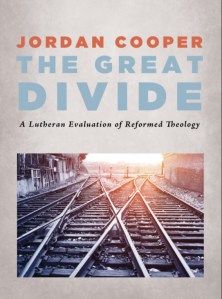 The Great Divide: A Lutheran Evaluation of Reformed Theology presents a broad-spectrum look at Reformed theology from a Lutheran perspective.* Cooper breaks this analysis up into three parts: Predestination and Free Will, Worship and the Sacraments, and Salvation. These parts are intended to show the greatest dividing lines between Reformed and Lutheran thought.
It is really quite exciting to see how well-read Cooper is on both Reformed and Lutheran thought. On the Reformed side, he frequently cites Calvin (of course), Bavinck, Edwards, Piper, Grudem, and more. On the Lutheran side, he draws from Luther, Chemnitz, Melanchthon, Kolb, and more. This thorough use of sources on both sides helps shield against bias, as Cooper continually cites the words of prominent theologians of each tradition.
Cooper provides in each chapter a presentation of Reformed thought on the topic, drawing extensively from prominent Reformed thinkers past and present, as well as various Reformed Confessions. Then, he provides a look at the Lutheran perspective, often quoting the Lutheran Confessions as well as prominent Lutheran thinkers. After providing this comparison, Cooper argues for the Lutheran position, noting the points of divergence along the way. At many points, this analysis is fairly robust. However, at other points Cooper does swiftly move from one point to another before providing enough to establish each point.
One of the things that comes to the front most clearly in the book is just how close Reformed and Lutheran thought are on a number of issues. Unfortunately, as close as the two traditions come on many areas, the chasm between the two remains vast. This is particularly clear in regards to the Sacraments and Predestination. I was also pretty surprised to see how different the Reformed and Lutheran view regarding worship is. The regulative principle within Reformed thought–that whatever is not commanded in Scripture ought not to be done in worship–was something that startled me. I hadn’t considered such a position, but Cooper showed the arguments for and against this position, coming down on the side of Lutheranism (again, he’s coming from that perspective), which sees worship as something that God allows for more leeway in than do Reformed thinkers.
It is truly amazing how much information Cooper manages to convey in just 200 pages. Readers are introduced to both Lutheran and Reformed perspectives on a number of important theological topics, treated to both exposition of those views and offered critique of the Reformed position all in a very clear style and form.
There are two minor critiques I’d offer of the book. The first is the continued use of the archaic “man” to refer to all people. There were, in fact, a few places in which I had to work to discern whether Cooper meant all people or just men when it came to what he was writing. A second critique is that because of the books relatively short length, some of the arguments on either the Reformed or Lutheran side seem extremely brief, leaving some of the arguments inconclusively demonstrated.
Jordan Cooper’s The Great Divide: A Lutheran Evaluation of Reformed Theology is a vast trove of information and analysis. Extensively researched and well-reasoned, it will provide readers unfamiliar with either Reformed or Lutheran theology (or both) an introduction to each tradition as well as a look at how they may interact with one another.
The Good
+Engages with prominent theologians from each group
+Historically informed
+Treats Reformed thought fairly
+Vast wealth of information
The Bad
-Continued use of archaic “man” etc. as inclusive
-Some points are breezed through very quickly
*It is worth noting my own bias here: I am a Lutheran who was raised Lutheran and, though I wandered a little bit, have become quite convinced of Lutheran theology in recent years.
Disclaimer: I was provided with a copy of the book for review by the publisher. I was not required to provide any specific kind of feedback whatsoever.
Source
Jordan Cooper The Great Divide: A Lutheran Evaluation of Reformed Theology (Eugene, OR: Wipf & Stock, 2015).
Links
Be sure to check out the page for this site on Facebook and Twitter for discussion of posts, links to other pages of interest, random talk about theology/philosophy/apologetics/movies and more!
Book Reviews– There are plenty more book reviews to read! Read like crazy! (Scroll down for more, and click at bottom for even more!)
Eclectic Theist– Check out my other blog for my writings on science fiction, history, fantasy movies, and more!
SDG.
——
The preceding post is the property of J.W. Wartick (apart from quotations, which are the property of their respective owners, and works of art as credited; images are often freely available to the public and J.W. Wartick makes no claims of owning rights to the images unless he makes that explicit) and should not be reproduced in part or in whole without the expressed consent of the author. All content on this site is the property of J.W. Wartick and is made available for individual and personal usage. If you cite from these documents, whether for personal or professional purposes, please give appropriate citation with both the name of the author (J.W. Wartick) and a link to the original URL. If you’d like to repost a post, you may do so, provided you show less than half of the original post on your own site and link to the original post for the rest. You must also appropriately cite the post as noted above. This blog is protected by Creative Commons licensing. By viewing any part of this site, you are agreeing to this usage policy.
Book Review: “Representing Christ: A Vision for the Priesthood of All Believers” by Uche Anizor and Hank Voss
 The doctrine of the “priesthood of all believers” is one that is easily misunderstood but joyfully affirmed by a number of Christian groups across denominational lines. Uche Anizor and Hank Voss’ book, Representing Christ: A Priesthood of All Believers is an attempt to hash out the particulars of this challenging, freeing doctrine.
The authors note the potential pitfalls of the doctrine while also showing the ways that the notion of the priesthood of all believers can be applied to many different situations. After some excellent introductory remarks–including a look at how priesthood is viewed in different theological traditions–they dive into chapters on the Scriptural basis for the doctrine, Martin Luther’s contribution to recovering the doctrine, the Trinity and our priesthood, the practices of the priesthood of all, and the overall implications and applications of the doctrine.
The doctrine of the “priesthood of all believers” has long been credited to Martin Luther, though he did not use the specific phrase and some Luther scholars (cited by Anizor and Voss) dispute that this doctrine can be derived from his writings. Despite these apparent challenges, the authors demonstrate not only the roots of the teaching in Luther’s writings, but also the fruit that such a doctrine bore for him. As a Lutheran myself, it was refreshing to see Luther’s contribution highlighted rather than ignored. Indeed, Luther’s notion of the functions of the believer–preaching and teaching the word, baptizing, administering the Lord’s Supper, binding and loosing sins, prayer, sacrifice, judging doctrine–is used as a basis for the ongoing discussion.
These 7 points are developed later in the book and serve as a great, applicable portion of the book. The authors rightly note the importance for the church of both baptism and the Lord’s Supper, and do so in ways that show how their importance comes in part from the way they create a fellowship of believers. The other aspects of this priesthood of all believers are equally insightful. Something like “binding and loosing sins” may seem quite abstract, but Anizor and Voss manage to make such a notion relevant and practical.
Highlighting the life of the Trinity and Christ’s role as great high priest was another strong point of the book. However, in this section there was a continued emphasis on the notion that it is “especially appropriate” to worship the Father in the name of Jesus by the power of the Spirit (100, cited below). Now I’ll not dispute that this is indeed one way that we ought to direct worship- praise to the Father in the name of Christ by the power of the Holy Spirit. But the authors belabored this point so much that I wondered why this was the case. After all, they clear agree that it is appropriate to worship the Son and the Spirit. If that is the case, then what basis is there for the claim of “especial” appropriateness regarding worship of the Father? We need to be careful in Trinitarian doctrine to not establish a hierarchy within the Trinity, and indeed the ancient Athanasian Creed states, “And in the Trinity none is before or after another; none is greater or less than another, but all three Persons are co-eternal together and co-equal. So that in all things, as is aforesaid, the Unity in Trinity and the Trinity in Unity is to be worshiped.” This creedal statement which has historically been defining for the whole Christian church makes it clear that all three persons are to be worshiped in unity, and although the formula Anizor and Voss put forward is Trinitarian, I wonder why the emphasis is on worship being directed to the Father. No person of the Trinity is more worthy of worship than any either, and our worship ought to be directed towards the Triune God, not “especially” towards one person.
One aspect missing from the discussion in the book is the notion of both men and women in this role as priests. Indeed, the point where this could have most easily been highlighted is in the Garden of Eden, where Voss and Anizor note the way the Garden of Eden is like a type of temple (28) and Adam is a kind of priest-king in the Garden (26ff). Someone is notably absent in this discussion: Eve. Eve was placed alongside Adam in Eden and also given the charge to have dominion over it; why should she be excluded from the discussion of priestly act in the Garden? It seems it would have been quite appropriate to include such a discussion here, and I wonder whether the lack of her inclusion is an attempt to restrict the priesthood of all believers after all. There remain many church bodies who exclude women from the role of representing Christ, and often this teaching is reinforced by keeping some parts of Scripture silent on the topic. In Representing Christ, we see no explicit mention of Eve as serving alongside Adam in these functions, despite reference to sections in which she appears. The priesthood of all believers is an explosive doctrine that frees both men and women, and to ignore this aspect of the doctrine does it disservice.
Representing Christ is an important look at a doctrine that is too often misunderstood or abused. The priesthood of all believers is a freeing doctrine, but not one that throws any kind of order in the church out the window. The authors do a fair job of pointing this out, but I cannot help but wonder why they didn’t go even farther and show how this priesthood of believers can free not only “us” in the general sense, but also, to take from a well-informed author, show that “there is neither Jew nor Greek, slave nor free, no male and female, for we are one in Christ” (Galatians 3:28).
The Good
+Highlights importance of Luther’s contributions
+Provides Scriptural basis for the doctrine
+Gives practical examples for applying content
The Bad
-Where’s Eve?
-Avoids some of the apparent implications of the doctrine regarding women
-Awkward wording of some Trinitarian discussion
Disclaimer: I was provided with a copy of this book for review by the publisher. I was not obligated to provide any specific kind of feedback whatsoever.
Source
Uche Anizor and Hank Voss, Representing Christ: A Vision for the Priesthood of All Believers (Downers Grove, IL: InterVarsity, 2016).
Links
Be sure to check out the page for this site on Facebook and Twitter for discussion of posts, links to other pages of interest, random talk about theology/philosophy/apologetics/movies and more!
Book Reviews– There are plenty more book reviews to read! Read like crazy! (Scroll down for more, and click at bottom for even more!)
Eclectic Theist– Check out my other blog for my writings on science fiction, history, fantasy movies, and more!
SDG.
——
The preceding post is the property of J.W. Wartick (apart from quotations, which are the property of their respective owners, and works of art as credited; images are often freely available to the public and J.W. Wartick makes no claims of owning rights to the images unless he makes that explicit) and should not be reproduced in part or in whole without the expressed consent of the author. All content on this site is the property of J.W. Wartick and is made available for individual and personal usage. If you cite from these documents, whether for personal or professional purposes, please give appropriate citation with both the name of the author (J.W. Wartick) and a link to the original URL. If you’d like to repost a post, you may do so, provided you show less than half of the original post on your own site and link to the original post for the rest. You must also appropriately cite the post as noted above. This blog is protected by Creative Commons licensing. By viewing any part of this site, you are agreeing to this usage policy.
Book Review: “Political Church” by Jonathan Leeman
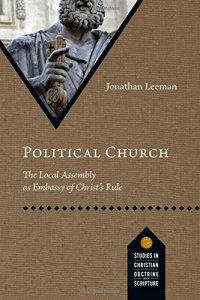
Jonathan Leeman’s Political Church: The Local Assembly as Embassy of Christ’s Rule is a detailed study of the interaction between Christianity and the public sphere. Leeman’s central thesis is that the church, as the local assembly, acts as an embassy–a political place in which Christ’s rule on earth is present.
The book is broken up into 6 lengthy chapters, each building on the last, as Leeman argues for his thesis. The first two chapters address the questions “What is politics?” and “What is an Institution?” From there, Leeman builds on politics of creation, the Fall, the New Covenant, and the Kingdom.
One of the most critical areas of the book is that there is no such thing as a totally neutral ground from which to build a political system. There is no religiously neutral political philosophy. To make the case for this central point, Leeman draws extensively from people like William Cavanaugh and Stanely Hauerwas. Essentially, the point is that because one’s religious beliefs (or alleged lack thereof) govern, effectively, all areas of one’s thought, one cannot excise them without effectively abandoning those beliefs, thus going against them. There is much more to this argument, but it is one of the many fascinating areas Leeman highlights.
Exactly how does the church act as an embassy for Christ? The sixth chapter, “The Politics of the Kingdom,” presents a number of fascinating insights into this question. Leeman takes a deep look at the notion of the “Keys of the Kingdom,” drawn from Matthew 16 (334ff). This discussion draws from multiple commentaries and spans questions from “what is the church?” to “how ought we perform church discipline?” to whether the church ought to function as a kind of civil magistrate. These kind of deep questions permeate the pages of Political Church such that readers will want to spend a great deal of time poring over the text and reflecting on the points therein.
There are a few areas worth critiquing in the book. First, much discussion time is spent on the notion of how exactly God’s covenant went from old to new covenant, but this all plays out on a kind of amorphous theological backdrop such that it is difficult to determine exactly what Leeman is saying. Is he pushing a kind of dispensational theology? At points it seems so, but other times it does not. Because the theological point here is not central to his book, Leeman doesn’t give readers enough to see where he’s coming from, particularly in chapter four’s (The Politics of the Fall) discussion of different covenants.
Another difficulty is, admittedly, drawn from a minor point in the book. Leeman states explicitly that, “if membership in the new covenant requires both the activity of the Spirit and the assent of the individual to God… then membership in… the church… should… be restricted to those who give their assent. To place infants born into a ‘Christian’ nation onto church roles misidentifies God’s presence, reputation, righteousness and justice…” (272). On the one hand, his notion that membership in the church requires both the Spirit and assent is explicitly tied to his understanding of the body of the church as a political one. On the other hand, although he stresses that exact point, it is never clear exactly what that means in terms of justification. This takes us away from the purpose of his book, but given statements like these it seems clear that justification is at least some part of what he is referring to. Justification is the work of the spirit, saving people who are dead slaves to sin who cannot free themselves. But if that’s the case, then his objection to infants being placed on church rolls seems to fall apart, for although infants cannot express consent, that does not seem to be required for the doctrine of justification. As a Lutheran particularly, I affirm that infants may have faith, because faith is a gift of the Spirit rather than an act of humans. Yet even here, Leeman might object noting that he is speaking in political terms rather than in the terms I am using.
A final difficulty is with Leeman’s reading of Luther’s Two Kingdoms model. Although he does avoid the most egregious misinterpretations of Luther on this point, Leeman argues that Luther’s model turns God’s people/not-God’s-people into church/state or Word/state. Then, he argues that the Bible and the church have words for those who are not God’s people as well and the state rules over God’s people (274-275, for example). But this is not what Luther’s model entails. It’s not that church/state on Luther’s model never interact; indeed, Leeman’s own conception seems to be extremely close to the core of what Luther was getting at in his doctrine of Two Kingdoms. He constructs it around the idea that there are two ages rather than two kingdoms, and that there are two kinds of life- secular and eternal (275). Yet even this speaking of two ages ultimately comes back to noting that there is “present simultaneity of the ages,” leading one to wonder how far from “two kingdoms” that exist simultaneously Leeman’s own argument truly is. This does go beyond Luther, but I think it’s the direction Luther’s own teaching was aiming towards, and it is interesting that Luther draws frequent mention as being close, but mistaken (29-31; 177; 275; etc.).
These minor points, though I have labored over them, do little to take away from the monumental importance of this work. Leeman has done a tremendous service to those interested in delving deeply into a theological vision of church and state. Each chapter brings together exegesis, philosophy, and sociology in informative, often surprising ways.
Political Church: The Local Assembly as Embassy of Christ’s Rule is an important work that is sure to influence all who read it, whether they agree with the contents or not. It is essential reading for those curious about the interplay between Christianity and politics. I highly recomend it.
The Good
+Engages with multiple voices throughout church history
+Generally offers balanced, ecumenical perspective
+Blends exegesis, systematics, sociology, and more
+Extensive interaction with experts in related fields
The Bad
-Wrongfully excludes children and infants from Christ’s Kingdom
-Somewhat vague on some theological points
Source
Jonathan Leeman, Political Church: The Local Assembly as Embassy of Christ’s Rule (Downers Grove, IL: InterVarsity, 2016).
Links
Be sure to check out the page for this site on Facebook and Twitter for discussion of posts, links to other pages of interest, random talk about theology/philosophy/apologetics/movies and more!
Book Reviews– There are plenty more book reviews to read! Read like crazy! (Scroll down for more, and click at bottom for even more!)
Eclectic Theist– Check out my other blog for my writings on science fiction, history, fantasy movies, and more!
SDG.
——
The preceding post is the property of J.W. Wartick (apart from quotations, which are the property of their respective owners, and works of art as credited; images are often freely available to the public and J.W. Wartick makes no claims of owning rights to the images unless he makes that explicit) and should not be reproduced in part or in whole without the expressed consent of the author. All content on this site is the property of J.W. Wartick and is made available for individual and personal usage. If you cite from these documents, whether for personal or professional purposes, please give appropriate citation with both the name of the author (J.W. Wartick) and a link to the original URL. If you’d like to repost a post, you may do so, provided you show less than half of the original post on your own site and link to the original post for the rest. You must also appropriately cite the post as noted above. This blog is protected by Creative Commons licensing. By viewing any part of this site, you are agreeing to this usage policy.
Who is Worthy?- A reflection on closed communion in Lutheran churches

I do not claim rights to this image and was unable to find original source. Possibly here: http://thehandsomehansons.blogspot.com/2010/11/lutheran-seal.html
My wife and I have been refused communion on more than one occasion. In each instance it was in a Lutheran church that we were turned away. We are, ourselves, Lutherans, but the church bodies that did not commune us were different groups of Lutherans, and held that the divisions between us justified not giving us the gifts of the sacrament that Christ promised.
Here, I’d like to examine this practice of some Lutheran churches, often referred to as “closed communion.”[1] What do the actual Lutheran Confessions say about who may receive the Lord’s Supper? That is the question which must be asked by any claiming to be Lutheran.
We believe, teach, and confess that the entire worthiness of the guests at the table of his heavenly meal is and consists alone in the most holy obedience and perfect merit of Christ. We make his obedience and merit our own through true faith, concerning which we receive assurance through the sacrament. Worthiness consists in no way in our own virtues, or in internal or external preparations. (The Formula of Concord, Epitome, Article VII, Section 20)
The Lutheran Confessions leave no wiggle room here. What makes one worthy to receive the sacrament? Is it one’s preparation? No. Is it one’s denominational commitment? No. It is explicitly and clearly stated here: “the most holy obedience and perfect merit of Christ” which is itself made our own “through true faith.” Indeed, what does it mean to add the requirement of complete doctrinal agreement onto these words? Would not such a teaching be to make one’s “own virtues”–here of the doctrinal variety–what makes one worthy? It seems so. The teaching here, however, is that it is only faith in Christ’s words and works that make one worthy.
Just in case one wants to persist and allege that there may be some difficulty interpreting these words, Martin Luther himself states, in the Large Catechism:
Now we must also consider who the person is who receives such power and benefit [from the Lord’s Supper]… It is the one who believes what the words say and what they give, for they are not spoken or preached to stone and wood but to those who hear them, to those whom he says, “Take and eat”…All those who let these words be addressed to them and believe that they are true have what the words declare…
Now this is the sum total of a Christian’s preparation to receive this sacrament worthily. (The Large Catechism, The Sacrament of the Altar, section 33-36)
What does Luther himself teach here? “[T]his is the sum total of a Christian’s preparation…” (emphasis mine). And what is that sum total? Simply being one who “let these words be addressed to them and believe that they are true…” Once again, we see no mention of further conditions. There is no place here for refusing communion to those who believe the words are for them. The Christian must simply take hold of the words of Christ, which promise his body and blood to them. They need not be part of a specific denomination (which would have been historically impossible or at least unlikely at this point). It is the faith of the individual that makes them worthy, not their adherence to a set of doctrinal truths apart from those affirmed about the Lord’s Supper.
What do Lutherans who turn away other Lutherans from the sacrament say about their reasoning? Here is one example, from the Lutheran Church – Missouri Synod:
Because the Bible teaches that this Sacrament may also be spiritually harmful if misused, and that participation in the Lord’s Supper is an act of confession of faith, the LCMS ordinarily communes only those who have been instructed in the teachings of our church and who have confessed their faith in these teachings. (LCMS FAQ, cited below)
Here we see an unwarranted limit being placed on the sacrament of communion. What makes one worthy to receive this sacrament? The Lutheran Confessions make it explicit that that which makes one worthy is faith in the words of Christ. Here, however, an addition is made: “only those who have been instructed in the teachings of our church [the LCMS] and who have confessed their faith in these teachings” are “ordinarily” communed. Yet this limit is nowhere taught in the Book of Concord.
Counter-Argument
A possible counter-argument to the above is that there were no divergent Lutherans or Lutheran groups at the time the Lutheran Confessions were written, so they couldn’t have even addressed the issue. Apart from the fact that this is historically false (for parts of the Book of Concord were written to correct others within the folds of Lutheranism), it doesn’t change the Book of Concord’s teaching on the topic. The Lutheran Confessions make very strong statements. Phrases like “the sum total” and “alone” are used accompanying what the Confessions teach in regards to worthiness for the Lord’s Supper. These phrases are exclusive. That is, they affirm explicitly that no other expectations may be added. For what else might saying “sum total” or “alone” mean?
Conclusion
Those Lutheran groups who have added requirements for worthily receiving the Lord’s Supper stand against the Book of Concord’s own teaching on the topic. Time and again Luther and other confessors state that the only requirement for worthiness is to affirm the words of Christ and take hold of them by faith. Any who add requirements to receiving this sacrament have made their own words supersede those of the Confessions.
[1] Closed communion may also refer to simply keeping communion closed to those who affirm what the Book of Concord teaches regarding the Lord’s Supper. There is a fine line between this practice and making the additions to the Book of Concord’s teaching as noted in this post. I am not addressing this less stringent variety here.
Sources
LCMS Frequently Asked Questions Doctrinal Issues- The Lord’s Supper/Holy Communion (accessible here).
Robert Kolb and Timothy J. Wengert, eds. The Book of Concord: The Confessions of the Evangelical Lutheran Church (Minneapolis, MN: Fortress, 2000).
Links
Be sure to check out the page for this site on Facebook and Twitter for discussion of posts, links to other pages of interest, random talk about theology/philosophy/apologetics/movies and more!
Adhering to the Book of Concord “In So Far As” or “Because” it Agrees with Scripture?– I argue that Lutherans must hold the position that we adhere to the Book of Concord In So Far As it Agrees with Scripture.
Eclectic Theist– Check out my other blog for posts on Star Trek, science fiction, fantasy, books, sports, food, and more!
SDG.
——
The preceding post is the property of J.W. Wartick (apart from quotations, which are the property of their respective owners, and works of art as credited; images are often freely available to the public and J.W. Wartick makes no claims of owning rights to the images unless he makes that explicit) and should not be reproduced in part or in whole without the expressed consent of the author. All content on this site is the property of J.W. Wartick and is made available for individual and personal usage. If you cite from these documents, whether for personal or professional purposes, please give appropriate citation with both the name of the author (J.W. Wartick) and a link to the original URL. If you’d like to repost a post, you may do so, provided you show less than half of the original post on your own site and link to the original post for the rest. You must also appropriately cite the post as noted above. This blog is protected by Creative Commons licensing. By viewing any part of this site, you are agreeing to this usage policy.
Book Review: “Bonhoeffer on the Christian Life” by Stephen J. Nichols
 Bonhoeffer on the Christian Life by Stephen J. Nichols is part of the “Theologians on the Christian Life” series from Crossway. This volume focuses on Dietrich Bonhoeffer, a German Lutheran theologian who was murdered by the Nazis. What is remarkable about this book is the way it successfully shows the interplay between Bonhoeffer’s theology and his life lived, and then demonstrates this is something we, too, can comprehend.
Nichols balances discussion about Bonhoeffer’s theology with discussion of his life. This is more than simply combining biography with theology. Instead, Nichols demonstrates that Bonhoeffer’s theology of Christian life is acted out by Bonhoeffer. Thus, readers are able to read about Bonhoeffer while learning what it means to lead a Christian life. This is fitting, because Bonhoeffer did act out the core of his theology, which, as the subtitle of the book (“From the Cross, For the World”) suggests, is cruciform. For Bonhoeffer, Christian living is living as Christ to the world, and this includes living and dying with Christ.
The book has chapters on ecclesiology, prayer, confession, and more. The chapters noted are particularly insightful. Nichols draws much from Bonhoeffer’s Life Together to show his doctrine of the church, which itself is deeply connected to a life of spiritual discipline, confession to one another, and willingness to suffer for Christ. Nichols notes well, however, that we in the West are not likely to be asked to pay the same cost of discipleship that Bonhoeffer did: execution for his lived faith. But that, Nichols argues, does not mean that we cannot live Christ-like lives. Rather than making Bonhoeffer a hero–and Nichols notes that Bonhoeffer would have rejected that categorization–we ought see him as a Christian living out the life God called him to.
Nichols balances the excitement of learning about Bonhoeffer’s life with the unveiling of deeper thoughts on the way Bonhoeffer points to a Christian life lived. It makes the book quite readable, despite its often complex subject matter.
There is, however, one glaring hole in the treatment of Bonhoeffer’s theology of the Christian life. That is, Bonhoeffer’s Lutheranism, and specifically his view of the proper theology as one of Word and Sacrament. A search of the book reveals but one reference to baptism, and only two references to the Lord’s Supper. However, Bonhoeffer continually held to the importance of these sacraments throughout his theology. For example, in The Cost of Discipleship, he wrote:
How then do we come to participate in the Body of Christ, who did all this for us? …The answer is, through the two sacraments of his Body, baptism and the Lord’s Supper. (239, edition linked above)
From this and many other references, it is clear that sacraments are central to Bonhoeffer’s understanding of ecclesiology. Yet Nichols doesn’t even mention them in the section on ecclesiology, an otherwise richly rewarding section of the book. Only a passing reference is made to the sacraments, despite their centrality to Bonhoeffer’s Lutheran understanding of grace and Christian living. This is a significant difficulty, for it effectively removes Bonhoeffer’s theology from its context.
Bonhoeffer on the Christian Life is an excellent, practical read. It shows how integrated Bonhoeffer’s theology is with his life, and gives many practical examples for readers to apply to their own lives. The book does, however, de-contextualize his theology by ignoring key aspects of his Lutheranism and their impact on Christian living. Readers will get much good from the book, but perhaps not as much good as they could have had it allowed Bonhoeffer’s Lutheranism to shine through.
The Good
+Focused on Bonhoeffer’s practical theology
+Gives insight into Bonhoeffer’s life with applications
+Excellent annotations for further reading
The Bad
-Little attention paid to Bonhoeffer on the sacraments
Disclaimer: I received a copy of the book for review from the publisher. I was not obligated to write any specific kind of feedback whatsoever.
Source
Stephen Nichols, Bonhoeffer on the Christian Life (Wheaton, IL: Crossway, 2014).
Links
Be sure to check out the page for this site on Facebook and Twitter for discussion of posts, links to other pages of interest, random talk about theology/philosophy/apologetics/movies and more!
Bonhoeffer’s Troubling Theology?- A response to an article on Dietrich Bonhoeffer’s theological perspectives– I look at an argument that Bonhoeffer’s theology is “troubling” to evangelicals and point out how much of it is merely a product of his Lutheran background.
Book Reviews– There are plenty more book reviews to read! Read like crazy! (Scroll down for more, and click at bottom for even more!)
Eclectic Theist– Check out my other blog for my writings on science fiction, history, fantasy movies, and more!
SDG.
——
The preceding post is the property of J.W. Wartick (apart from quotations, which are the property of their respective owners, and works of art as credited; images are often freely available to the public and J.W. Wartick makes no claims of owning rights to the images unless he makes that explicit) and should not be reproduced in part or in whole without the expressed consent of the author. All content on this site is the property of J.W. Wartick and is made available for individual and personal usage. If you cite from these documents, whether for personal or professional purposes, please give appropriate citation with both the name of the author (J.W. Wartick) and a link to the original URL. If you’d like to repost a post, you may do so, provided you show less than half of the original post on your own site and link to the original post for the rest. You must also appropriately cite the post as noted above. This blog is protected by Creative Commons licensing. By viewing any part of this site, you are agreeing to this usage policy.

 J.W. Wartick - Reconstructing Faith