Lutheranism
Sunday Quote: Dietrich Bonhoeffer as Lutheran
 Every Sunday, I will share a quote from something I’ve been reading. The hope is for you, dear reader, to share your thoughts on the quote and related issues and perhaps pick up some reading material along the way!
Dietrich Bonhoeffer as Lutheran
Dietrich Bonhoeffer is one of the most engaging characters of the 20th century as well as an immensely important and popular theologian. As time goes on, more and more people know who he is and acknowledge his influence on their work and lives. I have noticed, however, a strange lack of awareness or acknowledgement of Bonhoeffer’s Lutheranism. That is, many take what he says about discipleship, ecclesiology, prayer, and the like to heart, but divorce those ideas from their Lutheran context in his thought. Yet, for Bonhoeffer, his Lutheran theology was central to his understanding of Christianity. He wrote in The Cost of Discipleship:
How then do we come to participate in the Body of Christ, who did all this for us? It is certain that there can be no fellowship or communion with him except through his Body, baptism and the Lord’s Supper… The sacraments begin and end in the Body of Christ, and it is only the presence of that Body which makes them what they are. The word of preaching is insufficient to make us members of Christ’s body; the sacraments also have to be added. Baptism incorporates us into the unity of the Body of Christ, and the Lord’s Supper fosters and sustains our fellowship and communion… in that Body. (239, cited below)
These words can be found echoed in Bonhoeffer’s writings. His understanding of the universe was a Lutheran understanding, one which teaches Word and Sacrament. To do justice to his legacy, we need to acknowledge the fact that he isn’t just some theologian we can pull individual ideas from; instead, we must see him as Lutheran.
Links
Be sure to check out the page for this site on Facebook and Twitter for discussion of posts, links to other pages of interest, random talk about theology/philosophy/apologetics/movies and more!
Bonhoeffer’s Troubling Theology?- A response to an article on Dietrich Bonhoeffer’s theological perspectives– I have argued elsewhere that the broad evangelical understanding of Bonhoeffer may, indeed, be a misunderstanding of the fact that he is Lutheran.
Sunday Quote– If you want to read more Sunday Quotes and join the discussion, check them out! (Scroll down for more)
Eclectic Theist– Check out my other blog for my writings on science fiction, history, fantasy movies, and more!
Source
Dietrich Bonhoeffer, The Cost of Discipleship (New York: Touchstone, 1995).
SDG.
Made Perfect in this Life? – A Lutheran reflection on Methodist sanctification

I was visiting a United Methodist Church and the pastor preached on the doctrine of sanctification. She referenced the affirmation within the Methodist church that Christians can receive perfection in this life.
I’ve been curious about this assertion for some time, and I decided to explore some more. On the United Methodist Church’s website, in the section entitled “Our Wesleyan Heritage,” sanctification is defined, in part:
We’re to press on, with God’s help, in the path of sanctification toward perfection. By perfection, Wesley did not mean that we would not make mistakes or have weaknesses. Rather, he understood it to be a continual process of being made perfect in our love of God and each other and of removing our desire to sin. (accessed here)
The embedded link sends readers to a sermon from John Wesley. In that sermon, he talks about what he means by being made perfect in this life. He distinguishes between what, in his view, is not attainable in this life regarding perfection, as well as what is attainable. Christians, he argues, are not made perfect in knowledge in this life, nor will they become free from making mistakes, nor from illness, nor from temptations. Instead, Christian perfection in this life will lead to various blessings:
First, not to commit sin… Secondly, to be freed from evil thoughts and evil tempers…
Wesley, of course, goes into much more detail than that, and defends his positions from various objections. The length of the sermon makes it prohibitive for a detailed interaction, so I just want to focus on these aspects of Wesleyan/Methodist sanctification.
Sanctification Over Time?
The notion of achieving perfection over time is something that causes difficulty because it makes sanctification a biographical account. To clarify, a quote from Oliver O’Donovan in his chapter in the book Sanctification: Explorations in Theology and Practice entitled “Sanctification and Ethics,”- “Sanctification understood biographically [as occurring over the span of a life] has given encouragement to a belief in progressive and incremental moral improvement, to be attained with maturity and age” (155, cited below).
The implication of a view of continual sanctification that is progressive leads to the assumption that a more mature Christian ought to also be more sanctified. Yet this may lead to failed expectations related to the Christian life. If one is led to expect perfection in this life, and they continue to find themselves simul iustus et peccator (to borrow a very Lutheran phrase: simultaneously justified and a sinner [or a sinner and a saint, as it has come to be said]), they may lose their assurance of hope not just in sanctification but also in salvation. After all, their expectations of the Christian life are undercut.
It may be answered that the proper interpretation of Wesley is, rather, that he argued for instantaneous perfection. But this is a debate for a different time. (See the book Sanctification: Explorations in Theology and Practice for chapters related to this topic.)
A Lutheran Interaction
The Lutheran Confessions make it clear that sanctification is the work of the Holy Spirit (Formula of Concord, Article III, paragraph 41). In the Large Catechism, Luther refers to the basics of what could be considered a Lutheran view of sanctification:
…because holiness has begun and is growing daily, we await the time when our flesh will be put to death, will be buried with all its uncleanness, and will come forth gloriously and arise to complete and perfect holiness in a new, eternal life. Now, however, we remain only halfway pure and holy. The Holy Spirit must always work in us through the Word, granting us daily forgiveness until we attain to that life where… there will be only perfectly pure and holy people… (The Large Catechism, Second Part, section 57-58)
Thus, a Lutheran perspective of sanctification sees humans as part holy and part sinful. But what are we to make of this? Here, perhaps, is where the Methodist and Lutheran view of sanctification may split most sharply, for the Lutheran will note that what makes us holy is the Spirit through Word and Sacrament. That is, through the taking of Holy Communion and the receiving of absolution, we are daily made holy by the Spirit of God. Thus, holiness is, yes, in part works driven and completed by the Spirit, but it is also and perhaps mostly that which we gain through participation in the community of Christ, the church. For Lutherans, Word and Sacrament stand paramount.
Some object to this Lutheran position, charging Lutherans with a kind of antinomianism. After all, it can’t be that easy, right? Yet on the Lutheran view, sanctification is ongoing, but not in the sense that we discussed above. Instead, it is something that the Spirit works continually for us. Moreover, though the topic is hotly debated in Lutheran circles, the notion of the “third use of the law”–as a guide for Christian life–helps curb antinomianism and turn the Christian back to Christ for forgiveness.
Conclusion
I believe I have more to learn in this area, and I am interested to read on the topic further. I have a book on the topic I’m currently reading, so I’m hoping this will give me some more insight into the fascinating topic. For now, it seems to me that the primary division between the Lutheran and Methodist view here is centered not so much on the concept of perfection now (though that is an intriguing topic to explore), but rather on a view of sanctification through the Sacraments.
Sources
Robert Kolb and Timothy J. Wengert, eds. The Book of Concord: The Confessions of the Evangelical Lutheran Church (Minneapolis, MN: Fortress, 2000).
Oliver O’Donovan, “Sanctification and Ethics” in Sanctification: Explorations in Theology and Practice edited by Kelly M. Kapic (Downers Grove, IL: InterVarsity, 2014).
Other sources are linked above.
Links
Be sure to check out the page for this site on Facebook and Twitter for discussion of posts, links to other pages of interest, random talk about theology/philosophy/apologetics/movies and more!
Eclectic Theist– Check out my other blog for posts on Star Trek, science fiction, fantasy, books, sports, food, and more!
SDG.
——
The preceding post is the property of J.W. Wartick (apart from quotations, which are the property of their respective owners, and works of art as credited; images are often freely available to the public and J.W. Wartick makes no claims of owning rights to the images unless he makes that explicit) and should not be reproduced in part or in whole without the expressed consent of the author. All content on this site is the property of J.W. Wartick and is made available for individual and personal usage. If you cite from these documents, whether for personal or professional purposes, please give appropriate citation with both the name of the author (J.W. Wartick) and a link to the original URL. If you’d like to repost a post, you may do so, provided you show less than half of the original post on your own site and link to the original post for the rest. You must also appropriately cite the post as noted above. This blog is protected by Creative Commons licensing. By viewing any part of this site, you are agreeing to this usage policy.
Sunday Quote!- The Faith of Infants- Hermann Sasse
Every Sunday, I will share a quote from something I’ve been reading. The hope is for you, dear reader, to share your thoughts on the quote and related issues and perhaps pick up some reading material along the way!
The Faith of Infants – Hermann Sasse
One aspect of Lutheran theology that is often misunderstood is the notion of infant faith. It goes hand in hand with the Lutheran teaching of baptismal regeneration. Yet, time and again I have seen the accusation leveled at Lutherans that we somehow believe that faith is not required for salvation, because we believe infants are saved. Lutheran theology, however, teaches instead that infants do have faith. A brief quote from Hermann Sasse makes this more explicit:
[I]t is not merely avowed liturgical conservatism or even thoughtlessness when the Church for nearly two thousand years has thus baptized infantas as though they were adults, as though they could already confess with the outh and believe with the heart. This is not the ‘as though’ of mere fiction… God views us in Baptism as people who have already died and been raised… Thus he already views us as such who already believe, the poorest, weakest little child which we bring to Holy Baptism. (1197, cited below)
Sasse’s point here is that God views us eschatologically–as though we have faith, because that faith is the gift of God. Lutherans do not believe in salvation without faith; instead, a consistent application of the notion that faith is from God means God can impart that faith to whomever God chooses–whether one is elderly or newborn.
Source
Herman Sasse, quoted in Treasury of Daily Prayer (St. Louis, MO: Concordia Publishing House, 2008). Quoting from Herman Sasse, “Circular Letter 4 to Westphalian Pastors,” in The Lonely Way: Selected Essays and Letters, translated by Matthew C. Harrison et al., vol. 2 (CPH, 2002).
Links
Be sure to check out the page for this site on Facebook and Twitter for discussion of posts, links to other pages of interest, random talk about theology/philosophy/apologetics/movies and more!
Sunday Quote– If you want to read more Sunday Quotes and join the discussion, check them out! (Scroll down for more)
Eclectic Theist– Check out my other blog for discussions about all kinds of topics including science fiction, history, fantasy movies, and more!
SDG.
Practical Lutheranism: Luther on the 5th Commandment and Refugees

A Public Domain image of Syrian Refugees. Accessible: https://commons.wikimedia.org/wiki/File:Syrian_refugee_of_the_Syrian_civil_war.jpg
I have been reading through the Book of Concord, which is a collection of the Lutheran Confessions. I think it is vitally important for one who, like me, claiming to be Lutheran to be familiar with these documents. They are, after all, what we believe and confess. I decided to start a series of posts as I’m reading through the Book of Concord to highlight various areas I think are important.
The Fifth Commandment and Refugees
There is much fear in the world today over the question of Syrian Refugees. I’ve been reading through the Book of Concord and I ran into the section on the Fifth Commandment. I was taken back by how lucid Luther’s interpretation is there, and it has some serious application for today:
Therefore it is God’s ultimate purpose that we suffer harm to befall no [hu]man, but show [them] all good and love; and, as we have said, it is specially directed toward those who are our enemies. For to do good to our friends is but an ordinary heathen virtue, as Christ says Matt. 5:46.
One can see these same thoughts echoed in the discussion of the seventh commandment:
…we are commanded to promote and further our neighbors’ interests, and when they suffer any want, we are to help, share, and lend to both friends and foes (251-252)
What is particularly uncomfortable about these words is the word of law that is contained within them: “both friends and foes” are included in these commands. We ought to further their interests, “help, share, and lend to” them “when they suffer any want,” and show them “all good and love.” Luther is abundantly clear on this point: “it is specially directed toward those who are our enemies.”
Could more prophetic words have been written by Luther? Surely, the times in which we fear our enemies and wish to do nothing but avoid them are legion. Today is but one example of human injustice to fellow humans. But the words of the Commandments brook no argument, and Luther’s interpretation makes this abundantly clear: “to do good to our friends is but an ordinary heathen virtue…” and we are given a higher calling.
Those objections that would point to individual instances of violence, those who would alleged terrorists sneaking into our borders, and the like: the word of the law is spoken, and it is a powerful one: Christ’s calling is higher. When they suffer–even when our enemies suffer–we ought help them. If that means letting in the Syrian refugee fleeing from the violence in their homeland, if that means the “illegal immigrant” running from poverty and destitution, then so be it. There is no question here. There is no exception for fear that they will “steal our jobs” or that they speak a different language or have a different skin color or a different religion or anything of the sort. The words Luther writes here are clear: “it is God’s ultimate purpose that we suffer harm to befall no” one.
Source
Robert Kolb and Timothy J. Wengert, eds. The Book of Concord: The Confessions of the Evangelical Lutheran Church (Minneapolis, MN: Fortress, 2000).
Links
Be sure to check out the page for this site on Facebook and Twitter for discussion of posts, links to other pages of interest, random talk about theology/philosophy/apologetics/movies and more!
Adhering to the Book of Concord “In So Far As” or “Because” it Agrees with Scripture?– I argue that Lutherans must hold the position that we adhere to the Book of Concord In So Far As it Agrees with Scripture.
Eclectic Theist– Check out my other blog for posts on Star Trek, science fiction, fantasy, books, sports, food, and more!
SDG.
——
The preceding post is the property of J.W. Wartick (apart from quotations, which are the property of their respective owners, and works of art as credited; images are often freely available to the public and J.W. Wartick makes no claims of owning rights to the images unless he makes that explicit) and should not be reproduced in part or in whole without the expressed consent of the author. All content on this site is the property of J.W. Wartick and is made available for individual and personal usage. If you cite from these documents, whether for personal or professional purposes, please give appropriate citation with both the name of the author (J.W. Wartick) and a link to the original URL. If you’d like to repost a post, you may do so, provided you show less than half of the original post on your own site and link to the original post for the rest. You must also appropriately cite the post as noted above. This blog is protected by Creative Commons licensing. By viewing any part of this site, you are agreeing to this usage policy.
Another Problem for Book of Concord Inerrantists
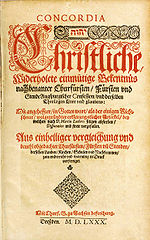
A title page of the Book of Concord
I have argued before that the stance of “confessional” Lutherans of having 100% agreement with the book of concord is unable to be maintained in the face of the evidence within the Book of Concord itself. That is, I believe that one must adhere to the Book of Concord “in so far as” it agrees with the Bible as opposed to “because” it agrees with the Bible. See my post on the topic for in-depth discussion of this distinction and its importance. I argued there, also, that the “because” position largely leads to a kind of inerrancy of the Book of Concord. After all, if the Book of Concord is to be agreed with because it agrees with the Bible, and the Bible is inerrant, it follows that anything that agrees with Scriptures 100% of the time will be without error.
Another example of defining Lutheranism according to strict adherence to the Book of Concord may be found in a recent post by Christopher Maronde entitled “What does the name ‘Lutheran’ mean?”:
Its meaning is simple: The name Lutheran refers to a person, congregation, or church body who unconditionally holds to the teachings contained within the Book of Concord, first published in 1580. A Lutheran is someone who declares that these specific documents rightly confess the truth of the Scriptures. It’s that simple; if you want to know what a Lutheran believes, if you want to know what that label means, you go to the Book of Concord. If you want to know if someone is using the label properly, you evaluate what they believe, teach, and confess according to the Book of Concord. (here)
These positions are generally considered to have a monopoly on the term “Confessional Lutheran” because they teach 100% affirmation of the Book of Concord and restrict any notion of Lutheran to that same adherence. My position, however, is that such a position cannot be maintained, nor should it have a monopoly on the term “Confessional Lutheran.”
Maronde’s definition above seems to provide a small loophole: it states that the Lutheran is to “unconditionally [hold] to the teachings contained within the book of Concord.” The key term here is “teachings.” At this point, if we grant this definition, one could argue that some purported errors in the Book of Concord may not be what the Book of Concord is teaching. However, later in the same quote, we see Maronde writes, “[I]f you want to know what that label means, you go to the Book of Concord…” which once again implies adherence to the totality, word-for-word truth of the Book of Concord. Yet the fact is the Book of Concord is not 100% true in every word-for-word instance.
I ran across another example of this in my readings the other day. In the Large Catechism, Martin Luther wrote,
This, I think, is why we Germans from ancient times have called God by a name more elegant and worthy than found in any other language, a name derived from the word ‘good,’ because he is an eternal fountain who overflows with pure goodness… [The Large Catechism, Part I, 25]
As Kolb and Wengert, editors of the critical edition of the Book of Concord published by Fortress Press note, the words for God and good in German (Gott and gut) are not derived from the same etymological root after all- “German: gut. This derivation is etymologically incorrect. The words for ‘God’… and ‘good’.. are not related in either Gothic or in Middle High German” (footnote 41 on page 389, cited below). Thus, within the very text of the Book of Concord, we have a clear error. Indeed, one that cannot be skirted around by arguing it is not something being taught therein; instead, it is clear that Luther is trying to teach about the meaning of God from an etymological derivation which is non-existent.
Therefore, it seems to me that the position of so-called “Confessional Lutheranism” and those who, like them, define Lutheranism narrowly to mean 100% adherence to the Book of Concord is clearly and demonstrably mistaken. The burden falls upon them to demonstrate that their position is actually viable in light of real, taught errors within the Book of Concord itself.
What does this mean for Lutherans–and indeed, Lutheranism? It certainly doesn’t mean we should all go chuck our Book of Concord editions in the trash. What it means is that, like any book, we should read the Book of Concord with a critical eye, checking it against God’s Word as found in the Scriptures and against the facts that we can discover in other studies as well. The Book of Concord is not inerrant, but that doesn’t mean a Lutheran cannot confess agreement with it so far as it agrees with Scripture, and, in doing so, remain a Confessional Lutheran.
Source
Robert Kolb and Timothy J. Wengert, eds. The Book of Concord: The Confessions of the Evangelical Lutheran Church (Minneapolis, MN: Fortress, 2000).
Links
Be sure to check out the page for this site on Facebook and Twitter for discussion of posts, links to other pages of interest, random talk about theology/philosophy/apologetics/movies and more!
Adhering to the Book of Concord “In So Far As” or “Because” it Agrees with Scripture?– I argue that Lutherans must hold the position that we adhere to the Book of Concord In So Far As it Agrees with Scripture.
Eclectic Theist– Check out my other blog for posts on Star Trek, science fiction, fantasy, books, sports, food, and more!
SDG.
——
The preceding post is the property of J.W. Wartick (apart from quotations, which are the property of their respective owners, and works of art as credited; images are often freely available to the public and J.W. Wartick makes no claims of owning rights to the images unless he makes that explicit) and should not be reproduced in part or in whole without the expressed consent of the author. All content on this site is the property of J.W. Wartick and is made available for individual and personal usage. If you cite from these documents, whether for personal or professional purposes, please give appropriate citation with both the name of the author (J.W. Wartick) and a link to the original URL. If you’d like to repost a post, you may do so, provided you show less than half of the original post on your own site and link to the original post for the rest. You must also appropriately cite the post as noted above. This blog is protected by Creative Commons licensing. By viewing any part of this site, you are agreeing to this usage policy.
Adhering to the Book of Concord: “In So Far As” or “Because” it agrees with Scripture?
A title page of the Book of Concord
Lutheran theology is derived from and reflective upon not just Martin Luther but also the Lutheran Confessions, as found in the Book of Concord. Within Lutheranism, there is much debate over exactly how tightly one must adhere to the Book of Concord. On one side, there are those who insist we must affirm the Book of Concord “because” it agrees with the Bible. On the other side, others maintain we should affirm it “in so far as” it agrees with the Bible.
Because it Agrees
Representative of the view that one must agree with the Book of Concord because it teaches what the Bible teaches is the following:
Authentically Lutheran churches insist on a subscription to the Confessions [The Lutheran Confessions/Book of Concord are used interchangeably] because they agree with the Bible, not merely in so far as they agree with Scripture. Otherwise, there would be no objective way to make sure that there is faithful teaching and preaching of God’s Word. Everything would depend on each pastor’s private opinions, subjective interpretations, and personal feelings, rather than on objective truth as set forth in the Lutheran Confessions. (Book of Concord (.org) FAQ)
Note some important aspects in this quote. First, the Book of Concord just does agree with the Bible. That is insisted upon. Second, the Book of Concord is said to be “objective truth” as opposed to the “subjective interpretations” of the individual. These considerations frame what I’d like to comment on regarding those who hold to the view that we must agree with the book of Concord “because…”
Because?
I’ll start with the second aspect noted above. There are, of course, all kinds of increasingly detailed issues people on either side of the debate might raise here. For example, how are “objective” and “subjective” being here defined? I’m going to set that kind of issue mostly aside and focus on a few difficulties I see.
The first is that one cannot simply read the words off the pages of the Book of Concord without going through the necessary step of interpreting them. That is, I as a reader of the Book of Concord must try to make sense of the words I am reading, and thus I am participating in the act of interpreting the Book of Concord. If, as the quote above states, the problem is the individual’s subjective nature, then the problem is completely unavoidable. Indeed, even if we grant that the Book of Concord is “objective truth” in its entirety, all we’ve done is moved the problem of subjective interpretation one step back. Now the reader must interpret the Book of Concord in order to get to the objective truth about Scripture found therein.
Another difficulty with this objective/subjective distinction is that it assumes the writers of the Lutheran Confessions were themselves either not subjective (which seems impossible) or explicitly guided by the Spirit to write out objective truth only. I would not dispute that the Holy Spirit could bring about a completely faultless writing, but the question is whether those who affirm the “because” position would like to argue this. The first thing we should do if they do want to argue this would be to see whether the writers of the Book of Concord assert the Holy Spirit did bring about such a completely objective, 100% correct work.
In the Preface to the Book of Concord, we can read:
Finally, with invocation of God Almighty and to his praise and glory and with careful deliberation and meticulous diligence through the particular grace of the Holy Spirit, they wrote down in good order and brought together into one book everything that pertains to and is necessary for this purpose. (Preface, 12)
Later, the Preface makes clear (15) that this Book was “the correct, Christian understanding of the Augsburg Confession…” In the closing of the Preface, we read (23) that those who signed on to it that they “are minded not to manufacture anything new… nor to depart in either substance or expression… from the divine truth… by the grace of the Holy Spirit we intend to persist and remain unanimously in this truth and regulate all religious controversies and their explanations according to it.”
These are all strong statements, and they clearly called upon God the Holy Spirit for guidance in the composition of the various works that make up the Book of Concord. But does it follow that they were explicitly, inerrantly inspired and guided by the Spirit to never once get a single thing wrong in this book? Those who affirm the “because” position must answer yes. There is no wiggle room.
But a close reading of the Preface seems to suggest that although the writers certainly believed everything in the Book of Concord to be without theological error (otherwise they would not have it regulate all controversies, etc.), I have yet to find anywhere that a claim could be made that the book is explicitly inerrant. It would have to be, however, for the “because” position to be true. This human composition would have to be 100% correct in every single minute detail down to the last proof text cited in order for it to be acceptable to affirm that we must agree with it “because” it agrees with Scripture.
Among other things, what follows from that is that anyone who subscribes to the Book of Concord “because” position must have read the entirety, looked up every citation, and assured themselves that every single interpretation, doctrinal position, and the like is 100% correct, lest they be saying that it is a human-made book without error on God’s Word without actually knowing every detail it contains.
The first issue raised above will be addressed in the section named “A Case Study,” below.
In So Far As
A supporting argument for the “In So Far As” position is that we should always only affirm that which is true. If we can agree that the Bible is true in all it teaches, then we should only agree with other writings about the Bible so far as they agree with the Bible. This seems like an obvious conclusion, but the whole debate centers on whether this argument is sound. It is difficult for me to figure out how to support this argument, not because I think it is a poor argument, but because it seems just intuitively clear.
It may help to use an analogy. Historians have debated how to write history and whether writers of history can ever fully get at the “true” history as it happened. Yet very few would deny that there is such a thing as a “true” history. There must be some absolutely correct sequence in which events occurred such that if we had a complete set of writings that simply reported those events, that would be the “true” history. Thus, there is an objectively true history, against which historians can be measured. Granting some of the hand waving involved in this thought experiment, suppose we had a book, The True History of the World, and we looked up the John F. Kennedy assassination therein. We would then have the objectively true report of that hotly-debated historical event as it really did happen. Now suppose I wanted to write a book about the JFK assassination based upon The True History of the World. However careful a historian I am, however excellent and detailed my mind is, however much guidance I may have had, would it be reasonable to say that you agree with my book, The Objective JFK Assassination “because” it agrees with The True History of the World or “in so far as” it does? It seems that the reasonable conclusion would be “in so far as” it does, because we know that The True History of the World is objectively true.
Though imperfect, this analogy gets at the argument written above. We can agree the Bible is inerrant. Thus, if I were to write a book entitled The Objective Bible, I think we can agree that we should only agree with my book so far as it agrees with the Bible, right? No matter how detailed I am, no matter how meticulous, no matter how large a group of thoughtful interpreters I got together to vet my work, it would be entirely reasonable to only affirm agreement with my book so far as it is biblical. Then why would such a standard not also apply to the Book of Concord? I see no reason why that standard would not.
Indeed, to argue against those who affirm the Book of Concord only “in so far as” it agrees with the Bible would mean that one would have to assert that the caution and respect for God’s word implicit in that position–that I would not want to affirm anything, even by mistake, as biblical if it is even possibly in error anywhere–are mistaken. That the care and caution necessary to say “I will only agree with any book in so far as it agrees with the Word of God” is mistaken, and that that the Book of Concord must also be included under the umbrella of books against which all others must be judged.
For the “because” position ultimately, unswervingly leads to the conclusion that we should only affirm any other book “in so far as” it agrees with the Book of Concord. After all, if it is true that the Book of Concord is affirmed because it agrees with Scripture, then it follows that the authority of the Bible is effectively equivalent to the authority of the Book of Concord. The Bible is God’s word, and the Book of Concord is the objective teaching of God’s word without even possible error. That is not simply rhetoric; it is what must follow from the “because” position. Any interpretation of the Bible must be judged against the Book of Concord; hence, any reading of the Bible must also be judged against it.
A Case Study
Finally, we are in position to ask whether the Book of Concord does indeed have any error therein. That is a crucial question, of course, and one not easily resolved by those who remain faithful Lutherans. If, however, there is even one incorrect use of a proof text in the Book of Concord, the “because” position fails.
In the Apology of the Augsburg Confession, Article XXIII (XI) on the Marriage of Priests, section 25, we read:
Therefore this law concerning perpetual celibacy is peculiar to this new pontifical despotism. Nor is it without a reason. For Daniel 11:37, ascribes to the kingdom of Antichrist this mark, namely, the contempt of women.
Daniel 11:37 reads (ESV) “He shall pay no attention to the gods of his fathers, or to the one beloved by women. He shall not pay attention to any other god, for he shall magnify himself above all.”
The whole passage is difficult to interpret given its prophetic message about the Kings of the North and the South. I’m not going to enter into whether this is specifically referencing “Antichrist” or “the kingdom of Antichrist” or anything of the sort. Instead, the issue is with the reading as “contempt of women.” The Reformers were obviously not using the ESV or anything in English. But older English editions like the KJV might support this text as a proof for contempt of women: “Neither shall he regard the God of his fathers, nor the desire of women, nor regard any god: for he shall magnify himself above all.”
But the problem is that critical editions of the Old Testament don’t support a reading as contempt of women. Without going into depths of detail, and because I’m not a Hebrew scholar by any measure, I would just point out that the Hebrew does seem to clearly state “the one desired by women.” So if we are to read 11:37 as a proof text for contempt of women, it doesn’t seem to be a right reading. It’s a minor difficulty, but one nevertheless. Did the citation above from the Book of Concord properly exegete the Bible? I would assert that the use of this proof text is mistaken. If we are to take “paying no attention” as “contempt”–itself a move that could be disputed, then the subject remains “the one desired by women” not “women.”
Now, if the Book of Concord should be agreed with because it agrees with the Bible, then how are we to take this? I don’t know. It seems to me that this is more an example of the way people read the Bible at the time and used proof texts–often stripped of context–in defense of their positions. A single dispute over a citation is not a paradigm shift; indeed, I think that the authors of the Apology were correct on this notion about the marriage of priests. But that doesn’t mean everything they wrote is correct.
Conclusion
I agree with and affirm the Book of Concord in so far as it agrees with Scripture. I think it is correct on a huge amount of the things it teaches. I am currently re-reading it (slowly) and checking citations as I go. I have found it to be edifying and a source of profound theological insight. But it is not the Bible, and I do not think that to be Lutheran–or even a confessing Lutheran–I need to affirm that the Book of Concord is without possible error.
Source
Robert Kolb and Timothy J. Wengert, eds. with Charles P. Arand, translator, The Book of Concord.
Links
Be sure to check out the page for this site on Facebook and Twitter for discussion of posts, links to other pages of interest, random talk about theology/philosophy/apologetics/movies and more!
SDG.
——
The preceding post is the property of J.W. Wartick (apart from quotations, which are the property of their respective owners, and works of art as credited; images are often freely available to the public and J.W. Wartick makes no claims of owning rights to the images unless he makes that explicit) and should not be reproduced in part or in whole without the expressed consent of the author. All content on this site is the property of J.W. Wartick and is made available for individual and personal usage. If you cite from these documents, whether for personal or professional purposes, please give appropriate citation with both the name of the author (J.W. Wartick) and a link to the original URL. If you’d like to repost a post, you may do so, provided you show less than half of the original post on your own site and link to the original post for the rest. You must also appropriately cite the post as noted above. This blog is protected by Creative Commons licensing. By viewing any part of this site, you are agreeing to this usage policy.
Really Recommended Posts 9/4/15- Shark Attacks, Sexism, and Planned Parenthood editing? Oh my!
 I have to say I’m very excited about this Really Recommended Posts round-up. The diversity of the set speaks for itself. I hope you’ll enjoy reading the varied posts. The topics we have this week are sexism, Shark attacks (but there’s more to it!), biblical inerrancy, the Gospel of Jesus’ wife, and the Planned Parenthood videos. Let me know your thoughts, and be sure to let the authors know as well!
10 Ways Men Can Fight Sexism– Here is an excellent resource that recommends ways that men can be engaged in fighting sexism. Yep, the description is straightforward, but the advice is invaluable.
Thoughts on Shark Attacks– My wife, Beth, wrote this post about a recent discussion we had with some kids and adults about her arm. Here are some reflections on grace, Lutheranism, and more.
7 Problems With Christian Opposition to Inerrancy– Here is a post which outlines some difficulties with Christians denying the doctrine of biblical inerrancy. I’m not sure I’m completely sold on all of these (for example, the argument that Jesus held to biblical inerrancy seems possibly a little weak), but it remains a good discussion to read nonetheless. What are your thoughts?
The Gospel of Jesus’ Wife: Patchwork Forgery in Coptic… and English– An in-depth look at portions of this alleged “gospel” and the ways in which it exhibits signs of being a forgery.
Planned Parenthood, Fusion GPS, and the Smokeless Gun– “To the surprise of no one, the group Planned Parenthood hired to exonerate them exonerated them.” Planned Parenthood hired a company to try to clear their name, and–shockingly–they allegedly did so. But did they really? Here is an analysis of the findings of the study. See also: Center for Medical Progress Refutes Planned Parenthood’s Claims About the Videos Point-by-Point– the director of the group who recorded the undercover videos directly addresses the concerns raised about them being edited (or not).
A Sacramental/Lutheran Response to Women in Church Leadership
 The debate over women in the church–and particularly in church leadership–often has a different tenor when it is carried out in those church bodies which are sacramental in nature. A recent post over at The Junia Project entitled “Women & Leadership in Sacramental Churches” written by Tim Peck highlighted some of the different issues that come up in these church bodies. Here, I will present a few objections that often come up to women in leadership in sacramental churches, using Peck’s post for some insights. Then, I will note how from a Lutheran perspective, the notion that women cannot perform the sacraments is unfounded.
In the Place of Christ
One common objection to women serving in the office of the pastor has been that the pastor is to serve in the place of Christ when presiding over the sacraments. Thus, it is inferred that because Christ is a man, the pastor must also be a man. A similar objection is that Christ is the bridegroom of the church, and the pastor acts as Christ to the church. Thus, the pastor must be male, it is argued, because of the union of bride (church) and groom (Christ/pastor). As one complementarian I spoke with on this issue asserted, if the pastor were a woman, it would mean the church is in a homosexual relationship with the pastor (the inference being that the bride [church] would then be ‘married’ to the woman pastor).
The first part of the objection is answered fairly easily by pointing out, as Peck does, that:
Jesus was ethnically specific (Jewish), gender specific (male) and class specific (poor). To focus on just one and ignore the other two for the presider to function sacramentally seems arbitrary.
The second, similar objection can be answered by pointing out that the literal interpretation being used to exclude women from the pastoral office should also exclude any number of others from the office as well. After all, to turn the analogy the complementarian used above, if the pastor were married, then the pastor would be in a polygamous relationship with the church! But of course this is absurd. The reason it is absurd is because an analogy–the pastor being as Christ to the church–is being pressed into service literally. But this literalism is selective at best.
The Levitical Priesthood
Another argument I’ve heard a number of times is that pastors are analogous to the Levitical priesthood and, since no women were in the Levitical priesthood, women cannot serve as pastors. Peck again answers this argument:
[T]he New Testament itself insists that any priesthood existing among Christians would differ significantly from the old covenant priesthood. This should be obvious, since the old covenant priesthood was passed on by heredity. Moreover, men who suffered disabilities such as deformities, blindness, or mutilation were forbidden from serving as priests in the old covenant.
He offers other reasons to undermine this argument as well, but I think this one pretty much clinches it already: there is, again, a selectively literal reading happening. When it’s helpful for the complementarian argument, texts are taken literally, but even in the same contexts the literalism is not applied consistently.
A Lutheran Appeal
The Lutheran Confessions and the Administration of the Sacraments
From a confessional Lutheran perspective, the documents contained in the Book of Concord are binding. Yet, the types of arguments already analyzed above are often presented alongside the notion that a woman cannot perform the sacraments by virtue of being a woman. The reason this is true often varies from person to person, but the core of the reasoning is that women are excluded from the pastoral office and so by necessity cannot perform the sacraments. This reasoning reveals a presupposition: the sacraments, if performed by a woman, are made invalid.
The Augsburg Confession in Article VIII, states “Both the sacraments and the Word are efficacious because of the ordinance and command of Christ, even when offered by evil people.” In The Large Catechism, Fifth Part, “The Sacrament of the Altar,” Martin Luther states “Our conclusion is: Even though a scoundrel receives or administers the sacrament, it is the true sacrament… just as truly as when one uses it most worthily. For it is not founded on human holiness but on the Word of God.”
Thus, we find the unified teaching of the Book of Concord is that the efficacy of the sacraments is not based upon the person performing them. Indeed, if they were, then surely our confidence in the sacraments would be destroyed, for what pastor has no sin? The sacraments, then, cannot be made invalid because they are performed by a woman.
Responses to the Argument Above
The most likely response to this kind of reasoning would be to appeal to the biblical text to argue that women shouldn’t be pastors. However, this type of response would be a red herring. A discussion of the biblical texts is both necessary and valuable, but the argument that Lutheran complementarians have presented suggests that somehow the sacrament cannot be performed by a woman. Yet, as was demonstrated above, the Lutheran confessions themselves contradict this. The efficacy of the sacrament is not–thank God–dependent upon the one performing the sacrament. Thus, to argue that women would somehow invalidate the sacrament would be to deny the confessions of faith that we hold most dear and, indeed, undermine the very basis for our confidence in the validity of sacraments to begin with.
No human is without sin; none has no blemish. Our confidence in the sacraments is found not in the person performing them but in the unfailing word of God.
Another possible response is to appeal to, for example, the Apology of the Augsburg Confession, Article XIV, section 1 in which it states that “no one should be allowed to administer the Word and sacraments unless they are duly called…” The appeal would then go on to suggest that no woman, by virtue of being a woman, can be “duly called” into the administration of the Word and Sacrament. This counter-argument begs the question from the beginning. Rather than offering an argument as to why women cannot be duly called, the complementarian has here simply assumed that women cannot be called and then applied this backwards to exclude women from performing sacraments.
If the appeal is then, again, made to the biblical text, then that is where the debate must play out. But notice that if one moves in this direction, they have already conceded the invalidity of the reasoning the argument began with. Instead, they must continually retreat from the reasoning used above and try to argue from proof texts through specific–often unquestioned–exegetical methods.
Conclusion
There are many arguments put forward in sacramental churches against the possibility of women being in the role of the pastor. An analysis of two primary arguments have shown they are faulty in that they are selectively literal. From a Lutheran perspective, we find that the Lutheran Confessions themselves actually work against anyone suggesting that the sacraments are invalid when performed by any variety of people. It is God working, not some magical formula that the human must perform.
We must instead go back to the texts and approach them with a cautious eye towards the fact that we have selectively taken parts literally that cannot, when pressed, hold up. The conversation within Lutheran circles–and indeed, within sacramental circles generally–should continue, but the arguments analyzed herein have been shown to be wanting.
Sources
Tim Peck, “Women & Leadership in Sacramental Churches” 2015, online at http://juniaproject.com/women-leadership-in-sacramental-churches/.
All citations of the Lutheran Confessions are from:
The Book of Concord: The Confessions of the Evangelical Lutheran Church (Minneapolis: Fortress, 2008).
The Image in this post is from Wikimedia Commons and published under Creative Commons licensing. It was created by John Snyder and may be found here. Please appropriate cite if re-used.
SDG.
——
The preceding post is the property of J.W. Wartick (apart from citations, which are the property of their respective owners, and works of art as credited) and should not be reproduced in part or in whole without the expressed consent of the author. All content on this site is the property of J.W. Wartick and is made available for individual and personal usage. If you cite from these documents, whether for personal or professional purposes, please give appropriate citation with both the name of the author (J.W. Wartick) and a link to the original URL. If you’d like to repost a post, you may do so, provided you show less than half of the original post on your own site and link to the original post for the rest. You must also appropriately cite the post as noted above. This blog is protected by Creative Commons licensing. By viewing any part of this site, you are agreeing to this usage policy.
Really Recommended 1/2/15- 2014 books and movies, bread and wine, and more!
 The first “Really Recommended Posts” go-round of this year has a set of diverse posts to lure you in, dear readers. As always, let me know what you think of the posts, and be sure to let the authors know as well!
The Inevitable 2014 List: Books, Movies, and TV Shows Worth Noting– Empires and Mangers is a fantastic site that features discussions of YA Literature, movies, and books from a Christian perspective. I highly recommend you follow it, and that you also check out this awesome post on some of the best reads and watches from this past year.
Why Does God Come to Us in Bread and Wine?– There is a sense of terror related to the Holy in our interactions with deity. But what does this mean for the Lord’s Supper and the way we interact as a people of God?
Everyone is Religious (comic)– Everyone has a religion. What can Christianity say to this notion?
The Case of the Shrinking Comet and the Age of the Universe– Does the rate of water loss on comets like the one Rosetta landed on mean the universe must be young? Here, an argument from the Institute for Creation Research is analyzed.
Is silicon-based life a possible alternative for carbon-based life?– One of the proposed alternative origin-of-life scenarios to try to explain fine-tuning away is the notion that silicon-based life widens the scenario. Is this the case?
The Lutheran View of Law and Gospel is not an Old-New Testament dividing line
 I’m going to admit a huge pet peeve of mine here: non-Lutherans misunderstanding the Lutheran view of Law and Gospel. I have found this demonstrated more than once in the Zondervan Counterpoints series. Now, I don’t want to take anything away from that series. My wife can attest that I love it. I have over 15 volumes of the series. But I have to wonder why it seems they rarely get Lutherans involved and, frankly, why they would have a non-Lutheran like Douglas Moo write the “Modified Lutheran” view in the Five Views of Law and Gospel book (an essay which I argued elsewhere is not the Lutheran view at all and should not be called even “modified” Lutheran).
Anyway, I was reading through another book in the series, Understanding Four Views on Baptism, and came upon the response to the Lutheran view written by the Reformed believer, Richard Pratt, Jr. He wrote, “Broadly speaking, Lutheranism has stressed discontinuity between the OT and NT under the rubrics of law and gospel” (Pratt, 117, cited below). He contrasted this with the Reformed understanding of the unity of Scriptures. Douglas Moo also made a similar statement in the Five Views of Law and Gospel book: “Basic… to biblical revelation is the contrast between ‘before’ and ‘after’ Christ, a contrast between two ‘ages’ or ‘eras’… the New Testament writers… relegate [the Mosaic Law] basically to the period of time before the coming of Christ” (322). Moo’s view is allegedly the “Modified Lutheran View” in this book.
What is astonishing to me about these statements, particularly the critical one made by Pratt, is that it seems to me neither of them has interacted with Lutheranism in a meaningful fashion. You see, Lutheranism has a very simple way to see what it does or does not teach: The Book of Concord
The Lutheran Confessions make it clear that both of these authors–and those who follow their interpretation of the Lutheran view–are mistaken. I’ll highlight a few statements below:
All Scripture should be divided into these two main topics: the law and the promises [Gospel]. In some places it communicates the law. In other places it communicates the promise concerning Christ… (Apology of the Augsburg Confession, Article IV.5)
…Scripture is full of such testimonies. In some places it commends the law, in other places it commends the promises… (Apology of the Augsburg Confession, Article IV.102)
These, and many other citations, make it clear that the entirety of Scripture contains both Law and Gospel. Moreover, the entire Article V of the Formula of Concord teaches that these two doctrines are found both in the Old and New Testament. In fact, the confessors noted that Jesus’ ministry demonstrated both aspects. Because Jesus’ ministry is in the New Testament, and yet Jesus utilized the law, it is clear that the Lutheran view is not a discontinuity between the Old and New Testament. For Pratt, this means that his allegation that his Reformed position preserves unity of Scripture as opposed to the Lutheran view which divides it is far off the mark. Lutherans hold that both law and gospel are found throughout the Bible, and the discontinuity is resolved by properly distinguishing these teachings. For Moo, this basically means his “modified Lutheran” view simply isn’t Lutheran.
Long story short: the Lutheran view of Law and Gospel is not a temporal dividing line between the Old and New Testament.
Links
The Law Always Condemns, The Gospel Always Saves. Or, why I’m a Lutheran.– I outline the Lutheran view of Law and Gospel with references. If you’re interest at all in this discussion, I recommend you read this post to be sure you’re not messing up the distinctions Lutherans make.
Be sure to check out the page for this site on Facebook and Twitter for discussion of posts, links to other pages of interest, random talk about theology/philosophy/apologetics/movies and more!
Sources
Douglas Moo, “The Law of Christ as the Fulfillment of the Law of Moses” in Five Views on Law and Gospel, ed. Stanley Gundry (Grand Rapids: MI: Zondervan 1999).
Richard Pratt, Jr. “A Reformed Response” in Understanding Four Views on Baptism edited by Paul Engle and John Armstrong (Grand Rapids, MI: Zondervan, 2007).
The Book of Concord
SDG.
——
The preceding post is the property of J.W. Wartick (apart from quotations, which are the property of their respective owners, and works of art as credited; images are often freely available to the public and J.W. Wartick makes no claims of owning rights to the images unless he makes that explicit) and should not be reproduced in part or in whole without the expressed consent of the author. All content on this site is the property of J.W. Wartick and is made available for individual and personal usage. If you cite from these documents, whether for personal or professional purposes, please give appropriate citation with both the name of the author (J.W. Wartick) and a link to the original URL. If you’d like to repost a post, you may do so, provided you show less than half of the original post on your own site and link to the original post for the rest. You must also appropriately cite the post as noted above. This blog is protected by Creative Commons licensing. By viewing any part of this site, you are agreeing to this usage policy.

 J.W. Wartick - Reconstructing Faith

