Martin Luther
“Only a Suffering God can help” – Dietrich Bonhoeffer’s Theologia Crucis
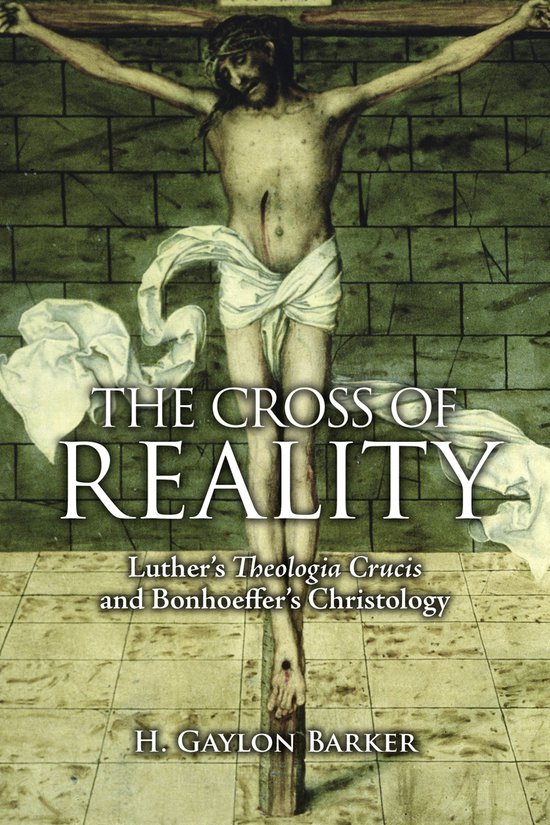
Dietrich Bonhoeffer’s theology is heavily based upon the Theologia Crucis or the Theology of the Cross which he inherited from Martin Luther. H. Gaylon Barker’s The Cross of Reality is a book-length exposition of this important aspect of Bonhoeffer’s theology that brings an enormous amount of material and analysis to bear.
Barker’s analysis of Bonhoeffer’s theology of the cross is worth quoting at length:
“One problem… religion produces , from Bonhoeffer’s perspective, is that it plays on human weakness. In the world in which people live out their lives… this means a disjuncture or contradiction. Daily people rely on their strengths, in which they don’t need God. In practical terms, therefore, God is pushed to the margins, turned to only as a ‘stop-gap’ when other sources have given out. Then God, perceived as a deus ex machina, is brought in to rescue people. This, in turn, leads to the religious conception of God and religion in general as being only partially necessary; they are not essential, but peripheral. All of this leads to intellectual dishonesty, which is not so unlike luther’s description of the theology of glory. The strength of the theology of the cross, on the other hand, is that it calls a thing what it is. It is honest about both God and the world, thereby enabling one to live in the world without seeking recourse in heavenly or escapist realigous practices. Additionally, such religious thinking leads to the creation of a God to suit human needs… For Bonhoeffer and Luther, however, the real God is one who doesn’t appear only in the form we might expect, one whom we can incorporate into our worldview or lifestyle. God is one who is always beyond our grasp, but at the same time is a hidden presence in the world” (394).
Barker highlights Bonhoeffer’s own words to make this point extremely clear:
“[W]e have to live in the world… [O]ur coming of age leads us to a truer recognition of our situation before God. God would have us know that we must live as those who manage their lives without God. The same God who is with us is the God who forsakes us (Mark 15:34! [“And at three in the afternoon Jesus cried out in a loud voice, ‘Eloi, Eloi, lema sabachthani?‘ (which means ‘My God, my God, why have you forsaken me?’)”]). The same God who makes us to live in the world without the working hypothesis of God is the God before whom we stand continually. Before God, and with God, we live without God. God consents to be pushed out of the world and onto the cross; God is weak and powerless in the world and in precisely this way, and only so, is at our side and helps us. Matt. 8:17 [“This was to fulfill what was spoken through the prophet Isaiah: ‘He took up our infirmities and bore our diseases.’] makes it quite clear that Christ helps us not by virtue of his omnipotence but rather by virtue of his weakness and suffering!” [388, quoted from DBWE 8:478-479]
Thus, for Bonhoeffer, God is not there as the divine vending machine, there to send out blessings when needed or called upon due to human inability. Instead, God enters into the world and by suffering, alongside us, helps us.
Bonhoeffer put it thus: “Only a suffering God can help.” Bonhoeffer, seeing the world as it was in his time, during the reign of terror of the Nazis, imprisoned, knew and saw the evils of humanity. And he knew that in seeing this, theodicy would fail. A God who worked only through omnipotence and only where human capacities failed was a God that did not exist. Instead, the God who took on our suffering and came into the world, who “by viture of his weakness and suffering” came to save us, is the only one who acts in the world–in reality.
Only a suffering God can help.
Links
Dietrich Bonhoeffer– read all my posts related to Bonhoeffer and his theology.
SDG.
——
The preceding post is the property of J.W. Wartick (apart from quotations, which are the property of their respective owners, and works of art as credited; images are often freely available to the public and J.W. Wartick makes no claims of owning rights to the images unless he makes that explicit) and should not be reproduced in part or in whole without the expressed consent of the author. All content on this site is the property of J.W. Wartick and is made available for individual and personal usage. If you cite from these documents, whether for personal or professional purposes, please give appropriate citation with both the name of the author (J.W. Wartick) and a link to the original URL. If you’d like to repost a post, you may do so, provided you show less than half of the original post on your own site and link to the original post for the rest. You must also appropriately cite the post as noted above. This blog is protected by Creative Commons licensing. By viewing any part of this site, you are agreeing to this usage policy.
Learning about Reformation History: “Melanchthon: The Quiet Reformer” by Clyde L. Manschreck
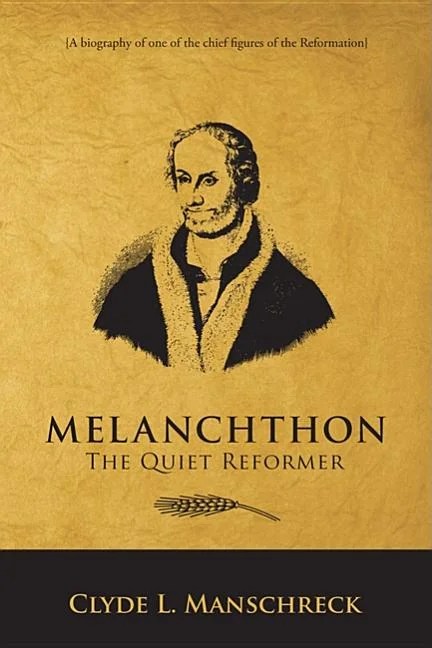
I have long wondered about Philip Melanchthon. He seemed to get vilified in a lot of Lutheran circles I ran in, but he also was clearly at the forefront of Lutheran theology at the time of its formation. Luther rarely seemed to have said anything negative about Melanchthon, but the charge was that he turned away from Lutheranism later in his life and compromised. Enter Clyde L. Manschreck’s excellent biography, Melanchthon: The Quiet Reformer. Manschreck presents a fascinating, balanced perspective on Melanchthon, one of the most intriguing of Reformation persons.
Manschreck starts off, appropriately enough, with looking at how Melanchthon has been treated historically. Surprisingly few biographies exist of the Reformer, especially compared to other luminaries of the period who had less of an impact. After his death, there was criticism from three fronts: he was too Lutheran for Catholics, too Calvinist for Lutherans, and too Catholic for Calvinists. That’s oversimplifying it a bit, but it becomes clear that his legacy was marred by attacks from all sides. So who was the man, and what did he really believe–and was he an infamous compromiser?
Manschreck moves very swiftly past Melanchthon’s early life, almost immediately settling into the time that brought him to Wittenberg. But as Manschreck paints the picture of Melanchthon’s time there, first as an extraordinary lecturer with phenomenal skill and later as a Reformer, we also get deep insight into his character and beliefs. Melanchthon, like many early Lutherans (and a huge amount of the surrounding population) believed in astrology. It’s a strange thing when you look back on it, but it was conceived as a kind of science. Melanchthon was a firm believer, even lamenting the sign a child-in-law was born under when he came to dislike them. Melanchthon also was a champion for public schools, creating the first publicly funded schools across Germany, and advocated for (and got) living wages for teachers. His reasoning was that if a teacher had to work yet another job to just be able to eat or live, the wouldn’t be able to focus on bettering their mind and, in turn, their students’ minds.
Melanchthon and Luther hit it off almost immediately, and Melanchthon joining the Reformation was an organic thing, rather than something one can just point to a single moment as the moment of changing of heart. He clearly believed in the arguments of justification, and ultimately became one of the primary (or the primary) authors of much of the Lutheran Confessions. Setting the writing of these alongside the circumstances in which they occurred makes them more understandable. The Augsburg Confession being prepared to try to, in part, make it clear that their movement wasn’t heretical and could be defended on Scriptural grounds is a fascinating story. Additional clarification due to attempts to unite with other Reformers–attempts that ultimately failed with Zwingli and Calvin–is also set in its historical perspective. The writing of the Confessions should not be separated in understanding from their historical circumstances.
Fascinating historical details about Melanchthon’s life can be found in abundance. Did you know that he had no small amount of correspondence with Henry VIII? The latter desired Melanchthon’s comments on his marriage, hoping the Reformer might be open to giving him an out. Even when Melanchthon failed to deliver for Henry VIII, the King realized the political expediency of an alliance and, perhaps, even was swayed ever so slightly towards some Protestant points. Manschreck makes it clear Henry VIII’s interest was almost certainly political–how to get out of an undesired marriage in a desirable way.
Ultimately, Manschreck paints Melanchthon as a man of convictions who was willing to change his beliefs as he learned more. One of the most obvious examples was Melanchthon’s shift towards a kind of spiritualized view of real presence regarding the Lord’s Supper. What’s interesting with this is that Manschreck is able to document that Luther was aware of this shift and yet explicitly did not condemn it, despite multiple means and opportunities to do so. Was it out of respect for Melanchthon? Or was it a recognition that Melanchthon’s position was somewhere within the Lutheran fold (a fold that is anachronistic to apply to the situation anyway)? I don’t know, but it is worth reading the whole account, including Luther’s non-condemnation. Perhaps Melanchthon could be somewhat welcomed back into Lutheran teaching on some level? Again, I know not. But what’s clear is that Melanchthon sought to go back to the source (the ad fontes of the Reformation and Renaissance) and to understand Scripture’s teaching without trying to invent new doctrines.
Melanchthon: The Quiet Reformer is a superb biography that is well worth the read by any wishing to learn more about one of the most important figures of the early Reformation. I found it informative, balanced, and of interest to even broader world events.
Links
Reformation Theology– Check out all my posts on various topics related to the Reformation (scroll down for more).
SDG.
——
The preceding post is the property of J.W. Wartick (apart from quotations, which are the property of their respective owners, and works of art as credited; images are often freely available to the public and J.W. Wartick makes no claims of owning rights to the images unless he makes that explicit) and should not be reproduced in part or in whole without the expressed consent of the author. All content on this site is the property of J.W. Wartick and is made available for individual and personal usage. If you cite from these documents, whether for personal or professional purposes, please give appropriate citation with both the name of the author (J.W. Wartick) and a link to the original URL. If you’d like to repost a post, you may do so, provided you show less than half of the original post on your own site and link to the original post for the rest. You must also appropriately cite the post as noted above. This blog is protected by Creative Commons licensing. By viewing any part of this site, you are agreeing to this usage policy.
Book Review: “Martin Luther and the Rule of Faith” by Todd R. Hains

Martin Luther and the Rule of Faith by Todd R. Hains explores Martin Luther’s reading of scripture. It’s a topic that has occupied theologians for hundreds of years, but Hains presents it in a way that allows readers to see Luther’s reading of scripture contextually.
Hains notes Luther’s words against reason and notes how it has been misunderstood. Then, he turns to the questions that arose in reading scripture, including the question of when scripture might be read against itself. This led Luther, Hains argues, to reading scripture in much the same way as others in church history had–reading it as a book of faith that speaks with the power of the Spirit (11).
The rule of faith, however, is to be understood not abstractly but as reading through ancient catechesis- the use of the Ten Commandments, the Apostle’s Creed, and the Lord’s Prayer. By understanding this as the foundation of Luther’s reading of scripture, the notion of sola scriptura as well as his reading in certain places becomes more evident. Not only does Luther follow the ancient catechesis in his own catechism (57ff), but it also helps illuminate how Luther read the Law (89ff especially). Here, Hains notes, that Luther argued that the Torah would be seen by reason as a “jumble of stories and random laws” while the rule of faith leads to seeing the Torah as books that “teach faith and its fruits” (93).
Martin Luther and the Rule of Faith is an intriguing look at Luther’s reading of scripture. Readers interested in what Luther may have meant by sola scriptura and how he practiced it will find it insightful.
All Links to Amazon are Affiliates links
Links
Be sure to check out the page for this site on Facebook and Twitter for discussion of posts, links to other pages of interest, random talk about theology/philosophy/apologetics/movies and more!
Book Reviews– There are plenty more book reviews to read! Read like crazy! (Scroll down for more, and click at bottom for even more!)
SDG.
——
The preceding post is the property of J.W. Wartick (apart from quotations, which are the property of their respective owners, and works of art as credited; images are often freely available to the public and J.W. Wartick makes no claims of owning rights to the images unless he makes that explicit) and should not be reproduced in part or in whole without the expressed consent of the author. All content on this site is the property of J.W. Wartick and is made available for individual and personal usage. If you cite from these documents, whether for personal or professional purposes, please give appropriate citation with both the name of the author (J.W. Wartick) and a link to the original URL. If you’d like to repost a post, you may do so, provided you show less than half of the original post on your own site and link to the original post for the rest. You must also appropriately cite the post as noted above. This blog is protected by Creative Commons licensing. By viewing any part of this site, you are agreeing to this usage policy.
Book Review: “Doing Theology with the Reformers” by Gerald L. Bray

The theology of the Reformation is a deep, complex issue. Gerald L. Bray is the editor of a number of commentaries, including Reformation Commentaries on Scripture and numerous other books. He brings much experience to the questions related to bringing the theology of the Reformers to light for modern readers. Bray’s book Doing Theology with the Reformers is an excellent place for readers to start gaining an understanding of the questions, controversies, and ongoing conclusions of the Reformation.
Bray divides the book into six major topics, each with a chapter dedicated to it: the education of a reformer, the sources of theological authority, the interpretation of the Bible, the work of the Holy Spirit, the Godly commonwealth, and the emergence of confessional theology. Each of these chapters has several subdivisions that help readers learn about each major topic.
The book excels at bringing to the forefront topics that will challenge readers to be careful in their interpretation of the Reformers’ theology. The Reformers clearly situated within their own cultural contexts (often with theology tailored to speak to then-current events), and those contexts are important for understanding how to read them and why their thoughts developed in the directions they did. The chapter on education is a great example of this, demonstrating that the Reformers’ had their own academic experiences that are far different from those of today.
The chapter on the sources of theology was fascinating, showing how the Reformers sought to go back to the source—the Scriptures–while also acknowledging the difficulties presented by attempting such an approach. The following chapter on the interpretation of the Bible in the Reformers’ thought is enlightening, as it shows that the modern debates over the same often experience similar difficulties to those of today. Bray argues that the Reformation Hermeneutic, however, is intensely personal in the sense that it is primarily about transformation: the Reformation hermeneutic demanded the work of the Spirit in the hearts and minds of believers and the Bible could not be rightly understood outside of that experience (103-104).
The work of the Holy Spirit was taken in different ways by many Reformers and led to some of the greatest rifts theologically both then and today. Such issues as the Sacraments and the Christian life served as dividing lines for the Reformers. These issues continue to divide Christians today. Additionally, the question of what it means to have church and state is dramatically divisive, just as it was in the time of the Reformation. During the Reformation, there was also a revitalized interest in confessionalism, proclaiming the specifics of different faith traditions as they emerged. Bray ties the book together with an attempt to show some of the core theological emphases of the Reformation. These are the radical character of the Fall, salvation, the church, and spiritual authority.
Doing Theology with the Reformers is a fascinating introduction to the Reformers’ thought. The exploration of the Reformers’ emergent and emerging thought–along with how it developed and its origins–makes the book a valuable resource for those interested in Reformation theology today.
Links
Be sure to check out the page for this site on Facebook and Twitter for discussion of posts, links to other pages of interest, random talk about theology/philosophy/apologetics/movies and more!
Book Reviews– There are plenty more book reviews to read! Read like crazy! (Scroll down for more, and click at bottom for even more!)
SDG.
——
The preceding post is the property of J.W. Wartick (apart from quotations, which are the property of their respective owners, and works of art as credited; images are often freely available to the public and J.W. Wartick makes no claims of owning rights to the images unless he makes that explicit) and should not be reproduced in part or in whole without the expressed consent of the author. All content on this site is the property of J.W. Wartick and is made available for individual and personal usage. If you cite from these documents, whether for personal or professional purposes, please give appropriate citation with both the name of the author (J.W. Wartick) and a link to the original URL. If you’d like to repost a post, you may do so, provided you show less than half of the original post on your own site and link to the original post for the rest. You must also appropriately cite the post as noted above. This blog is protected by Creative Commons licensing. By viewing any part of this site, you are agreeing to this usage policy.
Book Review: “Reformation Commentary on Scripture: Psalms 73-150” edited by Herman J. Selderhuis
 The Reformation Commentary on Scripture series focuses on sharing insights from Reformation theologians on the Bible. Here, we’ll take a brief look at the commentary on Psalms 73-150.
The general introduction gives readers insight into the different schools of interpretation that developed during the Reformation. The introduction to this Psalms, specific to this volume, provides readers with some background on understanding the context in which the Reformers wrote, along with some common themes. For example, the fact that the Psalms were effectively a prayerbook for the Hebrews lead to it being seen as a prayerbook for the church, from which the Reformers derived no small amount of theology. Selderhuis also comments on the anti-Semitic (he calls it anti-Judaic to try to avoid anachronisms associating it with more modern anti-Semitism) sentiment found in so many of the Reformers. He comments on the irony of the fact that so many Reformers loved the Hebrew language and interacted with various Jewish scholars to do their interpretation, but remained anti-Judaic in their comments and attitude. He also notes how the Reformers saw in the Psalms a model for how we Christians ought to rejoice, ask, and pray.
The selection of contributors for this volume is quite well done. It is particularly interesting to see the comments of Cardinal Cajetan (best known for his opposition for Luther) set alongside those of Martin Luther. Another comparison to make is between John Calvin and Jacobus Arminius. Other, lesser known names, are just as interesting. Martin Bucer is one of the most well-known of these “less known” contributors, such as Wolfgang Musculus or the English Annotations. These diverse and broad perspectives allow for the occasional side-by-side look at opposing schools, along with giving readers insights into some of the figures of the Reformation they may not have encountered otherwise. Some of the contributors were unknown to me. There is, as with every volume, a useful set of brief (short to long paragraph-length) biographical sketches of each contributor to give some background.
Perhaps the most consistent theme in the Psalms with the Reformers is their reading of the Psalms as being about Christ. Time and again, various Reformers (but particularly Luther) assert that a certain Psalm just is about Christ. Other times, with imprecatory Psalms, for example, it is fascinating to see the divergence among the Reformers. Psalm 109 is a good example of this. Luther, for example, reads it as a warning against taking vengeance in one’s own hands. Johannes Althamer and Johann Rurer read it as a curse against heresy and factions–a clear reading of their own historical context into the Bible. Robert Bellarmine reads the Psalm straightforwardly as being about Christ being persecuted by Judas and the Jews, but here we don’t see Luther offering such a comment (though he may have–it may just not appear in this volume). Calvin sees it as an exhortation to believers to bring every care to God. Though most of these aren’t strictly contradictory, this shows how diverse the Reformers could be in reading a single Psalm. Moreover, it shows the general penchant for reading their own current events into Scripture (or vice versa) and for reading Christ into parts of Scripture.
Psalm 104 is another fascinating study, as it has led to different discussions in our own day, too. Modern readers sometimes turn to this passage to see what it may say about creation debates–something that doesn’t come up in the Reformation discussion of the same passage. A hotly disputed part in this Psalm (hotly disputed in an American evangelical context, anyway) is the meaning of the Behemoth, and here the only suggestion about that is that it was a large beast–possibly one generally unknown. This helps give modern readers some perspective, too. Like the Reformers, our own concerns about what the text should say can sometimes come into our readings of the texts. Reading commentaries from those who lived in different times can offer a corrective for that, letting us see how the issues we assume are central to the text were understood–or not–by others.
It may be a foregone conclusion to say this volume on Psalms 73-150 is essential for anyone interested in Reformation readings of Scripture. The Psalms are an area that the Reformers across the board focused on, and it gives critical perspective on how various Reformers read Scripture. I recommend it.
Disclaimer: I was provided with a copy of the book for review by the publisher. I was not required to give any specific kind of feedback whatsoever.
Links
Be sure to check out the page for this site on Facebook and Twitter for discussion of posts, links to other pages of interest, random talk about theology/philosophy/apologetics/movies and more!
Book Reviews– There are plenty more book reviews to read! Read like crazy! (Scroll down for more, and click at bottom for even more!)
SDG.
——
The preceding post is the property of J.W. Wartick (apart from quotations, which are the property of their respective owners, and works of art as credited; images are often freely available to the public and J.W. Wartick makes no claims of owning rights to the images unless he makes that explicit) and should not be reproduced in part or in whole without the expressed consent of the author. All content on this site is the property of J.W. Wartick and is made available for individual and personal usage. If you cite from these documents, whether for personal or professional purposes, please give appropriate citation with both the name of the author (J.W. Wartick) and a link to the original URL. If you’d like to repost a post, you may do so, provided you show less than half of the original post on your own site and link to the original post for the rest. You must also appropriately cite the post as noted above. This blog is protected by Creative Commons licensing. By viewing any part of this site, you are agreeing to this usage policy.
Book Review: “Bonhoeffer’s Reception of Luther” by Michael P. DeJonge
 Michael P. DeJonge’s thesis in Bonhoeffer’s Reception of Luther may be summed up as saying the best interpretative framework for understanding Dietrich Bonhoeffer’s theology and thought is by understanding him as a Lutheran theologian specifically engaged in Luther’s thought.
DeJonge supports his thesis primarily through two strands of evidence: first, by showing Bonhoeffer’s close readings of and interactions with Luther; and second, by demonstrating that Bonhoeffer’s perspective on important controversies was a Lutheran perspective.
Bonhoeffer’s interactions with Luther outpace his interactions with any other theologian. DeJonge cites a statistic: Bonhoeffer cites or quotes Luther 870 times, “almost always approvingly”; “The next most frequently cited theologian is a distant second, Karl Barth with fewer than three hundred” (1). This alone may serve to demonstrate Bonhoeffer’s concern for interacting with Luther, but DeJonge goes on to note that Bonhoeffer also strove to correct competing interpretations of Luther, and affirm specifically Lutheran doctrine. For instance, in his interactions with Karl Holl, one of his teachers, he goes against Holl’s interpretation of Luther’s view of religion, arguing that Luther’s Christology saves one from idolatry of the conscience, which he felt Holl may have slipped into. Bonhoeffer also affirmed the emphasis on Christ’s “is” statements when it came to the Lord’s Supper, defending the position that “this is my body” means Christ is truly present in the Supper (70ff).
DeJonge’s argument expands to a demonstration that Bonhoeffer aligned with a Lutheran understanding on important issues. The Lord’s Supper has already been noted, but it is worth pointing out that in regards to this, Bonhoeffer explicitly sided with Luther against Karl Barth and the Reformed tradition, which argued that the finite could not contain the infinite. Instead, Bonhoeffer affirmed that, by virtue of the infinite, the infinite could be contained in the finite; allowing for a Lutheran understanding of real presence in the Supper. Another major controversy DeJonge notes is that of the interpretation of Luther’s “Two Kingdoms.” DeJonge argues that Bonhoeffer has been misunderstood as rejecting Luther’s doctrine in part because Luther’s doctrine itself is misunderstood. Thus, DeJonge engages in a lengthy section in which he traces the influence of Troelsch on the understanding of Luther’s Two Kingdoms and how often it is Troelsch’s understanding rather than Luther’s that is seen as “the” doctrine of the Two Kingdoms. Going against this, Bonhoeffer’s thoughts on the Two Kingdoms are closer to Luther’s position than many have argued.
DeJonge also interacts with other interpretations of Bonhoeffer, such as an understanding of Bonhoeffer as a pacifist, which has been a common understanding among some. Utilizing his deep analysis of the Two Kingdoms doctrine, DeJonge counters that Bonhoeffer’s comments about resisting the Nazis align with this doctrine much more closely than they do to a pacifist understanding. Like Stephen R. Haynes’s The Battle for Bonhoeffer, DeJonge notes that Bonhoeffer’s resistance cannot be linked explicitly to the Nazi treatment of the Jews. Though it is clear that Bonhoeffer detested this treatment, DeJonge argues he did so not through a broadly humanitarian theology (going against some interpreters here), but rather due to his understanding, again, of the Two Kingdoms. When the Nazis sought to attack the Jews, particularly by separating them from the so-called German Christians, they issued a direct assault on the body of Christ–the church. Thus, Bonhoeffer’s resistance to these ideals, again, springs from a Lutheran understanding of the Two Kingdoms. (As an aside, it is worth nothing DeJonge also acknowledges the contributions some aspects of Martin Luther’s own writings had to the Nazi ideology. However, DeJonge here shows how Bonhoeffer’s understanding of his theology set him against these anti-Semitic notions.)
Finally, DeJonge demonstrates that Bonhoeffer’s view of justification–certainly a vastly important doctrine for Luther and Lutherans–ought to be properly understood as Lutheran rather than anything else. Time and again, throughout the book, DeJonge carefully demonstrates how an interpretation of Bonhoeffer suffers when not understood in a Lutheran lens. Over and over, readings of Bonhoeffer that make sense in one context are shown to fail when compared to the whole of his writings. DeJonge also manages to offer a coherent account of Bonhoeffer’s theology that does not set an “early Bonhoeffer” against a “late Bonhoeffer” nor does it read the whole of his thought through any one work. As such, DeJonge offers a truly compelling reading of the totality of Bonhoeffer’s work.
Bonhoeffer’s Reception of Luther is an incredibly important work for understanding the theology of Dietrich Bonhoeffer. Anyone who is interested at all in the theology of Bonhoeffer and understanding it fully would do well to read and digest it. I cannot recommend it highly enough for those who wish to understand the theology of this man.
Disclaimer: I was provided with a copy of the book for review by the publisher. I was not required to give any specific kind of feedback whatsoever.
Links
Be sure to check out the page for this site on Facebook and Twitter for discussion of posts, links to other pages of interest, random talk about theology/philosophy/apologetics/movies and more!
Book Reviews– There are plenty more book reviews to read! Read like crazy! (Scroll down for more, and click at bottom for even more!)
SDG.
——
The preceding post is the property of J.W. Wartick (apart from quotations, which are the property of their respective owners, and works of art as credited; images are often freely available to the public and J.W. Wartick makes no claims of owning rights to the images unless he makes that explicit) and should not be reproduced in part or in whole without the expressed consent of the author. All content on this site is the property of J.W. Wartick and is made available for individual and personal usage. If you cite from these documents, whether for personal or professional purposes, please give appropriate citation with both the name of the author (J.W. Wartick) and a link to the original URL. If you’d like to repost a post, you may do so, provided you show less than half of the original post on your own site and link to the original post for the rest. You must also appropriately cite the post as noted above. This blog is protected by Creative Commons licensing. By viewing any part of this site, you are agreeing to this usage policy.
Jews and the Book of Concord: Why we cannot affirm “unconditional subscription”
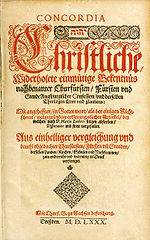
A title page of the Book of Concord
I’m a Lutheran, though some would say I am not. Why? Because many try to define out of existence those who adhere to the Book of Concord “in so far as” it agrees with Scripture as opposed to “because” it agrees with Scripture. Entire denominations argue that the affirmation “because” is the only way to be a genuine Lutheran. I have argued that this places adherents in an impossible situation before. First, I’ve argued that there are actually wrong interpretations of Scripture in the Book of Concord. There is also at least one etymological error. Must Lutherans, to be Lutheran, be saddled with these? According to the “because” position, the answer is yes, they must affirm these errors.
But it gets worse. In light of the despicable act of evil that occurred in Pittsburgh and with Reformation Day having just passed, I’ve been reading about Martin Lutherr and also decided to look up what the Book of Concord says about Jews. I believe the latter demonstrates conclusively that we cannot and must not give the Book of Concord “unconditional subscription.”
Unconditional Subscription?
I take my definition from one of the conservative Lutheran sites that is pushing for this as the definition of Lutheran:
What is an “unconditional subscription” to the Confessions?
Confessional Lutheran pastors are required to “subscribe,” that is, to pledge their agreement unconditionally with the Lutheran Confessions precisely because they are a pure exposition of the Word of God. This is the way our pastors, and all laypeople who confess belief in the Small Catechism, are able with great joy and without reservation or qualification to say what it is that they believe to be the truth of God’s Word. (Lutheran Reformation emphasis removed)
Unconditional subscription, then, is the notion that Lutherans must pledge to agree without reservation to the entirety of the Lutheran Confessions, which are those contained in the Book of Concord.
Jews and the Book of Concord
I have not cited every instance of the occurrence of “Jew” or “Jewish” in the Book of Concord. Rather, here I’ll be citing three instances which I believe demonstrate beyond a doubt that we cannot affirm unconditional subscription without seriously compromising our morality.
The first section comes from the Apology of the Augsburg Confession, Article XIII, section 18:
This is absolutely a Jewish opinion, to hold that we are justified by a ceremony, without a good disposition of the heart, i.e., without faith.
There are a number of problems with this sentence even apart from the use of “Jewish” here. First, it doesn’t just imply but states that Jewish “opinion” believes in justification without faith. Yet this contradicts the New Testament’s own teaching on the faith of Jewish people. For example, Hebrews 11:8-10:
By faith Abraham obeyed when he was called to go out to a place that he was to receive as an inheritance. And he went out, not knowing where he was going. By faith he went to live in the land of promise, as in a foreign land, living in tents with Isaac and Jacob, heirs with him of the same promise. For he was looking forward to the city that has foundations, whose designer and builder is God.
So Abraham, the father of Judaism, acted by faith, looking forward to the city whose designer is God. This famous passage in the New Testament goes on to affirm the faith of Rahab, Sarah, Jacob, the Israelites coming out of Egypt, and many, many more Jews, noting, ultimately, that though they acted on faith none of them received the promised final perfection (Hebrews 11:39-40). So the Book of Concord appears to simply be wrong in this offhanded remark about how “Jewish opinion” holds to a position that is “without faith.”
The next sentence in the Apology states that this “Jewish opinion,” now united with the Pope, is “impious” and “pernicious.” This ascribed to a view of faith that was simply assigned offhandedly to the Jewish people without proof!
The Large Catechism is one of the most important expositions of Lutheran faith, and therein, regarding the Ten Commandments, it is stated (Conclusion of the Ten Commandments, section 330):
Therefore it is not in vain that it is commanded in the Old Testament to write the Ten Commandments on all walls and corners, yes, even on the garments, not for the sake of merely having them written in these places and making a show of them, as did the Jews…
Here, a practice of Jews is simply dismissed offhand as “making a show” of the Ten Commandments. Jewish practice surrounding the Ten Commandments is dismissed as simply for the sake of having them written; as if the Jewish people had no more regard for the Ten Commandments than anyone else. I hope it need not be stated that we should not “unconditionally subscribe” to this.
A final example comes from the Solid Declaration VII, section 30:
Whosoever shall eat this bread, and drink this cup of the Lord, unworthily, [1 Corinthians 11:27] sins not merely against the bread and wine, not merely against the signs or symbols and emblems of the body and blood, but shall be guilty of the body and blood of the Lord Jesus Christ, which, as there [in the Holy Supper] present, he dishonors, abuses, and disgraces, as the Jews, who in very deed violated the body of Christ and killed Him; just as the ancient Christian Fathers and church-teachers unanimously have understood and explained this passage.
Here is a seriously problematic passage, though it is historically tied to the context. The Germany of Luther’s day was filled with anti-Semitic imagery, sayings, and practices. Churches had imagery of Jews suckling on pigs; the notion of Jews as killers of Christ was quite common. And here, in the Book of Concord, we see that leaking in, as Jews generally, not just a handful of people but all Jews are blamed for the “violation” of the body of Christ and killing him. Not only that, but it is alleged that the Church Fathers and “church-teachers” unanimously agree upon this language. This is exactly the language that is used to this day to attack Jews as “Christ-killers” and to raise anti-Semitic sentiment among Christians. This is the kind of language that we must take a firm stand against.
I realize some may stand up and try to cite 1 Thessalonians 2:14-16 here, arguing that the New Testament teaches specifically that Jews killed Jesus. Such would be a mistaken conclusion, because it also speaks of “the Jews” as killing the prophets. Jesus and the prophets were Jewish, and the common use of the phrase “Jews” in the New Testament refers to the leaders (see its use in the Gospels, each written by people who were Jewish, to refer to certain factions among Judaism).
Conclusion
I have already argued that the Book of Concord has errors of etymology and interpretation. In this post, we see that its treatment of the Jews is deeply problematic. Those who argue that we must have “unconditional subscription” to the Book of Concord must affirm these problematic statements in the name of being a “true” Lutheran. But what is more Lutheran than self-examination, confession of sins (like those of anti-Semitism), and the continuing Reform of the church? What can be more Lutheran than demanding that any document with which we agree, we will only agree with “in so far as” it agrees with Scripture?
Links
Be sure to check out the page for this site on Facebook and Twitter for discussion of posts, links to other pages of interest, random talk about theology/philosophy/apologetics/movies and more!
Adhering to the Book of Concord “In So Far As” or “Because” it Agrees with Scripture?– I argue that Lutherans must hold the position that we adhere to the Book of Concord In So Far As it Agrees with Scripture.
Another Problem for Book of Concord Inerrantists– I discuss an etymological error in the Book of Concord.
Eclectic Theist– Check out my other blog for posts on Star Trek, science fiction, fantasy, books, sports, food, and more!
SDG.
——
The preceding post is the property of J.W. Wartick (apart from quotations, which are the property of their respective owners, and works of art as credited; images are often freely available to the public and J.W. Wartick makes no claims of owning rights to the images unless he makes that explicit) and should not be reproduced in part or in whole without the expressed consent of the author. All content on this site is the property of J.W. Wartick and is made available for individual and personal usage. If you cite from these documents, whether for personal or professional purposes, please give appropriate citation with both the name of the author (J.W. Wartick) and a link to the original URL. If you’d like to repost a post, you may do so, provided you show less than half of the original post on your own site and link to the original post for the rest. You must also appropriately cite the post as noted above. This blog is protected by Creative Commons licensing. By viewing any part of this site, you are agreeing to this usage policy.
Book Review: “Reformation Commentary on Scripture: New Testament XIII- Hebrews, James” edited by Ronald K. Rittgers
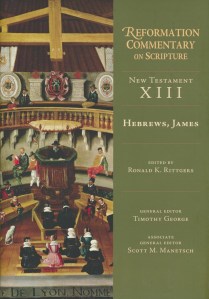 The Reformation Commentary on Scripture series focuses on sharing insights from Reformation theologians on the Bible. Here, we’ll take a look at the Hebrews, James volume of this extensive series.
I was particularly excited to read and review this volume of the series, because Hebrews and James were especially controversial in the Reformation period. The editor of this volume, Ronald K. Rittgers, does an excellent job of both showing that controversy over these books while also bringing forward some unified themes of the Reformers in regards to them. As a Lutheran, I found the various quotes and notes from Luther and other early Lutherans (particularly Veit Dietrich) to be of great interest. Luther infamously called James an epistle of straw, and here we have his quote in its context. It seems clear that the notions of inerrancy of modern evangelicalism cannot easily be read back onto many of these Reformers. When you have one explicitly stating that James is “worthy of censure in some places” (Veit Dietrich), it is hard to say that the Reformers unanimously would have affirmed modern notions of biblical inerrancy. Reading what these reformers actually said about specific Christian doctrines may serve as a corrective to some clearly false statements.
Of course, reading these Reformers also means we get insight into the controversies of their time, and we see, for example, John Calvin hitting back at those “who do not think [James is] entitled to authority” because he sees “no just cause for rejecting it” (quoted p. 202). Other major controversies dealt with Christology, human and divine responsibility for evil, and works righteousness. These issues are presented with multiple Reformation perspectives given, making the volume an essential resource for those wishing to look more deeply into some major modern controversies as well. Other areas are less controversial, such as the teaching of the eternally begotten Son–an orthodox position unfortunately rejected by some today.
Both the general introduction and the Editor’s introduction to this volume were informative and well worth reading on their own. They each provided much-needed background for understanding some of the controversies, as well as the names, involved in the text.
Volume XIII of the New Testament series of Reformation Commentary on Scripture is a simply excellent resources for those interested in reading and understanding Scripture. Reformation thinkers share much wisdom and insight. The conflicts that happened then, in some ways, still impact us today. By reading these voices from the past we can begin to understand our present more fully. I highly recommend this volume.
Disclaimer: I was provided with a copy of the book for review by the publisher. I was not required to give any specific kind of feedback whatsoever.
Links
Be sure to check out the page for this site on Facebook and Twitter for discussion of posts, links to other pages of interest, random talk about theology/philosophy/apologetics/movies and more!
Book Reviews– There are plenty more book reviews to read! Read like crazy! (Scroll down for more, and click at bottom for even more!)
SDG.
——
The preceding post is the property of J.W. Wartick (apart from quotations, which are the property of their respective owners, and works of art as credited; images are often freely available to the public and J.W. Wartick makes no claims of owning rights to the images unless he makes that explicit) and should not be reproduced in part or in whole without the expressed consent of the author. All content on this site is the property of J.W. Wartick and is made available for individual and personal usage. If you cite from these documents, whether for personal or professional purposes, please give appropriate citation with both the name of the author (J.W. Wartick) and a link to the original URL. If you’d like to repost a post, you may do so, provided you show less than half of the original post on your own site and link to the original post for the rest. You must also appropriately cite the post as noted above. This blog is protected by Creative Commons licensing. By viewing any part of this site, you are agreeing to this usage policy.
Perspicuity of Scripture in the Lutheran Reformers: Reformation 500
 2017 marks the 500th anniversary of what is hailed by many as the start of the Reformation: Luther’s sharing his 95 Theses. I’ve decided to celebrate my Lutheran Protestant Tradition by highlighting some of the major issues that Luther and the Lutherans raised through the Reformation period. I hope you will join me as we remember the great theological (re)discoveries that were made during this period.
Perspicuity of Scripture in the Lutheran Reformers
Luther himself wrote on perspicuity in no uncertain terms:
[T]hat in Scripture there are some things abstruse, and everything is not plain–this is an idea put about by the ungodly Sophists… I admit… that there are many texts in the Scriptures that are obscure and abstruse, not because of the majesty of their subject matter, but because of our ignorance of their vocabulary and grammar; but these texts in no way hinder a knowledge of al the subject matter of Scripture. (Luther, The Bondage of the Will, 110, cited below)
So far as I know, Luther did not change his stance on the perspicuity of Scripture. As the Reformation continued, however, it became clear that such a stance might not be appropriate regarding the entirety of every declaration of Scripture. Lutheran reformers qualified perspicuity, noting that it applied only to that which pertains to salvation.[1] Heinrich Schmid, in his Doctrinal Theology of the Evangelical Lutheran Church (translated 1875) compiles quotations from the major early Lutheran reformers to outline what Lutherans taught. Regarding perspicuity, Schmid notes:
If the Sacred Scriptures contain everything necessary to salvation, and if they alone contain it, they must necessarily exhibit it so clearly and plainly that it is accessible to the comprehension of every one; hence the attribute of Perspicuity is ascribed to the Sacred Scriptures… But whilst such perspicuity is ascribed to the Sacred Scriptures, it is not meant that every particular that is contianed in them is equally clear and plain to all, but only that all that is necessary to be known in order to salvation is clearly and plainly taught in them… it is also not maintained that the Sacred Scriptures can be understood without the possession of certain prerequisites [such as the language, maturity of judgment, unprejudiced mind, etc.].(Schmid, 87-88, emphasis his)
Schmid’s summary of Lutheran doctrine in the Reformation period sounds different from what Luther taught in The Bondage of the Will, but he shows from direct citations that this is the direction Lutherans moved in regarding perspicuity. To whit, Gerhard:
It is to be observed that when we call the Scriptures perspicuous, we do not mean that every particular expression, anywhere contained in Scripture, is so constituted that at the first glance it must be plainly and fully understood by every one. On the other hand, we confess that certain things are obscurely expressed in Scripture and difficult to be understood… (quoted in Schmid, 89)
Quenstedt:
We do not maintain that all Scripture, in every particular, is clear and perspicuous. For we grant that certain things are met with in the sacred books that are very obscure… not only in respect to the sublimity of their subject-matter, but also as to the utterance of the Holy Spirit… (ibid, 90, Quenstedt goes on to deny that there are doctrines that are so obscure that they “can nowhere be found clearly and explicitly”)
Hollaz:
The perspicuity of Scripture is not absolute, but dependent upon the use of means, inasmuch as, in endeavoring to understand it, the divinely instituted method must be accurately observed… (ibid, 91)
The whole section clarifies and explains the earliest Lutheran teaching regarding perspicuity of Scriptures, and it is clear that it is acknowledged that not every single text is plain, that the guidance of the Holy Spirit, among other things, is required to understand Scripture rightly, and that plain passage of Scripture are to be used to interpret those which seem obscure.
As I’ve argued elsewhere, this shift in perspective on perspicuity happened due to the very real differences on some major doctrines within the Protestant movement itself. If every single statement the Scriptures made about doctrine were so clear, how could such divisions exist within a movement that was upholding sola scriptura? The answer was that perspicuity applied to that which is essential for salvation, and that shift in perspective can be observed in the writings of the Lutherans listed here.
What applications might this have? The first is that the many attempts by Christians to argue for their own doctrinal perspectives simply by appealing to the perspicuity of Scriptures fails. To argue that someone else denies perspicuity of Scripture because they disagree on certain doctrinal positions is an abuse of the doctrine of perspicuity of Scriptures. It also shows an incapacity to show one’s own point clearly from the Scriptures themselves. A second application is that it acknowledges some of the difficulty in understanding Scripture rightly.
The doctrine of perspicuity is a major aspect of Reformation theology. It should not, however, be over-generalized and abused in the way that it has, unfortunately, often been used.
[1] In researching this post, I noticed that the Wikipedia page on the clarity of Scripture has been edited to suggest without qualification that all Lutherans hold to the notion that “Lutherans hold that the Bible presents all doctrines and commands of the Christian faith clearly. God’s Word is freely accessible to every reader or hearer of ordinary intelligence, without requiring any special education.” The citations provided to show that all Lutherans hold to this teaching are not to any of the early Lutheran reformers, nor are they citations of the Book of Concord; rather, they are references to two sources published by a publishing house of one form of American Lutherans. These sources are from 1934 and 1910, respectively, and not in the Reformation period nor do they, so far as I can tell, speak for all Lutherans. Given the evidence cited above from Quenstedt, Gerhard, and the like, I find it hard to believe such a claim could be substantiated.
Sources
Martin Luther, The Bondage of the Will in Luther and Erasmus: Free Will and Salvation edited by Rupp and Watson (Philadelphia, PA: Westminster Press, 1969).
Heinrich Schmid, The Doctrinal Theology of the Evangelical Lutheran Church.
Links
Be sure to check out the page for this site on Facebook and Twitter for discussion of posts, links to other pages of interest, random talk about theology/philosophy/apologetics/movies and more!
Please check out my other posts on the Reformation:
I discuss the origins of the European Reformations and how many of its debates carry on into our own day.
The notion of “sola scriptura” is of central importance to understanding the Reformation, but it is also hotly debated to day and can be traced to many theological controversies of our time. Who interprets Scripture?
The Church Universal: Reformation Review– What makes a church part of the Church Universal? What makes a church part of the true church? I write on these topics (and more!) and their origins in the Reformation.
The Continuing Influence of the Reformation: Our lives, our thoughts, our theology– I note the influence that the Reformation period continues to have on many aspects of our lives.
SDG.
——
The preceding post is the property of J.W. Wartick (apart from citations, which are the property of their respective owners, and works of art as credited) and should not be reproduced in part or in whole without the expressed consent of the author. All content on this site is the property of J.W. Wartick and is made available for individual and personal usage. If you cite from these documents, whether for personal or professional purposes, please give appropriate citation with both the name of the author (J.W. Wartick) and a link to the original URL. If you’d like to repost a post, you may do so, provided you show less than half of the original post on your own site and link to the original post for the rest. You must also appropriately cite the post as noted above. This blog is protected by Creative Commons licensing. By viewing any part of this site, you are agreeing to this usage policy.
Indulgences are Worse than Useless: Reformation 500
 2017 marks the 500th anniversary of what is hailed by many as the start of the Reformation: Luther’s sharing his 95 Theses. I’ve decided to celebrate my Lutheran Protestant Tradition by highlighting some of the major issues that Luther and the Lutherans raised through the Reformation period. I hope you will join me as we remember the great theological (re)discoveries that were made during this period.
Indulgences are Worse than Useless
Luther’s critique of indulgences was a typical (for him) combination of insight and invective. He sought to clearly condemn not just the sale of but also the use of indulgences, which means parts of his critique remain quite relevant today. Here we will draw primarily from Luther’s explanations of his 95 theses.
Luther argued that the pope actually has no power over purgatory and, moreover, that if the pope did have this power, he ought to exercise it:
If the pope does have the power to release anyone from purgatory, why in the name of love does he not abolish purgatory by letting everyone out? (81-82, cited below)
The question cuts straight to he heart of the system in which the pope is exalted as having power over souls in purgatory. It is clear that Luther did not at this point denounce the doctrine of purgatory. What his point is directed at instead, is the claim that the pope does have such power. After all, if the pope does have such power, then why would he not simply release all the souls from purgatory immediately, thus granting a most generous and wonderful reprieve? The fact that the pope of Luther’s time did not do so and was in fact selling indulgences for coin spoke volumes about the doctrine itself and the need for reformation.
But the point still has relevance today, as one might ask the question: if the pope today currently has the power over purgatory, why does he not simply release all those who are suffering there? One possible answer might be because it is just that people undergo such suffering or bettering of themselves in purgatory that they might truly be, er, reformed. But then the question of the two kingdoms comes to mind. After all, such a response effectively strips the pope of the power that has allegedly been granted him, for if the spiritual benefits of purgatory are so great, why does he ever exercise the power he is said to hold? The argument can proceed indefinitely in a circle, which seems to show that the initial point is valid.
Luther, however, did not stop there. Rather than questioning the power of the pope to grant indulgences, he also noted the great spiritual harm such indulgences do:
Indulgences are positively harmful to the recipient because they impede salvation by diverting charity and inducing a false sense of security… Indulgences are most pernicious because they induce complacency and thereby imperil salvation. Those persons are damned who think that letters of indulgence make them certain of salvation. (82)
Indulgences, by granting pardon from sin or the consequences thereof, produce a false sense of security of salvation that may lead rather to damnation. For once one believes that because someone else has told them future or past sins are paid for by some collection of merit of others, they may believe that they are forgiven, when they have not confessed and repented of that sin to God. Thus, a false sense of security is gained, but in reality the person may be condemned, not having received full and free forgiveness of their sins.
Links
Be sure to check out the page for this site on Facebook and Twitter for discussion of posts, links to other pages of interest, random talk about theology/philosophy/apologetics/movies and more!
Please check out my other posts on the Reformation:
I discuss the origins of the European Reformations and how many of its debates carry on into our own day.
The notion of “sola scriptura” is of central importance to understanding the Reformation, but it is also hotly debated to day and can be traced to many theological controversies of our time. Who interprets Scripture?
The Church Universal: Reformation Review– What makes a church part of the Church Universal? What makes a church part of the true church? I write on these topics (and more!) and their origins in the Reformation.
The Continuing Influence of the Reformation: Our lives, our thoughts, our theology– I note the influence that the Reformation period continues to have on many aspects of our lives.
Source
Quotes from Luther are from Roland Bainton, Here I Stand: A Life of Martin Luther (New York: Abingdon, 1950). It appears as though Bainton was either translating directly from a German edition or paraphrasing Luther.
SDG.
——
The preceding post is the property of J.W. Wartick (apart from citations, which are the property of their respective owners, and works of art as credited) and should not be reproduced in part or in whole without the expressed consent of the author. All content on this site is the property of J.W. Wartick and is made available for individual and personal usage. If you cite from these documents, whether for personal or professional purposes, please give appropriate citation with both the name of the author (J.W. Wartick) and a link to the original URL. If you’d like to repost a post, you may do so, provided you show less than half of the original post on your own site and link to the original post for the rest. You must also appropriately cite the post as noted above. This blog is protected by Creative Commons licensing. By viewing any part of this site, you are agreeing to this usage policy.

 J.W. Wartick - Reconstructing Faith