paleontology
Reconstructing the Past: Florrisant Fossil Beds National Monument and Young Earth Creationism
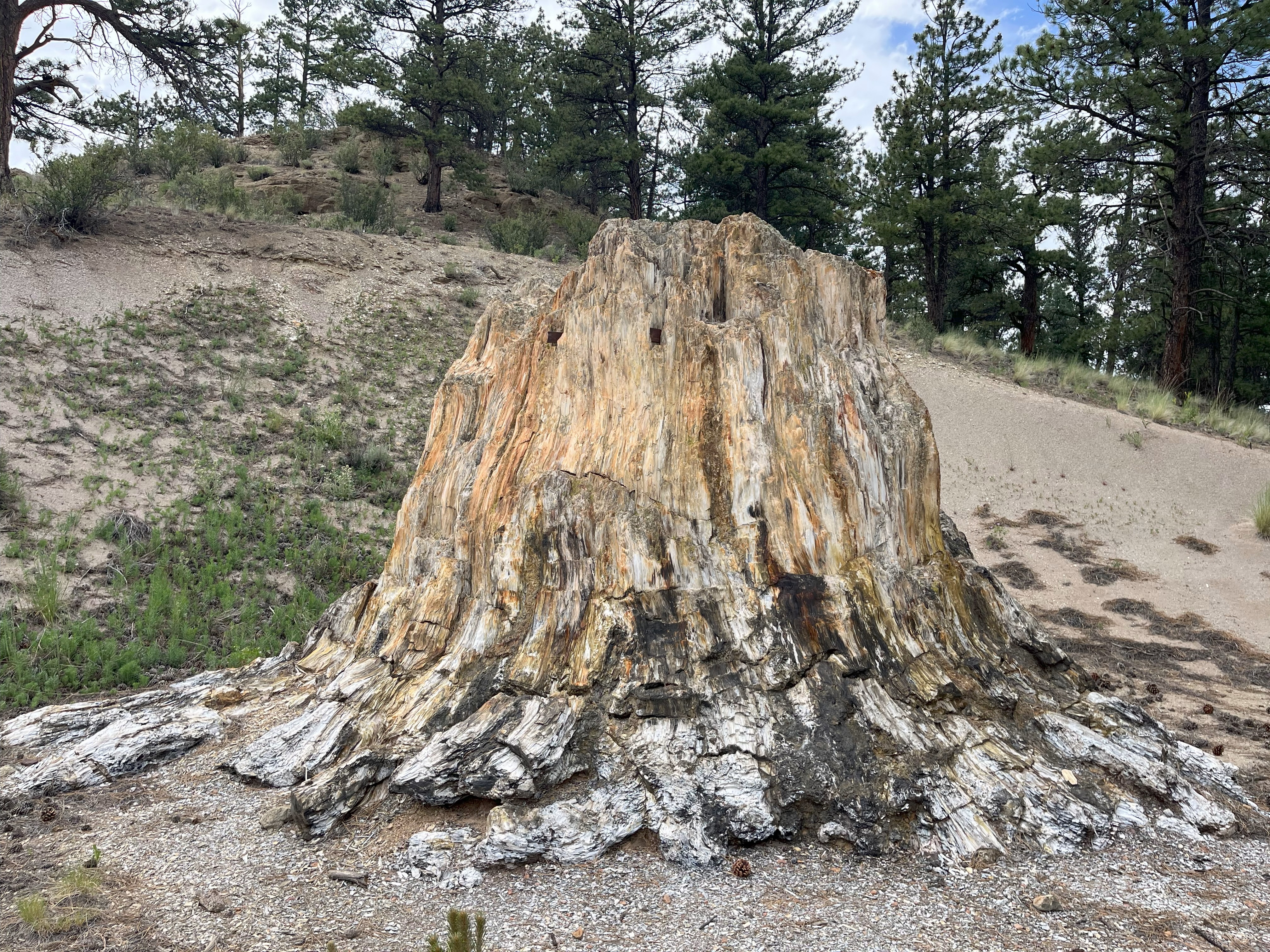
Florissant Fossil Beds National Monument preserves an incredible piece of geological and paleontological time in Colorado. The uniqueness of its geologic history helped preserve incredible details of tiny animals, all the way down to insects, including one of the most famous fossils in the world: a butterfly’s imprint preserved in ash. What struck me most as I wandered this beautiful National Monument and learned more about it was how intricately we can construct the past in this region. Geologists and paleontologists are able to use the clues spread across the landscape to see what happened in great detail. Those details, however, either directly contradict or at least present major difficulties for the narrative told by some Christians known as young earth creationists. Here, we will examine the two narratives alongside the region itself and ask which presents a better picture of the past.
The Narrative told by Conventional Geology and Paleontology
The National Park Service actually has a wonderful video that tells about how Florissant was formed, along with how it was discovered, used, and preserved by humans. My own narrative of conventional science is largely based on that video as well as on placards and other things I read and observed around the site itself.
About 37 million years ago, a volcano’s crater exploded, covering the region with ash. Volcanic activity continued for millions of years, forming layers of ash across the region. Eventually, heavy rainfall dislodged a massive amount of this ash, creating a kind of avalanche of volcanic material known as a lahar. This fast-moving mudflow was enormous, stretching for miles as it spread and eventually covering about 15 feet of the area we now know as the area within Florissant. This mud covered the bottoms of a number of enormous trees, which eventually died and decomposed. Life recovered and the region began to grow again, but another lahar blocked a stream and that stream formed a shallow lake across the area. The water that covered the area had deposited minerals into the ash-covered stumps of these trees, eventually preserving them as petrified wood. Meanwhile, diatoms–tiny algae observable on a microscopic level that persist into today–bloomed in massive quantities in the lake. Along with occasional volcanic eruptions that layered ash in the lake, the diatom blooms dying off also formed layers at the bottom of the lake. These layers alternated (not in a specific pattern), eventually forming paper-thin shale.
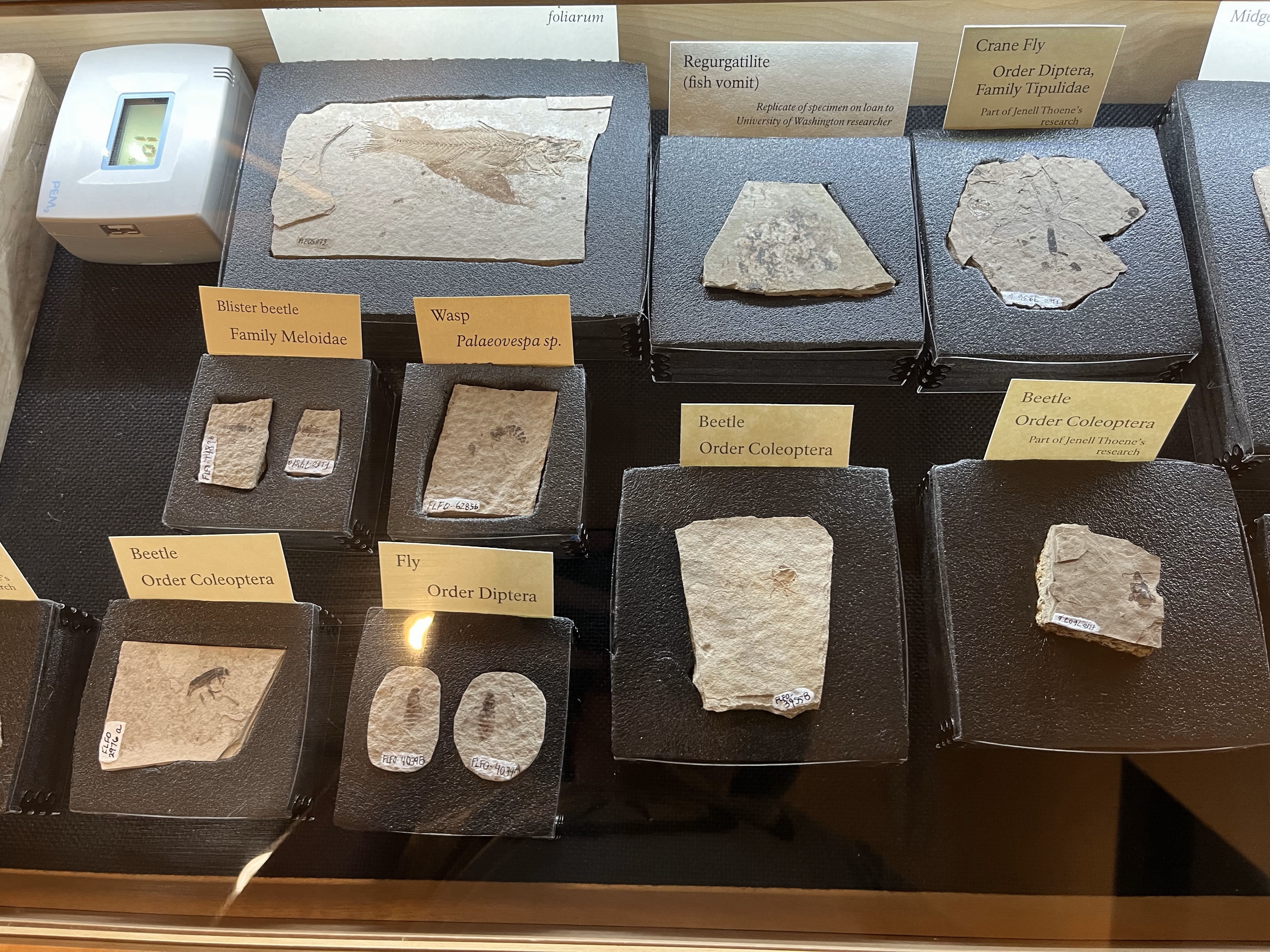
As creatures like fish, birds and even insects died and settled to the bottom of the lake, they were covered with these layers of diatoms and ash. Their bodies were mineralized, and to this day paleontologists can chip apart these incredibly thin layers of shale and find one of the richest deposits of well-preserved insect and plant life in the entire world. Large mammals also roamed the region, including brontotheres, an extinct rhinocerous-like mammal whose bones can be found across the area and into the Badlands. Their bones can also be found. Volcanic activity can be mapped across the region by observing directly the path of lava flows that have hardened into rock. Additionally, distant mountains can be seen to have blown off their tops in volcanic activity of that same time period, demonstrating the violent geologic past of the area.
The uniqueness of this site is due to the many factors involved in its formation: the volcanic activity that led to a lahar covering and preserving enormous ancient trees (including the largest petrified trees by diameter in the entire world); another lahar blocking a stream; additional volcanic activity that mostly spewed ash instead of lava in the area, allowing for preservation of fossils as the ash was cooled and settled in the water; intense periods of diatom activity due to whatever nutrients were provided by rich volcanic soil and plant deposits. For all of these, geologists can quite literally trace lines across the region and map where lava flows hit, where ash fell, whence came some of the volcanic activity (I had a park ranger literally point to the distance at a group of mountains; when looking more closely at the mountains later in the trip, you could see how they were partially collapsed from their volcanic past, blowing parts of themselves almost 100 miles across the landscape), and more. These were observable evidences of a past that linked all of these facets together to create the world-famous fossil site. It was incredible to see how well geologists could use the tools at their disposal to tell the story of the ancient past.
One last broad point in this section: the paleontological record here shows a dramatically different world than what we see in the same region today. The brontotheres are obviously extinct as we don’t see them anymore, but another facet of the discussion is that while the insects look incredibly similar to those of today, there are many with key differences that have changed over the 30+ million years since they were preserved. Some of them aren’t extinct and live into today, but in entirely different parts of the world. One prominently displayed fossil was of a tsetse fly, which once inhabited the land we now know as Colorado, but today lives in tropical Africa. The climate, in other words, has changed so dramatically that this kind of fly can no longer live in the snowy peaks of Colorado, but we have a record of its having done so in a past that was much warmer, and the other fossils in the area confirm the same observations. Conventional timelines don’t have difficulty explaining this, as the long timespan involved allowed for plate tectonics, glacier movement, ice age(s), and more to impact the climate.
Young Earth Creationism’s Two (or more) Narratives
Before diving too far into the narrative told by young earth creationism, we must realize that that movement itself is not monolithic. For a believe system that claims to be the plain reading of the Bible and that can be understood quite simply, it actually ends up teaching incredibly complex and continually edited narratives about the past. Its practitioners disagree on timelines and on how Earth’s geological history formed. So to tell a narrative of Florissant from that perspective, I have to do so knowing that there could be any number of “well, actually” type statements. That said, I believe that death by a thousand caveats is an issue that plagues young earth creationism generally. As YECs have to continually edit their narratives to try to force evidence to fit into a specific favored timeline, the constant ad hoc amendments serve to show just how mistaken YEC is generally. There are at least two broad narratives YECs could offer for Florissant.
The Noah’s Flood Narrative[s]
The Noahic Deluge truly did cover the entire surface of the Earth. In doing so, it churned up enormous amounts of dirt and sediment, remaking it and setting down virtually all sediment layers that we see across the entire Globe. An alternate version of this has a more tranquil Flood, which settled over the surface of the Earth but didn’t greatly impact the geologically observed history. This latter theory is largely abandoned in the literature as it has no explanation for the many aspects of geologic history we see to this day. The former is beset with difficulties, but the one I want to highlight here is that if we assume this is what happened, places like Florissant are almost entirely nonsensical. How would a churning Flood lay down deposits that happen to align in such ways that they can be traced across a region and layered, such that we can see a lahar covered the region, then another blocked a stream, forming a lake, volcanic lava flowed across nearby, and more, and more? It seems to be a non-starter. Why would random bits of sediment get deposited in ways that suggest a geologic past?
The Post-Flood Deposits Narrative
Increasingly, thoughtful YECs are being forced to draw lines to designate pre- and post-Flood deposits in the geologic record. There are a number of reasons for this, but one of the most obvious is that we can see geologic deposits being made today, so the obvious question is asked about how far into the past these records extend before one hits layers that were set down by a supposed global Flood. Many of the difficulties with the YEC narrative in which the Flood explains Florissant are assuaged by claiming that those deposits really were set down in the manner described, but that they were done so in a much more condensed timeline than mainstream geology teaches.
Going along with this, some YECs have suggested the Flood itself is responsible for almost none of the geologic record or, perhaps, only a tiny portion of it. The rest was formed largely as mainstream geologists suggest, but at a pace accelerated by hundreds or even thousands (millions?) of times the speed suggested by mainstream geology. This latter notion has its own massive difficulties, among them being the now well-known (among those involved in debating creationism) heat problem, but also that it doesn’t really provide an explanation for the geologic record other than “it moves fast.” So we’re going to set that one aside and focus on the more mainstream YEC view that Noah’s Flood formed the majority of the geologic column, but that some of it is post-Flood (and pre-, but we’re setting that aside, too). On this view, Florissant is post-Flood and so the way it formed geologically is essentially exactly as the geologists stated with lahars, lava flows, and more leading to what we observe today. The timeline, of course, is off (only a few thousand years instead of 37 million), but this YEC view at least has some kind of attempt to allow for us to learn about such features.
There are many problems with this view, too, however. One is that when we observe layering of sediment in the ways suggested at Florissant, it takes much longer than YECs could allow. While they often point to places like Mount Saint Helens to suggest that such formation could be much faster, this is problematic for a couple reasons. The first is that no mainstream geologist suggests catastrophes like Mount Saint Helens don’t happen in the past; rather, their timelines and observations align with such catastrophic events happening. The second is that Mount Saint Helens has been greatly exaggerated in YEC literature, taking features and labeling them with geologic terms that do not correspond with reality. Thus, an alleged canyon at Mount Saint Helens formed with the eruption is really just ash deposited and then cut through with runoff, which will continue to erode it rapidly in ways expected by mainstream geology. It’s not analogous to something like the Grand Canyon. Finally, a major problem with this “it just went fast” scenario is that it does nothing to explain the observation of different climate zones found in Colorado than what exist today. Are we to believe that alongside layering of ash and diatoms turning to rock and an immensely accelerated rate, the region also went from tropical to Mountainous and snow-covered during the winter in just a thousand or so years?
The answer from YECs of course is, yes, we are supposed to believe that. But what mechanisms do they suggest for this actually occurring? One is the notion that the Flood led to an ice age which, as the Flood waters receded, then changed the climate of the Earth. Another mechanism is the acceleration of nuclear decay (which again runs into the heat problem). Here we find YECs must continue to invent extrabiblical scenarios to explain extrabiblical observations, thus undermining their claim to be simply observing what the Bible says as their scientific starting point.
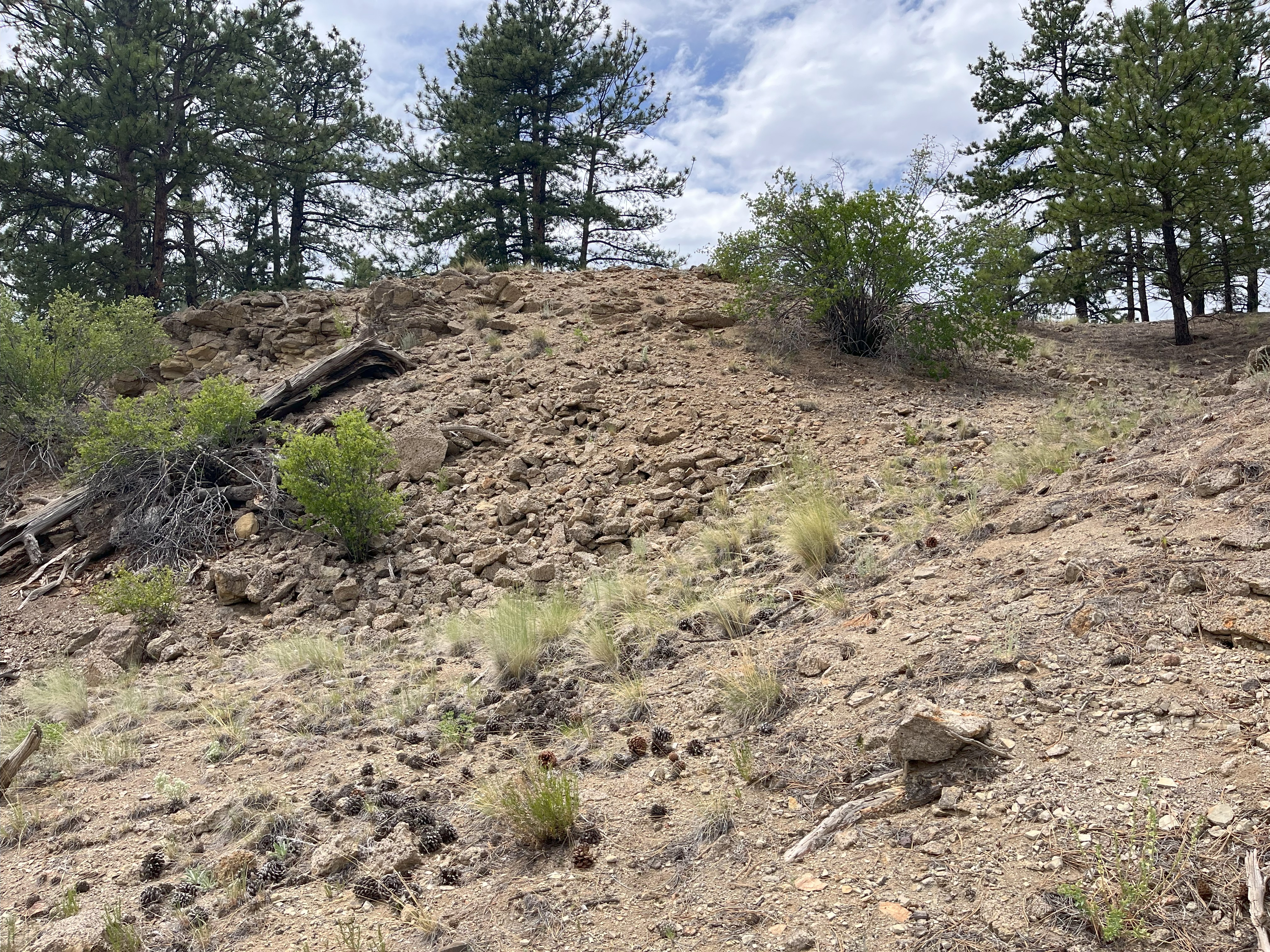
A final problem (not the final problem, simply the last one I’m touching on here) with the YEC scenarios is the sheer amount of deposition at even a relatively tiny site like Florissant. The photograph above shows just one hill composed of shale. This entire hill could be dug into and one could pull out paper-thin pieces of shale layering the entire hill (one should not do this as it is a National Park site and is very illegal; I’m saying this for the sake of observation!). This hill stands far taller than I do, and taller than surrounding trees, and is just one of many hills composed of the same material. All of this managed to get layered, ash-diatom-ash-ash-diatom-diatom-ash, etc. in such minute, miniscule layers that you literally can push them apart with a wedge and see the rock crumble in your hand because each layer is so thin. And for YECs, all of this is supposed to have happened in just a few thousand years, with the ash and diatoms getting compressed into those thin layers of rock, but in such an immense volume that it can cover hills, and in such precision that one can see where the trees were covered with mud from a lahar, and in such a careful way that it settled softly enough to cover but not destroy butterfly wings. Such a belief stretches the imagination beyond the breaking point. And this is but one site.
Conclusion
The first thing I want to conclude is that if you get the chance to visit Florissant Fossil Beds National Monument, you should do so. The hikes are fairly short- it isn’t a massive site. But for a day of exploring and learning about Earth’s past, it is nearly unrivaled.
Florissant provides an incredibly rich look at Earth’s geologic past. In just this one small region, one can literally see where volcanoes once spewed ash and covered parts of the area with lava, one can walk up to rock layers showing deposition of lava that flowed from nearly 100 miles away, one can see the world’s largest (by diameter) petrified trees, one can see the depositions of shale that led to some of the best insect fossils in the entire world, and more. It is an immensely wonderful experience to be able to see firsthand how geologists really can see the landscape and form conclusions about our past. And for all of that, it also provides a set of major problems for young earth creationism, a theory that is continually forced to evolve and add explanations simply to try to wave away the many, many difficulties with it.
Finally, Christians should know that young earth creationism is not even remotely a necessary doctrine for believing the Bible or remaining Christian. It is a theory with almost no connection to church history, and one which is a modern invention to try to counter modern science. The eternal truths of God do not rely upon human innovation of doctrine.
Links
Be sure to check out the page for this site on Facebook and Twitter for discussion of posts, links to other pages of interest, random talk about theology/philosophy/apologetics/movies and more!
Young Earth Creationism– This link will take you to the all my posts on YEC (scroll down for more).
Gregg Davidson vs. Andrew Snelling on the Age of the Earth– I attended a debate between an old earth and young earth creationist (the latter from Answers in Genesis like Ken Ham). Check out my overview of the debate as well as my analysis.
Ken Ham vs. Bill Nye- An analysis of a lose-lose debate– In-depth coverage and analysis of the famous debate between young earth creationist Ken Ham and Bill Nye the science guy.
SDG.
——
The preceding post is the property of J.W. Wartick (apart from quotations, which are the property of their respective owners, and works of art as credited; images are often freely available to the public and J.W. Wartick makes no claims of owning rights to the images unless he makes that explicit) and should not be reproduced in part or in whole without the expressed consent of the author. All content on this site is the property of J.W. Wartick and is made available for individual and personal usage. If you cite from these documents, whether for personal or professional purposes, please give appropriate citation with both the name of the author (J.W. Wartick) and a link to the original URL. If you’d like to repost a post, you may do so, provided you show less than half of the original post on your own site and link to the original post for the rest. You must also appropriately cite the post as noted above. This blog is protected by Creative Commons licensing. By viewing any part of this site, you are agreeing to this usage policy.
Young Earth Creationism and the Problem of Multiple Dating Methods for a Tyrannosaur Fossil

When I was a young earth creationist (here after YEC), I often heard about the absurdity of dating methods used to arrive at millions of years for the age of fossils. One such argument I have seen repeated is that scientists determine the date of fossils based upon presuppositions about the age of each layer in the fossil record. What I want to emphasize is that this massively oversimplifies the way scientists date fossils. When we look at how scientists actually do date individual fossils, the evidence for the age of the Earth against YEC mounts quickly.
There are many, many more methods of dating fossils that continue to show that entirely independent strands of evidence yield the same ages or relative ages. In an essay in Tyrannosaurid Paleontology edited by Parrish et al., the authors show the age of a juvenile Tyrannosaurid based upon pollen, leaves, and paleomagnetism. What is important to note is that these are independent ways of measuring the age of this specific fossil. That is, the data that needs to be explained by the YEC is not simply dismissal of Carbon dating or something, but rather that each of these data points must be independently falsified, along with an explanation for why they would all align. Additionally, the paper summarized below shows how much more complex dating methods based upon looking at the layer in which a fossil is found. In other words, it helps to show that the creationist teaching that remains fairly common on YouTube and elsewhere that scientists simply look at the layer a fossil is in and assume the age is quite complex and based upon a series of data points.
Brief Summary of the Evidence
Note: I am not a trained scientist. I am summarizing the content of the paper cited, and attempting to put quotations at every point I’m directly quoting. This section is largely a glossed summary of points of the paper, and any errors and misunderstanding thereof in such a summary are on me.
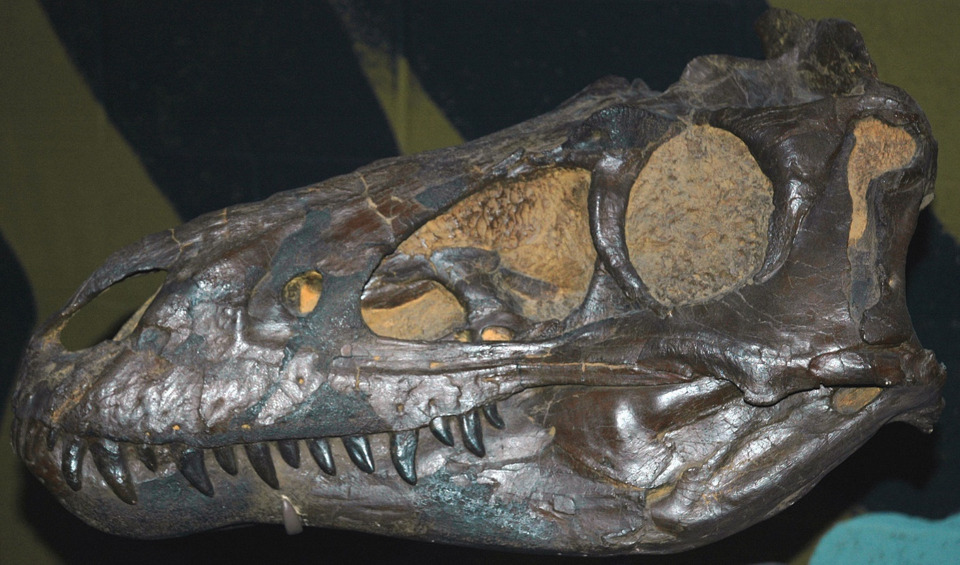
In an essay entitled “Using Pollen, Leaves, and Paleomagnetism to Date a Juvenile Tyrannosaurid in Upper Cretaceous Rock” by William F Harrison et al., the authors argue that a juvenile fossil tyrannosaurid fossil (named and sometimes hereafter referred to as “Jane”) can be confidently dated to about 66 million years ago. The juvenile tyrannosaurid (still an astonishing 7 meters in length!) was discovered in the Hell Creek formation in southeastern Montana in Carter County. The authors give details of the find, including the longitude/latitude, the place within the Hell Creek formation in which it was found, and other relevant details.
One of these is that the place the fossil was found was missing the top of the Hell Creek Formation with the Cretaceous-Tertiary boundary. This is a common part of the formation and other parts of the formation were visible from the site but the paleontologists were not granted access to the other sites within view to conduct a direct survey of the geologic columns there. This meant that they had to rely on additional dating methods.
First, they used a borehole log, which is made by cutting a cylindrical hole into the ground and extricating a section therefrom, allowing geologists to make a detailed summary of the formation. Another survey of nearby Blacktail Creek area of Montana was able to locate a magnetic reversal, which could then be used at the site of the Jane find to help place it in the formation. A stratigraphic section of the formation at the Jane site is provided, showing in detail each of these layers and correlations thereof. Jane, after death, was “buried within a 40 cm thick lens of poorly sorted silt, sand, and clay balls… This clay ball conglomerate contains abundant plant and animal fossils…” Again, a photograph shows a polished section of the clay ball conglomerate and siderite (a mineral compound) in which Jane was found.
Interestingly, from this conglomerate in which Jane was buried, scientists were able to extract fossilized pollen, vegetational residue, and more for analysis. This allowed them to determine what kind of plants the residue and pollen came from. The pollen was demonstrably from aquilapollenites and wodehouseia, each of which are entirely extinct now (more on that later). Fossil leaves were also collected from the Jane site, and these correspond to “the stratigraphic position indicated by the pollen and support the determination of its geologic age.” Once again, these leaves were determined to genus and species and they correspond to a “very narrow megafloral zone.” This is important, because, again, this megafloral zone is a zone in which only certain species occur within a stratigraphic layer on the Earth, and at the Jane site, only leaves from certain megaflora in a specific zone were found. Other types of plant leaves found are restricted in the fossil record to very specific parts of the Hell Creek formation. For conventional scientists, this marks their extinction [for YEC possibilities and problems thereof, see the section below]. The greatly delimited range of these plants allows scientists to narrow down the age of the Jane site even more, because it occurs only within a very specific stratigraphic range alongside very specific other fossils.
Additionally, the scientists collected samples from the fine grained sediment at the Jane site and analyzed them at the Paleomagnetics Laboratory of the University of California, Davis. There, based on the way the clay balls were sorted within the samples, they found the magnetic polarity of the sample corresponded to normal polarity and thus set another limit on the age of the Jane site (based upon stratigraphic samples showing differing magnetic polarity above or below it). Because these polarity shifts–reverse-normal-reverse-etc.–can be measured through stratigraphic analysis essentially globally, this allowed the scientists at the Jane site to determine that the age range of 65.9-66.0 million years ago is the correct age for the Jane fossil. The precision was possible because of both the paleobotanical and palynological–ancient plants and microorganisms–samples from the site.
Some Conclusions and Issues
It worth noting that the pollen at the Jane site was from two types of plants which are entirely extinct now. Young Earth Creationists often argue that all or most fossils, including the overwhelming majority (or all) dinosaurs were deposited by Noah’s Flood. One wonders, then, why in this great conglomeration and mixture of plants and animals, there is no fossilized pollen found from species that exist now. Why only extinct species? How did it just so happen that only extinct pollen–microscopic pollen!–settle onto this site? And how is that the case time and again, at site after site after site? To say that all this pollen and all these plants were washed away by the Flood but then somehow sorted into extinct and non extinct species, remarkably from bottom to the top of the geologic column, should be enough to stretch even the most credulous minds.
Similarly, the determination of just a few species of megaflora found at the Jane site demands explanation. Here, because leaves are obviously much larger than pollen, the creationist could theoretically just say that it so happened this area was only covered with that type of plant during the pre-Flood time and so it happened that only that kind of plant was preserved here. That does not, however, explain why totally different and distinct layers of plants are found in layers above and below this generalized stratigraphic layer, or why this specific megafloral zone is consistent across not just the Hell Creek Formation but elsewhere, and why examples of this can be multiplied essentially indefinitely. Time and again, specific fossils are only found with other specific fossils. There’s no mixing of them all together. You don’t find rabbit fossils with dinosaur fossils with the type of megaflora fossils found with Jane. Why not? Were there no rabbits roaming the pre-Flood world of Montana? Were there no flowering plants close enough to have their leaves cast about massive expanses of fossilized land? Again, it is far, far more parsimonious and plausible to acknowledge that, instead, the YEC narrative is simply mistaken on this. It cannot handle the sheer weight of the evidence.
The evidence here does not rely on Carbon-14 dating directly. Instead, it relies upon generally acknowledged dates for things like the Cretaceous-Tertiary (K/T) boundary, which again was sheered off by weather or some other events at the Jane site. This, along with the pollen fossils, microorganism fossils, and botanical fossils allowed scientists to make determinations to continue narrowing the date of the site from a broad range (before the K/T boundary) to a much more narrow range. These dating techniques were done independently. That is, the identification of the leaves was not used to determine the age of the polarity shifts in the magnetism of Earth. Instead, the way the sediments were sorted in the samples was used to determine a date; the specific pollen of megaflora was used to determine a specific date range because they only lived during a certain time range; the leaves were used to determine a specific range (here, independently, based upon botanical analysis of the age range possible with these plants). These all independently yielded a similar and narrow range. It was narrowed not arbitrarily but by noting the relative ages of each range.
So, for example, if you discovered a text fragment from the ancient world, you could narrow down the timeline in which it was made or discussing by finding out more about it. If, for example, it was in Latin and talking about events in the Roman Empire, that would broadly limit the possible dates to within the existence of the Roman Empire; then, if it talked about a specific province of Rome that wasn’t conquered until a certain time, that would narrow the possible timeline even more, and then if it talked about a governor of that province, it would narrow the dates to within the rule of that governor, etc. Similarly, since certain plants or microorganisms can be known to only occur in certain stratigraphic layers–and this is consistently determined by actual digs finding actual evidence of this assortment and lack of mixing–one can set ever-narrowing limits on the age based upon the overlaps of these events. Adding in the polarity shifts to the dating method was just icing on the cake. And again, why should all these data methods correspond unless the Earth is actually as old as conventional science supposes?
One obvious objection in all of this is the question of how the scientists determined the relative ages of things like the leaves, pollen, etc. While it seems, on the surface, problematic that these all correspond to ages in the millions of years that all align, just having a leaf in a fossil layer is not enough to put a date on it. Aren’t those dates slapped on based on radiometric dating of some kind, thus making the whole thing one line of evidence, not many? The objection has some weight at first glance because, to my knowledge, it is true that the ages for the stratigraphic layers were determined, in part, by radiometric dating, and thus saying that a certain layer has a consistent date across the region is reliant upon that dating method. Setting aside the many, many arguments and clarifications about radiometric dating, however, the problems in this paper go far beyond reliance upon radiometric dating. They also are grounded upon measurements about the magnetic polarity of Earth, as well as independent, multiple lines of evidence showing a narrow range of dates for when Jane was possibly alive. Supposing radiometric dating is entirely unreliable and that it just somehow continually yields similar age ranges for similar layers and fossils and consistently is measured in the same ranges across regions and beyond, the fact remains that Jane was identified in a unique stratigraphic layer with unique and exclusive megaflora pollen, unique and exclusive leaves, unique and exclusive microorganisms, and unique and exclusive polarity measurements through the clay ball sediment sorting present.
Why, given Noah’s Flood’s deposition of these layers, would this even possibly be the case? There’s not even one piece of pollen out of place from a plant in a different stratigraphic layer; there’s not even one piece of evidence of sediment being sifted in a different direction by changing tides of Flood water; there’s not even one leaf from an olive tree or any modern botanical features that happened to show up in this entire layer of deposited sediment; there’s not even one microorganism out of place; there’s not even one out of place animal fossil from a different sedimentary layer; there’s not even one post K-T Boundary layer creature found out of place. Not. Even. One. Did God miraculously sort each grain of sediment, each microorganism, each animal washed away by the Flood, each leaf, each pollen grain, each plant, each megafloral layer so that they would layer upon each other in distinct and evidentially detectable ways? It’s absurd to suppose this. It’s not that this would be impossible for God. No, it’s that there’s no biblical or extrabiblical evidence to suggest that God interacts in the world in this way. The only reason to even posit it is a desperate attempt to save modern young earth creationism from scientific absurdity. And that means that acts of God are being determined by modern science after all, in an ironic twist–YECs are determining how and why God acted based upon scientific evidence. The whole thing collapses on examination.
Additional Evidence and Conclusion
I have argued elsewhere about the stunning congruity of such divergent dating methods as tree rings, varves (annual layers of sediment), and Carbon-14. If YEC is true, there seems to be no explanation for why tree rings, Carbon-14, and varves should all align on the age of the Earth. I’ve also noted the argument from GPS measurement of the movement of the Hawaiian Islands and Carbon-14 dating of those same islands. Again, why should the measured movement rate of the Hawaiian Islands align with C-14 dating methods on YEC? And, as argued above, why should leaves, pollen, and paleomagnetism align as well? There is a stunning and constant refrain from these various and independent ways for measuring the age of fossils or the Earth generally: they point to an age that is orders of magnitude larger than that of YEC.
Young Earth Creationism, therefore, must contend either that all of these independent methods for dating fossils are mistaken in multiple independent ways or come up with a plausible explanation for why God would provide all these independent methods to provide false data. Proposals I have seen for the latter (eg. God intentionally creating with the appearance of age) suffer from severe theological problems, while proposals for the former are essentially nonexistent. It seems far more plausible, then, to suppose that it is Young Earth Creationism that is falsified.
Links to Amazon are Affiliates Links
Links
Be sure to check out the page for this site on Facebook and Twitter for discussion of posts, links to other pages of interest, random talk about theology/philosophy/apologetics/movies and more!
Gregg Davidson vs. Andrew Snelling on the Age of the Earth– I attended a debate between an old earth and young earth creationist (the latter from Answers in Genesis like Ken Ham). Check out my overview of the debate as well as my analysis.
Ken Ham vs. Bill Nye- An analysis of a lose-lose debate– In-depth coverage and analysis of the famous debate between young earth creationist Ken Ham and Bill Nye the science guy.
SDG.
——
The preceding post is the property of J.W. Wartick (apart from quotations, which are the property of their respective owners, and works of art as credited; images are often freely available to the public and J.W. Wartick makes no claims of owning rights to the images unless he makes that explicit) and should not be reproduced in part or in whole without the expressed consent of the author. All content on this site is the property of J.W. Wartick and is made available for individual and personal usage. If you cite from these documents, whether for personal or professional purposes, please give appropriate citation with both the name of the author (J.W. Wartick) and a link to the original URL. If you’d like to repost a post, you may do so, provided you show less than half of the original post on your own site and link to the original post for the rest. You must also appropriately cite the post as noted above. This blog is protected by Creative Commons licensing. By viewing any part of this site, you are agreeing to this usage policy.
Dinosaur Eggs: A serious problem for a young earth flood scenario
 Young Earth Creationism is usually paired with some form of flood geology–the notion that Noah’s flood was a global disaster which can account for most, if not all, of the fossil record and stratification of rocks. There are many problems with such a scenario, but for now I want to focus on one: dinosaur eggs.
The Problem Stated
Abstractly, dinosaur eggs aren’t really a problem: they could have been washed away in a global flood or rapidly covered by sediment, thus burying them and having them ready to begin fossilization. Problem solved, right?
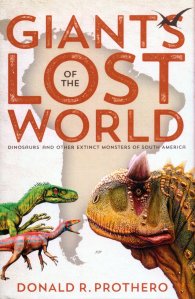
As usual, though, the fossil record doesn’t align with such a simple explanation. I was reading Giants of the Lost World, a book by Donald R. Prothero about the history of several huge species that once inhabited South America, and came upon an intriguing passage about a specific find of dinosaur eggs. This find is called, with tongue firmly planted in cheek, “Auca Mahuevo” (to make a reference to contracting the spanish words for “more eggs”). Situated in a region called Auca Mahuida in Argentina near an extinct volcano, the site has revealed an abundance of fossilized dinosaur eggs, including several spectacular finds in which the embryo can be seen inside the egg.
The fossil site is one in which clutches of eggs–between 15-34 eggs in each–were laid in clumps that suggest sauropod nesting sites. There were few crushed eggs, which “suggest[ed] that the site had been protected by the mothers guarding the perimeter but not walking among the eggs once they had been laid…” (33). But here’s where it gets especially interesting for the topic at hand:
The remarkable preservation of the eggs was due to the fact that large flash floods had buried the eggs–and had done so many times, because there were multiple egg layers in the rocks, covering a total thickness of 25 meters (75 ft). (33)
To say that this offers an enormous problem for a global flood scenario as the explanation for all of these eggs is an understatement. This site is evidence that there were multiple periods in which a group of sauropods came to an area, nested, laid eggs, some flash flood occurred that buried them in mud or other sediment, and then the sauropods laid more eggs at a later time in the same area, only to have it happen again. The young earth creationist scenario insists that rapid flooding is required for fossilization, and that is what occurred here, but it occurred at several distinct times, in layers upon layers of eggs.
Possible Young Earth Explanations and More Problems
One possible counter to this is for the young earth creationist (YEC) to assert that these eggs were simply all jumbled together from a single or several sites in the chaos of the flood waters, tossed with mud and left to fossilize. But the lack of crushed eggs, uniformity of species, and organization of the nests all work against such a scenario. If the flood was as turbulent as many flood geology scenarios suggest, how would the eggs have ended up in nests at all? Indeed, if the explanation is that they got jumbled together in the wet silt of the floodwaters, how could the structures of the nests have been preserved on multiple layers? And again, if these eggs just happened to get tossed together, why aren’t they cracked or smashed–how do they still have embryos inside?
Some young earth scenarios include dinosaurs fleeing the rising flood waters only to finally stop to lay eggs in a rush, only to flee on. But this site does not allow for such an explanation, as it shows multiple distinct nesting periods that were covered up over time. The YEC may counter by saying that multiple different dinosaurs fled past the area and just happened to lay their eggs on this site after mud and rain had covered the previous nests, but this doesn’t account for the lack of trampled eggs and the care in which they were organized, as above, suggesting a perimeter being guarded by parents.
Conclusion
Fossil beds like this present an enormous problem for a young earth creationist scenario that relies on the flood to explain the fossil evidence. Time and again, those scenarios fail to account for the actual findings in the field and amount to nothing more than implausible scenarios requiring miracles unrecorded in the Bible to have occurred.
Links
Be sure to check out the page for this site on Facebook and Twitter for discussion of posts, links to other pages of interest, random talk about theology/philosophy/apologetics/movies and more!
What options are there in the origins debate? – A Taxonomy of Christian Origins Positions– I clarify the breadth of options available for Christians who want to interact on various levels with models of origins. I think this post is extremely important because it gives readers a chance to see the various positions explained briefly.
What is the relationship between Christianity and science?- An Overview of 4 Views– How should the Christian faith interact with science? Do they interact at all? I survey 4 major views on these and other questions.
SDG.
——
The preceding post is the property of J.W. Wartick (apart from quotations, which are the property of their respective owners, and works of art as credited; images are often freely available to the public and J.W. Wartick makes no claims of owning rights to the images unless he makes that explicit) and should not be reproduced in part or in whole without the expressed consent of the author. All content on this site is the property of J.W. Wartick and is made available for individual and personal usage. If you cite from these documents, whether for personal or professional purposes, please give appropriate citation with both the name of the author (J.W. Wartick) and a link to the original URL. If you’d like to repost a post, you may do so, provided you show less than half of the original post on your own site and link to the original post for the rest. You must also appropriately cite the post as noted above. This blog is protected by Creative Commons licensing. By viewing any part of this site, you are agreeing to this usage policy.
“Oceans of Kansas,” Unexpected Fossils, and Young Earth Creationism
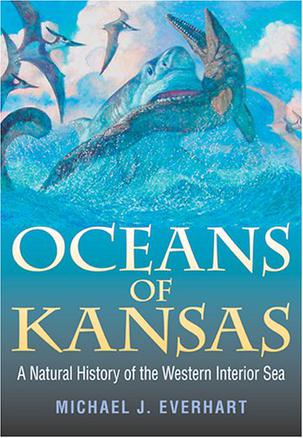 Recently, I reviewed the debate between Bill Nye and Ken Ham. In that debate, Bill Nye challenged Ken Ham to come up with just one fossil that was in the wrong place in the fossil sequence. In that review, I mentioned polystrate fossils as one possibility for the YEC rejoinder. Strictly speaking, these fossils are not “out of sequence” in a formal sense and so do not qualify as such evidence. Are there other possibilities? Michael J. Everhart’s fascinating look at the natural history of the Western Interior Sea brings up another possibility which may draw some looking for out-of-sequence fossils. After an introductory narrative about how a mosasaur (pictured on the cover of the book getting chomped by a shark) fossil could end up broken up in the middle of the sea, he wrote:
“Bloating and Floating” is certainly the case in many instances and is the only reasonable explanation for how the remains of large dinosaurs, such as Niobrarasaurus coleii…could have found their way into the middle of the Western Interior Sea… (48)
There have been, he noted, discoveries of dinosaurs in the middle of what should have been fossils of only aquatic creatures in the chalk and limestone that covers much of the central states–what was in ancient times the Western Interior Sea. His proposed explanation is that a dinosaur might die on the shore and get swept out to sea, bloated and floating until coming to rest at the bottom and becoming fossilized. Though not necessarily the “only reasonable” explanation, Everhart’s scenario provides an interesting test case for rival hypotheses.
Young Earth Creationists (YECs) tend to view evidences like these as proof of the Flood. That is, given a catastrophic global flood, one would expect that different life forms, all killed together by the flooding of the whole Earth, would be mixed together. Thus, a dinosaur in the middle of what should be sea creatures is alleged to provide evidence for the YEC Flood hypothesis.However, Everhart’s scenario does seem to be more plausible than a young earth account for several reasons.
First, Everhart’s proposed scenario is much simpler an explanation than the hypothesis that a global flood swept the dinosaur(s) into the position they are found among so many aquatic remains. This point is not to be understated; on a purely historical level, without any a priori assumptions of what should be the case given a specific reading of Genesis, it seems more reasonable to suppose that a dinosaur died and had its carcass swept out to sea before it was scavenged and sank to the bottom of the sea to be deposited than to suppose that a global catastrophe led to the dinosaur being found in its present location.
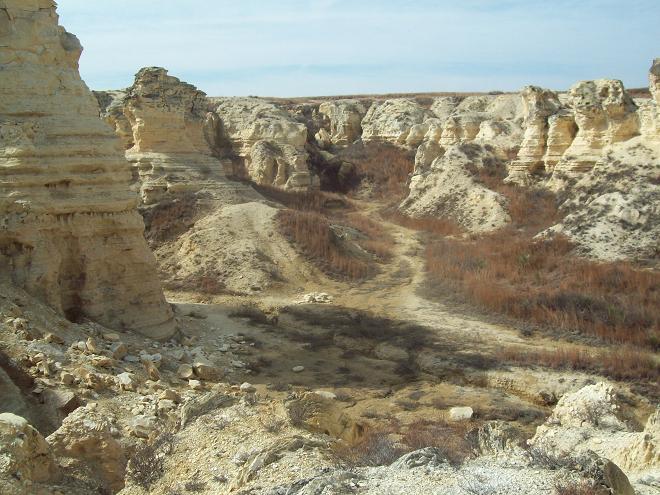
A picture I took at “Castle Rock” in central Kansas. This beautiful formation has huge amounts of deposited limestone and shells layered atop each other. One can walk to the walls and literally pull slabs of fossils out of the sides. If the YEC account of the flood were correct, one would expect to find multiple varieties of creatures found throughout these layers.
Second, and perhaps more problematic for the YEC position, is the fact that such finds as these are extremely rare, when, given a global flood, the expectation should be to constantly find such mixing of types of fossils. Simply finding one dinosaur fossil (or even several) among countless numbers of mosasaurs, icthyosaurs, fish, and of course limestone deposits from sea life (alongside shells of all sorts of varieties, etc.) does not actually provide sufficient evidence for the YEC account of the flood. We should instead find primates, dinosaurs, mosasaurs, trilobites, mammoths, and archaeopteryx fossils jumbled together. What we do find is a stunning uniformity of fossils such that the find of a dinosaur is means for speculation regarding how it got there rather than a commonality which demonstrates a planetwide flood.
Third, the dinosaur in question was contemporaneous with the aquatic life. That is, it lived at the same time as the creatures in the chalk in which it was deposited. Again, on a YEC scenario, one would expect instead to find all sorts of mixing of fossils from different time periods. The fact that these dinosaurs lived on land in the same time in which we find them at the bottom of the sea does not suggest a massive global flood which mixed all life (which all lived at the same time) together in one death pool; instead, it counts as direct evidence for the gradual diversification and extinction of life. The finds are consistent with what one would expect with longer periods of time instead of a global flood. Thus, it does not seem that fossils found in unexpected places may serve as evidence for Young Earth Creationism. Indeed, given the second point in particular (and in conjunction with the third), it seems that they serve as yet another evidence against the notion of a young earth and global flood. There are better options for Christians than Young Earth Creationism.
Links
Be sure to check out the page for this site on Facebook and Twitter for discussion of posts, links to other pages of interest, random talk about theology/philosophy/apologetics/movies and more!
What options are there in the origins debate? – A Taxonomy of Christian Origins Positions– I clarify the breadth of options available for Christians who want to interact on various levels with models of origins. I think this post is extremely important because it gives readers a chance to see the various positions explained briefly.
Shells and the Biomass of Earth: A serious problem for young earth creationists– I argue that the sheer amount of living organisms we can discover weighs against a young earth position.
My thanks to fellow blogger “The Natural Historian” for some comments on the topic of this post prior to publication.
Source
Michael J. Everhart, Oceans of Kansas: A Natural History of the Western Interior Sea (Indiana University Press, 2005).
SDG.
——
The preceding post is the property of J.W. Wartick (apart from quotations, which are the property of their respective owners, and works of art as credited; images are often freely available to the public and J.W. Wartick makes no claims of owning rights to the images unless he makes that explicit) and should not be reproduced in part or in whole without the expressed consent of the author. All content on this site is the property of J.W. Wartick and is made available for individual and personal usage. If you cite from these documents, whether for personal or professional purposes, please give appropriate citation with both the name of the author (J.W. Wartick) and a link to the original URL. If you’d like to repost a post, you may do so, provided you show less than half of the original post on your own site and link to the original post for the rest. You must also appropriately cite the post as noted above. This blog is protected by Creative Commons licensing. By viewing any part of this site, you are agreeing to this usage policy.
Really Recommended Posts: 11/09/2012
 I have featured literary apologetics, apologetics to Muslims and Jehovah’s Witnesses, geocreationism, and more. Check out the posts. Let me know what you liked. Come back for more.
Elves, Orcs, and Freaks: The Shared Authorial Vision of JRR Tolkien and Flannery O’Connor– Garret Johnson has written a very interesting look into the works of Tolkien and O’Connor. He notes that they viewed fiction as reality from a different outlook. It’s a fascinating post, and there is a second part, which can be viewed here.
An Encounter with a Jehovah’s Witness– It is easy for Christians to slam their doors on those who come door-to-door. What if, instead, we engaged them? This post is a model for engagement and provides some ways forward to engage with Jehovah’s Witnesses.
The Day After: My Thoughts on the Presidential Election– Michael Licona, author of The Resurrection of Jesus: A New Historiographical Approach
Human Footprints in Dinosaur Footprints– Over at GeoCreationism (a highly recommended site), Mike addresses the notion that human and dinosaur footprints have been found together or side by side. Some argue that this supports young earth creationism. Mike explores the paleontological evidence.
Meet the Multiverse– Edgar Andrews, author of what I think is the best introduction to Christian apologetics with a scientific emphasis, Who Made God?
Did Jesus Claim to be Divine? (Answering Islam)– I found this look at answering Muslim objections to the deity of Christ refreshing. It offers an essentially presuppositional approach, which I have found to be very useful when engaging with Muslims. Check it out.
Naturalis Historia: Is Young Earth Creationism True?
I recently came upon what is, in my opinion, the finest collection of essays challenging the scientific aspects of Young Earth Creationism to date. The blog, Naturalis Historia features a broad spectrum of posts offering challenges to Young Earth perspectives from a scientific viewpoint. I can’t recommend the blog highly enough. Below are a few links with brief summaries of the contents.
An Ancient and Alien Forest Reconstructed– the recent finds of several fossilized forests have revealed alien landscapes not similar to our own forests in any way. In fact, many of these ancient forests lack any kind of flowering plant whatsoever. If the biodiversity found across all of fossil history is compressed into a young earth timespan, the possibility of explaining these anomalous forests without contemporary features becomes extremely difficult for young earthers. Another forest found in New York exacerbates the problem.
The impact craters from various meteorites presents another difficulty for YEC. Dating these craters puts them well beyond the allowances of a young earth perspective, but the young earth explanations stretch credibility beyond the breaking point.
What of dinosaur eggs? The fact is that these eggs are found across the various strata. Now most YECs I have read argue that the large amounts of sediment across the earth were deposited by the Flood. If that is the case, then how did these dinosaur nests appear across various layers. Natural Historian put forward this challenge in the post, “Juvenile Dinosaur Fossils In a Nest…” One current YEC explanation is that the dinosaurs moved on top of the sediment as it was deposited and laid their eggs on the various layers, which were then covered as the rains continued to fall. The problem is that discoveries have now been made of juveniles in these nests, which would mean they would have had to hatch and grow before being buried by the Flood. Again, this truly stretches credulity beyond the breaking point.
What is the point of linking to these posts and challenging YEC? I am a devout Christian and I’ve struggled with the issues involved in this debate myself. I’ve written extensively on the topics involved and I continually seek to read and understand more about the debate. So why have I been focusing on rebutting YEC? The more I’ve read on the topics involved, the more I’ve realized that YEC truly does undermine the Christian faith. I’m not suggesting those who defend YEC are actively seeking to discredit Christianity; no, I think that YECs generally have their hearts in the right place–they are seeking to defend what they view as the only possible Biblical position against attack. The problem is that when one investigates the scientific evidence, one finds that if one ties Christianity to YEC, it simply cannot hold up to a deep investigation. The issues above are just a number of peripheral problems with YEC, and I don’t see any feasible answers forthcoming on just those topics. There are a great many to be found over at Naturalis Historia, as well as across the web. We must not marry Christianity to positions that are indefensible.

 J.W. Wartick - Reconstructing Faith