Reasons to Believe
Book Review: “Hidden Treasures in the Book of Job” by Hugh Ross
 Hidden Treasures in the Book of Job
Ross begins with an exhortation to Christian leaders to stop avoiding the issue of Creation and to come up with a reasonable “strategy of engagement. Christians who take the Bible as a trustworthy revelation from God need to study science and engage with scientists at the highest academic and research levels” (12). I pray Ross’s words will not fall on deaf ears.
Ross goes on to point out the historical backdrop of the book. The debaters present, Job, Eliphaz, Zophar, and Bildad were “likely the intellectual powerhouses of their day…” (28). Along with Elihu, who most likely recorded the book, they comprise the major characters. Interestingly, Eliphaz was named as a Temanite. Teman, Ross points out, “was famous in the ancient world for its exceptionally wise scholars” (28). Contrary to some who may accuse Ross of demeaning the historical value of Scripture, it is clear that he affirms the historical realism of the Book of Job.
Interestingly, HTBJ doesn’t start with the scientific questions; it dives in to “timeless questions” about God. Ross points out answers given throughout Job about the reason for death (39-40), the shorter lifespans of humans (40-41), blessings for the wicked (43ff), and more. Ross provides an argument about what is often called “natural evil.” He points out Job’s rejection of a “direct cause-and-effect relationship between destructive natural events and the people affected by them” and goes on to argue that scientifically, these “acts of God” are necessary for life (49). Hurricanes, for example, bring a number of benefits (51).
Ross quickly moves into scientific questions throughout the book of Job. He argues that God’s challenges to Job and friends reject naturalism, deism, evolutionism, and young-earth creationism (54). Job specifically points out that God continually interacts with creation. Perhaps most interestingly, Ross points out that in Job the Bible specifically points towards the Big Bang–with language of God “stretching out the heavens.” This, thousands of years before any scientific evidence existed (56-58). Not only that, but the book also alludes to dark matter. Rather than treating darkness as the “absence of light” as was the belief historically, Job points out the actual existence of darkness and its separation from light. Here again there is evidence that Job lines up powerfully with science (60-63).
Another fascinating aspect of the Book of Job, argues Ross, is its ability to speak to current situations like Global Warming (63ff).
Central to Ross’ argument in HTBJ is the thesis that the book of Job can be used as an interpretive backdrop for the Genesis creation account. Ross argues that Job 38-39 can be read in their entirety as a creation account (72). This opens the gate for interpreting other creation accounts through the lens of Job 38-39. He points out that there are areas of Moses’ creation account that Job makes explicit. Some of these points include a correct interpretation of “heavens and earth” (74); an outline of when plants were created (78-79); and perhaps most interestingly, one of the best explanations of the problem of light before the sun I’ve ever seen (80-84). Ross argues that, contrary to most interpretations, the Genesis account does not explicate that there was no sun before light, but rather that the light had been hidden by the atmosphere (82-83). Again, this would serve as powerful scientific confirmation of the Bible.
Ross is unafraid to pull his punches. He takes on the question of the extent of the flood (92ff) and argues convincingly that the flood was localized to all of humanity. Perhaps the most controversial point Ross makes is in regards to one of the best arguments for young-earth creationism–death and the Fall. Often, the young-earth argument is that the Bible excludes any possibility of death before the Fall. Ross argues that, given Job 38-39’s creation account, that interpretation can no longer be valid. He urges that Job 38:39-41 coincides with creation day five, and because these verses include death before the fall, this argument for a young-earth is unsuccessful. Ross’s argument here will really depend upon how convincing his assertion is that all of Job 38-39 lines up with the days of creation. Ultimately, I think, most young-earth creationists will remain unconvinced and argue that only the early part of Job 38 is a creation account. In Ross’s favor is the continuing tense (it appears as though the verbs throughout the section are in the Qal stem). But Ross doesn’t make this argument. Thus, it seems that this part of Ross’s argument will be convincing only to those willing to agree that Job 38-39 are, in their entirety, a creation account.
Later, Ross soundly demolishes the young-earth argument that Job provides evidence for dinosaurs living with humans. He convincingly argues that the behemoth is a hippopotamus (178-180) and the leviathan a crocodile (180-183).
Ross doesn’t leave the book of Job without discussing what seems like its primary question: suffering. He presents evidence that Job argues for both a greater good theodicy along with a free-will defense (190ff). Both of these sections are interesting, if brief.
There are many areas of interest within HTBJ I have left unexplored. Ross focuses extensively on soulish creatures and the differences between humans and animals. Most interestingly is Ross’s explication of the list of 10 “soulish” creatures named in Job and their import for humans (150-165). Suffice to say that there is much more content in the book worth reading.
There were times as I read Hidden Treasures in the Book of Job that I was filled with marvel at the magnificence of creation. At one point I stood up and surprised my wife, saying “Can you believe what God has made? And we know it from the Book of Job! Can you believe this!?” as I described some of the things Ross reveals in the book. There are some astounding ways that the Bible lines up with the evidence we have from cosmology, astronomy, biology, and other sciences. While some Christians may remain unconvinced by Ross’s argument for interpreting Genesis 1 through the lens of all of Job 7-39, the book deserves a reading and response by even those who disagree. Ultimately, readers of Hidden Treasures in the Book of Job will come away with some powerful evidence from science for the truths of Scripture–and vice versa.
Disclaimer: I was provided with a review copy of this book by Reasons to Believe. You can learn more about this science-faith think tank at reasons.org.
Source: Hugh Ross, Hidden Treasures in the Book of Job
SDG.
——
The preceding post is the property of J.W. Wartick (apart from citations, which are the property of their respective owners) and should not be reproduced in part or in whole without the expressed consent of the author. All content on this site is the property of J.W. Wartick and is made available for individual and personal usage. If you cite from these documents, whether for personal or professional purposes, please give appropriate citation with both the name of the author (J.W. Wartick) and a link to the original URL. This blog is protected by Creative Commons licensing. By viewing any part of this site, you are agreeing to this usage policy.
The Life Dialogue: Old Earth Creationism 4
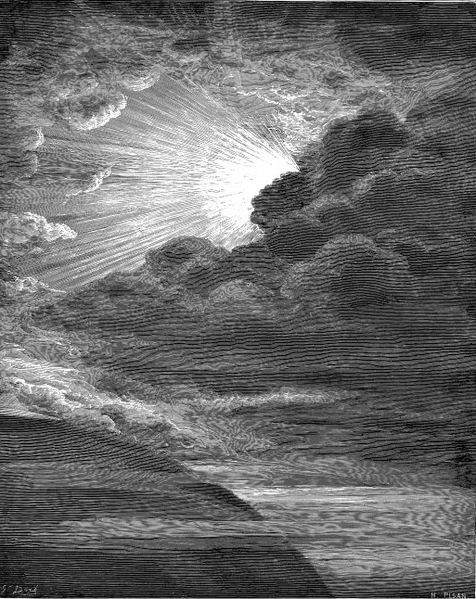 This is part of a series of posts on the “Life Dialogue/Origins Debate” within Christianity. View other posts in the series here.
The obvious point of contention between Old and Young Earth Creationism (hereafter OEC and YEC) is the age of the Earth/Universe. Hugh Ross argues powerfully for an old universe from both a theological and scientific perspective in A Matter of Days: Resolving a Creation Controversy.
The argument against the YEC position (derived from A Matter of Days) runs as follows:
1) The most coherent YEC position to explain the appearance of age in the universe is to hold that the universe appears to be old, but is not old in fact. (YECs often hold that God created light already traveling to earth, created Earth already to the point it could sustain life, etc.)
2) Scripture states that God does not lie. God is not a deceiver.
3) Scripture states that nature provides an accurate record of reality, though not a complete record.
4) 1) Scientific evidence (nature) demonstrates the universe is about 14 billion years old, as opposed to the 10,000(ish) years YECs grant.
5) Therefore, the universe is actually old. This follows from the accurate evidence of nature combined with 2) that God doesn’t deceive. If the universe is, in fact, 10,000 years (or so) old, then God has deceived humanity by making it in such a way that it appears to be much older than it is.
Premise 1) seems to definitely be the case. First, because the universe, according to the most modern science, is anywhere between 13-16 billion years old. Second, while YEC potentially has theories to explain why earth looks so old without relying on it being created already aged to a certain point (i.e. hydroplate theory), this does nothing to explain the background cosmic radiation; how we can see light from stars that are too far away to be seen yet were the universe 10,000 years old, etc. It therefore seems as though the only way to explain the apparent age of the universe is to argue that it is just that: apparent only. On this theory, God created the earth universe enough to support life, about 10,000 years ago.
Premise 2) doesn’t really need a defense (but if desired: Romans 3:4; Numbers 23:19; Deuteronomy 32:4; 1 Samuel 15:29; Titus 1:1-2).
Premise 3) can be seen in things like Psalm 19:1-4a:
“The heavens declare the glory of God;
the skies proclaim the work of his hands.
Day after day they pour forth speech;
night after night they reveal knowledge.
They have no speech, they use no words;
no sound is heard from them.
Yet their voice goes out into all the earth,
their words to the ends of the world.”
Premise 4) is at least implicitly accepted by YECs because they argue that even though science shows the universe is very old, it is not actually that old. It is worth noting that some YECs would claim that “real” and “unbiased” science would not lead to the conclusion that the universe is very old. There is little one can do to counter this claim other than argue that were that true, the YEC account would be able to present a fully testable, verifiable scientific model that shows that things like the background cosmic radiation are false.
Finally, the conclusion seems to follow from the preceding argument. God told us nature is an accurate record; He also created the universe (on YEC) in such a way that it appears to be billions of years old, but is not actually that old. Therefore, He created a universe that would deceive us into thinking, falsely, that the universe is old. But, God does not lie, so this cannot be true. Therefore, the universe is old.
I find this argument very convincing. It underscores my main problem with the YEC position: namely, that the best evidence does show the universe is old, and so God would be a deceiver were He to make it thusly.
SDG.
——
The preceding post is the property of J.W. Wartick (apart from citations, which are the property of their respective owners) and should not be reproduced in part or in whole without the expressed consent of the author. All content on this site is the property of J.W. Wartick and is made available for individual and personal usage. If you cite from these documents, whether for personal or professional purposes, please give appropriate citation and provide a link to the original URL. By viewing any part of this site, you are agreeing to this usage policy.
The Life Dialogue: Old Earth Creationism 3
This is part of a series of posts on the “Life Dialogue” within Christianity. Check out other posts in the series here.
Hugh Ross has been the subject of the last two posts on Old Earth Creationism (hereafter OEC) I wrote in this series on the “Life Dialogue” within Christianity. His work in fields related to this debate has been invaluable to Christians seeking an understanding of the world and Scripture. Thus, I’m continuing the trend of writing about his works for the OEC side of the debate.
Hugh Ross argues in Why the Universe is the Way It Is that the incredible fine-tuning of the universe shows that God planned the universe specifically for: 1) the rise of human advanced civilization at the earliest possible time, 2) the triumph of God through Christ over evil, while also keeping the natural laws constant and using a process which took literally billions of years.
Ross argues, among other things, that the universe must be quite old. This is the point of contention which is most prevalent in his book, so it is the part I will focus upon.
The universe must be old, argues Ross, for several reasons. First, there is the most oft-cited reason: the measured age of the universe, judging from the latest technology, shows that the universe is about 13.73 billion years old (Ross, 44). Second, heavy elements required for life needed time to build up (44), along with radioactive isotopes (45), while “dangerous events” such as supernova eruptions needed to subside (47). Ross further argues that the earth must be quite old (the latest measurements indicate about 9.2 billion years) in order to sustain life. This was because the sun needed time to stabilize, while there also had to be fewer bombardments from asteroids and the like (48ff). Further, continental landmasses had to form in order to sustain advanced civilizations (50ff).
Further, Ross believes Scripture backs up claims about the universe. He cites Psalm 104:2 and Isaiah 40:22 as passages which describe the universe as “stretching out” like a tent. These verses, he argues, show a divine inspiration of Scripture, as that is exactly what has been happening with our universe since the Big Bang (131). He goes on to cite extensively verses which point to Scripture lining up exactly with current scientific discoveries (cf. particularly p. 126-145).
So what can the Christian take from such an argument? This particular work of Ross’s will (mostly) mesh well with not just OEC but also the theories of Theistic Evolution (TE) and Intelligent Design (ID). It is in Ross’s expansion of his ideas that his view becomes distinct (see this post for a wider exploration of Ross’s arguments). But the conclusions he draws will remain contested by Young Earth Creationists (YEC).
The Christian desiring to combat Ross will have to attack the verses he cites while also attacking his scientific model. Again, the YEC could appeal to differing interpretations of the same evidence, arguing that while it may appear that the universe is as old as 14ish billion years (what’s a few million years when we’re talking billions?), that is only because, as Ross frequently points out, God would know exactly how old the universe would have to be to sustain life. However, God, being all-knowing and all-powerful, could have simply created the universe already capable of sustaining life. Ross would answer by arguing (as he does on p. 147ff) that it may be a false assumption to say that God only wanted to make an environment for humans to live comfortably in (153). Rather, argues Ross, God set the universe up in such a way that humans would not only exist, but also have opportunities to learn, grow, confront evil, explore and wonder at His Divine Nature and His conquest of evil through Christ (153-158).
Ross may be challenged from the “other camp”—that is, ID and TE—that he is arguing anachronistically and trying to read science into Scripture. I’m not sure what answer Ross would provide, but I believe he could counter that if God truly did inspire Scripture, then it seems as though God would know how the universe came to be. Not only that, but he could have left “markers” or “indicators” of inspiration throughout Scripture by revealing various truths about the origins and nature of the universe to the authors of Scripture. Thus, Ross might argue, it is entirely valid to treat the Bible as a “science book”, but only secondarily so. Interestingly, those who desire to read Scripture literalistically and apply it to science often fall under the YEC label, given Genesis 1ff, but Ross argues (rather well, imo), that the Bible can be read fairly literally while discovering an Old Earth scenario.
Source:
Ross, Hugh. Why The Universe is the Way It Is. Baker Books. 2008.
——
The preceding post is the property of J.W. Wartick (apart from citations, which are the property of their respective owners) and should not be reproduced in part or in whole without the expressed consent of the author.

 J.W. Wartick - Reconstructing Faith