science fiction
“Man of Steel” – A Christian look at themes in the film
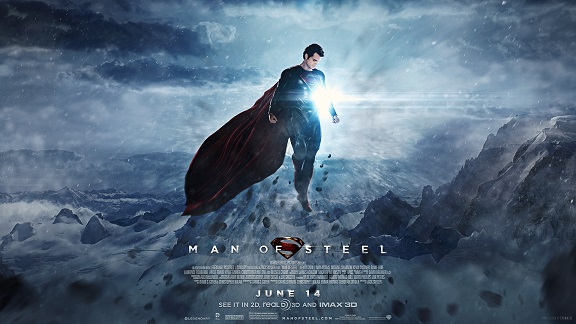 Every movie has a worldview. “Man of Steel,” the latest iteration of Superman, is no different. In fact, many explicit questions of worldview come up. Here, we’ll take a look at some major themes found in the movie. There will, of course, be SPOILERS below.
Morality
The question of morality looms large throughout the film. What does it mean to seek to do good in our world? At one point, Faora Ul, a commander in General Zod’s army, discusses how the fact that they have moved beyond morality has become an “evolutionary advantage” and that “evolution” always wins. I was struck by this brief aside for a few reasons. First, would moving apart from morality really be an advantage? Surely, it may lead to no self-sacrifice, but that self-sacrifice itself is something which preserves a race. In fact, the whole thrust of the film centered around the notion of self-sacrifice by Superman giving up those things which he liked or wanted in order to save others. The fact that Superman overcomes the moral nihilist is significant.
Second, does evolution always win? This is a question to consider for a different time and place, but surely I think one must wonder whether it is the case that having an advantage would guarantee victory in the race to survive. Any kind of random fluke could happen to eliminate a better-suited creature. Again, these are questions for another time, but in context of the movie, the whole notion was again overthrown, because Superman, with a stringent morality, overcame.
But at what cost? The climactic scene in which Superman confronts General Zod ends with Superman snapping Zod’s neck to prevent him from killing even more people. Superman’s self-made (but unmentioned in the movie) ethos of avoiding killing is thus itself overthrown. What does this say about objective morality? Is such a killing ever justified? Or, might it mean that Superman abandoned morality in order to confront the moral nihilist? Perhaps, instead, there are shades of virtue ethics found throughout, which confront Superman with a choice and allow him to carve out his own moral sphere?
These are questions suitable for reflection, and I think the movie does a great job asking the questions without spoon-feeding any answers.
Shades of a Savior?
Superman is, of course, readily seen as a savior-stand in. Superman is 33 years old, which is also the generally accepted age of Jesus at death. One scene depicts Superman in a church, and his face is set against a backdrop of a stained-glass depiction of Jesus in the Garden of Gethsemane. The scenery is surely intentional–Superman is seeking to give himself up for the sake of humanity, just as Jesus did. But the way in which they go about this self-giving are radically different. Superman’s ultimate sacrifice is compromising his moral code in order to save people, while Jesus’ was the ultimate sacrifice–taking on death and becoming sin for our sake.
The question which all of this begs, then, is whether Superman might be envisioned as an interesting Jesus-parallel, a kind of allegory to be utilized to discuss the real Savior, or whether Superman is instead a kind of rival savior figure intentionally subverting the narrative of an incarnate deity. Support for the latter might be drawn from the notion that Superman would be “viewed as a god” simply because he came from a different world and the atmosphere/sun of Earth strengthened him to superhuman (groaner, I know) levels. Is this a subversive way to describe Christ? Well, really only if one wants to accept that Jesus of Nazareth was some sort of alien and that a radical deception has gone on for two millenia. Of course, some people would like to suggest just that, but how grounded in truth might it be?
Conclusion
It seems to me that the film, then, is a useful way to juxtapose saviors. What does it mean to be a savior? How does one bring that about? There are parallels between Jesus and the story of Superman, but the most important things are perhaps the contradictions in their stories and lives. Many interesting questions about morality are raised in the film as well, and it would be hard to argue that the story of the movie is not compelling. “Man of Steel,” it seems, is another way to integrate the Christian worldview into every aspect of life. What are your thoughts on the movie? What other themes might be discussed (like this post on Platonic thought)? Let me know in the comments below.
Links
Be sure to check out the page for this site on Facebook and Twitter for discussion of posts, links to other pages of interest, random talk about theology/philosophy/apologetics/movies and more.
Book Review: “Hollywood Worldviews” by Brian Godawa– Speaking of worldviews in the movies, why not check out my review of this book which seeks to provide a method for analyzing film from a worldview perspective? Let me know what you think.
Engaging Culture: A brief guide for movies– I outline my approach to evaluating movies from a worldview perspective.
I have a number of ways in which I have critically engaged with culture in movies, books, and other arts in my posts on current events (scroll down for more posts).
Virtue Ethics and the Man of Steel– Check out this interesting post on the Platonic thought found throughout the movie.
SDG.
——
The preceding post is the property of J.W. Wartick (apart from quotations, which are the property of their respective owners, and works of art as credited; images are often freely available to the public and J.W. Wartick makes no claims of owning rights to the images unless he makes that explicit) and should not be reproduced in part or in whole without the expressed consent of the author. All content on this site is the property of J.W. Wartick and is made available for individual and personal usage. If you cite from these documents, whether for personal or professional purposes, please give appropriate citation with both the name of the author (J.W. Wartick) and a link to the original URL. If you’d like to repost a post, you may do so, provided you show less than half of the original post on your own site and link to the original post for the rest. You must also appropriately cite the post as noted above. This blog is protected by Creative Commons licensing. By viewing any part of this site, you are agreeing to this usage policy.
Book Review: “Theology and Science Fiction” by James F. McGrath
One of my favorite pastimes is to read and write science fiction. One of my others is to read and write theology. Thus, the intersection of the two is sure to catch my interest, and James F. McGrath’s book, Theology and Science Fiction serves as an excellent way to show how intertwined the two are. McGrath’s central thrust is to show how people may think of science fiction and theology as a cultural interchange. He does this by showing several parallels with science fiction and theology, and then outlining various views of science fiction and theology (science fiction against/as theology; theology as/against science fiction; etc.).
McGrath ably utilizes key source material while avoiding the pitfall of assuming readers of the book will be familiar with the entire field of science fiction. Rather than a survey of the who’s who in science fiction, then, the book serves as a kind of primer on how to reflect theologically upon science fiction, as well as how to perhaps integrate the two in meaningful, forward-moving ways.
The book is therefore full of broad points that trace themes such as “robots as gods” or “aliens as saviors,” reminiscent of the excellent Scientific Mythologies. The key with McGrath’s book, however, is a less negative assessment of science fiction overall. Yes, he acknowledges that often science fiction can be written against theology, but also draws out key areas in which the two overlap and even where theology can be written as science fiction and vice versa. These make for great ways to reflect on one’s own reading and writing in these areas and open avenues for research.
Gnosticism, Daoism, and many other views of the world are surveyed alongside science fiction as McGrath ably shows the wideness of the field.
Overall, Theology and Science Fiction is a worthy, exciting read. It would serve equally well as a textbook for a kind of cultural-integration theology course or as reading for those interested in either science fiction or theology (and certainly both). It comes highly recommended.
The Good
+Avoids potential pitfalls of being too negative or too positive
+Surveys wide range of views and possibilities
+Provides fruitful discussion points that may lead readers to more exploration
The Bad
-A tad short
-Perhaps too few examples
Disclaimer: I received a copy of the book from the publisher. I was not obligated to provide any specific kind of feedback whatsoever.
Links
Be sure to check out the page for this site on Facebook and Twitter for discussion of posts, links to other pages of interest, random talk about theology/philosophy/apologetics/movies and more!
Book Reviews– There are plenty more book reviews to read! Read like crazy! (Scroll down for more, and click at bottom for even more!)
Eclectic Theist– Check out my other blog for my writings on science fiction, history, fantasy movies, and more!
SDG.
——
The preceding post is the property of J.W. Wartick (apart from quotations, which are the property of their respective owners, and works of art as credited; images are often freely available to the public and J.W. Wartick makes no claims of owning rights to the images unless he makes that explicit) and should not be reproduced in part or in whole without the expressed consent of the author. All content on this site is the property of J.W. Wartick and is made available for individual and personal usage. If you cite from these documents, whether for personal or professional purposes, please give appropriate citation with both the name of the author (J.W. Wartick) and a link to the original URL. If you’d like to repost a post, you may do so, provided you show less than half of the original post on your own site and link to the original post for the rest. You must also appropriately cite the post as noted above. This blog is protected by Creative Commons licensing. By viewing any part of this site, you are agreeing to this usage policy.
Really Recommended Posts 10/21/16- Reading the Bible, a pro-life argument, and more!
 Go Cubs! Enjoy the reads.
The What-He-Did: The Poetic Science Fiction of Cordwainer Smith– Cordwainer Smith was a Christian who also happened to be an expert in psychological warfare, among other things. He wrote science fiction that is strange and alluring and poetic all at once, and imbued with his worldview.
Spoilers– Too often, we assume that because we’ve read it before, or know the “spoilers” of the story, we know exactly what the Bible is teaching. Is that really the case?
The Most Undervalued Argument in the Pro-Life Movement– A defense of a rather simple argument for the pro-life position.
Let’s All Be Nicene– The continuing debate over eternal subordination of the Son is, frankly, disturbing to me. I think the call to be Nicene is an appropriate one. This is a post highlighting some of the issues with those who are for eternal subordination of the Son and its problems.
6 Myths About Advocating for Women in Ministry– Don’t be deceived by false arguments that advocating for women in the ministry is somehow detrimental to the church.
“Here I stand, I can do no other, so help me God. Amen.”– A brief account and reflection on Luther’s famous words.
Celebrating 50 Years of Star Trek: Top 25 Moments, Times Two #5-1
 Readers of this blog know that I’m a huge science fiction fan. Science fiction is a genre that has more worldview seeping into it and through it than almost any other one, in my opinion. To celebrate the 50th Anniversary of Star Trek, I have teamed up with Mike Poteet of The Sci-Fi Christian (an excellent site and podcast you should follow in all forms) to share our top 25 moments each (50 total!) from all of Star Trek on screen. That’s right, from The Original Series all the way through Star Trek Beyond, we’re bringing you our favorite moments. Some of these are steeped with worldview, and some are just fun or interesting. Check them out, and let us know your favorites in the comments.
5.
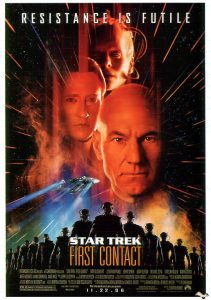
J.W. – Pretty Much All of It (Star Trek: First Contact, 1996)
It’s difficult to pick a single moment from First Contact, which is my favorite Star Trek film. As a kid I found myself looking up at the sky outside to see if Borg were descending on me that very moment. Watching it now, I enjoy the strong plot and characters.
Mike – Captain Borg (“The Best of Both Worlds, Part I,” TNG, 1990)
Composer Ron Jones uses Alexander Courage’s classic Trek fanfare to ironic and chilling effect as the camera reveals Locutus of Borg, formerly our hero, Jean-Luc Picard. It’s a moment that fires on all cylinders, heralding Trek’s coming-of-age as a modern storytelling force to be reckoned with.
4.
J.W. – “KHAAAAN!!” (Star Trek II: The Wrath of Khan, 1982)
It appears all is lost for Kirk and gang as Kirk yells his rival’s name bitterly into his communicator. In reality, Kirk has once again cheated the system, and it is this revelation that made the movie, to my younger self, utterly compelling. It remains captivating to this day.
Mike – The Kobyashi Maru Scenario (Star Trek II: The Wrath of Khan, 1982)
Viewers who dreamed of attending Starfleet Academy vicariously got their wish watching Saavik learn that “how we deal with death is… as important as how we deal with life.” (It’s also a brilliant fake-out, “killing off” Spock so fans lowered their guard before the movie lowered the real boom later.)
3.
J.W. – Klingon Jesus Appears (“Rightful Heir,” TNG, 1993)
Worf goes to find himself but ends up finding the long-awaited Kahless has returned. Not only that, but Kahless specifically calls him back to an enlivened faith. Kahless turns out to be a clone, and the episode remains thought-provoking and intense throughout.
Mike – “The Meld” (Star Trek: The Motion Picture, 1979)
Jerry Goldsmith’s lush score accompanies some of Trek’s most beautiful special effects as Decker, Ilia and V’Ger achieve transcendence. One of the franchise’s highest concept moments, dramatizing a yearning to “join with the Creator” that we Christians believe God perfectly fulfilled by coming to us (not vice versa) in Christ.
2.
J.W. – Darmok and Jalad at Tanagra (“Darmok,” TNG, 1991)
Although it seems obvious a species that can only communicate through metaphor would have problems building spaceships, this episode poignantly portrays the struggles to communicate cross-culturally while serving up some choice quotes. Not watching this is like Shaka when the walls fell.
Mike – The Phoenix Takes Flight (Star Trek: First Contact, 1997)
The movie makes up for Zefram Cochrane’s earlier, cringeworthy name check of the franchise by showing us humanity’s first warp-powered spaceflight, accompanied by the strains of Steppenwolf’s “Magic Carpet Ride.” It’s thrilling and inspiring, and a heck of a lot of fun—as Star Trek’s future, at its best, always is.
1.
J.W. – Picard Lives a Second Life (“The Inner Light,” TNG, 1992)
Picard lives an entire lifetime’s memories in just a few short minutes “real time.” Coming to, he realizes it was all the memories of a lost civilization, and the episode ends with him playing a flute from the lost world alone in his cabin. It’s absurdly beautiful.
Mike – Stealing the Enterprise (Star Trek III: The Search for Spock, 1984)
The heist is perhaps out of character for our heroes and the franchise, but friendship is at stake. Horner’s scoring is masterful, the cast’s acting is tops, and Kirk’s determination to go even when warned he’ll “never sit in the captain’s chair again” reminds us what really matters in life.
Links
The Sci-Fi Christian– There is so much to discuss when it comes to the intersection of faith and culture, and science fiction is often at the forefront of ways to drive this discussion forward. Check out The Sci-Fi Christian’s website and podcast for tons of discussion of related topics.
Eclectic Theist– Follow my “other interests” blog for discussion of sci fi, fantasy, movies, sports, food, and much, much more.
Be sure to check out the page for this site on Facebook and Twitter for discussion of posts, links to other pages of interest, random talk about theology/philosophy/apologetics/movies and more!
SDG.
Celebrating 50 Years of Star Trek: Top 25 Moments, Times Two #10-6
 Readers of this blog know that I’m a huge science fiction fan. Science fiction is a genre that has more worldview seeping into it and through it than almost any other one, in my opinion. To celebrate the 50th Anniversary of Star Trek, I have teamed up with Mike Poteet of The Sci-Fi Christian (an excellent site and podcast you should follow in all forms) to share our top 25 moments each (50 total!) from all of Star Trek on screen. That’s right, from The Original Series all the way through Star Trek Beyond, we’re bringing you our favorite moments. Some of these are steeped with worldview, and some are just fun or interesting. Check them out, and let us know your favorites in the comments.
10.
J.W. – Worf is Shunned (“Sins of the Father,” TNG, 1990)
One of the most poignant scenes in TNG is the Klingon High Council all turning their backs on a lonely Worf in the middle of a circle. It’s a radically unfair moment that contrasts Worf’s true honor with the subterfuge of his rivals.
Mike – “What does God need with a starship?” (Star Trek V: The Final Frontier, 1989)
Yes, really. Kirk shows us the importance of iconoclasm—challenging false gods—with this wonderful question. He may not believe in God, but he at least knows enough to “test the spirits” (1 John 4.1). Not every claimant of our ultimate trust, obedience and worship is deserving. Discernment is demanded.
9.
J.W. – Dealing with a Violent Past (“Duet,” DS9, 1993)
The Cardassian/Bajor conflict was apparent all through DS9 and certainly parts of TNG as well, but here it comes into true focus in beautiful ways rarely explored on Star Trek. It remains one of the better episodes of Star Trek across all series.
Mike – “I won’t kill you!” (“Arena,” TOS, 1967)
Kirk relies on his intelligence, ingenuity and mercy to survive, refusing to kill the Gorn he earlier wanted to destroy. He proves to the Metrons’ satisfaction (but not Spock’s) that humanity is “a most promising species.” One of the classic series’ most iconic and memorable hours, and deservedly so.
8.
J.W. – Invading Fleet “Can’t Stand It” (Star Trek: Beyond, 2016)
The latest Trek movie has all kinds of fun moments, but the self-referential humor of blowing away an invading fleet with music that hearkens back to the first reboot film tops them all. Tune into a modern classic to fight baddies.
Mike – Spock Melds with the Horta (“The Devil in the Dark,” TOS, 1967)
In a day when science fiction on TV often meant scary monsters (as in TOS’ own first-aired episode), Trek challenged the idea that the unknown, the alien, the “other” must, by definition, be the enemy. Innovative costuming and Nimoy’s empathetic acting sell the series’ most memorable moment of first contact.
7.
J.W. – We Learn What’s Important (“Family,” TNG, 1990)
Picard must try to reconcile with his brother back home in France as viewers get not only a tantalizing look at life on Earth in the future, but also an education in what’s important. Hint: it’s the episode title.
Mike – Benny Russell Dreams (“Far Beyond the Stars,” DS9, 1998)
Trek’s most direct assault on racial bigotry remains too timely in 2016. Sisko, in a Prophet-induced vision, learns the dangers of being black in 1950s America. It’s also one of the franchise’s most stirring affirmations of hope’s power: “You can pulp a story, but you cannot destroy an idea!”
6.
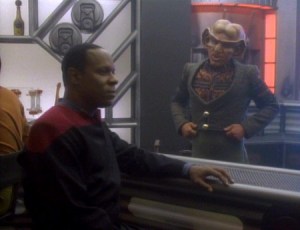
J.W. – That’s How You Premiere a Series (“Emissary” DS9, 1993)
“Emissary” was a rare moment for me- a pilot episode of a Star Trek series that was genuinely amazing. Sisko’s backstory was intriguing, all the other characters gave hints of potential, and the tension was ratcheted up with the discovery of a wormhole.
Mike – Tasha’s Farewell (“Skin of Evil,” TNG, 1987)
While Trek’s theology of immortality (living on in others’ memories) offers less hope than the Gospel, Tasha’s memorial shows the power of ritual and the necessity of community when coping with grief. Ron Jones’ score sings with heartbreak but also, as if by grace, healing. Season one’s most beautiful moments.
Links
The Sci-Fi Christian– There is so much to discuss when it comes to the intersection of faith and culture, and science fiction is often at the forefront of ways to drive this discussion forward. Check out The Sci-Fi Christian’s website and podcast for tons of discussion of related topics.
Eclectic Theist– Follow my “other interests” blog for discussion of sci fi, fantasy, movies, sports, food, and much, much more.
Be sure to check out the page for this site on Facebook and Twitter for discussion of posts, links to other pages of interest, random talk about theology/philosophy/apologetics/movies and more!
SDG.
Celebrating 50 Years of Star Trek: Top 25 Moments, Times Two #15-11
 Readers of this blog know that I’m a huge science fiction fan. Science fiction is a genre that has more worldview seeping into it and through it than almost any other one, in my opinion. To celebrate the 50th Anniversary of Star Trek, I have teamed up with Mike Poteet of The Sci-Fi Christian (an excellent site and podcast you should follow in all forms) to share our top 25 moments each (50 total!) from all of Star Trek on screen. That’s right, from The Original Series all the way through Star Trek Beyond, we’re bringing you our favorite moments. Some of these are steeped with worldview, and some are just fun or interesting. Check them out, and let us know your favorites in the comments.
15.
J.W. – Ro Chooses Sides (“Preemptive Strike,” TNG, 1994)
Ro Laren had been in and out of TNG for several episodes, and her Bajoran roots linked her plot with what was happening on DS9. Here, we see her go from favored protégé of Picard to betraying his trust to follow what she feels is the greater good.
Mike – Worf’s Bedside Manner (“Disaster,” TNG, 1991)
Pressed into medical service after catastrophe strikes the Enterprise (as it does), Worf makes ready to set a crewman’s broken leg with this blunt assessment: “This will hurt. Prepare yourself.” Afterward, he praises his patient: “You bore that well.” A pitch-perfect note of character-based comedy, at which mature TNG excelled.
14.
J.W. – Finally Home (“Endgame,” Voyager, 2001)
Though we may not get as much of the story as we’d like, fans finally got to see the return of Voyager to, approximately, home. The whole premise of the show was based on the culmination of this event, and the payoff is emotionally captivating.
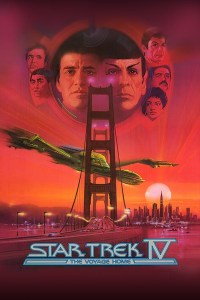
Mike – “Hello, computer!” (Star Trek IV: The Voyage Home, 1986)
It’s hard to pick a favorite funny scene in a film full of them, but Scotty’s (admittedly unrealistic) ignorance of a 1980s computer—”The keyboard; how quaint”—is always a contender. The scene is also the template for Spock Prime’s “invention” of transwarp beaming for Scotty in Star Trek (2009).
13.
J.W. – Blue Shirt? Kill me now! (“Tapestry,” TNG, 1993)
Picard must relive moments of his life that he would like to change as Q guides him to the realization that those choices made him who he was. The best part: when he ends up a blue shirt, he immediately demands death instead of continuing as a lowly science officer.
Mike – Khan Revealed (Star Trek II: The Wrath of Khan, 1982)
Ricardo Montalban’s performance as an older, crazier Khan so riveted me, I memorized much of it, including this scene. Montalban swings from nostalgic bitterness (“On Earth… 200 years ago…”) to unbridled outrage (“This is Ceti Alpha Five!”) All memories of Mr. Roark evaporate; here is the Trek films’ greatest villain.
12.
J.W. – “Would you mind stopping that noise?” (Star Trek IV: The Voyage Home, 1986)
Kirk asks a punk on the bus to turn off his boombox; in response, the punk turns it up. So Spock shuts him down and the bus applauds. This is one of the most memorable moments in all of Star Trek, in my opinion.
Mike – U.S.S. Enterprise, NCC-1701-A, Revealed (Star Trek IV: The Voyage Home, 1986)
A cathartic moment that restores order to the recently chaotic Trek universe. The unveiling of the new Enterprise, to the strains of Alexander Courage’s fanfare, is arguably the franchise’s first overt acknowledgment that (as Roddenberry’s own, unused lyrics to the old theme say), this “star trek will go on forever.”
11.
J.W. – Data is a Person (“The Measure of a Man,” TNG, 1989)
Riker must try to demonstrate Data is not a person, and does so by taking an arm off… he thinks. But Picard’s case comes out on top and Data is demonstrated to be a person with all the rights that entails. It’s a suspenseful, heartwarming moment early in TNG.
Mike – “This is 13 years ago…” (“The Menagerie,” TOS, 1966)
Gene Roddenberry faced the unenviable “no-win scenario” of needing to air the show’s unsold, radically different first pilot episode in order to fill out TOS’ first season. His solution was elegant, enveloping it in a frame story that instantly gave the Trek universe a “pre-history” and Spock a richer backstory.
Links
The Sci-Fi Christian– There is so much to discuss when it comes to the intersection of faith and culture, and science fiction is often at the forefront of ways to drive this discussion forward. Check out The Sci-Fi Christian’s website and podcast for tons of discussion of related topics.
Eclectic Theist– Follow my “other interests” blog for discussion of sci fi, fantasy, movies, sports, food, and much, much more.
Be sure to check out the page for this site on Facebook and Twitter for discussion of posts, links to other pages of interest, random talk about theology/philosophy/apologetics/movies and more!
SDG.
Celebrating 50 Years of Star Trek: Top 25 Moments, Times Two #25-21
 Readers of this blog know that I’m a huge science fiction fan. Science fiction is a genre that has more worldview seeping into it and through it than almost any other one, in my opinion. To celebrate the 50th Anniversary of Star Trek, I have teamed up with Mike Poteet of The Sci-Fi Christian (an excellent site and podcast you should follow in all forms) to share our top 25 moments each (50 total!) from all of Star Trek on screen. That’s right, from The Original Series all the way through Star Trek Beyond, we’re bringing you our favorite moments. Some of these are steeped with worldview, and some are just fun or interesting. Check them out, and let us know your favorites in the comments.
25.
J.W. – Trek is back to TV… kind of (Star Trek: Discovery Announced, 2016)
https://www.youtube.com/watch?v=Cxba2WjlN90
Finding out that Star Trek was returning in series form was massive news for Star Trek fans. It’s always been the format Trek has excelled in, and I know that the announcement of a new series was one of the best moments I’ve had with Star Trek.
Mike – “Is that classical music?” (Star Trek Beyond, 2016)
The perfect fusion of “nuTrek” and old: Instead of firing phasers or photon torpedoes, our heroes unexpectedly use music as a weapon against Krall’s “bees”—and the song of choice? The Beastie Boys’ “Sabotage,” a callback to the 2009 film. (We all like the beats and the shouting, Jaylah!)
https://www.youtube.com/watch?v=CeGHr9l-o1E
24.
J.W. – Data is an A-Bomb (“Thine Own Self,” TNG, 1994)
Data shows up at in a village with no memory of who he is, or that he’s carrying a container full of radiation poisoning. When the camera pans onto that case with the radiation warnings on it, it is one of the more chilling moments in TNG.
Mike – The Tragedy of Red Squad (“Valiant,” DS9, 1998)
One of Trek’s most haunting examinations of war and its costs. Jake and Nog’s friendship is tested past the breaking point aboard a Starfleet vessel crewed by cadets who want to become (depending on who you ask) heroes or martyrs. A powerful, not preachy morality tale in Trek’s finest tradition.
23.
J.W. – Seven of Nine is Revealed (“Scorpion, Part 2,” VOY, 1997)
The Borg are perhaps the most feared of all Star Trek villains, and for good reason. Here, however, viewers are introduced to a character who would later become a seeming paradox: a sympathetic, rehabilitated (?) Borg.
Mike – Tribbles Keep Fallin’ On Kirk’s Head (“Trial and Tribble-ations,” DS9, 1996)
An overrated TOS episode is redeemed with witty scripting and ingenious, seamless editing just in time for Trek’s 30th birthday. We learn those fuzzballs kept raining down on Kirk because, off camera, time-traveling Sisko and Dax were tossing them aside in order to find a bomb!
22.
J.W. – Data is Impersonal (“In Theory,” TNG, 1991)
Data experiments with humanity, but it turns out that much of his work is just that—experimentation. When his girlfriend breaks up with him, his utterly bleak—and apparently inhuman—reaction is to delete the program routine he wrote to date her.
Mike – Captain Proton to the Rescue!!! (“Bride of Chaotica,” VOY, 1999)
Buck Rogers and zap guns are an often overlooked part of Trek’s DNA, but not here! The pulp sci-fi tradition is on full, garish black-and-white display as Tom Paris’ B-movie holodeck program goes terribly—and hysterically—wrong. The “Voyager” cast always shone when set free to unleash their comedic chops.
21.
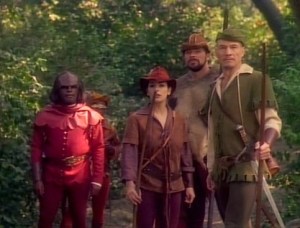
J.W. – I turned on the wrong channel (“Qpid,” TNG, 1991)
A rollicking good time in this episode of TNG, wherein Q attempts to give Picard a love interest by transporting him and select crew members to Sherwood Forest. If you start this episode in the middle, you’d be confused about what you’re watching.
Mike – “Why are they banging their heads?” (“Little Green Men,” DS9, 1995)
Arguably the funniest of Trek’s many trips to the past, wherein we learn that none other than Ferengi crashed in Roswell in 1947. “I’d always heard primitive hew-mons lacked intelligence,” Quark observes, “but I had no idea they were this stupid!” Out of the mouths of extraterrestrials.
Links
The Sci-Fi Christian– There is so much to discuss when it comes to the intersection of faith and culture, and science fiction is often at the forefront of ways to drive this discussion forward. Check out The Sci-Fi Christian’s website and podcast for tons of discussion of related topics.
Eclectic Theist– Follow my “other interests” blog for discussion of sci fi, fantasy, movies, sports, food, and much, much more.
Be sure to check out the page for this site on Facebook and Twitter for discussion of posts, links to other pages of interest, random talk about theology/philosophy/apologetics/movies and more!
SDG.
“Her Dangerous Visions” by Brandon Barr- Prophecy, Evil, and Hope
 Brandon Barr’s Her Dangerous Visions is a science fiction/fantasy drama that will suck you in and not let go. Here, I’ll offer a brief review of the book alongside a few comments on themes found therein. The shortest possible review is: get the book, it’s great.
Review
Barr’s writing style is direct, but has depth. There is an enormous amount of political drama, tension around love, and action packed into each page of the book. Moreover, Barr seamlessly combines elements of science fiction and fantasy, such that it is difficult to categorize the book neatly. But that combination works remarkably well here, as Barr moves from farms to space with ease.
This first entry in the series offers glimpses of a broader universe, leaving readers wanting more from future installments. The focus is on the planets that are involved in a conflict, Loam and Hearth, that is apparently much more than any of their inhabitants realize.
Barr’s style is driven by characters. The characters are all remarkably deep. They have qualities that make readers get immediately invested, and faults that make readers want to scream at the pages as they watch favorite characters make foolish choices time and again. Meluscia was my favorite character–a woman whose ailing father is debating whom to appoint as his successor. She works to become that successor, but her desires in other areas could throw her off her apparently single-minded quest. Winter, another character, is said to be a seer, but the visions she sees continue to show sickening danger. Does she share the visions to try to prevent what they foretell, or keep them silent in the hopes that sharing them will not cause them to happen? Each character, as I said, is full of depth and develops of the course of the story. They feel very real–with motivations, aspirations, and faults that drive them.
The plot itself is complex, with layers peeled away through the course of the book and in interludes between sections. The pace never lets up, and once readers start, they won’t be able to put it down.
Overall, Her Dangerous Visions is a simply phenomenal read. I highly recommend it, just be ready to read for a while, because you’ll want to dive into the next book ASAP.
There will be SPOILERS in what follows.
Prophecy
Prophecy is clearly an important part of the book and the whole series. Winter’s gifting as a Seer means that she must try to understand what it means and come to comprehend it. There are portions where scenes with Winter remind me of biblical prophets and their own struggles. Think about it: how many prophets truly had it easy in the Bible? Nathan had to tell the King he’d committed great evil; Elijah was hunted for much of his career; John the Baptist ate bugs in the wilderness; etc. Similarly, Winter doesn’t have it easy, and finds herself questioning the wisdom of deity in this book. There is more to be explored in the coming books in the series, but at the end of Her Dangerous Visions, it is difficult to see where Winter may end up on her journey.
Evil
Evil is not often black-and-white in the real world, but there are some clear instances of it being such (i.e. Stalin/Hitler). Similarly, Barr’s book shows evil at times being black-and-white, but at other times it is much more subtle. Much of the evil in the book is from the characters themselves–finding themselves motivated wrongly by lust or vengeance rather than by virtues. It is a dimension that, as I said, makes the characters feel very real, and causes reflection in readers.
Hope
In our world, hope may be found in Christ, no matter how bad the darkness gets. Similarly, in Her Dangerous Visions, hope is found in trusting in others and the goodness of God. The spiritual realm in the novel is not fully revealed yet, so it will be interesting to see how it comes to be shaped over time.
Conclusion
I’d recommend readers pick up Brandon Barr’s book. He’s a man of faith who has written a phenomenal set of novels that are thought-provoking and thrilling.
Links
Be sure to check out the page for this site on Facebook and Twitter for discussion of posts, links to other pages of interest, random talk about theology/philosophy/apologetics/movies and more!
Popular Books– Read through my other posts on popular books–science fiction, fantasy, and more! (Scroll down for more.)
SDG.
——
The preceding post is the property of J.W. Wartick (apart from quotations, which are the property of their respective owners, and works of art as credited; images are often freely available to the public and J.W. Wartick makes no claims of owning rights to the images unless he makes that explicit) and should not be reproduced in part or in whole without the expressed consent of the author. All content on this site is the property of J.W. Wartick and is made available for individual and personal usage. If you cite from these documents, whether for personal or professional purposes, please give appropriate citation with both the name of the author (J.W. Wartick) and a link to the original URL. If you’d like to repost a post, you may do so, provided you show less than half of the original post on your own site and link to the original post for the rest. You must also appropriately cite the post as noted above. This blog is protected by Creative Commons licensing. By viewing any part of this site, you are agreeing to this usage policy.
The Expanse: Episodes 6-7 – A Christian perspective
 I’ve been enjoying watching SyFy’s TV series, “The Expanse,” quite a bit. Part of that is because I’m a huge science fiction fan, but another part of it is because there is plenty of worldview discussion to go around. I’ll be posting a series on worldview in episodes from the expanse biweekly as they come out. There will be SPOILERS for the episodes discussed here, as well as possibly any earlier episodes. Please don’t post spoilers for later episodes on this post.
Home, Family, and Self
Once more we have the OPA entangled in a struggle for a sense of home. I emphasized this last time for episodes 1-5, but here we have the need for home countered by the revelation that the OPA killed Chrisjen Avasarala’s son, and it has become personal for her. Family was emphasized on her side of the plot, as she tries to play that card to get more information about the OPA. It will be interesting to see whether dynamics of family, self-service, and home continue to drive some of the main characters in the series. One question I still have: how important is it to have a place we can call “home”? So far, “The Expanse” seems to emphasize that this is a great need, and this resonates with a Christian worldview when, throughout the Bible, we have continued pointers to a promised land and sense of place.
Truth and Lies
One of the most common expressions regarding lies is that we “weave a web” of them. The more we engage in deception, the more we must tell more lies to keep up the facade. Detective Miller goes deeper and deeper into a web of lies. The question is: what does he have to ground himself? His job was terminated instantly once it was found out he was delving too close into territory that others wanted to keep quiet. What does it mean to continue to seek truth even in the face of such opposition–even threat to one’s own life?
Christianity was based upon the testimony of those who were willing to die for truth. This isn’t merely an appeal to sincerity of belief, but rather an argument that shows that some truths are worth dying for–something difficult to do if you know what you’re dying for is false. Miller–technically no longer Detective Miller–seems like he is willing to go to extraordinary lengths to discover the truth. I wonder where it will lead him.
Survival and the Secular Ethic
The conversation Burton has with the stowaway spy, Kenzo, in episode 7 is interesting, because it focuses on the notion that survival is the highest good for humanity. This reflects an understanding of reality that puts mere continued existence as “the good” as opposed to anything else. Frankly, this is the kind of grounding that secular ethics almost always end up appealing to, whether it is mere survival or some abstraction like “human flourishing.” Yet in this episode we see how hollow such an ethic is. It leads to Burton’s willingness to kill anyone–whether it is someone he just met (and has completely at his mercy) or to keep from getting captured.
Later in the same episode, Kenzo has a deep conversation, asking whether he is going to be dropped out an airlock because he is found to be “inconvenient.” Perhaps with the most moving line in the series so far, he asks to be told if they’re just going to kill him so he can make his peace, because “I am not an animal.” Yet, so far, many of the people have been acting just like animals, again, with Burton’s argument for mere survival as his motto for life.
The absurdity of this way of life was revealed by Kenzo, because his words resonate with us. Mere survival is not enough–we are not animals. Indeed, even the more popular appeals to ground ethics upon “human flourishing” is little more than putting forward prettier words for the same concept. Is mere survival, or even the move towards whatever hedonistic view of “flourishing” we’d like to put forward, the best we can do? I don’t believe so, and I have argued at length that the secular grounding for morality fails even on its own criteria. We are not merely animals, and we can do better than grounding a philosophy of life on an animalistic drive to survive.
Such an ethic makes the most sense on a theistic view of the world, and Christianity is the worldview that stands up under scrutiny. Those who wish to deny this and continue to affirm a secular ethic must embrace the very opposite of that which Kenzo states in this episode. That is, they must affirm “I am [merely] an animal” and then ground their moral action on that.
Conclusion
The Expanse continues to bring intriguing questions about worldview to the forefront, while couching it all in a pseudo-noir science fiction epic. I’m loving the series so far, and would like to know what you think as well. Let me know in the comments!
Links
Be sure to check out the page for this site on Facebook and Twitter for discussion of posts, links to other pages of interest, random talk about theology/philosophy/apologetics/movies and more!
Eclectic Theist– Check out my other blog for my writings on science fiction, history, fantasy movies, and more!
SDG.
——
The preceding post is the property of J.W. Wartick (apart from quotations, which are the property of their respective owners, and works of art as credited; images are often freely available to the public and J.W. Wartick makes no claims of owning rights to the images unless he makes that explicit) and should not be reproduced in part or in whole without the expressed consent of the author. All content on this site is the property of J.W. Wartick and is made available for individual and personal usage. If you cite from these documents, whether for personal or professional purposes, please give appropriate citation with both the name of the author (J.W. Wartick) and a link to the original URL. If you’d like to repost a post, you may do so, provided you show less than half of the original post on your own site and link to the original post for the rest. You must also appropriately cite the post as noted above. This blog is protected by Creative Commons licensing. By viewing any part of this site, you are agreeing to this usage policy.
“The Expanse” Episodes 1-5- A Christian Perspective
I’ve been enjoying watching SyFy’s TV series, “The Expanse,” quite a bit. Part of that is because I’m a huge science fiction fan, but another part of it is because there is plenty of worldview discussion to go around. I’ll be posting a series on worldview in episodes from the expanse biweekly as they come out. There will be SPOILERS for the episodes discussed here. Please don’t post spoilers for later episodes on this post.
Fear and Safety
A theme that resonates all too readily with the current state of our society is that of fear of the “other.” People on Earth are afraid of anyone not from Earth, people of the outer planets/belters are afraid of people of Mars and Earth. Fear is a driving motivation for many of the characters so far. Chrisjen Avasarala is a clear example of this so far. She submits a captured suspected OPA terrorist to torture in order to try to get information from him that should protect others. The apparent callousness with which she does this act seems to be unquestioned by those around her.
It is all too easy to dehumanize those who are not like us. It is made easier when we fear “them.” Safety is the proverbial carrot that is held out to justify wrongful acts against the perceived evil “other.” We are assured that if such measures are not taken, our lives may be forfeit. Yet what price is too high to pay for safety?
Christians should be working against injustice wherever it occurs. Injustice includes cruel punishments and torture of others. Although we need not be completely without defense, there is no place for an ethic of the ends justifying the means in Christianity.
Home and Place
Episode 5 had an interesting conversation between an OPA man and Detective Miller. In it, the OPA man was pointing out how people on earth have a home, a place to call their own, but elsewhere, people do not. Throughout the series so far, there has been a sense of displacement among the characters. No one does seem entirely comfortable where they are. This notion of place is one that should not be too easily passed over.
Place is something that everyone needs–somewhere to call their own. In the Bible, this is evident in the narratives of Israel and the Promised Land, but it continues into our time with the promise of the New Creation. The hope for a home is something that is ultimately forward-looking, because we will never be truly home until we have been united with Christ. The longing evident in characters in “The Expanse” points us towards our own longings.
Conclusion
I’d love to know what you think of the series thus far and what worldview level issues you have seen therein. Leave a comment and be sure to follow the blog as I will be writing more as the series progresses.
Links
Be sure to check out the page for this site on Facebook and Twitter for discussion of posts, links to other pages of interest, random talk about theology/philosophy/apologetics/movies and more!
Eclectic Theist– Check out my other blog for my writings on science fiction, history, fantasy movies, and more!
SDG.
——
The preceding post is the property of J.W. Wartick (apart from quotations, which are the property of their respective owners, and works of art as credited; images are often freely available to the public and J.W. Wartick makes no claims of owning rights to the images unless he makes that explicit) and should not be reproduced in part or in whole without the expressed consent of the author. All content on this site is the property of J.W. Wartick and is made available for individual and personal usage. If you cite from these documents, whether for personal or professional purposes, please give appropriate citation with both the name of the author (J.W. Wartick) and a link to the original URL. If you’d like to repost a post, you may do so, provided you show less than half of the original post on your own site and link to the original post for the rest. You must also appropriately cite the post as noted above. This blog is protected by Creative Commons licensing. By viewing any part of this site, you are agreeing to this usage policy.

 J.W. Wartick - Reconstructing Faith