science fiction
“Dune” by Frank Herbert- Prophecy, Religion, and the Messiah
 Bless the Maker and His water. Bless the coming and the going of Him. May His passage cleanse the world. May He keep the world for his people.
Dune has been called “Science Fiction’s Supreme Masterpiece.” I say that this tagline is accurate. The depth of the saga is breathtaking, and its majesty is at times overpowering. Here, I’ll take a look at some key themes in the book from a Christian perspective. There will be SPOILERS in what follows.
Prophecy
Prophecy is found throughout the various factions in Dune. The Bene Gesserit is a school composed of women who are working to bring about a prophesied man–but to use him for their own ends. The Fremen, inhabitants of the desert, also have prophecies of one who would bring their world–Arrakis–to fertility and unite the Fremen against their enemies.
Prophecy has a function, which will be fulfilled one way or another. Often, this involves the conscious working of persons towards the fulfillment. This is unlike prophecy in the Bible, which is sometimes fulfilled in quite unexpected ways or even has double applications (such as the virgin birth).
Religion
Religion is a theme throughout the book, as there are many different philosophies of life on offer, but few which seem genuine. Herbert’s vision of religion is that it is essentially a function of humanity and one which is constructed through the interplay of power and belief. For example, in one biographical entry about Paul Atreides, the protagonist, the Princess Irulan writes:
You cannot avoid the interplay of politics within an orthodox religion. The power struggle permeates the training, educating and disciplining of the orthodox community… the leaders of such a community… must face that ultimate internal question: to succumb to complete opportunism as the price of maintaining their rule, or risk sacrificing themselves for the sake of the orthodox ethic. (401)
Hebert also channels much wariness about any engagement of politics and religion throughout the book. Representative is a saying allegedly from the Muad’Dib–the name given to Paul Atreides after he is seen as the fulfillment of various prophecies: “When law and duty are one, united by religion, you never become fully conscious, fully aware of yourself. You are always a little less than an individual” (408).
Yet this is not to say there is no genuine belief in the world of Dune. Debates over determinism and divinely decreed futures are placed throughout the book, and Paul Atreides himself struggles with his own role as an apparent Messiah.
The religious mixture of Buddhism, Islam, and Christianity found in the various factions provides much food for discussion and engagement for those who want to dialogue on these topics. How should we interact with those of other faiths? What lines of correlation may we see in other religions and how might we use these to engage believers in other faith traditions? These are questions which arise in Dune, and Herbert also offers challenges to believers to see what harm might be in their beliefs and to search out those aspects of their faith which lead astray from the truth.
Truth
There are many more philosophical, theological, and political questions which could be asked after reading a masterwork like Dune. A fundamental issue is that of truth. The issues of religion and prophecy listed above make one read the world of the work with a rather ambiguous eye: there seems to be some deception, but some truth, in various aspects of the different factions’ belief systems and what they present to the world as the truth.
From a Christian perspective, there is but one truth and that is found in Jesus Christ. Similarly, even on the world of Arrakis, we find that there is an objective standard of truth, it just isn’t always cut-and-dried as to how we might discern it. It is a reflection of the fallenness of the real world in which often the truth is intermingled with lies. We should work ever towards seeking the truth and working to bring it forward.
Conclusion
Weeks after reading Dune, I can still feel the hot sand under my feet, and still smell the Spice in the air. It is a simply incredible read which demands hours of reflection afterwards. I recommend it highly to you, dear readers. It will get your mind going, and it will also perhaps force some thought into one’s own faith and life–are we living a genuine life of faith, or have we turned it into a perversion?
Links
Be sure to check out the page for this site on Facebook and Twitter for discussion of posts, links to other pages of interest, random talk about theology/philosophy/apologetics/movies and more!
A Solar System and Cosmos Filled with Life?- A reflection on Ben Bova’s “Farside” and “New Earth”– I explore the notion that life should be expected all over the place in a post that looks at some of Bova’s most recent works.
“Fitzpatrick’s War”- Religion, truth, and forgiveness in Theodore Judson’s epic steampunk tale– I take a look at the book Fitzpatrick’s War, a novel of alternative history with steampunk. What could be better? Check out some of the worldview issues brought up in the book.
I have discussed the use of science fiction in showing how religious persons act. Check out Religious Dialogue: A case study in science fiction with Bova and Weber.
Source
Frank Herbert, Dune (New York: Ace, 1990). Originally printed 1965.
SDG.
——
The preceding post is the property of J.W. Wartick (apart from quotations, which are the property of their respective owners, and works of art as credited; images are often freely available to the public and J.W. Wartick makes no claims of owning rights to the images unless he makes that explicit) and should not be reproduced in part or in whole without the expressed consent of the author. All content on this site is the property of J.W. Wartick and is made available for individual and personal usage. If you cite from these documents, whether for personal or professional purposes, please give appropriate citation with both the name of the author (J.W. Wartick) and a link to the original URL. If you’d like to repost a post, you may do so, provided you show less than half of the original post on your own site and link to the original post for the rest. You must also appropriately cite the post as noted above. This blog is protected by Creative Commons licensing. By viewing any part of this site, you are agreeing to this usage policy.
Really Recommended Posts 4/24/15- abortion and evangelicals, apologetics, and more!
 Winter is back, apparently, here in Minnesota. It’s COLD! And it snowed on Monday and Tuesday. Anyway, here we have some reading to keep you entertained on chilly nights. The topics are abortion and evangelicals, raising kids, apologetic methods, science fiction, and a debate over the Reformation.
Evangelicals Opposed Abortion Much Earlier than You Think– It has been said that evangelicalism wasn’t originally pro-life or oriented against abortion. Is that true? Moreover, does it even matter? Here’s an article examining the historical claim. My own thoughts are that it doesn’t matter when evangelicals began working against abortion. The question is whether abortion is morally permissible (or not). Whether a group historically opposed it or not doesn’t do much to the current debate other than provide a rhetorical flair. This post takes away some of that rhetorical flair.
4 Reasons the Internet May Influence Your Kids’ Faith More Than You– What influence does the internet have on kids exploring questions about the faith? How might awareness of this influence help us to confront worldview issues?
Comparing Apologetics Systems: Methodology and Practice– How should we do apologetics? Here is a post outlining some different approaches to apologetics and how they might be applied.
Spec[ulative]-Fic[tion] Subgenres: Superheroes & Fairy Tales– Christian publisher (of science fiction and fantasy) Enclave has an interesting post comparing the genres of superhero writing to fairy tales. They’re the same publisher who is re-releasing Kathy Tyers’ works. I had an interview with this awesome sci-fi author regarding worldview questions and science fiction here.
Revelation TV Debate: Church would have been better off without the Reformation?– Here’s an interesting debate about whether the Reformation was a good development in church history. The debaters are James White and Rev. Dr. Thomas Norris.
Interview with Christian Science Fiction Author Kathy Tyers
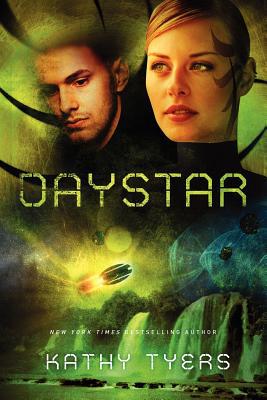 I am extremely pleased to be able to present my readers with an interview with New York Times-Bestselling author Kathy Tyers. Kathy Tyers has been instrumental in growing the genre of Christian science fiction and has published multiple books, including her award-winning “Firebird” series in this genre. She received the Mount Hermon Christian Writers Conference’s Pacesetter award for her work in developing science fiction. She has also published two Star Wars novels and appeared on the New York Times Bestseller list. She currently resides in Montana, where she continues to mentor other authors and work on her own future novels.
I have written several posts on Tyers’ “Firebird” saga (click here and scroll down or see links at the end of this post), and have immensely enjoyed her works.
What were some of the biggest science fiction influences on your writing?
The first SF novel I devoured was The Star Conquerors, an early space opera by Ben Bova. I was also a big fan of Zenna Henderson’s “People” novels. The original Star Wars movies swept me away, of course. I discovered Lois McMaster Bujold’s Miles Vorkosigan series when the first novel came out, and I kept up as she released titles in the series. Whenever I’m called to teach the craft in a classroom, I draw on Orson Scott Card’s excellent book on writing SF and Fantasy.
How has your faith inspired you to write?
My faith inspires my writing as it inspires everything I do; it’s the air I breathe, the ground I walk on, the light by which I can see and the gravity that keeps me grounded. If ever I shut my eyes, quit walking and stop breathing, it surely shows in my writing.
What do you think of the categorization of “Christian” fiction? Is it helpful to have a distinct category of “Christian” fiction?
Some people want to know, before opening a novel, whether it’s going to challenge them to think more deeply about God. Should all fiction come with a worldview alert about the author? That’s probably impractical. But if I open a novel that I know was written by a fellow Christian, or by someone of another faith, of course I approach it with different expectations.
What value do you think Christian speculative fiction has for evangelism, defense of the faith, and theology?
Whether or not we see ourselves as evangelists, we’re ambassadors for a Kingdom that is not of this world. That applies to every Christian in every profession. An author who’s known to be a Christian will have his or her books analyzed accordingly by some of the reviewers. If the book survives scrutiny as a good witness to the craft and the Kingdom, AND if it’s a good story well told, the author has accomplished what good fiction is supposed to accomplish—even if it gets the occasional one-star review.
How awesome was it to write Star Wars books?
Absolutely.
What is one piece of advice for aspiring writers?
Writing will take more time than you could possibly imagine. Don’t use that as an excuse to stop reading, because you’ll unconsciously (or consciously) emulate the books you’ve been reading. So read the good stuff.
What’s next on your plate? Any new books to look forward to?
I’ve written a contemporary supernatural novel set in Montana that I’m looking into indie publishing. Just looking, so far. Haven’t decided.
Conclusion
I would like to once more extend my thanks to Kathy Tyers for being willing to get interviewed for my site and for her excellent work in the field of science fiction.
Links
Kathy Tyers’ “Firebird” Trilogy- Faith, Humanity, and Conflict in the Far Future– The “Firebird” trilogy is one of my fondest memories of a read from when I was much younger. I recently re-read the series and was once more blown away. Here, I reflect on several issues of humanity and faith that Tyers raises in the novels.
Enter [Science] Fictional Messiah- Kathy Tyers’ “Wind and Shadow” and “Daystar”– I look into several worldview themes that Tyers raises in these sequels to her Firebird trilogy. What would a Messiah in the future look like?
Be sure to check out the page for this site on Facebook and Twitter for discussion of posts, links to other pages of interest, random talk about theology/philosophy/apologetics/movies and more!
Microview: “The Annotated Firebird Trilogy” by Kathy Tyers– I review the trilogy with a brief look at the plot and some positives and negatives in the book.
SDG.
——
The preceding post is the property of J.W. Wartick (apart from quotations, which are the property of their respective owners, and works of art as credited; images are often freely available to the public and J.W. Wartick makes no claims of owning rights to the images unless he makes that explicit) and should not be reproduced in part or in whole without the expressed consent of the author. All content on this site is the property of J.W. Wartick and is made available for individual and personal usage. If you cite from these documents, whether for personal or professional purposes, please give appropriate citation with both the name of the author (J.W. Wartick) and a link to the original URL. If you’d like to repost a post, you may do so, provided you show less than half of the original post on your own site and link to the original post for the rest. You must also appropriately cite the post as noted above. This blog is protected by Creative Commons licensing. By viewing any part of this site, you are agreeing to this usage policy.
Really Recommended Posts 4/17/15- Aquinas, Creationism, Abortion, and more!
 Spring is here for real this time (maybe?). That means that my family gets to go on long walks outside, which is wonderful. What else is wonderful? Sharing some awesome posts with you, dear readers! Here’s another round of RRP that includes posts on Aquinas, science fiction, creationism, men and women, and arguments for abortion (debunked). Check them out, and let me know what you think!
Soft Tissue in Mollusk Fossils and the Case for a Young Earth– Does soft tissue prove that the earth is, in fact, only a few thousand years old? Here is an analysis of an argument put forward for some for the position of young earth creationism.
Bad Pro-Choice Arguments– There are some really poor arguments out there for all kinds of positions. Here is an analysis of some bad arguments for the pro-choice position.
Three Reasons I believe Men and Women are Equal Co-Laborers in God’s Kingdom– Why believe that men and women should work side-by-side in pastoral (and other) ministry? Here are three reasons.
Spec[ulative]-Fic[tion] Subgenres: Paranormal & Supernatural– Christian speculative fiction [read= fantasy/sci-fi] publisher Enclave has put out this post on the genres of paranormal and supernaturalism in fiction. It’s worth a read to see some interesting distinctions.
Was Aquinas a Materialist?– Edward Feser analyzes the claim that Thomas Aquinas was a materialist when it comes to human nature.
Enter [Science] Fictional Messiah – “Wind and Shadow” and “Daystar” by Kathy Tyers
Kathy Tyers’ Firebird series is renowned by many for its explorations of worldview questions in a stirring science fiction setting. I have written on the Firebird Trilogy before. Here, we’ll take a look at the two concluding books in the series- Daystar

Human Nature
Both books have much to say about human nature. In particular, questions about the extent and nature of our free will abound as we as readers are confronted with different concepts of determinism and free choice. Although this theme is never, perhaps, fully developed in philosophical terms, the very activity of the characters makes a kind of argument towards the notion that we have free choice that is genuine, though the question of whether this might be compatibilist–set alongside determinism–or not is left open.
Daystar also raises major questions about the nature of humanity itself–are we purely material beings; or perhaps purely spiritual and trapped within a material body; or are we a unified center of body and soul? The organization known as the Collegium puts forward a kind of mystic view that we are eternal souls which, when we die, go back to the infinite, impersonal divine. There are strong elements of both Gnosticism and Platonism to be found in this teaching, and it is one which resonates with New Age type beliefs and other worldviews today. We need to think on this for ourselves: when it comes to the very concept of what it is to be a human, are we essentially matter, or is there something more? Christians need to think on such issues deeply and consider our own standing in the universe.
The Powers
There is a fantastic meld of science fiction technology and the reality of the spiritual realm found throughout the Firebird series. Wind and Shadow
Not long ago I read an excellent book on spiritual warfare which presented several views on the topic. I think we need to be prepared to dive into such challenging topics and see what the Bible has to say about them.
Messiah
Daystar
Tyers brings forth themes about the Messiah in surprisingly insightful ways. First, she integrates several parables into the text as Tavkel instructs people in the faith. (See a recent Sunday Quote! post for one of the parables from the book.)Some of these parables find parallels in those Jesus taught; others are clearly inventions of Tyers’ mind to try to put forth spiritual truths. All of them are unique and engaging. Second, Tavkel is very explicit about his own nature as divine. I think this was a good move on Tyers’ part because sometimes it can be easy to miss how clear Jesus’ own claims of divinity were. When Christ claimed the authority to arbitrate and expand the Mosaic Law, that would have been astonishing. In Daystar, Tavkel points to himself as a divine figure.
One conversation with Meris, a character who is a foreigner and who holds to rival beliefs, depicts Tavkel explaining the notion of being fully divine and fully human. Tavkel explains it by pointing out that “My father created the human form. He has mastery over it…” Meris objects by arguing that it doesn’t make sense that Tavkel can be “one hundred percent” human and one hundred percent God. She asks “Which [are you]?” Tavkel responds, “Both.” When Meris says “That’s not possible,” Tavkel responds: “Is light a wave or a particle Meris?” (426). Though the analogy is not perfect, it does help us to envision how we might assume to much in our own ability to comprehend reality.
Third, there is also much discussion over how the Boh-Dabar may fulfill some prophecies in unexpected ways and that even some preconceptions of what the Messiah figure should be or what verses are even about him might be mistaken. This finds its parallel in some ways in Jesus, who, being the Messiah, yet did not come as a military leader as many expected. To see the people in Daystar figuring out the implications their Messiah has for their understanding is a unique insight into how the Christian story itself might have played out during its earliest days. Confronted by the reality of a risen Lord, notions of what the Messiah should be had to fit this risen Savior.
Daystar is filled to the brim with interesting conversations and speculations like this, and the best part is that they point beyond themselves to the truth of God’s word.
Conclusion
Daystar
Links
Be sure to check out the page for this site on Facebook and Twitter for discussion of posts, links to other pages of interest, random talk about theology/philosophy/apologetics/movies and more!
Kathy Tyers’ “Firebird Trilogy”- Faith, Humanity, and Conflict in the Far Future– I look at a number of worldview issues in the Trilogy in this post.
Microview: “The Annotated Firebird Trilogy” by Kathy Tyers– I review the trilogy with a brief look at the plot and some positives and negatives in the book.
Popular Books– Check out my looks into other popular books (scroll down for more).
Sunday Quote!- A Science Fiction Parable– What might a parable look like in the future? Well, not too much different from one now. Check out this post on Tyers’ speculative parable in Daystar.
Sources
Kathy Tyers, Wind and Shadow (Colorado Springs, CO: Marcher Lord Press [Now Enclave], 2011).
Kathy Tyers, Daystar
SDG.
——
The preceding post is the property of J.W. Wartick (apart from quotations, which are the property of their respective owners, and works of art as credited; images are often freely available to the public and J.W. Wartick makes no claims of owning rights to the images unless he makes that explicit) and should not be reproduced in part or in whole without the expressed consent of the author. All content on this site is the property of J.W. Wartick and is made available for individual and personal usage. If you cite from these documents, whether for personal or professional purposes, please give appropriate citation with both the name of the author (J.W. Wartick) and a link to the original URL. If you’d like to repost a post, you may do so, provided you show less than half of the original post on your own site and link to the original post for the rest. You must also appropriately cite the post as noted above. This blog is protected by Creative Commons licensing. By viewing any part of this site, you are agreeing to this usage policy.
Sunday Quote!- A Science Fiction Parable
Every Sunday, I will share a quote from something I’ve been reading. The hope is for you, dear reader, to share your thoughts on the quote and related issues and perhaps pick up some reading material along the way!
Science Fiction Parable
Before I dive in here, I want to note that there are SPOILERS for the last book of the fantastic Firebird series by Kathy Tyers in what follows.
Kathy Tyers’ Firebird Trilogy was an amazing piece of science fiction which integrated issues of faith and worldview into a stirring narrative. In Daystar
“Once there was a little girl… She had a little pet that she loved… It was a kind of creature she’d never seen…. It had four stubby legs, a big head, ans sharp little teeth… She opened the bag of pet food the dealer sold them, she put the food into [the pet’s] bowl, and she stroked it while it ate with those sharp little teeth… After a few days, the girl noticed something. Her pet wasn’t getting any bigger. In fact, it looked thin… She found out that [its] species was strictly herbivorous–but the pet dealer had sold them dried meat pellets by mistake…
“It looked like a carnivore. So she asked her parents to buy the right food… And it sniffed the good food, but it wouldn’t eat. It walked away from the bowl and looked up at her with desparately hungry eyes. It had learned to like the wrong food. It refused to eat what would nourish it, because that food seemed strange and mysterious. One day it lay down at her feet, looking up at her with those hungry eyes, and it died.” (430-431, cited below)
The story is powerful and emotionally charged. Like the parables of Jesus, it also hints at much beyond the mere words spoken. For the rest of the book, Meris–the non-believing character Tavkel is telling the parable too–reflects on it and tries to draw out its meaning. The meaning, however, does not become clear until the Boh-Dabar fulfills the same kind of prophecies which Christ fulfilled.
Looking at this specific parable, there are many layers of possible meaning. How might we be eating food that doesn’t nourish us? Could it be a sinful habit, a practice, a temptation we give in to? Have we made ourselves used to bad food so that we don’t recognize that which is good? Do we need to ask God to help bring healing to our own habits of life? But the text could go in other directions as well. Have we seen others in ways that are mistaken? Perhaps we see something about someone else and think we do not want to associate with them. We see “sharp teeth” and think “predator.” We flee from that which is different.
Daystar
Links
Be sure to check out the page for this site on Facebook and Twitter for discussion of posts, links to other pages of interest, random talk about theology/philosophy/apologetics/movies and more!
Enter [Science] Fictional Messiah- Kathy Tyers’ “Wind and Shadow” and “Daystar”– I look into several worldview themes that Tyers raises in these sequels to her Firebird trilogy. What would a Messiah in the future look like?
Sunday Quote– If you want to read more Sunday Quotes and join the discussion, check them out! (Scroll down for more)
Kathy Tyers’ “Firebird Trilogy”- Faith, Humanity, and Conflict in the Far Future– I look at a number of worldview issues brought up in the “Firebird Trilogy.” Be sure also to check out my review of the trilogy on my other site.
Source
Kathy Tyers, Daystar
SDG.
Really Recommended Posts 2/27/15- Egalitarian Black Women, Diatoms, and more!
One day, my child will let me sleep again. It is not this day. 5 months of almost no sleep starts to make you a bit crazy! What year is it? Why do I walk on the ground and not the ceiling? Why did I put a picture of a Snowy Owl on this post? Anyway, I got myself coherent for long enough to assemble this great group of posts for your reading pleasure, dear readers! Read enough about 50 Shades? So did I, until I ran into the post I share below. It sets quotes from the book alongside definitions of abuse and stalking to some dramatic effect. We also have a great look at some egalitarian black women, young earth creationism, apologetics, and women in fiction. Check them out, and let me know what you thought! Be sure to also let the authors know!
5 Black Women Every Egalitarian Should Know– This is just a fantastic post that outlines the lives and impact of 5 black women who are major voices for egalitarianism (and other issues).
Issues of Abuse and Consent in 50 Shades of Grey– Here’s an excellent post that has specific quotes from 50 Shades alongside the definitions of abuse and stalking and the like. It’s quite disturbing to realize what’s in the book, and I wouldn’t have personally thought to write a post like this myself. This is a good resource to have on hand. There is some ADULT CONTENT in this link, which the author does a good job of warning beforehand.
Life in a Glass House: Diatoms Shatter Young Earth Flood Geology– What do diatoms tell us about the plausibility of young earth creationist models? Can Flood Geology really stand up under scrutiny?
The New Frontier in Apologetics: An Open Letter to the Apologetics Community– How do we move towards a broader integration of the Christian worldview into the culture and perhaps move back to the direction that Christianity is where the intelligentsia operate?
Oh No She Didn’t: The Strong Female Character Deconstructed– What does it mean to have a “strong female character”? Do we need to have specific tendencies for such characters? Can women just be women? Check out this interesting post from sci-fi publisher “Tor”‘s blog.
Really Recommended Posts 2/13/15- Sci-fi, Genesis 1, Professor Snape, and more!
 Whew, burning the midnight oil to get this one written by Friday! I ask for your prayers for uninterrupted sleep, dear readers. Still sleep training little man and boy is he stubborn! Anyway, I have here an assortment of great reads for you. We have a biblical look at the length of the days of creation, an interview with the great sci-fi author (and woman of faith!) Kathy Tyers, a response to 50 Shades of Grey, a look at companies who profit off porn, and Harry Potter. Oh yeah, that’s all right here for your perusal! As always, let me know what you think–I love to read your thoughts. Be sure to let the authors know your appreciation as well.
Biblical Reasons to Doubt the Creation Days Were 24-hour Periods– One of the most frequently repeated canards of the Young Earth Creationist side is that anyone who isn’t YEC is somehow undermining the Bible. Here’s a post from the conservative site The Gospel Coalition on some reasons to doubt the notion that strict literalism must be held regarding the length of creation days.
Interview with Kathy Tyers– Kathy Tyers is the author of the exceedingly awesome Firebird Trilogy (link to my post on the books) along with its sequels. She is also the New York Times Bestselling author of two Star Wars novels. Here’s an interesting interview about her body of work, her faith, and more!
50 Shades of Broken– Okay, I know there are a ton of posts out there on 50 Shades of Grey and Christian responses, etc. I still think this one is the one to read. I have a mind to respond to a specific post about the book, but this post itself presents the notion that our sexuality is broken, and the popularity of the book points to that.
Companies Who Profit Off Porn– Time to give these companies some feedback about their profiting off porn.
Someone Put Snape’s Scenes in Chronological Order and it will Make You Feel Things– Harry Potter is a series with some major moral and philosophical points to think about throughout the series. Here is a spoiler-laden set of the scenes of Professor Snape from the movies in chronological order, which reveals (SPOILERS HERE:) how his self-sacrifice ultimately preserved Harry’s life and by extension saved the wizarding world. Yes, there are major themes of redemption and sacrifice in Harry Potter. Check out my posts on the movies and books here.
Kathy Tyers’ “Firebird Trilogy” – Faith, Humanity, and Conflict in the Far Future
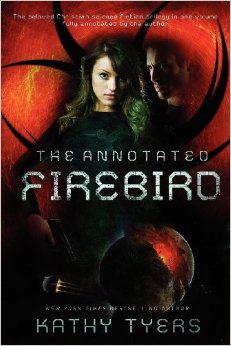
Kathy Tyers’ The Annotated Firebird
Faith in the Future
Throughout the trilogy, faith is front-and-center. The characters come from different faith backgrounds–Firebird is from a culture that worships the Nine “Powers”- essentially deified character traits; Brennan is from a people of exiles who have psychic powers and look to a coming Messiah from his line; others have no religious affiliation. This sets up a way to generate conflict among the characters but also have development.
Firebird is confronted by the notion that the “Powers” she worships are ultimately impersonal and thus seemingly without any power. Moreover, she is intrigued by a system which is not based upon what she does but rather on the grace of a Holy God. It is a struggle throughout her conversion to accept this notion–that she herself does not need to do anything to earn her salvation. Her path of faith is one that is extremely interesting because it shows how the Christian worldview can come into dialogue with other religious traditions on a number of levels–on the level of salvation/soteriology; on the level of deity; and on many other levels.
Brennan’s walk of faith is quite different as he was raised a believer. His character’s viewpoint is filled with brief prayers to the “Singer”–a primary name for deity in the book. These asides never throw off the pace of the book but rather offer ways for the readers to engage in the genuine faith of the characters therein. It’s also a call to believers to take their own faith lives more seriously. How often do we offer a brief prayer over some issue or of thanks throughout the day? How might we integrate our faith better in our daily walk?
Overall, the picture of faith in the Firebird trilogy is one that expects truth in religious belief as well as evidence, confronts rival views in a compassionate way, and is lived out.
Humans who are “Waste”?
Another major theme in the trilogy is that of human lives and the way they are often deemed waste. Firebird’s society is run by a monarchy and nobility which dominates all life and expects to be viewed as ruling with divine right. This is used as an excuse for devaluing the lower classes. Moreover, Firebird herself is considered a “Wastling”- one who is far enough back in succession that they are dedicated to serve until they die in combat or commit an ordered suicide because they are no longer deemed useful.
This is, of course, an unjust state of affairs. It is one that must be confronted on a systemic level, and this is only beginning when the trilogy wraps up. However, I think the reader cannot help but reflect upon the notion that in our own society, we treat some people like “wastlings” to be discarded as unneeded and unwanted. We do not value human life as we should–as created in the image of God.
Another aspect of this devaluing of life is found in the society of the Shuhr–a people who are the radical offshoot from Brennan’s own society. They practice genetic cloning and seek to make themselves immortal. The way they pursue this is through the creation and mutilation of embryos. Frankly, this disrespect of human life is little different from our own society’s, which allows for the murder of the unborn on demand. By putting this theme into science fiction, Tyers confronts our own worldview in a dramatic fashion.
Brief Autobiographical Note
Permit me a brief autobiographical aside:
I remember when I was younger–probably about 12 years old–shopping a table at a book sale that was going on in the parish hall at my church. I saw the cover of this book that looked like science fiction and reminded me of Star Wars. I had to have it! There were three of them, a trilogy! I begged my parents and with some extra chores loaded on I received the books.
I devoured them almost instantly, used Legos to try to build spaceships from them. I went to a Christian bookstore and demanded more science fiction from the author. The bewildered staff searched in vain to find anything else from Kathy Tyers. Without any more to read, I forgot the author but the trilogy entered that hallowed place of unassailable nostalgic bliss that we create in our childhood.
Then, when I saw a newly released edition with notes from the author pop up in my recommendations on Amazon, I was instantly intrigued. Lo and behold, sequels were on the way! I purchased the trilogy again, but didn’t read it, fearful I would penetrate that nostalgic bubble and perhaps discover the series wasn’t as amazing as I’d hoped. Finally, after over a year of owning the book, I opened it up, read it, and now offered this look at the series. Check out my review of the book on my other interests site.
Conclusion
The Annotated Firebird is an excellent edition to pick up in order to experience the whole Firebird trilogy. It is a series which resonates strongly with the Christian worldview, but more importantly it does so without ever compromising on the story, world-building, or characters. Tyers has created a masterpiece.
Links
Be sure to check out the page for this site on Facebook and Twitter for discussion of posts, links to other pages of interest, random talk about theology/philosophy/apologetics/movies and more!
Microview: “The Annotated Firebird Trilogy” by Kathy Tyers– I review the trilogy with a brief look at the plot and some positives and negatives in the book.
Popular Books– Check out my looks into other popular books (scroll down for more).
Source
Kathy Tyers, The Annotated Firebird
SDG.
——
The preceding post is the property of J.W. Wartick (apart from quotations, which are the property of their respective owners, and works of art as credited; images are often freely available to the public and J.W. Wartick makes no claims of owning rights to the images unless he makes that explicit) and should not be reproduced in part or in whole without the expressed consent of the author. All content on this site is the property of J.W. Wartick and is made available for individual and personal usage. If you cite from these documents, whether for personal or professional purposes, please give appropriate citation with both the name of the author (J.W. Wartick) and a link to the original URL. If you’d like to repost a post, you may do so, provided you show less than half of the original post on your own site and link to the original post for the rest. You must also appropriately cite the post as noted above. This blog is protected by Creative Commons licensing. By viewing any part of this site, you are agreeing to this usage policy.
Honoring Giftedness- Women in David Weber’s science fiction
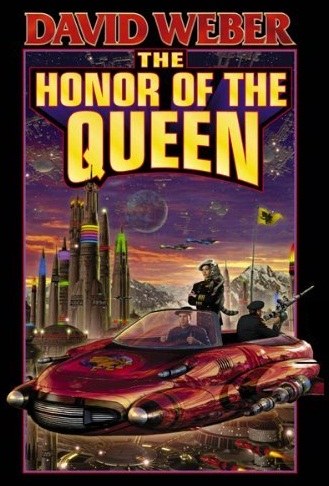 David Weber is the author of a few New York Times Bestselling science fiction series. One, the Honor Harrington series, follows a woman who starts off as a captain of a starship sent on routine (and initially boring) missions. The second book in the series, The Honor of the Queen
The two nations are complementarian in nature. Complementarianism is the theological belief that men and women are “complementary” in roles, which means that men should be in charge in the church and home. I have discussed it and the rival view that women should be ordained/treated as equals (egalitarianism) at length elsewhere [scroll down to see other posts].
What really struck me is that David Weber fairly presented firm theistic believers as a spectrum. In the future, the Christian Church has continued to reform and have splinter groups form because of this. Weber’s presentation of the issue showed that believers–even some who might be considered extreme–can be reasoned with and even persuaded to believe differently based upon evidence. Furthermore, he showed that even those who may line up on the side with which he disagrees are not all (or even mostly) blinded by faith or foolishness. Rather, although there are some truly evil and disillusioned people, Weber shows that many are capable of changing their position or at least acknowledging that rival views are worth consideration.
The most vivid portrayal of this theme is found in a conversation between Admiral Courvosier and Admiral Yakanov. Courvosier is from the same nation as Honor Harrington and wholly endorses his female officer in a position of command. They discuss Captain Honor Harrington:
[Yanakov responds to Courvosier’s question about his society’s reaction to Honor]: “If Captain Harrington is as outstanding an officer as you believe–as I believe–she invalidates all our concepts of womanhood. She means we’re wrong, that our religion is wrong. She means we’ve spent nine centuries being wrong… I think we can admit our error, in time. Not easily… but I believe we can do it.”
“Yet if we do[” Yanakov continues, “]what happens to Grayson [Yanakov’s world]? You’ve met two of my wives. I love all three of them dearly… but your Captain Harrington, just by existing, tells me I’ve made them less than they could have been… Less capable of her independence, her ability to accept responsibility and risk… How do I know where my doubts over their capability stop being genuine love and concern?” (96, cited below)
The exchange is characteristic of the way Grayson’s people are treated throughout the book. They are real people, capable of interacting with other views in honest ways. They feel challenged by a view contrary to their own. Some react poorly, and there are extremists who are blinded by hatred and anger. Yet all of them are treated as people with real concerns shaped by their upbringing and backgrounds.
Honor Harrington ends up saving Grayson, and at the end of the book, she is commended by the rulers of that planet. She talks to the “Protector” [read: king/president] of Grayson:
“You see,” [said the Protector] “we need you.”
“Need me, Sir?” [Responded Honor]
“Yes, Grayson faces tremendous changes… You’ll be the first woman in our history to hold land… and we need you as a model–and a challenge–as we bring our women fully into our society.” (419)
Weber thus allows for even ardent supporters of specific religious backgrounds to respond to reasoned argument and to change. They are capable of interacting on a human level and deserve every bit of respect as those who disagree with them. Again, there are those who are radicals and will not be reasoned with, but they are the minority and they do not win out.
The dialogue presented in this book provides some interesting insight into facets of the present dialogue between complementarians and egalitarians. David Weber’s fictional character presented a challenge to the Grayson’s notions of what it meant to be a woman by being an excellent officer and professional. There are, it seems, real “Honor Harringtons” out there, challenging preconceived notions of what it is to be a woman. When, for example, a woman takes on the role of leadership in the church and succeeds, that should not be dismissed as a fluke, but rather a challenge to a paradigm which may itself be undercutting women’s ability to succeed.
On a personal note, I have been challenged in exactly this way. When I was younger, I was a complementarian and was confronted by a woman who destroyed my presuppositions about what a woman “could do” spiritually. She showed that she could be a leader and present Christ to all without having to fit into role I defined for her. This real challenge caused me to realize that my notions of what a woman “should be” were themselves social constructs, not anything derived from the Bible. Like Yanakov, I had to rethink what my words and actions had done to perhaps limit the women around me. By God’s grace, this woman’s very existence forced me to rethink what I had assumed as truth and go back to God’s word to see where I had gone wrong.
David Weber’s own presentation of Honor Harrington as a paradigm-shattering woman is something that hits close to home for me. For you, dear reader, I think it is worth considering the same: who has challenged your view of what they are “supposed to be”? Is your view of someone’s giftedness directly drawn from the Bible or is it something that you’ve just always assumed? As for me, I think we need more Honor Harringtons in our lives.
Links
Be sure to check out the page for this site on Facebook and Twitter for discussion of posts, links to other pages of interest, random talk about theology/philosophy/apologetics/movies and more!
Check out my posts on egalitarianism (scroll down for more).
Source
David Weber, The Honor of the Queen
SDG.
——
The preceding post is the property of J.W. Wartick (apart from quotations, which are the property of their respective owners, and works of art as credited; images are often freely available to the public and J.W. Wartick makes no claims of owning rights to the images unless he makes that explicit) and should not be reproduced in part or in whole without the expressed consent of the author. All content on this site is the property of J.W. Wartick and is made available for individual and personal usage. If you cite from these documents, whether for personal or professional purposes, please give appropriate citation with both the name of the author (J.W. Wartick) and a link to the original URL. If you’d like to repost a post, you may do so, provided you show less than half of the original post on your own site and link to the original post for the rest. You must also appropriately cite the post as noted above. This blog is protected by Creative Commons licensing. By viewing any part of this site, you are agreeing to this usage policy.

 J.W. Wartick - Reconstructing Faith